




Abstract
This paper situates the rise of city-regionalism in China in the context of the Chinese Communist Party (CCP)’s approach to the urban question since 1949. From strictly controlling urbanization during the first two decades of socialist central planning, the Chinese state now promotes mega city-regionalization (literally in Chinese, city clusters) as a vehicle for internationalizing China’s economy. A reframed urban question in China today emerges from the ongoing tension between city-regional growth, on the one hand, and the emergence of new political interests in the urban living place around the collective provision of services, social and environmental inequalities, and citizen/resident representation in urban governance, on the other. The planetary scope of urbanization notwithstanding, differences in the national political context are crucial for explaining the full diversity of city-regional development processes and outcomes in different countries. The city-regional domain provides an exciting opportunity for urban scholars to examine the changing nature of the urban question in China in the context of an emergent ‘world of city-regionalisms’.
Introduction
In an era of planetary-scale urbanization (Brenner and Schmid, 2015), a rich lexicon has emerged to describe new and emergent urban socio-spatial formations, including ‘mega city-regions’, ‘mega-urban agglomerations’, ‘global city-regions’ or in Chinese ‘city clusters’ 1 (Harrison and Hoyler, 2015; Xu and Yeh, 2011). The implications of the emergence of a ‘world of city-regionalisms’ (cf. Jonas and Ward, 2002) for territorial planning, policy and politics has attracted considerable attention from urban and regional scholars working in diverse national contexts (Moisio and Jonas, 2018). Some argue that the formation of city-regional agglomerations and region-wide governance is not an inevitable outcome of economic globalization (Harrison and Hoyler, 2015). Instead the political landscape of city-regionalism is highly variegated, reflecting differences in state administrative structures, governance processes and, most crucially, the politics of collective consumption and social provision in different national settings (Jonas and Ward, 2007). Others are interrogating how national states, along with other political actors, use city-regionalism to orchestrate and manage various urban growth and distributional problems within and across their territories with a view to influencing domestic and international political agendas (Jonas and Moisio, 2018). It would seem that city-regionalism has become quite central to how the urban question in capitalism is geopolitically framed today within different national settings.
Meanwhile, scholars working in Asian cities have commented on the critical importance of exploring the different vantage points from which to examine planetary urbanization. Highlighting the powerful role that local geographical context plays in framing the contemporary urban question, Roy (2016: 816) argues that . . .even if we are to concede the urbanization of everything, everywhere, we have to analytically and empirically explain the processes through which the urban is made, lived, and contested – as a circuit of capital accumulation, as a governmental category, [and] as a historical conjuncture.
The question that we pose in this paper is: how is the urban question in China being reframed by the rise of mega city-regions? Governed by state-centric administrative structures inherited from socialism, China offers an empirically rich and theoretically informative context in which to consider how the state has managed urban problems bedevilling Chinese society and economy at large at least since 1949. By unpacking the complex, multi-layered and intertwined historical formation processes of city-regional development in China, we consider the ways in which the national state is currently reframing the urban question around city-regionalism in the service of domestic and, to a lesser extent, international geopolitical agendas. Here we examine the political contexts in which language such as ‘city-region’, ‘mega urban regions’ and ‘city-regionalism’ is deployed in order to suggest that the Chinese Communist Party (CCP) strives – with mixed success – to manage the expansion of city-regions, transforming these often vast mega urban regions into politically instrumental and socially functional new socio-territorial forms and settlement types.
The gist of the argument is as follows. From managing the urban question by imposing strict controls on the expansion of the urban system and collective provision during the first two decades of socialist central planning, the Chinese state now promotes mega city-regionalization as a vehicle for internationalizing China’s economy. Two state territorial policy instruments remain fundamental for how the CCP has reframed the urban question in the context of the rise of mega urban-regions: (1) its efforts to control the urban administrative hierarchy; and (2) its use of the hukou (place of residence) system as a basis for citizen access to the collective consumption of key urban services especially housing. The first of these originates from the economic governance realignments brought about by the shift from a centrally-planned national economy to a market-oriented international economy, including initiatives since 2001 to set up regional economic associations and alliances to foster functional economic connectivity. The second targets primarily the physical expansion of urban forms into mega city-regions and the distributional consequences for conditions experienced by residents in the urban living place. Though these instruments appear to be functionally quite distinct, they nevertheless reflect a recent convergence of state spatial policy, planning and politics around a Chinese variant of the ‘new regionalism’ (Dunford and Liu, 2018), of which city-regionalism has become a key component.
The wider aim of the paper is to explore how the urban question in China is currently being reframed, highlighting the emergence of new extended urban forms and regional planning solutions, which in turn internalize wider geopolitical tensions and crises in capitalism (see Harvey, 1985). Our intention therefore is not simply to document how the trajectory of city-regionalism in China has evolved as a state project and/or new socio-spatial formation but also to demonstrate how an understanding of its divergent underlying logics allows us to reframe theoretical understandings of the changing geographical specificity of a society experiencing rapid urbanization. A reframed urban question in China today reflects ongoing political tensions between city-regional growth, on the one hand, and the emergence of new political interests in the urban living place around the collective provision of services, social and environmental inequalities, and citizen/resident representation in urban governance, on the other.
The rest of the paper is organized as follows. The next section provides a review of literature review on the urban question and city-regionalism to underscore the need for a context-specific perspective in exploring the construction of city-regions and city-regionalism. After a brief overview of the Chinese urban administrative system, the paper then lays the groundwork for a distinctive political-economic interpretation of the urban question in China and the contemporary political landscape of Chinese city-regionalism. By unravelling the continuity of state governance through historic changes in urbanization strategies, we reflect upon whether emergent city-regionalisms in China represent a new era of city-regional planning and governance under globalization and marketization and corresponding reframing of the urban question. We use the opportunity to highlight some themes for future research into the changing nature of the urban question in China in the context of an emerging ‘world of city-regionalisms’.
Framing the urban question in capitalism
Manuel Castells’ wide-ranging treatise on the Urban Question (Castells, 1977) prompted much debate among critical urban theorists concerning the evolving nature of the urban question and the wider role of urban-based problems, solutions and struggles in the production of space in capitalism. In distancing himself from classical Marxist writings (e.g. Engels on housing conditions in the industrial city in Britain), Castells sought to reframe the housing question into a more generic urban question in order to shed light on wider processes of labour reproduction in capitalism. This inspired others to examine the urban question from the vantage of a politics of collective consumption as expressed in various urban fiscal and distributional crises (e.g. crises of housing, welfare, racial unrest, etc.) (Cockburn, 1977). Although some scholars questioned the theoretical merits of separating urban-based struggles around collective consumption from wider processes (and spaces) of industrial restructuring and the crisis of the welfare state (Cochrane, 1999), others argued that it is important to take into account not only local spatial interests in collective consumption but also differences and variations in the national political context when investigating, for instance, how the politics of race, class and consumption intersect with the politics of urban development in specific metropolitan settings (Cox and Jonas, 1993).
Eschewing the collective consumption concept, urban scholars in North America and Europe soon switched their attention away from distributional territorial politics towards exploring the role of uneven development and neoliberal state regulation in the restructuring and transformation of urban governance (Lauria, 1997). In doing so, many were influenced by Harvey’s attempt, in effect, to reframe the urban question in terms of the demise of urban managerialism and the corresponding rise of urban entrepreneurialism (Harvey, 1989). A notable feature of what is also known as the New Urban Politics (Cox, 1993) is the observation that traditional working class demands for civil rights, welfare and collective consumption have become marginalized in mainstream urban politics. In cities around the world, including those in China, the poor, minorities and the dispossessed continue to struggle and find a political space that allows them to challenge powerful elite-driven forces of urban redevelopment, investment in infrastructure, and economic growth (Harvey, 2012).
A parallel argument often made by mainstream political commentators (Barber, 2013) is that today’s urban political leaders are far more entrepreneurial and progressive than their national counterparts especially when it came to resolving the complex urban environmental and social challenges of a hyper-globalizing economy. As all sorts of new political problems, agendas and interests have colonized urban political space, ranging from climate change to democracy and human rights, the nature of the urban question continues to evolve, thereby demanding new ways of theorizing cities as comprised of spatial agglomerations of capital, labour and global finance along with attendant state institutions and ‘spaces of urban politics’ (Rodgers et al, 2014; Ward et al., 2018). Merrifield (2013) avers that the urban question today needs to be reframed in a way that energizes a new planetary-scale urban political movement capable of empowering the poor, the marginalized and the disposed rather than a traditional urban social movement defined by place-specific struggles around collective consumption.
City-regionalism as the new urban question
In an era of planetary urbanization, one particular theoretical challenge relating to the production of urban space concerns the appearance of new and extensive socio-territorial formations, including global city regions and mega-urban regions, along with their constituent processes of city-regional administration, planning and governance – and in this respect China is quite emblematic of global urbanization trends (Scott, 2019; Xu and Yeh, 2011). On the one hand, rapidly expanding city-regions and metropolitan areas continue to manifest all sorts of wider societal struggles, which unfold within and around built-up urban and suburban areas and their constituent state territorial structures (Cox and Jonas, 1993). On the other hand, these expansive new socio-territorial formations potentially pose all sorts of new geopolitical challenges to the power and authority of the national state (Jonas and Moisio, 2018). With attention focusing on the rise of city-regions as a powerful geo-economic force in global capitalism, it is nevertheless possible to identify nationally divergent city-regionalist processes, policies and politics.
Moisio and Jonas (2018) explore the rise of city-regionalism as a disparate set of administrative, geo-economic and geopolitical processes. In terms of administrative and geo-economic processes, form- and function-dominant approaches have tended to characterize city-regional development in terms of, variously, rapid urban expansion, forces of economic agglomeration, contribution to global and national economic growth, and increasing density of inter-urban flows and networks (Storper, 2013; Taylor, 2013; and on China see Li and Wu, 2020). Nonetheless, for some it is the sheer spatiality of the urban which has marked the arrival of a new age of regional urbanization which is threatening established territorial orders based on the world economy and the system of nation states (Soja, 2011). For others writing from the perspective of state theory, the rise of city-regionalism represents the specific outcome of the rescaling of the state, a process that depends upon the simultaneous activation and hollowing out of the regulatory capacities of the national state (Brenner, 2004). Driven by a need to correct regulatory deficits associated with globalization and neoliberalism, city-regionalism appears to have necessitated a simultaneous upscaling of state structures and capacities at the transnational scale and a downscaling around new and expanded competitive forms of city-regional governance (on the USA and China, respectively, see Wachsmuth, 2017; Wu, 2016).
If the purported rescaling of the state around city-regions represents one particular set of spatial responses to the challenges of globalization (Brenner, 1999), it by no means exhausts the full range of state spatial forms and territorial-distributional outcomes (Cox, 2009). In tandem with discussions of emergent urban-cum-regional political configurations arising from economic agglomeration and globalization, there are corresponding references to city-regions and city-regionalism in the sphere of regional planning and policy discourse as well in the political strategies adopted by different national states (Luukkonen and Sirvio, 2019). As new and arguably exceptional spatial forms, city-regions are increasingly mobilized and imagined by all sorts of political actors as coherent spaces for governance, planning and policy, feeding into a kind of ‘geopolitics of the urban’ (Moisio, 2018). This insight has triggered a productive dialogue between those examine the geo-economic rationale for city-regionalism and those interested the socio-political and geopolitical rationales shaping new city-regional forms of governance and planning (Harrison and Hoyler, 2015; Jonas, 2013; Scott, 2019).
Notably, scholars of cities in the Global South seek to conjoin quite disparate processes of nation building, societal reform, neoliberalism and competitiveness when analysing the rationalities guiding state interventions at the level of city-regions (Bunnell, 2002). Research on emerging city-regional formations in the Global South reveals how national governments have connected global economic prosperity and national development to the imagination and planning of mega-urban regional formations (Robinson and Roy, 2016). Especially in post-socialist and/or post-colonial settings in Asia, the state in some form or another remains a highly visible player not only in the processes and politics of urban and regional development but also in comparative analysis of suchlike (Bunnell, 2002). The conceptual insights provided by state-theoretical accounts of state territorial restructuring resonate particularly strongly in China, a country where administrative restructurings have been orchestrated selectively by the central state in pursuit of wider political and ideological agendas, many of which today are closely linked to China’s efforts to strengthen its position in the global economy (Li and Wu, 2020; Wu, 2016).
To summarize, the often divergent political rationales underpinning city-regionalism in different countries point to the need to take the national political context much more seriously when mapping trajectories of urban and regional development (Harrison, 2012; Storper, 2013; Wu, 2016). The literature on city-regions has often been criticized for essentializing inter-urban competition at the expense of knowledge of domestic political tensions around social reproduction and distribution (Ward and Jonas, 2004). In lieu of narratives that tend to project city-regionalism as a kind of international neoliberal political conspiracy (Harding, 2007), there is a need to identify how societal interests and factions – including interests in and around the urban living place – in different national contexts stand to gain or lose from new and emerging metropolitan-wide and regional socio-spatial formations (Cox, 2010; Etherington and Jones, 2009).
Our present interest is in how the Chinese state has used city-regionalism to reframe the urban question, thereby reflecting the countervailing geo-economic and geopolitical forces and tensions at work across and within its emerging mega urban-regions (Harrison, 2012). The remainder of the paper examines the urban question in China as a prelude to a more detailed examination of divergent and contradictory aspects of Chinese city-regionalism in domestic and, albeit to a lesser extent, international political contexts.
The urban question in China
In China, the production of urban space – and hence the material and social context in which the urban question is framed – is decidedly not a spontaneous process resulting from the invisible hand of the market. Instead, it is visibly driven by the political hand of the state through, for example, state-orchestration of the process of land assembly, the organization of ‘growth coalitions’ involving partnerships between state-owned and private business enterprises and city authorities, and, increasingly, the role of global finance (Wu, 2018; Zhang and Fang, 2003). Since at least 2001, a potent combination of housing reforms, relaxation of controls on urban development, and the influx of foreign direct investment has triggered rampant and, at times, spontaneous urbanization (Shen and Lin, 2017), contributing to land sprawl, deteriorating environment and social inequality (Wu, 2016). It is in this context that we briefly explore how the urban question in China has evolved historically.
The present conditions of urbanization in China represent a stark contrast to the first two decades of communist rule under Chairman Mao Zedong (1949–1976), a time when the communist party-state regarded the urban as a site for experiments in managing collective provision and, if anything, an obstacle to its efforts to catch up with Western countries. Urbanization was strictly controlled and responsibility for welfare provision, including health care, education, housing and the like, was shouldered by individual work units rather than municipal authorities or the central state (Bjorklund, 1986). Another important instrument of state policy was the imposition of controls on the development of the urban hierarchy. Even today, Chinese cities are still first and foremost administered as hierarchically-ordered administrative centres instead of economic spaces (Chung and Lam, 2004). Urban governors and their staff are directly or indirectly appointed by the central government with corresponding cadre ranks (Friedman, 2006). Furthermore, the so-called ‘city-leading-county’ administrative restructuring since 1984 has assigned a majority of rural counties under urban control (Chung, 2007). In short, China’s urbanization remains closely linked to, and shaped by, the wider governmental system and state policies.
Crucially, mega-urban regional development has served to erode what Liu (2002: 115) once described as the ‘sharp division between the rural and urban residents, particularly after 1949’; a division which, he suggested, continued to shadow urban research in China long after the 1980s, when ‘an unprecedented growth of towns and cities’ (p. 116) had first been discovered by western researchers. In a telling reference to Castells’ (1977) original treatise on the Urban Question, Liu posed a question that remains relevant to our analysis: is there an urban phenomenon in China that introduces a new historical form of social existence? To put this differently, how does the phenomenal pace of urban development in China today reframe the urban question in China? Liu (p. 123) argued that a central problem in framing the urban question in China is the problem of space itself – how urban space is produced and the resulting spatial practices (and struggles) that underpin organization of everyday urban existence across and within the country’s burgeoning city-regions. Two state spatial policy instruments in particular continue to shape the Chinese state’s approach to the urban question today, namely the urban administrative hierarchy and the hukou system (Chan, 2010).
Urban administrative hierarchy
The Chinese state has five levels within the hierarchical system of government, namely, the national state, province, municipality, county, and town or township. What is less well known is that ‘the structure determines the basic configuration of China’s urban system and the number of its cities and towns’ (Chan, 2010: 66). Largely corresponding to the central-local governmental structure, there are basically five levels of urban administrative units: (1) provincial-level cities that are directly administered by the central government, namely, Beijing, Tianjin, Shanghai and Chongqing, (2) deputy-provincial cities whose number kept as 15 since 1997, the majority of which are provincial capitals, (3) prefecture-level cities, (4) county-level cities, and (5) towns (Ma, 2005). With the city-leading-county administrative restructuring since 1984, the urban units have become a fundamental apparatus and nested administrative hierarchy in organizing state power and distributing social welfare.
With the pace of urbanization in China accelerating, conflicts between prefecture-level cities and county-level cities have frequently occurred, especially in provinces contiguous to expanding cities and metropolitan areas, such as Jiangsu Province and the Municipality of Shanghai (Zhang and Wu, 2006). County-level cities have been consolidated with, or annexed by, prefecture-level cities, primarily to realize economies of scale and promote further urban development. At the same time, public officials involved in managing expanding suburbs and edge-cities have deployed new central-local jurisdictional powers and functions to lobby for extra resources and infrastructure from the CCP (Anzoise et al., 2020).
Even in a centralized political system such as China’s, metropolitan jurisdictional fragmentation feeds into struggles around the allocation and redistribution of the social product; albeit any attendant politics of collective consumption around the living place remains muted in comparison to western countries (Jonas, 2020). Since the allocation of fiscal revenue and public investment follows the hierarchical structure, administrative ranking (rather than urban political demands) has significantly impacted on the fiscal and infrastructural development of cities and counties (Chung, 2007). In general terms, the lower the administrative rank, the poorer the infrastructure conditions and public services. This is especially the case for the politics of collective consumption, i.e. education, health care, transport and so forth, which reveals a deeply embedded hierarchical allocation of resources.
In managing this situation, the Chinese government has a long history of using regional planning to counterbalance the emergence of inequalities across the urban hierarchy by redistributing resources and services down the hierarchy (Xie and Costa, 1993). In the Chinese context, regional planning has allowed the state to frame the urban question around the rational development of a national urban system designed to achieve the optimal distribution of urban resources within any given region albeit slanted in favour of urban economic development.
Hukou system, mobility and urban politics
Another powerful state instrument for framing the urban question in China is the household registration or hukou system. The system was created in the late 1950s in response to mounting demands for food and other services in the cities. The youthful Chinese socialist state linked the hukou system to food rationing and welfare allocation. By dividing the population into those with urban (nonagricultural) hukou and those with rural (agricultural) hukou, the system was further intended to control rural-urban migration and dampen corresponding demands for collective social provision among the urban population (Kirkby, 1985).
During the Mao era, the work unit or danwei was the main spatial unit of collective provision, encompassing various dimension of the urban living space such as housing, childcare, schools, hospitals, shops and other services (Bjorklund, 1986). In the absence of a well-developed national welfare state, the work unit not only provided essential local social services to its members but also served to channel and deflect political demands on urban authorities for improvements in health, housing, and related collective consumption needs. At the same time, the urban population was to a large extent held in place by the hukou system; mobility was strictly regulated except for government-initiated recruitment, job assignment or relocation programmes.
Although the mobility of labour between cities has since been relaxed, the hukou system has not been abolished altogether. If anything it is still tightly linked with urban welfare, especially in terms of access to education, healthcare and housing in major cities; migrants lacking urban hukou status are often not entitled to subsidized housing and other state welfare benefits (Huang, 2004). Notably, severe restrictions are still placed on ‘upward’ migration from lower-ranked cities to ‘big’ cities, such as Beijing and Shanghai, which have greater collective consumption resources at their disposal corresponding to their high status in the national urban-administrative hierarchy (Chan, 2010). Despite the incentives to relocate to access better services and conditions in the urban living place, it is extremely difficult for new arrivals to obtain hukou status from these two centrally administered municipalities, a status which the Chinese often say it is ‘as precious as gold’.
In terms of access to housing, migrants lacking hukou (registered resident) status are further constrained in tenure choices especially in the major cities, such as Beijing (Dang and Chen, 2020). However, unlike the situation in cities in North America or Western Europe, conditions in the urban living place are seemingly not a significant factor explaining differences in urban political attitudes especially between recent non-registered migrants and registered residents (Cui, 2020). But how much this is related to neighbourhood social conditions rather than, say, the Chinese state’s efforts to manage and suppress urban struggles for citizenship and land rights (see, e.g., Po, 2020) is hard to say. There is clearly scope for further research on the relationship between the production of urban space in China and the role of the hukou system in structuring political demands – or the lack thereof – for urban services.
The historical geography of under-urbanization in China
Thanks to the two policy instruments described above, the Chinese state has been able to manage and manipulate the urbanization rate as well as its specific geographical patterning across and within cities. Indeed, China has deliberately maintained its urbanization rate rather low for a long time. Limited by domestic resources and hostile geopolitical circumstances, the new China had undertaken a distinctive national urban policy of ‘walking on two legs’ under the leadership of Mao Zedong (Murphey, 1980). The one leg is controlling urbanization to avoid the problems of uneven geographical development characteristic of urbanization trends in Latin America and Eastern Europe. The other leg is rural industrialization, namely in situ urbanization without rural-to-urban migration, which is designed to ensure that growing urban demands for basic resources are managed and contained. The result was a unique phenomenon of slow urban development accompanied by rapid industrialization, which had been phrased as ‘development without urbanization’ (Koshizawa, 1978). This national achievement of ‘under-urbanization’ was regarded to be a kind of socialist miracle, allowing China to avoid an ‘urban explosion’ and related urban health problems. However, subsequent reforms, including the Great Leap Forward and the Cultural Revolution, exposed the fragility of a model that used state urban policy instruments to control the reallocation of essential collective consumption resources from the countryside to the city (Dikötter, 2010).
After the introduction of market reforms in 1978, economic mobility was encouraged along with increasingly intense flows of trade, people, traffic, logistics and capital between cities. Despite the enormous stimuli for urbanization, the state tried to strengthen its influence by laying out a ‘coordinated’ spatial system of cities. In October, 1980, for example, the Chinese government issued its directives to urban development at the National Conference on Urban Planning as follows: ‘strictly control the size of large cities, properly develop the medium-sized cities, and actively encourage the growth of small cities’ (Zhang, 2008). A specific type of planning called ‘urban system plan’ was created in late 1980s to implement such a blueprint of a coordinated spatial system of urban distribution (Ng and Tang, 1999; Xie and Costa, 1993). Altogether, a kind of rank (urban administrative hierarchy)-size (city size judged especially by the non-agricultural population) regulation had taken shape in China to guide the development of urban settlement. And the Chinese cities did exhibit a low level of urban primacy especially in the socialist period and early days of economic reform (Xu and Zhu, 2009).
Such special emphasis on metropolitan control and preference to small-city development reflected the continuity of past territorial policy of ‘walking on two legs’ (Kwok, 1987). Under the circumstances, when urban investment was extremely limited and urban infrastructure under-provided, the vigorous development of small cities and towns at the expense of the large cities suited the ideological objectives and material constraints of national state planners and policymakers. First of all, it helped to ease the burden of growing demands for housing (and related employment) in large cities, i.e. state management of the urban politics of collective consumption. Secondly, it sought to induce rural economic growth and reduce urban-rural disparities by providing non-agricultural employment to absorb rural surplus labour. In short, the political interventions by the national state around urbanization had significant implications not only for the spatial pattern of national settlement in China but also the politics of distribution across and between metropolitan areas. In turn, judging from the literature on Chinese urbanization at the time, the distinctive pattern of urban growth consolidated the national political image around socialist principles and ideology.
Reframing the urban question in China
Viewed in an historical context, as the Chinese state looks to introduce new mechanisms for managing the uneven territorial-distributional consequences of city-regional development, de facto the urban question is being reframed. In the past, the CCP managed the urban politics of collective consumption in a manner that assisted industrialization and national economic growth. Since the early 2000s, there are emerging cracks in the architecture of state management of collective consumption and provision as evidenced by (1) growing societal tensions around national urbanization strategies, and (2) the emergence of new spatial political interests, institutions, actors and demands around the urban living place and also at the city-regional scale.
National urbanization strategy since 2001
Around the turn of the new millennium, the country’s urbanization strategy experienced some substantial yet under-noticed transformation. The political ingredients for this new epoch was established in 1998 at the Third Plenary Session of the 15th Central Committee, when urbanization was officially announced as the national strategy to boost domestic economic growth (Chan, 2014). By the time of the 10th Five Year Plan (2001–2005), the socialist doctrine of strictly controlling the size of large cities was removed from national planning documents for the first time. Nevertheless, it does not mean the state retreated from urban regulation completely, for what was involved was a conscious decision to deploy city-regionalism as an instrument for reframing the urban question in China.
In the subsequent 11th Five Year Plan (2006–2010), the CCP formulated that the city clusters were to be the carrier for China’s future urbanization. The directive was further elaborated in a national policy called ‘The National Guidelines of New Urbanization, 2014–2020’. This amounted to the first-ever national urbanization plan of its kind, and it stipulated the spatial concentration of urbanization in certain dominant city clusters (Chen et al., 2016). In sum, recent national policy marks a profound transition in the framing of the urban question in China. For the first time, the state has officially recognized the merits of mega-urbanization, which is in sharp contrast to the previous policy of imposing urban administrative hierarchy control to promote rural industrialization and small town development as a vehicle for managing the politics of collective consumption.
The transformation in national planning around a new kind of urban policy were further realigned with China’s changing geo-economic and geopolitical aspirations in the global economy. The 1997 Asian financial crisis damaged the country’s export-oriented economy and forced national economic planners to expand the domestic market in addition to economic internationalization. In the meantime, the former emphasis on small-city-led urbanization revealed its drawbacks. According to some urban economists, many big cities in China are still under-agglomerated economically (Au and Vernon Henderson, 2006) and the development of small towns has led to scattered development, urban sprawl and environmental degradation (Ng and Tang, 1999). Taken together, the promotion and management of urbanization is now regarded to be a key strategy to unlock China’s modernization (Chan, 2014). On the one hand, given that the rate of urbanization in China is still low compared with other countries, urban migration is seen as a strong impetus for urban economic growth. On the other, mega city-regions are promoted as the engine of economic dynamism to further leverage the productivity gains from economies of scale and complementarity. In order to exploit the purported economic and distributional benefits of urban agglomeration, a series of further measures have been introduced as follows.
Launching city-regional imaginaries
Following the 11th Five Year Plan (2006–2010), the national urbanization layout has been envisioned and re-imagined around city clusters. That is, integrated city clusters instead of individual cities become the dominant human settlement type. During the 12th Five-Year Plan period (2011–2015), ten city clusters were selected. In the 13th and recent 14th National Five-Year Plan (covering the periods of 2016–2020 and 2021–2025 respectively), the national government has broadly maintained this city region-centric territorial imaginary with 19 national-level city clusters identified across the country (Figure 1). In contrast to traditional urban system plans formulated by individual provincial units built around a pyramid structure of large, medium and small cities and towns, these reformed city clusters are not necessarily bounded by formal administrative jurisdictions. Likewise, the main growth poles within these agglomerations are not evenly distributed and aligned with a hierarchy of cities at different administrative ranks. Nevertheless, there exist divergent economic development levels among these 19 city clusters, ranging from the relatively developed and highly globalized ones such as Yangtze River Delta (YRD), Pearl River Delta (PRD) and Beijing-Tianjin-Hebei (BTH) along the coastal East to other developing ones in the middle and west regions. Together these constitute 80 percent of the national GDP. In other words, the state-steered model of urbanization follows the market logic and is meant to constitute and complement functional space of economy.
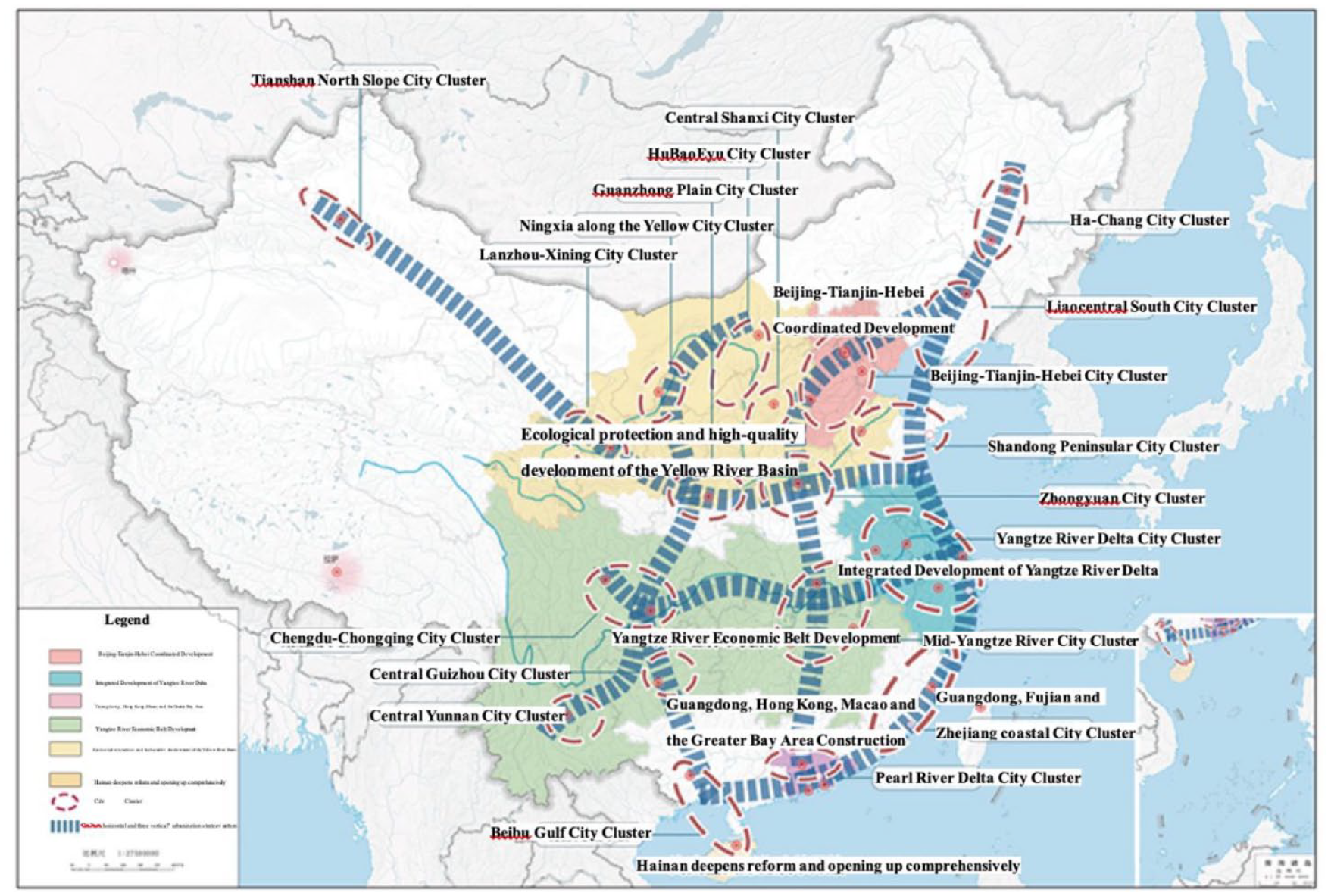
Diagram of the spatial pattern of urbanization in the national 14th five-year plan.
The national urbanization strategy based on selective city clusters is justified from two fronts. On the one hand, an urbanization form based on city-regional economies of agglomeration is perceived to be more competitive than that of small city-led urbanization, which is too scattered and lacks economies of agglomeration, and also than that of large city-led urbanization, in which the over-growth of metropolis may lead to negative externalities such as congestion, land sprawl and pollution. On the other hand, concentrated development in selective city clusters is believed to be more environmentally friendly, creating so-called ‘interstitial spaces’ (Allmendinger and Haughton, 2009) that are under less environmental and land development pressure and which can be conserved with enhanced ecological functions.
So far, the most obvious question is whether these centrally orchestrated city-regional imaginaries have the potential to influence territorial administrative outcomes at the national and regional scales. Administrative and expenditure decentralization from national to local government means that the central planning often lacks teeth in its implementation and monitoring (Li and Wu, 2012). It is subject to varied local politics and differences in local implementation. The complex politics at play are manifested in constant changes in the deployment of city-regional imaginaries, such as the total number, the spatial boundaries and the functional positioning of city-regions, in the national plans (Harrison and Gu, 2021). As a consequence, the city-region often becomes the arena where tensions unfold leading to countervailing efforts to coordinate various levels and scales of government to engage in collective action and implement redistributional policies.
Enhancing city-regional connectivity
The imaginaries shaping Chinese city-regionalism are dependent upon the availability of infrastructures, especially transportation. Using infrastructural investment to enhance regional connectivity has hence been identified by the national state as one of the main priorities. According to the 14th National Five-Year Transport Plan, the regional connectivity is promoted at three levels. The first is the expansion of the high-speed rail network at the national level. So far, China has built an extensive network with about 150,000 km of lines across the country, linking all of the major city clusters. The second level is the development of the inter-city railway network within city clusters. Over the next five years, for instance, about 10,000 km of new inter-city railway lines are projected for the three major city clusters of YRD, PRD and BTH. The third level is to build urban and suburban lines within these agglomerations to facilitate daily commuting across the consistent metropolitan areas. It is anticipated that inter-city travel within these city clusters will take less than two hours, and the commuting time within the metropolitan areas will be cut to less than an hour. The large-scale and networked form of infrastructure-led city-regional development contrasts sharply with the previous city-led investment dominated by industrial parks and new town developments. Infrastructure-led urban development feeds into China’s international aspirations by connecting ‘isolated places through the expansion of infrastructure networks’ to produce a new scale of economic production and plug in the global/domestic value chain (Schindler and Kanai, 2019).
An important question for future critical urban research is whether enhanced connectivity leads to growth spillover effects that benefits poorer places or instead contributes to further spatial polarization and uneven development (Hadjimichalis, 2017). As a new geographical scale where uneven spatial development and social inequality is produced, city-regionalism in China provides fertile territory for exploring the distributional consequences of a reframed urban question in China.
Facilitating labour mobility
The new national urbanization strategy has become more ‘people-oriented’ (Chen et al., 2016), using reforms to hukou and related social policy instruments to facilitate labour mobility across city-regions. These reforms are partly in response to criticisms that land-centred urban expansion often occurred without the corresponding expansion of social support for the growing urban population, for example, the granting of residency or urban ‘citizenship’ to migrant workers coming from rural areas and provinces. Central to the problem is the reform of the hukou system by eliminating the urban-rural distinction and granting urban hukou to long-term rural migrants who have had and can maintain stable employment and long-term residence in cities (Chan, 2014). According to the 2016 Central Urbanization Work Conference, the first-ever government conference on the issue of urbanization, the stated aim is for the national urban population to reach 70% within the next decade (Chen et al., 2016). This is a big departure from the past hukou policy which sought to control the mobility of population from rural areas to cities and from cities in largely rural inland provinces to the major coastal city clusters.
However, the hukou reforms of 2014 only apply to small or medium-sized cities. In other words, the central government still uses controls based on the urban hierarchy to control the mobility of labour. Whereas strict controls on the size of population growth are still imposed on the larger cities within a major urban agglomeration, urban hukou restrictions are much relaxed for the smaller towns and cities located within the same city clusters. Since public services such as healthcare and education are allocated in accordance with the administrative hierarchy, there is an inherent spatial and scalar unevenness of the distribution of these key services (Yu et al., 2019). Yet major urban regions remain far more attractive to migrants as they offer better welfare services and benefits. In the case of Chongqing, 2 a major city-region in south-western China, such reforms have led to tensions between, on the one hand, an ambitious project undertaken from 2010 to 2012 to construct over 40 million square metres of public rental housing and, on the other, a drive to ensure that peasant migrants enjoy equal access to social services and benefits as existing urban residents (Lim, 2014). Lim (2014) argues that state-driven pursuit of spatial equality in Chongqing represents an attempt to counteract the effects of spatially uneven urban development associated with the internationalization and marketization of Chinese economy and society.
In order to reduce widening socio-spatial disparities between local and non-local hukou, further measures have been rolled out to further the integrated development of public services across city clusters. Across the YRD, for example, people have hitherto experienced difficulties using healthcare insurance to access outpatient medical payments at hospitals outside of their province of residence. With the introduction of a mutual recognition scheme, which marks a milestone in cross-provincial medical insurance settlement, local residents who live in one city can use medical care in other cities within YRD. These measures taken to remove administrative barriers regarding social security and medical insurance, along with the availability of new digital platform technologies for accessing services, are expected to facilitate labour mobility across the country, which is analogous to the labour market integration discussed in the European Union (EU) context (Pires and Nunes, 2017). However, EU-based research suggests that uneven access to these kinds of technologies and practices may amplify social inequalities across regions and classes because of patient outflows and increasing financial burdens (Stan et al., 2020). The differentiated and stratified citizenship entitlement to collective consumption can bring an alternative perspective to discussions of the barriers to city-regional integration in China beyond a mainstream focus on inter-city competition.
Conclusion
In the context of planetary-scale urbanization processes, China offers a unique opportunity to investigate how city-regionalism reframes the urban question. By unpacking the complex, multi-layered, and intertwined formation processes of mega city-region development in China, this paper has explored how the urban question has been reframed by the CCP as it has responded over time to various administrative, governance and distributional challenges across China’s national territory. On the one hand, the application of the city-regional concept to existing planning structures helps to build a kind of city-regional imaginary as form of governance technology. On the other, the infrastructure investment associated with city-regional planning frameworks helps to function as a spatial fix to potential development problems by connecting ‘global economic prosperity’ and national development to ‘mega-urban regional formations’.
The Chinese state’s use of city-regionalism in these ways as a governance technology to manage the domestic urban question is further integral to its internationalization agenda (see Wu, 2003), allowing the country to break out of its semi-peripheral status within the hierarchy of a capitalist world-system. Here we are sympathetic to arguments in the literature on cities in the Global South that the emergence of global city-regions is not simply a contingent effect of the rise of a new hyper-global world order emerging around a network of competitive global city-regions (Scott, 2019). Nor is it an inevitable outcome of the rescaling of the nation-state in response to regulatory deficits associated with neoliberalism (Brenner, 2004). Instead, it is more a result of a state technology governing the spatial pattern and distribution of human settlement for territorial development and nation-state building.
We have further argued that a reframed urban question in China has emerged from the ongoing tension between city-regional growth, on the one hand, and the emergence of new interests in and around the urban living place around the collective provision of services, environmental and social inequalities, and citizen/resident representation in urban governance, on the other. The ultimate intent of creating city-regional territorial structures and discourses is not so much about building governance from within the city-regions – a kind of competitive rescaling of the (local) state apparatus. Instead, it is more about producing the territorial terrain for the Chinse state to envision and legitimate its territorial development strategy for both domestic and international concerns, creating a united front for all subordinate governments. In this way, the rise of city-regionalism does not pose a challenge to the sovereignty of the territorial state; instead city-regionalism and the attendant reframing of the urban question is integral to state building processes in China. All of this amounts to an exciting opportunity for urban scholars to examine the changing nature of the urban question in China in the context of a globally emergent yet inherently diverse ‘world of city-regionalisms’.
Footnotes
Declaration of conflicting interests
The author(s) declared no potential conflicts of interest with respect to the research, authorship, and/or publication of this article.
Funding
The author(s) disclosed receipt of the following financial support for the research, authorship, and/or publication of this article: Funding support from the National Natural Science Foundation of China (Grant Number: 42071206) is gratefully acknowledged.