




Abstract
A major social transformation is reshaping rural India. New processes of urbanization are marked by steep declines in agricultural jobs, the restructuring of local economies, changing livelihoods, and the emergence of new forms of permanent circular labor migration. Our research suggests that this transformation has important social ramifications for household dynamics and class structures. We conducted a comprehensive geospatial analysis across 600,000 villages to illuminate the extensive spatial patterns of this transformation. Additionally, we collected primary data from two case-study sites in Bihar and West Bengal. Our findings indicate trends toward smaller household sizes and increased complexity in extended family organization, shifting the roles of women within households, and either a continuation (and possibly deepening) of class disparities or an upending of existing class structures. These observations deviate markedly from what is postulated in conventional Western urban theory, and they may be relevant to the urbanizing experiences of other parts of the Global South. In India alone, this transformation is affecting the livelihoods and well-being of hundreds of millions of people.
Introduction
A major transformation is reshaping India’s rural regions, where new processes of urbanization are marked by steep declines in agricultural jobs, restructuring local economies, changing livelihoods, and new forms of permanent circular labor migration. This transformation is reshaping the daily lives and economic conditions of hundreds of millions of people. In previous publications we have provided evidence of significant local economic restructuring in these urbanizing regions, and of the accompanying major livelihoods changes (Choithani et al., 2021; van Duijne and Nijman, 2019; van Duijne et al., 2023). Here, we argue that these economic changes, and particularly the rapid increase in permanent circular male labor migration, are also having important impacts on the local social fabric.
In the empirical part of this article, we highlight the social dimensions of this urbanization process. First, through a wide-ranging geospatial analysis across 600,000 villages, we shine a light on the extensive spatial patterns of the transformation, involving thousands of villages across India’s countryside. We follow this up with in-depth quantitative data and interpretive observations in two case-study sites in Bihar and West Bengal.
We find that the rapid increase in permanent circular male labor migration is the main driving force behind the social changes we have observed. Traditional circular migration was short term and tied to the agricultural off-season; migrants generally left for 3–6 months, earned supplemental cash to the household’s farm economy, and returned in time for the next sowing (Tumbe, 2018; Yang, 1979). In contrast, permanent circular labor migration refers to a new pattern in which migrants reside and work away from their village for most of the calendar year (typically 9–11 months, and for many consecutive years), returning only briefly for major festivals, weddings, or other family obligations. Their mobility is no longer synchronized with the rhythms of the agricultural cycle, enabling multi-year circulation centered on urban jobs rather than farm seasons. In economic terms, remittances replace local farm earnings as the household’s primary income source.
As we will argue, this shift in the nature of circular migration has produced: (1) a more structural separation of migrant workers from the households that remain in the village; (2) a proliferation of nuclear households along with an unprecedented reorganization of extended families in which both nuclear households and extended families are integrated; (3) in many cases greater autonomy, power, and responsibilities for the female spouses of migrant workers; and (4) a reshaping of class and caste hierarchies, which can lead to either a continuation (perhaps even deepening) or an upending of existing class structures, depending on the magnitude of remittances and the differential involvement of various classes and castes in labor migration.
Theoretically, we position our study vis-à-vis two existing bodies of literature: conventional theory on the social dimensions of urbanization (which is biased toward the Western historical experience) and the literature on India’s rural social fabric, much of which tends to emphasize continuity rather than change. We observe that, in line with conventional theory (Scott and Storper, 2015), shifting divisions of labor and migration are fundamental to the urbanization process. However, we posit that the nature of migration in these regions demands an entirely different understanding of how this shapes urbanization. We also argue that current social (and economic) change in India’s formerly agricultural environs is more significant, more complex, and potentially more disruptive than recognized in the existing literature.
Background: Urbanizing rural India
India’s rural–urban transition is driven by three interconnected macro trends that have taken shape over the past few decades. First, the agricultural sector has witnessed significant employment declines, with tens of millions losing their jobs (World Bank, 2024). Between 2004 and 2016, there was a loss of 40 million farm-dependent jobs (van Duijne and Nijman, 2019). If we assume that these agricultural jobs were held by the primary earner in a household with an average size of five persons, this potentially affected 200 million people in their livelihoods (Choithani et al., 2021: 5). Figure 1 illustrates the magnitude of this transition: a decrease in male agricultural employment from 59% of total employment in 1991 to just 37% in 2022. The COVID-19 pandemic temporarily reversed this downward trend as many returned to agricultural work due to urban lockdowns, but that reversal was short-lived. Persistent agricultural distress, characterized by low productivity, declining rural wages, land fragmentation, farmer indebtedness, and crop failures, along with changing economic opportunities and aspirations, has driven the widespread abandonment of agricultural work (Narayanamoorthy, 2021).
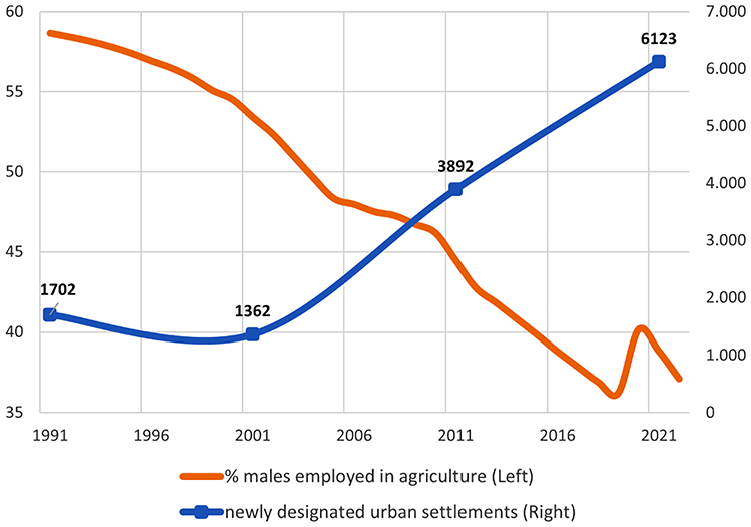
Male employment in agriculture as a percentage of total male employment (left axis) and growth in the number of newly classified “urban” settlements (right axis) between 1991 and 2021.
Second, India has witnessed the reclassification of thousands of formerly rural villages into urban towns. According to the Indian census, a settlement is classified as “urban” based on population size (5000 and above), population density (400+ persons per km2), and the proportion of male nonfarm workers (75% or higher). While the thresholds of population size and density have been surpassed in many settlements over the years, it is the rapid decrease of agricultural jobs that is at the heart of large-scale reclassifications from “rural” to “urban” in many parts of the country. The occupational transition away from agriculture is thus directly linked to widespread settlement reclassification (Figure 1 juxtaposes both trends). The reclassification process involves tens of millions of people and represents over one-third of India’s total urban population growth (Pradhan, 2017).
The dichotomous labeling of settlements as either “rural” or “urban” has long attracted criticism for being overly simplistic (e.g. Brenner and Schmid, 2014). Nonetheless, this reclassification mechanism in the Indian census helps identify locations where workforces are transitioning away from agriculture and, presumably, with important restructuring of local and regional economies (van Duijne et al., 2023). A critical question remains: as agricultural work diminishes and villages are reclassified as “urban,” what new kinds of employment and livelihoods can people turn to?
This brings us to the third macro trend shaping India’s rural–urban transition: the rapid increase of circular labor migration. Circular labor migration is generally defined as “a temporary move from, followed by return to, the normal place of residence” (Deshingkar and Farrington, 2009: 1). Individuals migrate for work, while their households remain in the village and receive remittances. As social and cultural norms pose restrictions on the mobility of women, labor migration is mostly undertaken by men (Choithani, 2020).
Multiple studies have documented a substantial upward trend in the number of labor migrants. Data from nationally representative surveys in India show that the number of domestic labor migrants increased from 10 million in 1999–2000 to 23 million in 2007–2008 (Tumbe, 2011). By 2011–2012, the number of domestic labor migrants had grown almost fourfold to 60 million (Nayyar and Kim, 2018), and the Economic Survey of India 2016–2017 placed the number of labor migrants at approximately 100 million (Government of India, 2017). This includes all migration streams including rural–rural migration, though the urban-centric nature of India’s economic growth over the past few decades is leading to growing rural–urban migration (Choithani, 2017, 2022; National Sample Survey, 2010). Additionally, there has been a significant increase in international labor migration from India, particularly to the Persian Gulf. Over the past 15 years, the number of international migrants has tripled, reaching 18 million by 2018 (United Nations, 2019).
This convergence underscores the critical role of labor mobility in compensating for the loss of agricultural livelihoods, and it plays a key role in the processes of urbanization across India’s rural regions. It should be noted that circular labor migration has a long history in rural India, but the nature of this migration has changed profoundly. As mentioned above, in the past most migration was temporary, and it was often tied to the agricultural cycle: workers remained locally engaged in agriculture, and it was only during the off-season that they would temporarily migrate away for work. In more recent years, however, male circular labor migration has become much more permanent, with migrants away from home for much of the year. Importantly, many households have become almost entirely dependent on remittances. It is this shift in the nature of labor migration that underlies much of the social change that we signal in this article.
Theorizing social change in India’s urbanizing rural regions
Theorizing social change at India’s rural–urban transition presents two conceptual challenges. The first pertains to the highly interdisciplinary nature of this topic, spanning urban studies, agrarian studies, geography, development studies, labor and migration studies, and cultural studies. The second challenge concerns the relevance of conventional urban theory, primarily developed in Western contexts, to the environments of urbanizing rural India (Coelho and Sood, 2022). More generally, this second challenge is about the debatable utility of Western urban theory in the Global South (Nijman, 2015; Parnell and Robinson, 2012; Randolph and Storper, 2023; Schmid et al., 2018; Sheppard et al., 2013). Acknowledging the magnitude of these challenges, we narrow the scope of our inquiry to specifically focus on how different migration patterns effect processes of urbanization with different socio-cultural dynamics (also see Randolph, 2024a). More specifically, we will contrast permanent one-way rural–urban migration by entire households (the Western experience) with permanent circular male labor migration (the Indian experience), and their social ramifications.
The meshing of rural and urban contexts (urbanizing rural India) complicates our understanding of the social dynamics of urbanization but there is some recent interdisciplinary research on which to build. An emerging body of literature seeks to bridge urban and agrarian studies to better conceptualize socio-spatial transformations at India’s rural–urban borderlands (e.g. Balakrishnan and Gururani, 2021; Gururani, 2020; Harriss-White, 2021; Upadhya, 2023). This scholarship introduces concepts such as agrarian urbanism, urban agrarianization, and subaltern urbanization, to help conceptualize the transformation. These writings generally underscore that traditional rural lifestyles, norms, and power relations of class and caste shape emergent urbanizing landscapes. They tend to consider the rural social fabric as more or less constant, and the nature of urbanization as a dependent variable. In our study, we approach urbanization and social fabric in dialectical terms, where causality can run both ways: social fabric may condition the nature of the urbanization process, but urbanization itself can change social fabric.
Traditional urbanization models from North America and Western Europe were shaped by industrial growth. Manufacturing was largely urban-based and labor intensive, and employment opportunities attracted rural households to permanently relocate to cities. Large-scale urban growth prompted social change, including the disruption of previous social bonds and class restructuring. This work largely originated in the 1920s and 1930s in what became known as the Chicago School, especially in terms of its attention to social ecology and urban lifestyles. Urbanization was viewed as a transformational force aligned with modernity and development. Rural life was portrayed as a realm of tradition with strong communal ties, extended families, and deeply rooted rural customs, where agrarian class structures based on legacies of landownership shaped group identities and social stratification. In contrast, urban life was characterized by individualization, smaller household sizes, nuclear family structures, increasing complexity of social networks, and anonymity in the public sphere. The urban demand for labor transformed class structures, diminishing the relevance of landownership while promoting occupational diversity with the promise of upward social mobility, and the formation of middle classes. Clearly, this was a stereotypical representation of the social experience of urbanization, especially prevalent in the USA, and it was nuanced in later times, as in the work of Herbert Gans, Robert Putnam, and others—but the core assumptions retained an important place in urban theory.
India exhibits one of the lowest levels of permanent rural–urban household migration globally (Bell et al., 2015), challenging the applicability of these models. The literature offers two explanations for this very low household mobility. First, in India, strong social and familial ties often discourage or preclude permanent changes in residency (Choithani et al., 2021; De Haan, 1997, 2002). Emotional attachments to family-owned lands and homes further anchor residents to their villages. Second, the high cost of living coupled with a lack of stable jobs in India’s large cities disincentivize rural households from permanently moving there. Urban employment opportunities for many less-educated men are not nearly what they were in US cities during industrial times. Indeed, it has been argued that India’s “exclusionary cities” fail to accommodate many rural–urban migrant households (Kundu, 2014). The combined result is that, instead of one-way rural–urban household migration, India’s occupational transition away from agriculture gives way mainly to (male) circular labor migration, with the rest of the household remaining in the village.
We introduce the notion of permanent circular labor migration to distinguish it from both household migration and from the more temporary circular migration patterns of the past. The term still recognizes the “circular” nature of this labor migration in the sense that it does not constitute one-way migration. It continues to involve regular returns to the family and the village, which is still considered home—but the duration of the away stints has become significantly longer, and many migrants stay with the same away-job for more years. An important reason for the latter is that and many households have become highly dependent on the remittances. 1 The conceptual significance of permanent circular migration goes well beyond simply the duration of time away from home; it denotes structural change in the economic and social impacts on the household. This pattern of migration presents a fundamental challenge to traditional theories of urbanization and social change.
The need for new theorizing becomes especially evident when examining household dynamics and class structure in the Indian context. Generally, debates have oscillated between the growing prevalence of nuclear families versus the enduring presence of extended families in both rural and urban settings. Empirical studies indicate diverging trends: some report an increase in nuclear families in urban areas (Niranjan et al., 2005; Singh, 2003), while others observe minimal or unchanged differences in nuclear household structures between urban and rural areas (Breton, 2019; Shah, 1998). Using primary data, we will argue that, in the wake of the rapid increase in permanent circular labor migration, household organization has become considerably more complex, without the prevalence of either nuclear household formation or continuation of traditional extended families.
The need for new theorizing is similarly evident when considering gender relations and the evolving roles of women within households. In the Western context, urbanization was traditionally posited as a catalyst for reducing gender disparities. It purportedly provided women with greater access to employment, contributed to lower fertility levels, and enhanced their independence. This view has been significantly refined in recent times, acknowledging more complex realities and enduring challenges to women’s emancipation both inside and outside the household (Bhattacharya, 2017; McDowell, 2014). In the context of India’s rural–urban transformation, gender outcomes may be even more multifaceted (Chant, 2013). Due to societal and cultural norms that restrict women’s mobility, circular labor migration predominantly involves men while women remain in the village. In both rural and urban India, traditional gender asymmetries and male dominance are often thought to have endured (D’Cruz and Bharat, 2001; Uberoi, 1993). However, the phenomenon of permanent male labor migration may disrupt these entrenched power dynamics in an unprecedented manner, as “left-behind” women may assume new roles and responsibilities in the absence of their migrant husbands (Choithani, 2020). This could lead to newfound tensions within extended families and broader communities as traditional norms are challenged.
Finally, there is a need for re-theorizing the dynamics of class in India’s urbanizing rural regions, and especially those experiencing notable labor migration. Past research suggests that class- and caste-based inequalities may be perpetuated—or even exacerbated—in the emerging nonfarm labor markets that include circular labor migration (e.g. Breman, 1985; Jeffrey, 2001; Kumar and Shriyan, 2024; for a more nuanced voice, see Randolph, 2024b). To be sure, most of these findings challenge Western models of urbanization and modernization that emphasize upward mobility and middle-class formation. However, this literature does not consider rapid increases in permanent circular labor migration in the past few decades.
Our previous research has shown that the shift of employment out of agriculture has gathered momentum in the past two generations of households, and this served as a precondition for the increase in labor migration (Choithani et al., 2021). The shift out of agriculture became particularly pronounced following the structural economic reforms since the early 1990s. Structural economic change has fundamentally altered the nature of the Indian economy that increasingly revolves around nonfarm sectors (Choithani, 2022). It is in this context that migrants now spend extended durations away from their rural homes for livelihoods, even if they remain embedded in their natal communities. While reliable recent figures are not available, several studies underscore that both Bihar and West Bengal, like many other parts of the Gangetic Plain, have relatively weak economies and relatively high levels of labor out-migration (e.g. Bajar, 2020).
Thus, we summarize our theoretical position as follows. We start with the general argument that urbanization is fundamentally driven by changing divisions of labor (e.g. Scott and Storper, 2015), that is, an occupational shift out of agriculture. We argue that this assumption has general validity in urbanization processes across time and space. In the West, this shift was accompanied by permanent rural–urban household migration. In India, however, it takes the form of male circular labor migration due to community and place attachment as well as a lack of stable urban jobs that disincentivizes permanent relocation. As heretofore agricultural regions provide very limited local employment (van Duijne et al., 2023), men migrate to cities for work to compensate for the loss of agricultural livelihoods, while their families remain in the home village and receive remittances.
The local impacts of these processes are mediated by the socio-historical contexts of these, increasingly, post-agricultural settlements. Importantly, the more permanent nature of circular labor migration may bring unprecedented changes to the existing social fabric. First, it directly affects household composition and has the potential to reshape extended family arrangements. Second, gender dynamics within households may change due to the gendered nature of circular migration and the prolonged absences of the male migrant worker. Third, the varying involvement of different classes and castes in labor migration and remittances has the potential to deepen or reshape social stratification. None of these dynamics can be expected to conform to conventional Western-based urbanization or modernization theory. How these changes manifest themselves at our two study sites and whether they result in new and stable social arrangements are the main questions we examine in the rest of this article.
Mapping India’s urbanizing rural regions
To analyze the geographic extent of India’s occupational and urban transition, we developed a comprehensive Geographic Information System (GIS) that integrates workforce data from over 600,000 settlements across the country. The data were sourced from the Indian censuses of 2001 and 2011 and linked with administrative boundary data for all registered settlements. Using the Primary Census Abstract (PCA) data tables, we collected information on population size and occupational profiles for each settlement. The PCA helped in delineating the agricultural workforce and categorizing agrarian laborers, cultivators, and nonfarm workers. These data are also disaggregated by gender, which allowed for an analysis of male labor transitions across all settlements. Unique six-digit settlement identifier codes enabled the merging of census data across the two periods with spatial data.
As noted earlier, the Indian census defines urban areas based on specific criteria: a population exceeding 5000, a density of 400+ people per km2, and more than 75% of males engaged in nonfarm jobs (Census of India, 2011). According to the census, the number of “urban” settlements increased from 1362 in 2001 to 3892 in 2011 (Figure 1). While this is obviously a significant trend, it reflects only part of the magnitude of the shift of livelihoods out of agriculture. We uncovered thousands of smaller village settlements in the 2011 census with over 75% of males working in nonfarm sectors that were not (yet) classified as “urban” because these settlements did not meet the 5000-population threshold. Our GIS analysis revealed that many of these smaller settlements are spatially clustered, suggesting a high likelihood of their (eventual) amalgamation into larger urban formations (yet these boundary-crossing formations are not recognized as “urban” by the census) (van Duijne, 2019; van Duijne and Nijman, 2019). Figure 2 concentrates on these kinds of smaller villages that, despite their small size, witness very substantial shifts out of agriculture.
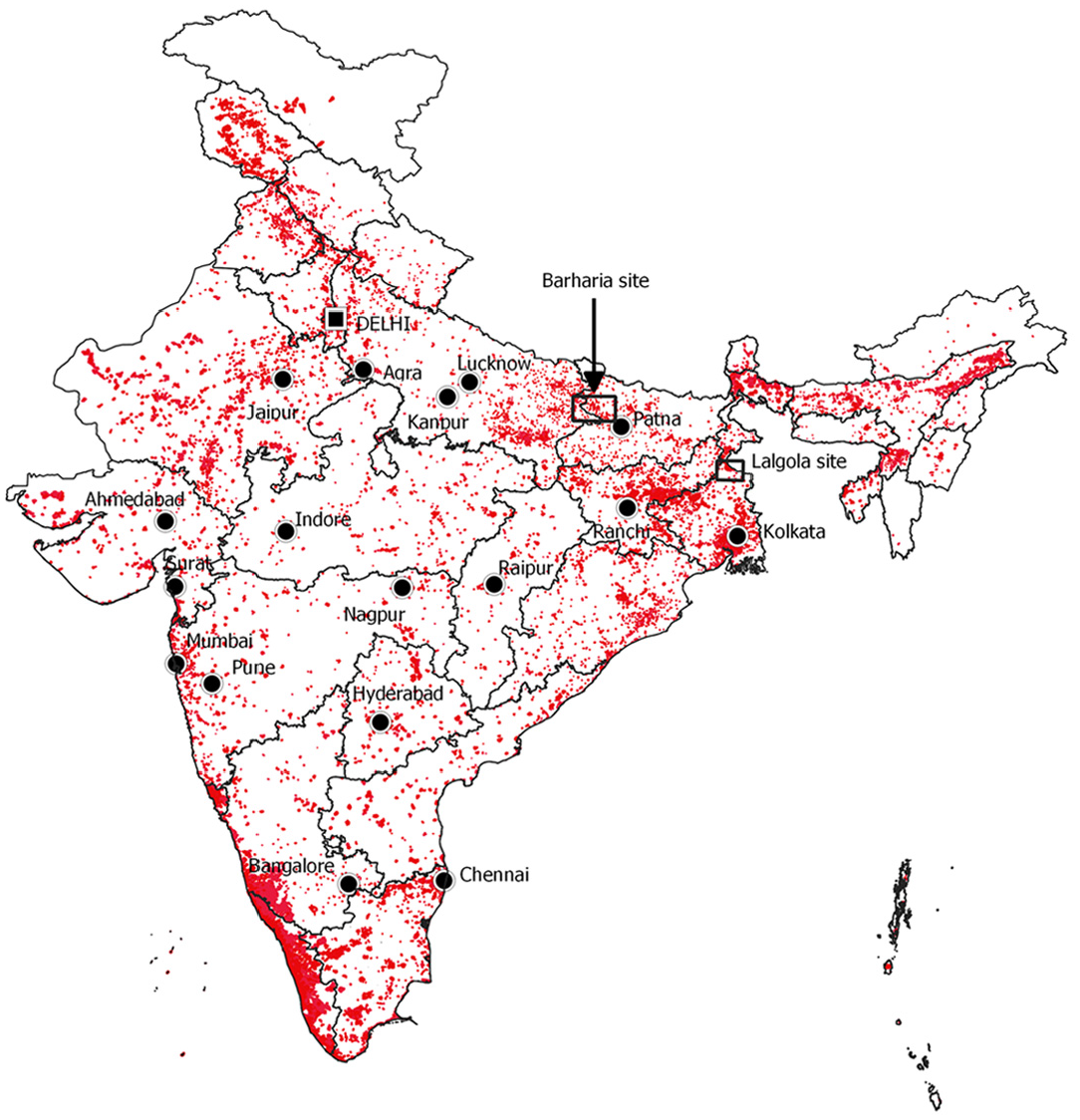
Villages not designated as “urban” by the census, with populations greater than 1500 and with male nonfarm employment exceeding 75%, in 2011 (N = 13,523).
To gain a deeper understanding of local urbanization and socio-economic change, we selected two case study sites from these clusters of villages: Lalgola in central West Bengal and Barharia in western Bihar (Figure 2). Both sites currently have over 80% nonfarm employment and have experienced population growth, densification, and increased built-up contiguity across multiple nonfarm settlements, resulting in overall populations that generously exceed the 5000 threshold for individual settlements to be officially considered “urban.” Neither site, however, has so far been designated as urban by the Indian census. The two sites also exhibit significant differences. The Lalgola cluster, located in Murshidabad district, consists of various contiguous high nonfarm settlements with a large combined population of approximately 90,000 people. Here, the occupational shift out of agriculture has been underway for about two generations. The population density is notably high at 5750 people per km2, nearly 15 times above the official “urban” threshold of 400. The other site, Barharia, is located in Siwan district, on the remote western edge of Bihar. Barharia is a smaller cluster, with a total population of around 18,000 and a density of 1800 people per km2. Here, the occupational transition away from agriculture is more recent and quite rapid, with nonfarm work increasing from 42% to 82% between 2001 and 2011.
We conducted surveys with a geographically representative sample of 645 households (n = 337 in Lalgola, and n = 308 in Barharia). In addition, semi-structured interviews with households were conducted to probe subjective experiences of social change. We conducted 46 interviews with heads of households and key informants—22 in Lalgola and 24 in Barharia—to obtain more detailed accounts of the daily functioning of households, and of possible changes therein. All of the surveys and interviews were conducted in 2019.
Interpreting social change in urbanizing rural India
We focus our observations on two critical dimensions of possible social change: the organization and functioning of households (including gender relations within the household) and class structure.
Household dynamics
Between 2001 and 2011, the number of households at both sites grew roughly twice as fast as their overall population (Indian census, various years). In Barharia, this trend is more recent and is unfolding fast: the number of households grew by 54% while the overall population grew by 29%. In Lalgola, where the trend has been underway for a longer time, the number of households grew by 34% and the population grew by 19%. Without significant in- or out-migration of households, these numbers indicate a splintering of existing households and decreasing household sizes.
The Indian census defines a household as a “group of persons who normally live together and take their meals from a common kitchen” (Government of India, 2011: 4). However, the census does not distinguish between extended and nuclear families. Extended families typically consist of a couple, their unmarried children, and their married sons with their wives and children, sharing not only a common roof but also meals, financial resources, and property, all under one household head. Our findings indicate that the dynamics within these extended families are undergoing significant changes and adaptations, closely linked to the high rates of male circular labor migration. To better understand these dynamics, let us first have a closer look at the relationship between labor migration and family structure.
The literature suggests that labor migration is predominantly undertaken within the context of the extended family, which provides a supportive structure for such migration (De Haan, 1997, 2002; Deshingkar and Farrington, 2009). Extended families offer financial support for initial migration costs, particularly important for international migration, and practical or emotional support while caring for dependents left behind. Our survey findings corroborate this: households with labor migrants are generally larger than those without. In Barharia, the average household size is 8.1 for families with migrants (n = 161) and 6.9 for those without (n = 147). In Lalgola, the average household size is 5.6 for families with migrants (n = 130) and 5.1 for those without (n = 207). But how does the suitability of extended families for labor migration reconcile with the observed trend toward smaller household sizes?
Interview data reveal that the influx of remittances can cause financial disparities and tensions, as they often exceed the local incomes of other breadwinners in the extended family. As a result, extended families who still share the same roof or compound may splinter into separate households by separating their finances and setting up individual kitchens. We encountered various such cases. Urmila (all names are pseudonyms), a 28-year-old female from Barharia, noted that within extended families “there are people who earn a lot outside, and there are people within these same families who sit idle, and do nothing. In those cases, households can split and separate their finances.” Bhagwan, a 57-year-old male from Lalgola, adds that whereas resources were once pooled, “there is more individualism now due to economic reasons. The more productive earners become reluctant to share their incomes with less productive members. There is less willingness to have a common pool of finances.” Shamshul, 53, from Barharia, questions: “Why do I have to earn in the Middle East for other relatives back home? They earn their own money. We still live together, and we are still one family, but we decided to separate the kitchens and the money. Many families have that now, that they separate the finances.”
Remittances from circular labor migration can thus lead to rifts within the extended family, prompting adaptive arrangements where units within the larger family separate their finances and kitchens (also see Choithani, 2022). According to the census definition, this separation results in the formation of “new” households, explaining the rapid increase in households as noted above. But census data do not capture that these newly formed household units typically continue to live under the same roof. Aside from separated budgets and kitchens, they maintain much of their communal lifestyle, partly to support migration-based livelihoods. Thus, a new household may form but it often does not replace the larger extended family; instead, it becomes a more distinct part of it. This goes some way toward explaining the protracted standoff in the literature noted above as to whether nuclear households are on the rise and extended families are on the decline. This growing complexity of the concept of the household also calls into question one of the main assumptions in the literature on the New Economics of Labor Migration (e.g. Taylor, 1999), where migration is seen as a household allocation problem, and the household is assumed to be a stable entity. We find that, while labor migration in many cases is enabled through the support of the extended family, it can result in the financial splintering of that same family.
Urmila, Bhagwan, and Shamshul, cited above, continue to live with their larger families under one roof, maintaining daily routines typical of extended families: land and property are still pooled, customs and traditions upheld, common worship practiced, and communal activities engaged in jointly. Urmila describes how the essence of the extended family persists, even with separate finances and kitchens: “Upstairs lives family, and next door too. We hang out together most of the time, during the day, and eat together sometimes, whenever possible. I would never want to live alone. I can’t leave them; they are my world.” Although Urmila’s family finances and kitchen are separate, making her unit a distinct household by census definitions, she, along with three of her brothers-in-law and their families, still shares one roof and maintains close connection to the larger family. This is not to suggest that these arrangements are always without friction. The tensions leading to nuclearization due to financial disparities are not necessarily resolved and can linger after the fact. But, as the quotations above indicate, they seem to rarely lead to a full breakup of the extended family.
As households gain financial independence from the larger extended family, the role of women, particularly spouses of migrants, is subject to change. With the financial split from the rest of the family, the smaller household unit has a relatively high degree of financial independence from the rest of the family, and, in the absence of the husband, the wife of the migrant worker can in some cases have considerable control over the remittances. Our interviews in Lalgola and Barharia show that many female spouses of labor migrants experience heightened autonomy and assume greater decision-making power. This shift in power dynamics is evident in various aspects of daily life, including managing household finances, overseeing daily expenses, shopping, and decisions about children’s education or healthcare. Amrita, a 35-year-old woman from Lalgola, describes her expanded role: “I manage everything from groceries to the kids’ schooling and healthcare. My husband stays in Delhi and visits only briefly a few times a year, leaving me to handle most household matters.”
In these households, the increased autonomy for spouses often comes with heightened responsibilities and burdens. Fatima, a 30-year-old from Barharia, shares her challenges: “My husband is in the Middle East, so I have to handle everything. The hardest thing was taking our daughter for an operation in Uttar Pradesh—a task my husband would have handled.” Similarly, a spouse of a migrant worker in Lalgola expressed: “Life is different without my husband around. Managing the household alone is difficult.” These women not only handle daily tasks but also manage household finances, interact with banks, and navigate government offices for services like Aadhar (identity) cards or official certificates. In contrast, our interviews with non-migrant households, or those where the migrant worker and his spouse remained integrated within the larger extended family with shared finances, revealed no such shifts in gender roles. In these settings, decision-making power, including control over remittances, was commonly shared among the spouse, the migrant’s brother, and/or his parents. It is tempting to consider what happens to the position of the “left-behind” woman in migrant households where there is no separation of finances and kitchens, in which case she is likely to become even more dependent on her migrant-husband’s parents and brothers and thus faces an overall diminishment of autonomy—but this was rarely expressed in the interviews.
Class structure and social stratification
As noted, a primary driver of the rural–urban transition is the occupational transition away from agriculture. According to the 2011 census, nonfarm employment levels in Lalgola and Barharia stood at 80% and 82%, respectively. Our 2019 household survey indicates that this occupational shift has continued and that currently only about 8% of main breadwinners remain in agriculture at both sites. Table 1 shows that the mean annual income of these primarily agricultural households in 2019 was Rs. 99,347 in Lalgola and Rs. 102,516 in Barharia (just over about US$1000). These incomes are significantly lower than those of non-agricultural households, suggesting that moving away from agriculture may have contributed to poverty reduction and income convergence across different social strata in both locations. Additionally, this shift likely diminishes the direct dependence of former agricultural laborers on the landowning classes, traditionally their employers.
Annual income levels of households, in Rupees, 2019.
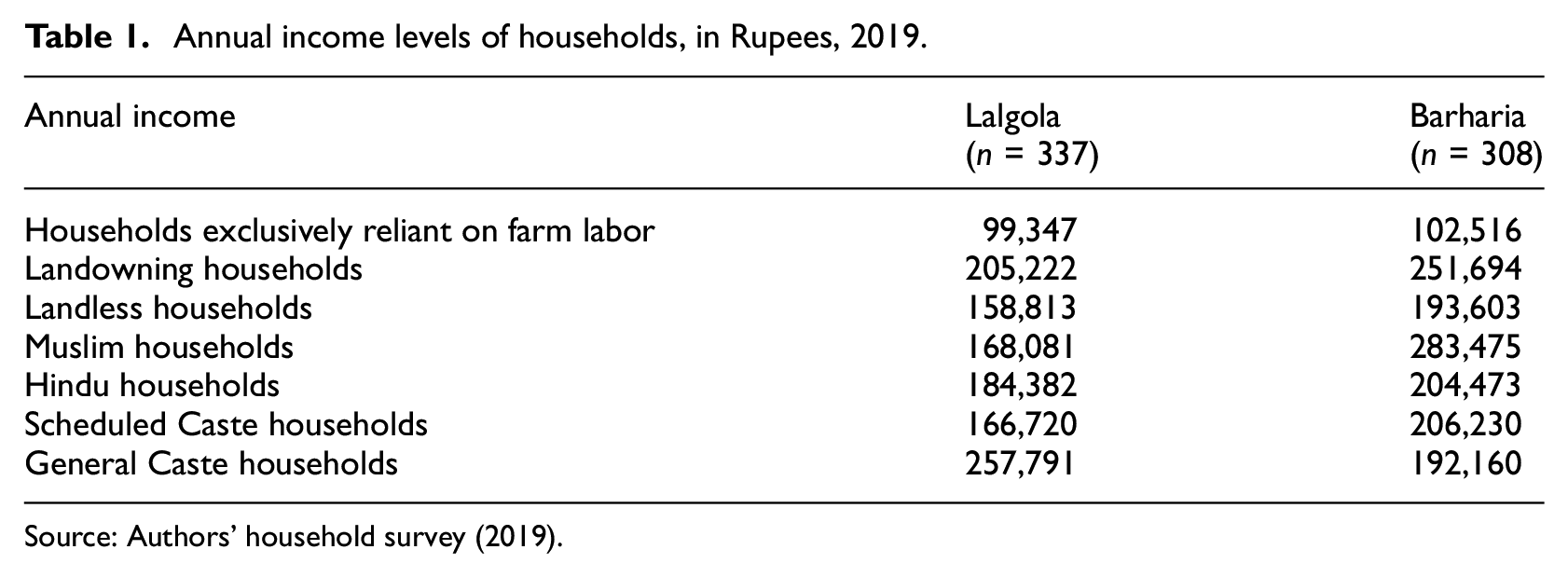
Source: Authors’ household survey (2019).
Table 1 also shows that landownership continues to play a significant role in determining household incomes, as has long been observed in studies of social stratification in rural India (Prasad and Rodgers, 1983). At both sites, for landowning households, the average plot size is quite small: 0.729 acres in Lalgola and 0.974 in Barharia. In Lalgola, landowning households earn an average annual income of Rs. 205,222, compared to Rs. 158,813 for landless households. A similar pattern is evident in Barharia, with landowners earning Rs. 251,694 versus Rs. 193,603 for landless households. Notably, incomes of landowning households are more than twice as high as those of households that rely exclusively on agricultural work (and without owning any land). Hence, owning land and performing agricultural work have opposite effects on income, which is fairly typical of traditional agrarian class structures (Srinivas, 1996), and this apparently continues to be the case in both Lalgola and Barharia. In this respect, then, we observe continuity of class structures—but this is only part of the story.
The table further shows the impact of caste and religious identity on income levels. It reveals striking differences between the two sites. In Lalgola, class divisions mirror well-established patterns observed in rural India: the disadvantaged Scheduled Caste households earn the least, with their incomes only slightly below those of Muslim households, and both significantly trailing behind the incomes of General Caste households. This suggests that traditional social stratification persists in Lalgola or at least reflects its legacy during this rural–urban transition. In contrast, Barharia presents a reversal of these patterns: Muslim incomes substantially surpass those of Hindu households, while Scheduled Caste households earn more than those belonging to the General Castes. This inversion of traditional income and class structures in Barharia warrants closer investigation.
Labor migration emerges as a significant factor influencing economic outcomes, albeit with different effects of domestic versus international migration. Table 2 presents income data categorized by migration status and landownership. Remittances from domestic migration are quite modest and seem to reinforce existing income and class disparities. Notably, across both Lalgola and Barharia, households with domestic migrants generally report lower incomes compared to those without domestic migrants. Specifically, landless households with domestic migrants record the lowest incomes, while those owning land and without domestic migrants show significantly higher income levels—approximately Rs. 70,000 higher in Lalgola and Rs. 100,000 higher in Barharia.
Household incomes in relation to domestic migration status and landownership, in Rupees, 2019.
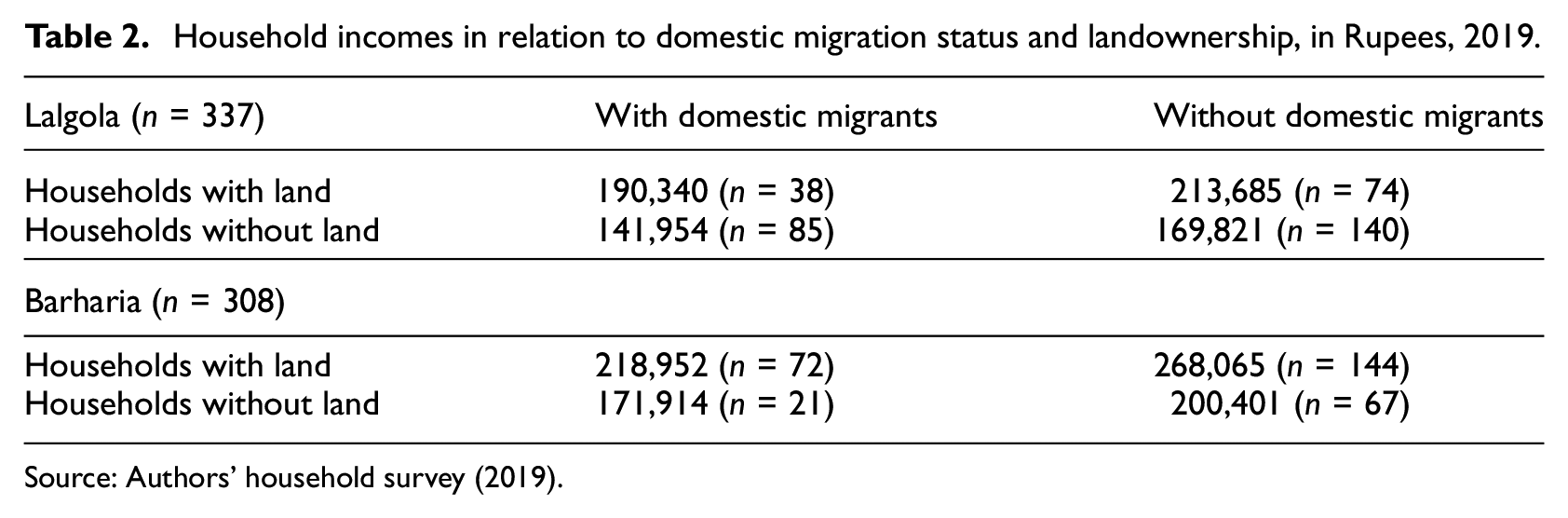
Source: Authors’ household survey (2019).
In Lalgola, domestic labor migration is more prevalent among traditionally marginalized groups: 43% of Muslim households and 30% of Scheduled Caste households have domestic migrants, compared to only 27% of General Caste households. This pattern suggests that domestic migration often serves as a livelihood strategy of last resort, offering respite but little opportunity for economic advancement. Furthermore, international migration is virtually absent in Lalgola.
In Barharia, half of all migration is international, with entirely different ramifications for social stratification. Unlike the last-resort nature of domestic migration seen in Lalgola, international labor migration in Barharia appears to represent a significant opportunity for upward social mobility. Households with international migrants in Barharia have annual mean incomes of Rs. 335,200, compared to Rs. 199,050 for those without international migrants. Notably, the presence of international labor migrants is especially prevalent among Muslim households (39%) and Scheduled Caste households (30%), but much less so among General Caste households (10%). This trend underlines important class restructuring in Barharia, as illustrated in Table 1. Since the mid-1990s, Muslim households have been well-connected to international migratory circuits linking India to the Persian Gulf, leveraging cultural and religious alignments with receiving countries to access work opportunities abroad. Scheduled Caste Hindu households have followed suit, gradually embracing these international work opportunities as well.
In the Baharia case, it is important to consider the combined effect of land ownership and international migrants on households’ incomes. Both variables have a positive influence on incomes, but international remittances trump landownership. Households without land but with one or more international migrants have substantially higher incomes than those with land but without international migrants: Rs 273,412 compared to Rs 213,200. By far the highest incomes are earned by households who have both land and international migrants (Rs 361,680), while households that lack both have by far the lowest incomes (Rs 163,675).
We deepen this analysis of class dynamics in Barharia in Table 3, splitting the data by landownership, international migration, and income levels among Muslims, Scheduled Castes, and General Castes. The income distribution, as said, upends traditional patterns, and stands in sharp contrast to the common distribution of land: generally, landlessness is much more prevalent for Muslims and Scheduled Castes than for General Castes.
Land ownership, international labor migration, and income among Muslim, Scheduled Caste, and General Caste households in Barharia.
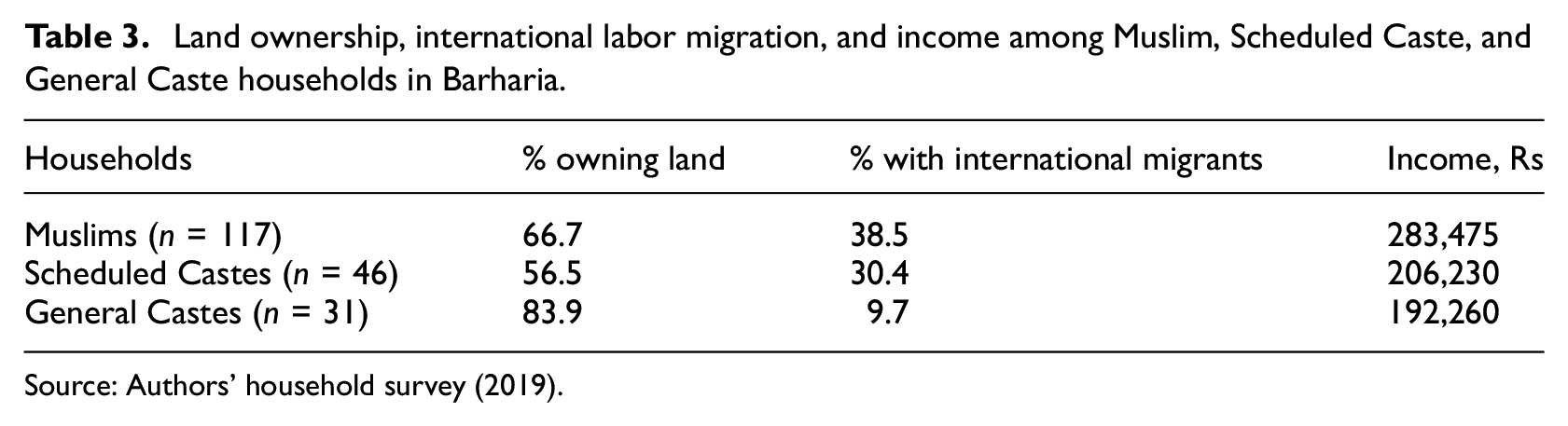
Source: Authors’ household survey (2019).
Thus, the impacts on class structure are very different across the two sites. While landownership remains a critical determinant of social stratification at both sites, and as such points to continuity of class and power relations as they shaped up in agricultural times, different types of labor migration have resulted in vastly diverging experiences. The prevalence of international migration in Barharia, dominated by Muslims and lower caste communities and with much higher remittances, has upended the traditional agricultural income distribution. On the other hand, in Lalgola, domestic migration prevails, with much lower remittances; and since migration here, too, primary involves lower income castes and communities, the result is a continuation or deepening of existing disparities.
Conclusions
In this article, we have explored the social dimensions of a sweeping transformation across India’s urbanizing rural regions. In the field of urban studies, this transformation is only just beginning to draw attention from researchers. We concentrate on the earliest stages of urbanization in rural India, where small settlements are experiencing rapid employment shifts away from agriculture. We argue that these economic changes, and particularly the rapid increase in what we call permanent circular labor migration, have important consequences for the local social fabric.
The proliferation of permanent circular male labor migration in recent decades appears a “game changer”: it implies a more structural separation of migrant workers from their households that remain in the village; it has resulted in growing numbers of nuclear households along with a reorganization of extended families; it has in many cases increased the autonomy, power, and burdens of the female spouses of migrant workers; and it has solidified or upended existing class structures, depending on the magnitude of remittances and the differential involvement of various classes and castes in labor migration.
It is also clear that more research is needed. While we offer strong evidence for the widespread retreat from agriculture and incipient urbanization across India’s regions, we examined only two case studies from the thousands of settlements undergoing this transformation. The case studies were carefully selected, but it is hard to judge exactly how representative Lalgola and Barharia are of urbanizing rural India or, indeed, other parts of the Global South. India itself is famously diverse and what happens in the Gangetic Plain may be different from developments elsewhere. But we have also shown evidence of the widespread shift out of agriculture across very large parts of the country, as depicted in Figure 2. While the two sites show considerable similarities, they are in some respects also very different, particularly in terms of the impact on class dynamics. It may be that Lalgola’s experience is more representative than Barharia’s, as domestic migration overshadows international migration in most of India.
Perhaps more important than the particular outcomes at the two sites, our comparative study points to some critical processes underpinning the transformation of large parts of rural India: the rapid emergence of permanent circular male migration, the necessary adjustments in household organization and in the role of women in the household, and the ways differential impacts on social stratification can take shape. Surely, these processes are at work across many settlements, even if they are mediated by existing local histories and conditions and result in variegated outcomes.
Our data collection and analysis focused primarily on the household level, which means that inferences about village-wide or community-wide changes can only be tentative. While changes at the household level appear irrefutable, the social impacts of these transformations at the village level seem to be softened by deeply rooted social conventions and the enduring social milieu of these settlements. For example, while the shifts in income distributions in Barharia have been remarkable, they may not directly alter class structures—and even less so caste structures—in the short term. In the words of India’s iconic 20th-century sociologist, M. N. Srinivas (1966), it may represent “positional change” rather than “structural change.” Our surveys and interviews suggest that communal ties and identities so far remain largely intact, social networks are mostly undisturbed, and shared values and norms generally persist. Whether the observed “positional change” will eventually translate into “structural change” remains an open question.
It is difficult to determine whether the changes we observe are there to stay. How stable are the current trends and social patterns? It is important to recognize the hardships, emotional and otherwise, that accompany the separation of the migrant from his family, for all involved. This is especially pertinent now that circular migration has, in many cases, become permanent. As we noted in Lalgola, labor migration tends to be an option of the last resort. In Barharia, many international migrants view it as an opportunity too good to pass up even if, there too, it comes at a considerable price and is generally driven by necessity. Should local economic conditions in the village and regional job markets improve, the reliance on labor migration might decrease, potentially restoring traditional social dynamics. Conversely, if current trends continue or accelerate, some of the social changes we observe may solidify and have lasting impacts. At any rate, rural India today is markedly different from what it was just a few decades ago.
Footnotes
Acknowledgements
The authors wish to thank Karin Pfeffer, Fenne Pinkster, Carol Upadhya, Annapurna Shaw, Shubhra Gururani, and Christian Schmid for providing valuable comments on the manuscript. The article also benefited from comments by two anonymous reviewers. We are especially indebted to local field assistants Anamika, Asim, Jitendra, Malati, Shree Bhagwan, and Subir.

Funding
The author(s) disclosed receipt of the following financial support for the research, authorship, and/or publication of this article: This research was supported by a grant from the Dutch Research Council (NWO), grant agreement no. 406.16.567.
Declaration of conflicting interests
The author(s) declared no potential conflicts of interest with respect to the research, authorship, and/or publication of this article.