




Abstract
Despite being a global urban policy laboratory with a diversity of research topics and case studies being reported, we still do not have a holistic understanding of urbanisation across different parts of China. We therefore pose three pertinent questions for discussion in this commentary: whether Chinese urbanisation research has reached a plateau of development and what are the prime sites of research; how has the policy and research environment in China created its own distinctive, interacting traditions of practical activity and intellectual inquiry; and what are the prospects of having more original conceptual thinking and theorisation of urbanisation processes in China? Our analysis highlights the spatially variegated landscape of publications, which closely mirrors China’s urban administrative hierarchy. We explain the paradoxical culture of urban research encountered by Chinese early career researchers through their constant struggle in the knowledge transfusion process of Western theories and their use in Chinese urbanisation research. The dynamic relationship between theoretical and methodological development; the need for innovative comparative research; and better data infrastructure and data sharing practice are seen as the ways forward.
Introduction
China has undergone rapid urbanisation and modernisation in less than four decades and is still perpetuating changes. Since the turn of the millennium, there has been a rapid surge in the volume of academic papers on planning and urbanisation issues in China. The launch of Transactions in Planning and Urban Research is timely as it aims to provide a platform to foster diverse new dialogues on urban and regional development and planning processes in China and situate debates in comparative perspectives. In the 2017 International Conference on China Urban Development, Professor Fulong Wu invited Cecilia Wong (co-author of this commentary) to make a plenary presentation on urban research in China. We think it is a useful exercise to revisit some of the arguments made by Wong (2017), especially by focusing on ‘What are the major challenges and obstacles of Chinese urbanisation research from the perspective of early career researchers?’.
The unprecedented pace of urban development and planning in China has made it a global policy research laboratory. There has been an increasing number of visiting researchers and doctoral students receiving research training and experience outside China whilst pursuing research topics on Chinese urbanisation and planning. Healey (2010: 3) coined the term for those who were actively involved in the diffusion of planning ideas or policy practices and techniques beyond national borders as ‘travelling’ planners. Urban planning is situated and operates within the institutional setting shaped by different social, environmental, and historical contexts which vary across countries and regions. It is, therefore, important to unravel the interactive dynamics between individual agency and institutional cultures in the mobility of policy ideas or practice.
We pose three questions over the future directions of urbanisation and planning research in China in this commentary: (1) whether Chinese urbanisation research has reached a plateau of development and what are the prime sites of research; (2) how has the policy and research environment in China created its own distinctive, interacting traditions of practical activity and intellectual inquiry; and (3) what are the prospects of having more original conceptual thinking and theorisation of urbanisation processes in China? The commentary is enriched by having a dialogue with eight (including co-author Zheng) ‘travelling’ Chinese early career researchers (CECRs) in a two-hour online discussion session on 12 April 2022. The participant CECRs have their main research focus on China’s urbanisation and planning issues. All of them completed their doctoral studies outside Mainland China: four in the UK, two in Hong Kong, one in the Netherlands, and one in the US. Two of them returned to China to take up postdoctoral positions and the others continued their postdoctoral research in Europe and the US; with two subsequently returning to China for permanent academic positions and four continuing their academic careers in the UK.
Research plateau and variegated spatial landscape
Whilst acknowledging the growing number of journal papers on Chinese urbanisation and planning topics, we would like to chart the trend of Chinese urbanisation research over the past four decades through some indicative analysis with Google Scholar (in English) and CNKI 1 (in Chinese). With the Google Scholar search engine, we entered the key words of ‘China’ AND (‘urbanisation’ OR ‘urbanization’) AND ‘planning’ to find out China-focused publications; and entered (‘urbanisation’ OR ‘urbanization’) AND ‘planning’ to search for publications across international contexts. As shown in Figure 1, Chinese urbanisation research has experienced continuous growth over the last four decades and gathering rapid pace since the millennium, though the growth stagnated in recent years. This growing trend can also be observed in other international (non-China) research though the number of publications declined after 2015.
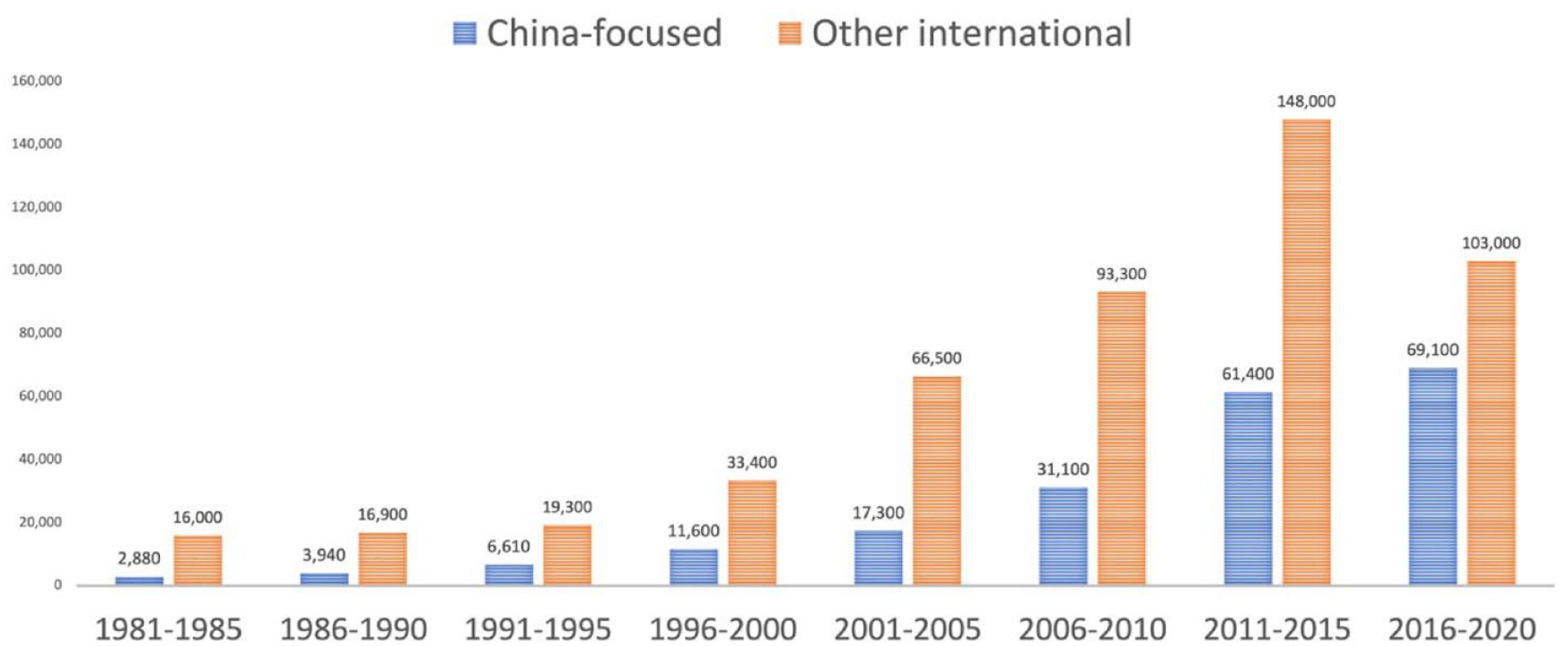
China-focused vs other international publications in Google Scholar.
International urban theorists have called for the need of placing all cities on the level playing field as ‘ordinary cities’ (e.g. Amin and Graham, 1997; Ong and Roy, 2011). The concept of ‘ordinary’ is at odds with the Chinese hierarchical administrative structure of cities which has a direct bearing on their differential resource allocation and political attention and priorities for urban development (Zhong et al., 2021). This has prompted us to find out the spatially variegated landscape of urbanisation research in China by searching publications related to directly administered municipalities (provincial level), 2 vice-provincial cities, 3 and other provincial capital cities in Mainland China. The same strategy was adopted to search English literature from Google Scholar, but we also searched Chinese literature from CNKI with the keywords of ‘urbanisation/urbanization’, ‘planning’, and the city name. As shown in Figure 2, the popular sites of urban research include Beijing, Shanghai, Nanjing, Chongqing, Tianjin, Wuhan, Guangzhou, Shenzhen, Chengdu, and Xi’an. There is an explicit relation between the volume of urban publications and the urban hierarchy, as municipalities and most vice-provincial cities have attracted more research attention. There are also notable differences between cities in the eastern coastal provinces and the inland cities.
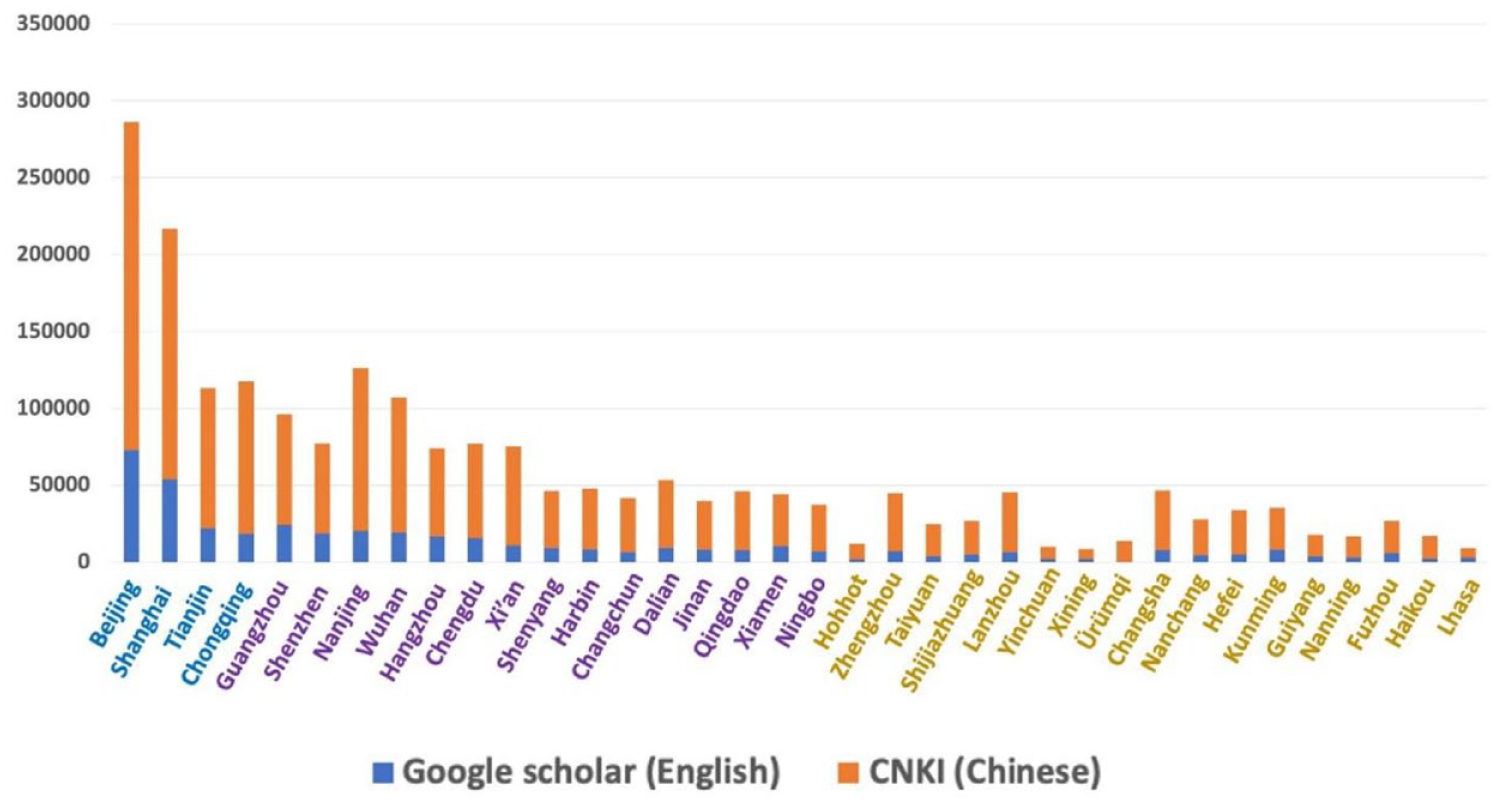
Publications on cities in Mainland China.
Notwithstanding the fact that majority of publications in different cities is in Chinese language, about a quarter of publications about Beijing, Shanghai, Guangzhou, and Shenzhen are in English. Given the sheer number of publications in these four cities, their international exposure and visibility has created the prime sites of Chinese urbanisation research. As argued by Shin (2021), the focus on a small number of cities will run the risk of giving prominence to those cities that already enjoy political, economic, and cultural privilege in their own countries. This core-periphery divide no doubt obfuscates our understanding of urbanisation processes in China.
Paradoxical culture of urbanisation and planning research
Spatial development in China has undergone a complex and complicated process of change, the dynamics of which was driven by the interplay of state policy and planning, local development conditions, and foreign direct investment (Hamnett, 2020; Wu et al., 2006). Besides internal reform, global industrial networks and production chains have perpetuated the urban restructuring process since the late 1990s, though the patterns and outcomes vary in different locations and spatial scales (Wang et al., 2016; Wei et al, 2011). It is this very rich and dynamic urban field of experiments and ideas that forms a magnet to attract the participant CECRs to continue to use China as the site of research. The experience of these knowledge diffusers provides some unique insights into the trajectories of Chinese urbanisation research. There are clear tensions and struggles for the CECRs in the knowledge transfusion process and these contradictory tendencies are summarised as seven paradoxes.
Paradox 1: Western experience for Chinese career progression
Gaining Western research experience has been promoted by the Chinese government and academic community. This establishes a strong culture for talented researchers to pursue their postgraduate study abroad since the early 2000s. In recent years, there has been a further push for academics to gain international research experience and qualifications as well as publishing in international journals. The international knowledge set is not only critical for seeking academic positions, but also for promotion up the academic career ladder. This overemphasis of international experience has resulted in a backlash and, more recently, there has been a call to encourage overseas returning scholars to publish in Chinese language alongside their English publications.
The CECRs consistently agreed that systematic research training in Western academic institutions had equipped them with critical thinking to grapple with the implicit assumptions of Western theories. Interestingly, two of the participants have changed their disciplinary areas from more physical and technical environmental studies to more social science-oriented urbanisation topics. This disciplinary re-orientation was boosted by the confidence they gained through research training abroad, with an emphasis on being an independent and open-minded researcher. Overseas academic returners, nonetheless, have to confront a culture clash when working in Chinese academic institutions. Urban and planning research in China has been largely driven by the state’s policy needs, which have constrained the framing of research projects and the wider academic agenda of theoretical development. As one participant commented, ‘we need to be aware that researchers in China are expropriated as policy think tanks and there is a need to leave room for research independence’.
Research conformity is further reinforced by a utilitarian approach to research production which combines senior academics’ knowledge and networks with the energetic research labour of early career researchers. This is widely seen as a formula for securing research grants and rapid career advancement. Two CECRs found themselves playing the ‘Snake and Ladders’ game upon their first postdoctoral positions in China. They were confronted with the dilemma of taking time to work out their independent projects or just jumping into senior professors’ research bandwagons. The preference towards the prestige and international reputation of Western research training is paradoxically running against its entrenched ‘paternalistic, utilitarian’ academic culture.
Paradox 2: Western theories Chinese use
The CECRs have adopted Western theories in their research on Chinese issues because they grew up with Western theories. Chinese urban planning and economic geography textbooks tend to use theories and concepts from the UK, the US, and Europe as well as from Russia. Many Chinese scholars never go abroad, but they consider the application of these theories provides them with a window to understand Chinese case studies. The CECRs commented that these textbooks tended to be a selective, often distorted and superficial interpretation of Western theories. This crude diffusion of theoretical and practice ideas has no doubt fostered their pursuit of ‘universal’ policy solutions such as technoscientific, entrepreneurial, and eco-managerial ideas promoted by international organisations such as the United Nations and the World Bank (Brenner, 2018), which further reinforces the need to use Western theories.
Paradox 3: Global-local dialectic of publication tracks
The CECRs pointed out that there are many locally based research studies that are closely grounded on local planning issues, but they tend to be published in Chinese journals and books. This is confirmed by our analysis of the dual publication tracks and variegated spatial concentration and focus. The global-local diffusion of knowledge of Chinese urbanisation research is very much a one-way house, as most international readers would not be able to read and access these Chinese publications. While concerted effort has been made to translate Western and Russian planning texts into Chinese (Wang, 2010), no reciprocal practice is found. For example, Neil Brenner’s 2018 book City, Territory, Planet: Studies in Critical Urban Theory was a Chinese language publication. Urban Planning International, a Chinese language journal, has often produced special issues by inviting Chinese scholars to translate selective international journal papers. For instance, the translation of Wong’s (2012, 2018) papers on the development of quantitative indicators were published in the journal. These efforts can benefit local scholars to overcome language barriers and to engage with international theories and practice. However, the quality of translation very much depends on the skills and knowledge of the translator to hold strictly to the author’s conception and render faithfully the content of the original work.
Paradox 4: Lots of data but no data
There have been more open data sources and fine-grained maps for Chinese cities in the last ten years. But there is still no consistent landuse data map for the whole country, as poignantly pointed out by our CECRs. Data is owned by individual researchers in China, with neither coherent central data infrastructure nor archives for data sharing. Take the UK as an example: datasets created/collected by projects funded by the research councils are required to deposit data into the UK Data Service upon completion of the project. Surveys and Population Census data collected by the government are published and made available for research use, including small area data at the neighbourhood level and microdata at individual level, as well as origin-destination commuting and migration flow data. In addition, the Office for National Statistics maintains the Open Geography Portal and provides free and open access to shapefiles of different administrative and census geographies of the UK. Such data infrastructure is critical to social science and policy research as it allows data access and sharing, which in turn provides feedback to improve data collection standards and publication practices. However, the open access and development of the UK data infrastructure has been the fruit of successive generations of academics arguing the case for it.
While there have been some positive shifts in data sharing of national surveys (e.g. China Migrants Dynamic Survey, China Family Panel Studies), the fragmentation of data ownership in China means that access to data has often been dependent on personal networks and relationships (Guanxi). This is seen as an increasing barrier for international scholars to gain access to data or have the knowhow to painstakingly compile raw data from different sources with inconsistent definitions and different timeframes of collection. As one CECR commented, the lack of data access has forced some scholars to develop creative tools to do data mining or use globally available datasets to conduct comparative studies. The problem of data fragmentation has obstructed knowledge development, with duplicating effort on collecting and compiling baseline spatial data rather than spending time on research analysis. Concerns over the quality and standard of data have been consistently expressed and one CECR vividly described that ‘data talks too much with too much noise!’.
Paradox 5: ‘Big’ data but little theory
The emergence of data has generated more quantitative based urbanisation and planning research. One CECR remarked that many quantitative studies were ‘naïve data exercise which produced some superficial results that added no value to our understanding of urban issues’. This means when peculiar patterns are discovered by data-driven research, researchers do not have the appropriate conceptual tools to explain the phenomenon and are not sure whether errors are involved in the process. Another CECR pointed out that big data itself did not generate any theories, but theories were important to guide theoretically informed analysis. Indeed, these observations are not uniquely found in Chinese urbanisation research, but also found in publications across the international research community (Wong, 2021). Big data, without a big theory to go with it, loses much of its potency and usefulness, potentially generating new unintended consequences. The sheer volume of diverse data that has emerged at such a quick speed also draws attention to the timeliness of information, which can encourage short-termism and place more emphasis on the moment. Batty (2013) thus advocates for the need to have new theories that are able to deal with diverse time horizons to underpin the framing of research analysis and to avoid the trap of short-termism.
Paradox 6: Theories ‘West’, methods ‘Quant’
While Chinese urban research community widely embraces theories developed from the Western context, it is less inclined to adopt qualitative research methods, which is not the case in many Western research studies. The CECRs explained that research into urbanisation often required intensive data collection and the use of qualitative methods would further prolong the timing of fieldwork. It is also very challenging to conduct qualitative fieldwork in China, especially to reach out and gain access to different actor groups. Qualitative research is thus seen as a time-consuming and costly activity, which pushes researchers to opt for quantitative approaches and working with big data. An investigation of over 200 papers in representative international journals related to Chinese cities between 2000 and 2012 by Zhao et al. (2013) showed that about 60% of the papers adopted purely quantitative methods. Hamnett (2020: 697), therefore, lamented that it is ‘particularly important to break out of the tendency to carry out very technical and detailed quantitative analysis, which seems to characterise an increasing number of Chinese urban papers’.
Paradox 7: ‘Opening up’ and ‘closing down’
Despite the rising numbers of publication on Chinese urbanisation and planning, the wholesale acceptance of Western theories means that there is a lack of original theoretical development. Our CECRs commented that there have been some ad hoc discussions among scholars in China on developing new theories to conceptualise urbanisation processes and issues (see Lu, 2019), though this conscious awareness has not led to any notable positive outcomes. As explained by one CECR, ‘whenever something new is proposed, they tend to get questioned and challenged by others easily’, which has thwarted any brave attempts to open debates up on new ideas. While there is diversity in research topics and case studies in China, there is a lack of holistic understanding of urbanisation across different parts of the country (Wong, 2017). This is partly related to the lack of consistent data, but also to the lack of original conceptual framework to understand spatial connectedness and to capture how the multi-scalar processes operate (Shin, 2021).
Prospects and pathways of quintessential Chinese urbanisation theories
The dynamic relationship between theories and methods was regarded by the CECRs as the conundrum of Chinese urbanisation research. There is a strong feeling that academics are tired of just applying Western theories to explain local Chinese issues. There is a realisation that the advance of new concepts and new perspectives of China’s urbanisation phenomena will take time and probably need at least another decade to develop China-based theories. Meanwhile, there is an acceptance that academics can continue to use Western theories to examine Chinese issues provided that these theories are applied critically and appropriately to the Chinese context. Social capital theories (e.g. Bourdieu, 1986; Putnam, 2000) were cited as examples that could not be directly applied to the Chinese context because of the very different socio-cultural underpinnings of these theories.
The importance of ‘learning to walk before you run’ was also raised: ‘it is important to get the Chinese urbanisation and planning stories right first, with more accurate and reliable accounts and understanding, and the accumulation of robust empirical research will naturally lead to theoretical development’. The ‘neo-liberal Confucianism perspective’ by Ya Ping Wang (2018) was cited as an example of emerging concepts of Chinese urbanisation. Wang argued that China’s urbanisation and development models – characterised by ‘an excessive trend of centralisation and property-led development in top ranked cities, the production of uniformed and homogenous residential areas with very high building height and density, the persistence of the hukou effects, the continuous prominence of the work unit system, and the emerging new patterns of urban community management and governance’ – were the inherent products of dynamic interactions between neo-liberalism and Confucianism. The ‘planning centrality, market instrument’ narrative proposed by Fulong Wu (2018; 2020b) also provides a new perspective to examine how China’s unique institutional configurations have shaped its urban transformation.
The discussion also raised questions over what kind of theories would be developed (grand theory or critical ideas and concepts) and wondered what should count as theories (e.g. whether ‘ecological civilisation’ counted as a theory)? The authors of this commentary did try to search the origin and meaning of ‘ecological civilisation’ whilst working on their Newton Fund project. Notwithstanding the vague and general answers provided by Chinse academics, a very useful commentary by Savage and Feng (2018) eventually emerged. They used a political-cultural perspective to explain how ‘ecological civilisation’, an idea first mooted in the Soviet Union, was used as an ideological counter-view to the Western ‘sustainable development’. It is interesting that The Guardian recently described the opening of Cop15 in Kunming as ‘an international debut for ‘ecological civilisation’, a little-known phrase outside its borders with big implications for the planet’ (Greenfield and Ni, 2021). This epitomises the global-local dialectic of the idiosyncrasy of some Chinese policy concepts. Due to the crucial role played by the state and its unique institutional system such as land ownership and expropriation, Hamnett (2020: 694) argued that China’s urban development is a process of ‘forced’ urbanisation and could be seen as an exceptional case. He speculated that there might be ‘a case for a specific school of Chinese urban theory trying to theorise the peculiarities and particularities of Chinese urban experience and to compare and contrast these with those elsewhere’ (Hamnett, 2020: 697). This also echoes the argument of Wu (2020a: 459) that the value of Chinese urban studies does not lie in generating universal theories, but in ‘adding new narratives to the urban imagination’.
There was a recognition among the CECRs that theory and method were two sides of the same coin to drive urbanisation research development in China and pointed out the value of carrying out comparative analysis. The purpose of comparative analysis is to explore insights and to test the applicability of theories, which helps to keep the conversation of theoretical and methodological development going to create a feedback loop. The different ways that ‘social class’ was defined under different national contexts was cited as an example, which led to the development of different theories in France and the UK (Harrison, 2010, 2013). This prompted the questions of ‘What we are comparing and comparing with?’ and ‘Is China a unique case?’ in the discussion. Due to contextual differences, scholars find it difficult to develop theories on, for example, infrastructure urbanisation when comparing different Belt and Road initiatives (Zheng et al., 2021). There is an argument of comparing cities with similar issues and contexts to address the urban research issues (e.g. Shin, 2021; Wong, 2015). However, there has been wider international debate over the new methodological approach of comparative urbanism. Academics such as Parnell and Robinson (2012), Roy (2015), and Storper and Scott (2016) have engaged in heated debate over the generalisability of urban theories and the need for a new form of urban theory that focuses on particularity, localism, and difference.
One CECR pointed to a paper by Teo (2021) who interestingly adopted a pragmatist approach by placing urban village upgrading in Shenzhen and Community Land Trust Development in London in a ‘comparative conversation’. The sequential and recursive comparison of the two ‘incomparable cases’ (in Teo’s own words) of urban experiments was to identify the emerging issue from one to guide the examination of the other and to evaluate the emergence, implementation, and outcomes of these urban projects. Teo’s methodology was inspired by Robinson’s (2016, 2021) arguments of the importance of ‘comparative gesture’ and ‘thinking across differences’ to open to the experiences of all cities. While we are not climbing into the ‘generalisation’ and ‘particularism’ debate in this commentary, we would lend support to the urge of having ‘adventurous, experimental, and boundary-exploding methodological strategies to facilitate the empirical investigation’ of urbanisation processes (Brenner and Schmid, 2011: 13). Some research institutions have become more innovative in promoting international comparative urban studies. Notable examples include the UK Government’s Global Challenges Research Fund and JPI Urban Europe and China’s National Natural Science Foundation, which have supported interdisciplinary and international collaborative projects with China.
Final remarks
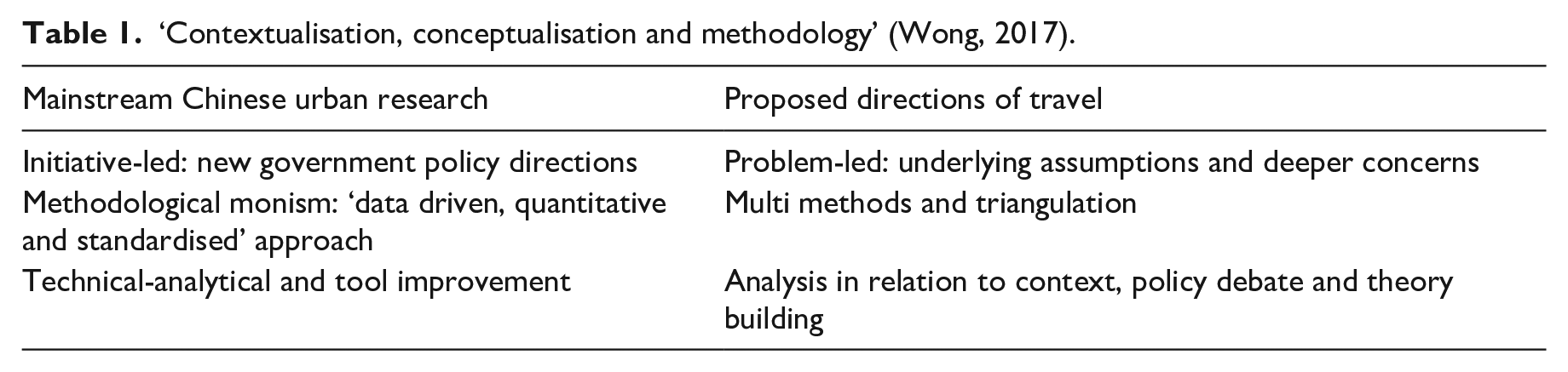
To end our discussion, we think it would be useful to revisit the presentation made by Wong (2017) about the proposed directions of methodological development for Chinese urbanisation research. As shown in Table 1, her arguments of moving from policy initiative-led to problem-led research, opening up to diverse methodological approaches and triangulation, as well as shifting from technical data analysis to more contextual analysis and theoretical development, are still pertinent to the current debate and have echoed the concerns expressed by our CECRs and experts in the field. With the spatially variegated landscape of research publications, there is a pressing need to drive for a more holistic understanding of urbanisation across different parts of China.
‘Contextualisation, conceptualisation and methodology’ (Wong, 2017).
We also share the sentiment made by Healey (2010) that travelling academics have been forced to acquire skills for comparing the different ways in which planning is thought about and practised for successful knowledge transfer and adaptation. There was a strong sense from our CECRs that they were very keen to be proactive and to act as critical ‘travellers’ to apply their creative learning experiences to China’s urban research. The short-termism of China’s academic performance and promotion systems, often commented on as the millstone to the advancement of theoretical and methodological development, has to be addressed to allow more creative and innovative research space.
Footnotes
Acknowledgements
We are grateful to Drs Can Cui (East China Normal University), Yinxuan Huang (London School of Theology), Lei Wang (Nanjing Institute of Geography and Limnology, Chinese Academy of Sciences), Mingshu Wang (University of Glasgow), Weikai Wang (University College London), Qianqian Wei (Development Research Centre of Shenzhen Municipal People’s Government), and Wenshi Yang (Tongji University) for their participation in the discussion and their generous comments. However, all the omissions and errors are the responsibility of the authors.
Declaration of conflicting interests
The author declared no potential conflicts of interest with respect to the research, authorship, and/or publication of this article.
Funding
The author received no financial support for the research, authorship, and/or publication of this article.