




Abstract
This article seeks to address current debates on ongoing China’s urban development and makes a theoretical proposal that links financialization and ecological civilization through the perspective of the increasing role of consumption in today’s transition to an upgraded domestic economy. While both financialized land value capture and the role of quality are now fundamental to the construction of the built environment in Chinese cities, we argue that the “consumption city” refers to an economic and urban production process as well as to a societal transformation. First, the economic upgrading has gone along with a greater mobility of people travelling ever longer distances who spend their income or invest in the places they travel to rather than necessarily their places of residence or of work. To attract these consumers, whether they are residents, tourist or property investors, the quality of the living and consumption environments play a dominant role in the complex urban production and in governance, beyond the classic model of development based on the city as a production place. Simultaneously, the rising role of financialization by external households as investors raises the issue of how and to what extent the construction of consumption places has been a way for the state to further enhance the land value capture in (new or not) cities. Second, as the latest government strategy, ecological civilization is part of a social engineering process aiming to shape people’s lifestyles in terms of both their everyday consumption practices and their mindsets. The current transition aims to “civilize” citizens by enlarging the scope of urban consumers beyond the upper and middle classes to people from rural areas who are encouraged to become urban. Ecological civilization promotes a better quality of life for all, together with new outdoor and experiential activities, although this comes with a high ecological footprint.
Keywords
Introduction
How to interpret ongoing urban development in China in the post 2008 Global Financial Crisis (GFC) era? Two separate and quite contradictory perspectives are being debated. Some scholars discuss the role of the financialization of urban development (Chen, 2022; Jiang and Waley, 2021; Theurillat et al., 2016; Wu, 2019) in reinforcing state entrepreneurialism in China (Wu, 2018). To cope with the GFC and to further enhance growth, land has been used extensively as a financial asset to help develop financial instruments to renew the built environment in Chinese cities since at least 2008.
Other scholars highlight the need to view urban development and state entrepreneurialism beyond growth objectives (Wu et al., 2021), and to take seriously into account the increasing role of quality resulting from the implementation of the state-led “ecological civilization” strategy by local governments (Hong et al., 2019; Zhang and Wu, 2021). Environmental objectives, cultural heritage preservation and community participation would enhance a transition to better quality forms of urban production and governance. Thus, the key question is to what extent it is conceptually and empirically relevant to combine these two separate and paradoxical perspectives in order to better analyse China’s current urban development.
This article aims to address, from a perspective of consumption, how financialization and ecological civilization interact in the production of the built environment in Chinese cities. We posit that the quality of the built and ‘natural’ environment is becoming more important as households as residents, consumers and investors have become more mobile (Theurillat, 2021). This leads to a view of urban development that goes beyond the “production city” model, in which the city is seen as an agglomeration of export activities (of goods and services). As inhabitants are more mobile, spillover effects of productive export activities are reduced since they are no longer necessarily spending or investing their income locally. This makes urban development more complex, and places attractiveness at the forefront of the “consumption city” both as a living environment and a place of consumption (Crevoisier and Rime, 2021), as well as a place of investment.
We further posit that the consumption city model is anchored in a state-led civilization process that is now being renewed and implemented by the ecological civilization strategy. On the one hand, local development for tourism and leisure activities is conditioned by new ways that urban citizens live and consume. On the other hand, the presence of consumers and new residents serves as a model in transforming the behaviours of the local population into urbanites by adopting their way of living and consumption.
The relevance of addressing the interrelations between financialization and ecological issues in the case of the consumption city in China is guided by ongoing research dealing with links between urban development and societal transition induced by the 2022 Beijing Olympic Games. This empirical research is used in a conclusive discussion as a hypothetical tool for a research agenda.
Urban redevelopment: the increased financialization of the built environment to boost growth
The key role of the built environment in China’s growth has been increasingly linked to financialization by scholars, at least in urban geography (Chen et al., 2022; Jiang and Waley, 2021; Pan et al., 2017; Wu, 2019, 2021; Wu et al., 2020). This is more specifically the case in the post-GFC period, when scholars started to open the ‘black box’ of the financing circuits of urban production within the framework of growth and land revenue generation objectives implemented by local entrepreneurial states. This new analysis of the financing circuit was done in line with the huge monetary and credit supply initiated by the state stimulus package to boost China’s economy through infrastructure and housing investments.
So far, the financialization debate has been related primarily to the financing of infrastructure and to the rapidly rising government debts that result. Several studies have highlighted the key role of land as a financial asset, and local government value capture strategies, in a municipal finance system initiated in 1994 that places local governments in charge of financing urban infrastructures. Land conveyance fees resulting from the appropriation of rural land at a relatively low cost, and its conveyance into urban land that can be sold at a higher price (at auction), are at the centre of the assetization of land (Lin, 2014). However, in this system of extensive ‘land grabbing’, which often goes hand in hand with population displacement, it has been shown that municipal finance relies on debt. In this respect, the key role played by local government investment platforms (LGIPs) has been underlined (Feng et al., 2022; Pan et al., 2017). Created by local governments, such platforms (chengtou gongsi) are granted land that is used as collateral to obtain bank loans. While Land Development Centres were initially the main platforms, Urban Development and Investment Corporations (UDICs) have, since 2008, become the main types of platforms to finance urban infrastructure and land development. The emergence of UDICs also epitomizes a double movement of securitization. In periods of stricter monetary policy and control of loans to UDICs and housing mortgages to property buyers, the financing of the built environment rested on the rapid development of a national system of shadow banking composed of large bank-trusts and funds. The development of wealth management products, in the form of chengtou gongsi bonds awarded to UDIC, and of trust bank loans to developers, gave rise to an indirect investment circuit in the built environment for households, companies and institutional investors. Moreover, the intervention of the central government to reduce local government debts since 2015 resulted in the securitization of urban infrastructures. Short-term debts (bank loans) were transformed into long-term debts that boosted the municipal bonds market in which households could invest.
In parallel, but to a lesser extent, the financialization of the built environment in China has been addressed from a housing perspective in line with ever-rising property prices in large cities, and an oversupply of housing, especially in small-tier cities. The homeownership property policy for urban households since 1998 has played a key role in the emergence of both the real estate and bank industries in China (Wu, 2015). While accelerating urban production, housing commodification has been a means of developing housing consumption as an important economic driver in a context of a low level of consumption (Wu, 2020). Moreover, while housing served as the main collateral for bank credits, the demand for housing rapidly developed beyond own use and housing became a financial asset for households. As a result of massive investments in housing, urban homeowners have come to be considered key agents of financialization. From this perspective, housing financialization in China relates to a real estate development finance model that depends first on mortgages that developers can access rapidly thanks to a pre-sales system, and second on a securitized circuit of money supplied by shadow banking (bank-trusts and funds) used mainly for buying land.
The links between land financialization and housing financialization are the two faces of China’s assetization of land and of the land value capture system. However, a few scholars have provided a broader and more complete picture of the financialized production of the built environment. By highlighting the nexus between finance and land, infrastructure, housing and real estate markets, Theurillat et al. (2016) point out the relevance of considering land value capture at the level of the urban system. Land value capture – along with varying territorial outcomes such as rising property prices and oversupply – has been enhanced by local growth coalitions made up not only of local governments and various investment companies and developers, but also urban households as major property investors (Theurillat, 2017). As stressed above, the state land value capture strategy inserts into a more complex financial system that is still bank-based but takes securitized forms that enable indirect investment in the built environment.
For Wu (2021), the increased financialization of the Chinese city is a by-product of the state-led strategy of crisis management. On the one hand, the urban built environment as the secondary circuit of capital was used to solve the accumulation problem in the first circuit of capital (production activities). While housing consumption enhanced by the ownership policy implemented since 1998 was a means to boost the economy after the Asian crisis, the 2008 state stimulus package to foster investment in infrastructure and real estate was introduced in order to cope with the GFC and the resulting drastic decrease of export activities. On the other hand, the securitization of local debt as well as the development of shadow banking are both direct and indirect consequences of the state intervention to increase growth by investing in the urban built environment. Moreover, in line with the deleveraging of real estate companies’ debt and state programmes to absorb unsold properties or to renew the property markets, such as the shanty town renovation programme (He et al., 2020) or the emerging rental housing market (Chen et al., 2022), Wu (2021) also points out the constant need for the state to control and orientate spatially financialized housing consumption in order to deal with the trend of autonomous over-accumulation in the secondary circuit of capital.
Urban development: the role of quality within the state ‘ecological civilization’ strategy
In parallel with the issue of state-led policy regarding the financialization of the urban built environment, scholars have also increasingly pointed out the change of policies in the post-GFC period. Various recent state-led policies implemented locally – such as environmental protection by economic upgrading and incremental regeneration that promotes heritage preservation and community participation – are seen as signs of new forms of urban governance and production that take China’s current urban development beyond that of a growth machine (Wu et al., 2021). Based on extra-economic goals that increasingly become the framework for the evaluation of local leaders, these state policies are ways to tame the market forces by fixing new institutional arrangements, and could be depicted as a paradigm shift from quantity- to quality-oriented urbanization (Zou, 2021). The growing importance of quality in the post-GFC era can be seen as a new phase of capital accumulation which aims to recreate value by coping with or correcting the negative social and environmental impacts of the first phase of growth (1980–2010) based on manufacturing and intensive investment in the built environment. As a societal project that is complementary to China’s “harmonious society” strategy, ecological civilization can be seen as an overarching project that embodies the various national policies that aim to enhance what Miao and Phelps (2019) call the current fourth phase of urbanization. Three main characteristics regarding current urban development within the ecological civilization strategy can be depicted here.
First, ecological civilization reflects the ongoing state policy to transition from basic manufacturing activities to a more knowledge-intensive economy. To cope with value capture issues since China has been mainly an assembling workshop of imported high-tech goods primarily benefiting multinationals, China’s current strategic re-coupling (Yang, 2013) to be a more intensive knowledge and higher value-added production place can be seen as a move towards cleaner or greener industries (Chang et al. 2016). “Characteristic or featured towns” (Miao and Phelps, 2019; Zou, 2021) become symbolic of the current transition and economic upgrading. More compact and with distinct features (high-tech, green, or smart industries), they are based on a new combination of production, living and ecology that makes them attractive to qualified workers. For Zou (2021), featured cities represent a new form of capital switching and spatial fix in which human capital plays a key role. The renewal of capital accumulation in production (the first circuit of capital) through economic upgrading implies investments not only in knowledge and research development activities (the third circuit of capital), but also in the quality of the living environment in terms both of residential areas (e.g. green spaces and Western-style buildings) and of the consumption environment (local services and urban equipment). Moreover, while eco-cities have so far been related to the building of totally new cities as demonstrative projects, Zhang and Wu (2021) speak of new ways of performing an ‘ecological fix’ that takes place on already-existing cities. Based on the replacement of inefficient and heavily polluting township and village enterprises with new green spaces and renewable energy, along with the transformation of the built environment in Taihu New Town, they highlight that the ecological fix performed by local governments has been a way of coping with urgent environmental issues by locally implementing the ecological civilization state strategy and recreating space for capital accumulation.
Second, ecological civilization relates to new forms of urban planning and of urban governance. For Wu et al. (2021), urban (re)development is framed by an ‘incremental regeneration’ approach that encompasses the preservation of cultural heritage, community participation and rural revitalization. This new approach demonstrates a broad process of urban restructuring with diverse motivations and complex state politics that goes beyond the classic large-scale development based on demolition, the dispossession of rural citizens, and real estate speculation. In this context, urban development tends to become a political operation rather than a pure real estate project that aims simply to maximize profits (Lin, 2014). On the one hand, the ‘fairer’ compensation of villagers for their land has been a way of guaranteeing social stability while helping to reduce the rural–urban wealth imbalance. On the other hand, the preservation of (parts) of traditional neighbourhoods and cultural heritage buildings has become a means of implementing a broader urban governance in order to better negotiate urban renewal. In this regard, heritage preservation policies that were first implemented in large cities has spread and is becoming a part of rural revitalization programmes (like the Beautiful China Initiative) and economic upgrading. The coupling between economic upgrading and ecology based on more high-tech industries, on tourism, and on the rural landscape can serve as a new phase of rural revitalization (Wu et al., 2021).
Large national developers are key actors of incremental regeneration. With regard to the implication of the real estate company Vanke in the “comprehensive improvement” programme in Shenzhen, Zhan (2021) speaks of new forms of housing gentrification. While urban villagers benefitted from the informal development of housing areas, the new rehabilitation programme reinforced the property rent situation. This programme helped local urban villagers to reconvert and upgrade their informal housing in order to target the young workers as being part of the new ‘creative’ economy. For Kan (2019), this new form of urban governance has become a strategic tool that increases the number of landowners in the land capture system. The urbanization of rural areas thus occurs via the enrolment of rural communities in the commodification of land via speculative rentiership. This form of rural community participation resonates with the role of households as major investors in housing financialization in China.
Third, ecological civilization must be viewed in continuity with the rise of city-regions as part of the state re-scaling strategy for planning and economic development (Wu, 2016). The fourth phase of urbanization takes place as part of a suburbanization process that combines various types of extended and scattered urban forms. The development of new towns and cities in large as well as smaller suburban areas is a well-known phenomenon. Science parks or smart cities, administrative cities or university cities (Li et al., 2014), are characteristic of a more long-term industrial upgrading since the early 2000s. As local governments often turn to large developers, the development of new industrial zones inside new towns, or even the construction of entire cities, have become new business opportunities for the property industry (Li and Yuan, 2021). With regard to environmental resources, Hong et al. (2019) also observe a scale strategy in the urbanization process framed by the national ecological civilization strategy. By highlighting the selective trade-off between the resources that need to be preserved and those that can be exploited, they show that urbanization can be further enhanced in hilly areas but is limited on arable land. At the same time, this goes along with the local protection of groundwater while using technology to exploit water located in other more remote provinces. In these multi-local interconnections, they argue that green developmentalism is a way to use technology to preserve certain green goals while pursuing a developmentalist logic.
The consumption city: what is the relationship between financialization and ecological civilization?
The concept of state entrepreneurialism advocated by Fulong Wu (2018) has become the backbone used by scholars in urban geography to address relationships between central and local government authorities. While the state plans centrality by fixing strategic goals in economic and urban development, it rests upon local governments to implement these goals, which are carried out by state-owned as well as private corporations. However, the type of state entrepreneurialism – as emphasized in the two previous sections – varies conceptually and empirically between two opposing frameworks that reflect two main schools of thought in urban political geography. On the one hand, urban governance and production can be inserted into the ‘variegated’ financialization framework (Aalbers, 2017, 2019). In this perspective, the transformation of land and built environment into a financial asset (assetization), despite national and local variations, is interpreted as a part of financialized neoliberalism. In this regard, the US and British context of austerity urbanism in the post-GFC era, which pushed local governments to connect to financial markets and actors via various financial instruments, has become emblematic of the financialized city and of the power exerted by bond and equity holders on cities (Peck and Whiteside, 2016). On the other hand, urban governance and production is viewed by some beyond the ‘neoliberalization–financialization’ framework of growth objectives (Robinson et al., 2021). In this approach, local varieties of urban entrepreneurialism and assetization are conceived as entry points for diversity and specificity in urban development. From this perspective, China’s state entrepreneurialism epitomizes a developmental state with various objectives and financing circuits that take urban development beyond just growth and financialized land revenue generation.
In order to address financialization, the land value capture, alongside ecological civilization, the role of quality, two contradictory issues that frame state entrepreneurialism in China, we propose to link these two phenomena via the “consumption city” model as a research hypothesis and agenda (Figure 1). We posit that the consumption city model induced by the rising mobility of urban households as residents, consumers, and property investors must be considered in the current context of transition which aims to upgrade the domestic economy. Simultaneously, we posit that the dynamics of production of the built environment and governance in urban and regional development must be re-questioned by the consumption city model.
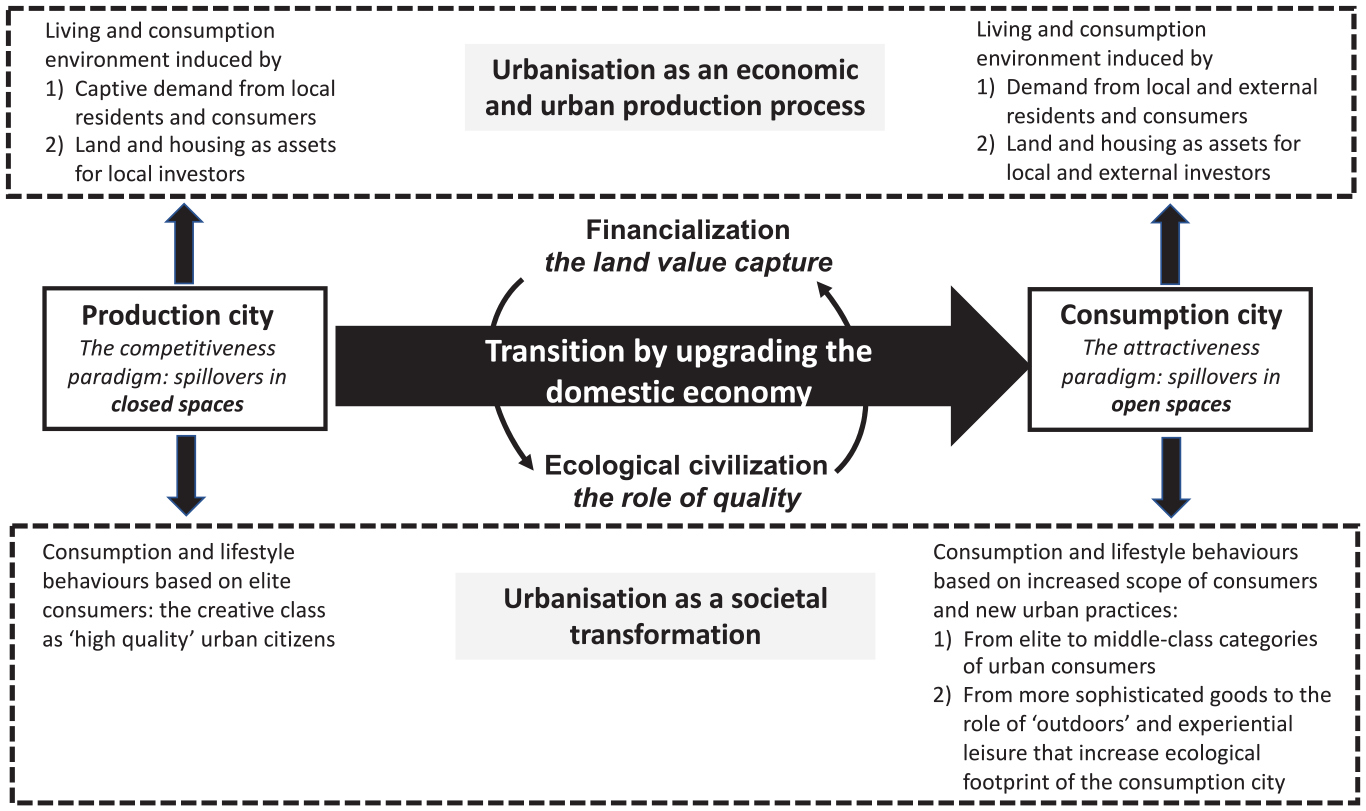
The increasing role of the consumption city as an economic, urban and societal transition in China.
So far, in China’s urban geography literature, links between the built environment and economic activities have been viewed more or less explicitly from the perspective of the production city, in which urban development occurs as a spillover effect of industrial activities (Su and Tao, 2017). In this perspective, local governments are in competition to attract industrial development – in the form of FDI or not for originally manufacturing to currently more upgraded and knowledge-intensive industries – which, along with the growth of the population (as a result of migration and of the territorial administrative inclusion of neighbouring localities), generates retail and service businesses, as well as housing and commercial real estate to meet local demands. In other words, the land value creation/capture system related to the urban built environment is induced by production and export-based activities that function as economic drivers. The production of consumption places in China have been addressed from the same perspective. The building of high-end residential areas, shopping malls, and cultural districts in Chinese cities are seen as direct outcomes of place branding strategies to enhance competitiveness by developing new high-tech industrial sites and tertiary services which thus attract qualified or creative workers (Zheng, 2011). Scholars also highlight that place promotion based on state culture-led policies has been a driver of urban development by tourism. Urban renewal and use of cultural heritage have enabled large cities like Beijing and Shanghai (Keane, 2011), as well as smaller cities, like Lijiang for instance (Su, 2015), to position themselves within international and domestic tourism.
Tourism is of course not a new phenomenon in China, and in terms of territorial development it relates to the mobility of consumers and the significance of extra-local demand. However, the consumption city model that we advocate goes beyond tourism development and must be viewed as complementary to the production city model (Theurillat, 2021). This is based on three main key impacts of the increasing mobility of people in China, which have thus far been under-conceptualized and empirically neglected by scholars in urban studies.
First, as emphasized by scholars in regional studies that revisited the ‘export-base theory’, the idea that the multiplier effect functions in a closed urban space and results from a competitiveness paradigm in which cities are seen simply as production clusters that export goods or advanced business services is an outdated standpoint. The increased mobility of residents and consumers leads to the development of local services that is therefore not automatically generated as a result of production. Seeing that people are no longer captive to their local area to spend their money, a first strand of literature, on the residential economy, focused on territorial development resulting from the capture of incomes generated elsewhere through mobile residents, typically commuters, but also pensioners and beneficiaries of other forms of annuity (Segessemann and Crevoisier, 2016). A second strand of literature, on the presential economy, looked at where mobile incomes are actually spent to address territorial development issues (Ruault, 2018). In this perspective, the attractiveness paradigm (Crevoisier and Rime, 2020) functions in a more open territorial space resulting simply from the presence of people (rather than necessarily residents). Territorial development results from an extra-local demand by both short-term consumers such as tourists (for culture, business, and leisure purposes) and longer-term consumers such as students, secondary residents and lifestyle or amenity migrants that choose a place for its quality of life and services. At the same time, the growing mobility of people implies that cities must remain attractive to their inhabitants. Crevoisier and Rime (2020) underline the combination between the city as a place of production, in line with the competitiveness paradigm, and the city as a place for living and consumption, in line with the attractiveness paradigm. In other words, the qualitative dimensions that makes the city attractive to local and external people – the built and natural environment, culture, services to people and other urban amenities – are not results from competitiveness but directly contribute to reinforce it.
Second, the consumption city further consolidates the change of scale of urban development that tends to be organized around city-regions, as we mentioned earlier. Numerous examples of the development of new towns and cities in suburban areas of large cities are representative of the industrial upgrading. But these new cities are also characteristic of high-end residential areas that are built to be attractive to new residents (Shen and Wu, 2016; Wu, 2010). Their development has involved extensive investment in rapid-transportation infrastructures (subways, highways, and fast-speed train lines) that have enabled the connection of these new towns and cities to the core city centres. All of this is part of the increasing mobility of people and of the reorganization of places of work and residence. While creating new kinds of interdependencies between places, this spatial planning has had an impact on territorial development. Spillover effects can be generated from competitiveness by exports and from attractiveness to internal and external increasingly mobile residents. The recent rapid development of new consumption places and tourist cities follows the same logic of interconnections and interdependencies induced by consumer mobility. There has been a diversification of consumption places whose types and intensity vary regionally, which goes beyond the traditional shopping malls and cultural clusters inside cities and the development of villages as ‘gardens for urbanites’ outside cities.
Third, the various more complex forms of mobility that have been developing in China change the dynamics of urban production and governance. To be attractive to internal and external residents and consumers, the qualitative dimensions of the built and ‘natural’ landscape as well as of local services are becoming very important. At the same time, the consumption city model addresses the production of the built environment in a context in which people are major investors. The more open housing and real estate dynamics raise the issue of the use by the state of housing financialization by external property owners in order to better control or (temporally) solve over-accumulation in real estate in some places by spatially orienting investment and enhancing land value capture systems in a growing number of new cities and neighbourhoods in city-regions territories, and also in smaller-tier cities and rural areas around China. Some have observed that the development of new towns as a spatial fix for investment in the urban built environment is related to the rise of cross-regional investment that goes beyond investment in secondary (or more) residency by urban households (Theurillat, 2021). While the key role played by urban households as local investors has been acknowledged, the role and impacts of the mobility of people as investors on property developers’ business models have so far been under-researched by scholars. Theurillat (2017) highlights the interactions between housing and commercial real estate development in urban mixed-use large projects as investment opportunities in which real estate companies are involved in urban property in the long term as landlords of large commercial areas while residential and also smaller commercial (shops and hotel rooms) areas are sold to local as well as to external urban households.
The consumption city as a societal transition
In the current transition towards an upgraded domestic economy, the perspective of the consumption city drastically changes urban development that is framed by the increased role of quality epitomized by the ecological civilization and at the same time by a more financialized land capture system that would be increasingly based on external households’ investments at larger and cross-provincial scale. However, as demonstrated above, China’s upgraded urbanization has mainly been discussed in primarily economic and material terms in urban geography. Scholars have neglected the role of social engineering in this process (Figure 1). For us, urbanizing also means shaping lifestyles, both in everyday consumption practices and in people’s mindsets. Thus, this means that Chinese people need to be educated and governed to behave as urban citizens with new practices of living, of consumption as well as of (real estate) investment that are now guided by the state ecological civilization strategy. Three main features of ecological civilization as a societal transition can be highlighted.
First, ecological civilization aims to shape citizens and at the same time enlarge the scope of urban consumers. As a state-led strategy, it is part of a long process of civilizing citizens (Feuchtwang, 2012) which means the modernization of the country together with the promotion of new behaviours and lifestyles. The civilizing process has been extensively studied, historically and across China, in both theoretical and empirical perspectives (Graezer Bideau and Pagani, 2019). For instance, the promotion of the ‘material and socialist spiritual civilization’ in the 1990s served to bind economic development and public policies to social behaviours and cultural practice (Dynon, 2008); this was followed later by the “harmonious society” strategy (Chan, 2010). These state-led strategies aimed to regulate profound societal change that had been accelerated by the consumer revolution in urban China (Davis, 2000), and that had gone hand in hand with increased inequalities induced by the reform era. For instance, as Tomba (2014) observes, living in recently built gated communities, accessing quality housing properties, or consuming in specially designed places such as new shopping malls are a significant lifestyle change for the wealthiest citizens, as well as opportunities to invest in valuable goods that sets them apart from the masses.
Ecological civilization constitutes a new step in the social engineering process that consolidates the previous concept of the “harmonious society”. Drawing on the Mao legacy of changing people’s behaviours alongside a total societal reorganization, social engineering can be associated with biopolitical governance (Foucault, 2003; Palmer and Winiger, 2020). Indeed, successive ideological concepts have been used by the state for defining what forms the Chinese civilization should take and how this social engineering could be implemented both in tangible and intangible terms. For instance, the recent “China Dream” (Taylor, 2015) and rural revitalization (Bray, 2013) strategies address issues of modernization and urbanization through sustainability. At the same time, they aim to reduce inequalities between the rural and the urban population by producing modern cities that are interconnected through consumption practices. For instance, Oakes (2017) analyses the culture-led development of Tongren, a “happy city” in Guizhou Province, and shows how the instrumentalization of culture has become a resource for endorsing state discipline and narrative with regard to social stability and the legitimacy of economic development. Moreover, Pow (2018) demonstrates with the Sino-Singapore Tianjin Eco-city flagship project the convergence between a techno-scientific planning culture and new environmental aesthetics about sustainability and lifestyle mainly shared by elite and upper middle classes. Both examples are emblematic of rebranding or constructing cities of leisure, tourism and consumption through biopolitical governance.
Second, the significance of quality aspects expressed by the ecological civilization is part of the complexification of society. Societal transformation has generated new needs: citizens thrive as consumers of material goods including household investment but are also driven by immaterial goods. There is an obvious upgrading of lifestyles from pure basic needs to more sophisticated goods and activities, together with the promotion of outdoor and more experiential leisure activities such as skiing, biking, trekking, e-sport, cultural heritage tours or rural tourism. Unlike the West, the Chinese state plays a guiding role in the mechanisms related to consumer behaviours and leisure activities (Dirlik, 2001). Depending on the values they convey and the ideological context, some practices are encouraged, while others are not (Lantham, 2006). To this end, state policies support new forms of consumption related to domains ranging from the homeownership, the entertainment industry, food and shopping, to tourism and mobility (Rolandsen, 2011). The middle and upper middle classes are central to this economic strategy. First, they possess the economic and cultural capital to consume (Tian and Boucher, 2021), and second, they play a pivotal role in the reproduction of social order and political stability by protecting their social status and consumer lifestyle (Chen, 2013).
The social engineering process is dialectical. For rural people, becoming a modern urban person means becoming a consumer. The radical change in everyday life concerns the quality of urban spaces, access to commodities, belonging to a social group, a better education, upgraded health care, new professional opportunities, easier mobility and more generally a better living environment, with cultural assets and free time for leisure. For relocated urban middle-class people in new consumption cities, it means staying urban but enjoying a better quality of life surrounded by the ‘natural’ landscape but very much connected to the centre for professional reasons. The development of cultural and leisure activities adds value to the areas they benefit from as consumers and investors. Furthermore, the presence of urbanites in situ accelerates the diffusion of urban values and social norms that are highly recognised and promoted by authorities under the concept of “quality” (suzhi) (Jacka, 2009).
Third, the concept of ecological civilization questions the impact of upgrading lifestyles and consumption practices. The impact of societal transformation has mainly been explored among middle-class consumers living in civilized enclaves (Miao, 2017; Zhang, 2010), while the social engineering process has been extended towards a larger proportion of the population. The recent change to the hukou system allows non-urbanites to reside in small towns or new cities can exemplify this extension. As part of improving the quality of life, state programmes are required to improve the quality of the consumers’ environment. The ecological civilization strategy thus concentrates on reshaping the landscape with large infrastructures and buildings through beautification and heritagization (Graezer Bideau and Yan, 2018). This goes along with social and cultural inequalities in marginalized areas or less visible or fashionable consumption practices (Sun, 2008) on the microscale.
Ironically, public policies attempt to correct the social injustices caused by the development while themselves producing new contradictions within society. Their objectives are indeed twofold and correlated, first by involving the whole population in these new urban lifestyles and cultural consumption patterns, and second by fighting against poverty in urban and rural areas (Solinger, 2018). However, there is very little literature on biopolitical governance based on the harmonious society strategy and on ecological civilization that relies on a vision of inclusiveness from the perspective of standardized consumption and commodified lifestyles. For national and local authorities, bringing the city into rural areas means allowing a larger proportion of the population to embrace new modalities of consumption, thus expanding the domestic economy (Yu, 2014). Development combining urbanization and social engineering necessarily comes at a high price for a sustainable environment.
Conclusive discussion: a research agenda on extended financialized ‘ecological’ urbanization driven by consumption
How should the current phase of urbanization in China be interpreted? This question requires an analysis of how and to what extent classic forms of urban production and governance are changing. So far, these forms have been mainly analysed within the frame of GDPism and of the financialization of land value capture systems. As emphasized by the literature, ecological civilization can be interpreted as a part of state entrepreneurialism, which now tends to have more quality-oriented developmentalist objectives that include social and environmental, as well as economic, issues. In this way, the current phase of urban development has become more complex, and quality can be seen as a political goal that, along with renewing the spatial fix, maintain and legitimize the political party in power.
In this article, we argue that the ongoing transition towards upgrading China’s economy implies various and more complex forms of urban development that must also be addressed from the perspective of the consumption city. Inspired by Brenner and Schmid’s (2015) extended urbanization concept, we look at extended ‘ecological’ urbanization driven by consumption in two dialectical faces. First, from the perspective of consumption, the city space is viewed as a more open space, with attractiveness at the forefront. On the one hand, urban development is increasingly triggered by the rising mobility of people, which implies a reduction of the spillover effects of production-based exports activities. The quality of the living environment and of services offered are becoming key features of attractiveness to both internal and external residents, consumers and investors. On the other hand, urbanization driven by consumption takes spatially extended and scattered urban forms on the scale of the city-region. Cities are connected to existing urbanites, and simultaneously urban development is extended by the creation of spaces for more diverse leisure activities.
Second, as a societal transformation, urbanization driven by consumption is a civilization process that extends its range and scope to become more inclusive. While it continues the transformation of rural citizens into urbanites, it enlarges the scope of urban consumers by promoting and diffusing new upgraded lifestyles and practices. This upgrading goes from basic to more sophisticated goods and outdoor cultural and experiential services, where iconic landmarks (natural scenic spots, cultural heritage sites, sites of mega-event as legacy) play a key role.
The arguments developed in this article are supported by ongoing research that uses the Beijing 2022 Olympic Games (OG) as an analytical tool to address economic, urban and societal transformation. The three selected case studies – the huge resort development in the mountainous area of Zhangjiakou/Chongli-Yanqing, the rehabilitation of the old steel factory of Shougang and the development of the historical district of Qianmen – reflect the significant role of consumption places based on tourism and leisure activities in the ongoing urban development in the city-region of Beijing-Tianjin-Hebei.
While Beijing Municipality used the OG 2008 to accelerate economic and societal transformations within its core space in order to transition from an industrial to a post-industrial and global city, the OG 2022 are being used to implement a post-industrial development on the scale of a city-region based on the consumption city model. Since 2016, the city-region strategy has been supported by the ecological civilization policy that extends the planning of Beijing urbanization outside the municipality territory and implies full reorganization between urban functions (working, residence and leisure) and ecological environment (land, water and energy resources). The city-region planning implies massive investments in major infrastructures and new types of real estate development in existing and new cities all over the city-region, to reinforce the connectivity between places and the regional governance by the core city of Beijing. Simultaneously, the policy is being used as a social engineering process where the supply of consumption places actively participates in the promotion of new lifestyles and practices for the entire population of the city-region.
The construction of new cities of consumption based on the development of huge resorts in Zhangjiakou/Chongli-Yanqing is representative of the convergence of the urbanization and social engineering processes that bring rural and urban people into a dialectical relationship. On the one hand, urban middle and upper classes from the metropolitan area in the plain are attracted to these new urban poles as a result of rapid infrastructural connections, which enable temporary or even permanent stays (new residency). The OG 2022 venue presented a promotional argument for encouraging sports lovers and wealthy urbanites to explore these new lifestyles in an environment of both natural and cultural interest (such as picturesque mountainous landscapes, heritage sites such as the Taizicheng imperial palace, the Great Wall and OG 2022 infrastructures). This environment perfectly fits the development of new touristic activities that meet the cultural demands of people from cities. On the other hand, rural populations also benefit from this urban development in terms of new public infrastructures for local communities. Their living standards is expected to increase not only materially, with better access to goods and services including modernized housing, but also culturally, as a result of a change in lifestyle and the availability of recreational activities. Furthermore, these local communities might also participate in the economic transformation from the original agropastoral and mining industries into a place of tourism, as opportunities to explore new jobs and social mobility become reality. Key questions address the agency of the local population to participate in the revitalization of its economy and lifestyle in a context of “urban colonialism”, where upper and middle classes impose norms and social values related to modernity, prosperity and sustainability which are promoted by state policies. In recent development and compensation programmes, attention focused on the rural population, and local authorities improved care for communities in order to avoid repeating the pattern over the past two decades of relocation and of dismantling the social fabric. Our research tries to go beyond a binary opposition between ownership and dispossession by deciphering how, in such a frictional context, people have learned to negotiate in terms of economic benefits and socio-cultural inclusion.
The extended urbanization by consumption can also be addressed inside the city space. Both case studies of Shougang and Qianmen, each in its own way, reflect new modalities of urbanizing through rehabilitation and improving the quality of life of residents. Shougang illustrates the creation of a new urban centrality for the Western part of Beijing based on the reconversion of a former highly polluting huge steel factory into a new consumption place. Next to a classical development based on mixed-use commercial and residential areas, the re-use of this industrial heritage site for fashionable leisure and urban (e-)sport activities became a symbol of the OG 2022. Here, the social engineering at work consists in extending contemporary lifestyles to consumers consisting primarily of young people living in Beijing and some older generations who would visit the site as a landscape of China’s industrial past. This new centrality would thus increase the land value of the entire area and be attractive for investors, namely for real estate companies and urban households. Qianmen, in turn, exemplifies the classic urban rehabilitation based on historical buildings for commercial and tourism purposes. However, recent urban operations differ from old ones in that they no longer rely on a tabula rasa policy. On the contrary, keeping more residents in situ has become an important foundation for producing a more ‘authentic’ commercial gentrification that attracts both domestic and international visitors, although it runs the risk of creating frictions in the lifestyles of both.
Our research seeks to critically address the role played by “harmonious” and “ecological” urban development projects as social engineering processes. It aims precisely to interrogate contradictories. On the one hand, with more qualitative financialization of the urban development, the land value capture also benefits outsiders rather than only local investors. On the other hand, the injunction of a better quality of urban production by the ecological civilization gives more voice to local people. The visions and values of the state (prosperity, modernity and civilization, and equity, sustainability and justice respectively) diffused through the transformation of the urban landscape need to be discussed in detail as they hide power relations between social groups that attempt to reduce their antagonism with regard to lifestyle choice and cultural taste (Pow, 2018). Caught between newness and heritage, the gentrification of historical areas endorses the invisibility of contested memories or unorthodox practices of marginalized communities (Graezer Bideau, 2018) in the name of social stability and domestic economic growth.
While this article calls for research that views China’s current urban development beyond the perspective of the city as a production place by considering the city as a place of consumption, it of course doesn’t consider development driven by consumption as the panacea. A critical research agenda on urban production and governance that addresses the increasing role of consumption induced by the mobility of people – that now embraces new qualitative dimensions of the ‘natural’ and built environment, new urban lifestyles and practices which extend to a growing share of the population – would need to consider at least two main directions.
First, it remains to be seen to what extent and how the state has been using urban development driven by consumption as a new spatial fix in relation to housing financialization by opening local markets to external property investors in order to control or (temporally) solve real estate over-accumulation in some places. Urban development driven by consumption basically relates to issues of rent capture and of gentrification. Sharing the city space between local and external people creates tensions (Sequera and Nofre, 2018). Development by tourism can transform significant portions of the residential areas used by inhabitants into areas for hosting tourists as well as longer-term ‘lifestyle’ or amenity migrants. This new form of gentrification can lead to an increase in land and property prices and in prices overall (food, leisure, transportation, energy, etc.) that have strong crowding-out effects on local lower middle classes and small enterprises. At the same time, overtourism can lead to the destruction of the landscape or cultural heritage as both material and symbolic basis of authenticity that consolidate the economic value of the consumption city.
Second, the consumption city perspective highlights the high ecological impact of the ongoing urbanization as both an economic and a societal transformation. Extended urbanization creates multi-local connections between (very) remote areas and cities as urban sites for production as well as for consumption, where pollution can drastically affect territorial ecosystems (Brenner and Schmid, 2015). At the same time, extended urbanization relates to the promotion of an urban postmodern consumption society based on more qualitative aspects and lifestyles that have, however, very high ecological footprints.
The mountain areas of Zhangjiakou/Chongli-Yanqing exemplifies these issues. Land is being transformed to produce renewable energy and as places for tourism and residency, while the local rural population are being turned into urban consumers. The urbanization of the mountain areas raises questions about land value capture as well as about the success or failure of resort development in the mountains. Will land ownership benefit local and/or external people, and to what extent will real estate development enhance development driven by consumption or, on the contrary, lead to a new type of ghost city?
Footnotes
Declaration of conflicting interests
The author(s) declared no potential conflicts of interest with respect to the research, authorship, and/or publication of this article.
Funding
The author(s) disclosed receipt of the following financial support for the research, authorship, and/or publication of this article: This article is part of a Swiss national foundation research (SNF: no 189196), The Uses of Cultural Heritage at the Beijing Winter Olympic Games of 2022. We sincerely thank the SNF for their support.