




Abstract
As China continues the profound socioeconomic transformations set in motion by market reforms, it is important to understand how these changes are impacting Chinese families. The central question examined in this article is whether, and to what extent, the Chinese family is undergoing a Western process of modernization and an associated reduction in the previously very high rate of parent-adult child co-residence. Using recent national survey data, this study reveals that only two decades into the 21st century, co-residence in China is as low as, if not lower than, that in the West, and instead, living apart but in proximity in the same city/county has replaced co-residence as the most prevalent living arrangement. We show that the shift to proximity is a result of the negotiations between traditional and modernizing tendencies, and is further enabled by significantly improved housing and household financial conditions.
Introduction
China is experiencing a social revolution, with important changes taking place in the Chinese family. Patrilineal and patrilocal extended families, with parents living with adult sons, have been prevalent in China for centuries (Whyte, 2003, 2005). However, in the recent century China has experienced profound socioeconomic and political transformations, including the modernization campaign after 1911, the socialist revolution (1949–1978), and recent economic reform and market transition (since 1978). In addition, the strict family planning program centered on the one-child policy (1980–2006) has further accelerated the demographic transition in China. As a result, the Chinese family has been experiencing society altering changes, including a sharp decline in fertility and household size, rising premarital sex and divorce rate, rapid population aging, and a large number of elderly only families (e.g., Hu and Peng, 2015; Whyte, 2003; Zeng and Wang, 2018). Intergenerational support, a key element in the traditional Chinese family, is experiencing profound changes in recent decades. Yet it is relatively less studied, compared to other aspects of family changes.
Parent-adult child co-residence has been at the center of the discussion of the changing family life in urban China. The deeply rooted Confucian culture emphasizes filial piety, which prescribes adult sons should care for their elderly parents, thus their co-residence is expected, and common in China. While some scholars predicted the shift away from traditional co-residence to more modern, independent living arrangements as a result of modernization (Goode, 1963; Levy, 1949), many find that a high rate of co-residence in China, and other East Asian countries persisted at the end of the 20th century (Chen, 2005; Logan et al., 1998). Co-residence rate was typically around 75% in the 1980s in East Asia, compared to only 18% in the U.S. (Crimmins and Ingegneri, 1990). In addition to the cultural norm, scholars have argued that the high rate of co-residence in China is a result of many practical constraints, such as the housing shortage, the lack of eldercare and childcare, and parents’ health condition and widowhood (Chu et al., 2011; Logan et al., 1998; Yang et al., 2012).
In the first two decades of the 21st century, market transition in China accelerated to a new level with land reform and housing marketization. Meanwhile, the standard of living in China, especially in cities, has improved significantly, with much higher household income and wealth, larger and better apartments, and a higher rate of home and auto ownership. A large middle class is emerging in China, who prefer and can afford a lifestyle distinctively different from earlier cohorts (Li, 2010; Zhang, 2012). The high rate of multiple home ownership in Chinese cities (about 20%) achieved in a rather short period of time, is a result of financial, institutional and cultural changes, including parental purchases of additional apartments for their adult children to live separately (Chai and Feng, 2020; Huang et al., 2020). Meanwhile, China is aging rapidly, accelerated by the one-child policy and increase in life expectancy, with 267 million people aged 60+ (UN, 2017). Eldercare in China traditionally relied on families, which has been challenged recently with high mobility and large numbers of single-child families. Institutionalized eldercare service is emerging and expanding rapidly in cities (Zhang and Goza, 2006). Yet the family remains the default care provider and the government reinforces this notion in Law on Protecting Elderly’s Rights and Interests in China (CPG, 2012). Meanwhile, most elderly Chinese still feel disgraced to spend their final years in nursing homes (Zhang, 2001). However, it remains unclear how Chinese families negotiate traditional values and the new economic and housing context in intergenerational living arrangements, with limited studies on the latest trends (Gan and Fong, 2020; Sun et al., 2018).
It is in this new demographic and socioeconomic context this article aims to better understand this key dimension of the Chinese family by asking two research questions: (1) What are the patterns of the parent-adult child living arrangements in the 21st century in China? How are they different from previous arrangements and is co-residence still prevalent? (2) What are the main driving forces underpinning the new living arrangement? We argue that Chinese families are in transition, with a new pattern of intergenerational support and parent-adult child living arrangements, which have shifted away from predominantly co-residence in the “traditional family” towards living apart in the “modern family”, and living apart but in proximity (LAIP) dominates now. LAIP refers to living apart but within the same city/county, which allows independent living for both parents and adult children and facilitates regular intergenerational support. We will demonstrate how this living arrangement is shaped by both traditional and modern values and is enabled by significant improvements in housing conditions and financial resources. This article contributes to a better understanding of living arrangements in China specifically and changing family life and intergenerational support in the process of modernization and population aging in general. With population aging becoming a global challenge, the parent-adult child living arrangement provides a fresh perspective on eldercare and intergenerational support. After reviewing the literature, we present a conceptual framework to understand living arrangements in China and propose hypotheses, followed by empirical analyses.
Literature review
This research is situated within the literature on living arrangements between parents and adult children in both the West and East. During the 20th century, the West has experienced a significant decline in parent-child co-residence as a result of modernization. In the U.S. co-residence declined from 50% in 1900 to 14% in 1990 (Schoeni, 1998). In Europe, co-residence among those aged 60+ is only 8% (Emery et al., 2019). A study of 143 countries showed that countries with higher per capita income have a higher percentage of older people living alone (United Nations, 2017). Even though there is a recent increase in co-residence (PRC, 2015; Wiemers et al., 2017), it has been replaced by residential proximity. Lin and Rogerson (1995) reported that a quarter of elderly parents lived within a mile of a child and 60% had a child within 10 miles. Even married couples on average live less than 25 miles away from their mothers (Compton and Pollak, 2015). Distance is a significant barrier to the exchange of intergenerational aid (Hank, 2007), and actual caregiving may be the central contribution to residential proximity. Such caregiving is increasingly the case amongst older adults in the United States, where there is less state support for the elderly population. Most American adults say that a family member does most of the care, and very few report paid help for their elderly parents (PRC, 2015). Geographic proximity can lead to a variety of “help” strategies, from simple “staying in touch” to actual health care (Seltzer and Bianchi, 2013). The greater the likelihood of physical impairment, the greater the likelihood of geographic convergence between elderly parents and their adult children (Compton and Pollak, 2015; Lin and Rogerson, 1995; Rogerson et al., 1997). Older parents can also help their adult children such as providing childcare for grandchildren.
In East Asia, extended family and strong ties between parents and adult children have been the cultural norm. Co-residence rate was typically around 75% in the 1980s (Martin, 1988). Despite recent declines in countries such as Japan and Philippines (Domingo and Casterline, 1992; Martin, 1988), the co-residence rate remains high. Circa 2010, 64% of older people co-resided with children in Asia (United Nations, 2017). Similarly, in China, co-residence has remained high and stable over time despite the socioeconomic and political transformation in the last century (Chen, 2005; Logan et al., 1998; Tsiu, 1989; Unger, 1993). Three recent censuses also reveal high rates of co-residence among those aged 65+ (70% in 1990, 63% in 2000, and 54% in 2010) (Zeng and Wang, 2018). Despite the significant decline, it is clear co-residence remains relatively high in China.
There have been generally three strands of explanations for the high co-residence rate in China. The first is the cultural explanation. Confucian values such as filial piety run deep, and remain strong in China, and it is expected that adult children will take care of their elderly parents. The family has been the most important institution for old-age support (Chen and Silverstein, 2000; Pei and Phillai, 1999), and co-residence is consistent with “Chinese familyism”, which prescribes parents as the basis of intergenerational relations, and patrilocal organization of family living (Levy, 1949). But filial piety has also been transformed over time, from one-directional children’s responsibility to parents to reciprocal intergenerational relations with the exchange of care and support, such as parents’ care for grandchildren in exchange for emotional and financial support from adult children (Cong and Silverstein, 2011). Co-residence is a gendered tradition as parents are expected to live with adult sons. Focusing on married couples, Gruijters and Ermisch (2019) find patrilocal residence remains prevalent even in 2010, with 75% of couples living with or in proximity to the husband’s parents, while matrilocal residence remains unusual. However, many scholars find the cultural explanation problematic, as co-residence may not be the preferred living arrangement, despite its high prevalence (Logan et al., 1998). Hu (1986) further argues that Chinese parents prefer to live close to their adult children. Yet, even when parents and adult children live apart, they function as “networked family” – extended families with strong intergenerational ties (Unger, 1993).
The second explanation is based on economic development. As society becomes modernized, obligations of extended family weaken, and parents not only give their children more freedom but also become less dependent on them in old age (Goode, 1963). Levy (1949) predicted the imminent changes in Chinese families from the “traditional family” to the “modern family” as a result of industrialization and urbanization. According to Levy, the “traditional family” is a unit that is centered on parents’ needs, with strong patriarchal authority and a high rate of co-residence, as the experience before 1911 in China. In contrast, the “modern family” is centered on children’s needs, gender-neutral, and has a low rate of co-residence, such as those prevalent in the West. Empirical findings are mixed and there is not a clear association between economic development and co-residence in China (Yang, 2008). In particular, patrilocal living arrangements did not experience profound changes despite significant changes in other aspects of family life.
The third explanation is the practicality hypothesis. Co-residence is a response to practical constraints and needs, such as severe housing shortage, limited economic resources, inadequate service in childcare and eldercare, and parents’ health conditions and widowhood (Chu et al., 2011; Ma and Wen, 2016; Yang et al., 2012). It has also been argued that the socialist state has helped to reinforce co-residence, with its policies on migration control, approval of male seniority preference in public housing allocation, and inadequate provision of services such as childcare and eldercare (Davis-Friedman, 1991; Logan et al., 1998; Unger, 1993). On the other hand, both parents’ and adult children’s economic resources may enable them to deviate from co-residence (Chu et al., 2011).
Conceptual framework and hypotheses
Given the socioeconomic transformation in the latest decades, we argue that the living arrangements between parents and adult children in China have shifted away from co-residence in the “traditional family” and has followed a path we identified in the West. LAIP is an alternative to co-residence which allows privacy and independence for both parents and adult children on the one hand and facilitates regular intergenerational support and maintains strong connections on the other hand. Living arrangements are a continuum from co-residence in the “traditional family” to living far apart in the “modern family”. China currently lies somewhere on the continuum and LAIP dominates. Instead of one main driving force as is argued in most existing studies, we argue this new living arrangement is shaped by both traditional and modern values, which tend to pull living arrangements towards the opposite ends of the spectrum, and is enabled by significant improvement in housing conditions and greater financial resources (Figure 1).
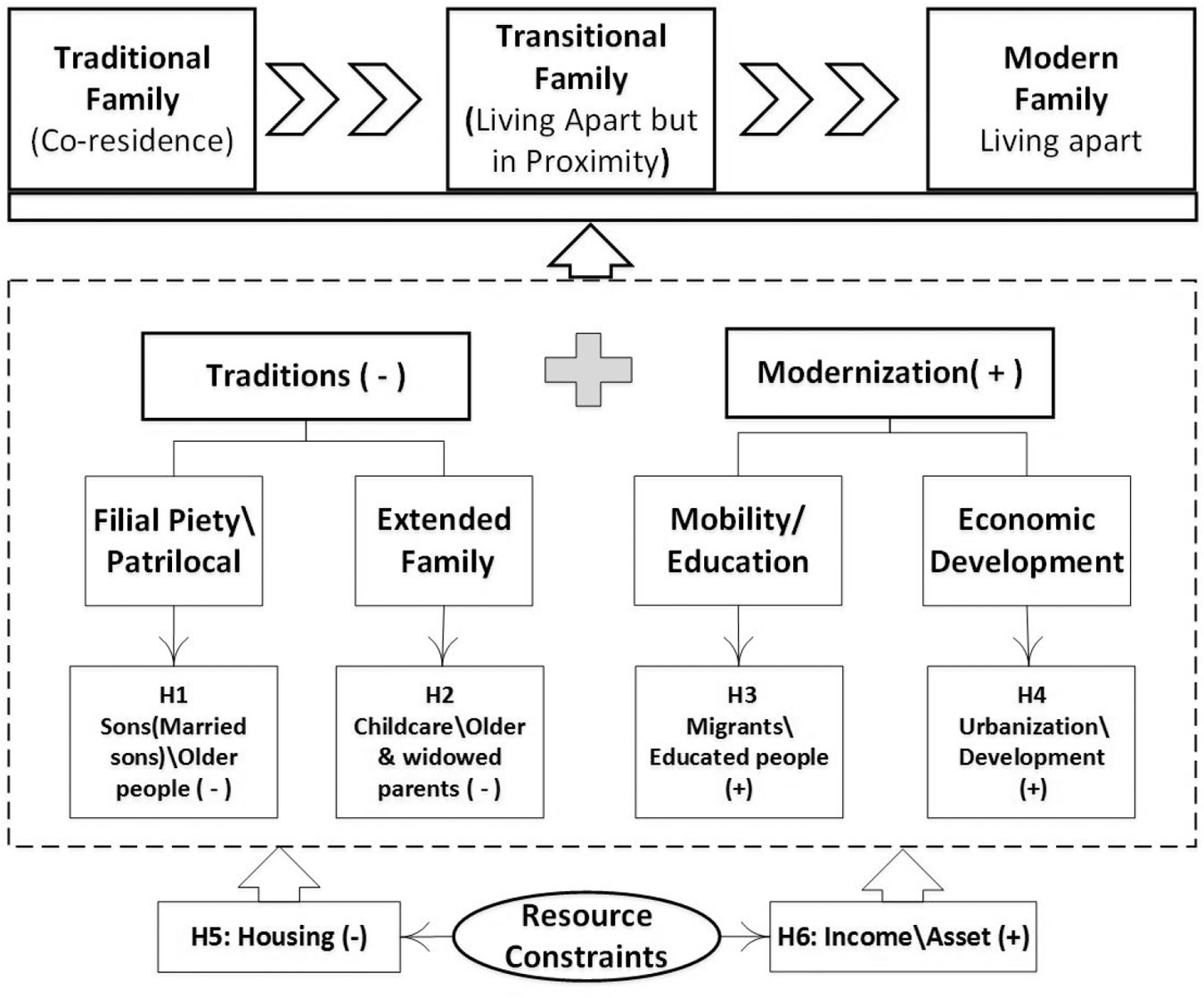
Conceptual framework on living arrangements.
First, despite significant social changes, traditional values such as filial piety and patrilocal and extended family links remain strong in both mainland China and Taiwan (Chu et al., 2011; Lin and Yi, 2011), and still play important roles in living arrangements. Patrilocal marriage, which traditionally requires the bride to move into the groom’s house and live with parents-in-law, is still strong (Chu et al., 2011; Gruijters and Ermisch, 2019). With younger generations’ growing desire for living apart, the groom’s family often provides housing for the new couple, which contributes to the high rate of multiple home ownership in China (Chai and Feng, 2020; Huang et al., 2020). Not surprisingly, parents are more likely to provide housing support to their adult sons than daughters (Deng et al., 2019). This intergenerational housing support is also shaped by whether parents have access to public housing before housing reforms, which allows them to offer housing and material support to their children and ask for care in return (Li and Shin, 2013). This demonstrates the reformed filial piety with reciprocal support between parents and adult children, as parents providing childcare and housing support and adult children providing eldercare. Sun et al. (2018) vividly argue that the “distance of a-bowl-of-soup” is now the most desired distance between parents and adult children, which means they live apart but close enough such that adult children can bring food (and care) to parents. From this discussion we hypothesize the following:
H1: Sons, especially married sons, older people, and those with strong traditional values, are more likely to co-reside and LAIP with their parents (traditions hypothesis).
H2: Adult children in need of childcare and those with older and widowed parents are more likely to co-reside and LAIP with their parents (support exchange hypothesis).
Second, modernization is transforming people’s values and behaviors, which discourages co-residence and encourages living apart. At least three factors in relation to modernization – mobility, education, and level of urbanization and economic development – are shaping new living arrangements. With rapid urbanization, mobility in China now is much higher than before, which increases the likelihood of parents and adult children living apart. This separation in part is a result of adult children migrating to cities for education and economic opportunities, as it is in the West. However, in China, this separation is further perpetuated by the Household Registration (Hukou) System that denies migrants access to basic welfare benefits at destinations and discourages them from migrating with families (Chan and Ren, 2018). Established in the late 1950s, the hukou system divided the Chinese population into categories with different hukou status and entitlements (Cheng and Selden, 1994). Despite reforms in recent years, migrants with hukou registered elsewhere generally are denied access to subsidized housing and their children are denied urban public education in cities. Not surprisingly, migrants often have poor and crowded housing conditions and have to leave their children and elderly parents in villages. Similarly, education erodes the value of extended family and increases opportunities afar. Thus, people with higher education tend to live apart from their parents, often over a long distance. Urbanization and economic development reduce traditional values and thus adults in larger cities and more developed rural regions are less likely to co-reside or LAIP with their parents than those in smaller cities and less developed regions.
H3: Migrants and educated people are less likely to co-resident and LAIP, and more likely to live far from their elderly parents (mobility and education hypothesis).
H4: The level of urbanization and economic development has a negative effect on co-residence and LAIP (urbanization and development hypothesis).
Finally, while tradition and modernization together shape people’s preference for living arrangements, actual living arrangements are also determined by practical constraints, as demonstrated by previous studies (Chu et al., 2011; Ma and Wen, 2016). In particular, economic resources and housing have to be available for either co-residence or living apart. Housing reforms in recent decades have resulted in a rapid increase in home ownership and significantly improved housing conditions. Households now have larger apartments with multiple rooms (3.9 rooms in cities and 4.3 rooms in rural areas in 2015) (Wang et al., 2020), which makes it possible for adult children to live with parents. In addition, home ownership has been rising rapidly, reaching 86% in Chinese cities and 94% in rural China in 2015 (Wang et al., 2020). When adult children own homes, they are more settled and more likely to live with elderly parents, while renters are more likely to have a sojourners’ mentality and have crowded housing conditions. In addition, financial resources are relevant for living arrangements. Young adults can live independently only when they have sufficient financial resources (Chu et al., 2011).
H5: People with owned and larger apartments are more likely to co-reside with their elderly parents (housing hypothesis).
H6: Adult children with more non-housing financial resources are more likely to live apart from their elderly parents (financial resource hypothesis).
These hypotheses will be tested in the following empirical analysis.
Empirical analysis
Data
This study uses the 2013 China Household Finance Survey (CHFS), a nationally representative, household-level survey conducted by the China Household Finance Survey and Research Center. The CHFS employed a three-stage probability proportional to size (PPS) sampling method, with counties, residential communities/villages, and households as sampling units. It collects detailed household information including demographics, employment, housing, income, and assets. In addition to household members who live with the respondent, this survey also collects basic information about extended family members who do not live with the respondent, such as parents and parents-in-law. This information is not usually available in conventional surveys, which makes this dataset particularly useful for the study of living arrangements between parents and adult children. However, information on parents-in-law is very limited, with many missing values 1 . Thus in this article, we focus on living arrangements between respondents and their parents. To answer our research questions, we removed cases with obvious mistakes in family relationships and cases where respondents’ both parents are deceased. We also limited cases to adults who are 23+ years old (23 is the age for college graduation). This resulted in a sample of 8,458 cases (67% urban households).
Two key questions in the survey are used to define living arrangements: (1) Aside from the respondent, how many family members live with the respondent and what is their relationship with the respondent? (2) Where do your parents live? (living in a different unit in the same community/village, living in a different community/village but in the same city/county, living in a different city/county but in the same province, in a different province, abroad). We combine the last three options as “living apart” (in a different city/county/province/country), as daily intergenerational support and care are impossible due to the distance. We consider living in the same community/village and living in a different community/village but in the same city/county as LAIP, which makes daily visits and caregiving possible 2 .
Descriptive interpretations
Co-residence rate in China is about 22% nationwide in 2013, and 18% in urban areas, which is much lower than it was thirty years ago and is similar to the level in the U.S. in the 1990s (Figure 2). Clearly, LAIP is the most prevalent living arrangement (56%), while living in a different city/county accounts for 22%. The urban-rural difference is expected – in rural areas, most people either co-reside (30%) or LAIP (63%) with their parents, while in urban areas, more people live further away from parents (29% vs. 8% in rural areas). This demonstrates a rather different pattern of living arrangements from the traditionally high rate of co-residence in China prevalent till the end of the 20th century.
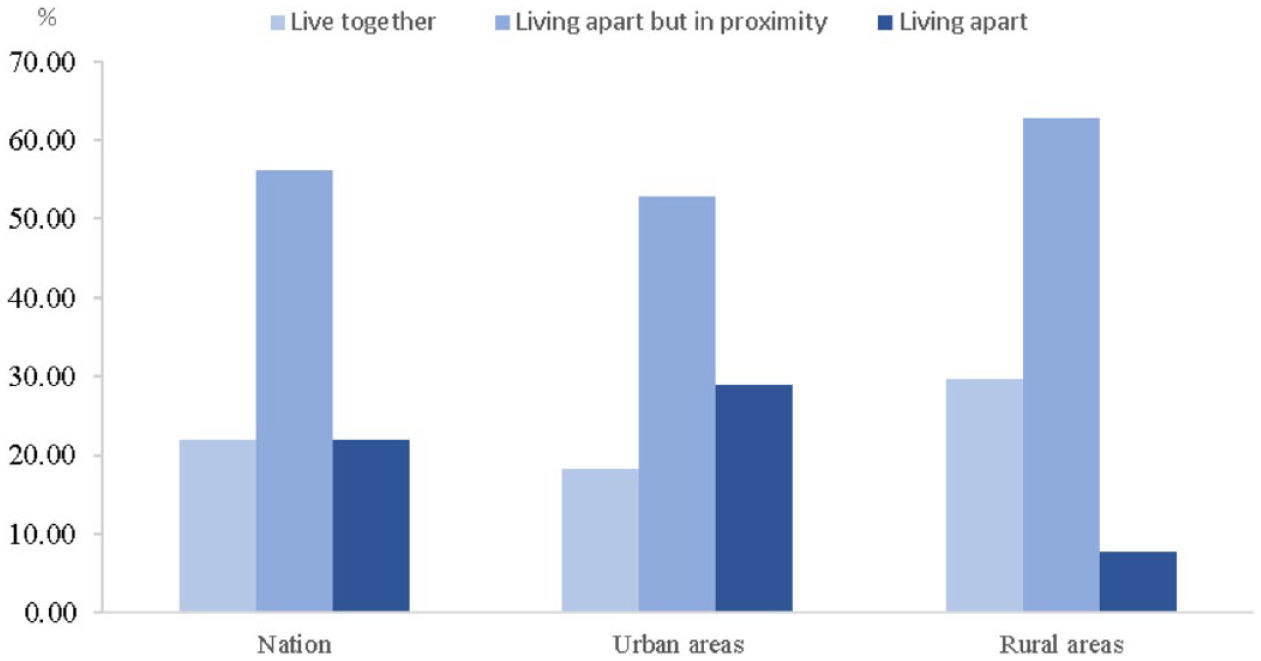
Living arrangement between parents and adult children.
There are regional variations depending on the degree of urbanization and economic development (Figure 3). In first-tier cities co-residence is the lowest (15%) and living apart is the highest (45%), compared to 19% and 25% in third-tier+ cities 3 . Similarly, co-residence is the highest in the least developed Western region (34%), while living apart is the highest in the most developed Eastern region (8%). Meanwhile, LAIP dominates every region and city tier, except first-tier cities. These regional variations clearly are in line with the modernization theory.
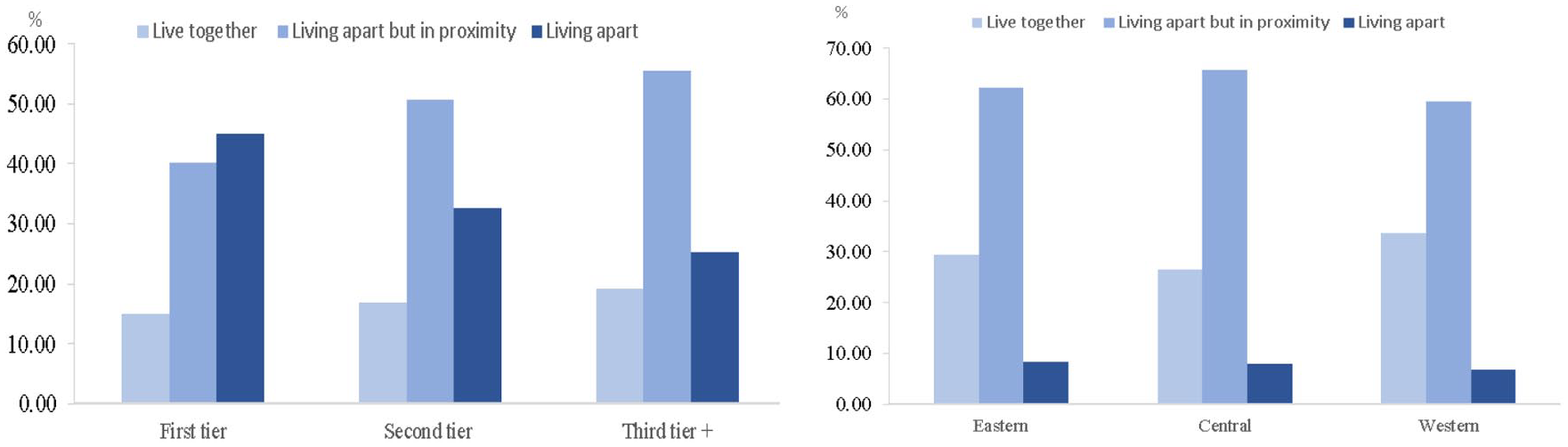
Living arrangement by city tier and region.
There is a significant gender difference which demonstrates continuing filial piety and patrilocality. Parents are much more likely to live with their sons than daughters, regardless of their marital status, more so in rural than urban areas. Nationwide, about 30% of married sons and 51% of single sons live with parents, compared to only 9% of married daughters and 32% of single daughters (Figure 4). Interestingly, the gender difference for LAIP is the opposite, with daughters more likely to LAIP than sons, especially in rural areas. Nationwide, 65% of married daughters and 40% of single daughters LAIP with parents, compared to 53% of married sons and 25% of singles sons. Daughters are also more likely to live further apart from parents.
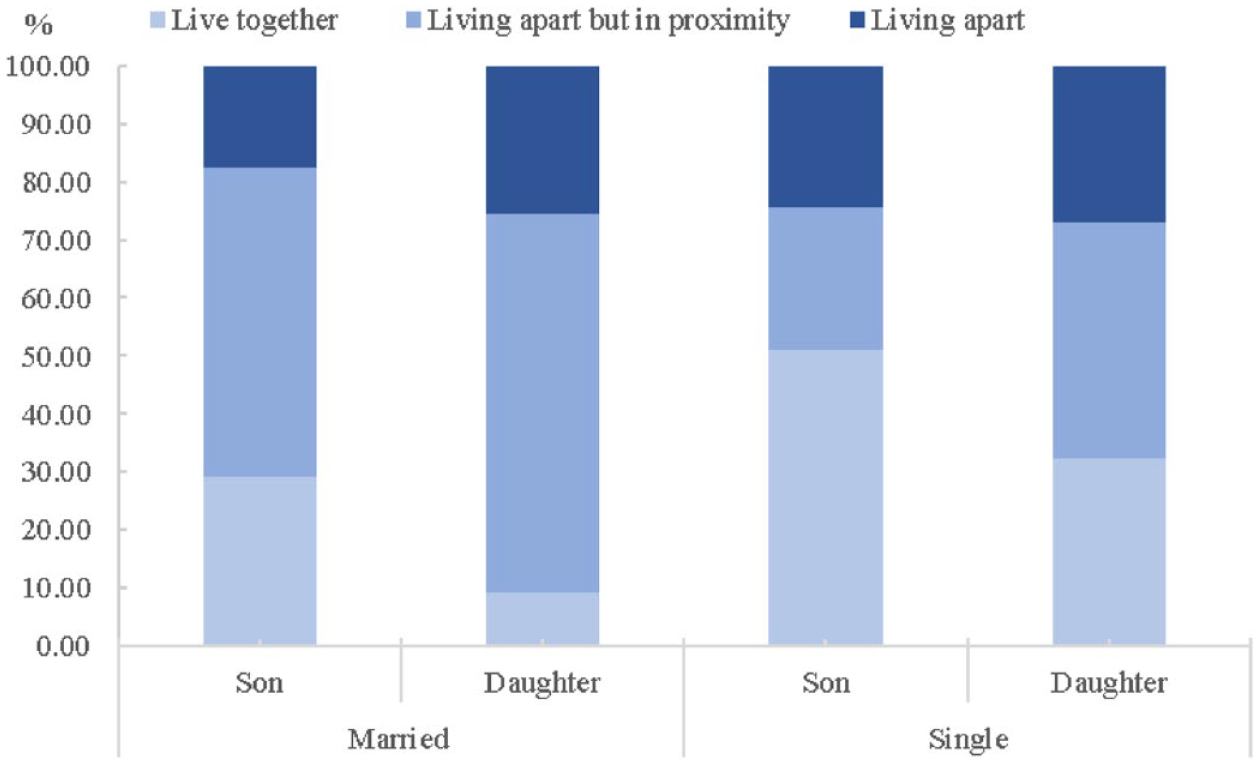
Living Arrangement by Married Status and Gender.
It is clear that homeowners are much more likely to co-reside or LAIP with their elderly parents (Figure 5). About 24% of homeowners co-reside and 60% LAIP with their parents, compared to only 10% and 33% of renters, respectively. In contrast, renters are much more likely to live further apart from their parents (57% of renters vs. 16% of owners). These tenure-based differences exist in both urban and rural areas.
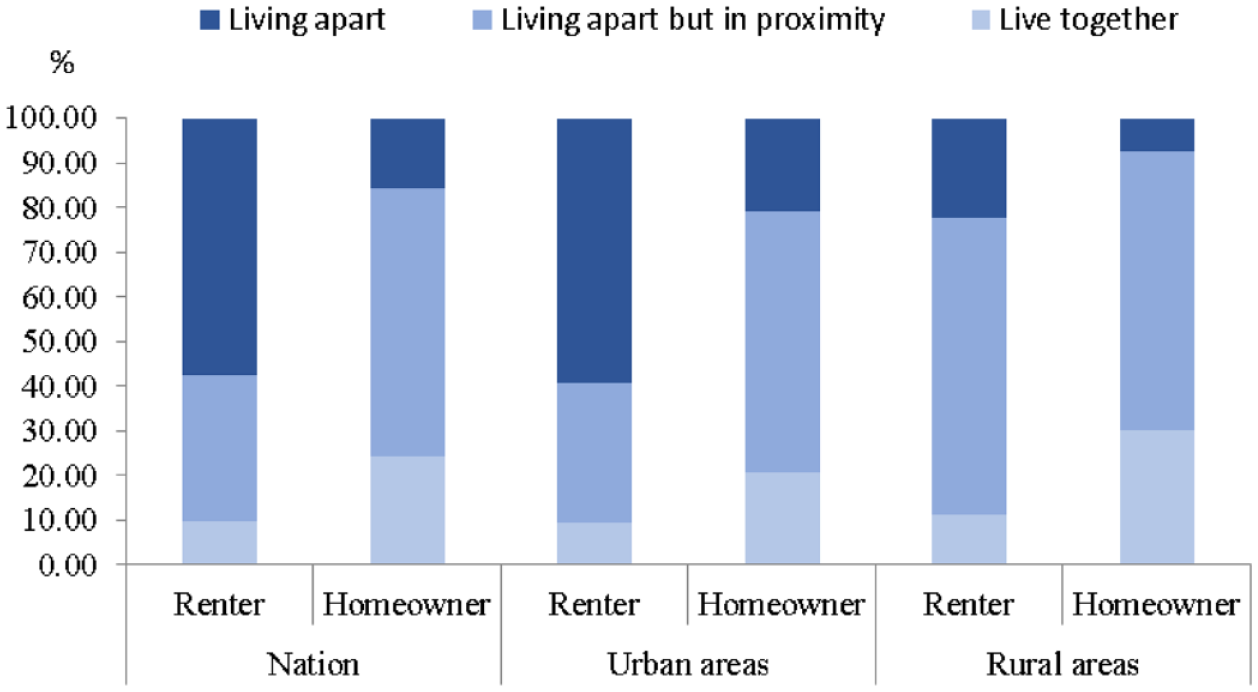
Living arrangement by tenure.
Regression analysis
Both logistic regressions and multinomial logistic regressions are conducted, as LAIP is qualitatively different from co-residence (Compton and Pollak, 2015). The dependent variable for logistic regressions is co-residence with parents (yes/no), and for multinomial logistic regressions is a 3-category living arrangement (co-residence, LAIP, living apart). These models are run for urban and rural areas separately, to control contextual factors. Furthermore, with rising individualism, the conjugal relationship is becoming as important as the parent-child relationship in China (Ji, 2017). Both the husband’s and wife’s personal traits and bargaining power will influence living arrangements (Gruijters and Ermisch, 2019). Therefore, we model married and single respondents (including divorced/widowed) separately and include spouse’s characteristics in models for married respondents.
Independent variables include the following three sets. The first set measures various aspects of traditions to test the traditions hypothesis (H1) and support exchange hypothesis (H2). It includes the following:
Age (<=30, 31–40, 41–50, 50+): older people tend to be more traditional. Thus, age is expected to have a positive effect on co-residence and LAIP.
Gender: this variable tests the role of filial piety and patrilocality. It is expected that sons, especially married sons, are more likely to co-reside.
Willingness to live with their children in the future (Yes/No): this measures how traditional respondents are and it is expected to have a positive effect on co-residence.
Number of grandchildren <7 yrs. old: this measures adult children’s need for childcare and is expected to have a positive effect on co-residence and LAIP.
Parents’ willingness to take care of grandchildren (Yes/No): this variable is expected to have a positive effect on co-residence and LAIP.
Parents’ widowhood (widowed mother, widowed father, both alive): this measures parents’ needs for care and support. Widowed parents are expected to be more likely to co-reside or LAIP.
Number of siblings: when respondents have siblings, naturally they are less likely to co-reside and LAIP with parents. To some degree, this is a test on the effect of the one-child policy in China.
The second set measures the degree of modernization and tests H3 and H4. It includes education and mobility status (urban migrants, rural migrants, urban and rural local residents) for both respondents and partners, city tier (1st tier, 2nd tier, 3rd+ tier) for urban areas, and region (Eastern, Central and Western) for rural areas. The third set measures resource constraints to test H5 and H6, including housing tenure (rent vs. own), size (floor space), household income, and non-housing assets (both in log form). However, size is not included in rural models due to many missing values and housing size is generally less a constraint in rural areas.
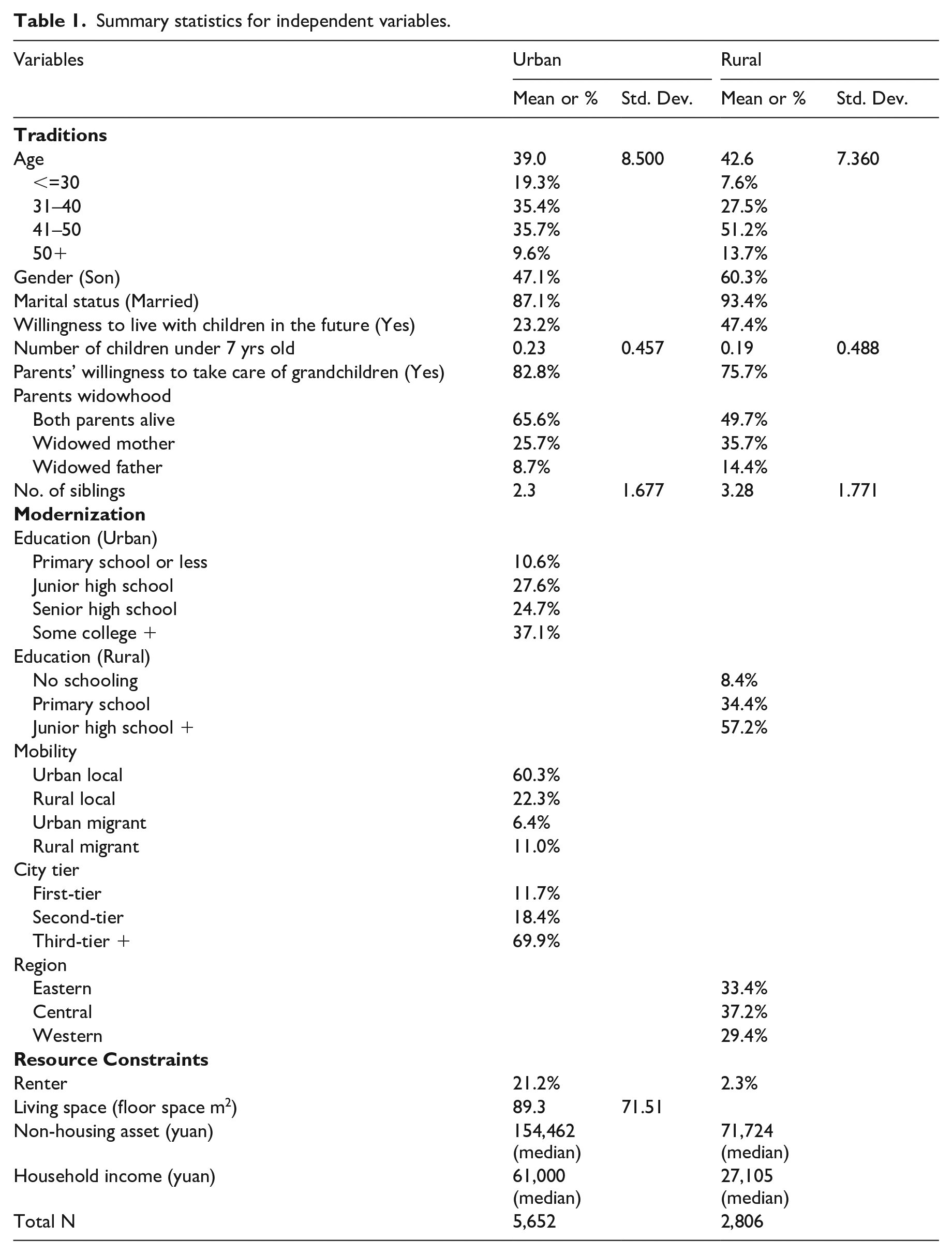
Summary statistics for these variables are listed in Table 1. Respondents in urban areas are generally younger, with fewer siblings, more educated and financially better off, and more likely to be renters than those in rural areas. Interestingly, parents in urban areas are more willing to take care of their grandchildren than counterparts in rural areas while urban respondents themselves are less willing to live with their own children in the future than those in rural areas. This shows not only the urban-rural difference but also generational gap regarding living arrangements.
Summary statistics for independent variables.
Logistic regressions on co-residence
Results are listed in Table 2, and findings for urban and rural areas are similar while there are some differences between models for married and single people. First, variables measuring traditions are all significant for married respondents. Age has a negative effect, which suggests that people become less likely to co-reside with parents as they age. There is some evidence for a curvilinear relationship with a slight return to co-residence when respondents are 50+ years old, probably due to the need to care for aging parents. This is consistent with findings by Gan and Fong (2020). Married sons are much more likely to co-reside with parents than married daughters especially in rural areas (twice more likely in urban areas and five times more likely in rural areas) 4 . Among singles, only single sons in rural areas are more likely to co-reside with parents. This offers strong evidence for patrilocality in marriage and filial piety in both urban and rural areas. The urban-rural difference also shows relatively greater gender equality in urban areas. In addition, more traditional adults, measured by their willingness to live with their own children in the future, are more likely to co-reside with their parents in cities. These results support H1.
Logit regressions on whether respondents co-reside with parents (coefficients with standard errors in parentheses).
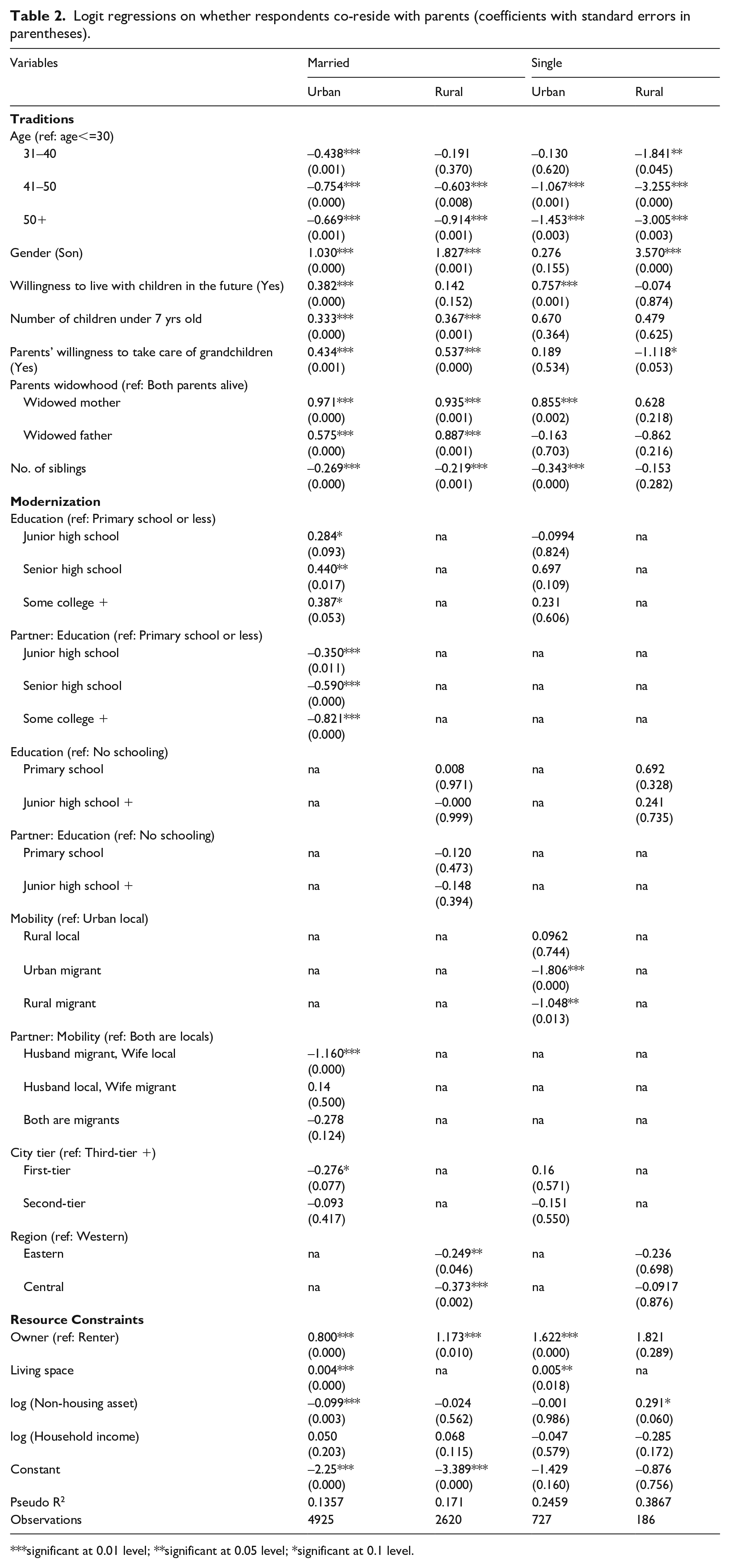
significant at 0.01 level; **significant at 0.05 level; *significant at 0.1 level.
There is strong evidence for the support exchange hypothesis. Married adults with young children are much more likely to co-reside with parents. With one additional young grandchild, married adult children are about 40% more likely to co-reside with parents. Meanwhile, parents who are willing to take care of grandchildren are also much more likely to co-reside with their adult children. Parent’s widowhood has a significant positive effect on co-residence, and widowed mothers are 1.5 times more likely and widowed fathers are 78% (in urban areas) and 1.4 times (in rural areas) more likely to co-reside with their children. For single adults, only widowed mother in urban areas is significant. Not surprisingly, number of siblings has a negative effect, and the only child is more likely to co-reside with parents, offering evidence for the role of the one-child policy in reinforcing co-residence.
Second, modernization variables generally have negative effects and discourage co-residence. While education is not significant in rural models and single models, it is interesting that married adult children’s education has a significant positive effect while their partners’ education has a negative effect on co-residence. This shows educated people are more likely to co-reside with their own parents but less likely to co-resident with their parents-in-law. Mobility is significant for singles, as both rural and urban migrants are much less likely to co-reside with parents compared to local residents in cities 5 . This indicates that the hukou system may have accelerated the transition towards modern living arrangements among migrants. The effect of mobility is also gendered. The husband’s migration status has a significant negative effect on co-residence while the wife’s migrant status is not significant. The gendered effects of both education and mobility show that modernization intersects with the traditional role of gender, offering partial support to H3. In addition, married people in first-tier cities and developed Eastern and Central regions are less likely to co-reside with parents, offering strong support for H4.
Not surprisingly, homeowners are much more likely to co-reside with parents than renters, and larger apartments encourage co-residence. In contrast, a larger non-housing asset discourages co-residence among urban married adults, while encourages co-residence among rural singles. While home ownership and large apartments make co-residence feasible, financial resources make living apart possible. In other words, H5 and H6 on housing and financial resource constraints are supported with strong evidence.
Multinomial logistic regressions
Results for urban (Table 3) and rural areas (Table 4) are similar, and interpretation will focus on urban models. For married respondents, age and number of siblings have significant positive effects while all other variables measuring traditions have significant negative effects. Older adults especially those in their 40+ and 50s+ and those with siblings are much more likely to LAIP than co-residence. In contrast, married sons are much less likely to LAIP or live apart from their parents than married daughters, demonstrating strong impact of patrilocality. People who are willing to live with their own children in the future are less likely to LAIP or live apart. Both parents’ willingness to take care of grandchildren and the presence of young grandchild have a negative effect on LAIP and living apart. Similarly, parent widowhood, especially mother’s widowhood, has a significant negative effect on living apart or LAIP. In other words, the need for daily care from both adult children (due to young grandchildren) and parents (due to widowhood) encourages co-residence. This shows the limits of LAIP in providing hands-on daily care. Co-residence is needed for childcare and eldercare, while LAIP is probably more for other needs such as emotional support and occasional care. These findings offer partial support for H1 and strong evidence for H2.
Multinomial logistic regressions in urban areas (reference: co-residence).
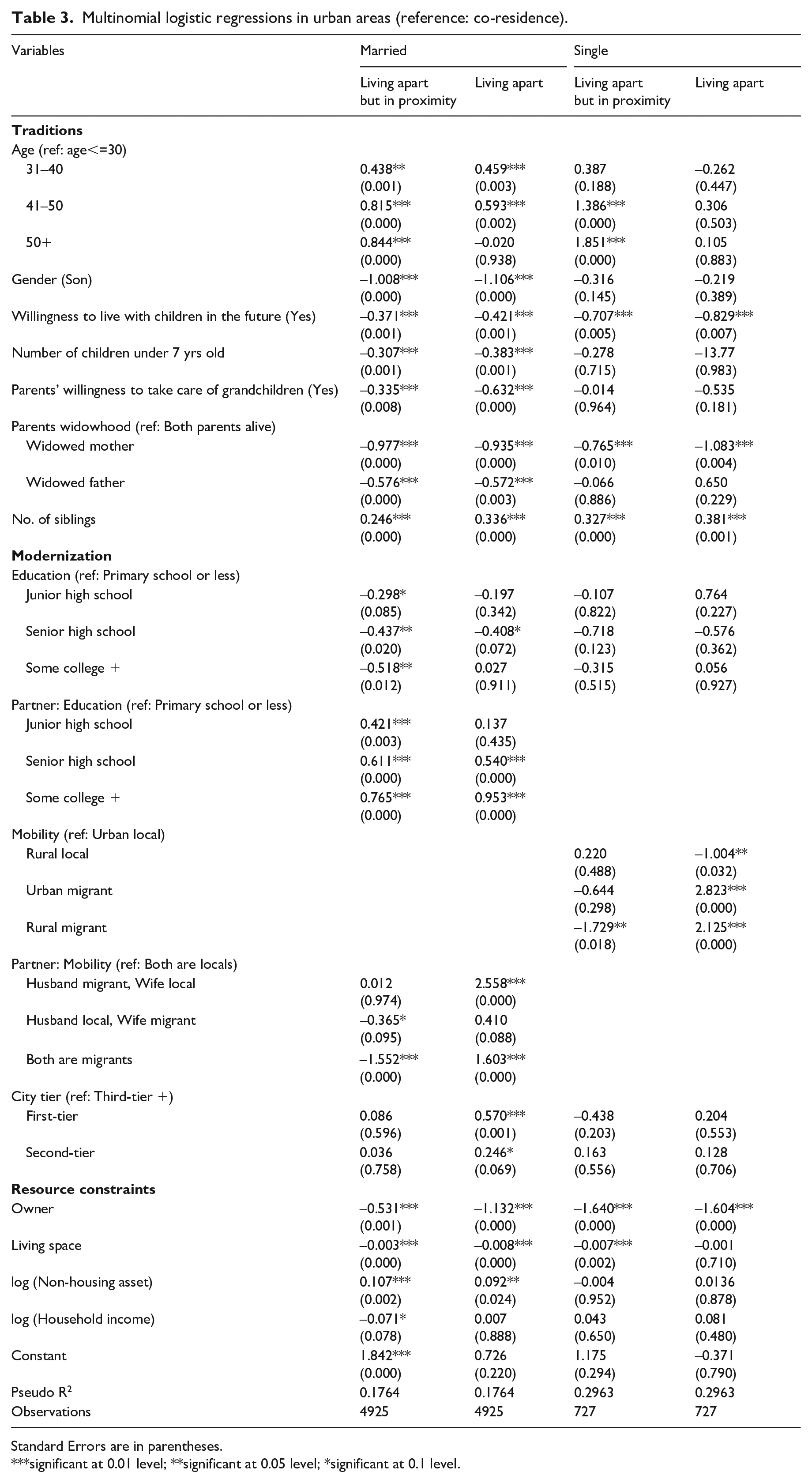
Standard Errors are in parentheses.
significant at 0.01 level; **significant at 0.05 level; *significant at 0.1 level.
Multinomial logistic regressions in rural areas (reference: co-residence).
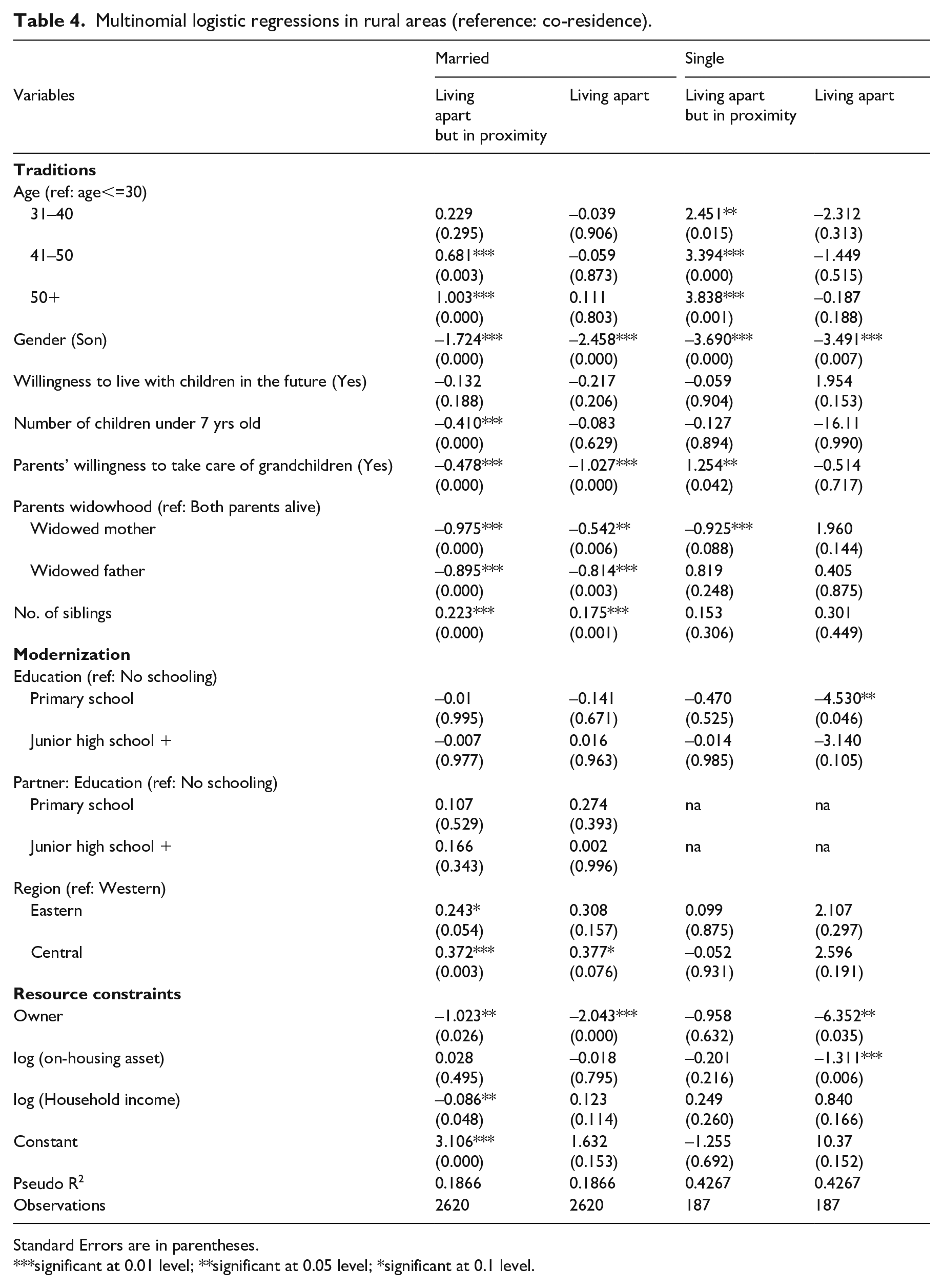
Standard Errors are in parentheses.
significant at 0.01 level; **significant at 0.05 level; *significant at 0.1 level.
Results on indicators for modernization are somewhat mixed. Educated married children are less likely to LAIP with their parents than co-residence but educated partners are more likely to LAIP and live apart. In other words, educated married children are more likely to live with their own parents but more likely to LAIP and live apart with parents-in-law. This paradoxical effect of education demonstrates the complex impact of education and how it interacts with gender on living arrangements. The gendered effect also exists for mobility. When both the husband and the wife are migrants, they are less likely to LAIP and more likely to live apart than co-residence. However, when the wife is a migrant and husband is a local resident, they are more likely to co-reside; when the husband is a migrant and the wife is a local, they are more likely to live apart from parents. This shows interactions between mobility and gender in shaping living arrangement. Residents in first-tier and second-tier cities are more likely to live far apart. In addition, homeowners and those with larger apartments are less likely to LAIP than co-residence. Interestingly, income and financial assets have the opposite effects as the former discourages while the latter encourages LAIP than co-residence. This shows more financial resources are needed to have two apartments to LAIP.
For single adult children, results are generally similar with a few important differences. For example, gender, parents’ willingness to take care of grandchildren, and father’s widowhood are not significant. This suggests gender specific obligations, potential childcare, and father’s need for elder care are not important to single adult children in deciding living arrangements. In addition, education and city tier are not significant, and migrants are less likely to LAIP but more likely to live apart. This shows that mobility is the main determining factor in living arrangements for single adults while education and city tier are not relevant. Furthermore, neither assets nor income are significant. In other words, for single adult children, living arrangement is mainly shaped by traditions, housing constraints, and migrant status.
Conclusion and discussion
After four decades of economic reform, China is now officially a middle-income country with a large middle class (Li, 2010). China has achieved the goal of economic modernization which leads by extension to the question of whether the Chinese family has also become “modern”. Long dominated by the “traditional family” with deep-rooted Confucian values, China has witnessed growing evidence of the “modern family”, such as lower fertility and smaller households, higher mobility, and greater gender equality in the family (Hu and Peng, 2015; Whyte, 2003; Zeng and Wang, 2018). This study finds that the process of modernization also appears to be true for living arrangements, although, as with so many changes in China, with unique Chinese characteristics. Co-residence between parents and adult children in 2013 is about 20%, which is much lower than that in the 20th century, and not very different from that in the West. There has been a significant shift to LAIP, now the dominant living arrangement in China, with about 60% of adult children living apart but in the same city/county with parents. This shift is consistent with Levy’s prediction (1949) about the Chinese family’s inevitable transition to the modern family, and with the empirical findings in the West on geographical proximity between parents and adult children (Compton and Pollak, 2015).
Despite the statistical shift, we find there are fundamental differences between the current Chinese family and the “modern family”. Instead of gender-neutral and children-centered as in the “modern family”, traditional values such as patrilocality and filial piety continue to shape living arrangements, although maybe in a somewhat different format. Sons, especially married sons, continue to co-reside with parents, and the family is centered on both parents’ and children’s needs. Instead of unidirectional support from children to parents as prescribed by traditional filial piety and from parents to children as in the modern family, reciprocal intergenerational support seems to be more relevant in contemporary China. Our empirical findings show that adult children with widowed parents especially widowed mothers and those with pre-school children are more likely to co-reside with parents. While inadequate services have been argued as one of the reasons for the high rate of co-residence in China before, we believe a reformulated filial piety is probably more important in the 21st century, as public and private services for childcare and eldercare have expanded significantly in recent decades. While contributing to low fertility and small household size that are often associated with the modern family, the one-child policy may have reinforced traditional co-residence. Progression towards the modern family is taking place, indicated by the importance of urbanization and economic development, and the fact that modernization related factors such as education are more important in urban areas than rural areas. However, gendered effects of education and mobility among married respondents and their partners reveal the paradoxical impact of modernization on living arrangements and its intersections with the traditional role of gender.
Previous research emphasized the lack of housing and financial resources in contributing to a high rate of co-residence in China. Recent housing reforms and rapid economic development have enabled Chinese families to make decisions that are more in line with their preference, rather than resource constraints. This study shows while more financial resources encourage LAIP, home ownership and decent housing conditions in fact encourage co-residence. This shows co-residence is a preferred living arrangement for some families. Meanwhile, LAIP allows both parents and adult children to achieve preferences in modern society such as independence and privacy, while fulfilling traditional obligations within the family. The prevalence of LAIP suggests it is a preferred living arrangement and may be here to stay as a unique Chinese family phenomenon.
The findings also suggest that the transition from traditional to the modern family may not be unidirectional, and Chinese families may be evolving in complex ways depending on the cultural context and economic conditions. LAIP may be not just an evolving solution to maintaining family connections and independent living, but also to the growing issues of how to care for aging parents. Eldercare in China traditionally relied on families, which has been challenged in recent decades with profound changes in the family and society. The government has also made it clear that eldercare is, in the main, to be provided by the family. While eldercare services have expanded rapidly in cities, they are very limited and precarious in rural areas (Zhang and Goza, 2006). Yet the hukou system has forced many migrants to leave their elderly parents behind and accelerated the transition to living far apart among migrants. This execrates eldercare in rural areas. Thus, reforms in the hukou system are needed, e.g., allowing migrants’ access to welfare benefits, to encourage migrants to bring elderly parents (and children) to cities. This may encourage co-residence and LAIP among migrants. This may seem to reverse the transition toward the modern family; it can alleviate the challenge in eldercare especially in rural areas. In particular, living in proximity may provide an alternative to co-residence to provide eldercare (and childcare), and reduce the burden on the state for service provision as the population is aging rapidly in China. Correspondingly, urban planning should consider the needs of both the elderly and young families with appropriate housing designs and amenities. This calls for mixed housing development with dwellings with different features and even tenures to make it easier for families to find appropriate units in the same/nearby community to facilitate living in proximity.
This research has two main limitations. First, we cannot untangle the role of preferences of parents and adult children though we expect it is a negotiated relationship. What is the actual decision-making process and the negotiation between parents and adult children to achieve such a living arrangement? Without data on their preference and qualitative data on the decision-making process, it is hard to answer these questions. Second, it is a cross-sectional study, a snapshot of living arrangements about one decade into the 21st century, which turns out to be rather different from that at the end of the 20th century. Whether living in proximity is a transitional state on the way to the modern family, or a unique adaptation of the modern family with Chinese characteristics is a study for longitudinal data. Despite these limits, this research provides fresh insight on parent-adult child living arrangements in China, and it also points to the growing challenges the society faces on the support for the rapidly aging population and the decline of the public support for eldercare, not just in China but globally.
Footnotes
Declaration of conflicting interests
The author(s) declared no potential conflicts of interest with respect to the research, authorship, and/or publication of this article.
Funding
The author(s) received no financial support for the research, authorship, and/or publication of this article.