



Abstract
Globalizing forces keep creating new “alien” or “introduced” species, but what should be done about these new nonhuman neighbors is contested. Arguments about whether species belong often bundle together claims about what is and what should be, which can create an uneven playing field that overlooks the diversity of human relations with new neighbors. This paper aims to distinguish a constructive path forward by distilling four ways that species are deemed to belong. From the literature, we identify nativeness, wildness, contributions, and right relations as distinct registers of belonging. We elaborate on the values and worldviews that each register enfolds, and who typically benefits from these regimes. Drawing from case examples, we show how this conceptual framework can help to expose the wider meanings and effects of new neighbors, broaden decision-making beyond technocratic debates, and compose new alternatives for conservation and wildlife governance.
Keywords
Introduction
A variety of global forces are bringing people into encounters with “new” nonhuman neighbors (Hobbs et al. 2006). In the history of Aotearoa New Zealand, trout were introduced to waterways by acclimatization societies who wanted to remake England in the Pacific. In North America, an invasive common reed is currently expanding its range through the Great Lakes basin, aided by human disturbance and climate change. In England, a family of beavers were illegally reintroduced into a Devon river by suspected wildlife vigilantes. And in Australia, feral camels that roam the central regions can be traced back to camels introduced in the 19th century for transport. Across these examples, human residents, including policymakers, have constructed different arguments about whether their new neighbors—often referred to as introduced, alien or invasive species—should be welcomed, removed, cultivated, or left alone (e.g., Figure 1; Crowley, 2014, 2017a; Thompson 2014; Gibbs et al. 2015; Reo and Ogden 2018; Tadaki et al. 2022).
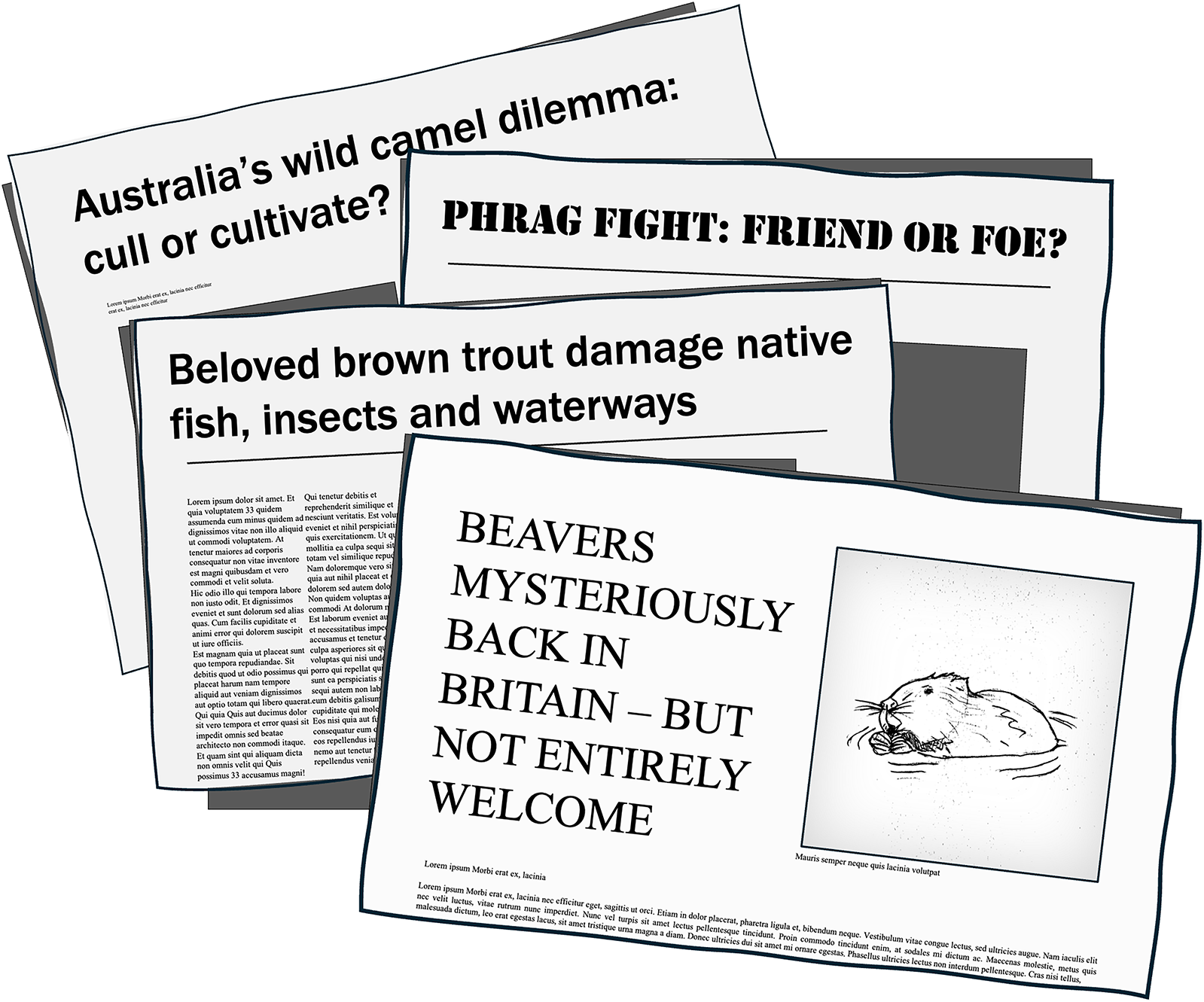
A Collage of News Headlines, Adapted from Real Articles, Highlighting a Variety of Responses to New Neighbors. These Issues Feature in the Conservation Realm, the Public Arena, and are Subject to Critical Research (see Main Text).
The societal status of species “belonging” is ultimately assigned by these arguments and their resulting actions (Biermann and Anderson 2017; Vermeulen et al. 2025). Decisions about which new neighbors belong in a place, and which do not, are made every day by a vast apparatus of actors: conservation and environment departments, biosecurity managers, gardeners, growers, farmers, trappers, consumers, hunters, traders, customary harvesters, cleaners, animal welfarists, exterminators, biologists, bureaucrats, and politicians, among others (Crowley et al. 2017b). In Aotearoa New Zealand, for example, community groups trap and kill “pest” mammals to protect native bird populations, while dung beetles are commonly imported to metabolize livestock feces, in support of major export industries increasingly confronted with environmental concerns and regulations (Russell et al. 2015; Pokhrel et al. 2021).
In the realms of conservation and environmental policy, species belonging is increasingly formulated as a technical exercise that produces seemingly objective answers (e.g., Gilroy et al. 2017; Essl et al. 2018; Lemoine and Svenning 2022). The International Union for Conservation of Nature (IUCN) notably launched the Environmental Impact Classification for Alien Taxa (EICAT) framework, providing an “objective and transparent” cost–benefit tool for classifying and prioritizing invasive alien species according to the severity of their environmental impacts (Blackburn et al. 2011; Kumschick et al. 2024). Meanwhile, scientific and technological developments in molecular genetics promise ever-finer clarity on populations’ evolutionary origins, which can then be employed to determine which ones should be conserved or removed (Hennessy 2015; Biermann and Havlick 2024). In these ways, environmental scientists and authorities aim to objectively and categorically decide which species and populations are in the right place, to be cared for; which ones are out of place, to be targeted or left to die; and which ones we must learn to live with (Atchison and Head 2013; Biermann and Mansfield 2014; Srinivasan 2014; Biermann and Anderson 2017; Fleischmann and Everts 2024).
However, in our world of continuous movement, technical solutions are failing to provide a satisfactory basis for managing new neighbors. A corpus of geographical thinking has shown that “fixed ideas of belonging no longer work” (Gibbs et al. 2015: 58); species routinely exceed intentional human control as they move across geopolitical boundaries, whether human-assisted or independently (Sundberg 2011; Hodgetts and Lorimer 2020). Migratory species such as terns (Newman 2025) and eels (Zumbrägel 2025) travel from one side of the world to another each year, while “invasive” plants are expanding their territories through intentional human movement and on their own accord (Head and Atchison 2009; Reardon-Smith 2025). Maritime trade has been identified as a key cause of species mobility, including algae, insects, and molluscs attached to ship hulls, carried in ballast water, or tangled in fishing tackle (Hulme 2009)., as species are forced to transgress their historic ranges through climate-driven range shifts, past arrangements can no longer provide an adequate guide for the future (Pecl et al. 2017). In contexts where nativeness has historically served as a key indicator of what does or does not belong, the matter of whether these “climate refugees” should be welcomed is less clear and increasingly contested (Minteer and Collins 2010; Urban 2020).
Social values provide another basis for opening up how we decide species belonging, including by querying how such decisions reflect status quo patterns of influence in society (e.g., Hattingh 2001; Trigger et al. 2008; Thompson 2014; Estévez et al. 2015; Kapitza et al. 2019; van Eeden et al. 2019; Atchison et al. 2024; Reardon-Smith 2025; Vermeulen et al. 2025). Management of new neighbors is typically guided by scientific and economic priorities, with less attention given to who decides, what kinds of knowledge are included, and who wins or loses (O’Gorman 2014; Reo et al. 2017; Fry 2023). For example, relations with nature that emerge more through lived experience have often been marginalized in conservation politics (Forsyth 2004; O’Neill et al. 2007; Whyte 2018). Meanwhile scientific and technical processes such as the IUCN EICAT framework tend to bundle together claims about what is with a suite of values and moral assumptions about what should be (for example, what kinds of impacts are “good” or “harmful”; Castree 2008a, 2008b). Critical scholars have illustrated how moving these values—and what is really at stake—away from scrutiny can create an uneven playing field determined by power, in which decisions become difficult to contest (e.g., Escobar 1998; Adams 2004; Lorimer 2012; Biermann and Mansfield 2014; Castree 2014).
Global trade and scarce conservation resources mean that we can expect conflict over new neighbors to continue and perhaps increase (Pyšek et al. 2020). Defaulting to technocratic arguments risks reinforcing historical power dynamics and overlooking the broader issues (e.g., capitalism, colonialism) and diverse human values that are at stake (Reo and Ogden 2018; Layden et al. 2025). For people—not just specialists—to question, take responsibility, and intervene in the politics of species belonging, we need to untangle and expose the social bases of these arguments. Amid the extensive body of work on values and nature, critical scholars have been working to bring a wider range of values to light in the context of species belonging, to analyse how belonging is argued and negotiated, and to unpick rather than suppress the diverse worldviews that underpin these arguments. An urgent next step is to organize these ideas in a way that allows people to grasp who and what is at stake.
This paper aims to help distinguish a path forward by identifying coherent social bases upon which belonging can be ascribed; how are species deemed to belong or not? Our typology is not intended to be comprehensive, but rather to provide an initial practical means of understanding different perspectives on new neighbors. We begin the next section with an overview of how concepts of belonging have been developed in the literature. We then introduce four “registers” of belonging and elaborate their underpinning logics and biophysical consequences. Finally, we discuss how these registers can assist decision-making about new neighbors.
The Multiple Registers of Species Belonging
When encountering new nonhuman neighbors, a variety of arguments about their belonging may ensue. We use the term “new neighbours” to foreground the relation between human and nonhuman entities, in the sense of relations that did not exist prior to some designated point (thus “new” neighbors can also be “old” neighbors returning, such as reintroduced beavers). We use the concept of belonging because it implies a process of social value assignment, and a normative determination of what is “meant ‘to be’ in a place” (Mee and Wright 2009: 772).
Geographers, anthropologists, and philosophers, among others, have often turned to concepts of belonging to understand which nonhuman entities are seen as fitting somewhere, and why (e.g., Mee and Wright 2009; Lavau 2011; Head et al. 2014; Gibbs et al. 2015; Martin and Trigger 2015; Crowley et al. 2017a). Lesley Head (2012), for example, shows how Australian plants can belong if they are deemed native or natural, and interrogates the boundary-making practices that underpin these categories. Drawing upon Indigenous ontologies, Sarah Wright (2015) and Bawaka Country et al. (2016), among others, reason that belonging is not solely about what humans deem to fit in a place, but the emergent co-constitution of humans, more-than-human beings, and place (Wright 2015). Building upon this, Tom Fry (2023) examines the role of nonhuman agency and social power in shaping (or challenging) the belonging of a reintroduced sea eagle. Emily O’Gorman (2014: 286) argues that by attending to both power and relationality, concepts of belonging can help us to unearth “the contested spaces of biocultural relationships; how they are created and contested and with what consequences for whom?”
To address the question of what to do with new neighbors, we employ a concept of belonging that foregrounds matters of social choice and power. Belonging certainly involves more-than-human elements, and humans are not infinitely powerful in enforcing any particular status (Wright 2015; Fry 2023). Our focus, however, is on the specific roles and responsibilities of humans in designating belonging, recognizing that people have differential abilities to designate and enact their preferred belonging status. By highlighting the roles of social choice and power, we aim to help shift belonging from a technocratic to an analytical question that enables people to debate the value of decisions and processes as well as their (intended) outcomes. We additionally find belonging useful for broadening participation beyond the technical debates introduced above because it is an “everyday theory with everyday resonance” that can encompass a diversity of experiences and ideas (Wright 2015: 404).
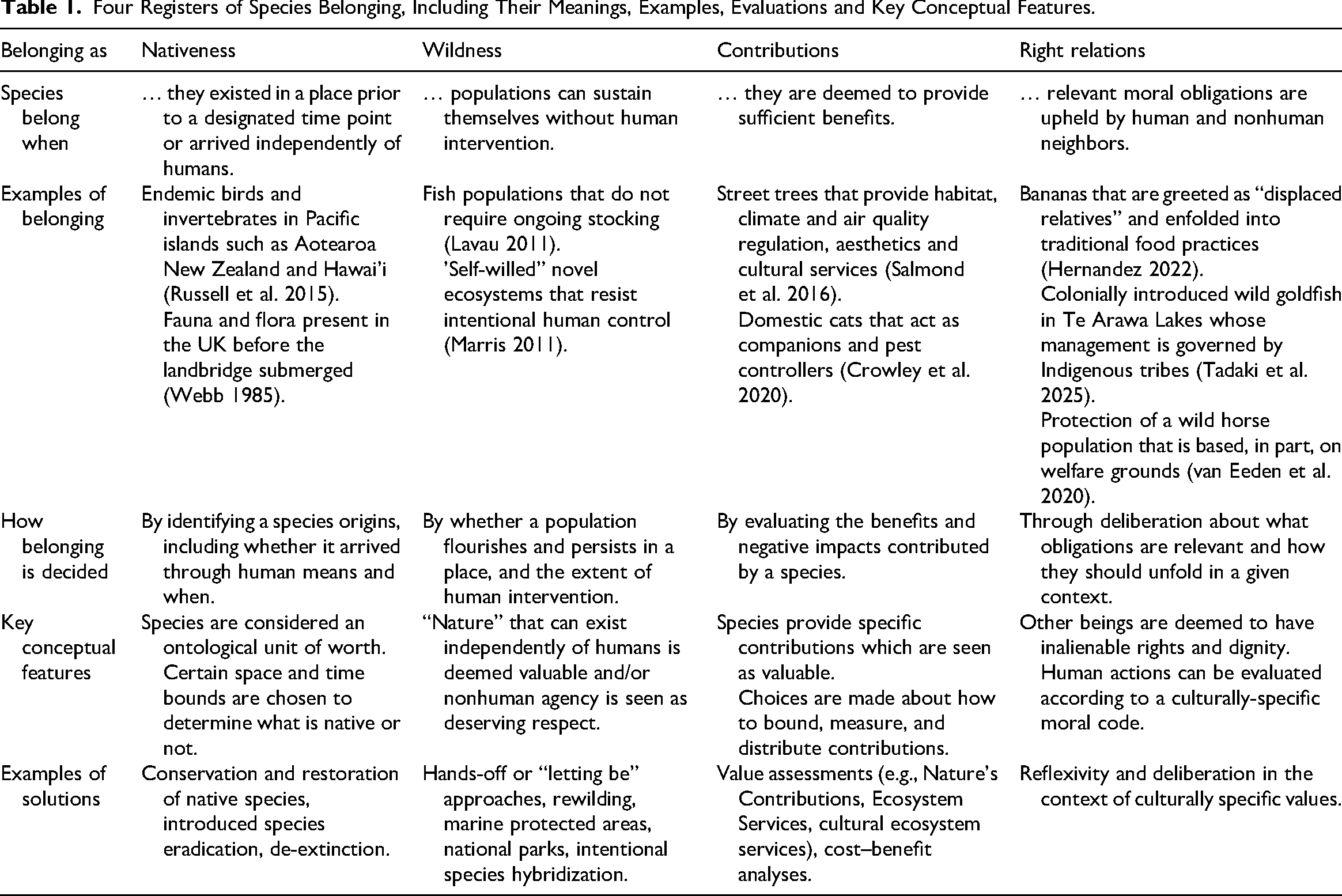
To address the question “how are species deemed to belong,” we conducted a theoretical exploration of literature on the social dimensions of introduced species. We probed the literature for arguments about new neighbors and their belonging, aiming to cover a wide taxonomic and geographical breadth of studies across conservation science, environmental geography, Indigenous studies, and the humanities. Once we had canvased what we deemed to be a sufficiently comprehensive range of arguments, we then identified and grouped patterns of assumptions, moral commitments, and discourses of worth that reflect “shared ways of apprehending the world” (Dryzek 1997: 8). From this process we constructed nine recurring arguments of belonging, which over time we distilled to seven and ultimately four (Table 1). We refer to these recurring families of argument as “registers” of belonging, to acknowledge that they are not mutually exclusive. For each register, we elaborated on key meanings, actors, and conceptual features. Finally, we tested and refined the registers by applying each to a variety of examples, drawn primarily from our own academic investigations and lived experiences with new neighbors in Aotearoa New Zealand, Australia, North America, and the UK.
Four Registers of Species Belonging, Including Their Meanings, Examples, Evaluations and Key Conceptual Features.
Belonging as Nativeness
When encountering new neighbors, a primary aim may be to preserve the tree of life as it has evolved in its home places (Soulé 1985). Species which arrived or evolved in a place before human “impacts” (see below) are generally considered native to that place; nativeness provides a criterion for deciding whether humans should undertake efforts to support them to exist there (e.g., Pyšek et al. 2004; Essl et al. 2018; Pauchard et al. 2018; but see also Kaplan et al. 2022). Under this rationale, flightless birds which evolved in New Zealand belong, whereas colonially introduced mammals do not belong (e.g., Russell et al. 2015); red squirrels which arrived in the UK before glaciation belong while recently arrived gray squirrels do not belong (Crowley et al. 2018). Nativeness arguments are thus often about preserving the species compositions of places that existed before a defined moment in time (Head 2012; Warren 2023). Humans can be seen as stewards of biodiversity, responsible for sustaining a “Garden of Eden”-like diversity of species, for preserving the irreplaceable coevolutionary relationships between these species and their ecosystems, and for making reparative efforts to address, or undo, past human actions (Adams 2004; Biermann and Mansfield 2014). Morally, appeals to nativeness invoke the sustenance of a natural order which is pure and uninfected by human desires, powers, and projects such as capitalism and colonialism (Smith 1984). By assuming that the full prehuman spectrum of species ought to continue existing, ideally in their places of origin, belonging-as-nativeness seeks to sustain the balance of global and local biodiversity.
Nativeness arguments are wielded by diverse actors in conservation, often in service of scientific or technocratic priorities. Scientists seek to clarify species’ evolutionary histories through integrative taxonomy and biogeography; conservationists raise public awareness of the ecological importance and intrinsic value of native biodiversity, and the damage that can be caused by introduced species; while policymakers and advisors mobilize efforts to control or eradicate non-native species (e.g., Soulé 1985; Russell et al. 2015; Essl et al. 2018; IPBES 2023). Chew and Hamilton (2010) trace the origins of nativeness back to 19th century botanists who adopted concepts of human citizenship from English common law (such as “alien,” “natural-born,” and “denizen”) into plant classifications. In the mid-1900s, early invasion biologists such as Charles Elton linked increasing influxes of non-native species to the demise of native populations (Chew and Hamilton 2010). While social and biophysical scientists alike have subsequently sought to distinguish between nativeness and invasiveness (e.g., Brown and Sax 2004; Head and Muir 2004), the concepts are often blurred in popular and scientific discourse. Charles Warren (2023: 288) argues that for many non-native species, their “unnaturalness renders them unwelcome in principle.”
Nativeness relies upon (1) species as an ontological unit of worth and (2) spatiotemporal bounds that are both constructed and political. Biodiversity can be conceptualized at several different levels, including genetic diversity (e.g., an individual's genome, and a population or species’ genetic diversity), species diversity (e.g., the categories used to classify organisms, where organisms are grouped into families according to shared characteristics), and ecosystem diversity (e.g., a set of living and non-living entities which interact in a given region). Species are typically the primary object of conservation (Braverman 2015; Srinivasan 2014), having “value in themselves, a value neither conferred nor revocable, but springing from a species” long evolutionary heritage and potential or even from the mere fact of its existence’ (Soulé 1985: 731). While scientists traditionally worked to classify species as distinct, stable and linearly evolving units, an increasing understanding of evolutionary processes has given rise to a web-of-life view, where speciation is not always entirely complete (e.g., Coates et al. 2018). For example, interbreeding or hybridization has proven more common in animals than previously thought, with instances expected to increase through climate change and globalization (vonHoldt et al. 2018). This poses difficulties for the technocratic project of conservation, where hybrids are typically seen as threats to the continuance and integrity of species (e.g., through extinction by introgression): Hybrids that carry both native and non-native ancestry are especially likely to be seen as “unnatural” and not belonging, as they destabilize both the ontological unit of species and the native-alien binary (e.g., Fredriksen 2016; Havlick and Biermann 2021; Hennessy 2015).
Underpinned by the ontological category of species, nativeness arguments posit a temporal horizon to designate belonging, as well as some spatial scale (e.g., river, biome, nation, planet) to which desired belonging is meant to apply (Head 2012; Warren 2007, 2023). For something to be native, and to belong to a “place,” the place itself must be bounded and constructed. To establish a baseline against which human intervention can be evaluated, there must also be some time period to which nativeness is assigned (Head 2008). Warren (2007: 431) summarizes, “No species is inherently alien, but only with respect to a particular environment at a particular moment.” Nativeness thus provides a territorial- and temporal-based argument about the conditions of inclusion in a socially constructed unit of the ecological polity (Head 2012). When applied globally, for example, all species which evolved on Earth independently of humans can be considered native—therefore all belong and are worthy of conservation. Such global discourses are adopted by scientific organizations such as the IUCN and IPBES, which use global species rarity to compile lists of native species and assign classifications (e.g., Threatened, Critically Endangered) to argue for greater regulation or resource mobilization for species conservation (Braverman 2017). Similarly, in contemporary renditions of “Noah's Ark” such as gene-banking, scientists and philanthropists work to preserve genetic material of rare and threatened species to help maintain diversity and insure against their future loss (van Dooren 2009).
Down from the scale of the global, territorial imaginaries give the categories native and alien their meaning. For flightless birds such as kiwi in New Zealand, territorial boundaries could be drawn nationally or around particular forests; conservation efforts aim to promote kiwi flourishing to a target abundance of pre-European arrival. Geographers, among others, have shown how such spatial and temporal boundaries are always socially constructed (e.g.,Smith 1984; Harvey 1996). Choices about which boundaries to construct, and to whom they should apply, imbue cultural assumptions about how nature is constituted and what kinds of relationships with new neighbors should be aspired to (Head 2012). Nativeness arguments invoke a worldview in which humans are set apart from nature and the “natural” (Smith 1984; Castree and Braun 2001; Whatmore 2002). Indeed, since humans are themselves excluded from “alien” species designations, and designations are typically defined in relation to human “impacts,” nativeness implies an ontological distinction between humans and nonhumans (Head 2012). Further, when designating temporal thresholds, human impacts are often deemed to begin with the arrival of European colonists such that Indigenous communities are by default relegated as Other or to “Nature” (Head 2008; Plumwood 2012; Fletcher et al. 2021). Analysing constructions of plant nativeness in Australia, Lesley Head (2012: 176) observes, “The boundary that we put around plants and animals is revealed … to be a boundary around the European human.” Through these processes of boundary-making—around space, time, and species—nativeness tends to enfold and reproduce colonial logics (Head 2012; Warren 2023). Critical scholars have further observed that in aiming to preserve or restore “community purity” based on these boundaries, nativeness arguments unavoidably parallel xenophobic and racist rhetoric (Hettinger 2001; O’Brien 2006).
Belonging as Wildness
Some new neighbors belong if they can take care of themselves. Wildness denotes self-agency and autonomy (Nash, 1967; Ridder 2007; Vannini and Vannini 2016, 2019); wild species belong because they can exist of their own accord. In her study of the Goulburn River in Australia, Stephanie Lavau (2011: 55) observes of river practitioners who are critical of fish stocking: “Stocked or domesticated fish populations (fish born and bred elsewhere) are bad; self-sustaining fish populations (those born and bred in the river) are good … An authentic river is one of ‘real’ fish that were born in the river, that can survive the rigors of river life, and that do not respond to a dinner bell.” Or as Havlick and Biermann (2021: 1207) write, “The longer a population remains in a watershed successfully reproducing, the wilder, in a sense, that population becomes … Wildness in the context of trout populations sounds like a relatively simple matter to evaluate: Are the fish reproducing and sustaining themselves generation after generation?” While nativeness and wildness both locate intrinsic worth in nature, belonging as wildness values that which is autonomous and self-sustaining, rather than a species’ place of origin.
Some actors argue that new neighbors can belong if they self-sustain in a place. Anglers and fisheries managers may prefer self-sustaining non-native populations over vulnerable native ones (Havlick and Biermann 2021). Rewilding practitioners might selectively introduce species based on how much they are likely to promote independently evolving ecosystems (Lorimer et al. 2015; Perino et al. 2019). Conservation scientists might consider moving, mixing or even genetically engineering species to increase their evolutionary resilience (Hoffmann et al. 2020; Schwartz et al. 2025). Meanwhile “new conservationists” have argued humankind should learn to live with our new neighbors, who might even help ecosystems withstand future changes (Marris 2011; Vermeulen et al. 2025).
Compared to nativeness, wildness implies a more flexible approach to encountering new neighbors. Wildness arguments can permit or even embrace change from historical states (e.g., Thomas 2020). Precisely what course of action they imply, however, depends on whether the argument is primarily about respecting nonhuman agency or reducing human intervention. Consider the Resist-Accept-Direct framework used by environmental managers (Schuurman et al. 2022): nativism can be seen as resisting change; respecting nonhuman agency as accepting the transformation and managing as best as possible; and pursuit of self-sustaining populations (i.e., reducing human intervention) as directing ecosystems toward a new ecological condition.
One narrative of wildness is about reducing the dependence of nature on continuous human intervention. According to this logic, new neighbors can be welcomed if they increase the overall ability of a population or an ecosystem to self-sustain. In North America, for example, genetically “pure” American chestnuts suffering from blight were felled and burned, replaced by blight-resistant trees produced through hybridization with Japanese and Chinese chestnut species (Biermann 2016). This narrative of wildness implies a vision of “wild” nature that is “synonymous with uninhabited, natural, and untouched” by humans (Nash, 1967; Cronon 1995; Vannini and Vannini 2019: 253). Critical scholars have traced the political dimensions of this vision, such as land grabs to establish national parks and wilderness areas (e.g., Callicott and Nelson 1998; Spence 1999; Jacoby, 2014). Anishinaabe philosopher Kyle Whyte (2024: 74) writes that terms associated with “wild,” and the meanings and imaginations behind them, “denigrate Indigenous peoples” land management practices, land tenure systems, science and knowledge systems, and political sovereignty and self-government’, in part because of their roles in “justifying wrongful land dispossession and colonial conquest.” The contradictions of pursuing “self-sustaining” nature through intensifying human intervention have not gone unnoticed either. Von Essen and Allen (2016: 80) argue that “the autonomy of nature in rewilding is more rhetoric than reality,” and Wynne-Jones et al. (2020: 74) similarly conclude that, “Paradoxically, in seeking to loosen control, rewilding highlights how much ordering and management is at the heart of the conservation project.”
A second group of wildness arguments invoke a respect for nonhuman agency that eschews nature-society dualisms (e.g.,Whatmore 2002; Plumwood 2012; Collard et al. 2015). Geographer Kim Ward (2019: 51) articulates a concept of wildness which acknowledges and allows for nonhuman independence and self-governance “while not restricting ‘wild nature’ to wilderness spaces.” Similarly, Vannini and Vannini (2019: 268) call for wildness to be distinguished from wilderness and understood instead as “relational aliveness, relational autonomy, and a vitalist freedom from control and captivity.” Wildness in this sense does not only apply to animals and plants which live independently of human interference, but to garden weeds, urban pigeons and coyotes who make their homes among the presence of humans or in human-modified environments. Species can be seen as designating their own belonging—new neighbors whom we may need to learn to live with.
These ideas can also be found in popular writing around novel ecosystems and rewilding, particularly in European contexts where “pristine” nature may no longer be perceived to exist (see Drenthen 2015). Environmental writer Emma Marris advances a more “nuanced notion of a global, half-wild rambunctious garden, tended by us” (Marris 2011: 2), while George Monbiot (2013) writes of rewilding, “It's about abandoning the Biblical doctrine of dominion which has governed our relationship with the natural world.” However, these arguments also recall the political and ecological realities of living with our more unruly neighbors (Drenthen 2015). For example, in an ethnographic study of rewilded boar in England, O’Mahony (2020: 120) observes that, due to the perceived impacts of a growing wild boar population, “for some people, tolerance of wildness and autonomy has transitioned to intolerance.” Indeed, a variety of actors have drawn attention to the wider implications of approaches such as rewilding, including who benefits from or bears the costs of ceding human “control” (Perino et al. 2019; O’Mahony 2020; Hodgetts and Lorimer 2020).
Belonging as Contributions
New neighbors might also belong if their contributions or “impacts” are deemed sufficiently beneficial (Cordell et al. 2021; Sax et al. 2022). Species which contribute sufficient benefits by existing in a place can belong, while those deemed to contribute, on balance, threats or costs do not. To supply timber and habitat, certain trees may be cultivated while less suitable species are removed to free up space, light, and nutrients (Head et al. 2014). In Aotearoa New Zealand, introduced trout are popularly fished and stocked in waterways for food and recreation. Meanwhile populations of weka, a native flightless bird, have been relocated from offshore islands because they predate on other native species. By naming a species' contributions and determining whether, and to whom, those contributions can be beneficial or costly, people seek to justify which new neighbors belong, and which do not.
A plethora of actors aim to systematically evaluate and/or predict the contributions of new neighbors (e.g., Pfeiffer and Voeks 2008; Blackburn et al. 2011; Schlaepfer et al. 2011; Larson et al. 2011; Hanley and Roberts 2019; Kourantidou et al. 2022; Sax et al. 2022). Invasion biologists investigate and raise awareness of the ecological impacts of new neighbors (Blackburn et al. 2011); environmental economists, ethnobiologists, ecologists, and geographers, among others, employ a variety of approaches to understand how biodiversity more broadly contributes to certain social and ecological goals (Tadaki et al. 2015; Pascual et al. 2023). Conceptual frameworks such as Nature's Contributions to People assist with assessing a broad suite of contributions at a global scale (e.g.,Pascual et al. 2017; Díaz et al. 2018). Other frameworks focus on specific kinds of valuation, from market-based (e.g., total economic value; Costanza et al. 1997) to more relational and nonmaterial (e.g., cultural ecosystem services; Raymond et al. 2014; Gould et al. 2015, 2019a; Chan et al. 2016). Within this register, we include contributions deemed to primarily involve other nonhuman interests (e.g., habitat provisioning) because they still require a human agent to evaluate nature's worth to nature.
To evaluate the contributions of new neighbors, two key steps are typically involved: bounding and measurement. First, there must be a choice about what goals the contributions should be evaluated against; this “effectively bounds the analysis by allowing certain ecological components in and excluding others” (Tadaki et al. 2017: 7). For instance, goals might be cultural (e.g., sustaining certain rituals and traditions), economic (e.g., increasing capital), or environmental (e.g., enhancing habitat). The second step of evaluating new neighbors’ contributions is to decide whether contributions should be made measurable, and by what means. Measurement involves quantifying benefits and costs in a way that permits the value of different things to be made comparable or commensurable; this is typically achieved through monetary or biophysical means, which are seen as providing a consistent and universal measure of value (O’Neill et al. 2007). By locating value not in species or nonhuman individuals per se, but in their contributions, new neighbors can be compared against and potentially substituted for another species if they have a similar exchange value.
Both bounding and measurement involve “political work and not just scientific judgement” in deciding which goals matter, and what kinds of measurement should apply (Tadaki et al. 2015: 168). For instance, frameworks such as IUCN EICAT have been criticized for excluding potential beneficial contributions of non-native species by explicitly framing the analysis around the benefits of native biodiversity and negative impacts of non-native biodiversity (Sax et al. 2022; Cassini 2023). Similarly, evaluating contributions against economic goals may indicate the monetary benefits or costs of a new neighbor, but exclude their cultural or ecological values (Pfeiffer and Voeks 2008). Further, value and its measurement are often framed by hegemonic groups in society who decide what a benefit is and to whom such benefits matter (O’Neill and Spash 2000; Tadaki and Sinner 2014; Ravi and Hiremath 2024). Interviewing local residents about invasive and non-invasive plants in northeastern Brazil, Dos Santos et al. (2014: 296) observe that “the frame of reference for what is considered harmful is often politically and economically motivated … [and] measured from the perspective of industrial- and national-scale interests—forestry, agriculture, fisheries, and tourism. What is frequently missing from this calculation is the perspective of people living in close association with botanical resources, whose primary interests are local rather than regional or national, and for whom otherwise ecologically harmful species may in fact be assets.”
Measurement is considered by some to be neither appropriate nor adequate for understanding new neighbors’ contributions. Critical geographers, among others, have argued that quantitative approaches imply substitutability among things that may not be substitutable, render nonmaterial kinds of value invisible or underappreciated, and exclude or further marginalize already marginalized groups (e.g.,West 2005; O’Neill et al. 2007; Gibbs 2010; Gómez-Baggethun and Ruiz-Pérez 2011; Wegner and Pascual 2011; Chan et al. 2012; Allen 2018). Alternative approaches, such as cultural ecosystem services, aim to accommodate context-specific and nonmaterial environmental values through qualitative and participatory methods (Chan et al. 2012; Satterfield et al. 2013; Raymond et al. 2014; Craig et al. 2019; Gould et al. 2019b). Despite allowing for greater inclusivity, these approaches are often overlooked or subsumed by instrumentalist framings (see also a wider corpus of work around the “neoliberalisation of nature,” e.g., Bakker 2005; Bigger et al. 2018; Castree 2008a, b).
Political work is not only found in bounding and measuring the contributions of new neighbors, but in deciding how to distribute their benefits and costs (O’Neill and Spash 2000; Tadaki and Sinner 2014). Environmental valuation often assumes that absolute benefits and costs are homogenous and substitutable: If there is net positive gain, and winners can pass the benefits onto “losers,” then society benefits overall (O’Neill et al. 2007). This assumption rarely eventuates; benefits and costs tend to be unevenly distributed among different social groups, and across space and time (Forsyth 2004; Gómez-Baggethun and Ruiz-Pérez, 2011). For example, to make way for trout (culturally significant to European colonists) in Aotearoa New Zealand, eels were methodically culled despite their cultural and economic significance to Indigenous Māori. Trout fishing licenses were largely restricted to middle-upper class European citizens. Meanwhile, some Māori were prosecuted for unlicensed harvesting of trout at the same time as their traditional fishing rights were denied (Chanwai and Richardson 1998). Today, the belonging of trout is contested in many watersheds, in part because of this governance regime (as we discuss in the next section), but also because of the threats posed by trout to valued native fish and the cultural practices associated with them (Tadaki et al. 2022). Similar treatments of Indigenous rights in fisheries governance have occurred elsewhere, including in South Africa and Canada (Bodwitch et al. 2024; Nustad et al. 2025).
Belonging as Right Relations
A newcomer can also be said to belong when moral obligations surrounding them have been met, and the right relations are upheld. In this logic of belonging, new neighbors are understood to have a moral essence that invokes certain obligations for the host community, as well as the newcomer (e.g.,van Dooren 2011; Reo and Ogden 2018; Inglis 2020). The host community determines relevant obligations; the right relations for belonging result when decisions and actions involving the newcomer uphold these obligations. Belonging as right relations thus depends upon human actions too, while explicitly exceeding human interests (Gibbs 2024). For example, a variety of Indigenous customary laws and procedural frameworks (e.g., animal welfare principles) establish certain moral codes against which human actions in relation to new neighbors can be evaluated (e.g., Reo and Whyte 2012; Inglis 2020; Wehi et al. 2023).
With this register, we acknowledge a wide swathe of research and thinking from Indigenous worldviews and moral philosophy, which start with the primacy of relationships of obligation. In the following examples, we lean into our team members’ personal connections to Anishinaabe (NR) and Ngāi Tahu (JK, RPR) communities and our wider experiences working in Indigenous collectives. Our understandings of right relations are drawn from these contexts, however we see resonance with relational thinking in other Indigenous spaces. These include practices of Caring as Country, as described by Bawaka Country including Suchet-Pearson et al. (2013) and trawlwulwuy woman Lauren Tynan (2021); kincentric ecologies articulated by Rarámuri (Tarahumara) scholar Enrique Salmón (2000); and the principle of Indigenous Place Thought developed by Haudenosaunee and Anishinaabe scholar Vanessa Watts (2013); among numerous others (e.g.,Marsden and Henare 1992; Cajete 2000; Helander-Renvall 2010; Todd 2014; de la Cadena 2015; Tallbear 2019; Arnold et al. 2021; Hernandez 2022). We also see similarities with non-Indigenous thinking in more-than-human scholarship (e.g.,Whatmore 2002; Haraway 2008), multispecies ethnographies (Ogden et al. 2013; Tsing 2015), compassionate conservation (e.g., Inglis 2020), and philosophical traditions such as deontological ethics and feminist care ethics (O’Neill et al. 2007; de La Bellacasa 2010).
Right relations arguments focus on what is morally right and rely less on making claims about how the world is. This shifts emphasis away from new neighbors as simply “good” or “bad,” and onto the wider decisions and processes associated with their presence. Aboriginal elders and rangers describe weed management in Australia as not about control, but the obligations to care for Country, and to treat “cheeky” kin fairly. This view “refocused weed work from an attack on the weeds themselves towards the processes that are responsible for allowing weeds to spread and make country unhealthy,” and led rangers to adopt alternative management approaches (Bach and Larson 2017: 577). Right relations arguments thus imply relational and obligation-based responses that do not just ignore or remove the newcomer. This is not to claim that right relations arguments are without their own exclusions, but rather that they present alternative epistemologies and institutions to status quo environmental politics.
One form that right relations can take is about acting respectfully toward new neighbors. This can include upholding welfare principles, turning to plant or animal relatives for guidance about how to respond, expressing thanks and sorrow when harvesting or killing, and the use of ceremonies and rituals (Reo and Whyte 2012; Reo and Ogden 2018; Wehi et al. 2023). Based on Anishnaabe teachings, newly arrived plants and animals can be understood as members of plant and animal nations who may be participating in their own migration stories (Reo and Ogden 2018). Every being is understood to have unique roles and responsibilities that are guided and governed by original instructions (Johnston 1990; Clark et al. 2022); thus these migrations could potentially be the path intended for these nations by the Creator. From this derives a moral responsibility to understand each newcomer's creation story and to consider how their unique gifts relate to the rest of creation (e.g., for hybrid cattails and introduced common reed; Reo and Ogden 2018). For some newcomers such as the sea lamprey in the Upper Great Lakes of North America, there are diverse perspectives around appropriate stewardship, which can include opposition to certain control methods such as lampricide and fish barriers (Mattes and Kitson 2021; Nonkes et al. 2023). The use of lampricides, for example, is seen by some Anishnaabe community members as an “easy way” out that does not respect the sea lamprey or “account for Indigenous teachings in certain contexts” (Mattes and Kitson 2021; Nonkes et al. 2023: 153). Some community members have insisted that more attention be paid instead to the “alien thought” and “invasive ideologies” of human newcomers that prioritize economic growth over caring for the water or the land (Reo and Ogden 2018; Nonkes et al. 2023).
Another set of right relations arguments imply certain processes of decision-making to uphold. For many people, decisions about new neighbors need to be justified and follow due process (e.g., Reo et al. 2017; Crowley et al. 2019; Tadaki et al. 2022). In Aotearoa New Zealand, the recreational benefits of trout have largely accrued to colonizers, they threaten other valued species, they often require ongoing human management to persist, and they are not native. Yet Tadaki et al. (2022) show how for some people, these issues matter less; the primary reason that trout are seen as out of place is because their management has been exclusionary and diminished people's connections to nature. A Māori knowledge holder interviewed about trout concluded, “I don’t have a problem with trout and salmon; I have a problem with management” (Tadaki et al. 2022: 470). Similarly, Mercier et al. (2022) and Wehi et al. (2023: 1407) argue that the diversity of relations with new neighbors in Aotearoa New Zealand “emphasises the importance of tikanga (the ‘right’ way of doing something according to cultural protocols) for decision-making.”
Right relations also imply a deliberative process to determine which obligations should be upheld, by whom and how. Moral obligations exist in a wider ensemble of relationships, values and meanings that vie for priority; what one person considers to be a relevant obligation or suitable procedural criteria may differ for another. Writing of broader Indigenous contexts, Wehi et al. (2023) reflect that, “Managers of Indigenous lands, as well as those leading Indigenous environmental programs, find themselves weighing conflicting responsibilities and perspectives related to both social and environmental justice in order to decide which plants and animals belong within a restored landscape.” Because right relations arguments are explicitly about what should be done, they point to a process for deliberating and agreeing upon which obligations are to be upheld, how.
Negotiating right relations can become more complicated as the scale and stakes increase (Harvey 1996). Animal welfare principles, for example, aim to set out common norms and regulations for the ethical treatment of animals but understandings of what it means to relate to nonhuman kin in ethical ways varies by place and cultural context (e.g., Lynn 1998; Reo and Whyte 2012; Hovorka 2017; Winter 2019). New neighbors can also disrupt or strain obligations to existing community members, for instance, by displacing local plants and animals (Reo et al. 2017). Some communities are actively working to reconcile conflicting right relations across cultural and geographical contexts. For example, a meeting was recently held between Aboriginal and Māori communities to deliberate the killing and care of colonially introduced common brushtail possums in Aotearoa New Zealand (Paewai 2024). Possums are widely perceived and culled as a harmful “pest” in Aotearoa New Zealand, sometimes using methods that induce significant suffering to target and non-target individuals (Palmer and McLauchlan 2023). Meanwhile in Australia possums face several threats, and hold immense cultural significance for a number of Aboriginal communities. The cross-cultural dialogue explored how to support the practice of sending pelts back to Australia for cultural use, and sought to build a shared understanding about the histories, cultural values, and wider effects of possums.
Negotiating New Neighbors
When confronted by new nonhuman neighbors, people reason about these newcomers in distinct ways. Distinguishing among these different registers of belonging helps to understand how each register invokes a different world of knowledge, obligations, and values. In practice, multiple registers of belonging are often applied together to justify whether a new neighbor should stay or be removed. For example, treating introduced cattail respectfully might involve accepting the gifts (e.g., nourishment) those species bring (Reo and Ogden 2018). Gray squirrels that have become locally abundant in the UK are framed as invasive because they have been introduced from elsewhere and deemed ecologically costly (Crowley et al. 2018).
The arrival of any new neighbor is likely to inspire multiple evaluations of belonging, and therefore more than one “solution.” In Aotearoa New Zealand, people regularly disagree over whether introduced trout should be stocked or removed from waterways: Anglers debate whether continued stocking of populations reduces their wildness, conservationists argue over whether their recreational and cultural benefits outweigh their costs to native fauna, and Indigenous communities and scholars, among others, draw attention to the colonial history and effects of trout governance (Tadaki et al. 2022). Yet in arenas such as biosecurity and wildlife management, decisions typically converge around one or two registers: if a newcomer is deemed non-native and does not benefit certain people, it will be removed. This can overlook practical considerations such as whether the newcomer is likely to survive, how much ongoing intervention will be needed, and who else might benefit or be harmed (Table 2). Consulting all four registers of belonging can help decision-makers to understand the wider range of meanings and effects associated with a new neighbor, and therefore acknowledge for whom a decision and outcome might matter, and how (Head et al. 2014; Gibbs et al. 2015; Crowley et al. 2017b; Reo et al. 2017).
What Each Register Implies About Who Can Designate Belonging, Typical Policy Objectives, and Questions That May Help to Negotiate New Neighbors.
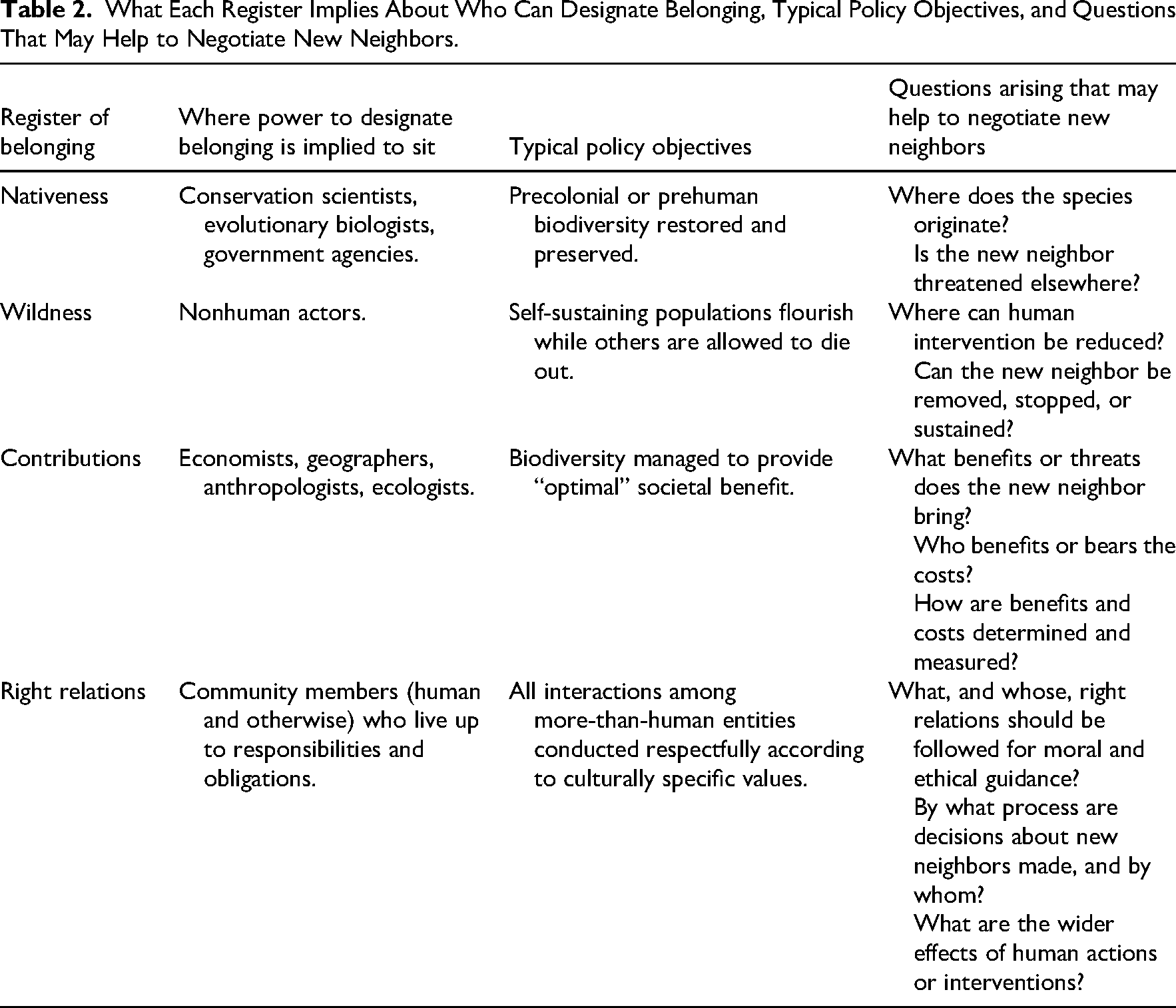
By making it clear how decisions reflect specific knowledge, obligations, and values, it becomes more possible to discuss the basis of decision-making. As right relations arguments illustrate, there is more at stake than just the nonhuman newcomer and their behaviors or effects. Conflict over species belonging can also be about who has the right to decide, whether local protocols have been upheld, and the wider processes (e.g., colonialism) represented by a newcomer's arrival (Crowley et al. 2017b, 2019; Reo and Ogden 2018; Atchison et al. 2024; Tadaki et al. 2022; Gibbs 2024). Conventional arguments such as nativeness or narrowly conceived contributions can reinforce the apparatus of technocratic decision-making, and make it harder for nonspecialists to contest decisions. In conservation policy, for example, scientific designations such as species origin and endemism are typically privileged over popular alternatives such as wildness and local cultural benefits, or time-tested Indigenous governance mechanisms (Escobar 1998; Reo et al. 2017; Havlick and Biermann 2021; Wehi et al. 2023). In other domains, the uncritical use of cost–benefit analyses to evaluate whether species should be cultivated or removed has tended to prioritize economic benefits and biophysical impacts in ways that can sideline local people, values, and processes (Chan et al. 2012). Recognizing that all four registers involve social values can help to see alternative designations of belonging as legitimate and worthy of deliberation (Dryzek 1990). For example, morihana (wild goldfish) in Te Arawa Lakes are introduced but have been adopted for their cultural values by local Te Arawa tribes, who hold management rights (Tadaki et al. 2025). A technocratic analysis might assert that morihana should be removed due to their non-native status, but acting solely on this would undermine Te Arawa self-determination and almost certainly erode trust. By consulting the four registers, a decision-maker can create conversational space for different values, and recognize the relational risks of pursuing one or two registers at the exclusion of others.
Registers of belonging can also help to understand the different scales at which belonging is designated and managed (Kull 2018; Atchison 2025; Table 2). In conservation governance, policymakers typically assign species belonging according to political (state or national) borders rather than what may be most ecologically or culturally relevant, such as Indigenous territories, river catchments, or even backyard gardens. These designations are also generally applied to species, although environmental managers often deal with populations, and it is individual bodies which are ultimately subject to killing or care (Atchison and Head 2013; Biermann and Mansfield 2014; Kull 2018). Designating belonging based on species and territorial boundaries might help coordinate and align biosecurity efforts—but as Beever et al. (2019) show, this can also produce mismatches with local perspectives and values (e.g., in instances where city residents have developed an appreciation for released parakeets), management regimes (e.g., where resourcing or priorities differ between areas), and marine and migratory species, as well as climate-driven “species-on-the-move,” with multiple or unfixed sites of belonging (Pecl et al. 2017). Meanwhile, hybrids arising from interbreeding among species further illuminate the limitations of species-based conservation governance (e.g., hybrid cattail; Reo and Ogden 2018). Considering all four registers of belonging can help decision-makers to think through the implications of a particular decision or outcome across multiple scales. This could, for example, support the development of flexible “place-based” policy and management responses to new neighbors that are more responsive to specific social and ecological contexts (Kull and Tassin 2012; Kull 2018). Indeed the pragmatics of management mean this already occurs more often than formal governance regimes might suggest (Head et al. 2015; Beever et al. 2019).
We have primarily focused on “new” nonhuman neighbors but registers of belonging can also help to think through the values and politics of contending with “old” neighbors. “Post-natural” interventions such as species translocations (i.e., geographical relocation), de-extinction, and gene editing are gaining momentum in conservation (Lorimer 2015; Adams 2017). Thinking across multiple registers of belonging can help to identify things that people care about that are overlooked in established conservation programs. For instance, captive breeding is often employed under the assumption that threatened species should be preserved at all costs. However, other perspectives can help to consider, for example, the possibility of animals becoming dependent on human care, the divestment of funding away from other conservation needs, as well as ethical and cultural concerns around bringing individuals from the wild into captivity (Lorimer 2015). Consideration of multiple registers of belonging could also help work through conflicts that can arise between conservation scientists who see genetics as an immutable and defining marker of species and Indigenous knowledge keepers focused on behaving responsibly in their relationships with more-than-human kin (e.g., disagreement over whether spring-run Chinook salmon should be designated a distinct group; Wilcox 2023). Promising examples such as a partnership-based translocation of culturally significant frogs illustrate how honouring Indigenous processes (i.e., right relations) can promote trust-building and support conservation objectives—in this case, by enfolding local knowledge about preferred habitat, involving community members in ongoing monitoring, and teaching younger generations how to care for the frog (Cisternas et al. 2019).
As we have sought to make clear, species belonging is not a yes-or-no question but a political “how and why” question that will always produce contingent and imperfect answers (Crowley et al. 2017b). Registers of belonging can help to account for the multiple meanings and effects of new neighbors, analyse who wins or loses under different arrangements, and grasp what wider social values and issues are at stake—but they cannot tell us what we should do about new neighbors. Many situations require difficult and often unsatisfactory choices about what should be prioritized, whose concepts of justice should prevail, and who gets to decide. Enacting the most popular designations of belonging might uphold certain democratic ideals but fail to adequately recognize nonhuman interests or Indigenous rights and ontologies (Whyte 2018; Gibbs 2020; Braverman 2021). This recalls the sometimes-uneasy negotiations between local struggles and broader political projects (Harvey 1996). For example, work by Kull et al. (2019) illustrates how diverse actors have politicized the role of invasive plants in sustaining vulnerable communities in Madagascar against conventional nativeness arguments, in ways that can obscure the practical concerns and wider issues (e.g., poverty, colonialism) faced by local people. As Jennifer Atchison (2025) observes, geographers, among others, are ideally placed to bring such issues to the fore and into conversation with environmental policymakers and managers.
Conclusion
New nonhuman neighbors pose a key conundrum in a world of globalizing biophysical and social flows. There is a need to figure out how to live with new neighbors in ways that go beyond command-and-control, that are more humble, inclusive, and open to unanticipated consequences. To this end, we have sought to distinguish four registers of species belonging that help to better recognize and understand conflict in conservation and environmental governance. By naming what is at stake when encountering new neighbors, these registers can support the development of processes for working through disagreements, and draw attention to complexities of scale and justice. The registers can also help to grapple with social power: Who decides, who benefits from current arrangements, and how decision-making processes might exclude or privilege particular worldviews. By better understanding the social bases of species belonging, we hope people will negotiate relations with nonhuman neighbors in more open and inclusive ways.
Footnotes
Acknowledgments
The authors thank the three anonymous reviewers for their generous and insightful feedback. We also thank Hēmi Whaanga for his contributions and advice in the paper's early stages of conception. Finally, we are grateful to all those involved in the Fish Futures MBIE research program for their support and generative conversations.
ORCID iDs

Author Contributions
All co-authors contributed critically to the conception and writing of the manuscript. AR led the writing of the manuscript.
Funding
The authors disclosed receipt of the following financial support for the research, authorship, and/or publication of this article: This work was funded by Fish Futures—MBIE Endeavor Grant CAWX2101.
Declaration of Conflicting Interest
The authors declared no potential conflicts of interest with respect to the research, authorship, and/or publication of this article.