



Abstract
This paper examines the intrinsic and instrumental value of corals, and coral reefs, from the epistemological perspectives of Western conservation biologists and Pacific coastal fishers. It uses data on local language names (‘folk taxonomies’) from several language groups to understand the salience, or perceived value, of corals and coral reef fishes for the speakers of those languages. In all of the folk taxonomies examined, there are very few local language names for corals or reef-associated fishes in the most species-rich families (gobies, blennies, damselfishes, and butterflyfishes). This is interesting particularly because one of the primary rationales for Western conservation interest in Indo-Pacific coral reefs is the ‘cumulative intrinsic value’ of the large number of biological species associated with these ecosystems, irrespective of their other values, including fishery production. The ‘weight’ of this cumulative intrinsic value underpins a moral mandate for transnational conservation intervention, typically in the form of marine protected areas, most of which impose a short- to medium-term economic cost on people who are already very poor. The related and widely used Western cultural construct of ‘iconic’ is also investigated. The paper examines various implications of the large differences between Western scientific and Pacific Islander attributions of value to corals and coral reef ecosystems, including in the context of their importance for fishery production and food (or nutrition) security. I also discuss the apparent lack of (a) reflexivity about the social construction of science and (b) curiosity about the environmental knowledge and values of Indo-Pacific coastal fishers, among many in the Western transnational conservation community.
Keywords
Introduction
A key premise of the argument presented in this paper is neatly exemplified in the abstract of Veron et al.'s (2009) highly influential paper ‘Delineating the Coral Triangle’: This study shows that the Coral Triangle, an area extending from the Philippines to the Solomon Islands, has 605 zooxanthellate corals including 15 regional endemics. This amounts to 76% of the world's total species complement, giving this province the world's highest conservation priority.
These findings, supported by parallel distributions of reef fishes and other taxa, provide a clear scientific justification for the Coral Triangle Initiative, arguably one of the world's most significant reef conservation undertakings. (p. 91)
The link between the ‘cumulative intrinsic value’ of species-rich ecosystems – as evidenced by the large biological species counts enumerated in the above excerpt, and the moral mandate for conservation intervention could not be more explicit. This is otherwise recognizable as the Conservation Hotspot logic originally outlined and championed by Norman Myers, Rob Mittermeier and others (Mittermeier et al., 1998; Myers, 1988; Myers et al., 2000).
The moral value attached to the biological species concept (Coyne and Orr, 2004) routinely manifests as a justification for the projection of Western environmental conservation power across political, economic and cultural boundaries in a unilateral and unreflexive way. This has generated a large body of critique from political ecologists over the past three decades (Brockington et al., 2008; Büscher et al., 2017; Fabinyi, 2018; Filer, 1994, 2000; Foale, 2001; Foale et al., 2016; West, 2006).
My second premise, based on 30 years of working in the Western Pacific, is that there are conspicuous differences between this scientific, biological species-based worldview and the way that coral reefs and coral reef fauna are known and valued by coastal and island fishers in the Western Pacific region (hereafter glossed as ‘Pacific’ fishers). I will substantiate this with evidence from at least five published works on local naming systems at various locations around the Pacific.
The divergence in the value systems of scientist-conservationists and Pacific fishers (which I broadly classify as intrinsic and instrumental, respectively) matters largely in the context of international donor-funded coral reef conservation programs, including those which frame their objectives around ostensibly instrumental goals such as ecosystem goods and services, including ‘food security’ (for critiques of this latter approach, see Clifton and Foale, 2017; Foale et al., 2013; Foale et al., 2016).
The Darwinian evolutionary worldview upon which the notion of cumulative intrinsic value is founded is alien to the great majority of Pacific fishers (Foale, 2001; Foale et al., 2016; Foale and Macintyre, 2005). If a species has a unique name in a given Pacific language, it usually has comparatively high salience in the minds of the speakers of that language (Dougherty, 1978; Hunn, 1982; Ross et al., 2011). I contend that a detailed exploration of ‘folk’ taxonomies, a sub-discipline of environmental anthropology with a long history, rich in theoretical debate (Berlin et al., 1973; Bulmer, 1967; Hays, 1982; Hunn, 1982; Levi-Strauss, 1966; Majnep and Bulmer, 1977; Sillitoe, 2002), can tell us a great deal about how different groups of people attribute meaning and value to various components of their natural environment and can serve as a useful means for comparing the environmental worldviews of Pacific fishers and Western conservationists. Such exercises can in turn facilitate a more genuine and potentially successful mutual exchange of knowledge that could greatly facilitate collaborative efforts at conservation and resource management.
A closer examination of such profound differences in environmental worldviews can also generate useful insights about the power relations between these two groups of people, particularly in the context of the discursive power of Western conservationists’ arguments for the preservation of coral reefs which are strongly based, not only on the regularly cited high species counts for corals and reef-associated fauna, but also on the comparatively recent Western cultural construction of coral reefs and many reef-associated species as ‘iconic’ (Comeros-Raynal et al., 2012; DiBattista et al., 2018; Hamilton et al., 2017; Knowlton, 2012). The power of the term ‘iconic’ is particularly conspicuous in Australia where the ‘iconic’ Great Barrier Reef (GBR) has often been (and is again at the time of writing) the subject of heated debates over the management of a variety of damaging impacts, both global (coral bleaching
The argument for coral reef preservation is also based in part on an economic rationale – ensuring the flow of the various ecosystem services (ES) (Burke et al., 2011; Costanza et al., 1997), principally fisheries. However, I will argue here that this rationale is typically subordinate (and indeed could be seen as ‘retro-fitted’) to the preservationist agenda that is justified by the hotspot and ‘iconic’ discourse. The ES logic is usually used as part of a ‘win–win’ argument (Foale et al., 2013, 2016; McShane et al., 2011), which makes sense in terms of the fact that fisheries will always need management, inevitably through some form of fishing effort reduction. However, there are usually more pressing social and economic problems in many rural communities that live adjacent to coral reefs, such as poor access to education and health. These issues often need more attention than the management of coral reef ES, whose actual value is often inflated by conservationists and Western donors whose reasoning is primarily motivated by intrinsic values (Clifton and Foale, 2017).
Methods
I reviewed two sets of data for this study:
‘Folk’ taxonomies, published and unpublished, for a number of languages in the Western Pacific region. I reviewed the extensive analyses of Oceanic language terms for marine fauna by Ross et al. (2011) and also searched the term ‘coral’ in Pollex, a large online database of Polynesian languages (pollex.org.nz) containing close to 70,000 entries. Web of Science and Google searches on the association of the word ‘iconic’ with ‘coral’, ‘reef’, ‘coral reef’ and various other reef-related terms.
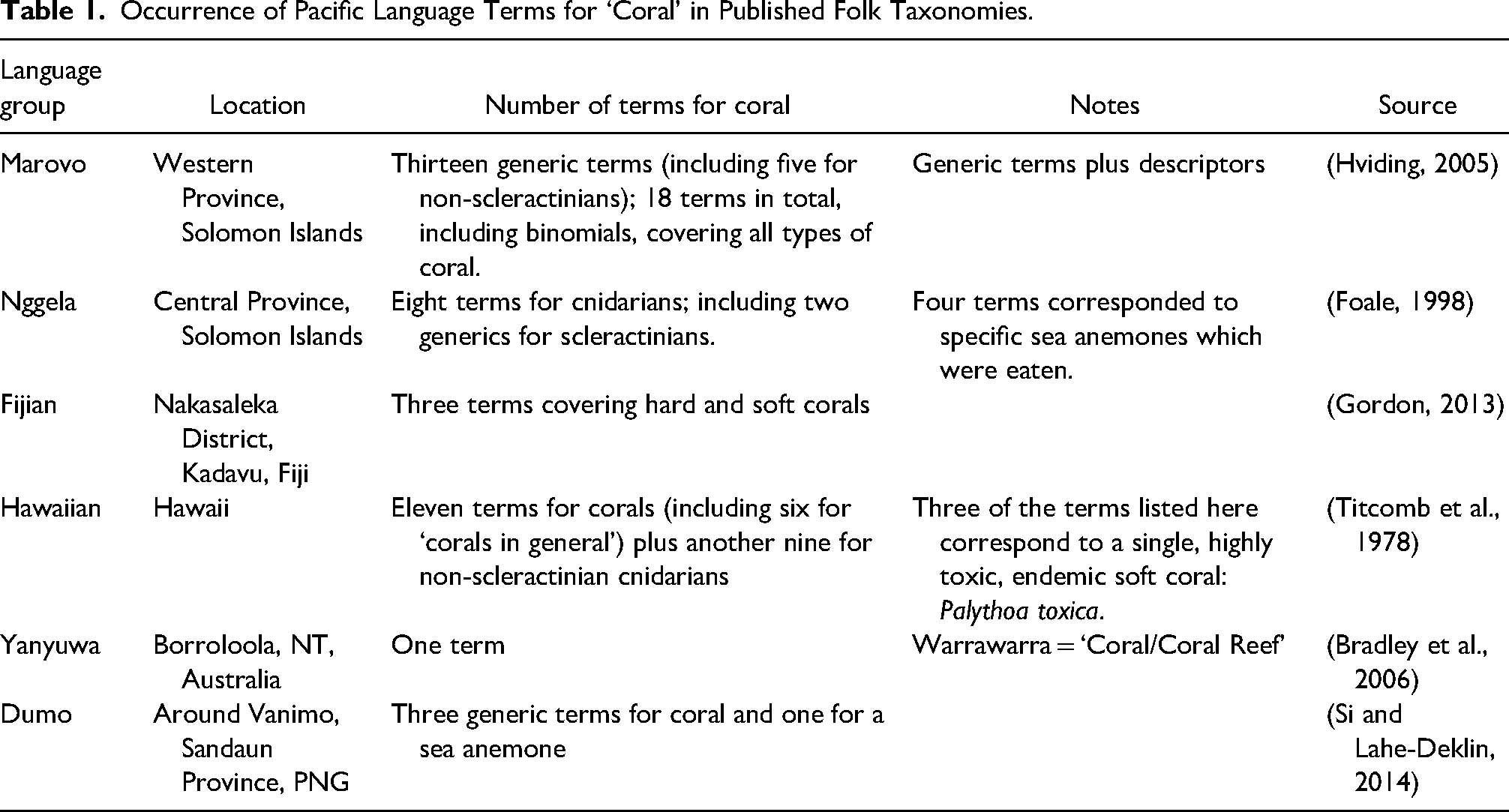
Table 1 lists locations and key statistics for the published folk taxonomies of coral reef organisms that I reviewed for this analysis. There is some variation in the approaches used in creating the taxonomies in these various sources, and the implications of that variation are discussed in the results and discussion sections below. I also reviewed several unpublished folk species lists which were compiled over a period of many years, usually as part of the fieldwork for a variety of research projects, the objectives of which were generally broader than the collection of fish and invertebrate names.
Occurrence of Pacific Language Terms for ‘Coral’ in Published Folk Taxonomies.
Most of the lists arising from my own research were created using one or more published reef fish and invertebrate guides (Allen, 2009; Allen and Steene, 2002; Myers, 1991; Randall et al., 1990) but in some cases (Foale, 1998) they include local knowledge acquired during extensive participation in fishing activities. For most of the sources drawn on here, this work was typically conducted with several key informants, sometimes singly but more often in small groups. The use of pictures for soliciting local language names has similar limitations for fish as it has for birds (Diamond, 1991) and my own techniques include triangulation using knowledge about a fish's behaviour in cases where an informant is perceived to be potentially confused (particularly by scale) by a picture in a guide book.
Generation of folk taxonomies is a very imperfect science and most researchers these days willingly admit that ‘traditional’ environmental knowledge, including knowledge of names, is subject to significant variation based on practice (Lauer, 2012), that not all knowledgeable informants will agree on 100% of local names (Sillitoe, 2002), and that continued work is likely to throw up more variation. However, for the purposes of the argument I am making in this paper, the methods used here (by myself and other researchers) are in my view sufficient.
Results
None of the language groups for which there is extensive published data on local terms for reef-associated fauna and flora have more than 20 terms for ‘coral’ (including but not limited to ‘scleractinia’ – the reef-building corals). Corals tend to be ‘lumped’ into generic and often broadly descriptive categories. In Papua New Guinea and Solomon Islands, the lingua franca term for coral is ‘ston’ (i.e. stone).
Hviding's (2005) list of corals in the Marovo language is probably the most illuminating, since it includes etymologies for most terms. Idaka translates to ‘stone’ and is a common generic for massive corals. Idaka to means ‘living stone’. Voa equates to ‘tabular corals’ (typically found on reef slopes), and Voa Legudi are ‘dead tabular corals’ (found typically on top of the reef flat).
Proto Oceanic terms for ‘coral’ are provided on pages 208 and 209 of Ross et al. (2011). There are two main generic terms: laje (‘branching corals’) and buŋa (‘smooth round coral’). The authors state: Oceanic languages generally have a generic name for living corals of the branching type and often distinguish several kinds. The Arosi dictionary lists eight different coral taxa, including six kinds of branching coral. However, dictionaries and wordlists seldom provide clear zoological identifications. (Ross et al., 2011: 208)
Typing ‘coral’ into the search bar of the Pollex database (Pollex.org.nz) yields 218 entries, but these include entries where the word ‘coral’ occurs either by itself or as part of any coral-related category (e.g., Rarotongan: Punga: ‘Coral lime, rock’; Sikaiana: Natala: ‘Coral trout’) and the 218 entries encompass terms that are shared among up to 67 Polynesian languages.
The small number of terms for corals reported here, in comparison with the number of scientific species, does not mean that local knowledge about coral reefs is not rich nor that corals have no value (see Narchi and Price, 2015). The point is that the form of value is different. There is abundant evidence of the intimate knowledge coastal people possess of marine habitats, often evidenced by numerous local language categories for habitat type, in addition to place names which reference traditional cosmological narratives, origin stories, and ancestral and/or spiritual beings (Kinch, 2020; Levinson, 2008; Piper, 2014).
Unless corals are useful, conspicuous, dangerous, or clearly form components of reef-scapes, they tend not to be subjected to much taxonomic differentiation by local custodians in the course of fishing activities. In many parts of the Western Pacific, they are used for making lime (for chewing with betelnut), scraping canoe hulls (Hviding, 2005), or constructing sea walls or artificial islands (Ivens, 1930) or other architectural purposes such as house foundations and footpaths.
The lack of taxonomic elaboration of local terms for corals parallels the pattern seen in Indo-Pacific folk taxonomies for some of the very species-rich families of reef fish such as gobies (Gobiidae), blennies (Blenniidae), damselfishes (Pomacentridae), butterflyfishes (Chaetodontidae), angelfishes (Pomacanthidae) and even soldierfishes (Holocentridae). These are fish families that contribute substantially to the fish component of the cumulative intrinsic value narrative of the coral reef conservation biology community. This pattern seems consistent across many publications containing extensive catalogues of scientific species with matching local language names (Bacchette et al., 2017; Foale, 1998; Kinch, 2020; White et al., 2013).
The use of the adjective ‘iconic’ with coral reefs and particular reef-associated fauna has become almost habitual among coral reef scientists in recent years. The fact that such a culturally constructed term should have no place in the conduct of ‘objective’ science seems to have been forgotten in the intense, competitive scramble for research funding and citations. I include a brief investigation of the use of the term here to underline the cultural and political nature of the epistemological divide between Western scientists and Pacific fishers (Table 2).
Web of Science Searches (20 November 2022).
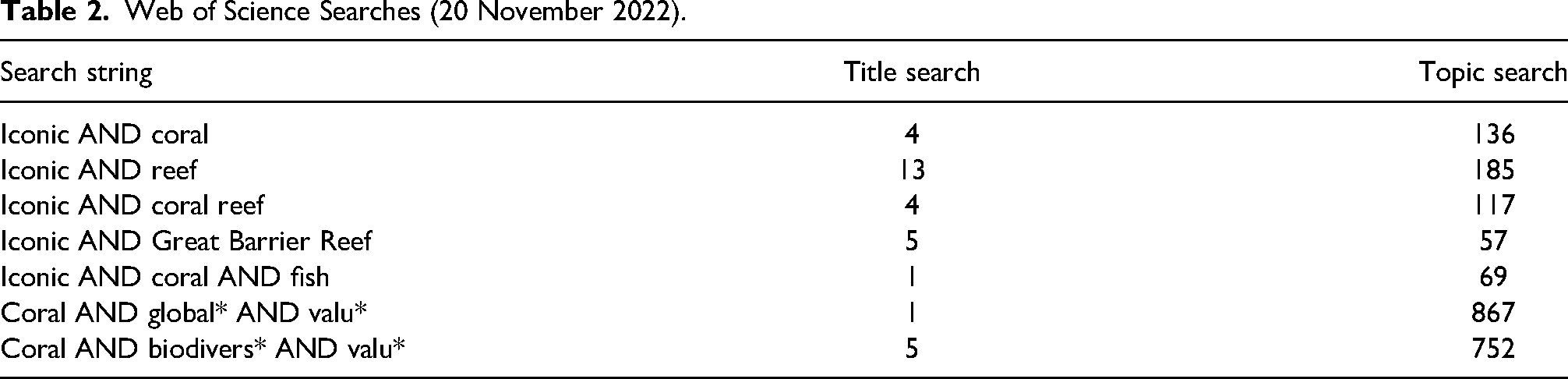
Example statements (italics mine) from some of the articles found through the above searches include:
‘As coral reefs continue to degrade at an alarming rate, coral restoration efforts are increasing worldwide in an attempt to keep up with the global challenge of preserving these iconic ecosystems and the many services they provide.’ (Dehnert et al., 2022) ‘One iconic group of reef fishes ideal for applying this technique are anemonefishes (Amphiprioninae)….’ (Mitchell et al., 2021) ‘On the iconic Great Barrier Reef (GBR), the cumulative impacts of tropical cyclones, marine heatwaves and regular outbreaks of coral-eating crown-of-thorns starfish (CoTS) have severely depleted coral cover.’ (Condie et al., 2021) ‘One of the most iconic mutualistic interactions on coral reefs is the cleaning interactions between cleaner fishes and their clients, during which direct physical contact occurs.’ (Pereira et al., 2023) ‘The fishes that inhabit coral reefs are extremely diverse in colouration, but the specific environmental factors that support this extreme diversity remain unclear. Interestingly, much of the aesthetic and intrinsic value humans place on coral reefs (a core ecosystem service they provide) is based on this extreme diversity of colours. …. We found that the diversity of colours found within a fish community is directly related to the composition of the local environment. Areas with a higher cover of structurally complex corals contained fish species with more diverse and brighter colourations. Most notably, fish community colouration contracted significantly in the years following the 1998 global coral bleaching event.’ (Hemingson et al., 2022)
Discussion
The differences between ‘Pacific’ and scientific naming systems for marine fauna underline a fundamental gulf in the way marine fauna are perceived and valued by these two groups of people. In the case of Pacific marine fishes, at least 50% of species recognized by scientists do not have a Pacific language name below a generic term that applies typically at the level of the family. In the case of groups such as corals, sponges, ascidians, bryozoans, and the myriad sub-groups of small and non-edible molluscs, crustaceans and echinoderms, these differences are even more profound. So the cumulative intrinsic value that has been deliberately generated by biodiversity surveys (Allen, 2008) and advocated by conservation groups (Green et al., 2008) has very little meaning to most of the people who own and use the coral reefs of the Pacific. Similarly, the value attributed by the term ‘iconic’ to particular species, to the species richness of coral reefs, and the aesthetic qualities of coral reefs is, by and large, also not shared by most rural Pacific fishers.
The development of both SCUBA technology and sophisticated underwater photography systems has coincided with the rise of coral reef tourism and environmentalism (Elias, 2019; Foale and Macintyre, 2005), and has indisputably contributed to the creation of the ‘iconic’ status of many reef-associated organisms (Militz and Foale, 2017), and indeed whole reefs and reef systems. Pretty images of fish, corals, turtles, seascapes and aerial vistas of reefs are used routinely to entice tourists, while reef researchers and their institutional managements strategically and shamelessly use colourful imagery of reefs and charismatic reef animals to market themselves and their work to funders and publishers. The enormous economic and political power of the tourism industry, particularly the segment that services the GBR, has in many ways captured much of the scientific community, and in doing so has profoundly shaped and influenced a scientific culture and epistemology that is then projected out, through internationally funded conservation programs, onto low-income countries where it is frequently found to be inappropriate (Clifton and Foale, 2017; Fabinyi, 2008, 2018). This pattern has in many ways been turbo-charged in Australia by the corporatisation of universities and large government research institutions, where intense competition for external research funding and metrics scores systematically erodes scientific rigour and ethics (Chomsky, 2014; Fleming, 2021; Foale, 2021; Muller, 2018).
The discursive power (Brosius, 1999; Fabinyi et al., 2014; Li, 2007) of the cumulative intrinsic value of biological species narrative continues to be wielded in a disturbingly unreflexive way by many environmentalists, as evidenced above. Despite at least two decades of concerted critique of global techno-scientific environmental managerialism (Brockington et al., 2008; Brosius, 1999; Büscher et al., 2017; Dowie, 2011), evidence of the transnational environmental conservation community actually engaging seriously with other ways of thinking about nature appears scant. In parallel with this is the fact that scientific taxonomies, particularly for corals, are far from settled. In recent years, molecular techniques appear to be driving a radical reappraisal of species boundaries among some groups of reef-building corals (Cowman et al., 2020), which will almost certainly result in a dramatic increase in the accepted number of coral species in the near future. Whether this will lead to even louder calls for conservation interventions in species-rich areas such as the Coral Triangle we are yet to see. Meanwhile, coral bleaching, the result of a failure to curb the excesses of capital and the consumer lifestyle, mostly in the affluent West, is rapidly outstripping local fishing pressure as a driver of coral reef ecosystem degradation (Bruno et al., 2018, 2019; Johnson et al., 2022; Teh et al., 2013).
The ecosystem goods and services narrative (Moberg and Folke, 1999) has been running almost in parallel with the cumulative intrinsic value/Hotspot narrative. In some ways, it could be seen as a response (conscious or unconscious) to critiques of early iterations of the cumulative intrinsic value/Hotspot model (e.g. Myers, 1988). Conservationists have long been at least vaguely aware that indigenous custodians of the species-rich systems they seek to preserve are likely to be far more concerned with survival and economic betterment than with the more abstract values that motivate transnational conservation interventions. It is therefore easy to see how an economistic rationale became incorporated into conservation programmes. However, even this approach is problematic and many critiques of the ecosystem goods and services narrative for coral reefs have also been published (Clifton and Foale, 2017; Foale et al., 2013, 2016; Roeger et al., 2016). These critiques cite abundant evidence that the ‘food security’ importance of coral reefs is exaggerated by the ecosystem goods and services narrative and that non-reef-dependent fish species (such as small and large pelagic species, like sardines, scads, mackerels and tunas) are, for much of the Indo-Pacific region, far more important for food security. This is of course not to deny that good management of reef-associated fisheries is a sensible objective, as long as it is achieved equitably, and with an eye on the drivers of poverty at multiple scales (Fabinyi et al., 2014; Foale, 2021). All fisheries are capable of collapse if subject to excessive fishing pressure, and it is in everyone's best interests to find ways to manage fisheries sustainably. Ethical management schemes, particularly if the impetus for management is primarily external, have a mandate to ensure the costs are distributed in ways that avoid punishing people who are already poor. This requires thinking at larger scales of both space and time, and situating what might be a heavy dependence of fishers on a particular ecosystem here and now, within historical processes of colonization and displacement, and unequal ecological exchange, past and present (Dorninger et al., 2021; Hickel et al., 2021). Breathless crisis narratives based on iconic status or Hotspot thinking do nothing to aid this process.
Conclusion
To conclude, I have argued here that the lack of interest in, and engagement with, local ways of understanding coral reef environments in the Western Pacific region inevitably produces new forms of imperialism, albeit well-meaning. Pacific Islanders’ folk taxonomies reveal a fundamentally different set of values, which need to be engaged with seriously if individuals and organizations with a desire to do something beneficial for coral reefs on the other side of cultural, economic and political boundaries wish to achieve ethical and constructive outcomes. Due to the limitations of space, I have somewhat skated over a large and rich literature in political ecology here, which I would encourage more members of the marine science and the wider academic community to engage with. High-handed or neo-imperialist conservation programmes have drawn sharp critique from a growing community of political ecologists for around three decades now (Brockington et al., 2008; Buscher and Fletcher, 2015; Dowie, 2011; Fabinyi, 2012; Filer, 1994; Foale, 2001; Igoe and Brockington, 2007; West et al., 2006). Some (perhaps many) conservation organisations and research institutions are not culpable of the charges I level here (cf. Foale et al., 2017), and there may have been an increase in activity by local conservation groups that are independent of the kind of thinking I have critiqued in this paper. However, this independence does not come easily, and local conservation groups often collapse or have to put their activities on hold when they cannot secure funding – an outcome that only increases the political and epistemological dominance of large and wealthy transnational conservation non-governmental organisations (NGOs).
In this paper, I have sought to highlight the pressing need to transcend the epistemological divide between affluent, globe-trotting, Western conservationists and scientists, and the (typically) much poorer custodians of the biodiversity the former seek to ‘save’. It is important to note that many custodians of biodiverse ecosystems are very interested in conservation and also in science (Macintyre and Foale, 2013). What they want most of all is a respectful, trusting and mutually beneficial relationship with the wealthy foreign scientists who seek to conserve the immense diversity of life associated with these ecosystems. The frustration experienced when such relationships, and the desired open communications that should accompany them, fail to materialise is nowhere better articulated than in a powerful recent lecture by a well-known Papua New Guinean conservationist and head of the local NGO, Ailan Awareness, John Aini: More often than not, the questions asked by scientists derive from their interests and the agendas generated at the international levels of funding, governance, and trends in scholarly disciplines. While this produces important knowledge and drives new forms of knowledge making processes, it often alienates communities living in places with high levels of biological diversity. The very places where scientists work and where conservation scientists wish to have meaningful conservation impacts.
Communities often feel that scientific research does not address their needs, answer their questions, or focus on their agendas. This is the case in numerous knowledge-making fields, indeed in all of the traditional sciences and social sciences, Indigenous scholars have termed these knowledge making processes ‘colonial’ and have argued that until method, theory, and practice are transformed, that communities still suffer a form of colonialism. (Conservation Watch, 2018)
Pacific fishers possess immense knowledge of their marine (and terrestrial) environments. Despite the fact that this knowledge is constantly eroding (Kik et al., 2021) it constitutes a precious cultural heritage which I believe Western conservationists and scientists would benefit greatly from learning and engaging with. Such engagements can generate life-changing insights, about nature, culture, science, and, ultimately, about our common humanity.
Footnotes
Acknowledgements
I thank the many Pacific Island fishers and farmers whose rich environmental knowledge has taught me so much over three decades of discussions about fish, corals and other denizens of the sea. I also thank Rosita Henry and Sean Ulm for tips on useful research referenced here. I thank two anonymous referees for constructive and insightful reviews, and Peter Case and Doug Hill for encouragement, patience and helpful feedback on the manuscript.
Declaration of Conflicting Interests
The author declared no potential conflicts of interest with respect to the research, authorship, and/or publication of this article.
Funding
The author received no financial support for the research, authorship, and/or publication of this article.
