



Abstract
Although income levels play a critical role in determining a household's food security status, this alone cannot fully explain the variations in the phenomenon. To fully explore food insecurity, it is essential to consider non-household factors such as social and physical infrastructure, which directly impact people's quality of life. In this study, we used data from rounds 6, 7, and 8 of the Afrobarometer survey conducted between 2014 and 2021 to investigate the relationship between infrastructure deficit and household food insecurity vulnerability in Africa. Our findings from multilevel logistic regression showed that access to social and physical infrastructure can alleviate household food insecurity vulnerability to varying degrees. For instance, having an electricity grid and a public water supply system can reduce the likelihood of food insecurity by 15% and 13%, respectively. Similarly, having a bank and a health clinic in a community can reduce the possibility of food insecurity by 6% and 3%, respectively. These findings revealed that physical infrastructure has a more substantial impact on reducing food insecurity than social infrastructure. Nevertheless, African governments should focus on investing in both types of infrastructure and ensuring that it is distributed fairly and equitably to benefit all.
Introduction
Many studies, such as Andersen (1990), Shisanya and Hendriks (2011), Wight et al. (2014), and Pirrie et al. (2020), have established that insufficient income is a leading cause of household food insecurity. However, it is essential to acknowledge that this issue is not solely attributable to household-level factors or income, as highlighted by Carter et al. (2012) and Ngcamu and Chari (2020). Other factors, such as the living environment, also impact a household's ability to access food. The living environment refers to the physical and social infrastructure essential for a community or society to function effectively.
Social infrastructure encompasses various facilities and systems, such as schools, hospitals, banks, and public transportation, which aim to promote the community's overall well-being, function, resilience, justice, equity, and sustainability (Baldwin and Stafford, 2019; Frolova et al., 2016). On the other hand, physical or hard infrastructure like electrification, sewage systems, and piped water systems help mobilize the economic potentialities of economic agents, which in turn can ensure the economic growth and development of the community (Buhr, 2003). Scholars like May (1998), Leventhal and Brooks-Gunn (2000), Carman and Zamarro (2016), and Janssen, van der Velde and Kiefte-de Jong (2022) have emphasized the importance of these nuances on diverse individual and household outcomes; and food insecurity could be no exception.
It is important to recognize that no region is devoid of infrastructure. However, certain regions, especially those still developing, may not have adequate access to essential amenities in terms of quantity or quality. This reality has been underscored by several studies over the years, including those conducted by Ahluwalia et al. (1998), Small et al. (2010), Tafesse (2012), Denney et al. (2018), and Smith et al. (2022). An additional challenge concerns the eco-friendliness of existing infrastructure in developing countries. While many developed nations have made or are transitioning to greener alternatives from traditional infrastructure, this is not a viable option for African countries due to the poor state of their conventional infrastructure. As Denona Bogovic and Grdic (2020), Chukwu (2020), and Stringer and Joanis (2022) have noted, the condition of their infrastructure is so dire that it is impeding access altogether.
Electricity is an essential element of infrastructure that requires attention in Africa. According to Ritichie et al. (2022), 78% of the population without electricity worldwide lived in Africa in 2019. Even for those with access, consumption per person was less than one-tenth of the BRICS economies (Lakmeeharan et al., 2020). However, access to electricity varies within Africa, with Mauritius having all its communities connected to the grid. In contrast, Burkina Faso has approximately 3 out of 10 communities without access to the grid, according to the Afrobarometer survey's round 7 (2016/2018) descriptive analytics.
Likewise, the need for safely managed water and sanitation infrastructure in Africa is critical. According to Ritchie and Roser (2021), 7 out of 10 Africans lack access to safe drinking water, and 1 out of 5 residents in sub-Saharan Africa practice open defecation. These numbers are alarming, especially compared to Latin America and the Caribbean. In fact, sub-Saharan Africa is home to 37% of the global population without access to safe drinking water. The situation is even worse when it comes to sanitation, as evidenced by the Afrobarometer survey (2020/2021). The survey found that about 95% of Niger and Malawi residents have no sewage system and practice open defecation. On the other hand, Tunisia has the highest proportion of market stalls within walking distance (95.4%), while Angola has the least access at only 44.7%.
Although having these amenities or services in an area ought to improve wellbeing, there is no assurance that this will always be the case. For instance, the purpose of a police station in an area is to maintain law and order. However, given that public institutions are a significant source of bureaucratic corruption in the continent, the presence of any in a community might do more harm than good. It might increase vulnerability to unethical transfers of household resources meant for the provision of their basic subsistence to the police through bribery and plain extortion in order to avoid trouble (Olabiyi, 2022). On the flip side, the availability of a public water supply system in an area is expectedly beneficial to several courses, one of which is household food security (Tafesse, 2012). In spite of the lack of consensus about the effect of these amenities, the fact still remains that Africa has a huge infrastructure gap. As long as the deficits remain, people residing in African communities might have difficulty functioning effectively or experiencing meaningful improvements in their quality of life, defined as those “factors other than income and wealth which affect people's wellbeing.”
Limited studies have been conducted on the impact of infrastructure on food insecurity in Africa, and the few studies available are limited to specific countries and cannot be generalized (Fisher and Lewin, 2013; McCordic, 2016; Selepe et al., 2014). As a result, fully understanding the effect of infrastructure deficits on food security throughout the continent is still a challenge. This study aims to fill this gap in the literature by investigating how social and physical environments influence food insecurity beyond individual or household factors in Africa, utilizing data from Rounds 6, 7, and 8 of the Afrobarometer survey, covering the period from 2014 to 2021. The research excludes previous rounds as they did not cover the particular variables of interest.
The study aims to achieve two main objectives. Firstly, it identifies infrastructure that can improve or worsen food insecurity. Secondly, it seeks to determine how much such infrastructure affects the issue. The paper is structured as follows: Section 2 provides a brief review of existing literature, Section 3 outlines the data and methodology used, Section 4 presents and analyzes the findings, and Section 5 sets out a summary and conclusions.
Literature Review
There is no shortage of studies regarding understanding the impact of local attributes on food insecurity. However, most of these studies have focused on economically stable countries in the northern hemisphere, such as the United States, Canada, and the United Kingdom (Carter et al., 2012; Kirkpatrick and Tarasuk, 2010; Pérez, Roncarolo, and Potvin, 2017). The consensus from extant studies seems to be that neighbourhoods are not all created equal, with differences in physical infrastructure, social cohesion, and other factors playing a role (Fisher and Lewin, 2013; Denny, Kimbro, and Sharp, 2018). Nevertheless, no explicit agreement exists on whether these differences positively or negatively affect food insecurity. Some researchers have even argued that local characteristics can be a double-edged sword, with both advantages and disadvantages for area residents (Kirkpatrick and Tarasuk, 2010). For example, while having community gardens in an area may not guarantee food security, having a piped water system is undoubtedly beneficial for a variety of reasons (Gulliford et al., 2005; Shisanya and Hendriks, 2011; Winter et al., 2021; Young et al., 2021). This leads to the hypothesis below.
Infrastructure: Widespread Impact
Living in nondeprived areas has been shown to be incredibly useful, as evidenced by the study conducted by Rose and Richards in 2004. Their research revealed that residing within five miles of a grocery store helped low-income households increase their consumption of fruits. However, if the nearest supermarket was over five miles away, fruit consumption was reduced by 62 g of food per adult equivalent per day. In Canada, Perez, Roncarolo, and Potvin (2017) conducted a study that found that living between 1 and 2 km from grocery stores resulted in moderate food insecurity. The negative impact of living in a food desert is not limited to any specific demographic. Shieh et al. (2021) found that aged women in North Carolina and Georgia had difficulty accessing nutritious food when they did not live close to food stores.
According to Bartfeld et al. (2010), living in a food desert does not just affect older people. They found that households with small children who live 15 to 22 miles away from a supermarket or grocery store were about 67% more likely to report food insecurity. Additionally, Bartfeld and Wang (2006) discovered that the likelihood of food insecurity increases by 2% for every additional mile between home and a supermarket or grocery store. These findings suggest that the link between proximity to grocery stores and food security is not exclusive to developed regions. In fact, research by Fisher and Lewin (2013) in Malawi showed that living far from the weekly market can have a negative impact on food security in developing countries as well.
Other studies have investigated a possible link between transportation constraints (or lack of transportation system, etc.) and food insecurity. Perez, Roncarolo, and Potvin (2013) and Shieh et al. (2021) argued that any form of transportation constraint could pose a significant obstacle to achieving household food security. Similarly, Baek (2016) noted that access to public transportation could cause a substantial reduction in the occurrence of household food insecurity. Explicitly, the author found that an extra bus-equivalent vehicle per 10,000 people put a downward pressure amounting to 0.78 percentage points on the probability of food insecurity. Like other accessibility measures, the presence of agricultural cooperative groups in a community has been shown to lower the likelihood of food insecurity at individual and household levels (Fisher and Lewin, 2013). Carter et al. (2102) stressed that residents of areas with little or no trust, reciprocity, interactions, and support among dwellers are vulnerable to food insecurity. However, its likelihood of occurrence dissipates in any locality with higher levels of social integration (Sampson, 2012). Research that disaggregated social integration found that each element was undoubtedly linked to food security. De Marco and Thorburn (2009) revealed that a tightly knitted civic arrangement might prevent area residents from experiencing food insecurity. This leads to the hypothesis encapsulated below.
Infrastructure: Limited Impact
Some researchers argue that the differences in local characteristics are not that significant. For instance, Stafford and Marmot (2003) point out that living in a nondeprived neighbourhood may not necessarily guarantee better health outcomes. It all comes down to how an individual's attributes compare to the neighbourhood average. If a person's endowment is below the neighbourhood average, their health outcome will likely suffer, regardless of the neighbourhood's attributes, and vice versa. Kirkpatrick and Tarasuk (2010) conducted a study that showed that proximity to food retail or community food programmes did not alleviate the issue of food insecurity among low-income Toronto families, which contradicts the findings of Rose and Richards (2004) and Perez, Roncarolo, and Potvin (2017). Even in South Africa, community gardens did not positively impact food security. Shisanya and Hendriks (2011) found that while consumption improved, the 53 community gardens in Maphephetheni, KwaZulu-Natal, South Africa, did not protect against the likelihood of food insecurity.
There appears to be a lack of consensus regarding the extent to which the living environment can alleviate the issue of food insecurity. This may be attributed to the fact that previous research has mainly concentrated on examining the problem at the national level. Nevertheless, the disagreement underscores the necessity of conducting in-depth investigations like the one currently being undertaken to comprehend better how social and physical infrastructure can contribute to mitigating the prevalence of food insecurity.
Data and Methodology
The study sample was collected from Rounds 6, 7, and 8 of the Afrobarometer survey. The three Rounds spanned eight years, i.e., 2014–2021. Specifically, the data collection for Round 6 occurred in 2014 and 2015, Round 7 in 2016 and 2018, and Round 8 covers 2019 to 2021. In each representative family, one voting-age interviewee is asked questions about political, socio-economic, and related issues. With the aid of random selection and probability proportionate to population size methods, each survey achieved a representative sample size at all stages of data collection (Afrobarometer, 2016, 2018, 2019).
It is important to note that the survey conducted in different countries had different sample sizes. Some surveys had a sample size of 1200 people, while others had 2400. With a smaller sample size, inferences can be made about the adult population with a margin of error of no more than ±2.8 percentage points and a confidence level of 95%. On the other hand, a larger sample size reduces the margin of error to ±2.0 percentage points at the same confidence level. To ensure accurate representation, the survey used a clustered, stratified, multi-stage, area probability sampling design to avoid uneven representation of a particular ethnic or language group. Afrobarometer surveys are conducted every two to three years and utilize a face-to-face interview format to elicit information from individuals who are 18 years old or above but do not include those living in institutionalized settings such as students in dorms, hospital patients, people in prisons, nursing homes, or conflict zones (Afrobarometer, 2016, 2018, 2019).
Our research focused on the African continent, and thus, we included all African countries with representative samples in the Afrobarometer surveys. Nevertheless, we excluded some missing observations from the survey data. In the end, we analyzed 137,853 observations nested in 556 regions or provinces across 37 countries. The observations per group ranged from 7 to 2,046, averaging 247.9.
Dependent variable
In this study, the outcome variable of interest is the self-reported experience of food insecurity. Participants were asked to indicate whether they had experienced food insecurity at any point in time, and their response options ranged from ‘never’ to ‘always’. It is important to note that these response options are mutually exclusive and not cumulative, meaning that participants could only select one option to describe their experience of food insecurity. Importantly, these ordinal outcomes were consistent across all the Rounds of the Afrobarometer study.
The Leading Independent Variables of Interest
Our study concentrates on the physical and social infrastructure of the communities where households reside as the leading independent variables. We selected the infrastructure for the study by following McCordic's (2016) findings. Consequently, we identified three physical infrastructure measures (electricity, sewage system, and piped water system) and four social infrastructure measures (health clinic, bank, paid transportation, and market stalls). We created binary measures for each infrastructure based on the survey questions, which are as follows:
Are the following services present in the primary sampling unit/enumeration area: Electricity grid that most houses could access? Are the following services present in the primary sampling unit/enumeration area: Piped water system that most houses could access? Are the following services present in the primary sampling unit/enumeration area: Sewage system that most houses could access? Are the following facilities present in the primary sampling unit/enumeration area or within easy walking distance: Health clinic? Are the following facilities present in the primary sampling unit/enumeration area or within easy walking distance: Market stalls (selling groceries and/or clothing)? Are the following facilities present in the primary sampling unit/enumeration area or within easy walking distance: Bank? Are the following facilities present in the primary sampling unit/enumeration area or within easy walking distance: Is there any kind of paid transport, such as a bus, taxi, moped, or other form, available on a daily basis?
Control Variables
Our analysis considered various crucial factors in previous research contributing to household food insecurity. These factors comprised asset ownership, which we assessed by examining the possession of vehicles, along with gender, location, age, education, employment status, year effect, and regional effect. By adjusting for these variables, we were able to attain a more accurate comprehension of how food insecurity connects to other variables.
Methodology
The analysis of the outcome variable centred on the random-intercept model using the logit link and C = 5 categories:

The analysis followed a stepwise procedure. First, we fitted a random intercept model with covariates (null model) followed by a random intercept model with household-level covariates. After that, we incorporated community-level covariates, i.e., the social and physical infrastructure. Lastly, we constructed and included interaction terms between urban and all community-level variables in the analysis.
Results
Table 1 outlines the descriptive characteristics of the study sample and their distribution by household food insecurity. About 52% of respondents reported they had never gone without food or worried about getting nutritious food in a socially acceptable manner. Further analysis showed that more than 60% of respondents that never experienced food insecurity fell into the following groups: North African residents, vehicle owners, those that had at least post-secondary qualifications (not university), and those who had full-time employment.
Socio-Demographic Characteristics of Respondents by Household Food Insecurity in Africa.
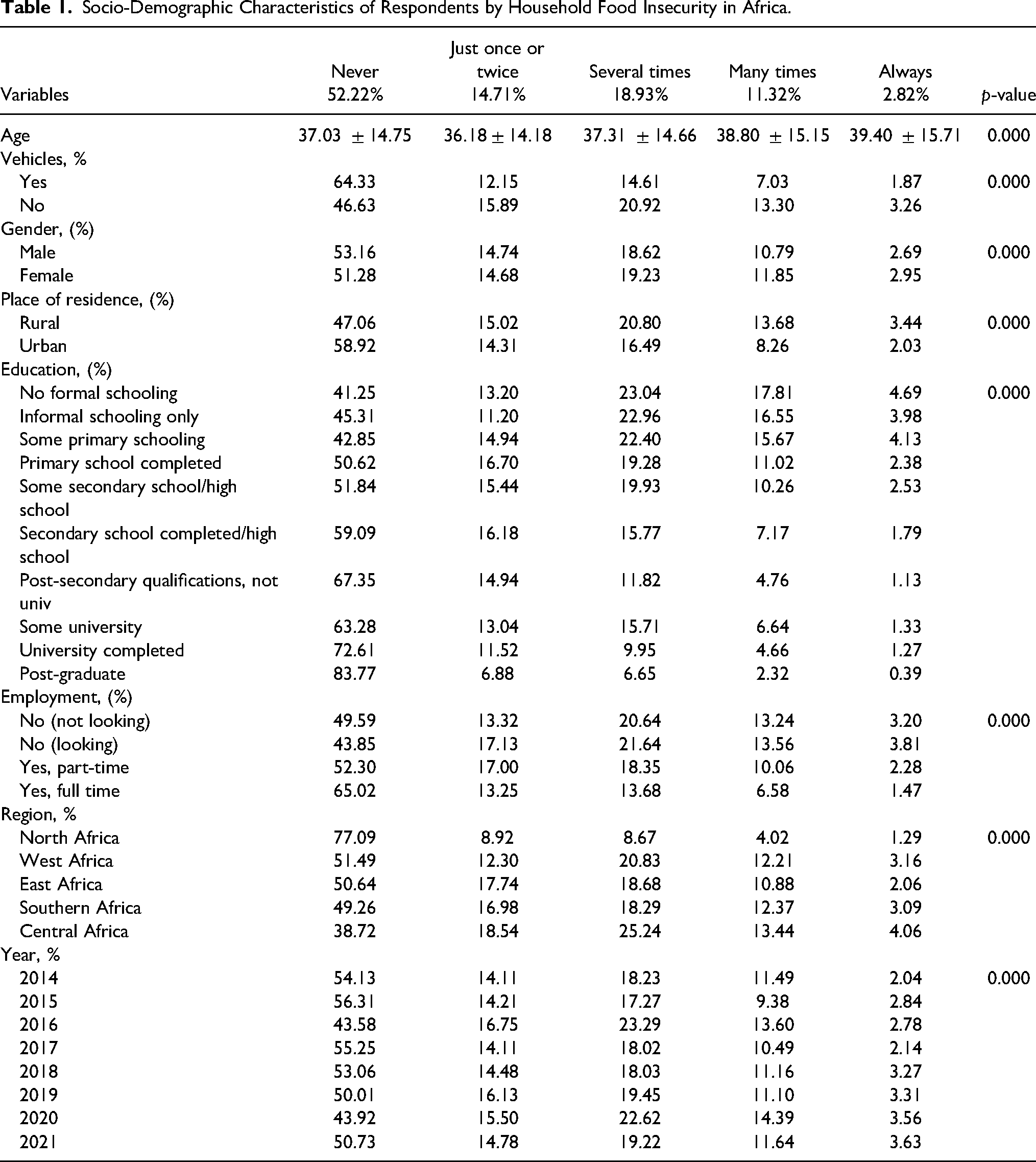
On the other hand, about three out of every hundred respondents reported that food insecurity was a chronic experience. Furthermore, the extent of the anomaly cascaded with higher educational attainment but increased with age. Also, each stratum of employment status had records of chronic food insecurity, but the proportion decreased with involvement in the labour market. The year-to-year comparison revealed that the proportion of respondents who constantly experienced food insecurity decreased from 2015 to 2017. Nevertheless, the statistics reveal that the numbers have increased since 2018. In addition, severe food insecurity was more common among people living in Central Africa, those in rural areas, and women were disproportionated impacted.
Among other disclosures, Table 2 shows that the infrastructure deficit is a fundamental problem in Africa. For instance, electricity grids were available to only about 6 of every 10 enumeration areas, i.e., neighbourhoods. About 60% of Africa has a piped water system. In addition, market stalls within walking distance are not commonplace in Africa, and this is because only 55% of the enumeration areas have them. As for the presence of banks, about 6 out of every 10 African neighbourhoods surveyed had them. Like other infrastructure, access to public transportation was not widespread because it only exists in 54% of African neighbourhoods.
Neighbourhood Services by Household Food Insecurity Status in Sub-Saharan Africa.
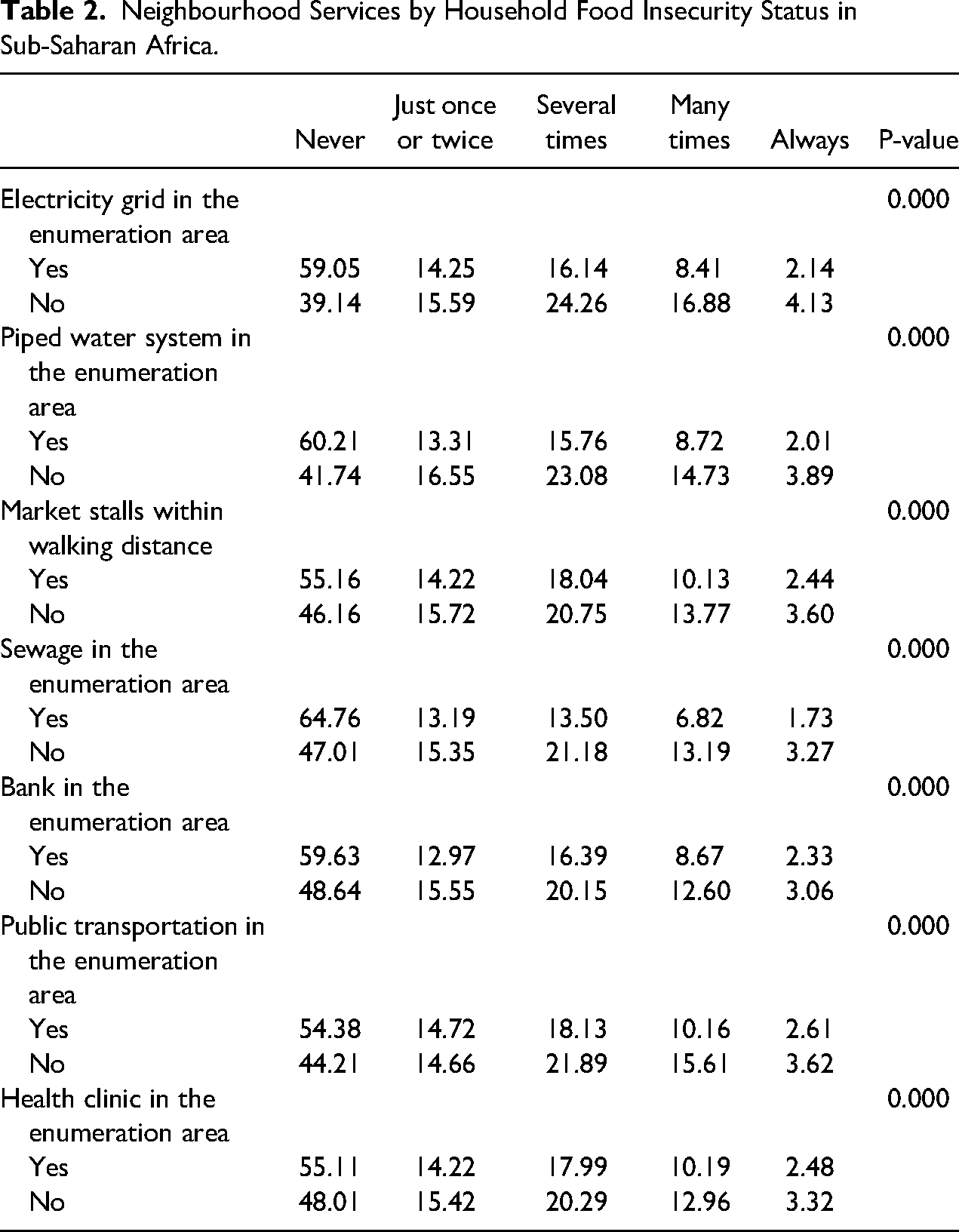
In addition, it is interesting to note that households living in environments with better physical and social infrastructure tend to have a higher level of food security. However, it is essential to note that even living in an infrastructure-rich climate does not guarantee complete protection against household food insecurity. According to Table 2, the percentages of households experiencing different classifications of food insecurity were lower in infrastructure-rich environments compared to those that lacked them. For example, households living in an environment with an electricity grid reported only 2.14% of the worst form of food insecurity, while those without an electricity grid reported 4.13%. Similarly, households living in an environment with piped water systems reported 2.01% of always food insecurity, while those without access to piped water systems reported 3.89% of habitual food insecurity. Furthermore, 2 out of every 100 households in an environment with a bank reported the worst form of food insecurity, while 3 out of every 100 households without financial institutions or services experienced the same. This trend was also observed for other markers, such as the presence of a market, a health clinic, sewage, and the availability of public transportation.
Table 3 displays the outcomes of the random-intercept multilevel ordinal regression analyses. Before selecting this method, we assessed the intraclass correlation coefficient (ICC) for a null model, which does not include any predictor variable at any level. Our objective was to ascertain the extent to which the community-level variables explain the variance of the outcome variable. This approach aligns with the recommendations of Bosker and Snijders (2011) and Hox et al. (2017). According to Heck et al. (2014), a multilevel specification is necessary if the ICC reaches the conventional threshold of 0.05. We estimated the null model, also known as Model I, and found that it yielded an ICC value of 0.217, which provided significant evidence of clustering in the data. This confirmed the appropriateness of ordinal multilevel analysis. More importantly, the estimate indicated that 22% of the variation in household food insecurity is attributable to differences in physical and social infrastructure contexts in which households reside across Africa. The log-likelihood ratio test compared the null model with the single-level ordinal logistic regression.
Random-Intercept Multilevel Ordinal Models of Food Insecurity in Africa (N = 137,853 Households from 37 Countries).
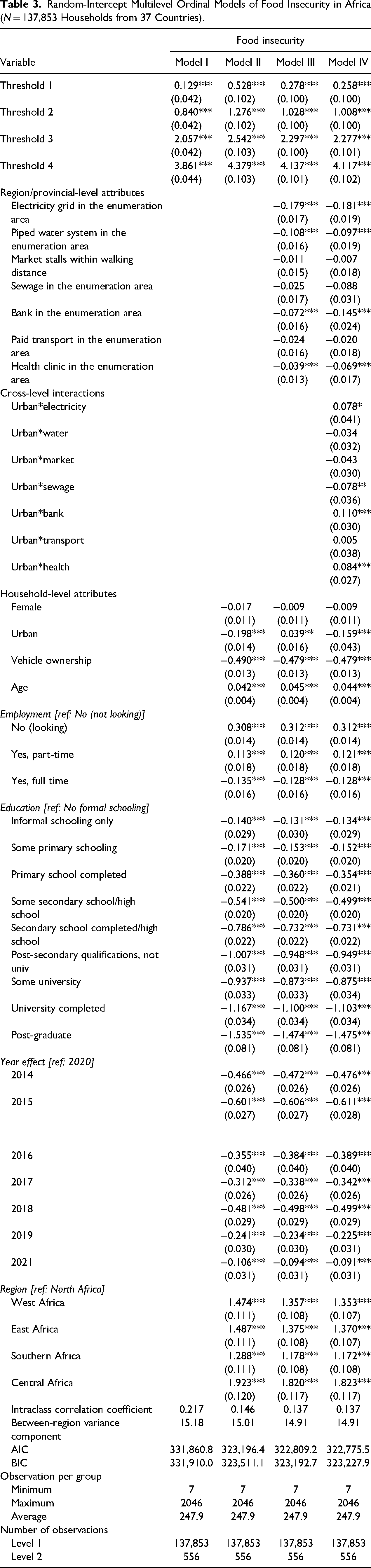
Given that the estimate was statistically significant, we concluded that using multilevel ordinal logistic regression was proper for the analysis (chibar2(01) = 21,918.43 Prob ≥ chibar2 = 0.000). In Model I, the between-region variance, otherwise known as the intercept variance across all regions, is 0.912. The estimated ratio of the variance of intercept and its standard error is 15.18 (0.912/0.060 = 15.18). We argued that the between-region variance differs significantly from zero because the estimate is more significant than two.
Model II included predictor variables in the level 1 equation, i.e., household-level variables, and specification allowed intercept to vary randomly across regions or provinces. Including these variables reduced the ICC to 15% but did not eviscerate it. The household-level variables have proven relevant as they exhibited statistically significant associations with the correct sign. For instance, owning a vehicle has been linked to a 40% decrease in the likelihood of experiencing an anomaly. Moreover, not all employment statuses have a buffering effect against food insecurity. While full-time employment has reduced the risk of food insecurity by 14%, part-time employment has increased it by 14%. Educational attainment has been identified as an excellent buffer against food insecurity, with even the slightest increase in education lowering the risk by 15% and the highest level of education reducing it by 71%. Furthermore, residing outside the North Africa enclave significantly increased the likelihood of household food insecurity in West Africa, East Africa, Southern Africa, and Central Africa, with the chances being 3.9 times, 3.9 times, 4.4 times, and nine times higher, respectively.
Through Model III, we found that including community-level variables did not diminish the impact of household-level variables. This highlights the crucial role of household-level variables in determining food insecurity. Additionally, our analysis emphasized the significance of physical and social infrastructure in addressing food insecurity in Africa. We found that having access to an electricity grid, piped water system, bank, and health clinic in a neighbourhood decreased the likelihood of food insecurity by 16%, 10%, 7%, and 4%, respectively. Interestingly, our findings showed that market, paid transportation, and sewage system variables did not significantly impact food insecurity.
It is worth noting that Model IV incorporates cross-level interaction variables, setting it apart from the previous model. The study has confirmed that household-level and community-level variables play a moderating role in food security status in Africa. The relevance of some cross-level interactions has also been established. For instance, residing in an area with a sewage facility reduces the likelihood of food insecurity, but only when the variable interacts with the place of residence. Therefore, the usefulness of a sewage facility on food insecurity in Africa depends on the household's location, as it was found to be insignificant for urban centers. On the other hand, having a health clinic in an enumeration area decreases the possibility of food insecurity by 6%. However, residency in a metropolitan area erodes the gain by 8%. However, access to an electricity grid, piped water system, bank, public transport, and market stalls did not significantly impact the likelihood of household food insecurity in Africa.
Robustness Check
Our study dichotomized the outcome variable into 0 for no food insecurity and 1 for any experience. We then analyzed the data using random-intercept models to test for robustness. Our null model, also known as Model V in Table 4, produced an ICC of 24%, which further supports the relevance of the multilevel analysis. Our findings revealed that the presence of certain infrastructure greatly influenced household food security. Having an electricity grid, piped water system, bank, and health clinic in a neighbourhood significantly reduced food insecurity by 15%, 13%, 6%, and 3%, respectively. However, market stalls and public transport did not significantly impact food security.
Random-Intercept Multilevel Binary Regression of Food Insecurity in Africa (N = 137,853 Households from 37 Countries).
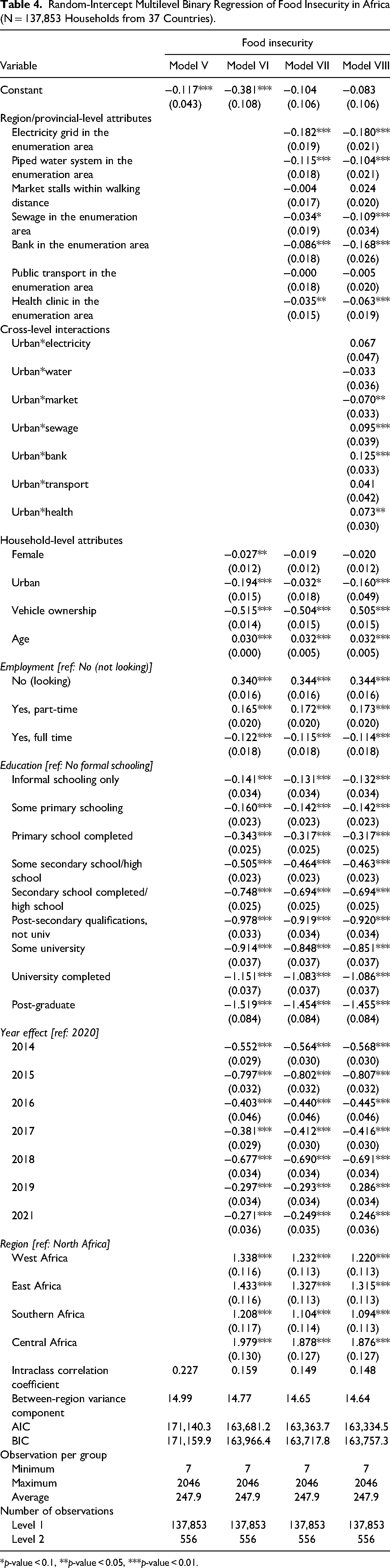
*p-value < 0.1, **p-value < 0.05, ***p-value < 0.01.
Our analysis confirmed the significance of including cross-level interaction terms, and we found that the previously discussed variables remained significant even after their inclusion. Of all the interaction terms between urban and level-2 variables, only ‘urban and sewage’ and ‘urban and health’ were statistically significant. The associated odds ratios indicated that the buffer provided by the presence of sewage and health facilities in a neighbourhood was reduced. However, our final analysis showed that residing in an urban neighbourhood with a health clinic and sewage facility lowered the chances of experiencing food insecurity by 8% and 9%, respectively. The results from our multilevel logistic regression aligned with those of the multilevel ordinal regression, but it is worth noting that the latter may have inflated estimates.
Discussion
The paper underscored how social and physical infrastructure affects African household food insecurity. Our analysis established a strong correlation between the availability of some amenities and food security. Therefore, it is instructive to note that the fight against food insecurity in Africa might remain unattainable or a lost cause until the various governments actualize a marked improvement in the households’ living environment across the continent (Rao and Pachauri, 2017). An area that needs such an improvement is the electricity grid distribution. We found that living in an environment with an electricity grid lowered the odds of household food insecurity compared with counterparts residing in any environment that lacked the amenity. The finding is not only consistent with existing studies, but it is also indicative of the abysmal state of access to electricity in Africa. Blimpo and Cosgrove-Davies (2019) estimated that only 43% of the African region has electricity access compared to the global access rate of 87%.
It is worth noting that the impact of electricity is wide-ranging on food security, for it impacts both the production and consumption side of food (Habanabakize and Dickason-Koekemoer, 2021; Joshi et al., 2019; Otekunrin, 2022; Rud, 2012; Tawodzera, 2014). Candelise et al. (2021) noted the impact of electricity access on food security filters through food availability and utilization. In the same vein, Asghar and Ahmad (2015) argued that access to the amenities makes food preparation, preservation, and storage seamless, which, in turn, buffers the likelihood of food insecurity. In addition, these benefits do add up. For instance, McDonald et al. (2015) found that improvements in food preparation, preservation, and storage facilitated by access to electricity helped rural households in Cambodia reduce the likelihood of food insecurity by 50%. A likely reason is that the presence of such infrastructure motivates families to see the need for food-preserving and food-preparing appliances, which in turn help cut food spoilage (Oluwafemi et al., 2015).
Another notable result of this study is that living in an environment with a piped water system enhances food security. This result is consistent with existing knowledge about the importance of water in the fight against food insecurity. Water does not only play a significant role in the production of food, but it is an essential input for the preparation of nutritious meals (Bethancourt et al., 2023). Whenever access to safe water is constricted, households often transfer resources from other basic needs, usually the food budget, to ease the condition (Cairncross and Kinnear, 1992; Sola et al., 2016). Brewis et al. (2020) argued that such a transfer increases the chance of food insecurity.
Water sourced through a piped system is often considered safe, but the same cannot be said for water from other sources like rivers and streams. Drinking untreated water from such sources can lead to waterborne diseases such as cholera, typhoid, diarrhea, fever, and dysentery. The cost of treating such diseases can be quite high, and it often means sacrificing resources allocated for other basic household needs like food. Fear of the direct and indirect effects of waterborne diseases usually motivates households to treat water drawn from other sources before usage. However, this increases the household's cost of living and makes them more vulnerable to food insecurity. Without access to safe water, households may have to make drastic changes like doing away with food altogether, preparing food that requires less water, or allocating more water for drinking than cooking. These changes increase the household's susceptibility to food insecurity, as Rukundo et al. (2019) confirmed.
According to our analysis, living in an environment with a banking facility significantly affects food security status among African households. This finding is unsurprising as having a bank in the locality means several benefits for the residents. With social infrastructure available, residents no longer need to travel outside their vicinity to access their funds, which saves money on transport fares and makes more funds available for household staples. Moreover, the presence of a banking facility increases residents’ interest in financial products, fosters more banking relationships and credit opportunities, and enhances knowledge of basic financial concepts, according to Goldberg (2016) and Baborska et al. (2018). This factor may gradually lose relevance as more economies become card-driven instead of cash-based. However, for now, the presence of social infrastructure is crucial for ensuring food security in African households.
In many African nations, cash exchanges are still widespread, especially when it comes to settling food bills. Having financial institutions nearby would make it much easier for people to withdraw funds for immediate household use. Unfortunately, when these institutions are absent, it can be very challenging for people to access the necessary funds (Tawodzera, 2014). This is why financial inclusion is so important. According to Gyasi et al. (2021), even having a bank account, being a credit union member, or using Mobile Money can positively impact food insecurity.
Our research shows that the presence of health clinics in a locality can significantly impact household food security status. This may be because these clinics offer more than just traditional healthcare services to residents in their area (Bissonnette et al., 2012). In fact, the British Columbia Ministry of Health's 2004 report highlights nutritional counselling as one of the many services offered by these facilities (BC Ministry of Health Services, 2004). Nutritional counselling empowers residents with the knowledge to develop healthy eating habits and make informed decisions about their food choices (Seed et al., 2013, 2014). This knowledge can significantly reduce the risk of food insecurity faced by households (Thompson et al., 2017). Additionally, nutritional care can benefit those with severe health conditions. For example, Raber et al.'s (2022) study demonstrated that counselling helped individuals with cancer manage their food security concerns. In conclusion, it is clear that nutritional counselling offered by health clinics can effectively address food security challenges faced by both the general public and those with specific health concerns.
Lastly, our study found that paid transportation did not have a significant impact on reducing household food insecurity. The outcome was not surprising for transportation, as having access to paid transportation does not necessarily mean it is affordable. In many African countries, individual operators control road transportation and have unchecked power to set transport fares, often charging high prices. As trekking remains a viable alternative, many people choose it over paid transportation, rendering it irrelevant (Churchill and Smyth, 2019). Similarly, the presence of market stalls within easy walking distance did not moderate the likelihood of food insecurity. Likewise, it is not surprising that market stalls within walking distance have a limited impact, as the vendors tend to charge higher prices for their produce than those who sell directly from the source. Consequently, consumers tend to avoid them and prefer to buy straight from the source instead. For instance, East et al. (2005) found that fish was more affordable on the beach in the early morning than from nearby market stalls.
Policy Implications
It is of utmost importance to understand that some infrastructure may be unable to prevent food insecurity. However, it has been observed that a bank situated in a neighbourhood can play a pivotal role in addressing this issue. Therefore, it is crucial for African governments to ensure that the regulations governing the placement of banks are not overly strict, as any deviation from this could have a significant and negative impact on the wellbeing of citizens. Furthermore, the significance of physical infrastructure, including electrification, in promoting wellbeing has been well-established. The present study also underscores the unparalleled impact of physical infrastructure on food security. All these factors together highlight the dire need for increased investment in physical infrastructure throughout Africa. While this investment may require a substantial financial commitment, the benefits are extensive and all-encompassing, making it a worthy endeavour.
Limitations of the Study
It is essential to acknowledge the limitations of this study, as with any research. One limitation is that it did not consider the quality of amenities in African communities, such as access to reliable public water systems or uninterrupted power. While access to public transportation can help alleviate food insecurity, other factors may also contribute to the outcome variable. Unfortunately, relevant data were lacking, making it challenging to explore these issues thoroughly. Furthermore, the study's cross-sectional nature means causality cannot be conclusively established (Wang and Cheng, 2020). Additionally, the self-reported nature of the study variables may introduce recall bias and misclassification. It is essential to note that further research is necessary to understand the link between infrastructure and food insecurity in Africa.
Future Research Direction
Future studies should use longitudinal data and analyze household-level variables to investigate this connection. It would also be worthwhile to examine how the quality of available social and physical infrastructure affects the likelihood of household food insecurity. Another potential area of research focus is how cultural practices mediate the influence of infrastructure on household food security status in Africa. Overall, these studies will offer valuable insights into this critical issue.
Conclusion
The study examined how local services, basically social and physical infrastructure, affect household food insecurity in sub-Saharan Africa. It uncovered three significant outcomes. Firstly, social and physical infrastructure in each locality played a role in household food security status, but not all were statistically significant. For instance, market stalls were not a significant factor in determining access to food for home consumption or ready-made meals. Secondly, the impact of local environmental variables varied. Physical infrastructure, such as electricity grids and sewage systems, significantly impacted household food security status more than social infrastructure, such as public transportation, banks, and health clinics. Lastly, the significance of community-level factors differed, with piped water systems having a more significant impact on household food insecurity than the presence of an electricity grid.
Footnotes
Declaration of Conflicting Interests
The authors declared no potential conflicts of interest with respect to the research, authorship, and/or publication of this article.
Funding
The authors received no financial support for the research, authorship, and/or publication of this article.
