




Abstract
Critics have identified the corporate and business sector as contributing to household food insecurity through its endorsement of low wages, anti-union activities and lobbying for retrenchment of the Canadian welfare state. It is therefore troubling that this same corporate and business sector has come to dominate positions on the boards of directors of civil society organizations with missions to reduce household food insecurity. Fisher uses the term ‘Big Hunger’ to describe how this ‘hunger-industrial complex’ of food banks, food diversion schemes and corporations and companies are accruing benefits to themselves yet do little to reduce household food insecurity. We consider such processes as illustrating two key political economy concepts: (1) Marx’s concepts of base and superstructure and (2) Gramsci’s cultural hegemony. We carry out a critical case study of the relevance of these concepts to the Canadian household food insecurity scene by examining how the corporate and business sector now dominates the boards of directors of four major civil society organizations concerned with reducing household food insecurity. We find evidence of these civil society organizations exhibiting agenda distortion, reciprocity and loss of integrity, all reflecting their becoming part of the superstructure of capitalist society whose ruling elites come to dominate the ideas and values of society. Issues of wages, unionization and collective agreement bargaining, taxes and taxation, income inequality and retrenchment of the welfare state – all important contributors to household food insecurity and key concerns of the corporate and business community – are for the most part absent from these civil society organizations’ reports, documents and statements. We specify the implications these developments have for addressing household food insecurity and the inequitable distribution of other social determinants of health.
The English bourgeoisie is charitable out of self-interest; it gives nothing outright, but regards its gifts as a business matter, makes a bargain with the poor, saying: ‘If I spend this much upon benevolent institutions, I thereby purchase the right not to be troubled any further, and you are bound thereby to stay in your dusky holes and not to irritate my tender nerves by exposing your misery’.
Introduction
Food banks are now a common feature of the Canadian landscape. Their appearance during the early 1980s signalled a variety of adverse changes in the living and working situations of many Canadian families brought about by welfare state retrenchment and a deteriorating labour market (Riches 2002, 2018). While initially seen as an emergency stopgap response to household food insecurity (HFI), food banks are now institutionalized and a barrier to reducing HFI (Tarasuk et al. 2020). Another response to HFI with similar issues is food diversion schemes by which unwanted food from supermarkets and farmers is distributed to food banks and other agencies (McIntyre et al. 2017).
Critics argue food banks and food diversion schemes fail to address HFI in a significant way; give the mistaken impression HFI is being managed; depoliticize HFI, absolving governments from the responsibility to respond to it; and perhaps most problematic, partnerships with corporations allow these companies – whose employment practices, anti-union activities and lobbying for welfare state retrenchment create HFI – to gain control of these civil society organizations’ (CSOs) agendas and polish their own images (Mendly-Zambo et al. 2021; Riches 2018). These partnerships also come to limit the ability of these CSOs to call for public policy changes such as improving working conditions and wages, unionizing workplaces, increasing taxation on corporations and the wealthy, reducing income inequality and enhancing the welfare state since all these actions are generally opposed by the corporate and business sector with which these CSOs now partner (Fisher 2017; Mendly-Zambo et al. 2021).
The concern that corporations shape the agendas of these CSOs has been specifically raised by Riches (2018) in Canada and Fisher (2017) in the United States. Fisher terms these partnerships in the United States as a ‘hunger-industrial complex’ by which food banks and food diversion schemes become institutionalized accruing benefits to these CSOs and the corporate and business sector – represented in the form of members of boards of directors from this sector – that have little to do with reducing HFI. Fisher (2017) suggests this ‘unholy alliance’ of corporations and hunger-related CSOs not only does little to reduce HFI but also serves to retrench the structures and processes by which the United States’ corporate practices create HFI. Livingstone (2013, 2015) takes this argument further by arguing – in relation to the UK scene – that these corporate-supported food charities entrench the capitalist system of exploitation within which these corporate practices are embedded.
In an examination of Walmart Canada’s partnership with the flagship food bank association in Canada, Food Banks Canada (FBC), Mendly-Zambo et al. (2021) found strong evidence of agenda distortion, reciprocity with corporate partners and loss of CSO integrity (Marks 2019) by FBC. A careful review of its reports and policy statements found an absence of any mention of the societal structures and processes that have been identified as important contributors to the presence or absence of HFI such as unionization and working under collective agreements (Muller and Raphael, 2021), wages (McIntyre et al. 2014), tax rates and structures (Brady & Rundall 2011) and retrenchment of the welfare state (Riches 2018). Mendly-Zambo et al. (2021) also found that all executive members of the Board of Directors of FBC came from the corporate and business sector, making explicit the conflicts of interest between the CSO’s mission of reducing HFI and its board members coming from the sector arguably responsible for HFI in the first place (Carroll & Sapinski 2018; Mendly-Zambo & Raphael 2018).
Our reading of Mendly-Zambo et al.’s (2021) work suggested a need to consider how memberships of boards of directors of CSOs such as FBC illustrate increasing corporate and business domination of HFI-related CSOs. From a theoretical perspective, it seemed to us that the elaborate food charity structure also represented an illustration of how the base of Canada’s capitalist economic system – which creates the conditions leading to HFI – constructs a superstructure by which such charitable giving comes to justify the base. The result is the imposition of a cultural hegemony by which the values and ideas of the ruling economic elites comes to dominate all discourse around HFI and means of alleviating it. Such a process is indeed a Marxist-predicted development.
In this article, we examine corporate and business membership on the boards of directors of four well-positioned HFI CSOs and the influence they appear to have upon their advocacy activities. 1 We suggest that such influence assures that these CSOs’ definitions of HFI, their identification of its sources and preferred responses will do nothing to threaten the corporate and business sector’s employment practices, anti-union activities and their broader public policy agenda of retrenching the welfare state, all of which contribute to HFI. In essence, these CSOs become part of the superstructure of Canada’s exploitative capitalist economic system and facilitate these HFI-producing ruling elites’ cultural hegemony over Canadians’ understandings of HFI and means of reducing it.
Background
The political economy of food insecurity in Canada
HFI is the inability of people to acquire food in socially acceptable ways, and since it contributes to numerous adverse health outcomes, it is also an important social determinant of health (Tarasuk 2016). The 2017–2018 Canadian Community Health Survey found 12.7% of Canadian households experience some form of HFI with rates higher for families with children at 17.3% (Tarasuk & Mitchell 2020). HFI is at even higher levels among Canada’s Indigenous population at 28.2%, Black population at 28.9% and other minority groups (South Asian, 15.2%; and Arab and West Asian, 20.4%) (Tarasuk & Mitchell 2020). Not surprisingly, Canada has been the target of ongoing rebukes by the United Nations for its failure to address HFI (De Schutter 2014; McCormack 2006).
Mendly-Zambo and Raphael (2018) and Livingstone (2015) apply a materialist political analysis by which HFI is seen as a result of corporate and business dominance – and this is especially the case in liberal political economies – over the economics and politics by which economic resources are distributed leading to HFI. This dominance contributes to HFI in two separate but related ways (Raphael & Bryant 2015). First, governing authorities come to see little role for the state in distributing economic and social resources in public policy areas that influence HFI such as social assistance levels, affordable childcare, provision of affordable housing, support for post-secondary education and employment training, coverage of pharmaceuticals and home care for the elderly (Olsen 2011).
This acceptance is accompanied by a mantra of lowering corporate and business taxes and reducing progressivity in the tax structure which limits the ability of governments to offer these supports even when the public desires them (Langille 2016). This tendency is most easily captured in measures of public social expenditures on which liberal welfare states rank lower than the other three forms of welfare states (social democratic, conservative and Latin) (Organisation for Economic Co-operation and Development 2019).
The second effect of corporate and business dominance is limiting state regulation of economic activity. Legislation to require living wages, employment security and benefits, and promote unionization and collective agreements is resisted (Pontusson 2006). Ceding control of resource allocation to the corporate and business sector increases the social inequalities that lead to HFI, such that HFI can be seen as a ‘side-effect’ of profit making (Scambler 2009).
Food banks and food diversion schemes in Canada
Responses to HFI in Canada include providing counselling and education to stretch financial resources; charitable provision of food through soup kitchens, food banks and feeding programmes; community kitchens and gardens; advocacy for income-increasing public policy; and restructuring societal power relations to address the inequitable distribution of income, housing and working conditions that drive HFI (Mendly-Zambo & Raphael 2018). Charitable responses to HFI are the most common with a vast network of food banks and associated agencies dominating this landscape (Riches 2018). Food diversion schemes donate food that would be disposed of to food banks (McIntyre et al. 2017).
As noted, food banks appeared in Canada in the 1980s as a short-term emergency solution to conditions brought on by a recession, economic restructuring and cuts to welfare programmes. They since become institutionalized such that by 2019, there were at least 4,934 agencies providing charitable food distribution of which 1,499 were food banks (FBC 2021d). March of 2019 saw 1,084,306 visits to these 4934 agencies (FBC 2021d). Aligned with the exponential growth of food banks are increases in food diversion schemes which, as noted, deliver surplus foods to food banks (McIntyre et al. 2017).
There are numerous critiques of food banks and food diversion schemes. They are ineffective in that most HFI in Canada is not addressed by the vast food bank network as less than 25% of HFI Canadians use them (Loopstra & Tarasuk 2015). Food banks and food diversion schemes do not address the fundamental causes of HFI (McIntyre et al. 2017).
Food banks use promotes stigma as food bank users experience feelings of desperation, shame and embarrassment from their use (Douglas et al. 2015; Enns et al. 2020; Tarasuk & MacLean 1990). Additional emotional consequences arise when food is inappropriate for those with diseases such as diabetes, food is outdated or damaged (Enns et al. 2020; Jessri et al. 2014; Willows & Au 2006), and clients must prove eligibility.
There is a lack of quality and quantity of food provided by food banks (Teron & Tarasuk 1999). The quality of foods accessed through food banks do not meet Canada’s Food Guide and Dietary Reference which is especially important as many clients have illnesses or disabilities (Holben 2012; Irwin et al. 2007; Jessri et al. 2014; Tarasuk 2016; Willows & Au 2006). Food bank visits provide just a few days to a week’s worth of food. Most have limits of one food hamper per month (FBC 2019).
Food banks and food diversion schemes mislead the public into thinking HFI is being managed, thereby reducing public policy responses to the source of HFI, the inequitable distribution of resources (Riches 2018). The depoliticization of HFI leads to governments, rather than implementing public policy to reduce HFI, contributing to its continuation (Tarasuk et al. 2014). Ontario funds expansion of food banks’ capacity to transport and store perishable foods (Ontario Ministry of Finance 2017), Nova Scotia (Smith 2016) and BC (Government of British Columbia 2017) provide tax credits for farmers’ donations to food banks. In August 2021, the federal government added another $100,000,000 to the earlier provided $200,000,000 to food banks and food diversion schemes (FBC 2021b; Kennedy 2021).
And as pointed out by Mendly-Zambo et al. (2021), corporations which contribute to HFI through low-wage employment, anti-union activities and lobbying for a retrenched welfare state partner with food banks and food diversion schemes to polish their companies’ brands. Food diversion schemes also allow corporations to avoid costly disposal fees (Toronto Food Policy Council 2016).
Base, superstructure and cultural hegemony
The findings of corporate members dominating the FBC Board of Directors executive suggested to us the value for our enquiry of two Marxist concepts: base and superstructure and cultural hegemony. Marx (1978 [1859]) terms the structures and processes of the economic system and the relations it generates as the base of capitalist society. The base of capitalist society consists of the forces and relations of production which, in its present form in Canada, creates the inequitable distribution of resources leading to HFI but at the same time benefits the corporate and business sector allowing increased profits (Vidal et al. 2015; Mendly-Zambo & Raphael 2018). Marx (1978 [1859]) uses the term superstructure to refer to the political, legal and ideological edifice that is built upon these relations and comes to both institutionalize these relations as well as justify them: In the social production of their existence, men inevitably enter into definite relations, which are independent of their will, namely relations of production appropriate to a given stage in the development of their material forces of production. The totality of these relations of production constitutes the economic structure of society, the real
The first aspect of superstructure is the ideology that justifies the economic system that creates these social relations and their resulting social inequalities, including HFI. The second aspect of superstructure is the structural institution of capitalist ideology. This involves governmental actions such as laws, regulations, policies and rules that maintain these class-related relations. In the modern era, structural institutions of the superstructure include a media dominated by these economic interests and the promotion of particular ideological approaches to social service provision, health promotion and, of course, reducing HFI. The dominance of the boards of directors of CSOs whose mission is to reduce HFI by those who create it would be another instance of a constructed superstructure that justifies and maintains the problematic base of economic relations in Canada that produce HFI. In addition, such domination would perpetuate the hegemonic belief that food banks and food diversion schemes are the preferred means of reducing HFI.
At the ground level, corporate domination of CSOs would suggest the relevance of Gramsci’s concept of cultural hegemony, whereby the ideas and values of the ruling classes – in the present case, the corporate and business sector – come to be imposed upon and accepted by those being dominated (Gramsci 2000). This process has much to offer in explaining corporate and business Canada’s involvement with food banks and food diversion schemes (Elmes & Derry 2013). As described by Cole, The term refers to the ability of a group of people to hold power over social institutions, and thus, to strongly influence the everyday thoughts, expectations, and behavior of the rest of society by directing the normative ideas, values, and beliefs that become the dominant worldview of a society. (Cole 2017)
The corporate and business sector certainly has interest in maintaining a perception among authorities and the public of food banks and food diversion schemes as the preferred means of responding to HFI. By situating the problem of HFI within the individual or community and not in the public policies that benefit corporate and business interests at the expense of most citizens, redressing the imbalances in power and influence that skew the distribution of economic resources and create HFI is unlikely.
Present study
If the sources of HFI are to be found in the problematic employment practices, anti-union activities and public policy advocacy for retrenchment of the welfare state by Canada’s corporate and business sector, any finding that the corporate and business sector is coming to dominate the boards of directors of major CSOs concerned with HFI would be very troublesome. We investigated this possibility by examining the boards of directors of four CSOs concerned with HFI in Canada: FBC (the flagship food banks association in Canada); the Daily Bread Food Bank (DBFB) (the largest food bank in Canada), Second Harvest Food Rescue (SHFR) (Canada’s largest food rescue agency) and the National Zero Waste Council (NZWC) (the primary national agency advocating for food diversion).
We then examined how these CSOs frame HFI and its causes and proposed responses in their reports and statements by identifying their positions on wages, unionization and collective agreement bargaining, taxation of corporations and the wealthy, reducing income inequality and retrenchment of the welfare state, all important means of reducing HFI yet in apparent contradiction to the positions and activities taken by the corporate and business sector in Canada (Carroll & Sapinski 2018; Langille 2016).
Methodology
We conducted a critical case study, informed by a critical social research perspective, of the inherent contradictions of CSOs being dominated by members of the same corporate and business sector responsible for HFI in the first place. Harvey (1990) describes critical social research as situating social phenomena within the larger dominant social structures perpetuated and maintained through political and economic power and legitimated through ideological messaging. For Harvey (1990), the case study researcher ‘deliberately selects, for detailed empirical analysis, a case that provides a specific focus for analysis of myth or contradiction’ (p. 153). In this case, an analysis of the inherent contradiction of corporate and business domination of four CSOs whose stated mission is to reduce HFI.
We examined membership of these CSOs’ boards of directors attaining their biographies from the CSOs’ websites. For those directors coming from the corporate sector, we investigated whether their employers were members of the Business Council of Canada, an influential association consisting of the top 150 companies in Canada whose lobbying for business control over the economy and retrenchment of the Canadian welfare state is well established. We contrasted these public policy positions to CSOs’ public positions on HFI. We specifically looked for evidence of CSOs avoiding issues of wages and benefits, unionization and collective agreement coverage, increased taxation of corporations and the wealthy, income inequality, and retrenchment of the welfare state.
Findings
Corporate and business sector membership on boards of directors
We first provide the backgrounds of three of these CSOs boards of directors with focus on board executives. For the fourth, we highlight the Chair and Vice-Chair of its larger management board, as it is without a board of directors. 2
FBC
FBC purports to provide national leadership to reduce HFI: ‘Our mission is two-fold: One is to reduce hunger today and the other is to prevent hunger tomorrow’ (FBC 2021d). It provides support to a vast network of provincial associations, and affiliate food banks and food agencies. While it expresses a concern with ‘reducing the need for food banks’, the great proportion of its activities involve fund-raising to assist collection and distribution of food. Its annual HungerCount report documents food bank use in March of each year across Canada (FBC 2021c). HungerCount also provides demographics of food bank users and recommendations for reducing HFI. HungerCount details FBC’s understanding of the causes of HFI and proposed solutions, discussed in detail below.
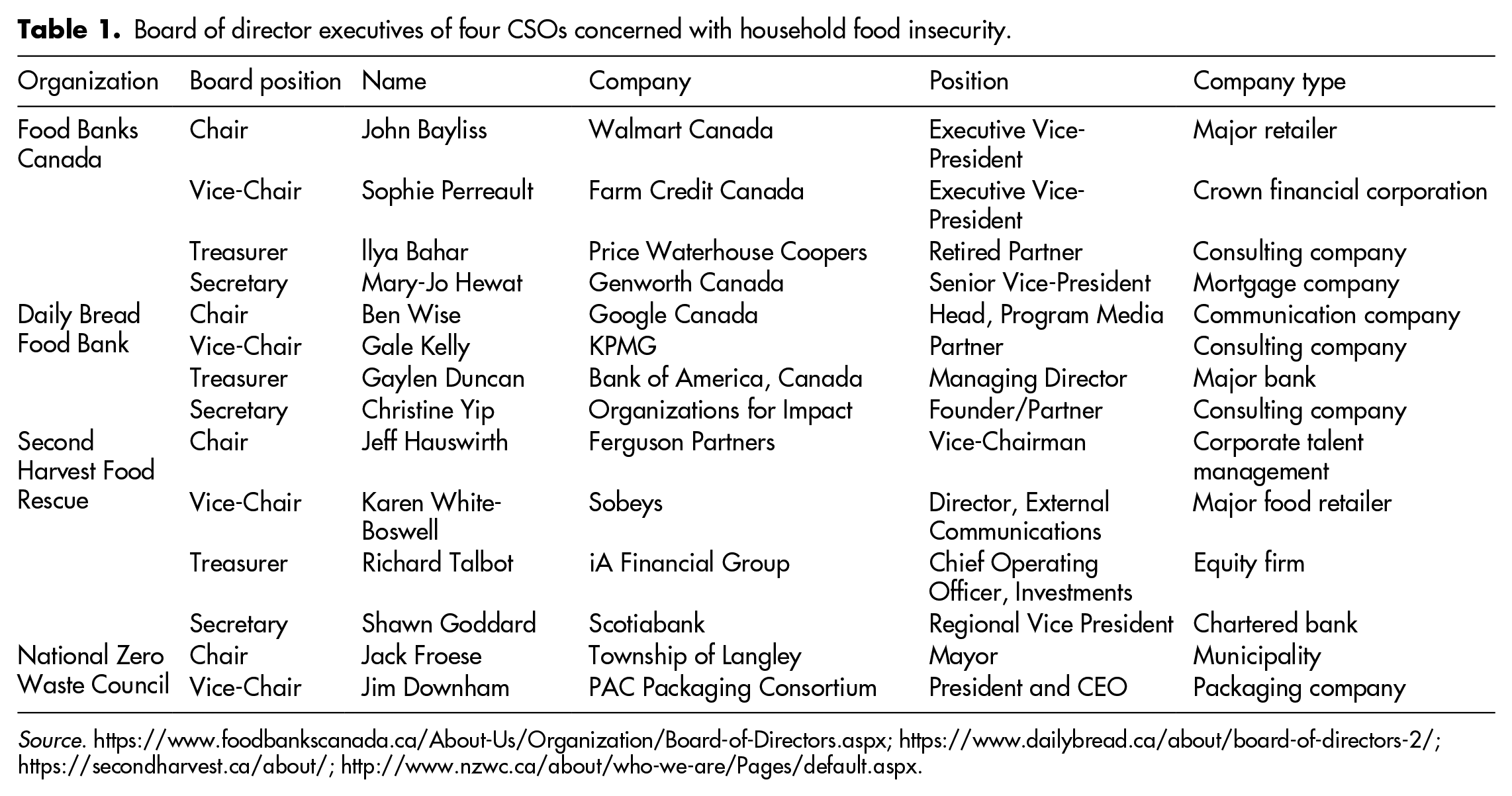
All four members of the Board of Directors executive are from the corporate and business sector (FBC 2021a). Table 1 provides details concerning the board member executives of all four CSOs in this study. Of the additional 11 members of the Board, 6 are from the corporate and business sector: IGM Financial, Algonquin Power and Utilities, McCrie and Mundy Professional Services, Thomas, Large and Singer, Inc., Quebec Food Processing Council and Kellogg Canada. Four others are employed by food banks and one is from a networking agency providing opportunities for newcomers. The Interim CEO of FBC is David Armour who is a fund-raising professional who recently served in the dual role of Director of Philanthropy of the United Church of Canada and of President of the United Church of Canada Foundation.
Board of director executives of four CSOs concerned with household food insecurity.
Daily Bread Food Bank
DBFB in Toronto works to ‘end hunger in our communities and change the way people think about poverty’ (DBFB 2021e). All four executive positions of the Board of Directors are held by men or women from the business and corporate sector (see Table 1) (DBFB 2021a). There are 10 other directors, 8 of whom come from the corporate and business sector. They hail from Deloitte, Focused Improvement Consulting, Ontario Power Corporation, Canada Goose, Four Corners Group, Nobul Corporation, Just Boardrooms, with another one an independent business consultant. The two others are a litigation lawyer with a union and a community developer working on income security issues. The CEO of DBFB Bread Food Bank, Neil Hetherington, spent his early career in construction and then served as CEO for Habitat for Humanity.
SHFR
This organization describes itself as ‘Second Harvest is the largest food rescue organization in Canada and global thought leader on food recovery (Second Harvest 2021a). We work across the supply chain from farm to retail to capture surplus food before it ends up in the landfill which negatively impacts our environment’.
It reports that in 2020 it ‘recovered more than 22.3 million pounds of nutritious, unsold food – focusing on protein, dairy and produce – we rescued before it became waste and redistributed to a broad network of 2,300 social service organizations’ (Second Harvest 2021a).
All 12 directors of SHFR – including the executive – are from the corporate and business sector (Second Harvest 2021a). The non-executive directors come from Royal Bank of Canada, DW LLP, Dale and Lessmann, Scotiabank, Dalfen Industrial, International Financial Data Services, the Ontario Municipal Employees Retirement System and Manawa Networks. Sobeys, from where the Vice-Chair hails, is a Big Food company and the others are part of the banking, investment and financial sectors. Lori Nikkel has been CEO of SHFR since 2018 and has 20 years experience in the charitable food sector.
NZWC
NZWC is a self-proclaimed ‘leadership initiative’ of Vancouver City Council to advance waste prevention in Canada that includes local governments, non-profits and grocery store chain Metro and the Retail Council of Canada. It calls for a federal tax incentive to encourage businesses to donate food to charitable organizations and has support to implement this tax incentive from twenty local governments including Montreal, Ottawa and Vancouver (National Zero Waste Council 2021b).
The Chair of NZWC is Jack Froese who is serving his third term as Mayor of the Township of Langley. He previously owned and operated a turkey farm and wholesale business and served as a police officer for the Vancouver Police Department. The Vice-Chair, Jim Downham, serves as the president and chief executive officer of PAC Packaging Consortium, a packaging value chain, and chairman of LeaderLinx, a recruiter company serving the packaging industry.
Of the 27 management board members of NZWC, 20 are from the business sector, 3 are politicians and 3 others come from a charity, food bank and municipal association (National Zero Waste Council 2021a). The majority of business companies and associations are involved with chemical distribution, material diversion and recycling, and circular economy business models.
The 20 members of the Management Board coming from the business community or representing business interests are with A&W Food Services of Canada Inc., Unibuilders, BASF Canada, Canadian Manufacturers and Exporters, Dillon Consulting, LaFarge Canada, Nature’s Path Foods, Ocean Wise, One Earth, Retail Council of Canada, Surrey Board of Trade, Cascade’s Recovery, London Drugs, Circular Supply Chains, Return-It, Recycling Alternatives and Telus. The additional three members from recycling councils in British Colombia, Quebec and Alberta clearly represent business and corporate interests.
The four members of the management board from government are a city councillor from Vancouver, Director of the Metro Vancouver Regional District, a councillor from Toronto, and a representative from a Montreal borough. An additional member represents the Federation of Canadian Municipalities. The two directors from the non-business sector come from a Salvation Army Thrift Store and Second Harvest Food Recovery. Three members represent recycling councils in British Colombia, Quebec and Alberta. Table 1 provides a summary of board of directors membership for three CSOs with boards and for the NZWC, its management board. Clearly, corporate and business sector domination of membership is apparent for FBC, DBFB, SHFC, and NZWC. Table 2 summarizes our findings concerning these CSOs’ boards of directors.
Membership on the boards of directors and management board of four CSOs concerned with HFI.
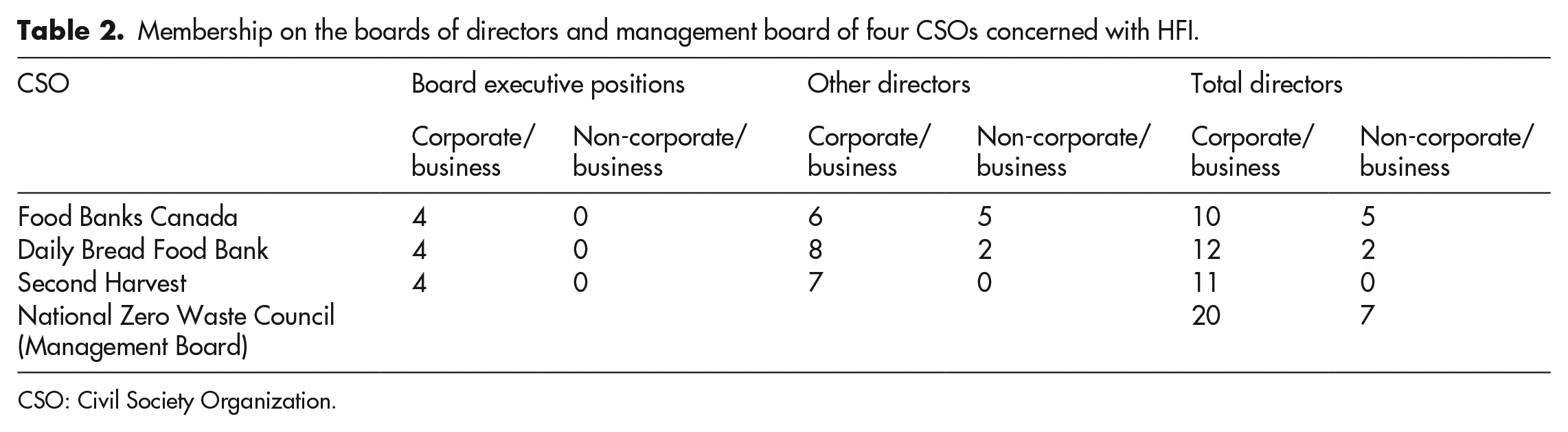
CSO: Civil Society Organization.
CSOs’ framing of HFI
We were particularly interested in how these CSOs frame the problem of HFI, its causes and proposed solutions, and whether these frames include wages, unionization and collective agreement bargaining, taxation of corporations and the wealthy, income inequality and retrenchment of the welfare state, all documented as contributing to HFI but also concerns of the corporate and business sector as these influence profit levels. We reviewed CSOs’ major reports and statements over the last 5 years to identify their framings of HFI. We searched these documents and their websites for the specific terms: wages or low wages, unions, unionization or collective agreement bargaining, taxes or taxation, income inequality or equality, and welfare state. We also did so for the term social assistance which is an indirect measure of the welfare state.
FBC
We looked at the last five HungerCount reports and then searched using their website search engine (FBC 2021c). The 2019 HungerCount report attributes HFI to a deficient social safety net, as 43.4% of food bank users stated ‘social assistance/benefits too low’ as a reason for visiting the food bank. FBC also identifies increasing employment precarity as 19.4% of users give ‘low or delayed wages’ as the reason for food bank use. But this was displayed in a table with no mention of the finding in the text of the report.
While the 2019 report states ‘the root cause of food bank use is, and always has been, related to poverty and low income – and this core issue can only be addressed through government policies’ (p. 29), there are no recommendations in the report to increase wages and employment benefits or reduce worker precarity. Rather, FBC recommends piloting basic income projects, a policy criticized for subsidizing low-wage companies (Clark 2020). The keyword search through the 2019 HungerCount makes no mention of low wages or wages beyond the single mention in a table, unions, unionization, collective agreement bargaining, taxes or taxation, income inequality or explicit mention of welfare state policies.
FBC recommends the creation of affordable childcare programmes, increased support for low-income single adults, rapid implementation of the Canadian Housing Benefit, reducing Northern food insecurity, increasing non-cash benefits to all low-income households, a national pharmacare programme and converting non-refundable tax credits into refundable ones (FBC 2019), all arguably related to the welfare state. None of these recommendations, however, question the wage levels and benefits provided by many corporations or businesses, nor say anything about how unionization of workplaces and collective bargaining would reduce HFI among workers. Nothing is said about income inequality or even inequality. Corporate opposition to these recommended social programmes goes unmentioned.
Like the 2019 HungerCount, no mention is made in the 2018, 2016, 2015, or 2014 (there was no 2017 report) HungerCount of unions, unionization, collective agreement bargaining, taxes or taxation, income inequality or explicit mention of welfare state policies. The 2014 report does state in regard to wages: Canada has a booming low-wage economy, thanks in part to a confounding, ongoing loss of well-paying blue-collar jobs. For example, the well-paying manufacturing sector accounted for less than 10% of Canadian jobs in March 2014, compared to 14% in 2004 – a loss of 400,000 jobs during a time of steady population growth. Meanwhile, lower-wage retail, accommodation, and food service jobs continue to grow at a rate equal to or greater than the population, consistently accounting for one in every five jobs in the country.
And the 2016 report includes a box stating: ‘George works full time in a factory and, though the sector has a reputation for good wages, he earns only minimum wage’. However, in neither report is there a call for higher wages as a means of reducing HFI.
Our search of the FBC website for the terms unions or unionization, collective bargaining, taxes or taxation, income inequality or equality, or welfare state returned nothing. There was one mention in a blog of unions helping to collect food for a local food bank and three blog returns on how food banks can help clients in filing tax returns. One of these called for automatic tax filing so food bank clients could receive eligible benefits. Regarding wages, a blog reported the wish of a food bank client ‘That income supports and minimum wages were set high enough so that all families can thrive without the use of emergency support programs like ours’. No FBC document text mentions wages or low wages. We note that the newly appointed chair of the board of directors is vice president of Walmart Canada – hardly an advocate of improving working conditions, increasing wages and benefits, and promoting unionization of workplaces (Mendly-Zambo et al. 2021; Meunier 2019). Instead FBC calls for ‘recognizing charitable donations of food by manufacturers, importers, distributors or retailers to food banks in Canada’ through a tax incentive plan, that would allow these sectors to profit from their poor management of supply as well as avoid costly disposal fees (FBC 2012).
DBFB
We reviewed 5 years of the reports Whose Hungry? (DBFB 2021f). The 2020 report contained two mentions of low wages as contributing to HFI together with recommendations that more directly addressed HFI than what we found with FBC.
Low-income wages have been stagnant for decades despite overall growth in wealth and income in Canada. At the same time, work has become increasingly precarious, offering not only low wages but low security, fewer hours, and little to no employer provided benefits. The availability of work has changed, with temporary jobs growing faster than permanent employment in the Greater Toronto and Hamilton Area between 2011 and 2017. One in 10 people in Toronto are now working in the ‘gig economy’, typically defined by short-term contracts or freelance work, often with low wages and no benefits. Precarious employment and a lack of opportunities further concentrates poverty within marginalized communities in Toronto. Without health benefits and with wages too low to afford all of life’s basic necessities, such as nutritious food and medication, individuals in low-wage employment tend to have poorer health outcomes. These health challenges can create further barriers to securing meaningful employment as a pathway out of poverty. However, we also need to re-examine labour standards and minimum wages to ensure that employment is a pathway out of poverty.
And their recommendations were certainly more in line with the academic literature on means of reducing HFI: (1) implement a national universal childcare programme; (2) raise the minimum wage; (3) protect workers by raising employment standards; and (4) increase access to health benefits for low-income communities. However, we found no mention of unions or unionization, collective bargaining, taxes, income inequality or the welfare state. DBFB also issued a report entitled Hunger Lives Here concerned with the effects of the COVID-19 pandemic (DBFB 2021b). We did not find a single reference to wages, unions or unionization, collective bargaining, taxes or taxation, income inequality or the welfare state. However, it did state that the Federal government should: ‘Commit to reviewing and reforming the E.I. system to ensure workers in non-traditional occupations have access to employment supports’ and ‘Enact a national pharmacare plan that is universal, comprehensive, accessible, portable, and public’.
The 2019 Who’s Hungry, however, has a few references to wages. These include reference to immigrants having and maintaining lower on-average wages than the Canadian-born. It also mentions those earning low wages are less likely to have employer-provided health benefit coverage. The report called out the Province of Ontario for repealing provisions of Bill 47 that required employers to pay employees equal wages for the same work, regardless of whether they were casual, temporary or part-time, an approach strongly resisted by the corporate and business sector.
The report does call for strengthening social assistance, expanding tax benefits, investing in affordable housing and tenant protections, enhancing access to affordable childcare and adopting a human rights-based approach to decision making to ensure policies promote equity. However, the report makes no mention of unions, collective bargaining or increasing taxes on corporations to restore benefits for those unable to work to levels that would reduce HFI. It says nothing about corporate and business influence in policymaking, a situation by which Canada’s welfare state has undergone retrenchment on an ongoing basis and the labour market has been unregulated.
Use of the search engine at the DBFB found three instances of wages. In a blog of 7 April 2021, 1 year, 1 million food bank visits later, it’s time to refocus poverty reduction efforts, it was stated (DBFB 2021c): The pandemic has clearly exposed holes in our social safety net. Canada’s Employment Insurance system was designed in the 1940s and no longer reflects the reality of most low-wage workers. Due to changes made to Ontario’s labour laws in 2018, employers are no longer required to provide paid sick days or pay equal wages for casual, temporary or part-time work. Ontario recently released its 2020-2025 Poverty Reduction Strategy, but its sole target is to move social assistance recipients into employment. Employment can be a pathway out of poverty, but only when combined with strong labour protections and livable wages, accessible education and training, and access to affordable housing, childcare, and health benefits. In the Toronto region, stagnant wages coupled with the rising cost of living are leaving families struggling to make ends meet. Since last year, the median monthly income for food bank clients has remained at $806, yet the cost of a one-bedroom apartment has increased by 6% and the cost of food has increased by 7.5% in Toronto.
Similarly, a 16 June 2021 blog: Returning to a new normal: Our economic recovery must address poverty and inequity includes mention of wages and investment in social infrastructure, a welfare state issue (DBFB 2021d): In the face of high costs of living, employment has too often failed to provide a pathway out of poverty. Who’s Hungry 2019 revealed that approximately one in four food bank respondents aged 18-64 were working. Most of these individuals reported earning low wages, lacking full-time hours, and not receiving employer benefits. COVID-19 has disproportionately affected hourly and low-income workers. The 38% decline in employment for low-wage workers through March and April, compared to 12.7% for other employees, demonstrates that there is a clear need to provide more stable employment to our marginalized workers. With low interest rates and an impending need for job creation, now is the time to make a long-term investment in Canadians’ right to housing. The creation of permanently affordable housing through the building of public and community housing would create immediate jobs while stable long-term investments in a national housing system would create more sustainable spaces for our communities to flourish. In the short term, providing funding to provinces/municipalities to tackle the backlog of public housing repairs would again provide employment opportunities and immediately improve living conditions. Other physical and social infrastructure, including transit and childcare systems, would further strengthen this new middle class and create stronger, more resilient communities.
DBFB blogs are clearly more proactive than the FBC ones and, as will be shown, the SHFR. There are, however, no mentions of increasing taxation on corporations and the wealthy, corporate influence upon policymaking or strengthening the Canadian welfare state.
SHFR
We reviewed the last five annual reports released by Second Harvest (2021b) and then searched their website using their search engine. In none of the 2014/2015 to 2019–2020 Annual Reports is there a mention of wages, unions, collective agreement bargaining, taxes, income inequality, social assistance or welfare state policies. While the 2020 Annual Report mentioned the effects of COVID-19 on job loss, the solution put forth was SHFR providing food for those in need (p. 2), rather than state-organized emergency relief for people experiencing HFI. The report also indicated that SHFR’s strategic priorities for the 2020–2022 period include sustainable growth, talent management, and awareness and communication (p. 4), none of which address causes of HFI, and instead illustrate Second Harvest’s normalization of food diversion as a means of addressing HFI.
The 2019 Annual Report indicates SHFR’s role as a food rescue organization, first and foremost, with the CSO being ‘Canada’s largest food rescue organization’ (p. 1). While the 2019 report mentions that ‘65% of the food redistributed was protein, produce and dairy, food categories that are typically the most difficult to access if you’re low-income’ (p. 2), there is no mention of root causes of low income or recommendations for wage and/or social assistance increases. Instead, SHFR continues to promote food redistribution as a means to ‘rescue’ foods from the landfill by diversion to hungry Canadians, as indicated by their slogan ‘feeding people, not landfills’(p. 1). Furthermore, the 2016–2019 strategic plan involved responsible and sustainable growth, revenue growth and increased awareness (Second Harvest 2016). Second Harvest intends on further institutionalizing food rescue organizations, despite their known ineffectiveness in addressing HFI.
In the SHFR 2018 Annual Report (Second Harvest 2018), while it is indicated that ‘we are committed to finding solutions to the inequities and inefficiencies of Canada’s food system’ (p. 2), the solutions put forth were to increase awareness, grow responsibly and build a sustainable future for the organization (p. 3).
Our search on the SHFR website for the terms wages, low wages, unions or unionization, collective bargaining, taxes or taxation, income inequality, social assistance and welfare state returned nothing for unions or unionization, collective bargaining, taxes or taxation, income inequality, social assistance or welfare state. There was one mention of low-wage jobs in a 1 February 2015 blog post, Poverty, Hunger and Eating Well: Understanding Food Security, concerning food insecurity (Second Harvest 2015). This post suggested low-wage jobs as a possible reason why people may struggle to put healthy food on their tables. The blog post concluded with a discussion of SHFR’s role in tackling food insecurity and food waste as a solution to the problem of HFI.
In a 28 May 2018 blog post, Feeding our Future, it is noted that summer camps are situated in ‘very low and low-income neighbourhoods’. Again, this post passively mentions income as being related to HFI. In a 12 November 2020 blog post, Lori Nikkel: Food programs are a band-aid to food insecurity and income disparity, Lori Nikkel, CEO of SHFR, discusses food programmes in a BNN Bloomberg video interview (Second Harvest 2020). Here, Nikkel mentions that ‘precarious employment’ is the cause of food insecurity, with ‘working poor forced to work two, three, four jobs’. While it is clear that Nikkel recognizes low wages and precarious work as the cause of HFI, SHFR fails to promote solutions that address the root problem.
NZWC
NZWC is a leadership initiative which brings together government, businesses and CSOs to diversity food, mainly to food banks (National Zero Waste Council 2021b). It produces numerous annual publications. Several publications spanning the 5-year period from 2015 to 2020 were reviewed as a proxy for the annual reports of the aforementioned CSOs. The 2020, Less Food Loss and Waster, Less Packaging Waste Summary sets out the crisis of food waste asserting that in Canada, 11.2 million metric tonnes of avoidable food loss and waste (FLW) occurs every year. The report goes on to explore best practices in reducing waste in packaging and food while advocating for a circular food system.
In their 2018 publication, A Food Loss and Waste Strategy for Canada (NZWC 2018), NZWC begins with the statistic that ⅓ of the food produced in Canada is never eaten. In the development of this strategy, NZWC consulted with over 900 stakeholders and advanced the strategy of prevent, reduce and recover. Aligned with the United Nations Sustainability Development Goal #12: ensure sustainable production and consumption patterns, several international organizations including the European Union’s REFRESH banded together to ensure global sustainability. Among the top five root causes of FLW was human behaviour and specifically employee and management decision making.
NZWC (2015) discussed charitable food donation in their publication, Study of Organic Waste Redirection: Tax Incentive Options for Charitable Food Donations. In this report, NZWC advocates for tax incentives that encourage food donation to those in need. This is food that is past its due date, for example, but is not unsafe for human consumption but rather is merely harder to sell as it is not as fresh. The premise being that this food can support those afflicted by HFI, thus having far-reaching societal benefits. When analysing the barriers to food donations, 50% attribute lack of storage and refrigeration at local food banks to be the problem. This study contributes to the belief that food banks are a way out of food insecurity rather than a temporary measure with the added benefit of enhancing corporate reputation measure by indices of corporate social responsibility.
Many management board members of NZWC represent organizations that contribute to food banks (National Zero Waste Council 2021a). In 2020, Nature’s Path Foods proudly announced donating 1M bowls of food to US and Canadian food banks (NZWC 2020). Save-on-Foods from western Canada, contributes $3M annual to food banks. Similarly, A&W Food Services of Canada Inc. has donated 55,000 pounds of food to food banks since 2015. With extensive experience from Walmart, the cargo carousel system designed by Circular Supply Chains Inc. boasts a $188,000,000 annual packaging savings in their test use case of banana shipments from Costa Rica further eliminating warehousing and loading docks.
Search of the NZWC reports revealed not a single mention of any of the search terms of wages, unions, collective agreement bargaining, income inequality, social assistance, or welfare state policies. There were, however, 24 instances of ‘tax incentives’ for corporations and farmers to donate food that would normally be wasted sprinkled among their numerous reports.
These corporations’ activities and positions
In this section, we consider what is known about the corporations from which the executive members of these four CSOs hail from with the Business Council of Canada (BCC) as the primary focus with mention of other corporations. There is clear consensus that the corporate and business sector in Canada has been very successful in maintaining many of the structures and processes that contribute to HFI (Riches 2018).
The BCC, in particular, has been identified as one of the strongest forces responsible for the adoption of neo-liberal public policies associated with the retrenchment of the welfare state in Canada (Langille 2016). It describes itself: ‘The Council is composed of the chief executives and entrepreneurs of over 150 leading Canadian companies, operating in every sector and region of the country’ (Business Council of Canada 2021). Brownlee (2020) states, Broadly focused intersectoral policy organizations are among the key coordinating points in the capitalist power structure, and are one of most successful means by which corporate Canada has formed and exercised its collective will. By far the most powerful of these groups is the Business Council of Canada (formerly the Canadian Council of Chief Executives). The Council was created in 1976 as part of the corporate offensive to unite Canada’s business community and to counter organized labour and the threat posed by state intervention. Its committees and task forces have covered a wide range of domestic and international policy issues, culminating in many victories in areas such as energy policy, tax reform, deficit reduction, and free trade.
FBC
One of the four executive directors comes from a corporation whose chair or CEO is a member of the BCC: Nicolas Marcoux, Chief Executive Officer, PriceWaterhouseCoopers. The chair of the FBC board is a vice president of Walmart Canada whose HFI creating employment practice and anti-union activities are well documented (Mendly-Zambo et al. 2021).
It is worth noting that FBC receives support from a Who’s Who of Canadian corporations and businesses that include: Amazon, Walmart Canada, Loblaws, Beiersdorf, Campbell’s Fidelity, CP, CN, Johnson and Johnson, Kraft Heinz, Kellogg’s, KFC, KPMG, McDonald’s, Microsoft, Coca Cola, Pepsico and Unilever, among others (FBC 2021d), many of which are known for problematic labour practices (Abdelbaki 2020; Mendly-Zambo et al. 2021).
DBFB
Two of the four executive directors of the DBFB also come from corporations whose chairs or CEOs are members of the BCC: Google’s country manager, Sabrina Geremia and KPMG’s Chief Executive Officer, Elio Luongo. DBFB receives support from the Bank of America, Merrill Lynch, Tribute Communities, KPMG, Greenrock, Zurich, Campbells, Telus, Dollarama, RBC, and Loblaws, among others.
SHFR
One member of the executive comes from Scotiabank where the President and CEO Brian Porter is a member of the BCC. SHFR receives support from Walmart Canada, Zurich, Times Group, Loblaws, General Mills, McCain Foods, RBC Foundation, ScotiaBank, TD Bank, George Weston Limited, CIBC, Great West Life and Cadillac Fairview among others.
NZWC
Three members of the management board come from companies where the Chair or President is a member of the BCC: BASF Canada’s President, Apala Mukherjee, London Drugs Chairman Brandt Louie, and Canadian Manufacturers & Exporters Chair, David McHattie.
While these board members from these organizations do not necessarily take direct orders from these BCC members or their corporate and business donors, it would be expected they would advance positions taken by their companies who are members of the BCC or supporters of its positions (Fisher 2017). And BCC’s and corporate and business Canada’s opposition to increased corporate and business taxes, unionization and expansion of the Canadian welfare state stands in stark opposition to measures that would seriously reduce the extent of HFI in Canada (Banting and Myles 2013; Carroll 2016; Katz 2003).
Discussion
Understanding the ‘Hunger-Industrial Complex’
Fisher (2017) provides a detailed analysis of how anti-hunger groups in the United States have entered into what he calls an unholy alliance with corporations and businesses. The alliance is unholy because the corporations and businesses that are being celebrated for their donations to anti-hunger initiatives are the same ones whose employment practices, anti-union activities and public policy advocacy positions are responsible for HFI in the first place, a conclusion that also appears to apply to Canada. Fisher shows how the strategic approach taken by business towards food charities serves a variety of their own purposes. First, it polishes their images; second, it directs attention away from their business practices that create the problem in the first place; and third, it silences what should be the strongest critics of their employment, anti-union and advocacy positions, the anti-hunger community. The benefit for the charitable industrial complex is their self perpetuation. Partnering with those corporations and businesses responsible for HFI shows little willingness to deal with the sources of HFI, but rather a will to continue the well-tread path which keeps these CSOs in business.
Livingstone (2013) describes the seductiveness of charitable giving: ‘Charity has become ubiquitous in contemporary capitalism. It is an inculcated moral concept, a symbolic representation of “the good,” accepted without question’ (p. 347) but at the same time: ‘Through the experience of charity, the contradictions of capitalist reproduction are given an outlet, a social expression in an “acceptable” and permitted way, which doesn’t undermine capital, but is itself antagonistic’ (p. 351).
Base and superstructure
There is much that Marxist theory – specifically the concepts of base and superstructure – can offer in regard to the issue of corporate domination of CSOs’ boards of directors (Vidal et al. 2015). There are numerous interpretations of the interrelationship of Marx’s (1978 [1859]) concepts of the base and superstructure of capitalist society (Smith 1984). Most interpretations agree that the base of capitalist society are the relations of production and the superstructure of capitalist society denotes the various edifices built upon these relations that both institutionalize these relations and justify them.
The economic relations creating HFI in Canada have been well documented by Riches (2018) although not placed by him within a base and superstructure framework. Specifically, public policy that distributes economic resources is increasingly being dominated by corporate and business interests leading to growing precarious, low-wage employment and a residual social assistance system which drives HFI (Langille 2016; Mendly-Zambo & Raphael 2018; Mendly-Zambo et al. 2021). Reducing HFI requires modifying these relations – the base – through the curbing of corporate and business power, strengthening the labour movement, and extending the Canadian welfare state (Carroll & Sapinski 2018; Langille 2016).
As noted earlier, a key aspect of superstructure is the ideology that justifies the economic system that creates social inequalities, including HFI, while the second is the structural institution of capitalist ideology. In this article, we are concerned with the aspect of superstructure that posits that the solution to HFI is the distribution of food to the hungry by food banks and food diversion schemes. We have argued that these CSOs’ boards of directors coming to be dominated by the corporate and business sector obscures the sources of HFI, minimizes the likelihood of it being reduced and makes the perpetrators of HFI being seen as providing its solution.
There are differences in theorizing the relationship between the base and superstructure, which are especially relevant to the issues raised in this article (Smith 1984). Smith outlines two ways of theorizing this relationship that are relevant to our analysis. The fundamentalist thesis is that the superstructure is fundamentally caused by the economic relations of the base. There is certainly good evidence for this regarding Canada’s laws, regulations and ideology concerning the workplace, provision of supports and benefits, and governmental reluctance to shifting the distribution of resources in a manner that would reduce HFI.
However, there is no strict determinism between Canada’s economic base and these CSO’s coming to have their boards of directors dominated by the corporate and business sector. The internal relatedness thesis of base and superstructure argues that base and superstructure are part of an interlocking network where each component evolves in relation to the other but are not determined as in the fundamentalist thesis (Smith 1984). The strong view argues one cannot separate the two, while the weak version suggests the ability to identify causes and effects. Indeed, Smith’s statement: ‘To say that the various organs of the body form a complex interlocking whole does not prohibit us from also saying that it is the heart that cause the blood to flow’ (p. 947) certainly allows us to separate base and superstructure in the present situation.
In this case, we have the economic base driving the HFI superstructure of CSOs’ approaches to reducing HFI with certain caveats. The corporate and business sector creates the conditions that lead to HFI. It also has the economic resources upon which HFI CSOs can draw upon to stay in business. The CSOs accepts this domination as a means of securing these economic resources. Yet, in the process they become part of the superstructure that maintains the economic relations that create HFI. No one forces these CSOs to submit to corporate and business domination, yet they clearly choose to do so. The link between base and superstructure is therefore not determinant. At any point in time, these CSOs can break their domination by the corporate and business sector. It is here that the concept of cultural hegemony may offer some insights why this is not the case.
Cultural hegemony
At first glance, our findings lend credibility to Gramsci’s concept of cultural hegemony, whereby the ideas and values of the ruling classes – in the present case, regarding the accepted causes and solution to HFI – are accepted (Gramsci 2000). Certainly, the corporate and business sector through its coming to dominate these CSOs’ boards of directors has inculcated the Canadian public with the view that food banks in partnerships with those causing HFI – are the preferred means of reducing HFI. But this is not simply an imposed ideology by these directors on the society. Williams notes (2006) that if ideas were only imposed by a ruling class, these ideas would be rather easy to be overthrown. Instead, he suggests that The processes of education; the processes of a much wider social training within institutions like the family; the practical definitions and organization of work; the selective tradition at an intellectual and theoretical level: all these forces are involved in a continual making and remaking of an effective dominant culture, and on them, as experienced, as built into our living, its reality depends. (p. 136)
In the case of HFI and the importance of food banks, the Canadian public is constantly messaged by the media, the food banks themselves, sports teams, businesses, and schools of the importance of food banks with rather little to be said about the structural sources of HFI. As one example, the Canadian Broadcasting Company’s annual Sounds of the Season food raising initiative turns feeding the hungry into an entertainment spectacle despite repeated pleas by food security advocates to stop such efforts (Canadian Broadcasting Company 2021): But we object to our national broadcaster helping to perpetuate the myth that if we all just ‘pitch in’ for food banks, then we can ‘end hunger’. This comforting fable is a convenient smokescreen for government inaction on poverty and the intersecting gender, racist and ableist inequities that disproportionately keep women, BIPOC, and people with disabilities in poverty and food insecurity. These are problems that food bank donations can never fix. (Power et al. 2021)
In addition to diverting the attention of the public away from the sources of HFI, the dominant discourse benefits the corporate and business sector by polishing the images of companies whose problematic labour practices and advocacy for lower taxes and shrinking of the welfare state create HFI. Public policies that would provide secure employment with living wages and benefits, greater taxation of corporations and the wealthy, and a stronger more encompassing welfare state are not mentioned. Livingstone (2017) eloquently describes how these processes play out in the United Kingdom: By refusing to address and accept the food poverty experienced across the UK today the state form has become detached, but this detachment has resulted in a response through food banks and food aid providers, who are effectively performing the state’s welfare role through charity. In this respect, relations of capitalism are being reformed and fundamental social transformation evaded, as food banks are operating in a way which can only fail to effect radical change under capitalism. (p. 119)
Regarding the present case, the process by which the corporate and business sector has ingratiated itself with the HFI sectors is a clear example of what Maielli (2015) terms hegemonic projects as described by Vidal et al. (2015):‘Hegemonic projects are undertaken by a specific group of actors within a particular set of relationships’ (p. 411). How do we respond to these developments? Calls for the closing down of food banks (Ontario Dieticians in Public Health 2015; Power 2011) have the potential to unfreeze existing ideas about the nature of HFI and force consideration of many of the broader issues raised in this article. Such reconsideration could serve to mobilize the public to literally force governmental action to address issues of distribution of economic and social resources. This requires building political and social movements to combat the power of the corporate and business sector. Ultimately the best means forward is to offer an alternative to the current capitalist economic system, an idea to which many Canadians – as well as Americans and Britons – are increasingly receptive (Banares 2019; Dahlgreen 2016; Elkins 2018).
Conclusion
Banting and Myles (2013) document how increasing corporate and business power and governmental withdrawal from managing the distribution of economic and social resources has affected labour markets, social spending, and tax and transfer policy, all to the detriment of the majority of Canadians’ economic and social security. We now add the finding that corporate and business power and influence is also relevant to understanding food banks and food diversion discourse. No greater contradiction between these CSOs’ mission of reducing HFI can be seen than having as the chair of the board of directors of FBC, an executive vice president of Walmart Canada, whose business practices – low wages and few benefits, and ongoing anti-unionization activities – contribute to HFI (Mendly-Zambo et al. 2021).
Mendly-Zambo et al. (2021) in regard to FBC’s partnership with Walmart Canada stated, ‘Embracing corporations and polishing their images is not a solution to HFI in Canada’. We can now amend those authors’ statement to read: Embracing the corporate and business sector by having their members dominate their boards of directors and avoiding mention of public policies that, while they would reduce HFI, would go against the interests of these corporate and business board members, is not a solution to HFI in Canada or elsewhere.
