



Abstract
We outline the discursive origins of United Nations Sustainable Development Goal (SDG) 17, describing its ambiguous marching orders, which are further confused by shifting and contested stakeholder approaches. The widespread effect is to obscure the primary aim of making the tropics and other vulnerable countries more resilient, and also globally overcoming barriers to their development. We argue that ecological reflexivity, as developed and advanced by deliberative democracy and the Earth System Governance Project, belongs at the apex of those capacities needed for implementing the Agenda for Transformation. Ecological reflexivity conceptually grounds inclusive, open, critical, and consequential engagement of discourses situated among capable representatives, advocates, and citizens. SDG-related partnerships – whether designed around funding, technology, knowledge generation, or business innovation – are the locus in which this gets worked out. We advance this aim by proposing adjustment of the focal point using a Picturing framework that can enable both scholarly and practitioner approaches to SDG 17 to correct distortions and also materially ‘strengthen the means of implementation’. Using this framework, which entails Picturing politics, Picturing proximity to the poor, and Picturing progress, actors can shift attention to the accompanying discursive properties that affect implementation of the 2030 Agenda. Picturing is given concrete application through five case examples aligned to the research lenses of the Earth System Governance Research Framework. By drawing on studies spanning Barbados, Grenada, Bolivia, Ghana, Zambia, Peru, India and Fiji we demonstrate potential for the Picturing framework to provoke novel development pathways for a more sustainable future in the tropics.
Keywords
Introduction
The definition of Sustainable Development Goal (SDG) 17 is to ‘Strengthen the means of implementation and revitalise the Global Partnership for Sustainable Development' (United Nations, 2015b). However, the meaning of SDG 17, as applied and evaluated by diverse actors working to advance sustainable development, is a variable and ambiguous notion. It has literally changed over time. The original 2015 UN website description was edited in the summer of 2020 to reflect the COVID-19 pandemic with altered wording on the key challenge of the Goal. The original described ‘a particular focus on the least developed countries, landlocked developing countries, small island developing states and countries in vulnerable situations’. 1 However, the rise in global popularity of the SDGs prescribed the 2030 Agenda for ‘all people in all countries' (Rowlands, 2016: para. 3). This shifted the narrative of SDG 17 within the UN apparatus to an unwieldy discourse of competing and contested applications. The tropics are a significant focus of the 2030 Agenda, but our survey of academic, practitioner, and popular discourse (including major news sources and industry blogs), demonstrates that outside of UN agencies and related governmental organisations, the global focus on the most vulnerable has been lost.
In this limited space we are not able to offer a complete ‘logic of critical explanation’ (Glynos and Howarth, 2007) or address the proliferation of knowledge and resources that are influencing and interpreting SDG 17. This gap includes four prominent areas meriting further analysis: First, expanding an understanding of the wide range of literature published on cross-sector partnerships (Sehgal, 2022) from a 'how-to' approach (Stibbe and Prescott, 2022) to critical assessments (Bendell, 2017). Second, examining the relational and interpersonal connections among actors which is an approach increasingly favored by practitioners (Stott and Murphy, 2020; Stott, 2022). Third, exploring governance instruments that highlight a narrow private sector approach. For example, the role of business in community-focused partnerships as a positive development (Ordonez-Ponce et al., 2021) is growing in activity and attention. Fourth, evaluating the business and financing discourses of SDG 17, both of which have swelled in recent years, paralleling the expansive approach to SDG 17 framed by Ban Ki-moon as ‘all hands on deck' (FT Live, 2019). In addition, while there are any number of definitions of partnership, we use the term to mean the full array of various formal and informal arrangements where actors between scales and sectors work to collaborate across differences.
As business scholars with field research and professional expertise in sustainable development in the tropics, we frame our discourse analysis in terms that would inform scholars and practitioners not currently attuned to the broad interdisciplinary agenda of sustainability science and Earth System Governance, reflected vividly in pursuit of the Global Goals. Through our interrogation of SDG 17 as a discourse, we point to the centrality of governance as a more useful conceptual approach for a research agenda advancing SDG 17 as originally conceived. We relay six capacities needed for sustainable development in this context (Clark and Harley, 2020), and point to partnerships as a place to learn and develop them.
After an overview of SDG 17, we examine how obfuscation in the agreed framing of SDG 17 contributed to a rise in governance as a shared language for implementation of the Goals. In different contexts the material ends of governance can differ considerably – governance in environmental policy is driven by state actors increasingly concerned with a changed and changing Earth System, the Anthropocene in geological terms (Dryzek and Pickering, 2017), while private sector governance largely dictates shareholder reports and/or investment strategies – Environmental, Social, and Governance (ESG). The tale of two ‘ESGs’ expresses markedly different aims. Among several sustainable development themes, the research agenda of the Earth System Governance Project is particularly engaged with the SDGs, and provides a landing place for interdisciplinary and intradisciplinary social science scholarship to ‘help realise just and sustainable futures’ (Earth System Governance Project, 2018: 8). To further these aims we develop a Picturing framework for locating the normative aims of the SDGs in partnerships: Picturing politics, Picturing proximity (to the poor), and Picturing progress. This framework is given concrete application by illustrating use of the Earth Systems Governance (2018) research lenses to demonstrate how Picturing can generate additional research questions for application by management and organisation scholars and other social science approaches to SDG 17.
Brief conceptual history of SDG 17
Shared meaning, different means: SDG 17 as an environmental discourse
The discourses of SDG 17 can largely be understood within the context of sustainable development as an environmental discourse, articulated and critiqued by John Dryzek over 24 years and 4 editions of The Politics of the Earth: Environmental Discourses (2021). With the pivotal launch of the Brundtland Report to the United Nations, from the 1980s onward, sustainable development became the dominant discourse in global environmental affairs. First embodied in the Millennium Development Goals, it was then later included in the SDGs with the adoption of the post-2015 sustainability agenda. The 2002 World Summit on Sustainable Development (WSSD) in Johannesburg endorsed a ‘Plan of Implementation’ for Agenda 21, the detailed follow-up to Brundtland. In association with the WSSD, more than 330 partnerships involving governments, non-governmental organisations and the private sector were registered with the UN (Biermann and Pattberg, 2008). However, the lack of clear targets meant that sustainable development continued largely as a discourse, with the most effective discursive repositioning accomplished by corporations. Following the WSSD, business faded from view as a problem to be overcome having become a major player in multi-sector partnerships.
The SDGs were incorporated into the global business sector in 2019 through the framework of the business-affiliated UN Global Compact (2021), which works actively through networks and partnerships. The connection between business and the SDGs is seen to carry both positive and negative results (Agarwal, 2017). While the SDGs have often been presented as a means of advancing social and environmental goals, there has also been a business case made in light of the trillions of dollars it provides in market opportunities (UNDP, n.d.). Over time that has meant that the role that business plays in sustainability in general, and in partnerships in particular, has broadened. That role, we would argue, became significantly more important in recent years, perhaps for three principal reasons: (1) the COVID-19 pandemic and its impact on supply chain disruptions which had a direct impact on consumers globally, (2) the drive for equity and inclusion across cultures and the injustices arising from climate change and wealth distribution, and (3) rapid environmental degradation that is increasingly seen as a risk to shareholders and stakeholders alike.
As an environmental discourse, sustainable development reflects a finite set of understandings about collaboration. As a viewpoint it recognises nested human–environment systems and the capitalist economy as entities, with ambiguity concerning limits, but with the acknowledged need for agents with ‘cooperative rather than competitive effort’ at all levels of society working towards the public good (p. 159). This includes governments, international organisations, non-governmental organisations and citizens. As Dryzek summarises: The discourse combines ecological protection, economic growth, social justice, and intergenerational equity, which can be sought globally and in perpetuity…Sustainable development is an integrating discourse that covers local and global environmental issues and a host of economic and development concerns. Beyond this shared discourse, different actors (such as corporations and environmentalists) ascribe different means to the idea. Despite its popularity as a discourse, sustainable development has not actually been achieved anywhere. (2021: 149)
Deploying partnerships in the post-2015 development agenda
Global sustainability governance is marked by a highly fragmented system of distinct clusters of international organisations, along with states and other actors. Enhancing interorganisational coordination and cooperation is thus recognised as an important reform challenge. The SDGs therefore explicitly aim at advancing policy coherence and institutional integration among international and coordinating institutions. Despite this focus, however, we find that discontinuity and cleavages do not automatically improve with the adoption of the SDGs, and in fact, may be seen to contribute to increased network fragmentation and silos among international organisations (Bogers, et al., 2022).
Likewise, the SDGs do not necessarily provide the same benefits at all levels of international organisations and institutions. While they were found to bring an orchestration effect within the UN system, they have not provided the same benefit in mobilising resources at the local, regional and national levels (Bernstein, 2017; Bogers et al., 2022), especially in cases of devolution without resources. Put simply, rather than revitalising the global partnership for sustainable development, the current atmosphere of multiple overlapping crises at the global, national and regional-local level is a fog of fragmentation and inconsistency.
This fog obscures the pivotal place of the tropics and other vulnerable states as the intended beneficiaries of SDG 17, which calls for the world to ‘revitalise the global partnership for sustainable development’ (United Nations, 2015b: 2). Within the overarching framework of the 2030 Agenda for Transformation, SDG 17 is situated as the critical interlinkage, ‘A successful development agenda requires inclusive partnerships – at the global, regional, national and local levels – built upon principles and values, and upon a shared vision and shared goals placing people and the planet at the centre’ (United Nations, 2020). These principles and values are codified in the 2030 UN Transforming our world, preamble (2015): This Agenda is a plan of action for people, planet, and prosperity.
We recognize that eradicating poverty in all its forms and dimensions, including extreme poverty, is the greatest global challenge and an indispensable requirement for sustainable development.
All countries and all stakeholders, acting in collaborative partnership, will implement this plan. We are resolved to free the human race from the tyranny of poverty and want and to heal and secure our planet. We are determined to take the bold and transformative steps which are urgently needed to shift the world on to a sustainable and resilient path. As we embark on this collective journey, we pledge that no one will be left behind. (p. 3)
Collaborative partnerships are to be ‘based on a spirit of strengthened global solidarity, focused in particular on the needs of the poorest and most vulnerable and with the participation of all countries, all stakeholders and all people’ (UN, Transforming our world, Partnership, 2015b: 4). The ‘interlinkages and integrated nature’ of the goals are considered critical to ensuring that the Agenda's purpose is realised (UN, Transforming our world, Partnership, 2015b: 4). While the storyline of SDG 17 emerges as an ‘embarkation’ in these texts, its announcement is projected into a milieu informed by many decades of contested global action to advance sustainable development.
Partnerships trending upwards: From pedantic to panacea
Following agreement on the 2030 Agenda, the UN found that established partnerships had fallen far short of what was needed, merely ‘only scratching the surface’ in terms of the number, and quality, of partnerships required to deliver the SDGs (Stibbe and Prescott, 2022). Some of the difficulties are made clear in the widely cited review of research by Pattberg and Widerberg (2016) and a literature review by Hickman et al. (2022). The Pattberg and Widerberg (2016) research recommended nine enhancements for partnership success to achieve the results expected of the Global Goals and their targets:
An optimal partner mix Effective leadership Stringent goal-setting Sustained funding Professional process management Regular monitoring, reporting, and evaluation Active meta-governance Favourable political and social context Fit to problem-structure
This increasingly professionalised approach to developing multi-stakeholder partnerships (MSPs), envisioned as necessary to their success, can also be seen as a contradiction to the underlying logic of SDG 17. Maltais et al. (2018) conclude that ‘Given such high expectations on the operational capacities that need to be in place for MSPs to be effective, the existing literature raises questions about the realistic scope for MSPs in bringing about the SDGs’ (p. 35). Instead the gaps in governance may point to a key role for MSPs but indicate the need to improve the capacity of traditional authorities in order to close the gap (Maltais et al., 2018). On the other hand, it may be that professionalism is secondary to other factors. Hickman et al. (2022) found that the Millennium Development Goals (MDGs), the precursor to the SDGs, catalysed changes only in countries with resource availability, administrative capacity, and economic development, which included support from external donors. With the commonalities in framework and institutional support between the MDGs and the SDGs this has serious implications for how the SDGs are approached in vulnerable areas like the tropics.
The discourse on SDG 17 often frames partnership possibilities in terms of polarities (and the spaces between) in an attempt to describe and build capacity for changing practice. For example, Stott and Scopetta (2020) criticise the tendency of the language in SDG 17 to perpetuate North–South dynamics through ‘providers’ and ‘recipients’ and call for a move from narrow and ‘anachronistic’ international development cooperation. In contrast, they champion ‘the potential that multidimensional and multilevel relationships offer for transformation…the process of building collaborative relationships may offer lasting benefits for individuals, organisations, and society as a whole’ (p. 35). Implementation of partnerships may even perpetuate a North–South ‘divide’ by existing global inequalities in the design and implementation of partnerships that pursue a Northern agenda rather than respond to lower income countries’ needs (Blicharska, et al. 2021). In partnering, the tensions between these seeming dualities are evident – democratisation and professionalisation, local and global interests, resourced and resource-deprived actors, processes and outcomes. It effectively encapsulates the Earth System Governance efforts to reframe partnership in new orchestrations that could more effectively create change.
The 2018 Partnership Exchange, held in the margins of the 2018 High-level Political Forum on Sustainable Development, and subsequently, the 2030 Agenda Partnership Accelerator (PA) (UN DESA and TPI, 2023) launched in 2019 were designed to address many of these factors. Following its launch, the independent organisation The Partnering Initiative (TPI) (Stibbe and Prescott, 2022) developed several resources in concert with the UN, including the ‘The SDG Partnership Guidebook: A practical guide to building high impact multi-stakeholder partnerships for the Sustainable Development Goals’, which is billed as the ‘flagship publication’ of the PA (Stibbe and Prescott, 2022). ‘The Guidebook seeks to convey the magic of how multi-stakeholder partnerships at country level can deliver significantly towards the Sustainable Development Goals and provide guidance on how to build robust, effective collaborations that can achieve extraordinary results’ (emphasis added).
Perhaps because of this high profile among the Goals in the public, SDG 17 is one of the most highly searched internet terms. According to Google Trends it ranks third, behind SDG 1: no poverty and SDG 2: no hunger, and has increased steadily over time (2023) (Figure 1). Interestingly, as Figure 1 demonstrates, a portion of overall search volume, SDG 17 ranks highest in countries situated in the tropics, evidence of the centrality of the SDGs to the tropics more broadly.
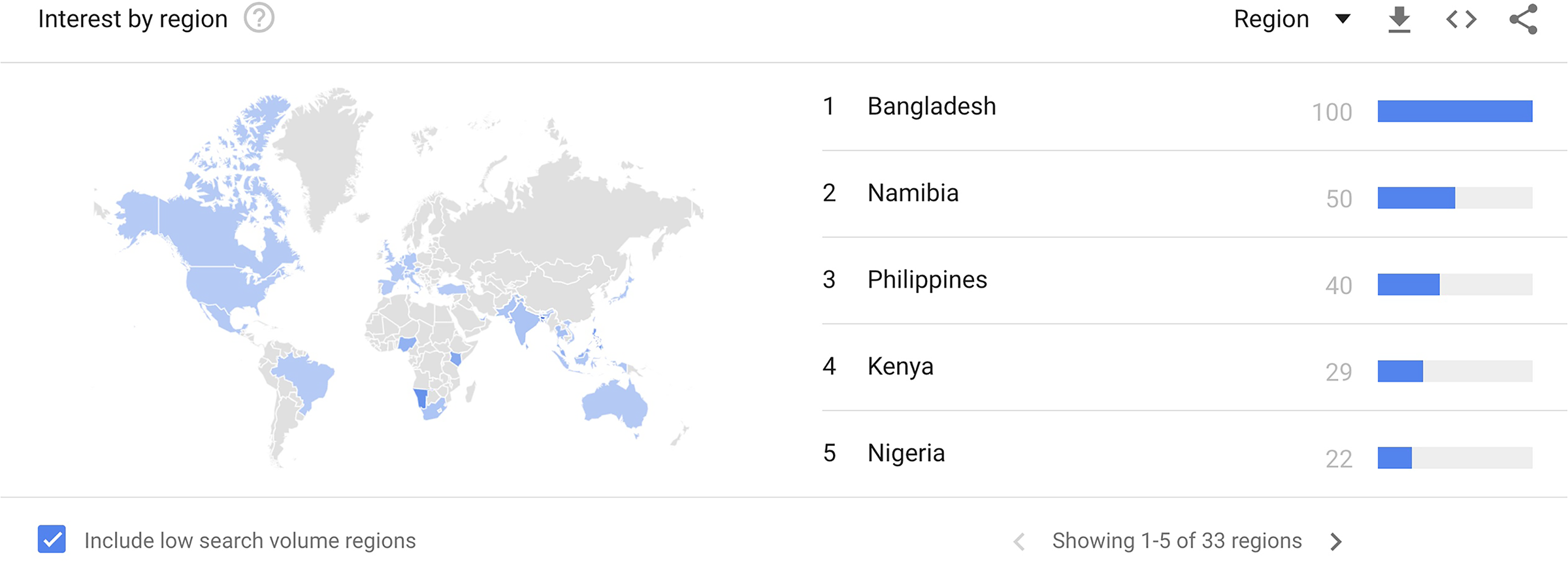
Data source: Google Trends search results for SDG 17. Parameters: since 2004, worldwide, include low search volume. Available at https://www.google.com/trends (accessed 8 March 2023).
Productive tensions or getting nowhere, fast?
At the global level partnerships were originally conceived of as a mechanism within which to package and consolidate financial resources to advance economic sustainability along with the other goals (United Nations, 2015b: 30). This discourse was the specific focus of the Addis Ababa Action Agenda (United Nations, 2015a), adopted alongside the Global Goals, which identified international trade as an engine for inclusive economic growth and poverty reduction. However, the conflation of economic sustainability with economic growth emerged as a central criticism of the SDGs – particularly its incongruence with sustainable consumption and production (Bendell, 2022).
A similar example of contradictions can be found in the Paris Agreement on Climate Change, a parallel document to the Agenda for Transformation. In the Agreement's preamble, we find what Viñuales (2015), describes as: carefully crafted expressions of the main tensions underpinning the entire text: between developed and developing countries; between more vulnerable countries and the rest; between countries that expect to suffer from measures that ‘respond’ to climate change and the rest; between climate change action and human and collective rights, particularly as regards the fight against poverty (as a paramount objective) and the need for a smooth transition of the workforce; between intervention in and conservation of nature; and between science and equity. (Viñuales, 2015: 10)
From this analysis, the dominant view interpreting the SDGs may be as Arturo Escobar critically explains, that human economic activity follows a single, universal path of progress from simple to complex societies, and that development means the ‘modern’ progressively encroaching on the traditional (2011: 77–78). Like the earlier models of development, it runs the risk of using the wrong yardstick for measuring ‘progress’ which meant it: excluded the possibility of articulating a view of social change as a project that could be conceived of not only in economic terms but as a whole life project, in which the material aspects would be not the goal and the limit but a space of possibilities for broader individual and collective endeavours, culturally defined. (2011: 87)
Reflexive Governance: Harnessing capacity for ‘Strengthening’ implementation of the Global Goals
Sustainability science is an interdisciplinary and applied research agenda that brings the breadth of available knowledge to bear on the practical problems of sustainable development. In an integrated review of its first 20 years of concerted effort, Clark and Harley (2020) construct a framework for understanding the dynamic interactions of coupled human–environment systems as a globally interconnected, complex adaptive system in which heterogeneity, nonlinearity, and innovation play formative roles and synthesises the principle insights of these diverse research approaches. It looks at sustainable development as more than just GDP or meeting basic human needs, and embraces a broader vision of sustainability as fairness along with the need to enhance human well-being ‘to more equitably meet the needs of both current and future generations’ (Stiglitz, 2019). Efforts to advance sustainability science also increasingly acknowledge that its pursuit should treat humans, in Amartya Sen's language (2013: 7), ‘not as patients whose interests have to be looked after, but as agents who can do effective things’ – who have the freedom and capacity to participate in setting their own sustainability goals and in choosing how to pursue them.
The intent of Clark and Harley's research agenda is to describe the practical implications of sustainability science, to point interventions towards the pursuit of the goals of sustainable development, and to aid scholars in locating their work in this agenda. As strengthening the implementation of the 2030 Agenda is the aim of SDG 17, we approach partnerships as the natural locus of action for the six capacities Clark and Harley (2020) identify as necessary to support interventions in guiding development pathways toward sustainability. They are the capacity to: (a) measure sustainable development, (b) promote equity, (c) adapt to shocks and surprises, (d) transform the system into more sustainable development pathways, (e) link knowledge with action, and (f) devise governance arrangements that allow people to work together in exercising the other capacities. They also recognise reflexive governance (Dryzek and Pickering, 2017) as the ultimate requirement needed to work towards implementation.
Key to our analysis of equity in the SDG 17 discourse, Clark and Harley (2020) note the general scarcity of research on equity in sustainability, and in particular towards governance arrangements that promote specific dimensions of ‘informed agitation’ (Sen, 2013). The reality of frontline change agents and formative agents of justice (Dryzek and Tanasoca, 2021) inventing and implementing these forms requires attention to the work of practitioners and research such as this that challenge the prevailing view of hegemonic power.
The SDGs are believed to create a common vision and incentive for more cooperation among international organisations and institutions and hence improve policy coherence or global governance (Biermann et al., 2017). The concept of global environmental governance came to the fore with different analytical and programmatic uses of the term but with at least three new broad conceptual developments that made it different from what global governance used to be. These include the emergence of new types of agency and of actors in addition to the governments of nation states, traditionally at the centre of international environmental politics; the emergence of new mechanisms and institutions that go beyond traditional forms of state-led, treaty-based regimes; and increasing segmentation and fragmentation of the overall governance system across levels and functional spheres (Biermann and Pattberg, 2008).
Actors are characterised by increasing participation and engagement with other actors, including experts and scientists, non-governmental organisations, businesses and their associations, cities and regions, as well as intergovernmental parties. These in turn have created new forms of institutions outside of legally binding documents negotiated by states or agencies, and where non-state actors become formally part of norm-setting and rulemaking and implementation institutions and mechanisms, with different layers and clusters, including multiple forms of partnerships (Biermann and Pattberg, 2008).
Earth System Governance emerged early in the 2000s and by 2010 included a new 10-year global research effort designed to go beyond traditional environmental policy analysis and resolve questions about human-induced change on biogeochemical systems, and planetary boundaries, and address their complex governance challenges (Biermann, 2010; San Martin and Wood, 2022). The concept of planetary justice has gained greater recognition in recent years and represents an epistemic shift within the earth system and environmental governance (Biermann et al., 2017, 2022; Dryzek and Pickering, 2018), partially evident in the SDGs, which serves as a prominent governance tool. Planetary justice emphasises the inequalities embedded in complex governance interactions as a central lens of environmental research and practice. However, the discourse still tends to be primarily focused on Western and (re)distributive notions of justice, ignoring the understanding of justice formed and practised in different communities, particularly those outside the industrialised North (San Martin and Wood, 2022).
Effective global environmental governance embraces ‘environmental‘ in a broad sense, recognising the need for research that covers change, the adaptiveness and resilience of social-ecological systems, and a better understanding of the learning processes in environmental governance (Biermann and Pattberg, 2008). In particular, such global governance raises legitimacy concerns because environmental policymaking affects a range of non-state actors who have not consented to be governed by rules established in international fora (Bernstein, 2005: 144).
As observed above with a variety of institutional partners, needed corrections to the governance system in light of the SDGs also applies to research agendas. The STRINGS report (Ciarli, 2022) provides an important window to how the funding and work of the global research apparatus contributes (or does not contribute) to advancing implementation of the SDGs. The report acknowledges the difficulties of interdisciplinary work, and especially of the institutions, universities, and funders that support research to engage in their own transformations to support such work – what we would term a failure of ecological reflexivity. The STRINGS report argues that a new range of tools that engage and co-produce in concert with the communities that have increasingly become actors in the new system is required to advance actionable knowledge: In low-income countries (LICs), 60–80% of the research is related to the SDGs, but these countries account for only 0.2% of globally produced research. Since most global research is produced in HICs without collaboration with researchers in LICs (where SDG challenges are most severe), there is little chance that STI [science, technology and innovation] can address contextual challenges. (Ciarli, 2022: 11)
Following the next section which conveys the three Picturing framings from which to explore the discourses related to the SDGs, we include a matrix that illustrates how these Picturing case studies and accompanying research questions can provide a tool to further a more enlightened and proactive response to the challenges identified above.
Three lenses to explicate approaches to SDG 17: Picturing politics, proximity and progress
The relational entanglements of citizens, the poor and marginalised, and entrenched powerful interests embedded in ecological systems represent an unwieldy morass in the ‘Decade of Action’. Interwoven with implementation of SDG 17 are complex layers of temporal and geographical scale, consumption and production cycles, powerful hegemonies and histories, and judgements of ‘valid’ and ‘subjective’ knowledges that permeate the partnerships and governance arrangements employed towards implementation. To explicate these in association with the evolution of SDG 17 we use three lenses: Picturing politics, Picturing proximity to the poor, and Picturing progress. Our Picturing framework is conceived of as a reflexive experiment in generating analyses towards alternative pathways, while also offering the potential carefully to consider and locate the researcher or practitioner within, and sometimes contributing to, inequitable governance arrangements (Hammond, 2019). The Picturing framework also seeks to be generative. The disciplinary lenses of scholars and powerful narratives of ‘ships’ such as partnership and leadership, can shield mechanisms of both injustice and potential transformation from view (Balda and Stanberry, 2021).
We acknowledge there is a danger of oversimplification, but we have in view the many forums, dialogues and action spaces where such accessible tools of critical analysis can assist diverse actors in raising issues of injustice and opening nascent possibilities for collaborative action to address them. The Picturing framework has additional applications for scholars, editors, teachers and students to explore these complexities together.
Picturing has in mind not only attention to how discourses are shaped and enacted, but also the sorts of material and figurative Picturing that appear in places such as organisation charts, partnership agreements, memoranda of understanding, report charts and graphs, photos, and physical and virtual meeting spaces. It does not prescribe action to be taken in response to learning and feedback, but its goal is to generate an atmosphere of questions with the intent of opening dialogue, emancipatory participation, and reflexivity in applied practice. Picturing in our framework begins from the Earth System Governance (2018) research lens of anticipation and imagination and enacts it in a practice of critical evaluation revealing additional facets of the SDGs.
Picturing politics
Our approach to Picturing politics conceives of ‘the contestation and institution of social relations and practices’ (Howarth et al., 2016: 100), and we have in mind language that critically captures the role of power and exclusion. In international politics, Barnett and Duvall (2005: 42) define power as the ‘production, in and through social relations, of effects that shape the capacities of actors to determine their circumstances and fate’. Picturing politics is primary, because it envisions the arrangements that determine both proximity to the poor and how one will engage with measuring progress. As an example, consider that rather than creating global standards for ecotourism (which in all likelihood would be dominated by financially interested tourism industry parties) the real issue is identified as ‘the motivations to fully adopt these [standards] across the industry, and to carefully monitor, manage, and regulate operations to achieve genuine and demonstrable social and environmental benefits for the organisms and communities that serve as its central resources’ (Kettunen et al., 2021: 23). The Picturing framework approach is less concerned with the as-stated criteria for such a standard, than by the co-creating cycle of practices resulting from a discursive-informed politics.
Picturing proximity
Picturing proximity to the poor takes as its starting point the original aims of the SDG that no one is left behind and follows that track of normative imagination towards solidarity and the decolonisation of the Global South. In the previous example, Picturing proximity would ask how the voices of those who are the most resource-constrained, most vulnerable to climate crisis, and most likely to experience violence and deprivation are not only being heard but can enact their best future. What is the distance between those voices and the governance mechanism in place? How do they orchestrate or deny agency to the poor? How is proximity to the active deliberation and action by individuals and groups of ‘most concern’ defended, negotiated, and denied? How does this figure in organisation charts, citations, speaker line-ups and technological access? Following Mehta (2005), it recognises that often ‘government’ is not only treated as a monolith, but also acts as one. She demonstrates that in contrast, the perspectives of local village life are highly varied, with complex, power-constrained interactions. These formations of people use language to advocate for particular changes or for the status quo. In Mehta's case, a discourse of water scarcity regarding the Narmada concrete dam was proleptic – the built and political systems led to the lack of water. Thus, it could be that the neglect of Picturing proximity to the poor creates narrow or inaccurate depictions of social status that lead to material changes – the entanglements of human–planet relationships mean discourses create facts.
Picturing progress
Because of global health and security crises, amplified by the climate and biodiversity crises, the sustainable development agenda is at risk. We have experienced a decline in the SDG Index score since 2019, driven primarily by a reversal in progress on socio-economic related Goals. SDG 1 (no poverty) and SDG 8 (decent work and economic growth). As a result, the share of people facing extreme poverty has increased significantly, particularly in low-income countries (LICs) and in Small Island Developing States (SIDS) where communities are dependent on international financing and trade, remittances and tourism.
A key discourse on ‘alignment’ of action towards the SDGs – situated with SDG 17 but often with no explicit mention of contributing to its Targets and Indicators – seeks to map Indicators to support measurement of progress towards Goals (Bennich et al., 2020; Fonseca et al., 2020). In this view ‘synergies and trade-offs’ exist as an either/or quality of the Goals, as well as their Indicators and Targets. One approach concludes ‘Once assessed within a system, we find that more SDGs and their corresponding targets act as levers towards achieving other Goals and Targets rather than as hurdles’ (Anderson et al., 2022: 1459). In this view, conflicting Goals such as reducing consumption and economic growth are seen as outliers. This sort of reasoning minimises resource scarcity as an emerging reality that suggests all allocation decisions are trade-offs. This reduces space for the honest conversations that can emerge from collaborations acknowledging these tensions.
In an analysis of three key indicator databases for this effort, Warchold et al. (2022) highlight how fungible data selection can be, changing the understanding of SDG interactions even if the same mythologies are applied: ‘The varying data availability, inconsistent data format, and the tension between national and global perspectives make it almost impossible for the data-driven SDG research community to create comparable results by each goal or target.’ This mapping takes the Targets and Indicators at face value – as goals that were intended to be mapped in this way. However, this was not the expectation; in addition, gathering data and feeding information into monitoring and evaluation frameworks is usually difficult and burdensome for rural and resource-constrained tropical communities. The reality is that ‘complex, adaptive problems defy tidy logic models and reductive technical solutions' (Milligan et al., 2022).
Due to these constraints, Picturing progress pays particular attention to the discursive and material aspects of how measurements of progress are constituted and applied, Notwithstanding the techno-optimist viewpoint raised by ‘progress’ in general, the term is broadly ambiguous and requires looping back to how both proximity to the poor and politics are Pictured.
Picturing progress requires an openness to new ways of visioning and measuring that are appropriate for the design but also for meeting the human need. As Patton (2017) suggests when considering evaluation trends and challenges for Agenda 2030, transformation should not be subject to narrow measurement or narrow operationalization because it occurs in non-linear and often unpredictable ways. The problem is not the measurement of transformation; the problem is actually engaging with multiple perspectives, multiple kinds of data — qualitative and quantitative, case studies, indicators — and global to local scales in an integrated, systemic way to understand what the global patterns of transformation are. (pp. xviii–xix)
Picturing in the Earth System Governance implementation plan
The Earth System Governance (2018) project is advancing a research agenda through an implementation plan that captures the interlinkages of five research lenses and four contextual conditions, captured as a matrix. The five lenses are architecture and agency, democracy and power, justice and allocation, anticipation and imagination, and adaptiveness and reflexivity with four contextual conditions – transformations, inequality, Anthropocene and diversity.
In addition to identifying key concepts and terminology for Earth System Governance research, it is designed to help generate salient research questions where contextual conditions and research lenses intersect (Earth System Governance Project, 2018).
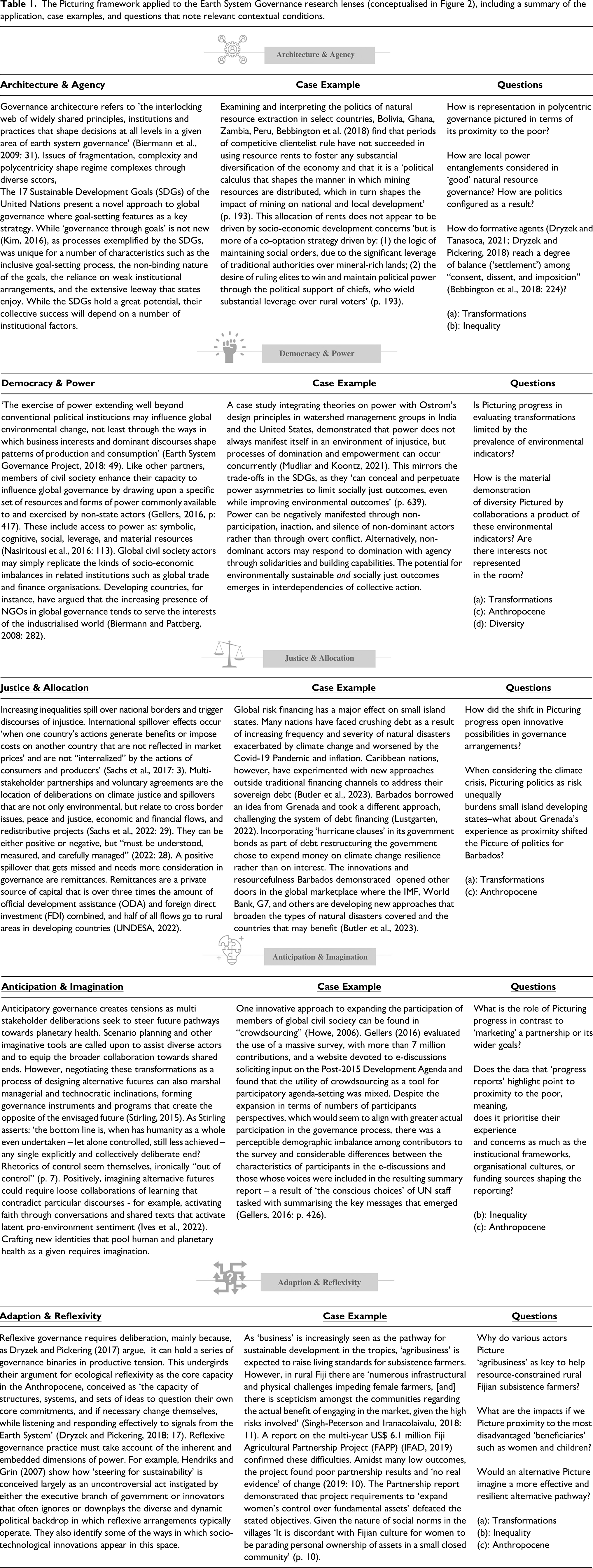
In Table 1 we chart the interlinked framework of Earth System Governance to better understand its relevance for SDG 17. Through case examples, we suggest questions for Picturing politics, Picturing proximity and Picturing progress to understand possible applications for reflexive governance capacity development in a variety of educational, institutional, partnership and community settings.
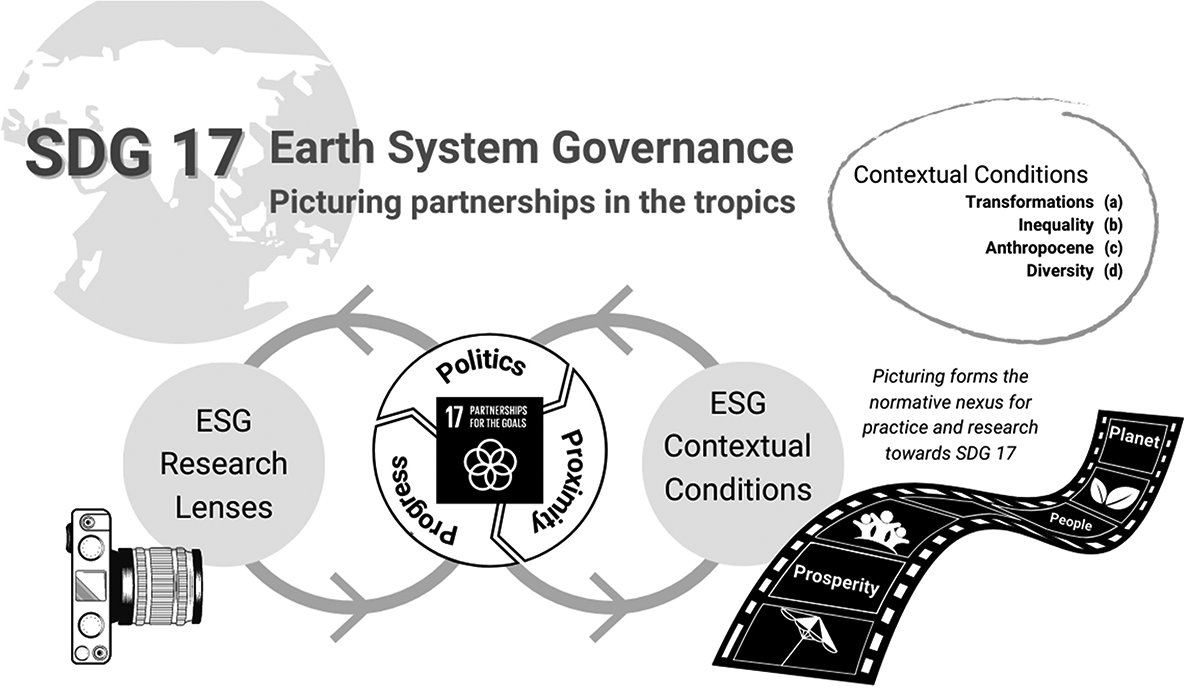
SDG 17: Earth System Governance- Picturing partnerships in the tropics. Exploring the Earth System Governance Research Framework (2018: 19). Key: Contextual Conditions: (a) Transformations: (b) Inequality: (c) Anthropocene: (d) diversity.
The Picturing framework applied to the Earth System Governance research lenses (conceptualised in Figure 2), including a summary of the application, case examples, and questions that note relevant contextual conditions.
Conclusion
The post-2015 sustainable development agenda as a whole, and SDG 17 in particular, have achieved global reach. In the process, the discourses surrounding implementation and collaboration have varied considerably, and the normative aim that no one be left behind is often lost in translation, especially as these debates move away from the tropics. We introduced the Picturing framework as a bridge to a more reflexive interdisciplinarity and a more inclusive cross-sector governance discourse. We framed Picturing in the context of the Earth System Governance implementation plan to assist scholars and practitioners to advance their thinking and practice towards reflexive governance, asking critical questions about the discursive and material make-up of collaborations.
By beginning from a research lens of imagination and anticipation, we propose moving through the interconnections and entangled relationships that make-up human–environment pathological path dependencies (Clark and Harley, 2020), and the nascent possibilities in reflexivity for transitions (Dryzek and Pickering, 2018). The Picturing framework opens alternative futures – towards resilience for the most vulnerable people on the planet, and towards regenerative organising that challenges unsustainable consumption and production cycles and narratives of endless growth.
Understanding and self-development (individual and organisational), are critical to the change required to address what we must now consider planetary (earth system) rather than global (political system) goals. We can think of no better way to engage in Partnerships for the Goals than through a process of removing our blinkers and Picturing ourselves and others in proximity to the poor, and then asking questions that bring us into relationship with our neighbour – whether down the street or around the world. The dissolution of the binary of ‘Global North’ and ‘Global South’ towards a ‘pluriversal’ perspective (Escobar, 2015), could promote thinking from the perspective of the Earth as a whole and consider life in all its forms. The use of Picturing in the context of research questions as an evaluative framework is an important addition to the resources used to prepare and equip partnerships at various scales in power-differentiated systems with planetary implications.
The repositioning of equity, power and the structures that negotiate their place is central to the future of the tropics. The reflexivity we propose must consider knowledge in all its relevant forms. For example, Picturing can support widening the vista of the imaginary of islands to critically consider how islands are being enrolled in the Anthropocene as key sites for understanding relational entanglements, in and for the generation of many different forms of relational ontology and ways of knowing. (Chandler and Pugh, 2021: 410).
Our approach suggests that reimagining the Pictures of human–environment systems and relational entanglement is an important entry point for a radical interdisciplinarity for the future of the tropics. The discourse of sustainable development, and SDG 17 in particular, shapes the material futures of vulnerable places. The picturings expressed by actors inform governance arrangements, and open up (or close off) resource flows and their spillovers, whether to support rural Fijian livelihoods, to form risk assessments for Loss and Damage in Caribbean coastal disasters, or to determine extractive industry standards. Transformations occur not as linear processes, but oblique and incremental movements. Picturing allows and informs a reflexive pause to envision these material relationships and collectively choose an alternative pathway, the critical juncture of transformations in and for the future of tropical places and the people who live there.
Footnotes
Declaration of Conflicting Interests
The author(s) declared no potential conflicts of interest with respect to the research, authorship, and/or publication of this article.
Funding
The author(s) received no financial support for the research, authorship, and/or publication of this article.
