



Abstract
While water has long been an object and mechanism of conflict, predicting water conflict remains a challenge. Little evidence supports strong, direct causal, or statistical links. Yet, connections between water and conflict remain relevant. As climate-driven water disturbances increase, it is imperative to understand how monitorable and predictable drivers like droughts and floods may affect political instability, of which conflict is a subset. Drawing from a variety of bodies of literature, we synthesize theory and case studies on water and conflict and integrate them into a generalized Pathways to Instability Framework. This framework presents a novel arrangement of conceptual categories that parse the biophysical and social elements that make up the multi-step, indirect links from water disturbance to instability. We demonstrate the framework’s usefulness by organizing literature on the onset of the Syrian Civil War and showing how disagreements among findings stem from studies on different links in the causal chain. The framework’s linear nature effaces specificity and depth in favor of simplicity, which helps evaluate the importance of different drivers. Acknowledging that policy contends with intertwined rather than standalone issues, the conceptual categories present discrete entry points in which policy-makers can devise and assess the value of interventions.
1. Introduction
Governments and diplomatic bodies have explicitly stated that an inability to adequately address water challenges could exacerbate interstate geopolitical competition and risk internal political stability (European Commission, 2024; General Assembly of the United Nations, 2023; National Intelligence Council’s Strategic Futures Group, 2021; United Nations Security Council, 2016). In the face of increasing resource scarcity and climate change-driven biophysical disturbances (de Bruin et al., 2023; De Stefano et al., 2012; Munia et al., 2020), the specter of water conflict looms large (Executive Office of the President of the United States, 2021; National Intelligence Council’s Strategic Futures Group, 2021; The White House, 2022). But while water has long been both an object and a mechanism of conflict (Pacific Institute, 2024), predicting water conflict remains a challenge, and little evidence supports strong, direct causal, or statistical links from water to conflict.
The “water wars” narrative is well established. Emerging in the 1980s alongside research derived from neo-Malthusian case studies on environmental degradation, the narrative argued that international conflicts would erupt to secure diminishing resources (Baechler, 1999; Falkenmark, 1986; Gleick, 1993; Homer-Dixon, 1991, 1994). This work has been heavily critiqued for failing to appropriately account for the wider socio-political setting of water conflict and for failing to consider counterfactual instances in which environmental disturbance did not lead to conflict (Buhaug et al., 2014; Gleditsch, 1998; Selby, 2014). Much of the more recent water conflict research has been framed within the context of climate change (Gleick & Shimabuku, 2023; Niyitunga, 2019; Swain, 2015). The climate conflict narrative emerged in the late 2000s, in part because extensive data on both climate and conflict became available, and scholars sought to link them. Statistical analysis showed weak but significant direct effects with temperature increases but little or no connection with water (Burke et al., 2015; Burke et al., 2009; Hsiang et al., 2011, 2013).
Yet, attention to the connections between water and conflict remains relevant, particularly in light of recent evidence that conflict associated with environmental change is increasing (Schmeier et al., 2019; Turgul et al., 2024). As climate-driven water disturbances like droughts and floods increase (de Bruin et al., 2023; De Stefano et al., 2012; Munia et al., 2020), the imperative to understand how they may affect conflict becomes more crucial (Kuzma et al., 2020).
Studies across a wide range of geographies and time scales have provided considerable insight by revealing complex drivers and pressures that indirectly link water and conflict. While research skews heavily toward drought and violence (Bagozzi et al., 2017; Bell & Keys, 2016; Gizelis et al., 2021; von Uexkull et al., 2016), researchers have also reviewed climate-related disasters more generally (Brzoska, 2018; Gleditsch, 2012; Ide, Brzoska, et al., 2020) and evaluated interactions between floods and protests (Ghimire & Ferreira, 2015; Ghimire et al., 2015; Ide, Kristensen, et al., 2020). But the diversity in research foci has made generalizations around how people react to water disturbances difficult to ascertain, and has made structured, repeatable research similarly difficult. Case study-based research is context-specific, and this body of work tends to be siloed into distinct disciplines and literatures, including environmental security, disaster resilience, civil war studies, peace and conflict studies, international relations theory, environmental peacebuilding, and scientific disciplines that describe biophysical drivers, with limited cross-pollination.
We seek to operationalize the rich bodies of existing literature by synthesizing nuanced case studies that explicate how water connects to conflict and integrating them in a generalized Pathways to Instability Framework. In lieu of constructing a single causal pathway, we standardize relevant conditions and mechanisms into consistent conceptual categories and simplify linkages to unidirectional, chronological connections. Though this effaces specificity and depth in explaining the intricacies of a particular situation and how it evolved, it provides guidance and clarity in identifying and evaluating the importance of different drivers. Acknowledging that policy typically must contend with intertwined rather than standalone issues, the conceptual categories were designed to present discrete entry points into otherwise complex situations such that policymakers can devise and assess the value of interventions. Though derived primarily from research on conflict at the subnational scale, the framework is flexible enough to accommodate large international events and small-scale communal violence.
Here, we discuss the key theories on which the framework is built and present the framework itself. We then demonstrate how the framework can be used to categorize insights from a variety of scholarly and news publications, using the 2011 onset of conflict in Syria as a case study to develop a new understanding of a complex problem. We close by discussing the framework’s merits, limitations, and lessons learned. As the framework has emerged from work with policymakers and practitioners in the international and national security spaces, these practitioners also serve as our primary audience. Though the framework can be informative for a range of users, we have geared this framework toward those working in military, security, diplomatic, and development roles. Through this paper, we aim to show how the novel arrangement of conceptual categories in this framework can guide these users through major biophysical and social elements preceding any conflict event to better understand the multi-step, indirect links from water disturbance to instability.
2. Theoretical context
Existing frameworks designed to understand links from environmental drivers to diverse human impacts proliferate and range in their approaches (Partelow, 2023). Generalized frameworks like Driving forces, Pressure, State, Impact, Response (DPSIR) (Smeets & Weterings, 1999) Social-Ecological Systems (SES) (Ostrom, 2009), and Human–Environmental–Climate Security (HECS) (Daoudy, 2021) seek to establish a common language, structure research, and streamline analysis. At the international scale, highly specified causal pathway approaches elucidate links and feedbacks between water and conflict (Al-Muqdadi, 2022; Berardo & Gerlak, 2012; Mobjoärk et al., 2020). Scholars have developed causal loop frameworks to investigate the iterative nature of the climate-conflict nexus in specific contexts such as the Middle East (Feitelson & Tubi, 2017) and Colombia (Bodini et al., 2024), while others have used similar frameworks to describe the intricacies of peacebuilding (Bodini et al., 2024; Coleman et al., 2019; Liebovitch et al., 2019). Frameworks such as Weathering Risk (Adelphi & Potsdam Institute for Climate Impact Research, 2021) and Strata (United Nations Environment Program & Food and Agriculture Organization, n.d.) address climate security risks at an intergovernmental scale. These frameworks, like the one presented here, tread similar conceptual ground: they incorporate biophysical elements alongside socio-political factors like inequality, state capacity, and dependence on climate-sensitive resources (Šedová et al., 2024). They also incorporate feedback loops to mitigate or exacerbate conflict.
Our contribution to this body of literature is a straightforward framework that can be applied at multiple scales to illuminate the links between water and political instability. We employ a linear approach to prioritize speed over depth of understanding for our intended users, who regularly make decisions with limited time, accepting Partelow’s (2018) critique that such linearity may leave methodological gaps between steps. Drawing from McGinnis and Ostrom, we consider our framework as providing “the basic vocabulary of concepts and terms that may be used to construct the kinds of causal explanations expected of a theory” (McGinnis & Ostrom, 2014, p. 1). In Binder et al.’s (2013) categorization of frameworks, ours fits most comfortably within action-oriented policy frameworks. Our framework incorporates literature focusing on political instability as a collective action problem that requires mobilization to overcome (Holzinger, 2003), and as such, it highlights the need to identify discrete actors and the type of instability they are mobilizing, steps that may be overlooked in other frameworks.
To develop this framework, we undertook a review of civil war, conflict, disaster, and development literature to synthesize and extend an understanding of how conflict manifests more generally. The literature cited is not intended to be exhaustive, but follows the methods of a scoping study to provide an overview of the breadth and diversity of relevant literature (Levac et al., 2010). We combined these findings with elements of existing frameworks to build a simple, flexible framework useful for rapid assessment of the conditions and mechanisms that link a water disturbance with instability. Though not designed to be predictive, the framework can suggest places and conditions susceptible to instability in the wake of water disturbances.
3. Conceptual framework
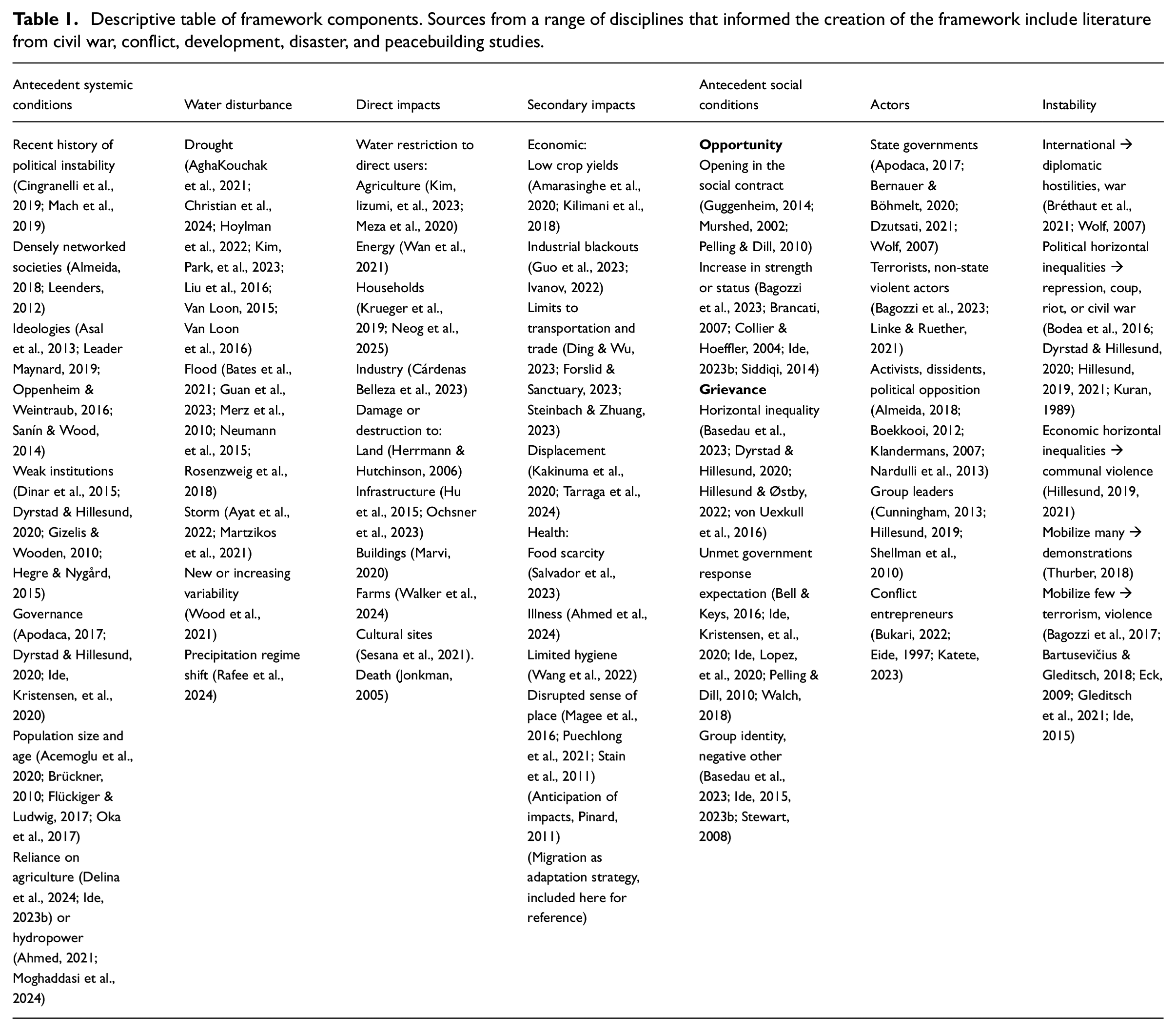
The Pathways to Instability Framework marshals conceptual categories into a functionally consecutive series of steps—explained in detail in this section—that begin with a water disturbance, such as a flood or drought, moves through social conditions and human response, and ends in instability, of which conflict is a subset. Acknowledging the criticality of societal context, the framework includes both antecedent systemic conditions, like governance structure and history of conflict, and antecedent social conditions, such as inequity and the resilience of the social contract. Both systemic and social conditions influence how governments and populations are primed to react to a water disturbance (Figure 1). Key characteristics and references used to create each step are discussed in the text and summarized in Table 1.
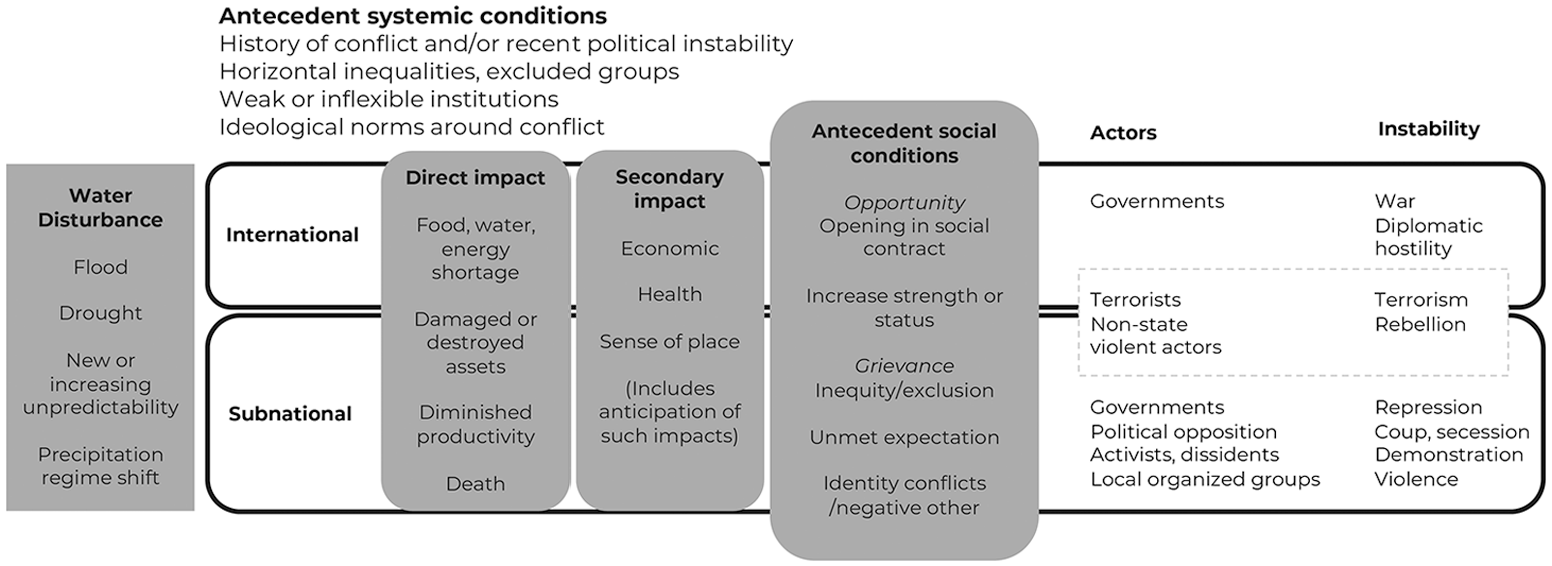
Pathways to instability framework. Top: Antecedent systemic conditions set the stage for susceptibility to water disturbances. Main row, from left to right: (a) Water disturbances are biophysical phenomena that are primarily driven by the Earth system. (b) Black outlined boxes separate international and subnational scales, a distinction that becomes important on the right side of the framework. (c) Direct impacts, the limited number of mechanisms through which water disturbances affect landscapes and people, span all scales. (d) Secondary impacts, the ways that direct impacts interact with human systems, span all scales. (e) Antecedent social conditions, the stability-related socio-political conditions most relevant to the impact of a water disturbance, span all scales. (f) Actors are the parties that leverage social conditions affected by the water disturbance to mobilize people to instability. Some actors and the instability they manifest defy easy categorization into subnational or international scales and are therefore represented as both. (g) Instability is the outcome and can range from communal clashes to diplomatic hostility and war.
Descriptive table of framework components. Sources from a range of disciplines that informed the creation of the framework include literature from civil war, conflict, development, disaster, and peacebuilding studies.
3.1. Antecedent systemic conditions
Antecedent systemic conditions encompass the political conditions, governance, and social and economic structure that influence stability, regardless of the impacts of water or other types of disturbance. Of all antecedent systemic conditions, it is perhaps recent political instability (Fearon & Laitin, 2003; Raleigh & Urdal, 2007) and history of conflict (Cingranelli et al., 2019; Hegre & Sambanis, 2006; Mach et al., 2019) that are the strongest predictors of future conflict of all kinds.
Many critical antecedent systemic conditions conducive to stability or instability differ by scale. At the international level, countries that share water are more likely to peacefully withstand water disturbances when they have established and maintain effective institutionalized cooperation mechanisms, such as basin treaties and organizations. The opposite also holds: countries without explicit mechanisms tend toward instability in the face of water disturbances (De Stefano et al., 2017; Schmeier, 2024; Turgul et al., 2024; Wolf, 2007). At the subnational level, conditions favorable to conflict include ideological stratification advantageous to organization and recruitment within a shared political worldview and social structure (Leader Maynard, 2019), particularly if those norms condone violence (Sanín & Wood, 2014) (see Bagozzi et al., 2023; Ide, 2023a; Siddiqi, 2014; Wood & Thomas, 2017 for more literature on violence). As instability is a collective action problem (Holzinger, 2003) that benefits from sustained organization, densely networked societies may be more likely to mobilize and sustain civil action (Almeida, 2018; Leenders, 2012). Poorer countries with larger, younger populations have been shown to have a higher likelihood of instability (Acemoglu et al., 2020; Flückiger & Ludwig, 2017; Ide, Brzoska, et al., 2020; Oka et al., 2017).
Stability within and between countries tends to increase with the presence of responsive governments with flexible institutions (Dinar et al., 2015; Gizelis & Wooden, 2010; Hegre & Nygård, 2015; Yoffe et al., 2003) that can, among other processes, meet human needs, facilitate sharing of wealth and resources, and render aid during disasters (Bruch et al., 2020). Heavily militarized autocratic regimes also tend toward stability as they can use their responsive apparatus to quell protests and insurgencies (Apodaca, 2017; Hegre & Sambanis, 2006). Political systems such as anocracies that lack both political and repressive means of dispute settlement tend toward instability (Dyrstad & Hillesund, 2020; Raleigh & Urdal, 2007).
Antecedent systemic conditions also put in place the mechanisms by which water disturbances could have an impact. For example, drought affects livelihoods via impacts on crops and livestock in regions where rainfed agriculture dominates food production and is a primary source of income (Carrão et al., 2016; Delina et al., 2024; Ide, 2023b). By contrast, drought affects livelihoods via impacts on hydropower in regions that rely heavily on hydropower for electricity (Ahmed, 2021; Moghaddasi et al., 2024).
3.2. Water disturbances
Water disturbances encompass short-term events such as floods and storms, as well as slow-onset events such as droughts. In addition to overtopping river banks (Merz et al., 2010), floods may be localized, overwhelming urban drainage systems or filling low points in a landscape (Rosenzweig et al., 2018), or characterized by ocean water forced inland by storm surges (Neumann et al., 2015). Storm impacts include wind (Martzikos et al., 2021) as well as direct impacts of heavy rain (Ayat et al., 2022). Effects are amplified when they occur in combination (Bates et al., 2021; Guan et al., 2023). Drought may be rapid-onset (Christian et al., 2024) or longer term, with lower-than-normal rainfall (Kim, Park, et al., 2023), characterized by its impact on soil moisture (Liu et al., 2016) or freshwater flows (Van Loon, 2015). Water disturbances also encompass changing precipitation regimes, which include changing rainfall variability, making the difference between wet and dry years more extreme (Wood et al., 2021), and shifts in timing, such as shifting winter snow into spring rain (Rafee et al., 2024).
Water disturbances can also manifest as changing rainfall variability, making the difference between wet and dry years more extreme (Wood et al., 2021), or precipitation regime shifts, where large-scale changes alter the timing or amount of rainfall up to the decadal scale (Rafee et al., 2024).
We constrained the research that informed this framework to studies that drew from biophysically driven water disturbances rather than studies on human interventions in the water cycle to simplify the development of the framework, and, as such, these remain our focus. Despite these origins, the framework is useful in the face of a broader set of water disturbances, including socio-political-driven disturbances like new dams or large irrigation systems that affect water downstream (Delli Priscoli & Wolf, 2010; Wolf, 2007), as well as human-caused water quality disturbances that can lead to illnesses and shortages. Studies show complex and increasing interactions between climate extremes and water quality (van Vliet et al., 2023; Wang et al., 2024). The framework can also guide analysis of other quasi-exogenous drivers such as food shocks and climate change, though given the feedbacks inherent in many types of disturbances, our linear framework should be employed thoughtfully. We do not seek to address water as a casualty or tool of war (Gleick & Shimabuku, 2023; King, 2023).
3.3. Direct impacts of water disturbances
This category encompasses the limited number of mechanisms through which water disturbances directly affect a landscape and the people who live within it (Brauman et al., 2007). Sectors that directly use water may face shortages or excess. These include agriculture (Kim, Iizumi, et al., 2023; Meza et al., 2020), energy production (Wan et al., 2021), households (Krueger et al., 2019; Neog et al., 2025), and industry (Cárdenas Belleza et al., 2023). Damage and degradation may occur to land (Herrmann & Hutchinson, 2006), infrastructure (Hu et al., 2015; Ochsner et al., 2023), and assets, including buildings (Marvi, 2020), farms (Walker et al., 2024), and cultural sites (Sesana et al., 2021). People may be killed in rapid-onset disturbances like floods and storms (Jonkman, 2005). Though the specifics vary, simplifying direct impacts in this way makes it possible to rapidly inventory the potential effects of any particular water disturbance.
3.4. Secondary impacts of water disturbances
Secondary impacts flow from direct impacts and tend to occur on a time lag and at larger geographic scales. As water touches numerous aspects of society, the specifics of the secondary impacts of water disturbances will vary dramatically. We are primarily concerned with quickly identifying where practitioners in the security space can intervene, and, as such, this category synthesizes them into a relatively small number of types: economic, health, and sense of place.
Economic impacts stem from food, energy, and water shortages or damaged assets. Income may be reduced due to anything from low crop yields (Amarasinghe et al., 2020; Kilimani et al., 2018) to factories shuttered for lack of power (Guo et al., 2023; Ivanov, 2022). Infrastructure damage may cause economic impacts if it limits transportation and trade (Ding & Wu, 2023; Forslid & Sanctuary, 2023; Steinbach & Zhuang, 2023). People may be displaced if the intensity of direct impacts limits their ability to maintain their livelihoods (Kakinuma et al., 2020; Tarraga et al., 2024). Health-related impacts include hunger due to food scarcity (Salvador et al., 2023), illness from water contamination (Ahmed et al., 2024), and water-constrained hygiene and healthcare (Wang et al., 2022). Water disturbances may secondarily fracture a people’s sense of place through direct impacts such as death, destruction of cultural monuments, or geomorphic impacts so intense that a landscape becomes unrecognizable (Magee et al., 2016; Puechlong et al., 2021; Stain et al., 2011).
Secondary impacts can also arise when those affected by a water disturbance expect potential impacts, as these “can greatly increase the sense of grievances, as when the anticipation of increased hardships accompanies current ones” (Pinard, 2011, p. 17).
Much focus is placed on migration as it relates to water and conflict (Johnson et al., 2024). Following McLeman (2017) and Watson et al. (2023), we categorize migration as an adaptation strategy deployed in response to secondary impacts, not as instability per se. Though a range of possible adaptation strategies exists, we explicitly include migration here to acknowledge its status in policy and academic conversations around water and climate change.
3.5. Antecedent social conditions
Antecedent social conditions are a subset of the antecedent systemic conditions and encompass the specific stability-related socio-political conditions most commonly leveraged by actors in relation to a water disturbance. Each water disturbance occurs within a socio-political context. Alignment of the antecedent systemic conditions previously identified as conducive to conflict does not guarantee conflict, and, as such, it is necessary to consider how those conditions interact with a specific disturbance on a per-disturbance basis. The framework captures this consideration within the antecedent social conditions. Throughout the critical review of the literature, opportunities and grievances emerged as the most influential antecedent social conditions, so we have harmonized the following elements into these separate but overlapping subcategories.
Opportunity in relation to water disturbances was first conceptualized as greed. Greed has been posited as a driving force behind rebellion and other sorts of conflict in literature, but the concept has been highly contested (Keen, 2012; Murshed & Tadjoeddin, 2009). Rather than focus squarely on greed as a chance to increase one’s material wealth (Collier & Hoeffler, 1998, 2004), we take a wider approach, including both openings in the social contract and potential increases in strength or status of an individual or group as opportunities. Secondary impacts of water disturbances can break down the social contract (Pelling & Dill, 2010) and create opportunities to renegotiate it (Guggenheim, 2014; Murshed, 2002; Pelling & Dill, 2010), particularly if survivors create a sense of collective identity around that disturbance (Apodaca, 2017).
Increases in strength or status are a levelling up of one or more parties in a conflict. Combatants may capture or destroy assets like farmland (Linke & Ruether, 2021). Rebel groups may leverage secondary impacts to recruit new members (Brancati, 2007), which becomes easier if the government’s capacity to perform counterinsurgency efforts has been diminished by the disturbance (Eastin, 2015). Groups can stage an oppositional show of force (Wilson, 2021), convert individuals or groups to religious extremism (Siddiqi, 2014), and gain access to international media that tends to gather around disasters (Bagozzi et al., 2023). If a water disturbance does more damage to one party than another, the advantaged party can capitalize and make advances in an ongoing armed conflict (Ide, 2023b).
Grievance encompasses the overlapping elements of horizontal inequalities, unmet expectations of government response, and identity-based clashes between groups. First and foremost, research shows unequivocal links between grievances developed through sustained horizontal inequalities, the inequalities between groups in a society, and political instability (Basedau & Roy, 2020; Cederman et al., 2011; Koubi & Böhmelt, 2013; von Uexkull et al., 2016). Overlaps exist here between political exclusion in the system conditions and inequality within the social conditions, where political exclusion is the formal or de facto power structure, and inequality is related to the sentiment that results. Agreement between objective and perceived inequality is unnecessary; perceptions are powerful tools that can be used to mobilize people to different types of instability (Basedau et al., 2023; Brzoska, 2018; Hillesund & Østby, 2022).
Unmet expectations play out differently at different scales. At the international scale, norms around international water law suggest that water flowing through multiple countries should be shared to ensure fair access to the benefits of large water infrastructure development (Dellapenna, 2001; Rahaman, 2009; Wouters & Tarlock, 2024). Should an upstream country build a dam or change a dam’s operation without warning those affected downstream, that country has broken the expectation of consultation, which could cause or exacerbate grievance (Schmeier, 2024; Wolf, 2007). At the subnational scale, people will often look for assistance from governments or other trusted sources during or after a water disturbance. If that government fails to respond in a way that its citizenry believes appropriate, those unmet expectations can create or exacerbate grievances (Bell & Keys, 2016; Ide, Kristensen, et al., 2020; Ide, Lopez, et al., 2020; Pelling & Dill, 2010). Governments that choose repression over assistance (Almeida, 2018; Apodaca, 2017) can further increase grievances and radicalize peaceful movements toward violence (Alimi et al., 2015; Almeida, 2018; Trejo, 2016).
Identity clashes between groups have been leveraged to mobilize people toward instability. These types of clashes are especially powerful when one group perceives another as having received more assistance; to be the cause of the water disturbance and its impacts (Ide, 2023b; Stewart, 2008); or when rhetorically weaponized to frame an “opposing” party as negative or subhuman (Ide, 2015).
3.6. Actors
All types of organized group-based instability require mobilization (Almeida, 2018; Holzinger, 2003; Stewart, 2008). Actors are the parties who deliberately leverage the opportunities presented and grievances exacerbated by the impacts of water disturbances (Eide, 1997). Actors can include state governments that take action against their citizens (Apodaca, 2017; Dzutsati, 2021) or, in international conflicts, may initiate diplomatic, economic, and/or military actions against other states with whom relations are tense (Bernauer & Böhmelt, 2020; Wolf, 2007). At the subnational level, actors can include terrorists and non-state violent actors (Bagozzi et al., 2023; Linke & Ruether, 2021); group, community, and religious leaders (Cunningham, 2013; Hillesund, 2019; Shellman et al., 2010); and dissidents and activists (Almeida, 2018; Boekkooi, 2012; Klandermans, 2007; Nardulli et al., 2013). Those who benefit from the conflict but are perhaps not directly involved, also known as conflict entrepreneurs, may exacerbate grievances or pursue opportunities when they arise (Bukari, 2022; Eide, 1997; Katete, 2023).
3.7. Instability outcome
Our use of the term instability outcome is intentional: while the “water wars” literature cited in the introduction typically focused on armed, violent conflict, this framework approaches conflict in a broader sense, encompassing nonviolent tactics like demonstrations at the sub-national scale and diplomatic hostility at the international scale.
The type of instability that is likely to manifest is guided by the scale of the actors involved, the type of grievance or opportunity, and those from whom actors seek remedy. If the actors involved are national governments with a shared water source, that instability is likely to include actions like economic sanctions, diplomatic hostility, or all-out war (Bréthaut et al., 2021; Wolf et al., 2003). At the subnational scale, if actors face political exclusion and/or see the government as the source of their grievance, instability is likely to manifest as actions against that government (Cingranelli et al., 2019; Dyrstad & Hillesund, 2020; Hillesund, 2019; Kuran, 1989). In instances where actors see other groups with similar political power but uneven economic power as responsible for their grievance, that instability is more likely to manifest as communal conflict (Hillesund & Østby, 2022). Whether any of this instability turns violent is influenced by factors such as likelihood of successfully achieving desired outcomes (Bagozzi et al., 2017; Bartusevičius & Gleditsch, 2018; Eck, 2009; Gleditsch et al., 2021) and the degree of negativity with which actors view each other (Eck, 2009; Ide, 2015). Though we take no stance on the merits of disruption or repression as political tools, the framework assumes that political stability is generally more desirable from a national security perspective. For a critique of this approach, see Conca and Dabelko (2024).
4. Unpacking the role of drought in the onset of the Syrian civil war
In the first 10 years of Syria’s civil war, which began in 2011, 585,000 people were killed and more than 12 million were displaced (Jabbour et al., 2021). As an important event in its own right, the conflict has been the subject of intense press coverage and academic study. In 2014 (Gleick, 2014) and 2015 (Kelley et al., 2015; Werrell et al., 2015), high-profile academic papers linked the onset of the civil war to regional drought, laying the foundation for the still common narrative that drought caused the civil war and, indeed, that the Syrian civil war might be the first climate change-driven war. The commonly accepted causal pathway, summarized by Ide (2018), was that the drought caused a large number of people to migrate from agricultural areas into cities, and that the influx of “outsiders” stressed thin resources in the cities, leading to conflict that ultimately incited the civil war. Subsequent studies have called this causal pathway into question and argued for a more nuanced interpretation of the conflict’s onset (Daoudy, 2020; Dinc & Eklund, 2023; Eklund et al., 2022; Selby et al., 2017). We use the framework (Figure 2) to categorize insights from diverse studies of the topic to illustrate how this single, simplified causal chain from water disturbance to conflict onset is insufficient to describe what actually took place, particularly in the cities of Dar’a and Homs where the conflict is considered to have started, and how the framework can be used to fill crucial gaps in the accepted narrative. As an illustrative case, this example seeks to rein in the wide breadth of literature rather than serving as an exhaustive literature review, and, as such, has followed a scoping study methodology (Levac et al., 2010).
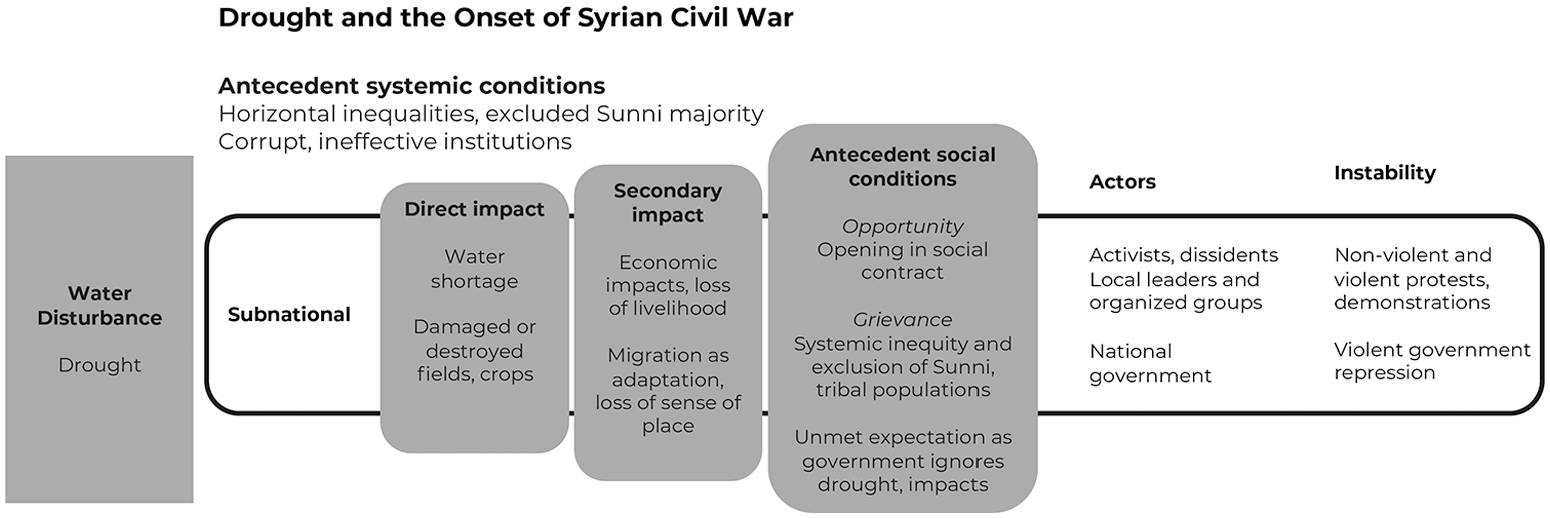
The pathways to instability framework was populated using details of the onset of the Syrian civil war.
4.1. Antecedent systemic conditions
Syria’s economy has historically been heavily reliant on agriculture. From 2001 to 2010, agriculture made up about a quarter of the country’s GDP and employed 17% of the working population (Ababsa, 2019). In the years leading up to the onset of Syria’s civil war, aging, poorly managed irrigation megaprojects left farmers more susceptible to drought impacts as they were reliant on diminishing groundwater and erratic rainfall (Daoudy, 2020; Gleick, 2014; Werrell et al., 2015). Between 2002 and 2008, the country lost 40% of its agricultural workforce, an exodus hastened by a 2004 law that allowed landlords to expel farming tenants for little compensation (Ababsa, 2019). The country’s autocratic government, which banned public gatherings (Qureshi, 2012), left little room for negotiation over water policies (De Châtel, 2010, 2014), economic liberalization (Conduit, 2016), and cuts to fuel subsidies (Kelley et al., 2015). Syria’s water institutions were weak and rife with corruption (Fröhlich, 2016). Moreover, the country was home to a youth bubble (Fröhlich, 2016) and a highly networked Sunni population (Mazur, 2020).
4.2. Water disturbance
Over the hydrologic years that cover 2007 to 2009, the Fertile Crescent region was hit by its worst drought since 1940 (Eklund & Thompson, 2017; Trigo et al., 2010). The droughts Syria experienced during this period were not homogeneous: localized but impactful droughts occurred in different regions and different years across the country (Conduit, 2016; Daoudy, 2020; Gleick, 2014; Werrell et al., 2015). Drought was most pronounced in Dar’a in 2007 to 2008 but had eased there by 2009 to 2010 (De Châtel, 2014), while drought in Homs continued into 2009 (Conduit, 2016). These conditions occurred in the context of more widespread climate-related drying in the second half of the 20th century (Werrell et al., 2015), particularly in Hassake province in the country’s northeast (Daoudy, 2020).
4.3. Direct impacts
Agricultural water shortages from a lack of rain and insufficient irrigation damaged and destroyed assets in the form of dry fields and dead livestock (Daoudy, 2020; Gleick, 2014; Kelley et al., 2015; Werrell et al., 2015). Yields of staple crops dropped by 32% in irrigated areas over the previous year and 79% in rainfed areas (De Châtel, 2014). The amount of Syria’s cropland being actively farmed dropped to about 50% in 2008, but in Hassake province dropped to 15% to 20% (Eklund et al., 2024). As rains returned, Syrian agriculture showed a near-full recovery in 2010 (Eklund et al., 2022).
4.4. Secondary impacts
Across Syria, the harshest, most widespread drought of 2007 to 2008 had devastating secondary impacts. Homs saw a 90% decline in income and a steep increase in poverty from diminished crop yields (Conduit, 2016). Prices of wheat, rice, and livestock feed more than doubled (Feitelson & Tubi, 2017). A large (though contested) number of farmers left their homes in the northeast for cities (Daoudy, 2020; Gleick, 2014; Kelley et al., 2015; Selby et al., 2017; Werrell et al., 2015). Residents from provinces in the northeast reported leaving the region due to drought, water scarcity, and financial difficulties (Dinc & Eklund, 2023). Thousands moved into Dar’a, where normal rains by 2009 made for improved agricultural conditions (De Châtel, 2014), and into Homs, where agriculturalists had deep religious, tribal, and family ties (Mazur, 2020).
4.5. Antecedent social conditions
Grievance was a common political sentiment in the mid to late 2000s in Syria. Farmers already distrusted the Assad regime after a series of changes to well licensing and irrigation practices left them scrambling amidst the drought (De Châtel, 2010, 2014). The government offered almost no assistance to those who had lost their farms to drought in the northeast or to the cities like Dar’a, which took in migrating families (Fröhlich, 2016; Gleick, 2014). But this recent set of grievances occurred in the context of longstanding resentments. Ethnic minority rule contributed to a feeling of exclusion among Sunni farmers and urban dwellers alike (Mazur, 2020). A collapsing decades-long social contract, where the state took care of rural Sunni agriculturalists in exchange for their absence from political power, offered both a grievance over status lost and an opportunity to remake relations (Conduit, 2016). Millions of farmers who had moved to slums and informal settlements around Homs over the preceding decades—and with increasing haste during the droughts—blamed the Assad regime for their new poverty (Conduit, 2016).
4.6. Actors
Actors involved in the Syrian uprisings receive comparatively less attention than drought and its impacts in environmentally focused literature (Gleick, 2014; Kelley et al., 2015; Werrell et al., 2015). Historical accounts derived from other bodies of literature provide important insight.
In the months before March 2011, when the civil war started, activists in different cities held rallies in solidarity with Tunisia and Egypt in the beginnings of the Arab Spring but were met with a subdued public response (Ismail, 2011). In March 2011, in Dar’a, where the conflict is thought to have meaningfully begun, police arrested 15 young boys for writing anti-government graffiti on their school walls. Calls for the boys’ release were ignored. Community leaders organized small protests; when the boys were finally released with signs of physical harm, protest organizers leveraged it to mobilize more people to their cause (Leenders, 2012). Organizers centered protests around Friday prayers in the boys’ local mosque—the only time and place where gathering was allowed—where religious leaders preached for liberty and against corruption (Qureshi, 2012). As the protests intensified, key organizers from the Abu Zeid clan mobilized people within the clan, labor, and extra-legal networks (Leenders, 2012, 2013) by leveraging other grievances, including over corruption in well licensing and water use policies (De Châtel, 2014), to expand protests beyond their original focus. The government sent security personnel to disperse the protestors, but forces injured and killed protestors and set off a feedback loop of increasing grievance. Here, actors were (a) local and religious leaders, who activated other networks by leveraging shared grievance, and (b) government forces sent to quell the uprising, who, in turn, inflamed existing grievances. Though much has been made of the presence of migrants in Dar’a as both protestors and a source of grievance, qualitative research shows that city dwellers paid them little attention, and most migrants left the city when the conflict started (Daoudy, 2020; Fröhlich, 2016).
In Homs, local dissidents and activists organized protests in solidarity with those killed in the Dar’a uprising. Here, too, the government sent security forces to quiet dissent, and soon, protestors were turning funerals for those killed among their ranks into demonstrations. Actors like the Homs Quarters Union, a federation of protest coordinating committees (Ismail, 2011), leveraged shared grievances and the deep social networks among family and tribal clans that spanned suburban Homs and the northern regions that had been hit by the drought to mobilize the group action required to hide armed revolutionaries and withstand government assaults (Dukhan, 2014; Mazur, 2020). Moreover, these coordinating committees mobilized across diverse social and religious groups to expand support (Ismail, 2013). Here, actors are again (a) local leaders and (b) the government forces sent to quell their action.
4.7. Instability
The civil war in Syria began as non-violent demonstrations against a government that responded with violent repressive action. The type of instability that was viable to actors was guided by (a) the subnational scale of the direct and secondary impacts and applicable social conditions and (b) the party that initial actors saw as positioned to remedy those social conditions.
4.8. Insights from the application of the framework
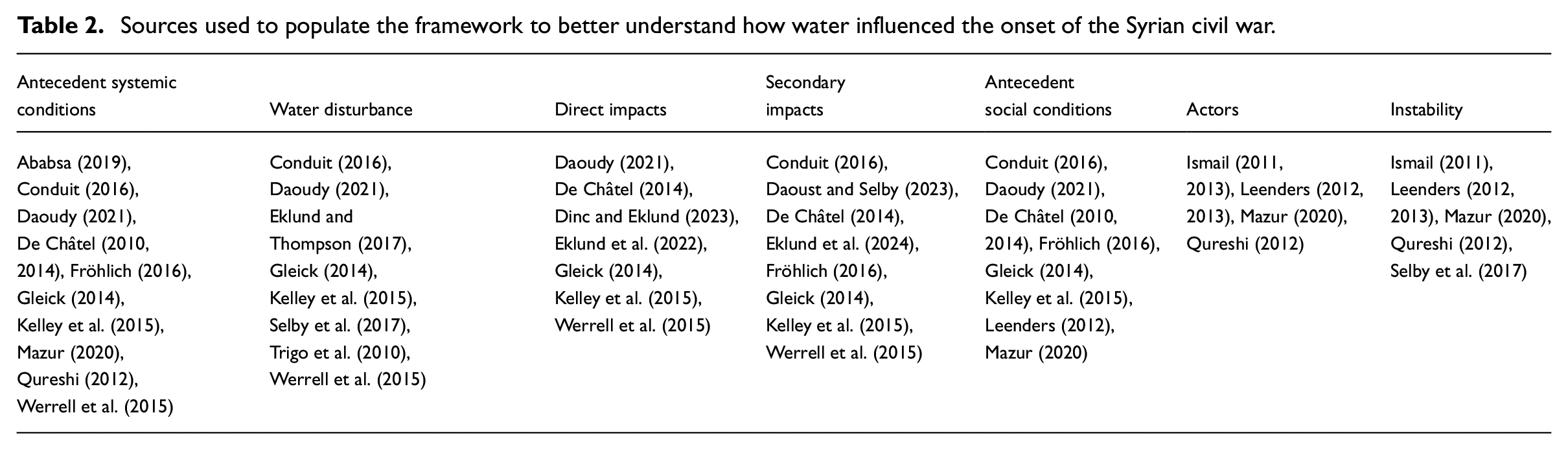
Researchers from a wide range of disciplines have investigated biophysical and socio-economic contributing factors to the Syrian civil war. By sorting the focus of these disparate articles into the categories of our framework (Table 2), we show that their findings rarely stand in opposition to one another. Rather, the diverging analyses reveal distinct and incomparable elements of a complex situation (Ide, 2018). When evidence and arguments from studies and disciplines are distributed into their relevant framework categories, a more fulsome picture begins to emerge.
Sources used to populate the framework to better understand how water influenced the onset of the Syrian civil war.
More recent work has argued quite persuasively that while drought may have played a role in the onset of civil war in Syria, that role is often overstated in the commonly cited literature (Selby et al., 2017). After parsing the conflict using the framework, we argue that the role of drought and drought-driven migration in the Syrian conflict is misunderstood. There are plausible arguments that the drought contributed to unrest in Homs, a city where protests helped the civil conflict take root, but migrants did not create a grievance; they were among the aggrieved (Conduit, 2016). The drought hastened longstanding migration from agricultural areas to Homs suburbs, where migrants had deep family and tribal ties (Dukhan, 2014), as the government allowed its social contract with agriculturalists to collapse (Conduit, 2016). In Dar’a, the presence of drought migrants was seen as a symptom of government failures and added to grievances around corruption and mismanagement (Fröhlich, 2016). Drought was just one element of the many conditions that led to instability. Non-water factors were critical, and there would not have been a war without them.
5. Discussion
The Pathways to Instability Framework collapses complex pathways into functionally consecutive conceptual categories and, in so doing, enables rapid assessment, uniform comparison of multiple cases, and deep parsing of disparate sources for a single case. It also acts as a boundary object (Leigh Star, 2010) among users from a range of disciplines—security practitioners with backgrounds in climate change, conflict, anthropology, and geography can populate different categories based on their expertise and easily visualize how those categories relate to one another. The framework can incorporate conditions for instability, often the focus of quantitative work; mechanisms, often the focus of qualitative work (Brzoska, 2018); and new research findings as they emerge.
The framework also offers practitioners in international and national security spaces a way to situate themselves within a pathway. For example, biophysical interventions like drought-resistant crops or flood management mitigate the direct impacts on the left side of the framework. These interventions can, of themselves, only affect secondary impacts such as economic stability, nutrition, and physical safety. The extent of their impact on stability is mitigated by antecedent social conditions: depending on the antecedent systemic conditions, the secondary impacts stemming from biophysical interventions might shift antecedent social conditions, thus reducing grievances or diffusing opportunities for actors to mobilize people. Social interventions might affect secondary impacts by providing alternative livelihood strategies, thereby reducing susceptibility to water disturbances. Interventions that affect antecedent social conditions, such as anti-corruption initiatives, cannot directly alter the impacts of a water disturbance, but could promote antecedent social conditions that reduce grievances and therefore the fuel actors use to mobilize instability.
Finally, the framework provides a consistent basis from which to identify places and events to monitor if a user’s goal is to anticipate or prepare for instability. For instance, literature documents political instability in the form of protests or political violence following flood events (Ghimire & Ferreira, 2015; Ghimire et al., 2015). But this is not a deterministic or even common outcome of flooding. Antecedent systemic and social conditions identify places where instability is a more likely outcome—places with large populations, democracy, and politically excluded groups (Ide, Kristensen, et al., 2020). Thus, using the framework, an emerging flood situation can be rapidly assessed for conditions conducive to protests. The framework can also be used to understand counterfactuals, where similar water disturbances produce contrasting results. For example, floods and other water disasters have been theorized to facilitate rebel recruitment, as such events can lower the opportunity costs of participating in rebel activities and increase grievance. But research from the Philippines showed that international aid in the wake of typhoons left citizens with little appetite for demonstration despite calls for violent protest from rebel groups (Walch, 2018). Similarly, Islamic extremists had middling success recruiting villages in the wake of Pakistan’s 2010/2011 floods, as differing ideologies between extremists and locals undermined the extremists’ ability to leverage shared grievances and mobilize people to instability (Siddiqi, 2014).
While the framework can help parse how a water disturbance led to political instability, without the benefits of feedback inherent in causal loop models, it cannot explicitly explain the process by which instability escalates to violence. The framework’s linear nature intentionally flattens complexity in favor of simplicity, which means it is generally inadequate to describe emergent processes that take place over long periods of time. Using the Syria case as an example, the framework handles conflict initiation with ease but sheds limited light on how the conflict changed once external actors like extremist groups and foreign governments became involved. The framework could be used, however, to describe how water disturbances post-onset may have influenced particular moments or inflection points within the ongoing conflict.
Moreover, as we have designed the Pathways to Instability Framework to be as flexible as possible, we acknowledge that there are a variety of approaches users could take to populate each step. Without strict rules around data collection and analysis, the framework suffers from common limitations around transparency, comparability, and data abstraction issues (Partelow, 2018). With that said, the framework can still serve as a “common fire[] to huddle around” (Partelow, 2023, p. 512).
6. Conclusions
The Pathways to Instability Framework guides the parsing of impacts of different types of water disturbance and insights into how these water events may lead to instability across locations and timeframes. In individual cases, the framework synthesizes the components that link water disturbances to instability. In comparative cases, it helps clarify why the same disturbance produces different outcomes in different places and times. While the framework is not intended to be predictive, its use may reveal indicators to monitor in anticipation of instability. The framework can also reveal where and when certain interventions may facilitate cooperation in response to a water disturbance. Drawing from literature on environmental peacebuilding, the framework could be used to identify cooperative opportunities such as diplomatic leveraging of shared political values to overcome differences during droughts (Tubi & Feitelson, 2016) or technical assistance in building mutually beneficial water access in post-conflict settings (Tignino & Kebebew, 2023).
Avenues for future research could include using the framework to uncover whether multiple water-driven pathways to instability intersect in as-yet undescribed ways. For instance, conflicts have simmered between Kyrgyzstan and Tajikistan over diminishing water supplies in the shared Isfara River in the Ferghana Valley (International Crisis Group, 2014; Pak et al., 2013) and even erupted into military violence in 2021 (Arynova & Schmeier, 2021; Pannier, 2021a, 2021b). A popular drug route from Afghanistan to Europe travels through this region (Peyrouse, 2009), and traffickers rely on this border being unsettled and porous (Goodhand, 2012), which may imply the presence of conflict entrepreneurs (Eide, 1997). Drought has been shown to increase opium production in Afghanistan (Parenti, 2015), much of which makes its way through this Ferghana Valley route. The framework could be used to assess in more depth how these two pathways intersect both through their geography and through the actors involved, and be used to illuminate other such intersecting cases.
The framework does not aim to elucidate every possible pathway from water disturbance to instability, nor does it capture the feedbacks between links in those paths. Rather, it sets out a series of conceptual categories through which major biophysical and social elements of any pathway from water disturbance to instability can be organized and understood. This will not settle the debate on whether water disturbances cause or intensify instability, but it does provide a means to unpack complex situations where water disturbances and instability are linked and to explicate the links in that chain.
Footnotes
Acknowledgements
None.
Author contributions
Penny Beames and Kate Brauman conceived the original idea and drafted the paper. Patrick W Keys, Melissa McCracken, Sarah Rosengaertner, Susanne Schmeier, and Aaron Wolf contributed insights in early iterations of the work and pushed ideas forward in subsequent drafts. Penelope Mitchell assisted with writing and editing. Michael Gremillion shaped policy relevance.
Funding
The author(s) disclosed receipt of the following financial support for the research, authorship, and/or publication of this article: PLB, KAB, PM, and MSG were partially supported by DoD HQ00342220002 and DoD HQ00342420014
Ethical approval
None. No human subjects.
