



Abstract
Climate change is leading to severe environmental degradation and ecological breakdown. We are on a path towards 2°C to 3°C warming above pre-industrial levels, yet at the current 1°C warming, we already see drastic and irreversible changes. Arguably, this represents an existential threat to humanity, and by extension, a national security threat to every country in the world. Nevertheless, the securitisation of climate remains contested, and research on states’ approaches to climate securitisation remains limited despite them being the most important actors in climate change policy. In this article, we perform a content analysis on a large corpus of current national security and defence documents from 94 countries to determine: Is climate on national security agendas? To what extent is it prioritised? What are the main ways in which national security agendas handle climate security? We find that although most states in our sample (84%) mention climate in their national security documents (NSDs), they still treat it as a low priority in most cases. All states devote less than a quarter of their NSDs to climate change. Only five states dedicate 10% or more, whilst the majority of states dedicate 3% or less.
Introduction
Climate change is leading to severe environmental degradation and ecological breakdown (Buzan et al., 1998, pp. 74–75; Cohn & Duncanson, 2020, p. 2). If states cannot limit greenhouse gas (GHG) emissions and keep global temperatures well below 2°C above pre-industrial levels, in accordance with the Paris Agreement 2016, the destructive effects of global warming and ecological collapse will be irreversible. The 2022 IPCC report establishes with high confidence that the impacts of climate change are more substantial in both extent and magnitude than previously estimated in earlier assessments that there is already evidence of ‘widespread deterioration’ of ecosystems and natural adaptive capacities and that climate change has already been the cause of ‘substantial damages’ and ‘increasingly irreversible losses’ (p. 8).
Our puzzle is that despite strong empirical evidence that climate change would fit and support the discursive structure of an existential threat as set out by the Copenhagen School of securitisation theory, few states appear to have securitised the issue. By securitisation, we mean elevating an issue above the level of normal politics into the more urgent and exceptional realm of security politics (Buzan et al., 1998, pp. 23–24). Buzan et al. (1998) define the discursive structure of an existential threat as: ‘if we do not tackle this problem, everything else will be irrelevant (because we will not be here or will not be free to deal with it in our own way)’ (p. 24). Historically, traditional security issues have dominated national security agendas, meaning that war, terrorism and protection of state sovereignty are prioritised while climate security has for decades been overlooked as (at most) a secondary concern (McDonald, 2018, p. 173). Climate security was reduced to a merely eco-centric issue where nature, rather than the entire global ecology, was the main referent object (Buzan & Hansen, 2009, p. 128).
Now, however, ‘tipping points’ have become a growing scientific, policy and public concern as they represent drastic, irreversible changes to essential parts of Earth’s natural system as a consequence of exceeding warming thresholds (Armstrong McKay et al., 2022; Van der Hel et al., 2018). 1 Currently, a temperature of 1°C above pre-industrial levels has already put an imminent threat to the Earth’s system of function, and thus Earth’s capacity to have a safe and stable climate. Meanwhile, we are still on a path towards 2°C to 3°C above pre-industrial levels and, regardless of mitigation efforts, we will still reach global warming of at least 1.5°C (Armstrong McKay et al., 2022; Carrington, 2022). So, while Armstrong McKay et al.’s (2022) findings support the efforts of the Paris Agreement to reduce global warming, they simultaneously warn that these ambitions are too little too late (Carrington, 2022).
The impacts of climate change may have been discounted and their severity dismissed because they were considered too remote (Scott, 2008, p. 604). One reason may be that the damages and consequences of current levels of carbon emissions are delayed, and thus climate change is dismissed as a problem for future generations (Zickfeld & Herrington, 2015, p. 2). Another may be that current damages and consequences caused and exacerbated by climate change are mostly suffered by already-vulnerable regions and people. This means that the consequences of the climate crisis disproportionately affect women, Black, Indigenous and People of Colour (BIPOC), and countries that are conflict-ridden, have developing economies, or are already susceptible to natural disasters or extreme weather (CARE, 2020, p. 3; Max-Planck-Gesellschaft, 2016; UN Security Council, 2021). Thus, climate insecurities are overlooked by hegemonic international security actors.
It is not controversial to observe the general absence of climate change at the top of national and international security agendas, but there remains a shortage of empirical accounts on the extent and distribution of climate securitisation among states. The notable exception is the recent work of Anselm Vogler, who, parallel to us, has analysed the discursive framing of environmental and climate impacts using an overlapping but slightly different set of national security and defence documents. Vogler (2023) finds that 73% of those published between 2008 and 2020 mention climate impacts, compared to 84% for us (p. 4). Vogler identifies three main shortcomings in these framings: an excessive focus on disasters, inadequate reflection of indirect climate impacts based on current research, and problematic representations of the planetary dimension of climate change. Prior to Vogler, we find passing reference to 70% of national security strategies (NSS) treating climate change as a security threat, but this claim transpires to be based on incomplete, non-academic research that provides neither primary data nor a comprehensive account of its methodology (Holland & Vagg, 2013, p. 3; McDonald, 2018, p. 153, Scott, 2015, p. 1330). Given that states remain the most important actors in climate change policy (e.g. as the primary members of the UN-based IPCC and COP systems), we must build more comprehensive knowledge of states’ respective approaches to climate securitisation. Our study sheds critical light on the discrepancy between the scale of the climate threat and the generally paltry space it occupies in national security policies worldwide. The analysis indicates how, at the lower end of the scale, certain states offer only lip service to climate change, addressing it in a cursory manner that may skirt around the substantial issues of climate security, while at the higher end of the scale, others present a more serious and thorough treatment, embedding it deeply within their NSS.
National security and defence documents
We analysed a large corpus of recent national security and defence documents for their climate security content. This corpus was built from a systematic search for national security and defence documents covering all 249 states and territories in the ISO 3166 Country Code standard. 2 Conducted in 2022, we searched government websites, national news publications, thinktank reports, grey literature and academic literature to identify and locate national security and defence documents, establishing that, at the time of searching and to the best of our knowledge, 94 countries published public security and defence documents. We selected the most comprehensive document at the top of any security and defence document hierarchies, thus excluding any sub-documents for specific policy areas and from other ministries or agencies. While national security and defence documents are not all alike, they do form a distinct genre. We aim to provide a practical comparison of countries’ national security agendas through document-based methods.
Growing numbers of countries publish these documents, from a handful in the 1990s to nearly 100 today. They come in two main formats: defence white papers published by ministries of defence, which tend to have an exclusively military focus, and NSS published by central government ministries or offices, such as those of the president, prime minister, cabinet or national security council. NSS are more comprehensive and cross-cutting than defence white papers, dealing not only with military issues and threats but also with broader national risks, challenges and priorities. Forty-six per cent of our documents are from defence ministries and 54% are from central government offices.
The study of national security and defence documents unveils the extensive array of subjects they encompass. Most issues they contain are not framed as traditional threats or existential issues. This raises the question of what makes an issue a security issue because very few of these documents’ contents are securitised in the urgent or exceptional sense. However, any issue included in a national security document (NSD) has been chosen by the publishing government to be at least an element of national security in a broad sense. As such, these issues are elevated over others that are not included, such as, for example, taxation (although corruption, perhaps related to taxation, is often an included issue). This elevation is at least a facet of securitisation. Given that climate change has more empirical and discursive claim to be an existential threat than many of the broad national priority issues included in these documents, we find a compelling puzzle in the apparent lack of climate securitisation in most national security and defence documents.
Locating the issue of climate in NSDs does not indicate that it has been fully securitised, but its presence would indicate some level of national security prioritisation compared to non-included issues. The securitisation framework allows us to examine the degree of prioritisation governments have chosen to give to climate change. Securitisation theory founder Wæver (1999) argues that the approach highlights the ethico-political choices of policymakers – and indeed all political actors and analysts – to identify issues as security issues or not (p. 334). The choice to include climate change in an NSD – or not – is such a choice. Given the building evidence of the threat and ongoing damage caused by climate change, our puzzle is that governments are not making this choice to a greater extent, particularly since securitisation works in tandem with empirical, objective circumstances, not against them. As Buzan et al. (1998) argue, It is more likely that one can conjure a security threat if certain objects can be referred to that are generally held to be threatening – be they tanks, hostile sentiments, or polluted waters. In themselves, these objects never make for necessary securitisation, but they are definitely facilitating conditions. (pp. 32–33)
By analysing the most recent national security and defence documents of the countries in our corpus, we provide a quantitative account of whether climate and environmental security appear on national security agendas and to what extent. We also offer qualitative analysis of some of the lowest- and highest-ranking documents to see how they handle these issues. For our purposes, we combined climate and environmental security under the umbrella of ‘climate’ to encompass security risks imposed by the climate crisis. Our overarching research questions are as follows: Is climate on national security agendas? To what extent is it prioritised? What are the main ways in which national security agendas handle climate security?
Security and securitisation
With the above considerations in mind, we now revisit the concepts of security and securitisation. ‘Security’ is an essentially contested concept, meaning that it is incapable of holding a neutral definition (Booth, 2005, pp. 21, 27; Gallie, 1955). In the context of the discipline of international relations, ‘security’ is subject to opposing theoretical standpoints on what are considered the referent object, primary threats and key actors (Booth, 2005, pp. 21, 27). Regardless, in the simplest terms, ‘security’ is considered the actual or perceived absence of threats (Booth, 2005, p. 21; Wolfers, 1952, p. 485). Baldwin (1997, p. 13) suggests refining this definition by replacing ‘absence’ with ‘low probability of’, and ‘threats’ to ‘damage’. These changes are intended to broaden the scope of application while preserving the meaning of Wolfers’ definition. For us, this refined definition recognises that ‘threat’ may merely be perceived, be hard to measure and difficult to prevent, but ‘damages’ do manifest, can be accurately measured, and should be mitigated (see also Balzacq, 2005, p. 181). According to Ullman (1983, p. 138), this is an important distinction that distinguishes and reprioritises problems like nuclear weapons and natural disasters; whereas damages from the latter exist and intensify because of climate change, the former remains a low probability (despite its high impact potential).
Shifting our focus away from the actual or perceived absence of threats towards current and intensifying damage puts the securitisation of climate change in a different light. Securitisation is the process of constructing an issue as an existential threat (Buzan & Hansen, 2009, p. 214). In so doing, securitisation elevates a problem so that it should no longer be bound to normal political processes, and rather be dealt with by ‘special politics’ or even ‘above politics’ by permitting rare, emergency measures (Buzan et al., 1998, pp. 23–24). However, it is increasingly debated whether the elevated weight and urgency of securitised issues necessarily manifest in ‘emergency measures’, which is a complex and ambiguous term that varies greatly in different constitutional contexts (see Neal, 2019). Therefore, our focus when examining these documents is not if the states regard climate threats as an emergency, but rather if they address these threats at all and how extensively they may do so.
Wæver (2011) argues on ethico-political grounds that it should always be questioned whether issues should rather be handled according to the usual bargaining processes of the political sphere rather than the elevated means of security (p. 468). Securitisation is a negative process and thus implies ‘a failure to deal with issues as normal politics’ (Buzan et al., 1998, p. 29). Unfortunately, given the growing body of evidence and expert opinion that would elevate the climate crisis to an existential level, this ‘failure’ seems to apply to the current slow and inadequate efforts to deal with it. In terms of security threats as existing and intensifying ecological damage, the climate crisis already meets the discursive structure of an existential threat, which, as mentioned above, means that ‘if we do not tackle this problem, everything else will be irrelevant’ (Buzan et al., 1998, p. 24). The palpable damage caused by the climate crisis also supplies plentiful objective ‘facilitating conditions’ to help ‘conjure a security threat’ (Buzan et al., 1998, pp. 32–33). Again, this is the root of our research puzzle.
Despite growing agreement about the urgency of climate change mitigation, securitisation of climate change remains controversial (Peters & Mayhew, 2016, p. 214). One challenge of securitising climate threats is the novelty of its existential urgency, which still has to operate on a political agenda (and within institutions) designed for other types of threats (Buzan et al., 1998, pp. 4, 29). Another is the competing interests of major actors and unequal distribution of power. For instance, this is evident in the difficult and painful compromises of COP negotiations. To try to transcend these political struggles and to address the insecurities of the planet and the disadvantaged, McDonald (2018) proposes an ecological security discourse that incorporates ecosystem resilience along with the associated rights and needs of the most vulnerable across space, time, and species as an approach to the climate–security relationship. While compelling, our concern is that an ecological security discourse may remain too detached from international security politics and thus considered too alien to policymakers and other key actors (Barnett, 2002, p. 121 as cited in McDonald, 2018, p. 174). In Copenhagen School terms, climate change is also a national security threat, both in the objective sense that ‘if we do not tackle this problem, everything else will be irrelevant’ (Buzan et al., 1998, p. 24), and in the discursive sense that some states are, in some ways, securitising climate change even if others are not. To put it differently, states remain unavoidable actors in climate politics, both in terms of their action and inaction, and in terms of their dominance of international security agendas. In our analysis, we show that there are stark differences in how states approach climate security (or not) in their national security agendas. Climate securitisation by states does not necessarily imply a militarisation of climate security, as some older critiques of environmental securitisation have suggested (Deudney, 1990).
Methodology
We explore the research questions of this article through a large-N content analysis of current national security and defence documents in which we combine quantitative and qualitative content analysis. Content analysis-based research into climate change discourse often analyses media coverage – usually investigating different perspectives and the extent of climate change coverage (Metag, 2016, p. 1). For instance, Baum (2012) did a content analysis of U.S. and U.K. magazine advertisements to evaluate their environmental claims. Other sources have also been analysed. Poortvliet et al. (2020) assessed the discourse of climate change risks through a content analysis of the IPCC’s summary for policymakers. Huang et al. (2010) conducted a content analysis of various Chinese governmental documents, their research focusing on the level of attention given to different environmental issues. These examples show that, while content analysis for environmental issues is commonplace, systematic large-N content analyses of environmental issues in NSDs – which after all are states’ very own written declarations of some of their highest priorities – are, except Vogler, rare.
While small-N studies may have the benefit of carrying more detail and contextual understanding, a large-N approach is better for uncovering trends and patterns. As such, this article analyses the most recent security documents from 94 countries. Note that the temporal range of these documents varies greatly, as the ‘most recent’ documents have been published as early as 2000 (i.e. Turkey) and as late as 2022 (i.e. Denmark). These security documents include NSS, defence white papers and other similar top-level defence documents. Within this corpus, 74 of these documents were originally published in English and 12 in Spanish. We analysed the original language versions of these. We machine translated (using Google Translate) seven documents from Portuguese, Hungarian, Latvian, Romanian, Slovak, Russian and Ukrainian into English, and used a human translation of Israel’s document published by the Harvard Belfer Centre. With the caveat that machine translation is not perfect, we nevertheless consider it good enough for identifying closely related terms and surrounding texts as we do (rather than deep subtleties of the meaning) since alternatively translated words are still likely to be identified. Given our limited use and dependence on machine translation, we consider it a low possibility that our results could be significantly skewed by translation effects.
We used a combination of manual and automated searches to find keywords to discern whether climate is on national security agendas. We collected and analysed the data in two phases.
The first phase sought to establish whether climate is addressed on NSAs. We selected a series of keywords to identify a wide range of possible climate-related issues. The primary keywords for the automatic search were ‘climate’ and ‘environment’. According to the literature, ‘climate security’ encompasses the security risks generated from GHG emissions, climate change and altered weather patterns (Schwartz, 2020), while ‘environmental security’ is broader, encompassing the adverse impacts human activities have on the environment, the effects of environmental degradation (e.g. biodiversity loss, scarcity and ecological collapse), and the vulnerability and injustice experienced by various groups (TZurlini & Müller, 2008, pp. 1351–1352).
Manually, we assessed our search terms according to context, meaning that some instances were excluded if used in the context of situation, domain or circumstances rather than natural conditions and patterns (i.e. implicitly or explicitly referring to earth, nature or habitat). An example of a context we excluded is: ‘This will offer other opportunities for business development and for creating [a] favourable economic climate for foreign investors’ (The Republic of Albania, 2004, p. 6, emphasis added). Other instances where these exclusions apply include, but are not limited to: ‘strategic environment’, ‘security environment’, ‘competitive environment’ or ‘operational environment’. These keywords, for papers in Spanish, were ‘clima’, and ‘ambient’ for the automatic search. Manually, these words were used to detect words such as ‘climáticos’, ‘cambio climáticos’, ‘ambiente’ and variations of these words used in the context of natural conditions and patterns. The contextual understandings of these Spanish words were confirmed using Google Translate.
We also used words such as ‘weather’, ‘temperature’, ‘disaster’, ‘resource’, ‘sea level’ and ‘change’ in the automatic search. Again, these words were only considered if applied to natural conditions and patterns, for example, atmospheric change, anthropogenic change, climate change, natural resource (protection, not exploitation) and natural disaster (resilience, prevention or relief). Variations such as ‘sea-level’, ‘warming’, ‘Celsius’, ‘Fahrenheit’, ‘phenomenon’, ‘catastrophes’ and (‘food’, ‘water’, ‘energy’) ‘scarcity’ were also used in both automatic and manual searches to find other references to climate threats. In Spanish documents, ‘tiempo’, ‘temperature’, ‘desastre’, ‘recurso’, ‘nivel (del mar)’, ‘cambio’, ‘calentamiento’, ‘Celsius’, ‘Fahrenheit’, ‘fenómeno’, ‘catástrofes’ and ‘escasez’ (de ‘alimentos’, ‘agua’, ‘energía’) were used for similar purposes. These words, representing a broad understanding of climate threats, were influenced by the IPCC (2022) Report (p. 7), whose assessment of climate change impacts, risks and adaptation are measured against ‘unfolding non-climatic global trends e.g., biodiversity loss, overall unsustainable consumption of natural resources, land and ecosystem degradation, rapid urbanisation, human demographic shifts, social and economic inequalities and a pandemic’.
The second phase of data collection was to compare the number of words discussing climate threats (in addition to the keywords themselves) with the total number of words in the security documents (excluding indices, tables and appendices). The key words and their corresponding translations in Spanish were used in the automatic search to find these sections of text. We took this as an indication of the proportion of the document (%) concerned with these issues. Again, the aforementioned exclusions and contextual considerations were applied. These findings were used to calculate percentages that were then used to rank countries accordingly.
Is climate on national security agendas?
Here we seek to establish whether climate issues are in fact on the NSAs, before conducting a more in-depth analysis of some of these agendas. Due to space limitations, this deeper analysis will be reserved for the countries scoring the lowest and highest, but this is still revealing. The analysis of the lowest shows us how mentions of climate change may be tangential or even evasive regarding climate security, while the analysis of the highest shows us which states appear to take climate security most seriously and how they do so. The complete findings for all 94 countries are shown in Tables A1 and A3 in Appendix A.
First, we must establish whether countries do have climate on their NSAs. In our first phase of analysis, 81 countries did, while 13 countries did not (see Figure 1). The data were derived from findings in Table A3 (see Appendix A), following our first phase method (see above). These findings show that most countries do have climate on their NSAs, amounting to 84% of our de facto sample of 94 countries; compare this to the 73% claimed by Vogler (2023). Our closer analysis will show that most of these references to climate are insubstantial, and some are even evasive or disingenuous.
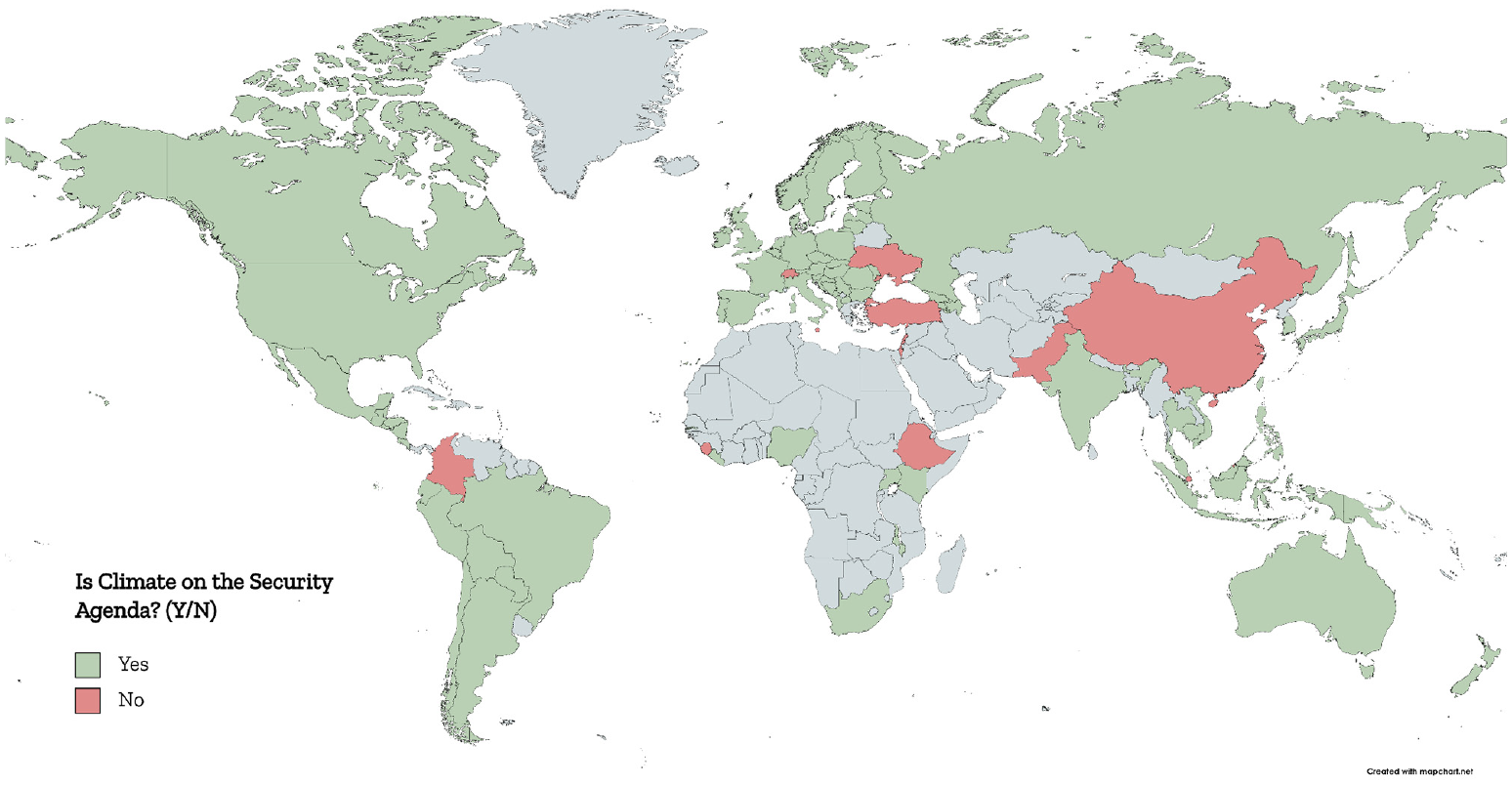
Map of countries that do and do not have climate security in their national security document (Y/N).
In the second phase looking at document content proportions, data were derived from findings in Table A2 (see Appendix A). Here, 74 countries had climate on their NSA, which is 79% of our sample (with 1% or more of their document discussing it), while 20 countries did not. The differences between the first instance (Figure 1) and second instance (Figure 2) data are slight but noticeable.
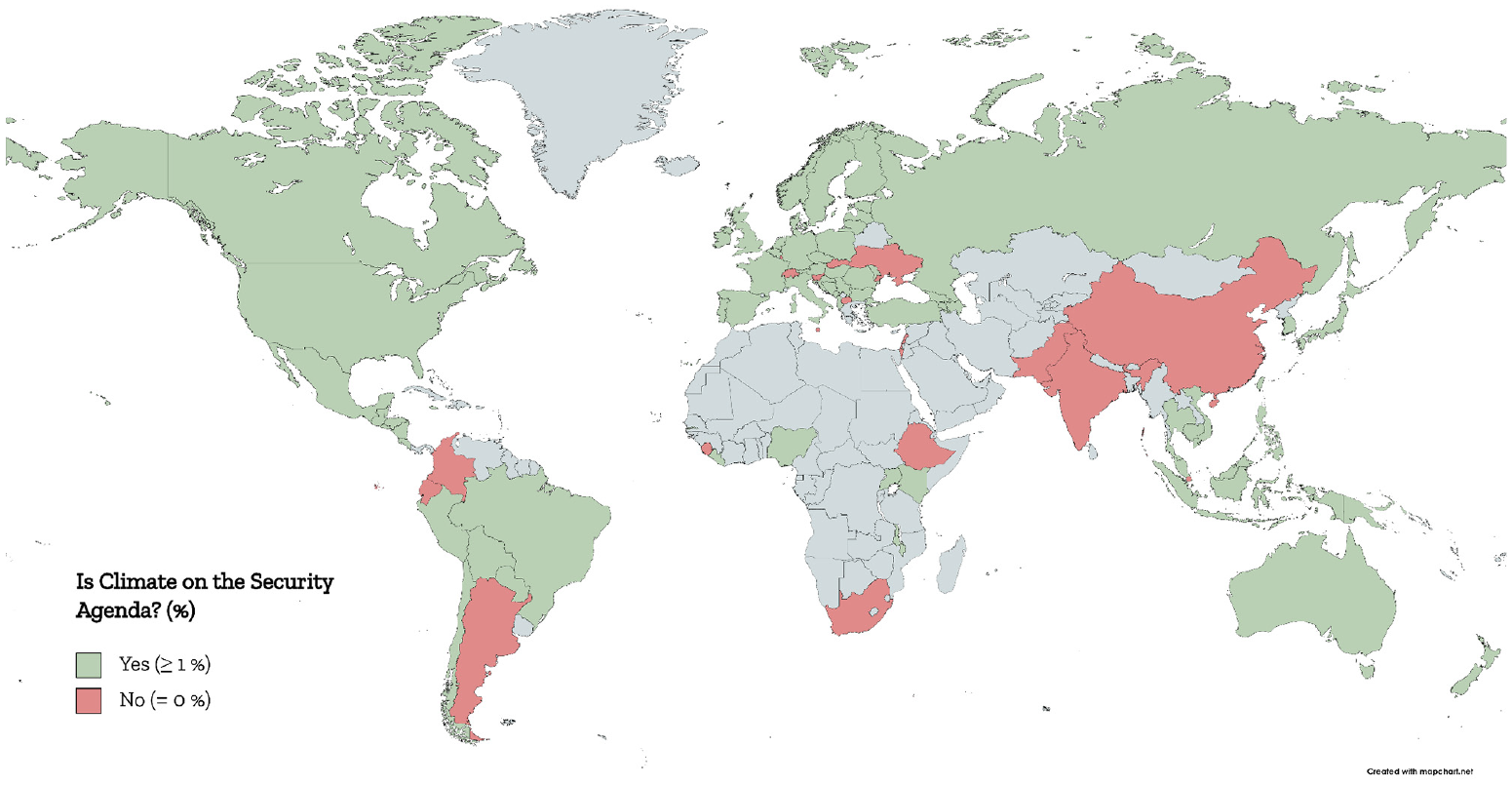
Map of countries that do and do not have climate security in their national security document (%).
The above findings are simplified and do not account for the full variations in the security documents, which is important because while most countries do have climate on their security agendas, most countries still give climate security a low priority. For a more detailed consideration of findings (see Table A1, Appendix A) and a visual representation of these findings, see Figure 3 (see also Appendix B).
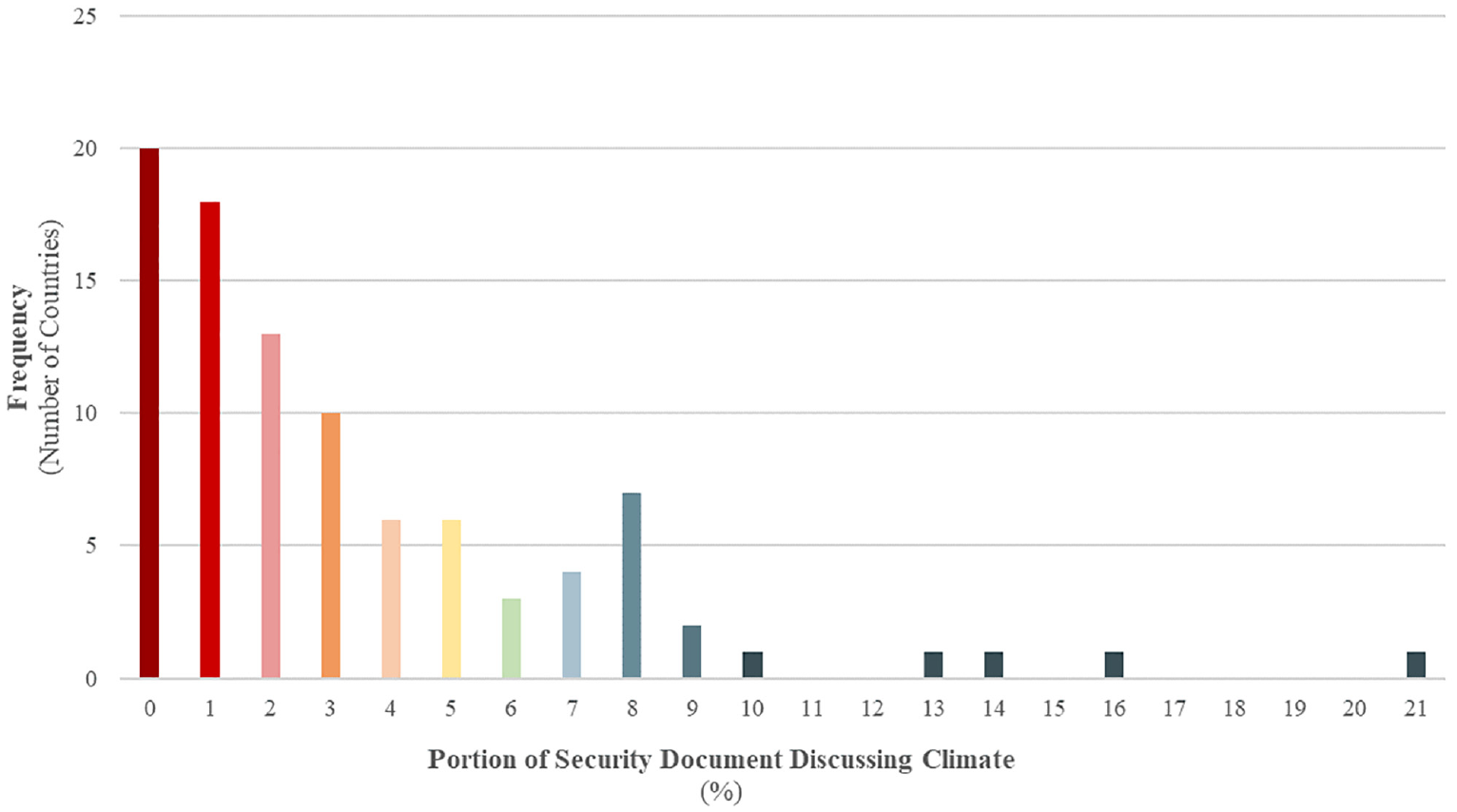
Bar chart illustrating the variations and frequency of portions of national security documents discussing climate (%).
The value that appears most frequently in the data (mode) is 0%, with 20 countries not having climate on their security agenda. This is followed by 18 countries that only have 1% of their security documents addressing climate-related issues, and 9 of these actually have a value that we have rounded up to 1% as a non-zero percentage (e.g. Bulgaria at 0.00501, Turkey at 0.00679 and Brazil at 0.00997; see Table A2 in Appendix A). Furthermore, 13 countries only have up to 2% of their security documents addressing climate.
The five highest percentages are still less than a quarter of the document with 21% (Belgium), 16% (Maldives), 14% (Denmark), 13% (Samoa) and 10% (United States) discussing climate threats. These countries are the only ones scoring equal to or above 10%. In short, most countries have such a low consideration of climate on their security agendas compared to other issues, that the average (mean) value is only 3.44 (i.e. ≈3%). Figure 4 illustrates that more countries are scoring below this average percentile (3%) than above (see calculation in Appendix C).
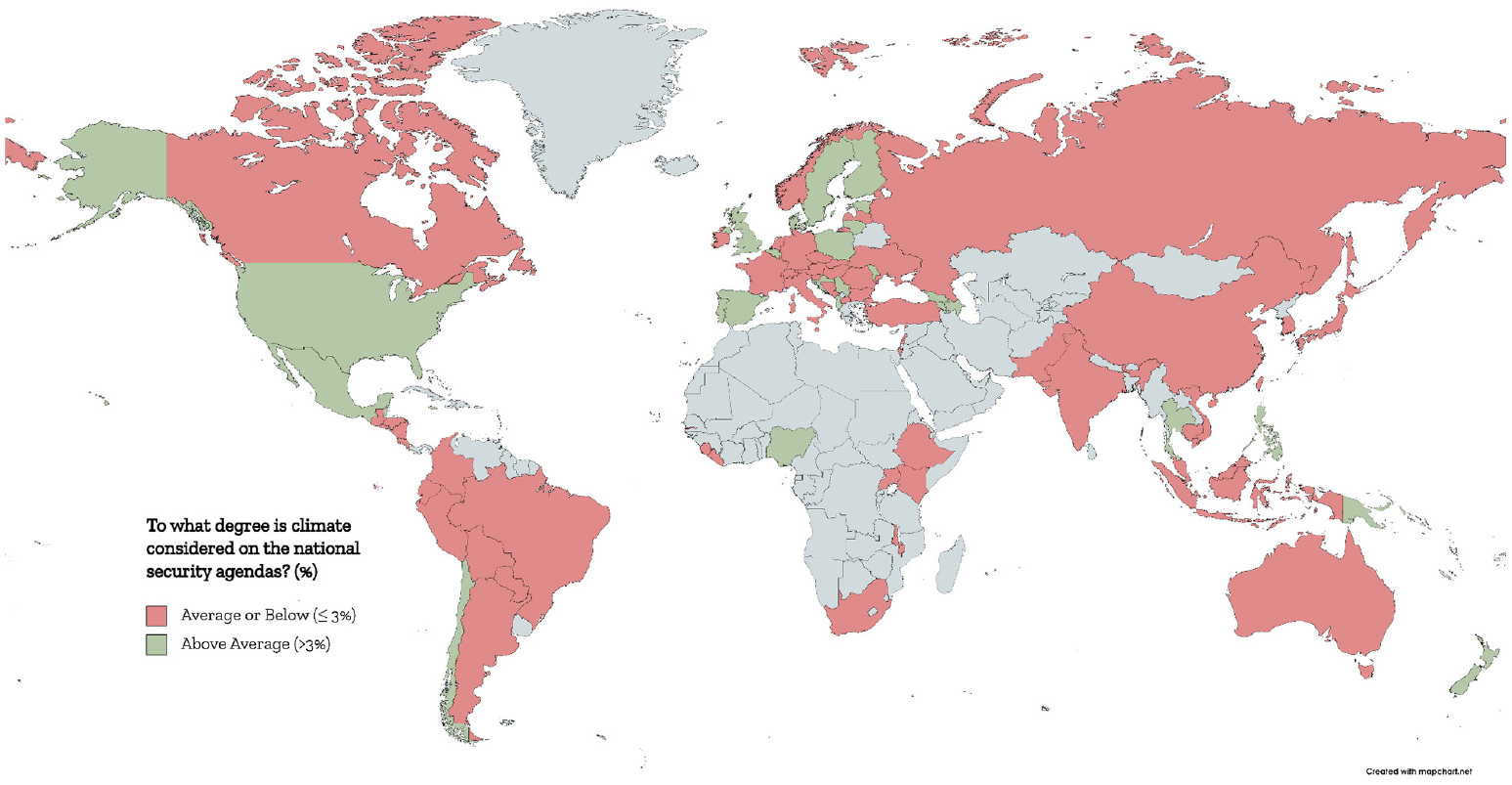
Map representing countries with a portion of their national security documents that is either above average or below or equal to the average (%).
With that said, while most countries do mention climate on their NSAs (as per Figures 1 and 2), most countries also regard climate issues as a low priority on the basis that climate-related issues only make up 3% or less on most NSAs (as per Figure 4).
Countries with no climate security agenda
A total of 20 countries were not considered to have climate on their NSAs. Here, the nine lowest-ranking countries were tied (at Rank 86–94) with an exact score of zero. The remaining 11 countries scored below 0.00419772, rounded down to 0%.
The nine lowest-ranking countries were China, Ethiopia, Israel, Lebanon, Luxembourg, Malta, Sierra Leone, Singapore and Ukraine (see Table A1 in Appendix A). These countries take a purely traditional approach to security in their NSAs. These countries prioritise defending their state sovereignty, survival, defensive capacity and economic prosperity (Armed Forces of Malta, 2017, p. 2; Belfer Center for Science and International Affairs, 2016, p. 3; Defence Directorate of Ministry of Foreign and European Affairs of Luxembourg, 2017, pp. 12–14; Ministry of Defence of Sierra Leone, 2003, p. 5; Ministry of Defence of Ukraine, 2021, p. 44; Ministry of Information of Ethiopia, 2002, pp. 9–18; Ministry of National Defense of China, 2019, pp. 4–5, 8). In meeting these priorities, Israel (2016, p. 4) highlights the primary threats as states (Iran, Lebanon and Syria), sub-states (Hezbollah and Hamas) and terrorist organisations (Islamic Jihad, Palestinian Islamic Jihad, ISIS and others). Meanwhile, China (2019, pp. 4–5) highlights their opposition towards aggression, Taiwanese independence and separatist movements (e.g. Tibetan independence and East Turkestan). Most countries consider their militaries as the primary means of pursuing national security interests, with China (2009, p. 8) explicitly declaring that their armed forces are also dedicated to addressing rising non-traditional global challenges including terrorism, cyber-security and natural disasters. Singapore (2004, pp. 11–12), in particular, puts great emphasis on the threats of transnational terrorism while considering itself ‘high on the list of targets of terrorist actions’ (their NSS was published in 2004, shortly after the September 11 terrorist attacks in the United States). Finally, Ukraine (2021, p. 66) emphasises defending the country and also strengthening bilateral cooperation in their pursuit of EU and NATO membership.
The 11 remaining countries with a negligible consideration of climate (0%) were South Korea, Switzerland, Colombia, Argentina, Ecuador, South Africa, Slovenia, Slovakia, India, Pakistan and North Macedonia. Below we offer a detailed qualitative analysis that shows how states may make passing mention of climate issues in their NSDs but often subordinate them to other national interests rather than treating climate change as an existential threat in itself.
South Korea (Ministry of National Defense of Republic of Korea, 2020) prioritises traditional threats including (a) territorial, religious and ethnic conflicts, (b) Japan, China and Russia strengthening military capacity, (c) U.S.–Russia arms control conflict and (d) North Korean nuclear threats (pp. 10, 11, 14, 15). Still, they recognise climate change as one of several transnational non-military threats that transcend borders and need international cooperation (pp. 12, 45). On the grounds that natural disasters will become more persistent as a consequence of climate change, South Korea calls for greater disaster management in areas of prevention, preparation, response and recovery (p. 91).
Switzerland (Swiss Confederation Federal Intelligence Service FIS, 2020) claims that violent left-wing extremists ‘are always on the lookout for larger movements’ which include environmental degradation, racism and police violence ‘whose issues and protests they can exploit for their own ends’ (pp. 56–67). There is no other mention of climate or environment. Instead, Switzerland prioritises other non-traditional threats including pandemics, jihadists and ethno-nationalist terrorism, violent right- and left-wing extremism, proliferation, illegal intelligence and threats to critical infrastructure (p. 3).
Colombia (Ministry of National Defense Republic of Colombia, 2007, pp. 30–31) mentions the environment once in the context of launching a pilot programme to promote ‘the recovery of the environment’ along with other pilot programs to address regional security, institutional legitimacy, effective governance, the justice system and ending drug cultivation and illegal sectors of the economy. There is no other mention of climate or environment, nor their related threats. Instead, Colombia prioritises their drug trafficking problem (pp. 23, 36).
Argentina (Ministry of Defence Argentina, 2015, pp. 182–184) strongly believes in observing, understanding and forecasting the climate to ensure the safety of the population and their property from extreme weather conditions and to predict circumstances to ensure sustainable economic development. This is the extent of Argentina’s climate-related security policy. Argentina is primarily concerned with emerging powers and how technological advancements will shape the waging of wars (pp. 22–25). The country also highlights inequalities between states in the current international order, including concerns regarding the distribution of scarce natural resources and technological power (including resulting defensive capacity) (p. 23).
Ecuador (Ministry of National Defense of Ecuador, 2018) does not regard climate as a security priority, but it is still fair to say that Ecuador does consider climate on their NSA despite being a low portion of their document. It recognises that climate change and environmental degradation threaten survival and pose a security risk by causing large-scale deaths, undermining the basic functions of the State and massively reducing the quality of life (pp. 24, 46, 47, 49). Ecuador considers itself more prone to environmental risks (including floods, tsunamis and volcanic eruptions) by being positioned in the Pacific Ring of Fire and considers these risks a threat to national security, life and infrastructure (p. 53). Ecuador also recognises that poor mitigation efforts against natural resource exploitation and climate change will pose a serious resource scarcity risk (p. 58). Like Argentina (2015), Ecuador emphasises how the inequitable distribution of resources (including resources vital to the technological development and maintenance of renewable resources) imposes a risk and explains that this is because the tension between states will increase along with the unmet, growing needs of human civilisation (p. 58). Although Ecuador’s primary interest in Antarctica is to increase its sovereign rights and exercise its national interests, they still recognise how essential Antarctica is for maintaining the global geopolitical and environmental balance, and how incredibly vulnerable it is to global warming (pp. 113–115). Nevertheless, Ecuador prioritises ‘real’ threats (‘verdaderas amenazas’) including transnational crime, armed groups and other traditional security issues that threaten their sovereignty, along with their territorial integrity, strategic resources and population (p. 19).
South Africa (Department of Defence of South Africa, 2010) does not consider climate beyond its socio-economic implications establishing that its national objectives are to defend the sovereignty of the state, improve defence capabilities and promote economic development and poverty alleviation – both nationally and regionally (pp. 10, 21, 24). To achieve these objectives, South Africa has 10 strategic priorities where ‘using and managing resources sustainably’ ranks sixth (pp. 25–29). From this primarily economic standpoint, this policy entails the protection and ‘enhancement’ of natural resources and relies on the environment as an ‘asset’ (p. 21).
Slovenia (Republic of Slovenia Ministry of Defence, 2020) considers poor governance, corruption, poverty, resource scarcity, land degradation, population growth, radicalism, terrorism, crime and illegal mass migration as their sources of instability and primary security threats (p. 8). Slovenia still regards preserving the environment and natural resources as one of their less prioritised national interests (p. 10). That said, Slovenia’s security document is highly militarised and has no consideration of climate-related issues imposing an existential threat to national security (p. 10).
Slovakia (Ministry of Defence of the Slovak Republic, 2021) expresses many varied security concerns. Their highest priorities include state competition, violations of international law, hard-power pursuits in international relations, conventional and nuclear arms and threats to national security interests imposed by non-state actors (p. 9). Slovakia is concerned with climate change only to the extent that it exacerbates massive illegal migration (p. 10). Furthermore, the only environmental policy expressed in Slovakia’s security agenda is for the Ministry of Defence and Armed Forces to make their activities more energy efficient (p. 26). There is no other consideration of climate on the Slovakian security agenda, and thus they do not consider risks imposed by the climate crisis a threat to national security.
India (Ministry of Defence of India, 2018) considers the biggest contemporary threat to global peace and security to be terrorism and radicalisation (p. 2). There is a small discussion on India’s environmental policy. For instance, the Institute for Defence Studies and Analyses considers climate change as a contemporary development affecting India’s security and foreign policy (p. 206). India also mentions the Coast Guard’s responsibility to preserve and protect the Marine environment and prevent marine pollution, the Social Service and Community Development Environmental Protection Project to spread awareness about the plastic problem, and the military board’s initiative of banning polythene bags, managing waste, planting trees and promoting similar measures for environmental protection (pp. 50, 126, 194, 195). That said, India recognises environmental degradation and climate change as a problem but not as a national security threat. It considers Pakistan’s expansion of its military forces, and the rise of religious extremism a greater threat (p. 4).
Pakistan (Ministry of Interior Government of Pakistan, 2018, p. 36) prioritises improving strategic cooperation and coordination. For the seventh policy area (responding to man-made or natural disasters), Pakistan declared that ‘special security arrangements will be made during disasters whether man-made or natural’ and to prevent further damages, there will be ‘proper’ educational and health facilities provided in affected areas (p. 45). There was nothing else written on the seventh policy area, nor was there any consideration for any other threats related to climate issues. Meanwhile, the six other policy areas went into detail about the importance of the policy area and paired this with thoroughly considered strategies. It will be interesting to see how the massive floods of 2022, which put one-third of the country under water, will shape Pakistan’s next NSD.
Finally, North Macedonia (Ministry of Defence of Republic of Macedonia, 2012), like many other highly militarised NSAs above, prioritises the territorial integrity and sovereignty of the state (p. 35). Thus, the ‘vital interests’ of North Macedonia include cooperation with alliances and neighbouring countries, respecting the rule of law, encouraging socio-economic development, promoting democracy and protecting the legitimacy and survival of the country (p. 21). North Macedonia claims it is ‘currently not facing direct conventional threats to its national security’ while the global political order is ‘faced with new growing asymmetrical threats and risks’ (pp. 17, 18, 22). However, this statement is inconsistent with North Macedonia’s geopolitical concern as a country exposed to Europe, Asia and Africa, and maintains that this ‘means greater responsibility’ to combat recurring threats (such as terrorism, illegal migration and drug-, human- and weapon-trafficking) through regional and international cooperation (p. 17).
Most countries addressed above have shown little to no consideration of climate in their NSAs. Notably, Ecuador (2018) did, in fact, consider climate change and environmental degradation a threat to national security and did have a dense, despite short discussion on their emergent risks. The remaining countries in the above analysis had very limited discussions of climate and did not regard the climate crisis as a threat to national security.
Countries with the highest consideration of climate on their security agendas
The five highest-ranking countries, by virtue of having the highest portion of their NSD discussing climate, were Belgium (21%), Maldives (16%), Denmark (14%), Samoa (13%) and the United States (10%) – see Table A6 in Appendix A. These countries still maintain that traditional security threats are relevant but expand the scope of their security policy to address other concerns that pose an existential threat to national security. They divide between three Western states that prioritise international cooperation and comprehensive approaches to security and climate mitigation, and two low-lying island states to which climate change is an imminent existential threat.
Belgium (Belgian Defence, 2021) defines national security as the ‘absence of war or violent conflict’ and declares that the threat of interstate war prevails, thus militarised geopolitical strategy is still considered essential to national interests (p. 1). Belgium extends their understanding of national security to include economic prosperity, strong political institutions, balanced society and stability (p. 1). Furthermore, it recognises climate change and resource scarcity as destabilising phenomena and is prepared for both traditional and non-traditional security threats to accommodate contemporary risks (p. 1). As a result of their widened, cross-sectoral approach to security, Belgium dedicates much (21%) of their NSA to discussing climate while expressing their interests transparently and multi-dimensionally (p. 1). For instance, Belgium expressed how climate change highlights issues of energy scarcity by mobilising a global shift to renewables – which cannot currently meet growing energy demands (p. 3). Belgium then extends this concern by expressing that – to meet these energy demands – there will be an increased dependence on natural gas, meaning some countries (e.g. Germany) will become increasingly dependent on Russia (p. 3). This has proved a prescient warning in light of Russia’s 2022 invasion of Ukraine. Belgium also raises concerns about other scarcity and supply problems which will be exacerbated by both the climate crisis (depleting resources) and technological advancements (increasing demand). Like Argentina (2015) and Ecuador (2018) above, Belgium recognises that the climate crisis will highlight distributional inequalities and provoke conflict – especially over minerals and rare earth materials (p. 2). It signals that scarcity of these resources will increase their dependence on China, increase global conflict and destabilise parts of Africa, Central Asia, Middle East and Latin America (pp. 3, 14–17). Belgium also flags that mass migration and refugee crises will increase as more people flee from conflict-ridden regions as their conditions are increasingly exacerbated by climate change (p. 4). Finally, Belgium sees itself as extremely vulnerable and unprepared for the increased frequency of widespread infectious diseases, which is exacerbated by climate change and will demand greater technological advancements (p. 3). Overall, Belgium recognises that there is a ‘climate emergency’ that needs immediate preventative measures as the climate crisis not only exacerbates existing threats but also poses an ‘existential danger’ in itself (p. 2).
Maldives (Government of the Republic of Maldives, 2012, pp. 12–14, 39–40) dedicates 16% of their first NSS to discussing climate change and gives environmental threats and security (including climate change, natural disasters and marine pollution) their sections. Additionally, Maldives explicitly considers the climate crisis a long-term threat to their national security – threatening their survival, independence, infrastructure and sovereignty (pp. 5, 12). In fact, Maldives declares that climate concerns are an existential threat and high priority (p. 38). Maldives – by virtue of being a low-lying vulnerable island nation – takes on a self-proclaimed, leading role to represent Small Island Developing States (SIDS) which are all disproportionately affected by the climate crisis (pp. 5, 6, 13). They emphasise that while climate change is portrayed as a problem for future generations, the reality is that the consequences of the climate crisis are already being experienced by SIDS (p. 39). Maldives has the eighth largest coral reef in the world and, like many other small island states, is dependent on their reefs. These reefs are now facing degradation and biodiversity loss. Consequently, these reefs have a reduced capacity to provide shelter from natural disasters and to sustain local livelihoods (p. 13). Furthermore, Maldives (like other SIDS) is en route to becoming uninhabitable by 2100 due to sea-level rise, as predicted in the IPCC Fourth Assessment Report (as cited in Government of the Republic of Maldives, 2012, p. 39). Overall, Maldives regards the traditional threats as ‘problematic’ and ‘irrelevant’ to SIDS and calls for widening the concept of security (p. 6).
Denmark (Danish Ministry of Foreign Affairs, 2022) ranks lower than Belgium (2021) and Maldives (2012) with 14% of their document discussing climate, despite mentioning climate more frequently (see Table A6, Appendix A); they repeatedly mention keywords within a paragraph. Still, Denmark intends to increase the global ambition of climate mitigation and sees itself leading the way for climate diplomacy (p. 8). Denmark reveals that countries are not doing enough to reach the 1.5°C target and declares that national climate policies around the world are insufficient (pp. 31, 33, 34). Not only does Denmark appear serious about phasing out fossil fuels by ‘declaring war on coal and pressing for a green transition’ (p. 31), they also envision themselves leading debates at The Conference on the Future of Europe to promote the transformation of the European Union (which started as a Coal and Steel Union) to becoming a Climate Union with ‘global clout’ (p. 16). Denmark emphasises their self-proclaimed status as a ‘green pioneer’, repeatedly highlighting their contribution to green development (pp. 8, 35). For instance, they highlight their intention to combine their environmental approach to development, with the global influence of the United States to create the necessary ‘international momentum’ to strengthen climate policy (p. 14). Furthermore, they mention their goals to establish (a) a national law to reduce 70% of GHG emissions by 2030, (b) an end date for oil and gas exploration in the North Sea and (c) the world’s first ‘energy islands’ (p. 33). Nevertheless, Denmark prioritises democracy, freedom, security and human rights over climate, sustainability, welfare, justice and equality. Notably, a major ground for considering climate security with importance is their concern of the climate crisis evolving into a ‘democratic crisis’ (p. 28). Still, they acknowledge how the climate crisis threatens security and stability through resource scarcity, migratory flows and hindering economic development (pp. 6, 31, 36).
Samoa (Ministry of the Prime Minister and Cabinet of Samoa, 2018) operates ‘under the expanded concept of security’, which explicitly includes climate change, and claims that this approach is ‘now widely accepted internationally’ (p. 5). Similar to Belgium (2021), Samoa addresses how, globally, there is a security ‘risk’ by virtue of the political and economic ‘disruption’ that will likely be caused by an imbalance of increased demand due to technological advancements, and depleting supplies due to environmental degradation (p. 6). With that said, Samoa regards climate change as an ‘enduring’ threat to national security and emphasises that it needs a ‘long-term, well-resourced and coordinated strategic management’ for its mitigation and adaptation (pp. 18, 27). Samoa regards itself as ‘highly unlikely to face conventional military threats’ (p. 18). Instead, Samoa emphasises that SIDS have ‘special needs’ and, thus, is a strong advocate for an ‘integrated approach’ to climate change mitigation, including conservation, sustainable development and protection of oceans (p. 8). Samoa themselves have a majority of their infrastructure and almost 80% of their population on low-lying coastal land (p. 26). As such, Samoa considers themselves ‘highly vulnerable’ to natural disasters and climate change and, thus, regards these as ‘critical’ threats (pp. 9, 11). Samoa recognises that climate change may significantly ‘damage’ national interests and livelihoods (p. 5). Samoa already struggles with the availability of cultivable land and fears that climate change may exacerbate this issue through the dislocation of coastal populations (p. 26). Furthermore, coral bleaching caused by climate change is having devastating impacts on the ecological balance on which their fishing and tourism industries are dependent (p. 26).
Finally, the United States (The White House United States, 2022) is repetitive with the vague goal of ‘a free, open, prosperous, and secure international order’ through modernisation and democratisation (pp. 10, 14, 16). As such, the United States puts great emphasis on the growing competition between major powers in a post-Cold War era, and the necessity for transnational cooperation when dealing with global issues such as climate change, food insecurity, pandemics, terrorism, energy shortages and inflation (p. 6). For example, the United States repetitively addresses the tensions between democracies and autocracies (i.e. Russia and China), and how the latter’s ‘assertive’ behaviours are escalating conflict and instability despite the intensifying interdependency and the need for cooperation to address issues of climate, economics and public health (pp. 8, 9, 23–27). The United States claims that climate change is the ‘greatest’ global problem as it is ‘potentially existential’ to all states (pp. 9, 27). However, the emphasis is on the growing tensions that will come with the irreversible effects of climate change around the world when the 1.5°C warming is surpassed (pp. 9, 27). This suggests that the United States is still more motivated by state relations and tensions than the emerging risks which they proclaim need immediate action. Furthermore, the United States claims that the rest of the world is dependent upon their leadership (p. 2). In terms of climate change mitigation, the United States says they are ‘galvanising’ and ‘incentivising’ the rest of the world to raise their climate ambition and action (p. 27). They also consider they have an ‘international credibility’ that they must uphold through setting the example and ‘integrating climate change into our national security planning and policies’ (p. 27).
The highest-ranking countries show an exceptional consideration of the climate crisis as a threat and its role in exacerbating other threats. Belgium (2021), Maldives (2012) and Denmark (2022) all explicitly consider the climate crisis to be an existential threat, whilst the United States (2022) expresses the potential for it. Denmark (2022) is particularly ambitious with its goals to phase out fossil fuels, become a global climate leader and inspire the European Union to become a regional climate union. Meanwhile, Maldives (2012) and Samoa (2018) clearly demonstrate the disproportionate effects of climate change that SIDS experience, despite being among the smallest contributors towards GHG emissions and pollution. Finally, Belgium (2021) exemplifies what a broad, cross-sectoral approach to security looks like, and thus illustrates how to innovatively approach climate as a national security threat.
Conclusion
In this article, we have performed a quantitative and qualitative content analysis of NSAs to address the research questions: Is climate on national security agendas? To what extent is it prioritised? What are the main ways in which national security agendas handle climate security?
The findings have revealed that most countries in our corpus (a total of 74 out of the 94 states that publish NSDs) do have climate issues on their NSAs (see Table A2 in Appendix A). However, most countries also have a very low prioritisation and consideration of climate security. Most countries have such a small portion of their NSDs discussing climate that it is considered negligible (0%). The average (mean) consideration was approximately 3% and the median was even lower (2%). This is despite Belgium (2021), Maldives (2012), Denmark (2022), Samoa (2018) and the United States (2022) pulling up the average with their exceptionally high considerations (21%, 16%, 14%, 13% and 10% respectively). A further qualitative content analysis revealed that the Maldives and Samoa are the only countries in our deeper analysis that consider climate security as an existentially high priority. All other high-consideration countries prioritise traditional security objectives, with most having a high regard for their territorial integrity, sovereignty, economic prosperity, and democracy.
The greatest contrast between the lowest and highest-ranking countries in their prioritisation of climate change (when mentioned) is whether to prioritise merely adaptation or mitigation (or both). These mitigation efforts include raising global ambitions to minimise GHG emissions and global warming in accordance with the Paris Agreement 2016, and, generally, ‘eradicating those practices that create or worsen the problem of climate change itself’ (McDonald, 2018, p. 170). To generalise, the lowest ranking countries that do have climate on their NSAs tend to do so with an intent to adapt to the problems, instead of preventing them. We see this when armed forces are assigned to managing extreme natural disasters (Ministry of Defence Argentina, 2015, p. 192; Ministry of National Defense of China, 2019, p. 3). Furthermore, for these lower-ranking countries, their climate policies are often limited to what the armed forces or the Ministry of Defence can do within the sector, such as management of waste, energy and pollution (Ministry of Defence of India, 2018, pp. 50, 126, 194–195; Ministry of Defence of the Slovak Republic, 2021, p. 26; Ministry of National Defense of Republic of Korea, 2020, p. 177). There are some exceptions to this generalisation. For instance, Ecuador (2018) is a strong advocate for mitigating climate change and resource scarcity (p. 58). Meanwhile, the highest-ranking countries do prioritise mitigation and are more concerned with the impact climate change could have on exacerbating other issues in the future (Belgian Defence, 2021, p. 2; Danish Ministry of Foreign Affairs, 2022, pp. 8, 33–34, 36; Government of the Republic of Maldives, 2012, pp. 5, 39; The White House United States, 2022, p. 27).
In concluding our analysis, it is clear that while climate change is increasingly recognised on national security agendas, in general, the degree of prioritisation remains disappointingly insufficient. At worst, states are evasive or disingenuous about climate change even when mentioning it; at best, a few take its current and future impacts seriously. We have used the Copenhagen School framework to show that despite climate change meeting the discursive and objective facilitating conditions for securitisation, there is a glaring discrepancy between the increasing scale of the climate threat and the meagre space it generally occupies in national security policies. With 84% of states acknowledging climate change in their security documents, yet allocating, on average, a mere 3% of their content to it, the urgency of the crisis is not matched by action (Kimball, 2021). This dissonance further calls into question the effectiveness of current climate change efforts and underlines the need for a radical overhaul of how climate change is integrated into national security agendas as tools of policy prioritisation (Depledge, 2010).
Footnotes
Appendix A
Overview of climate cooperation and agreements on national security agendas.
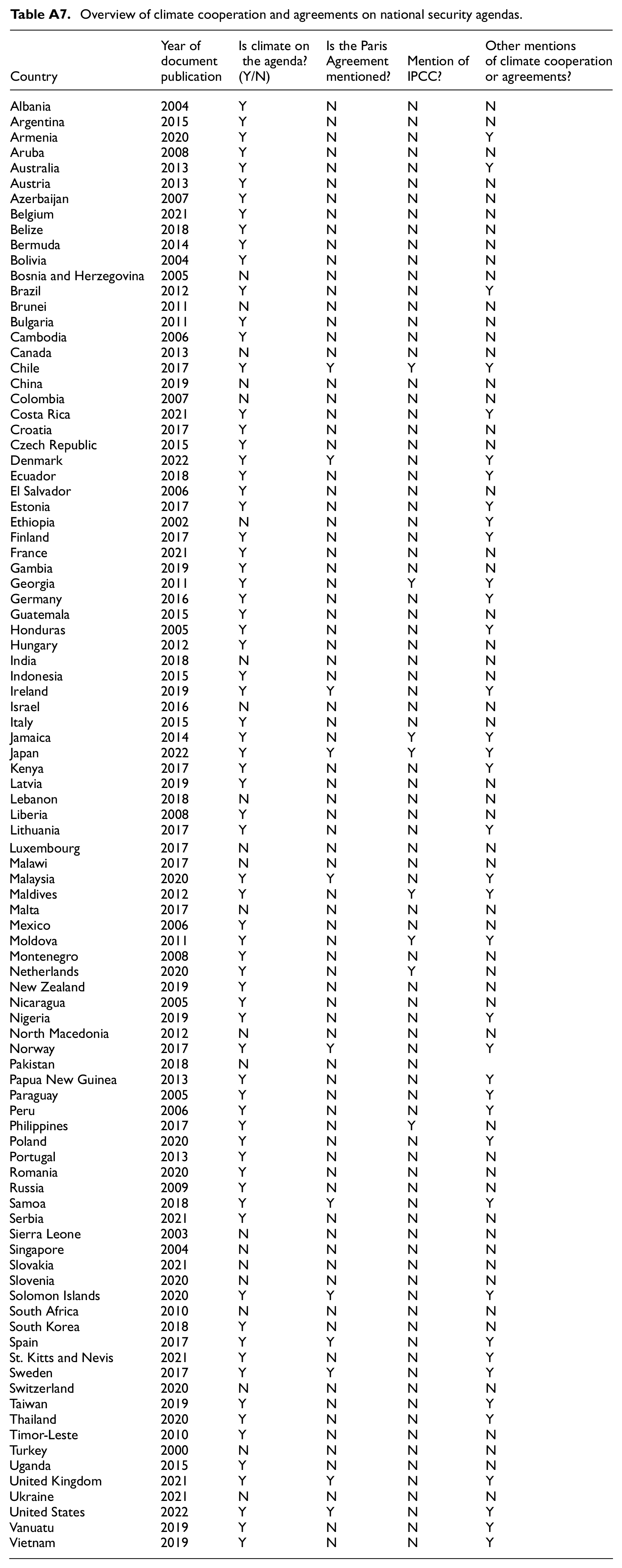
| Country | Year ofdocumentpublication | Is climate on the agenda?(Y/N) | Is the Paris Agreementmentioned? | Mention of IPCC? | Other mentionsof climate cooperationor agreements? |
|---|---|---|---|---|---|
| Albania | 2004 | Y | N | N | N |
| Argentina | 2015 | Y | N | N | N |
| Armenia | 2020 | Y | N | N | Y |
| Aruba | 2008 | Y | N | N | N |
| Australia | 2013 | Y | N | N | Y |
| Austria | 2013 | Y | N | N | N |
| Azerbaijan | 2007 | Y | N | N | N |
| Belgium | 2021 | Y | N | N | N |
| Belize | 2018 | Y | N | N | N |
| Bermuda | 2014 | Y | N | N | N |
| Bolivia | 2004 | Y | N | N | N |
| Bosnia and Herzegovina | 2005 | N | N | N | N |
| Brazil | 2012 | Y | N | N | Y |
| Brunei | 2011 | N | N | N | N |
| Bulgaria | 2011 | Y | N | N | N |
| Cambodia | 2006 | Y | N | N | N |
| Canada | 2013 | N | N | N | N |
| Chile | 2017 | Y | Y | Y | Y |
| China | 2019 | N | N | N | N |
| Colombia | 2007 | N | N | N | N |
| Costa Rica | 2021 | Y | N | N | Y |
| Croatia | 2017 | Y | N | N | N |
| Czech Republic | 2015 | Y | N | N | N |
| Denmark | 2022 | Y | Y | N | Y |
| Ecuador | 2018 | Y | N | N | Y |
| El Salvador | 2006 | Y | N | N | N |
| Estonia | 2017 | Y | N | N | Y |
| Ethiopia | 2002 | N | N | N | Y |
| Finland | 2017 | Y | N | N | Y |
| France | 2021 | Y | N | N | N |
| Gambia | 2019 | Y | N | N | N |
| Georgia | 2011 | Y | N | Y | Y |
| Germany | 2016 | Y | N | N | Y |
| Guatemala | 2015 | Y | N | N | N |
| Honduras | 2005 | Y | N | N | Y |
| Hungary | 2012 | Y | N | N | N |
| India | 2018 | N | N | N | N |
| Indonesia | 2015 | Y | N | N | N |
| Ireland | 2019 | Y | Y | N | Y |
| Israel | 2016 | N | N | N | N |
| Italy | 2015 | Y | N | N | N |
| Jamaica | 2014 | Y | N | Y | Y |
| Japan | 2022 | Y | Y | Y | Y |
| Kenya | 2017 | Y | N | N | Y |
| Latvia | 2019 | Y | N | N | N |
| Lebanon | 2018 | N | N | N | N |
| Liberia | 2008 | Y | N | N | N |
| Lithuania | 2017 | Y | N | N | Y |
| Luxembourg | 2017 | N | N | N | N |
| Malawi | 2017 | N | N | N | N |
| Malaysia | 2020 | Y | Y | N | Y |
| Maldives | 2012 | Y | N | Y | Y |
| Malta | 2017 | N | N | N | N |
| Mexico | 2006 | Y | N | N | N |
| Moldova | 2011 | Y | N | Y | Y |
| Montenegro | 2008 | Y | N | N | N |
| Netherlands | 2020 | Y | N | Y | N |
| New Zealand | 2019 | Y | N | N | N |
| Nicaragua | 2005 | Y | N | N | N |
| Nigeria | 2019 | Y | N | N | Y |
| North Macedonia | 2012 | N | N | N | N |
| Norway | 2017 | Y | Y | N | Y |
| Pakistan | 2018 | N | N | N | |
| Papua New Guinea | 2013 | Y | N | N | Y |
| Paraguay | 2005 | Y | N | N | Y |
| Peru | 2006 | Y | N | N | Y |
| Philippines | 2017 | Y | N | Y | N |
| Poland | 2020 | Y | N | N | Y |
| Portugal | 2013 | Y | N | N | N |
| Romania | 2020 | Y | N | N | N |
| Russia | 2009 | Y | N | N | N |
| Samoa | 2018 | Y | Y | N | Y |
| Serbia | 2021 | Y | N | N | N |
| Sierra Leone | 2003 | N | N | N | N |
| Singapore | 2004 | N | N | N | N |
| Slovakia | 2021 | N | N | N | N |
| Slovenia | 2020 | N | N | N | N |
| Solomon Islands | 2020 | Y | Y | N | Y |
| South Africa | 2010 | N | N | N | N |
| South Korea | 2018 | Y | N | N | N |
| Spain | 2017 | Y | Y | N | Y |
| St. Kitts and Nevis | 2021 | Y | N | N | Y |
| Sweden | 2017 | Y | Y | N | Y |
| Switzerland | 2020 | N | N | N | N |
| Taiwan | 2019 | Y | N | N | Y |
| Thailand | 2020 | Y | N | N | Y |
| Timor-Leste | 2010 | Y | N | N | N |
| Turkey | 2000 | N | N | N | N |
| Uganda | 2015 | Y | N | N | N |
| United Kingdom | 2021 | Y | Y | N | Y |
| Ukraine | 2021 | N | N | N | N |
| United States | 2022 | Y | Y | N | Y |
| Vanuatu | 2019 | Y | N | N | Y |
| Vietnam | 2019 | Y | N | N | Y |
Appendix B
Appendix C
Acknowledgements
The authors would like to thank Luc Wilson for research assistance in document search and collection, and Yuemiao Ma for editorial assistance.
Funding
The author(s) disclosed receipt of the following financial support for the research, authorship and/or publication of this article: Background research for this project was partially supported by the project ‘Non-Western dynamics of peace and transition management’ (PI: Mateja Peter) funded the U.K. Foreign, Commonwealth & Development Office (FCDO) for the benefit of developing countries (FCDO Project Number: 300708-144). However, the views expressed and information contained in it are not necessarily those endorsed by FCDO, which can accept no responsibility for such views or information or any reliance placed on them.

Data availability statement
The data that support the findings of this study are available from the corresponding author, Andrew W. Neal, upon reasonable request.