



Abstract
The number of people in displacement settings has grown steadily over the past decades. As refugees spend extended periods outside their home countries, new pressures have emerged in and around refugee camps, bringing refugees and host communities into conflict. Camp-based refugees have been blamed for increased environmental degradation rates, resource scarcity, reduced livelihood opportunities and other social and environmental problems. Many theorists have resorted to presenting these conflicts as an inevitable result of increased the pressure on the surrounding environment and its resources. This article challenges these notions and argues for an understanding of the spatial effects of the refugee camp. It will be argued that environmental resources can be a viable pathway towards a peaceful, sustainable and durable solution to protracted refugee situations rather than a conflict driver. Using the example of Ghana’s experience as a refugee–hosting country, it examines the impact of protracted refugee situations on refugees and host communities, demonstrating how compounding pressures have led to conflicts between the two groups over time. Potential environmental peacebuilding interventions are examined to understand the wide-ranging benefits that cooperation over environmental resources can bring to communities in conflict.
Introduction
Global displacement figures show a concerning trend of rising numbers of displaced people coinciding with decreasing rates of return. In 2022, forced displacement exceeded 100 million people for the first time (United Nation High Commission for Refugees [UNHCR], 2022). Between 2010 and 2019, there was more than a two-fold increase in displacement situations compared to the start of the decade (UNHCR, 2020). At the end of this period, close to 16 million people were in protracted refugee situations (UNHCR, 2020), 1 meaning displacement is becoming an intergenerational phenomenon. This is compounded by the breakdown of the UNHCR’s main pathways to resolve protracted situations: repatriation, resettlement in a third country and local integration (Addo & Tanle, 2023).
While political turmoil and violence have historically been the leading causes of forced displacement, climate change, environmental degradation and disaster are increasingly primary drivers (Hiraide, 2023). Some estimates suggest that 1.2 billion people could be forced to leave their homes by 2050 (Institute for Economics & Peace, 2020). A debate is ongoing as to whether or not these people should be considered climate refugees or migrants, which would have vast impacts on the response to such displacement (Warner et al., 2010). Regardless of classification, such an increase in displaced persons over the next few decades will create new challenges for refugee–hosting and high-migration countries (D. S. Miller, 2017).
As of 2021, approximately 6.6 million people lived in refugee camps globally, both planned and self-settled (UNHCR, 2023a). As refugee camps increase in size, they are seen to place strains on the surrounding environments (Cosgrave, 1996; Wardeh & Marques, 2021). This is compounded by the ever-increasing periods of time that refugees are spending in refugee camps, with the average stay in a refugee camp being 20 years. Long periods spent in camps have a range of impacts on the well-being of refugee communities, including denial of legal rights, poor support, discrimination and lack of livelihood opportunities, among others (Milner, 2014). Despite this, refugee situations are treated as short-term crises; as a result, the structures put in place during the emergency phase fail to consider mechanisms to manage the situation should it become protracted (Wardeh & Marques, 2021, p. 2471). At the same time, their presence often brings new stressors for host communities, often linked to refugees’ response to the challenges they face, provoking conflict between the two parties (S. D. Miller, 2018).
Environmental degradation and pressures on natural resources amplify these conflicts’ risks, particularly where host communities rely highly on environmental resources to meet their needs (Crisp, 2003; Martin, 2005). Refugees are often perceived as ‘exceptional resource degraders’, with refugees argued to use environmental resources, such as wood fuel, unsustainably and at a disproportionately high rate compared to their host counterparts (Leach, 1992). This argument has also been subject to widespread critique, with a broad body of evidence emerging to refute key claims (Black, 2018; Cavendish, 2000; Kibreab, 1997); however, it has remained a prominent and popular explanation for conflict between hosts and communities (Habib, 2023). Recently, the threat to natural resources within displacement settings has been linked to ‘maladaptive coping strategies’, whereby liquidating assets during flight ‘results in the rapid and intense exploitation of natural resources’ (Bruch et al., 2023, p. 69). In these cases, host communities may fear that an influx of refugees could threaten the stability of available resources. Such behaviours and beliefs have contributed to dominant securitised discourses around resource scarcity and conflict, where scarcity narratives based on ‘fear, self-interest and competition’ present conflicts as an inevitable consequence of a limited resource base being subject to use by a suddenly expanded population (Amster, 2015, p. 29).
As an alternative to a securitised treatment of natural resource use, environmental peacebuilding centres on the role of natural resources in generating cooperation and conflict transformation. Environmental peacebuilding represents a wide collection of ‘approaches and pathways by which the management of environmental resources is integrated into and can support conflict prevention, mitigation, resolution and recovery’ (Ide et al., 2021, p. 3). The possibility of coalescing around shared resources allows for experimentation with alternative societal structures and new conflict-resolution mechanisms based on cooperation, mutual aid and trust. This is not to say that conflicts will not arise. Instead, it is a recognition that these conflicts do not have to follow a pre-ordained path that leads to competition and violence.
Environmental peacebuilding operates within a range of fields relating to natural resource management and beyond, including governance (Bruch et al., 2016), conservation (Barquet, 2015), water, sanitation and hygiene (Krampe & Gignoux, 2018) and agriculture (Chavez-Miguel et al., 2022). Krampe et al. (2021) posit three mechanisms through which environmental peacebuilding operates: the contact hypothesis, the diffusion of transnational norms and equitable state service provision. These mechanisms stretch across different scales from the interpersonal (the contact hypothesis) to the transnational (norm diffusion), indicating the enormous scope of environmental peacebuilding activities. As a problem-driven practice, environmental peacebuilding encourages movement towards cooperation over natural resources, which is assumed to spill over into other arenas (Amster, 2015). By reframing the role of natural resources in conflicts and their resolution, environmental peacebuilding can promote an understanding that environmental issues are rarely the core drivers of conflict and hold a valuable capacity to inform peace (Ide et al., 2021).
While environmental peacebuilding has expanded scope from an initial focus on transboundary cooperation (Conca & Dabelko, 2002) to include a vast array of conflict types (Ide et al., 2021), the field has yet to devote much attention to the refugee–host relationship. What discussions exist centre on environmental conflicts rather than the potential for cooperation, presenting the negative impacts that refugees have on host ecosystems and seeking to provide causal explanations for the emerging conflicts. For instance, refugees are presented as ‘more likely to are more likely to cause environmental destruction than others’ and linked to various forms of environmental harm such as ‘deforestation, land degradation and water pollution’ (Swain & Öjendal, 2018, p. 3). As such, this article will investigate the potential role of environmental peacebuilding in fostering peaceful and sustainable refugee–host relationships. The purpose of this investigation is two-fold: first, to offer a critical lens through which to understand refugee–host conflict that moves away from dominant discourses that overwhelmingly blame resource users for conflicts through the application of spatial theory. Second, it will reflect on potential pathways to sustainable solutions for protracted refugee situations through environmental peacebuilding, addressing the need for alternative peacebuilding approaches in protracted refugee situations.
This article will proceed as follows: first, it will present a review of refugee–host conflict and environmental peacebuilding to offer a new understanding of these conflicts and pathways for their resolution. This will be followed by a short discussion of the study’s methodology. The article will then present a case study of refugee–host conflict in Ghana and a discussion of the potential of environmental peacebuilding during such conflicts.
The refugee camp, refugee–host conflict and environmental peacebuilding
Since the end of World War Two, the refugee camp has become the primary mechanism for managing large-scale displacement. However, despite its important role in the refugee response, analysis often overlooks how it shapes the refugee–host relationship, especially the role it plays in mediating the relationship between refugees, hosts and the environment. In instances of conflict with an environmental component, blame is placed on resource users (both refugees and, to a lesser extent, hosts) rather than the interceding conditions of resource use (Salehyan & Gleditsch, 2006). The integration of spatial theory in studying refugee–host conflict helps us to understand these conditions. Ide (2017) encourages environmental peacebuilding to consider the important role of space in conflicts. Borrowing from geography and political ecology, he argues that environmental peacebuilding and peace and conflict studies should focus on how peacebuilding practices are shaped by ‘contested and changing social constructions of space’ (Ide, 2017, p. 554). Understanding space as socially constructed opens new opportunities for understanding the refugee camps’ role in refugee–host conflicts. For Ramadan (2013), this understanding of spatiality reveals the ‘everyday politics and material practices of refugees’ (p. 65). The meaning ascribed to refugee camps influences the interactions that occur around them, examining how the refugee camp is conceived and understood by different actors helps to uncover some of the underlying causes of the conflicts that emerge within and around them.
One of the most notable effects of the refugee camp is the creation of boundaries that distinguish between hosts and refugees. In this sense rhetorical and material boundaries ‘delimit the self from the other’ (Ide, 2017, p. 547). Those living inside camps are defined through the paradigm of the ‘invisible line between the camp and its surroundings … a position that is simultaneously excluded from and included into host society’ (Turner, 2016). From an environmental perspective, camp segregation from host communities means that refugees are not exposed to local resource management mechanisms, leading to conflictual resource use patterns of a limited resource base (Jacobsen, 1997). A lack of familiarity with local environmental management practices may cause refugee communities to overexploit renewable resources, resulting in a loss of long-term sustainability. The perceived temporality of one’s stay in refugee camps compounds this challenge, as engaging with local practices is considered unnecessary by refugees who may believe they will only be in a camp for a short time (Hoerz, 1995). From a host community perspective, however, preserving common-pool resources is central to community well-being and the acceptance of refugees (Tsagaris & Manitsaris, 2016).
According to Lefebvre (1992), the dominant understandings of space are based on the perspectives of the powerful, which prioritises their use in certain ways. Officially, the UNHCR asserts that refugee camps are temporary and ‘not intended to provide permanent, sustainable solutions’ (UNHCR, 2021). However, this is not reflected in the lived reality of many refugees currently living in protracted refugee situations. From 2010 to 2019, just 3.9 million refugees returned to their country of origin, a reduction of 6.1 million people from the previous decade and over 11.1 million from the decade prior (UNHCR, 2020). For host communities, this perceived temporality means that the use of the land acquired as part of the response is only considered legitimate temporarily (Fisk, 2019). Furthermore, because of perceived temporality, the allocation of land favours shelter and ‘vital’ infrastructure rather than long-term considerations such as land for cultivation (Tomkins et al., 2019), forcing refugees to seek spaces outside of the camp, such as forests, where they can grow crops for subsistence (Perkins et al., 2017).
Forests are important resources for displaced communities due to their comparative ease of access and the wide array of services they can provide (Kibreab, 1997). The Food and Agriculture Organisation has found that over 80% of those in displacement settings depend closely on forest resources (Gianvenuti et al., 2018). In refugee situations, wood and biomass are collected to cook, heat and make improvements and repairs to shelters, whereas non-wood forest products provide food and medicines (Pierce & Emery, 2005). High levels of forest utilization by refugee communities brings significant impacts to forests. In Bangladesh’s Cox’s Bazaar refugee camp, remote sensing analysis found a significant reduction in vegetation cover in surrounding wildlife reserves after the expulsion of over 1 million Rohingya from neighbouring Myanmar (Imtiaz, 2018). Similar findings have been observed in the Senegal River Valley (Black & Sessay, 1997) and Northern Pakistan, where rapid deforestation occurred following an influx of refugees from Afghanistan looking to clear land for agricultural purposes (Lodhi et al., 1998). Encouragingly, in the case of Cox’s Bazaar, evidence suggests that recovery is possible with the right interventions and positive engagement with hosts and refugees (Jalal et al., 2023).
These patterns mean that the dominant narratives around refugee–host relationships closely mimic those of the material scarcity narrative despite evidence of the same circumstances also leading to cooperative dynamics (Black, 2018). Kibreab (1997) warns against correlating refugee flows with environmental degradation and framing refugees as ‘pollutants and defoliants’, which can shape the humanitarian response and, in some cases, lead to governments rejecting assistance to refugees based on environmental concerns. This framing can trickle down to the community level, impacting refugee–host relationships, where refugees are perceived threats to the community’s environmental and resource security and the cause of environmental degradation in and around the camp (Codjoe et al., 2013). The perceived threat is amplified where camps are established in peripheral, rural and resource-poor areas, which is common practice for many refugee–hosting countries (Fisk, 2019).
Environmental peacebuilding offers pathways to break down the boundaries created by the refugee camp. Peace parks encourage cooperation across borders and boundaries, building communication channels, trust, institutions and, ultimately, peace between former adversaries (Ali, 2007). Although peace parks have traditionally been large-scale conservation projects, mostly between states, the same practices can be applied locally where artificial boundaries, such as those between a refugee camp and its surrounds, have enforced a demarcation between communities. Applying peace park principles at the local level, such as through collaborative environmental projects, highlights the potential for shared ecological visions to foster peace through cooperation and mutual benefit. Amster (2015) showed that these microcosms of peace parks similarly build trust, avoid conflicts and lead to non-violent conflict resolution. The principles and benefits of having an area with a shared vision of the outcome remain the same regardless of scale, informing an understanding of the importance of shared ecological visions and forward-looking projects in creating peace.
The boundaries and segregations between refugee and host communities caused by refugee camps impede the building of social networks, which are central to cohesive communities (Fajth et al., 2019). Building the level of trust required to reduce conflict is difficult without resilient social networks which promote ‘reciprocity and active engagement’ (Cox, 2008, p. 1). Agroforestry and reforestation programmes are emerging as essential mechanisms for mitigating the impact of camp environments and addressing broader environmental challenges brought about by a changing climate (Grosrenaud et al., 2021). These programmes help to challenge perceptions of refugees as exceptional resource degraders among host communities and, therefore, contribute to a more positive understanding between the communities. The impact of environmental programmes in bringing together refugee and host communities is evident in Northern Cameroon, where reforestation and agroforestry programmes established within refugee camps are combating environmental challenges brought about by both displacement and climate change (Moore, 2014). Although the programme began as a refugee-led response to increased deforestation around the refugee camp, its expansion to include host community members has helped to overcome conflicts between the two parties. This has cascading effects with climate adaptation benefits, as well as providing knowledge to refugees which has been applied in other parts of the country and region as they have moved away from the refugee camp.
It is important to note that host communities are not always bystanders to degradation during refugee situations. Host communities have been found to take advantage of the disorder and confusion accompanying the influx of a refugee population to change their own resource consumption patterns, thereby contributing to increased resource exploitation (Jacobsen, 1997). The uncertainty and unpredictability of an emergency phase of a refugee situation offer host communities an easy scapegoat for their changed behaviours, increasing tensions between the parties when refugees are accused of actions they did not take, again highlighting the importance of spaces for conflict resolution to be created. For example, community members engaged in ‘illegal’ activities, such as poaching or illegal forest exploitation, can blame the activities on the refugee communities (Berry, 2008).
While not widely documented in the case of refuge–host conflict, the institutionalisation of coordinated cooperation is a key factor in the success of environmental peacebuilding interventions (Carius, 2006). Community-based institutions can help to regulate practices in and around the environment and open space for formal conflict resolution. In refugee–host conflict, these spaces have the potential to further break down the barriers between the two communities and open additional space for exchange. Successful integration strategies are predicated on full and meaningful inclusion and participation in institutional settings at local, regional and national levels, and as such policies enabling such participation should be pursued (Hynie, 2018).
Limitations on participation stem from the uncertain or unresolved legal statuses of living in refugee camps. The lack of legal status while asylum claims are assessed can also impact on rights to work can also reduce livelihood opportunities. This leaves refugees heavily dependent on available aid, increasing reliance on natural resources to meet livelihood needs when aid is reduced. This creates conflicts around the perceived legitimacy of accessing common pool and community resources. As a result, host communities will often seek to exclude refugees from accessing these resources through the invocation of two inter-related concepts: ‘ownership’ and the ‘legitimacy of refugee activities’ (Agblorti & Grant, 2021, p. 2). The concept of ownership is linked to the previously discussed issues around the tenure of land around refugee camps. Tenure regimes can be complex and overlapping, sometimes making claims difficult to assess, further complicated by the complexity of refugee legal status. Meanwhile, the legitimacy of refugee activities raises questions about who has the right to benefit from natural resources (Agblorti & Grant, 2021).
Environmental peacebuilding can support diversified and sustainable income generation opportunities, which can be legitimate alternatives to subsistence-based activities while building resilience in the face of climatic and other shocks by creating new, sustainable livelihood opportunities (Kurtz & Elsamahi, 2023). In refugee camps, programmes such as seed distribution, market gardens and integration into local markets have been shown to increase economic freedom and lessen dependence on aid (Bradford et al., 2009). This is in line with the findings from Jacobsen (2002), who observes that the ability to pursue productive lives reduces aid dependence and opens pathways ‘to overcome the sources of tension and conflict in their host communities’ (p. 95).
Methodology
To better understand how environmental peacebuilding could contribute to the understanding and resolution of refugee–host conflicts, this study adopts a case study approach focussing on the evolution of the refugee–host relationship in Ghana from the first wave of Liberian refugees during the first civil war from 1989 to 1997 through to the present. Ghana serves as a compelling case study due to the legacy of Pan-Africanism, which historically created an accepting environment for refugees (Agblorti & Awusabo-Asare, 2011). However, shifts in institutional and political support since the mid-2000s, including the closure of a major refugee camp, presents a complex scenario and lead to conflicts between hosts and refugees. With the general trend in West Africa indicating higher rates of displacement in the coming years (UNHCR, 2024), Ghana, as a politically stable West African country, may host high numbers of refugees again in the future. In this context, understanding the development and deterioration of the refugee–host relationship becomes crucial for crafting positive interventions.
Following Ide’s (2020) call to integrate environmental peacebuilding and political ecology approaches, this study adopts a critical-normative stance, making both descriptive and normative statements about the case and broader processes observed, an approach common in works of political ecology (Helmcke, 2022). Integrating the two approaches also seeks Castree’s (2005) critique of the case study approach: it fails to connect localised cases with global processes. Environmental peacebuilding presents a bridge between cases and processes as a ‘multi-level pursuit’ that ‘touches upon frames from the personal and communal to the national and global’ (Amster, 2015, p. 10). This offers a valuable framework through which to understand Ghana’s refugee–host conflicts.
Despite prominence in the 1990s and early 2000s, studies of refugee–host conflict, particularly environmental conflict, have declined in the past decade or more, and, as such, much of the discourse reflects outdated modes of thinking around environmental conflict. While relying solely on secondary data and desk-based research, which inevitably limits its validity, this research intends to provide insights that can be further investigated in the future, acting as a catalyst to increase the attention paid to refugee–host conflict by environmental peacebuilding scholars and practitioners, steering the discourse away from securitised models of natural resource management during displacement situations.
Refugee–host conflict in Ghana
Ghana currently hosts 22,950 refugees and asylum seekers from across the West African region, including Cote d’Ivoire, Togo, Libera and Sierra Leone, as well as from the Sahelian and Great Lakes regions of Africa (UNHCR, 2024). Most refugees live in Accra, the former refugee camp of Buduburam, 2 or one of four official refugee camps: Krisan, Egyeikrom, Fetentaa and Ampain. Ghana has historically hosted small numbers of refugees; however, the Ghanaian government established the country’s first refugee camp in Buduburam as part of a centralised response to an increased number of people seeking asylum following the outbreak of civil wars in Sierra Leone and Liberia during the 1990s. In many ways, Buduburam challenged traditional camp structures. It was located close to Accra and offered refugees unrestricted freedom of movement throughout the country (Holzer, 2012). However, a series of protests and rising ‘anti-social behaviours’ stemming from reduced humanitarian support throughout the 2000s saw the closure of Buduburam and Liberian in 2012. Partly as a consequence, all of Ghana’s extant camps are located in rural areas and mostly on unproductive or undesirable land, the latter of which is part of the Ghana Refugee Board’s efforts to avoid resentment in host communities based on sentiments that the land could have been used for other, more profitable or locally beneficial purposes (Agblorti & Grant, 2021) (Figure 1).
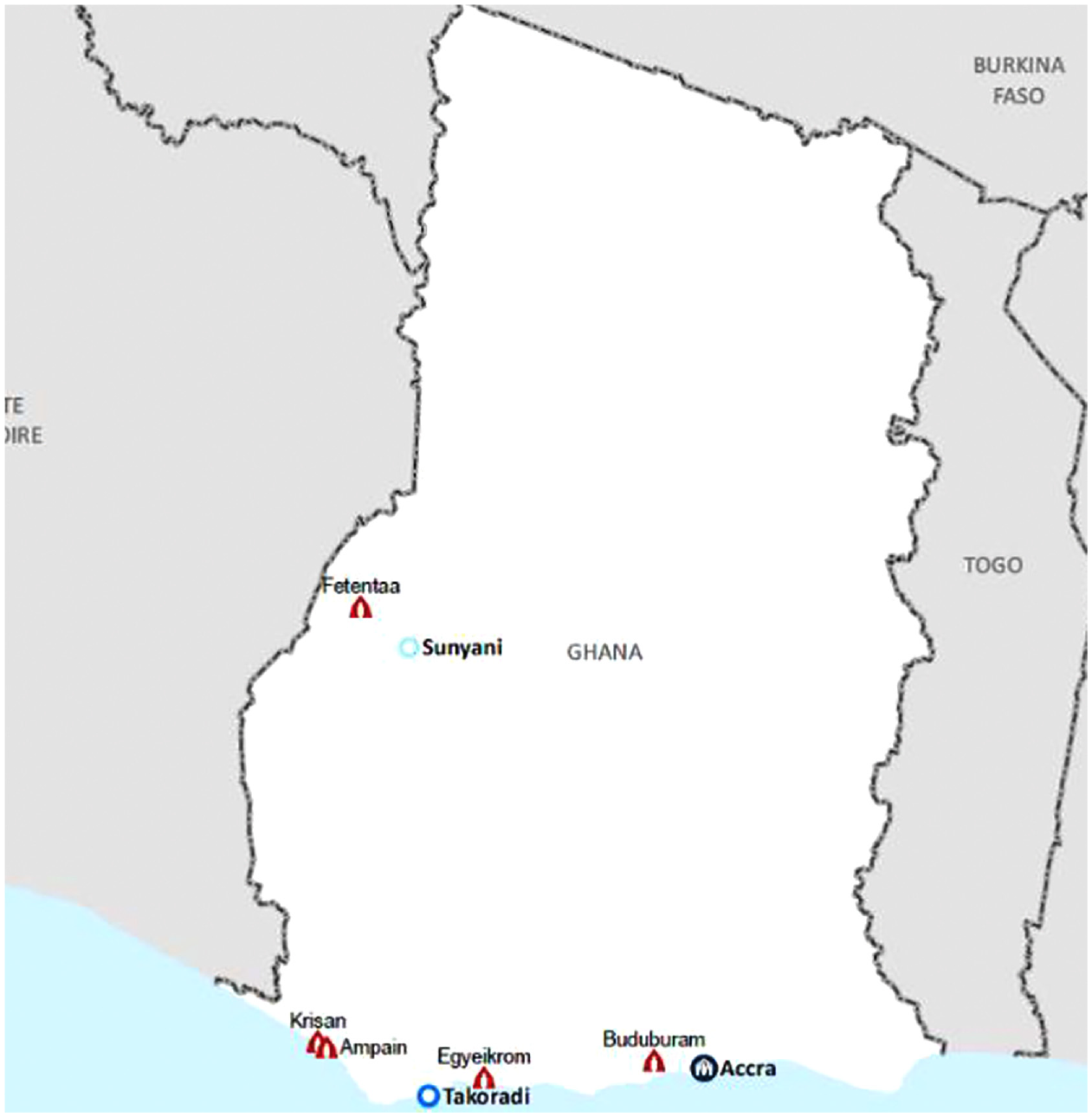
Ghana’s refugee camps.
The largest of these extant camps in Krisan, southwest of Accra, was established in 1996 after renewed violence in Liberia saw increasing numbers of people flee to Ghana. Although Krisan is a smaller camp than Buduburam, with less access to the capital for services and work opportunities, access to surrounding forest resources has contributed to a higher quality of life (Agblorti & Awusabo-Asare, 2011). However, this access to natural resources has come at the cost of conflicts with the local communities, who also rely on these resources for their livelihoods (Agblorti & Grant, 2021).
The failure of the UNHCR’s durable solutions to address protracted refugee situations has led to the refugee situation in Ghana becoming protracted. Many refugees in Ghana have been reluctant to repatriate for fear of reprisals, lack of livelihood opportunities and having observed their peers repatriate only to return to Ghana shortly after (Antwi-Boateng & Braimah, 2021). Others will stay in the camps awaiting settlement in a third country, such as the United States; however, this heavily depends on increasingly restrictive immigration policies in the Global North, and few are successful in this pursuit (Essuman-Johnson, 2011). In 2022, just 58,457 refugees were resettled worldwide, 21,915 to the United States, representing a mere 3.9% and 1.4% of 1.47 million refugees awaiting resettlement (UNHCR, 2023b). This rate has fallen from a recent high of 4.5% in 2019 (UN News, 2020) and indicates a stark future for those awaiting resettlement.
As a result, local integration has emerged as the only remaining durable solution, though met with reluctance on all sides. For Ghanaians, there are fears of the impact of large numbers of refugees on livelihood opportunities, as well as broader negative perceptions that have emerged due to the previous three decades of slowly deteriorating relationships with refugee communities (Porter et al., 2008). Meanwhile, refugees fear that they would receive limited support if they were to integrate, though it has been noted that around one-third of refugees ‘would accept local integration if it was paired with an acceptable integration package’, including access to land rights and the ability to cultivate land (Agblorti & Grant, 2019, p. 206). Rather than looking for aid handouts, many refugees seek the rights and services that will allow them to reach self-reliance as part of a local integration approach. Evidencing this, Addo (2016, p. 437) also found that refugees wanted to be afforded the right to own landed properties and education on modern, sustainable farming techniques.
Agblorti and Grant (2019) have identified three main barriers to local integration in Ghana, which offers insights into the underlying drivers of conflicts between refugees: how the land for refugee camps was acquired, the quality of interactions between refugees and hosts, and the response of humanitarian organisations to local needs. The same study found that over half of the conflicts between 2003 and 2015 were related to access and use of environmental resources (Agblorti & Grant, 2019). These findings highlight the centrality of land, resources and the environment to the conflicts in and around Ghana’s refugee camps, and, consequently, they could offer the key to peaceful relations and the successful integration of refugees into host communities.
As the emergency phase of Ghana’s refugee situation ended, the level of aid available for those living in refugee camps was reduced; however, this reduction was not coupled with integration efforts to address barriers to refugees’ engagement in economic activities outside the camp, reducing many ‘to bare subsistence’ (Omata, 2016, p. 10). Requirements to obtain work permits from camp authorities further limited opportunities to participate in the formal economy (Tanle, 2013). The lack of livelihood opportunities and support drove an increased reliance on the land and environmental resources in and around the camps, in line with the findings of Martin (2005) that pressures on environmental resources around refugee camps increase as the level and quality of aid decrease. This bare subsistence lifestyle places increased strain on natural resources, which host communities equally rely on. Interestingly, this dynamic seems to challenge Leach’s (1992) notion that high resource use among refugees is linked to the temporary nature of displacement. Instead, it suggests that those who stay the longest rely on the surrounding environment the most and become the heaviest users of the services it provides. It also indicates a need to identify ways refugees can generate sustainable livelihoods in a manner that does not undercut the opportunities of local communities.
Livelihood opportunities and the use of environmental resources have been central aspects of the subsequent conflicts that have emerged between refugees and hosts. In Krisan, these two aspects have converged through the local charcoal economy. Because charcoal production has a low barrier to entry, it has become a prominent strategy for livelihood generation amongst refugees in Ghana, a pattern observed across West Africa (van der Horst & Munro, 2015). The conflicts, documented in a study by Agblorti and Grant (2021), emerged after increased charcoal production led to the degradation of local forests. However, they noted that the conflict in the Krisan camp did not solely stem from environmental degradation; instead, it was largely related to concepts of legitimacy and ‘who benefits from what’ (Agblorti & Grant, 2021). Understanding this dynamic and the centrality of environmental resources to livelihood generation is important in understanding pathways towards sustainable conflict resolution.
Legitimacy is closely linked to the emergence of concerns around the lack of compensation for long-term land use and has led to conflict between host communities and refugees and camp management, including arguments suggesting that limited land availability makes co-existence impossible (Agblorti & Grant, 2019).
This is complicated by the previously discussed demands from the refugees for the right to own land (Addo, 2016). As conflicts have come to define interactions between the communities, refugees opted to remain close to the camps and avoid interaction altogether (Porter et al., 2008), causing poor exchange of cultural information. Contravention of these cultural norms by refugees unaware of local practices has caused conflict (Agblorti & Awusabo-Asare, 2011). Again, the boundaries created by the camp limit communication between local and refugee communities; thus, opportunities for cross-cultural exchange and education are few.
The potential for environmental peacebuilding
Experiences in Ghana illustrate how increasing periods spent in camp environments with inadequate support structures can lead to resource distribution and livelihood generation conflicts. Scarcity narratives present these conflicts as an inevitable product of increased population pressure on a resource base (Homer-Dixon, 2010). Through this lens, the only viable pathway for resolving these situations is repatriation to refugee home countries or settlement in a third country with a larger resource base. However, refugees are often unwilling or unable to pursue these pathways, meaning establishing peaceful relationships between refugees and hosts is critical. As has also been shown, these conflicts emerge largely due to the confluence of factors relating to the space of the refugee camp and the meanings and boundaries it perpetuates. This final section will continue to examine the conflicts around Ghana’s refugee camps; however, it will consider the role that environmental peacebuilding could play in mitigating these conflicts. It will pay particular attention to the concept of scale presented by Amster (2015) and Ide (2017) offers a valuable framework to examine potential positive impacts of environmental peacebuilding in Ghana’s refugee–host conflicts at the individual, community and biosphere levels. Of course, these are not the only scales operating in these spaces but are indicative of the broader multi-scalar nature of environmental peacebuilding and its potential impacts.
Analyses of refugee camps often centre their role as a mechanism of biopolitical control, indicating how the camp acts upon the bodies of refugees (Agamben, 1998; Wahab, 2022). As such, it makes sense to begin the analysis of scale in refugee–host conflict at the individual level. Already, it has been shown how the spatiality of the refugee camp defines the material realities of refugees. Ghana’s camp policies have led to many living in a subsistence manner, highly dependent on aid or the natural environment to meet their material needs. The Food and Agriculture Organization has found that supporting ‘the widespread production, preservation and consumption of high nutrient value foods’ is critical to strengthening resilience in food and income insecure situations (Okello, 2017). Given the high rates of food insecurity experienced by refugees in Ghana, agroecological projects have a strong potential to increase the food security of refugees. Community gardening projects are found to positively impact the consumption of nutrient-rich food (Carney et al., 2012). Holistic approaches to refugee camp development incorporating community and household gardening practices have profound psycho-social benefits for those participating in the programmes (Millican et al., 2019).
Beyond material consequences, the experience of displacement and the circumstances have profound psychosocial and outcomes. Ensuring that environments are created to mitigate the impacts of trauma and offer outlets to begin a healing process is vital to ensuring that trauma does not become deeply engrained within the individual. For trauma sufferers, gardening and cultivation can be important forms of occupational therapy (Baranowsky & Gentry, 2023). The alienating effects of refugee camps do not create environments conducive to healing these traumas and mental health issues. Instead, through participatory environmental peacebuilding approaches the benefits of an active relationship with nature are expected to foster healing from past traumas, a widely observed effect among people living with posttraumatic stress disorder (Poulsen et al., 2018). High rates of depressive and anxiety disorders, including posttraumatic stress disorder, have been documented among refugees in Ghana’s camps (Nyarko & Punamäki, 2021). Participants in a camp greening programme in Domiz Camp in Iraqi Kurdistan reported ‘increased energy’, ‘peace of mind’ and the simple satisfaction of seeing something green as being perceived benefits of the programmes (Perkins et al., 2017). Environmental engagement has been found to counter some of the adverse effects of involuntary imprisonment, such as ‘the psychological trauma of incarceration, boredom, depression, and loss of contact with the world outside’ (Helphand, 2006, p. 107). Although this should not be considered a replacement for other formal forms of psychological treatment, environmental peacebuilding can create spaces conducive to healing and a sense of groundedness often lacking in temporary camp environments.
Expanding outwards from the individual, the community level is arguably where environmental peacebuilding has the greatest impact. In most cases, it is at the level of the community that the refugee–host conflicts manifest and, therefore, it deserves the greatest attention when considering pathways to conflict resolution. Continuing with the benefits of increased food production can extend beyond the refugee community through trade between the two groups, especially where the refugee camp is within close proximity to the camp (d’Errico et al., 2022). Both pathways increase contact between the two communities and break the boundaries that the camp creates, fostering interdependence and laying the groundwork for a sustainable relationship. In Northern Uganda, moving from direct seed distributions to seed fairs in refugee camps increased refugee independence and self-reliance (Bradford et al., 2009). As a form of livelihood generation, this creates a sustainable pathway that allows the reduction of aid while not risking leaving communities unsupported and reliant on subsistence strategies, which inevitably places pressure on surrounding ecosystems.
These processes and the potential augmentation they may cause to local markets must not fundamentally threaten the existing economic systems of the host communities (Agblorti & Awusabo-Asare, 2011). This means that, where possible, capitalising on local capacities within the host communities and strengthen local livelihoods. This is underpinned by Lederach’s (1997) approach to peacebuilding of employing local socioeconomic and sociocultural resources to ensure the long-term sustainability of peace. Including environmental resources in this framework recognises the capacity of natural resources to inform peace which underpins environmental peacebuilding. The participation of communities capitalises on local knowledge of social, political, economic and environmental resources and creates the best possible conditions for the success of the intervention, as the capacities for sustaining it are not reliant on external sources of support. As such, any peacebuilding work in and around Ghana’s refugee camps would need to take place through extensive consultations with both communities. Local participation creates the best possible chances of success as the capacities for sustaining peace do not rely on external support sources. This means that when aid is reduced, neither refugees nor host communities are left behind, and integration in local markets presents greater opportunities to reduce reliance on natural resources, such as forests, in the absence of aid.
Working together on environmental projects allows communities to develop shared ecological visions to guide the pursuit of ecologically sound norms and practices. Although Agblorti and Grant (2021) claimed that livelihoods, not environmental degradation, are at the centre of conflicts in Ghana, the links between the environment and local livelihoods leave the two closely entwined. For communities where these ecosystems are critical to everyday life, their degradation can hurt perceptions of those designated as ‘outsiders’. As Berry (2008) and Jacobsen (1997) both show, refugees’ status as outsiders means they can often become the scapegoat in these cases. Environmental peacebuilding empowers a better understanding of these issues, and increased information exchange can help counter false narratives that feed the conflicts. Adopting peacebuilding approaches that seek to promote shared norms that reject degradation based on understanding its inherent threat to the livelihoods of both parties opens channels for connection between them. The resulting shared ecological vision should prioritise the environment’s needs, recognise the centrality of livelihoods and understand the potential for mutual benefit if norms are recognised and followed.
Where a conflict is not centred on an environmental issue, the environment can serve as a ‘neutral space interaction’ (Dresse et al., 2019), becoming a ‘contact sphere’, a space where ‘otherness’ can be negotiated (Alexander, 2019). Within this space, parties to a conflict can uncover shared values and identities conducive to peaceful relationships. For refugees in Ghana, who have increasingly retreated into the camp, creating spaces intentionally distinct from the sites of historical conflicts, such as inter-communal agricultural sites, opens such spaces. These spaces are most likely to yield positive results when they are non-competitive, informal, personal and equal (Jackman & Crane, 1986). Cultural exchange and learning occur within these spaces, which ‘builds social cohesion and relationships to be able to utilise the different perspectives, values and interests people bring to a sustainability challenge’ (Wals & van der Waal, 2014). Given the role of cultural norms in the conflicts in Ghana, such initiatives can be expected to increase contact points and exchange between the communities, fostering mutual understanding and respect.
Finally, the analysis of environmental peacebuilding should not overlook the impacts of actions on the environment itself (Ide, 2020). Ghana is already experiencing the consequences of climate change and environmental degradation as a driver of internal migration. Approximately one in five people born in Northern Ghana live in Southern Ghana, primarily driven by environmental factors (van der Geest, 2011). Northerners have moved from places with poor agroecological conditions to the south, where fertile soil is more widely available. Given that four refugee camps exist in Ghana’s south, ecosystems face the dual pressures of internal migration and refugee flows. Environmental peacebuilding has the potential to promote carbon sequestration, reduce emissions and reduce local ambient temperatures (Brown et al., 2012; Emery & Brown, 2016; Qiu et al., 2013). Additionally, these projects open spaces of learning that allow participants to understand climate change processes, develop an awareness of the importance of sustainability and renew awareness of human impacts on the environment (Verhagen, 2014). Ultimately, communities based on ecological engagement and sustainability are important alternative spaces for peace education based on prefigurative politics embracing regenerative cultures (Esteves, 2020).
Conclusion
In 2019, following a decade where forced displacement was at the forefront of international policy, Secretary General of the United Nations Antonio Guterres told a press conference: … the growth in forced displacement is outpacing the rate at which solutions are being found. Conflicts have become more complex and interlinked. Combined with the megatrends of climate change, population growth, rapid urbanisation, food insecurity and water scarcity, forced displacement, and humanitarian needs will likely continue their troubling rise. Our system of international protection is one of the defining successes of the past century. But it is clearly feeling the strain. (ReliefWeb, 2019).
The strain referred to by Guterres is not just a financial one: as conflicts become increasingly intractable leading to increasingly protracted refugee situations, host countries are facing enormous pressures to find ways to accommodate growing populations of refugees. Refugee camps established during emergency phases of a humanitarian response now exist long after the emergency response has ended and refugee settlements continue even after the formal closure of the camps, as in the case of Buduburam in Ghana. This has given rise to new challenges, particularly relating to the use of resources and integration of refugees into host communities.
This article set out to establish how environmental resources around refugee camps could be used as a pathway to peace rather than conflict. Establishing that certain conditions created by camp spaces lead to conflict challenges preconceived notions that resource scarcity is at the heart of conflicts between refugees and host communities. These conflicts are products of the modern refugee system. Promoting environmental peacebuilding in these contexts offers a collaborative approach to managing shared environmental challenges and creating neutral spaces of interaction where common shared identities can be formed. Through a comprehensive understanding of how conflicts between refugees and hosts emerge, encompassing social and environmental issues, environmental peacebuilding approaches that subvert the conflict-inducing effects of camp spaces can be identified. These approaches empower refugees to play active roles in host communities and lay the groundwork for a sustainable approach to local integration, both from a social and environmental standpoint.
Ghana exemplifies the necessity and the applicability of such an approach to resolving and preventing refugee–host conflict. The experience of conflict that has arisen during the current protracted refugee situations within the country highlights the need for alternative approaches to supporting displaced communities. Ensuring that communities are well equipped to manage potential conflicts constructively and that pathways to sustainable local integration are in place for refugee communities will prevent future conflicts while ensuring that environmental resources are sustainably used to the benefit of host and refugee communities.
With this said, challenges remain to be overcome, which should be the focus of future environmental peacebuilding research and practice. This article focused primarily on how environmental peacebuilding could be used to intervene in pre-existing conflicts; however, integrating environmental projects from the state of a humanitarian response could mitigate the need for such interventions later. These efforts must recognise the critical importance of incorporating social and environmental conflict analyses to understand the contexts they enter. Finally, this article highlights the value of applied peace studies. Through further studies seeking to understand barriers to peace in one setting and their implications for broader contexts, lessons learnt can be widely shared and used to inform future action.
Footnotes
Funding
The author received no financial support for the research, authorship and/or publication of this article.
