




Abstract
Bangladesh is customarily presented as a poster child for climate change and conflict given its dense population and susceptibility to climate variability. This vulnerability exacerbates existing challenges such as food insecurity and conflict potential. Crises like pandemics and conflicts are external drivers stressing already compromised domestic governance, such as violent politics, poor rule of law, and corruption, further compounding the challenges of land and water resource management and affecting food (in)security in Bangladesh. While we will argue that Bangladesh’s all-out (‘securitised’) efforts to achieve food security are largely successful and there is no evidence of climate conflict related to food, this does not obviate very real food security challenges in remote areas. However, these have not built up to the sense of frustration associated with food riots or community violence. Navigating the possible linkages between climate, food (in)security, and conflict requires debunking common myths and identifying unresolved research puzzles in Bangladesh’s context. These myths promote the oversimplification of complex issues and may lead to misinformed policies and actions. Future research needs to be focused on understanding how climate factors interact with local economic, political, and social dynamics, including governance mechanisms, religious and ethnic tensions, economic inequality, grievances, and political exclusion.
1. Introduction
Ravaged in the past by famines, notably in 1943 and 1974, the Republic of Bangladesh prides itself on having been food self-sufficient since 2007. Nevertheless, Bangladesh remains a sizeable importer of rice, wheat, milk, and edible oil. Faced with food supply constraints triggered by international developments such as the military standoff in Ukraine, there even were indications that the country could move towards possible famine in 2023. In this light, Bangladesh’s Prime Minister reiterated that the government wants to use every inch of land in Bangladesh for food production (The Daily Star, 2022). Apart from incidental, yet severe, crises such as Ukraine and the COVID-19 pandemic, there has been an increasing focus in recent years on the more structural disruptive potential of climate variability in affecting human well-being and food security. With some regularity, there have been predictions of political instability, mass migration, and violent conflict, both within Bangladesh and across state boundaries (Hossain, 2015; Macdonald, 2023). Notably, the India–Bangladesh border is an unstable area attributable to illicit migration and trans-border operations, underscored by a noteworthy ‘high degree of porosity’, as delineated in the Union Home Ministry’s annual report for 2021–2022 (Northeast Today, 2022).
The realism of projections linking climate variability, food production disruption, food scarcity, grievances, mass mobilisation and conflict, however, is debatable; they tend to rely on statistical model studies and rough estimations without sufficient empirical evidence, underestimating the complex interaction between climate variability and other social, economic and political factors which further complicates the understanding of the risks and mitigation strategies to address future climate impacts, food insecurity and conflict risks.
Unlike said model studies, we bring a different, more qualitative literature that leaves room for subnational differences. In the literature (especially non-governmental organisations [NGOs] and multilateral organisations), Bangladesh has been consistently portrayed as a ‘poster child’ of vulnerability – one of the most climate-vulnerable countries, with dire predictions of climate disaster, climate migration and climate conflict, combined with poor governance, inexorable political unrest and high population density (Environmental Justice Foundation, n.d.).
Bangladesh has captured the global imagination from its birth. The 1971 ‘concert for Bangladesh’, organised by musicians George Harrison and Ravi Shankar, was the first ever such mega-event to raise awareness and support for the refugees from the war of independence from Pakistan. It provoked an outpour of global solidarity, but unfortunately also painted Bangladesh as a helpless country from the start. The 1974 famine, triggered by flooding of the river Brahmaputra, was one of the worst of the 20th century. In the early 1970s, US Undersecretary of State Alexis Johnson famously called Bangladesh a basket case (sometimes referred to as a ‘bottomless basket’ and attributed to Henry Kissinger). Present-day literature on climate and conflict reinforces the international image of an unstable country that cannot help itself in the face of climate change. This image sadly persists, while Bangladesh, for all its flaws, can also be praised for its achievements in climate adaptation and steady economic development. This paper aims to explore not only visible and traceable connections and open manifestation of climate, security and conflict in the Bangladesh Delta, referred to as the climate–security–conflict (CSC) nexus but also underlying trends and patterns related to inequality and climate events, and risks. We aim to identify priority areas for future research through a wide-ranging qualitative literature review examining the relationship between climate variability, food (in)security and conflict in Bangladesh. To gather relevant information, various sources including Web of Science and Google Scholar were utilised for document retrieval and systematic analysis. The search process involved the utilisation of specific keywords such as climate change, variability, extreme events, food security, human security, climate conflict, food conflict, Bangladesh, climate migration and disaster. These search terms were carefully selected to ensure that the retrieved documents were highly relevant to the topics under investigation. A wide range of academic papers and grey literature were thoroughly examined and synthesised to provide a deeper understanding of the issues at hand.
This paper is structured as follows: it begins with conceptual debates surrounding the CSC nexus and climate and food securitisation and addresses definitional concerns. Subsequently, the attention turns towards examining the state of food security, considering its historical, current and projected scenarios, with a special emphasis on possible disruptive factors, including climate. Moving forward, we analyse the interactions between climate factors and governance issues, with particular attention to violent politics, dispossession, degradation of land and natural resources, food insecurity and corruption. Through this examination, the aim is to debunk some prevalent myths and start unravelling complex puzzles. Finally, the conclusion outlines a research agenda aimed at identifying further investigations into the interconnections between climate, security and conflict in and beyond Bangladesh.
2. Conceptual framework: the CSC nexus
In most literature, concepts like security, conflict and climate are rather loosely defined. Later, these will be defined in this paper. Security (from the Latin s(in)e-cura: without worries) is a mixture of certainty and safety: a stable, relatively predictable environment in which one can pursue one’s goals without disruption or harm or fear thereof (Fischer & Green, 2004). Labelling a phenomenon a security issue has a special ‘social magic’ in that ‘securitisation’ can lift an issue to an absolute priority legitimising extraordinary measures (‘securitisation’), such as blank cheques for, for example, food estate projects, expanded mandates for security intelligence agencies, violent interventions, spying, surveillance and detention without charge when something has been declared a security issue (cf. Buzan et al., 1998). To securitise is to structure an issue such that a referent is existentially threatened and worth preserving, presumably at any cost (ibid.). The security referents can be individuals but also the globe, as in climate securitisation. After Sen (1981), Pulliat (2015: 4) defines food securitisation as ‘a range of practices and strategies that people adopt to securitize or enhance one’s food situation, considering one’s capabilities and resources’, that is, to reduce food vulnerability. While food security can be measured using numerical criteria (e.g. the percentage of people with access to sufficient healthy food supplies), securitisation is essentially a subjective, persuasive act of issue framing (Pulliat, 2015). Originally, securitisation was tied to the state – security language was used to ‘defend national security through the creation of policy’ (Griver & Fischhendler, 2021: 1305). Over time, food security has seen different frames, and as a result, the actors involved and indicators of success: food self-sufficiency, food availability, access to food and nutritional quality. A related key concept here is food resilience – the ability to cope with, withstand and recover from food shocks (Pulliat, 2015). Finally, Griver and Fischhendler (2021, p. 1303) note that food securitisation should not be seen in isolation but is a relational issue – it ‘refers to the process by which food supplies are linked to larger security issues or broader notions of human security’.
The food security imperative in Bangladesh is a good example: ever since its independence, the country’s central government has gone all out to ensure food security, with, as we shall show, at times deleterious side effects. Food security is generally defined as secure access at all times to sufficient food for a healthy life (FAO, 2006). But as we shall see, delivering security at the macro-level does not mean food security is enjoyed at the meso- or micro-level. This study addresses climate and (food) security as potential drivers for conflict. The conflict has commonly been understood as arising from opposing interests or activities involving scarce resources, goal divergence and frustration. In this paper, the focus will be on violent conflict, where physical force is exerted to lend force to competing claims. Conflict does not just ‘happen’, even less escalates automatically; people decide along the way whether or not they are in conflict, the issues at stake and their feelings about it. Social conflict is both inevitable and potentially highly constructive because it can help solve societal problems. This means that conflict is therefore not only a matter of material scarcity but also of perceptions and emotions, especially frustration. So, issues of social fragility where there is political exclusion, economic inequality and religious extremism should be addressed because they can be underlying causes of violent conflict and exacerbate the consequences of climate change and variability.
Neo-Malthusian theories see conflict as a consequence of a fast-rising population and a dwindling resource base. Figure 1 shows a popular six-stage generic neo-Malthusian environmental security model, based on earlier work by Homer-Dixon (1999). In this model, the population is exposed to environmental shocks or changes. This then sets the stage for the immiseration of that population who, by dint of being in a developing country, is already in an overpopulated, stratified country with agriculture under severe strain, and on top of this, is governed by a weak government. A report by the CNA Corporation, a Virginia non-profit, surmises that ‘struggles that appear to be tribal, sectarian, or nationalist in nature are often triggered by reduced water supplies or reductions in agricultural productivity’ (Daoudy, 2021). Others consider the failure of local and national institutions and especially state failure as the key variable enabling conflict. Climate effects can be softened or aggravated by government policies.
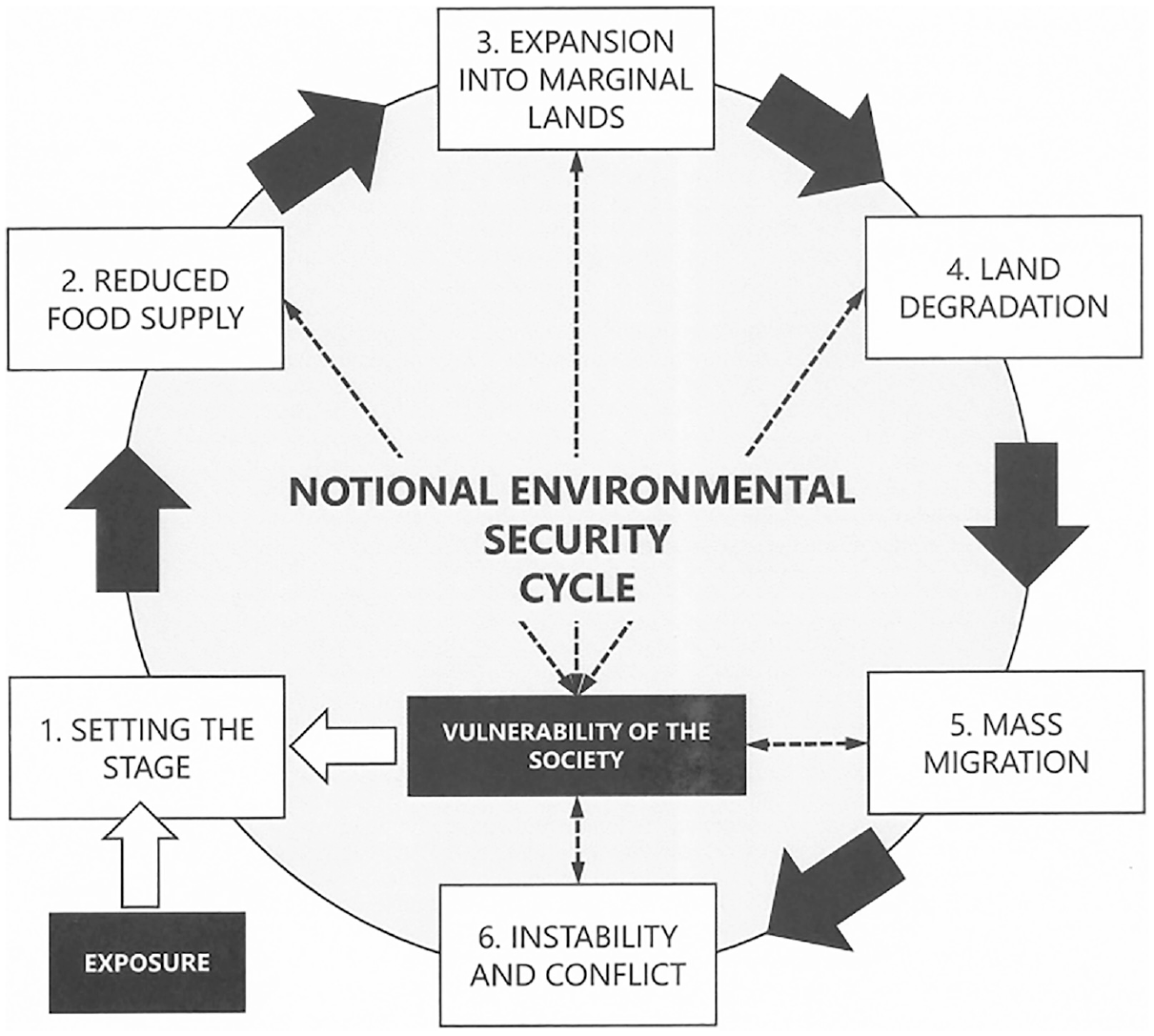
A generic environmental security model.
Global climate change and variability have undergone a process of securitisation. While in the 1990s, climate was not considered a direct threat to environmental security, in the past 15 years or so climate has entered the domain of ‘high politics’, a survival issue; a vital threat to international stability and state security by multilateral bodies such as the Security Council and governments (McDonald, 2012). Others have focused on climate as a threat to human security at individual, household or community levels. After a report by US military generals, climate variability is now commonly referred to as a ‘threat multiplier’ (The CNA Corporation, 2007). More recently, European Commissioner Timmermans has warned of wars over food and water if radical reduction of CO2 emissions is not undertaken (Gilchrist, 2023).
However, such linear connections, while often repeated and often used in political discourse to mobilise support for specific policies, have simply not been established in empirical research findings (Raleigh et al., 2010; Tertrais, 2011). Interstate water war predictions driven by scarcity are ill-founded (Katz, 2011; Wolf, 1999), while violent domestic conflicts in Darfur (Sudan) and Syria have been termed climate conflicts, this is hotly disputed (Selby et al., 2017). Short-term rainfall shocks appear to be associated with intensified competition for water, but a significant shift towards conflict due to climate variability is not observed (Hendrix & Glaser, 2007).
In reverse, Oels (2012) has noted the overall ‘climatisation’ of security issues: a tendency to understand all security issues as climate issues. The risk is that this leads to a (possibly deliberate) neglect of the underlying causes of these security issues. Specifically for Bangladesh, a successful reductive narrative claims the country will drown due to rising sea levels caused by global warming, with wretched and desperate inhabitants watching their land and livelihoods wash away, producing millions of ‘climate refugees’, in a country from its inception tainted by the stigma of ‘powerlessness, inferiority, dependency and failure’ (Paprocki & Cons, 2014). While failure to secure livelihoods in coastal areas is expected to drive millions of vulnerable people to the cities located further upland (Shams & Shohel, 2016), the assumption that environmental stress directly causes violence in a context of general instability is far less well-founded (Galgano, 2019; Saha, 2012).
In this narrative, ‘climate migration’ is linearly connected with urban violence in Bangladesh, with cyclones, storm surges and riverbank erosion believed to be driving people to move to migrate to the Dhaka megacity, where they end up in the dire conditions of mega slums, and would inevitably fight over resources, income and water (Saha, 2012). Briefly, the predictive chain of this narrative runs as follows: climate disasters => climate migration => climate conflict (Fischer & Green, 2004).
The tacit assumption in these mechanistic neo-Malthusian narratives is that human ingenuity to mitigate the consequences of climate variability will not make the difference and that climate is the main driving force of instability and conflict, reinforced by weak governance and instability. Such reasoning can lead to an over-emphasis on climate as a driver for insecurity, backgrounding other daily sources of insecurity for local people such as resource distribution issues. unsustainable land use, poor governance, exclusion and historic frictions. Below, a more nuanced approach to understanding violent conflict potential is proposed by zooming in on a range of actual and potential stressors in Bangladesh including climate factors.
3. Food (in)security in Bangladesh: Past, present and future
The devastating famines in 1943 and 1974 have left a lasting impact on the population and policymakers. The 1974 famine, triggered by a severe drought in 1973 and a cyclone in 1974, resulted in an officially reported death toll of 30,000. Since then, achieving food self-sufficiency has been the primary goal. Although subsequent events, like floods causing crop losses in 1979 and 1984, reached similar levels of devastation, Bangladesh has managed to avoid widespread famines thanks to significant investments in high-yield varieties, mechanisation, agricultural extension and advanced agricultural (‘Green Revolution’) practices, including the use of improved seeds, fertilisers, fungicides and irrigation technologies (Roy et al., 2019). The Government of Bangladesh is credited with taking on board the insights on entitlements from economics Nobel Laureate Amartya Sen, especially in dealing with the 1998 ‘century floods’, which reduced rice output by 10% (Del Ninno et al., 2001) considerably reducing disaster impact. Sen’s approach shifted the focus from physical scarcity to the socioeconomic aspects of access, known as entitlements. It also influenced Bangladesh’s food policy in a meaningful way.
As an antidote to the dire predictions often sketched for Bangladesh as a poster child of climate disaster, it merits recalling in this context that at the macro-level Bangladesh is a remarkable story of poverty reduction and development. This progress is evident in declining maternal mortality and fertility rates, improved gender parity in school enrolment and a strong focus on poverty reduction. Despite obvious structural flaws discussed later and periods of instability, we cannot say that Bangladesh has a weak government, as surmised in Homer-Dixon’s model. Bangladesh has exhibited a strong track record of growth and development driven by a robust youthful workforce advantage, coupled with strong ready-made garment exports, resilient remittance inflows and stable macro-economic conditions, which has contributed to rapid economic growth over the past two decades (The World Bank, 2023a). Since its birth as one of the poorest nations in 1971, Bangladesh has risen to lower-middle-income status in 2015 and is targeted to graduate from the UN’s Least Developed Countries list by 2026.
Since the 1970s, micro-credit has been championed as a solution for poverty and food insecurity – a small loan can make a vast difference to a poor family. This has long been presented internationally as a success story and a model. Its champion, Md. Yunus and Bangladesh’s Grameen Bank playing a prominent role in its implementation jointly were awarded the Nobel Peace Prize in 2006.
Successes at the macro-level have not necessarily trickled down to the micro-level: despite the positive accomplishments of successive governments, they have not translated into meaningful gains for everyone. Income inequality in Bangladesh has taken on a worrisome trajectory, evident in the Gini coefficient of income progression from 0.458 in 2010 to 0.482 in 2016, and a subsequent increase to 0.499 in 2022 (Bangladesh Bureau of Statistics (BBS), 2023). However, this situation was exacerbated during the COVID-19 restrictions, which placed both rural and urban households in extremely challenging conditions where they needed to cope in their ways with the combination of increased food prices and a lack of income-earning options. To control the spread of the Coronavirus, the government of Bangladesh announced its lockdown measure without any compensation measure to enable food access, and to deal with increased food prices and shortage of food (Dev & Kabir, 2020). The COVID-19 pandemic has increased levels of vulnerability and food insecurity in cities through disruptions to food supply chains, increased food prices and loss of income (WFP, 2021). Poor rural households went through moderate to severe food insecurity as they had problems related to accessing enough food. Food market and shop closures were among the main reasons (Ahmed et al., 2021). Even though Bangladesh proved relatively resilient to the COVID-19 pandemic and was trying to recover, the impact of record-high inflation due to the Ukraine war hit the food market. Although remote from Bangladesh, this war has significantly put the country’s food system at risk because of export sanctions on Russia, and more expensive food imports in dollar terms, which impacted the volume of total imports. In September 2023, a reported 9 million Bangladeshis were exposed to acute food insecurity, one major current stress that is often a destabilising factor is skyrocketing inflation. By the close of the fiscal year in 2023, Bangladesh experienced a record-breaking inflation rate, leading to elevated costs of essential goods and services. This inflationary pressure has disproportionately affected the ultra-poor, exacerbating the ongoing economic crisis. Regrettably, the government of Bangladesh has not yet taken steps to enhance the allocation of its social safety net programs for the fiscal year 2023–2024. These programmes aim to aid marginalised populations, encompassing widows, people with disabilities, the visually impaired, orphans and the elderly, by providing different types of assistance, such as cash and in-kind transfers, micro-credit programs and conditional cash transfers. However, the extent to which these programs reach those in need remains limited, and the accessibility of these benefits for the most vulnerable populations remains uncertain. Furthermore, the government’s efforts to distribute food assistance have been plagued by corruption issues, making the task of ensuring access to these vital benefits a formidable challenge in the quest for food security.
To our knowledge, however, Bangladesh has no recorded instances of food riots, and even after the food price crises of 2007 and 2022, Bangladesh has not seen the widespread instability witnessed in other parts of the world. Given the current inflation and fears that it will destabilise Bangladesh, we may take a cue from these earlier price spikes. It is worth looking into the 2007 global price hikes as a precedent. In response to the global food price spike, two waves of price spikes were felt in Bangladesh: 2007–2008 and 2010–2011. Did they lead to food riots? (McKie & Stewart, 2008).
In 2007, Bangladesh households found themselves in a temporary subsistence crisis, expressed in widespread ‘hidden hunger’. At that time, close to 40% of households were already below the poverty line and the GINI coefficient had strongly increased between 2000 and 2010 (Jahan, 2012). The Public Food Distribution System was woefully understocked, instigated by World Bank frugality advice. In 2006, Dhaka saw an impending food crisis after urban floods. The caretaker government made the situation worse by banning roadside stalls and hawking. This informal networked economy connecting the suburbs with the centre is part and parcel of the urban survival system in Dhaka, and it prevailed, preventing food crises (see Keck & Etzold, 2013).
Protests in 2007 were led by garment workers, and subsequent rickshaw puller riots were about road closures, not prices. Hossain and Scott Villiers (2017) claim that Bangladesh has achieved a position such that wage protests do not target food. Thus, when workers took to the street to demand better pay, it was not a food riot per se, but about purchasing power, exposing underlying economic struggles (Hossain & Jahan, 2014). Likewise, a mutiny within the Bangladesh Rifles (BDR) in 2009 again was not so much driven by concerns over soaring food prices, but rather by grievances related to low pay, denial of promised benefits such as UN peacekeeping opportunities, disparities in ration entitlement compared to the army and resentment towards army control over the BDR (Zahid, 2023). Hossain and Scott Villiers (2017) conclude that Bangladesh by that time was structurally food resilient enough to prevent people from taking the streets on a food platform, and there is no immediate occasion to presume it will be otherwise this time.
That is not to say, however, that violence over food is unthinkable. In the below, we will sketch how Bangladesh’s agricultural development model and political culture have done considerable damage that could lead to an accumulation of grievances in the face of increasing climate extremes. We will discuss the connection between climate, food (in)security and violence in this light.
4. Climate, food (in)security and conflict
4.1 Climatic issues
As shown above, addressing food security in densely populated Bangladesh presents a critical challenge, the more so in the face of persistent climate variability that impedes efforts to expand food production on decreasing arable land base. The north-western region frequently experiences droughts, while approximately two-thirds of Bangladesh’s land area are susceptible to river and rainwater flooding. Additionally, its coastlines are at risk of storm surges, salinisation and tidal flooding (Goosen et al., 2018). The compound impacts of rising temperatures, increased precipitation, CO2 fertilisation, occasional seasonal droughts, flooding and the loss of cultivable coastal land due to saltwater intrusion are projected to lead to an annual decrease in rice production by 3.9% (The World Bank, 2011).
Coastal agriculture in Bangladesh is exceptionally susceptible to climate variability due to its heavy reliance on natural resources (Arfanuzzaman et al., 2016). With rising sea levels and ongoing climate fluctuations, the likelihood of destructive coastal-originated floods is expected to rise, causing erosion of agricultural territories. Prolonged tidal flooding and saltwater intrusion have inflicted substantial harm on the livelihoods and incomes of vulnerable households engaged in marginal farming and agricultural day labour. The rising sea levels have exacerbated soil salinisation, resulting in diminished crop yields and the transformation of agricultural land into shrimp farming as a last resort.
But climate alone is not the only factor responsible for the loss of land or income in Bangladesh’s agriculture. Even without worrying about climate trends, ensuring food security faces considerable difficulties, especially in the coastal areas, due to systemic change. While there is a tendency in much of the literature to attribute Bangladeshi’s woes to climate, resource governance may be as much to blame (Shewly et al., 2023). The section below highlights some peculiarities of how Bangladesh’s development is governed.
4.2 Governance issues
Bangladesh is characterised as an economic powerhouse with a coherent development vision despite widespread unrest and violence over prolonged periods. While managed purposefully, the country has been beset by poor governance throughout its existence, almost irrespective of who was in charge. There are many problematic aspects to the rule of law, accountability and access of the poor to justice and economic opportunities. The next sections discuss this governance context, impacting land and water resource management and development, which, in turn, impacts food (in)security in Bangladesh.
4.2.1 Violent politics
Politics in Bangladesh is increasingly authoritarian and repressive, and the rule of law and the implementation of laws are weak, although the Supreme Court and the military are respected. Bangladesh has a violent political culture at all levels, peaking around elections (Hoque, 2014), as was also manifested by the last elections. The rivalry between main political parties has dominated Bangladeshi politics since 1991 when Bangladesh returned to democracy. While successive governments have been successfully embarking on an ambitious economic development programme, political conflict between political blocs rooted in the war of Independence in Bangladesh has led to a political culture of obstruction of political antagonists through violence and general strikes (hartals) and resorting to corruption and patronage to hold on to power no matter who is in charge, resulting in a dysfunctional democratic system. Each Jatiya Sangsad (Parliament) election has been followed by allegations of rigging, coercion and other forms of electoral malpractices by the party losing the polls. Instead of accepting the election results, the defeated party will indulge in street protests, boycott parliamentary sessions and organise drawn-out (hartal) strikes (Mahmud & Mahmud, 2008).
This political instability goes at the expense of ordinary people because their movements are restricted, property endangered and progress curbed (Hasan & Kamruzzaman, 2019). Urban services are a hybrid of the formal and informal (Cawood et al., 2022), strongly dependent on political patronage, and violence and corruption are rife. Social, ethnic and religious conflicts simmer below the surface and may be exploited for political gain.
Yet, the bigger issues are the role of religion in political life and who was right and wrong in the Bangladesh War of Independence. Whichever government comes to power privileges certain religious groups over others to counter their political opposition. This process has enabled the gradual strengthening of religiously motivated extremist groups, who have become more organised and better positioned to bargain with the government and other political and non-political actors. As a result, both home-grown and transnational violent extremist groups have become increasingly assertive in their efforts to influence politics and the public sphere. Targeted extremist attacks took place across the country from 2013, creating an atmosphere of fear and apprehension. It has included the killing of atheist bloggers, religious minorities, LGBTQ activists, social workers and foreign nationals (Khan, 2017). Violence against labour and social activists, as well as gender-based violence, is widespread.
Several ethnic and cultural minorities in the Chittagong Hill Tracts are facing widespread discrimination, violence and abuse. After 20 years of intermittent violent uprisings (1976–1997), they achieved a poorly implemented semi-autonomous status, but instability and human rights violations remain. This, however, is portrayed as a law-and-order problem rather than a political problem (Jamil & Panday, 2008; Nepram, 2003).
Other factors have created further vulnerabilities that are adding to the spread of violent extremism and extremist ideologies. Bangladesh continues to struggle with the ongoing humanitarian crisis caused by the displacement of millions of Rohingya refugees, who fled oppression in Myanmar in 2017. This large-scale influx was neither well received locally nor well facilitated by the government. Local resentment and hostility are fuelled by a perception that the presence of the Rohingya is increasing local poverty by forcing down wage rates. Local concerns also focus on social differences and fears of radicalisation within camp communities, given the Rohingyas’ more conservative approach to Islam. The pressures of overcrowding, limited privacy, the lack of education facilities and few outlets for engaging with young people create a potentially volatile environment and increase the risks of radicalisation.
4.2.2 Dispossession and corruption
Much of Bangladesh’s agricultural development policies have been driven by the trauma of past food crises (the famines of 1943 and 1974) concomitant with destructive floods and cyclones. The development drive coming from a food security imperative has been highly successful in terms of reducing the death toll from such disasters but also exposed Bangladesh to major social and environmental (water-related) risks, increased by accelerating climate variability. If pursued in the same vein as before, climate adaptation measures may reinforce rather than reduce pressures on human security, including food security. The subsequent sections will belabour this point.
Large- and small-scale interventions, often paid for by international donors, have dramatically changed Bangladesh’s land and water management and livelihoods, impinging on Bangladesh’s food security. It has not always been well understood at the international donor level that fishermen and farmers in Bangladesh deeply depend on flood water and sediment, respectively, carried by the rivers flowing into Bangladesh for irrigation and nutrients. After extreme flooding in 1987 and 1988 the Flood Action Plan (FAP) was proposed in 1989. French President Mitterrand proposed infrastructure to ‘save Bangladesh from flooding forever’ and proposed to fully dike up the main rivers, which would cut farmers off from the irrigation they depend on. In practice, those FAP projects that were eventually implemented more sensibly experimented with controlled flooding/FCD(I) techniques such as compartmentalisation of polders to make the most of the natural inflow of irrigation water and nutrients. Likewise, donors have rarely taken full account of the discrepancy between the provisions of the law and the reality of its implementation, for example when making provisions for stakeholders displaced by a project intervention – compensation is unlikely to reach those most in need of it.
The development model focusing on large-scale agriculture investments encouraged the enclosure of beels (depressions), reducing the area available to fishermen. It also created openings for the ‘grabbing’ of khas (government) land by the enclosure of common-pool resources as communally used land was embanked under flood protection schemes. The Flood Action Plan of the 1990s is a good example. After two consecutive ‘century floods’ (foods statistically calculated to occur only once every 100 years), an internationally backed programme of 26 interventions was hatched to protect Bangladesh from floods through a mix of structural and non-structural flood management measures. In addition to protecting communities from physical flood threats, the project also sought to pursue food security goals. The relative protection enabled farmers in central Bangladesh to adopt Green Revolution techniques such as High-Yielding rice varieties. Concentrating on improving monsoon rice yield however mainly benefited landowners at the expense of sharecroppers and the landless fishers – at the time, three out of every four Bangladeshis (predominantly women) were involved in (part time) fishing (Faaland, 1995) – who did not receive adequate compensation and saw common-pool resources privatised, widening socio-economic disparities (Hanchett & Mahbuba, 1992). Despite the intended participatory mechanism, those with money to pay the operator or to pay musclemen (mastans) to intimidate potential detractors are effectively in control of the (intended) participatory decision-making bodies. Physical insecurity due to police beatings and intimidation from hired goons are depressingly regular (Ali et al., 1998; Warner, 2008).
The infrastructure introduced in flood management projects functioned as an enclosure facilitating the privatisation of the common pool resources and dispossessing the landless, who depended on these resources for multiple benefits for their livelihoods such as agricultural land for subsistence farming. irrigation water, grazing areas for livestock, fishing grounds for food and livelihoods, etc. Hydroclimatic disasters were windows of opportunity to privatise beels and, on the coast, instate shrimp farms (Akber et al., 2022).
The introduction of commercial aquaculture in the 1970s in the coastal zone benefited landowners but not the landless, who often are Hindu fisherfolk (Feldman, 2016), depending on common-pool land. This was facilitated by institutional change at the national level: In the late 1970s, shrimp farming was recognised as an industry, leading to legal changes that allowed external actors – often cartels of businessmen and absentee landlords, that is, businessmen with close ties to political leadership, to take control of land through land grabbing (Feldman & Geisler, 2012). As a result, the shrimp farming sector has strongly and in some cases violently taken hold of the coastal region (Ahmed, 2018). As shrimp farming is far less labour-intensive than rice farming, it led to unemployment and promoted coastal de-agrarianisation. The limited availability of livelihood opportunities remains a challenge for vulnerable households, especially in those areas where opportunities for agricultural diversification are already very limited. This also limits access to income-generating activities, with serious implications for food security and the nutritional status of the vulnerable population.
Over time, rural populations have moved away from primarily depending on self-produced foods to a growing reliance on market-purchased products (FAO et al., 2023). This shift has compelled them to earmark a substantial portion of their income for acquiring food items. The ongoing challenge of diminishing purchasing power among rural residents has firmly ensnared them in poverty for generations, resulting in lives marked by food insecurity. The food security situation is particularly dire for rural households residing in the north-western, central-southwestern and coastal areas of Bangladesh (Tariqujjaman et al., 2023).
Recent research conducted in erosion-prone areas has revealed the loss of homes and farmland, which has left residents with limited employment opportunities and minimal purchasing power (Billah et al., 2023). In 2022 and 2023, a field study conducted on Hatiya Island by the first author revealed that vulnerable individuals with livelihood and food insecurities held negative attitudes towards local government authorities due to their lack of access to these initiatives or perceived deliberate deprivation of their rights (Suza et al. fc).
Such evidence raises serious questions about the food security of the most vulnerable rural households and their access to government benefits. In addition, the future of food and nutrition security in Bangladesh is contingent not only on factors such as domestic food production, food exports, political stability, and government and private stockpiling but also on its ability to navigate unforeseen challenges from climate variability and unexpected crises like pandemics and conflicts (Haque, 2022). Looking ahead, it is paramount to prioritise food security for all, with a special focus on rural households.
Violent/forced displacement, often to make space for development projects, brings mass marginalisation and immiseration, forcing people into loans and clientelist relations verging on servitude (Feldman, 2016; Wood, 1999). Said micro-finance schemes may even have exacerbated the problem of indebtedness for some. It has become common for households to accumulate multiple micro-credits, including loans taken out to purchase food during lean seasons. This cumulative level of indebtedness has become overwhelming and debilitating for many individuals and families (Cons & Paprocki, 2008).
Exclusion from landholdings and ‘othering’ of minorities (including Hindus, Buddhists and indigenous groups) bring frustrations (Feldman, 2016; Hasan, 2014). Those who do migrate to the megacities tend to live in precarious jobs open to abuse and political and financial dependency on patrons (political figures and NGOs) for the most basic services including nutritious food. A sense of inexorable marginalisation can make extremism more attractive.
More recent interventions, under climate and green development rationales, follow the same pattern of dispossession. As Sovacool (2018) succinctly lists, the bulk of resource management projects and interventions have led to enclosure, exclusion, encroachment and entrenchment in their design and implementation. While on paper, compensation for lost land and revenue due to development interventions or by natural factors such as coastal and river erosion is generous, poor people encounter major obstacles trying to obtain it as they encounter enormous institutional barriers when trying to improve their existence. Proving title to a piece of land may take multiple steps, and every stamp needed is another occasion to extract ‘tea money’ (small bribes) from the applicants so there is usually no net gain for most community people (Stålgren, 2006).
An example is the ongoing River Stabilisation Project which aims to narrow the Brahmaputra through embankments from a (monsoon) width of 12 km to 6–8 km, reclaiming land through reed fixation of the sediment (‘building with nature’) and developing agro-industrial projects on land likely to be already claimed by influential figures. As a result, an estimated 3 million char dwellers will need to move with very few guarantees (Netherlands Commission for Environmental Assessment, 2020). The impact of this project on the future incidence of floods is not known (Institutional Strengthening and Project Management Consultant (ISPMC), 2016). Although adaptation plans have at times led to the rediscovery of local knowledge such as a traditional ‘controlled flooding’ approach to trap sediment while draining excess water out in the Southwest (Tidal River Management) problems of compensation and dispossession keep besetting such interventions.
Recent climate adaptation policies in the water sector have shown remarkable path dependency investing mainly in hard infrastructure: large embankment raising and river training projects with far-reaching environmental and social impacts. Climate change concerns have only intensified and legitimised national and coastal adaptation policies based on hard engineering coupled with ‘green growth’. Such megaprojects inevitably cause mass displacement, and while excellent on paper, compensation mechanisms are so elaborate and rife with corruption that their effectiveness is very limited (e.g. Al Atahar, 2014; Mahmud et al., 2020).
5. Discussion: Myths and puzzles
For the people of Bangladesh, extreme climate events are no longer shocks, but persistent and daily phenomena exacerbating existing social stress and insecurity and pushing the lives of vulnerable and marginal people to the limit. Perhaps the most worrying aspect of all this is that households and livelihoods are stretched to the limit by this unremitting pressure. It gradually undermines the sources of their existence and the social and psychological resilience of the individuals, households and communities involved.
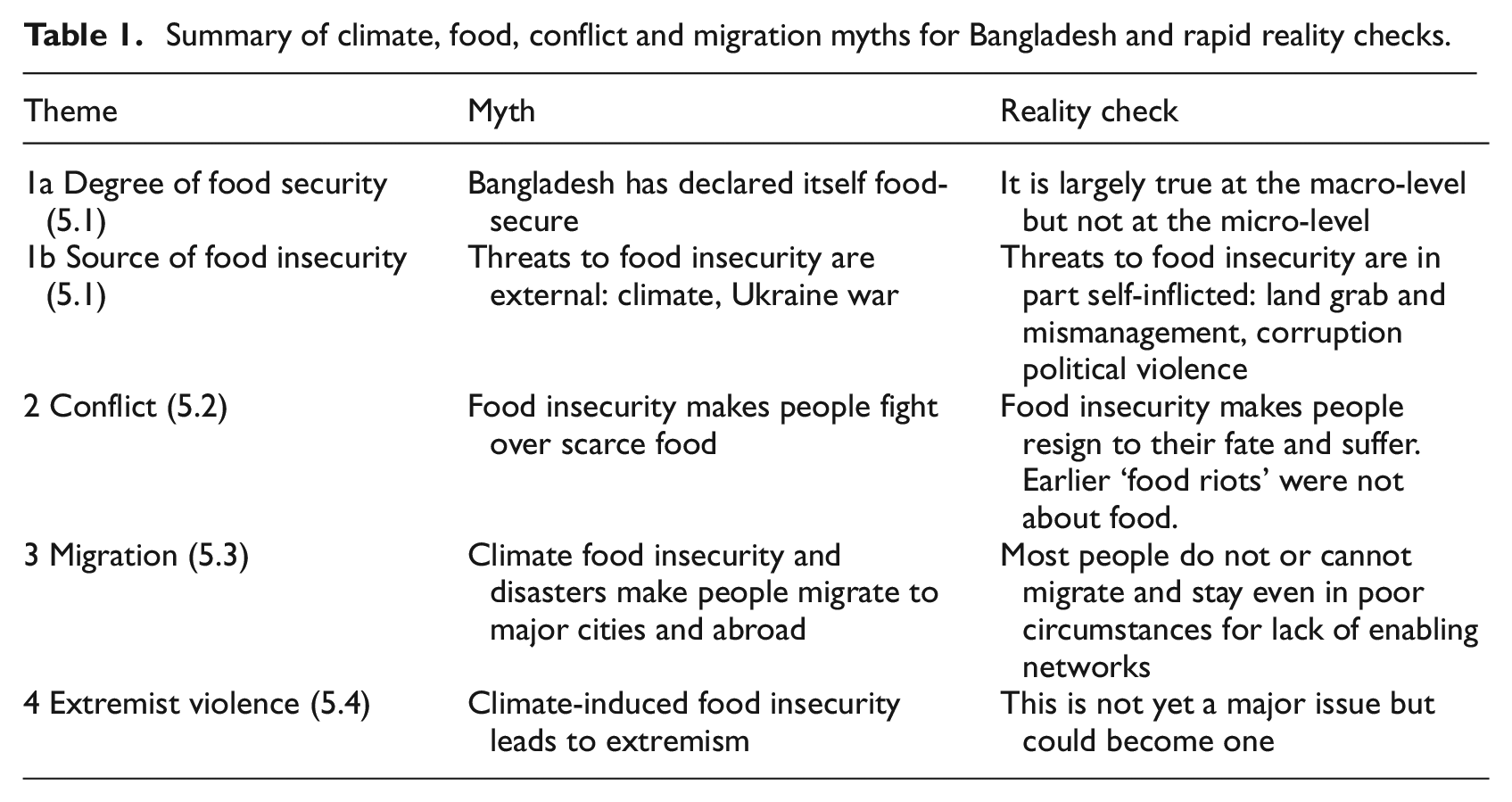
To start a long overdue conversation on what to focus on in an uncertain climate future, the focus is placed on identifying four broad myths and puzzles on food security, conflict, migration and extremism in the Bangladesh context, as summarized in Table 1.
Myth 1a: Bangladesh is food-secure.
Myth 1b: Climate is linearly undermining food security in Bangladesh.
Summary of climate, food, conflict and migration myths for Bangladesh and rapid reality checks.
Bangladesh has officially been food self-sufficient since 2007 and targeted the year 2021 to achieve ‘universal food security’. This target has proved elusive: many Bangladeshis go without sufficient, or any, food for some periods of the year (Mamun et al., 2022). The June 2022 IPC (Integrated Food Security Phase Classification) indicates that 21% of the total population of Bangladesh faces moderate to chronic food insecurity (IPC, 2022). Expansion of the food distribution program by the government is one of the measures to deal with income losses, unemployment, and price hikes and to ensure food security. But considering political favouritism and corruption, there is reason to doubt that people in need are the core target population and are reached by food distribution (Chowdhury et al., 2021).
While Bangladesh’s food challenges tend to be attributed to climate change, millions of natural resource-dependent people live hand to mouth due to climatic and non-climatic reasons. While it can be argued that the impacts of the COVID-19 pandemic and the Ukraine war have reinforced food security challenges, dispossession (land grab), mismanagement, corruption and political violence play a major role in explaining why food security is not for everyone, not at the micro-level. Despite the widespread seasonal human insecurity observed, there is a notable absence of evidence of communal or urban violence (food riots) over food insecurity.
A remaining research puzzle, then, is the high, though decreasing stunting rates of young children (under 5 years). In rural areas, the rates are still close to 40%, associated with underweight mothers (body mass index < 18.5) (Islam et al., 2023). This indicates that there is a large group of people who have problems surviving and experience food insecurity under extreme climate and socioeconomic stress. To what extent these tendencies are related to the fall-out of agricultural development policies (see Section 4.2.2) and to what extent these mothers and children belong to minorities is an open question. There is evidence of regional disparities within Bangladesh (Hossain et al., 2021), but to what extent this is related to specific population groups and religions is not clear.
Myth 2: Severe extreme climate events are forcing people to migrate.
As observed, the consequences of sea-level rise include increases in coastal flooding that can damage infrastructure and crops to the permanent displacement of coastal communities. The declining financial and societal conditions do push people to leave rural regions subject to climate variability for urban areas (Haddad & Rahman, 2018). We can also expect that many people displaced by agricultural development policies and river stabilisation will eventually end up in urban areas. Migrants from the coastal regions first tend to end up in regional urban hubs like Khulna and on the char land sandbars. (Penning-Rowsell et al.’s (2013) Bangladesh case study has shown most people only move 10–15 miles away when displaced by bad (banna) floods, before coming back. Char dwellers may move 17 times, taking even their home with them (Ferdous et al., 2019), before making the final jump to the city. Many migrants to the city are seasonally working as rickshaw pullers and vegetable street hawkers during the Ramadan festival season. There is little to support alarmist predictions of climate-induced mass migration (migration as an adaptation strategy) to the Dhaka megacity inciting violent resource competition in the slums. But urbanisation is not without its problems as well.
An important error in these myths is that certain projections are made based on quantitative evidence only and all kinds of (yet unknown and not yet developed) mitigation and adaptation strategies are not taken into account. Climatic crisis narratives tend to favour linear, technical, ahistoric analyses and solutions (Lewis, 2010). A recent development in this context is that plans for ‘managed retreat’ (preventive evacuation) of climate-prone coastal areas are now seriously on the table for Bangladesh and ‘climate shelter cities’ such as Mongla are already identified (Rahman et al., 2023). Research in the Solomon Islands (Vanuatu) shows that such well-meaning interventions may well go against people’s wishes and strategies to deal with environmental change including voluntary immobility (Farbotko, 2019).
So far, cities have been able to absorb internal migrants and the manufacturing sector has managed to provide many of them with employment. However, there are concerning trends, including wealth and resource concentration, landlessness, religious militancy, and escalating weather and climate risks, which have the potential to undermine these positive developments. Rising inequality, land loss and increasingly extreme climate variability call for proactive research and planning. Such efforts cannot rely solely on large datasets and modelling exercises due to the diverse contexts and unpredictable external events like the Ukraine war or a mega-typhoon. The puzzle at hand is understanding why, despite facing significant environmental and social vulnerabilities, people are not opting for mass migration as a coping strategy. What strategies do they have to adapt to and mitigate the increasing climate risks?
Myth 3: extreme weather events exacerbate conflict?
The above has nuanced some widespread myths about climate, food (in)security and migration in Bangladesh. While think tanks such as USIP have suggested that higher temperatures make people fight or whip up intercommunal conflict (Hasan & Macdonald, 2021), there is little evidence for that (Raleigh et al., 2010). More subtle pathways may reveal connections between, say, more frequent or intense events and increased competition for resources. Climate ripple effects may also extend to conflicts over adaptation measures (Eriksen et al., 2021; Sovacool, 2018), such as infrastructure that displaces people. However, it is worth noting that much of the literature in this field is characterised by conditional language, often using terms like ‘could’ and ‘might’. Political and socioeconomic trends are as meaningful, if not more, than climatic ones in shaping the food futures in Bangladesh. Many people go without sufficient food and live in such precarious conditions for long periods of time so that they cannot afford to revolt but still harbour deep-seated resentment against the state and other population groups.
The limited incidence of food-related violence in Bangladesh should not be misunderstood as the absence of conflict potential. Extreme climate events are a recurring reality in the lives of Bangladesh’s people. However, without sufficient support and effective governance, these events erode the resilience of livelihoods and contribute to growing inequality. Consequently, there are indeed risks, but they may not necessarily be directly tied to climate factors; they could be rooted in political dynamics. The unresolved puzzle revolves around whether there is a direct or indirect relationship between extreme climate events and the political dynamics in climate-vulnerable Bangladesh. What pathways and contextual factors might connect these elements, if at all? Is there a plausible way to establish such a link.
Myth 4: Climate-induced food insecurity leads to extremism.
Extremism, defined as ‘actions and ideological programmes that are boundary breaking that attack convention and rule and which in some way or another defy the status quo’ (Loperfido, 2021), does not necessarily lead to violence. Neither is it necessarily connected with religion and can have a political or ideological background. Violent extremism emerges under specific and economic conditions in situations of extreme political pressure, long-term deprivation and a lack of perspective for improvement (van Dijk & de Bruijn, 2022). It also often emerges in areas that are marginal from a geo-political perspective such as drylands or remote forest areas, where living conditions are marginal, and populations belong to minorities and are disconnected from national politics. Likewise, Siddiqi (2019) has shown how destitution wrought by major floods in Pakistan made families willing recruits for Islamist factions.
Bangladesh has a history of violent extremism, with its own ‘9-11’ moment when militants stormed into the Holey Artisan café in uptown Gulshan, Dhaka in 2016. Since then, attacks have steadily declined despite occasional eruptions of extremist violence.
Recent news reports have shed light on the presence of Jamaat, the largest Islamic political party in Bangladesh through their extensive rallies, prompting questions about their survival despite the pressure exerted by the current government (Hasan, 2023). Yet despite how politics is conducted in Bangladesh, characterised by a violent political culture, there is little evidence of widespread communal food conflict and riots. Though there have been occasional outbursts of violent extremism there have not been large-scale Muslim Jihadist movements.
This does not exempt Bangladesh from the danger zone (Hasan & Macdonald, 2021). The lack of a long-term perspective for the many poor in the country and the violent nature of politics is a significant risk factor that should be mitigated by the government. Extremist movements recruit mainly among discontented youth, who feel left out by elite politics and corruption. Now that people have access to all sorts of information from all over the world and from all kinds of sources, misinformation, hate speech and religious propaganda are everywhere and may impact conflict potential.
Extremism could be mitigated, however, through pro-poor policies that support youth to develop a perspective on life and by making the political debate less violent.
Another risk factor might be the community of Rohingya refugees. They have no perspective to return to their home country any time soon and are facing exclusion and discrimination, not only within Bangladesh but also in other Southeast Asian countries where refugee communities have settled. The recent events in the Gaza Strip show us a vivid lesson about what long-term distress may cause.
Yet, these risk factors do not have a direct link with climate risks and climate events. Climate change and climate events may deepen existing rifts in society and therefore contribute to the emergence of violent extremism. These risks and events however are mediated through politics and the socio-economic situation of the poor and minorities as a long-term result of exclusion and discrimination. We still need to tease out how exactly these grudges are related to physical insecurity.
6. Towards a research agenda for the Bangladesh Delta
Bangladesh as a case of food securitisation has few equals; its government has linked its survival to food security almost since independence and has fast-tracked agricultural development. As indicated in the introduction, the current Prime Minister echoed food securitisation at the national level by calling for putting every acre of spare land into agricultural production. We may argue, as do Hossain and Scott Villiers (2017), that Bangladesh thanks to its ruthless development drive, has reached a level of food stability (if based on mass exploitation) that prevents widespread riots. In more liberal institutionalist literature, there is a tendency (e.g. Devlon, 2022’s interview with Prof Saleemul Huq) to celebrate Bangladesh’s resilience rather than focus on vulnerability. There is, indeed, little to support the image of Bangladesh as a candidate for climate collapse, but the country is not out of the woods. Locally, large sections of the population still go without sufficient food. However, as we have seen, Bangladesh’s development model and political culture have created considerable collateral damage, which may, in time, still expose the country to widespread unrest, as the limits to people’s resilience are tested.
Given the diverse regional contexts and unique local vulnerabilities, various parts of Bangladesh experience different degrees of exposure and vulnerability to climate variability and change, making it challenging to draw generalised conclusions about potential climate-related conflict tendencies in the future. The extent to which these differences are, for example, related to variations in malnutrition rates is as yet unclear. Focused research may contribute to more in-depth knowledge of these risk factors within various contexts.
As previously argued, the impact of these climate factors is contingent upon pressure factors already present in the local and national economy, international economic and political developments, growing inequality, loss of resilience of households and livelihoods, and local and regional administration. The impact of climate factors is diverse, from drought in the northeast to floods in the centre to coastal erosion, saline intrusion and cyclones on the coast. At present, there is only scarce long-term data on the impact of these climate factors on livelihood resilience, population mobility and local conflict potential. As noted above, the adaptation and mitigation strategies of the poor need further attention also to investigate to what extent there is still buffering capacity left in their livelihoods and communities. In addition, the mechanisms by which these climate factors operate and interact with a specific context are insufficiently known. An observatory monitoring the evolution of these factors and mechanisms relating climate data and events with livelihood resilience, mobility and conflict potential might be a way forward in getting grips on this matter.
While political tension, conflict and other social ills have been part of Bangladesh, the pathways by which existing conflicts can be exacerbated by climate-related events and what new conflict and cooperation dimensions will emerge through different interlinked socio-political processes is unclear. Much can be learned from systematic comparisons with other areas at high climate risk. For example, there has been a lot of debate about the importance of governance and institutions in conflict management and mitigation. To what extent do the governance mechanisms and institutions in place in local contexts promote either conflict or cooperation in climate-vulnerable areas? Interestingly, the climate-vulnerable mega delta of the Mekong seems to be doing well and not experiencing disruptive effects as in Bangladesh, while facing similar challenges and with equally powerful neighbours, intervening in the management of water in this Delta. Other climate-vulnerable areas such as drylands seem to be doing much worse in terms of conflict issues. This might be due to specific climate vulnerabilities. Yet, dryland states in the Sahel also have extremely limited financial and institutional capacity to deal with climate factors and development issues in general, and this is precisely where Bangladesh seems better positioned.
Others have argued that existing social tensions exacerbated by ethnic and religious oppositions could be a factor facilitating violent conflict. In most cases, conflict is attributable to a sense of unequal treatment and frustration rather than resource deprivation (Hendrix & Glaser, 2007; Theisen et al., 2011). In the Sahel. another extremely vulnerable area, intercommunity conflicts and Muslim Jihadism are now at the core of increasing political instability, though the relation with climate factors has not yet been determined yet (see e.g. Benjaminsen & Ba, 2019; van Dijk & de Bruijn, 2022). As observed in Bangladesh as well part of the conflict potential is also related to religious and ethnic fault lines. How do climate factors interact with these underlying tensions? Therefore, a case can also be made for economic inequality and political exclusion as important drivers of conflict. In the Sahel, the areas where insurgencies emerged were the most marginalised and poor, such as the Northeast of Nigeria, the Centre and North of Mali and the North of Burkina Faso inhabited mainly by nomadic pastoralists who have no access to public services, lack political representation and are even discriminated by their leadership. In this sense, more should be done about the polarisation of wealth and resources and the representation of religious and ethnic minorities in the Bangladeshi political system to avoid future tensions. Climate factors may eventually drive people over the edge to undertake collective action against what they perceive as injustice and oppression.
Footnotes
Acknowledgements
We express our sincere gratitude to Dr. Peter Läderach and Dr. Grazia Pacillo from CGIAR Climate Security FOCUS – The Alliance of Bioversity International and CIAT, for their valuable feedback on the manuscript.
Funding
The author(s) disclosed receipt of the following financial support for the research, authorship, and/or publication of this article: This work was carried out with support from the CGIAR Initiative on Climate Resilience, ClimBeR, and the CGIAR Initiative on Fragility, Conflict, and Migration. We would like to thank all funders who supported this research through their contributions to the CGIAR Trust Fund: 
Data availability Statement
None.