



Abstract
To date, no studies have examined the nationwide support for environmental peacebuilding projects in post-conflict countries, that is, projects that seek to use the management of natural resources as a way of fostering peace and cooperation. However, public support can be crucial for the legitimacy and effectiveness of these projects. This article aims to address this gap by exploring which project characteristics influence public support for environmental peacebuilding projects. It does so through a conjoint experiment in Colombia with 1,504 survey respondents, focusing on forest conservation projects. The findings indicate that provisions related to the reintegration of ex-combatants and the dialogue between victims and ex-combatants resonate positively with respondents. Participants from the political right or those opposed to the 2016 peace agreement were somewhat less responsive to this information. The most significant impact was observed with provisions for job creation and public investments that targeted the entire population. Based on these findings, we conclude that the inclusion of environmental peacebuilding provisions in forest conservation projects can increase public support for them in post-conflict countries.
1. Introduction
Environmental peacebuilding is a rapidly growing field of research and practice, situated at the intersection of environment, conflict, peace, and security, as noted by Ide, Bruch, et al. (2021). While natural resources and the environment were long viewed primarily as potential sources of conflict and violence—as seen in discussions about the resource curse or conflict resources—environmental peacebuilding posits that the environment can also act as an incentive for cooperation and peace (Dresse et al., 2019). For instance, communities may overcome mistrust by managing natural resources jointly, or former combatants may reintegrate into society through employment in nature conservation projects (Krampe et al., 2021). Numerous studies have provided in-depth case studies of environmental peacebuilding efforts by analyzing their successes and failures (Dresse et al., 2021; Valenzuela & Caicedo, 2018). However, public opinion about environmental peacebuilding projects remains under-researched (Pedraza et al., 2020). While some studies have examined support for these projects at the local level (Morales-Muñoz et al., 2021), to our knowledge, no studies have looked at support at the national level. This is a research gap because nationwide public opinion on the features of environmental peacebuilding projects can matter. Local environmental peacebuilding projects are not disconnected from higher levels of governance. The context in which environmental peacebuilding projects take place can be influenced by conditions at the national level, such as legal frameworks, specific policies, and financial incentives (Adell, 2012; Morales-Muñoz et al., 2021). Public opinion can shape the design and implementation of these conditions at the national level. Politicians may, for example, be hesitant to create incentives to include former combatants in the labor market, as they may fear a public backlash. This article aims to explore which characteristics of environmental peacebuilding projects influence public support for them.
To understand which characteristics of environmental peacebuilding projects are important to the general population, we conducted a representative online survey in Colombia. In a conjoint experiment, respondents had to choose between two fictitious forest conservation projects with various characteristics related to different dimensions of environmental peacebuilding. This approach allowed us to identify the most influential characteristics of participants. We correlated the responses with information on the respondents’ political ideology and conflict experiences to gain a nuanced understanding of the drivers of public support for these projects.
We chose forest conservation projects for our survey experiment because forest management plays a central role in environmental peacebuilding processes in diverse locations such as Colombia, Liberia, and Timor-Leste and has been the subject of many studies (Beevers, 2016; Ide, Palmer, & Barnett, 2021). During armed conflicts, dense forests provide cover and resources for militarily inferior parties and can be a substantial source of revenue for armed groups through illegal logging. In irregular wars, (violent) rebel activities are often concentrated in or near forest areas. Post-conflict, these areas are where many demobilized insurgents reside or where new, armed actors seek control (Clerici et al., 2019; Hoffmann et al., 2018). Consequently, certain forest conservation projects in post-conflict countries have been crafted to promote collaboration between former combatants and civilians. These attributes of irregular wars rendered forest conservation projects intriguing subjects for this study. However, it is crucial to bear in mind that not all forest conservation projects in former conflict zones automatically qualify as environmental peacebuilding projects. To attain such a classification, the projects must include other project features such as broad socioeconomic inclusion; fostering a culture of peace and conflict management; addressing transitional justice; creating joint natural-resource governance; and increasing security (Morales-Muñoz et al., 2021).
Based on our findings, we argue that the public is supportive of most features of environmental peacebuilding. Even politically, potentially more sensitive elements, such as provisions that support the economic reintegration of ex-combatants or that foster dialogue between victims and ex-combatants, resonate with respondents. However, respondents from the political right, or those who opposed the 2016 peace agreement, were less positively influenced by this information. The most significant effect was observed in the provisions for job creation and public investments aimed at the entire population.
Academically, this paper contributes to the limited literature examining public support and opposition to different stages of peacebuilding processes. The literature includes studies on social reconstruction in Cambodia (Pham et al., 2009), transitional justice in Zimbabwe (Bratton, 2011), and the effect of political attitudes in Colombia (Clavijo, 2017). By identifying causal relations between the characteristics of forest conservation projects, and the likelihood of public support for them, this paper provides a more nuanced understanding of the factors that influence public opinion in this area. Furthermore, identifying public support for various dimensions of environmental peacebuilding projects can aid in monitoring and evaluating specific projects by providing insights into public priorities and ensuring alignment with their preferences (Ide, Bruch, et al. 2021). Practically, the current paper is significant as various governments in Latin America, including Colombia, are considering better regulation of the forest carbon projects sector, described by Susana Muhamad, Colombia’s Minister of Environment and Sustainable Development, as the “wild west” (Monsalve, 2023). Understanding which characteristics of forest conservation projects matter to the public can therefore assist in the design of these policies, make them more effective, and contribute to their democratic legitimacy (Drews et al., 2018).
This article is structured as follows: The next section introduces the analytical framework that structured our survey experiment. The section combines literature on environmental peacebuilding with literature on public support for peacebuilding policies. This is followed by necessary information on the Colombian context. We then present our methodological approach, findings, and discussion, and conclude the article with final remarks.
2. Analytical framework
According to the United Nations, peacebuilding “aims to reduce the risk of lapsing or relapsing into conflict by strengthening national capacities at all levels for conflict management, and to lay the foundation for sustainable peace and development” (UN Peacekeeping, n.d.). Environmental peacebuilding suggests that environmental factors can support the achievement of these aims. Environmental peacebuilding is defined as “multiple approaches and pathways by which the management of environmental issues are integrated into and can support conflict prevention, mitigation, resolution and recovery” (Ide, Bruch, et al., 2021, pp. 2–3). In a post-conflict setting, Krampe et al. (2021) identify three mechanisms through which improved natural-resource governance can positively affect peace: First, joint natural-resource management can lead to intergroup cooperation, thus reducing bias and prejudices. Second, the introduction of good natural-resource governance spills over into other areas, strengthening both governance and civil society. Third, natural resources can be used to improve public service provision, thereby strengthening trust in the state.
To develop our hypotheses, we used the five peacebuilding dimensions defined by Morales-Muñoz et al. (2021): (1) socioeconomic inclusion, (2) peace culture and conflict management, (3) transitional justice, (4) governance, and (5) security. In addition, we considered two other variables: political ideology and conflict experience. As mentioned earlier, to the best of our knowledge, there are no similar studies on public opinion regarding environmental peacebuilding projects. In building the analytical framework for our conjoint experiment, we relied on the broader literature on environmental peacebuilding to identify potentially relevant project characteristics. We then relied on the literature concerning public opinion about peacebuilding measures to formulate our expectations of how people might react to those characteristics. Incorporating all dimensions of environmental peacebuilding identified in the rich and fast-growing academic literature would be impossible. Therefore, we decided to start with the well-established framework of Morales-Muñoz et al. (2021). Based on secondary literature, Morales-Muñoz and his co-authors identified and validated mechanisms for the five dimensions that could potentially contribute to a peaceful outcome for sustainable land-use projects in Colombia. These mechanisms represent a practice of environmental peacebuilding. Since our interest lies in forest conservation—another form of sustainable land use—we considered this framework a suitable starting point for our study. Although Morales-Muñoz and colleagues’ case study is also located in Colombia, these dimensions are not confined to a country-specific context. In the remainder of this section, we will discuss the five dimensions, explain how they relate to environmental peacebuilding projects, and connect them to existing surveys from post-conflict countries to formulate our hypotheses.
2.1. Socioeconomic inclusion
Our first dimension focused on socioeconomic inclusion, examining how anticipated effects on the livelihoods of affected communities would influence support for a forest conservation project. Livelihood is understood as encompassing “the capabilities, assets … and activities required for a means of living” (Johnson et al., 2021, p. 4). Socioeconomic inclusion plays a crucial role in peacebuilding efforts, contributing to the stability and sustainability of peace processes. For example, Byrne et al. (2008) highlight the role of economic assistance in post-conflict peacebuilding contexts, aiming to empower local communities, rebuild socioeconomic infrastructure, reduce support for violence, promote social inclusion, and address economic inequality (Byrne et al., 2008). Much work on environmental peacebuilding emphasizes how the economic benefits of natural resources can help kickstart an economy after a war—a concept also referred to as “ecological development” by Milburn (2012). Morales-Muñoz et al. (2021, p. 191) define the socioeconomic inclusion dimension of natural-resource management programs as a characteristic that “can grant sustainable access to secure livelihoods for vulnerable populations after war.” Reviewing 79 empirical articles on intrastate environmental peacebuilding, Johnson et al. (2021) argued that measures to improve the livelihoods of affected communities were among the most effective steps for successful peacebuilding. Policies aimed at improving the livelihoods of affected communities are not only deemed effective in the academic literature on peacebuilding, but existing surveys in post-conflict countries have also shown that they are popular among the population in these areas. After a minimum degree of stability had been achieved, economic concerns were one of the top priorities for the population (Pham et al., 2005). This pattern was observed in surveys from places as diverse as the Democratic Republic of the Congo (Vinck et al., 2008) and Cambodia (Pham et al., 2009). In the context of destruction and poverty, prospects of economic improvement are seen as paramount.
In the case of forest conservation, nature is often “commodified,” and economic benefits to improve the livelihoods of affected communities are not generated by extracting resources from the environment, but rather by mitigating deforestation and biodiversity loss (Jaramillo Castro & Stork, 2015). Sustainable forest land use and conservation can generate revenue for local communities. This revenue may be through direct economic incentives, such as payment for ecosystem services, sustainable forestry, non-timber forest products, ecotourism, and carbon offsetting projects. Based on the results of the aforementioned surveys, we expected that project characteristics that promised socioeconomic benefits would increase the likelihood of the respondents in Colombia supporting a forest conservation project. Therefore, our first hypothesis was as follows:
H1: In post-conflict countries, the inclusion of provisions in a forest conservation project to promote socioeconomic benefits for the local population makes it more likely that individuals would support the project.
2.2. Peace culture and conflict management
Our second dimension addressed the extent to which forest conservation projects can contribute to a “culture of peace.” This concept is defined by the United Nations as a “set of values, attitudes, modes of behavior, and ways of life that reject violence and prevent conflicts by tackling their root causes to solve problems through dialogue and negotiation among individuals, groups, and nations” (United Nations, 1999). Building (environmental) peace involves transitioning from a culture of (violent) confrontation to one where conflicts are managed through peaceful dialogue between involved parties. This shift can be facilitated through education and awareness campaigns, as well as by establishing forums where stakeholders can discuss and resolve potential conflicts peacefully. In the context of environmental peacebuilding, the expectation is that the common management of natural resources would enhance dialogue and negotiation skills among participants. By engaging in frequent, peaceful interactions about a shared goal, participants would internalize a culture of peace and nonviolent conflict management (Krampe et al., 2021). However, there is still relatively little research on this dimension of environmental peacekeeping. In their review of three environmental peacebuilding projects that involved Israelis and Palestinians, Ide and Tubi (2019) showed that such projects can catalyze processes of building everyday/local peace, at least among the relatively small group of people exposed to the project.
The idea that teaching a culture of peace is crucial for achieving peace is echoed in surveys from populations in post-conflict countries. For instance, in Burundi, 94% of survey respondents emphasized the importance of teaching peaceful conflict management in schools (Vinck & Pham, 2015). In Liberia, a survey highlighted that the most favored approach to preventing future violence was through educating the youth (Vinck et al., 2011). These two surveys underscore the recognition in post-conflict countries of the importance of fostering a culture of peaceful conflict management. Therefore, our second hypothesis was as follows:
H2: In post-conflict countries, the inclusion of provisions in a forest conservation project to promote a culture of peaceful conflict management makes it more likely that individuals would support the project.
2.3. Transitional justice
Another factor that potentially influences public support for forest conservation projects is the extent to which the projects contributed to transitional justice in the country. Transitional justice refers to a society’s response to massive and serious human rights violations (International Center for Transitional Justice, n.d.). The importance of transitional justice for peacebuilding is well documented in the literature, which emphasizes its role in addressing victims’ needs and in restoring societal relations fractured by conflict and violence (Hall et al., 2018). In the realm of environmental peacebuilding, Morales-Muñoz et al. (2021, p. 191) describe this dimension as including trials, truth commissions, compensation to victims, and initiatives for reintegration and reconciliation. In forest conservation, this can manifest through ecosystem recovery as compensation for victims, reintegration of former combatants into ecological livelihood activities, or land-access and land-use programs. The public can also be willing to pay for peacebuilding projects. This is demonstrated by Mjelde et al. (2017), as they show a widespread willingness among the South Korean public to pay for the development of a peace park in the demilitarized zone between South Korea and North Korea.
While the significance of transitional justice is widely recognized in academic literature, surveys from post-conflict countries often show that respondents prioritize issues like justice, reintegration, and reconciliation only after basic security and economic needs are, at least partly, met (Pham et al., 2007; Vinck et al., 2008). After these conditions have been fulfilled, however, transitional justice is seen as a crucial prerequisite for long-term peace. A majority of survey participants in post-conflict countries like Cambodia, the Democratic Republic of Congo, and Uganda expressed the importance of establishing the truth about past conflicts and then memorializing them (Pham & Vinck, 2010b; Pham et al., 2019; Vinck et al., 2008). The respondents in these surveys were also amenable to the reintegration of perpetrators, provided certain conditions—such as apologies—were met. Therefore, it could be expected that respondents would react positively to forest conservation projects that incorporated transitional justice measures. Our third hypothesis was as follows:
H3: In post-conflict countries, the inclusion of provisions in a forest conservation project to promote transitional justice makes it more likely that individuals would support the project.
2.4. Governance
Another aspect anticipated to influence respondents’ support for forest conservation projects was the extent to which these projects contribute to improved and inclusive governance of natural resources at the local level. In the context of environmental peacebuilding, Morales-Muñoz et al. (2021, p. 191) define governance as “the way societies make decisions regarding collective problems, thereby creating norms, rules, and institutions.” This concept of governance encompasses its processes—which ensure broad community involvement in decision-making—and its outcomes—the equitable distribution of benefits among community members. Community-based decision-making in peacebuilding, which includes both ex-combatants and other community members, is likely to be more effective than interventions that exclude certain stakeholders (Asiedu, 2012; Kilroy, 2014). According to Morales-Muñoz et al. (2021), experts and practitioners at global, national, and local levels concurred that inclusive participation in decision-making can unify stakeholders. In post-conflict countries—where trust in the state is often limited—these dynamics become particularly local. Traditional, political, or religious leaders at the local level, especially in rural areas, are generally more trusted and are the first point of contact for the people (Pham & Vinck, 2010a, 2010b,). Local ownership, inclusivity, and community-driven initiatives have been stressed as crucial elements in promoting peace (Lilja & Höglund, 2018).
In the realm of forest conservation, these processes can also be seen as tools for states to expand their control under the guise of environmental stewardship. When the interests of the state align with those of local communities, this approach can lead to a more effective and sustainable management of natural resources. However, environmental motives can also serve as a pretext to interfere in local governance structures to the detriment of the interests and preferences of the affected communities. Forest conservation objectives, for example, can be (mis-)used to justify “green grabbing” or for establishing a military presence in parts of the territory where the state has little control (Corredor-Garcia & López Vega, 2023).
Given the context of limited trust in central government and the prevalence of localized governance structures, it seems plausible that promoting inclusive governance at the local level would enhance support for forest conservation projects. Our fourth hypothesis was as follows:
H4: In post-conflict countries, the inclusion of provisions in a forest conservation project to promote inclusive local governance makes it more likely that individuals would support the project.
2.5. Security
Our final hypothesis addressed the extent to which the forest conservation project promised to improve the security situation. The degree to which peacebuilding should be viewed as a security issue is a matter of debate. On one hand, establishing a certain degree of stability is a prerequisite for any peacebuilding efforts (Nilsson, 2018). This expectation is reflected in survey results from post-conflict countries, where peace and security consistently rank as top priorities for the populace, especially during periods of ongoing instability (Pham & Vinck, 2010a; Vinck et al., 2008). On the other hand, efforts to improve the security situation can also introduce new conflict potential when they fail to incorporate local conditions and are perceived as coercive attempts by the state to establish its monopoly of violence without sufficiently engaging local communities (Nilsson & González Marín, 2019). With this caveat in mind, our fifth hypothesis was as follows:
H5: In post-conflict countries, the inclusion of provisions in a forest conservation project to improve public security makes it more likely that individuals would support the project.
We expected the respondents’ political ideology and their conflict experiences to affect their opinions related to peacebuilding. We will close this section by discussing the two moderating variables.
2.6. Political ideology
Research on the support for different peacebuilding dimensions has shown that existing political beliefs can influence the attitudes of individuals. Often, when assessing parts of the peace process, there is a distinction made between “in-groups” and “out-groups.” Individuals may evaluate, for example, a peace agreement for how it holds members of the “out-group” responsible for their actions during the conflict, but not so much for how transitional justice is handed out with respect to their own “in-group” (Tellez, 2019). For example, when dealing with the past in Zimbabwe, supporters of the opposition were much more likely to demand justice than supporters of the previous government (Bratton, 2011). Studies in Colombia have shown that politically left-leaning respondents were more supportive of peacebuilding policies than right-leaning respondents (Clavijo, 2017). We expected to see similar patterns in the context of our forest conservation projects and that the broader political beliefs of the respondents would moderate the effects of H1–H5.
H6: In post-conflict countries, the effect of including peacebuilding provisions in forest conservation on the likelihood that individuals would support the project is moderated by the individual’ s political ideology and degree of support for the peace process.
2.7. Conflict experience
Likewise, we expected the respondents’ personal experiences of conflict to influence their reaction to the project characteristics, particularly to the characteristics related to the peacebuilding dimension and not necessarily to the socioeconomic dimension. The current scholarly literature is divided about whether victimhood affects a person’s attitude toward peacebuilding. Some studies argue that victims of violence are more critical of peacebuilding measures, forgiveness, and the reintegration of former perpetrators and are less likely to support them (Bratton, 2011; Hall et al., 2018; Kao & Revkin, 2023). However, numerous studies also find no differences between victims and non-victims (Dyrstad & Binningsbø, 2019; Nussio et al., 2015). And finally, a group of studies even concludes that being exposed to violence during the conflict makes individuals more supportive of peacebuilding. A study from Colombia concluded that respondents, after being affected by the conflict, showed a greater likelihood of supporting the reintegration process, although this did not imply that they were more likely to forgive the perpetrators (Murillo Orejuela & Restrepo-Plaza, 2021). People who lived in conflict-affected areas in Colombia, compared with those who lived in non-affected areas, also showed greater support for transitional justice measures and greater support for granting concessions to ex-combatants (Clavijo, 2017). In sum, there is a complex picture in the literature. In our hypothesis 7, we expected an effect from individuals’ exposure to violence:
H7: In post-conflict countries, the effect of including peacebuilding provisions in forest conservation on the likelihood that individuals would support the project is moderated by the individual’ s exposure to violence during the armed conflict.
3. Contextual information on forest-based peacebuilding strategies in Colombia
We selected Colombia as a case study for our survey experiment because it was a post-conflict country with a variety of forest conservation initiatives that also aimed to contribute to environmental peacebuilding. Consequently, the survey experiment was not entirely hypothetical for the respondents; it aligned with current policy debates.
Environmental factors played a role during various stages of the armed conflict between the Revolutionary Armed Forces of Colombia—People’s Army (Fuerzas Armadas Revolucionarias de Colombia—Ejército del Pueblo, FARC) and the government. Environmental issues and the struggle for land control were major causes of the insurgency (Valenzuela & Caicedo, 2018). During the conflict, as in many other irregular armed conflicts, the FARC operated primarily in and near Colombia’s vast forests, using them for cover. Due to the importance of land issues in the conflict, it also played a significant role in the peace process and the 2016 peace agreement. Following the peace agreement, the Colombian government enacted various policies for the use of forested lands. For example, the first chapter of the peace agreement—Comprehensive Rural Reform—is considered a core instrument for improving the living conditions of the rural population and reversing the negative effects of the conflict, thus contributing to sustainable peace (Valenzuela & Caicedo, 2018). The chapter deals extensively with access to land and rural development and includes three specific provisions regarding forest land use: (1) the demobilization of FARC from forested areas; (2) the distribution of legal land titles and the construction of new roads into forest areas; and (3) the eradication of illicit crops (Murillo-Sandoval et al., 2020). It is, however, important to keep in mind that there is no specific nationwide government policy to support environmental peacebuilding projects (Vanegas-Cubillos et al., 2022).
Nevertheless, forests are seen as an important element of post-conflict reconstruction. The Colombian government argues that there is significant potential for synergies between the environmental protection of national forests, their economic exploitation—for example, through carbon storage—and peacebuilding efforts (Castro-Nunez et al., 2017). Numerous peacebuilding programs in Colombia include projects that aim to achieve their goals through environmental and forest governance, including the European Union Trust Fund for Peace in Colombia (EUTF, n. d.) and Sustainable Amazon for Peace (Amazonía Sostenible, UNDP, n. d.). The Colombia Peace Fund (Fondo Colombia en Paz) coordinates the state’s peacebuilding intervention and administers its resources (Fondo Colombia en Paz, n. d.). Also, several of the largest Colombian peacebuilding funds include projects that aim to achieve their goals through the environment, and several of these are directly linked to the country’s forests. For example, Sustainable Amazon for Peace (Amazonía Sostenible para la Paz) was specifically established to connect actions for reducing deforestation and actions for conserving biodiversity with peacebuilding.
The retreat of FARC from many forest areas has triggered a rush for economic actors to move into these areas, areas that were previously deemed too dangerous to operate in. On one hand, FARC’s demobilization left a power vacuum in numerous rural areas of Colombia which criminal groups now attempt to fill, making it more difficult to implement any government policy. On the other hand, increased security in other areas opened up new areas for investment in cattle ranching, for instance, which was responsible for over 45% of deforestation in 2016 (Minambiente, 2017). Studies have shown that deforestation has increased dramatically in some parts of the country since the peace agreement (Vanegas-Cubillos et al., 2022). At the same time as the end of the conflict, there was also a massive move from entrepreneurs for carbon credits in the territory. In Colombia, the carbon market exploded in 2017 when the government of Juan Manuel Santos created a tax incentive for those companies that burned fossil fuels to reduce their carbon tax payment by purchasing these carbon credits. Both national and international companies became very active in promoting carbon credit projects in the country’s forest areas. These projects were often related to forest conservation or reforestation. According to the 2023 data from the Colombian Association of Carbon Market Actors, the country had 208 projects for reducing pollutant emissions certified by various standards. Of these projects, 81 were reforestation projects, and 47 were REDD+ projects 1 (Garzón et al., 2023).
A growing number of studies have drawn attention to the negative environmental and social effects of new policies enacted as a result of the 2016 peace agreement in Colombia (Sierra et al., 2017; Vélez-Torres & Lugo-Vivas, 2021). The promotion of carbon credit projects triggered a gold rush mentality. In some cases, companies staked claims in the national registration system RENARE (Registro Nacional de Reducción de Emisiones de Gases de Efecto Invernadero) without any planned projects, but merely to “block” a territory from competitors. In other cases, companies registered projects and sold carbon credits without the knowledge of the local communities (Garzón et al., 2023). Consequently, the Colombian government is currently considering establishing stricter rules for forest conservation projects to address these issues (Monsalve, 2023). Even more concerning for local communities is the militarization of deforestation campaigns over the past years. As part of a “war on deforestation,” President Iván Duque deployed considerable armed forces to forest areas, supposedly to stop non-state armed actors—such as organized criminal groups and post-paramilitary groups—from illegal logging. Critics, however, argue that deforestation is used as a new narrative to justify a military presence in areas with limited state control. As part of these campaigns, local communities were displaced from protected areas, and local civilians were killed as “deforesters” (Corredor-Garcia & López Vega, 2023).
4. Methods
4.1. Experimental design
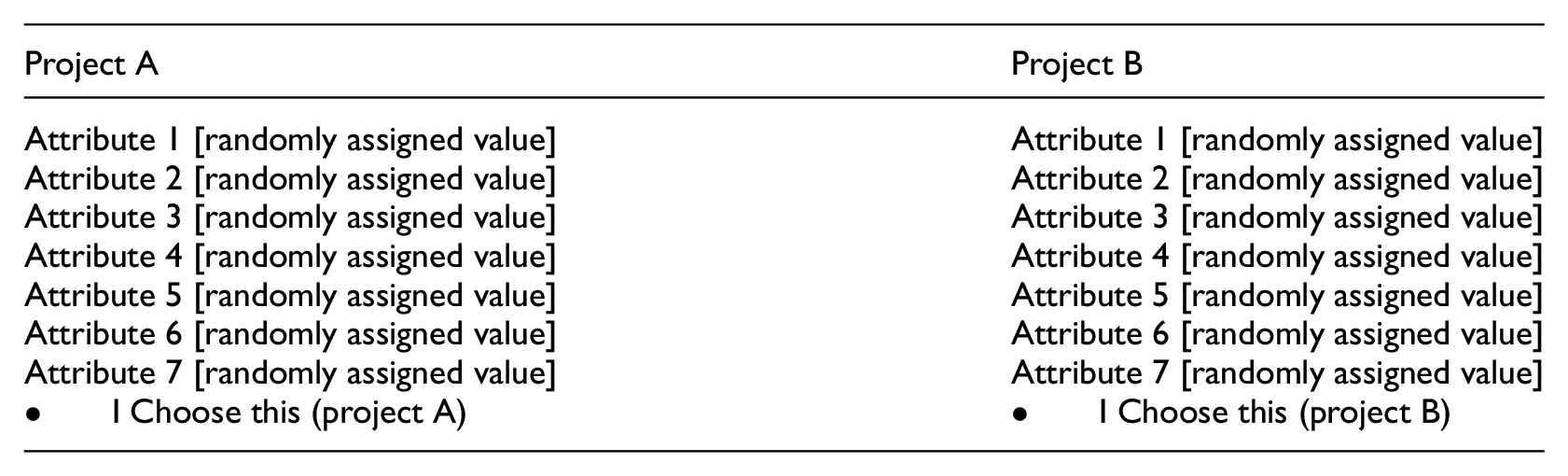
To answer our research question and to test our expectations, we conducted a representative online survey in Colombia with a conjoint experiment. 2 Our survey included a set of questions related to moderating and controlling several variables of interest. It also included a forced-choice conjoint experiment. 3 In a forced-choice conjoint experiment, the respondent must choose several times between two profiles consisting of randomly assigned attributes. Such a design allows evaluating multiple attributes simultaneously and evaluating the role of each attribute of one profile in relation to another (Hainmueller et al., 2014). In our experiment, the survey participants had to choose three times between two fictional forest conservation projects with attributes related to peacebuilding. For the respondents to make a choice, they were presented with the following scenario, followed by the two projects to choose from. 4
We will show you two fictitious projects in a forest area of Colombia where the FARC committed violent acts against the civilian population and which is now home to demobilized ex-combatants. Both projects will conserve the forest. The characteristics (attributes) of each of the projects are shown in the table below. We will ask you to indicate which of the two projects convinces you the most.
4.2. Attributes and expected mechanisms in the Colombian context
This experimental design allowed us to identify the respondents’ priorities, based on their political attitudes, relating to peacebuilding activities in relation to forest conservation projects. The experiment included seven attributes related to socioeconomic benefits, peace culture and conflict management, transitional justice, governance, and security as discussed in the theoretical framework. We translated each of these dimensions into the specific Colombian context to make the information relatable for the respondents. Table 1 shows the attributes and possible values, which were randomly selected in our experiment for each attribute. However, to keep our conjoint experiment clearly arranged, we had to limit our focus to a few attributes per dimension.
Attribute values.
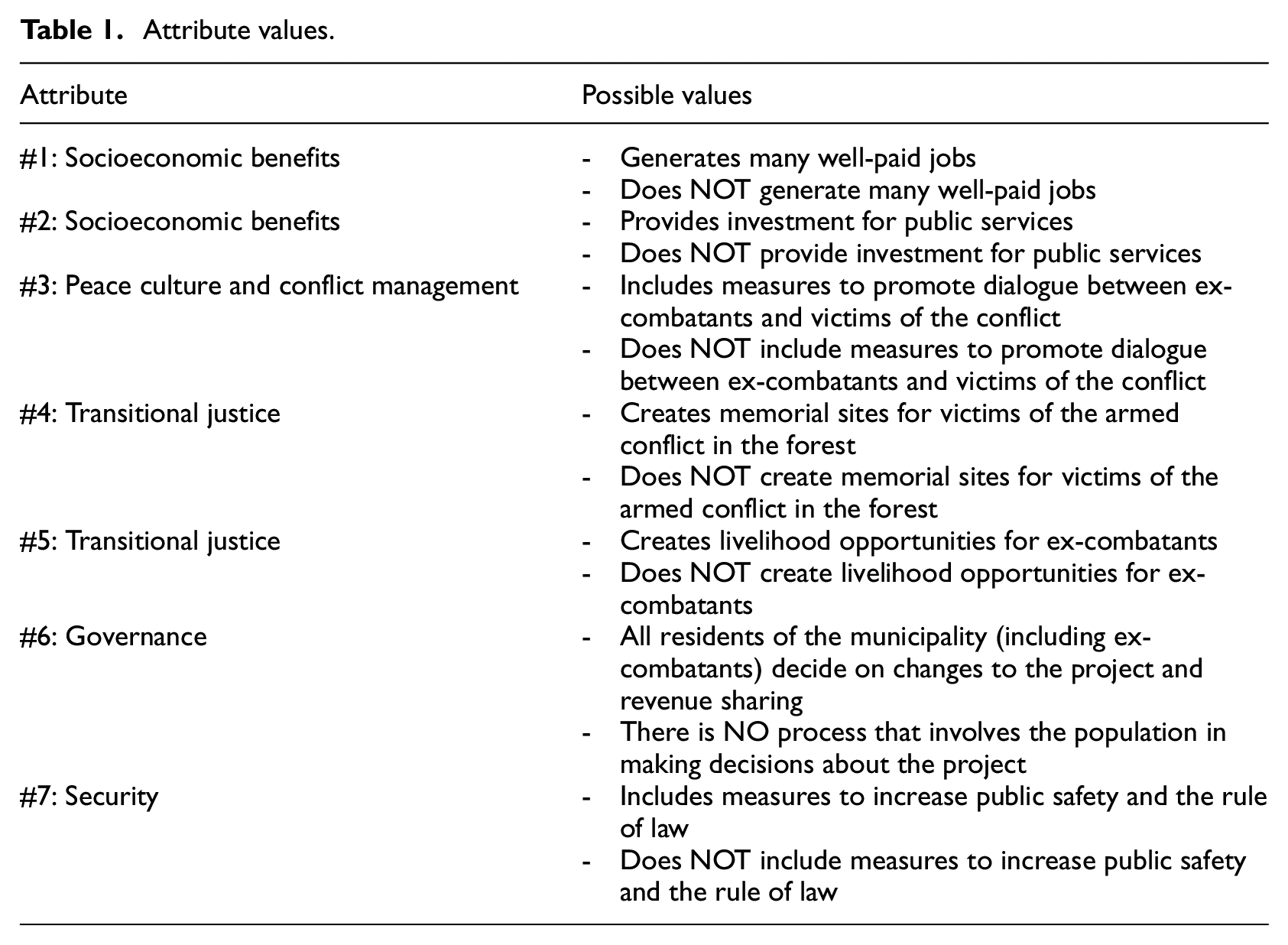
For the socioeconomic dimension (H1), our first attribute was the prospect of job creation through the project. The respondents received information about whether the project would generate many well-paid jobs. Particularly in rural areas, it is a considerable challenge to create sufficient employment opportunities, and while poverty is an issue across Colombia, the problem is particularly severe in rural areas and those regions hardest hit by the conflict (Morales, 2017). Unemployment figures in Colombia have been rising since 2015 despite a slight uptick in the economy (Vallejo Zamudio, 2020). At the end of 2020, about 15% of Colombians were unemployed, one of the highest rates in Latin America (World Bank, 2020). An estimated 56% of Colombians work in informal labor markets which offer very limited social protection (García & Badillo, 2018).
The second attribute—also related to the socioeconomic dimension—told the respondents whether the projects would provide investment for public services. Socioeconomic recovery is also linked to infrastructure development and the provision of social services. Despite hefty investments, public infrastructure development and renewal remain slow in Colombia mainly because of corruption, natural disasters, and poor civil engineering (Daheshpour & Herbert, 2018). While infrastructure development is not commonly a mechanism of environmental peacebuilding, forest land-use projects, such as conservation projects, are frequently combined with additional benefits such as access to health care, drinking water, electricity, or education. Projects in proximity to urban centers can also be linked to infrastructure development such as roads. Given the limited job opportunities and the country’s infrastructure—which, for several decades, has been falling into a state of severe disrepair—we expected that these two attributes would strongly influence respondents to select projects that would improve prospects in these areas.
For the peace culture and conflict management dimension (H2), we decided to focus on activities that promote dialogue between ex-combatants and victims of the conflict. The project descriptions explained whether the projects included such a measure. Reconciliation after armed conflict is a multidimensional process that all parties must commit to. It entails overcoming prejudices against ex-combatants and encouraging openness to reach a new status quo (Murillo Orejuela & Restrepo-Plaza, 2021). Community members may fear ex-combatants, and they often view them with suspicion and stigmatize them when they return to their communities (International Labour Organization, 2010). However, repeated and mediated contact between victims and ex-combatants can open up spaces for trust and cooperation (Carius, 2007). While resentment against ex-combatants is still prevalent in Colombia, this trend is declining. A study in Bogotá showed that the proportion of people who resented forgiving ex-combatants had decreased significantly from 67% at the beginning of the peace process to 52% at the end of the process. These figures are based on data gathered in 2010–2011 and 2015–2016, respectively (López-López et al., 2018).
As for transitional justice (H3), our first of the two attributes stated whether the project would create memorial sites in the forest for victims of the armed conflict. Memorial sites are a form of symbolic transitional justice that refers to policies designed to commemorate victims of political violence (Balcells et al., 2022). One example from Colombia is the Bosques de Paz (Forests of Peace) program. In four communities that had been affected to a large degree by the armed conflict, trees were planted in the forests with the names of victims, representing a monument to peace and paying homage to the victims of the armed conflict in Colombia (Bosques de Paz, n. d.). Scholarly work has largely focused on evaluating how memorial sites have affected individuals (Balcells et al., 2022; Cilliers et al., 2016; Lavielle, 2020; Loyle & Appel, 2017) but not on their opinion about those sites. This is surprising because memorial sites are an integral part of peacebuilding policies around the globe.
Another side of transitional justice is the reintegration of ex-combatants into society. In post-conflict settings, the socioeconomic inclusion of ex-combatants is crucial. Without this reintegration, economic deterioration and social isolation might drive ex-combatants back to illicit activities and violence (Bauer et al., 2018; Blattman & Annan, 2016). Our second attribute of transitional justice defined whether the projects would create opportunities for ex-combatants to earn a living. In the case of Colombia, the socioeconomic inclusion of former FARC insurgents is closely related to land and their reintegration into society. Specific mechanisms include not only programs for livelihood generation connected to ecological activities but are also related to land use and land access for both ex-combatants and victims. A study by Tellez (2019) found that these reintegration programs were among the most unpopular provisions of the peace agreement. In a difficult economic context, people might consider it “unfair” that ex-combatants are potentially favored over the rest of the population. Given this evidence and the specific context, we assumed that this effect would be weaker than many of the other effects.
With respect to local inclusive governance (H4), we included information in our project description that stated that all residents of the municipality (including ex-combatants) decided on changes to the project and revenue sharing (or not). As previously stated, the improvement of local governance structures can foster transparency and accountability. More specifically, Cairo et al. (2018) focused on local communities in Colombia and found that they oppose the state’s idea of hegemonic development and that they call for localized governance structures that recognize ancestral knowledge and memories. Trust in the national government is often low after an armed conflict, and Colombia is no exception. In 2018, almost 90% of the Colombian population declared that it had very limited trust in the government. Only Guatemala and Peru had a lower trust rating globally (Haerpfer et al., 2022). And in 2021, over 75% of Colombians perceived the majority of politicians as corrupt (Plata Caviedes et al., 2021). Because of these findings, and because of the trust ratings, we expected that projects that strengthen local inclusive governance structures would be more likely to be selected by the respondents than those that did not have such provisions.
Lastly, we looked at the security dimension (H5). As already mentioned, the end of the conflict in Colombia had a mixed effect on the country’s nature, with different actors—state and violent non-state actors—seeking to fill the power vacuum. Violence today still continues to have a significant effect on people’s lives, and the situation has been deteriorating. In 2021, over 1,090 events of political violence were recorded. This corresponds to a 70% increase compared with 2020 (ACLED, 2022). In 2021, 96 massacres caused 335 civilian deaths. In addition, 171 social leaders and human rights defenders were assassinated (Indepaz, 2021). In the same year, the Cauca, Antioquia, Valle de Cauca, and Nariño departments—departamentos: the country’s second administrative division—were most severely affected by violence against civilians, and in all parts of Colombia, armed actors continued to be present (ibid). Given this structural post-conflict violence, we wondered how important the inclusion of public security measures was for the respondents when forest conservation projects were being implemented. However, despite the apparent need for more security measures, we expected that security would not be the most important attribute for the respondents, particularly because of their low trust in the state and the police apparatus. Over the previous 3 years, Colombia had seen a wave in protests against economic, social, and environmental policies, as well as against police brutality and abuse in general, and against protesters in particular. Due to this behavior, many local communities perceived the police as untrustworthy (Devia-Valbuena et al., 2022; Human Rights Watch, 2021).
4.3. Moderating variables
As explained in H6, we expected that respondents’ opinions about the peace agreement and their own broader political beliefs would affect their stance toward peacebuilding. Support for the 2016 peace agreement and the peace process has been very contentious in Colombia and heavily conditioned by existing political preferences: the political left was much more supportive of the peace process than the political right (Liendo & Braithwaite, 2018). In our survey, participants had to self-declare their political stance (left to right) on a 10-point numerical scale and declare their degree of support for the peace agreement (opposed to support) on a 5-point scale. We categorized ratings of ≤5 as left-leaning and >5 as right-leaning respondents, and ratings of <3 as opponents of the peace agreement and ≥3 as supporters of the peace agreement, respectively.
For our second moderating variable—conflict experiences—we used two dimensions: First, we asked the respondents whether they had experienced FARC violence during the conflict. Specifically, the respondents had to indicate whether they or a family member had experienced one of the following events due to the FARC: being forced to leave the country; becoming displaced from their homes; enduring property deprivation; getting kidnapped; encountering physical violence; or even whether a family member had been killed by the FARC. Second, we looked at indirect exposure and asked respondents whether they lived in an area that had been controlled by the FARC. As mentioned above, studies from Colombia have shown that political beliefs influence people’s attitudes toward transitional justice, but that this effect was moderated by where they lived, and that people who lived in a conflict zone were more supportive of the peace process (Clavijo, 2017).
4.4. Estimates, controls, and robustness checks
To understand the respondents’ preferences for peacebuilding attributes included in forest conservation, we performed a conjoint analysis estimating average marginal effects (AME) using the margins package in R (Leeper, 2021) from a generalized linear regression with a probit link. The number of observations of the study was 9,024 (N = 9,024), defined as the number of respondents (R = 1,504) times the number of jointly assessed profiles (J = 2), times the number of repetitions (T = 3).
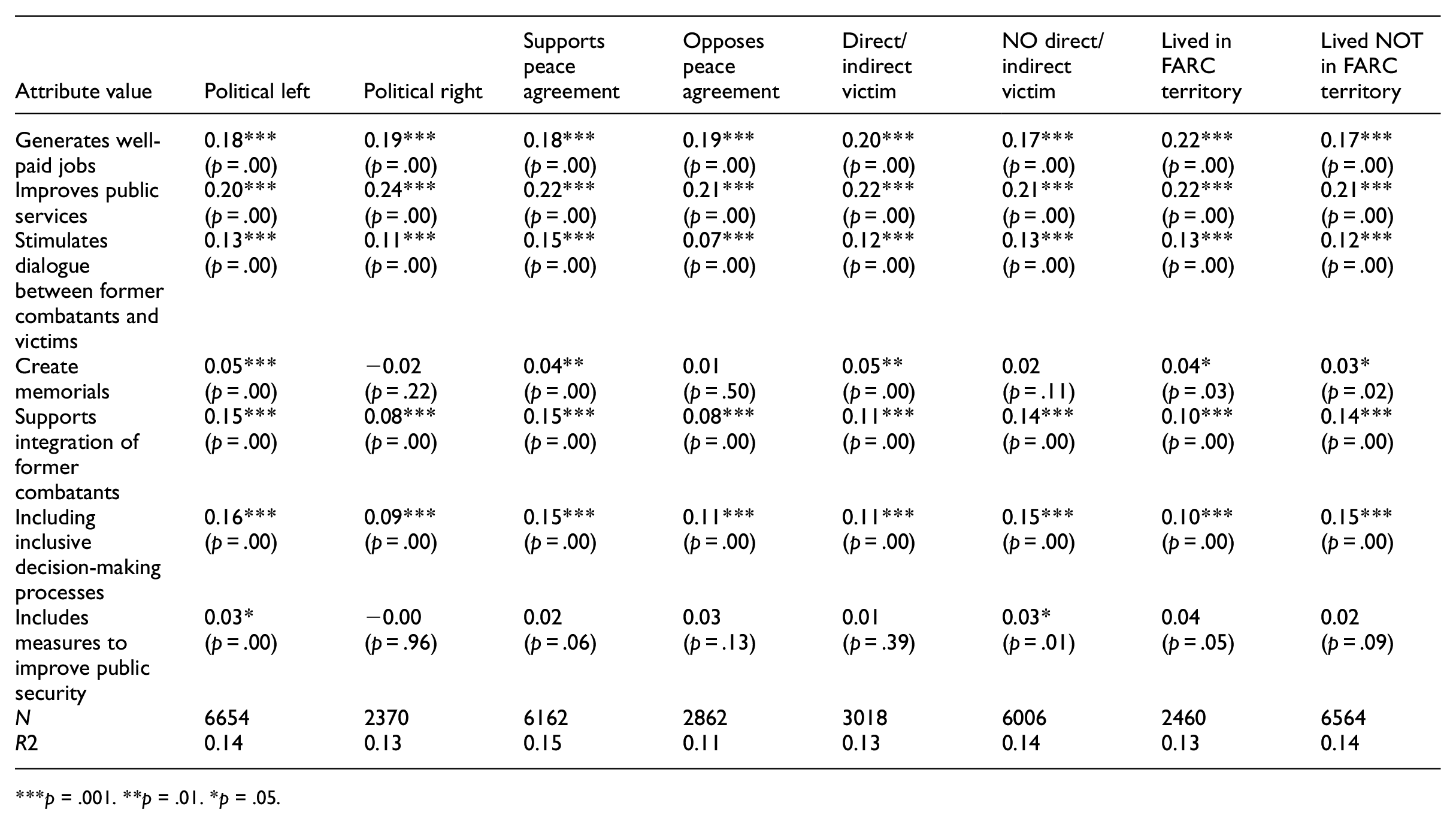
As a robustness check, we performed the conjoint analysis estimating AMEs by fitting a linear regression. As mentioned earlier, our conjoint experiment used a completely independent randomization of attributes, which allowed us to estimate the AMEs using linear regression (Breitenstein, 2019; Hainmueller et al., 2014).
We controlled our models with a range of sociodemographic variables including gender, age, place of residence, and social class. We operationalized place of residence in two ways: First, we asked respondents to self-declare whether they lived in an urban or rural area, and second, we looked at whether they lived in departments with an above-average or below-average forest cover intensity (more than or less than 25% of the surface area). For the second indicator, we used data from the Colombian Institute of Hydrology, Meteorology, and Environmental Studies (IDEAM—Institute of Hydrology, Meteorology and Environmental Studies, 2018). 5
4.5. Data collection and participant selection
We conducted our survey between 22 and 30 July 2021 in cooperation with the company Netquest, which has an established pool of respondents for online surveys in 23 countries. Netquest provided us with respondents through its existing panel, which at that time comprised 103,000 members in Colombia.
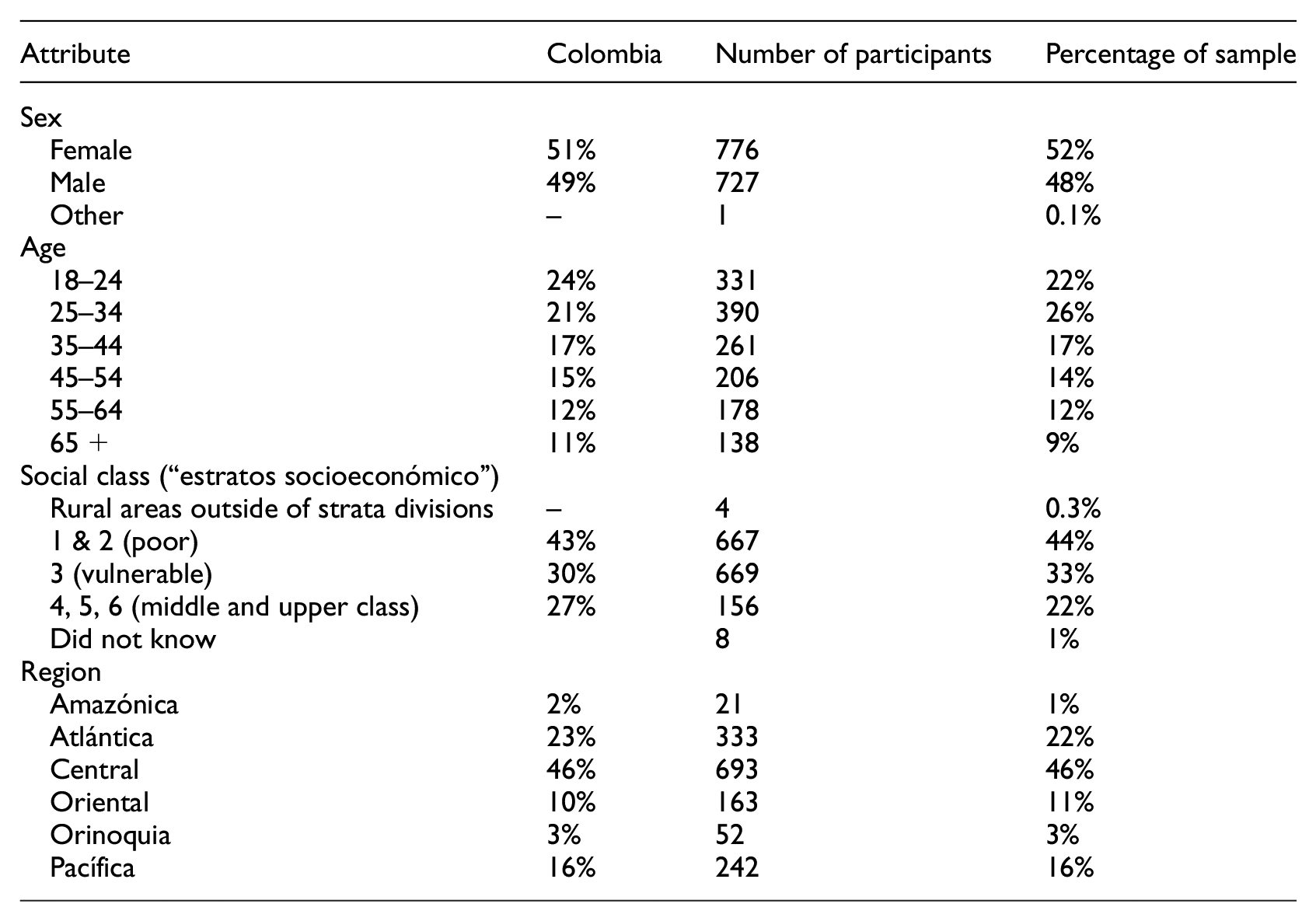
For representativeness, we established a series of quotas 6 of the total population over the age of 18 in terms of gender, age, geography, socioeconomic level, and region. All individuals in the Netquest panel with permanent residence in Colombia were invited to participate. Potential participants could no longer participate after the quota had been filled, or if they had failed one of the two manipulation tests during the survey, in which we asked respondents to select option “B” or option “A,” respectively. Respondents who failed a manipulation check were excluded from the sample and their answers were disregarded. The survey was completed by 1,504 participants. With a margin of error of 3% and a confidence level of 95%, the minimum number of respondents for representativeness was 1,066, taking into account that Colombia has 50.3 million inhabitants.
5. Results
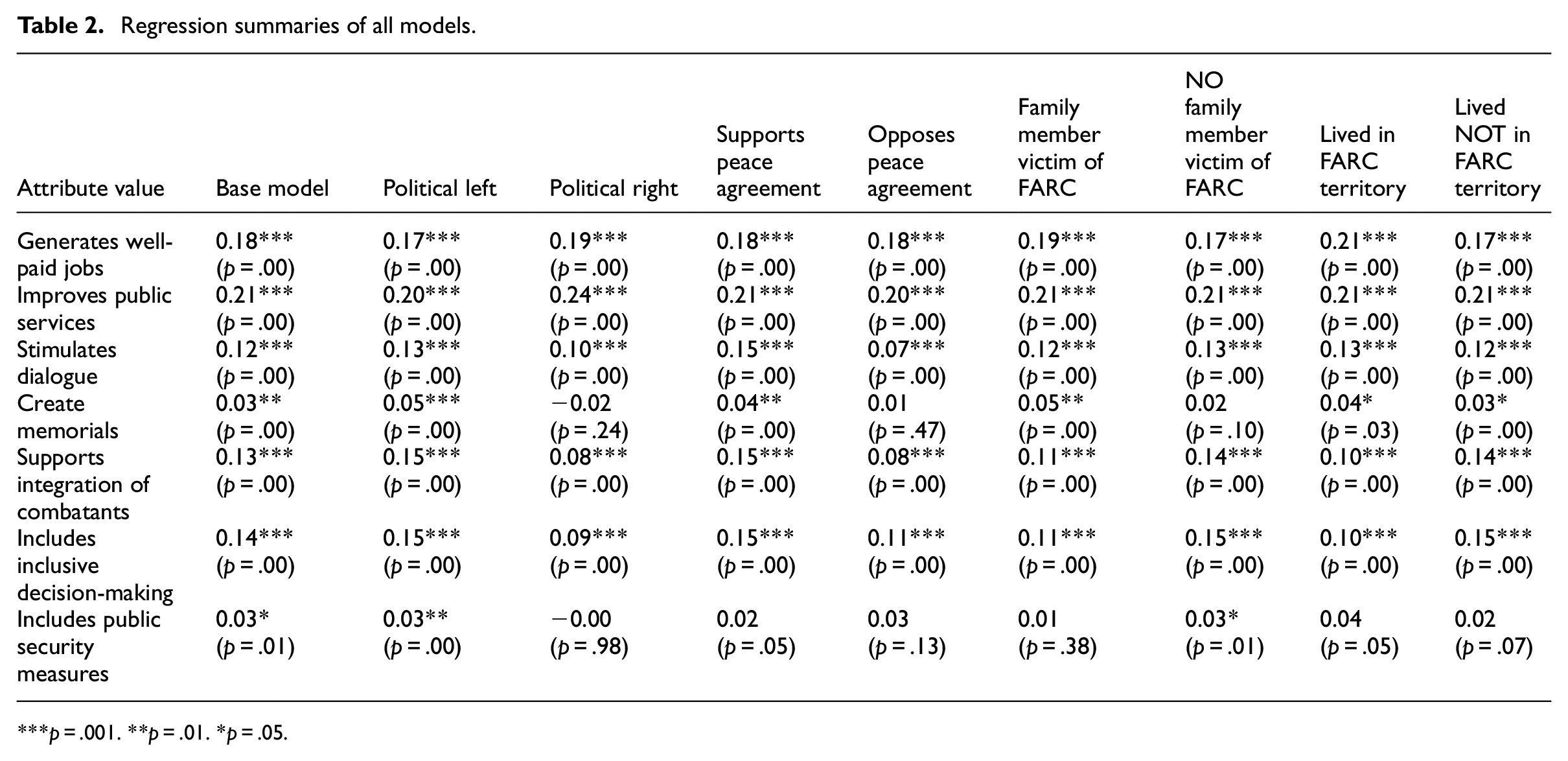
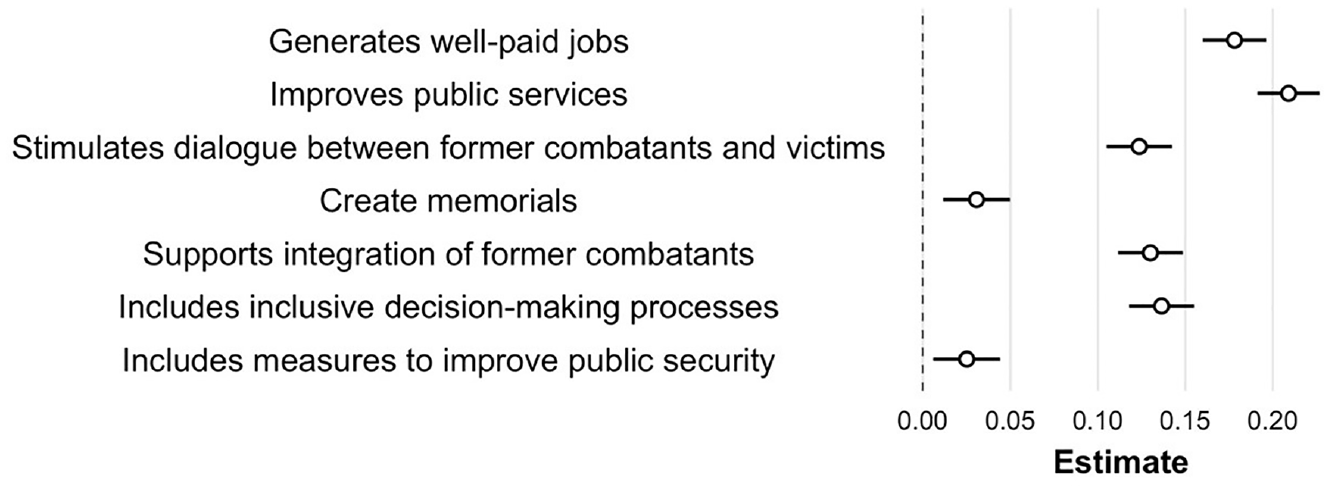
As outlined in the theoretical framework, we expected that the prospect of socioeconomic benefits would increase public support for forest conservation projects (H1). Indeed, of all the attributes included, this information had the strongest effect on our respondents. The promise of future investments in public services increased the probability that a respondent picked this project by over 20 percentage points (AME = 0.21, p < .001) (Table 2 and Figure 1). The prospect of well-paid jobs also increased the probability that a respondent would choose a project by 18 percentage points (AME = 0.18, p < .001). Looking at the moderating variables, there were no differences between our subsets, and all ideological groups were most influenced by the information about socioeconomic benefits (Table 2 and Figure 2). Also, we found no statistically significant difference between them. Likewise, exposure to violence during the conflict played no statistically significant moderating role (Table 2 and Figure 3).
Regression summaries of all models.
***p = .001. **p = .01. *p = .05.
Base model.
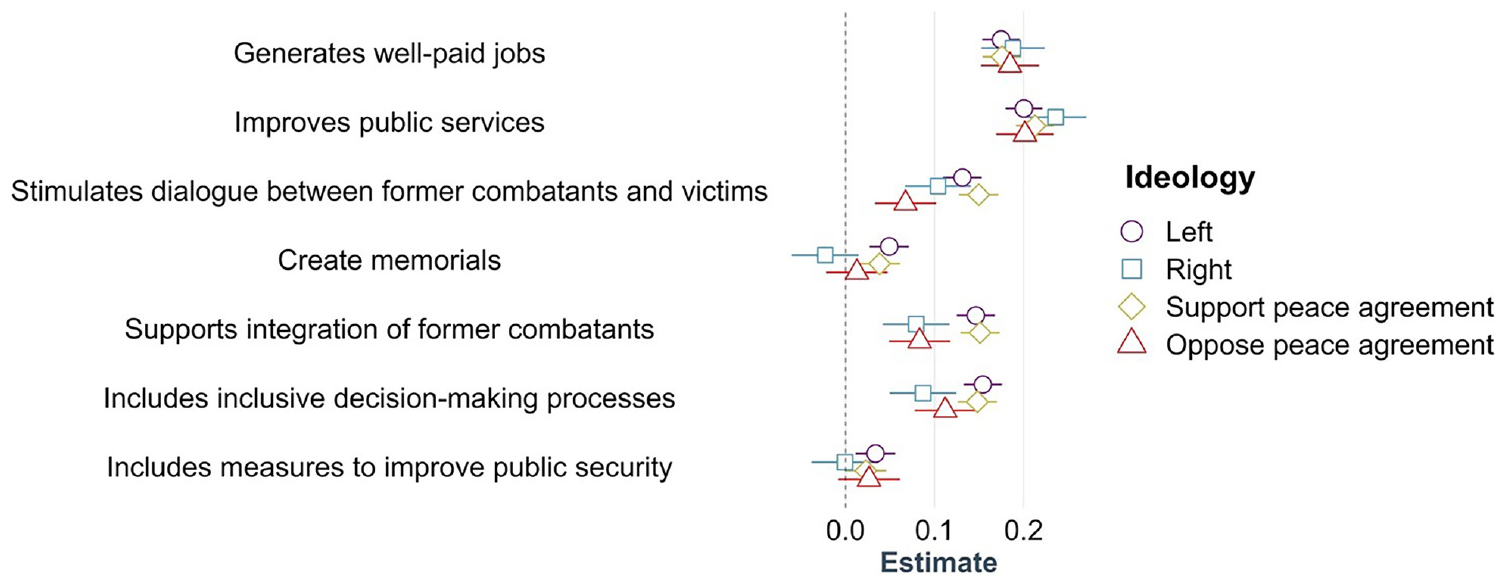
Political ideology moderators.
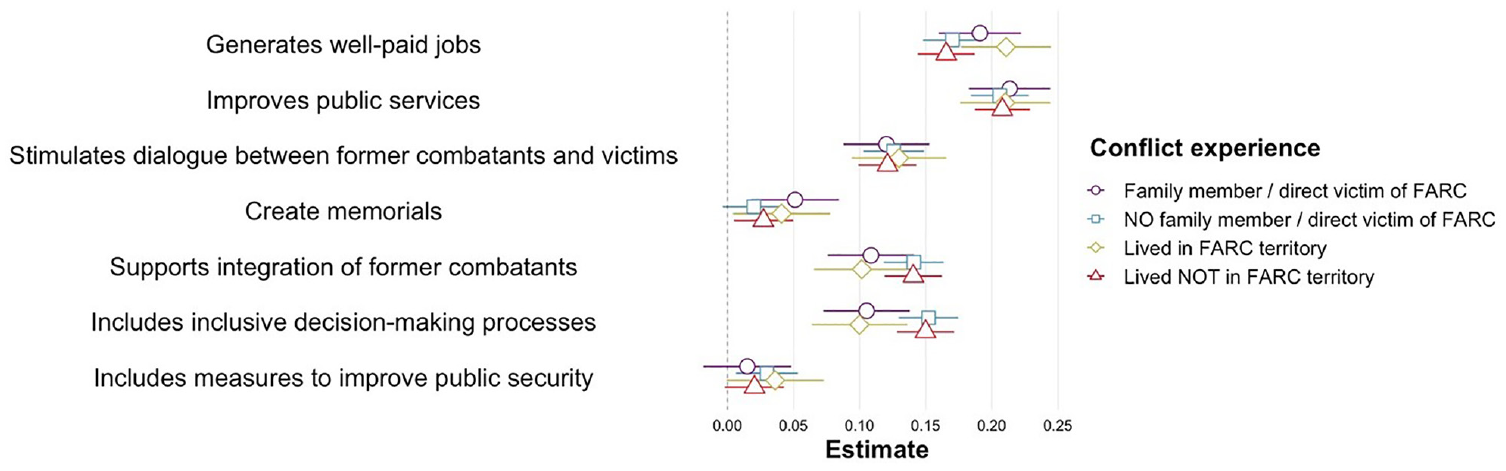
Conflict-experienced moderators.
For the peace culture and conflict management dimension, we assumed that measures that supported building capacities to increase trust and understanding between parties through dialogue would also positively affect the respondents’ attitude toward forest conservation projects (H2). This attribute increased the likelihood that a respondent would choose a project by 12 percentage points (AME = 0.12, p < .001). The results were fairly consistent across the political subgroups, but the respondents who supported the peace agreement were 7 percentage points more likely to select a project that included provisions to stimulate dialogue than respondents who opposed the agreement. Again, exposure to FARC violence during the conflict did not influence the effect to a statistically significant degree.
In the transitional justice dimension, we looked at two attributes: memorial sites and the socioeconomic reintegration of ex-combatants. Memorial sites increased the likelihood that respondents picked a project by only 3 percentage points (AME = 0.03, p < .01) and were one of the most polarized attributes in the experiment. Supporters of the peace process and those leaning to the political left were positively influenced by the information about memorials for victims of the conflict, whereas the effect on opponents and politically right-leaning respondents was not statistically significant. A possible explanation is that right-leaning paramilitary groups were responsible for over 2.5 more victims than left-leaning guerillas like the FARC and the ELP (Romero, 2018), and that therefore some right-leaning respondents could be less interested in keeping this memory alive. Respondents who were victims of FARC violence were more likely to pick a project when it had a memorial site, but this information did not influence the choice of the rest of the respondents. Whether a respondent had lived in a FARC territory (or not) did not influence the impact of this information on their choices.
The socioeconomic reintegration of ex-combatants into society is a pivotal component of a successful transition to peace. As described above, the issue of reintegration was among the least popular stipulations of the peace agreement in Colombia. Nevertheless, the likelihood that respondents picked a project increased by 13 percentage points when it included this attribute (AME = 0.13, p < .001). We again detected some differences in responses based on political ideology. The effect was about 7 percentage points stronger among respondents who were in favor of the peace process and among those who leaned to the political left. At the same time, people who did not live in FARC territory, or were not impacted directly by FARC violence, were about 4 percentage points more likely to support the socioeconomic reintegration of ex-combatants than those who were affected by FARC in these two categories. If the campaign about the peace agreement is kept in mind, these differences are not surprising: Opponents argued that the FARC got off lightly in the agreement. Here, a similar mechanism probably came into play. Many opponents of the peace process did not want to reward combatants for their violent past with special programs. In this attribute, we specifically referred to opportunities for earning a living. However, our finding is consistent with the findings of another study that looked at the reintegration of ex-combatants into civilian life. Based on secondary literature, between 2016 and 2018, Gómez Quintero and Pasachova Sánchez (2021) explored respondents’ opinions relating to the peace process of Colombians. They found that over 70% of the respondents did not want an ex-combatant as their neighbor. The respondents held this opinion as a proxy for the reintegration of the ex-combatants into civilian life.
We were then interested in how governance provisions concerning local, inclusive decision-making would affect the respondents’ attitudes toward forest conservation. We expected that the inclusion of such provisions in the project design would be favored by respondents because hegemonic state control is widely opposed in Colombia (H4). Indeed, the prospect of collective decision-making increased the likelihood that respondents pick a project by 14 percentage points (AME = 0.14, p < .001). Respondents who described themselves as politically left-leaning, and who also supported the peace process, were more positively influenced by this attribute than the right-leaning respondents and those who opposed the process (7 and 3 percentage points respectively). Again, participants who did not live in former FARC territory, or who had not been exposed to FARC violence, were about 5 percentage points more strongly influenced by this information than the respondents who were not affected by FARC in this way. The governance attribute included in our survey specifically mentioned that ex-combatants would also be included in the decision-making process. This could explain why politically right-leaning respondents and opponents of the peace agreement were less influenced by the prospect of inclusive decision-making than the other subgroups.
Lastly, we looked at the provision of security measures as part of the projects. This attribute had the smallest effect of all (AME = 0.3, p < .05). Security policies in post-peace agreement environments tend to be designed around the core threats from the state’s perspective, not from the people’s perspective, and Colombia is no exception (Nilsson, 2018). The Colombian state has a history of placing national security interests and the fight against illegal armed groups above rural citizens’ interests and their need for security (Bulla & Guarín, 2015). For example, Nilsson and González Marín (2019) found a stark discrepancy in the perception of threat and insecurity between the residents of three rural communities in Colombia and the state actors in charge of security. The authors also found that cooperation between the actors was virtually non-existent. The “war on deforestation” was, according to critics, just another example of this pattern and was more motivated by national political and economic considerations than by the interests of the local population (Corredor-Garcia & López Vega, 2023). It is also worth noting that our survey was conducted a few weeks after the peak of the violent protests in 2021, during which over 80 protesters were killed and 1,200 injured. The police brutality and abuse of power witnessed during these protests likely exacerbated the public’s distrust of state authorities. Although we had anticipated that the security attribute would have only a comparatively limited influence on respondents’ likelihood of choosing a project, these events, still fresh in people’s minds at the time, likely further diminished the impact of this attribute.
Overall, H6 could be supported: The existing political beliefs of the respondents moderated the effect of the different attributes. However, there were noteworthy variations between them. Information about the expected socioeconomic benefits of a forest conservation project increased the likelihood that respondents picked a project, regardless of their political ideology or their experiences of violence during the conflict. By contrast, many of the pure “peacebuilding” policies—such as stimulating a dialogue between former combatants and victims; supporting the socioeconomic integration of former combatants; and promoting inclusive decision-making, including former combatants—were somewhat more controversial. Respondents who identified with the politically left and/or who supported the peace agreement were more (positively) influenced by this information than respondents who identified with the politically right and/or who opposed the peace agreement. However, it is noteworthy that this information did not provoke a counterreaction. Politically right-standing respondents/opponents of the peace agreement were not more likely to oppose a forest conservation project because of these provisions; they were only somewhat less positively influenced by this information. Given the politically controversial nature of some of these provisions, this finding is noteworthy, as it shows that the provisions were not a dealbreaker for these respondents.
Finally, H7 could not be confirmed. The answers of respondents who were themselves affected by FARC violence, or who had family members who had been affected by FARC violence, were not statistically significant to a degree different from the answers from the rest of the population. A possible explanation could be that only 2.8% of the respondents reported to have been personally affected by FARC violence. 27.5% of the participants reported that family members were affected, and 27.3% of them stated that they lived in territory that used to have a FARC presence. Hence, the sample size might have been too small. While the data did not provide statistically significant results, overall, most of our results pointed in the direction that victims of FARC violence were somewhat more “hawkish” than the rest of the population with respect to provisions related to peacebuilding measures. Likewise, people who lived in territories that used to have a FARC presence were somewhat less positively influenced than the rest of the population by the information of a dialogue with former fighters and their inclusion in decision-making processes. However, as in the case of political ideology, people who had experienced FARC violence (themselves or a family member), or who had lived in FARC territory, were generally still positively influenced by the information on peacebuilding.
5.1. Robustness checks and controls
As described in Section 3, as a robustness check, we estimated the same models with a linear model. These results were almost identical with only minor differences at the second and third decimal points. 7 As mentioned, we also controlled for a range of socioeconomic variables, which did affect the results. 8
6. Conclusion
The purpose of this study was to explore the influence of project characteristics on public support for environmental peacebuilding initiatives, focusing specifically on forest conservation projects in Colombia. As expected, and consistent with other studies on public support for peacebuilding, respondents were most swayed by information regarding economic benefits. The prospect of new, well-paid jobs and enhanced public services were the attributes that exerted the strongest influence in our survey. However, our experimental design does not allow us to claim that respondents reflected these preferences because of their potential effect on stability and peace. These preferences might also be driven by a fundamental need for personal economic development. This finding is in line with other surveys from post-conflict countries discussed in the theoretical framework which showed that respondents prioritize measures that meet basic security needs and address economic concerns. Nevertheless, the experiment provides evidence that other peacebuilding measures also enjoy public support in post-conflict contexts because economic incentives were not the sole factors that mattered to respondents. Notably, initiatives that promoted dialogue between former combatants and victims, which supported the socioeconomic reintegration of former combatants and which encouraged local inclusive decision-making processes, were more likely to be endorsed by participants. Conversely, the establishment of memorials and investments in public security did not significantly sway the respondents’ choices.
In analyzing the data, we noted differences between respondents who supported the 2016 peace agreement with the FARC and/or who leaned politically left and those who leaned right and/or opposed the peace agreement. Attributes explicitly associated with the peace process—such as the reintegration of former combatants and inclusive decision-making processes—proved particularly divisive. Typically, right-leaning respondents and those opposed to the peace process were less receptive to this information. However, it is crucial not to exaggerate these differences: Even among these respondents, the presence of such information increased the likelihood of selecting a project. Likewise, the differences between victims and non-victims of FARC violence were only very small.
What are the broader implications of these findings? To our knowledge, this study is the first to gauge nationwide support for environmental peacebuilding initiatives. Our goal is to contribute to the broader body of research on public support for peacebuilding measures. The outcomes of our study largely validate the findings of the limited existing public opinion studies on peacebuilding in post-conflict nations. Generally, people are supportive of peacebuilding measures. Consequently, incorporating environmental peacebuilding elements into forest conservation projects garners additional support. While our focus is on forest conservation projects, future research could extend similar surveys to other types of environmental peacebuilding projects in Colombia, or in other regions, to determine the consistency of these findings.
In terms of public policy, our findings indicate that there is public backing for an environmental peacebuilding approach in the post-conflict regions of Colombia. Although establishing some degree of stability in former conflict zones is crucial for any peacebuilding effort, environmental motives have been exploited by state authorities in Colombia to reinforce their presence in areas with limited government control, sometimes leading to the displacement of local communities (Corredor-Garcia & López Vega, 2023). Forest protection has become securitized and subjected to “green militarization.” This term refers to “the use of military and paramilitary (military-like) actors, techniques, technologies, and partnerships in the pursuit of conservation” (Lunstrum, 2014). Without assurances that these measures will genuinely benefit the security of the local population and that the measures are not merely attempts at state encroachment, such strategies can be counterproductive and can potentially ignite new conflicts. In our survey, respondents are not persuaded by security promises linked to forest conservation projects. This is likely due to a generally low level of trust in the state. Rather than framing forest conservation purely as a security issue, adopting a more localized and comprehensive approach may prove more effective in establishing stability in former conflict zones. As our survey indicates, at least in Colombia, the public is supportive of such an approach.
Footnotes
Appendix 1: Survey experiment
Information: This is the survey experiment in Spanish, as received by the respondents. The English translation can be found in the text (Table 1).
Seguidamente, le mostraremos de nuevo dos proyectos ficticios de desarrollo de una zona forestal colombiana en una región en la que las FARC cometieron actos violentos contra la población civil y que ahora alberga excombatientes desmovilizados. Esta vez se trata solamente de proyectos en que se conserva el bosque y que intentan a mitigar el cambio climático dentro de las pautas establecidas por la Política Nacional de Cambio Climático. Las características de cada uno de los proyectos se muestran en la tabla más abajo. Le pediremos que nos indique cuál de los dos proyectos le convence más.
Appendix 2: Forest cover density per department
Departments with an above or below average forest cover intensity (more or less than 25% of the surface area), using data from IDEAM, the Colombian Institute of Hydrology, Meteorology, and Environmental Studies. 9
Appendix 3: Sample distribution
| Attribute | Colombia | Number of participants | Percentage of sample |
|---|---|---|---|
| Sex | |||
| Female | 51% | 776 | 52% |
| Male | 49% | 727 | 48% |
| Other | – | 1 | 0.1% |
| Age | |||
| 18–24 | 24% | 331 | 22% |
| 25–34 | 21% | 390 | 26% |
| 35–44 | 17% | 261 | 17% |
| 45–54 | 15% | 206 | 14% |
| 55–64 | 12% | 178 | 12% |
| 65+ | 11% | 138 | 9% |
| Social class (“estratos socioeconómico”) | |||
| Rural areas outside of strata divisions | – | 4 | 0.3% |
| 1 & 2 (poor) | 43% | 667 | 44% |
| 3 (vulnerable) | 30% | 669 | 33% |
| 4, 5, 6 (middle and upper class) | 27% | 156 | 22% |
| Did not know | 8 | 1% | |
| Region | |||
| Amazónica | 2% | 21 | 1% |
| Atlántica | 23% | 333 | 22% |
| Central | 46% | 693 | 46% |
| Oriental | 10% | 163 | 11% |
| Orinoquia | 3% | 52 | 3% |
| Pacífica | 16% | 242 | 16% |
Appendix 4: Robustness check: linear models
| Attribute value | Political left | Political right | Supports peace agreement | Opposes peace agreement | Direct/indirect victim | NO direct/indirect victim | Lived in FARC territory | Lived NOT in FARC territory |
|---|---|---|---|---|---|---|---|---|
| Generates well-paid jobs | 0.18*** (p = .00) | 0.19*** (p = .00) | 0.18*** (p = .00) | 0.19*** (p = .00) | 0.20*** (p = .00) | 0.17*** (p = .00) | 0.22*** (p = .00) | 0.17*** (p = .00) |
| Improves public services | 0.20*** (p = .00) | 0.24*** (p = .00) | 0.22*** (p = .00) | 0.21*** (p = .00) | 0.22*** (p = .00) | 0.21*** (p = .00) | 0.22*** (p = .00) | 0.21*** (p = .00) |
| Stimulates dialogue between former combatants and victims | 0.13*** (p = .00) | 0.11*** (p = .00) | 0.15*** (p = .00) | 0.07*** (p = .00) | 0.12*** (p = .00) | 0.13*** (p = .00) | 0.13*** (p = .00) | 0.12*** (p = .00) |
| Create memorials | 0.05*** (p = .00) | −0.02 (p = .22) | 0.04** (p = .00) | 0.01 (p = .50) | 0.05** (p = .00) | 0.02 (p = .11) | 0.04* (p = .03) | 0.03* (p = .02) |
| Supports integration of former combatants | 0.15*** (p = .00) | 0.08*** (p = .00) | 0.15*** (p = .00) | 0.08*** (p = .00) | 0.11*** (p = .00) | 0.14*** (p = .00) | 0.10*** (p = .00) | 0.14*** (p = .00) |
| Including inclusive decision-making processes | 0.16*** (p = .00) | 0.09*** (p = .00) | 0.15*** (p = .00) | 0.11*** (p = .00) | 0.11*** (p = .00) | 0.15*** (p = .00) | 0.10*** (p = .00) | 0.15*** (p = .00) |
| Includes measures to improve public security | 0.03* (p = .00) | −0.00 (p = .96) | 0.02 (p = .06) | 0.03 (p = .13) | 0.01 (p = .39) | 0.03* (p = .01) | 0.04 (p = .05) | 0.02 (p = .09) |
| N | 6654 | 2370 | 6162 | 2862 | 3018 | 6006 | 2460 | 6564 |
| R2 | 0.14 | 0.13 | 0.15 | 0.11 | 0.13 | 0.14 | 0.13 | 0.14 |
p = .001. **p = .01. *p = .05.
Appendix 5: Regression results (main model) including controls
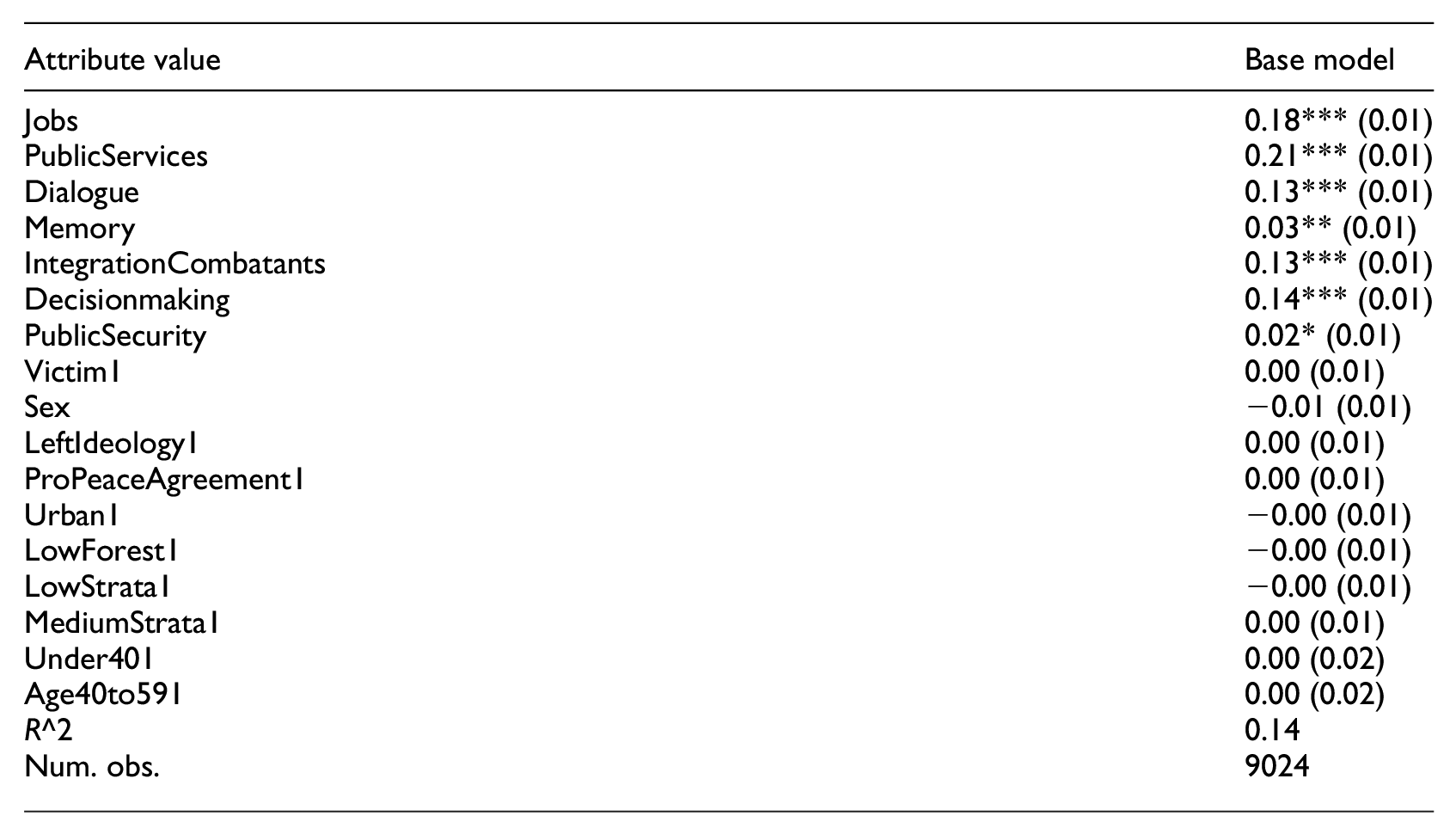
| Attribute value | Base model |
|---|---|
| Jobs | 0.18*** (0.01) |
| PublicServices | 0.21*** (0.01) |
| Dialogue | 0.13*** (0.01) |
| Memory | 0.03** (0.01) |
| IntegrationCombatants | 0.13*** (0.01) |
| Decisionmaking | 0.14*** (0.01) |
| PublicSecurity | 0.02* (0.01) |
| Victim1 | 0.00 (0.01) |
| Sex | −0.01 (0.01) |
| LeftIdeology1 | 0.00 (0.01) |
| ProPeaceAgreement1 | 0.00 (0.01) |
| Urban1 | −0.00 (0.01) |
| LowForest1 | −0.00 (0.01) |
| LowStrata1 | −0.00 (0.01) |
| MediumStrata1 | 0.00 (0.01) |
| Under401 | 0.00 (0.02) |
| Age40to591 | 0.00 (0.02) |
| R^2 | 0.14 |
| Num. obs. | 9024 |
Acknowledgements
The authors are grateful for comments received from Juan Carlos Triviño-Salazar (Institut Barcelona d’Estudis Internacionals) and José Ignacio Carrasco (Universitat Pompeu Fabra) on earlier versions of this manuscript.
Funding
The author(s) disclosed receipt of the following financial support for the research, authorship, and/or publication of this article: The survey of this study was funded by the International Catalan Institute for Peace (2019 RICIP 00016).
Research ethics review
This study was approved by the Ethical Review Board of Universitat Pompeu Fabra (ID 196).
