



Abstract
Although the focus of United Nations (UN) peacekeeping operations (PKOs) remains peace and security, missions may also have an environmental orientation. Such an emphasis is usually based on environmental goals and activities in operation mandates or deployed units on the ground dedicated to environmental matters. A “green” mission orientation can strengthen peacekeepers’ commitment to environmental protection and help promote environmental quality in host countries. However, little is known about what leads to an environmental mission orientation in the first place. This research contributes to addressing this question as I analyze the mission orientation of African PKOs since 1991. Consistent with the general rationale that interventions tend to strategically select themselves into the more difficult cases, I report evidence that peacekeepers are more likely to have a green orientation when host countries are more exposed to climate change and environmental stress. The analysis is complemented by a short qualitative study of UN peacekeeping in Somalia.
Keywords
1. Introduction
United Nations (UN) peacekeeping operations (PKOs) are based on mandates and policies, which specify “what peacebuilders are supposed and allowed to do during a mission” (Steinert & Grimm, 2015, p. 519). They establish the legal framework for these interventions, providing them with goals that should be achieved and legitimizing activities on the ground (see also Bakaki & Böhmelt, 2021). Post-Cold War missions are usually more multidimensional as they tend to comprise elements going beyond the traditional scope of peace and security (see Blair et al., 2023; Da Costa & Karlsrud, 2012; Di Salvatore, 2019). The environmental footprint of peace operations, helping to address climate change, or environmental protection in general can be such non-traditional elements (see Maertens & Shoshan, 2018; Leloup & Maertens, 2023).
The mandate of the United Nations Mission in Liberia (UNMIL, 2003–2018), for example, specified explicitly that peacekeepers would have the direct mandate to “assist the government in restoring proper administration of natural resources.” And the Multidimensional Integrated Stabilization Mission in Mali (MINUSMA) incorporates an environmental action plan “to observe the management of solid and dangerous waste, energy, water, wastewater, flora and fauna.” Moreover, the UN Organization Stabilization Mission in the Democratic Republic of Congo (MONUSCO, 2010) is based on policy measures that refer to “environmental protection” more generally, while the various missions in (South) Sudan (UNAMID, UNISFA, and UNMISS) incorporate personnel that oversees “environmental compliance” (see Bruch et al., 2016; Maertens & Shoshan, 2018). Which factors determine whether PKOs have such an environmental orientation?
According to Maertens and Shoshan (2018), UN peace operations began incorporating environmental factors (directly or indirectly) at least since the early 2000s (see also Leloup & Maertens, 2023). In 2008, the first environmental officer was appointed to the UN Department of Field Support. One year later, the Environmental Policy for UN Field Missions was adopted. In 2010, the UN launches its “Greening the Blue Helmets” campaign, while the Department of Field Support passed the Waste Management Policy for operations in 2015. And in 2016, a UN Environment Assembly resolution recognizes “the role of healthy ecosystems and sustainably managed resources in reducing the risk of armed conflict.” Most recently, there is the 2018 Declaration of Shared Commitments on UN Peacekeeping Operations, which “support[s] environmentally-responsible solutions to [UN] operations and mandate delivery.” The UN thus have “environmentalized” their practices more and more over the past decades, also through peacekeeping missions, with the goal to make PKOs more environmental-friendly and even to contribute improving environmental quality on the ground (Bakaki & Böhmelt, 2021; Krampe, 2017; Krampe & Gignoux, 2018; Leloup & Maertens, 2023; Maertens, 2019). Assigning an environmental orientation to peacekeeping deployments credibly shows that PKOs recognize the need for environmental protection, and commitment is fostered to allocate resources for improving environmental quality (see also Di Salvatore et al., 2022). However, not all post-Cold War missions have a “green” orientation based on environmental elements in mandates and activities—despite the UN’s overall commitment to environmental quality and fighting climate change.
This article seeks to contribute to this debate on “green peacekeepers” (e.g., Leloup & Maertens, 2023; Maertens & Shoshan, 2018; Maertens, 2019) as I analyze UN PKOs’ environmental orientation in Africa since the year 1991. On one hand, contemporary types of PKOs with a multidimensional character emerged only with the end of the Cold War, and missions rarely (if at all) considered environmental concerns before the 1990s. On the other hand, I focus on Africa as this continent remains the peacekeeping emphasis worldwide. Theoretically, I explore whether countries’ exposure to climate-change related or, generally, environmental stress is associated with PKOs’ green mission orientations. PKOs are not randomly assigned to (post-) conflict countries and tend to self-select into the more difficult cases (see Fortna, 2004; Fortna & Howard, 2008; Gilligan & Sergenti, 2008; Gilligan & Stedman, 2003; Walter et al., 2021). I argue that a similar rationale may apply to the consideration of environmental aspects in PKOs’ mission orientations.
On one hand, a first mechanism links climate-change-related stress directly to what peacekeepers can address in mission states. If countries are severely exposed to environmental stress, a green orientation (this may be through mandates (direct and indirect) or activities on the ground) is more likely to be assigned to peacekeepers. If conflict countries are less exposed to environmental stress, however, there is not much need for an environmental orientation.
On the other hand, an indirect mechanism is based on the association between peace/security and environmental cooperation (see, e.g., Ide, 2019; Ide & Detges, 2018; Ide & Tubi, 2020; Ide et al., 2021, 2023). That is, cooperation over environmental projects can lower political violence and the risk of armed conflict. If PKOs’ activities can help improving environmental quality, then this further adds to PKOs’ effectiveness in their core areas of interest: UN missions not only have a direct effect on peace and security, but also an indirect one via their impact on environmental quality. The latter can be strengthened via an environmental mission orientation. 1
2. The implications of PKOs’ case selection for missions’ environmental orientation
Peacekeeping forces are not randomly assigned to host nations, but missions’ self-selection into (post-) conflict countries follows a strategic process (see Clayton et al., 2017; Dorussen, 2023; Fortna, 2004; Fortna & Howard, 2008; Gilligan & Sergenti, 2008; Gilligan & Stedman, 2003; Hegre et al., 2019; Ruggeri et al., 2016; Walter et al., 2021). As Fortna and Howard (2008, p. 290) discussed, PKOs may be deployed either to the “easier” or the more difficult cases. Assigning peacekeepers to the former type of (post-) conflicts makes it more likely to claim success and to be effective, while lowering the risk of, for example, combat involvement and casualties (Carter, 2007; Gilligan & Stedman, 2003). That said, interventions are less likely to be needed here, but in the more challenging, harder cases where antagonists may find it difficult to settle a dispute on their own (Dorussen, 2023; Fortna, 2004). While troops have been deployed to the easier and more difficult cases over the history of UN PKOs, there is, on average, more empirical support for the latter scenario, that is, PKOs go to the more difficult cases that are in need of peacekeepers and cannot address their hostilities without outside assistance (see Fortna, 2004; Fortna & Howard, 2008; Gilligan & Sergenti, 2008; Ruggeri et al., 2016; Walter et al., 2021).
I argue that a similar rationale might apply to missions’ environmental orientation and explore two rather complementary mechanisms: a direct and an indirect one. On one hand, there is a mechanism that could link environmental stress, including climate-change vulnerability, directly to what peacekeepers can do on the ground. Bakaki and Böhmelt (2021) identified a synergistic association between UN PKOs and environmental quality, that is, what PKOs can do for the environment seems to be effective. If host nations are severely exposed to climate-related or, more generally, environmental stress, assigning a green orientation to deployments seems reasonable—also in light of general UN policies that express a commitment of the UN to address environmental problems including climate change. Peacekeepers obtain an environmental orientation through (direct and indirect) mandates or activities in host nations. Pursuing environmental goals and having environmental units on the ground are then needed when deployment countries are severely affected by the adverse effects of climate change and environmental degradation. Indeed, an environmental orientation for the troops would strengthen their commitment to pursuing these goals. Conversely, if conflict countries are less exposed to environmental stress, there is less need for a green orientation.
As indicated above, the UNMIL mandate comprised the direct order to “assist the government in restoring proper administration of natural resources.” And the peacekeepers of UNMIS (Sudan, 2005–2011) had an indirect mandate to promote environmental protection including the provision of water due to their direct mandate to “support the implementation of the Comprehensive Peace Agreement.” Another aspect to consider for mission orientation is peacekeepers’ activity on the ground (Bruch et al., 2016; Maertens & Shoshan, 2018). Some deployments do not refer to environmental issues in their mandate (directly or indirectly), but nevertheless comprise units or officers dedicated to environmental issues based on, for example, the 2009 UN Department of Field Support’s Environmental Policy. The United Nations Multidimensional Integrated Stabilization Mission (MINUSCA) mission in the Central African Republic (2014), the United Nations Support Office in Somalia, or the UN Organization Stabilization Mission in the DR Congo (MONUSCO) have special units dedicated to “environmental protection” or “environment and occupational health and safety.” Neither mandates comprising green elements nor environmental activities on the ground are “cheap talk” (see Di Salvatore et al., 2022). Indeed, if operations have a green orientation, environmental protection is an integral part of the intervention (see also Heldt, 2011). But because environmental goals in mandates or units dedicated to environmental activities are not cheap, the UN likely assigns an environmental orientation only when there is the need for it. If PKO mandates do not comprise environmental elements (directly or indirectly), missions rather focus on meeting the goals that are indeed laid out by the mandate, especially as resources available for an intervention to achieve its goals are often limited.
On the other hand, there likely is an indirect mechanism complementing the first one that links climate vulnerability and environmental stress to missions’ green orientation via the association between peace/security and environmental cooperation (see, e.g., Ide, 2019; Ide & Detges, 2018; Ide & Tubi, 2020; Ide et al., 2021, 2023). That is, political violence, conflict, and insecurity—and addressing them remains the core goal of UN PKOs—can be overcome by cooperation over environmental issues: “environmental peacebuilding” (Conca & Dabelko, 2002; Ide, 2019; Ide, 2020; Ide & Detges, 2018; Ide & Tubi, 2020; Ide et al., 2021, 2023). The UN first established a connection between environmental factors and conflict risk in their 1987 report “Our Common Future” (Dresse et al., 2019). In turn, ample of research emerged that explored the relationship between climate change and conflict (e.g., Buhaug et al., 2014; Koubi, 2019; Nordås & Gleditsch, 2007), even if only indirectly and potentially moderated by mitigation and adaptation measures (Mach et al., 2019; Pearson & Newman, 2019; SIPRI, 2021). The environmental-peacebuilding literature argues in this context that UN interventions can facilitate cooperation over environmental problems, for example, activities relating to climate-change mitigation and adaptation. For example, Diehl (2018) outlined how peacekeepers reply to conflict precipitated by climatic changes, also as preventive deployments (see also Bakaki & Böhmelt, 2021). Ultimately, if UN PKOs address environmental stress and can effectively establish cooperation over environmental matters, this will also lower the risk of future conflict.
Correspondingly, if PKOs with a green orientation can help improving environmental quality on the ground, this also adds to furthering the primary goals of peacekeeping deployments, that is, peace and security. Hence, an environmental orientation may be considered for missions not only to address climate vulnerability and environmental stress directly (direct mechanism, see above) but also to further peace and security indirectly through establishing cooperation over climate change and environmental issues. Eventually, this makes peacekeepers’ influence more substantive and far-reaching than anticipated before. Therefore, UN PKOs likely have an indirect influence on peace and security via their impact on environmental quality—and effectively addressing the latter becomes more likely with an environmental mission orientation.
In sum, I argue that climate-change vulnerability and, generally, environmental stress are associated with the establishment of PKOs’ environmental mission orientations. A direct effect suggests that a green orientation should be assigned to deployments when there is a need for it: this is likely the case in the more environmentally vulnerable and exposed host countries. An indirect effect links missions’ green orientation via the cooperation over environmental matters to the future risk of conflict. More effective cooperation over environmental issues likely lowers the chances of recurring conflict and, hence, implementing an environmental orientation for addressing climate stress and vulnerability seems to be of use here—in the end, with a view toward furthering the UN’s core goals of peace and security. This theoretical discussion leads to the expectation that more climate-related stress and environmental vulnerability make it more likely that PKOs have an environmental orientation.
3. Research design
To explore the validity of my theoretical expectations, I pursue a two-fold empirical strategy. First, I have compiled data on UN PKOs in Africa since 1991 as defined by the Peacekeeping Mandates (PEMA) dataset (Di Salvatore et al., 2022) and compare the degree of climate-change-related and environmental stress across two types of missions: those without an environmental orientation and those PKOs with a “green” orientation. This approach combines basic quantitative methods and is inspired by a recent Stockholm International Peace Research Institute (SIPRI) report on UN peace operations and climate change (Krampe, 2021). Second, I complement the first analysis by qualitative evidence obtained from peacekeeping in Somalia (UNSOM, 2013). In the following, I discuss the design of both empirical parts of my research, paying particular attention to sample selection, variable operationalization, and the identification of qualitative material. The empirical strategy combines basic quantitative and qualitative methods, but clearly has its drawbacks and cannot capture a causal influence on PKOs’ environmental orientation. However, this analysis provides the first step into addressing an important question in the peacekeeping-environment nexus.
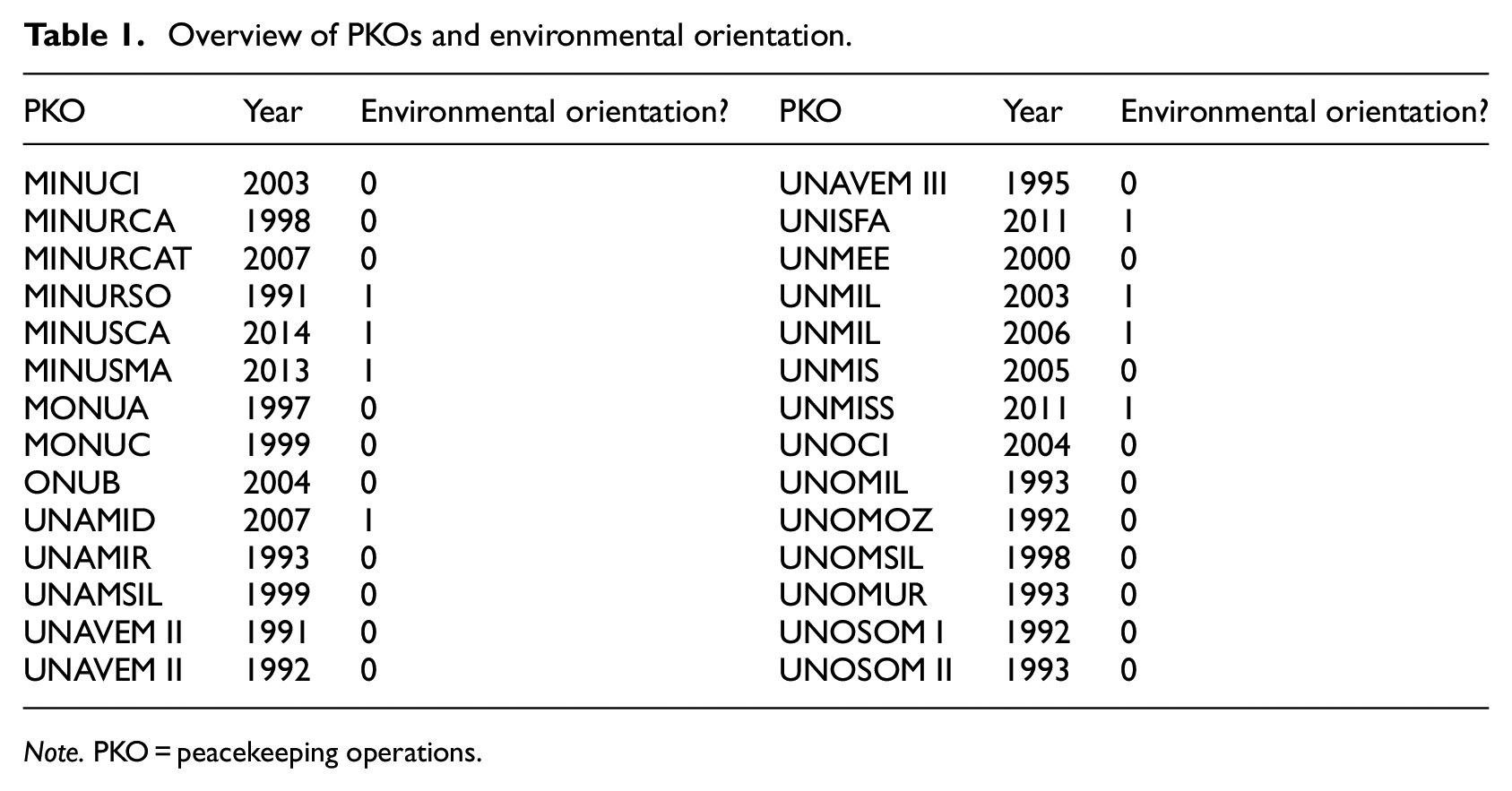
The first analysis relies on a data sample comprising UN PKOs in Africa since the year 1991. These missions I analyze are taken from and based on the PEMA dataset by Di Salvatore et al. (2022). Using this source, I first identified all PEMA PKOs in Africa after 1991. The unit of analysis in the PEMA data is a UN Security Council resolution and, hence, the data code multiple resolutions per mission. For example, there are several data entries for one mission when operations are renewed or confirmed—even if the underlying resolution is not altered. As described in the next paragraph, my data on missions’ environmental orientation is time-invariant, that is, there is no temporal variation within missions, but only across. To avoid a duplication of cases and an artificial inflation of the number of observations in light of this, I only focus on “new” missions, that is, the first resolution for each operation (Di Salvatore et al., 2022, p. 936). To this end, each mission since 1991 has one observation in my final dataset. Any additional observation per UN intervention that may be coded in the PEMA data because a mission mandate is adjusted or an unchanged resolution is renewed for a deployment has been discarded from my analysis. According to this approach, I could identify 28 cases (UN PKOs initiated) between 1991 and 2017 (Table 1, alphabetically sorted).
Overview of PKOs and environmental orientation.
Note. PKO = peacekeeping operations.
I then created a dichotomous variable on whether a PKO has an environmental orientation (1) or not (0) drawing on information from a UNEP (2012, p. 10) report and Maertens and Shoshan (2018, p. 12). I coded a deployment’s “green orientation” based on missions’ actual mandate texts (resolutions), but also on indirect mandates of an intervention and mission activities on the ground authorized by general UN policies such as the UN Department of Field Support’s 2009 Environmental Policy or the 2016 Environment Strategy. For example, the mandate of the UNMIL mission in Liberia (2003–2018) expressed explicitly environmental goals. And recall the peacekeepers of UNMIS (Sudan, 2005–2011) who had an indirect mandate to promote environmental protection.” Finally, some deployments do not refer to environmental issues in their mandate directly or indirectly, but comprise units or officers entirely dedicated to environmental issues. Such missions, for example, MONUSCO (Democratic Republic of the Congo) with their “Environmental Protection” unit, are also coded as interventions with an environmental orientation. According to this approach, the environmental orientation of missions is not only based on UN resolutions, but frequently comprises actual activities (via officers or units) on the ground and, thus, not just some “loose commitments on paper.” I could identify eight cases of UN PKOs initiated that had an environmental orientation when established between 1991 and 2017 (about 28.57% of all missions since 1991, Table 1): MINURSO, MINUSCA, MINUSMA, MONUSCO, UNAMID, UNISFA, UNMIL, and UNMISS.
I combine this information with two indicators capturing climate-change-related/environmental stress. On one hand, there is the variable Temperature Deviation. This variable measures the country-level (country-year average) surface temperature change (in Degree Celsius) with respect to a baseline climatology. This latter benchmark corresponds to the period 1951 to 1980. The data are taken from the Global Surface Temperature Change (GISTEMP) data, which are distributed by the National Aeronautics and Space Administration Goddard Institute for Space Studies. The time series temperature change at a point is calculated as a weighted average of the GISTEMP data over all stations within a given radius, with the closest stations weighted most heavily. 2 For example, a value of 0.341 for Angola in 1991 indicates that the mean surface temperature in that country-year deviated from the baseline surface temperature of 1951 to 1980 by 0.341°C. I measure this item in the year before a UN PKO (with or without an environmental orientation) has been established to avoid problems of endogeneity (see also Blair et al., 2023). According to my theoretical argument, I expect that environmental orientations correlate with higher temperature deviations from the baseline in 1951 to 1980: more strongly pronounced surface temperature changes signify greater environmental or climate-change-related stress and, thus, signal that these cases are in need for a more strongly established environmental commitment.
On the other hand, I employ the Emergency Events Database from the Center for Research on the Epidemiology of Disasters. 3 In this dataset, a disaster is defined as a “situation or event, which overwhelms local capacity, necessitating a request to national or international level for external assistance; an unforeseen and often sudden event that causes great damage, destruction and human suffering. Though often caused by nature, disasters can have human origins.” I focus on the frequency of such disasters per country-year that are climate-change related. Climate-change-related disasters belong to either of the following types of events: droughts, extreme temperatures, floods, landslides, storms, or wildfires. As in the case of the previous environmental stress variable, the item Environmental Disasters is temporally lagged by 1 year, that is, the data are based on the year before a UN PKO has been established. A value of 3, for instance, such as in Chad in 2007, means that this country has suffered from three climate-change-related disasters in the previous year. More climate-associated disasters likely increase the environmental stress on a country and then signal to the UN that this could be an “environmentally difficult case.” Hence, I expect more environmental disasters to be correlated with PKOs’ environmental orientation.
A comprehensive quantitative analysis is not possible as the dataset is simply too small for large-sample inference. For example, the asymptotic properties of maximum-likelihood estimation are not met with a sample size of N = 28. Hence, my analysis is of a more descriptive, exploratory nature. The approach is inspired by Krampe’s (2021) report on UN peace operations and climate change and, to this end, I present descriptive statistics of the key “explanatory” variables of Temperature Deviation and Environmental Disasters across UN PKOs with and without an environmental orientation. This overview is accompanied by the discussion of the variables’ correlations where I use Pearson’s r and Spearman’s rank correlation.
Pearson’s r is the coefficient of correlation that measures the strength of a linear relationship between two variables, for example, x and y. It is calculated by:

with σx being the standard deviation of the variable x and σy standing for the standard deviation of the variable y. Pearson’s r ranges between −1 and 1: values approaching −1 signify a stronger negative relationship, that is, higher values of one variable relate to lower values of the other variable. If Pearson’s r approaches 1, this represents a stronger positive relationship, that is, higher values of one variable relate to higher values of the other variable. A value of near or equal to 0 implies little or no linear relationship between the two items x and y.
I also present the Spearman rank correlation. In general, rank correlations sort the observations by rank and compute the level of similarity between the rank. Such measures have the advantage of being robust to outliers and not being linked to the data’s distribution. The Spearman rank correlation is non-parametric and also suitable for measuring the strength and direction of association between two variables on an ordinal scale. It is calculated by:

with the numerator capturing the covariances between rank x and y. In the denominator, there are the respective standard deviations. Spearman’s correlation ranges, as Pearson’s r, in [−1; 1] with a value approximating −1 (1) standing for a stronger negative (positive) relationship.
I also present a two-sample t-test, which I employ to determine whether the variables’ means are equal across UN PKOs with and without environmental orientation. As there are more PKOs without an environmental orientation than missions with “green values,” the data are unpaired. The test statistic I calculate is defined as:

with
The last part of the first empirical analysis presents predicted probabilities. While the asymptotic properties of maximum likelihood estimation are clearly not met with a sample of N = 28, I have produced graphs that plot the predicted probabilities of PKOs with an environmental orientation based on a simple logistic regression model using the following equation:

with
In the descriptive analyses of the next section, I do not consider other influences such as population or income that are frequently added to empirical models on environmental politics (see Kammerlander & Schulze, 2021). However, I return to this in Supplemental Appendix where I introduce these two controls for a short analysis. The data for population and income (constant 2015 US Dollars) are taken from the World Bank Development Indicators. These items are lagged by 1 year to avoid issues stemming from post-treatment bias and to address concerns over alternative influences. Their operationalization as well as data sources are presented in Supplemental Appendix.
Finally, I have conducted a more qualitative analysis that focuses on the UN Assistance Mission in Somalia (UNSOM). This deployment is a special political mission established in the Somali capital of Mogadishu in June 2013. It is mandated by the Security Council to work with the Federal Government of Somalia and federal member states to support national reconciliation, provide strategic and policy advice on various aspects of peacebuilding and state-building, to monitor human rights, and help coordinate the efforts of the international community. 4 The qualitative analysis is based on primary material such as the mission mandate and secondary material taken from SIPRI (Eklöw & Krampe, 2019; Krampe, 2021; SIPRI, 2021).
4. Empirical findings
The empirical analysis comprises a descriptive quantitative part, which is complemented by a brief qualitative analysis of peacekeeping in Somalia. I begin with an overview of the distribution of the three core variables, that is, Environmental Orientation, Temperature Deviation, and Environmental Disasters) in each host country since 1991. Figure 1 comprises three panels (maps) of Africa: the first (left) panel captures whether a PKO had an environmental orientation or not, the middle panel is about temperature deviations from the long-term benchmark 1 year before peacekeepers were deployed, and the right panel captures the number of disasters in the year prior to the establishment of a UN PKO. In the left panel, the eight PKOs with an environmental orientation are included in six countries. These six countries seem particularly affected by temperature deviations as shown in the middle panel. The relationship between Environmental Orientation and Environmental Disasters is less clear, though, according to the right panel in Figure 1, but this could also be driven by the lower amount of variation in Environmental Disasters. While there seems to be some sort of relationship among the three core variables, a more systematic approach is in need.
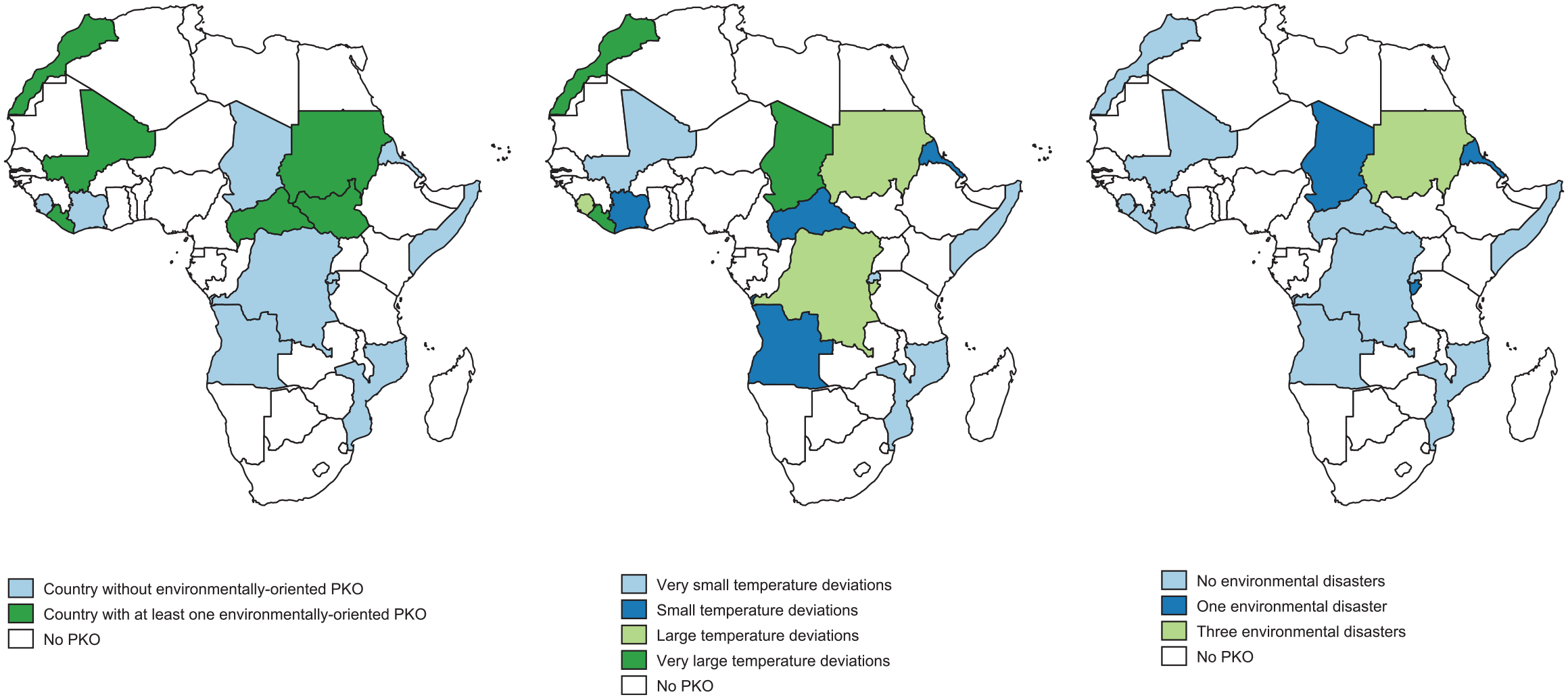
Distribution of key variables across African peacekeeping missions, 1991 to 2017.
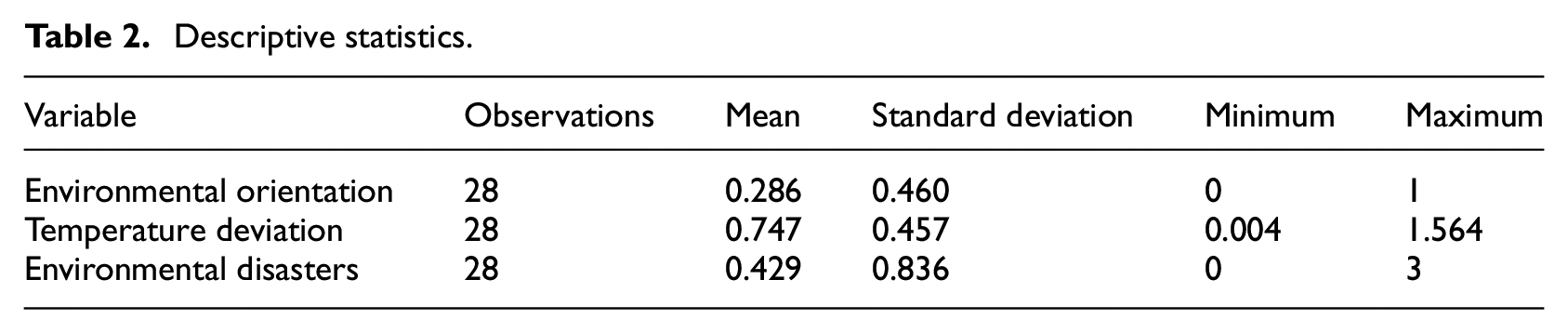
I thus continue with the descriptive statistics for the core variables of interest (Table 2): Environmental Orientation, Temperature Deviation, and Environmental Disasters. First, Environmental Orientation has a mean value of 0.286, which suggests that almost 29% of all peacekeeping operations in my dataset have an environmental orientation via their mandate and/or their activities on the ground. Clearly, the small sample size is an issue, but it is impressive nonetheless that almost one-third of the cases examined deal with environmental issues explicitly. Second, the first indicator for countries’ exposure to climate change and environmental stress, Temperature Deviation, has a mean value of 0.747. This means that the average temperature deviation from the long-term benchmark is slightly larger than 0.7°C. The item ranges between 0.004°C and 1.564°C, and thus is characterized by a sufficient amount of variation. Third, the second indicator for countries’ exposure to climate change and environmental stress, Environmental Disasters, ranges between 0 and 3, highlighting that a country has seen up to three environmentally related disasters in the year before the deployment of peacekeeping troops. The mean value approaches 0, however, as it is calculated at 0.429.
Descriptive statistics.
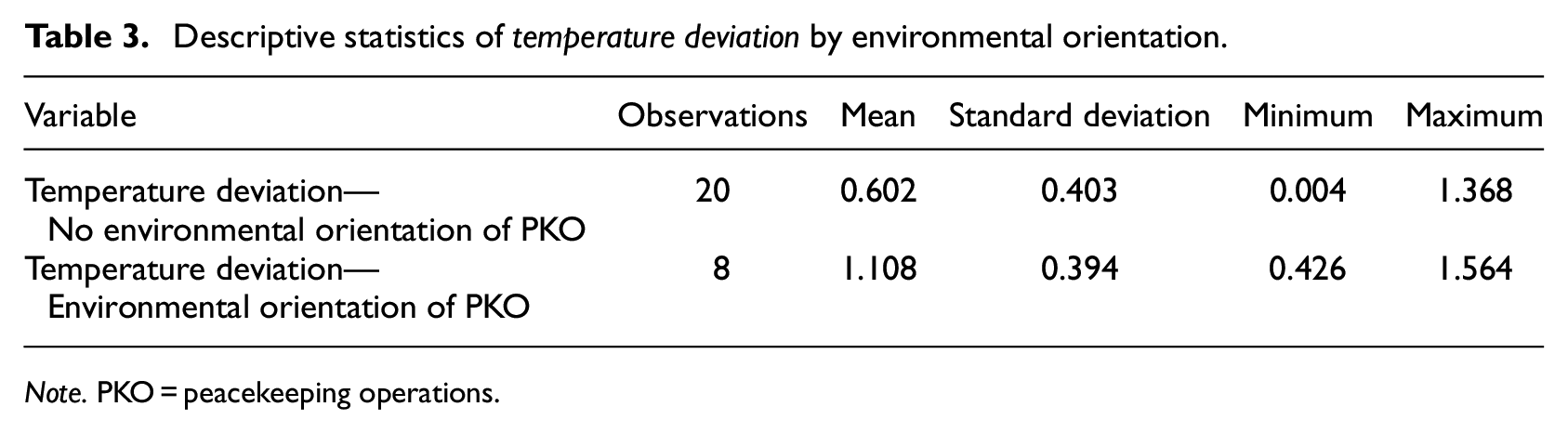
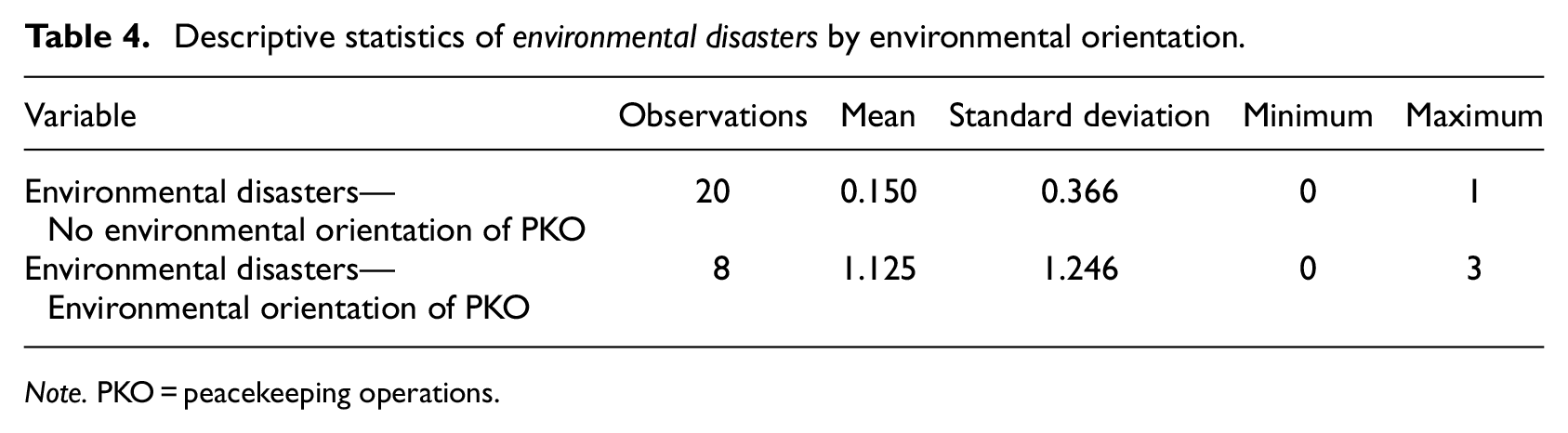
Tables 3 and 4 also present descriptive statistics for Temperature Deviation and Environmental Disasters, respectively, but I now split the samples into PKOs with and without an environmental orientation. With regard to Temperature Deviation (Table 3), we can see that the sample is now divided into 20 PKOs without an environmental orientation and eight missions with environmental elements. In the former group, the mean temperature deviation from the long-term benchmark is slightly larger than 0.6°C. Having said that, in the latter group, that is, PKOs with an environmental orientation, the average temperature deviation is calculated at 1.108°C. Evidently, the mean temperature deviation from the long-term country benchmark is higher in the environmental-orientation group. A similar picture emerges for Environmental Disasters: the mean value of disasters in the year before a peacekeeping intervention has been set up is 0.15; this starkly contrasts with 1.125 disasters on average in the year prior to a deployment when focusing on the eight environmentally oriented PKOs. In sum, the evidence presented in Tables 3 and 4 mirrors to a large degree the maps of Figure 1, but it is more systematic. And, ultimately, the association between PKOs’ environmental orientation and climate/environmental stress emerges more clearly: stronger temperature deviations and more disasters in the year before a deployment seem to be linked to the establishment of an environmental orientation for PKOs.
Descriptive statistics of temperature deviation by environmental orientation.
Note. PKO = peacekeeping operations.
Descriptive statistics of environmental disasters by environmental orientation.
Note. PKO = peacekeeping operations.
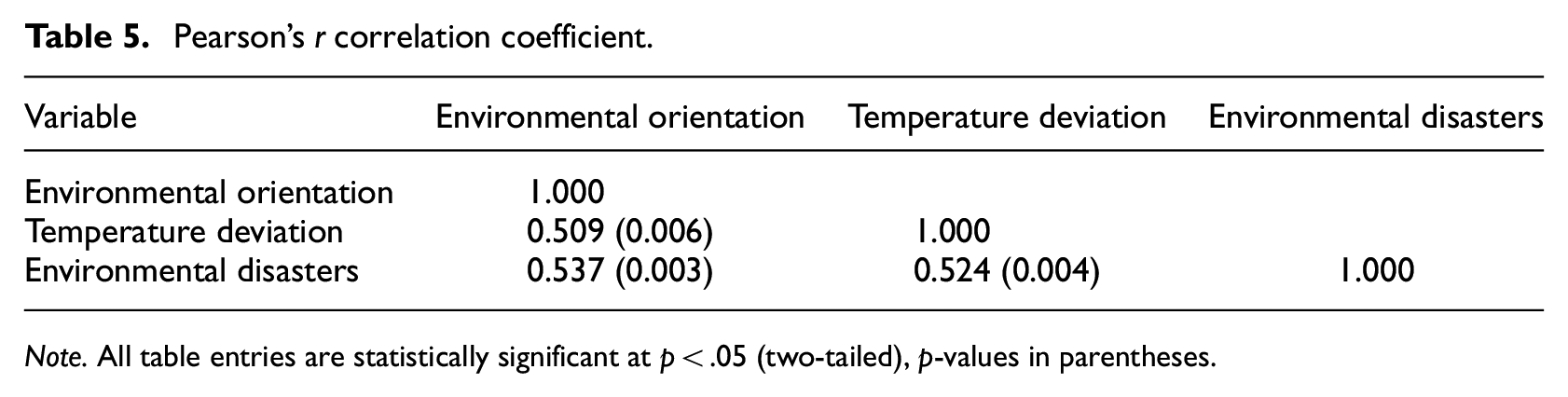
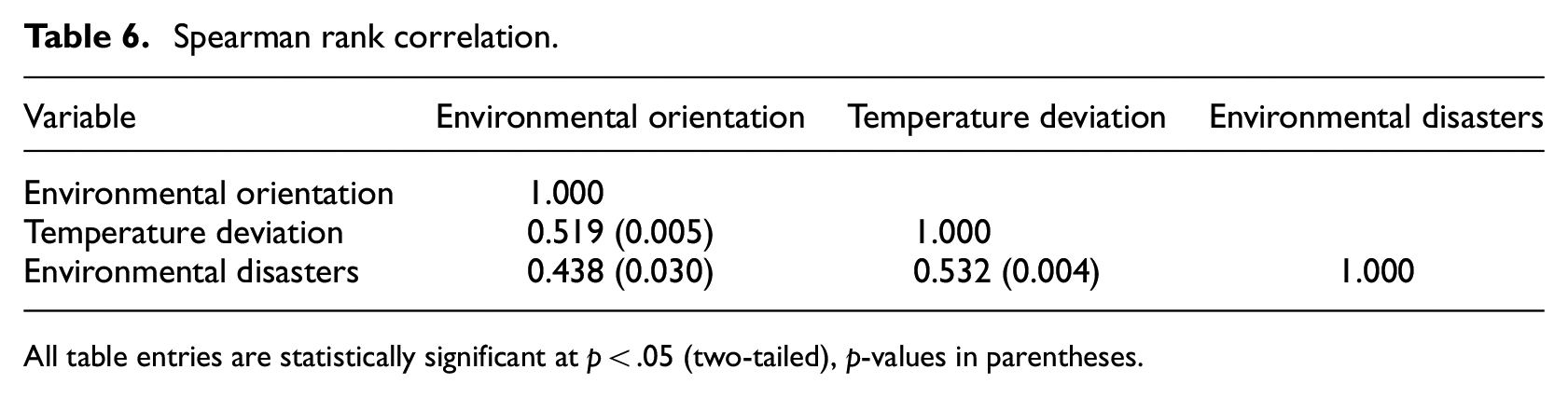
But how strongly pronounced are these relationships? To answer this question, I present Pearson’s r and Spearman’s rank correlation in Table 5 and Table 6, respectively. First, both explanatory variables, that is, Temperature Deviation and Environmental Disasters, correlate quite highly with each other. The calculated Pearson’s r is 0.524, the Spearman rank correlation is estimated at 0.532 (both statistics are statistically significant at the 1% level). This suggests that the two variables capture the same, latent dimension of climate/environmental stress. Second, both explanatory variables do also correlate highly with the outcome variable, Environmental Orientation. Pearson’s r is estimated at higher than 0.5, while Spearman’s rank correlation ranges in [0.438; 0.519]. All values are statistically significant at least at the 5% level. In sum, Tables 5 and 6 highlight that Environmental Orientation strongly and positively correlates with Temperature Deviation and Environmental Disasters: if climate-related and environmental stress is higher in (potential) deployment countries, the likelihood of PKOs having an environmental orientation increases as well.
Pearson’s r correlation coefficient.
Note. All table entries are statistically significant at p < .05 (two-tailed), p-values in parentheses.
Spearman rank correlation.
All table entries are statistically significant at p < .05 (two-tailed), p-values in parentheses.
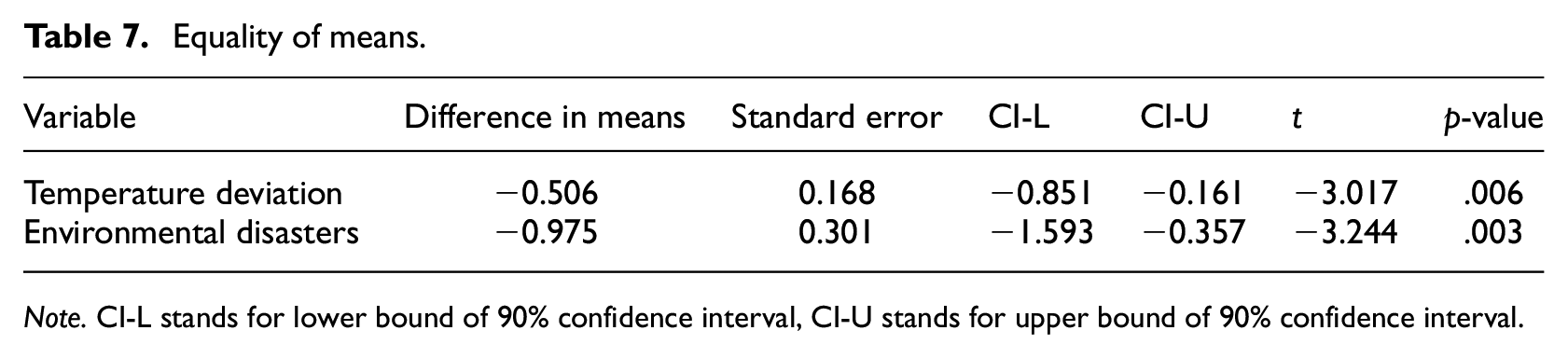
Two final statistics or quantities of interest further support my theoretical argument. On one hand, Table 7 presents the results of two two-sample t-tests: using Environmental Orientation as the treatment, I examine whether the means of Temperature Deviation and Environmental Disasters are statistically significantly different across treatment and control groups. According to Table 7, the mean value in each “untreated group” (PKO cases without environmental orientation) is lower than in each treated group, that is, PKO cases that have an environmental orientation. For Temperature Deviation, this difference is calculated at −0.506, for Environmental Disasters we obtain −0.975. Both values are statistically significant below the 1% level. Hence, the values and distribution of either explanatory variable are significantly different for PKOs with an environmental orientation and those without; what is more, this difference is negative, that is, higher climate/environmental stress is associated with a higher likelihood of PKOs having an environmental orientation.
Equality of means.
Note. CI-L stands for lower bound of 90% confidence interval, CI-U stands for upper bound of 90% confidence interval.
On the other hand, Figure 2 plots the predicted probabilities of Environmental Orientation equaling 1 for the values of Temperature Deviation and Environmental Disasters, respectively. For low values of Temperature Deviation, that is, the first quartile of the original variable’s distribution, the likelihood of an environmental orientation for PKOs is virtually 0; however, when approaching the maximum level of Temperature Deviation, this likelihood increases to almost 75%. In terms of the frequency of environmental disasters, the likelihood of an environmental orientation is around 20% when there were no climate-related disasters in the year before deployment; the chances to see an environmental orientation do increase to almost 100%, though, when there were at least three disasters in the year before peacekeeping troops were deployed.
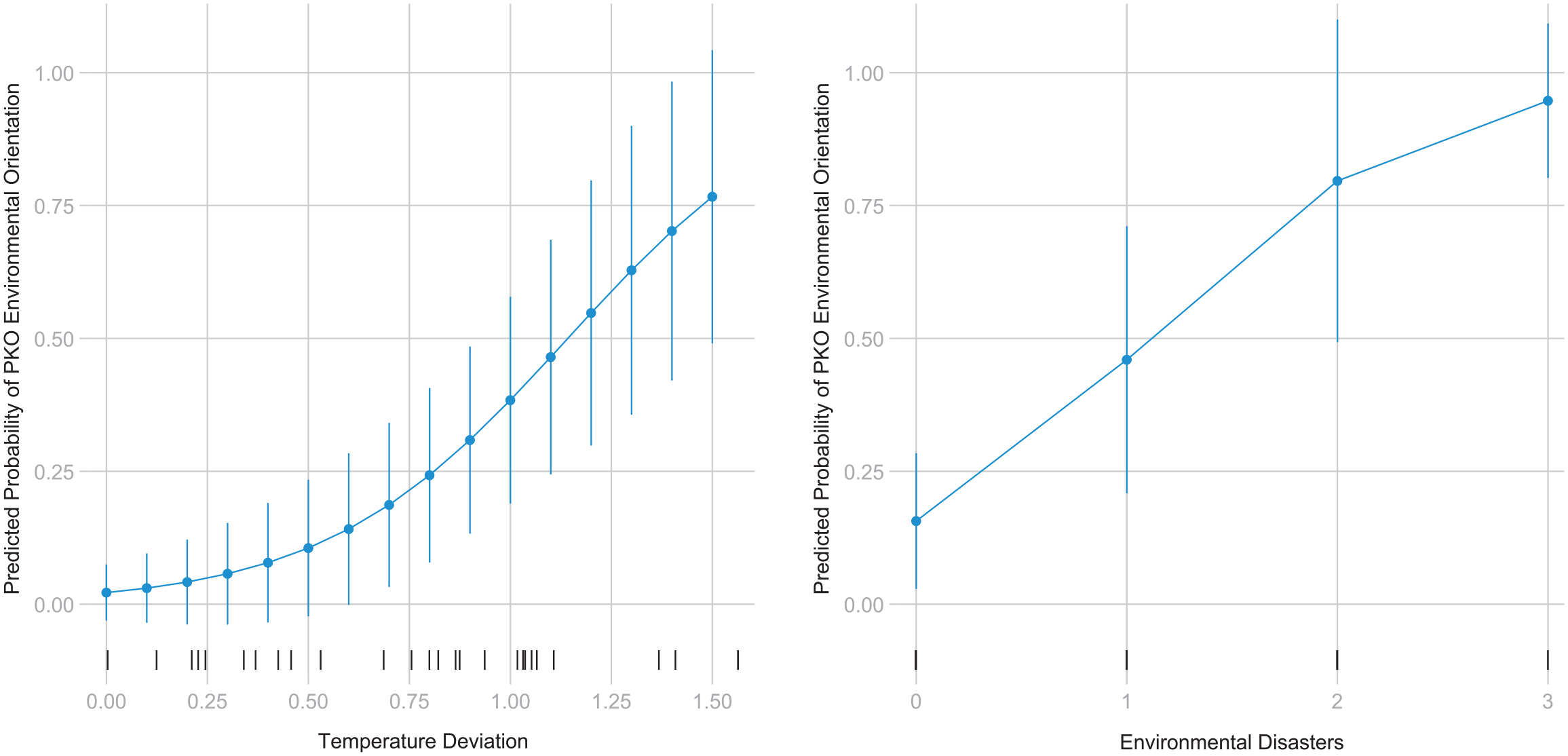
Predicted probabilities of PKOs’ environmental orientation.
In sum, the available quantitative evidence highlights that climate-change-related vulnerability and environmental stress are related to whether PKOs have an environmental orientation or not. In Supplemental Appendix, I provide robustness checks that support this conclusion, including analyses on variables that are lagged by 2 or 3 years, a robustness check on the total number of climate-related disasters until a specific point in time (not only the disasters in the year prior to a deployment), the estimation of linear probability models with and without a limited number of control variables, and an examination of potential confounding variables (population and income). And there is qualitative evidence based on UN peacekeeping in Somalia supporting the theoretical arguments I develop above on environmental stress and missions’ green orientation as I have analyzed UN Security Council Resolution 2408 and a number of SIPRI reports on peacekeeping and peacebuilding in Somalia (Eklöw & Krampe, 2019; Krampe, 2021; SIPRI, 2021). I have selected Somalia as a case study mainly due to three reasons. First, Somalia has an active peacekeeping mission: the United Nations Assistance Mission in Somalia (UNSOM) was established in 2013 by UN Security Council Resolution 2102. This mandate was renewed by several resolutions afterwards, including resolution 2408. Second, the UNSOM mission has not yet been included in the PEMA data (Di Salvatore et al., 2022). Hence, since UNSOM is not part of my analysis above, the qualitative evidence presented in the following does not duplicate the quantitative results. Third, Somalia is a country that is heavily exposed to the adverse effects of climate change and, given the lack of state capacity, it is highly vulnerable to climate-change-related and environmental stress (Eklöw & Krampe, 2019, p. 10ff; SIPRI, 2021). Against this background, Somalia seems like a most-likely case for the postulated mechanisms: if there is no evidence here that the UN have implemented an environmental orientation in light of Somalia’s exposure to climate-change-related stress, it would be unlikely to find such evidence elsewhere (Goertz & Mahoney, 2009).
Yet, the available qualitative evidence stresses that an environmental orientation has indeed been implemented in direct response to Somalia’s vulnerability to climate change and environmental degradation. The UNSOM mission was established by UN Security Council Resolution 2102. While this resolution does not comprise any references to climate or environmental stress, Resolution 2408 that renewed the mandate in 2018 does. That is, the resolution states on p. 3 that the Security Council is “[r]ecalling its Presidential statement S/PRST/2011/15, recognizing the adverse effects of climate change, ecological changes and natural disasters among other factors on the stability of Somalia, including through drought, desertification, land degradation, and food insecurity, and emphasizing the need for adequate risk assessments and risk management strategies by governments and the United Nations relating to these factors.” According to Krampe (2021), this constitutes a direct call to report on climate-related security risks and manifests that UNSOM has been set up as “climate sensitive.” In other words, the environmental orientation for the mission has been established.
Furthermore, Krampe (2021) outlined how a number of climate-change-related activities have been set up in direct response to climate vulnerability and environmental stress: “climate-related issues have increased the pressure on an already overburdened and under-equipped governance and judicial system. They have moreover directly inhibited the work of the UNSOM. UNSOM has responded with promising initiatives such as the development of a Recovery and Resilience Framework, the establishment of Drought Operations Coordination Centers, and the appointment of an environmental security adviser.” This is echoed by the SIPRI (2021) report, which describes that “[m]ore frequent and intense droughts and floods undermine food security and worsen livelihood conditions in Somalia, adversely affecting marginalized groups, fueling grievances, increasing competition over scarce resources and exacerbating existing community tensions and vulnerabilities.” In turn, the “UN Security Council (UNSC) has requested UNSOM and the African Union Mission in Somalia (AMISOM) to include climate-related security risks in their reporting.”
Finally, Eklöw and Krampe (2019, p. 18ff) stated as well that “UNSOM has responded to the increasing impact of climate-related change.” According to their assessment, important measures such as Drought Operations Coordination Centers, the Recovery and Resilience Framework, and environmental security advisers were established in response to climate-related stress. These PKO activities on the ground are indeed meant to further the long-term goal of “a sustainable and resilient society.”
5. Conclusion
UN peacekeeping missions increasingly have an environmental orientation, not only regarding their own, that is, missions’ environmental footprint but also in terms of environmental quality and protection of the host country generally. Empirical evidence suggesting that including environmental elements in PKOs has a positive impact does indeed exist (e.g., Bakaki & Böhmelt 2021; Leloup & Maertens, 2023; Maertens & Shoshan, 2018; Maertens, 2019), but our understanding of what determines peacekeepers’ consideration of the environment in the first place is limited. Given that the assignment of missions to host countries is not a random process (see Fortna, 2004; Fortna & Howard, 2008; Gilligan & Sergenti, 2008; Gilligan & Stedman, 2003; Walter et al., 2021), this article sought to contribute to this debate by exploring the inclusion of an environmental orientation in African PKOs since the end of the Cold War. The results emphasize that missions seem to be more likely to have a green orientation when climate-change-related vulnerability and environmental stress are high.
This finding hopefully informs the research on PKOs and the environment and, specifically, studies on “green peacekeepers” (e.g., Leloup & Maertens, 2023; Maertens, 2019; Maertens & Shoshan, 2018). Most importantly, I have advanced two mechanisms that link environmental stress to PKOs’ environmental mission orientation. First, a direct mechanism—PKOs go green because they need to, having been deployed to a conflict-affected setting experiencing environmental stress. Second, there is an indirect mechanism that postulates that PKOs assume an environmental orientation as they realize doing so will accelerate the peacebuilding process. As indicated, these two mechanisms are not competing, but rather complementary. It would be interesting to explore, also from a policy perspective, which of these mechanisms receives more empirical support. While I cannot tease out these mechanisms with the data material at hand, it may be an effort worth making for future work to extend qualitative and quantitative work along those lines.
Supplemental Material
sj-docx-1-eas-10.1177_27538796231221176 – Supplemental material for When are peacekeepers “green?”
Supplemental material, sj-docx-1-eas-10.1177_27538796231221176 for When are peacekeepers “green?” by Tobias Böhmelt in Environment and Security
Footnotes
Funding
The author received no financial support for the research, authorship, and/or publication of this article.

Data availability
The data will be made publicly available via the Harvard Dataverse upon publication of the article.
Supplemental material
Supplemental material for this article is available online.
Notes
Author Biography
References
Supplementary Material
Please find the following supplemental material available below.
For Open Access articles published under a Creative Commons License, all supplemental material carries the same license as the article it is associated with.
For non-Open Access articles published, all supplemental material carries a non-exclusive license, and permission requests for re-use of supplemental material or any part of supplemental material shall be sent directly to the copyright owner as specified in the copyright notice associated with the article.
