



Abstract
This article draws on my PhD thesis ‘Duplicate, Copy, Print: Towards a Material History of the Zine’, in order to explore the ways in which specific technologies, such as the stencil and spirit duplicator, photocopier, risograph and digital inkjet, have impacted zine production and zine culture. I propose a sociotechnical understanding of zines and how they are created, drawing on emerging theoretical turns within book theory and wider media theory, which seeks to ground the emerging field of Zine Studies within a materialist media theoretical framework.
While the academic study of zines has significantly increased over the last decade, a dedicated field of Zine Studies is still emerging. While most research into zines to date has had a sociological underpinning, related to specific subcultures or the role of zines within wider movements, little attention has been given to their material form and the influence of certain technologies of production on their materiality, and how this materiality impacts the zines function within subcultural identity and community formation, often treating the zines materiality as an extraneous element, subordinate to the textual or visual content, rather than a co-constitutive part of it.
This article draws on archival research to outline some specific examples of zines relationship to their technologies of production over the last century, starting from the coining of the term ‘fanzine’ in 1940, up to the postdigital zines of today, in order to outline the ways in which contemporary zine production maintains and diverges from the ways zines have historically enacted their iconic properties of DIY, anti-mainstream, intimacy and intensity. This article argues that zines are instructional, dialogic, and communally produced, and that these factors, integral to zine culture, are informed through the technologies used in their production and performed through the materiality of the zine object.
This article is intended as an introduction to the relationship between different technologies of production and zine cultures, in order to propose a materially focused study of zines. 1 It touches on three stages in the ‘canon’ of zine history, through examples that utilise three technologies that loosely map onto these stages: the stencil and spirit duplicator in relation to the production of early science fiction fanzines, the photocopier, and contemporary digital inkjet print. I argue that zines are instructional, dialogic and communally produced, and in lieu of a concrete definition of what is or isn't a zine, utilise the iconic properties of the zine as outlined by Ash Watson and Andy Bennett in their article ‘The Felt Value of Reading Zines’ (2021); their DIY ethos and aesthetic, anti-mainstream positioning, intimacy, and intensity. These properties, integral to zine culture and the constructed identities of its participants, are informed through the technologies used in their production and performed through the materiality of the zine object.
Though a field of ‘zine studies' is growing year-by-year, to date the majority of academic work around zines have been sociological studies with a focus on their underground, radical or political position (for example, Stephen Duncombe's Notes from underground: zines and the politics of alternative culture (1997, updated and revised 2008) and Chris Atton's Alternative Media (2002), their role within specific subcultures (Guerra and Quintela, 2020; Subcultures Network, 2019; Wertham, 1973, etc), or their use within identity formation (Bailey and Michel, n.d,; Piepmeier 2009; Radway 2011). All studies of zines inevitably grapple with the specificity of their materiality, and the impact that it has on the function of the zine within the specific context the authors are writing about, and there have been a handful of important interventions in recent years, following from Alison Piepmeiers article ‘Why Zines Matter: Materiality and the Creation of Embodied Community’ (2008) and including Ash Watson and Andy Bennett's ‘The Felt Value of Reading Zines’ (2021), both of which explore the ways in which zine makers’ decisions in relation to their zines material form help to enact and emphasise their textual content. Both these articles perform a close reading of a zine's materiality to better assess the ways in which zines constitute an ‘embodied community’ (Piepmeier) or create meaning (Watson and Bennett). Similarly, recent work by Miloš Hroch, ‘Not Out of Date, but Out of Time: The Materiality of Zines and Post-digital Memory’ (2020) and with Nico Carpentier ‘Beyond the Meaning of Zines: A Case Study of the Role of Materiality in four Prague-Based Zine Assemblages’ (2021), explores the zines’ materiality within a contemporary, postdigital context.
I use the terms materiality and material here to signify the inextricable relationship between the ‘work’ itself, often meaning the textual content of a publication, and its methods of production and dissemination. A focus on this relationship between the materiality of the zine and its shifting function over time draws on the recent material turn in book historical discourse (Adema, 2021; Drucker, 2009; McGann, 1991, 2001; Senchyne, 2018), and in particular on work around the material text; what Jerome J. McGann calls the ‘textual material’ (1991), the paratextual, or in Anne Royston's preferred term ‘nonsemantic’ (2019). This includes ‘typefaces, bindings, book prices, page format’ (McGann, 1991: 27) and so on. The inclusion of the nonsemantic elements of a text in what it does also connects to the distributed understanding of the book present in other recent scholarship in this field, particularly the idea of performative materiality as outlined by Johanna Drucker (2009, 2014), and work on the processual nature of the book in the work of Janneke Adema (2021); Whitney Trettien (2021), and others (Gillespie and Lynch, 2020). This discourse engages with ideas developed by Robert Darnton (1982, 2007) and Adrian Johns (1998), which attempt to decentre the book object within the history and study of the book, and draw attention to the wider network of printers, distributors and readers in constituting the book itself. Here, I draw comparison to the nature of zine identification, which is reliant on a community and social understanding of what constitutes a ‘zine’, due to the inconsistent and varied production methods and content of zines (their diversity being a constitutive factor of their ‘zineness’).
Materiality is also used in the wider sense of materialist media theory, of what Jussi Parikka calls ‘media materialism’, referring ‘to technology as an active agent in the ontological and epistemological sense’ (2015: 1). Materialist media theory has its origins in the medium theory of Marshall McLuhan (2010) and was developed further by Friedrich Kittler, who argued that in order to understand a medium one must have an understanding of the technical aspects that produce it (1999; Kittler and Enns, 2009). For a study of zines, this inclusion of the material is key to understanding what zines do, and this materiality is informed through an assemblage of social and technical factors that interrelate in a processual and recursive manner. The materiality of the zine is ‘performed’ in the sense outlined by Johanna Drucker, in which a book (or zine), is ‘conceived as a distributed object, not a thing, but a set of intersecting events, material conditions, and activities’ (2014: 12). This is an instructive and inclusive method with which to explore zines, that allows for each of the elements of this assemblage to be acknowledged, including the technologies of production.
Of course, the question of materiality and its influence on and representation of zine culture has been most significantly engaged with in zines themselves, which is why I choose here to focus on examples of zines in order to engage directly with a discourse that has been self-organised for decades. To begin, I’d like to look at a title whereby materiality and technologies of fanzine production form an integral part of the text (Figure 1).
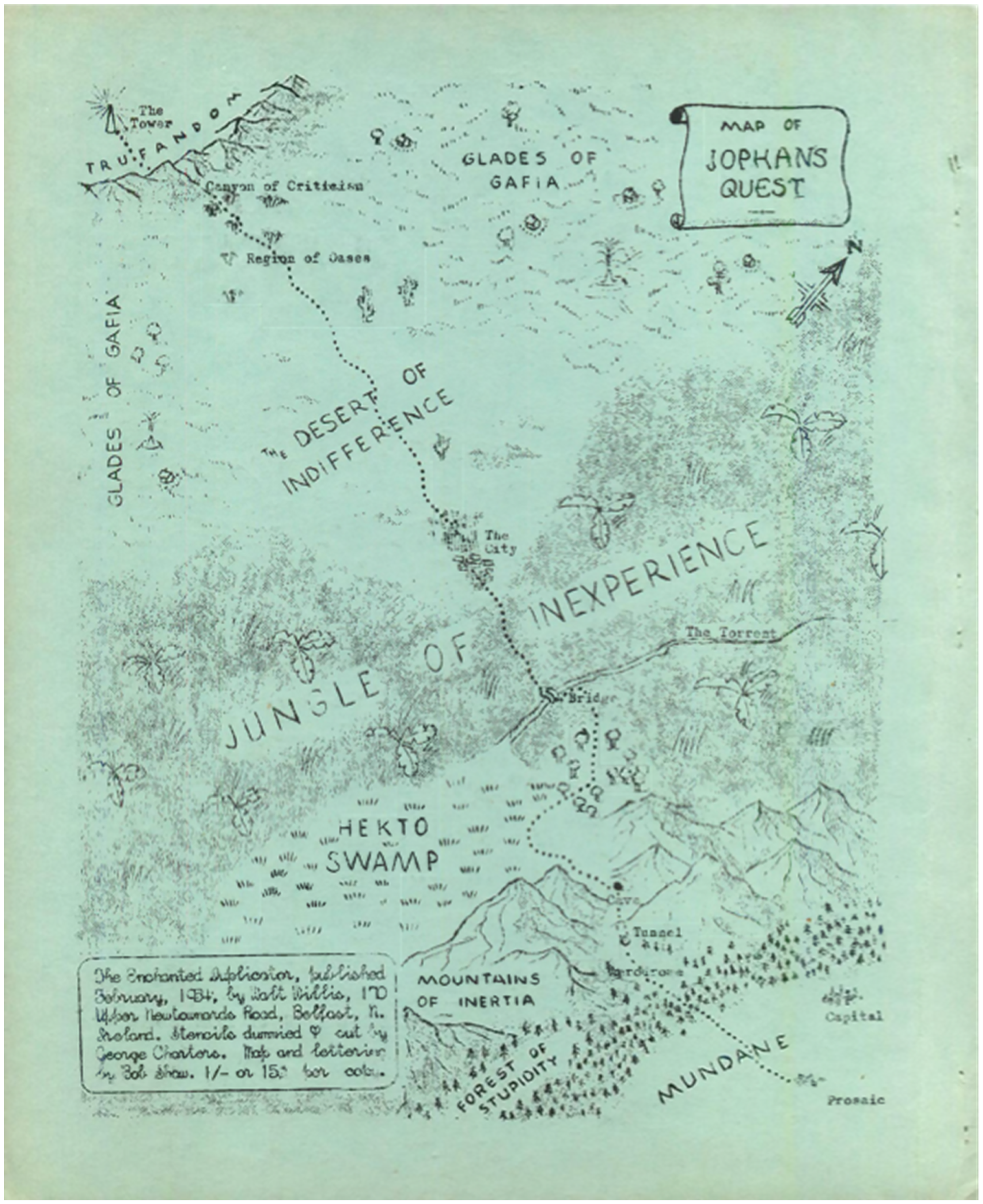
Page two of The Enchanted Duplicator © FANAC.org.
Duplicate
The first example I’d like to look at is The Enchanted Duplicator, a fanzine from the science fiction milieu of the 1950s. Hugo Gernsback, editor and publisher of Amazing Stories, had kick-started science fiction fandom in the 1930s with his inclusion of a letter column that not only published regular letters sent in by fans from across the country, but also printed the full name and address of each correspondent. This small act immediately sparked inter-connections of letter writing from fan-to-fan rather than fan-to-magazine, leading to the formation of local fan-clubs of like-minded (primarily) young men, to meet and discuss recent scientific developments and popular science fiction works. The earliest of these was the Science Correspondence Club, sponsored by Gernsback himself, who are often afforded the prestige of producing the first science fiction fanzine in their club bulletin The Comet which was published on a mimeograph stencil duplicator in May of 1930 (Moskowitz, 1974: 8–9; Ross, 1991: 114). As more clubs developed, so did the production of a whole wave of these club-zines, and later fanzines produced by individuals (Ashley, 1974: 25; Moskowitz, 1974: 5).
A historical account of this early science fiction fandom can be found in Sam Moskowitz's The Immortal Storm (1954) and Harry Warner Jr's All Our Yesterdays (1969), both of which cover the United States, Rob Hansen's extensive THEN, Science Fiction Fandom in the UK: 1930–1980 (1987–1993), covering the United Kingdom, as well as Fredric Wertham's survey of fan publications The World of Fanzines (1973). All offer a detailed description of the main events, players and, crucially, publications involved, but I want instead to turn to a zine that encapsulates many of the key cultural characteristics of this fandom both in content and in form.
Published in an edition of 200 copies in 1954 by Walt Willis and Bob Shaw, The Enchanted Duplicator is a 28-page mimeograph-printed parable, tracing the quest of Jophan as he leaves his home in the country of Mundane to travel to Trufandom, in search of the titular duplicator with which to produce the ‘Perfect Fanzine’. A defining text of science fiction fandom, The Enchanted Duplicator can be read both as a historical snapshot of a community in its second decade, an insular document with in-jokes and references understood only by those in the know, and as an instructional guide to producing your own fanzine. Key throughout are references to various printing and publishing technologies, reflecting the importance of publishing in facilitating fandom itself. Jophan passes through the ‘inky blackness’ of a tunnel while riding the Letter Press Railroad, where passengers must disembark periodically to re-lay the track they’ve just travelled on in front of the train to continue their journey – a reflection of the fanzine publisher dismantling and resetting each new page of type. He avoids the Hekto Swamp, whose horrible purple stains clog its victims’ mouths and nostrils. They can only be saved by clinging onto ‘Slip Sheets’ that help those stranded escape –nbsp;a reference to the aniline dye, purple or violet in colour that characterises the ink used by a hectograph duplicator, heavily prevalent in early fanzines representing the low-end of production both in cost and quality. The hectograph reproduced type or handwritten text and drawings, and despite the names implication, could produce a maximum of 50–60 copies before its gelatine pad dried out. Because of its messy operation, one would often have to interleave the printed pages with blank ones, called slip sheets, to stop the ink from rubbing off onto the back of each page.
At the end of Jophans quest, he eventually arrives at the Tower of Trufandom but finds not a gleaming jewel-lined machine but a rusty, inky mimeograph stencil duplicator. Nevertheless, when he starts to crank the handle, a ‘potent force’ flows back and forth between him and the machine, leaving them both changed; ‘FOR THE MAGIC MIMEOGRAPH IS THE ONE WITH A TRUE FAN AT THE HANDLE’.
And so the story ends, the ‘enchantment’ of the title emerging from the interaction between the ‘true fan’ and the machine, an emphasis of intent rather than equipment, the potent force ‘feeding back and forth’ between Jophan and the machine, a summation of the sociotechnical production of zines. The conclusion is a final message of empowerment to the reader that they need not require access to sophisticated print methods, as evidenced in earlier encounters with the Letter Press Railroad, or the brothers Offset and Litho, who threaten to take all of Jophans' money, in order to produce a fanzine and become a ‘true fan’. Within the world of The Enchanted Duplicator these are one and the same, the emphasis being that a true fan is someone who contributes, utilising whatever methods they can. The text emphasises the importance of technologies of production in the makeup of science fiction fandom, it literally is part of the world of Fandom, existing as the very fabric of the landscape that Jophan navigates, personified as individuals, animals or natural phenomena, but the conclusion reminds the reader that technology is not everything, and that an assemblage of the human fan and the technology of production is what generates the perfect fanzine and contributes to sustaining fandom itself.
Andy Sawyer describes The Enchanted Duplicator as a ‘Pilgrims Progress retold as a manual of how to publish a fanzine’ (2004), and this instructional aspect is not just present in the text, but also in the materiality of the zine itself. The publication is 28 printed pages, quarto-sized, stapled twice on the left-hand side with red binding tape running along the makeshift spine. On the reverse of the front cover is a map of the fictional land in which the story is set, a common occurrence in works of the fantasy genre that works to immediately situate the text within this frame of reference. In the bottom left corner is a small box which works as a colophon, listing that The Enchanted Duplicator was first published in February of 1954 by Walt Willis. His address is listed, again a common feature throughout fanzine publishing, in order to facilitate communication between fans. Here, we also learn that the stencils to produce the publication were ‘dummied and cut’ by George Charters, with the map on the same page and the titles that adorn each chapter drawn by Bob Shaw. Additionally, the back cover states that ‘200 copies of this book have been produced on Strathesk Old Gold duplicating paper and Cordelia Anvil Finish cover stock. The type used in the text is that of Mr Charters ‘Standard Monarch Visible Writing Machine. Chapter headings by Varityper’. These inclusions, down to the paper and typefaces used in its production, work as another method to entice the reader to produce a fanzine themselves. By demystifying the processes of production, the text and its materiality show the reader how it was made, down to the name of the typewriter and who it belongs to. This crediting of George Charters, alongside the already collaborative production of Willis and Shaw, again makes visible the communal production of fandom. Willis and Shaw wrote it, Shaw did the illustrations, and Charters used his typewriter to cut the stencils.
Both The Enchanted Duplicator's narrative and materiality therefore reinforce certain central tenets of the science fiction fandom of the 1950s that endure within zine cultures today: that of community, an emphasis on individual contribution based on one's ability, of active participation rather than passive consumption. This participatory element is a key factor within zine culture and is reflected through the materiality of zines themselves. As Chris Atton (2002 : 55) has outlined, zines are inherently dialogic, reflecting the canonical origin of science fiction fandom through the letter pages of Hugo Gernsback's publications, as well as instructional in the ways they are produced, their DIY production methods work to make legible and promote the concept of self-publishing itself.
Copy
This instructional aspect is reflected in the affordances of the photocopier, by far the most iconic of ‘zine technologies’, retaining a continued resonance on zine practices despite it no longer being the most widely used production method. The availability and affordability of copy machines reinforced the notion that zines are an accessible form of self-expression, with a low barrier to entry that facilitates free and open sharing of knowledge. The photocopier offered an immediacy of publishing that suited personal and intra-communal communication and facilitated the high-contrast, low-fidelity, cut-and-paste aesthetic that has become synonymous with punk zines of the 1970s and 1980s and has become a shorthand for the design or anti-design sensibilities of zines in general. This aesthetic can be summarised in Janice Radway's description of zines as ‘collaged pamphlets, with chaotic, cut-and-paste layouts that defy linear scanning, sometimes resist traditional narrative sequencing, and even refuse pagination altogether’ (2011: 121). This common aesthetic of photocopied zines often contains a mix of images (both made and appropriated) and text (either handwritten, typed or in combination, again either made by the zine author themselves, or taken from an external source).
Roughly, the xerographic process that underpins the photocopier works as follows: an image is placed face down on a glass panel, which is then passed over by a strip of light which reflects the image through a lens onto the copier's photoreceptive drum. The drum has been electrically charged so that wherever light hits (the white areas of the image), the charge is grounded, whereas the dark areas of the image remain negatively charged. Toner powder, charged positively, is then distributed over the drum via a roller or a cartridge, particles of the toner affixing to the negatively charged areas of the drum. Paper is then passed over the drum, and a combination of the static electricity and pressure from a roller transfers the toner powder from the drum onto the paper. This paper is finally run through a heat lamp in order to bind the toner powder and the fibres of the paper, and thus, out comes a copy. The xerographic process is then a binary operation; the toner is either charged or not, producing the high-contrast effect. The lens’s shallow depth of field results in a flatness of the image, and the use of the heat lamp to bind the toner with the paper produces a haptic quality to the photocopy that differs from processes whereby ink sits atop the paper. This gives a photocopy a sense of being less like something printed but rather an object in its own right.
But the affordances of the copier are not just aesthetic; one key characteristic is the ability to use a copy to generate more copies. The ability to copy a copy is an integral part of what the photocopier does that other print and duplication methods could not; it allowed for copies to be made from an infinite variety of sources, anything you could fit onto the glass platter, and for these copies to then be copied further, and each of those to repeat the process. As Marcus Boon in his philosophical study In Praise of Copying identifies, ‘the copy is inherently multiple’ (2010: 45), and that ‘implicit in the notion of copying is the possibility of producing multiple copies’ (2010: 177). Each copy contains within it the possibility of infinite reproduction, and therefore infinite distribution. The proliferation of copies speaks both of the efficiency of the new technology, as well as to societal shifts like the rise of the office and a booming post-war economy, but also in no small part to the inventiveness of its users who ‘found myriad new uses for copies’ (Gitelman, 2014: 84). Copies begat copies begat copies, as Xerox Chairman Peter McColough described; ‘the thing that surprised all of us on the 914 and gave us a lot more volume was what happened in making copies of copies. No one anticipated that’ (Jacobson and Hillkirk 1987: 67).
Unanticipated though it may be, this proliferation of copies of copies matched perfectly Xerox's business model, photocopy technology being so expensive that machines were leased rather than sold outright, with output charged on a per copy basis. The more copies a user makes, the more money is generated for the company. As Gary Jacobson and John Hillkirk summarise in their business history of the company, ‘Xerox doesn't sell copiers, it sells copies’ (1987: 13).
This inbuilt self-perpetuation then finds its mirror in the recursive dialogic and communal production of zine culture, whereby images, text and ideas are taken from and developed by individual zine makers with a laissez-faire approach to copyright, plagiarism and authorship. Photocopied zines often contain a mix of image (photographs, drawings, patterns, either made by the maker, taken from another source, or some combination of the two) and text (handwritten, typed, or some combination of both, original writing and, again, content taken from other sources) assembled in a collaged style that ignores standardised graphic design practices of justification, grid layouts, and linearity. In Mimi Nguyen's edited collection evolution of a race riot #1 (1997) (Figure 2), this juxtaposition of different writing styles and methods of expression works to reflect the diversity of the contributors’ experiences. Each page reproduces the submission from the contributor in the manner in which it was submitted, be it handwritten, typed, word-processed or a copy of a page from an already published zine. Nguyen's decision to print these as-is works both to acknowledge the diversity of contributions, emphasising the publication as a group effort and the community it stems from as a plurality of different experiences and personalities, but also works as a visual record of how the zine was assembled.
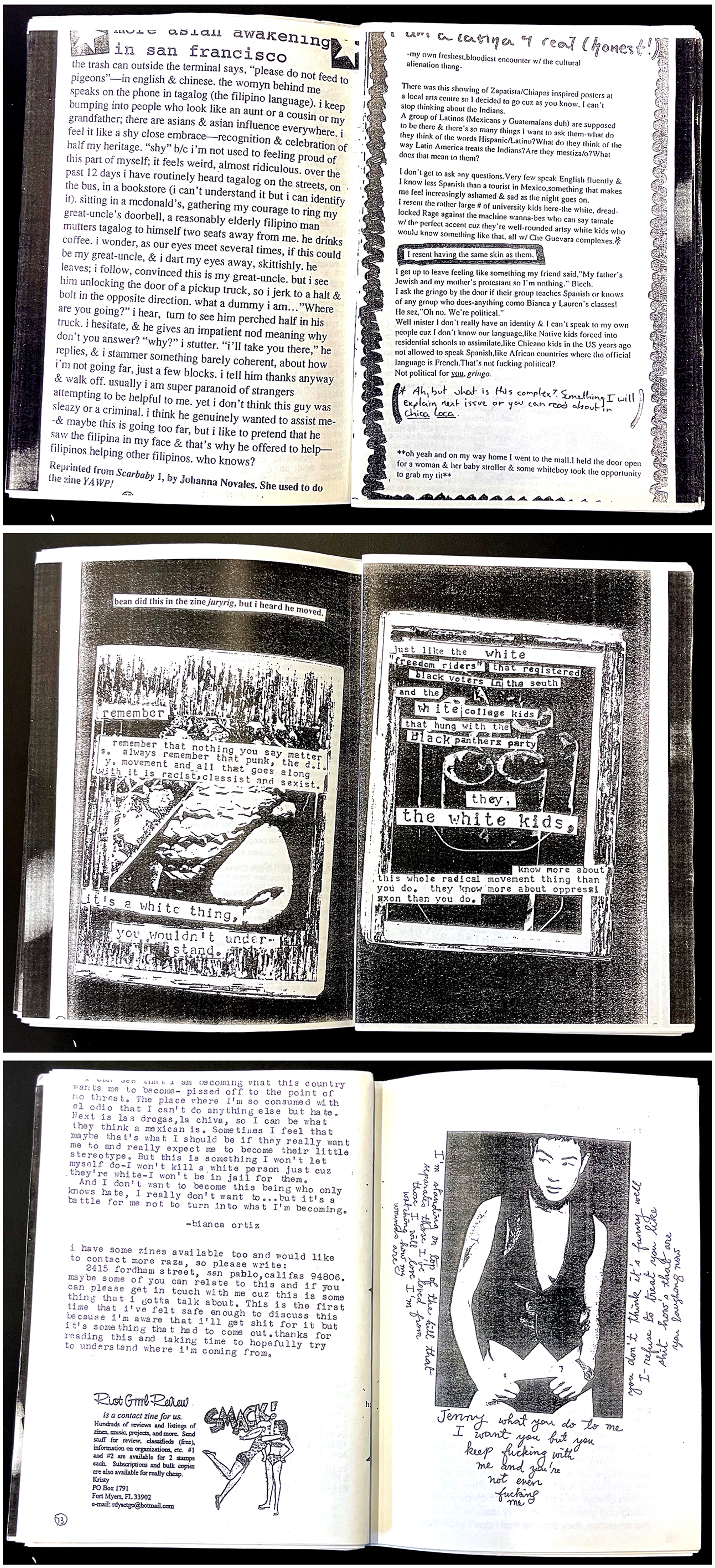
Mimi Nguyen's evolution of a race riot (spreads) © nguyen and the feminist library.
The cut-and-paste aesthetic, in combining content from multiple sources and therefore multiple voices, is easily legible in terms of how it was produced; the reader can see where text has been cut and arranged on the page, how the paper they are holding is folded and stapled. The photocopied zine, therefore, acts as a guide that shows how it was made, encouraging further zine production. It shows its workings. This idea is essential to the zine as a DIY object, and this legibility of production is deeply entwined with the characteristics of self-proliferation present within the photocopier. The photocopier offers the theoretical, though not really practical, possibility of infinite reproduction; therefore, the possibility of more zines is implicit in the zine as a copied object. This reproducibility, of course, also has implications for the published object as a commodity, as any zine can be used to produce more zines. It is this representation of proliferation, through the copying of copies, that has solidified the photocopier as an icon of zine production.
Of course, the conceptual and technical basis for a cut-and-paste aesthetic existed prior to the emergence of both punk fanzines and the widespread availability of the photocopier. Offset lithographic printing and the ability to make plates from photo-ready paste-up allowed for a design methodology freed from the restrictions of hot-metal typesetting, and a utilisation of the entirety of the printing plate, as is present in much of the counterculture and alternative press of the 1960s. The ability for the design and typesetting to be undertaken by relative amateurs allowed for an expediency of production which, coupled with a ‘thrown together’ anti-design sensibility, underlined a sense of urgency, of being responsive to the current moment and initiated a sense of dialogue and seriality that is further entrenched by the zine. What the arrival of the photocopier allowed then was a further increased expediency of production, and a further reduction of the skill level required both for the design and printing of the publication itself. It reduced the steps between author, designer, production, printer, and distributor, already slimmed down by offset, to a single person using a single machine. In this way, we return to the key defining characteristic of the photocopier, that which sets it apart from the mimeograph and offset, the ability to copy from a copy. As Matthew Fuller identifies, ‘being multiple and never unique, the photocopy is always social’ (1992). It is the copy as inherently multiple which underlines the discursivity represented in the cut-and-paste aesthetic, marking the importance of the copy both in practical and conceptual terms. The copier facilitates cut-and-paste, and cut-and-paste reflects the seriality and discursivity of the copy.
This then leads us to contemporary postdigital zine practices. I am recounting here a very linear, periodised version of a zine history that goes through the technologies chronologically by invention, but the use of different technologies of production is not straightforwardly progressive, whereby each innovation supersedes the last. It is often precisely because specific technologies have been superseded in the general market that they become affordable and available for use within zine communities. I use the term postdigital here to characterise the all-encompassing impact that the introduction of computation has had on zine production, following from ideas of post-digital print from Alessandro Ludovico (2012), Florian Cramer (2013, 2014) amongst others, and the postprint era as characterised by N. Katherine Hayles, that all books published since the year 2000 will have had their production process transformed by computation, meaning that in the ‘postprint era hard copy becomes merely one kind of output among many possible displays’ (2021: 3). The postdigital describes the interrelation and diminishing binary between so-called ‘analogue’ production and the purely digital.
Where previous generations of zine makers might be both formally and conceptually opposed to other forms of print media like the magazine or the book, todays’ zine production finds itself in dialogue with primarily online spaces as the dominant media form. As Miloš Hroch and Nico Carpentier in their study of four Prague-based zine assemblages discuss, ‘post-digital theory moved the attention, in the world of zines, from radical political statements, enthusiastic fan writing and subcultural rituals to the role of the material in the zine-making process and zine scenes: printing techniques, combinations of materials and even the weight of paper’ (2021: 2). They posit that the dominance of online spaces for an increasing amount of day-to-day activity has instead resulted in a return, and more considered approach, to the materiality of zines, while existing within a wider ecology of the postdigital network. Hroch and Carpentier propose that while previous incarnations of zines, particularly those made during the most widely studied ‘photocopy era’ of the previous section, were often utilised for political or subcultural ends, contemporary zines instead eschew content for form as their primary affective terrain.
The postdigital itself, as a term, is often used to refer to this ‘recuperated value of materiality’, reflecting what Cramer deems a ‘disenchantment with new media’ (Bajohr, 2016: 103). Scholar Hannes Bajohr sees in the postdigital a conscious turn away from the ‘increasing hegemony of digital technology toward DIY culture’ (Bajohr, 2016: 103). Contemporary zine cultures’ approach to materiality, then, can be read as a rejection of the handful of corporate-owned platforms towards a smaller, slower temporality of both production and consumption. This is in contrast to the urgency and expediency that characterised many photocopied zines. For some zine makers, this ‘return to print’ is a conscious attempt to evade the surveillance inherent within these corporate internet platforms. 2
This has been a particularly prevalent strategy in the context of zines emerging from the Umbrella Movement (2014) and the Anti-Extradition Law Amendment Bill Movement (2019) in Hong Kong (Tong, 2020). Aware of the high level of online surveillance of activists, printed zines became a key organising tool to further the aims of the demonstrations. As Karen Cheung of the Asia Art Archive has outlined, demonstrators utilised a combination of online and offline resources to disseminate information, including uploading PDFs of zines to an online shared cloud folder, accessed through scanning a QR code on social media or on flyers and posters shared throughout the city. Some were geared towards explaining the protests to English-speakers (Cheung n.d.), others provided potted timelines to document the movement in real time, while others offered a personal reflection on the events, such as My Daughter Asked Me, Whats Happening in Hong Kong? (Lim and Ku, 2023: 435). Cheung comments that the zines that appeared during this time came from a cross-section of zine makers, from illustrators and artists to anarchists and activists, and the diversity of zines reflects this. Cheung highlights in particular zines that offered digital security tips, where the method of their dissemination reinforces the content of the message, as well as those that offered ‘basic first-aid instructions for protest injuries’ (Cheung n.d.). Save Hong Kong Ourselves, Self-Help First-Aid by Yan Yu is one such example, a collection of ‘illustrations of household items that would help with pepper spray or tear gas (bottled water, baby shampoo, baking soda, etc.)’. These zines are often unattributed or published under a pseudonym (Lim and Ku, 2023: 39), and distributed both in-person and via online communication platforms and airdrop, with the assumption, and encouragement, that they be re-copied and shared. Kin-Long Tong identifies that this method meant that, though he and others printed the same original file, ‘the final printed products did not look alike, because we used different materials, printers, inks and papers’, that ‘printing an e-zine is an integral part of the creation process and it allows the zine collectors to exercise individuality in the mechanical production of print products’ (2020: 72). In other words, even though the zines are distributed as a single digital file, the act of printing them adds the variation and personality of each individual distributor and reader.
A similar comment on the possibilities of print production when faced with online censorship can be seen in the example of the zine Queer Reads Lexicon, published by queer reads library in 2023. Amidst a context of an attempted ban on queer content on the Chinese social media platform Sina Weibo in 2018 (Bao, 2021), the zine is a result of a series of workshops inviting members of the Chinese queer diaspora to contribute their knowledge of queer terms, including those restricted and banned on social media platforms like WeChat. The cover of the zine itself references this censorship of queer content, the format of the zine mimics the size and dimensions of a smartphone, and the cover recreates a phone screen with a notification that ‘the account has been blocked and the content cannot be viewed’. The format and cover choice conveys the message that where state or corporate control of online space can block and restrict content it deems subversive or otherwise harmful, DIY print media cannot be mediated in the same manner. While the cover indicates something has been removed, the interior content remains the same.
The impact of computation on zine publishing is a result of a combination of technological developments in ink production, the capacity of high-performance microprocessors, and the development of page-description software. These developments can be charted through the introduction in 1985 of Apple's Laserwriter printer containing within it Adobe's PostScript software, allowing for the ability to format image and text in a single document. The same year Aldus launched their PageMaker design programme, and began the desktop publishing revolution, followed by QuarkExpress in 1987 and eventually Adobe InDesign in 1999. The rise of home printers alongside this desktop publishing software meant the possibility of publishing your own work became a reality for a population beyond those already integrated in zine or other self-publishing cultures (Figure 3).
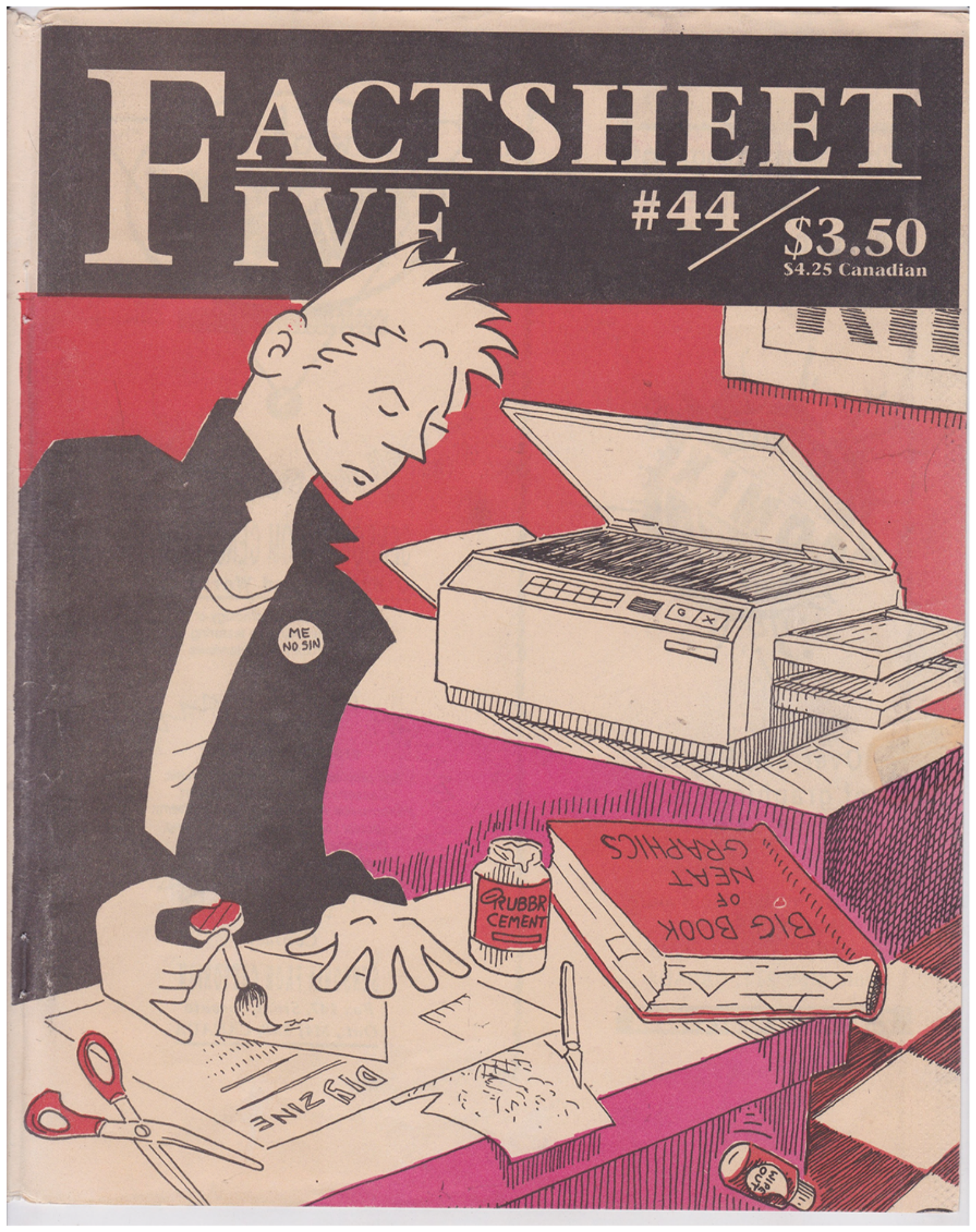
Cover of Factsheet Five #44 (CAMPOS 1991) © MICHAEL A. GUNDERLOY AND CARI GOLDBERG JANICE.
The cover of issue #44 of the zine Factsheet Five from 1991 is instructive of this shift; while the cover depicts a fairly typical scene of zine making; a generic punk cutting and pasting their layout to be photocopied on the machine that sits behind them, the material production of Factsheet Five itself is a two-colour offset printed publication, laid out using desktop publishing software. Here, we see the distinction between our punk zine-makers’ DIY zine and the professionalism that the new technologies afford, while maintaining a sense of conceptual affinity.
While digital inkjet is the print process primarily used through these, increasingly outsourced, production methods, it is the Risograph machine that embodies the notion of the postdigital in its marrying of ‘analogue’ processes (stencil duplication) and contemporary digital production (computation, automation and digital input). It is a method that both utilises the affordances of contemporary technologies while simultaneously offering a way to reject them; a digital, automated process that nevertheless is characterised as producing, as Brad Haylock outlines the ‘artisanal, auratic quality’ of the unique object (2011: 123). A machine that nevertheless, as Max Stadnik argues, produces print that ‘says something about the people making it – it was made by a human hand. That human element is a thing that people crave’ (Oravetz, 2023: 175). The comparison between these two print processes provides a method of questioning in what ways the zine as a DIY, anti-mainstream, intimate, and intense object, is informed by its methods of production.
Conclusion: The possibilities of a material-focused zine studies
What these brief explorations of the technologies of zine production over the last 70 years offer is a way of thinking through a connected history of zine production. A materially engaged study of zines offers a way to interrogate questions of the shifting relationship between the iconic properties of the zine as their technologies of production change. If we understand the zine as a DIY, anti-mainstream, intimate and intense object, how do these methods of production problematise or enact these properties? Through a focus on the materiality of the zine, their DIYness is revealed as entangled with notions of the labour of this production, as well as being deeply interweaved with notions of authenticity and therefore identity, as Frances Robertson identifies; the ‘typed-up-looking pages act to denote the sincerity and honest labour of the writer, clattering at the keys to craft an authentic, if necessarily imperfect, statement’ (2012: 117). Through an understanding of these shifting relationships between the zinemaker and technologies of production, we can understand how the cutting of stencils and the rotation of the duplicator, laying out the pages and standing in front of the copier, endless collating and folding, utilising print-on-demand services like Mixam and Doxyoo, or digital programmes like SHRIMP ZINE or Issuu, are very different processes with varying levels of physical and situated labour. Through this, we can also analyse zine production through a spatial lens, from happening in the home, to the office via ‘cheap and often illegal printing on workplace photocopiers, or labour taken from the “boss's time”’ (2012: 109), to the outsourced production of many postdigital zines. This outsourced production necessarily meaning this labour is performed by someone else, somewhere else, and is increasingly automated. Does this mean the zine is no longer DIY? Or is the ‘doing’ of do it yourself simply shifted to the making of the zine's content rather than the production of the material zine object. Is the zine still anti-mainstream when its materiality is haptically and technologically identical to aboveground, mainstream publications? Or is this a continuation of publishing by whatever accessible means are available? Does the intensity of the zine change through these extra steps of mediation? These are all questions that a material approach to zine history can start to explore.
In this article I have briefly sketched out the beginnings of a material history of zine production from the 1930s up to the present day through a comparative study of its changing technologies of production. To do this I looked at three technologies, loosely aligned with three distinct, yet connected, periods of zine production; the duplicator, the photocopier, digital inkjet printing and risography. What this method proposes is that by using the lens of materiality, a broader, more inclusive history of a connected zine culture can be outlined. I argue that the zines iconic properties, as outlined by Ash Watson and Andy Bennett (2021) of DIY, anti-mainstream, intimacy and intensity, are both enacted through, and informed by, the technologies of production used in the making of zines, and that an analysis of how these different technologies have been used over time can engender a study of zines that allows for both their changing nature and the persistence of key characteristics across temporalities and geographies.
The examples used here are predicated on archival access in the UK and largely reproduce the Western canon of zine history. What a focus on the material production of zines can offer is a de-centring of this history within a global history of zines. Elaine W. Ho and Ming Lin of the Hong Kong-based group Display Distribute have put forward a conception of an Asia-centred zine history in their essay ‘The Semi-Autonomous Zine: Charting Margins and Peripheries in Independent Publishing’ (Asia Art Archive 2018; Catalogue 2017). They offer a method by which to ‘depart from a Western-dominated narrative and to rethink and refine what zines and independent publishing culture can be’. Ho and Lin cite a number of regional-specific contexts in which to view the growth of contemporary zine cultures across Asia, including dōjinshi in Japan, a literal translation of ‘same person periodical’ that ‘exemplifies a community of those with common interests’. These comics, novels and magazines can be traced to the early Meiji period ‘long before science fiction fanzines emerged in the West’, and contemporary dōjinshi manga grew primarily out of the widespread access to photocopiers in the 1970s. 3 In China, where they say the term ‘zine’ only appeared as recently as the 2010s, an understanding of 連環畫 (lianhuanhua) serial picture books, as well as 大字報 (dazibao) ‘big-character posters […] handwritten statements of protest, propaganda, debate, and denunciation’ is an integral context for an understanding of contemporary Chinese self-publishing culture. 4 In Indonesia in the 1980s, a number of self-produced gay and lesbian publications such as Gaya Hidup Ceria and Jaka ‘arose in cities all over the archipelago’, significantly, before punk arrived in the mid-1990s. Ho and Lin's aim by using these examples is that they allow ‘for a more complicated and more context-focused analysis of the conditions and outputs of zine culture in our regional context’ (2018).
Ho and Lin's intervention shows clearly how the development of zine cultures differs depending on the social, political and technological context, and in order to decentre the West as arbiter of the zine canon, a plethora of counter histories must emerge that engage with these differing contexts. A focus on the materiality of the zine can assist this decentring by offering a concrete method of comparative analysis, both between zines from the same period but different geographical contexts, and in mapping the concurrent movement of technologies across geographies and the related impact on local zine production. A materially grounded analysis of zines offers a way to expand the canon of zine history to include the histories and context beyond that of the existing US and Western-centred one.
A materially focused study can be utilised towards an expanded definition of the ‘zine’, which draws from the relational turn in recent book historical discourse, and allows for the ‘non-semantic’ and material elements of the zine to be acknowledged as constitutive of what Teal Triggs refers to as the ‘zineness of zines’ (2010). It can offer a way to engage with existing disparate scholarship on zines in order to place them within an inclusive, diverse Zine Studies. Varied and diverse though they are, zines do share a set of common characteristics across their history, which are informed and adapted through their use of technologies of reproduction. A materially focused zine studies offer a means by which to assess zine history in a wider and more inclusive way that allows for both difference and specificity. In short, I argue that a material analysis is an expansive one that includes both the social and technical aspects of cultural production. An engagement with the materiality of zines allows for a study of zines that maintains their diversity, and allows for the ways in which they problematise neat categorisation and generalisation. The material history of the zine is one that has already been written, and is continually being added to, with every new publication run off in the tens by an individual with something to say.
Footnotes

Funding
The author received no financial support for the research, authorship, and/or publication of this article.
Declaration of conflicting interests
The author declared no potential conflicts of interest with respect to the research, authorship, and/or publication of this article.