



Abstract
This article is concerned with the fanzines published within science fiction fandom from the 1930s onwards. Its focus is on the “amateur press association” (or “apa”) an organizational form for the distribution of fanzines among member-publishers. One variation of the apa is the club-based amateur press association, which emerged in the 1960s as a way of joining fanzine publishing to the in-person sociability of the science fiction club. The status of apa relative to other forms of communication within science fiction fandom is analyzed.
One day in early 1973, in the student room I was renting in Ottawa, Canada, I typed up mimeograph stencils containing the contents of a two-page fanzine to which I had given the title Arfur. Rushing against a deadline, I sent the stencils through the mail to the Official Editor of something called Minneapa, one of the key activities of the Minnesota Science Fiction Society (MSFS). Minneapa was an example of a “club apa” - an amateur press association operated by members of a local science-fiction fan club. When the stencils for Arfur arrived in Minneapolis, they were run off on a mimeograph duplicator by someone who had agreed to do this for me in exchange for a small fee. At the next meeting of the MSFS, my contribution, along with the apazines contributed by others, became one part of identical bundles held together with staples. A complete bundle was given (or, in my case, mailed) to each contributor. Arfur contained musings by my adolescent self and comments on the contributions of others to Minneapa's previous edition.
This article is about “the amateur press association” (or apa), a system for the distribution of printed materials outside of the worlds of professional publishing and distribution. While amateur press associations have a long history, reaching back into worlds of non-professional printing and publishing which took shape in the late nineteenth century, they are most often associated with the fan cultures which grew up around science fiction. My focus here, on the print culture of science fiction fandom, is deliberately historical, limited to a period extending from the 1940s through the 1970s, and with greatest attention paid to the years 1964–1974. This period saw a significant growth in the place of apas within science fiction fandom, as well as the emergence of an eccentric form of amateur press association which will be a key focus of this article. This was the “club” apa, which compiled bundles of fanzines at meetings of local science fiction clubs.
In what follows, I will consider the amateur press association in relation to three sets of concerns and frames. The first of these has to do with the amateur press association as something like a media institution – as an organizational form and set of procedures for the circulation of printed matter. A second set of concerns has to do with the place of amateur press associations in relation to another institution of science fiction fandom, the local club. Finally, I will look at the role of the amateur press association in calibrating particular relationships between the private and public within science fiction fandom. In particular, I am interested in the ways in which, in moments of conflict within that fandom, the restricted space of the amateur press association might be perceived as a space of refuge from hostile exchange.
Methodology
This essay draws, first, on my own experience as a member of amateur press associations, dating back to the early 1970s. This experience is woven into my analysis, at two points, as a way of illuminating procedures and experiences which are otherwise difficult to observe or reconstruct. This article is based, as well, on research undertaken in 2019 using the fanzine collection of the University of California, Riverside, which contains large holdings of contributions to club-based amateur press associations. These were supplemented by items remaining in my own collection of fanzine materials.
During the period under discussion here, the mailings of amateur press associations embodied, in almost perfect fashion, that character of being “oriented to their own circulation” that Michael Warner has theorized in relation to early U.S. print culture (2002: 66). Warner is designating here the tendency of periodicals to build continuity through the projective and retrospective accumulation of references to previous issues and anticipations of those to come. In the amateur press association, this building of continuity became a principal activity, as contributions were more and more dominated by comments on previous mailings and the production of statements intended to elicit later response. Likewise, and following the call by Gaonkar and Povinelli (2003) for research attentive to the “mobility and mutability” of circulating forms, I will explore those ways in which the history of the science fiction apas has been shaped by their variable relationship to several other phenomenon. The most important of these are local in-person interaction, processes of integration within fanzine culture, and the elaboration, within science fiction fandom, of spaces of privacy and refuge.
Definitions
The amateur press association is seen as having its origins in the United States, as part of the broader expansion of “amateur” publishing which followed the introduction of cheap printing presses in the last third of the nineteenth century. 1 As Lisa Gitelman and others have shown, portable presses developed to facilitate communication during the Civil War were quickly adapted for civilian, post-war use, and advertised to a range of potential users, including children and young adolescents (Gitelman, 2014: 141–142.) Publishers or printers who wanted to write and publish their own writings on the side might now do so without significant expense; writers who wished to disseminate their work could purchase or borrow a small printing press and issue magazines with limited print runs.
By 1900, the worlds of amateur publishing in the United States had come together in organizational forms which included national or regional associations and regular conferences and meetings. Various systems for the exchange of amateur publications took shape during this period. The most novel of these, perhaps, was the amateur press association, eventually abbreviated as “apa.” While amateur press associations might perform many functions for their members (such as the holding of conferences), many of them undertook to distribute copies of magazines to a limited membership through their assembly into identical “bundles.” For this and other administrative functions, amateur press associations named or elected one of their members as “central mailer” or “official editor.” This individual received a specified number of copies of members’ contributions and undertook to send the assembled bundles (alternately called “distributions” or “mailings”) to all members.
The first and largest of these apas was the National Amateur Press Association (NAPA), formed in the US in 1876 and still in existence in 2022. The second largest, the United Amateur Press Association (UAPA), was launched in 1895 and split, in the 1930s, into rival associations with very different fates. A British Amateur Press Association was founded in 1890, though among its various activities it appeared that the distribution of “bundles” of contributions from its members was a late and relatively minor one. 2 Frank Farmer and Steven Duncombe each repeat Michelle Rau's claim of the existence of early U.S.-based apas for women and African-Americans, though the existing research on these is thin, and it is not certain whether these associations engaged in the bundling of publications for distribution to members (Duncombe, 2008 [1997]: 55; Farmer, 2013: 37; Rau, 1994: 10.)
The first apa in science fiction fandom was the Fantasy Amateur Press Association (“FAPA”), formed in 1937 by the science-fiction editor Donald A. Wollheim and still distributing mailings in 2022 at its traditional quarterly frequency. 3 While FAPA was U.S.-based, its membership, like that of many apas launched subsequently in the United States, was open to fans from other countries, though English remained the exclusive language of communication. An avowedly international and short-lived organization, Interapa, was formed in 1964 but attracted few members from outside the United States. An apa for science fiction fans based in the United Kingdom, OMPA, came into existence in 1954 and associations based in Canada and Australian-New Zealand followed in the next two decades.
The apa as medium and circulatory form
An amateur press association is many things. Apas are perhaps media, in the definition Lisa Gitelman has given – that is, “socially realized structures of communication, where structures include both technological forms and their associate protocols” Gitelman (2006: 7–8.) Any mailing of an apa might also include an idiosyncratic mix of media, from the individual apazines submitted by members - printed using one of several technologies of duplication, from gelatin-based flat printers to rotary mimeographic duplicators, photo-offset techniques and photocopying - - to postcards and commercially-produced brochures. An apa is something like a format, in Jonathan Sterne's sense of the term, as that which “specifies the protocols by which a medium will operate. 4 ” Typically, an apa offers membership in return for a minimum level of activity (so-called minac) - a specified number of pages which must be contributed per year, or across a given number of mailings, in order to retain membership in good standing. The insistence on regular contribution further encourages content which participates in ongoing collective discussion, through regular commentary on the pages submitted by others. It is in relation to this regularity that the “mailing comment” - a response in one member's new contribution to the previous contributions of others - became the dominant textual genre in the apazine.
Other systems and formats for compiling and distributing expressive media have existed outside of science fiction fandom. The degree to which these resemble the amateur press associations of that fandom has much to do with the extent to which they imagine their main focus as the bundling of disparate materials or the maintenance of sequential communication over time. As Stephen Perkins has shown, so-called “assemble magazines”, since the 1960s, have given visual artists the opportunity to circulate their work alongside that of others, in compilations which gather pieces of art together in a single package (Perkins, 2005). We may also see these practices of assembly at work in anthologies of music, short films, or literary works released to showcase artists belonging to local cultural scenes or historically-bounded movements. In all these cases, assembly reduces the cost of distribution of any single item and enhances the appeal of any one contribution by allowing it to benefit from that of others.
The apa “bundle” or mailing shares with these assemblies or compilations the promise of variety and abundance. At the same time, by setting in place a sequentiality which encourages ongoing communication, the amateur press association overlaps with a different set of media forms. The round-robin letter, the correspondence chain, and what Hilliard (2006: 57) calls “pass-round magazines,” all circulate media objects which are typically lighter (in both physical and textual terms) than those found in “assemble magazines” or other weighty compilations. In chain-like systems of sharing, the emphasis is on interpersonal connection maintained through the quick circulation of textuality in light containers.
The amateur press associations of science fiction fandom have functioned, throughout their history, both as vehicles for the delivery of elaborately designed magazine-like publications and as fast circulating carriers of communicative expression. At the first of these extremes, we find the thick bundles of FAPA mailings, full of lengthy, well-crafted contributions sent out in padded envelopes every three months and often meeting with a sluggish response. At the other extreme, we find the rapid-fire distribution of the weekly apa, its contributions hastily run off, assembled and sent into busy circuits of in-group communication.
As a system for assembling and distributing the fanzines produced by individuals, the amateur press association shaped the rhythms of involvement of those engaged in zine publishing and reading. As noted, the FAPA, science fiction fandom's oldest apa, has always had quarterly mailings. In the 1940s, a certain dissatisfaction with the slow rhythms of FAPA led to the creation of the bi-monthly SAPS (the Spectator Amateur Press Association) (Warner, 2004: 263–267.) Eccentric formats to follow included the weekly apas whose distributions are assembled at meetings of local science fiction clubs, to be discussed later, and the annual Worldcon Order of Faneds apa, whose single yearly mailing or bundle is produced at each World Science Fiction Convention.
The apa and the “autonomization” of science fiction fandom
Other aspects of the apa's role in structuring science fiction fandom warrant comment. The most well-known of these is their role in that process of “autonomization” which Harry Warner and other historians of fandom have noted. This process saw the transformation of fandom from a subculture devoted to commentary on a world exterior to it (the realm of professional science fiction magazines and books) to one primarily concerned with its own functioning, or with what literary scholar André M. Carrington calls “its own textuality”. 5 While evidence of this autonomization of fandom could be found in fanzines circulated outside of apas, the rhythmic sequentiality of the amateur press association, in which contributions to one mailing were largely taken up with comments on the previous one, helped to reinforce the circumscribed self-referentiality which became one of science fiction fandom's most noted features.
This autonomization shaped the challenge of finding one's place in fandom – of building and maintaining networks or friendship circles in a subculture preoccupied with its own functioning rather than simply a shared devotion to science fiction. The amateur press association would come to play a key role in integrating new entrants to fandom. In the 1960s, new apas, like N’APA (the Neffer Amateur Press Alliance, launched in 1959) or Apa 45 (founded in 1964, with membership restricted to people born after 1945) served as footholds for new fans, allowing them to build the contacts and develop the experience from which more ambitious publishing experiences might grow.
Conversely, other, longstanding apas, like FAPA and SAPS, came with time to serve as the last connections to fandom for fans who had otherwise departed the subculture. The FAPA, seen in its early years as fandom's powerful inner circle - a “fortress of fandom” in the words of Harry Warner, Jr. – would by the 1960s be known as the “elephant's graveyard” of fandom, with a slowly-evolving roster of members of very long standing whose persistence created very few openings for new members. 6 One might say more generally, of apas in science fiction fandom, that they have served as spaces of transition. One joined them as one was entering fandom, as a way of building relationships and establishing a personality. For those people on their way out of fandom, apas served as a last link or foothold before a final withdrawl.
Four institutions of fandom
One way of thinking about the history of science fiction fandom is in terms of the shifting relationship between four platforms for sociability and exchange. Two of these are print-based forms – the amateur press association and the genzine (the fanzine circulating outside of apas, typically sent to a mailing list established by its editor/publisher.) The other two are sites of interpersonal encounter – the local science fiction club and the convention (or “con”.) One might build a list capturing the variety of possible relationships between these platforms. Members of apas might “graduate” to publishing fanzines destined for wider circulation (so-called genzines) as their range of contacts and general familiarity with fandom grew. Similarly, those sending genzines to individuals might also circulate these through amateur press associations, both to meet an apa's minimum activity requirements and to efficiently reach a sub-set of intended readers. (Warhoon, a highly-regarded fanzine from the 1950s on, was distributed through the Spectator Amateur Press Association, but circulated widely outside of that context.) The relationship of clubs to conventions was more direct. The local committees who proposed their cities as sites for a World Science Fiction Convention (the WorldCon), and hosted the Convention if successful, were typically dominated by members of a local science fiction fan club. Conventions, in turn, were often showcases for large numbers of local clubs, who might host special parties or other events.
The relationship of fandom's print culture to events designed for in-person encounter was more complex. One of the most long-lasting products of this relationship was the early enshrining of the “con report” (a lengthy, personalized report on a convention) as a genre of fanzine content. In a pattern familiar from other subcultural worlds – like those devoted to sports or music - fanzines, as a printed form, had always been important chroniclers of science fiction fandom's in-person events. However, as conventions grew larger, in the 1960s and 1970s, offering an expanded range of attractions which had more and more to do with audiovisual media (like science-fiction films and television series), the disjunction between those fans attending cons and those devoted to the production of printed fanzines intensified. In part, this reflected demographic shifts which could only be welcomed. From the late 1960s onwards, the influx of those who would later be called “media fans” radically re-ordered a world hitherto dominated overwhelmingly by white males. For a time, these developments made the split between a white male culture centred on fanzines and a much more diverse media fandom, focused on convention-going, all too conspicuous. Eventually, the heightened participation in fandom of women and non-white persons would be reflected more and more in the realm of fanzines and amateur press associations as well. 7
The club apa
Out of these possible relationships between fanzine publishing and in-person sociability, the “club apa” emerged in the 1960s as an unusual phenomenon. The amateur press association rooted in a local science fiction club was intended in part to re-order relationships between so-called “fanzine fandom” and the fandom of face-to-face meet-ups. The first club-based apa was the weekly Apa-F, produced at the alternating bi-weekly meetings of two New York City-based science fiction clubs, the Manhattan-based “Fannish and Insurgent Scientifictional Association” and the Brooklyn-based Fanoclasts. The first distribution of Apa-F was dated July 10, 1964. Three months later, the Los Angeles Science Fiction Association (LASFS) produced the first compilation of its own Apa-L (dated October 22, 1964.) Figures 1 and 2 show the front covers of mailings of each of these. The on-line Fancyclopedia 3 tells us that Apa-F folded in October 1965, after 69 distributions, by mutual agreement of its regular contributors. Apa-L was still operating as of January 2022, with 2957 distributions to date.
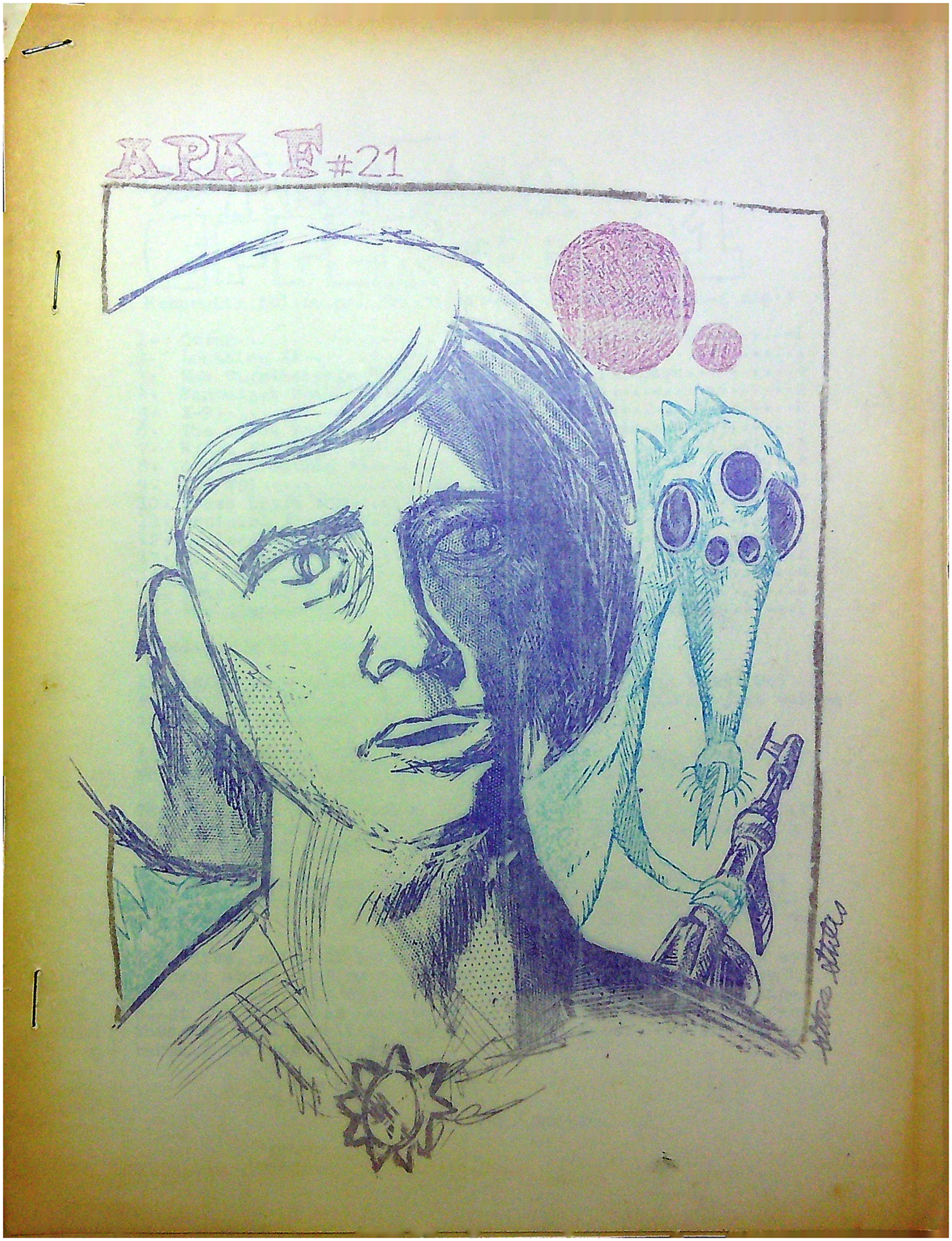
Apa-F, no. 21, November 27, 1964 (collection of the author).
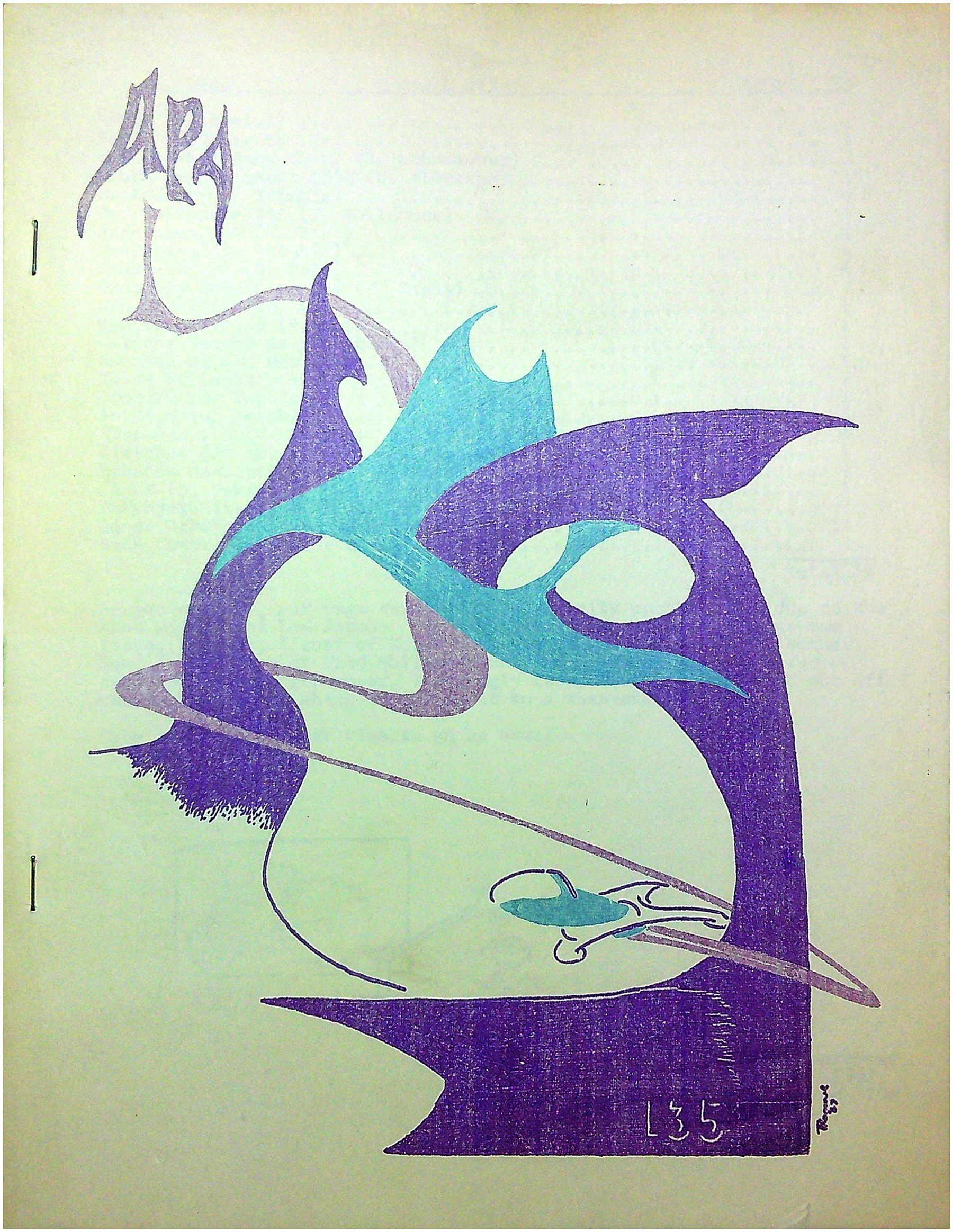
Caption: Apa-L, no. 135, May 18, 1967 (collection of the author).
Members of these clubs would arrive at their weekly meetings bearing a certain number of copies of a contribution – typically only two or four pages in length - or they would bring stencils or masters which would be run off at the meeting itself. One of the activities of the meeting, then, was that cherished fan event, the collating party, in which people collectively assembled the contributions into a certain number of identical bundles. While the primary purpose of local club-based apas was to function as a supplemental means of communication between club members who were also meeting face-to-face, they often allowed for the “remote” involvement of people living outside the host city who did not attend the club meetings at which apa distributions were assembled. (The Los Angeles-based Apa-L, from its beginnings, had regular contributions from New York members.)
The club-based amateur press association was intended to fulfil several functions. One, we might say, was reparative. Science fiction fandom was already attentive to the split between so-called fanzine fans, for whom fandom was principally a culture of fanzine production, and club fans, for whom the appeal of fandom lay in the sociability of gathering in person. However, fanzine fans also went to clubs, and the production of a weekly apa allowed for the integration of fanzine production within a broader social eventfulness. As well, by pulling those who had never edited fanzines into a publishing activity whose demands were modest and procedures transparent, the club apa helped to entice members into an endeavour that might otherwise have seemed intimidating. In a contribution to the December 2, 1964 edition of Apa-L, one member commented on the reasons behind its founding: Apa L (as I understand it) was supposed to be a sort of contribution from the active publishing faction in the LASFS to the larger non-publishing segment; partly to serve as a means for furthering intra-club communication to make the meetings more friendly and enjoyable, and partly to encourage those members who’ve never published a fanzine to try their hand at an issue or two (without any necessity to “make every Distribution” if they don't want to) to see how they like it.
8
Minneapa and me
My own membership in a local amateur press association, Minneapa, occurred before I had ever set food in the city whose club was its host. I was drawn to Minneapa because it was, for an extended period of time, a lively source of print-based sociability and discussion. (I was not the only out-of-town member.) In the early 1970s, the MSFS which produced it was seen as one of the most effervescent centres of fan activity. My involvement in Minneapa occurred in the first phase of my engagement in science fiction fandom, when I had never met any other science fiction fans in person. I had learned about fandom's history by buying old collections of fanzines, and I participated in current fanzines solely as a writer of letters and publisher of the occasional apazine. For a time, I was what was known as an “omni-apian,” a member of several amateur press associations.
In 1972, a Toronto-based fanzine called Energumen published an article whose first paragraph asked whether I really existed [Figure 3]. Energumen was a much-beloved and high-profile fanzine of the early 1970s; it would win the Hugo Award (science fiction's Academy Award) as Best Fanzine in 1973. The author of this article was Susan Glicksohn (born Susan Wood; d. 1980) who co-edited Energumen along with her then-husband Michael Glicksohn. 9 The article described a road trip by several prominent Toronto science fiction fans to Fort Erie, Ontario (where I lived before going off to university) to solve the question of whether I really existed or had, in fact, been manufactured as a hoax.
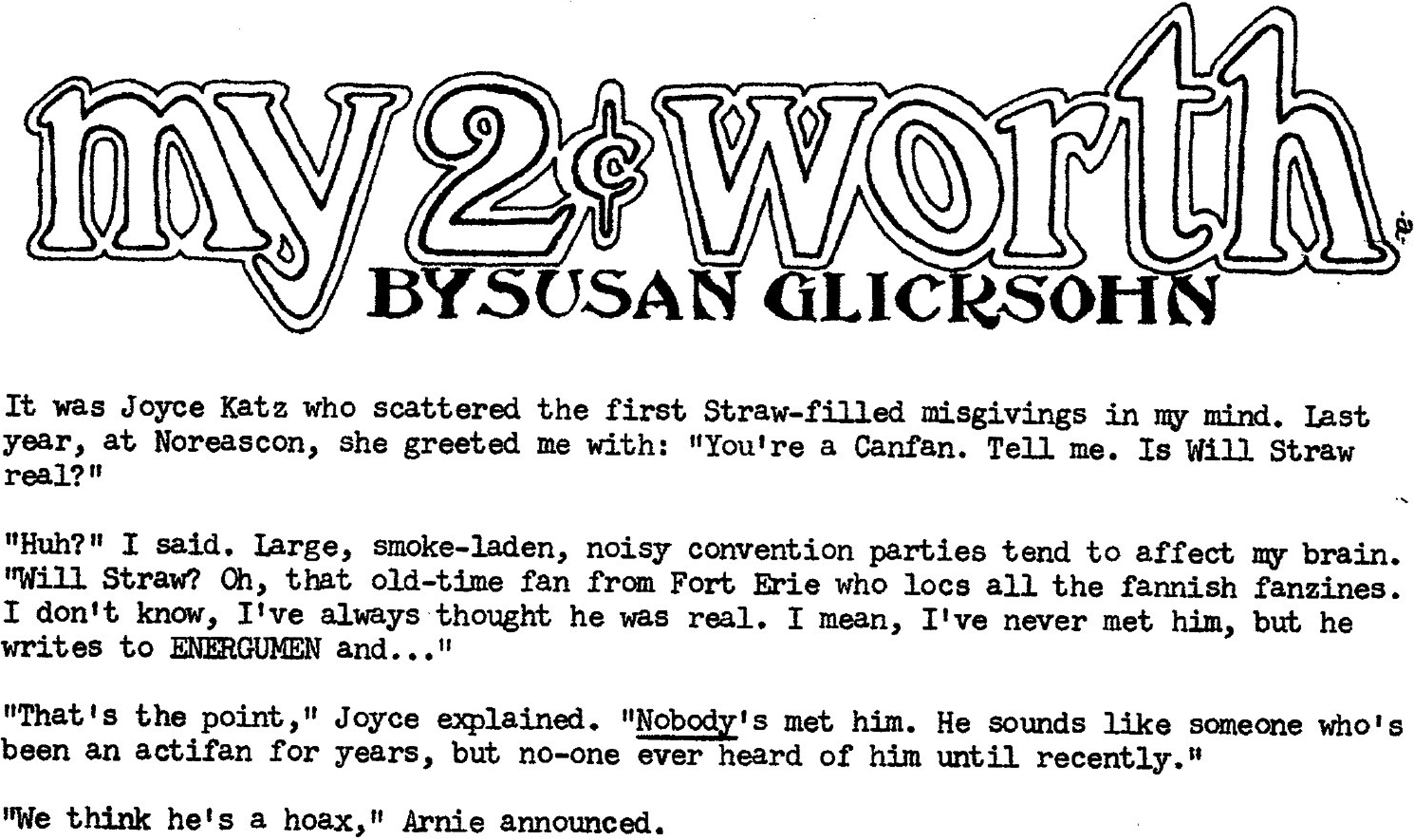
Energumen 13 (detail), 1972, collection of the author.
There had been hoaxes in fandom since the 1940s; fans invented and gave names to personalities who appeared to publish their own fanzines and contribute to others but had never been seen in person. The highly mediated character of fandom – its reliance on the postal system more than on face to face contact – made this possible. André Carrington has written recently of what would become the most notorious and symptomatic of such hoaxes: the appearance, in the 1950s, of an African-American fan named Carl Brandon, who published letters and articles in fanzines for two years before being uncovered as the creation of two white authors. 10 The success of the Brandon hoax rested in large part on the perceived novelty of a Black fan in a subculture recognized as almost exclusively white. (A “Carl Brandon Society” was formed in 1999 to “help build further awareness of race and ethnicity in speculative literature and related fields 11 .”)
Suspicion that I might be a hoax was bolstered by the fact that I had seemingly come out of nowhere, appeared to know more than was normal about the history of fandom, and had never been seen in person by another science fiction fan. And, of course, there was my last name, which, as the Energumen article noted, suggested a certain insubstantiality. If I dwell at some length on this experience, it is partly to comment further on relationships between a print-based involvement in fandom and the kinds of sociability that came from attending club meetings and conventions. In early 1973, the fanzine-based sociability of Minneapa was a reasonable substitute for the in-person contact with other fans which was largely unavailable to me (or which I had not sought out.) Later that year, I attended my first in-person event, the Toronto World Science Fiction Convention, where I met a number of people who became friends. Several of these pulled me into newly-formed private apas which perpetuated relationships established first in person. In the back and forth between print media and in-person contact, the first provided the impulse to meet others in person, while in-person sociability led to new networks of print communication, many of them hidden and private, intended in part to preserve the relationships formed in face-to-face meetings.
Privacy, publicness, polemic
When university libraries and other institutions began collecting the fanzines produced in science fiction fandom, the ambiguous status of the amateur press association raised a number of concerns. 12 On the one hand, materials from amateur press associations could not be ignored by any institution looking to assemble research collections which reflected the variety of fan print culture. Apa zines and mailings made up a a significant portion of the personal fanzine collections donated to collecting institutions, and the importance of apas in any historical understanding of fan publishing was widely acknowledged. On the other hand, the peculiar status of the apazine – destined only for a small group of people whose identities (as members of an apa) were known in advance, and very often personal in its tone and content - posed important questions about privacy. These questions were compounded by the fact that, while apa mailings donated to institutions had been the individual possessions of their owners, they also contained contributions by others – alive or dead – who would probably have no input into later decisions to give these to libraries or offer them for sale on sites like Ebay.
In one of the few reflections on the archiving of apa materials, the Special Collections Librarian Gregory J. Prickman summarizes these dilemmas: The closed-network nature of apas created a safe, non public forum for members to express intimate and personal details about their lives to other members. Conversations often turned to relationships (many formed within the social boundaries of fandom or even the specific apa) and frequently include discussion of sexual and romantic partnerships. Many of these apa contributors are still living and never considered that their writing might end up in publicly accessible collections (Prickman, 2008: 140).
When I first drifted into science fiction fandom as a young teenager, around 1970, one could still hear echoes of an event, known variously as the Breen Affair or Breendoggle, which had transpired six or seven years earlier. In 1964, the annual World Science Fiction Convention (Pacificon II) was held in Oakland, California. Four months before the event, the organizers of the conference issued an interim progress report, as was the custom. It contained an announcement, signed by several prominent science fiction fans, endorsing the right of the conference organizers to “limit membership – in the convention – for cause.” The target of this statement, who would be excluded from the 1964 World Con, was a science fiction fan named Walter Breen, who was accused of the sexual abuse of children.
The details of these events, and the enormous divisions in science fiction fandom which were the result, are well covered (and continue to be debated and revised): in the online Fancyclopedia, in Wikipedia entries, online fan histories, personal memories and in the oral memory of science fiction fandom, as it has been transmitted over time. (See, among many other portals and sites, Breendoggle, 2022; Glyer, 2014 and Wise, 2014) The shifting frames through which the Breen affair has been understood are covered in detail in the excellent dissertation and subsequent monograph by Hannah Mueller (2017, 2022).
In the second distribution of the Los Angeles-based Apa-L, assembled on October 29, 1964, a prominent member wrote, as part of an exchange with another member, that “I’m quite willing to accept the idea that Walter Breen is the cause of Apa-L, via being the cause of Apa-F 13 .” What this person meant, I believe, was that, confronted with a newly divided, conflicted fandom, many were retreating into the ingroups of the local club and the small circulation apa. The high-profile genzine, the non-apa fanzine that might serve as a token of fandom's unity and the object of its collective attention, was not possible in an environment so fractious. Reading the distributions of Apa-L and Apa-F from immediately before and after the convention from which Breen had been barred, one sees, as well, the seemingly conscious attempt to keep the lid on heated passions and pointed opinions, as if the pressures of co-presence in the shared space of the club had a tempering effect on printed discourse.
Nevertheless, the spaces of the amateur press association were not entirely sheltered from the violent polemics surrounding the Breen affair. In the same second distribution of Apa-L, one member chided another for using the new apa to distribute his contribution to The Cult, the 13-member, tri-weekly apa which was known for the virulence of argument among its almost exclusively male membership: I can't say that I agree with you about using Apa-L to circulate such items as your Cultzine. Perhaps you forget how many people may not be up on the many personal arguments that fill Cult literature, and who may thereby misunderstand them, and who also, oddly, may not be accustomed to the tone of Cult publications
14
.
The Cult had played a prominent role in fanning polemics over the Breen Affair. When the longstanding FAPA threatened to remove all Cult members from its own membership over their behaviour during the controversy, The Cult announced it would retaliate by making all FAPA members honorary members of its organization. 15 Increasingly, however, it seemed clear that apas were places where science fiction fans sought refuge, among those who shared their opinions or, at the very least, accepted similar protocols of engagement and debate. In 1964, lilapa was formed by a small number of fandom's well-established fans as a forum for “people discussing the Breendoggle [the Breen affair]” (“Lilapa”); it would become, over the next several decades, the best-known among many private, invitation-only apas, formed in or after 1964, in which friendship circles or generational cohorts carried on in-print sociability invisible to others. Any cartography of science fiction fandom, then and since, would need to acknowledge the multiple closed spaces of amateur press associations in existence. Some of these are secret, others not. Some are constantly renewing their memberships while others drift through time with an unchanging roster of contributors.
Conclusion
The history of the amateur press association is not, of course, a history of attempts to invent the internet - or even what one fan has called a “very slow internet” (Hayden, 2009). 16 ” Arguably, though, the apa has lent itself more easily than most fan media to digital transformation. I remain a member of a small email list which replaced an invitation-only paper-based apa about 20 years ago. Its membership, on both sides of this transition, has consisted of friends made several decades ago. Longstanding apas like the still-quarterly FAPA maintain Facebook groups as supplements to their paper-based communication and as channels for more frequent interaction.
The fandom I have been describing sits in a relationship of almost total inversion to the zine and fan cultures which have taken shape since the 1970s. The painstaking, artisanal inscription of words, drawings and other communicative marks onto mimeograph stencils could not be more different from the scavenging practices of the punk fanzine editor, and from a mode of duplication (photocopying) which almost required that fanzines be imagined as compendia of materials wrested from the outside world. The theoretical frames through which punk and other activist zines since the 1970s have been understood – through notions of the “citizen-bricoleur” (Farmer, 2013: 29–25) or a “cut-and-paste” revolution 17 - have little pertinence to a fanzine culture, like the one described here, whose inventiveness focused on devising clever ways by which little packages of personal expression might circulate in relation to each other and elicit responses.
Likewise, the oft-remarked-upon “autonomization” of mid-century science fiction fandom, as its attention shifted away from its founding objects of devotion (professional science fiction magazines and books,) made this fandom distinct in almost every way from later media fandoms, which hover at the edges of commercial cultural production in a relationship of ongoing commentary and transformative appropriation. The closest recent equivalent to the world of limited-circulation apazines might well be the personal zines which, from the 1980s onwards, have circulated outside of science fiction fandom, at zine fairs or in the “alternative press” racks of independent bookstores.
Footnotes
Acknowledgements
Research for this article was based in part on research using the Fanzine Collection of the University of California-Riverside. I owe special thanks to Andrew Lippert and other collections management professionals at UC-R. Other details and observations are based on my own collection of fanzines. The research on which this article is based was supported by an Insight Grant from the Social Science and Humanities Research Council of Canada.
Declaration of conflicting interests
The author(s) declared no potential conflicts of interest with respect to the research, authorship, and/or publication of this article.
Funding
The author(s) disclosed receipt of the following financial support for the research, authorship, and/or publication of this article: This research was supported by an Insight Grant from the Social Sciences and Humanities Research Council of Canada.