



Abstract
In this article, I introduce my concept of the ‘affective circuit’, and discuss how it functions particularly within British science fiction (SF) fandom and its networks of communication. While I initially set up British SF fandom as a male-dominated space, I turn to a consideration of women SF fans to understand their oft overlooked contributions in the Golden Age of British SF. The publication of Femizine (1954–1960), the first all-women British SF fanzine, marks a turning point in British SF, and engages us in considerations of gender, conflict, and community. Using my understanding of the affective circuit, alongside the invasion of women fans into the male-dominated SF scene, I consider how women have to rewire understandings of masculine community to create their own space in fandom. It is only in this dedicated space of a female community, fostered by notions of solidarity, hope, and encouragement, that a collective sense of ‘selfing’ emerges.
Keywords
Introduction
‘There are plenty of images of women in science fiction. There are hardly any women’.
– Joanna Russ, The Image of Women in Science Fiction
Science fiction (SF) was born in the magazines. Starting with Hugo Gernsback's 1926 publication of Amazing Stories (1926–) in the United States, SF quickly became one of the most recognisable pulp fictions. This is not to say that stories did not contain anything resembling SF before 1926. As Mike Ashley (2000) suggests, the first all-SF magazine was ‘neither sudden nor a surprise, but the inevitable result of years of development of science fiction in the popular magazines’ (p. 44), while Brian Attebery (2003) argues that ‘sf magazines […] were chiefly responsible for creating a sense of sf as a distinctive genre’ (p. 32). Often referred to as the father of SF, Gernsback defined the genre as he saw fit (although he originally termed it ‘scientifiction’). He established the magazine as separate from the ‘so-called “sex appeal” type of story’ (Gernsback, 1926: 99), declaring that SF literature ‘appeals to the imagination, rather than carrying a sensational appeal to the emotions’ (Gernsback, 1926: 99). Indeed, Justine Larbalestier (2002) recognises the threat that came from the idea of romance or sex: ‘[t]his anxiety to keep the whole discourse of romance out of science fiction…is a long-running one. The idea of romance, and therefore women, polluting science fiction begins almost immediately in the pulps’ (p. 107). I suggest that Gernsback was really referring to a condemnation of feminine associated emotions; that is, emotions associated with the romance pulps – the most popular type of pulp at this time. Building on this understanding of the relationship between gender and genre in the pulps, it is evident why Russ later famously asserts that there are ‘hardly any [real] women’ within SF.
From the first issue of Amazing Stories, readers quickly converged around the genre. Gernsback received letters from his readers, and realised there was an undiscovered network of people that enjoyed SF. He decided to publish these letters of comment (LOCs) in his SF magazine, which resulted in readers being able to correspond with each other: the LOCs featured readers’ personal addresses and possible areas of interest, or thoughts on stories, that would encourage communication and create friendship between readers. These readers, then, in their continuous and often intense participation, can be categorised as fans. As fan scholars note, to be a fan is to have an emotional connection or bond with something (Katherine Morrisey: 2016; Henry Jenkins: 2018). This is not always viewed positively: in Textual Poachers (2012), Jenkins recognises the sense of danger that the media attributes to fans’ because of their supposed emotional and frantic obsessions (12–13). However, as is more commonly recognised in recent fan studies, the creativity and productivity that fans demonstrate compels us to consider their importance alongside, or simultaneously with, forms of popular culture and their audiences. However, while Lisa A. Lewis (1992) generalises that ‘[f]ans are, in fact, the most visible and identifiable of audiences (1)’, I argue that, actually, there are a myriad of connections that can be found within fan-networks, often revolving around fans that are not “visible” or “identifiable”, but this does not make them less of a fan. It is their emotional connections or bonds to a thing that defines their fannish identity, and their shared connections to said thing that creates a fandom.
From the 1930s, fans’ affective attachment to SF became significant, with readers critiquing stories, artwork, or other fans’ opinions in their LOCs and advising Gernsback what would improve the genre, exclaiming outrage if a section of the magazine did not meet their expected standards. Soon after the publication of Amazing Stories came the first fan-produced zine, a fanzine called The Comet, published in 1930, which provided an independent space for fandom to take an interest in the genre and its community. In the British context, the first British SF fanzine, Novae Terrae (1936–1939), emerged before the first British adult SF magazine, Tales of Wonder (1937–1942). Therefore, there were already fans/readers of SF in Britain before the first prozine (professionally produced magazines), who felt the need to create a place of community and discussion via a fanzine. The fanzine, in a combination of ‘fan’ and ‘magazine’ were print products created, distributed, and circulated by fans. Fanzines illustrate an important aspect of fan culture, or fandom. As Rachel Anne Johnson (2015) argues, SF criticism overlooks the earliest fanzines, and in doing so, ‘propagates a false history of science fiction and erases gendered and liminal voices from the foundational years of fandom’: in erasing this study of its history, it ‘inadvertently creates its own canon that privileges television and film fandom over literary production’ (p. 2). The publication of Novae Terrae, SF in Britain began to form its own print history. Fanzines could be circulated nationally, or around a SF geographical group (e.g. the Manchester or London group), and therefore could be intended for 5 people or 50. Either way, the fanzine was an independent, personal way to actively engage with SF fandom and be involved within the community. As I argue, fanzines would provide a space to carve an identity within the wider SF fandom.
In this article, I argue that while Russ argues there are ‘hardly any women’ in SF, in fact, we can find networks of women fans writing, creating, and participating in SF and its fandom. These women fans, I posit, had to rewire understandings of masculine community to create their own space in fandom. To do so, I discuss the idea of the ‘affective circuit’, and begin a discussion on how it functions particularly within British SF fandom and its networks of communication. I use Femizine (1954–1960), the first all-women British SF fanzine, and emphasise that it marks a turning point in British SF. I argue that the affective circuit I propose accounts particularly for male fans’ experience within the network of British SF. As I will illustrate, the treatment of women fans often renders them unable to move through the affective circuit with the same ease as male fans. The fanzine, and in particular, Femizine, I posit, creates an alternative and accessible space, and therefore allows women to feel included and involved in SF. In turn, this helps women fans establish their own entry into my proposed ‘affective circuit’. This article will start with a discussion of how I understand and apply the idea of the affective circuit, and how conflict and communities function within. Then, I discuss the impact of Femizine, including the subversive hoax figure of Joan W. Carr, and how women fans were able to utilise this space to build their own affective community. Ultimately, I argue that it is only in this dedicated space of a female community, fostered by notions of solidarity, hope, and encouragement, that a collective sense of ‘selfing’ can emerge.
Affective circuits and exclusivity
The term ‘affective circuit’ is reasonably recent. However, in its previous iterations it is used in different ways. Jennifer Cole and Christian Groes (2022) use the term to examine African migrations: How do the exchanges of goods or money pass between African migrants and those who remain at home, and how do emotions become entangled in this circuit? Drawing on Cole and Groes, Apostolos Andrikopolous (2019) considers the physical movement of bodies over borders in terms of cross-border marriages, and how these loaded exchanges can interact with social lives and social formations. While these iterations of affective circuits are useful in understanding how emotions can stick and move in a literal sense, as well as drawing attention to how resources ‘both material and emotive’ can be disseminated, I move away from the understanding of a migrant's affective experience. Jenny Sunden and Sussana Paasonen's (2018) study of feminist resistance and online hate considers how emotions, particularly negative emotions, can circulate online and generate power, introducing shamefulness as a tactic of resistance. I have also found helpful Matt Yockey's (2012) work on community and affect in regards to a charitable organisation combating domestic violence. Yockey discusses the idea of consumerism and affect, and how they can become so easily entwined. Ultimately, these scholars argue that these informal spaces are sites of circulating affect(s), and the idea of ‘absent, yet present bodies’ (Yockey: page unknown): how affects can move between physical bodies, materials and ideas. I postulate my idea of an affective circuit as one still filled with sticky (Ahmed, 2004) and moving affect, but in the context of a fannish community.
There are different ways we can examine affect within SF. For example, we can consider the modes of affect in relation to genre fiction, such as fear, wonder or excitement. Pulp genre fiction generally relies on these ‘shock-wow’ affects: what it may lack in ‘good’ writing or developed characters/plots, it makes up for in its ability to make the reader feel strong emotions. While these can be useful when textually analysing the genre of SF, I examine affect as seen through the fan's (evolving) engagement or participation within the community. I borrow from Nicolle Lamerichs (2018) study on affect and cosplay, in which she speaks of an ‘affective process’; a way to help account for the diversity in fan practices by considering emotional experience(s) as felt, shared instances that continuously change and evolve (p. 208). In recognising that affect does not have to be limited to a singular instance, I am able to consider how it moves as a process as well as through bodies as part of my proposed affective circuit. I discuss fandoms’ affective attachment, investment and protectiveness over the genre and its community. These affects stick and circulate through the fandom, in a physical sense through conventions, social gatherings, libraries, shared spaces of residence, and in a textual sense via the magazines. Prozines and fanzines constantly circulate published editorials, stories, artwork and LOCs; all which help promote, and engage with, the fan community. They then generate further affective responses and investments to/from fellow fans (Figure 1).
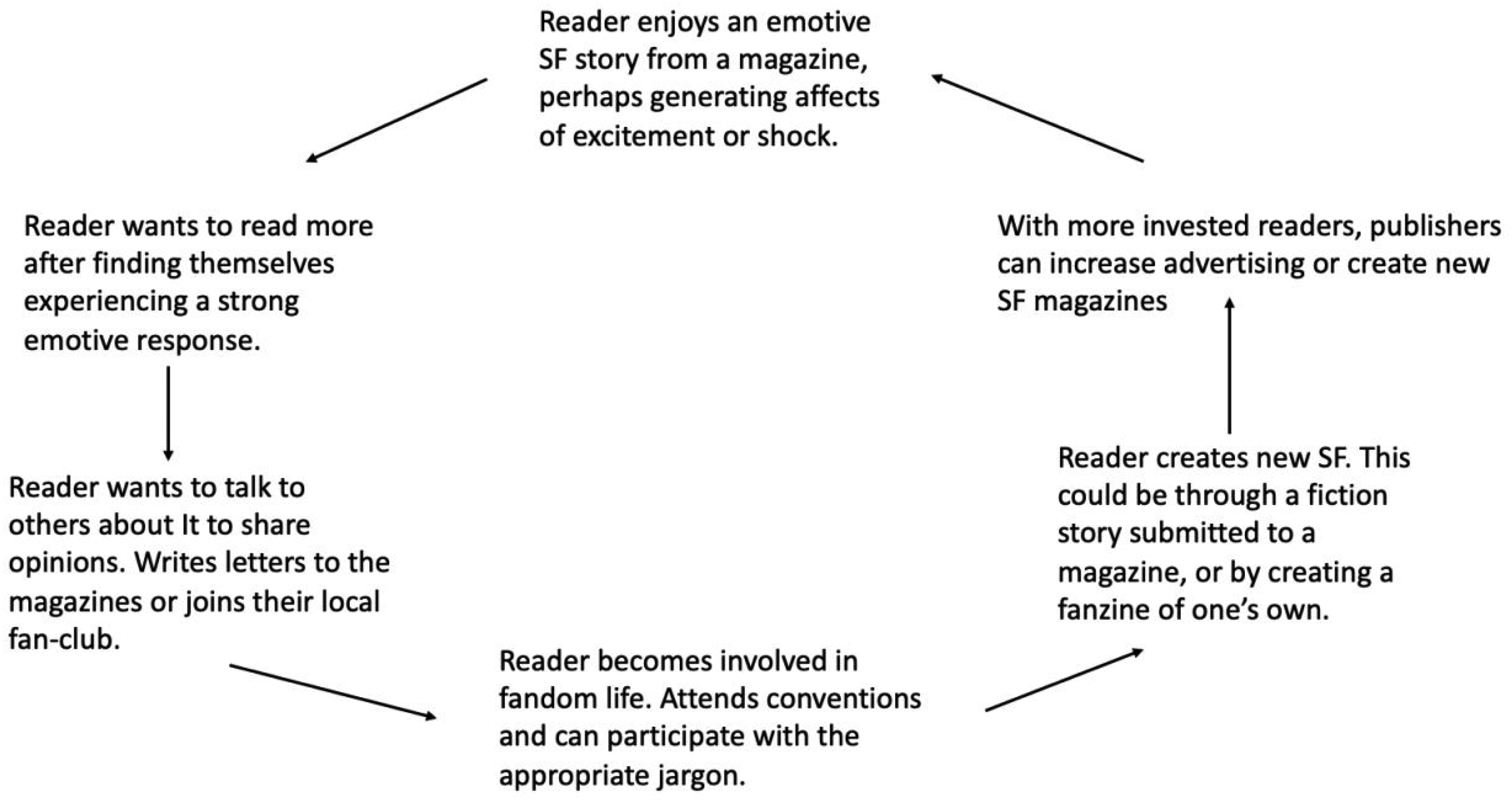
An affective circuit model predicated on the science fiction (SF) community and its generative affective attachments. Hockaday, A (2025). Author's design of an affective ‘fan’ circuit. In possession of the author.
We can consider a model something like this: a reader stumbles across a SF magazine, such as by its cover design on the newsstand. These covers, aimed at male readers, often featured sexualised women or illustrations of ‘hard’ SF: rockets or planetary imaginations, for example. The stories, filled with modes of affect such as excitement, wonder, shock or fear, can persuade the reader to continue reading SF. These magazines, which publish reader contributions through LOCs, encourage the reader to interact with members of the community, either via the personal addresses included, or through the magazine itself. Readers may also join their local fan-club to discuss SF. This begins a reader's transformation into an ‘active fan’, which was a hierarchical distinction used to define those who contributed to fandom in a myriad of ways. 1 To be an active fan, one must participate in all aspects of fan life, such as letter writing, organising and attending conferences. An active fan was also expected to create new SF, or at least engage with SF enough to act as a knowledgeable critic within the LOCs. Fans might create their own fanzine for a small group of friends, or for a ‘Chapter’. For example, Novae Terrae was formed by members of the Science Fiction League (SFL) – who divided themselves into geographical regions or ‘Chapters’. Novae Terrae was the product of the Nuneaton Chapter, and as is made clear in the first issue, its purpose is ‘in the interests of Science Fiction in general’ (Hanson and Jacques, 1936: 1). All of this culminates in invested readers who desire more SF. Therefore, publishers have the backing to produce more SF, or improve their advertising, which will therefore result in new readers finding SF and continuing the affective circuit.
In each layer, or strand, the affects stick, and circulate. It is the initial enjoyment or intense emotions of the affective modes of SF that propel the reader to continue within this affective circuit. The strands can also be skipped or blurred together, such as when readers become immediately attached to the genre and discover its fandom, immersing themselves completely rather than a gradual progression. In whichever order the circuit is followed, however, it all culminates in a growth of affective responses and affective attachments, which produces further affects. An affect that starts out as excitement or fear prompts action and participation from the reader, which then circulates throughout the fandom and becomes different modes of engagement. The affects shared by fans can result in an affective collectivity: people participate in fandom at a joint, emotional level. By this, I mean readers become invested in the community. As Karen Hellekson (2015) comments upon the early American SF fan, ‘[…]the activities of the fans – who were the writers, editors, and consumers of SF literature – ended up not just constituting a fandom but the genre of SF itself. […] Some fans organised their lives around fandom, with marriages and children resulting; FIAWOL (fandom is a way of life) became a catch phrase’ (p. 155). Hellekson emphasises the intensity of belonging to and within this community, and the ways that SF as a genre and the SF fandom almost instantly became inextricably interlinked. Therefore, I argue that the way we can understand affect is also interlinked: to be a fan of SF is to have affective attachment for the genre and for the community.
Fans, then, can be understood as heavily connected and reliant upon fandom and its networks of communication. In the British fannish community of the 30, 40 and 50 s, fans’ lives became intertwined, with friends marrying friends’ sisters, or (particularly women) being introduced to fandom by a partner or relative, and becoming involved in fandom this way. This is not to say that fandom was a completely peaceful place. As Hannah Mueller (2022) uncovers in her book study of conflict in SF fandom, there are many examples of controversies throughout the twentieth century, and argues that these revolved around social and political conflicts such as socialism or women's rights. While I agree with Mueller that conflicts within fandom would occur due to social and political significance(s), I contend that fans often created conflict in their ‘quest’ to be labelled an active fan. That is, active fans needed to be knowledgeable and have a sense of intellectual hierarchy that was demonstrated in their own contributions to SF; whether in their fiction stories, but most commonly in their LOCs. The LOCs provided a site for SF fans to criticise a myriad of things: previous fiction, the magazine's print quality (such as typesetting) or the cover art. These criticisms, while often causing conflict between author-reader/editor-reader, were an expected part of being an active fan. It was important to have opinions about what constituted ‘good’ SF, and what was best for the genre, and it was in these opinions that a fan was considered well informed in British fandom. SF fans expected and created conflict within the fandom to promote their understanding of the genre: in fact, it is in their conflicts that they formed communities.
However, it is these criticisms and opinions that SF fans voiced that, I argue, created what I understand as an exclusionary inclusive community. That is, a community that accepts a specific group of people (even if they have contradicting opinions) while rejecting other groups of people. I refer here to ways in which male SF fans repeatedly othered and excluded women SF fans from participating within the community of SF. Mueller acknowledges that previous scholarship on fan studies describes these communities as a haven: a safe space for those who are excluded from society from being misfits. However, I emphasise how women, and their understanding of SF, were regarded differently within fandom. Indeed, ‘[f]andom, it turns out, is not so much a unified nation but rather a network of states, each of whom has its own historically and culturally specific rules, exceptions for citizenship, alliances and conflicts with other constituencies’ (Mueller, 6). Therefore, we cannot understand SF fandom from a singular voice, that is, simply a consideration of white male fans. We need to consider more deeply these ‘networks of states’ at play, and examine how they interact with each other. In considering where women fans (were allowed to) fit within the wider SF fandom, we can understand conflicts of exclusion, and how they were able to create their own community. Indeed, I argue that women fans were not allowed to access the masculine affective circuit in the same way: that is, at some point male fans disregarded their contributions, or continued to stereotype women roles within their own fiction, thus making it an uncomfortable space for women to participate within.
Invasion of women fans and femizine (1954–1960)
Women were (and still are) often considered unable to effectively contribute towards the genre because they do not have the same professional science, technological or engineering background as men, and therefore could not write logical or plausible ‘hard’ SF. Instead, women's stories throughout the early-mid-twentieth century were considered ‘soft’ SF, concerned with social and cultural issues rather than new inventions or explanations of devices, and were repeatedly disregarded by male readers. For example, David McIlwain, who wrote under the pseudonym Charles Eric Maine was a prolific UK author who voiced strong opinions about women's place in SF fandom. In a letter to American SF magazine Astounding Science Fiction (1930–1980) in November 1938 he writes ‘[s]cience fiction (especially Astounding) does not cater to sentimental old maids who like a little bit of “slop” in their literature. Neither does it cater to love-sick nymphs who attempt to gain the Elysium of their frustrated desires via the doorway of books. Your male readers greatly outnumber your female fans, so why not cut out the age-old love idea, and give us newer themes’ (Maine, 1938: 158). It is clear, then, that there was gendered tension between what male readers wanted SF to be, and the perceived fear of what women fans could transform it into.
If women fans wanted to engage and be taken seriously in fandom, they had to find new means to do so. Fan activity takes a number of forms, and one of the most prominent in SF fandom was fanzines. The print run of fanzines was much lower than regular prozines: especially in the British context, a popular fanzine would be lucky to reach a hundred readers. The subscription rate of these periodicals is not a stable source of the actual readership, as they were often traded or exchanged by fans. The content of fanzines varied; it could be a place for work rejected by the prozines, it could be reviews of relevant SF material, or it could be a commentary on fan activity, whether that was conventions, parties or meetings. Ultimately, they were an informal space where fans of SF could contribute, network and connect with other members of the fandom. I approach women's involvement in the British SF community by examining Femizine (1954–1960), the first British all-female fanzine dedicated to SF, first published in 1954, and which ran to 1960 over 15 issues. Within this fanzine, we can see the existing gendered fan community; connections between female fans and their male counterparts; how women's involvement in the community was being received, and as I ultimately argue, how Femizine helped foster an identity for women fans, especially when we position the proposed affective circuit as a masculine space.
The establishment of Femizine as a collective space for women, however, was not that simple. As was revealed in the ninth issue of Femizine, the editor Joan W. Carr was actually a hoax (Figure 1). Carr was created by male Manchester fan ‘Sandy’ Sanderson, who had read about American hoaxes, and as Hansen explains ‘had long been toying with the idea of trying one himself’ (p. 117). The concept of hoaxes were common in British fandom: they tended to happen at conventions as the different SF circles (normally London, Manchester, and Belfast) competed against each other. 2 Sanderson decided, as his hoax, to create a complete other fan. 3 The idea of a fanzine for the female fans was actually first suggested by Frances Evans to Ethel Lindsday, but when Lindsay wrote to ‘Carr’ to mention this, ‘back by return came a full fledged scheme to produce one, with herself [Carr] as editor as I [Lindsay] as her assistant. I felt a bit miffed about this on Frances’ behalf as her idea had been more or less lifted from her’ (Lindsay, 1956: 10). Sanderson decided this would be an opportunistic space to continue his hoax: while Evans and Lindsay envisioned the publication of Femizine to connect women fans, Sanderson was using it for his own gain. However, while some may argue that the Carr figure makes Femizine's ‘purpose’ unauthentic, I instead posit that Carr existed affectively in her ability to rally the women fans and provide a space for their own voices and community.
The creation of Joan W. Carr complicates the history of Femizine. Indeed, it is an ironic way to establish the female fan community within Britain. While hoaxes were generally intended as harmless, the fabrication of Carr furthers the idea that a dedicated, knowledgeable female fan was easily replicable or imitable: in many ways, ‘she’ was a joke. It is important to consider the implications of it being a man who facilitated the affective space of Femizine: would the fanzine have ever been created if it was not led by a male fan who wanted to hoax? That is, would the female fans have had the strength and commitment to establish Femizine without the figure of Carr, particularly in the exclusionary male-dominated fandom? As Daphne Buckmaster recounts in her own fanzine, Esprit (1954–1961), on her (literal) difficulty entering fandom, ‘I learnt that the London Circle met every Thursday not five minutes walk from where I was working! Now, had I been a man this would have been the end of the story but I was (and still am) a woman and could I walk alone and unintroduced into the stag gathering? I could not. On two occasions I got as far as the door but could not pluck up the courage to go in’ (Buckmaster, 1954: 136). Buckmaster acknowledges the gendered differences in terms of joining fandom: she recognises that it would have been much easier for a man to approach this community, and her fear held her back. This reflects the idea that the affective circuits work differently for men and women: while Buckmaster could have continued her affective attachment to the genre by joining fandom, the exclusionary space prohibited her from doing so. Therefore, the breakthrough of Femizine provided women fans such as Buckmaster a space dedicated for them: they do not have to question whether they belong, and this was because of the momentum and solidarity that Carr created. The hoax, then, can be viewed as a subversive strategy: a playful prank that resulted in an emancipatory effort to create a space for women fans in SF. Femizine, then, began to establish a collective selfing for women fans, who could build their own community and identity in relation to fandom within the pages of this fanzine.
The female fans are drawn towards this strong, witty, and encouraging editor, while the men (as described by Sanderson in later issues of Femizine) either send flirtatious correspondence, or attack the figure of Carr, and the femme-fans in general. When the hoax was revealed, many female fans mourned the loss of a fellow fan: their grief motivated by their affective responses to Carr, Femizine, and what they both represented. Evans describes Joan as ‘dead’ (Evans, 1956: 11), while Pamela Bulmer (who took over editorship of Femizine when ‘Carr’ left) describes the ‘very real sense of loss which will be felt by everyone that knew her’ (Bulmer, 1956: 2). The blurring between authenticity, that is, the real and the pretence, is one that heightens the affective response(s): how can one miss a fan that was never real? The everlasting figure of Joan Carr, then, is an important one. When discussing the hoax, Bulmer writes that Carr did not exist. I argue that, in an affective sense, she was very real. Her presence in the femme fandom is one that transcended reality: of course, no one ever met Joan, so it was the idea, or memory of her, that pervaded fandom. Her presence and her role is one that heavily influenced fandom. Femizine began to decline in numbers once the hoax was revealed; whether this was because the women fans felt they had been tricked, or because it was the personality and voice of Carr that had attracted them to the fanzine originally. In many ways, Sanderson performed Carr so well that he deceived himself, along with the editors who knew it was a hoax, but still considered Carr as a ‘separate personality’ (Lindsay, 1956: 10). While the establishment of Carr and Femizine may have been intended as a hoax by Sanderson, it succeeded in providing a space for women's community and SF publishing, and therefore should, I contend, be treated as a turning point for the female fans in the hitherto male-dominated SF fandom.
When Femizine emerged, it provided an intervention into the somewhat quiet and unrecognised female fan community in Britain. While these female fans (also referred to, both by themselves and by the male fans, as ‘femme-fans’ or ‘femmes’) were slowly contributing to magazines in the ways of stories, articles and LOCs throughout the 1940s and 1950s, it is the production, circulation and reception of Femizine that marks the turning point for the beginning of an active female group in the male-dominated space of SF fandom in Britain. As Helen Merrick (2011) posits, these women-only fanzines ‘mark an important phase in the history of women's involvement in sf fandom’ (p. 84), and argues that the label ‘femme-fan’ was a ‘positive sign under which they could consolidate some kind of collective identity and presence’ (p. 84). Launched at the 1954 British National SF Convention: Supermancon, in Manchester, at the Grosvenor Hotel, Femizine's first issue boldly states that ‘[i]n the clubs and unorganised groups already in existence in the UK the femme-fan is in the minority. “Femizine” is designed to unite these minorities in order that they can get a better hearing in the fan world’ (Carr, 1954: 1). Carr makes the fanzine's purpose explicit from the opening issue. By recognising that the women SF fans are a minority group within fandom, Carr argues that they need a place to unite and be recognised in the fan world. I understand women's contributions to Femizine (also affectionately nicknamed Fez by its fans) as an act of resistance against the patriarchal exclusive space of SF fandom insofar. I look to Femizine to understand how these women fans rebuilt their own understanding of community, rejecting masculine tropes that constituted the genre and the fandom, and replacing them with notions of female friendship and solidarity, encouragement and hope. Furthermore, I understand how Femizine helped provide women fans with an opportunity to access the affective circuit.
I examine first Ina Shorrock's and Bulmer's non-fiction section entitled ‘A Call to Arms’. These were published in different issues (Shorrock's in the first, Bulmer's in the joint third and fourth) but draw upon the same theme: female empowerment within SF fandom. In the first issue, Shorrock writes ‘[e]very little thing you do counts. Don’t be afraid of doing an article for us. Everything will receive attention. If it is considered to be below standard, we will tell you why. There's no harm in that, is there?’ (Shorrock, 1954: 17). This collaborative space is constructed to be an affirming, non-judgemental way to increase the number of women actively participating and producing within the SF fandom. By confirming that ‘everything will receive attention’, Shorrock here validates and recognises the limits of these women, and in doing so, declares that every one of them is important within this fandom: even though she is not an editor, she uses ‘we’ to address the shared identity of femme-fans. By encouraging the dialogic exchange and transformation from reader to writer, Shorrock reaffirms the gendered space of women SF fans through Femizine. She does so specifically to increase female involvement. By gently guiding women readers to continue the affective circuit and become more involved in fandom by writing, Shorrock facilitates a site of production, friendship, and celebration that provides a community for women fans.
These affective intensities are not only experienced by an individual, but rather, networks or ‘products of swirling, moving sets of relations’ (Chadwick, 2021: 558) that support these female fans. It is the (re)building of a community, and finding new networks within, that continues the affective circuit's movement. Shorrock argues for women to ‘push much harder than we have been doing in order to equal the men in science fictional affairs’ (Shorrock, 1954: 17). She follows this, however, with an underwhelming admission: ‘I wouldn’t like to say that we will eventually pass them in this sphere of activity, but we must, no, we will have a really good try’ (Shorrock, 1954: 17). Shorrock's attempt to be inspiring still illustrates an unwillingness to be confident: it is an example of women still not feeling able to transgress the previous male-dominated fandom. I argue that this is a result of the exclusionary tactics of SF fandom, which functions through the affective circuit. When male SF fans disregard women's SF as ‘soft’ and therefore not good, this acts as a circuit breaker. That is, if women are not encouraged by male SF fans to continue writing (either through fiction or LOCs), then they cannot move onto the next part of the circuit: fandom. They are excluded from the male-oriented community of SF fandom, and these tactics take a variety of forms.
Within the LOCs of Femizine, for example, we can observe who is reading this fanzine. While women were repeatedly encouraged to contribute to the main body of the fanzine, men were, apart from a few outliers, only published in the LOCs. They use this space, I argue, to sexualise women fans. For example, Paul Hammet, in the second issue of Femizine, writes an advertisement for the fanzine, which reads: ‘Femizine! The only female fanmag, hospitable and alluring, blending pornography and science fiction…It also mentions spaceships’ (Hammet, 1954: 32). The ways in which Hammet views this fanzine is drastically different from that of the female fans: he removes any female agenda of creativity, friendship and transgression, and replaces it with overt sexualisation. It becomes an object made for the male fans: the fanzine's purpose and intent is redirected to one that suits the male's interest. I argue that Hammet creates an affective feeling of discomfort for the female fans. This personification and objectification of Femizine is a recurring theme with the male fans: because it is written by women, it offers something other than the male fanzines. It is not, in some of these male fans’ eyes, a reputable fanzine of SF knowledge and creation, but a space for women to cater to the masculine territory of SF fandom. Chuck Derry writes to say ‘[t]he instant I opened the mailbox I knew Femizine was there. The soft purring sound comes from no other zine’ (Derry, 1956: 29). This alluring, enticing quality that Derry admits to stems from the gendering of the fanzine: they expect, or create, the female fanzine to be a sexualised space.
In fact, if male fans do not receive enough discussion in Femizine on what they want, they are quick to comment. Stuart MacKenzie agrees it is ‘high time the femme fan had their “Woman's Own” now we can get a concentrated feminine viewpoint’ (MacKenzie, 1954: 27) but, a few issues later, MacKenzie argues with the ‘Call to Arms’ feature: ‘[w]hat is this – suffragettes rearing their banners again? It simply isn’t good enough, and besides, I don’t think she has the right idea…’ (MacKenzie, 1954: 30). We can see, then, that the male fans want a specific type of femininity, even though this was created as a space for women, by women: while MacKenzie initially appeared supportive of a dedicated space for women fans, he did not like the sorts of emancipatory pieces the fanzine published. I suggest that these male fans believe that women are disrupting ‘their’ masculine SF with this fanzine. For example, Brian H. Varley writes, ‘[g]hod if there's one thing annoys me more than a nattering woman it's an ‘intellectual’ nattering woman. My only salvation from such creatures is to slip into the sublime oblivion provided by Bheer’ (Varley, 1955: 27). 4 Varley here places blame onto women for writing such ‘intellectual’ (in quotation marks to emphasise its sarcasm) pieces. It is peculiar to do so, of course, considering Varley is reading this all-female fanzine: by writing in, and imposing his views towards the contributors to this fanzine, he attempts to regain some gendered territory of SF fandom by criticising women. As Helen Winnick responds to him in the next issue, ‘AND IF VARLEY DOESN’T LIKE NATTERING WOMEN WHY DOES HE SUBSCRIBE TO FEZ?!!!’ (Winnick, 1955: 44). While I recognise that these comments may be deliberately playfully provocative in tone, as fandom culture often is, I do emphasise that both these LOCs engage with and critique Femizine in a different (gendered) way than other fanzines published by male fans.
While Shorrock facilitated a space of gentle encouragement, Bulmer, in her ‘Call for Arms’ takes on the nickname of ‘Gloria Famhurst’ – a play, of course, on Emily Pankhurst, and including ‘Fam’ to represent the femme-fans. The tone of this ‘call’, while maintaining similar themes, is remarkably different. The transgression of the domestic is brought up in Bulmer's speech: reminiscent of a propaganda war-cry, she exclaims ‘[t]o arms you shackled slaves of marriage! You who economise with the housekeeping, going short yourselves, nay all but starving so that they might buy their duplicators, their ink and paper, their stencils and their infamous magazines […] Let them brew the tea whilst we besmear ourselves with ink and swearwords’ (Bulmer, 1954: 7). The anger is palpable here: Bulmer evokes domestic labour as a rallying cry against the treatment of female fans, blaming their husbands as the reason why women have insofar been unable to flourish within fandom. She (re)fashions the image of women through inverting the home scene, thus allowing female fans to write: there is a deliberate attempt to place the active role of a fan onto the women, satirically encouraging them to ‘besmear ourselves with ink’ to produce SF. The link between gender and social roles is something Kate Heffner (2022) argues that Femizine highlights. She posits ‘the relationship between gender and domestic science’ (p. 20) is a common theme in Femizine, and discusses femme-fans ability to make a ‘home’ in SF fandom by figuratively highlighting and inverting the domestic scene. 5 Indeed, by collecting the voices of the femme-fans and their ability to transgress the space of the home, Bulmer facilitates an affectively charged space of hope.
This gendered tension is not surprising considering a common (mis)conception of SF is that women were only present in the genre because of their relation to their male counterparts, whether this be spouses, siblings, or parents. Editor of New Worlds, John Carnell, in his discussion of reader survey findings, writes that while there is an increasing interest in SF amongst women readers, this ‘may have been stimulated by husbands being readers’ (Carnell, 1959: 2). While this (as I will argue), has truth to it – it does not wholly account for women's interest in the genre: in the same survey, he notes that 56% of women responded that they were single (Carnell, 1959: 2). Merrick understands that female fans were often discounted because they were ‘wives, girlfriends or female relatives of male fans’ (p. 43), which implies that the ‘male delegitimated the woman fan identity – that her interest and presence was dependant solely on male influence’ (p. 43). As we can see, however, most women in this survey classified themselves as single, and we can therefore determine that they enjoyed the genre of SF without male influence. When considering this alongside the affective circuit, I emphasise that while women fans could have help accessing fandom via their male partners, this was not an option for most of them, and they therefore had to find their own ways to participate.
In Femizine, however, one of the main ways that the female fans communicated was through a shared acknowledgement of having male SF partners. In issue 5, Joan Burns writes a story entitled: ‘I Said to My Spouse’. Burns argues with her husband about writing a story on bathrooms. This menial topic reinforces the idea that fan-wives – a self-described term used to foster another sense of collectivity – were concerned with the domestic, or at least, representations of the domestic in SF. Her narrative is framed around her role as a wife in a domestic setting: with such few stories written by men concerning the household, Burns acts as an activist for such narratives. Indeed, many of these fan-wives discuss their treatment at the hands of their husbands. The unknown, but prolific alias writer ‘Francezka’ writes in her own columns, ‘[i]t is a great and noble thing to be the wife of a fan…And when he turns up again it is staggering under a pile of alcoholic fanzines and showing obvious signs of having being kissed’ (Francezka, 1955: 11). They are also eager to share their negatives of their fan husbands; Burns starts off her story with ‘I said to my spouse who was tapping away at his typewriter in the hope of adding to his record collection of rejection slips from the pro-mags’ (Burns, 1955: 3). She frames her husband's f(r)antic activity as an embarrassment: he is not good enough for the pro-mags, and so she must suffer. Through Femizine, women have the ideal space to share their common interests and concerns, one of these undoubtedly being a fan-wife. Femizine's persistence in publishing these types of works demonstrates its aim to unite and connect women fans: they develop a collective sense of ‘selfing’ in the pages of Femizine.
Male fandom often did not acknowledge the role of women in SF: if they had to be used then it was as a character to either aid the male protagonist, or warn male readers of the dangers of female power. With the creation, and publication of Femizine however, women in Britain suddenly had an area with which they were actively encouraged to publish because of their gender, and this area, or space, functioned affectively. I suggest that women fans rewired notions of masculinised fannish community, from one of conflict and critique, to a space of encouragement, solidarity and support, demonstrating how the affective circuit can function differently according to gender expectations. I recognise that instances of conflict and critique can provide different productive modes of engagement; the subversive strategy of the hoax, for example, suggests that boundaries between gendered spaces were not completely exclusive. However, Femizine provided women fans in Britain a place in which to contribute to SF, and furthermore, create a site of collective ‘selfing’ – something that they struggled to access previously.
Conclusion
What is evident, then, are the ways in which Femizine functioned for its women fans, and, conversely, how men attempted to disregard their contributions. Femizine provided women with an opportunity for community, and at its peak, it was one of the most popular fanzines, reaching nearly 100 subscribers (which, as mentioned, does not account for the actual reader-number, as magazines were constantly borrowed and traded). For the first time in British SF fandom, women had a dedicated space of solidarity and friendship. The male-dominated community understanding of what it meant to be an SF fan was drastically different to that of women. While male fans often reverted to harsh critiques and conflicts, Femizine's interactions, especially between female fans, can be understood as supportive and encouraging. In this way, Femizine altered the previously understood definitions of community and fandom that the male-dominated scene of SF followed. Heffner writes: ‘[i]nterest in Femizine has primarily focused on the “Carr Hoax” […] which has often overshadowed the contributions made be femme-fans’ (p. 23). In a similar vein to Heffner, I argue that Femizine should not be remembered solely for the hoax. In its publication of editorials, short stories, poetry, song lyrics, non-fiction articles, illustrations and LOCs, Femizine cultivated and encouraged the gendered production and growth of women SF fans in Britain. In disrupting the masculine exclusive community, Femizine provided a space of networking and solidarity for female fans, for them to connect and create their own affective investments and attachments to fandom.
This article has argued that not only were women present in SF fandom, they were also actively aware of the gendered constraints that SF as a genre presented. In recognising the subversive strategies of the hoax, I demonstrate the complicated history of Femizine, and its influence on women fans. I posit that Femizine provided women fans a space in which to create their own community; which as Buckmaster had discussed, was easy for male fans, but became a challenge for women. The idea of the affective circuit suggests a reading on how affect, fans, and fandom function and grow. In considering the exclusivity of the masculine community of SF, I understand the constraints that fandom can bring: they are not always inviting and hospitable to anyone who identifies as a ‘fan’. Indeed, as this paper examined, the identity of a fan is repeatedly considered in relation to gender. Instead, women fans have to find their own ways to access the affective circuit, and Femizine created a dedicated space to transgress previous male notions of not only what a SF fan is, but also what the genre of SF can look like. While I opened this article with a consideration of how Gernsback defined the genre, I argue that masculine notions of SF have continued to pervade the genre. For further research in this area, I would suggest a deeper investigation into the functioning of the affective circuit, particularly how it can be used throughout different genre fictions to understand the growth of fandom and community.
Footnotes

Funding
The author received no financial support for the research, authorship, and/or publication of this article.
Declaration of conflicting interests
The author declared no potential conflicts of interest with respect to the research, authorship, and/or publication of this article.