



Abstract
The Detroit band Insane Clown Posse (ICP) and their fan subculture of ‘Juggalos’ have created an alternative culture with its own symbolism, rituals, and forms of kinship, called the ‘Dark Carnival’. This article connects ICP and the Juggalo subculture to the cross-cultural study of clowning in European and Indigenous North American and Oceanian societies. It is argued that ICP and the Juggalos use clowning as a creative method to develop new ways of living and being and mount liberatory political challenges within an egalitarian counter-cultural space. ICP's clowning is situated within the post-industrial Rust Belt and is posed in relation to economic grievances, masculinity, class, Whiteness, and intergenerational violence. Clowned forms of performative violence are used in lyrics and rituals to create a communitarian ethos of ‘Juggalo family’ which accepts participants unconditionally, rejects actual violence, and eschews social taboos in favour of creating its own symbols and norms.
Social creativity
Insane Clown Posse (ICP) is a ‘horrorcore’ hip hop music duo founded in 1989 in Detroit, Michigan by Joseph Bruce a.k.a ‘Violent J’ and Joseph Utsler a.k.a. ‘Shaggy 2 Dope’. The band has won notoriety for their confronting lyrics and dramatic performance style, appearing on carnivalesque stages in clown face-paint and spraying the soft drink Faygo onto their ecstatic fans. While the band's popularity peaked in the late 1990s and 2000s, they have given rise to an enduring fan community of ‘Juggalos’. Sporting a distinctive dress including clown outfits, face paint, and ICP tattoos (see fig. 2), Juggalos have built a community around countercultural ethical principles of fraternity, unconditional acceptance, and rebellion against authority, constituting a classical musical subculture similar to Punk or Goth (Halnon, 2014; Przemieniecki et al., 2019: 3). Juggalos are widely dispersed across the US and number in the low tens of thousands (Przemieniecki et al., 2019: 7). Demographically, Juggalos are mixed-sex, overwhelmingly White and lower-income, and likely to be marginalized in various ways including being socially ostracized or being victims of domestic and sexual violence (2019: 4; Halnon, 2014: 88) Figure 1.
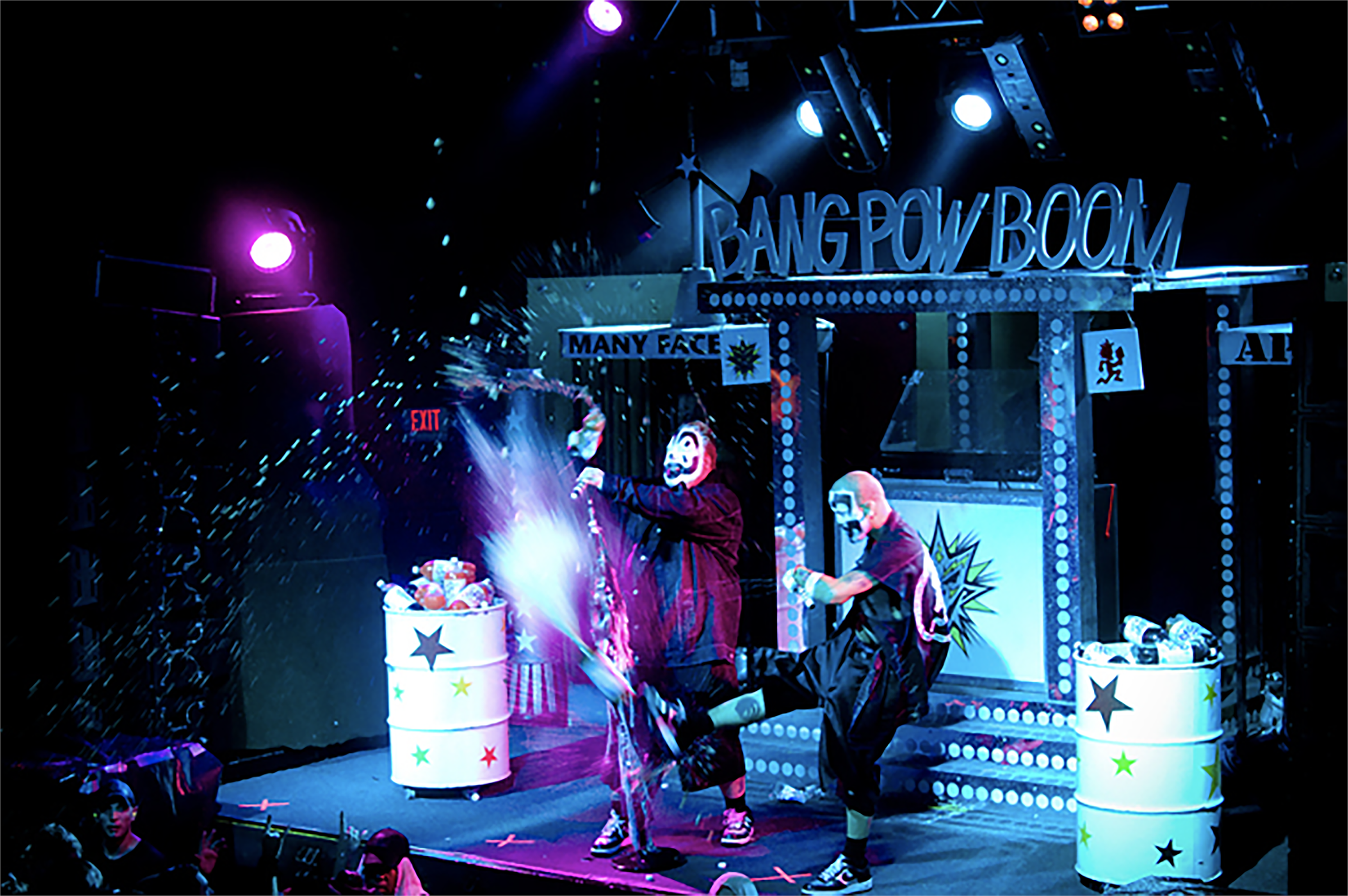
A typical insane clown posse show (Relux, 2009).
ICP has been prolific for over thirty years, with their oeuvre spanning sixteen albums, twenty-two annual ‘Juggalo Gatherings’, dozens of singles and EPs, and over a hundred shows. Their lyrics, performance, and the subculture around them have given rise to a musical mythology known as ‘the Dark Carnival’, a realm of decaying cityscapes scarred by poverty and violence, into which magical killer-clowns appear to punish the wicked and spearhead an urban revolution against the ruling classes, all presided over by fantastical figures like ‘The Great Milenko’ and ‘The Wraith’ (Halnon, 2014). Dark Carnival has expanded beyond the typical confines of art to seed a real-world cultural landscape inhabited by thousands of Juggalos for whom Dark Carnival provides symbols, meanings, codes of living and being, and self-representations (2014: 95–96) Figure 2.
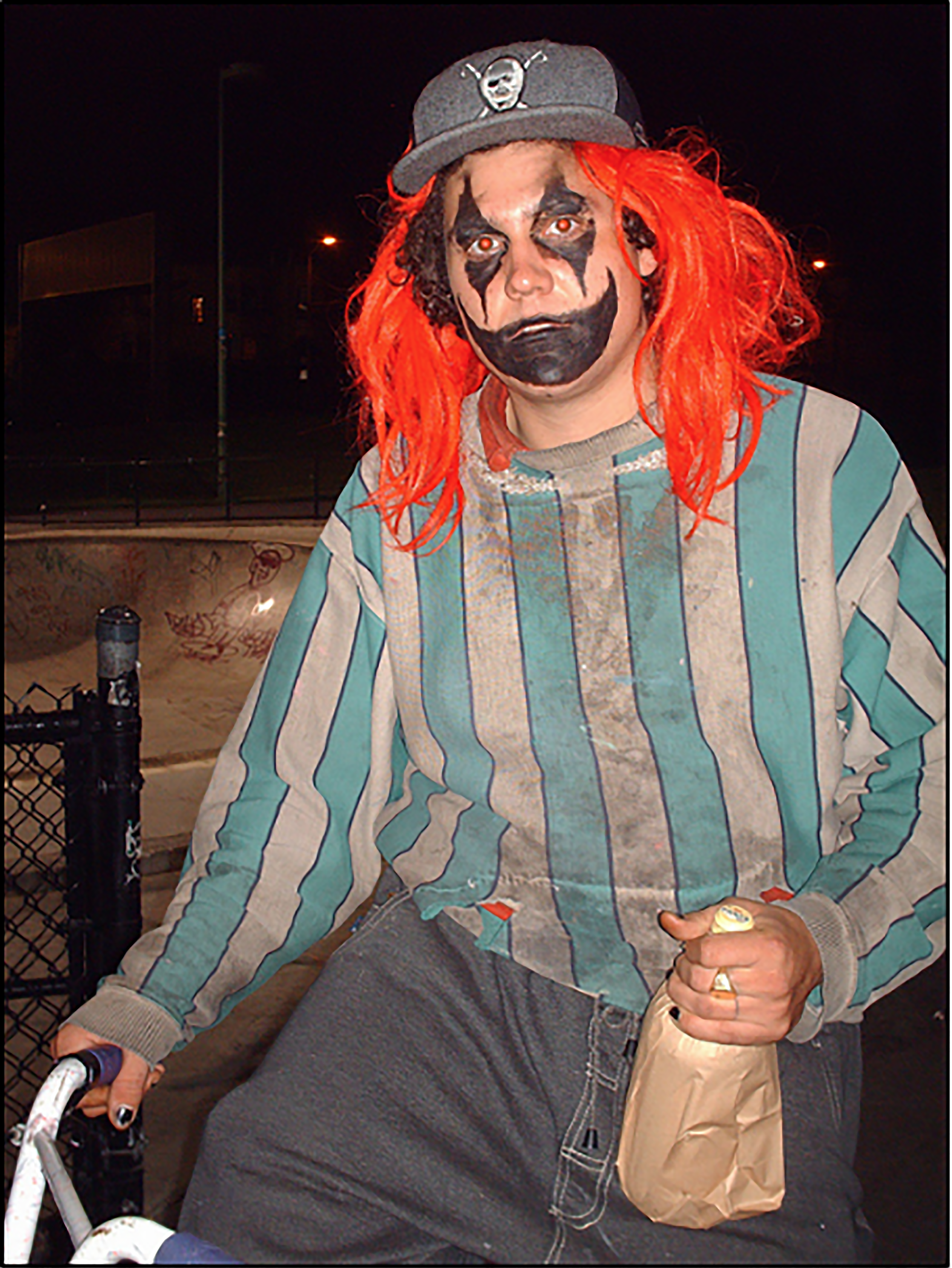
A Juggalo in clownface (Brodiesel710, 2019).
ICP and the Juggalo subculture have been subjects of some scholarly interest. Halnon (2014) draws on Bakhtin's (1984) carnivalesque to argue against stereotypes of Juggalo criminality, providing a rich source of ethnographic data which she uses to define Juggalo culture as a life-affirming community of ‘fellow outcasts’. Neely and Marone's (2014) multimodal study comes to similar conclusions, emphasizing the importance of unique Juggalo expressions like hand gestures, greeting rituals, and symbols in cultivating a communitarian ethos. Petering et al.'s (2017) analysis of the relationship between Juggalo identification and risk factors among unhoused youth in Los Angeles is the only quantitative research yet published on Juggalos. The review finds that Juggalo respondents reported higher rates of childhood trauma, drug use, and suicidality than non-Juggalos, arguing along with Halnon (2014) that Juggalos should be understood as a victimized population seeking community rather than as dangerous criminals. From a criminological perspective, Przemieniecki et al. (2019) evaluate behaviour at an ICP event to argue that Juggalos constitute a deviant subculture with gang-like elements, reflecting the criminalization of Juggalos which Halnon (2014) and Petering et al. (2017) seek to reject. No published research has yet connected ICP to the body of anthropological work on ‘sacred’ or ‘ritual’ clowning. As Edith Turner asserts, “there are thousands of clowns in human culture” (2012: 38), and a rich ethnographic tradition has tracked sacred clowns across Indigenous North American and Oceanian cultures, finding many similarities with European circus clowns, fools, and jesters. In this paper, I follow on Van Ham (2009) in locating the ‘sacredness’ of such clowns in their challenges to social and political order (2009: 320, 331). These clowns are inversive, outlandish cultural dissidents who elicit fear as often as laughter and deploy tactics of burlesque and mockery to facilitate serious self-reflection on cultural norms and hint at a wealth of alternative social possibilities.
In resting my analysis upon a broad category from comparative anthropology such as ‘clowning’, I am consciously treading a path that has become quite unorthodox. In a critique of the notion of the trickster, Beidelman (1980) argues that such categories can be the result of “false translations” (1980: 28) which crudely gloss over cultural particularities. There can be no dispute that attempts by anthropologists to create sweeping classificatory regimes have produced wild misinterpretations and can engender reductive readings of complex cultural phenomena. However, the falsity of such ‘translations’ can only be borne out should they fail to provide for any fruitful analysis. Beidelman himself suggests that “good translation remains worth attempting, even if it may be unrealizable” Beidelman (1980: 39). David Graeber (2007) makes a compelling argument for the viability of ‘back-translating’ such categories in the study of Western cultures. Graeber argues that notions like taboo, totemism, and sacred clowning were developed by Western anthropologists to describe otherwise inexplicable cultural phenomena they encountered. Indeed, Keisalo-Galván (2008) observes that much of the ethnographic fascination with sacred clowning owes to a Euro-American feeling that “clowns and religion do not go together” (2008: 39). Yet this expanded understanding of clowning allowed for the often-repeated realization that “what seemed most alien was not actually that alien after all” (2007: 15), and that Western examples from Charlie Chaplain (Caron, 2006) to Jackass (Hye-Knudsen, 2023) operate on clown logics strikingly similar to those seen in Indigenous societies. One of the most persuasive arguments for a cross-cultural understanding of clowning is that those involved typically recognize that “something is going on here” (2007: 15), as a telling note in Elsie Clew Parsons’ (1917) classic Notes On Zuni relates: “Zuni who have seen our clowns call them American newekwe” (1917: 232). Contemporary Indigenous thinkers such as the Rotuman academic Vilsoni Hereniko (1994, 1995) have continued to find this tradition useful, such as for revealing connections between political satire and traditional Polynesian clowning practices.
In this paper, I engage in documentary research including media analysis and the collation of ethnographic sources, with a great debt owed to the late Karen Halnon (2014) in particular. I follow on Van Ham's (2009) indexing of early punk culture as a form of clowning to argue that Juggalos engage in sacred or political clowning practices to develop new social and ethical principles. I contend that considering ICP and the subculture around them as clowns can provide for deeper insight into the means by which the band cultivates a radically alternative cultural space, elucidating elements which would otherwise remain obscure. In taking heed from ICP 1 themselves to “let the wagons of the Dark Carnival show you different worlds” (Dark Lotus, 2001), I want to take seriously the ways in which the Dark Carnival utilizes clowning as more than an aesthetic but as a method to develop new forms of family and kinship, to reflect on, upset, and reverse cultural taboos, and to mount emotive political challenges to hierarchies of wealth, power, and class.
Political clowning
In exploring the creative and political potentials of clowning as enacted by Insane Clown Posse, I draw on the diverse practices of European and Indigenous North American and Oceanian clowns. In so doing, I have had to contend with dated ethnographic accounts which were written in a colonial context by Western outsiders. To the greatest possible extent, I have drawn from sources in which the key elements can be validated by contemporary Indigenous sources—such as Boas’ (1894, 1897) recording of Kwakwaka’wakw nułamał clowns by the U’mista Cultural Society (2023)—or in which the potential for misinterpretation is low, such as in the documentation of specific physical actions by Makarius (1970). Additionally, I have drawn at length from the contributions of Indigenous scholars Alfoso Ortiz (1972) and Vilsoni Hereniko (1995, 1994), as well as of non-Indigenous scholars subject to Indigenous oversight (Hieb, 1972). Following on Van Ham's (2009) centering of the social challenge of clowning, I break with much of the literature on this subject and employ the term ‘political clowning’ where others might use ‘sacred’ or ‘ritual’ clowning. I do this in order to emphasize the essential elements of my analysis, and to be clear that while I relate ICP and the Juggalos to Indigenous ‘sacred clowns’, I am not arguing that they have a sacred nor Indigenous element themselves. So as to not conflate the culture-bound roles of specific clowns touched upon here, I have pursued a praxeological approach which centres clowning as a practice rather than as an essentialized role.
Political clowns are often identified with activities that blend buffoonery with serious challenges to social structures including taboos (Handelman, 1981: 338; Makarius, 1970) and hierarchies (Graeber, 2017; Zucker, 1967). The eminent anthropologist of ritual Don Handelman (1981, 2009) has grounded clowning in the confusion of ontological and symbolic boundaries, with clowns acting to mess-up hierarchies, dichotomies, and the proper relation between symbols (1981: 340–342, 2009). This emphasis on the (de)constructive ‘boundariness’ of clowns becomes particularly useful in understanding the social applications of clowning, evincing that the disfiguration of one social order acts to create another, and that ultimately “to generate discontinuity is to create boundary” (2009: 310). The ambiguous and transformative character of clowning has been connected to Victor Turner's (1969, 1970, 1974) notion of ‘the liminal’, the intermediary point within ritual when subjects are “betwixt and between” (1969: 95) and become changeable and fluid. Turner argues that liminal states are ruled by a mood of ritual egalitarianism, or communitas, which can reverse or confuse everyday hierarchies and has been associated with clowns and clowning, with both carrying the capacity to dissolve and transform social edifices (Turner E, 2013: 38–39). Many clown practices have been understood as a type of liminal ‘status reversal’, in which the “underling comes uppermost” (1969: 102). Despite typically coming from marginal backgrounds (Course, 2013: 776; Willeford, 1969: 12), clowns are empowered to wield power over social superiors, such as subjects over chiefs and women over men (Hereniko, 1994, 1995: 116–18). Clown practice—or simply ‘clowning’ (Keisalo-Galván, 2008: 39)—is often inversionary, with clowns performing actions backwards or upside down (Graeber, 2017: 384), muddying sacred symbols with those of the profane (Charles, 1945: 32; Makarius, 1970: 53), practicing reverse-logics such as wrapping up in the heat or stripping in the cold (Turner E, 2013: 41) and compelling others to do the opposite of what they say (2012: 41; 2017: 383–84). Clowns are often ‘paradoxical’, embodying within themselves diametrically opposed traits: Zucker (1967) describes them as being “crude and mean, but also gentle and magnanimous; clumsy and inept, but simultaneously, incredibly agile” (1967: 308).
For Insane Clown Posse and the Juggalos, clowning offers a means by which to invoke Dark Carnival as a liminal play-frame to engage in social experimentation and challenge normative structures of power and taboo. Heeding Welsford's (1936) postulate that “there is no such thing as Clown […] only clowns” (1936: 273), we must disabuse any structuralist notions of a ‘pure clown’ and emphasize the settings in which clowning takes place (Van Ham, 2009: 320). In the case of ICP, these contextualities will involve a recognition of the post-industrial geographies, revanchist masculinities, hierarchies of race and class, and intergenerational traumas within which their clowning is situated.
Class and violence
Emerging from the Detroit hip-hop scene of the early 1990s, the lives of both Insane Clown Posse's frontmen and their Juggalo fans are inseparable from the Midwest's post-industrial cityscapes and their haunting by narratives of decline, alienation, and violence. In his autobiography, Violent J records a coming-of-age marred by poverty, domestic instability, and sexual victimization (Bruce and Echlin, 2003: 3–28). J was keenly aware of the wider socioeconomic contexts within which his experiences were situated. In one section of his autobiography, he recalls striking back against class power with a crew of fellow outcasts, smashing up luxury cars 2 and attacking those they saw as “richies” (2003: 123, 112–14). This sense of rebellious working-class masculinity echoes forward into Dark Carnival, with many ICP songs foretelling of a fantastical clown revolution against the police, the wealthy, and the comfortable middle classes.
Clowned class warfare
Dark Carnival is far from the first site where clowns have become associated with marginalized populations. Zucker (1967) posits that European clown performances challenge dominant social formulations by confounding the very markers which support them, inverting norms of dress, manners, and behaviour (1967: 309–13). While cautious about the political implications, Zucker nonetheless provides a roadmap for how the socially entropic nature of clowning practice becomes moored in class dynamics as the forces of authority move to expel the clown to the social periphery and away from the inner workings of power. The rendering of clowns into crude peasant entertainment is thus an essentially political move which hopes to neutralize the danger of the social possibilities revealed by clowning (1967: 316).
This same dynamic is reiterated within Dark Carnival: already ostracized, ICP and the Juggalos turn to the methods of political clowning to not only express their grievances but also to imagine a new world through a dramatized clown revolution. The band's first album, Carnival of Carnage, begins with the arrival of a parade of “savage jesters” to an idyllic American town to visit chaos upon its well-to-do inhabitants (Insane Clown Posse, 1993). In the song Piggy Pie, a clown vigilante breaks into a mansion—the owner of which “sleeps on a mattress stuffed with hundred dollar bills”—and beats him to death with one of his many gold bars (Insane Clown Posse, 1997b). Inverting both spatial and political dynamics, the physical arrival of barbarous clowns from the deprived periphery into the interior spaces of wealth and power marks a crossing into a flipped otherworld rich with social possibilities. This reading of ICP's work hardly requires laborious analysis; these political implications often stated plainly, such as in the coda to Night of the Axe: The ghettos of America are breeding grounds for the criminal minded As for years they've killed one another off, and America has enjoyed its creation Well now those ghetto-minded criminals have crossed the line into your neighborhood, and will soon give you a taste of the hell that they have lived for so long (Insane Clown Posse 1993)
Violence and status reversal
It is difficult to overstate the centrality of violence to ICP's lyricism (Halnon, 2014). Very few of their songs pass without someone being killed or maimed. ICP are not alone as political clowns in employing theatrical or ritualized violence, which is often used to articulate novel ritual rules. Graeber (2017) notes that during certain festival seasons—liminal ‘otherworlds’—Kwakwaka'wakw nułamał are vested with unique creative powers backed up by the threat of force. These clowns not only enforce ritual rules—such as forbidding laughter around them, reversing everyday expectations—but actively generate new ones. This contouring of ritual space is facilitated by acts of violence which range from the performative—tossing people in the air (2017: 382–84)—to the very real, as Boas (1897) illustrates: “[Nułamał were] throwing stones at people […] stabbing and killing them with lances and war axes” (1897: 468; U’mista Cultural Society, 2023). Nułamał also typically engage in wanton destruction of property, as do Pueblo clowns during their initiations (Boas, 1897; Ortiz, 1972: 151).
As Graeber notes (2017: 384), the creative authority endowed to clowns in Northwest Coast cultures is particularly striking in light of the fact that they are often drawn from the lowest rungs of society, as are both koyong clowns among the Mapuche (Course, 2013: 776) and European fools (Willeford, 1969: 12). Political clowns are often associated with the inversion of social hierarchies and stand alongside other liminal figures as “persons who habitually occupy low status positions […] [who exercise] ritual authority over their superiors” (Turner V, 1969: 167). Hieb records that Zuni clowns often use mockery to upset the powerful and burlesque sacred dances (Hieb, 1972: 183–84), while Hereniko (1994) illustrates how Polynesian clowns lampoon chieftains in a dynamic similar to European jesters. Echoing Zucker's arguments about the class dynamics of European clowning, it is clear that political clowns everywhere subvert authority, “[managing] to disentangle people from their proper, respectful attitude” to their betters (Turner E, 2013: 38). As suggested by Handelman (2009), the disruption of normal order—such as that one laughs at a joke or respects authorities—rather than being a purely negative act, articulates a new ‘border’ (2009: 310) and in this case an inverted cultural space with its own rules and norms Figure 3.
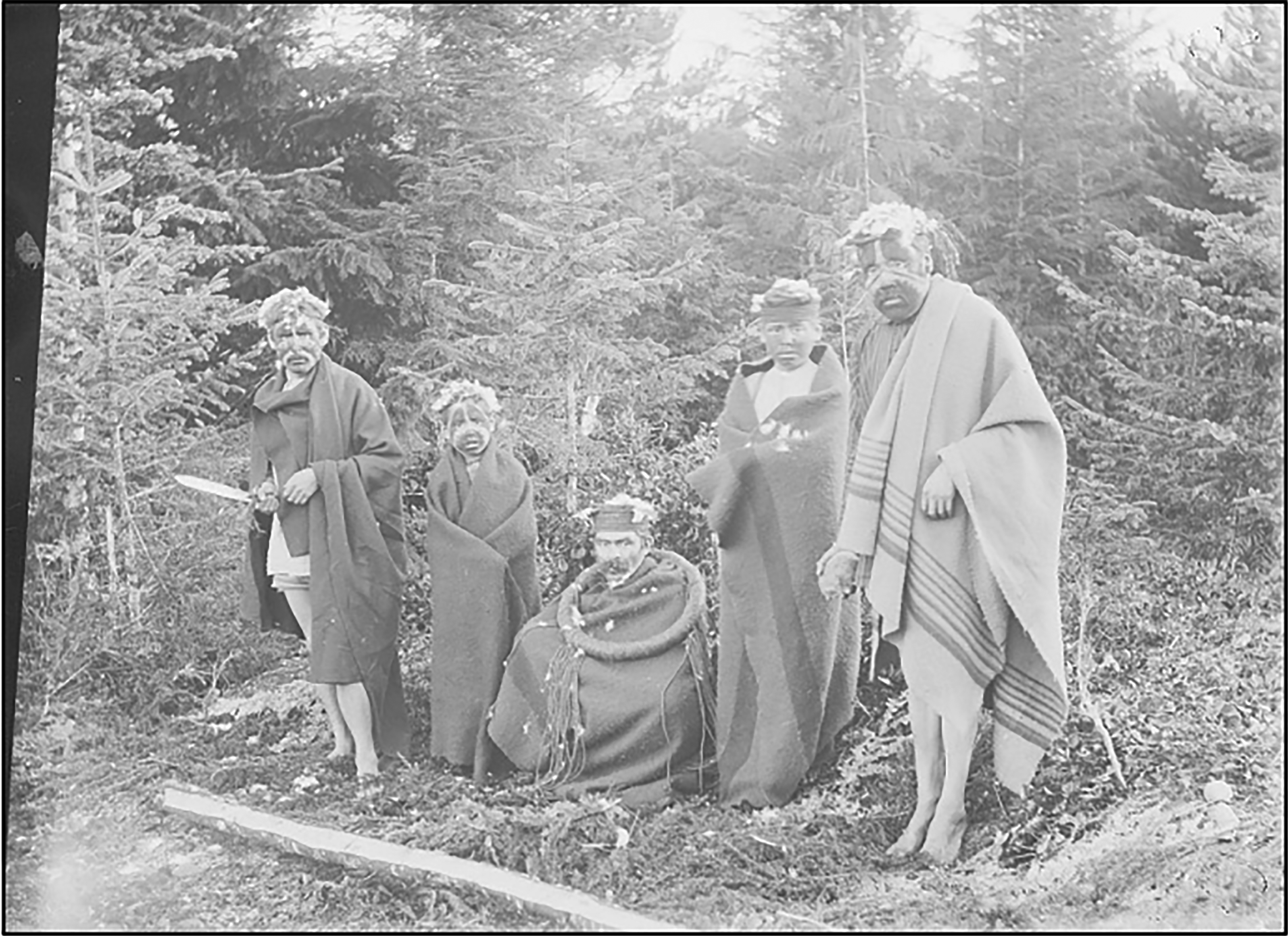
Kwakwaka'wakw nułamał or ‘fool-dancers’. Note the dagger held by the leftmost clown, as well as their bichromatic face paint (Boas, 1894).
In the political clowning of Dark Carnival, these tactics of mock violence and status reversal work together. The inversions of Dark Carnival are achieved through violence, with the forces of order—police and judges—being physically overcome by a rebellious clown underclass who take up a role as ritual tyrants atop an inverted class hierarchy. For ICP, these clowned forms of performative and imaginary violence become the primary means by which they not only challenge existing order, but articulate new social forms. In going forward, I wish to interpret this violence as a multivocal ‘language’ of Dark Carnival, one which is used discursively to express a diversity of overlapping ambitions and moods. By ‘reading’ ICP's violence in this way and tracing the ways in which it is deployed and dispersed, I hope to shed light on the social and cultural implications of Dark Carnival.
Juggalo ethics
A reading of Dark Carnival's violence as a liberatory force might be complicated by the fact that many of Insane Clown Posse's songs present as classic morality tales which emphasize the inevitability of punishment for wrongdoing. The song Halls of Illusions follows an abusive father in his passage to hell, while To Catch a Predator depicts the torture-murders of child molesters (Insane Clown Posse, 1997a, 2009). Many of ICP's most popular songs and albums are set in carnivalesque realms of torment which play on this karmic theme through figures like the Great Milenko, the Riddle Box, and the Wraith. This pattern of violence is hardly revolutionary. However fantastic, the sight of a quasi-carceral institution doling out punishments upon ‘sinners’ is closer to Christian images of hell or the criminal justice system than any radical social innovation. Far from “generat[ing] discontinuity” (Handelman, 2009: 310), such images seem to be an intensification of the dominant moral order which situates the clown as the overseer of a system of crime and punishment.
In the context of the deindustrialized Midwest, it would not be difficult to index these fantasies as the outbursts of a revanchist masculinity which seeks to protect the weak and reinstate order. However, the actual position of ICP and the Juggalos in this scene is not as vengeful male guardians or as sadistic enforcers, but as their lived realities reveal, is intimately entangled with these very ‘sinners’. Not only Violent J but many other Juggalos have been victims of sexual abuse and domestic violence (Halnon, 2014: 88). The clowns here must thus be identified not only as punishers, but as victims as well. The clown's position within these fantasies is then not that of a detached, institutionalized actor but of a survivor reclaiming power and agency. Indeed, Petering et al.'s (2017) study of Juggalo identification amongst unhoused youth argues that Juggalo identity “may be a source of resilience and empowerment” for those who have endured trauma (2017: 8). In this light, these violences become legible alongside those discussed previously and constitute not an inconsistency but an extension of the Juggalo rebellion against not only their socioeconomic violators, but against those who have personally abused them and their loved ones.
Again reading Dark Carnival's violence as a form of discourse, I want here to take seriously the stated ambitions of these violences and follow them to their conclusions. Halnon has marked these tales as the “moral guidance” (2014: 95) implicit in Dark Carnival, providing a framework which emphatically rejects predation on every level. Looking beyond the mythology of Dark Carnival, I turn now to the actualized cultural spaces informed by this guidance—which I term ‘Juggalodom’—to explore the ways in which this ethos of non-harm manifests.
Juggalo family
Spaces of Juggalodom range from the scale of major festivals such as the ‘Juggalo Gathering’—which attracts thousands each year—and ICP shows to smaller fan meetings and chance encounters. Juggalodom has a festive atmosphere, marked by idiosyncratic behaviours which both Halnon (2014: 87) and Neely and Marone (2014: 262) identify as counter to the norms of contemporary American society. The ruling mood of Juggalodom is one of camaraderie, being permeated with distinctive symbols and behaviours. Juggalos often greet each other with cries of “whoop-whoop!”—which elicit the same response—while tattoos and accessories depicting the ‘Hatchetman’—the logo of ICP's record label—are common, as is consumption of the soft drink Faygo (Neely and Marone, 2014: 258–260, 262). Open sexuality and public nudity are another common feature of these spaces, especially at the Juggalo Gathering where attendants solicit for sex or socialize in states of undress (Neely and Marone, 2014: 260, 262). Halnon describes a common format for ritual nudity, in which Juggalettes—female Juggalos—are incited to flash, or “show [their] tits!” by other attendees (2014: 90). Halnon cautiously indexes this as a form of parade stripping which hints at the reversal of fat-shaming beauty standards. Many Juggalettes are overweight and assert that these performances provide opportunities for body positivity which are pointedly absent in everyday life, evidencing that what might be perceived as a form of sexual harassment is instead part of an ethos of affirmation (2014: 90). Through such practices, Juggalos follow many other musical subcultures in deploying “gestures, movements towards a speech which [offend] the ‘silent majority’”, using a subcultural ‘style’ to set themselves off against the dominant culture and assert their own identities (Hebidge, 1979: 17). While most Juggalos are White, songs like Fuck Your Rebel Flag and a running antipathy towards ‘bigots’ make it clear that Juggalo solidarity is not necessarily a racial phenomenon and poses itself as an anti-racist project. Juggalos express these cultural logics of fellowship with a number of emic terms, especially the notion of “fa-mi-ly” (2014: 91). Being a Juggalo is then seen as a kinship status which affords nigh-unconditional acceptance and affirmation, or, in their own words, “clown luv” (2014: 90).
Clown communitas and violence
In understanding Juggalodom as a ritual space, I suggest that Juggalo family can be understood not only a form of kinship, but an idiom used to express Victor Turner's (1969) spirit of communitas, which can be both an affective state and a pattern of relations. Edith Turner (2013) describes communitas as “a group's pleasure in sharing common experiences with one's fellows” (2012: 2), in which the ego is dissolved and “all are in unity” (2012: 3). Turner asserts that liminal phases lack hierarchies—as do many clowned spaces—and are characterized by a blend of “lowliness and sacredness, of homogeneity and comradeship” (1969: 96). Juggalo kinship poses the members of its family—who are typically of low status outside Juggalodom—in horizontal, reciprocal relationships of acceptance and kindness (Neely and Marone, 2014: 263). Juggalos often ascribe acts of fraternity to the spirit of fa-mi-ly: “all these people don't know each other from Adam and Eve, but you can walk up to anyone and talk to them because it's family” (Halnon, 2014: 91). Juggalo family can be understood as an example of ‘ideological communitas’, identified by Victor Turner as when the communitas experience becomes the basis for a whole society (1969: 132). In further exploring how Juggalo communitas can be related to clowning, I want to consider at some more depth the relationship between the ever-present—albeit theatrical—themes of violence in Dark Carnival and this communitarian ethos. How can violence be used to argue for, and create, peace?
Dark Carnival's violent themes are equally inescapable in physical Juggalodom, as Halnon (2014: 93) offers in an account from the Juggalo Gathering: A wrestling ring was set up. People began assembling around it, chanting “You Suck!’ People clapped and cheered, “Fuck em up Tony. Fuck em up!” The death match goal was to push the wrestling opponent into the barbed wire circumventing the ring. Similar threats come from within, as one wrestler was assailed with a barbed wire club. He escaped by jumping up and off the wire into the crowd. A guy behind me affirmed with appreciation, “that takes balls!” Others bellowed, “We want blood!”
Halnon herself understands this scene as a “piercing cry for life among the ‘walking wounded’”, a visceral affirmation of masculinity and the potentials of living (2014: 93). The thread on which I will pull to expand my analysis, however, comes from one of her Juggalo interlocutors: “‘Most of us have anger issues.’ […] [Halnon] asked if this type of activity helped relieve some of the anger. He responded unequivocally, ‘Of course!’” (2014: 93). We have already seen how violent acts committed by clowns can have a socially generative function in the contouring of ritual space. Equally pertinent however is the clowning of violence itself through burlesque performances, common in both Western and Indigenous traditions. Focusing on Charlie Chaplain and circus clowns respectively, both Caron (2006) and Peacock (2020) note the exaggerated capacity of clown bodies to absorb violence, eliciting a laughter which Caron suggests creates a kind of spectatorial communitas (2006: 19). Ortiz (1972) argues that mock-beheadings and hangings among Pueblo clowns permit the renewal and regeneration of social order (1972: 150–53). Hereniko (1994, 1995) states that Rotuman clowns often act as mediators to dissipate tension (1995: 63–64, 85–89, 133), and cites anthropologist Adrian Tanner's observations of mock-conflicts performed by Fijian clowns as a nonthreatening way of venting latent interpersonal animosities (1994: 11).
In the context of Dark Carnival, for Juggalos—a population who have been extensively violenced socially, economically, and personally—the attainment of peace necessarily involves a reckoning with the cycles of violence which have marked their lives. In other words, violence cannot be ignored; it permeates Dark Carnival, but ultimately operates to create its own opposition: communitas. It is used discursively, to articulate grievance—“generat[ing] discontinuity”—but also to create nonviolent ritual space—“creat[ing] boundary” (Handelman, 2009: 310). Halnon's wrestling ring, then, can be read as demonstrating how the clowning of violence—through its parody in lyrics and theatre—works to maintain peace, periodically expunging the anger begotten by systemic violence and subduing it within the realms of play. In so doing, boundaries shift and envelop one another; the pantomime subsumes the object of parody and dissolves it. This format might be understood as a performative manifestation of the ‘reverse logic’ clowns typically display, such as backwards speech or movement (Makarius, 1970: 61). Posing the violence of Dark Carnival discursively reveals the same thing; play-violence demands play-peace, or in other words, communitas, the animating principle of the Juggalo family.
Taboo play
Insane Clown Posse's music is rife with offensive and taboo themes. Incest, necrophilia, drug abuse, and domestic violence are all set against a backdrop of grinding poverty and urban decay. The shock elicited by these subjects is only further intensified by their juxtaposition with cackling clowns and spectral carnivals. During their heyday in the 1990–2000s, moralistic media outlets often highlighted the band's “depravity, brutality, and insanity” (Itzkoff, 2013). FBI documents castigated their “violent and dark lyrics” (Federal Bureau of Investigation, 2008: 14) and ICP were famously christened the ‘worst band of all time’ by Blender Magazine (Aizlewood et al., 2003: 89).
Political clowning often breaches and confuses taboos, with a significant portion of latter scholarship arguing that such profanations were the central ‘purpose’ of clowning (Keisalo-Galván, 2008: 39, 42). Handelman (1981) has offered a more nuanced view, contextualizing taboo engagements within a framework of boundariness to argue that clowns do not violate taboos but erase or mix-up the boundaries between the sacred and profane, remaking tabooed material as “sign-posts of transition” (1981: 342, 338). Much like how clowned forms of violence contour the Juggalo ethos, I want to explore how Dark Carnival clowns taboo relations to articulate novel cultural forms and symbols across three thematic areas: dirt, social morality, and violence.
Dirt, biofluids, and class
Discourses around dirtiness and purity are inevitably interwoven with social hierarchies, especially those of class and race. Political élites have often weaponized hygenic practices to delineate themselves both spatially and symbolically from “the great unwashed” (Shove, 2003: 88–89). The germophobia and aversion to bodily function in contemporary American culture is particularly stark in this regard. In their music, ICP rejects the demands of this hygenic order by declaring “we ascend from the dirt, filth, grit, and grime” (Dark Lotus, 2001). In so doing, they reclaim the classist grammar of dirtiness for themselves. In a song of the same name, they identify planet Earth as The Dirt Ball, evoking and embracing connotations of moral sleaze, physical filth, and the great mass of humanity (Insane Clown Posse, 2000). Dark Carnival is permeated with images of dirt and decay, playing out amidst decrepit cityscapes which are rotten both physically and socially. These scenes focus on the bodily, biological, and fluid: blood is released through acts of outrageous violence, and sexual continence evokes the shedding of semen.
Victor Turner (1969, 1970) has identified liminal personae—including clowns (1969: 125)—as being marked by motifs of “death, decomposition, catabolism, and other physical processes that have a negative tinge” (1970, 96). Many political clowns are described as ugly, dirty, and bumbling, and numerous scholars have noted the connection between clowns and the bodily secretions—here ‘biofluids’—produced by stigmatized biological processes (Charles, 1945; Makarius, 1970; Hieb, 1972). Zuni newekwe drink urine and eat excrement (Hieb, 1972: 184; Makarius, 1970: 48), Hopi koyemsi smear blood upon one another (Makarius, 1970: 48–49, 66), and the exaggerated noses of Kwakwaka'wakw nułamał masks are endlessly flowing with mucus (U’mista Cultural Society, 2023). Bakhtin's (1984) notion of the grotesque evinces similar uses of bodily excreta within Western clowning traditions. These ‘negative biologies’ and their resulting biofluids emerge in Dark Carnival through processes of excretion, bloodshedding, and ejaculation, all of which are deeply bound up with class. Along with motifs of dirtiness, Dark Carnival eagerly internalizes what could be called the ‘class politics of ejaculation’— hegemonic discourses in which the life-giving semen of wealthy men in nuclear families is contrasted with the debauched and disease-spreading trysts of the poor. Within this context, the free shedding of semen in Dark Carnival references and lampoons classist discourses of careless fecundity and immorality.
Victor Turner (1974) has identified the liminal as a space for the creation of “root metaphors [and] conceptual archetypes” (1974: 50). I argue here that ICP's taboo play inflects the themes of dirt, decay, bloodshed, and sexuality which are used to stigmatize working-class populations and instead transform them into new symbols of Dark Carnival.
Sociomoral taboos
Insane Clown Posse's lyrics involve many outrageous subjects which are offensive to social norms. Its ignominious cast of characters—incestuous rednecks, internet pedophiles, and axe-murderers—regularly engage in parodically aberrant behaviour including eating corpses, having sex with animals, or pickling human heads. I have previously contextualized these figures within an ethical framework which ultimately discourages such behaviours. Here I assume a different position to consider how the outrage provoked by these subjects acts as a form of clowning and confuses taboo restrictions. While these characters almost always meet grisly fates resulting from either their own actions or the karmic interventions of clowns, their very presentation is upsetting in of itself, such as in the song In My Room: “Tap tap” on the glass go the piece of ass So young and pretty, it's too bad she passed But she comes to my room and we talk at night She's demonic and bloody, but she holds me tight […] Sometimes I kiss her, I start shakin’ She slips me the tongue, and it tastes like bacon
The narrator's undead lover eventually drives him to commit suicide, thus avoiding any ultimate valorization of necrophilia. Nonetheless, the lyrical grotesquerie here still manages to arouse shock even as it validates existing taboo relations. Handelman has suggested that clown violations of taboo act as “sign-posts of transition” (1981: 338) which mark the passage into the liminal phase where boundaries become malleable. Boundaries need not always be moved far. Even as ICP reconfirm the taboos they engage in outraging, their approach imbues these topics with an aura of ambivalence, revealing the “rule of rules” (Bouissac, 1990: 197)— an uncomfortable awareness that social regulations are constructed and always subject to change. In striving primarily towards communitas, Dark Carnival is content to let these particular prohibitions stand, though not without some disturbance— at least enough to remind us that this is a clowned space of unlimited and potentially upsetting possibilities.
Violence and blood
More than any other theme, the violence of ICP's lyrics has continually elicited the most intense backlash. The band's zenith in the 1990s–2000s coincided with a peak in cultural anxieties about the effects of violent lyrics—especially in rap music—on adolescents and their purported contribution to a ‘culture of destruction’ (Richardson and Scott, 2002). Despite being a fundamentally racist discourse directed primarily at Black artists, the mostly-White ICP and the Juggalos found themselves caught up as well. The consequences of this went well beyond judgemental headlines; in 2011 the FBI moved to classify ‘Juggalos’ as a “violent street gang” (Przemieniecki et al., 2019: 2) on the basis of a small number of individual incidents. This decision has been extensively criticized by scholars, Juggalos, and civil rights activists and has enabled the legal persecution of Juggalos who have lost jobs, homes, and even custody over their children (2019: 2). Clearly, the perceived threat of a violent uprising from a disgruntled urban underclass—White or Black—remains significant. I suggest that embedded here is a fear of a shift in the flow of violence, from towards and within the socioeconomic margins—emblematized in police brutality and gang violence, respectively—to the fears of its potential emanation from the margins: the exact kind of revolutionary scenario depicted in Dark Carnival.
In recalibrating a consideration of violence as a social and political taboo, I find it useful to use the prism of blood. In so doing, blood reveals itself as the physical product of violence, a clown biofluid, a synecdoche for kinship, a type of dirt, and possesses a unique capacity to alter spatial and political relations. To make this point, I will explore the manufacture of blood and its meanings across three patterned ‘flows’: in violence directed ‘outwards’ from Dark Carnival, violence directed ‘inwards’, and violence within Juggalodom itself.
Outwards
Dark Carnival's violent incursions into suburbia are directed outwards from the city, reversing not only a social order but also taboo relations within space. In the hegemonic cultural imagination, the city is a site of filth and violence, kept separate from the purified suburb by sociospatial boundaries which require constant maintenance (Watt, 2007: 80–81). But in Dark Carnival, the blood shed by clowns behaves fluidly, acting as a ‘liquid dirt’ which brings the stain of poverty into suburbia. In so doing, the clowns are accompanied by the other ‘negative biologies’ of poverty—death, decay, illicit sex—and not only reverse, but actively collapse the symbolic relations between the pure and the dirty. Blood acts as the prime mover here, facilitating inversion at every turn. ICP's ‘ghetto clowns’ are compelled to cross into suburbia in vengeance for the blood ‘lost’ in the city—to police brutality, gang violence, intergenerational abuse—and cement the overcoming of their former overlords with the shedding of more blood. Blood acts here as more than a “sign-post” of liminality as Handelman (1981: 338) suggests, but as the animating symbolic force behind Dark Carnival's political inversions.
Inwards
In other contexts, this clowned blood can act as a metonym for kinship and community, imbued with the potential to make and unmake Juggalo ‘fa-mi-ly’. To articulate this point, I pose two opposite loci in which this familial blood operates in different ways. In the first, I return to the site of retributive violence directed at abusive fathers and other ‘sinners’. This blood flows ‘inwards’, emerging from the cycles of intergenerational abuse inside the ruined landscapes and broken homes of the Juggalo city. Unlike suburbanites or the police, however, sinister neighbours and failed fathers are not alien oppressors, but deeply familiar—often, they are actual family. I posit then that this bloodshed signals a loss of potential family: it is directed at those who could be Juggalos, but through their own actions have alienated themselves from any reconciliation with Juggalodom, which is comprised of the mass of their victims standing in solidarity with one another. Blood then comes to delineate boundary: who is family, and who is not.
Within
Turning to the patterns of bloodshed within Juggalodom itself—epitomized by Halnon's Juggalo wrestling ring (2014: 93)—reveals how blood not only flows across and demarcates boundaries, but operates within them in a sustaining capacity. As the Juggalo in Halnon's account reminds us—“most of us have anger issues” (2014: 93)—to be a Juggalo is to be enmeshed in cycles of intergenerational and systemic violence, and thus to carry in oneself the implicit risk for the irredeemable action which might place one beyond family. Yet the blood shed amongst Juggalos serves not to unmake kinship, but to create and sustain it. The cries of Juggalo spectators that “we want blood!” (2014: 93) then hint not at sadism, but towards a Juggalodom as ‘blood-brotherhood’: a pact between those who have relinquished doing harm to one another, and among whom blood has been recalibrated from a substance of pain to an agent of family Figure 4.
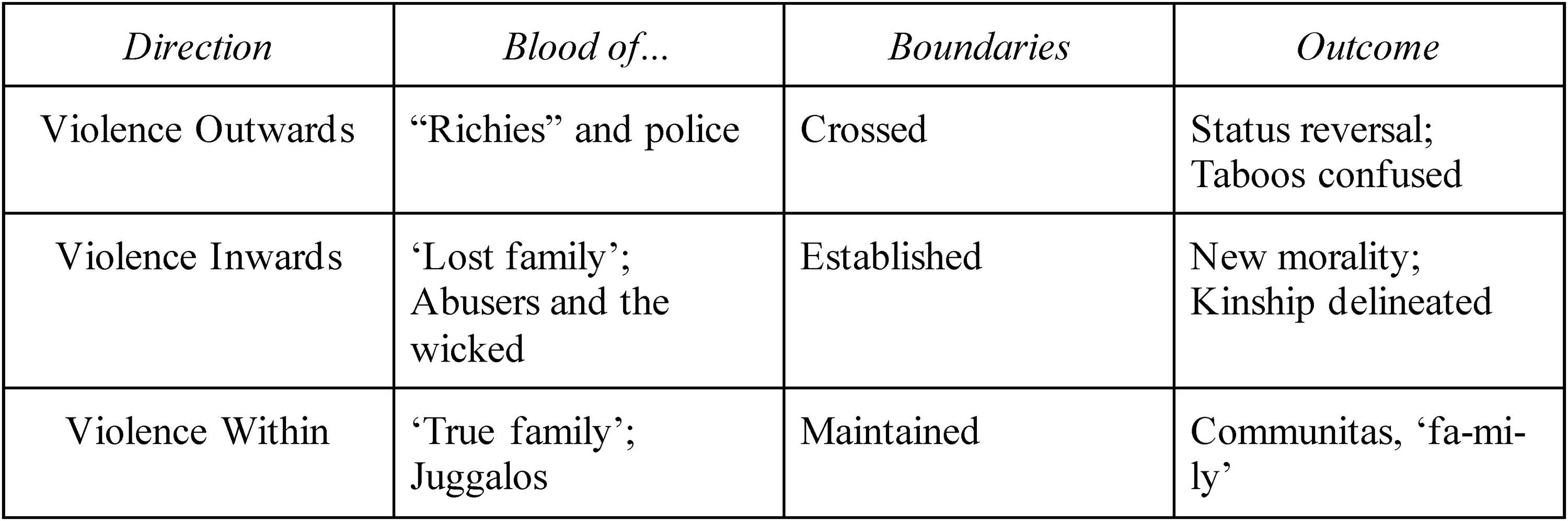
Flows of violence/blood within dark carnival.
Taboo play and Juggalodom
Throughout this section, I have argued that as part of their articulation of Juggalodom, Insane Clown Posse practices political clowning to reformulate taboo relations to develop new social, cultural, and political possibilities. This taboo play spans several distinct sites and different outcomes. In challenging hegemonic notions of hygiene, ‘dirt’ becomes a nexus for class, poverty, organicism, and bodily fluids and acts to generate new identifiable symbols for Dark Carnival. Extant sociomoral taboos—against acts like incest and necrophilia—are ultimately reinforced but in such an outrageous manner that it reminds us of the uncomfortable possibilities of liminal innovation. In playing with cultural anxieties around class violence, blood becomes an animating biofluid which confuses and collapses spatial taboo boundaries, facilitates revolution, and delineates the boundaries of the Juggalo family Figure 5.
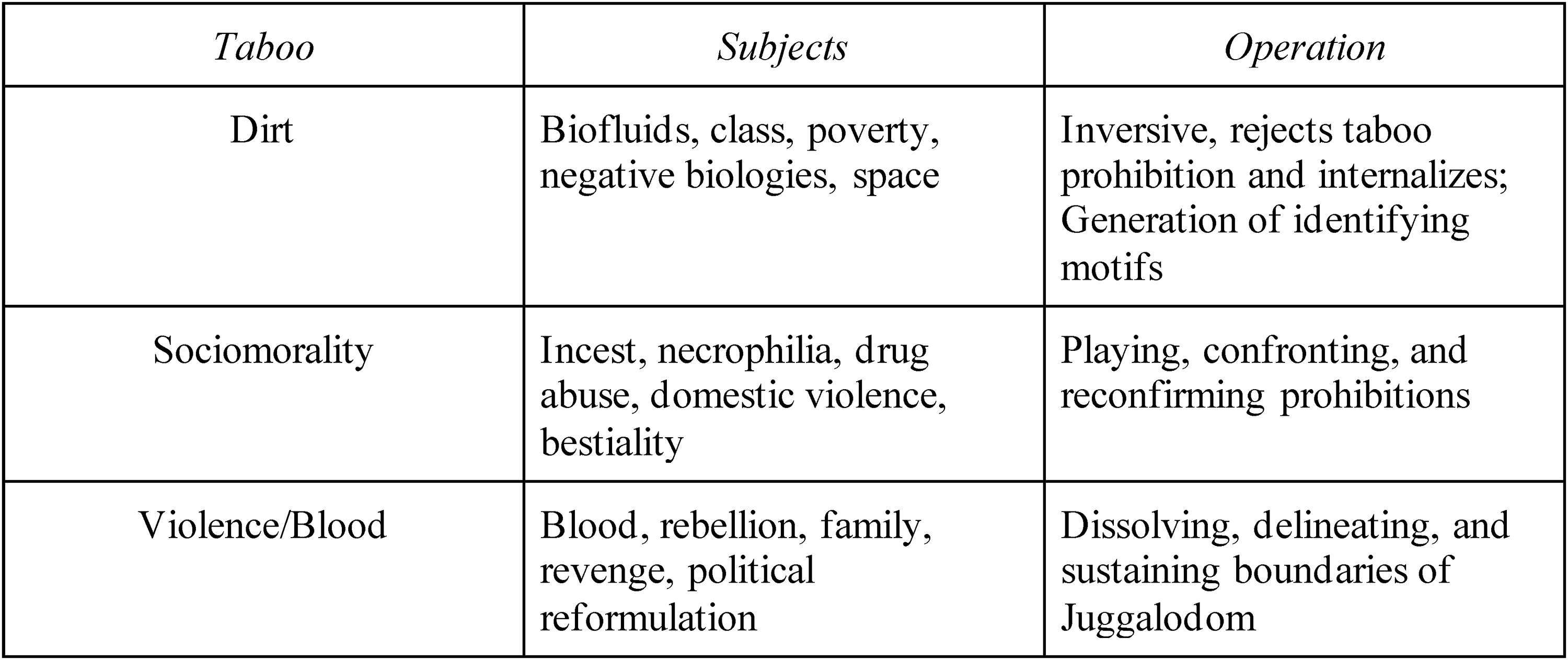
Taboo play within dark carnival.
DIY baptisms
It has thus far remained unclear if Juggalo culture can be understood as a product of Insane Clown Posse's oeuvre, or if agency and creativity can be attributed to the Juggalos themselves. Here I follow on Neely and Marone's (2014) argument that “Juggalos have transitioned from a music-inspired fandom to a community-driven family” (2014: 263) to explore the key role of Juggalos in cultivating Dark Carnival. I do so here through analysing the ritual use of the soft drink Faygo to reveal unique forms of spontaneous ‘DIY clowning’.
The Faygo baptism
One of the most dramatic elements of any ICP show, invariably mentioned by anyone in attendance, is what has been popularly dubbed the ‘Faygo baptism’: a mass spraying of the audience with the popular Midwestern soft drink of the same name. In a typical ‘baptism’, ICP and squads of clown assistants—dubbed ‘Faygo Monsters’—stand on stage armed with two-liter bottles, which they proceed to shake up and spray onto the audience to the accompaniment of blaring lights, roaring music, and the shrieks of the crowd (Halnon, 2014: 94; Hazin, 2011). The fluid is released in such epic quantities—one Faygo Monster reported releasing 1600 litres within ten minutes—that during a tour of Europe, the band encountered legal difficulties importing the necessary amount (Bruce and Echlin, 2003: 387–388). Faygo has subsequently become a central symbol of the band and of Dark Carnival generally. Almost no depictions of ICP or Juggalos by themselves or outsiders fail to mention the drink Figure 6.
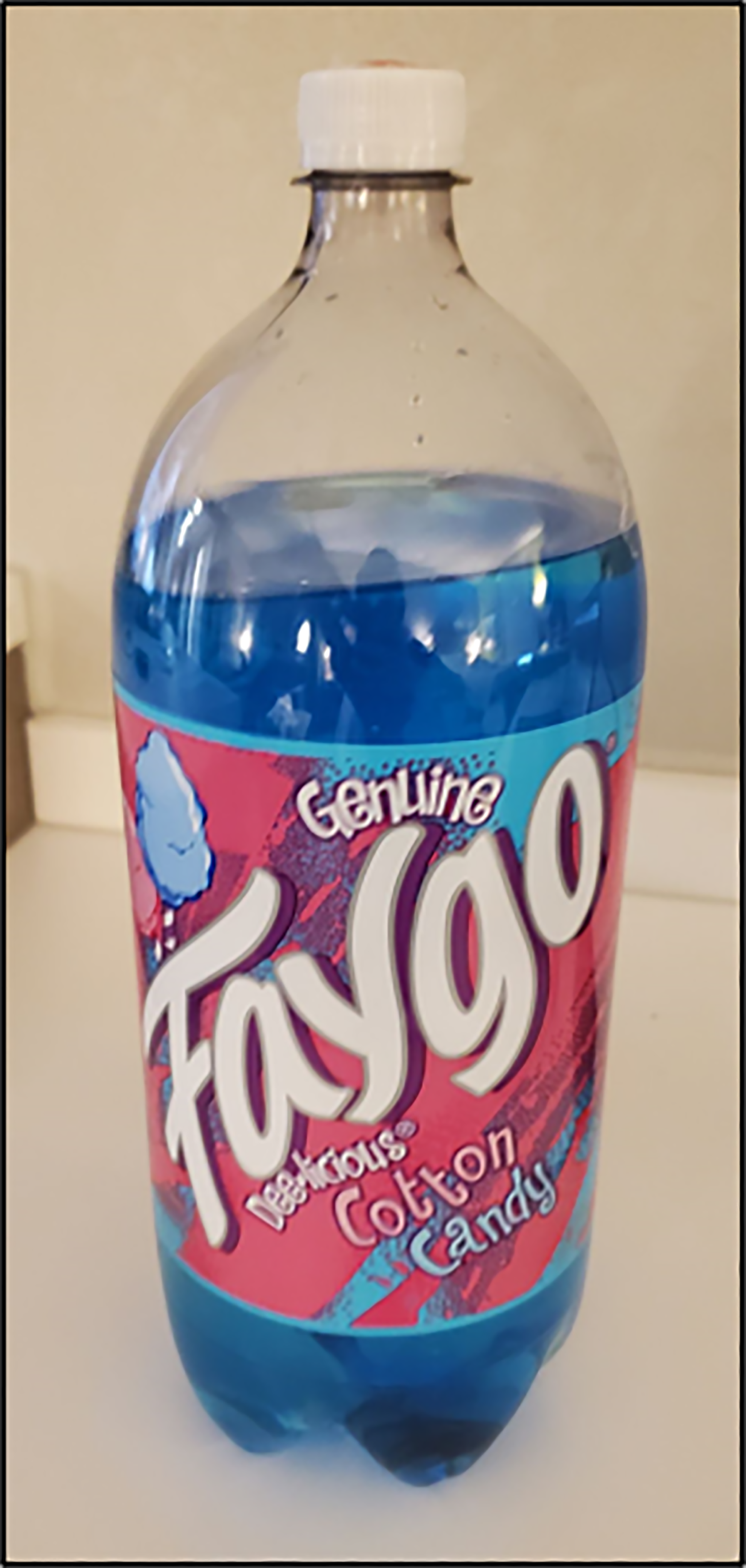
A bottle of Faygo (Lane, 2022).
Bouissac's (1990) examination of circus clowning centres the ‘profanation of the sacred’, such as parodies of religious rituals (e.g., baptisms), as a means by which unstated social rules are made visible by confusing their most essential elements (1990: 196). This point recalls Handelman's (1981) arguments that clowns mix-up the sacred and taboo, thereby transforming their relationship. For Bouissac, this process is demonstrative rather than transformative, asserting that circus clown profanations “fully enact” the “basic but unwritten rules on which our construction of a culturally bound meaningful universe rests” (1990: 196). Clowns in many cultures delight in lampooning—and accordingly ‘exposing’—the sacred, with Hereniko (1994) noting that Polynesian clowns “deliberately [instigate] laughter in the midst of a serious ritual” (1994: 5). While Bouissac frames this exposure of the “rule of rules” (1990: 197) as at least partially dysphoric, provoking discomfort through dramatic reflexivity, I follow on Handelman (1981) in contending that such clowning ‘exposures’ can be constructive as well.
Halnon's Juggalo interlocutors seem to agree on the emic function of the Faygo baptism: “when you are covered in Faygo, you’re all the same color”, “It's like being Christianized, like being baptized”, (Halnon, 2014: 89, 94). In the context of Juggalo family, the Faygo baptism signifies passage to a liminal realm of “homogeneity and comradeship” (Turner V, 1969: 96), the clowned otherworld where the inversions and experimentations of Dark Carnival can take form. It is perhaps for this reason that the recovery of a discarded Faygo bottle has become a rite of passage among Juggalos (2014: 94), as though proving that one truly has been clowned— even if only for a little while. Thus, the Faygo baptism's burlesque elements—“generating discontinuity”—are of equal importance to its transformative and demonstrative elements, “creating boundary” (Handelman, 2009: 310) by consecrating Juggalodom's clown family through an act of clowning itself.
DIY clowning
As Halnon (2014) tells us, the emergence of the Faygo baptism was far from planned: “J explained that the [baptism] started out organically […] from him always drinking Faygo 2 liters, including when performing on stage. One day he spontaneously decided to douse a few fans with it. They reacted. He sprayed more” (2014: 94). Many other features of Juggalodom have appeared from spontaneous improvisation, not least the term ‘Juggalo’ itself, which was seized on by the audience during an early performance of the song The Juggla (Bruce and Echlin, 2003: 237–38). Many other musical subcultures operate as ‘free spaces’ which allow for collective innovation and the prefiguration of sociopolitical alternatives (Culton and Holtzman, 2010: 271). Like Culton and Holtzman's (2010) DIY punk interlocutors who are stirred to action by realizing “wow, I could be making a change” (2010: 272), the collective invitation to spontaneity and creativity is a core part of Juggalo culture, especially its egalitarian components. This invitation dissolves audience passivity and allows Juggalos to become fellow clowns in a space of “homogeneity and comradeship” (Turner V, 1969: 96). Neely and Marone's (2014) lengthy itemization of unique Juggalo behaviours speaks to the astounding creativity of the subculture. The origins of many of these practices remain unclear, but it is hard to imagine, for example, the ‘whoop-whoop’ greeting emerging from anything other than an improvisational response to a spontaneous outburst. I suggest these improvisations—which Violent J has described as “natural shit that happened” (Putnam and Sanchez 2021)—show ICP and the Juggalos engaging together in a kind of ‘DIY clowning’, acting not as a formalized clown society but as a whole population clowning freely for their own ends.
Juggalos are far from the only political clowns to improvise extensively. Hereniko's (1995) interviews with Rotuman hȧn mane’ȧk su—female clowns at weddings—tell us that spontaneous improvisation is a key part of clowning. In explaining what makes a good hȧn mane’ȧk su, Hereniko's interlocutors highlight “not minding stupid things people shout at you, and playing along with them” (1995: 39) and recounting “[collapsing] on the ground thinking that people would find that funny. And they did, they liked it” (1995: 43). While hȧn mane’ȧk su improvise to elicit laugher, Juggalo spontaneity pushes in the direction of community-building, producing greetings and initiations. In contrast to conservative arguments that clowning is merely an “expressive [form] of pressure release” (Zucker, 1967: 314) playing with pre-established social themes—“evoking something which at the same time must be suppressed” (Makarius, 1970: 70)—Juggalo creativity demonstrates that clowning affords for incredible freedom and creativity, and that clowns invents new things all the time from gestures to entire new ethea.
Conclusion: why clowns?
To assume the perspective of Insane Clown Posse themselves for a moment: what's going on here? For them, why clowns? Perhaps it could have never been any other way. Rising from the liminal landscape of Detroit—a city betwixt life and death, stuck between narratives of decline and the anticipation of rebirth—ICP stands at the clowned intersections of class, geography, history, and disposition. No other comparable stock character could play the same role: it is hard to imagine an otherwise identical ‘Insane Pirate Posse’, or ‘Insane Vampire Posse’, for example. Given Shaggy 2 Dope's Cherokee ancestry, influence from the tsu'nigadu'li mask performances which have elements of clowning cannot be ruled out (Speck and Broom, 1951: 25–39). Direct inspiration is perhaps more likely to have come from American circus clowns and Hollywood tropes of ‘killer clowns’. Nonetheless, as I have argued accounts for many features of Dark Carnival, ICP appears to have arrived at clowning through improvisation. The band initially began life as ‘Inner City Posse’, with clowns appearing as an impromptu gimmick which stuck, having struck a chord of approval with their audience (Putnam and Sanchez, 2021). In a manner not dissimilar from the improvisational comedy of Rotuman hȧn mane’ȧk su, ICP became clowns because clowning works. Asking ‘why clowning?’ is akin to asking ‘why singing?’ or ‘why painting?’. Perhaps if those asking understood, they would be clowns themselves. Indeed, the primary reason why this question has dogged clown studies seems to be that clowning practice appears outlandish and absurd (Keisalo-Galván, 2008: 39). This is, in fact, the point. But however ridiculous clowns appear, their independent appearance in disconnected places and times—what Van Ham calls an “ancient lineage of contrarian performance” (2009: 329)—demonstrates that clowning is not only appealing to performers and audiences but highly effective at producing divergent social and political outcomes.
While I do wish to emphasize creative agency within clowning practice, it should also be acknowledged that individual clowns are rarely driven by strong intentionality. From the Pueblo to the Mapuche, clowns seem driven more by ominous dreams and strange impulses than any clear mission (Course, 2013: 776; Handelman, 2009: 311)— as one Mapuche koyong clown put it: “I’m just like that” (2013: 77). For his part, J echoes a similar sentiment, reflecting: “It's destiny, man, it's our destiny” (Putnam and Sanchez, 2021).
Taking ICP at their word—as clowns—shines new light on how the band have richly textured new cultural spaces, both imaginary and corporeal, and deployed cross-cultural modes of clowning including ritual violence, bodily fluids—especially blood—and play with taboo to extending the spirit of communitas to provide for a subcultural ethos of radical ‘fa-mi-ly’. As these Detroit fools show us, clowning goes beyond unsettling buffoonery, but, as Handelman hints (2009: 31), can provide for the generation of entirely new ways of living and being, and remains a worthy frame of analysis for contemporary cultural phenomena.
Footnotes
Acknowledgements
Dr Jaime Yard, for her continual support and confidence.
Declaration of conflicting interests
The author declared no potential conflicts of interest with respect to the research, authorship, and/or publication of this article.
Funding
The author received no financial support for the research, authorship, and/or publication of this article.


