



Abstract
Whilst the position of young people as arts consumers has been highly critiqued, the opportunities for young people to be celebrated as entrepreneurial and subcultural arts producers are often overlooked. This article explores the role of young people as agents of creation through arts programmes and the development of ‘common cultural dispositions.’ The framework – Artistic Production and (re)production – draws on and combines analytical insights and theoretical concepts from Paul Willis and Pierre Bourdieu in order to argue that young people both consume and produce artistic practices, which then leads to a reproduced social hierarchy. This combination gives additional insight into culturally reproductive cycles, which remain problematically entrenched with social class disadvantage. An ethnographic methodology is reported, which enabled an in-depth exploration of everyday creativity, self-efficacy, self-identity, and forms of resistance for the young people in this study. However, I argue that whilst Artistic Production offers hopes of transformation, in particular for working-class and marginalised groups, ‘positional suffering’ and unconscious mechanisms of reproduction were also apparent.
Introduction
In neo-liberal capitalist societies, young people are increasingly becoming consumers and producers of ‘common culture’. They are consuming less state-funded and school curricular-based culture and in turn less-valued forms of artistic practice are being produced (Willis, 2005). In the UK in particular, artistic practice through youth arts programmes is becoming both instrumentalised and commercialised (Howard et al., 2018). High value is placed upon entrepreneurial outcomes for young people, such as knowledge and skills around self-employment, portfolio working and resilient character traits. However, these vocabularies of ‘self-entrepreneurship’ and ‘individualistic rhetoric’ are not always accessible to working-class young people (McRobbie, 2018). Within this context, cultural production, consumption and representation continue to be structured by social class (O’Brien et al., 2017). Bull and Scharff (2017) in particular, argue that there are unspoken and uncontested hierarchies of value that can be made visible through studying production and consumption together. Building on these previous contributions, this article explores the role of young people as agents of creation through arts programmes, whilst also acknowledging unconscious mechanisms of reproduction.
Sociologists of the arts and culture frequently lean towards Bourdieusian analyses in order to show that arts practices are an important site of cultural and social inequalities (Brook et al., 2018; Friedman et al., 2015). However, there has been limited recognition of youth cultural production as opposition to dominant forms of culture (Born, 2010). In response, this article draws on and combines analytical insights and theoretical concepts from Paul Willis and Pierre Bourdieu to argue that young people both consume and produce artistic practices. These culturally reproductive cycles remain problematic in terms of social class disadvantage. I draw on four vignettes from an ethnographic study, which enabled an in-depth exploration of young people’s everyday creativity, self-efficacy, self-identity and forms of resistance. This study sought to investigate the diverse experiences of young people undertaking the Arts Award programme outside of mainstream settings, most associated with dis-engagement and disadvantage. First, I explore the role of young people as agents of creation.
Young People as Agents of Creation
Paul Willis conceptualised young people as key producers and consumers, who draw on their available cultural resources as inputs for their own cultural productivity. He argued for a ‘common culture’, which has a dual significance of being found everywhere, as well as being shared amongst individuals and groups (Willis, 1990). Young people draw on ‘symbolic creativity’ through cultural media and new screen-based technologies to be active producers. Willis argued that young people use symbolic creativity as identity work with the artistic resources that they find around them, namely TV and media, music and fashion (Willis, 1990). Music, in particular, provides young people with symbolic resources in the context of their everyday lives (A. Bennett, 2000). As such, the production and consumption of music on the part of young people provides a privileged site for observing a productive and creative synthesis for exploring new forms of cultural practice (Cohen and Ainley, 2000).
As well as reporting benefits for young people’s sense of self-identity, research on youth arts programmes has demonstrated augmented self-efficacy for the young people involved (Delk, 2016; Morton and Montgomery, 2011). A recent study by Parker et al. (2018) highlighted the affordances of a music programme for marginalised young people’s motivation and positive mental health. In addition to personal development, youth arts programmes, have social developments in regard to networks and activism. For example, Bloustien and Peters (2011) argue that young people are acquiring technical, professional and entrepreneurial skills through forming social networks, training and mentoring each other. As collective endeavours, youth arts programmes are also identified as spaces of resistance to governmentality (Hickey-Moody, 2013) and forms of subversion (Ferreira, 2016). The arts have an established tradition of being used as a site for resistance under modernity. In particular, young people use new media artforms as sites for constructing counter-narratives. Digital media are central to the ways in which young people attempt to rewrite themselves into the reality of their everyday (life)worlds (Stornaiuolo and Thomas, 2018). For example, Denmead’s (2019) auto-ethnographic exploration of a youth arts studio challenges the assumed lack of cultural capital of working-class and BAME young people, whose art-making symbolises resistance. This article, positions young people as agents of creation by focusing on their symbolic creativity, self-identity, self-efficacy and resistance.
Combining Capitals and Dispositions
In more recent work, Willis (2018) cites the ‘invisibility of cultural production’, by which he refers to the social hierarchies within the arts that constitute themselves as naturally occurring systems of normative ideals and values. New and emerging cultural practices refract the (uneven) distribution of power relations of the system they form part of and work to inform (Inglis and Hughson, 2005). As such, the enactment of cultural practices reproduces the economic subordination of some groups, through largely unconscious mechanisms of reproduction. This position offers a bridge to the work of Pierre Bourdieu on ‘distinction’ (1984), through exploring not only the domain of legitimate culture but also everyday cultural practices. Bourdieu contends that individuals assume a ‘position’ within the field of cultural production, with the position they are able to assume contingent on the amount and types of ‘capitals’ they possess (Lane, 2005). Whilst different forms of capital – economic, cultural, social, symbolic – can compensate for a lack in others, individuals can experience positional suffering (Bourdieu, 1999) as an adverse effect of perceived deficits in capital. Recognition of diverse combinations of capitals and dispositions within youth arts programmes highlights problematic assumptions about the empowering transition of young people from the role of ‘consumers’ to ‘producers’ (A. Bennett, 2011; T. Bennett, 2011).
This article applies Bourdieu’s toolkit of field, capitals and habitus in order to analyse the field of artistic production, the development of subcultural and entrepreneurial capitals, and ‘common cultural dispositions’. Subcultural capital (Thornton, 1996), is derived from popular culture and is defined as engagement with non-traditional forms, such as digital arts, screen-based media and DIY cultures (Bennett et al., 2005). Entrepreneurial capital (Firkin, 2018) refers to young people developing particular skills, values and practices for employment, often as freelancers or arts entrepreneurs within the Cultural Industries (Haenfler, 2018). These include self-promotion, event organising, branding and commerce, income generation and networking. These forms of capital are grounded in knowledge and practical know-how acquired through participation and can enable advantage with careers (Bennett, 2018). Dispositions are formed as young people invest in fields of life and therefore steer actions, experiences and understandings (Thomson and Coles, 2018). Combinations or ‘clusters’ of dispositions both produce and reproduce a sense of what is possible, which offers an in-depth exploration of consumption and social stratification (Prior, 2013). Bourdieu’s toolkit, therefore, affords an investigation into whether each of the individuals in the study might fit in the field, based upon the capitals and dispositions they bring with them, how far these are recognised as valuable and how far these are further developed by the youth arts programme under study.
The Young People’s Arts Award
The Arts Award is a nationally recognised vocational qualification for young people between the age of 11 and 25. The aim of the award is to enable young people to ‘grow as artists and arts leaders, connecting them with the wider arts world through setting personal challenges in an art form of their choice’ (Arts Award, 2016: 5). For this award young people can work with artists and arts professionals to create new and original work in a variety of artforms from visual arts to music production, including a variety of dance styles and drama practices. Launched in 2005, Arts Award is a major initiative set up by Arts Council England and is now accredited by Trinity College London. The award is principally offered within mainstream schools, often as part of extra-curricular activities, however, it is growing in popularity with informal arts education, youth projects, and alternative education settings. To date, there has been only one piece of research about Arts Award, which was an impact study commissioned by Trinity College London (Hollingworth et al., 2016). This longitudinal impact study focused in particular on young people from formal schooling who had engaged with official arts institutions and came from arts-rich backgrounds. Taking an instrumental approach to arts education as educational advancement, the commissioned impact study failed to recognise the unequal social relations that I am claiming here that the award in part works to (re)produce.
In order to explore the differing offer and implementation of the Arts Award, this study sought to investigate the diverse experiences of young people undertaking the programme outside of mainstream settings. A multi-sited ethnography spanned five sites – two youth-work settings, two alternative education programmes, and one vocational education setting. These settings were selected because of their participants’ categorisation as disengaged or disadvantaged, as identified by programme staff’s judgement of the young person having either been expelled from mainstream schooling or disconnected from arts education therein. This purposeful sample was a way of privileging the experiences and counternarratives of those deemed lacking in cultural and economic capital. The aims of the study were (1) to explore the experience of the programme for young people under deficit labels such as NEET, school excludee and ‘facing challenging circumstances’; 1 (2) to investigate the particular affordances and constraints of undertaking arts education in non-mainstream settings; (3) to explore the alignment of the Arts Award, as a vocational qualification, with careers in the Cultural Industries. Programmes were selected to encompass a variety of artforms – dance, music, visual arts and digital media, as well as a range of Arts Award levels – Bronze, Silver, and Gold 2 and there was also a mixture of optional and compulsory programmes. In total, 46 young people were included in the study across the five sites.
An Ethnographic Exploration
Ethnography was chosen as the appropriate methodology due to its approach in gaining an in-depth experience of other people’s lives and cultures, seeing the world as they do (Charmaz, 2014; Charmaz and Belgrave, 2012). My approach to the ethnography was influenced by my background as a Youth Arts Worker, where I was able to fit naturally into ‘hanging around’ in various youth settings, building rapport with young people, and participating in arts activities as they did (Russell, 2013). In addition, being an arts-based programme, ethnography enabled the range of creative outputs young people produced to be analysed as experiential and evocative elements (Pink, 2013, 2015). A multi-sited approach meant that I could spend a year in these settings and capture a diverse range data, including lyrics, visual images and films. This enabled an investigation of what young people chose to take up from the different programmes, but also utilised visual and digital artefacts as research data aligned with how young people experience the arts today.
The methods for this study comprised: participant observation; participation in arts activities; one-to-one interviews; and a range of arts-based research methods including photography, collage, lyric writing and filmmaking. These activities were embedded within the young people’s Arts Award programmes from the beginning of the project and were supported by the staff and arts professionals working on these programmes. There were three phases of data collection over the year: (1) an initial two/three months of participant observation in order to become familiar with the sites and the participants; (2) informal interviews, occurring at several points over a six-month period, which included talking about the work young people had created for the award; (3) collaborative arts-based methods intended to explore particular issues raised by participants.
Using this assortment of methods, over a sustained period, generated a greater depth of data and allowed for significant ethnographic research to be undertaken on the young people’s experiences, including their creative strategies, inspirations and ambitions. The empirical examples presented in this article take the form of visual vignettes (Barter and Renold, 1999) which aim to capture and share specific experiences of the participants by juxtaposing images, interview extracts and fieldnotes. The vignettes represent a form of artistic production in and of themselves through the assemblage of digital media and text. The vignettes are designed to represent the young people’s experiences, whilst presenting experiential learning in expressive forms, which is a relatively underdeveloped area in academic research (Howard, 2021).
Long-term engagement in the field, relationship building, and extensive descriptive writing were luxuries of this fieldwork. Continuous spirals of data, such as collection, hypothesis building, and theory testing were enabled, rather than simply recording one-off events. My strategy for analysis was based upon grounded theory ethnography (Charmaz, 2014; Charmaz and Belgrave, 2012), a responsive research process, which enabled the continual development of categories and theoretical interpretations and the collection of further data on emerging categories and frameworks. It became obvious fairly early on in the fieldwork that the young people’s experiences could be best categorised by diverse combinations of capitals and dispositions. However, I also recognised that an analytic framework was required that recognised the widening of arts practices, encompassing everyday creative practices and informal spheres of arts participation. In response, a theoretical framework was devised – Artistic Production and (re)production – that brought the work of Paul Willis and Pierre Bourdieu together. This framework will be further explained following the presentation of data in this article.
Entrepreneurial Capital
The Cultural Industries have influenced how young people position themselves in the arts world as events organisers, promoters, networkers and entrepreneurs (Banks and Hesmondhalgh, 2009). Drawing on resources and practices from the commercial sector was part of the underlying strategy of the Arts Award for widening access to the ‘arts world’ through inclusion of more young people. Activities such as working in collectives and using social media to set up their own record labels and production companies to recruit more young people and promote their work, reflected entrepreneurship. Some young people managed events, which became commercialised as a way of sustaining themselves financially, through developing an economically viable brand. This demonstrated the resourceful and entrepreneurial nature of young people’s experience on these programmes.
Across the five sites, entrepreneurial capital manifested in the formation of networks, platforming, organisation and event planning. The Arts Award programme also provided opportunities to build social media presence, be ‘professional’ and be inducted into ‘tricks of the trade’. Entrepreneurial capital enabled young people to develop their self-efficacy in being highly driven and self-managing in the goal for a career in the Cultural Industries. The vignette I draw on to highlight this is that of Amos, a 15-year-old black male. Like many of his peers, Amos used one of the iMac computers provided by the programme and took up his regular position at the screen every Thursday evening. In one session I talked to him about what he is doing, while he is editing a music video. He tells me that he makes a lot of videos for his friends, posting them on his website and he shows me a Facebook page called ‘E-Crew Entertainments’ (see Figure 1). It is described as a record label, but Amos tells me that it is much more than that. It is a collective, a joint enterprise with two friends: one rapper and another musician, who together promote their creative work and call out to other young people to get involved.
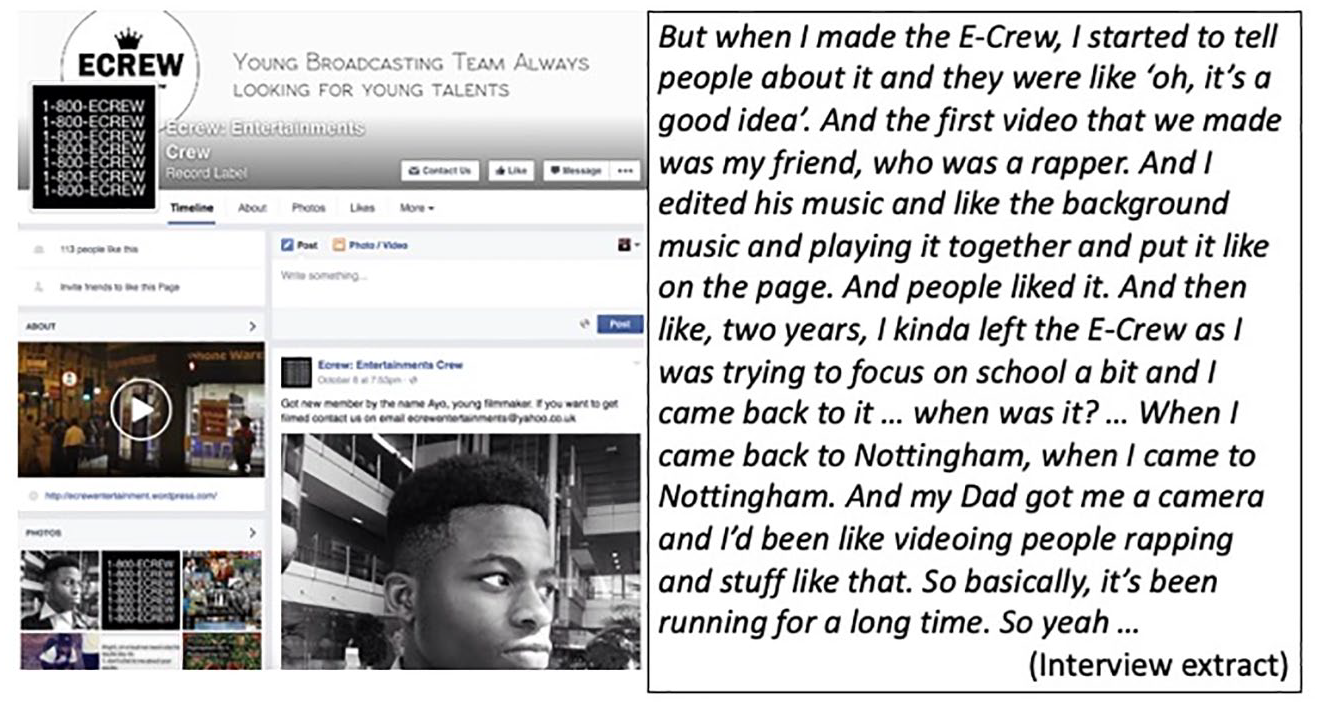
E-Crew – an entrepreneurial network. Vignette containing Facebook page screenshot of record label and accompanying interview extract.
The vignette in Figure 1 is a screenshot of the social media page of ‘E-Crew Entertainments’. Amos has set up his own label to host the work of his friends and young people with common interests as part of a proto-community. This is an example of a young person demonstrating self-efficacy, forging a self-made pathway, and creating their own conditions for platforming and making artwork. It was clear across all sites that developing entrepreneurial capitals included building collectives and creating networks as a way of contributing to a ‘scene’. These forms of cultural activities were accommodated by the Arts Award programme as viable activities meeting both the requirements for arts practice and arts leadership assessment criteria. 3 In developing entrepreneurial capital, as part of their Arts Award experiences, young people were able to gain valuable insight into setting up cultural organisations or creative companies.
Subcultural Capital
Subcultural capital was demonstrated through engaging with digital and DIY arts practices and performances. These subcultural capitals, frequently built alternative narratives that contributed to young people’s self-identity and resistance. Whilst subcultural capital offered opportunities for young people to become authentic and innovative agents of creation, for those that combined this form of capital with deviant behaviours or deficit identities, this led to reproduction of lower social status. Recent research has questioned whether subcultural capital represents the same advantage within the field as social, cultural and symbolic capital (Friedman et al., 2015; Oakley and O’Brien, 2016). For a middle-class young person ‘playing’ with these subcultural practices and cultural resources, associations with deviance and deficit may not have a lasting impact and may instead be converted into valuable subcultural capital in relation to future careers such as designers (Jensen, 2006; Moore, 2005).
One young person that I spent nearly the whole year of my fieldwork with was Tyrone, a 15-year-old Black male, who undertook the Arts Award as part of alternative education provision. Tyrone told me that he was excluded from school with a whole group of his mates, as it was the ‘season for expulsions’ because it was coming up to exam time and he was ‘distracting everyone’. He enjoyed attending the programme because he had skills as a DJ, but he wanted to develop his rapping and create some new recordings. The following vignette represents the album artwork he created for his EP. 4 I watch from across the room as the Youth Worker sets up the camera to take his photograph and then supports him to add the desired effects using Photoshop. Once the image is completed, I interview Tyrone about the process of making this image and how he feels about the final product.
Figure 2 is an example of Tyrone’s experimentation with subcultural capital, through the attention to detail in creating images, including the use of the parental advisory logo. The dark and often unrecognisable figures, gang logos, particular hand gestures, use of certain colours and effects, as well as artefacts such as hoodies and chains are all significant elements and were specifically chosen by the young people. We can see from the fieldnotes that describe the design process that Tyrone is drawing on symbolic creativity to play with the codes gleaned from his available cultural resources contributing to the development of his own self-identity. However, the artwork created does not ‘reflexively penetrate’ (Miles, 2018) Tyrone’s identity, and instead reaffirms his ‘offender discourse’ (Baker and Homan, 2007).
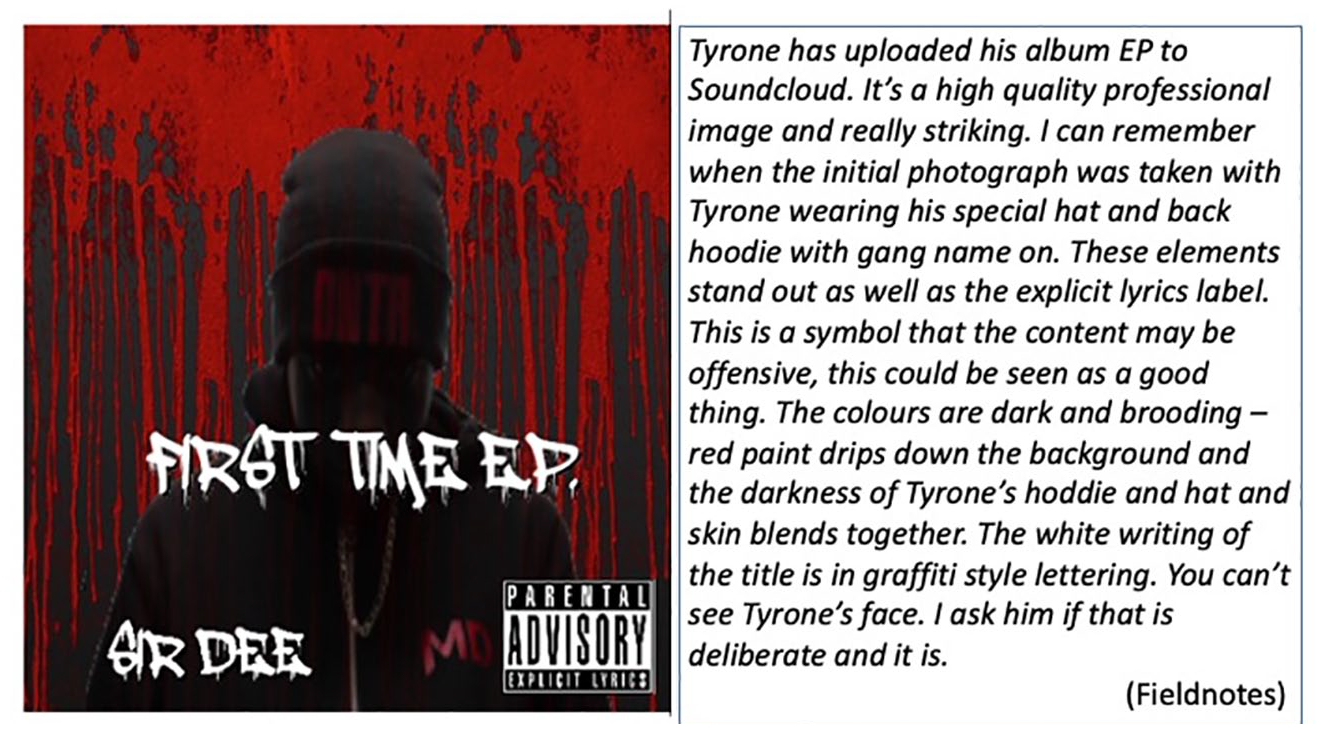
First Time EP
The fieldnotes accompanying the vignette (Figure 2) reflect the amount of consideration he has put into the elements of composition, for example clothing, colours and typography. The particular image he has created is subcultural in style, designed to project a particular image of Tyrone akin to those found on the cover of gangster-style hip-hop albums. By drawing on existing cultural knowledges and resources to create his own version of this identity, Tyrone is clearly developing subcultural capital. As Friedman et al. (2015) and McRobbie (2018) have highlighted however, there are implications for working-class young people in playing with particular codes and messages. Reconfirming deficit identities, assumptions around criminal behaviours, and stereotypes of young Black males, contribute towards the remaking and reproduction of deviant identities. Despite working in their best interests, the Youth Worker becomes complicit in these unconscious mechanisms of reproduction, as no alternative forms of expression are offered or explored.
To give a further example of the development of subcultural capital, I now refer to Jack, a White 16-year-old British working-class male. Upon arriving at the youth club one evening, a Youth Worker rushes up to me and asks if I have seen Jack’s film. ‘It’s incredible’, he tells me. As I enter the room, young people are huddled around the iMac computer ready for the film screening. I pull up a chair and sit at the back. I am enthralled by what I watch in the first five minutes: a powerful poem on the rights of young people to have their voices heard, interview clips with young people from the programme, and news footage from the 2011 riots. 5 The young film-maker has provided a voice-over to these clips, challenging the perspective on young people being broadcast. He argues that ‘not all young people are bad like this’ and that the media just wants people to see youths as bad. When I get the chance to interview him about the film, having watched it in full, he gives more details on the artistic and moralistic messaging behind it, which is shared in the vignette in Figure 3. The film-making genre is subversive, subcultural and it oscillates between grainy news clips and slick well-lighted pieces to camera. Jack’s film knowingly draws on all of these devices.
Figure 3 includes a screenshot from this film, titled ‘Life as a Youth’. Taking the form of an hour-long documentary, it demonstrates the DIY assemblage-manner of creating digital work, whilst the accompanying interview text describes the young person’s choice to incorporate news coverage of the Nottingham riots in his film.
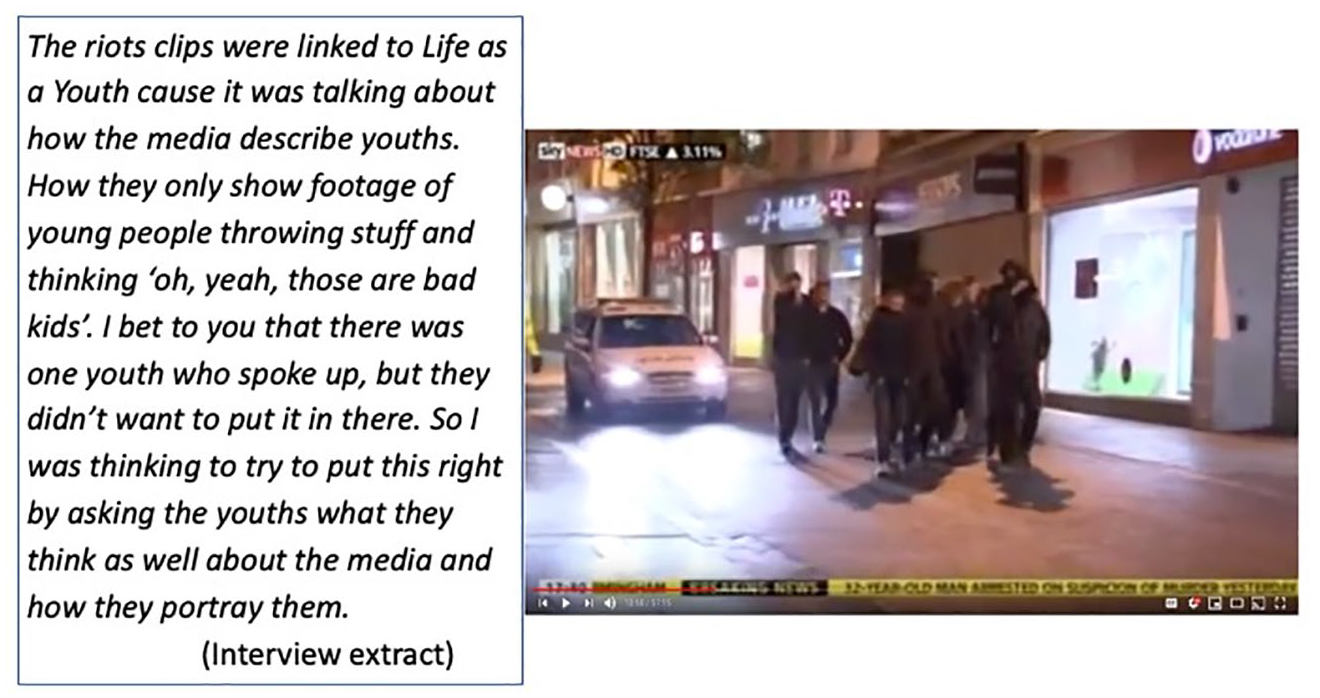
‘Life as a Youth’ film.
The film is littered with subcultural frames of reference, imagery depicting moral panic, and youth deviance and non-compliance. Using the media available to him, Jack is asserting his self-identity, drawing on the deficit images of youth in the riot clips to define what he is not and what he stands against. This film is part of his resistance. To show people that young people ‘ain’t all bad’. When presented this way, it is striking how media footage such as this reproduces stereotypes of raced and classed young people, engaging in acts of defiance, violence, and rioting. These clips do not convey the desperation and dissatisfaction that young people must have felt to get involved in these activities. In trying to challenge these stereotypes through the film that he has made, Jack is trying to repair or bridge this position, by speaking back to deficit discourses of youth, creating resistance while simultaneously not knowing what the resistance achieves.
The film can be seen as an inheritance of radical work supporting marginalised groups to gain control over their representation in the arts and media (Coles and Howard, 2018). However, hierarchies of value of different arts practices, as highlighted in previous research (Bull and Scharff, 2017; Burnard, 2016) can result in positional suffering (Bourdieu, 1999). What is striking about these two vignettes from Tyrone and Jack, is that choosing to engage in issue-based work, often re-enacts the stereotypes they seek to challenge. Young people can either chose to draw on subcultural capital which aligns with stereotypes – as in the case of Tyrone – or they can choose to speak back to them – as in the case of Jack. Subcultural capital, developed by young people with deficit identities, through non-highbrow artforms has implications for the reproduction of social disadvantage.
Common Cultural Dispositions
The final vignette that I draw upon is that of 18-year-old, Black male, JB, who is one of the most regular attenders at the music programme. He attended music-making sessions for over 4 years, since he was struggling at school and the Youth Workers reached out to him through an after-school programme called ‘Hip-Hop Fundamentals’. JB aspires to ‘make it big’, to convert the musical experience and knowledge he has developed through this programme into a career. I have the luxury of being able to interview JB several times over the year, during which time I have witnessed his progression and development as an artist. His journey begins with inductions into entrepreneurship, including self-promotion on social media, and ends with ‘getting air time’ on a national radio station with one of the tracks he has created.
The affordances of this longer-term experience, where JB is consistently drawing on everyday practices of consumption and production are valuable, not only to his creativity and self-efficacy but to his potential future career also. The vignette demonstrates his awareness of branding, social media presence, and marketing as practices that are openly coveted through this programme. He is learning how to be self-made, self-sufficient, and how to make himself stand out from the crowd – qualities JB will go on to develop throughout his life. JB’s music production demonstrates cultural awareness, responsivity and symbolic creativity. He has also developed an awareness of what is necessary to develop his profile and platform his music so that he can get ‘picked up’ by a more mainstream source.
Figure 4 is an example of how access to digital resources had enabled a young person like JB to undertake self-promotion and develop entrepreneurial networks. With digital tools and DIY techniques, young people can raise the status of their artistic work. This increases the likelihood that it is seen and recognised by mainstream cultural organisations. The vignette is a screenshot of the young person’s Soundcloud page, where people can listen to the music, follow the artist, download the track for free and leave feedback. The accompanying interview transcript excerpt demonstrates the awareness JB has about the process of undertaking self-management tasks and how he can balance this with other things in his life. The second excerpt describes how he measured his success by celebrating his achievement of a radio play of his track.
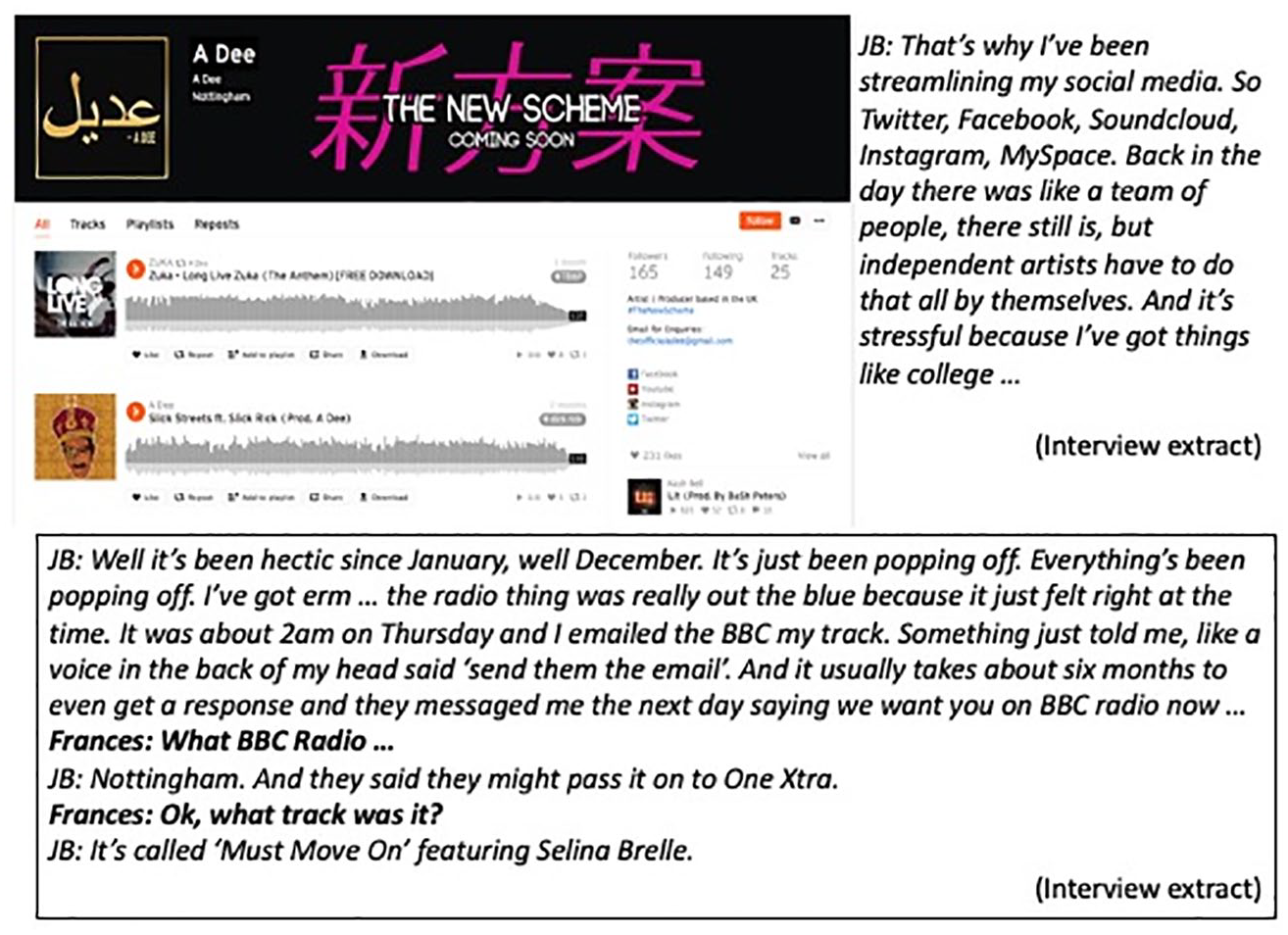
Trying to make it ‘big’ – self-promotion.
Whilst entrepreneurial and subcultural capitals combine to offer common cultural dispositions, these did not advance the position of all creative agents within the field. My data demonstrate that the range of capitals and dispositions continue to be stratified. Although both types of capitals are aligned to the Cultural Industries and represent opportunities for young people to become artistic producers, for those whose subcultural capital aligned with perceived deviant behaviours, this led to reproduction of social status. As these ethnographic data highlight, young people developed the capitals and dispositions, not aligned to the ‘high arts’ but to the Cultural Industries. However, for working-class young people who came with low cultural capital, the Arts Award programme served to reinforce their sense of and objective position within the lower levels of the social hierarchy.
Recognising Artistic Production and (Re)production
This article is an attempt to combine two cultural theorists and their approaches to capitals and dispositions. Taken together Willis and Bourdieu’s work seeks to understand sociological changes such as the increase in mass media consumption and the recognition of social and cultural hierarchies. The theoretical notions of Artistic Production and (re)production provides an organising framework within which to interpret and analyse the data. The capitalising of Artistic Production reflects a specific process of cultural production that encompasses social, political and economic factors and forms of inequality. In choosing the coupling with the word ‘(re)production’, with (re) in brackets signifies the symbiosis of production and reproduction, signifying that production cannot exist without reproduction. These representational and grammatical decisions were influenced by a post-Bourdieusian theory of cultural production (Kuttner, 2015). Artistic Production describes the possibilities for young people to be entrepreneurial and subcultural agents of creation. Whilst (re)production offers a sociological analysis of the production and reproduction of capitals and dispositions through consumption.
Artistic Production and (re)production is a useful tool for investigating unequal social relations produced by the tensions between arts practice and structure. As the empirical examples within this article demonstrate, production often leads to reproduction, can be understood as comprising social and cultural processes. Both Willis and Bourdieu frequently use the same vocabularies of ‘culture’, ‘production’ and ‘reproduction’ but with diverse meanings. For example, ‘culture’ referred to by Willis represents something more narrowly aligned to the arts through a cultural studies lens. Whereas for Bourdieu ‘production’ is positioned as a wider process that incorporates ‘culture’ and is embedded within the social, political and economic inequality. This positioning enables us to recognise the role cultural dispositions and practices play in reproducing social inequalities and forms of identity. The conceptual collaboration I am proposing here, incorporates Willis’ notions of ‘symbolic creativity’ (Willis, 1990) and ‘common culture’ (Willis, 1998) as key facets of Artistic Production. Whilst (re)production recognises the unequal impact of arts practices available to diverse social groups of young people, which both produce and reproduce cultural and social patterns.
As demonstrated through the ethnographic data in this study, the Arts Award programme, encourages practices of Artistic Production, which include DIY and digital artforms, whereby anyone can be an agent of creation. In seeking to be more accessible, by positioning the young person as an arts producer or arts leader, the award supports creativity, self-efficacy, and self-identity. Artistic Production is a form of production that draws on symbolic resources which were available to the young person in their everyday lives such as pre-existing music or images. By implication, the award is heavily reliant on cultural consumption. Artistic Production represents a democratic approach to cultural production and demonstrates a shift from the assumed superiority of high art and traditional aesthetics, towards cultural activities that can form part of individual identity formation, entrepreneurship and subcultural arts practice. However, previous research has identified bedroom culture as the development of sophisticated practices of self-expression which often draw from a limited repertoire of relating and meaning-making implicit in online media consumption (Coles and Howard, 2018). As a result, young people are addressed uncritically as enterprising subjects and subject to the wider social forces of reproduction.
The accompanying (and opposing) concepts of (re)production offer a sociological analysis of the production and reproduction of capitals and dispositions through consumption. Engaging with (re)production as an analytical framework enables the recognition of wider factors that may impact an individual’s capacity to draw upon existing cultural knowledge or qualifications in the development of capitals. (Re)production is a way of highlighting non-advancement and unconscious mechanisms of reproduction for some young people. In his writing on cultural consumption Bourdieu (1984) argues that cultural preferences and taste vary according to social-class position, but also that different artforms are hierarchised. (Re)production can be defined as a strategy within a system, which positions some as low-achievers and reinforces success for others. Those who do not hold the benefits of social mobility experience ‘positional suffering’ (Bourdieu, 1999) or become ‘sticky subjects’ (Allen and Hollingworth, 2013). Being able to recognise Artistic Production and (re)production within arts programmes makes visible the role common cultural practices play in the remaking of established class-based structures of disadvantage.
Discussion
Drawing on the particular example of the Arts Award, I have argued that the young people on this particular programme valued ‘common cultural dispositions’ more highly than the award’s accredited outcome. Ethnographic data demonstrated the development of entrepreneurial and subcultural capital by young people on the programme, which served as a counter-cultural movement to the cultural capital of the high arts and legitimate culture. This programme offered something different and arguably more valuable to these participants, where they were able to shun the established ‘order’ and instead explore what they deemed to be desirable, worthwhile, and cool. This was often undertaken with an entrepreneurial zeal that looked beyond the conception of culture as bourgeois exploitation and economic competition. Despite the young people never articulating that they wanted to enter the ‘mainstream’, the high arts of theatres and galleries, they did accumulate capitals that were of significance for the Cultural Industries through ‘common cultural dispositions’. The Arts Award programme within informal and alternative education settings did not enable young people to ‘catch up to the mainstream’ through consuming existing forms of cultural capital, as recently problematically set out by Ofsted 6 (Birkenshaw and Temple Clothier, 2021; Nightingale, 2020). Under settings with more of a youth focus, the programme offered a counter-cultural movement. Therefore, a sociological examination of the often-overlooked capitals and dispositions afforded by youth arts programmes has value in demonstrating the subcultural and entrepreneurial capitals and common cultural dispositions on offer to marginalised young people.
My theoretical framework of Artist Production and (re)production was designed to bring this new perspective into dialogue with more established ideas surrounding neo-Marxist theories of social and cultural reproduction. I argued for the applicability of the framework to other scenarios which seek to explore the tension between the assimilation of common culture through arts education but within existing social hierarchies. This combination gives additional insight into culturally reproductive cycles, which remain problematically entrenched with social class disadvantage. For example, whilst entrepreneurialism within young people has been valued for the development of multi-tasking and multi-jobbing professional roles, these kinds of dispositions have also been criticised for self-exploitation and risk (Tarassi, 2018). Furthermore, McRobbie’s (2018) work on young creatives questions the possibility of the cultural economy for enabling and supporting marginalised young people’s livelihoods. In the long-term, subcultural capitals often fail to be translated into economic gain, despite examples of where participants in subcultures can get jobs as artists or graphic designers, as re-mixers or producers (Jensen, 2006).
Yet, these counter-cultural movements, whilst resisting processes of normative production, at the same time unknowingly contribute to (re)production, through the privileging of certain forms of capital. As young people become ‘cultural omnivores’ (Tampubolon, 2010) the consumption of common cultures fails to address existing social hierarchies. For example, research on classical music demonstrates the relation of particular arts practices to class through the highly ritualised production of social practices (Bull and Scharff, 2017). For young people facing deficit identities, such as the ones in this study, often receive lower-quality programmes, low-level work, and over-regulated teaching, by way of disadvantage (Howard, 2020). Whilst the empirical examples in this article have offered glimpses of self-efficacy, self-identity and resistance, forms of reproduction and positional suffering remain unconsciously present in these programmes. This analytical framework has longer-term significance for the reconsideration of what can be done to turn these different capitals and dispositions into advantages within the field. As a framing concept, Artistic Production and (re)production, leads us to reconsider what a truly beneficial and ‘inclusive’ youth arts programme might look like.
Conclusion
This article has explored one youth arts programme – the Arts Award – and the enabling of ‘common cultural’ dispositions in supporting young people as creative agents. Bringing together particular ideas from Paul Willis and Pierre Bourdieu, I offer a new perspective that has a greater emphasis on everyday creativity, self-efficacy, self-identity and resistance but also highlights ‘positional suffering’ through entrenched culturally reproductive cycles. To do this, I have drawn on the concepts of common culture and entrepreneurial and subcultural capitals. The mobilisation of the theoretical framework of Artistic Production and (re)production has acknowledged the value of everyday artistic production. However, the structures of reproduction that disadvantage some participants of youth arts programmes have also been highlighted.
In departure from previous research, which has focused on careers within the ‘high arts’, this study found that Arts Award is aligned to employment in the Cultural Industries. The development of entrepreneurial and subcultural capitals is instrumental in this pathway. I have demonstrated through Artistic Production that Arts Award has the potential to disrupt the field by creating an alternative hierarchy through which young people could move into employment. However, this was dependent on entrepreneurial networks, symbolic resources, deficit identities and unconscious mechanisms of reproduction explored in the analysis. This exploration demonstrates that not all young people accrued entrepreneurial and subcultural capital equally and therefore not all young people were able to mobilize common cultural dispositions to their advantage. It is clear that more needs to be done to work against the logics of (re)production within youth arts programmes. Further research should be undertaken into young working-class people’s experiences of arts education programmes in order to un-mask the (re)productive established hierarchies and power dynamics at play. Assumptions about young people should not be made on the grounds of the social filtering and selection of the programmes, which is based on the combinations of capitals and dispositions they already possess. This would lead to a wider consideration of the purposes of arts education, changing the current narrative away from social mobility, towards social justice.
Footnotes
Funding
This doctoral study was funded by the University of Nottingham.
