



Abstract
This article focuses on the do-it-yourself artistic creation of migrant women in the city of Porto, Portugal, and emerging modalities of artivism. It is focused on the project ‘Headless Women in Public Art’, by the artist Mariana Morais; an art and design project – sustained by a do-it-yourself praxis and ethos – that aims to examine public art in the city of Porto through a feminist and (i) migrant lens, to identify/deconstruct aesthetic narratives created around women in public art. By adopting a case study methodology based on the use of a qualitative and visual methodology, we present a sociological discussion around the project ‘Headless Women in Public Art’, as well as a content analysis regarding a semi-structured interview made to the artist. The goal is to enhance social, cultural, artistic and symbolic re-significations around public art and female bodies in public art in Porto, while using do-it-yourself.
Why do women lose their heads? An introduction
This article lies in the theoretical-empirical association of the phenomenon of female migration and do-it-yourself (DIY) artistic practices carried out in Portugal, in the city of Porto. We assume that this intersection poses a challenge in the scope of academic production because little is known about each of these phenomena individually, and even less when they intersect. For example, the feminization of migration has been extensively analysed from a quantitative perspective (Abusharaf, 2001; Gabaccia, 2016; Kofman, 2000; Marinucci, 2007), others have looked at the artistic careers of the male migrant population (Bennett, 2010; Comunian et al., 2016; Petersen, 2017), and others have focused on the relationship between migration, gender, resistance and activism (Freedman, 2008; Guerra et al., 2020; Lee, 2003). With this, we have found that there are no scientific contributions that combine these three themes (female migration, DIY artistic practices, and artivism). In the Portuguese case, there are some works that have focused on male migration and DIY practices (Guerra and Quintela, 2016), but the use of DIY by migrant women artists remains unexplored.
We intend to analyse the Headless Women in Public Art 1 project, adopting a qualitative and visual methodology (Guerra, 2022). This project was created by Mariana Morais, a young Brazilian artist, immigrant in Portugal, who has an artistic practice of questioning Portuguese public art, 2 in the city of Porto. To do this, Morais uses the DIY ethos and praxis, through the creation of nomadic sculptures, urban collages and the exploration of revisited narratives (Morais, 2019: 50).
A qualitative methodology was used to establish the empirical contributions of this article. A semi-structured interview was conducted with Morais, 3 in which we explored themes such as female migration, artivism, DIY and art as a form of resistance. This interview was conducted under the application of a snowball sample, 4 and it was categorized and analyzed using categorical analysis (Guerra, 2022). Also, a visual and content analysis of Morais artistic creations (Bell, 2012) was carried out, as we considered them to be a way of questioning the lived experiences of Morais in the host country.
Morais is 31 years old, and currently she works as an artist and a studio assistant in Portugal. Regarding Morais trajectory, she was interested in art from an early age which manifested itself in her academic training and professional trajectory. For her, art and public space go hand in hand, affecting each other. She was born in Brazil, in the city of Recife, and in 2017 she moved to Porto, Portugal: A destination that seemed easy because her grandparents were Portuguese who had emigrated to Brazil. Her decision to immigrate to Portugal helped her escape the insecurities and uncertainties of her home country, which has an ongoing history of social and political turmoil. This issue of insecurity is decisive to understand the artist's intention with the Headless Women project. One of her greatest desires when coming to Portugal, was to be able to enjoy public space without fear of gender violence, in fact, Morais’ interaction with sanctioned public art in Porto, awoke her interest to approach gender violence artistically. To Morais, these monuments and statues were forms of gender violence, as well as an influence on other types of symbolic violence in public spaces.
We intend to reflect on the role that the DIY artistic practices carried out by Morais, have in questioning public art nowadays, as well as to understand how migrant women artists movements contribute to a change of social and artistic paradigms in Portugal. Firstly, we will establish a reflection around the intersections between DIY and Morais artistic practice; secondly, we will discuss the concept of artivism in relation to female migration; thirdly, we will address the topic of women and sanctioned public art; finally, in the last section, we will establish some reflections about the project and about Morais DIY artistic practice.
DIY practices and sanctioned public art: ‘From Justice to Pain’ 5
In the artistic repertoire of migrant women, a DIY praxis is used to bridge the systemic gaps that these migrant women artists experience, especially in terms of their integration into the host country. A DIY praxis emerges as an alternative and it becomes associated with the concept of resistance (Guerra, 2021: 123). In relation to Morais practice, DIY is used as a political tool, since it serves the purpose of questioning her lived experiences (Bennett, 2018), such as sexual and moral harassment, machismo, xenophobia, etc. On a broader level, a DIY practice presupposes the mobilization of strategies that foster freedom and individual and collective action, as well as enables the contestation of the uncertainty and instability of labour markets (Guerra, 2021: 124). On the other hand, artists like Morais, use DIY merely as a form of expression and resistance, and not to obtain economic sustainability. The DIY ethos in Morais artistic practice, becomes a vehicle for expressing herself, because it's through DIY that the artist interacts with the host country, and with the public art and spaces in the city.
Alongside this, we must recognize the artist's place of speech (Ribeiro, 2020). In our understanding, this concept of ‘place of speech’ has connections to DIY because, for Ribeiro (2020: 32), the place of speech concerns the place from which – from a discursive point of view – subaltern bodies claim their existence. This concept portrays the need for an understanding of the social place that certain individuals occupy; places that dictate the way they relate socially. Ribeiro (2020) argues that we must recognize the place of privilege that some individuals occupy in relation to others, as is the case of Morais regarding other artists. We can see that this principle of recognizing privilege is evident in Morais’ artistic practice, and in her use of a DIY practice: Morais uses DIY as a form of expression, interaction, and resistance/critique, i.e., as a way to ‘protect her mental health and well-being’ (Excerpt from Morais interview). In contrast, other migrant female artists use DIY to try achieving economic stability in the host country. In fact, the ways in which DIY is used depend on the place of speech of the artist. The Headless Women project, by addressing the representativeness of female bodies in sanctioned public art, enables the transit between borders – gender, racial, class, ethnic, etc. – but also delimits other types of borders. This prompts us to think about which women are able to use art and DIY purely as a form of expression and resistance?
Her time living in the United States (2013–2014), fuelled her interest in projects such as Guerrilla Girls (1988).
6
In the specific case of the Guerrilla Girls, Morais highlights the satirical manifesto ‘The advantages of being a woman artist’, There's that work by Guerrilla Girls, I don't know if you've seen it, but what are the benefits of being a woman artist? It's not having pressure to be successful, it's satirical … it goes a little bit to that side of the challenges as a woman artist. In Headless Women, one of the things I talk about is: Headless because you lost your head? How did you lose your head? Patience? Did you lose your head because you were silenced? So the headless thing is not simply the headless torsos. I go on to explore a little bit of the meanings of not having a head, and why it's so hard to deal with that sometimes, and why it happens not just in sculpture, but in film posters when they also cut off the woman's head. (Excerpt from Morais interview)
7
The contemporary public space recovers historical-social functions, affirming it as a place for establishing social relations and artistic and cultural interventions, and assuming itself as a promoter of political discussions (Lopes et al., 2018). However, the difficulty in addressing the relationship between a DIY praxis, art, and public space lies in the absence of a unified definition of the concept of public space, which depends on subjective experiences. To Guerra (2019: 22), public space is composed of indicators that portray past and present social relations, framing them within a broader social structure of social manifestations. In other words, it is the everyday social relations of interaction that define the multiple typologies of public space and, in this way, the DIY ethos in Morais artistic practice is seen as a vehicle for interpreting/communicating these same everyday relations of interaction, with an emphasis on migrant women's social ties with public space and with broader social structures.
Activism related to public space, in the artist's practice, emerges as an instrument of political negotiation and as a means of resistance (Mekdjian, 2018). In the artist's opinion, Portugal is a sexist and xenophobic country, in which Brazilian female bodies – in public spaces – tend to be sexualized and objectified. So, Morais’ use of a DIY ethos and praxis in relation to sanctioned public art in Porto stems from the artist's migratory experience, in the sense that the subjectivity of her works denotes a Foucaldian vision of the migrant self, i.e., her practices show a contestation of a migrant subjectivity (Silvey, 2004: 498) that is formed from discursive practices that aim to dictate what it means to be a woman and a migrant in a society that has a patriarchal structure, i.e., she intends to criticize the limits on behaviour, that are imposed according to gender, artistic practice and nationality ideals. The fact that women are portrayed as torsos without heads, or as submissive to men in sanctioned public art, is something that relates to Morais perception that women are an invisible face of the Portuguese society, especially in public art and in the artistic/social structures. Moreover, her artistic work also serves as a metaphor for an opposition to the idea of migrant women's subordination to the rules and ideals of the host country, i.e., it intends to convey the thought that the culture and practices of the host country should be challenged and influenced by migrant's experiences and subjectivities. Morais’ critique of the representation of women in sanctioned public art in Porto is made in this sense, in order to demonstrate that social inclusion also involves the relationship of the migrant population with public spaces and artistic products of the host country.
From our point of view, Mariana's DIY ethos can also be seen as an urban-feminist DIY practice, i.e., something that's unauthorized and led by individuals who organize temporary, creative and site-specific interventions that take place outside the formal systems of planning and relationship with the urban public space (LaFrombois, 2017). This urban-feminist DIY ethos can be seen in the artist's organization of city tours and poster collages (see Figures 1 and 2). According to Morais: I did some guided tours which, was one of the interactions of my project. I pasted posters in the city, and one day, a woman who worked in tourism told me that I was destroying the city when I pasted these posters. She told me to take them off the wall or she would call the police. I was careful and I wasn't putting them on any functioning buildings, they were abandoned buildings. At that time there was a discussion about a monument regarding the oversea war and I thought ‘funny, that thing is permanent, which in my conception is vandalism, but it is institutionalised, and my work is not permanent, why is it vandalism?’. Then I started to think about the similarities and differences between my poster and public artworks. The posters are put up by me, the artworks are permanent and put up by the council; posters don’t need public consultation, permanent artworks the same. Mine is ephemeral and theirs is not. Mine is fragile and theirs is resistant. (Excerpt from Morais interview)
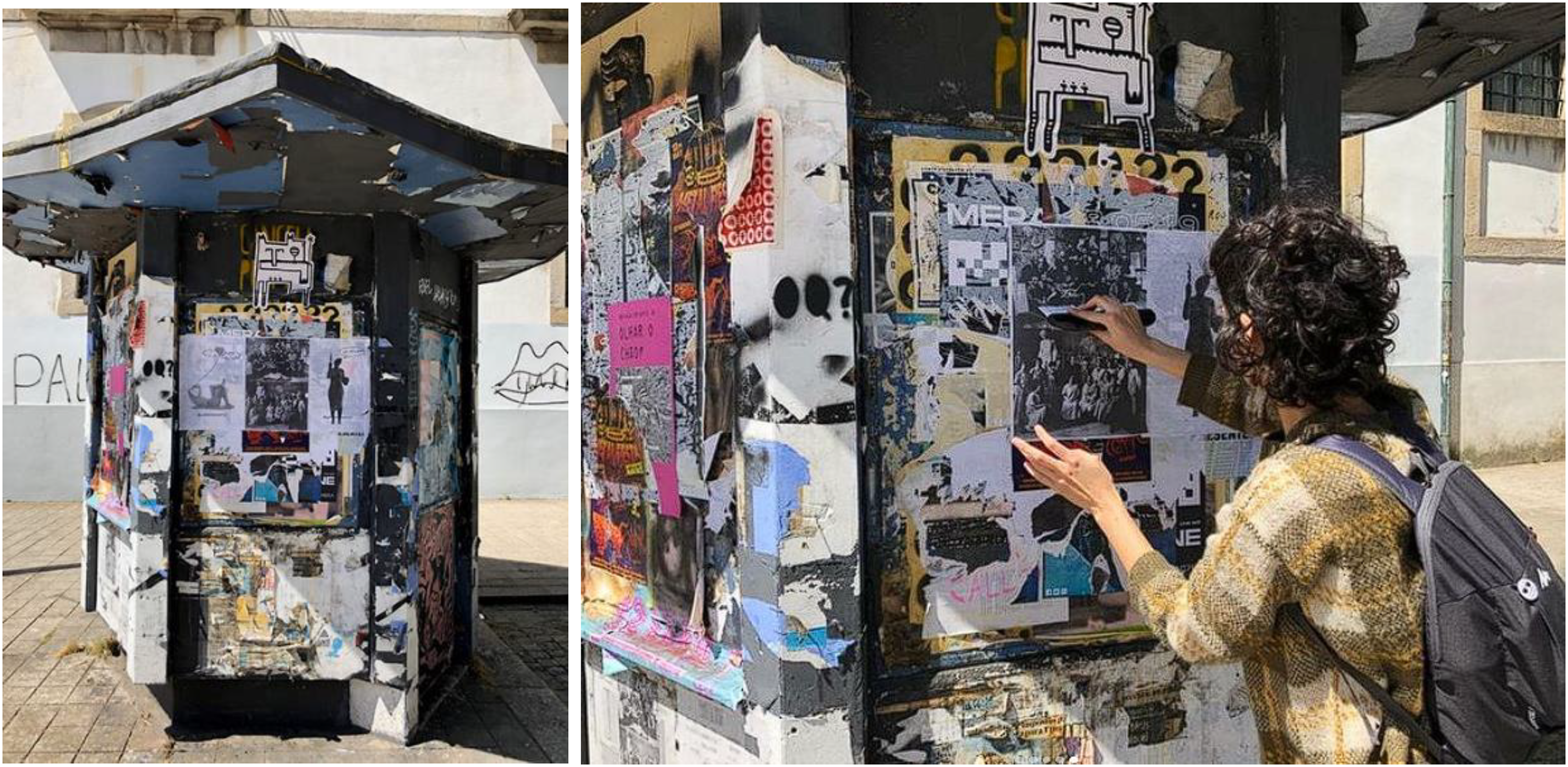
Morais, while pasting posters related to Headless Women in Public Art, in the city of Porto. Source: courtesy of Mariana Morais. All Worlds Project (ref. 2021.06637.BD).
What Morais mentions, about the limits of what is or is not considered public art are latent in her DIY practice, mainly because the artist questions the existence of a Eurocentric perspective on public art. Being from the Global South, Morais’ migratory experience, combined with her artistic practice, contribute to this act of critique. According to Morais: It was difficult to be Brazilian, to recognize myself as a Brazilian here because in Brazil I am just another person and here I am Brazilian and it's another layer. I am Portuguese for legal purposes, for the rest I am Brazilian. Nowadays I don’t feel it as much. Even simple things like not understanding what was being spoken because we do not have the experience of the European Portuguese language in Brazil as you have the Brazilian Portuguese language here. (Excerpt from Morais interview)
The connection between female migration and contemporary artivism: The creation of routes in Porto 10
Most migration studies have historically been guided by a colonial bias or a Eurocentric view (Heimer, 2021). These perspectives tend to see migration as a problem that needs to be solved, leading scholars to adopt a kind of methodological nationalism (Lucy and Turner, 2021). The notion of methodological nationalism concerns an act of contesting a historical understanding of a country as an integrated territory, composed of a homogeneous community and, in this sense, the migrant population is seen as a threat, because they are seen as cultural otherings and as social deviants. In this sense, the artistic work and social critique of Morais intend to break with the notion of the migrant population in Portugal as cultural otherings and as social deviants who don’t engage or reflect upon public art and the meanings of public space.
Heimer (2021) argues that some transnational migration and gender studies may have been responsible for reproducing this idea of methodological nationalism; that they may have contributed to producing Western feminist perspectives on gender and patriarchy (Pessar, 2005). This is evident in Morais migrant trajectory and artistic practices, given that she is from the Global South, and that, through her artistic practice, she investigates and questions how gender ideals can be challenged, reconfigured, or reinforced among the migrant and non-migrant population through art and public spaces. Pio and Essers (2014) argue that transnational feminism is related to postcolonial theories, as it was developed to challenge Western feminist theorizations. Thus, the authors say that transnational feminism (Zwingel, 2012) is based on the idea that migrants must resist and constantly renegotiate multiple layers of history: for example, the meanings and stereotypes attributed to Brazilian women in the host society.
These theoretical axes of resistance and transnational feminism are associated with the concept of artivism (Vico et al., 2018). This concept is increasingly limited to certain practices with a political connotation. There is a limitation of the specialization of discourses around what can (or cannot) be considered artivism. Following Jurriëns (2020), we assume that artivism is inherently related to the natural environment and to a historical and traditional perspective; in institutionalized art, this association can presuppose idealized representations of landscapes and local communities, as well as stylized terms of nature and values in art. Morais aims to challenge these traditional representations that can be applied to sanctioned public art. Morais artistic practice aims to analyse two centuries of public art, namely the 19th and 20th centuries, in the city of Porto, from a twenty-first century feminist lens and from her own experience as a migrant cis woman artist. This project arose from a questioning of the role/representation of the female body in sanctioned public art in Porto. In Morais words, I came here and then I felt this shock because there was a lot of harassment all the time. I went to a class, and we were given a map of public art from the Porto City Council, the teacher said to interpret the map as we wanted. I wanted to know where the women were. I went to a concert at Casa Música and there were no women playing instruments, there were no women on the street, where are these women? I started counting the women on the map, related or represented in public art, and then I saw that there were some categories: women artists, the women honoured and there were all those other bodies and allegories that had the shape of women but were not women. I think that's where Headless Women was created in 2017 (Excerpt from Morais interview)
Since its emergence, the project has identified female representations 11 in Porto, in the form of monuments and statues, while establishing comparisons with the statues and monuments that portrayed males. The main objective was to demonstrate that sanctioned public art in Porto follows a model of essentialist representation based on the objectification of the female body. The artist managed to group the sculptures and monuments into four categories: (1) women artists; (2) women honoured; (3) allegories in the form of women; (4) headless women. The category of headless women concerns sculptures that are female torsos but without heads. Alongside this categorization, she created revisited narratives (Morais, 2019: XV); that is, within these categories, Mariana created stories – that aroused from her lived experiences as a Brazilian migrant woman to try and justify why those torsos had no heads. The artist also organized city tours (see Figure 3), where she carried a mobile sculpture to question the limits of what can be considered public art. This mobile sculpture, depicting a legend from Brazilian folklore, also calls into question the representation of gender roles in Brazil, creating an intercultural dialogue.
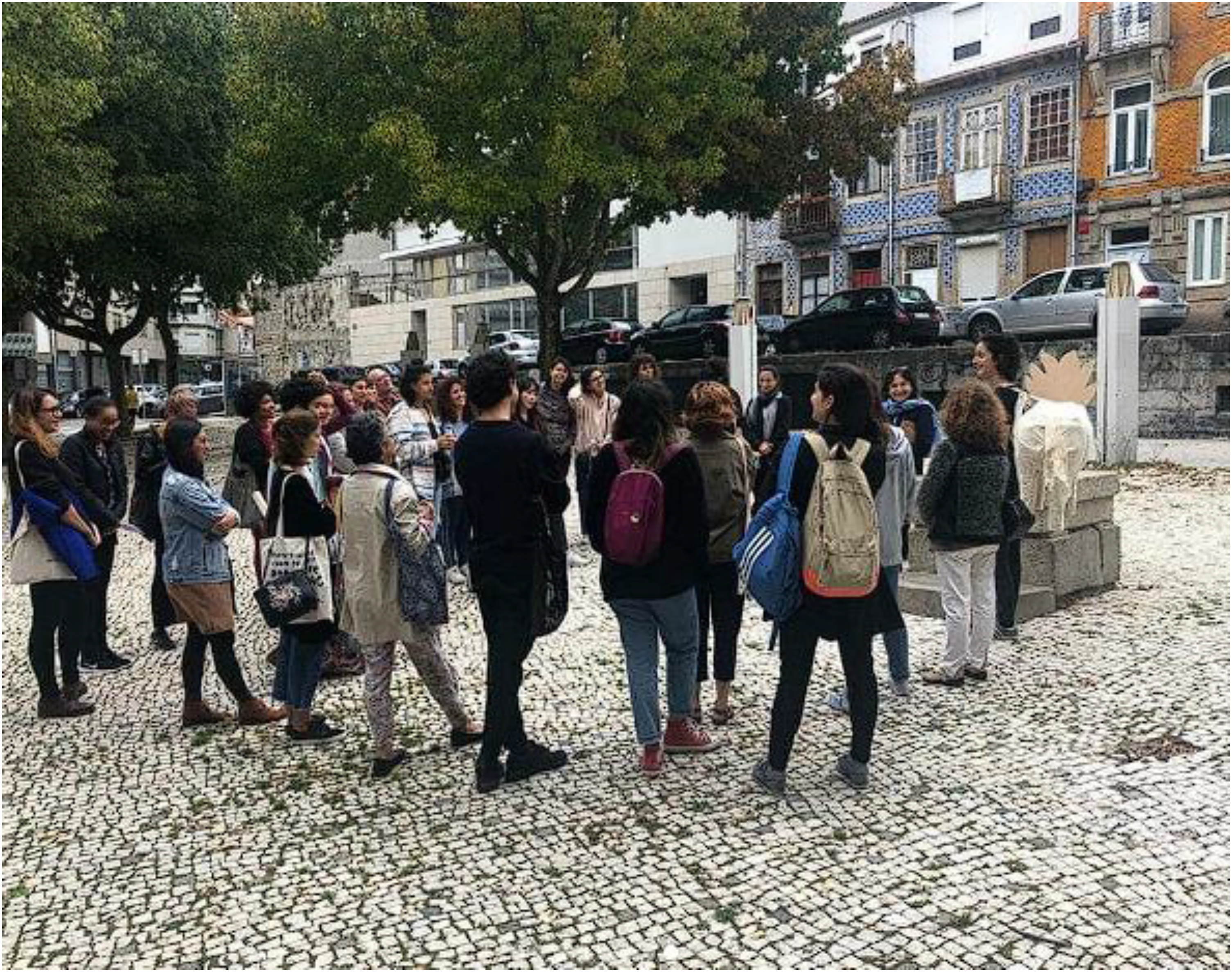
Morais, with a mobile sculpture, referring to the legend of the headless mule 12 , in one of her city tours in 2019. Source: courtesy of Mariana Morais. All Worlds Project (ref. 2021.06637.BD).
Morais defines herself as ‘an intersectional feminist artist’ (Excerpt from Morais interview). This definition punctuates a discourse around the inequalities faced by migrant women in contemporary times, especially by women from the Global South (Chant, 2013; Nawyn, 2016), while it also analyses the reproduction of gender inequalities in public art within the Portuguese sociocultural system and traditions. In other words, based on Heimer's (2021) perspective, Morais artistic work tries to portray complex interconnections between concepts such as social class, culture, urban environment, gender, and lived experiences.
Recent studies (Jurriëns, 2020) have applied the concept of artivism to social movements that use creativity to convey their messages. In this context, Morais work can be seen as a form of artivism since she uses images (natural and revisited) to question the ways the female body is represented in sanctioned public art in Porto. Artivism emphasizes inextricable links between art and activism, mainly when the political field (Weibel, 2015) is dominated by image-making, performance, digital connection, and DIY culture. Other academic debates (Heimer, 2021) facilitate a similar approach to the role of creativity in environmental movements and others about gender struggles (Stange, 2017). Based on the latter premise, underrepresented social groups, including migrant women such as Morais, see art not only as a way to position themselves against something but as a means to explore and express creatively and critically, the experiences that have shaped their feelings and migrant subjectivities: The migrant self (Silvey, 2004). In Morais case, these subjectivities relate to the ways in which migrant women like herself interpret and communicate with public space and public art in Porto. Artivism in Morais practice is a means of transformation, that is, a tool that breaks with hegemonic (bio)politics (Agamben, 2013), with social norms and discursive practices that discipline bodies in contemporary public art (Marín, 2018). So, Morais artivism can be seen as a migrant feminist critique, which rejects the hegemony of modern masculine and positivist knowledge in the host country (Gutiérrez, 2012).
Whose public art and for whom? The representation of the female body
Returning to the ideas of the previous section, the artist's urban-feminist DIY can be traced to her perception of the female body, migrant experiences, and criticism of sanctioned public art in Porto. LaFrombois (2017) states that feminist studies have been interested in an approach that understands public space – and public art, we add –, whilst highlighting power relations, something present in Morais artistic work. An example of this is the lack of consideration, on the part of political leaders, of the needs and interests of subaltern social groups, such as women or the migrant population (Parker, 2011). There are feminist approaches that examine public space from the lens of social identities, arguing that they are (re)produced through urban physical spaces (Bondi, 2005), for example, LaFrombois (2017) affirms that several American and European cities were historically constructed from notions of gender, social class, race and labour division. The same idea can be applied to the production of public art. In fact, Morais during our interview, reflects on these issues when she narrates her experiences as a Brazilian migrant woman in some public spaces in the city of Porto.
When we think about these ideals that have guided Portuguese public art, it is impossible not to establish a connection with the female body. For Adelman and Ruggi (2008), contemporary Western societies have developed patterns of understanding bodies, sexuality and subjectivities that, consequently, end up being evidenced in public art in the form of domination, sexualization, objectification and stigmatization. These patterns allow social scientists and artists to gain a glimpse into the conflicts and struggles between bodies and power, gaining a broad view of a complex system of social and cultural relations.
The female body, and the reappropriation that is made by Morais in her project, can be seen within a broader conception of body design (Brumberg, 1997) and that is associated with the notion of reflexive project of Giddens (1991), which is guided by the existence of elements that construct individual and collective identities, such as the shaping of bodies according to an aesthetic or social representation, and the construction of the self which – despite being inserted in social relations of power – can also be seen as a place of creative activity (Adelman and Ruggi, 2008). Moreover, these processes of identity construction made by Morais, while using revised narratives can also be understood as liminal forms of social discipline. The sculptures that were intervened by the artist denote this (re)production of social and symbolic hierarchies that reaffirm patterns of social status that value some subjects while devalue others, in this case, the male body is overvalued and the female body undervalued (see Figures 4 and 5). This connects with the idea of migrant subjectivity (Silvey, 2004: 498), because Morais questions the limits of her behaviour as a woman, as an artist and as a migrant, breaking with the essentialist idea of othering in the host country.
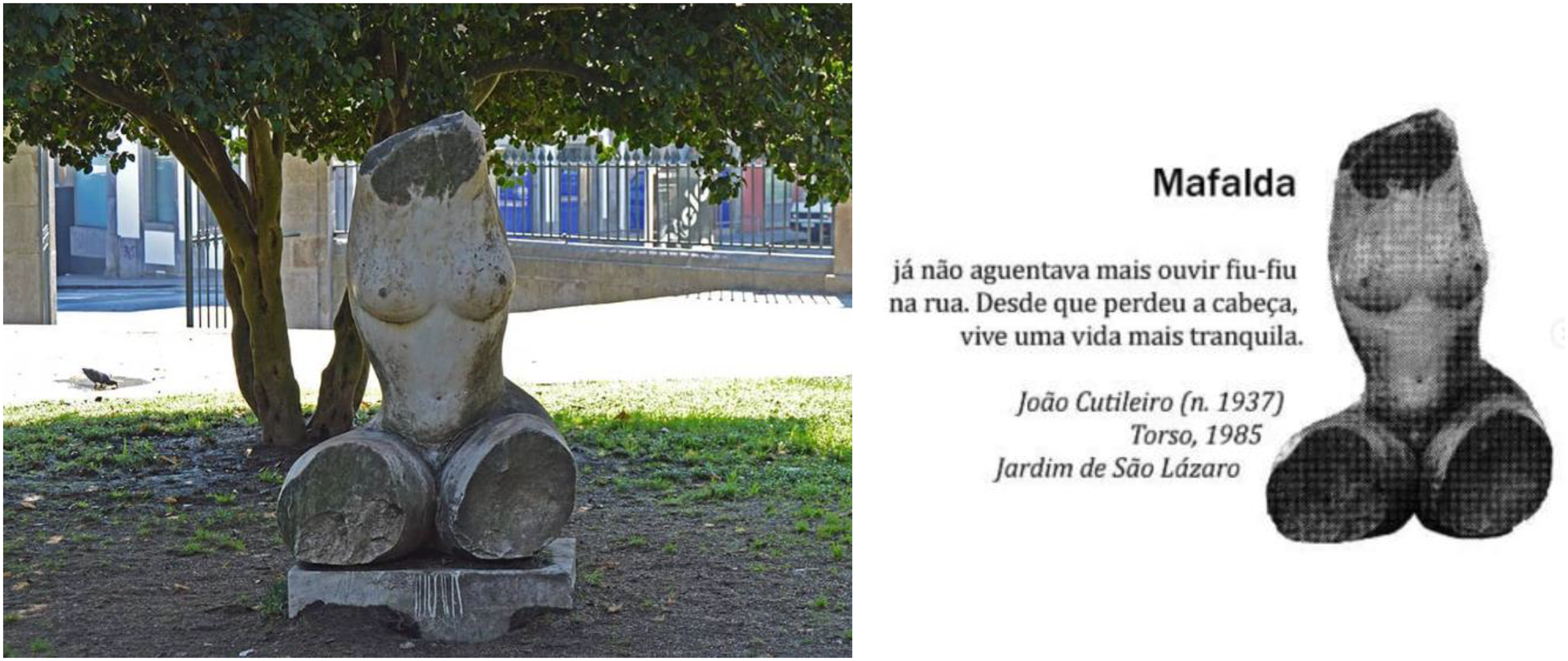
Example of an artistic intervention made by the Headless Women in Public Art project. Source: courtesy of Mariana Morais. All the Worlds Project (ref. 2021.06637.BD).
The upper images refer to the category of ‘headless woman’, and they concern a sculpture that has a feminine physiognomy, that does not have a head, legs or arms. This sculpture is located in the garden of S. Lázaro, in a central area of the city, near the municipal library. During the interview, Morais tells us that she had a Brazilian friend who spent a lot of time in this garden, however, the garden of S. Lázaro is a public space that usually has a strong male presence, and Morais friend was ‘constantly approached by men and she thought it was strange’ (Excerpt from Morais interview). Motivated by this curiosity – and by not being familiar with the social history of the garden – she discovered the garden of S. Lázaro 13 was once a space associated with prostitution, something that connects with the idea that contemporary public urban spaces assume themselves as the result of social relations of the past. Then, from this (see Figure 5), Morais – through the concept of revisited narratives – reconfigured her friend's experience and constructed a revised narrative for that sculpture, with the intent to explain why that woman had ‘lost her head’ (Excerpt from Morais interview). In short, Morais gave her a name (Mafalda), and stated that she lost her head 14 due to the harassment she felt in that space. Furthermore, Morais states that since ‘Mafalda’ lost her head, she lives a quieter life. With this, the artist sought to counter the commonplace of women being portrayed as crazy when they have behaviours that escape the institutionalized patriarchal structure. This artistic intervention aimed to challenge the machismo that characterizes Portuguese society.
Both the process of artistic creation and dissemination (i.e., social media and website) were carried out by the artist in a DIY manner, and that ends up revealing other issues that are related to the representation of female bodies, in which is seen as an object and the male body is seen as a subject. In Figures 4 and 5, we see the shaping of the female body from social power relations, not least because most sculptures – such as the one shown in Figure 4 – were created by men, something that can also be explained by the historical difficulty of women to access positions of power in the field of the arts. Also, the artist's count of sculptures of female honourees and female artists is substantially lower than sculptures for male honourees and male artists. 15 From this interpretation, we see what Adelman and Ruggi (2008) defend, about the fact that these power relations promote the incorporation of postures, behaviours, norms and languages that are linked to hegemonic, dominant and patriarchal visions and practices, that are questioned, especially by migrant women like Morais, who critique the social structures of the host country, while promoting social change and a more inclusive and multicultural society.
The use of DIY in relation to disseminating these revisited narratives (Figures 5 and 6) is also intertwined with the contributions of Bourdieu (1998), Foucault (2001) and Butler (1990), since these authors argue that the incorporation (even in contemporary times) of ways in which the male and female genders express themselves, occupy different places and hierarchical positions in the social structure, i.e., men and women position themselves in societies – or are positioned – in an unequal matter (see Figure 6).
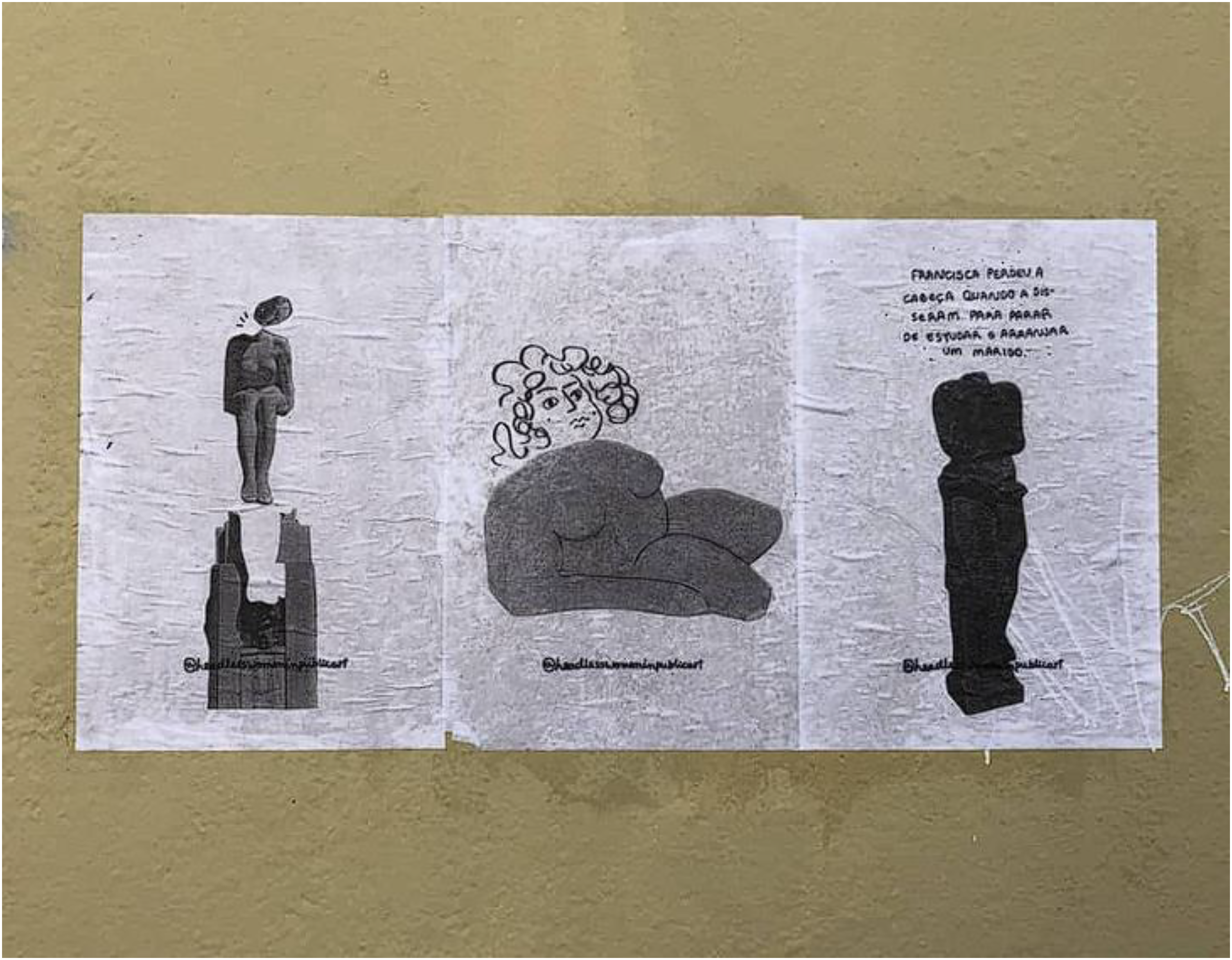
Posters pasted by Mariana around the city of Porto, referring to the revisited narratives of Headless Women in Public Art. Source: courtesy of Mariana Morais. All the Worlds Project (ref. 2021.06637.BD).
In Figure 6, on the poster on the right, you can read the following sentence ‘Francisca lost her head when they told her to stop studying and find a husband’. Associated with this sentence, we see De Lauretis’ (1987) arguments related to the technologies of the self that act on an embodied subject, something that is evident when one thinks of the social pressure that is placed on women to get married and have children. These technologies of the self (De Lauretis, 1987) relate themselves to the reproduction of subjects according to modes of action corresponding to the male and female genders. A DIY practice by Morais emerges as a form of resistance and opposition to these technologies of the self, as text and image come to be seen as a means of contesting the socially imposed norm.
In the sculptures of headless women, the female body is associated with nudity. Nudity, in traditional and contemporary art, has multiple and historically constructed meanings (Sutton, 2007). With the institutionalization of artivism (Danko, 2018), the meaning of the naked body in relation to artistic practices and in a global context of multiculturalism, becomes more difficult to unveil. In countries like the United States of America, history continues to permeate dominant representations of the female body (hooks, 1998), making it difficult to counteract this with alternative images. Regarding this, we state that Morais through DIY and by assigning names, stories and experiential perspectives to these torsos, is promoting forms of resistance, but also of decolonization of public art and public space, ultimately contributing to the construction of a discourse about the representation of the female body in public art from a migrant perspective. At the same time, there is a claim to a place of belonging (Ribeiro, 2020) by Brazilian woman in Portuguese society in relation to public space and public art. This practice by Morais presupposes the denunciation of the discomforts that affect Brazilian women, namely their hypersexualization, within a broader patriarchal structure. Regarding these issues, Morais mentions that, Recognising myself as a Brazilian and the place I occupy as a Brazilian, and I have also understood that no matter where I go in the world, as a woman, there will be issues that are transversal and sometimes more or less intense of how society is built around patriarchy. Recognising myself as an artist I don't think is the simplest thing … I don't know, I didn't get here as an artist in 2017, so that changed and it was here in Porto (Excerpt from Morais interview) I read things and tried to understand how I could represent the feminine, what it meant for the Statue of Liberty to have the figure of a woman and in the end, it did not necessarily represent liberty’. This questioning is articulated with the sculptures in the form of a female allegory, something that makes the artist question what public art consists of today: Justice has a female form, but is it feminist? (Excerpt from Morais interview).
Through these questions, the artist questions herself about the purposes of public art, therefore, her intervention meets the arguments of Sharp et al. (2005), that public art aims to involve the notion of public with material, virtual or imagined spaces. The essence of public art involves the creation of subjectivities, that is, the creation of reflections and proximity relations with communities or social agents and, due to this perspective, the authors argue that public art cannot just be expressed visually: It needs to be accompanied by soundscapes (Augé, 2005). It is with the construction of these soundscapes by Morais – with the city tours – in relation to virtual and symbolic places of action, that the artist creates other places of belonging for migrant women in the public space. Let's read Morais interview, Now I'm looking to explore what the feminine is. Why does the feminine have to have breasts and a vulva, and with that, I already start to get into other discussions that interest me, of sexuality and identity, and why are people from other minorities, like trans people, not also tied to public art and how interesting would it be if we had not only cis men contributing to this public art, what other things could we have? I'm also realising that even the allegorical male figures have an active position and that male representations are different from female ones. (Excerpt from Morais interview)
Who are the headless women after all? Final remarks
From the artist's point of view, public art in the city of Porto is fragmented, patriarchal and essentialist. Instead of establishing concluding thoughts, we intend to question research potentialities around these themes, namely female migration, DIY artistic practices and artivism. It is undeniable that migratory movements, especially those of women, have been causing significant changes in host societies, something that is due, above all, to a conflict of experiences and discourses; something even more evident in Portugal, due to the fact that it has an intense migration, mainly of Brazilians, but especially because it is still a society based on traditional and patriarchal values that are institutionalized.
What we intend to demonstrate is that Morais’ artistic work starts from a questioning position: Why do I, as a migrant woman, must accept these representations in public art? Basically, it is an approach that, as mentioned in our interview, aims to alert to the need for a more inclusive society, which considers the experiences, subjectivities and needs of the migrant population. We are facing a form of criticism and questioning of the migrant population as otherings in the host country. Morais’ artistic work can be seen as a way of affirming her experiences in the public space as a migrant woman, cis gender and as a Brazilian, but also alerts us to the existence of a variety of relationships and questions around public space in the city of Porto. Therefore, through DIY practices, Morais ended up finding means of claiming, contesting and resisting the characteristics of the host society, contradicting, likewise, the difficulties imposed on them by institutional means (lack of support, poor visibility, economic instability, etc.). Thus, what we intend to affirm is that DIY practices, in relation to some segments of female migrant artists, are assumed as the only viable practice for communication, personal and collective identity affirmation.
The questioning about the representation of the female body in public art by the artist is not a simplistic act, but rather a critique of the state of things, namely the domestication and institutionalization of sanctioned public art (Guerra, 2019). This is a point to be explored by the author, but could we social scientists, think that the creation of initiatives, projects and public policies for social integration are in disuse? Perhaps all that is needed to promote social integration is the creation of an open space for discussion, contestation and manifestation of interest and speeches, and from this point of view, a DIY ethos and praxis can be seen as a tool for promoting social change. We found that the DIY ethos and practice is used by Morais to contest experiential aspects, such as sexual and moral harassment, sexism, xenophobia, LGBTphobia, etc. It is also through a DIY practice that she communicates with the host society and with public space and art in Porto.
Footnotes
Acknowledgements
The author would like to thank Mariana Morais and Headless Women in Public Art for the interview opportunity, and for providing the images used in this article. I also want to thank Professor Paula Guerra and Professor Andy Bennett for the invitation and for the constant support and encouragement.
Declaration of conflicting interests
The author(s) declared no potential conflicts of interest with respect to the research, authorship, and/or publication of this article.
Funding
The author(s) disclosed receipt of the following financial support for the research, authorship, and/or publication of this article: This article received funding from the Foundation for Science and Technology (FCT), corresponding to an individual PhD scholarship entitled ‘All Worlds within Porto. Migrant women, arts and artivism in contemporary Portugal’, with the reference 2021.06637.BD.
