




Abstract
Interrelated social and environmental challenges call for ideation and responses that integrate the environmental and the social. Arising from the global megatrends of wealth inequality and environmental degradation, two scenarios are outlined. The original scenario pertains to ‘the world as it is’ with increasing concentration of wealth and aggravation of environmental crises. In response to the destructive aspects of the original scenario, an alternative scenario is constructed with reference to socio-psychological theories and considerations that guide legacy-making in the interest of ‘heirs’ including future generations of humans and non-humans. The Legacy Maker scenario foregrounds longer timescales, the more-than-human, and diverse forms of justice, constituting a heuristic device that transposes private and kinship-based material legacies passed down family generations into consideration of enablers or obstacles to the viability of future human and non-human welfare.
Keywords
Introduction
This article introduces the novel concept of legacy-making that serves as a theoretical yet policy-relevant heuristic device for approaching the intertwined global challenges of inequality and environmental destruction. Inspired by the presence of scenarios, imagined futures, and thought experiments in sociopolitical theories – such as the veil of ignorance and original position scenario in Rawls’s (2009 [1971]) A Theory of Justice – we construct the Legacy Maker scenario as a heuristic device for imagining the future otherwise.
Thinking about the future is not an exclusively theoretical exercise as ‘we are constantly anticipating, expecting, hoping for, and speculating about – and thus living – the future in everyday life’, an inclination that could ‘be better incorporated into our methodological and analytical toolkit’ (Bryant & Knight, 2019: 192). Rapid electoral and financial cycles have created a political and economic time-scape that is radically dis-embedded from the environmental time-scape (Adam, 1998). The climate crisis accentuates the need to re-assess the assumption that imagination is secondary to reason (Glăveanu, 2021), and requires horizon work (Petryna, 2022): imaginative responses to situations where established assumptions prove inadequate in the face of evolving challenges. Anticipation can drive future-oriented explorations of what is conceivable (Bloch, 1995) even though what is anticipated might not be immediately achievable.
Human temporalities are intertwined with a web of what we call legacy-making through the material and environmental effects that humans bequeath to future. In this extended scale of time and place, human activities are framed through their prolonged and postponed (future) effects. We begin by defining legacies and outlining the original scenario – projected from current trends – and the Legacy-Maker scenario, a prospective future where private legacy-making practices are transposed to the collective level. We are using the image of a Legacy Maker as this connects an easily understood positionality – a person disbursing their material legacies to heirs – to a collective and planetary legacy-making scenario, thereby offering an intuitive route to concerns that generally are less relatable from Western ontological stances. The idea that future generations’ interests must be guarded features in many Indigenous communities – for example, the Seventh Generation Principle (Haudenosaudee Confederacy, n.d.) – but these views are currently marginalised. Therefore, while departing from an individual-centred image pertaining to personal (psychological) and family concerns, the Legacy Maker scenario transcends these by pointing to their transferability to collective and planetary, long-term concerns.
Defining Legacies
The question of what do we leave behind? is key for understanding and addressing the greatest global challenges: inequality and environmental degradation. The concept of legacies brings forth the interconnections between these two challenges and provides impetus for addressing them. The term legacies is colloquially used to refer to either obsolete or old-fashioned things (‘legacy media’, ‘legacy technologies’) or to significant individual achievements that resonate across time (e.g., ‘the legacy of Sibelius for Finnish music’). Our conceptualisation of the term does not refer obsolete things ‘left behind’ or to ‘extraordinary’ individual achievements. Instead, we conceptualise legacies as dynamic, future-oriented processes that span co-existing more-than-human generations and extend to future ones. Environmental and material legacies that pass from one generation to the next are greater in volume and impact than ever before, shaping life trajectories and opportunities, as illustrated by the scale of environmental crises and by the ‘great wealth transfer’ that is taking place between large post-Second World War generations and their heirs (Cerulli Report, 2024). Inequalities and environmental degradation are intertwined (Hamann et al., 2018). High levels of consumption and wealth – fuelled by unequal material legacies – and attendant ecological damage shape environments all the way to the level of geology. Those who are less likely to receive material legacies – inheritances and bequests – are also more likely to be affected by negative environmental legacies (risks and harms such as pollution in their communities). Affluent groups and populations with larger material legacies are to a greater extent responsible for negative environmental legacies, while generally being shielded against direct or extreme forms of environmental degradation. This is the case within societies, and at a global level where countries in the Global South carry a disproportionate burden of harmful environmental legacies.
Material Legacies
Material legacies – posthumous inheritances and pre-mortem bequests – have always shaped societies. Material legacy-making aims to secure the continuation of kinship structures by maintaining living standards and social positions across generations: younger generations’ opportunities are shaped by the distribution of resources accumulated by older and past generations. Although material legacies are often considered self-evident, they emerge in and relate to specific social, cultural, economic, and environmental contexts. Piketty (2011) argues that after a phase of competition-based capitalism, the current era has much in common with the 18th-century economy characterised by patrimonial capitalism: inherited and accumulated wealth exceed that generated by enterprise or innovation. The growing wealth inequalities, typically connected to environmentally destructive economic activities (Hamann et al., 2018), often escape the effective purview of progressive taxation and standard redistributive mechanisms.
Post-Marxist scholars have provided comprehensive critique of the destructive character of capitalism (Aglietta, 2015 [1979]; Fraser, 2022) focusing on the extraction of labour and resources that threatens societies, ecologies and even the long-term viability of the market-based system. Recent legacy-relevant trends can be also understood in that vein. Inheritance and bequests contribute towards household wealth and influence wealth distribution significantly, and wealthier households tend to receive larger inheritances compared to less wealthy ones (Alvaredo et al., 2017; OECD, 2021). The trend towards concentrated accumulation of inherited wealth is exacerbated by demographic changes, such as fewer descendants (legatees) due to lower fertility. This fuels concentration of wealth, economic polarisation, discontent, and impaired class mobility (e.g., Acciari et al., 2024). The ongoing increase in wealth-to-income ratios and wealth inequality could persist throughout the 21st century, driven by slower population and productivity growth (Piketty, 2011; Piketty, 2014; Piketty & Zucman, 2015).
Inheritance is not only a vehicle for conveying material wealth but also for transmitting socio-cultural values and ideas pertaining to justice. Inheritance has been designated as an unjust institution by several scholars with different ideological leanings. Those who stress social and political unity and solidarity view inheritance as dysfunctional. For example, Durkheim (2009 [1928]) anticipated that socio-economic progress would lead to abolition of inheritance. Many liberal thinkers consider untaxed inheritance contrary to equality of opportunity and meritocracy; Rawls (2009 [1971]) called for taxation of bequests and inheritance, arguing that untaxed inheritance erodes justice because it creates a powerful privileged class. Based on the assumption that the individual is the primary subject of justice, anthropocentric frameworks of justice have focused on the fair distribution of social and material goods (Sandel, 2009), procedural equity and participatory parity (Fraser, 2014), recognition of difference (Young, 2011), economic inequality and poverty (Sen, 2010), equal standing and differentiated needs (Fraser, 1998), human rights (Taylor, 1997), and the potential for flourishing through equal access to core capabilities (Nussbaum, 2011). Despite their contribution to reframing socio-economic and political justice, ideas of justice based on human exceptionalism and separation from nature have limitations in a time of environmental crises (Winter & Schlosberg, 2023) and associated negative environmental legacies.
Environmental Legacies
Environmental injustices exist worldwide and are not recent phenomena, yet environmental justice ideation is often seen to have its roots in the United States, where environmentalists and civil rights movements joined forces in the 1980s to protest toxic wastes deposited in areas where most residents were African American (Schlosberg & Collins, 2014). Distributive environmental justice is mainly concerned with the uneven distribution of environmental risks and advantages, and disproportions regarding who are responsible for environmental harms and who bear their burden (Walker, 2009). Justice as recognition pertains to differential valuation of environmental ideas and cultures (Martin et al., 2016). Procedural justice refers to ensuring fair decision-making processes through plurality and participation (Bell & Carrick, 2017). The extent to which groups are treated fairly regarding distribution, recognition and procedure is linked to socioeconomic aspects which are often intergenerationally transmitted.
Despite the broad and pluralistic approach to environmental justice, research in the field has been largely human-centred (Grear, 2020). When turning to more-than-human thinking, where humans are no longer centre-stage, but entanglements and interdependencies are foregrounded, justice can no longer be considered an exclusively human affair (Tschakert, 2022). Although more-than-human perspectives have entered Western thinking rather recently, perspectives where humans are seen as part of their environment have a long history in Indigenous thinking (Maller, 2021). From a more-than-human perspective the environment needs to be cared for due to our interdependence with non-humans (Puig de la Bellacasa, 2017). Although it is beyond the scope of this article to engage at length with the critiques and debates surrounding new materialist, more-than-human perspectives, we nevertheless acknowledge and are sympathetic to concerns about ignoring injustices among humans when attending to the non-human (Lettow, 2016); reproduction of colonialist attitudes by assigning newness to such perspectives (Hokowhitu, 2021); and the difficulty of allocating responsibility to any single (human) actor when focusing on more-than-human entanglements (Bennet, 2010). Further, in generating ways of taking non-humans into consideration within policymaking, one always runs the risk of reinforcing anthropocentric worldviews, which has been argued to be the case when granting other-than-humans legal personhood (Reeves & Peters, 2021). With these reservations in mind, we focus on the potential strengths of integrating more-than-human perspectives within policymaking, as this entails ceasing to approach the environment as inert and passive and as something subordinated to humans, and instead regarding it as alive and something humans are part of and interdependent with. Understanding humans as interdependent with various non-humans does not evade responsibility for the practices that humans are part of but can foster attentiveness towards various actants in more-than-human entanglements – including other humans.
Among the driving forces behind the current situation and its likely sequelae – the original scenario that is discussed below – are human-centred conceptions of justice, with emphasis on distributive justice. These were the foundation of welfare states and current understanding of citizenship (Timonen, 2025), but they are no longer functioning as they did in the post-Second World War era (Ó Rálaigh, 2025) and instead are underpinning the crises outlined next.
The Original Scenario
The informed consensus on the projected trends concerning human environmental impacts is that they present at best as concerning and at worst as catastrophic. Several policy fora and instruments highlight this and propose adjusting the current trajectories (e.g., COP 29, 2024; Global Climate Forum, 2024; US Climate Action Summit, 2024). Some of these reflect the notion of future generations as implicated in current policymaking; the most widely known example of this being the Sustainable Development Goals (SDGs) (Menton et al., 2020; Sachs et al., 2024). Despite such efforts, projected scenarios render sustainable environmental futures unlikely (Boasson & Tatham, 2023; Willis et al., 2022). Moreover, existing policies and frameworks that aim to balance current and future needs, such as circular economy, systems thinking, and SDGs, have been widely criticised for fostering anthropocentric views and endorsing continuous economic development at the expense of long-term environmental sustainability (Adelman, 2018).
A major obstacle to disrupting these projections that constitute the original scenario is the fact that most policymaking remains oriented to short time horizons. There are vast power imbalances between groups adversely affected by and benefiting from this scenario, impeding radical shifts in course. Differences in foci and logic of social-redistributive and environmental decision-making create tensions between these policy fields (Mandelli, 2022). A burgeoning literature using the varied terms of socio-ecological/environmental, or eco-social, policies has emerged, wherein scholars aim to bridge social, economic and environmental policies to pursue sustainable welfare and just transitions (e.g., Im et al., 2024; Kaasch & Schulze Waltrup, 2021). The proponents of eco-social policies have made the case for co-developing policies (Lindellee et al., 2021), inclusion of Indigenous knowledge (Fonchingong Che, 2024), and attention to the Global South (James, 2024). Environmental scholars have emphasised how sustainability and environmental justice need to extend to diverse ways of deciding and acting that value multi-species justice, under-represented populations and cultures and progress beyond existing geographical, political, and biological borders and ideas of citizenship (e.g., Winter & Schlosberg, 2023). Notwithstanding these efforts, integrating environmental and redistributive welfare remains challenging (Bennett et al., 2019) as increasing personal welfare and national consumption – concerns that welfare states are deeply implicated in – has adverse environmental effects (Krpan et al., 2025; Mandelli, 2022).
In the original scenario, inequalities continue to grow, redistributive justice is hollowed out, climate justice remains aspirational, and wellbeing is undermined amid multi-crises and turbulence, even in relatively sheltered parts of the world. Incentives and prompts continue to lean towards individual and kinship-based resource accumulation and economic success. The lack of connection between individual incentives and system-level goals undermines ecological sustainability (Antal & Hukkinen, 2010). Current political turbulence underscores that even scientific consensus can be argued against. Trump’s second presidential term starting in 2025 demonstrates that political consensus can be overturned, and international agreements abandoned in favour of directions that were deemed regressive in recent past (Noor, 2025). While the political verdict over the original scenario therefore is not universal as several powerful actors and groups continue to benefit from it in the short term, we build on the scientific consensus (e.g., IPCC, 2023, Ripple et al., 2024) and evidence of public perception of climate change as a major threat (e.g., OECD, 2023) which lead to renouncing the original scenario as a profoundly undesirable legacy, in the interest of sustainability of life within planetary boundaries.
Orienting to the Legacy Maker Scenario
When envisioning an alternative scenario, we propose to start from a position of acknowledging the future implications of present-day challenges, that is, recognition of existing crises and awareness of the tensions in relation to time, power, and representation, with resultant shift of emphasis towards justice as recognition and restitution (c.f. Galanis et al., 2025). The original scenario points to growing wealth inequalities and environmental injustices. The concentration of material wealth is abetted by reductions in levies on inheritance and bequest (Advani & Sturrock, 2023) and cumulative inheritances across generations. The resultant consumption patterns will affect underprivileged populations and ecosystems; they will be confronted with aggravated spoiled environmental legacies while having fewer beneficial material legacies. Yet the costs of environmental degradation will befall even the privileged as the value of certain assets (e.g., property in wealthy coastal areas) is liable to decimate due to climate change (The Economist, 2024). We assume consensus over the undesirability of the trajectories in the original scenario, especially as regards the likelihood of irreversible environmental degradation and climate change that threatens human and non-human life. While discounting present needs is a risk in orienting to future needs, this risk is diminished by threats to human and non-human life and welfare both in the long and the short term (climate change already resulting in increased mortality of humans and demise of multiple non-human species). In view of the manifold connections between inequality and environmental damage (Hamann et al., 2018), orientation away from the path of environmental destruction aligns with reversing the trend towards growing inequality.
Given the widespread condemnation of the original scenario as posing grave, existential threats to humans and non-humans, an alternative scenario that frames new ways of thinking about governance and policy is required. We add to the calls for behavioural, cognitive, and cultural changes that entail rethinking principles of justice and the common good (e.g., McPhearson et al., 2021) by taking recourse to concepts from the private realm of material legacy-making and through them, engaging the idea of legacies as a means of collective survival and flourishing. Accordingly, we ask how survival and flourishing could be understood, beyond individual existence and kinship, when the very existence of humans and non-humans is threatened by ecological multi-crises. To depart from the original scenario, it is necessary to consider the long-term impacts of human actions, and to link individual and collective security. We are not starting from abstract principles or a justificatory account but rather depicting a scenario that addresses the destructive aspects of the original scenario and employs abductive thinking concerning what would need to change for the Legacy Maker scenario to materialise. This points to legacy-making of a different kind, where we envision the kind of bequest that we would like to leave and identify its core constituents.
The Legacy Maker Scenario
Approaching the original scenario from the perspective of a guardian preparing their last will and testament, what changes would we seek to effect? What are the principles that we would expect the Legacy Maker to decide on, and how might they align with or differ from an individual disbursing legacies based on altruism or reciprocity? If we were bequeathing the situation to future humans and non-humans, what would we want to change, adjust, rescue? What would we wish to leave behind if we were approaching the world and its ‘assets’ from the point of view of a testator? We are aware that this plays to the problematic ‘gifting the Earth to future generations’ trope, but it is merely a device for marshalling an argument that transcends the idea of ‘gifting the Earth’ and other anthropocentric notions. Table 1 outlines the needs and concerns that are connected to material legacy-making by individuals and families and extends these to collective and planetary legacy-making, as explained below.
From Private Towards Collective and Planetary Legacy-Making.
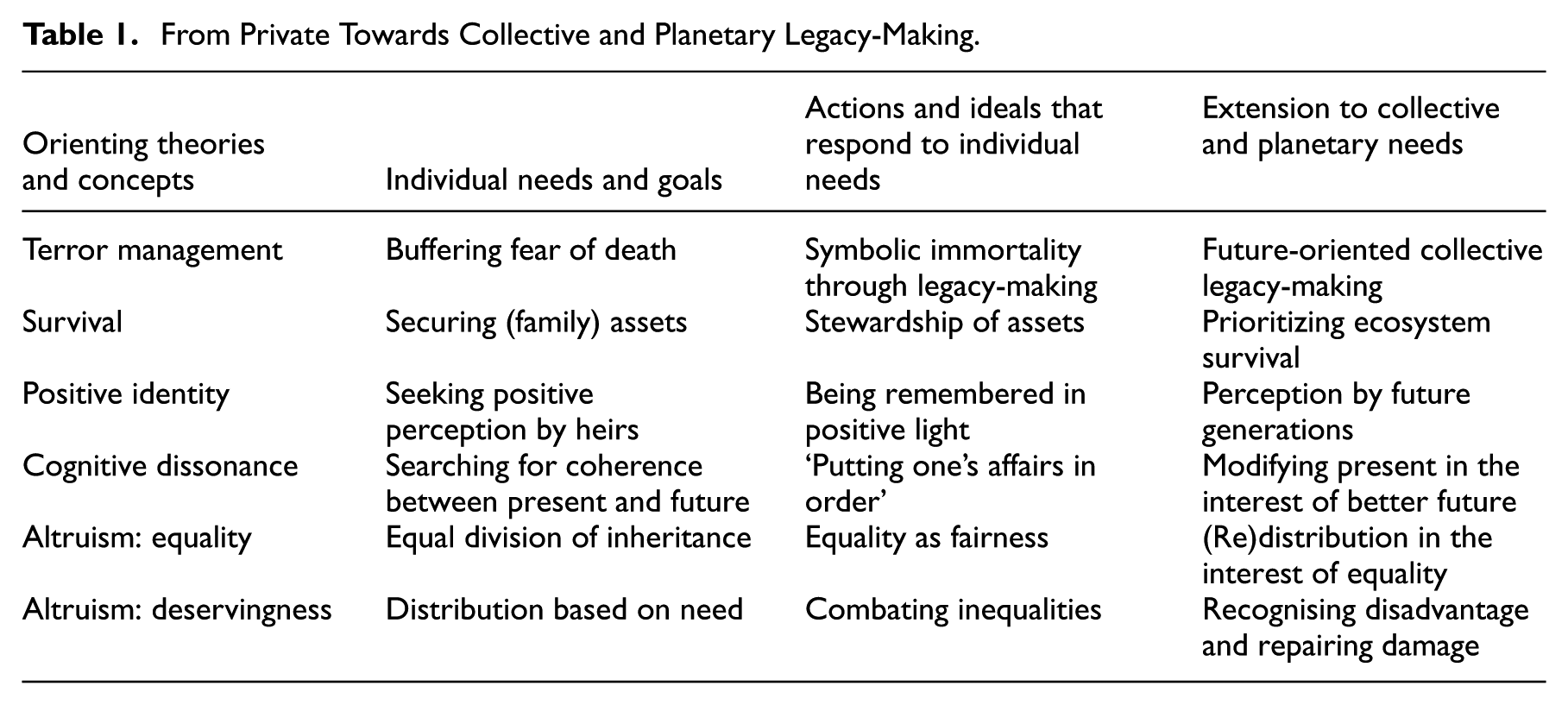
The Legacy Maker scenario is framed with reference to the psychological concepts of terror management, survival, positive identity, and cognitive dissonance. Further, it draws on altruism as a guiding principle in private material legacy-making practices (Arrondel & Masson, 2006). We employ these theories and concepts as lenses that orient the Legacy Maker’s view from the original scenario towards a new one, starting from an individual, micro, perspective provided by classic (Western) socio-psychological theories, and moving towards perspectives that resonate with more-than-human (Indigenous) ontologies, thereby straddling individual concerns that have the potential to prompt policymaker attention while foregrounding long-term collective and planetary wellbeing.
First, the classical socio-psychological theory of terror management suggests that a range of thoughts, attitudes, and behaviours are rooted in the human need to combat the fear of physical death as the end of existence (Jonas et al., 2002). Within this frame, an individual can aspire to symbolic immortality (Kaufman, 2025) through a range of endeavours, such as having offspring, producing creative work, as well as endorsing cultural norms and worldviews (of a nation, a religion, etc.). Intergenerational altruistic behaviours are an additional way for people to attain symbolic immortality, as demonstrated by Wade-Benzoni (2019): acting for future generations allows for extending oneself into the future, seeing oneself as part of the same social entity as future generations, and supporting self-esteem by acting according to this endorsed worldview. However, the promotion of altruistic behaviour in view of mortality salience is contested, some authors (e.g., Kasser & Sheldon, 2000) suggesting that in the face of death, competition and accumulation of resources are prioritised (processes that have contributed to the original scenario and ideologies of success that frame inheritance as an individual entitlement, justly passed on from one kinship generation to another). In contrast, Indigenous ontologies centred around relationality, interdependency between non-humans and humans, and continuity with places and community where death is viewed as a transition (not an end), are conducive to intergenerational altruistic behaviours.
Second, threats to the wellbeing and security of even the most privileged ‘heirs’ in the original scenario (e.g., through destruction of properties in fire- or flood-prone areas) point the Legacy Maker towards prioritizing the survival of the ‘asset’ (healthy ecosystems) that underpins the welfare of all (human and non-human) ‘heirs’. The Legacy Maker is motivated by survival (and thriving) as contingent on respect for planetary boundaries, and by symbolic immortality through collective entities, including future generations of humans and non-humans.
Third, to foster collective legacy-making, we point to the role of legacies in constructing identities. Thinking about one’s legacy is nested in ideas about what we are leaving behind as resources to younger and future generations and as something they will remember us by. Personal material legacy-making has a temporal dimension, an orientation to the future, and an interpersonal dimension in the search for positive identity whereby legacies carry ‘an enduring meaning attached to one’s identity … manifested in the impact that one has on others beyond the temporal constraints of the lifespan’ (Wade-Benzoni, 2019: 19). Identities are shaped in and through social interactions. Groups generally guide what norms and beliefs are appropriate for members (e.g., Tajfel, 1974). Hence, belonging to a group that endorses the Legacy Maker norms would foster coherent behaviours, as shown in relation to biospheric and environmental group identities (Wang et al., 2021). In the Legacy Maker scenario, the entity to be protected extends to the whole planet and its boundaries, and interactions include the more-than-human. Whilst maintaining a positive identity does not automatically foster ethical behaviours (on the contrary, it could lead to moral grandstanding), in the Legacy-Maker scenario thinking about the foreseeable demise of humans and environments due to human actions, motivates a need to leave a ‘good’ legacy. Acting to remedy the ‘spoiled legacy’ allows for the possibility of positive assessment by posterity and avoids aversive generational self-image resulting from anticipated negative legacies.
Fourth, cognitive dissonance refers to the tension felt by an individual when there is conflict between what they think should be done and what is or will be done (Cooper, 2019; Festinger, 1957). Dissonances can be viewed something that requires resolution; yet they also organise social settings and provide sets of discursive resources that maintain existing practices, as in the original scenario. People often operate discursively between conflicting norms and do not always strive to eliminate contradictions but rather learn to live comfortably with them. Contradictory arguments may be employed to make sense of the dissonance; influential actors can manage to stabilise dissonances rhetorically and cultivate the use of banal discourses that skirt difficult choices (e.g., valorise recycling while exhorting more consumer spending; c.f. Billig, 1991). Oppositional rhetorical repertoires and ideologies are employed whereby human dependency on the environment is denied or made into an imminent existential threat.
Yet, within a more cognitivist tradition, such contradictions prompt attempts to resolve the tension, which in turn motivates changes. At institutional level, North (1990) argues that change is triggered when formal institutions, such as laws and policies, no longer align with informal practices, norms, and expectations, bringing about tensions and cognitive dissonance. The concept of cognitive dissonance has been used in investigating the dilemmas encountered by decision-makers between personally endorsing the ideas of long-term sustainability while making decisions aligned with short-term expectations (Hukkinen, 1999). According to Antal and Hukkinen (2010), there is dissonance between the widespread belief in human independence from ecosystems fostered by technological and economic development, and the undeniable fact of human dependence on ecosystems. They suggest that policymakers resolve this by establishing and using the modern taboo of infringing ecosystems and recognition that human survival depends on (care for) the environment. Prioritising the goal of ‘saving civilisation’ (Antal & Hukkinen, 2010: 941) establishes direct connections between (ecological) system-level safety and individual endorsement of species’ survival.
Fifth, an individual legacy maker typically reflects on the needs, circumstances and perhaps also the merits of prospective heirs. Intergenerational transfers follow the logic of altruism, or exchange and reciprocity (Kohli, 2004). According to the exchange/reciprocity principle, individuals calibrate inheritances and bequests as a reward (e.g., for past care) or as a strategy to secure something (e.g., companionship) in later life, but the importance of this principle is diminished when considering timescales well beyond the testator’s lifespan which render the idea of reciprocity irrelevant. When focusing on collective legacies, the time scale extends to centuries and beyond, hence accentuating the altruism model where resources are transferred out of care for the beneficiaries’ wellbeing. Some testators prefer to give equal shares, others try to equalise recipients’ resources, typically by giving more to poorer ones and less to better-off ones. The altruism principle is deployed here in contrast to the ‘Matthew principle’ that currently applies to patterning of material legacies at societal level, that is, more inheritances and bequests accruing to those who already are relatively well off (Szydlik, 2016), a key driver of growing wealth inequalities.
Lastly, we understand legacy-making to be an ongoing process that relates to the future – the welfare of heirs and survival of entities (such as family businesses) whose lifespans exceed our own – and that also resonates with care ethics (Tronto, 1998). When thinking about our legacies beyond human kinship and beyond the lifespans of our immediate descendants, longer time horizons come into play, extending to future generations of the more-than-human. The collective Legacy Maker would be concerned and care about the future of their currently most disadvantaged and existentially threatened ‘heirs’, but also those who might be currently thriving (e.g., the materially secure) yet ultimately depend on the entire ‘kinship’ structure’s survival and wellbeing (because even the materially secure are affected by climate turbulence). In the Legacy Maker scenario, there is awareness of such dissonances and resolve to address these: legacies are construed as beneficial and harmful effects that are addressed across species and generations to create a liveable future. Deploying legacy-making as a vehicle for an alternative scenario of social and environmental justice evokes recognition, restitution, and (re)distribution of resources among more-than-human actors, over extended timescales. Unequal material and environmental legacies are recognised and addressed so that the many ‘heirs’ (people and other species) can continue to exist and thrive without prioritizing the few.
Accordingly, as detailed in Table 2, the Legacy Maker scenario firstly departs from the current short-term focus and orients to the future. This involves recognising that past (re)distributive patterns are reflected in present ones, which shape future (re)distribution of resources including environmental resources. Secondly, if resolution of the current environmental crises is to be the foundation for multi-species (including human) survival and thriving, this necessitates attention to the more-than-human in policymaking. Thirdly, while not dismissing the relevance of distributive justice, especially its role in international cooperation to address inequality (examples to follow), the Legacy Maker scenario involves orienting to justice as recognition and restitution.
Comparison of the Original Scenario and the Legacy Maker Scenario.
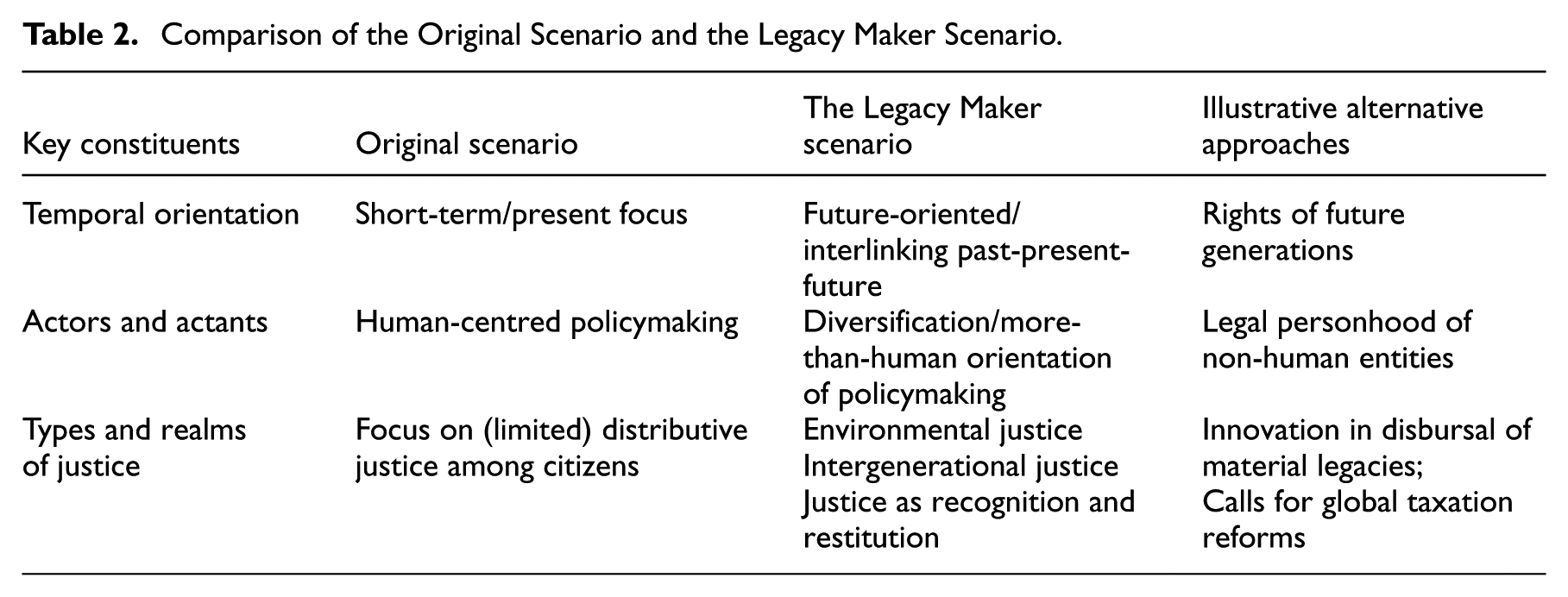
The Legacy Maker scenario gives rise to three underpinning principles for policymaking. First, sustaining social and environmental wellbeing into the future is brought centre-stage (Laybourn-Langton et al., 2019; Wood-Donnelly, 2023). The very long-term future –longtermism – and attendant concerns are strategically deployed by powerful technological and entrepreneurial actors in the Silicon Valley and beyond valorising artificial intelligence (e.g., Bratton, 2025), a development that demands the attention of everyone concerned about such attempts to colonise the future, even as these attempts also serve to detract from what are fundamentally short-term goals within an ‘extractive microtemporal business model’ (Kemper, 2024: 32). In contrast to such attempts, connection with future generations and environments involves relationality rather than a liberal understanding of isolated individuals (Hiskes, 2006). Out of this legacy contingency and (re-)generative capability new answers to distribution, process, recognition, and transformation (Matsuoka & Raphael, 2024) can be developed. One recent example of drawing attention to the rights of future generations is the South Korean Constitutional Court’s ruling concerning the under-protection of future generations in the government’s climate policy that the court deemed to lack long-term targets (after 2030) and measures of progress towards reducing carbon emissions (Constitutional Court of Korea, 2024).
Second, in the Legacy Maker scenario, justice comprises non-human life and entities (Winter & Schlosberg, 2023) based on recognition and inclusion of ‘the active role of nonhuman material in public life’ (Bennet, 2010: 2). Recent legal discussions on the rights of nature have included cases of granting legal personhood to natural entities, such as rivers and forests whereby nature ‘becomes a person’ (Kramm, 2020: 1). Others argue that these legal innovations go beyond the legal fiction of nature being granted personhood; they introduce a new consideration of sustainability where humans are viewed in a relational position with nature, acknowledging place-based kinship (as in Māori culture, for example). Therefore, natural entities are not seen as something humans, from their superior position, should protect, but rather, humans and non-humans are related in an exchange of resources and care (Cribb et al., 2024). An example is the Whanganui River in New Zealand, which was granted legal personhood in 2017 (Te Awa Tupua [Whanganui River Claims Settlement] Act 2017 – New Zealand Government, 2017) as part of a reparative settlement between local Māori iwi (tribes) and the Crown. This innovative act is based on legal pluralism, or the acknowledgment that different systems of laws are recognised (e.g., Western, Indigenous). This establishes a new type of deliberative local democracy, where the community is in conversation with the river (Cribb et al., 2024). Environmental courts and tribunals are important examples of efforts to reduce the gap between state and non-state actors and to resolve environment-related disputes (Preston, 2014).
Third, a forward-looking orientation to justice requires recognition, care, repair, and alleviation of damages caused by colonialism, racism, and exploitation of natural resources and human labour (Matsuoka & Raphael, 2024; Tuck & Yang, 2012). Feminist scholars have proposed to understand the climate crisis as a crisis of care (Williams, 2017) and stressed community-based care relations in this context as opposed to technocratic (MacGregor, 2021) and neocolonial (Erickson, 2020) solutions. While emphasising the shift towards restitutive justice and moving away from human-centred ideas of justice, we are not dismissing the continuing relevance of distributive justice as a starting point towards restitution which requires resources. Existing taxation regimes are blunt instruments in the face of growing wealth inequalities across the globe due to low wealth taxation, tax avoidance, and international tax havens (Zucman, 2019). Although most OECD countries levy taxes on wealth transfers including inheritance and bequests, these taxes are relatively low and made up only 0.5% of total tax revenues in 2018, among other reasons due to exemptions for wealth transfers to close relatives and preferential treatment of certain assets (OECD, 2021: 3). The OECD (2021) has recommended increasing inheritance tax rates and such taxation would be a powerful instrument in alleviating inequality in societies where ‘the great wealth transfer’ is starting to happen as large post-war generations pass on their material legacies (Cerulli Report, 2024).
One innovative example of seeking alternative ways of distributing inheritances is the Resource Generation (2024) network of wealthy individuals who seek to address inequality by giving away inherited wealth (or excessive income) to those most impacted by social and environmental injustices. Another is the Austro-German heir and wealth-tax activist Marlene Engelhorn who commissioned a representative group of 50 Austrian citizens to decide how to distribute most of her inherited wealth to civic organisations (B. Bell, 2024), representing a quasi-democratic alternative to conventional inheritance. Notwithstanding such examples, states and governments remain crucial actors in relation to global (re)distribution of wealth. Preparing the ground for restitutive justice requires progressive taxation of the (partly inherited) wealth of billionaires (Saez & Zucman, 2019), necessitating international cooperation to control tax evasion. In 2024, the Finance Ministers of the G20 declared an International Tax Cooperation to enforce progressive taxation globally and to achieve more sustainable and inclusive forms of growth. The agreement involves two new types of taxation – a minimum tax on large multinationals and a tax on the world’s 3000 richest billionaires – that could yield themselves to ‘mobilise funds in a sustainable way to compensate the world’s poorest citizens and help them adapt to climate change’ (Duflo, 2024: 1).
Limitations and Further Development
As a heuristic, the Legacy Maker scenario is amenable to diverse uses (e.g., in simulations of decision making, creative forums on intergenerational relations and ecological preservation) but it also has limitations and requires further development, both conceptually and when applied to different contexts and entities. The following are some limitations and points for development pertaining to assumptions inherent within the scenario, and systemic-contextual aspects that pose challenges for applications in practice.
The starting point for the Legacy Maker identity is framed in individualistic terms, yet identities are shaped in relation to others. In societal contexts, it is groups – not individuals – that define what legacies are, and whose values count in addressing them. For example, majority-minority comparisons and power dynamics influence what comes to be seen as a positive legacy. In actual political contexts, principles and policies pertaining to distribution of resources are always contested. Reconciling present and future needs requires negotiation and mediation, and the resolution of competing priorities takes different forms across contexts. Clashing legacy norms based on different identities and power differentials are likely and need to be reconciled. The circumstances under which discourses and identities can evolve towards the Legacy Maker scenario, and how clashing legacy norms may be reconcilable through political means, warrants further development.
Power relations impact on who shapes legacies and whether or how the more-than-human voices are represented, with considerable variability across settings and systems. The voices of groups that are closer to the legacy ideation presented here are currently relatively marginalised in most polities but have made productive inroads into policy formation in some; understanding the circumstances where this becomes possible requires additional analysis. There is a need for further interrogation of the kind of systems, institutions and processes that are conducive towards identities and actions that centre the long term and the more-than-human.
Conclusion
We have identified how the foundations of the original scenario are turning against us as they no longer serve human wellbeing, let alone environmental justice. Current human legacies – the material and environmental effects that humanity is leaving behind – are generating future trajectories that are undesirable not just for the marginalised but increasingly for everyone. The need for alternative trajectories is imminent and immanent within this scenario. The human ability to see ourselves and our time as part of an extensive continuum of time and resources is underdeveloped; new concepts and thinking are needed that animate the connections between policies in the here and now, and human and non-human life in future, considering capabilities and communities far beyond our immediate surroundings and time. Longtermism is at risk of becoming the preserve of companies and individuals promoting specific entrepreneurial-technological agendas; collective and planetary legacy-making demands ongoing efforts to redirect the future by focusing on the wellbeing of future generations, interdependency between humans and nonhumans, and reparation of damages through recognition and restitution. The Legacy Maker scenario seeks to contribute to this endeavour by offering a heuristic device that transforms the understanding of legacies as material possessions passed down family generations into consideration of enablers of future human and non-human wellbeing.
Footnotes
Acknowledgements
We wish to acknowledge the support of the European Research Council for the Legacies project. We thank Professor Janne Hukkinen (University of Helsinki) and Professor Iain McMenamin (Dublin City University) for constructive comments on an early draft of the article. We also thank the anonymous reviewers for their insightful critique and suggestions.

Ethical Considerations
The University of Helsinki Research Ethics Committee in the Humanities and Social and Behavioural Sciences has reviewed the Legacies research project on the 12th of June 2024 and deemed it to be compliant with the ethical principles of research issued by the Finnish Advisory Board on Research Integrity.
Author Contributions
Virpi Timonen: Conceptualisation, Writing – Original draft, review and editing; Supervision; Funding acquisition Federica Previtali: Conceptualisation, Writing – Original draft, review and editing Friedemann Yi-Neumann: Conceptualisation, Writing – Original draft, review and editing Malin Bäckman Conceptualisation, Writing – Original draft, review and editing Eunsil Shin: Conceptualisation, Writing – Original draft, review and editing.
Funding
The authors disclosed receipt of the following financial support for the research, authorship, and/or publication of this article: This work is supported by the European Union (LEGACIES, ERC, project number 101094124). Views and opinions expressed are those of the authors only and do not necessarily reflect those of the European Union or the European Research Council. Neither the European Union nor the granting authority can be held responsible for them.
Declaration of Conflicting Interests
The authors declared no potential conflicts of interest with respect to the research, authorship, and/or publication of this article.
Data Availability Statement
There are no data associated with this article as it is theoretical in orientation.