




Abstract
Turning to the possibilities of a posthumanist phenomenology, this autoethnography explores the “wandering” of the immigrant self, navigating between performance and concepts. Shifting away from proceduralism toward performative alternatives to analysis, I consider walking as a diffractive practice that encourages critical awareness and deep engagement with one’s surroundings. Toward the affectivity of post-phenomenological life worlds, the concept of “becoming possible” emerges as a central theme in my daily encounters, moving from imagining alternative ways of being to performing them. In the context of research, this performative event creates a line of flight, in a Deleuzian sense, escaping the established territory of knowing. In doing so, the immigrant self is actualized within a dynamic in-between space of what might be possible. Situated knowledges that are tied with specific contexts are, as a result, produced and reproduced, entangled in non-linear ways that remain resistant to representation, meaning, and understanding. While possibility thinking foregrounds hope, imagination, agency, and creativity, the practice of diffraction provokes an ethics that is accountable to both the social and material world, thereby enabling the envisioning of various possible futures.
Keywords
PYNCHON, an Asian figure, in his late mid-20s, walks along the sun-raked streets of suburban neighborhood in Auckland, New Zealand. The houses stare at each other with glazed tolerance. (It might not be immediately apparent to the audience that this immigrant life presents a stark contrast to his past life in his home country.) PYNCHON (V.O.)
In the ivory tower, I once stood as
A foreign student with unremarkable marks.
The pages of my postgraduate studies turned, and
My academic pursuit met an abrupt end.
I stepped out of the game, my dreams deferred.
Almost a decade flowed like ink on parchment, I yearned to become a scholar like you.
In the quietude of my solitude,I bumped into the art of writing auto∼ ethno∼ graphy.
One syllable at a time.
1
This is how I write the self into the future.
Opening: The Immigrant “I”
At the time of writing this article, I am a doctoral student, reflecting upon certain life events as an immigrant teacher from 2009 to present. And yet, I am not satisfied with traditional research practices in the “logic of procedure and extraction” that need undoing (Springgay & Truman, 2018, p. 204). Because in this line of research, most of the empirical studies generate certain discourse that focuses on “what I am,” rather than “what I could potentially become.” As Yan et al. (2024) critique, the current state of knowledge indicates that this particular group of teachers commonly faces integration challenges, such as employment and career progression, linguistic barriers, cultural and pedagogical issues, feelings of alienation, and emotional struggles.
As a human being, the “I” cannot help but narrate the personal aspirations I once held, daring to dream about what might be possible for me (Yan, 2024b). By highlighting their problems and flaws, such (over)simplified claims demand the “urgency of hope, the necessity of hope, in a landscape so often bathed in devastation and despair” (Freeman, 2023, p. 77). Writing from the positionality of the immigrant “I,” I want to tell you that I am more than just a hyphenated entity of an immigrant-teacher. Informed by Jones and Jenkins (2008), I argue that this hyphen becomes a chain to limit what I can become, “mark[ing] a relationship of power and inequality that continues to shape differential patterns of cultural dominance and social privilege” (p. 473). Refusing this binary thinking (Harris, 2023), this autoethnographic account, as a moment of methodological self-consciousness about the betweenness, provides a pre-reflective perspective, emphasizing the need for the human “I” to envision what might be possible.
Diffracting Posthumanist, Phenomenological Thinking
This possibility study is framed as a posthumanist, phenomenological autoethnography within a performative paradigm (McGregor, 2020; Østern et al., 2023; Trafí-Prats, 2020). By conceptualizing an entangled post-reflexivity as a generative methodological move, I experiment with literary montage opening up new ways of thinking and creating knowledge. The conjoining of heterogeneous discourses, as Walter Benjamin outlined in The Arcades Project, is that I needn’t “say anything […] I should merely show,” in the only way possible, “by making use of them, as exhibited in the montage” (Benjamin, [1982] 1999, p. 460).
Possibility studies, as a new and emerging multidisciplinary field, embraces this unboun-ded thinking and doing that precede the emergence of understanding certain phenomena and theorizing. As Glăveanu (2023) puts it, the “study of the possible requires diverse and creative methodologies” (p. 6). While its foundational concept is the realization of becoming, this research shifts the focus from deterministic worldviews to agentic, generative, and intra-active understandings between self and others. Such intra-active understanding is about recognizing and exploring the ways in which entities (including ideas, objects, and beings) mutually constitute one another through their relations. Rather than explicitly stating what I am (doing), this autoethnography offers some loosely connected scenes, through the hybridity of textual materials (such as first-person narrative, third-person account in scripts along with poetic discourse).
Unsettling methodological constructions, I contemplate this posthumanist, phenomenological framework to redress shortcomings of phenomenology, highlighting “the nature of things to be dependent on the relational context” (de Klerk, 2020, p. 202). It is in a relationship with more than human worlds that “allow for the invention of new concepts to think and new realities to experiment with what is-not-yet” (Trafí-Prats, 2020, p. 437). This kind of possibility thinking lies in crafting a creative space in which “post[humanist] ideas and phenomenological ideas can be put together to see what happens” (cf. Vagle & Hofsess, 2016, p. 335). Exploring possibilities for more-than-human forms of sense, movements, such as walking, allow the immigrant “I” to become other through a historical materialism of being, doing and knowing across multiple temporalities and contexts.
Echoing Struppe-Schanda (2024), a posthumanist account of selfhood and its relations to time and reality underscores how the bodily orientations require a condition for possibility thinking. In this article, I consider a particular form of diffraction, walking, as a means to explore that felt sense into an embodied way of knowing as non-linear and materially and affectively entangled through time and space. Through diffractive practice, walking events open up the thought of politics, making the public spaces a platform for discourse and truth. A “secret wound,” often unknown to myself, “drives the foreigner to wandering” (Kristeva, 1991, p. 5). To do so, it compels the writing self to contemplate how to present this thought as one that is in process.
While challenging the strict conventions of academic writing, this possibility study “relies on the quintessentially human capacity to hope, to imagine and to envision new possibilities,” thereby liberating and empowering the self (Glăveanu, 2023, p. 3). It lies in developing new ways to engage with thinking the unthinkable. In rejecting simplistic, reductionist analyses of the other’s lived experience, which usually hinges on “what it is” as a hyphenation of immigrant and teacher, I am attentive to difference and the complex becoming of the immigrant “I” as an ethically engaged practice.
Meanwhile, a post-phenomenological approach enables me to explore “how the excessive modalities of these worlds are felt, and how they shape bodied capacities, relationalities, and affectivities” (Trafí-Prats, 2020, p. 433). To articulate particular (in)tensions, the countless quotations, thereby, cannot be omitted since these components serve as orienting concepts. This “plugging in” technique, that is, plugging one text with another (Jackson & Mazzei, 2023), creates a language that makes it possible to direct attention towards not only what already is, but also to what might be. Such dialectics aim “to bring together theory and materials, quotations and interpretation, in a new constellation compared to contemporary methods of representation” (Benjamin, [1982] 1999, p. 931).
As a minority teacher, my pursuit of a doctoral program took a decade to fulfill (Yan & Poole, 2024). Over the years, expressive writing has helped me to explore my thoughts and feelings, gain insight into certain life events, and most importantly, ease my emotional pain (Yan, 2024e). This emergence of becoming is not in spite of, but rather due to, the intentionality of navigating through circumstances that may initially seem impossible or unimaginable. As Massumi (2002) suggests, affect carries immense potential for the body, a continuous presence, “much like a background perception that accompanies every event” (p. 36). The dialogical tension, between the actual and the possible, then, serves as a “starting point for theoretical development and empirical exploration” (Glăveanu, 2023, p. 4). In doing so, the focus of this post-phenomenological autoethnography is on multiple temporalities, during the course of the immigrant life, not on how the immigrant story will be resolved at the end. These multiple temporalities narrate different “possible selves”—what they might become—across various places. In this context, the trace of the other should be understood not only in spatial but also in temporal terms.
Recognizing a body as form and substance, as an organism, as a totalized organization of elements (Bright, 2017), I utilize walking to illustrate how diffractive thinking can open new pathways for understanding and interpreting the world around us. By doing so, the body presents itself as “a porous and desiring surface,” opening up to sensations and engaging with various forces (Trafí-Prats, 2020, p. 433). Specifically, I want to explore the idea that I am not a bounded subject—an immigrant—but the “I” is connectible with my surroundings “through ‘wide-awake’ hearts, minds and relationships” (Harris, 2023, p. 99). Without being permanently locked in this mundane abjection, my daily walk serves as a diffractive practice, offering “a contestation of the unexamined habits of mind” (Barad, 2003, p. 802). My aim in applying this diffractive thinking is to rigorously attend to the important details of certain life events, without endorsing or prioritizing one particular disciplinary approach over another.
Through my daily walks, this agential practice allows me to intra-act intimately with my surroundings, such as the river, the buildings and city sounds. As Barad (2007) argues, “who and what are excluded through these entangled practices [of knowledge-making] matter” (p. 58). In order to achieve this, I embrace the act of walking to make sense of this diffractive practice. This, in turn, enables me to develop a critical rethinking of methodologies in social science research. As an alternative to traditional critical reflective, representative methods, I dwell in the provocation that comes with post-phenomenological exploration (McGregor, 2020), offering generative ways to contemplate the becoming of the immigrant “I.”
The “diffraction or interference phenomenon” of encountering, as Barad (2007) posits, lies in the dynamic expression and articulation of the world in its “intra-activity” and its “performativity” (pp. 80, 392). It is an open invitation to think and reach the possibilities of knowing and feeling. Considering myself as an “academic outsider” conducting social science research (Yan, in press), this possibility study is how I find my way around and become entangled in complex, ambivalent, and sometimes territory where knowing and unknowing touch. Through this diffractive thinking, I attend to walking events imagining “concatenations of relations that blurred boundaries of bodies and materiality” for envisioning the impossible (Trafí-Prats, 2020, p. 434).
Framed as a post-phenomenological inquiry, this autoethnography further utilizes a variety of strategies that promote performative writing, the aim of which is to offer “an embodied consciousness that is entangled with the world” when walking (McGregor, 2020, p. 509). This way of thinking and writing is, as Benjamin ([1982] 1999) puts it, “to discover in the analysis of the small individual moment the crystal of the total event” (p. 931). Writing in this preflexive manner (Engstam, 2023), I use performative texts to foreground hope, imagination, agency, and creativity, contributing to more open, insightful and interesting social science.
*** FADE IN: 1.EXT. AUCKLAND HARBOR – DAY 20111 PYNCHON, having finished a small breakfast, leaves his apartment. He strolls along the harbor, then downtown. He admires those carefree Kiwis who seemingly enjoy their morning exercise.PYNCHON (mumbling)
The most intimate moment for me happens during the walking.
I enjoy strolling through the narrow side streets
Without a fixed destination, immersing myself in the unfolding life
Around me—the realistic noises and visions,
Which are among the great pleasures to be had.
2.EXT. CBD AUCKLAND – SAME DAY2 PYNCHON walks back and forth along Queen Street. As hunger strikes, he enters a FOOD COURT where he often orders his favorite bāo-zi (steamed buns). LATER: PYNCHON wanders aimlessly along Ponsonby Road, through the historic backstreets of a suburb, and into the residential neighborhoods on either side. The grand buildings reflect a history of feminism, hospitality, pioneering philosophies, and social reform. It is here that one discovers the stories and secrets of backstreet Auckland. PYNCHON (CONT’D)
Perhaps it is because walking makes me feel not so alone.
The process involves noticing and observing,Translating dust into a form of precious entity,In the hope that it might yield something meaningful.
However, timing is important in a walking event, as in an immigrant life. There are periods of pace and recovery,Of struggle and injury, of plotting and recalculating.
During my immigrant years, I have always been in a state of deep thought, especially when I am walking. This constant thinking might be the reason for my sleep troubles. I possess the ability to walk while thinking without any interruptions. Deleuze (1994) explains it to us that “something in the world forces us to think” and this “something is an object not of recognition but of a fundamental encounter” (p. 139). This encounter is the actual process of movement, through which events take place and engender some possibilities of thinking. It is because “affect does not have a shape or structure that it needs to be composed” (Trafí-Prats, 2020, p. 433). It is through movement, such as walking, that involves senses interfering, enfolding and reoccurring over time, and being distributed in different levels of reality (Massumi, 2002).
As an overseas-trained teacher, I arrived in New Zealand with a working holiday visa in 2009. Being a working-holiday maker, I soon realized that I wouldn’t have a future with that visa status if I wanted to stay in that country. So my contingency plan was to pursue academic studies (Yan, 2020). In the following year, I graduated with a master’s degree from the top university, as per the institution’s humble brag. As my visa expiration date approached, I found myself anxiously searching for a job. I recall that, back then, the entanglement of my being with the world often resonated with vibrations of unease, worry, and apprehension. These feelings were not solely mine but emerged from the intra-actions within the assemblage of various forces. This pending feeling “of being selectively plugged-in to forces,” and this registering “of a nextness betokening always more” may be called “sensation” (Massumi, 2002, p. 92).
To follow a path that turns out to be a dead end is akin to making something happen in real life. In that particular juncture, straddling the realms of my personal and professional existence, the future seemed elusive, shrouded by the ambiguity of this borderland. As Kristeva (1991) writes, “rejection on the one hand, inaccessibility on the other: if one has the strength not to give in, there remains a path to be discovered” (p. 5). Back in those months after my graduation, I stopped in a park or on a bus bench to rest for a few minutes, but usually, I walked slowly past houses and stores, my gaze fixed on the sidewalk ahead. Seemingly, I dawdled on, rather lackadaisically, somehow seeing visions in the middle of the afternoon. I now try to rationalize the fear, a fear for which I fail to find a logical explanation as to why I am living for the future. However, its pull is too strong and original. Now I realize it is “an emptiness” that I have swallowed up—“a blank subject,” I would remain, discomfited, without the awareness of play and its pleasure (Kristeva, 1982, p. 7).
Now it dawns on me that, embodying the “figure of the stranger” (Yan, 2024d), I have always been an outsider in this public space. This out-of-placeness, over a decade, reflects my persistent mood of exile and dislocation (Said, 1999). My sense of being and knowing, however, is continuously shaped by my encounters with the city, a place where architecture and culture intersect. Looking ahead from 2011, it would have been hard for me to grasp how these seemingly minor walks could play a role in my research project. But then I look back at where I’ve been, an assemblage seems to emerge, and if I project forward from that pattern, then sometimes I can come up with something (Yan & Poole, 2024).
The Rhythm of Walking
In “How to Philosophize with the Hammer,” Nietzsche (1997) confessed that “all truly great thoughts are conceived while walking” (p. 10). To me, the significance for this performative event became apparent only later. It is when walking, I come to understand that “space is not neutral […] the space we occupy,” as Elkin (2016) put it, here, in the city, we—city dwellers—are “constantly remade and unmade, constructed and wondered at” (p. 286).
In A Philosophy of Walking, Frédéric Gros ([2011] 2023) highlights various thinkers for whom walking was a key part of their practice. Gros himself engages in walking as a means of experiencing the real. When walking these days, I sometimes like to take photos or memorize certain images when inspiration strikes from viewing things (Figure 1). While writing my doctoral thesis, this simple act of walking fosters the potential for profound contemplation regarding the influence of matter in forming my understandings about beings and becoming other things.
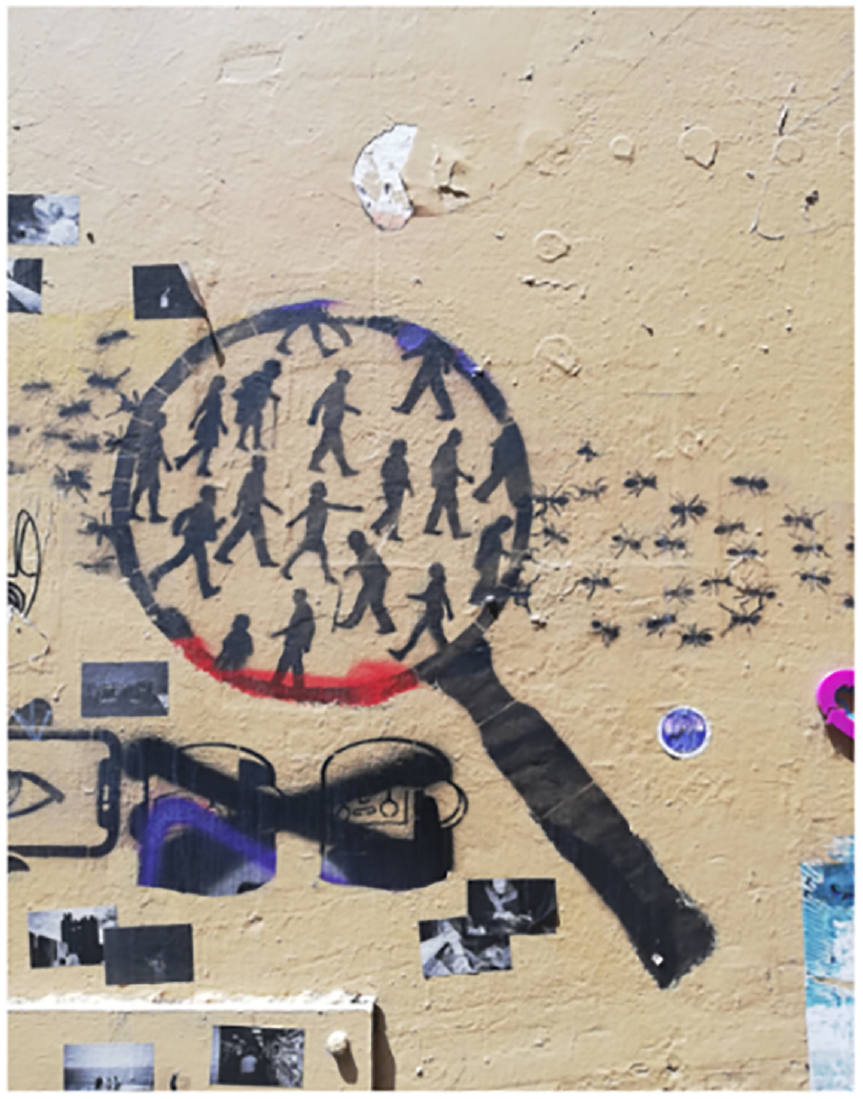
This image, which I took while walking around the city of Melbourne, reminds me of Jonathan Crary’s (1992) Techniques of The Observer. The corporal subjectivity of the immigrant “I,” which was a priori excluded from the camera, suddenly becomes the site on which an observer is possible.
Now, I’ve come to understand that walking is a performative event. It is “the best way to go more slowly than any other method that has ever been found” (Gros, [2011] 2023, p. 12). Beyond the philosophers’ cherished practice of walking, Oppezzo and Schwartz (2014) highlight walking itself is a complex process. This bodily movement leads to physiological changes that foster mental health and influence the cognitive control of imagination.
In all its contingency and specificity, the knowing body generates their situated knowledge and becomes the active producer of “autotheory” (Fournier, 2021) in which memoir and autobiography are fused with theory and philosophy. Considering the politics, aesthetics, and ethics of autotheory, the ramifications of such knowledge production, however, are manifold, having little to do with the empirical truth contained with the reductive accumulation of statements and findings. In this posthumanist autoethnography, what’s vital in this immigrant’s autotheory is the blending of often separate and conflicting perspectives, rejecting a conventional mode of categorical perceptions (Kant, [1790] 1987).
*** 3.EXT. FLAGSTAFF GARDENS, MELBO URNE – NIGHT 20243 On Sunday night, April 28th, PYNCHON takes a brisk walk in the park instead of his usual stroll along the Yarra River. The park is cloaked in darkness, and in that obscurity, the possum along with their friends, rats, move with an unbridled sense of liberty. Yes, it seems that only in the dark do they truly have freedom. PYNCHON (V.O.) While in the park, I observed a group of immigrants—how did I determine their “alien” status, using the American term? They encircled a creature known as a possum, capturing videos and displaying fascination for this animal. Then, there was another group of people. This time, they were studying the possum. Suddenly, the possum emitted a sharp “sss” sound, which startled these humans. As it turns out, they couldn’t comprehend this noise, which in the animal kingdom, they might call a voice—an expression of emotional truth. Essentially, * the possum was saying, “Get the heck away from me!” Then, can we, as humans, ethically speak for them? I am using the possum to articulate my own feelings as a human. *To interpret this text correctly, the audience must accord with authorial intent. In the moonlit shadows, the possum—its fur a patchwork of memories—navigated the park, embodying an immigrant’s silent journey. Meanwhile, the humans, armed with mobile phones filming and full of curiosity, dissected its existence, cloaked in fur and vulnerability. ***
This ceaseless wandering in Auckland came to an end. Eventually, I left New Zealand because I couldn’t build a career and imagine a flourishing future. In 2016, I moved to Melbourne, and that’s when I started teaching in a government school. Amidst an abundance of parks and gardens, I become a professional flâneur, wandering through urban space, an event that “interfere[s] with the images’ effect” (Massumi, 2002, p. 25). From the expectation of the body came “movement and sensation whereby each immediately summons the other” (Massumi, 2002, p. 1).
Having been in this city for 8 years now, I walk and often provide directions to people who seem lost on the street. However, when attempting to help them, I often encounter various degrees of attitude, which leaves me uncertain about my own intention. Perhaps it would be best if I refrained from intervening in the affairs of those who seem to be lost. This assumption reflects a sense of “disconnection,” as Massumi (2002) explains, which “is not just negative” but impacts my “subjectivity” and the “receiving body’s sensation” (pp. 25, 75).
To the flaneur, as Benjamin ([1982] 1999) pointed it out, “his [sic] city is […] no longer native ground. It represents for him a theatrical display, an arena” (p. 347). When I walk, the “I” exposes itself to the multifarious gazes of other lives and, in doing so, allows the mind to wander into territories that the act of walking produces. It unsettles and complicates the notion of the human “I,” breaking “linguistic structure to shape or determine our understanding of the world,” against the “prior ontological reality of substance and attribute” (Barad, 2007, p. 133).
In these wandering moments, I dream of a thought that can be pursued to the end with absolute certainty; of a word as definite as a tombstone with my name imprinted on it; of the silence that screams a lexicon of echoes etched upon an indomitable force. These thoughts are inherently contradictory. For instance, how can I pursue something with absolute certainty? As Massumi (2002) elaborates, “To see oneself standing as others see one is not the same as seeing oneself walking as others see one. […] Movement is relational. Its specificity is compromised if any aspects of the relation are lost to generality” (p. 50).
In this diffractive process, “its practices, processes and patterns are unknown, its problems both unknown and unsolved” or, as Galman (2007) put it, perhaps, I am “a loner, a rebel bent on utilizing multiple data sources to provide emic perspectives in naturalistic settings” (pp. 4–5). While out on my daily walk, I am visited by a thought from Cioran ([1973] 2012): “To think is to undermine oneself.” In this context, walking serves to fill the “interval between things and selves” (p. 192). The rhythmic movement of walking stirs thoughts within me, thoughts that might have otherwise been lost or forgotten. This process of discovery is akin to finding something new in the perceived absences within an archive. It cultivates a language of responsibility, recognizing the significant role that imagination and personal initiative can play in “enjoy[ing] a dignified life” (Glăveanu, 2023, p. 6).
To the immigrant, Anzaldua (1987) cautions that their struggle is “inner” and is played out in the “outer” terrains (p. 87). Perhaps, in walking, there emerges a strong sense of loneliness for me to feel when no one is around me but just some “one” around. This act of bodily movement enables me to encounter a sense of “being in the borderlands,” a unique mode of existing in a “state of perpetual transition” (Anzaldua, 1987, p. 78). In walking, this knowing body, then, transcends the borders that kept this immigrant “I” captive over the years and ventures out into new territories with fresh eyes.
The Diffractive “Semiotic Chora”
Writing about the world and contributing to it signifies a concern for exploring possibilities. Walking provokes the torrent of the poetic thought that can be uttered “in one breath, cutting, chopping, imparting rhythm”; thus isolated, the “constituent loses its identity as object phrase” (Kristeva, 1982, pp. 198–199). One notices here, contrary to the binary practice, diffraction bridges the gap between self and surroundings, where meaning and sensation intermingle. This gap “left by the subject’s self-departure” is filled not “by a new subject or object” but by “a continuous displacement of the subject, the object, and their general relation” (Massumi, 2002, pp. 50–51).
Within this open, diffractive space, I am enabled to recast certain life events, interweaving them with my new surroundings and sensations—a concept reminiscent of what Kristeva (1980) refers to as the “semiotic chora” (p. 133). By portraying the self as a collection of fragments, this autoethnographic text creates multiple temporalities that disrupt the language of narrative in various contexts and registers that one comes across in the world (Yan et al., 2023). In the process of re-narrating an immigrant’s life, this performative account of walking emphasizes the need to perceive “thinking, observing, and theorizing as practices of engagement with, and as part of, the world” in which we inhabit (Barad, 2007, p. 133).
This post-phenomenological mode of diffractive analysis investigates the “material- discursive boundary-making practices that produce ‘objects’ and ‘subjects’ and other differences out of, and in terms of, a changing relationality” (Barad, 2007, p. 93). This practice also resonates well with Kristeva’s notion of the “abject,” a key concept of this project that breaks away from the traditional binary analysis of subject and object. The Kristeva’s notion of abjection “draws me toward the place where meaning collapses” (Kristeva, 1982, p. 2). Under Kristeva’s gaze, to live means to be in a state of change, to be nearly under siege from a variety of forces, through which the “I” makes sense of this world.
Metaphorically, walking enables me to map the interventions of a discourse in the text that interrogates this abject subjectivity. If all the signs, such as poetry, lyrics and other texts, fail to eliminate the “necessity for confession,”Kristeva (1982) posits that these hybrid discourses extend the “logic of speech” even to the “most inaccessible folds of significance” (p. 132). Consider walking as a form of non-verbal communication, a “hybrid discourse” in itself. Each step can be seen as an expression, a sign, carrying its own weight of significance. In this way, walking extends the “logic of speech,” producing a silent discourse—a confession without words—that reaches the depths of my being, often unexplored and unexpressed.
The bodily movement of walking offers a process of world-making, liberating me to become the speaking being, “an inner fold within that impossible identity,” unfolding a place where inner drives are discharged into language, where the body and culture meet (Kristeva, 1982, p. 21). The pace, rhythm, direction, and even the path I walk on reveal some aspects of my inner state that words might fail to express. By deliberately interlacing various discourses, this way of writing elevates diffractive thinking, thereby breaking down the boundaries of this abject “I.”
*** PYNCHON (sings)
My footprint is everywhere, seldom forthe better.
I had to start walking to keep from falling down.
I am positioned by attitudes, my own and others,
That sometimes have me feeling
That the world is filled with
Ripening fruit and sometimes with fruitless
Waste. I’ve known the pleasures of walking that
Go hand in hand, of one body
Next to another, as well as the pain of the body
Turned away, the kiss not given.
I’ve known the satisfaction
Of muscles working, Of meeting a challenge,
Of competence as well as
The frustration of feeling weak, overpowered, inept.
I’ve known the welcoming smile
Of acceptance and love as well as
The look of Disapproval,
Disappointment, and Disgust.
In walking, I’ve known the glance of indifference
And dismissal. Positioned by attitude,
The immigrant “I” maneuvers in closer or I
Withdraw. It is an ongoing process, never stable, Determined by and determining how my body,
This immigrant body feels.
My body speaks this situated knowing
By the stance it takes. It is positioned by affect.
2
***
In walking, memories rise from long-lost depths, putting my body and so my mind in a certain state of thinking about certain life events. Situating this immigrant self at the intersection of performance, new materialism and psychoanalysis, this act of walking disrupts the orderly symbolic realm and necessitates “the subject in process,” providing an imaginary and semiotic liminal space for symbolic, linguistic articulation (Kristeva, 2002, p. 10). It emerges from a place where the ordinary dissolves into cosmic revelations, where the mundane “I” traverses between reality and imagination.
Walking offers a unique way of integration inherent in human life, emphasizing the fragmentation inherent in human existence. As Emerson ([1844] 2009) urges us to consider, “our life is not so much threatened as our perception” (p. 41). It starts from where the sublime awaits those who dare to look beyond the known. I believe Emerson would concur that the physical environment serves as a conduit for exploring humanity’s limitations in perceiving and comprehending. Thus, walking offers a reference point for understanding human experience, a compelling entity to which more-than-human entities have spiritual influences and ramifications on human life.
As Emerson ([1844] 2009) notes, “I know that the world I converse with in the city” is not the world I think; but I observe “that difference” and one day I shall know the “law of this discrepancy” (p. 75). Through walking, I am inextricably implicated by the physical surroundings. Each new “immediation” is agentic in these flows and is an event in the ceaseless worlding that the “I” actualizes with each encounter between the interior and the exterior of selves moving on (Gale, 2018, p. 48). And the “I” is sensing that much can be gained in exploring the world of thought.
By intra-acting within the larger process that provokes the reconfiguration of the subject, I am imploring this “unnavigable sea [that] washes with silent waves between us and the things we aim at and converse with” (Emerson, [1844] 2009, p. 44). Through a diffractive practice, my daily walk brings me to the brink of a new understanding, enabling me to recognize the inseparateness of the self without borders. As I stroll along the river, bathed in light, my mind often drifts back to a particular night in New Plymouth. I had traveled there by coach to take up a job as an interpreter for a group of officials from Shanghai. I remember vividly how, as darkness fell, the Wind Wand came to life, its light piercing the night like a beacon. Bathed in its glow, I found myself contemplating the vast expanse of my future.
During my daily walks along the Yarra River, my emotions vary greatly depending on the specific events I recall at particular moments (Yan, 2024e). Each memory brings with it a different emotional response, effectively transporting me to a different world. It is “an opening onto a space of transformation” (Massumi, 2002, p. 51), where the subject, without explicitly stating his place and solitude, remembers with either melancholy or delight. As an immigrant, walking has enabled me to explore “multiple affective worldings,” embracing an intense and passionate sense of being. Through these worldings, the “I” expresses his desire and invites the reader to reconsider “what it means to be human in a world that oftentimes resists our needs, expectations, and aspirations” (Glăveanu, 2023, p. 3).
Now I realize that “drives hold sway and constitute a strange space” where “repression already borrows its strength and authority” (Kristeva, 1982, p. 14). Walking creates this “semiotic chora,” a space “where emotion does not allow itself to be dolled up in flowery sentences” (Kristeva, 1982, p. 204). On the move in interacting with the world, I shift from imagining alternative, more-than human ways of being to performing them as a way to understand how “the world concretely appears where the paths cross” (Massumi, 2002, p. 98). Toward the affectivity of post-phenomenological worlds, this autoethnography, thereby, addresses a metaphysical reconsideration that underlies the belief in pre-linguistic, affective and epistemological forms of representation.
***
4.EXT. YARRA RIVER, MELBOURNE – NIGHT4 It is a Sunday evening. The fading light outside contrasts with the encroaching night against the backdrop. Artificial lights brighten. PYNCHON walks along the river and looks out into the night. The temperature drops and his mouths shut, sense alert. Homeless and mentally-disturbed people are everywhere in certain parts of the town. He, again, is meandering through one of Melbourne’s nightlife scenes. PYNCHON (singing under breath) Be patient and with patience,
I shall understand … soon…
This immigrant life. But I must be(come)
Very suspicious of the deceptions …
Of the element of time.
It has already taken a good deal
Of my time to eat and sleep, or …
To make a decent living that
Allows me to think differently.
Every little time is granted to dream …
To entertain a hope which becomes
The light of this immigrant life.
3
That hope speaks to
The potential for a better life.
An easy message to sell. But then,
A glitter of hope too easily evaporates
Into frustration and desperation.
It only spells the death of being …
***
Through walking, diffractive thinking blurs the traditional boundaries between “subject” and “object,” as their identifications are not fixed. While these “entangled practices are productive,”Barad (2007) urges us to consider “who and what are excluded through these entangled practices matter” (p. 58). As Kristeva (1982) deftly explains, “suspensive intonation stresses incompletion and invites the addressee to include himself in the daydream” (pp. 199–200). What assimilates the attitude of the subject of enunciation hinges on the intonation, which bears both affect and subjective position.
In this regard, diffraction corrects that mode of reflection “[that] has an asymmetrical focus that fixes one as the standard” (Barad, 2007, p. 418). In the context of affective bodily expressions, it is critical to recognize how the immigrant other’s perceptions and interpretations are shaped not just by what they see, but also by the language they use to describe and understand it. From that moment on, while I recognize my “image as sign” and “change in order to signify,” my desire alone will bear “witness to that ‘primal’ pulsation” (Kristeva, 1982, p. 14). Broken up by the rhythmic sound of an other’s voice, those poetic utterances carry, through their signification.
Toward the affectivity of post-phenomenological life worlds, the poetic pedagogy of the possible is done beyond words, through the reconfiguration of melody, allusive in intonation alone. The poetic is not an object for thought but rather the means through which new thought and new meaning becomes possible. When walking, the immigrant self “remains devoted to solitude,” even amidst a crowd, because he remains faithful to a shadow—an enchanting secret and an unattainable ambition (Kristeva, 1991, p. 5). In the production of poetics, the immigrant “I” finds solace and purpose in their inner world, even when physically present among others. As the openness to poetry relies on one’s openness to difference, transformation, thus, is located neither in everyday discourse, nor in epistemes, but in an interventionist poetics. This transformational capacity of poetry signals its ability to create, to invent new signs, and most importantly to reconceive of relations.
The reimagining of melody, therefore, sets the stage for recounting what it means to be human through the deployment, or creative potentiality, of poetry as a process. And yet, Kristeva (1982) asserts that it is the “sociological thrill, flush with history,” that the reader seeks in order to encounter the idea of abjection (p. 180). In moments like this, my act of walking creates a dialogical space, imbuing me with a sense that I am writing alongside you. I imagine that meeting a stranger and listening to their life story has the power of rekindling within me a sense of inspiration and a sense of possibility. The distant allure of far-away places seems to draw me in. The immigrant “I” has always been the flâneur, residing within the walker’s waking dreams—
Can it be that waking is the synthesis of dream consciousness as thesis and awakened consciousness as antithesis? Then the moment of waking would be identical with the “moment of recognition,” in which things put on their true—surrealistic—face. Thus, […] the importance of committing the whole of life to its ultimate dialectical breaking point—waking. (Benjamin, [1982] 1999, pp. 463–464)
Thoughts and emotions, emerging through walking and encountering, lead me to enter a whole new space of “shifting and interlocking temporalities, where disparate events, people, and ideas inform actions in the past, present, and future simultaneously” (Springgay & Truman, 2019, p. 90). However, this ontological process requires time as resources for individuals to connect with their inner being and sense-making and be more present and attentive in how they engage with the world. To transfer that felt sense into this knowing body, hybrid discourse practices “traverse and organize places; they select and link them together, they make sentences and itineraries out of them” (de Certeau, 1984, p. 115). This is also what Robinson (2020) reorients us to consider: the act of directing attention towards the “life, agency, and subjectivity of sound” (p. 15). Performative writing, thus, engages not only “sensory experience” but the act of “listening” should attend to the “relationship between listener and the listened-to” (Robinson, 2020, p. 15).
*** PYNCHON (V.O.) Sometimes, walking on Swanson Street, I can’t help but wonder if I’vestepped into a scene from The Walking Dead. I am acutely aware of “thechanging mood of the street” (Elkin, 2016, p. 18). Walking, even when I amuncomfortable and sometimes feel scared, provides the icky material that themind needs in order to feed and live in words that resonate with others. So Iwill walk anyway, because walking is concomitant with this embodied thinking. ***
Gros ([2011] 2023) describes walking as the act of being out of doors, outside, in the fresh air, “with so many things under our gaze which are given to us through the inalienable grasp of contemplation” (p. 29). In the context of research, walking provides a unique, diffractive approach to performative writing. It allows for a differentiation between subject and object, and a liberation in thinking that begins as an attachment to my own action and comes to find that action of little importance.
In walking, each step becomes a semiotic trace on account of my being physically connected with them, inscribing my existence upon the fabric of the world. While I am beset by a sense of abjection, Kristeva (1982) cautions that the “twisted braid of affects and thoughts” does not have a definable object (p. 1). In the quest for the fragile texture of desire for meaning, a momentary situated knowledge emerges—a fleeting awareness where the immigrant “I” deposits itself into this autoethnographic account of becoming.
And now, this intra-action within walking renews the self, becoming transfigured. It establishes itself with exteriority between ontologically and epistemologically distinct kinds—one that implies refusal, but also sublimating elaboration (Kristeva, 1982). And yet, as the immigrant “I” walks across various places, I often feel deprived of a world to the point that I might faint. In that compelling, raw memory, walking prompts me to think “that thing” that no longer matches and signifies anything I behold, the “breaking down of a world that has erased its borders: fainting away” (Kristeva, 1982, p. 3).
Instead of forcing language into a strict form of argument, Carlson (2021) suggests that life-in-motion as articulation “attunes to the crafting and composing aspects of research presentation” (p. 158). In doing so, I find that what is a non-separation of thinking and doing and that the very sensation to be thinking in movement. Diffractive thinking, then, sets languages and discourses in motion, and most importantly, it incorporates immanence in the process of research. As such, movement isn’t just a medium for the emergence of ideas; instead, the ideas themselves materialize and gain significance into the possible.
*** PYNCHON (singing unconsciously)
Without a sign, the “I” is an abject figure
That of being opposed to “I.”
I endure it, for I imagine that
Such is the desire of the other.
A massive and sudden
Emergence of uncanniness, which, familiar as
It might have been in an opaque and forgotten life,
Now harries me as radically separate, loathsome.
Not me. Not that.
But not nothing, either.
A “something” that I do not recognize as a thing.
A weight of meaninglessness, about which
There is nothing insignificant, and which crushes me All the while. A burden both repellent and repelled, A deep well of memory, Both unapproachable and intimate,
Now instilling a sense of strangerness to the self.
4
***
As Glăveanu (2023) puts it, “the possible is intertwined with the actual” (p. 4). This intertwining is particularly evident when considering the lived experience(s) of individuals on the margins. When these individuals perceive a loss of control over their own life story, it can feel like “identity theft.” This perception stems from shared but tacit premises about knowing and being. For these individuals, certain life events often lead to introspection about the “auto-” aspect of identity, which revolves around the idea of selfhood and the tension between the actual and the possible.
While doing or moving is something a body does, this walking space signifies a marginal space in which the human “I” occupies, necessitating the epistemological and cultural position of resistance. This “primordial” semiotic of gesture blurring the line between signifier and signified constitutes the dialectic, “determining the type of discourse involved” (Kristeva, 1985, p. 24). Thereby, walking is gestural, personal and political, affective and always more than the simply human. In this context, the “I” traverses the city, not merely absorbing “the sensory data,” but often internalizing “abstract knowledge,” even the stark truth, as lived and experiential realities (Benjamin, [1982] 1999, p. 417).
Such diffractive practice, as Gale and Wyatt (2019) highlight, is “always shifting, always about movement, intensity, and potentiality; it never resides, it lives in the creation of the next moment, the next step into the not yet known” (p. 566). It is about actively creating and contemplating new concepts that exist within the politics of the event. This walking space, therefore, provides a means of critically engaging with theoretical issues while simultaneously being (within) that space where the debate occurs.
In this possibility study, the poetic pedagogy of the possible offers a “propitious ground for a sublimating discourse” rather than a “scientific or rationalist one” (Kristeva, 1982, p. 7). The combination of various discourses allows the radical openness to be actively constructed; however, it must be understood as an “open-ended set of defining moments” (Soja, 1996, p. 260). To disturb the insolence of rational explanation, posthumanist performativity speaks to different theoretical ideas and draws them into its expansive understanding. These “intra-active material entanglements” enable me to sense a “knowing that simply makes this real” (Gale, 2018, p. 22), and allow me to ask with incredulity: How can this immigrant body become the possible?
The Possibility Thinking
My daily walking offers a diffractive mode of contemplation, enabling me to revisit certain life events through memory and signs. Drawing upon various concepts such as mimicry, interstice, hybridity, and liminality, Bhabha (1994) asserts that it is the spatial dimension of distance that constitutes the memory and the event as a narrative. From a different starting point, this kind of diffractive thinking offers a place of enunciation, where new identities can be forged, and abject voices can be uttered within this marginal space.
As I walk to different parts of the town, the moving body is feeling “surrounded by space” but also, implicitly, feeling “varying intensities of different moments and memories” (Crouch, 2013, p. 124). Through walking, I trace the material and discursive constraints and conditions of the present to the exemplary events of this immigrant life. At that moment, in an abyss of suffering where notion of desire has no purchase, the abject shatters the “wall of repression and its judgments” (Kristeva, 1982, p. 15), revealing hidden truths within the interstices of existence.
The possibility thinking invokes complex webs of personal history and develops new gazes, through which places constitute and are constructed by the self, the other and the narratives of identity that fall in-between. For Kristeva, through mimesis, the displacement and transposition that occurs in poetic language leads literature away from questions of truth and objectivity to explore the creative act of what is possible for me. To illustrate this sense of affect, the hybrid text, then, produces a profound ambivalence or unreadability that “links the body to its history” (Kristeva, 1980, p. 99). It presents a world that revels in difference and seeks to gather and redisperse something of the embodied, mercurial, ever-shifting nature of being.
In Cosmo Cosmolino, Garner (1992) challenges the idea that the world is explicable in rational, scientific terms. Theatre and performance offer an affective diffraction, implying that the gaze of language turns inward and explores its own sublime nature. The diffractive writing allows the human “I” to feel, through senses, that this world is alive, that the air answers and sings, but we sometimes forget to notice it happening. This posthumanist performativity is, thereby, considered an open text, through which an aesthetic movement allows “both territory and body to emerge” (Trafí-Prats, 2020, p. 433). Through walking, the “I” feels the sensation described by Bright (2017), where I, too, become “a part of and not apart from the multiplicity [of becoming], entangled in the entanglement” (p. 419).
Perhaps owing to its repetitive and monotonous nature, each rhythmic action finds itself embroiled in networks of “mak[ing] agential cuts that allow us to generate different narratives and different nodes of attention” (Shotwell, 2016, p. 106). When walking, I am not just moving through space, but also engaging with the world in a way that shapes my understanding of the self and its surroundings. Through the act of walking and the sensation of moving, I am able to sense a kind of generative process, provoking “departures, [and] transgressions” and, in the grief and loss process, thinking philosophically (Gros, [2011] 2023, p. 25). For me, walking instills in its inhabitants a sense of hope, a mode of living, a life of indifference to the self, giving rise to lost memories and rewriting the stories of their life. Such transgression could be said to involve an attempt to reject civility and return to a violence laid bare, as Kristeva (1991) puts it:
Not belonging to any place, any time, any love.
A lost origin, the impossibility to take root, A rummaging memory, The present in abeyance. (p. 7, poetic form added).
Within this performative space, I contend that “language is made not to be believed but to be obeyed, and to compel obedience” (Deleuze & Guattari, 1987, p. 76). Through the act of walking, I encounter the emergence of becoming-other, and understand how a posthumanist voice is productively bound to an agentic assemblage. Thinking with Bennett’s (2010) concept of the agentic assemblage, I position the discursive artifacts of performative inquiry as being inherently material, and conversely, the material as an inherently discursive construction.
There is also an embodied character of transformational encounters—a dynamic in-between space—imbued with the traces, ambiguities and contradictions of being and becoming. As Kristeva (1982) advises, two seemingly contradictory causes “bring about the narcissistic crisis that provides, along with its truth, a view of the abject” (p. 15). This “mechanism of contradiction in the biography of a writer,” as Benjamin ([1982] 1999) adds, arises from “his train of thought [that] cannot bypass certain facts which have a logic different from that of his thought by itself” (p. 464).
The performativity of diffraction, thereby, explores the embodied, intra-active “becoming” of matter and meaning along the trace of that perspective (of being) under erasure. Walking enables me to generate thoughts that serve as a corrective to my personal history and misrepresentations, thereby reclaiming my authority over my own personhood. The sensation of walking is not just abstract or theoretical but is physically embodied and actively felt. The absence of such a perspective, as Bhabha (1994) cautions, necessitates its own history of “conceiving the relationship between discourse and politics” (p. 95). As with performance, critical theory both affects us and diffracts into thought, experience, memory, physicality, (re)creating the world and subjectivity (Hartnell, 2020). By moving between performative writing and diffractive thinking, this post phenomenological inquiry creates “affective incisions,” finding a self that I could not just identify but sense in emergent materiality (Gale, 2018, p. 24).
Epilogue of the Performance
As I walk, I realize that “every encounter between city and inhabitant is an event” (Bright, 2017, p. 419). Clearly, my thought has clearly taken a different form in response to the dynamics of the city. From reflection to diffraction, I find myself searching for signs, tracing the evidence of my own becoming. Taking into account these events, which are characterized by their unique “appearance” (Phelan, 1997, p. 2), this autoethnographic act of writing nurtures my confidence to work with the “practices of common sense and nonsense” that trouble “the metaphysics of being” (cf. Gale, 2018, p. 24). Shifting away from the proceduralism toward performative alternatives to analysis, the affections of performance on its audience as it folds into public life are not always perceptible. As Hartnell (2020) points it out, its “impact is carried back out in the bodies of those who were there, an affective and cognitive memory of performance” (p. 9).
Within this public, yet intimate space, I find “a symbolic existence, and the very logic of the symbolic” (Kristeva, 1982, p. 15). It is at this point that the object is no longer confined, rationalized, or dismissed. Instead, the “I” emerges as the abject. Dimen (2016) cautions that “thinking and knowing at all levels, in heart and mind and bones, inside and together,” is necessary in order to reduce the incidence of separation from the knowing body. By (re)configuring the humanist voice, I refuse “the primacy of voice as simply spoken words emanating from a conscious subject” and instead place “[that] voice within the material and discursive knots and intensities of the assemblage” (Bennett, 2010, p. 1090).
*** PYNCHON (V.O.) We are subjects in our own, Little worlds while, at the same time,
Part of a pulsing, quickening whole.
As an audience, you are in another world, Of your own, focused on this stage of performance, Which is itself a world of sorts, A simulated reality,
Beaming out through this epic theatre.
Instead of rigorously interrogating the logic of my feeling,
I am asking you to meet
This world
Of mine
Halfway.
5
***
Massumi (2002) raises the question “how, without symbolizing, without communicating to an audience, can a particular performance target a generality?” (p. 100). In this performative space, the experiences of each individual reader come together to form a collective consensus, which contributes to the creation of a temporary contract for the performance. For this reason, I cannot make a claim within this public space, which holds semiotic potential, for a collective audience. Towards the affectivity of post phenomenological worlds, this autoethnography is written to diffract within the body of each reader, with each affect diffracting into thought, feeling and emotion. In this regard, I have presented an entangled and unended space, encouraging you to imagine what might be possible for me.
As Glăveanu (2023) asserts, “the possible emerges in human experience whenever there is a multitude of perspectives” available for us to draw upon in understanding the self and their environment (p. 5). There are multiple relationships and stories of place as different peoples form different perspectives from their unique places of observation. Diffractive practice empowers me to make sense of this ethical subject that is not the disembodied rational subject of traditional ethics, but rather an embodied sensibility: what Levinas calls “being in one’s skin” (Levinas, 1991, p. 109).
Enoch (2023) contends that “language is fluid and changes with usage alongside a set of cultural values being expressed” (p. 165). Sometimes in the search for absolutes, we thereby risk losing nuance and complexity. In the search for certainty and ease of communication, traditional methodology may sometimes simplify in order to achieve a sense of rigor and reflexivity. In the pursuit of speech and reality, we find ourselves ensnared by the significance and positionality. The challenge lies in allowing differences to coexist within relationships, even when apparent contradictions arise, without diminishing the other’s ways of being.
The social order is founded in the “violence of mourning for an ‘object’ that has always already been lost” (Kristeva, 1982, p. 15). This posthumanist phenomenological inquiry takes the human “I” back to its source, to its limits from which I must break away through death in order to exist. It is then that the abject begins a life of new significance. The abject “I” is situated in the liminal, in-between spaces in which he encounters the “ongoing reworkings of ‘moments’, ‘places’, and ‘things’—each being (re)threaded through the other” (Barad, 2010, p. 268). Through a diffractive process of worlding a particular life, the next chapter serves as both data and findings, producing a kind of situated knowledge.
*** 5. EXT./INT. THE EDGE OF REALITY5 As he traverses along the path to the City Hall, PYNCHON finds himself not just in the city, but of it. He was brutally assaulted on the tram when it stopped at City Hall. Of course, his thinking shifts depending on the part of the city. With each step, his thoughts consume him and, at times, liberate him, while the thinking body moves. To think the unthinkable, it is much like a river’s course shaped by the terrain it flows through. (EXT/INT is for built spaces that are visibly outside, signifying Kristeva’s concept of the “semiotic chora,” a space that mediates between the imaginal and the rational, the body and the mind, and the self and the other.) PYNCHON (V.O.)
Walking is the way
How I fight each day …
Against the exhaustion,
(Amongst other things)
Of the day catching up with me.
To walk is by a thought to go,
Observing all the things I meet.
My own pace provokes my thinking.
6
Well-guided thoughts within possess,
Things are indifferent as I move.
While they are unknown but affect,
Thoughts most sensibly though quite alone
On which I dream or pore
That heal or wound.
Since then, by thoughts,
I only see …
That now that affects me.
Since these are real things.
These things are most dear to me.
To frame this immigrant living
Day and night. In such a solemn sort Settled on me.
***
Toward the affectivity of post-phenomenological life worlds, this autoethnography foregrounds crucial inquiries related to ontology, materiality, and creative agency (Yan, 2024c). In the intra-action of each moment, being is “alive to the possibilities of becoming,” an ethical invitation that needs to be written into a dynamic and contingent multiplicity (Barad, 2007, p. 396). The shift toward performative alternatives to analysis redirects our attention from questions of “correspondence between descriptions and reality to the matters of practices/doings/actions” (Barad, 2003, p. 802). To clarify this entanglement that challenges a fixed coding process, I use the act of walking as a lens to illuminate the concept of diffraction.
To live this immigrant life, I sense the power of embracing creative possibilities, and responsibilities of intra-acting within and as part of the world. Now I understand that subjectivity is not only a matter of individuality but also a responsibility in relation to others. However, I caution that what one can become varies greatly depending on an individual’s resources, their location, and the specific situation at hand. In walking, “through a mode of wonderment” (Barad, 2007, p. 391), I understand how personal history, cultural knowledge and life events are synthesized to help produce and reproduce my situated knowledges.
*** 6.EXT./INT. THE EDGE OF REALITY – CONTINOUS6 PYNCHON (PAST) Every day, as part of my walking routine, I pass the hairdressing salon on the William Street. I can’t help but glance Inside. It’s a bustling business where one’s accent doesn’t matter. It serves as a reminder of a path the “I” once considered— Becoming a hairdresser, a profession that would have been A perfect fit for my cultural identity. A profession that is in high demand (in the West)! PYNCHON (PRESENT) Now, I am strolling along the banks of the Yarra River, Oblivious to the serene beauty of its flowing waters. One might think of The last few kilometers that cut through the city Of Melbourne, but it’s so much more. Indeed, the city itself is “a bloc of becoming,” Always “claiming a territory”— The “intensities and forces, territories and interests, particles of all kinds contracted into a moment. An accumulation of silt in the flow of brown water.”
7
A lost memory to be collected. PYNCHON (FUTURE) Don’t define a body by form, you say,
But I seem to disagree: For a poem, it cannot exist but be defined by
Its form and substance and function,
By its rhythm and meter and the free verse and the reader.
Now I am still uncertain what lies ahead and what is possible.
Perhaps, if I keep wandering towards the meaning in life,
I will eventually arrive, shaping my understanding and perspective
Of this immigrant life.
Or will I?
FADE TO BLACK:
Footnotes
Declaration of Conflicting Interests
The author declared no potential conflicts of interest with respect to the research, authorship, and/or publication of this article.
Funding
The author received no financial support for the research, authorship, and/or publication of this article.
