



Abstract
This essay strives to challenge a conceptual foundation of psychology that is questioned all too rarely: causal determinism. Specifically, the issue we have an argument with is the idea that human behavior is characterized by strict and inevitable sequences of cause and effect. We make two arguments against this notion. First, we argue that, even if true, this conception of determinism is useless and misleading for psychological theories, because psychological theories typically must explain how agents respond to situations defined by having multiple alternative possible outcomes. Second, we argue that this determinism is probably wrong, outdated, and circular in its reasoning. Alongside these arguments, we present results of a survey among fellow researchers, assessing their beliefs on the topic. Results show that psychologists are indeed discordant about this issue, and tendencies to endorse notions of causal determinism are more prevalent in younger than older scientists. We respect this diversity of opinion and seek to make the case that psychology theory would be best served by abandoning the wrongheaded idea of human behavior being inevitable and physically predetermined and replacing it with a brain-based agent operating in a world defined by multiple genuine possibilities and probabilistic causation.
A science needs a conceptual foundation. Causality is an essential concept for scientific analysis: Scientific theories are causal theories. Causal determinism is an appealing theory that posits universal, ineluctable causality as a powerful foundation for scientific theories. Our purpose in this essay is to propose that determinism is not a viable foundation for scientific theories in psychology.
By way of context, we have heard countless informal comments by psychology researchers asserting that determinism is the foundation we need. Some assert that all science is necessarily deterministic (e.g. Krueger, 2009; Wertenbroch et al., 2008; also see survey results, below). Others make deterministic arguments in less sweeping but still strong terms: A person’s behavior in every situation is an inevitable result of the person’s genes and prior experience. We shall argue that both these approaches are wrong, or at least useless for psychology. They argue that in a particular situation, given a person’s genetic makeup and reinforcement history, there is only one single possible response the person could make. There is no evidence whatsoever to support that assertion of inevitability, however, so it must be embraced on faith. We shall propose that such faith is unwarranted and counterproductive.
One relevant point is that the essence of agency is operating in a situation with multiple alternative possibilities, as argued recently by Steward (2012) and List (2023). In determinism, the agent’s choice is an inevitable result of prior causes, and so in an important sense the presence of multiple options is illusory.
There are two parts to our argument. The more ambitious is that determinism is wrong. The less ambitious, but perhaps more important, is that regardless of whether determinism is wholly or partly true or false, it would be useless, ineffective, and indeed counterproductive as a basis for psychological theory. We shall first present a summary of determinism, including explaining three different conceptual disputes that attend the concept. Then we shall address its uselessness for psychological theory, and last we lay out why we think it is probably wrong anyway.
Our own views have changed and may continue to do so. One of us was a rather fanatical and slightly obnoxious determinist himself, years ago. Apostates invite extra measures of hostility, though the fact of changing one’s views does at least indicate that the person has been able to see both sides of the issue, at different times. Nevertheless, we invite debate and are open to persuasion.
The question of determinism is often discussed in connection with the question of free will, but these are ultimately separate questions. This article is about determinism, not free will. There could totally be a non-deterministic universe without free will (indeed that is probably the view of quantum physics, at least prior to the evolution of brains). Conversely, most philosophers think there could be free will despite strict determinism. The arguments in this paper entail no assertions about free will.
What is determinism?
Determinism was an idea most prominently put forward by LaPlace (1951/1820) two centuries ago. (Some earlier thinkers articulated similar thoughts.) He said a super smart mind could in principle by mathematical calculations predict every future event in the universe with absolute certainty, provided it began with knowledge of the disposition of every particle (“thing”) in the universe at the present moment, plus a complete knowledge of all the laws of nature. The mind-blowing implication (which is the basis of its appeal) is that there is only one possible future based on the present. All of everyone’s impressions that various future events are merely possible, that there are alternative possibilities, are illusions (mistakes). The next election outcome, the next sports championship, indeed the entire next century is already predestined in every detail, and has been thus since shortly after the Big Bang. People watch sports contests, not to see agents operating among shifting chances for victory, but rather merely to find out who was always going to be the winner, an outcome that was inevitably determined before the first living creatures evolved.
The super-mind became known as “LaPlace’s demon,” a mythical entity able to perform those calculations. Obviously LaPlace did not think that any real mind would be performing those calculations any time soon. Two centuries later, despite a vast accumulation of scientific knowledge, the chances of predicting the future with perfect accuracy are still far beyond the horizon. (Improved accuracy of prediction does however nurture the faith that “we are getting closer” to being able to do this, thus sustaining the idea that it might become possible. Determinists like to take this as supportive evidence, though technically it is not that. If a man wakes up in Cleveland and starts walking toward Hawaii, as long as he’s heading in southwesterly direction he can honestly say “I am getting closer” but that hardly proves he will be able to walk to Hawaii. He won’t.) A further complication is that the physical requirements of an intelligence able to perform such complex calculations are impossible to meet in the real world (see Hoefer, 2016).
Doing the calculations is not the point. Rather, the point is that there is only one possible future. Nothing is possible other than what actually happens. Humankind’s inability to know the future is entirely due to human ignorance, not to the inherently unpredictable and indeterminate nature of reality. The future itself is a single path. In a word, every future event has already been determined. As Hoefer (2016) puts it, the state of the world back in 1900 already contained guarantees of exactly everything that will happen to you for the rest of your life. This is where it clashes with free will, as people believe they reserve the right to choose whether to take this path or that.
LaPlace was joining a diverse and odd crowd in asserting that there is one single, inevitable future. The history of civilization is replete with many varieties of seers and fortunetellers, whose craft was often based on the assumption that there is one future, already determined, so it can be known in the present. (To be sure, even some of them were probabilistic rather than deterministic: they could predict where things were headed but by acting vigorously now someone could change the outcome, perhaps to avert disaster. Indeed, that may have been central to their business model: People paid the fortunetellers to know what was looming so customers could act prudently.) Concepts of fate and destiny suggest that the future is already determined and individuals cannot change it, try as they might. One briefly influential line of Christian thought held that God knows everything and therefore God knows the future, which means that the future is already knowable (predestination). Still, LaPlace’s version was different in that it argued the only-one-possible-future claim from a purely scientific standpoint.
Modern philosophical analysis has developed complex refinements of determinism that probably remove them from what most scientists could possibly grasp. For example, quantum mechanics seems to postulate indeterminacy as a feature of reality, thereby discrediting determinism at the subatomic level for many scientists and philosophers. Some do however say that in our everyday world, classical (Newtonian) physics still operates without exceptions, so our psychological experience could operate deterministically. But Hoefer’s (2016) authoritative overview of determinism says that Newtonian physics could be indeterminate, while quantum mechanics offers a possibility for a wholly deterministic world. 1 Such complex analyses are beyond the scope of our analysis, which focuses on the way determinism is commonly debated among scientists: If you knew everything about a person and all relevant causal processes, could you predict that person’s every behavior with 100% accuracy? And will psychological theory eventually attain the status of having exceptionless laws of behavior and cognition?
The essence of determinism as we understand it, from LaPlace, is this: the future is already determined (hence the name), which means from the present there is only one possible sequence of events going forward. Everything that will happen is the only thing that could have happened at that particular moment. Each future event is effectively inevitable, given the current state of affairs. Determinism is a powerful, compelling, elegant, seductive vision—yet one that clashes with almost everyone’s constant ongoing experience that there are multiple possible futures, some of which are greatly to be preferred over the others, and many of which are genuinely possible. We shall argue that the deterministic view is useless and probably counterproductive to building psychological theory.
Three different disputes
When people start to argue about determinism, there seem to be three distinct issues. Much of the failure of dialogue between proponents and opponents of determinism may be because they are arguing about different things.
Causality
Some people think determinism is simply an assertion of causality. To deny determinism would be to insist that causality does not apply. As a prominent example, some think that free will means freedom from causality (e.g. Sapolsky, 2023). Our dispute is not with causality. We accept that everything is caused and that scientific theories are theories of causation. It is just that some causes operate with indeterminacy and in probabilistic manner.
The point of determinism, and what LaPlace’s thought experiment emphasized, was that there is only one inevitable future, not that there is causality. We are fine with the assumption that everything is caused (“causalism”). Our beef is specifically with the view that everything is fully determined and inevitable, including behavior, which implies that humans are “meat robots” without any choice (see Coyne, 2017).
To be clear: Everything is caused. The universe likely contains an immeasurable number of causal chains that differ vastly in their reach and complexity, leading to outcomes such as the creation of planets, the turn of water into ice, the formation of cancer or the increase in car sales. Insofar as human free will exists, it would be just one more kind of cause, albeit a very sophisticated and complex one. In short, ubiquitous causality is not the issue.
Reduction
Reductionism provides another debate. Can the laws of physics explain everything? Can all thinking, indeed all psychological processes, be explained by brain cell firings, let alone atomic or subatomic processes? Whereas causality is universally vindicated, we think reductionism has been resoundingly defeated. With scientific progress, causal accounts become increasingly complex rather than simpler (e.g. Mackie, 1974). Crucially, new causes emerge at higher levels of organization. Even in psychology, reductionistic models such as animal learning have invariably been dismissed as simplistic and unable to cope with the full reality. Positive reinforcement, for example, may be strongly true as far as it goes, but it does not go nearly far enough to explain all human behavior.
Indeed, we suspect that many determinists who cloak their arguments in lofty appeals to the laws of physics (e.g. Coyne, 2019) are not actually very well acquainted with those laws. We invite anyone who has taken a university-level physics course to re-open the textbook and spend an hour refreshing memory for its contents. There is plenty of information about basic processes, starting perhaps with the calculations about the block sliding down an inclined plane, the first derivative of velocity measured per second per second, vector products, and so on. Now, try seriously to use that information to explain the French revolution, or the Great Recession of 2009, or the election surprises of 2016, or even why a particular woman rejects a particular marriage proposal. We are confident that no expert physicist would think that such an explanation is possible, even speculatively.
Indeed, in our view the definitive repudiation of reductionism was written by an eminent physicist. Anderson (1972) explained that the sciences are arranged on a hierarchy of levels, with the higher ones constrained by the more basic ones—but, crucially, adding new causes that cannot be reduced. Biological processes cannot violate the laws of chemistry but are not fully reducible to them. Likewise, psychology is constrained by biology but cannot be fully reduced to it. In a similar vein, economics cannot be reduced to psychology. Emergence of new causes at higher levels of organization is widely accepted in the sciences and contradicts reductionism.
Reductionism is not our focus. However, there is one relevant point. The higher-level causes become increasingly probabilistic. The physics textbook that computes the speed of a block (or toboggan) sliding down a hill can get a precise answer, and only measurement error comes between it and reality. In contrast, the idea that next year’s economic indicators can be precisely predicted is laughable. Indeed, as one moves along Anderson’s hierarchy of sciences, from physics through chemistry and biology on to psychology, and thence further to economics and sociology, the reliance on complex statistics becomes increasingly ubiquitous—quite plausibly because the causes they study are themselves increasingly probabilistic.
Inevitability
The third argument is the one we are having. Each future event is effectively inevitable. Laplace’s demon super-mind could only compute the correct answer about the future because there is a single correct answer. A single correct answer presupposes that all events in the universe are bound together by strict causal laws and follow successively with necessity (the so-called “clockwork universe”). It also presupposes that all the laws were in place since the universe’s beginning and that nothing has changed in that regard. This defines determinism in a sense of all-encompassing predictability. However, as modern physics show, assumptions of such an overall predictability are outdated (Hoefer, 2016). And as we will show, this assumption and the underlying premise of inevitability do not even make sense for a majority of psychological theorizing and conceptualization. To achieve overall predictability is an empty promise.
What is the alternative to determinism?
The alternative to determinism is that the future genuinely holds multiple possibilities, the “multi-maybe matrix” (e.g. Baumeister et al., 2018), rather than a single sequence of events that has already been determined. LaPlace’s demon can only calculate with complete accuracy what a given future moment will hold if every outcome is inevitable: The calculations must have an objectively correct single answer. There is no room for mere probabilities in objective reality, according to determinists.
The alternative is thus that there is no correct answer, so LaPlace was wrong. The future is not yet determined. The most perfectly informed calculations could not possibly predict the future with 100% accuracy, though they could get plenty of them right. At any present moment, there are multiple possible futures—each is genuinely possible but not all are guaranteed.
The alternative thus emphasizes the reality of mere possibility. There is no guaranteed pathway through future outcomes, and so even if LaPlace’s demon had all the facts, it would still not be able to get the future exactly right every time. Put another way, the alternative is that as of now the future holds some things that might really happen but also might really not happen. Our thesis is that this is an indispensable assumption for most if not all psychological research and theory. We shall argue that psychology in practice bases its enterprise on the reality of mere possibility. That is why it cannot embrace determinism. Much of the mission of psychology assumes indeterminacy, in the form of the reality of mere possibility.
Indeed, recent forays into the study of prediction lend precious little support for deterministic worldviews. Tetlock’s research on “superforecasters,” that is, individuals who have the highest success rates at predicting future world events, notes that they do not use deterministic prediction but instead are ruggedly probabilistic (Tetlock & Gardner, 2016). If determinism were true and/or an optimal foundation for psychological science, then one would expect that embracing determinism would improve predictive accuracy. But apparently it is detrimental.
What do psychologists believe?
We sought evidence as to whether modern research psychologists believe in determinism, and so we posted a survey on the Society for Personality and Social Psychology (SPSP) listserv which was completed by 368 participants, ranging from graduate students (n = 102) over PhDs (n = 158) to full professors of psychology (n = 80). There was one section asking specifically about determinism, which participants were invited to skip if they were unfamiliar with the term (100 of 368 participants chose to skip this section) and a broader one about causality in general. This should be considered exploratory, as it did not test preregistered hypotheses (or indeed any sort of hypotheses).
Quickly summarized, the full range of opinion is present among today’s researchers. (See Appendix A for relative frequencies of obtained responses across all items.) Responses to the item “Determinism is true” ranged from the extreme 1 = “I am certain this is wrong” (7.9%) to 11 = “I am certain this is right” (5.1%), and every point on the scale in between was advocated by between 4.7% and 11.1%, except the midpoint (6 = “Precisely even chance of being right or wrong”), which pulled in 23.7%. Not surprisingly, the mean was almost exactly at the center of the scale. 2 Clearly today’s psychologists have no consensus regarding determinism, and indeed every possible opinion along the spectrum has its advocates.
Over 20% agreed at least to some degree with the assertion that “All serious scientists should accept determinism as true,” and 5.1% gave it the maximum agreement. Over 75% said that determinism is one useful basis for scientific theorizing in psychology (contrary to what we shall argue), though most backed off from asserting that it is the only appropriate basis for such theorizing. Meanwhile, in the opposite direction, over 80% agreed that some causes are probabilistic rather than deterministic—which is incompatible with the view that determinism is a usable basis for psychological theory, given that determinism by definition rejects probabilistic causation.
The survey included other questions about causality and inevitability. Here, agreement with deterministic views was lower, though there were still plenty who agreed strongly with LaPlace’s worldview. The statement “With complete knowledge about a person and psychological laws, future psychology could fully predict a person’s future behavior with 100% accuracy” (our attempt to articulate LaPlace’s vision) elicited responses at every point on the scale, and 16% agreed to some degree. “Each event in the universe is inevitable—strictly determined by prior causes” garnered over 20% agreement to some degree, as did “It is impossible for people to act other than as they do, given their situation, genes, and background.” To be sure, these are clearly minority opinions.
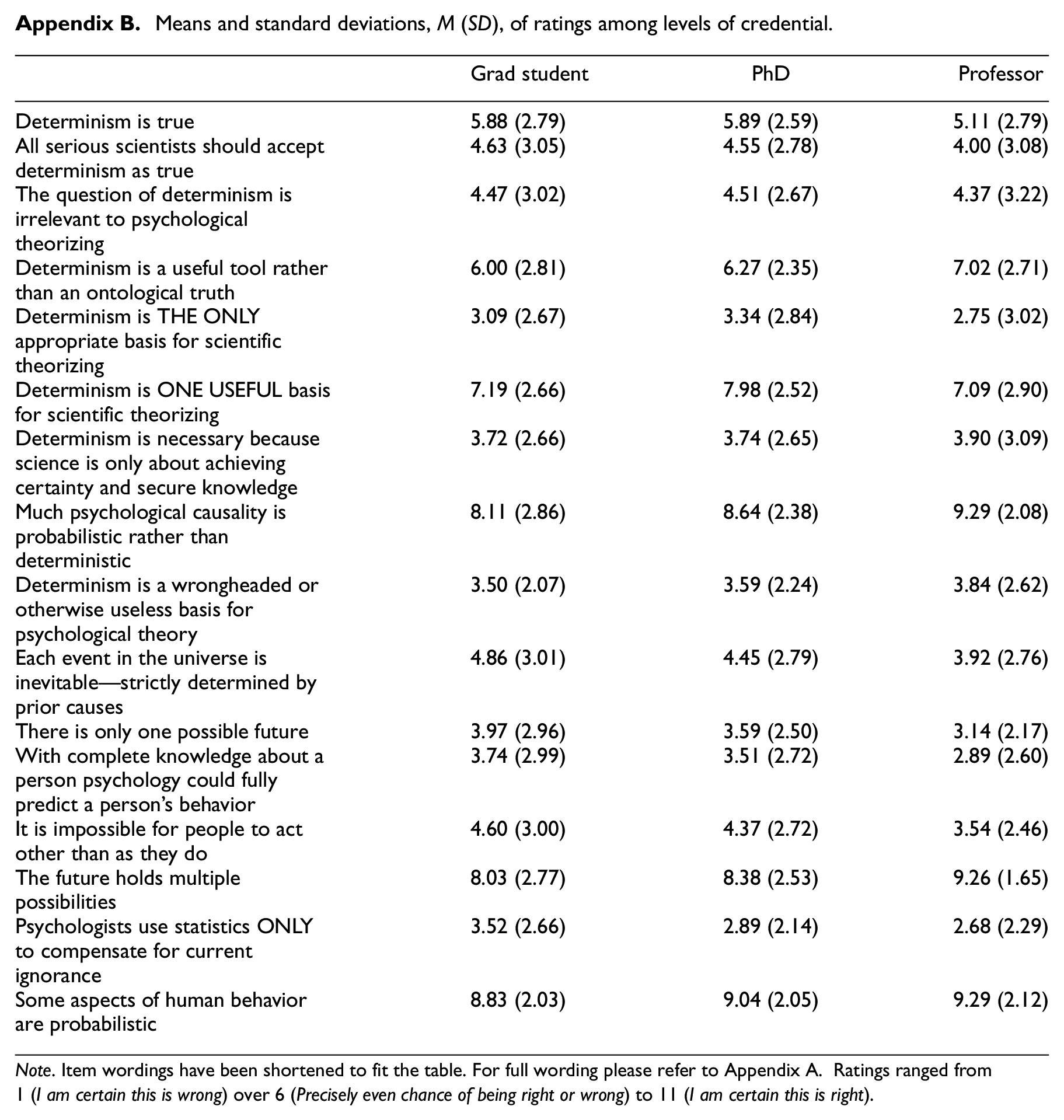
Moreover, agreement with determinism was strongest among the youngest researchers, including graduate students and new PhDs, and weakest among full professors (see Appendix B). Professors embrace (more than graduate students) the assertions that determinism is more of a useful tool rather than an ontological truth (t(117) = 2.00, p = .047, d = 0.37) and that much psychological causality is probabilistic rather than deterministic (t(120) = 2.59, adjusted 3 p = .011, d = 0.47). In the same vein, graduate students agree more than professors that every event in the universe is inevitable (t(178) = 2.15, p = .033, d = 0.32), that there is only one possible future (t(179) = 2.18, adjusted p = .031, d = 0.32), that with complete knowledge psychology could fully predict human behavior (t(179) = 2.06, adjusted p = .041, d = 0.30), and that it is impossible for people to act other than as they do (t(177) = 2.61, adjusted p = .010, d = 0.38). The largest difference we obtained concerns the notion that the future holds multiple possibilities, to which professors agree significantly more than grad students (t(180) = 3.73, adjusted p < .001, d = 0.55).The one-shot survey gives no basis for ascertaining whether these are cohort effects or age effects. Nevertheless, it seems that determinism has substantial appeal among today’s young researchers entering the field and shaping its future.
Last, we note that the item “Determinism is a wrongheaded, misguided, misleading, or otherwise useless basis for psychological theorizing” articulates our position. Precisely 0% of respondents said they were certain this is right. Less than 15% expressed any level of agreement (and these were mostly at the mildest level). Hence the view we advocate in this article is a minority perspective among today’s social and personality psychologists. We anticipate a critical response, but at least no one can accuse us of attacking a straw-man position overall. The present article is, if nothing else, an exercise in intellectual diversity.
Causality without determinism
The nature of causality is highly relevant. Determinism rests on the assumption that each cause guarantees its effect (unless overridden by another cause). LaPlace’s demon could only perform its calculations if each situation, with its confluence of causes, has a single guaranteed outcome. But do causes produce effects with perfect accuracy?—Or do some causes merely change the odds of the effect? Particle physics has long abandoned deterministic causality (unless one embraces the multiple-universe theories that might open up loopholes for fully deterministic worlds again), though in the medium-sized world of Newtonian physics, the foundation of engineering and technology, effects are treated as if they were inevitable. (But, again, Hoefer, 2016 says that advanced philosophical analyses has raised the possibility that Newtonian physics could be indeterminate while quantum particle physics could be deterministic.) Billiard-ball causality is an appealing image: The one ball strikes another, and the second one must inevitably move, and indeed the direction and distance of its move depend precisely on how the other one struck it. Still, even if the demon knew the layout of all the world’s molecules today, could it predict the winner of next year’s Super Bowl 4 with perfect accuracy?
The alternative would be probabilistic (stochastic) causation (e.g. Hitchcock, 2018). A cause does not guarantee a result but merely changes the odds for what will happen. In some cases, at least, identical situations can produce different results. That is after all the basic assumption in classical probability theory. Objective probability is indeterminacy. In contrast, all the determinist can talk about is uncertainty in current knowledge.
As far as we can tell, psychological science does not have any deterministic laws. Our journals are filled with demonstrations of causality that alter the odds or frequency of some response. The typical psychology experiment changes the odds of some response by a small amount, usually less than 10%. Determinists can offer a somewhat convoluted explanation for why this would occur despite deterministic causation: Essentially, a determinist would claim that each combination of causes produces an inevitable result, but across diverse trials the single deterministic causal relationship being tested would be overridden by other causes sometimes and not other times. No two situations (or people) are exactly alike, so two situations may produce different results because different combinations of causes are at work. (We shall return to this point later, insofar as it renders deterministic analysis circular reasoning.)
Deterministic causation, by definition allows for no exceptions. (Obviously, it does permit causes to be overridden by other causes, in deterministic fashion.) The LaPlaceian demon has to know all the laws of nature, which permit no exceptions other than by additional laws that govern which causes can override or reverse which others under which circumstances.
Uselessness of determinism: Incompatible with psychological phenomena
The reasons for abandoning determinism begin with its being counterproductive for psychology’s mission. This section will argue that much of what psychology does is essentially based on how people deal with multiple possibilities, including learning about contingencies and responding to situation structure as a matrix of alternative possibilities. In our view, situation structure often is defined by sets of incompatible possibilities, often contingent on what the person does. Thus, for a social psychologist to explain how a person interprets and responds to a situation, it is essential to appreciate that the person defines the situation partly in terms of the multiplicity of possibilities.
Indeed, recent evidence suggests that perceiving multiple alternatives is one distinctive feature of the human mind. Other animals, in contrast, may learn stimulus-response pairings but not appreciate alternative possibilities. Redshaw and Suddendorf (2016) set up a situation in which obtaining rewards required participants to prepare for two alternative possible outcomes (by using both hands to cover the two reward outlets). The smartest non-human primates were unable to master this, but all the humans past the age of 3 years succeeded. (The 2-year-old human children could not master this, so apparently the ability to understand multiple possibilities is learned.)
Psychological theories must therefore explain how humans, at least, manage to choose among various incompatible possibilities, fully recognizing that all are possible (and that choosing one consigns the other to not becoming reality). The human mind, at least, can assess a situation in terms of its alternative possibilities and respond accordingly. Insofar as that capacity is specific to the mature human mind (and is also a major aspect of free will), it would fit the view that human evolution produced an increase in freedom of will and choice.
This section asserts that assorted psychological phenomena are based on the reality of mere possibility—and that therefore require a non-deterministic conceptual foundation. Determinism refuses to acknowledge their essential structure as situations with multiple possible different outcomes. Hence determinism cannot function as a conceptual foundation for psychological theories about situations with multiple possibilities. (And those are the overwhelming majority of psychological theories.)
We are not attempting metaphysical arguments here. Rather, the point is that in order to construct psychological theories, it is essential to explore how the mind grapples with multiple alternative possibilities. For a determinist to insist that the alternative possibilities other than the eventual outcome were never really possible is completely unhelpful. Indeed, trying to construct theoretical accounts of how people behave in these situations on a deterministic basis (that is, denying that multiple outcomes were possible) is extremely difficult.
For our purposes, it is not necessary to show that all psychological phenomena rest on non-deterministic assumptions—only that some do. We think many do, which exposes the uselessness of a deterministic approach for psychological theory. For us to make a strong argument here, a long list of such phenomena would be most convincing. Unfortunately, that would make a long and tedious article. Hence we have decided to explain a few cases to show the style of argument and then simply list many others.
Threat, danger, challenge, opportunity, and affordance
Much psychological research focuses on threat, ranging from threats to one’s self-view or reputation to threats to one’s survival, as well as various risk factor variables. Threat also activates motivations and responses.
Threat is inherently a matter of indeterminate possibility. An inevitable disaster is not a threat, any more than an already-occurred disaster is a threat. A threat represents a future disaster that might occur but also might not. The concept of danger likewise depends on mere possibility. Being shot to death by a firing squad does not count as danger any more by the time one is standing there blindfolded, because it is a certainty. 5 Danger is a possible but not guaranteed bad outcome. The dangerous part came earlier, when one contemplated doing the things that would lead to getting shot.
Likewise, challenge inherently evokes alternative possibilities. In traditional honor cultures, challenges were issued as invitations to a combat or other contest, the point being that either party could prevail. The parallel between threat and challenge has been documented and studied as alternative ways of interpreting similar situations (e.g. Blascovich, 2008). Strong emotional reactions like uncertainty and anxiety are triggered by stimuli that are novel and include a potential for undesirable outcomes (Brooks, 2014). The essence of those situations is the multiplicity of alternative outcomes. A threat construal emphasizes the possibility of the negative outcome, whereas the challenge construal emphasizes the possibility of avoiding the negative and perhaps achieving a positive. Nevertheless, both are merely possible, and the outcome depends on how the person performs.
Opportunity is the conceptual complement of threat and danger. Opportunity is non-guaranteed possibility that something good might happen. Whether it does happen depends on what the agent does. Indeed, agency presumably evolved precisely to promote the optimal responses so as to minimize threats and capitalize on opportunities. People do fail to seize opportunities, sometimes, even though the opportunity did influence some of their actions. (They at least thought about it, which means some molecules moved because of it.) The concept of opportunity entails multiplicity of alternatives. Steward (2012) has argued that agency presupposes an environment comprising multiple alternative possibilities (see also List, 2023).
Likewise, an affordance is a feature of situations that creates an opportunity for positive outcomes, dependent on the agent making use of it. It is unclear what role affordances could play in a deterministic account of history, because everything is equally inevitable. Affordance is based on multiple possibilities, so it shifts the odds in favor of one outcome rather than the other. If there are not multiple possible outcomes, it could not really do that.
Success or failure
Success and failure are pervasive features of modern human social life and probably were also quite familiar to our hunter-gatherer ancestors, albeit in more limited spheres. Psychology has much to study and explain in terms of people’s efforts to bring about success instead of failure, and to react to either outcome. Something is only a success if there existed the possibility of failure, and vice versa.
Yet if LaPlace was correct, each so-called success was inevitable since the dawn of time, and the corresponding failure was never actually possible. The person may have believed that failure was possible, and actions based on that belief (e.g. trying harder) may have contributed to the success. But that belief was false. That assertion of falsehood is profoundly unhelpful for developing psychological theories, particularly in explaining the emotional states and mental processes designed to avoid failure and achieve success. To a determinist, people’s worries about failure prior to an actual success were based on ignorant mistakes, because there was never really any chance of failure. A student worrying about failing an exam is like a child worrying that there is a monster under the bed. For psychology to explain performance, it is reasonable and useful to assume that both success and failure are genuine possibilities, with neither guaranteed. Everything the person does is predicated on that belief.
Social influence, cooperation, and trust
Influence and cooperation are among the most basic social relations. Why did natural selection enable solitary animals to evolve into social ones? Both influence and cooperation can improve survival and reproduction, such as by garnering more resources for the individual. But influence is presumably much older in evolution, and indeed full-fledged, while deliberate cooperation may be limited to humankind (Tomasello, 2016).
Influence is a matter of making someone else do what you want, presumably for your benefit, instead of doing something else. It is thus inherently based on the reality of mere possibility, that is, that the other might do what you want but might do something different. Influence begins when the influencer recognizes that the other person can act in different ways, and so influence seeks to bring about one action rather than the alternatives. Thus, the goal and raison d’etre of influence are a matter of trying to make one thing happen rather than another. Animals might have a kind of influence based on stimulus-response pairings, but humans are able to understand that others have mental states that make decisions among competing alternatives and can strategically design communications and other actions to influence the decision processes.
Cooperation seemingly depends on mutual understanding of multiple alternative possibilities. When people cooperate, they perform complementary efforts and typically share the rewards. Either one’s efforts depend for success on the other’s efforts. Cooperation greatly increases mutually beneficial outcomes but has to occur in a context in which both understand the interdependency, which entails that failure and betrayal are possible.
Thus, both influence and cooperation function amid the reality of mere possibilities. To invoke determinism and deny that alternative outcomes are possible is no help to the theory and indeed is an impediment.
Effective cooperation usually depends on trust. Trust only matters in the context of multiple possibilities. Someone makes a commitment or promise to you—will that person keep the promise even if his or her own advantage would be to do otherwise? Righetti and Finkenauer (2011) pointed out that risk is an inherent basis of trust. If the outcome is guaranteed, trust is irrelevant. One trusts that the other person will do what was agreed in advance or what is good for the truster, rather than doing something else that may be more appealing to that other person.
Situation structure
One of us once attempted to lay a foundation for a theory of situation structure by creating a list and then taxonomy of independent variables in social psychology research, on the assumption that social psychologists typically study how situations cause behavior. This bottom-up approach started by recording independent variables in all articles in all odd-numbered volumes of the Journal of Personality and Social Psychology and then sorting the 1,622 resulting variables into groups, which yielded 53 categories—which then reduced to five major dimensions of situation structure. One of those was a matrix of possibilities (Baumeister & Tice, 1985).
Independent variables included under matrix of possibilities included the following. Some studies manipulated the presence or absence of freedom, or the range of options available to the participant. (The presence or absence of an escape option, or choosing among 3 or 12 options, or being permitted to choose what to do vs. a yoked control are examples of these manipulations.) Whether the participant had some choice or control over outcomes was varied. Designating the participant as responsible for some prior event, or not, was another. Incentives and importance were manipulated both by presence versus absence of contingent rewards and by size of rewards. Reinforcement contingencies were also manipulated, sometimes in the form of task difficulty. Implications of possible behavior were a diverse category, such as what success or failure might signify, as well as identification versus anonymity. Expectation of future interaction versus no such expectation was manipulated with good effect. Anticipation of being evaluated often made a difference. Power relationships included dependency and vulnerability, as well as opportunity to retaliate. There were several others, but these are sufficient to establish that social psychologists’ efforts to study the causal power of situational variables include a diverse set of variables that are essentially based on multiple possibilities.
Section conclusion
To prevent our analysis from getting bogged down with a long list of examples, we cut short our discussion of the prominent role of multiple possibilities in diverse psychological phenomena. Table 1 contains a list of additional phenomena that fit this pattern. It is not exhaustive either.
Presumptive indeterminacy in psychological theories: the reality of mere possibility.
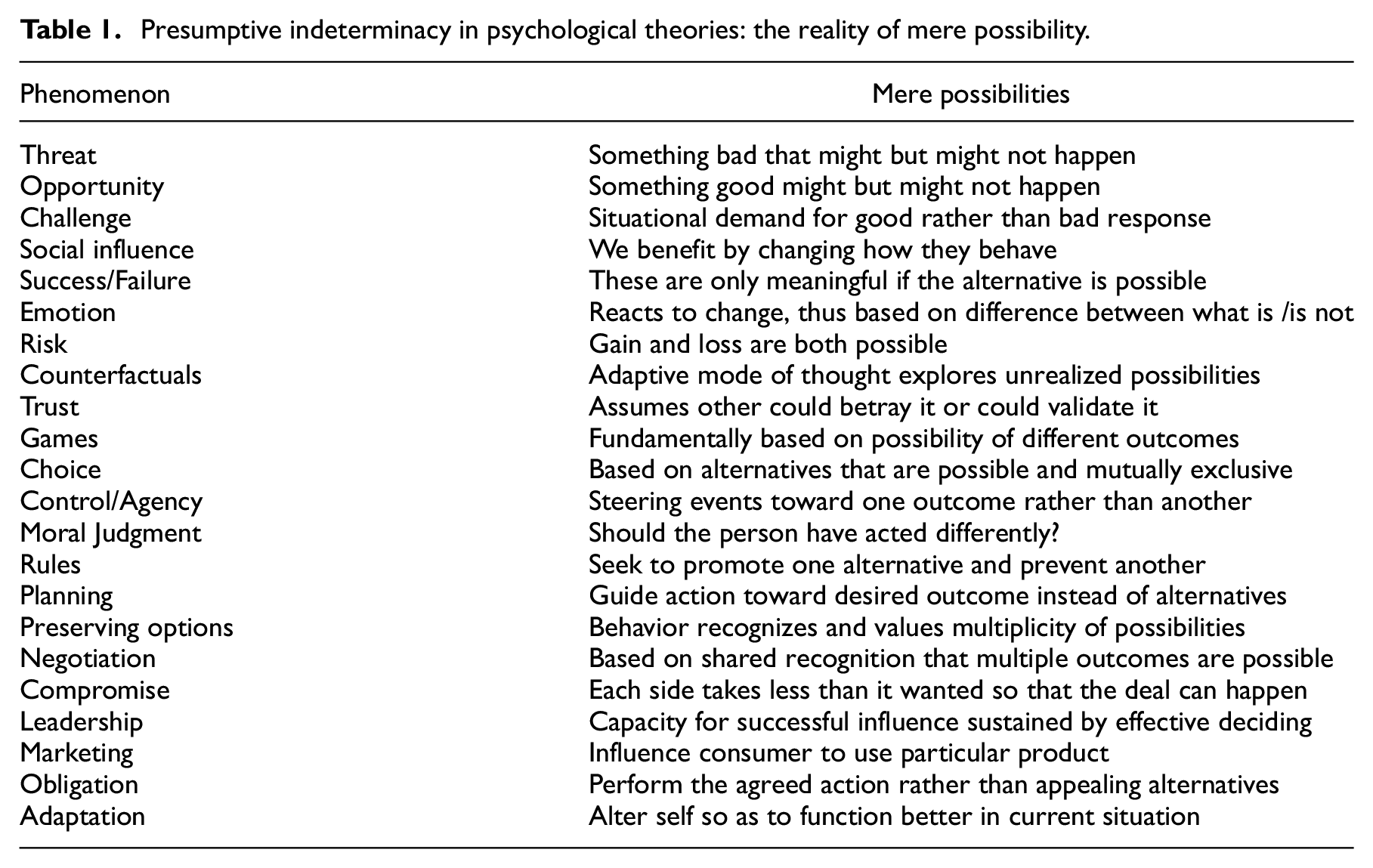
Many of the major phenomena studied by psychologists require a conceptual system that includes multiple possibilities. A threat is something bad that might happen but also might not happen, and the individual’s agentic capability evolved to exert whatever control to steer events toward the more desirable outcome. We invite skeptical readers (especially determinists) to make lists of psychological phenomena that do not involve multiple alternative possibilities. There are presumably some such cases, but we predict they are few and circumscribed.
In our view, this is the crux of the determinism debate: the reality of mere possibility. Something honestly truly might or might not happen. Psychological theories mostly deal with the reality of mere possibility, so determinism is unhelpful and indeed counterproductive. It requires the theorists to deny the essence of the phenomena they seek to explain. Psychologists study how people (and animals) respond to situations that are defined by multiple alternative possibilities.
Uselessness of determinism (2): Assertions of inevitability do not advance theory, indeed mayhamper it
The previous section listed a wide assortment of psychological phenomena that essentially invoke multiple, alternative possibilities. These phenomena violate the deterministic assertion that each outcome is ineluctably determined. A psychological theory seeking to explain such phenomena typically must acknowledge that the person recognized the situation as having multiple different (incompatible) possibilities, judged these in terms of their desirability and viability, and acted so as to steer events toward the best possible outcome instead of the others. For example, the student anticipates that both success and failure are possible on the upcoming test, and by studying carefully, the student tries to achieve success rather than failure. Behavior happens, molecules are moved differently, because the student’s brain represents the idea that different outcomes are possible. The person responds based on the contingency structure, the multi-maybe matrix.
To the LaPlacean determinist, the student’s grade on the test has been determined long ago. The student’s perception that both success and failure are possible is fundamentally mistaken. The student acts on this mistaken assumption to bring about the actual outcome. Basing one’s actions on this mistaken assumption has also been foreordained. Yet how do these dubious claims of inevitability help the psychologist to construct the theoretical account? If anything, they make the task considerably more difficult, insofar as one would have to explain the mistakenness of thinking that one might fail, whereas the successful outcome has been inevitable since the dawn of time. But worrying about the consequences of possible failure helped motivate and cause the student to succeed.
Yet it is hard to find any published psychological theorizing that actually explains behavior that way. The researchers would presumably insist that the person operated on mistaken beliefs and might explain why the person fell into that mistake.
To be sure, there are cases in which situations are about finding out what is already determined. Shepperd et al. (2013) had participants take a medical test and predict the outcome, first while they expected the results in 4 weeks, and then when the experimenter said that it would now be possible to get results within the hour. But these are unusual sorts of situations, and people knew there was nothing they could do to alter the outcome and could merely prepare themselves psychologically (brace themselves) for what they would find out. Thus, it is entirely possible for research to study cases in which the truth already exists and people merely strive to learn it. But much psychology does not fit that simple paradigm.
More broadly, a recent review of the psychology of uncertainty found it necessary to distinguish subjective from objective uncertainty, indeed because people respond differently ti situations with clear facts that are unknown to them as opposed to situations in which multiple outcomes are possible (Alquist & Baumeister, 2023). For the determinist, all uncertainty is subjective, resulting from ignorance. This vastly complicates the problem of explaining the difference in responses between objective and subjective.
For the most part, human behavior occurs amid awareness of multiple, alternative, mutually incompatible possibilities. It seems simplest and most parsimonious to assume these alternative possibilities are really there. Psychological theories are based on this. For the determinist to insist that the alternative outcomes were in fact impossible adds nothing to the theory. If anything, it makes it much more difficult to construct the theory. How can one effectively explain how someone makes a choice while insisting that only one outcome was ever genuinely possible?
A determinist might say that the alternative possibilities are merely epistemic, that is, they exist only in the imagination and not in reality (e.g. Coyne, 2017). People are thus fundamentally mistaken when they believe there are multiple possible outcomes in any given situation. The previous section illustrated that the assumption of multiple possibilities is pervasive as well as fundamental to a wide variety of behavior and emotion. The determinist thus requires the psychologist to postulate that the majority of human behavior is based on a profoundly mistaken understanding of the world. Everybody is wrong most of the time about everything he or she does. This may be part of the perverse appeal of determinism, as it enables its believers to think that they alone understand the world while everyone else wallows in false consciousness and silly misconceptions. That alone is not a fatal critique of determinism, because it is remotely plausible that almost all human behavior is based on fundamentally mistaken understandings of reality. It does however stretch credulity. It also encumbers the theory-building task with adding a layer of mistaken understanding to almost every action, while accomplishing nothing in terms of making the theory clear or testable. Indeed, it adds to each theory a postulate that is essentially impossible to test.
An astute reviewer pointed out that determinism could still be true despite the pervasiveness of choice. Insisting that all human decision-making is based on false assumptions is not necessarily a fatal flaw of determinism, because people believe many false things, such as witches and ghosts. We concede the point, though the analogy seems rather unfair: Witches and ghosts are not part of everyone’s everyday behavioral repertoire, unlike dealing with multiple possibilities is. Moreover, given that science’s mission is to look beyond the fabric of subjective realities and to correct for perception patterns and biases shaped by evolution, it becomes all the more important to ascertain the pitfalls of determinism as a theory.
Determinism is of course unproven. Indeed, it is probably unprovable (Gadenne, 2004; Hájiček, 2009). It is, in essence, a metaphysical world view that does not provide testable and falsifiable hypotheses. It has to be accepted on faith rather than evidence. There is no way to prove that everything that happens is the only thing that could possibly have happened just then and there. It does not fit psychology’s data base, which is overwhelmingly probabilistic (i.e. showing that causes merely change the odds of some response), as well as contrary to everyday experience of making choices. None of these proves determinism is false, but together they do make determinism a very dubious grounding for social science.
Determinism’s conceptual flaws
The previous sections argued that determinism is unsuitable as a basis for psychological theory. This section will argue that the theoretical basis of determinism is fatally flawed. So, whereas the previous section argued determinism was unsuitable, here we argue that it is conceptually untenable.
Determinism rests on false assumptions
LaPlace proposed that the super-mind or demon would begin by knowing the disposition of every particle in the universe at some particular moment in time. This, however, contradicts the nature of reality as set forth in relativity theory. According to relativity, as we understand it, there is no one simultaneous moment across the universe. This is a major problem in determinism. Of course, one can hardly reproach LaPlace for this. He formulated his theory a century before Einstein introduced relativity. Nevertheless, this reveals a crucial and fatal design flaw in the thought experiment on which determinism is based. It would not be possible to know the disposition of every particle in the universe at exactly the same moment, because there is no such thing as exactly the same moment for the entire universe.
A further problem is that the computing power needed to perform the LaPlacean demon’s calculations would exceed the universe’s capabilities. Mathematicians have proven that those calculations exceed what is possible, even if everything in the universe were converted into one giant computer (Ulanowicz, 1986; Wolpert, 2008).
Thus, the calculations LaPlace imagined could not possibly be done. The required informational input is impossible in a relativistic universe. The thought experiment that is the basis of determinism is doomed to fail. Indeed, it would be impossible to conduct the experiment.
Mere circular reasoning
A second complaint is that determinism is arguably just an exercise in circular reasoning. Circular arguments can sound elegant and persuasive, even profound, but on careful inspection they turn out to mean hardly anything beyond “if we assume X is true, then X is true”.
To explain the circularity, we set aside the previous section’s objection that there is no such thing as a simultaneous moment of the entire universe, which was the starting point of determinism. Let us pretend such a thing is possible (and maybe future work will find a way that it is possible.) Let us also set aside the computing capacity issue. Could a super-mind predict with 100% accuracy what will happen next? The assumption was that the demon knew all the laws of nature, in the form of causal relationships. Of course, there are a great many causes operating at any given time in any given psychological situation (let alone all the causes in the entire universe!). Moreover, causes frequently interact with other causes, and by definition these interacting causes modify, cancel, or even reverse each other’s impact. A causal relationship that has generally been true may cease to be true in this particular situation, because of some other causes. Flipping on the switch turns on the lights, but not if there is a power failure, or a short circuit. We can think of no psychological causes that are always true in all situations, impervious to other variables that could create exceptions. This in itself is not a problem for determinism: It simply stipulates that knowing all the laws of nature would have to include knowing all their interactions, in all possible combinations.
Thus, suppose LaPlace’s demon could map out precisely where every particle in the universe is, and suppose further that it knew absolutely all the laws of nature, including how causes combine and interact. This is the foundational assumption of determinism, as promulgated by LaPlace. What happens in the next moment depends on all the causes operating on all the entities right now, and some causes override others, particularly in situations in which multiple kinds of causes and causal sequences coincide and interact. The deterministic demon’s knowledge of natural law would specify which causes take precedence over which others under which circumstances.
Moreover, and crucially, no two moments for the entire universe (again, conceding the deterministic assumption that such simultaneous moments existed) are exactly alike. Again, this is no problem for the deterministic demon, who would know how all the causes combine in every possible situation.
However, if each moment of the universe is (slightly) unique in its configuration of causes and matter, and if the deterministic demon’s knowledge has to encompass that precise knowledge, then the argument becomes circular. This coming Wednesday at noon GMT the universe has a unique situation in terms of how all the causal processes in the universe combine to influence the unique layout of all the particles. Therefore, the demon had to already know exactly what happens next as a result of how the universe is configured on this coming Wednesday at noon GMT. To say that the demon can calculate what happens next in that situation, based on the assumption that it already knows what happens next in that situation, is circular.
Discussion
Determinism is the belief that everything that happens is fully determined and hence inevitable. It denies the reality of alternative possibilities. Many psychology researchers entertain some belief in determinism, and, anecdotally at least, we have heard several psychological scientists assert that all psychologists should embrace determinism as an essential foundation of scientific research. For example, one of us was instructed by a journal editor to revise a manuscript by stipulating at the outset that genuine freedom is impossible because of the truth of determinism.
This article has sought to make a case for the opposing view: Determinism is completely unsuitable as a required basis for scientific research in psychology, given that it is unproven, unprovable, contrary to everyday experience, and contrary to the probabilistic nature of psychological data. We note that these facts do not prove determinism is wrong, but we think that they raise sufficient doubts that alternative, non-deterministic views deserve to be respected as plausible. This is the minimum we have argued.
More assertively, we have proposed that the core idea of determinism is profoundly useless in view of the tasks of psychological theory. A great many topics of research (probably the vast majority) in psychology seek to explain how agents deal with situations in which multiple alternative outcomes are possible. Determinism denies the reality of mere possibility. This is unhelpful for the psychologist’s task. Indeed, it makes the task more difficult. For example, it is already difficult enough to create a theory that seeks to explain how someone assesses a risk and then decides what behavioral adjustment to make. To do this as a determinist, the psychological theorist also has to explain why the person is fundamentally mistaken in believing that there was a risk. The essential point of determinism—that only one outcome was ever possible in a given situation—blinds one to what one seeks to explain, namely how people negotiate multiple possibilities.
Hence our second conclusion is that even if determinism were true in some respect or to some extent, it would not make a viable foundation for psychological theory. It refuses to recognize many of the essential phenomena that psychological scientists study (i.e. how subjects respond to mere possibilities). It needlessly complicates theories by requiring to explain how almost all human behavior is based on profound mistakes and sweeping misconceptions. Put another way, most psychological theories operate by explaining how people envision the various outcome possibilities and adjust their behavior on that basis, but the determinist has to explain why people engage in all these mental calculations that are based on false premises and doomed to be fundamentally wrong. If there really is a threat, then it makes sense to analyze how subjects assess it and how that assessment informs their actions that prevent the threat from coming true. But to the determinist, there is no threat, because there was never a possibility that that would happen (except in the few cases in which it does come to pass, in which case again it was not a possibility but an inevitable outcome that has been determined in advance for millions of years). There was only a subjective, mistaken belief that something bad might happen but also might not.
Our third and most aggressive line of argument is that determinism, at least in the LaPlacean original and “hard” form, is not itself a defensible theory. Over the past two centuries, determinists have remained largely unchallenged in their position based on the seemingly logical fact that if you accept their premises, then the conclusions are inevitable, and so it is difficult to refute determinism from the inside. We have disputed the premises. The starting point for the LaPlacean exercise in prediction is not possible to be reached. Moreover, we suggested that if there were a way around the starting point problem, determinism would still be vulnerable the accusation of being merely circular reasoning.
Implications from statistical methodology
We have noted the irony that many psychological scientists assert the truth of determinism while still using statistics. The irony is that statistics based on classical probability theory assume indeterminacy. Some determinists may seek to defend the practice by claiming that the indeterminacy is merely epistemic, that is, statistics are used to compensate for the gaps in human knowledge that preclude correct understanding of deterministic causality. Such a claim has no evidence to support it, but it is difficult to refute. It is true in some cases: Asked whether a particular baby born last year was male or female, and having no information, people might reasonably say there is a roughly even chance, even though there is a definite, objectively correct answer. However, generalizing from these few cases of subjective ignorance to propose that all outcomes are objectively, inevitably determined and all use of statistics is merely coping with subjective ignorance is an extreme stretch—and would entail some serious re-thinking of scientific knowledge.
The insistence that indeterminacy is simply a subjective mistake born of ignorance of the full causal process thus makes statistics not a way of understanding the world but of compensating for subjective ignorance. There is perhaps one way to get some relevant data. If the use of statistics arises merely to compensate for gaps in knowledge, then as the body of scientific knowledge increases (and the gaps in it correspondingly decrease), the use of statistics should diminish and then disappear. Hence one could examine long-term trends in scientific progress to ascertain whether all fields of inquiry do indeed start out with extensive use of statistics and then gradually phase that out as they accumulate knowledge. Our strong impression is that the opposite has been the case in all scientific fields. Certainly, the immense advances in psychological knowledge over the past century of research have not led to any reduction in reliance on statistical methods—on the contrary, statistics have become more complex and ubiquitous. In general, scientific progress involves ever more reliance on increasingly advanced and complex statistics, which suggests that the need for statistics does not arise from ignorance. If anything, it suggests that the essential nature of psychological reality is probabilistic, not deterministic. As scientific progress brings the field closer to understanding reality, it needs more and more statistics, not less and less.
It is entirely plausible that Newtonian physics operates in the human world in an essentially deterministic fashion—but that psychological causes are not deterministic. The simple causation among inanimate objects has simple principles that may approach deterministic perfection, but the causes that operate in psychology, sociology, economics, and politics are vastly more probabilistic and, crucially, are not reducible to those inanimate processes such as the laws of physics. As Anderson (1972) explained, nothing violates the laws of physics, but physical processes are subsumed into more complex organizations. These organizations, such as the human mind, exist to deal with probabilistic realities such as pervade human social life.
Concluding remarks
To any who continue to uphold determinism, we reiterate our two central challenges. First, to what laws of psychology can you point that are clearly deterministic (i.e. having no exceptions)? Second, in what way does the assertion of causal inevitability help or improve any psychological theory?
Instead, we think psychologists should disdain determinism. At present, we know of no psychological causes that operate with the 100% inevitability required by determinism, even if we allow the determinist to specify (deterministic) boundary conditions. Nor do we know of any major research projects that have achieved 100% accurate prediction of every data point. Determinists hold to faith that psychology may approach such ideals. We think that faith is completely unwarranted.
Moreover, we have argued that asserting causal inevitability adds nothing to psychological theorizing. If anything, determinism can potentially blind psychologists to the probabilistic nature of the phenomena they study and also hamper their ability to construct models of many psychological processes, which are inherently based on minds perceiving, constructing, and responding to situations defined by multiple alternative possibilities. Rather than cling to a faith in determinism, psychological scientists should embrace a view of the social world as inherently defined by maybes. Indeterminacy, and the corresponding need for statistics, is not just a way of coping with ignorance. It is a fundamental fact that psychology ignores at its peril.
There are many causal processes, which researchers can explore and elucidate—but they do not resemble the universality and inevitability of the law of gravity, for example. (Again, we challenge determinists to articulate any deterministic laws in psychology.) The agentic powers of the human psyche presumably evolved precisely because many situations presented multiple alternative possible outcomes, and those powers sought to steer events toward the more adaptive and desirable ones. Psychology’s most promising path, in our view, is to assume the reality of mere possibility and build its theories on that basis.
Footnotes
Appendix
Means and standard deviations, M (SD), of ratings among levels of credential.
| Grad student | PhD | Professor | |
|---|---|---|---|
| Determinism is true | 5.88 (2.79) | 5.89 (2.59) | 5.11 (2.79) |
| All serious scientists should accept determinism as true | 4.63 (3.05) | 4.55 (2.78) | 4.00 (3.08) |
| The question of determinism is irrelevant to psychological theorizing | 4.47 (3.02) | 4.51 (2.67) | 4.37 (3.22) |
| Determinism is a useful tool rather than an ontological truth | 6.00 (2.81) | 6.27 (2.35) | 7.02 (2.71) |
| Determinism is THE ONLY appropriate basis for scientific theorizing | 3.09 (2.67) | 3.34 (2.84) | 2.75 (3.02) |
| Determinism is ONE USEFUL basis for scientific theorizing | 7.19 (2.66) | 7.98 (2.52) | 7.09 (2.90) |
| Determinism is necessary because science is only about achieving certainty and secure knowledge | 3.72 (2.66) | 3.74 (2.65) | 3.90 (3.09) |
| Much psychological causality is probabilistic rather than deterministic | 8.11 (2.86) | 8.64 (2.38) | 9.29 (2.08) |
| Determinism is a wrongheaded or otherwise useless basis for psychological theory | 3.50 (2.07) | 3.59 (2.24) | 3.84 (2.62) |
| Each event in the universe is inevitable—strictly determined by prior causes | 4.86 (3.01) | 4.45 (2.79) | 3.92 (2.76) |
| There is only one possible future | 3.97 (2.96) | 3.59 (2.50) | 3.14 (2.17) |
| With complete knowledge about a person psychology could fully predict a person’s behavior | 3.74 (2.99) | 3.51 (2.72) | 2.89 (2.60) |
| It is impossible for people to act other than as they do | 4.60 (3.00) | 4.37 (2.72) | 3.54 (2.46) |
| The future holds multiple possibilities | 8.03 (2.77) | 8.38 (2.53) | 9.26 (1.65) |
| Psychologists use statistics ONLY to compensate for current ignorance | 3.52 (2.66) | 2.89 (2.14) | 2.68 (2.29) |
| Some aspects of human behavior are probabilistic | 8.83 (2.03) | 9.04 (2.05) | 9.29 (2.12) |
Note. Item wordings have been shortened to fit the table. For full wording please refer to Appendix A. Ratings ranged from 1 (I am certain this is wrong) over 6 (Precisely even chance of being right or wrong) to 11 (I am certain this is right).
Declaration of conflicting interests
The author(s) declared no potential conflicts of interest with respect to the research, authorship, and/or publication of this article.
Funding
The author(s) disclosed receipt of the following financial support for the research, authorship, and/or publication of this article: The work of Stephan Lau was supported by a grant from the Deutsche Forschungsgemeinschaft (DFG), number LA 3891/1-1.