



Abstract
We ordinarily think that we human beings have agency: we have control over our choices and make a difference to our environments. Yet it is not obvious how agency can fit into a physical world that is governed by exceptionless laws of nature. In particular, it is unclear how agency is possible if those laws are deterministic and the universe functions like a mechanical clockwork. In this short paper, I first explain the apparent conflict between agency and physical determinism (referring to recent work by Helen Steward), then review some salient responses one might give to this conflict, and finally sketch a response that rests on a distinction between “physical” and “agential possibilities.” Agency, I suggest, is a higher-level phenomenon, which comes with its own level-specific notion of possibility, and it cannot be adequately analyzed in physical terms alone or just through the lens of physical possibility.
Introduction
A widely shared assumption is that we human beings have agency: we act intentionally—in a goal-directed manner—and have control over our choices; we make a difference to our environments. For instance, it was up to me whether to have tea or coffee for breakfast this morning. Or, to give a less trivial example, it was up to me whether to accept the invitation to contribute to this symposium. More broadly, we think we can choose between different life paths: which career to pursue, whether to get married, which political party to support. Even more broadly, we think that, collectively, we can exercise some control over our destiny, at least in principle. It is possible for us to act to combat climate change, for instance, even if it may be difficult. The assumption that there is human agency features prominently in commonsense psychology as well as in many of the human and social sciences.
How does human agency fit into the physical world? In particular, how is agency possible if, as the dominant naturalistic worldview suggests, the world is at bottom physical and everything that happens is ultimately the result of physical processes? And, to sharpen the question further, how can there be genuine agency if those physical processes are governed by deterministic laws of nature?
The idea of deterministic laws of nature is familiar from Enlightenment thought with its notion of the “clockwork universe.” It means that the state of the universe at each point in time fully determines what happens next: the initial state, say at the time of the Big Bang, will have permitted only one sequence of events. In a deterministic universe, a hypothetical observer with complete information about the initial state of the universe and unlimited computational capacities—“Laplace’s demon” from Pierre-Simon Laplace’s famous thought experiment—could in principle predict everything that was ever going to happen. Of course, because of informational and computational limitations, no such observer exists or could in practice exist. But the underlying deterministic conception of the laws, despite being contested, has not yet been disproved by science, as I will explain in more detail later. Einstein prominently expressed support for a deterministic conception of the laws when he said “God does not play dice.” If the universe is deterministic, the fact that I have written this paper will have been predetermined as much as the date and time of the next solar eclipse in Munich is predetermined, and so it is unclear whether my writing of this paper or any other action of mine can be truly attributed to my choice as an agent.
In short, there seems to be a conflict between human agency, as conventionally understood, and physical determinism. The philosopher Helen Steward (2012) has influentially defended the view that there is such a conflict. She calls this view “agency incompatibilism”: agency is incompatible with a deterministic physical world. If agency incompatibilism is true, there are significant repercussions. In a deterministic world, human agency would be an illusion, and consequently, the idea that we are morally responsible for our actions would rest on shaky ground too. After all, it is widely held that agency is necessary for responsibility: only beings that qualify as agents are capable of bearing responsibility.
In this short paper, I will first explain the conflict between agency and determinism a bit more precisely and then sketch a response that I find more compelling than the dominant responses in the scholarly debate. This will allow me to explain the concept of agential possibilities.
The conflict
The conflict between agency and determinism can be derived from two propositions:
A necessary condition for agency is the openness of a putative agent’s choices. That is: for someone or something to qualify as an agent, he, she, or it must sometimes face choices between different courses of action: alternative possibilities or “forks in the road.”
If the universe is deterministic, there are never any alternative possibilities or “forks in the road”: given the initial state of the universe, only one sequence of events is possible under the laws of nature.
If both propositions are true, it seems to follow that there cannot be any agency in a deterministic universe. Agency would require “forks in the road,” namely whenever an agent is faced with a choice between different courses of action, and determinism would rule out such forks. The possible histories of the universe (state evolutions) that are permitted by the laws of nature would look like the ones in the simple example of Figure 1 (from List, 2019).
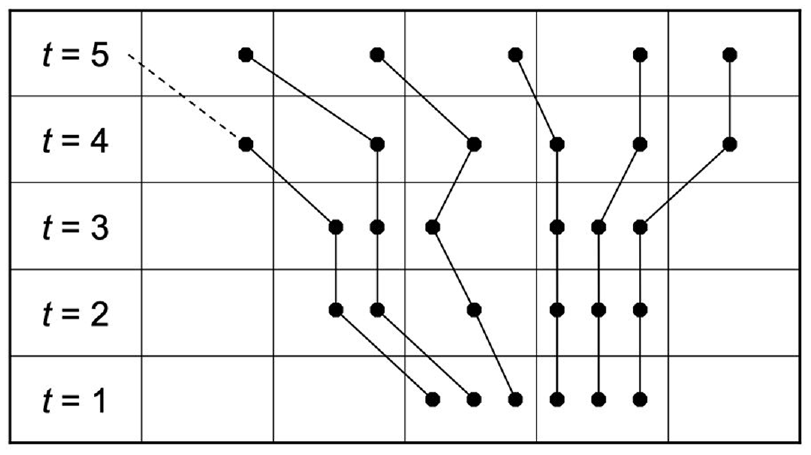
A simple example of determinism.
Here, little dots represent states of the world at a given time, and lines connecting dots—interpreted as moving from time t = 1 (in the bottom row of the table) to time t = 5 (in the top row)—represent histories over time. Once the initial state (at time t = 1) is given, all subsequent states (at times t = 2, 3, 4, …) are fixed too. If the initial state at time t = 1 is the one represented by the rightmost dot in the bottom row of the table, for instance, then the states at times t = 2, 3, 4, and 5 will also be the ones represented by the rightmost dots in the corresponding rows. The entire history across all times will be fixed by the initial state: here, the rightmost line. And the same is true for all the other possible histories. There is never any possible branching in any of these histories.
In a deterministic universe, it seems, no-one could ever genuinely choose between different courses of action. And if no genuine choices are possible, there seems no room for anyone to make a difference to the world. Putative agents wouldn’t add anything to the course of events happening in the world. Everything that happens would be an inexorable consequence of prior physical conditions. In a slogan: no choice, no agency. This seems to support Steward’s (2012) thesis of “agency incompatibilism”: either the world is indeterministic or there is no agency.
Some readers will object that there is no conflict between determinism and agency as such, only between determinism and free agency, the sort of agency that involves free will. Indeed, the traditional philosophical debate has revolved around the question of whether there could be free will in a deterministic universe (see, e.g. Kane, 2002; Van Inwagen, 1975). Many philosophers have assumed that determinism puts pressure on free will, but not on agency itself. They believe that agency could exist in a deterministic world, though perhaps without free will. On this view, we could still qualify as agents even if determinism were true, though we might not be able to choose and control our actions “freely,” precisely because those actions would have been fully determined by prior conditions. My impression is that, while this apparent conflict between determinism and free will is relatively widely recognized, far fewer people think that there is a conflict between determinism and agency itself.
However, I am inclined to agree with Steward’s thesis that determinism poses a threat not just for free will but for agency itself. Steward’s (2012) own argument for this thesis rests on the premise that the exercise of agency requires what she calls the “settling of matters.” When I exercise my agency, I settle certain matters that weren’t previously settled. When I chose coffee over tea this morning, I settled the fact that things were going to be such that Christian had coffee today rather than tea. Before my choice, this matter was still open: not yet fixed by prior conditions. Similarly, when I chose to contribute to this symposium, I settled the fact that there was going to be a contribution from me rather than none. The outcome was a little different from what it would have been otherwise. On this account, exercising one’s agency involves choice-making amongst some previously open possibilities: coffee versus tea, for instance, or contributing to the symposium versus not contributing. It seems, however, that in a deterministic universe there is nothing left to be settled. It would have been predetermined from the outset which situation was going to materialize. There aren’t any open possibilities. And so, determinism undermines a central requirement for agency: the ability to settle matters that were not previously settled.
One might still object that Steward’s conception of agency already builds in a certain kind of “free will” requirement, where “free will” is understood as requiring alternative possibilities between which one can choose. And so, one might say that the phenomenon with which Steward is concerned should really be called “free agency,” not just “agency” simpliciter. Undeniably, the conflict that Steward identifies resembles the widely discussed conflict between free will and determinism. However, whether the phenomenon that Steward describes is best labeled “free agency” or just “agency” itself is largely a question of terminology. The important point is that it seems very plausible that the kind of agency about which we care, and on which moral responsibility depends, does indeed require the “settling of matters.” Intuitively, it is only if my actions make a genuine difference to the world that I can be held responsible for them. If some outcome was going to happen anyway and I had no control over it, it is unclear that I should be held responsible for it. For example, when someone is accused of having committed a crime, a defense lawyer could successfully argue for this person’s innocence if the lawyer could demonstrate that the defendant had no control over the outcome and could not have “settled” things in any other way.
I therefore consider the conflict between determinism and agency (or “free agency,” for those who prefer that terminology) a serious one. On the one hand, the idea of agency is central to our image of the human condition, and on the other hand, determinism is an important assumption of a significant part of science, albeit not all of it. As noted, especially the sort of science that became dominant in the Enlightenment and in early modern times until well into the 20th century, broadly ranging from Newton and Laplace to Einstein, gives us an image of the physical universe in which the laws of nature are deterministic, operating like a mechanical clockwork.
More recently, quantum mechanics has been interpreted by some, especially by proponents of the so-called “Copenhagen interpretation” (named after the place where Niels Bohr and other proponents of it worked in the 1920s, including Werner Heisenberg), as supporting the view that nature is indeterministic and that it involves true randomness. The time at which an individual uranium atom decays, for instance, is supposed to be random. Or, whether a light particle is reflected or transmitted by a semi-transparent mirror is supposed to be random, assuming there is a sensitive light detector in place. However, the interpretation of quantum mechanics remains controversial, and competing deterministic interpretations are also available. For example, the so-called “hidden variables” interpretation (associated with Louis de Broglie and David Bohm) treats the appearance of indeterminism in quantum systems merely as stemming from our ignorance of certain unobservable “hidden variables.” It assumes that, despite the seemingly random “surface-level” behavior of a system, there is an underlying deterministic process; we are merely ignorant of some variables determining it. Even more importantly, we do not yet have a unified theory of fundamental physics, which subsumes quantum mechanics and general relativity theory, two of the central (albeit hard-to-reconcile) pillars of contemporary fundamental physics. So, the last word on the foundations of physics has not yet been spoken.
As things stand, therefore, deterministic laws of nature have been neither proved nor ruled out by science, and the conflict between agency and determinism cannot be easily dismissed as being merely hypothetical. If we do not want our concept of agency to be at the mercy of how certain debates in fundamental physics turn out, we must find a strategy of responding to this conflict. So, what can we say in response?
Some standard responses
Different thinkers have given different responses to the identified conflict (for good overviews, see Kane, 2002; Steward, 2012). One response is simply to deny that there is any agency or free agency in the physical world. According to this response, it is an illusion to think that we humans have agency and that it would ever have been possible for us to do anything other than what we actually did. We never have any open possibilities among which we can choose. Instead, we are just spectators of a sequence of events which unfolds inevitably according to the laws of nature and over which we have no control; the idea of agency is just a remnant of a prescientific way of thinking. Neurophilosophers such as Patricia and Paul Churchland have prominently argued that the traditional idea of intentional agency has no place in a scientific worldview (P. M. Churchland, 1981; P. S. Churchland, 1986). Humans are ultimately just biophysical systems, and the aspiration of science should be to explain human behavior at some mechanistic neuroscientific level rather than by ascribing intentional agency to people. However, this view fails to do justice to the centrality of the idea of agency in our lives and across the human and social sciences. It would suggest that our entire conventional understanding of the human condition rests on a systematic error or illusion. Moreover, as I will explain later, the explanatory indispensability of agency ascriptions can be defended against this skepticism.
A second response is to accept that humans have agency or even free agency but to deny that this requires open possibilities among which we can choose. This amounts to giving up the claim that a necessary condition for agency is the openness of any agent’s choices—the first proposition stated earlier. Instead, the present response would redefine the notion of agency such that it becomes compatible with the lack of real choices. Perhaps all that is needed for agency is that any agent “subjectively intends,” “endorses,” or “supports” his or her actions, irrespective of whether this agent could ever have chosen anything else. The conflict between agency and determinism then goes away. In response to Steward’s claim that there could be no agency in a deterministic world, for example, Karin Boxer (2013) has argued that one can reinterpret the notion of agency in a “compatibilist” way such that it doesn’t require the “closing off” of previously open possibilities. My worry about this response, however, is that it waters down the idea of agency, perhaps so much that we lose what is central to it. I feel the intuitive force of the thought that the exercise of agency involves the settling of something that was previously open: agents sometimes do make real choices. Of course, it is ultimately a psychological question whether our commonsense understanding of agency is aligned with Steward’s incompatibilist conception. While the evidence is not fully conclusive, empirical studies of laypeople’s intuitions suggest that many people tend to agree that there is a tension between agency (of the commonsense sort that involves making choices) and determinism (for a review and discussion, see, e.g. Nichols, 2012).
A third response is to argue that the laws of nature are not deterministic. This would render the second of the earlier propositions mute: if the universe is not deterministic, then alternative futures are possible after all, and it seems that the “forks in the road” that are needed for agency could indeed exist. Steward (2012) herself defends a version of this view, as do other free-will “libertarians” (as surveyed, e.g. in Kane, 2002). The problem with this response, however, is twofold. First, if we look at contemporary science, the jury is still out on whether the laws of nature are deterministic. As noted, some scientific theories—especially classical physics—support a deterministic picture, while others—especially quantum mechanics—are compatible with indeterminism. But as already noted, those theories don’t strictly commit us to assuming an indeterministic universe. Whether quantum mechanics supports indeterminism or not depends on its interpretation, and the “correct” interpretation is far from settled. In fact, Einstein’s above-mentioned quote “God does not play dice” was an expression of his reservations about indeterministic interpretations of quantum mechanics.
A second, even worse problem is that indeterministic laws of nature might not by themselves suffice to provide the right kinds of “forks in the road” that are needed for human agency. Even if the laws of nature were indeterministic, contrary to what Einstein thought, this might, in the first place, only imply that there could be random influences on human behavior, which is not quite the same as genuine human agency. Suppose, for instance, that the phenomena studied in quantum mechanics are indeed indeterministic. Even if there were such instances of quantum randomness inside the human brain and body—say, if random physical events in the brain were “amplified” so as to influence a person’s decision whether to have coffee or tea—it is a big leap of faith to think that this leaves room for agential control over the resulting choices. It might simply mean that what we do is random or a matter of chance or luck: hardly reassuring if we wish to defend the idea of agency, let alone in the context of moral responsibility. (Mele, 2005 calls this the “luck problem” for an indeterministic conception of choice; Kane, 1999 tries to offer a response.) When we make morally significant choices, the conventional idea is that it is “us” who are making those choices, not just some random event in the brain. In short, the forks in the road that are needed for agency are ones amongst which we can choose, not just ones corresponding to different possible outcomes of a random process.
In sum, although I do not have space to engage with the rich philosophical debate here, it seems to me that the established responses to the identified conflict between agency and determinism all have some shortcomings. This brings me to a different response.
A new response
I suggest that the idea of agency, with the associated idea of making choices between alternative possibilities, does not conflict with science or even physical determinism at all. Rather, it is supported by our best scientific understanding of the human condition.
I will argue for this by putting forward three theses, which I will first state and then elaborate in more detail:
Thesis 1: If we wish to make sense of human behavior, both in ordinary life and in the human and social sciences, the ascription of agency to human beings is indispensable. We cannot explain human behavior without viewing people as agents.
Thesis 2: Once we ascribe agency to someone and explain their behavior in agential terms, we must presuppose that they have alternative possibilities to choose from.
Thesis 3: The postulated alternative possibilities—agential possibilities, as I call them—do not conflict with physical determinism. This is because the notion of agential possibility is distinct from (though compatible with) the notion of physical possibility.
Let me now fill in some details. For a full defense of the three theses, I refer readers to a series of more technical works on which I draw here (especially List, 2014, 2019, 2020, 2022).
The indispensability of agency ascriptions
I begin with the first thesis, that the ascription of agency to humans is explanatorily indispensable. Consider the sciences of human behavior, from anthropology and psychology to economics and sociology. Although this is a wide spectrum, something these disciplines all have in common is that they view humans as intentional agents, as beings capable of acting in a goal-directed manner, of making choices, and of responding intelligibly to their environments. In all these fields, scholars try to explain human behavior by depicting people as choice-making agents, with beliefs and desires, goals and plans, on the basis of which they decide which actions to take. Of course, there are disagreements about the details of such explanations. Economists, for instance, give us a different account of human decision-making than sociologists and anthropologists. The former often put more emphasis in their explanations on agents’ rational (or at least boundedly rational) responses to incentives, while the latter tend to focus more on social and cultural influences on human agency. But despite these disagreements, the premise that humans are capable of goal-directed agency and of choosing between different actions is not generally in dispute.
This is for good reasons. If we view people as agents, their behavior becomes intelligible, at least in principle. Were we to view people as mere biophysical machines, we would not know where to begin in making sense of them. Consider some examples of questions concerning human behavior:
Why does someone who has made an appointment normally show up?
Why does a taxi driver take you to your specified destination?
Why do consumers respond to price changes?
Why do people vote the way they do?
All these behaviors become intelligible if we assume that the relevant people are choice-making agents who pursue certain goals in line with their beliefs. That is:
they have alternative courses of action to choose from;
they consider these alternatives and think about them (whether slowly and carefully or quickly and instinctively); and
they choose one of these alternatives in a goal-directed manner, even if they may be only approximately but not perfectly rational.
If we assume that people are choice-making agents, we have an explanatory strategy at our disposal for answering the above-mentioned questions about human behavior and many others. Indeed, this is precisely the explanatory strategy adopted by scholars of human behavior in the above-mentioned disciplines, from anthropology and psychology to economics and sociology.
By contrast, if we were to view people exclusively as biophysical machines—as heaps of interacting particles or cells—we would miss the goal-directed nature of their actions. It would be as if we tried to explain history, politics, or culture at the level of quantum mechanics: a category mistake. As the philosopher Daniel Dennett (1987) notes, to explain human behavior, we must often take an “intentional stance” toward people and interpret their behavior based on the assumption that they are (at least approximately) rational agents.
The presupposition of alternative possibilities
This takes me to my second thesis, that this ascription of agency to people carries the presupposition of alternative possibilities. The explanatory scheme I have described—namely, explaining human behavior by interpreting people as choice-making agents—evidently assumes that people have alternative possibilities to choose from. This was the first ingredient in the scheme summarized above, labeled (i).
Agential explanations are typically contrastive: we explain why someone shows up for an appointment rather than doesn’t show up; why someone votes for one political party rather than another; why someone commits a crime rather than refrains from doing so; and so on. An agential explanation renders a person’s behavior intelligible by investigating which beliefs and motivations prompted the person to make one kind of choice rather than another. This explanatory scheme would not get off the ground if we did not assume that people face choices between alternative possibilities. Thus, agential explanations come with a presupposition of genuine choices at the level of agency—and thus a form of indeterminism, which consists in the possibility of different future actions.
The idea, here, is that any agent makes their way through a decision tree. At various points, the agent faces choice nodes, that is, points at which they could do one thing or another. Our goal is to explain why the agent chooses one particular path through the tree rather than another. Unless the tree exhibits some genuine branching, where the agent could choose either A or B, the need for an agential explanation does not arise; or such an explanation would be vacuous or trivial.
Would we not have to concede, then, that agential explanations are indefensible against the background of physical determinism?
Why alternative “agential possibilities” do not conflict with physical determinism
So, I must turn to my third thesis, that there is no conflict with physical determinism. At first, one might think that if physics establishes determinism (which, as noted, remains a live option) and the human and social sciences presuppose some form of indeterminism, then we have an irreconcilable conflict.
My response is that indeterminism at the level of agency is compatible with determinism at the level of physics. To explain this, I begin by noting that we need different levels of explanation for making sense of different phenomena. The study of elementary particles in physics, for instance, takes place at a different level than the study of organisms in biology or the study of human behavior in psychology and the social sciences. Explanations at different levels employ different concepts and categories and postulate different entities and properties. Biologists, for instance, speak about cells, metabolism, and ecosystems; particle physicists don’t. Similarly, social scientists speak about institutions, economic growth, and unemployment; natural scientists don’t. In a 1972 article, the physicist Philip Anderson already emphasized the need for such level-specific explanations, writing: “The behavior of large and complex aggregates of elementary particles, it turns out, is not to be understood in terms of a simple extrapolation of the properties of a few particles. Instead, at each level of complexity entirely new properties appear, and the understanding of the new behaviors requires research which I think is as fundamental in its nature as any other” (p. 393).
The key point I want to make is that:
just as we employ different concepts and categories at different levels of explanation, so there is no single notion of possibility that can be applied equally to all levels of explanation;
rather, there are different level-specific notions of possibility, which can be derived from our best theories at those levels.
Physical possibility is distinct from chemical possibility, which is distinct from psychological possibility, and so on. I want to emphasize this point, because it is as basic as it is important and often under-appreciated.
Agential possibility, to which we refer in the explanation of human behavior, is the notion of possibility to which our best theories in the human and social sciences are committed. They use this notion whenever they attribute alternative possibilities for choice to people. This is analogous to the way in which chemical and biological possibility are the notions of possibility to which our best chemical and biological theories are committed, while economic possibility is the notion to which our economic theories are committed.
In a similar spirit, the philosopher John Maier (2015) has argued that there is a distinctive “agentive” notion of possibility, which we must rely on when we ask what agents can or cannot do. For Maier, “agentive possibility” is associated with option availability, and relative to that notion, we humans do indeed face choices between different possibilities, not just when we choose between coffee and tea at breakfast but also when we encounter more significant junctures in our lives. When assessed in the appropriate agential terms, an agent’s future is indeed open, as Helen Steward’s above-mentioned picture of agency would require.
Given that our notions of possibility are level-specific, the determinism/indeterminism distinction becomes level-specific too. It is not meaningful to ask “is the world deterministic or indeterministic simpliciter?” Rather, the question becomes meaningful only if we specify the level at which we are asking it. It is meaningful to ask whether the world, as depicted at the level of quantum mechanics, is deterministic. Likewise, it is meaningful to ask whether the world, as depicted at the level of psychology, is deterministic. But the answer to those questions may vary from level to level. We may see a change from determinism to indeterminism as we move from one level (say, that of fundamental physics) to another (say, that of agency).
A system’s possible lower-level histories could look like the ones shown in the earlier Figure 1, where the notion of possibility is a physical one, and its possible higher-level histories could look like the ones shown in Figure 2 (also from List, 2019), where the notion of possibility is an agential one.
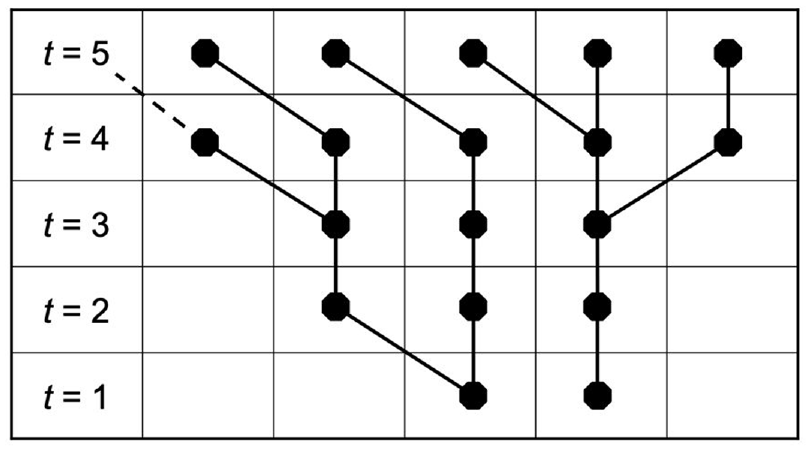
A simple example of indeterminism.
In Figure 2, thick dots represent higher-level states at a given time, and lines connecting dots—interpreted again as moving from time t = 1 (bottom row) to time t = 5 (top row)—represent higher-level histories over time. A “higher-level state of a system” is a state of that system as described at the level of detail appropriate for the relevant higher-level theory of that system, for instance a theory of human behavior as opposed to a theory of particle physics. A “higher-level history” is a state evolution of the system, according to such a theory. In the present example, Figure 2 represents the system’s higher-level behavior, while Figure 1 represents its lower-level behavior. Formally, Figure 2 can be derived from Figure 1 by assuming that any two or more distinct lower-level states (little dots) that fall within the same cell of the rectangular grid in Figure 1 give rise to the same higher-level state (a thick dot) in Figure 2. (The technical rationale behind this assumption is that higher-level descriptions are more “coarse-grained” than lower-level ones, insofar as they abstract away from certain lower-level details, thereby putting the emphasis on relevant higher-level patterns. In philosophical jargon, higher-level states are “multiply realizable” at the lower level; see, e.g. Fodor, 1974; Putnam, 1967.)
In the scenario of Figure 2, there are forks in the road. For example, if the initial higher-level state at time t = 1 is the one represented by the thick dot on the right-hand side of the bottom row, then there are three possible higher-level histories, each of which is compatible with this initial state, namely the higher-level histories that end with the states represented by the three rightmost dots in the top row of the table, at time t = 5.
It would be a mistake to think that only the lower-level description of this system as being deterministic is correct (in Figure 1), while the higher-level description of the system as being indeterministic (in Figure 2) is not. Rather, the system can be both at once: deterministic at a lower level and indeterministic at a higher level.
Consistently with this observation (made more formally in List, 2014), the philosopher of physics Jeremy Butterfield (2012) has argued that, in a system that admits multiple levels of description, the system’s dynamics—say, whether it is deterministic or indeterministic—at different levels need not “mesh.” In short, low-level determinism (e.g. in fundamental physics) is compatible with high-level indeterminism (e.g. in relation to agency). (Versions of the same formal point can also be found in Werndl, 2009, Yoshimi, 2012, and List and Pivato, 2015.)
Put differently: there can be degrees of openness or freedom with respect to agential possibility even when, from a low-level perspective, there aren’t any such degrees of openness or freedom with respect to physical possibility. Far from being paradoxical, this observation—that a system may display different dynamics at different levels (in Butterfield’s terms)—is supported by a multi-level picture of the world.
Conclusion
I conclude that the assumption that there is agency—even free agency—is vindicated by a scientific understanding of the world, provided we acknowledge that the world admits many different levels of description. Agency is a higher-level phenomenon, which comes with its own level-specific notion of possibility—agential possibility—and it would be wrong to analyze it in physical terms alone and just using the lens of physical possibility. Possibilities are best understood in a level-specific manner.
Footnotes
Author’s note
This paper was written as an informal position paper for the Templeton Symposium on “Possibilities: A New Science of the Unlimited” (September 2022); it is therefore written in a slightly different style than a more technical article. The paper draws on my earlier works on free will and agency (e.g. List, 2019,  ), from which Figures 1 and 2 are also taken, and my Theoria Lecture (titled “Agential Indeterminism”) at the Swedish Congress of Philosophy in Lund, June 2022. These works should be viewed as prior reference points for the ideas presented here. I also draw on a popular-science article on a related theme (List, 2020). For reasons of space, the paper omits a detailed literature review. I refer readers to List (2019, 2022). I thank the participants of the Templeton Symposium, two anonymous referees, and Johannes Kleiner for comments and suggestions.
Declaration of conflicting interests
The author declared no potential conflicts of interest with respect to the research, authorship, and/or publication of this article.
Funding
The author(s) disclosed receipt of the following financial support for the research, authorship, and/or publication of this article: A preliminary version was presented online at a symposium sponsored by the John Templeton Foundation, which paid a honorarium.