



Abstract
Looking at how people get oriented towards the psychological discipline, it is striking that students are often initially drawn to psychology because they wish better to understand their personal experiences and the world around them. However, these initial aspirations often remain unmet by the content of academic psychology classes and the teachers conveying it. Building on my experiences as a psychology lecturer, I explore the challenges of connecting personal experiences to psychological content in academic practice for students and teachers and how this can be traced back to the ongoing contested nature of psychology’s subject matter. In doing so, I mainly draw on the distinction between ‘big P’ academic psychology knowledge and ‘small p’ everyday psychology knowledge to explain the current conditions and discursive dynamics in psychology classrooms. I then turn to insights from other disciplines concerned with facilitating academic teaching experiences integrating personal engagement and everyday experience to explore how the role of psychology instructors can be redefined and expanded in the future. Given that university classrooms play a pivotal role in shaping students’ professional identity and perception of the discipline, I advocate for acknowledging and utilizing the personal relevance of seminar contents to bridge the gap between ‘big P’ and ‘small p’ psychology in academic teaching.
Keywords
Introduction: Putting the personal in psychology?
Looking at how people get oriented towards the psychological discipline, it is striking that students are often initially drawn to psychology because they wish better to understand their personal experiences and the world around them. However, regrettably, because everyday experience is not reflected in psychology, many students drop out over time or report on how difficult it was to persevere and complete their studies (Struppe-Schanda & Wrbouschek, 2022). Additionally, some students may feel disconnected and isolated due to the distant way psychology is taught to them (Martins et al., 2023). A recent movement initiated by psychology academics (Victor, Devendorf, et al., 2022; Victor, Schleider, et al., 2022) seeks to bridge this gap in ‘coming out proud’ by sharing personal experiences of psychological struggles while working and succeeding as academic psychologists. In doing so, the authors (Victor, Devendorf, et al., 2022; Victor, Schleider, et al., 2022) shed light on how complicated personal connection to psychological content can be in academic practice and teaching. Some scholars even argue that good academic practice – apart from common claims – lives on meaningful engagement and integrating personal interests with psychological content rather than maintaining distance (Nzinga et al., 2018).
To explore this disconnect between academic psychology and everyday life in more detail, I will first lay out how the ongoing question of the concrete subject matter of the discipline of psychology shapes the way psychology is currently learned and taught in academic settings based on the example of my own teaching experience in a social psychology seminar at an Austrian private university. Therefore, I will delve into theoretical questions regarding academic psychology, as considered by Benetka and Slunecko (2023) and Pickren and Rutherford (2010). The latter, who critically reflect different types of relevant knowledge for psychology, advance an analytic distinction between academically institutionalized psychological knowledge, “big P” Psychology and lived everyday psychological knowledge in the form of “small p” psychology (Pickren & Rutherford, 2010, p. xix). I will then examine the effects of this separation of psychological knowledge stocks in present teaching and learning psychology. In doing so, I will draw from studies on instructors’ and students’ experiences in academic classrooms and focus on the spatial conditions and discursive dynamics that shape the seminar experience. Finally, I will attempt to reconnect the academic and everyday psychological knowledge by drawing on ideas from teaching approaches that centre student learning, such as feminist pedagogy (Hassel et al., 2021) and transformative teaching (Handelsman et al., 2020). Herby, I will extend their arguments insofar as I will argue that real-life experiences can be used to establish a student–teacher relationship in classrooms in the first place and the importance of authenticity in psychology seminars for students and teachers alike. The purpose of this paper is not to question that different positions and responsibilities are fundamentally important in the teaching context but to outline initial considerations, as well as stumbling stones and reflections about current and possible future ways to redefine teaching and being in a psychology seminar. I also cannot provide definitive answers to all the questions raised along the way. Instead, I aim to theoretically reflect on and contextualize my experiences with my students and colleagues as a young psychology lecturer and attempt to shed light on the possibilities and limitations that can be imposed on psychological teaching. Given the high dissatisfaction with the classroom experience in psychology by students and academics alike, it seems necessary to open up a conversation about how we, as psychologists, want our discipline to move forward. Scholars from other disciplines have already elaborated on their teaching experiences (Anderson et al., 2020; Hassel et al., 2021). However, a thorough transfer of teaching experiences to the disciplinary identity by a psychology lecturer still needs to be included in the literature. Redefining the role of psychology instructors to keep students interested and engaged in psychology in the future is crucial because today’s students will be tomorrow’s figures of psychology. Thus, I will close my elaborations with considerations about which paths might be worth exploring in bridging the gap between different stocks of psychological knowledge.
Teaching reflections: Connecting student experiences to classroom practices
To illustrate the importance of examining psychology’s current learning and teaching conditions for the people involved, I will briefly describe how I first became aware of this problem. In the course of the paper, I will also repeatedly refer to the two examples given to condense my theoretical reflections.
As part of their final thesis in psychology, Martins et al. (2023) recently published a collaborative zine with their interviewees that explored the experiences of undergraduate psychology students in Canada. The collaborative zine, which took previous interviews and statements as a starting point, centred on the student’s difficulties with psychology course content, criticism of the disconnectedness of academic psychology to everyday life and general discomfort in psychology classrooms despite (initial) high personal motivation and interest in the subject. These findings and insights into the lives of psychology students (Figure 1) also led me, as a young teacher in social psychology and qualitative methods, to initiate a process of reflection on my own teaching experiences and practices and how these relate to the (history) of the discipline.
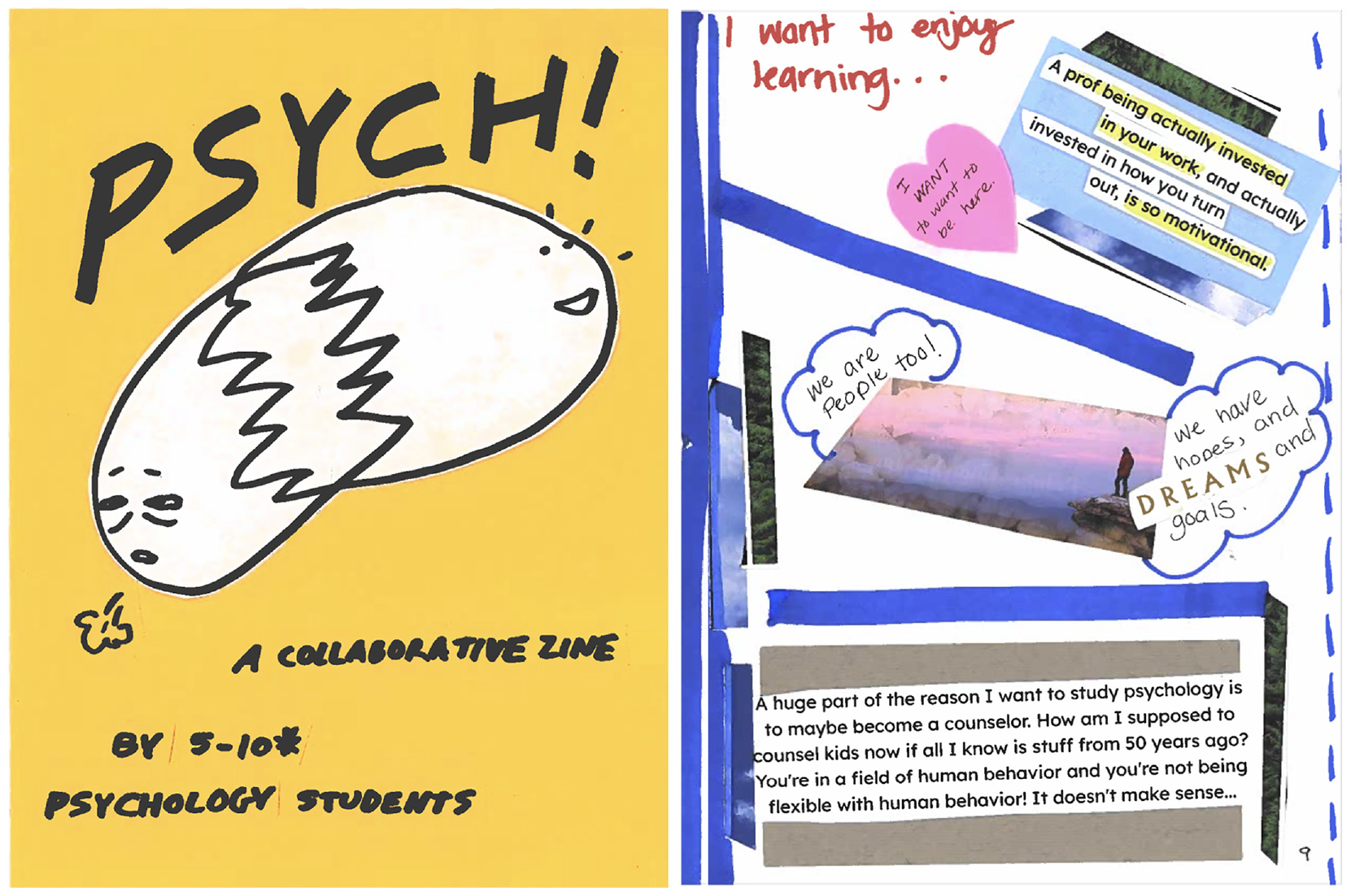
Excerpts from Martins et al. (2023) collaborative zine ``PSYCH!’’
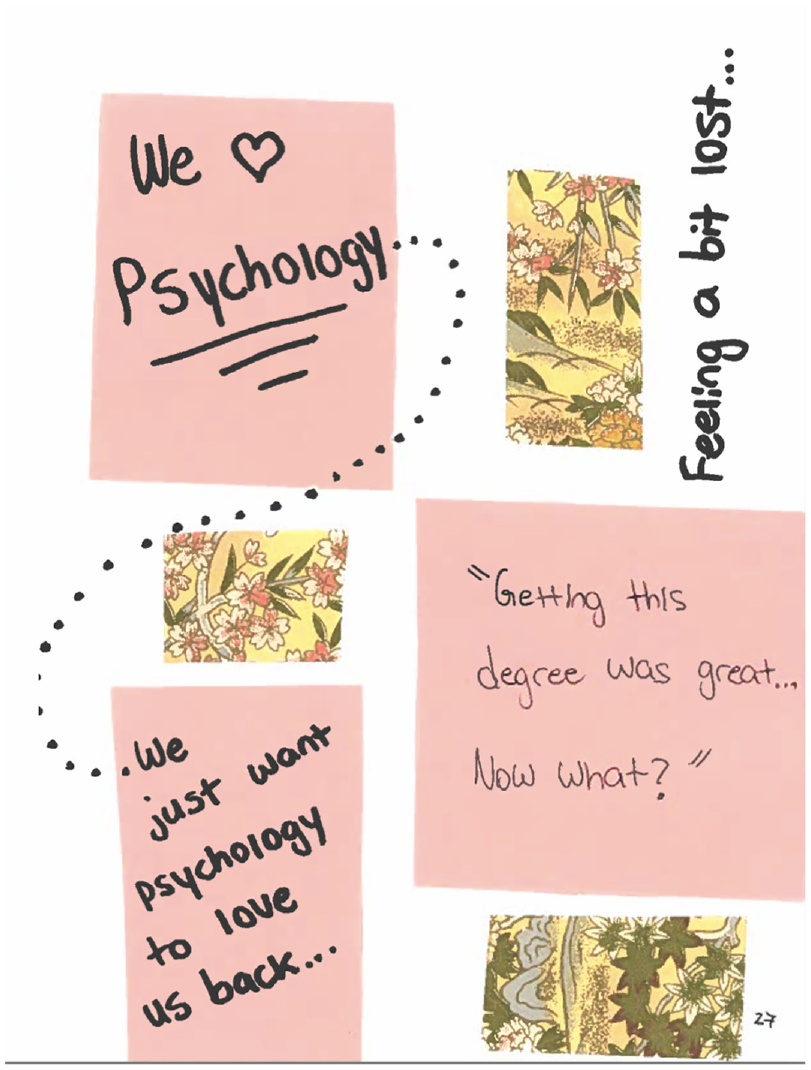
Excerpt from Martins et al. (2023) collaborative zine “PSYCH!”
To illustrate my point further, I briefly want to use an example from one of my seminars: The topic of the course was, roughly speaking, the construction of mental illness and mental health over time. During the course, I had the pleasure of working with very engaged students, and we (sometimes more, sometimes less) eagerly discussed different conceptions and latent meanings of mental disorders and their importance over time. The class built on a previous class the semester before, which meant that I already knew most of the students at that point. During the seminar, I – thinking of my role as the lecturer – kept trying to urge them to stick to the historical context and the thought processes of the scholars we were dealing with. Nonetheless, the question of how mental illness is constructed today always found its way into the seminar room. However, when we started discussing the current relevance of mental health and mental illness, it was always in a very general and abstract way that made me – from my point of view as a lecturer trying to make the students achieve certain pre-set learning goals – doubt the added value of such discussions. In parallel, yet separately, I noticed that many students (also from other courses and contexts) started to disclose their personal experiences of mental discomfort and how it hindered their pursuit of their studies in other ways, for example, personal emails or discreet face-to-face encounters. Abstractly discussing issues of mental illness during class and trying to support students through their psychological battles outside of class led me to wonder if these two aspects were somewhat connected. I wondered if I should or should not consider this parallel between their everyday experiences and the course material into account in my teaching. As the end of the course approached, I felt like I needed to ask myself if I had not fallen prey to the very same problem that I had so desperately tried to change through the course: The possibility of being able to talk (openly) about everyday psychological knowledge and potentially personal connections to the course theme. To counteract this, in the last seminar session in attendance, I asked my students if they might be interested in reading something about the psychological condition of people who work and teach in psychology. This was only possible because a professor I look up to had told me a few weeks earlier that we, as people working in scientific psychology, hardly ever talk about our relations to the phenomenon we study. She had heard about a paper that tried to change just that. As I was thinking about my students and our course, this very conversation came up again, and I set out to find the paper, which turned out to be the work by Victor, Devendorf, et al. (2022) on “Only Human: Mental health difficulties among psychology faculty and trainees”. Some of these authors accompanied their papers with the publications of a commentary (Victor, Schleider, et al., 2022), which I, in turn, gave students for an in-class reading exercise. Just as it felt important and right to include this text, the situation also made me nervous. How would the students, or we collectively, deal with this explicit introduction to the possibility of having some personal relation to the course contents? Would this ‘elephant in the room’ make some feel uncomfortable? And if so, for what reasons? Would I be able to handle their reactions to the text? One consequence of this nervousness, but also the concern for the student’s safety in the seminar setting, was that I tried to very insistently point out to them, even before handing out the reading, that discussing the text would not, however, mean that anyone should feel compelled to disclose experiences of their own. I, unfortunately, do not remember much of the ensuing discussion, except that none of my previous fears materialized. Besides, this particular statement from a student will probably haunt me for a long time: “I have not come across a text like that in the whole of the last 3 years of my studies; we have never talked about it before”. I saw a few others nodding in the room and could not help but think, “Me neither”.
This experience raised several subsequent questions for me, which I will reflect on and theoretically contextualize in the following to explore how the way psychological knowledge is taught in university classrooms might shape and imprint our understanding of psychology and vice versa.
Academic epistemologies and didactics of psychology
To investigate the phenomenon of the psychological classroom experience, psychology as an academic discipline and its didactic specifics will be examined in the following. According to Knotts et al. (2009) each discipline comes “with [its] own sets of epistemological assumptions and research practices”, which leads to the fact that “each discipline produces and validates its form of knowledge” (p. 194). Therefore, to understand which forms of knowledge are present and acknowledged in psychological seminars and which are not, I will first examine the discipline’s psychological self-concept closely.
Teaching psychology in universities has become a subject of scientific research in recent years (Dicker et al., 2019; Hagenauer et al., 2016; Hagenauer & Volet, 2014; Tulis, 2021). A discipline’s self-concept has implications for how the discipline’s knowledge is conveyed in the teaching context, as subject didactics also convey normative assumptions about its subject (Duetke, 2021). According to Kullasepp (2022), study curricula are institutional interventions to develop students’ skills for their future professions. Furthermore, examining the details of teaching psychology plays a crucial role as students already come to class with preconceptions about psychology (Tulis, 2021). However, some psychology teachers view these so-called everyday understandings of psychology with concern, and as potential ‘misconceptions of psychology’ (Tulis, 2022). Therefore, by learning psychology in an academically conveyed manner, these ‘everyday’ or ‘commonsense’ assumptions may change and get replaced over time (Tulis, 2021). For the successful and sustainable teaching of (psychological) subject matter, two key concepts, particularly, are repeatedly cited in the literature: Relevance to everyday life/subjective relevance and the importance of the learning context. Nonetheless, Tulis (2021) notes that “even after years, school knowledge and everyday knowledge often stand side by side unconnected” (p. 159).
Looking at the ongoing attempts to define academic psychology (Benetka & Slunecko, 2023), it quickly becomes evident wherein this circumstance lies: The postulation of psychology as a ‘hard’ science makes it imperative to detach personal connections to the discipline. Benetka and Slunecko (2023) highlight the impact of the disputed definition of the subject matter psychology on its teaching and learning at the university level. They specifically critique the undergraduate guidelines set by universities and draw from their own experiences of teaching psychology in academia. They argue that the objective of the guidelines is to “rid young people of these notions: that this science could have something to do with their real life” (German in original, Benetka & Slunecko, 2023, p. 39).
In summary, psychological teaching is multifaceted in that it ties in with philosophical, educational science and psychology debates and raises fundamental questions about ‘what is psychology?’ (Geiß & Tulis, 2021). This is important because research has shown that teaching and classroom experience vary by discipline and epistemologies (Knorr-Cetina, 1999; Lindblom-Ylänne et al., 2006). However, some scientists point out that the vagueness of psychological concepts is a constitutional factor that cannot be resolved (Hutmacher & Franz, 2024). Questions about how psychology is taught go beyond the discipline’s core paradigm, while the fundamental subject matter continues to be contested. How psychology is taught and communicated nevertheless signals a particular canon of the discipline and “professional identity” (Kullasepp, 2022), just as its teachers act as points of orientation and role models for newcomers (such as students) (Leijen et al., 2018). Geiß and Tulis (2021), therefore, describe psychological didactics as being “normative-theoretical” as well as “methodological-practical” and “experiential” (p. 13), which illustrates the tremendous demands, heterogeneity and complexity of psychological teaching.
Different stocks of knowledgein P/psychology
Pickren and Rutherford (2010), in their work on “A history of modern psychology in context”, emphasize the importance of understanding “Psychology as a socially embedded science” (p. xv). Even before the scientific institutionalization of psychological knowledge as an academic discipline, forms of everyday psychology have always existed, shaped and practised by humans and their ways of being and existing in this world (Pickren & Rutherford, 2010). Benetka and Slunecko (2023) also refer to “our immediate involvement in the world in which we “live and move and have our being”” in this context (p. 39). To explore the different facets of psychological knowledge that come into play in the discipline of psychology (and thus in psychological teaching), Pickren and Rutherford (2010) further elaborate:
Psychologists claim some of the most intimate and personal aspects of human experience as their subject matter. For many students, this is what makes psychology so fascinating. Stated most broadly, psychology is the scientific study of being human. While we each have access to our private experience, psychologists approach and study this experience more systematically and scientifically than we can. (p. xvii)
Pickren and Rutherford (2010) distinguish between ‘little p’ psychology and ‘big P’ Psychology knowledge to approach these different bodies of knowledge. The term ‘big P’ Psychology refers to the body of psychological knowledge recognized academically as scientifically valid and subject to formalization and institutionalization processes. In contrast, ‘small p’ psychology refers not only to the stocks of psychological knowledge relevant to everyday psychological understanding but, according to the authors, also “the psychological subject matter itself” (Pickren & Rutherford, 2010, p. xix). After all, psychology appears at least in some dual nature, on the one hand in the form of a distinguished academic discipline and on the other hand as something that affects and encompasses everybody in their everyday lives. Because of this hard-to-grasp nature of psychology, Pickren and Rutherford (2010) point to the importance and power psychological knowledge production can hold. Psychological knowledge can influence and change people’s perceptions of themselves and others, whether it is part of academia or not (Pickren & Rutherford, 2010). To make sense of this “socially embedded science” (Pickren & Rutherford, 2010, p. xv), the authors point towards the importance of reflexivity, given the fact that “we are both agents and the objects of scientific study in psychology and are thus active generators and recipients of that knowledge” (p. xix). Pickren and Rutherford (2010), in line with Benetka and Slunecko (2023), stress that even though many academic psychologists continuously try to distinguish their own experience from their field of study, it remains challenging to separate the observed from the observer themselves, consequently.
Nevertheless, one common critique about academic practice that supposedly hints at the authors’ attachments to their work is the accusation of doing ‘advocacy research’ or ‘me research’ (Nzinga et al., 2018) – accusations that implicitly attack not only the nature of the research but also question the scholarly quality of the academic practice in question. According to Nzinga et al. (2018), this situation can be traced back to the influence of Merton’s (1973) sociology of science, who postulated that science should be universal, disinterested and sceptical, among other things. However, Nzinga et al. (2018) demonstrate the consequences and affordances that such a distant approach to academic practice can entail (such as inattention to the social context or insensitivity about assumptions). They compare these with the consequences and possibilities of being openly ‘engaged’ with one’s scientific endeavours (Nzinga et al., 2018). Although both approaches bring their challenges, the authors point out that given the ongoing maintenance of a distant approach to psychological science, significant blind spots and gaps can still be found in the existing body of academic psychological knowledge (Nzinga et al., 2018). According to the authors, this calls even more for engaged scientists, as good academic practice would thrive on engagement, interest and healthy scepticism rather than distance (Nzinga et al., 2018).
Applying these insights to teaching psychology in an academic context raises the question of how these different facets of psychological knowledge can be incorporated into teaching and learning and how engaged learning experiences in a classroom can be promoted rather than discouraged. As previously discussed by Pickren and Rutherford (2010) and Benetka and Slunecko (2023), students are initially drawn to academic psychology due to their keen interest in everyday psychological phenomena. At the same time, studies on teachers’ experiences show that they fear being discredited as not academic enough if they allow emotions in the classroom (Rogers & Freiberg, 1995; Wagh, 2022). Within academia, the division between two forms of psychology – the ‘scientific’ and the ‘unscientific’ – remains strongly upheld and an additional topic of intense debate. Therefore, considering Nzinga et al.’s (2018) insights regarding the consequences of maintaining a distant approach to psychological knowledge, one might critically need to question whether students’ initial enthusiasm is met by their actual experiences in their courses, curricula and classrooms. Indeed, this raises the question of what consequences this separation may have for psychological teaching and learning.
In this sense, the proposed differentiation between ‘big P’ Psychology and ‘little p’ psychology can be used to untangle the different facets of psychological knowledge that can become relevant in psychology classrooms. Therefore, I propose that even though academic classrooms are undoubtedly sites for gaining and expanding scientific knowledge, many relevant bodies of knowledge and expertise can easily be dismissed when only genuine ‘big P’ Psychology academic endeavours are considered.
Beyond tables and chairs: Exploring the discursive dimensions of seminar spaces
When thinking about the status of everyday psychological knowledge to academic psychology knowledge creation in the classroom, examining the various dimensions of a seminar experience that unfold during teaching psychology classes can be helpful. In order to do so, I will examine the conditions and the discursive positions of students and instructors in the following.
To investigate the strategic setup of a seminar room in more detail, I will draw upon my experience as a course instructor in the aforementioned social psychology seminar and contextualize this with relevant literature findings. Typically, the seminar room features numerous tables and chairs facing a central stage. The instructor is expected to occupy the front space, enabling them to lecture, moderate and observe their students. From my experience, this arrangement inherently signals a power dynamic between students and teachers, with the seminar room serving as the instructor’s stage and realm of authority (Rich et al., 2015; Rogers & Freiberg, 1995; Wagh, 2022). Additionally, this room setup dictates how students are expected to interact with each other and affect their communication with the instructor (Rich et al., 2015). Consequently, it is common for students to direct their comments or questions towards the instructor rather than engage with their peers. Even if instructors can occasionally alter the room’s layout, students generally lack the agency to initiate such changes. In this sense, instructors have a significant say in arranging the room and facilitating conversation and interactions (Montero-Hernandez et al., 2021).
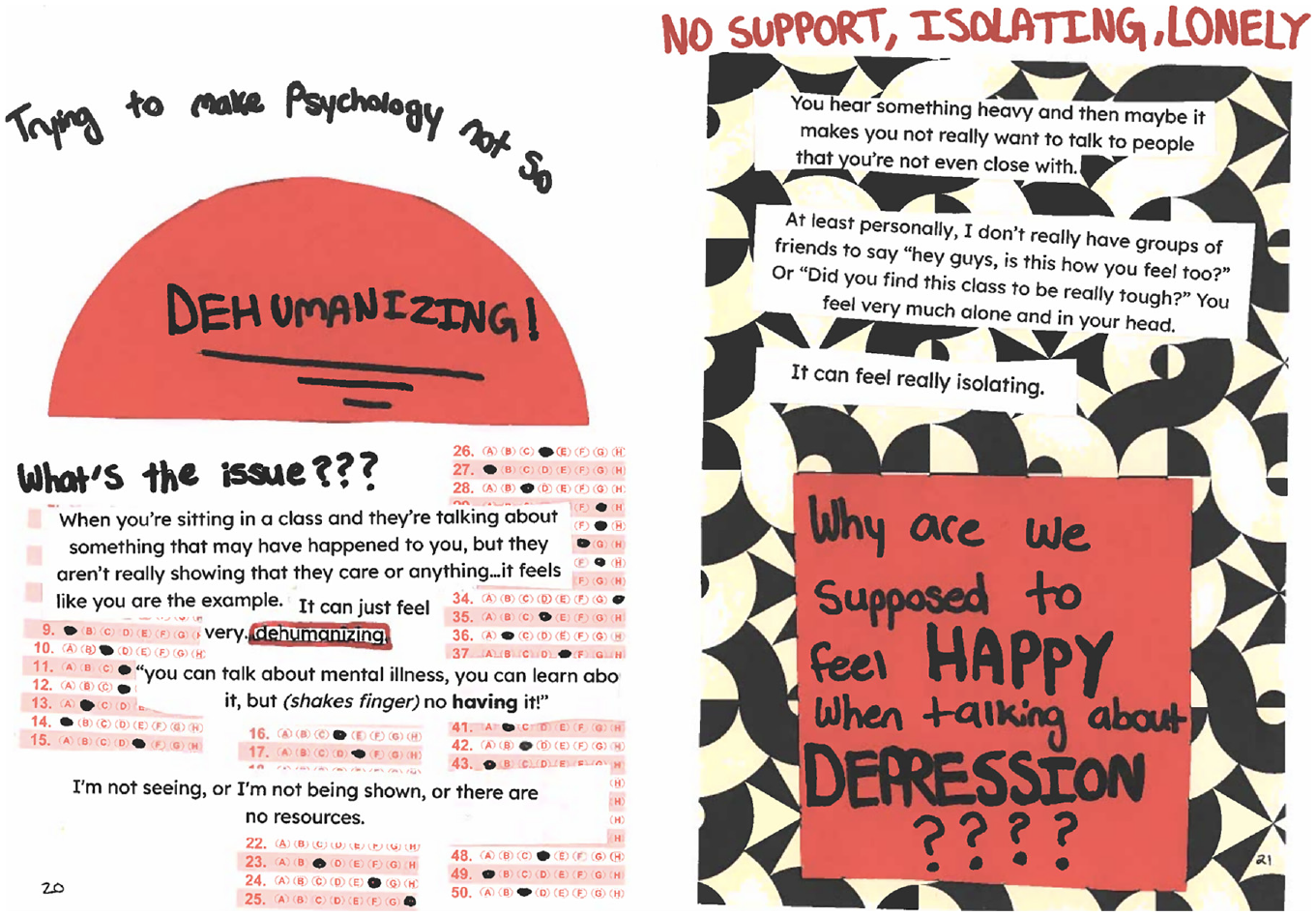
Thereby, on the discursive level, a more subtle arrangement between these spatial conditions of the academic classroom can be found: the emerging question of what content or references are even sayable or “undiscussable” (Baker, 2004, p. 693) in the seminar. In this regard, students often attempt to drawstrings to their personal experiences and life stories in psychology classrooms. However, others have already documented that students’ experiences also show that they are often quickly, either implicitly or explicitly, signalled by their instructors that these personal experiences have no place in psychology classrooms (Martins et al., 2023). Hence, Leijen et al. (2018) conclude that educational structures also signal to students social role expectations, a professional code of conduct and the possible scope of their affective responses allowed therein. According to their findings, instructors play a crucial role in shaping the future professional identity of students. How they design the course curriculum, teach their classes and interact with students can significantly impact the student’s experience of the discipline and their perception of themselves and others in it. Social expectations and social roles can also influence students’ code of conduct and emotional responses, which may cause a conflict between their personal and professional selves (Leijen et al., 2018). Accordingly, Hassel et al. (2021), in drawing on feminist pedagogy, advocate acknowledging that students already enter the seminar with preconceptions and bodies of psychological knowledge that they have acquired, in some cases, throughout their lives. This aligns with the ongoing engagement, identification, application and modification of P/psychological knowledge, as discussed by Pickren and Rutherford (2010). Psychological content’s instructional significance is underscored because it is assumed to influence how students think about themselves and others (Kullasepp, 2022; Leijen et al., 2018; Martins et al., 2023). This can be seen, for example, in the mentioned zine by Martins et al. (2023). In this zine, interview excerpts have been collected and used from interviews with psychology students about their experiences in an undergrad psychology programme in Canada (see also Figure 3). Here, one statement elaborates: “You can talk about mental illness, you can learn about it, but (shakes finger) no
Excerpts from Martins et al. (2023) collaborative zine “PSYCH!”
Nonetheless, instructors may have good reasons to contain students in their personal narratives. From their perspective, the issue presents itself differently. They aim to steer students away from personal experiences to sharpen their focus on the bigger picture and the underlying systems and structures. Even if instructors are usually convinced that their students hold much knowledge, the (sometimes hidden) agenda may be that students need to train themselves to master psychological theories and tools first to be able to revise, expand or dismiss them second. These differing positions are opposed (similar to the seating arrangements described earlier in the classroom) and seem irreconcilable, even though students and instructors are brought together precisely because the former wants to learn from the latter, and the latter wants to teach the former. An aspect that is, yet again, evident in the collaborative zine by Martins et al. (2023), in which one contribution raises the question: “Why are we supposed to feel HAPPY when talking about DEPRESSION????” (emphasis in original, p. 21).
However, it is usually the students who disclose their experiences in seminars, if at all. Instructors rarely share their personal experiences in academic seminars. When they do, it is usually very selectively and carefully, as evidenced by academic psychologists’ need to ‘come out proud’ (Victor, Devendorf, et al., 2022; Victor, Schleider, et al., 2022) when they decide to disclose. Already Rogers and Freiberg (1995), in their humanistic, person-centred approach towards teaching and learning, raised the question of whether it might be (im)possible for teachers and students alike to be “real” (p. 41) in a classroom and pointed towards “the risk of being human in class” (p. 43). In turning again to Pickren and Rutherford’s (2010) claim of psychology as a ‘socially embedded science’, one may wonder: Are not all of us who come together in these psychology classrooms, in one way or another, inevitably connected to the course contents? Connecting these findings to the initial teaching reflection and theoretical contextualization, it appears that two distinct, yet inextricably connected, worlds collide in a psychology seminar due to the subject of the discipline itself: the students and their inital interest in ‘small p’ psychology and the instructors, in trying to adhere to their job description, mostly centring established ‘big P’ Psychology content.
Redefining the role of psychology instructors
Research suggests that a professional teacher identity develops through a dialogue between personal and professional selves when becoming a teacher (Leijen et al., 2018). However, the call made by Victor, Devendorf, et al. (2022) to be recognized as ‘only humans’ as psychological academics shows parallels to Rogers and Freiberg’s (1995) humanistic approach to teaching and learning and the difficulties this can entail. In order to explore the potential of combining ‘small p’ and ‘big P’ psychology in academic teaching for psychology instructors, the following section will examine interdisciplinary research on integrating personal experiences into teaching.
Most scholars on teaching agree that teaching is a form of relationship between teachers and students. This relationship can significantly impact teachers’ and students’ experiences (Anderson et al., 2020; Dicker et al., 2019; Hagenauer et al., 2015). Research into teachers’ emotions suggests that the perceived appropriateness of showing emotions in the classroom depends on the type of emotion (positive or negative) and the cultural context (Hagenauer et al., 2016). At the same time, studies show that teachers fear being seen as unprofessional or non-academic if they allow their humanity or authenticity in the classroom (Rogers & Freiberg, 1995; Wagh, 2022). However, research on students’ experiences in academic classrooms shows how highly students value teachers’ expressions of engagement, interest, commitment and passion for their learning experiences beyond the classroom (Anderson et al., 2020; Dicker et al., 2019).
Knotts et al. (2009) identified four core facets of authenticity for teachers and students in academic education. These encompass “being present in the classroom”, “awareness and utilization of context”, “active engagement” and “ownership of education for student-centred learning” (Knotts et al., 2009, p. 188). The authors emphasized the significance of incorporating students’ personal stories, personalities and experiences into the seminar, emphasizing the need to empower students’ voices for enhanced learning. This could be represented for psychology by including everyday, commonsense psychological knowledge in conjunction with academic psychological knowledge in the course contents.
In this sense, Montero-Hernandez et al. (2021) extend this perspective, suggesting that an “open classroom climate where dialogue and mutual acknowledgement are welcomed” (Montero-Hernandez et al., 2021, p. 17) can benefit both students and teachers. According to the experiences of Hassel et al. (2021, p.42), the authentic sharing of personal connections (be it impressions, affects, experiences, or open questions and personal unknowing) in the classroom can help in “getting students excited to share their knowledge with [one of the authors] and establishes a collaborative atmosphere”. The authors argue that sharing personal connections can thus become a means that broadens students’ horizons, opens their understanding of the material beyond the classroom context and thereby promotes reflexivity and a more sensitive awareness of the bigger context (Hassel et al., 2021). Especially in the context of psychology seminars and regarding the previously cited work by Martins et al. (2023), it, therefore, seems indispensable to me as a psychology lecturer to not only ask how personal experiences and encounters can be handled in the course but also how it can be facilitated that students feel overall more connected to their coursework. Considering the provided insights by Hassel et al. (2021), the idea lends itself that a connection can be found between those two aspects and that to facilitate students’ connection to the seminar work, we also need to take their (and our) personal experiences seriously.
According to Hassel et al. (2021), asking oneself, as the person teaching the seminar, what one wants their “teacherly persona” (p. 40) to be like can be fruitful. This self-reflection can take the form, for example, of questioning how one wants to present oneself to the students, how one intends to interact with them and how one wants to position oneself to the course material. Given the still disputed definition of psychology between natural and humanistic sciences, finding an answer to these questions remains challenging. Thus, the impression arises that the decision for a variant of the teacherly persona is inseparably linked to one’s understanding of psychology as a science and will be answered differently depending on the perspective.
Against this background, we who teach psychology could introspectively ask ourselves: What kind of psychology is embedded in our classes and teaching? How informed by everyday psychology is our academic teaching? How personal can and do we want our teaching to be? How personal should our teaching not be? Lastly, how can we bridge this gap between personal and academic psychology knowledge while remaining professional? These questions are not intended to be a definitive checklist but rather to provide an initial impetus on how our role and responsibility as educators can facilitate new ways of knowledge production in approaching the life worlds of psychology students. In this context, it can also be helpful for a teaching person to consider the extent to which they wish to reveal their connections to course content and the impact this might have on their students. Again, the student learning experience should be central to all such decisions. Just as instructors typically design their syllabi and classroom activities before teaching, it might be worthwhile to carefully consider what message about psychology as a discipline they want to convey.
With this in mind, another essential consideration for psychology teachers might be to think about how to support the transformation of students into psychology professionals (Kullasepp, 2022). Handelsman et al. (2020) argue that supporting students in their agency is critical to achieving professionalism in light of their transformative teaching approach. To accomplish this, the authors outline how their aim as educators was “to make students more professional, rather than just people who know more about the profession. To accomplish this, we needed to integrate course material into students” own experiences, practices, professional activities and professional identities” (emphasis in the original, Handelsman et al., 2020, p. 131). Here, too, an important indication can be found of the need for and the added value that incorporating personal experience into teaching can have.
Applied to the teaching of psychology, I, therefore, suggest that the personal relevance of seminar contents to students and the inseparable connection between ‘big P’ psychology and ‘small p’ psychology can be utilized productively for academic teaching and learning. By creating a positive learning environment, teachers can foster positive relationships between themselves and their students and encourage positive peer relationships among students (Bovill, 2020). Redefining the role of psychology instructors to keep students interested and engaged in psychology in the future is crucial because today’s students will be the future figures of psychology.
Conclusion
Bringing together the findings presented, it is clear that the way psychology is understood as an academic discipline has an enormous impact on the concrete classroom experience of students and teachers alike (Lindblom-Ylänne et al., 2006). However, the current way psychology is taught and learned stands in sharp contrast to what brings many people into the discipline in the first place (Struppe-Schanda & Wrbouschek, 2022). In this regard, I align myself with Nzinga et al. (2018) in suggesting that an open engagement with scientific content has an impact, and an explicitly distanced position comes with consequences for research and teaching. For instance, one of the persons quoted in the collaborative zine by Martins et al. (2023) elaborates on their experiences in a psychology undergrad programme: “When you’re sitting in a class, and they’re talking about something that may have happened to you, but they aren’t really showing that they care or anything… it feels like you are the example. It can just feel very dehumanizing” (p. 20). In this context, I agree with Hassel et al. (2021) in advocating for “putting student learning at the centre of course design” (p. vii), and I argue that in a psychology seminar, this can might entail to not only think about the ‘what’ of the course content but also to reflect on the interpersonal ‘how’ of its delivery. However, putting my initial teaching experience into context by, on the one hand, drawing on the differentiation of ‘big P’ Psychology and ‘small p’ psychology as proposed by Pickren and Rutherford (2010), and, on the other hand, on the personal experiences as presented by Martins et al. (2023) for students and by Victor, Devendorf, et al. (2022) and Victor, Schleider, et al. (2022) for academic staff, it appears that different stocks of knowledge come to clash in psychology seminars quite regularly. For future research, it could be interesting to explore further the relation between ‘small p’ and ‘big P’ psychology theoretically. The paper is intended to provide an initial impetus for this. However, it is exciting and essential to investigate the relationship between different stocks of knowledge involved in psychology and whether they could be constitutive of each other. Furthermore, the consequences of applying such a teaching concept could thus far only be touched on in a self-reflexive theoretical manner and experience-based beginnings, which will need further development in the future.
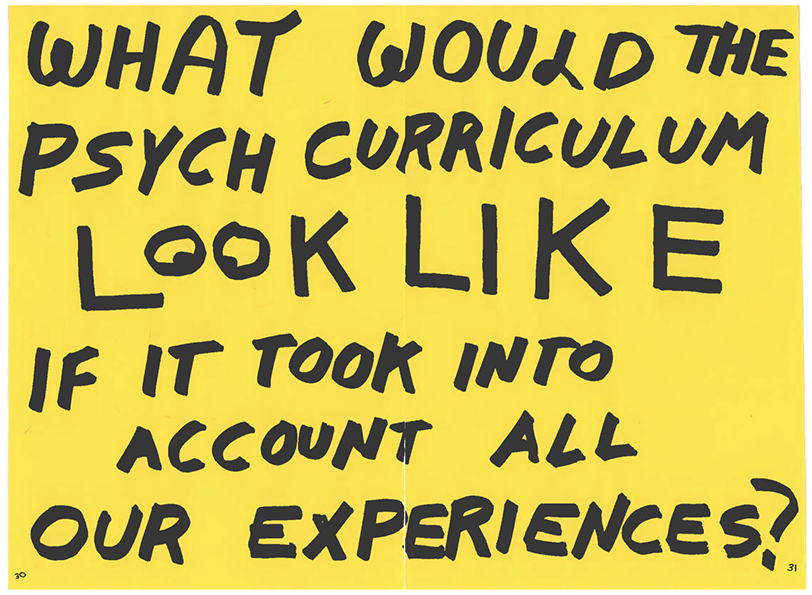
Establishing new ways of teaching and learning psychology raises the question of what psychology seminar rooms can learn from the classroom experiences of other academic disciplines and everyday life (Figure 4). Looking at the insights provided, it becomes evident that self-reflection, fostering professional relationships between teachers and learners based on authenticity and mutual recognition and incorporating academic guidance and everyday experience can have a lasting impact on the seminar experience. With this in mind, it is rewarding to consider how bridges can be built between these various stocks of psychological knowledge to successfully redefine and expand our ways of teaching and being in a psychology seminar.
Excerpts from Martins et al. (2023) collaborative zine ‘PSYCH!’
Footnotes
Declaration of conflicting interests
The author declared no potential conflicts of interest with respect to the research, authorship, and/or publication of this article.
Funding
The author received no financial support for the research, authorship, and/or publication of this article.