



Abstract
The human being as an individual has unique ways of perceiving the dynamic interrelation between self-environments. The shift in the irreversible time interrelates with the organic notion of development. Still, change does not simply mean that we are physically changing, but it also implies that our way of seeing the changing reality-construct is constantly in change. But how do we actually see the world and what goal does the concept of goals/dreams play in all of that? In the following article the construct “goal” is redefined into a more phenomenological-based understanding in which goals are transformed into fields that inhabit our vision field and flourish in the deep spheres of imagination.
Attention the word dreams in the following article represents the dreams of archiving goals, not the dreams rooted in our slumber.
The human being is complex when it comes to the realization and exploration of goals. Always searching for the possibility to reach something. “Making dreams true” for example creates a space for new inventions and central achievements, nevertheless it is also a starting point of emotional pain and suffering. A central reason for experiencing an impossibility of achieving the desired goal is that there is not simply a single solid one (dream) that we are following. The human is a complex dynamic being that changes, conscious as subconsciously, and so is part of a development that transforms the physical but also the mental level of the individual and so results in a cultivating of the perception and direction toward our dreams and goals. Another factor may be that the human being is a multidimensional individual that, as the Dialogical-self-theory suggests (Hermans, 2001), inhabits multiple inner voices that through an inner dialogue create the construct we understand as self—the core unit of our perception experiencing—. These multiple voices also inhabit a diversion of fragments of our desires and create a constantly altering fragmental shift that results in our experienced felt-sense (Gendlin, 1995; Tsuchimoto, 2023) of having-goals-and-“dreams.” By connecting the previously mentioned notions of “why-archiving-dreams-in-common-sense-is-impossible” and by extending the own perception a new essential perspective is introduced, in the following article, as a synthesis of cognitive, cultural and developmental system-views; “the goal-fields.”
The notion of dreams and goals
There is still even a deeper layer of why we cannot avoid certain suffering in our dedication to the desired. A reason that appears small, while its impact is tremendous.
Before I share the triggering statement, I would like to underline that this claim may sound bold and slightly depressing, but still has to be taken into consideration. Also, the reason why you may feel so is the core of the phenomenon I will explore through the following article: “Dreams can never be archived nor reached.”
Goals or “dreams” are nothing else than the projection of the current self 1 into the future, while using memories (past) as a blueprint (Campill & Valsiner, 2021). The concept goal is in its core unit an object of interest that has been shaped in the metaphysical layered fields of our mind—something that we experience, while it physically does not consist of matter. In other words, goals are not unarchivable because they are unrealistic, they are unreachable as they have never been something else than projections that are based on our brilliant, but still very limited, minds. A goal should never be intended to be used to reconstruct it precisely as we envision it. Goals are guidelines we can choose to follow but do not need to.
There are many kinds of goal projections that we experience as “the point” in our lifeline we want to cross 2 for example we could say “My-goal-is-to-become-scientist,” “My-goal-is-to-become-happy,” or “My-is-to-be-musician.” Ironically, we can already define the following statements from a researcher position as insufficiently described: what we intend to say with such statements lies hidden in ourselves, while we identify our goals instinctively as points, we are reaching for—Something we want to be part of. We could for example say that when we have thought about being a scientist, we have thought also about the role of a character on TV (as Bill Nye the science guy). In the case of happiness, we may have thought of having a lot of fun with our friends, and by being a musician, we thought about being the singer and songwriter in a band. The illusion is to become something, while the nuances and precision we envision our success are so unique and detailed that it could never become exactly like that. In the end, we need to gain the awareness that our projections are not forcing us to a specific point “MY GOAL IS X.” Instead, we need to see our goals as a field “MY GOAL IS SOMEWHERE IN THIS DIRECTION AND STILL NOT CLEAR”—we are always working and adapting on ourselves and so on our goals, based on the experience and meaning we make in our environmental 3 context.
So that the act of trying “to make the own dreams true” can become unbelievable painfully for the individual ass the created projection is determined to fail, while the individual is giving their all to make it become reality. A process that in habits multiple illusions, one of them is the belief to run behind the own dream never truly reaching it while the core idea of those goals has been reached.
Of course, some readers could now state that they never have experienced such a feeling of despair, while I would underline here that you may have found in that case another way to cope with the distress of dissonance between the projection (imagination) and experiencing physical life.
Goals have become central projections of human sense-making, in which our environment receives a certain consent-sense and we on ourselves in relation to our environment gain a reason for existence—felt-sense of connecting with the world. Meanwhile, we progressively lose our awareness of the imagination-reality-condition we are living in (Zittoun, 2016), even though our global knowledge of life expands continuously.
Human: The inner imagination-reality-condition
The human being is often referred to be a single unity with multiple layers, which can be retraced in many Naturwissenschaften, in physical and mental spheres. In general, this means that the human body or the human mind is one single complex object that then is divided into multiple inner layers that interact with each other and result in unity—Implying the notions of Ganzheitlichkeit, holistic (Diriwachter & Valsiner, 2011). Such example of the humans in layer we can take for example the biological perception of the human body layers; such as skin, muscles, blood vessels, and bones, or the layers into the ground structure of existence; as organisms, cells, atoms, and nucleons, or in case metaphysical layers of the internalization of messages into an individual; as attention decay and retention of messages, Abstractive generalization and Integration of subjective meaning into the value (Valsiner, 2014). Nevertheless, there is more than just these layers to see.
“The moment” is a figurative expression, and therefore it is not easy to deal with.
(Kierkegaard & Mcguire, 2021, p. 71)
The sense of a word … is the sum (totality –“sovokupnost‘ of all the psychological events aroused in our consciousness by the word. It is a dynamic, fluid, complex whole, which has several zones of unequal stability. Meaning is only one of the zones of sense that the word acquires in the context of some kind of speaking - the most stable. precise and unified zone. As is known, a word easily changes its sense in a different in which it appears. Meaning, on the contrary, is that stationary and unchanging point that remains stable in case of all changes in the sense of the word in a different context. This change in the sense of the word we could establish as the basic fact in the semantic analysis of speech. The real meaning of the word is non-constant. In one operation the word presents itself in one meaning. in another — it acquires another meaning. This dynamicity of meaning brings us to Paulhan’s problem - the question of the relations between meaning and sense. The word, taken separately in a vocabulary, has only one meaning. However, that meaning is nothing more than a potentiality, which becomes realized in live speaking, in which that meaning is only a building block of the edifice of sense. [Vygotsky, 1934, p. 305]
(Translated version reproduced from Valsiner, 2001, p. 89)
The human needs to be seen continuously as incomplete (Deacon, 2011; Wang, 2006), as not only the notions of space (geographical or metaphysical) but also of time have to be taken into consideration—to reconstruct the human as a holistic-gestalt. If from bones to skin or from sensation to metaphysical meaning, time also inhabits a central role for the humans experiencing (Jancosek, 2023) as the human is bonded only to the present while the present is constantly shifting/ongoing—A felt stagnation in the endless shift.
A simple example of the incompleteness of humanity in time can be visualized in the following artwork. Where the layers of existence can be implicated in human development; as baby, child, adult, elderly, and death, all part of one while all of the phases in one moment never can be found but they can be imagined (Figure 1).
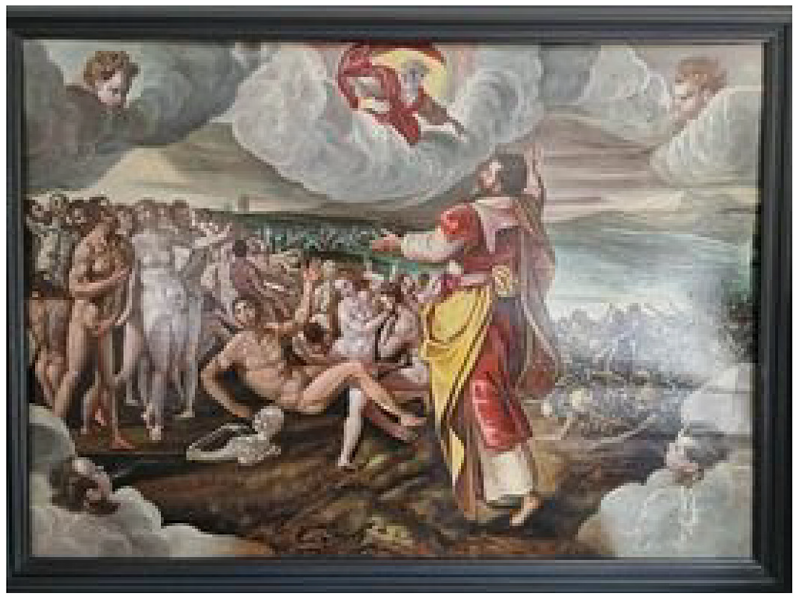
Prophétie de St. Hézékiel, artist unknown (app. 1600).
The projections of perception from imagination-reality
Besides this shifting, we experience a feeling of dual movement. As we do shift in the physical layers of time and space, we also shift based on our experience-making in an altered reality that is linked to our metaphysical layers, the substance of thoughts. A development that is simultaneously but is experienced in divergence. Even though mind and body are bonded to each other, existing in a symbiosis, none of them can fully irrupt into the other one’s spheres. We could say for example that experiences are made, once based on the physical experience and secondly based on the cognitive experiencing of the individual. Both play their role of creating the experience we memorize but after all, they are both not representing the same phenomena and sense—the physical event is always something else than the experience. And both change further over time.
Imagination cannot be reached, nor can imagination reach physical substance (Figure 2), as the context and the holistic nature can never be fully anticipated or reproduced. As Figure 2 visualized the body (head) is generating the space where our imagination can emerge even though this space has been created by the mind its content becomes unreachable a perception of the imagination remains possible for the generating individual. 4 The split between both notions is relevant even though the interrelation of both layers are completely intermingling when it comes to the actual development during the shift in irreversible time. Leading to the hypothesis that desire/goals/dreams are not what we believe they are: dreams do not equal points we can reach. As previously mentioned, goals are unarchivable, secondly, these future-oriented goals are not points (like dots in a canvas) either.
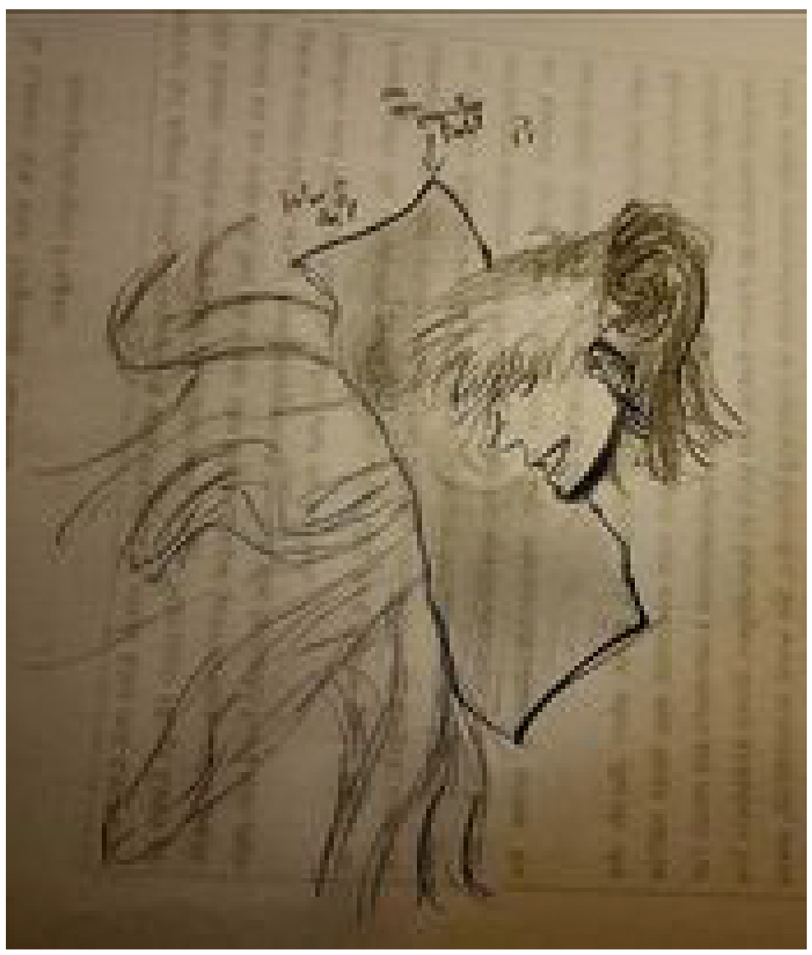
Drawing underlining the border and shifting between physical and imagination (by the author).
Human: How we tend to approach goals
As introduced in the beginning it is typical to believe that we can reach our goals, that we can make them true, whereby the full meaning of our goals and their actual potential stays hidden.
I-want-to-become-an-artist for example does not equal becoming an artist, as both constructs are changing with the individual. The individual may have thought artists are only painters and in the future, the achievement would be a beautiful artwork, in the following future, the individual may have become a sculptor and still remember the unarchived goal while following a new one of becoming an artist, in sculpturing. The goal has not been archived, nor has it been unarchived.
Human: How we can approach goals
“Dreams/goals are not points but open-bordered fields,” so they are constantly in the dynamic move. We need to be reminded that constructs are created by the use of the sense-maker and are constantly in revision. This means the classical thought that Individual A tries to reach goal B over time is insufficient. Both individual and goal are not points in a linear development they are spheres that are constantly involved in our development. A cannot archive B because B is nothing that can be simply realized. Furthermore, A is not stagnating in being A.
A and B change over time = A,B(t). A is bonded to B. A can never archive/become B. B can never become reality. B is imagined B(i,t). A is imagined but consists of reality A(i,r,t).
A(I,r,t) is constantly approaching B(i,t), while B(i,t) is constantly shifting while being located in diverged spheres. Meanwhile past frames of B can be approached closely by A(I,r,t). The missing dimension of B(i,t) results in other words in B(r) = 0, while 0 represents the inexistence (in the numeric sense 0 represents non-existence) which leads to the inability of the individual to approach the constructed goal. Nevertheless, as 0 can be anticipated hypothetically, the feeling of a coincidence of both can be experienced in the dimension of the felt-sense (I-feel-like-I-reached-my-goal). In other words, through the awareness that my feeling of reaching my goal is based on my approaching of the goals through the dimension-crossing-0. I can experience a pure form of achievement, considering that both constructs are separated consequently through their context of existence.
Nevertheless, this does not mean that as shown above individual, environment, and goal can simply be seen as separate objects, taking into consideration that B exists based on the projections and reflections the individual A is creating. Even though we are still approaching the goal the realized achievement, and past projections of goals, have been connected fragmentally to the sense-makers’ projection-material (experiences made).
The current self is in other words shifting in its holistic gestalt while following the concept goal that is constantly moving forward in a similar distance—both changing constantly in shape and meaning. Nevertheless, the fragmental echoes from the past goals may have been approached. Therefore, it may be even better to give up on goals as separated objects beside the current Self and manifest them into the ability of projecting meaning into the unknown future—as a perception field.
“I-have-goals-and-I-experience-the-approaching-of-these,” in other words not the goal becomes the achievement, but the vision field toward my current achievement’s tendencies. Feeling pleasure, a fulfillment is becoming part of approaching the goals and not realizing them, which should meanwhile free the human being from experiencing failure by dissonance or diversions between the imagined/reached-out-for future and the experienced future (which becomes in that moment the new present).
To extend a previous statement; Dreams are not points but open-bordered fields, that inhabit our notion of perceiving the irreversible time stream and space shift. Furthermore, the following definition does not simply apply only to the concept of goals and dreams, it can also be used in the context of problems and avoidance-based goals (such as nightmares). All of them inhabit the notion that they may occur in the future but will never occur as expected—experience 5 -imagination diversion—(as in Figure 2, goals are material from the imaginative space).
It is based on Herb Simon’s elaboration of the General Problem Solver, where we can even clearer identify how we can understand dreams/goals as Ill- or well-structured problems are predicated upon open goal-fields (1977). A positioning that is also supported by the Idea of satisficing (Simon, 1978) which underlines that there is no such thing as “perfect rationality” and such assumption should be seen as contrary to phenomena. 6 Assumptions that are based on the belief of a rational processing human being are contra-productive as such disfigure the actual complexity in which such a decision-making process is running (Simon, 1978). The principle of satisficing is applied by focusing on the most basic theoretical construct “that works.” A positioning that we as human beings tend to use and tend to be blinded by.
Between problems and goals
We need to be reminded that the problem is part of the goal—as the individual creates steps to achieve the goal. Meanwhile, the problems themselves can never be solved as expected. Nevertheless, an inner generalization process (meaning-maker and sense-maker—Valsiner, 2007) creates the illusion of having solved a problem—sufficiently-to-experience-a-feeling-of-achievement—. This process happens repeatedly until the remembered (and currently reinterpreted) goal is-experienced-as-should-be-approached-now. If the discrepancy of the current criteria and the solving-of-the-problem (goal-realization) are overlapping sufficiently (as-a-feeling) an achievement is experienced, an uneasiness is felt or even failure is experienceable.
In contrast to our every-day-life-believes the actual goal-realization has never been of relevance, except when the individual is actively injecting it into the criteria lineup. The goal itself is a fluid and dynamic vision field, while the experience of archiving a goal is based on fragmental-past-projections (memories) of a goal and its reevaluation in the now. An experienced fragment of achievement, that is experienced as similar to the future-projection- “blueprints,” can be achieved whereby the evaluation of satisfaction is triggered—the level of satisfaction depends on the set/remembered criteria (Figure 3).
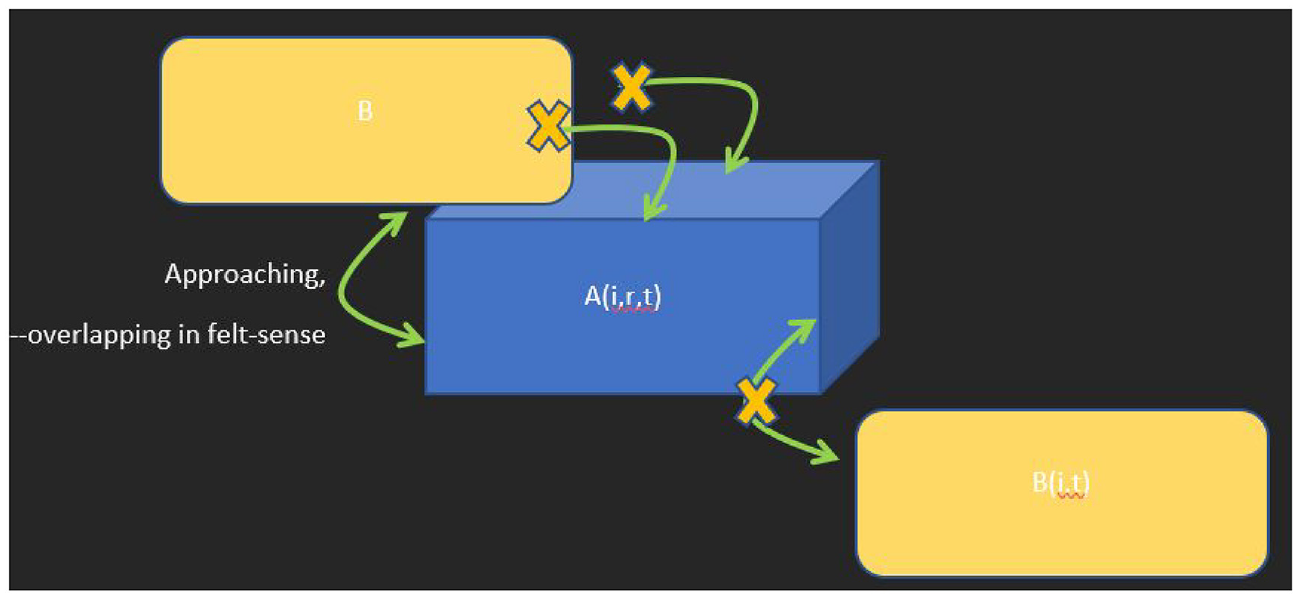
First attempt to describe the dynamic of self and dreams/goals and the potential fragmental overlap of its parts.
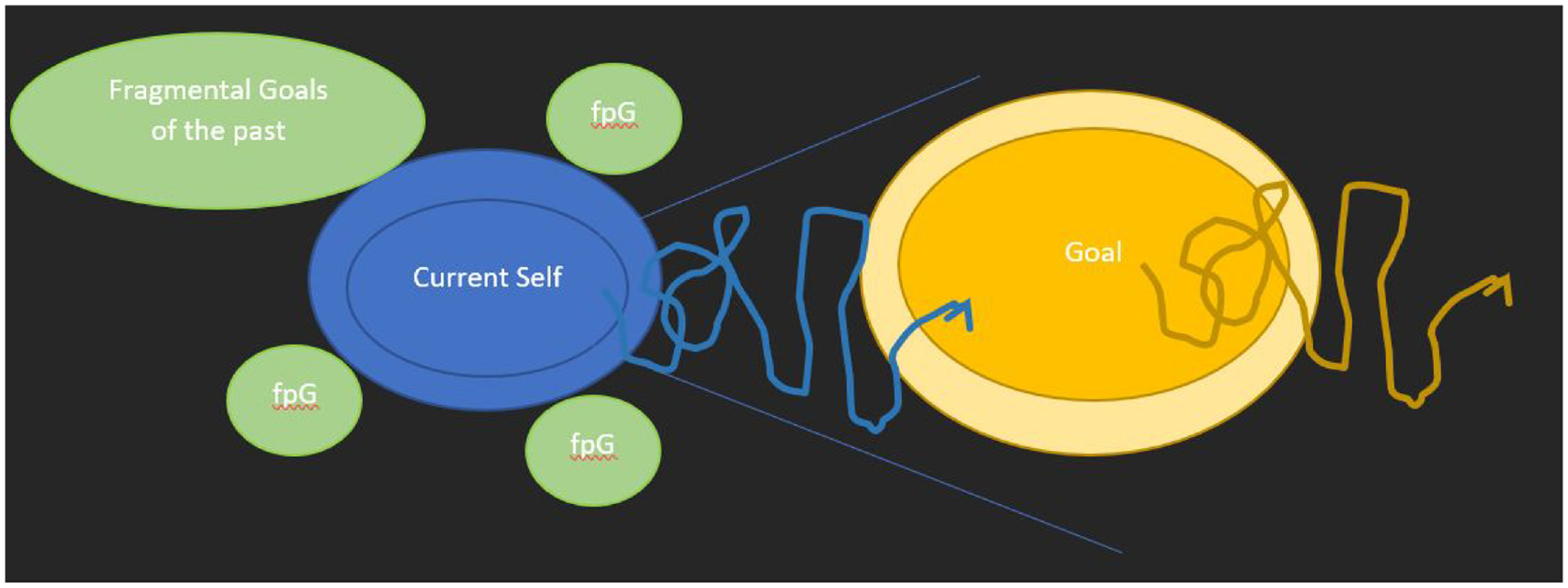
The dynamic shift of the self and their dreams/goals, while the fragmental goals are approached.
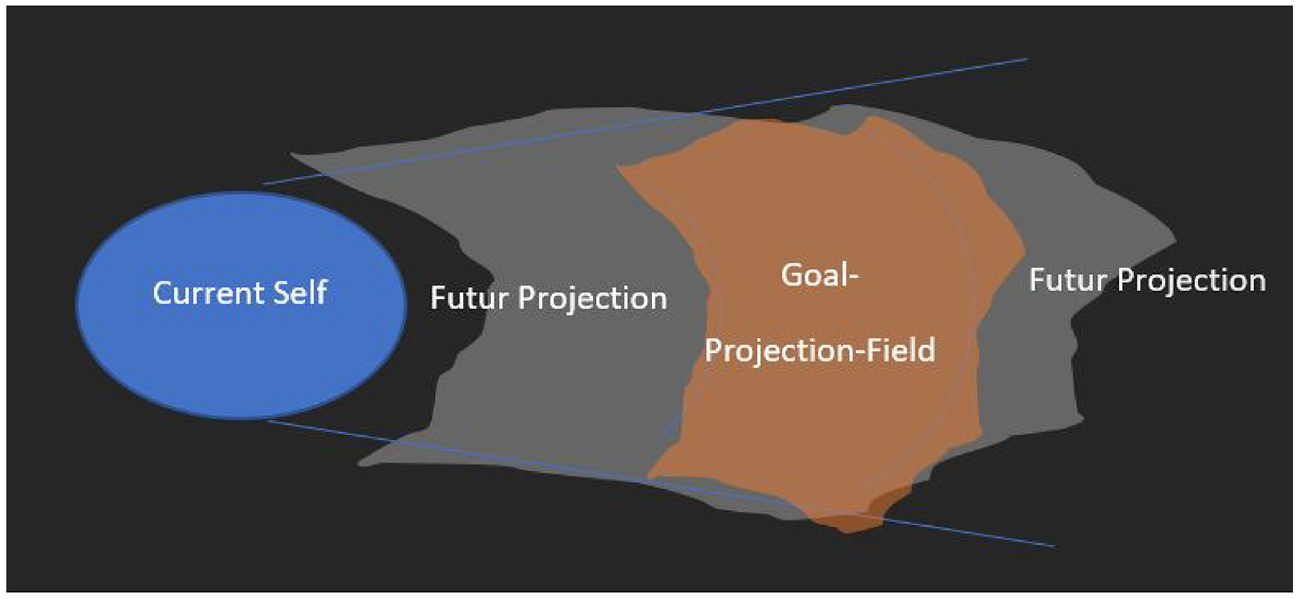
The goal as projection field in the future.
General Problem Solver: Ill- or well-structured problems
Herb Simon formulated in 1977 two criteria lists that should describe the meaning of what he called Well-Structured-Problems and what conditions the General Problem Solver needs to process. Both lists are enlisted below and will be used to emphasize the field-like notions of perceiving goals: (Well-Structured)-Problems: With these caveats, we will say that a problem may be regarded as well-structured to the extent that it has some or all of the following characteristics: 1. There is a definition criterion for testing any proposed solution and a mechanizable process for applying the criterion. 2. There is at least one problem space in which can be represented the initial problem state, the goal state, and all other states that may be reached, or considered, in the course of attempting a solution of the problem. 3. Attainable state changes (legal moves) can be represented in a problem space, as transitions from given states directly attainable from them. But considerable moves, whether legal or not. Can also be represented – that is, all transitions from one considerable state to another. 4. Any knowledge that the problem solver can acquire about the problem can be represented in one or more problem spaces. 5. If the actual problem involves acting upon the external world, then the definition of state changes and of the effects upon state of applying any operator reflect with complete accuracy in one or more problem spaces the laws (laws of nature) that govern the external world. 6. All of these conditions hold in the strong sense that the basic process postulated require only practicable amounts of computation, and the information postulated is effectively available to the processes –i.e., available with the help of only practicable amounts of search. (Simon, 1977, p. 305–306)
Crucial is to stay aware that those are the construction conditions for a so called well-structured-problem and do not represent a notion to include every problem’s nature.
First of all, we can start with step 3 as a central clue toward a dynamic view of the goal, problems, and self-transition through the irreversible time stream. The awareness and experience of shifting in time and space are required to experience change and so development and goal are approaching.
Unfortunately, points 1, 5, and 6 represent fundamental steps, that rely on mechanical thinking patterns—unreachable in the full context of reality (Campill & Valsiner, 2021). In step one a “definition criterion” is described as an interaction plan of how testing potential solutions should work, nevertheless, who should evaluate whether this step is fulfilled or not? Humans are not always aware of all criteria in use, and neither do they know what should be understood as good, bad, or unnecessary criteria. For an individual the process is based on the own meaning generated and so also on the feeling-of-being-“objective.” In step 5 the natural laws are implied to be taken fully into consideration in the potential problem solutions (in imagination), nevertheless, the human being is unable in their current state to take everything fully and correctly into consideration. The imagination of development can never be realized in reality like in the completely imaginary-experienced context. This also means that point six is incomplete, as it is based on a mechanical model of reality and does not take into consideration that the projection of the “basic process postulated requires only practicable amounts of computation” is able to separate the information into practicable and non-practicable, whereby here again it is more based on the belief that such has been reached or not. In other words, even though the mechanical elaboration implies central elements of the handling and evaluation of problems, the procedure is far from being such a smoothly running process that can differentiate between sense and non-sense as it creates based as own sense-maker when ad what dimensions are applied or not and whether they are experienced later as solved or not.
Finally, we can underline steps 2 and 4 as units that represent the strong relation between past experiences, reflected in the present for the purpose of projecting potential future ongoings of the self. Nevertheless, we need to underline again that the conditions are more dynamic as described based on the awareness that even though human interacts with the physical world they perceive and live in the first line in an intermingled, but imagination-based, imagination-reality pool. Therefore, the solutions or experiences we retrace do not need to be physically experienced but need to be experienced in any sense—including imagination-based alternative pathways of behavior constructed based on fragmental sub-steps of other experiences made (Campill & Tsuchimoto, 2022)—. Central is that the individual experiences these solutions as potentially useful and educatable.
In short, this means not only the individual can be defined as fluid and dynamic, but also the vision field and so the projections as goals and dreams need to be dynamic as they are emerging from the individual over time persistence-shift. Making goals unarchivable, while also reducing the comparative notion that all problems need to be labeled-well or ill-structured—and need to be conserved in time.
This implies that the General Problem Solver inhabiting the human being needs to be perceived as much less mechanical based.
General Problem Solver: Before the General problem Solver can go to work on a problem, it requires: (1) A description of the solution state, or a test to determine if that state has been reached; (2) a set of terms for describing and characterizing the initial state, goal state, and intermediate states; (3) a set of operators the change one state into another, together with conditions for applicability of these operators; (4) a set of differences, and tests to detect the presence of these differences between pairs of states; (5) a table of connections associating with each differences one or more operators that is relevant to reducing or removing that difference. (Simon, 1977, p. 306)
As the process needs to be believed to be fulfilled, based on the experience of approaching the initialized goal as a fragment of the still ongoing dreams—the meaning makers elaborated criteria (problem-solving) needs to be felt as sufficiently solved—. Essential is also important to be reminded that the basic mechanisms of human beings’ interactions may be running in relatively simple process steps but that this simplicity is non-existent when it comes to the actual phenomenological context in which these so-called basic functions are running under highly complex boundary conditions that are resulting of a multidimensional and dynamic nature of the human being and the environment (Simon, 1978, p. 367).
Between goals and rabbit-holes
Before we continue to elaborate our understanding of the goal field, we need to rest for a short moment and have a short excurse toward the deeper meaning we can retrace in the previous reflection toward steps 2 and 4 of the (Well-Structured)-Problems construct of Simon (1977).
The expansion of the imagination is interrelated with the dimension of goals. It is not simply the experience of one single moment that expanse the Imagination by one new concept. The new experience is a multitude of Information that in the metaphysical-world “Mind” can be split, generalized, and reconnected with other partial-fragment-of experiences.
As we have initialized the goal is a field that is part of our perception-ability—lies in the imagination sphere—and is bonded to our construction of self and MyCu-culture (individually cultivated understanding of the concept culture we are living with—Campill, 2022). “Who we think we are” and “Who we want to be” influence our way of setting our goals, while they also influence our way of experiencing these.
In the rabbit-hole (Campill & Tsuchimoto, 2022) metaphor, the human gains be ability to overcome their own common sense by leaving the field through a tunnel –constructed by oneself based on the experiences made while intermingling several experiences and repositions oneself, by burrowing and crawling through, towards these unknown. In other words, innovation relies on new experienced perspectives and repositioning toward the past. It is a construct that does not emerge from nothingness or is reserved for use by anyone. So, for example in Figures 1 and 2 an unseen or impossible phenomenon can become visualized by extending the own perception through existing materializations and perspectives.
In the context of goal-field projections, the rabbit-hole represents the notion of changeset in the self-environment-dialogicality.
7
Passing the rabbit hole creates a new perspective and so a new self-awareness, that is based on the past positioning while it has been redefined. The goal is neither burrowing, crawling, climbing out, nor finding a new place to burrow, at the same time it stands for all of these steps. All these steps are part of the movement into the uncertain, expanded by the notion of goal-field projections that create the feeling of following something essential. A something that is rooted in our self and is actually in itself unreachable. Following goals is in other words an endless process that is altering with our development over irreversible time and represents the incompleteness of the human being as it has no beginning or ending but exists through the processing on its own:
Nothing is lost, nothing is created, everything is transformed.
Experiencing or illusion, making the impossible possible?
Like in the metaphorical construct of knotting praxis, as the essence of the dynamic growth of the self (Picione, 2023), the act of reaching for a goal is not stagnating but dynamic and fluid. We are constantly working on ourselves to get closer to what we want to be. This construct “what-we-want-to-be” is in the same moment clearly in our mind like an object as it is completely uncertain to happen in any way. “What-we-want-to-be” and “What-we-are” is in the first moment easily framed based on our generalization abilities, while the complexity and context could not be more unapproachable. As previously mentioned, becoming an artist is easy but becoming this one projected vision of being-in-future-an-artist stays impossible. It may sound philosophic, but life is not based on our achieved goals it is about the way we are living while following and reinventing them. For example, it is the vision of a perfect knot that is driving us to praxis, but meanwhile, our understandings and our technic are changing so that the knot we want to knot and which one we describe as perfect become another one as it has been, the way has altered as well and so we did during the process. Achievements need to be seen as achievements as well as they have to be seen “not as the realization of our goals” but as “approaching the altering and growing goal of our life.”
There is a certain cruciality behind the awareness that goals are field-like constructs, as they arise out of our ability to project our self-environment-relationship into past, present, and future. In other words, in a certain manner, we do experience the realization of dreams—by experiencing the feeling that we have made it. At the same time this so-called goal that we archived does not exist anymore—had never existed 8 any longer as in that single moment where we have envisioned it—. What we do experience is an achievement of approaching the current goal in a certain way that then creates the illusion “that we have archived the past set-goal(s).” We, the goal and our persistence in time and space (between self and environment) have changed and are still changing—not stopping to move on. We feel confirmation in our way of persistence and self-realization, through the similarities of our envisioned goals, for us currently emphasized as essential fragments of our remembered goals, and our experiences we made in the altering present.
In other words, by the illusion we create of archiving our goals we experience the motivation to challenge the “physical-world,” we experience accomplishment—goal realization—, while the phenomenon in such form stays covered in the impossible-to-experience notion of imagination. 9
Conclusion
Mechanical and linear elaborations of the construct archiving-goals are incomplete and provoke a misinterpretation in the daily experience of the phenomenon.
Goals are part of our human perception ability (resulting from our intense dialogue with our environment) that allow us to define our present, future, and past while helping us to move forward in the irreversible stream of time and space.
The concept goal or dreams are not points in a linear stream of time, but open-bordered fields that allow us to construct a clearer vision of our uncertain future.
Goals and dreams are dynamic and fluid constructs that are never the same, they are in the same way as the meaning-maker constantly in changeWhile shifting in the irreversible stream of time.
Goals are impossible to reach, as they have never been supposed to be approachable. We can experience a certain emotional satisfaction in “What we call archiving our goals/dreams,” at the same time we experience the satisfaction that certain elements from the dream have been partly reached.
Footnotes
Acknowledgements
I want to thank Jaan Valsiner and my students and colleagues in the ENAD for their great and innovative insights that have helped extend my perspectives.
Declaration of conflicting interests
The author declared no potential conflicts of interest with respect to the research, authorship, and/or publication of this article.
Funding
The author received no financial support for the research, authorship, and/or publication of this article.