




Abstract
In the present paper, I introduce the concept of the Zone of Inhibited Action (ZIA) for the knowledge production within universities. Different zones (Zone of Free Movement (elaborated within Lewinian field theory) extended by Zone of Promoted Action (ZPA) by Valsiner in conjunction with Zone of Proximal Development (ZPD) known via the legacy of Lev Vygotsky are central to the present paper. The new concept (ZIA) is at the foreground. For that purpose, I draw upon an autoethnographic event—from the perspective of a student—showing how the ZFM, ZIA, ZPA relate to each other in an academic context. In this regard, I exemplify how negotiation between course instructor and student can help to define and sharpen the borders of the ZIA and ZPA which alters the relation of the life-space. Here, I underline that democratic back-and-forth negotiation makes the ZPA and ZIA dynamic meaning that different actions become promoted or inhibited. ZIA and ZPA only become illuminated in a democratic back-and-forth-process between student and course instructor which changes their relation to the ZFM showing that the borders of the ZFM become re-structured.
Keywords
Field theory and the Zone of Free Movement
Academic knowledge construction is a highly constrained field. It consists of different zones that are important in the breakthrough of new ideas. It is trivial to say that this field is inherently social meaning that the social other (professor, tutor, course instructor, peers) is constraining the educational action field in very peculiar ways for a student.
1
If we consider the example of a student starting his psychology undergraduate studies, he has—in the very beginning of his studies—a highly open Zone of Free Movement (ZFM), for example, he can choose where to study, he can decide how to study, he can choose his peers as he wants, and so forth. The ZFM originates from Lewinian field theory stating that behavior is a function of person and environment (Lewin, 1933) b(f) = P,E which was further developed by E. von Fircks (2022a) arguing that the environment has a historical component that needs to be taken into account. In Lewin’s terms the ZFM is the following: The first presupposition for the understanding [of the person] (…) is (…) his region of freedom of movement, i.e., the regions that are accessible to him and those regions that psychologically exist for the [person] but which are inaccessible to him by reason of the social situation (…) or because of the limitations of his own social, physical and intellectual abilities. (Lewin, 1933, p. 598)
Here, we need to argue that the person develops specific needs and goals that define his psychologically unique field which is called life-space (Lewin, 1926, 1936). The ZFM is used in order to satisfy pressing needs and goals of the respective person, thus, to reach a psychological equilibrium (Valsiner, 2017) and to feel a meaningful I-world-balance (Boesch, 2021). However, what remains unknown within field theory is how actions become regulated by specific environmental inhibitions. The ZFM is an interesting and important concept but remains vague when not further specified. This is the predominant goal of the paper and in line with the call of Valsiner (2014) to further develop significant historical frameworks of psychology. For that reason, I focus mostly on the novelty production within student-teacher encounters within the university setting that I try to expand later.
I use Lewin’s field theory because it is a major framework of Cultural Psychologists to make sense of a person and the environment in conjunction (E. von Fircks, 2022a, 2023a). Thus, within field-theory we are focusing on the personal demands—that is different needs—that become the driving force of the person to appropriate the environment. However, the environment is not an undifferentiated mass but constraints the personological appropriation in many different ways such as by other people’s needs that work as a resistance to overcome, for instance. Here, we overcome monistic scientific perspectives either focusing too much onto the person or the environment. Bourdieu’s (1993) social field theory is a concurrent approach to the study of how person and environment interact. However, Bourdieu’s approach predominantly focuses on the struggle for power in a respective field in order to gain different sorts of capital where we define persons solely by their drive to gain power and to preserve that power. I think that this political definition is too narrow minded because the person per se has many different needs and motives to appropriate the environment and power is not the most important one (E. von Fircks, 2022b, 2023a) but meaningfulness (E. F. von Fircks, 2020). Field-theory, fortunately, lacks this politicized component and focuses on meaningfulness that has become the primary goal of Gestalt therapy—the therapeutic institutionalization of field theory (Perls et al., 1951).
Freedom of movement of a psychology student
If we remain within our fictitious psychology student example, 2 the student can appropriate the environment in many divergent ways in order to reach a psychological or physical equilibrium (Lewin, 1935). The ZFM is constituted by the free access of the environment in order to give closure to a specific need (Lewin, 1926, 1933). The ZFM is not yet (highly) constrained, and the individual can move (almost) freely within that specific zone. For example, the student can enter his classrooms freely; he can enter the library; he can access co-working spaces; he can eat at the cafeteria. All these spaces lie in his specific ZFM allowing our student to satisfy his dynamic needs that change over the time (need for food, need for study, need to relax, need for social interaction, and so forth). However, within that ZFM, specific actions are promoted (Valsiner, 1984, 1998). This means two things: First several goals are promoted (activity) and second different means to reach those goals (actions) are encouraged in order to reach a psychological or physiological equilibrium (Lewin, 1926, 1935). This means that out of a totality of different activities and actions, several are socially supported by specific agents (Valsiner, 1984). This is called the Zone of Promoted Action (ZPA). Consequently, those agents channel goal-directed behavior of people continuously and dynamically (Valsiner, 2021) which means that we need to look at the relation between ZPA and ZFM (Valsiner, 1984). The ZPA impacts the ZFM. As we know the ZFM is in the very beginning more or less unstructured, ZPA gives the ZFM some structure as it supports several actions in contrast to others. Out of a multitude of many different activities and actions that are principally possible and thus lie within the ZFM, the ZPA channels activities and action and narrows them down. This means that the ZPA gives the ZFM some borders where to go and how to go somewhere, when to go and with whom (Valsiner, 1984). 3
I want to come back to the issue raised by a colleague how the ZFM can be almost open and bordered. This is a matter of temporal or historical sequence. If a psychology student inscribed himself to study psychology, right in that moment he can go almost anywhere at the university. The ZFM has not yet become structured. Only by his schedule—that the course is providing him with—and by some introductory classes, he learns to go to several places and to leave out some others. Hermann Hesse said that there is magic in every new beginning – that is the feeling of limitless possibilities which is only a small temporary asset of what becomes structured afterward.
For instance, our psychology student is told by his course director (adviser) to study at the library (because maybe he can make use of many different books at the same time) in order to do his weekly homework. Here, the activity of inquiring is clearly promoted as well as the trajectories how to face that activity (e.g. by which concrete actions are set up). A library may allow for open access to the stacks (as is usual in US university libraries) or the access is gained through a librarian bringing out the books (the European tradition).
We need to face some interim results at this point of the paper. The ZFM confronts our individual with many different actions that are all principally possible. In other words, the horizon of the ZFM is highly open (in the beginning) within specific borders (that become set after some time) set by the ZPA. Now, the individual’s activity and his action get channeled, socially and personally—I only want to take this book and not looking at others. As a consequence, the ZFM becomes structured and loses some of its unpredictable and shadowy characteristics.
This feature of the ZFM structured further by ZPA has general implications for the topic—what is freedom? As we know from existential psychologists (Heidegger, 1927/2001; May, 1981, 1991), too much freedom might be experienced by our psychology student as frightening because there are too many actions at stake how to face the activity. The ZPA limits this totality of freedom and make possible actions cognitively and emotionally digestible. As it has been specified: “The ZFM and the ZPA are mechanisms through which the degrees of freedom for the [person’s] actions within environmental settings are selectively regulated” (Valsiner, 1984, p. 68).
This canalization is necessary in order to make the ZFM bordered and hence the demands of the person’s life-space to be channeled. Without canalization, the student would be left in an almost unbordered ZFM that makes his goal attainment almost impossible because literally every action might be appropriate to satisfy the need, for example, the quasi-need to become a psychologist. This would be counter-productive for our psychology student. On the contrary, our student is appealed to study for example at the library, to eat healthy food in order to concentrate, to exercise in order to detach from work, and so forth. This means, our individual is promoted in several action domains to pursue out of a confrontable selection of actions, the one that helps him best to satisfy his pressing need or goal (E. von Fircks, 2022a). Without any guidance, meaning without any socially promoted actions, our individual would be comparable to a mountaineer facing the Mount Everest without knowing and without having any equipment at hand. As a consequence, we can look at a second intermediate result that is how socially promoted actions function as guiding resources how to pursue a certain activity.
So far, we have elaborated on the relationship between the ZFM and ZPA and we have seen that they are in a mutual relationship. This means that you cannot alter one zone without affecting the other. They are symbiotically intertwined with each other. This is called the co-genetic logic of development (Herbst, 1975; Marsico & Tateo, 2017). In other words, development does never happen in isolation but only through the co-development of another specimen. A teacher or professor learns in conjunction with his student, and the student learns in conjunction with the professor. In their mutual open systemic development (Valsiner, 2014) it is not helpful to separate two organisms one from the other.
Introducing the Zone Inhibited Action: Altering the co-genetic logic of ZFM and ZPA relationship by adding a new zone
However, our endeavor becomes somehow more complex. We are confronted with another zone that has not yet been clarified beforehand. I call that the Zone of Inhibited Action (ZIA). In the beginning of my thinking about the concept, I was not clear whether the concept is the simple opposite of the ZPA or whether it operates on an independent basis. I believe strongly—and I hope to scientifically evidence that in the course of that article—that the ZIA works in a non-symmetrical matter. But first things first: The ZIA is a specific zone that operates at the border of the ZPA and ZFM. Within this zone, specific actions become inhibited in varying degrees from this is strictly forbidden to you should not do that. If we remain within the example of our psychology student meeting the course instructor, we could imagine that next to promoting several actions for a specific activity, the instructor inhibits several actions, simultaneously.
This means that while saying you should go to the library in order to study silently, the professor might also add that our boy should not go the first floor because it would be too noisy to study effectively or that he should not revise the lecture in a café in the city because people distract you there. Consequently, our course instructor or professor inhibits several actions that would make the goal attainment—in his view—difficult or almost impossible. It becomes clear now why the ZIA is not a simple opposite to the ZPA; the opposite of the ZPA is not structured and it would simply mean to not go the library which is not a communicative advice anybody would say to anyone. On the contrary, specific actions are directly pinpointed that would make the goal attainment difficult and as a consequence are inhibited. Again, because this was an issue during the review process, the ZIA is not the simple default mode of the ZPA (there is no symmetry between ZPA and ZIA). A professor can encourage his students to read Jerome S. Bruner’s Cultural Psychology which does not mean that he inhibits directly every kind of literature that is related to Bruner.
If we apply the ZIA onto a real-life example such as when a student asks his professor for literature advice, we can unravel the co-genetic implications of the afore mentioned. The professor might say: See literature X (because…) but avoid literature Y (because…); here goal-directed conduct is channeled in two ways. First by highlighting specific beneficial literature that might be key for the student’s project and second by inhibiting the acquaintance with literature that would lead the student away from his primary, personal goal. ZIA and ZPA work together effectively in order to regulate actions directed toward a specific activity. And for sure, this has crucial implications for the ZFM. While the ZPA has bordered the ZFM and structured the endless variation and proliferation of multiple action to pursue a goal, the ZIA works in a similar manner. It narrows the ZFM from another side or perspective and helps the student in our example to not waste his time with literature that might be not useful for his project.
We know the benefits of such a perspective if we focus on the life-course philosophy or the career development of people in general (Zittoun, 2016). When people make experience in the professional domain and come to the conclusion that they cannot imagine working in a certain domain, they inhibit their efforts toward this direction (Kullasepp, 2022). Thus, they narrow their ZFM by excluding specific aspects that have been once in the ZFM or even in the ZPA which makes the ZFM less fuzzy and more substantive. Instances are people saying: I have worked in this enterprise for 1 month but then I quit because I felt ignored and not appreciated by my colleagues. The ZFM gets transformed immediately while the person transfers willfully elements from the ZFM or even ZPA to the ZIA. This means that the ZFM, ZPA, and ZIA are not passive entities unfolding specific effects onto a person, but they become personologically appropriated for the inner teleology of the person (Stern, 1924; E. von Fircks, 2023b).
A concrete example is the story of a French friend of mine who worked for the French administration. People in his nearer environment (partner, friends, former colleagues) encouraged him to get this job and even wrote recommendation letters. They were happy for him because he was now working in an environment where he could earn more money, have more time with his family and life a more-balanced life (see the promotion by salary, life-work-balance and family). However, my friend was frustrated after several months because he did not like the tasks he had to do. He needed to take account of a lot of administrative things which estranged him from his former interests (interacting with people). Despite being promoted by his friends and his partner to stay on the job, he left because his job was inhibiting his real passion (social interaction). His job was thus inhibiting the social nature of his personality which was the reason why he left. Despite the promotion of several benefits, he quit due to the inhibition of something crucial of his personality (a social self-determination tendency in Sternian terms, 19244). And as a consequence, he transferred from the ZPA the elements of money, family, work-life-balance to his ZIA and transferred courageously the social aspect of his job to the ZPA.
Criticism was raised during the review whether the transfer happens in a spatial (material) manner or that the transfer is interpreted by the author too materialistic. I am the opinion that the person does not imagine specific zones in his head and transfers some boxes from one side to the other. On the contrary, the person just becomes aware of his resources (priorities in our example) and how he should re-organize those. And by this re-organization of resources, by putting them in a different hierarchy, the person changes willfully the nature of the ZIA, ZFM, and ZPA.
Thus, my French friend went to unemployment and started his own business where he could realize his general self-determination tendency. Of course, the transfer of core regions from the ZIA to the ZPA and from the ZPA to the ZIA has crucial co-genetic implications for the ZFM. While, previously, my friend had some free movement in regards to financial issues, time with his family as well as his work-life-balance, starting his own business limited the open ZFM toward those things. While my friend was now able to move freely toward the direction of his passion (social and artistic) and to realize himself in space and time with his full personality, he was now inhibited financially and timely which results in clear effects upon his systemic environment (e.g. having less money for birthday presents, having less money for a second car, and so forth). This means that the different zones are not socially determined but develop only through co-operative activity with a concrete individual.
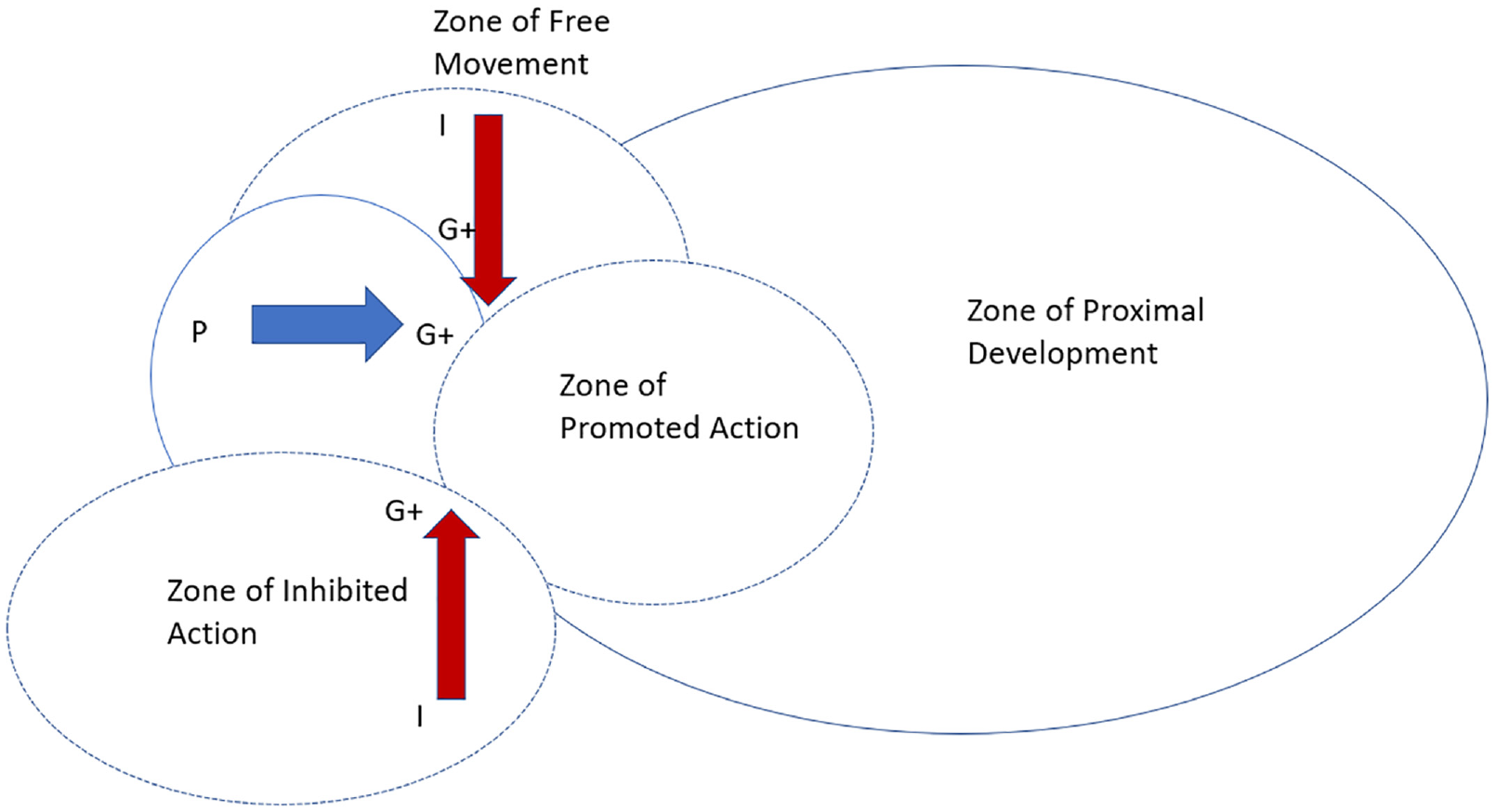
What was once promoted becomes inhibited and what was once inhibited becomes now promoted and with that comes the re-structuring of the ZFM, thus the zones to move in freely in order to give closure to pressing needs. The promotion becomes inhibited and the inhibition promoted because of the person’s alteration in his self-determination tendency (inner teleology). But importantly, both zones shape the ZFM in peculiar ways meaning that they border the ZFM and promote and restrict actions simultaneously. The ZFM gets structured and narrowed from two different fronts and with that actions become more transparent, for our respective individual. This transparency that is created in and through social interaction between our student and professor becomes illustrated by Figure 1. Transparency means in this regard that the actions and the means (signs and tools) become more apparent for the satisfaction of a need or the goal pursue.
Co-genetic logic of ZFM, ZIA, and ZPD. 5
The person is tensed in regards to satisfy a specific need or goal (blue arrow); however, his ZFM is channeled by specific promoted actions as well as by inhibited actions (note that the circle of the ZFM goes beyond the life-space of the person and overlaps with the ZIA) which means that the manifold of actions is reduced by promotion and inhibition simultaneously. Thus, the ZFM becomes more transparent in regards to specific actions by two over-lapping zones that reduce the high variety of possible actions to attain a specific goal. Now, not only certain areas are promoted to step in physically or psychologically, but certain areas are also forbidden ground. If we put that into a more developmental context, we can imagine parents allowing their children to go the sports field but not to a party or parents allowing their children to use the internet for educational contents but not for recreational or sexual contents.
We have seen that the ZFM gets constrained by the ZIA and the ZPA and that the zones do not determine our individual socially. On the contrary, they constrain the individual, but the individual might resist and negotiate the inner core regions of the ZPA and ZIA which alters the ZFM sustainably.
This becomes evident if we imagine a realistic example (encounter) between professor and student. Within that encounter they discuss which literature to use for the preparation of the Bachelor or Master thesis. The professor suggests, look at X but try to avoid Y which sets the stage for a transparent ZFM. Now, our student might not resist and follow our professor’s advice right in that moment. However, after having read the paper, he comes back to the professor and argues X was not helpful. But why is Y not helpful? The professor might answer Y is not helpful because it is too estranged from the methodology you want to employ. But why was X not helpful? The student answers the thematic frame is too far off my reach and the professor might agree and suggests to the student to read Z. So again, our student goes his way and reads Z. After a week not hearing anything from the student, the professor asks was Z helpful? The student confirms that and thanks his professor.
Here, we see multiple psychological events happening in a processual way. Our professor promotes several actions for the preparation of the Bachelor thesis (read X) while inhibiting concurrent actions (avoid Y). However, our student goes the advised way of reading X and avoiding Y only to find out that X was not helping him to give closure to the pressing need. Thus, he refrains from reading further papers on that topic and puts literature X and comparable pieces of work in the ZIA while asking for more appropriate promoted actions. Here, our professor has the opportunity to ask why X was transferred to the ZIA (thematic issues) which gives him some insights about a new promoted direction—I need to promote actions that are more goal-oriented. This means that the dialectical tension between the ZIA and ZPA creates the need for clarification of the inner nature of the zones—their conceptual nuclei and calls for a synthesis between promotion and inhibition. I argue that this can only happen in and through dialogue.
Negotiating zones: How ZIA and ZPA need to be dynamically defined
Thus, the ZFM becomes negotiated on the basis of permeable borders between ZIA and ZPD for student and professor. It is the mutual permeability of inner core regions, the transfers between ZIA and ZPA and ZPA and ZIA that illuminate the underlying ground-theme of the respective zones. The student became aware of his need for newly promoted action only when realizing that former promoted action was actually inhibiting his goal pursue. Thus, while experiencing this issue, our student transfers X to the ZIA and demands new support for the ZPA. By the transfer from the ZPA to the ZIA, the professor now asks why his promoted literature turned out to be inhibiting the life-space of the student which was a thematic issue in our instance. This means that the very process of the ZPA-ZIA transfer helps the professor to specify the ZPA (thematic papers) in and through dialogue on the basis of the ZIA-ZPA tension. For that issue, the professor needs also to inhibit his former promotion and to be open to the self-determination tendency of the student.
The inhibiting actions illuminate the nature of the potentially promoting actions in a negotiative process between student and professor. 6 Academic guidance is facilitated in our example if the professor remains open and does not insist on the importance of promoted actions that turn out to be goal-estranged for our individual. If our professor was to insist on the importance of X, negotiation of meaning and neither novelty would emerge as a consequence. It is only while allowing to reject promoted actions and to transfer them to the ZIA, that the clarification process, the un-shadowing of the ZPA comes into being, organically. Hence, we can say that academic innovation or novelty is facilitated in a scientific encounter between student and professor when the individual can co-construct and re-construct the ZPA and ZIA relationship which alters his ZFM.
Analyzing the co-genetic relationship of ZIA, ZPA, and ZFM within an autoethnography
We have formulated our interim conclusions from a deductive perspective, and we need to point out the temporary nature of those results which remain theoretical for the moment. However, we want to see whether our theorizing can be applied onto a concrete empirical example. For that purpose, I rely on a narrative ethnography reporting a specific situation in which I developed a goal in conjunction with my environment while focusing on my thoughts and emotions that came with the specific narrative (for that type of autoethnography see E. von Fircks, 2023b, 2023c): “[A]utoethnography in the present paper is applied in a Boeschian manner while focusing on actions, interactions, goals, means, and feelings within a myth-like structure (should-values)” (p. 8). This example comes from an academic context which is the background of the present paper.
As I was preparing for my last year in my undergraduate studies in psychology, I came across a task in a clinical course. The assignment was to write about a therapeutic or a psychological school – be it Gestalt psychology, psychoanalysis existential and so forth. I chose to write about Gestalt psychology because I was fascinated how people can be facilitated in their growth. The course instructor asked us to write about the benefits and pitfalls of the respective therapeutic school. However, while screening the basic literature, this was something already accomplished for and boring for me. On the other side, I was heavily interested how the process of growth can be linked from the therapeutic context to the political domain of initiating change within an organism. In other words, I was intrigued about the notion how politics can be organized in a way of helping people to close pressing needs (Gestalten) in a dynamic way. I then asked my course instructor whether I can write about that topic. She denied. I asked her why. She answered that she needs to compare my essay to all the others and that there is no possibility for me to do a modified essay. I showed her openly my discomfort and asked her whether this is her last call. She nodded. And I went my way. Frustrated. Eventually, I swallowed my frustration and did the essay the way she wanted me to do it.
This autoethnographic event shows us the following. Our student (Me) has a strong self-determination tendency—that is to enrich the academic environment by writing about the political implications of Gestalt psychology. However, we become rapidly aware from the autoethnography that I was not allowed to do so. She inhibited my general actions to write an essay and bracketed out the political domain of interest. On the other hand, she highlighted the promoted actions another time—we can also say promoted the promoted action in order to emphasize the non-negotiability of the event. Thus, she channeled my academic conduct in a very constrained way, actually denying my self-determination tendency and putting it wholly into the ZIA. As I was blocked in the way of realizing myself into the environment (Ent-Ichung in Sternian terms, 1924), I was frustrated and became angry about the teacher as well as about the university in general. The comparability of the examination took priority over the autonomous development of a young student; thus, the goal of the teacher or the course director—holding high the comparability nature of the examination—overruled my self-determination tendency, in other words the way how I wanted to create a specific I-world balance (Boesch, 1998). Thus, they denied a crucial feature of my person—that was yet to be developed and deepened through a modified essay. This is the Zone of Proximal Development, the jump from a what-is to a what-could be condition, personally constructed by a given individual (Valsiner & van der Veer, 1993, 2014).
ZPA, ZIA, ZFM, and their relation to the ZPD
Figure 2 illustrates the specific conduct of the professor in regards to my goal of writing a modified essay. Interestingly, the life-space of the individual becomes highly restricted toward the assignment. As visible in Figure 2, there is literally one channel of facing and doing the exam that is only to write in a specific manner and to inhibit all other forces operating within the individual. In our example, the channel becomes rigid because it cannot be circumvented (only by leaving the field and not writing the essay at all). This means the total range of actions to reach the goal is highly limited and in opposition to the individual’s self-determination tendency—which is to appropriate psychology in a political manner. It is not a surprise that the ZPD cannot come into being in the long run because the individual acts in opposition to his self-determination tendency and needs to follow promoted action that is actually inhibited by himself as well as inhibits action that is actually promoted in regards to his self-determination tendency.
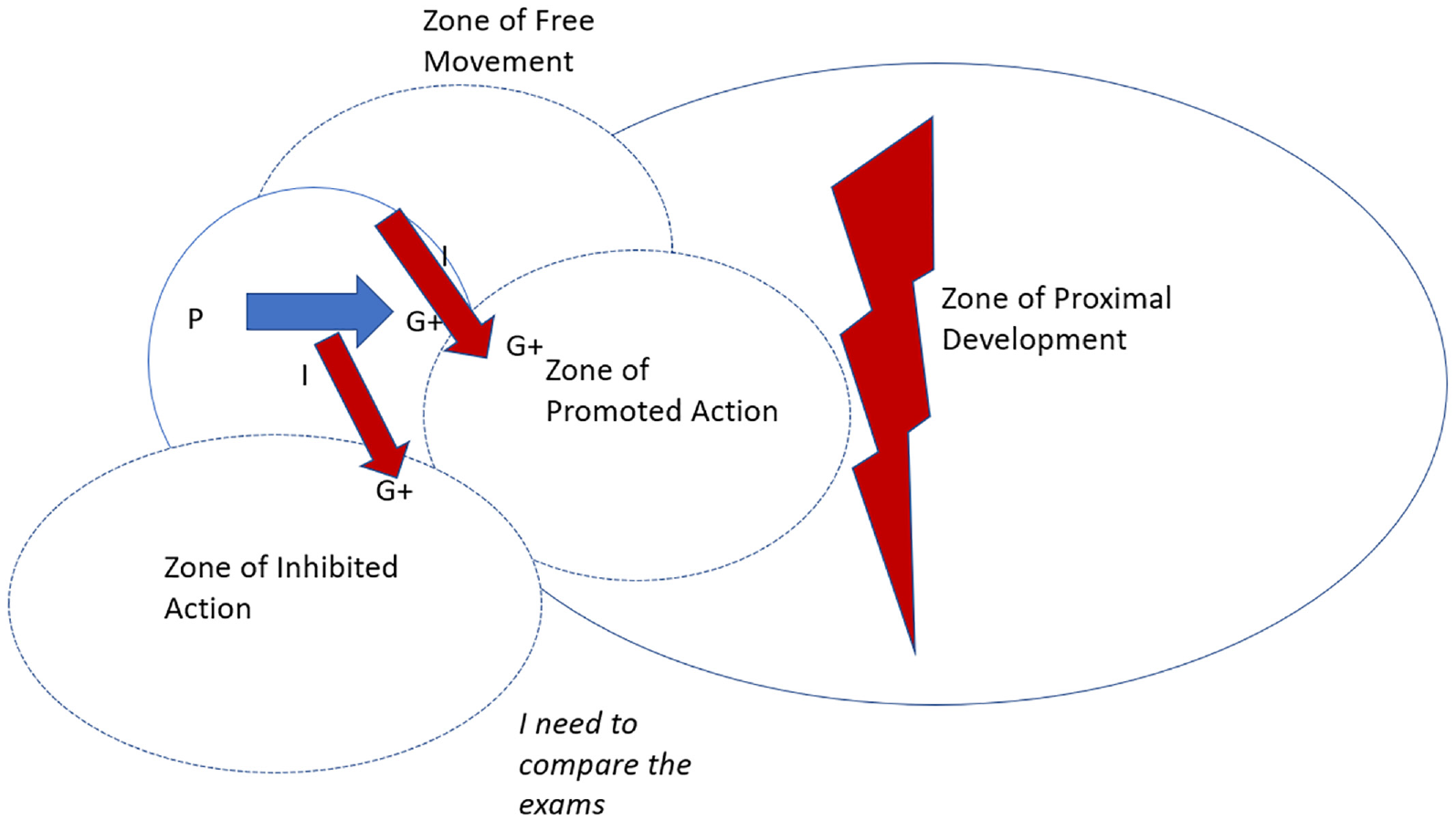
Rigid ZPA, ZIA, ZFM, and ZPD relationship.
This means that a pre-requisite for novelty that gets catalyzed within the ZPD, is that ZPA and ZIA are structured according to the self-determination tendency of the person. The reason is almost trivial and can be put into a rhetorical question: Why should an individual move to a specific direction that is opposition to his very own development? Prof. Boulanger (2023)) argues that this is the monological nature of the ZPD as externally imposed while it is paradoxically supposed to promote self-determination: Why should an individual learn skills that he is not interested in or do not mirror his I-world-balance? Academic innovation can only emerge if an academic person can structure and re-structure dynamically the ZIA, ZPA, and ZFM relationship—of course in cooperation with other individuals. When this is not possible, the individual loses himself not only in conformity (adapting to foreign promoted actions) but his own self-determination tendency is rejected and gets atrophied (inhibiting on promoted actions). The key to academic innovation is to make use of the self-determination tendency of a person and to structure the ZPA and the ZIA accordingly. But this can only be accomplished in and through negotiation (E. F. von Fircks, 2023).
Beyond the autoethnography: How students can be facilitated in their growth
In Figure 3, we are confronted with another picture—that is a professor wanting to help a student to develop himself. While previously, the channel is quite narrow-minded in regards to possible actions of our student (ZFM), it becomes now re-turned to our individual (student). The instructor (I) has the goal to serve the self-determination tendency of the student and to negotiate the nature of the ZIA and ZPA according to it. This means that ZIA and ZPD become co-operatively established by the student and the professor which means they are figuring out both zones, jointly. This means that ZPA and ZIA are in the dark and become only illuminated in and through communication—that again is a co-operative endeavor.
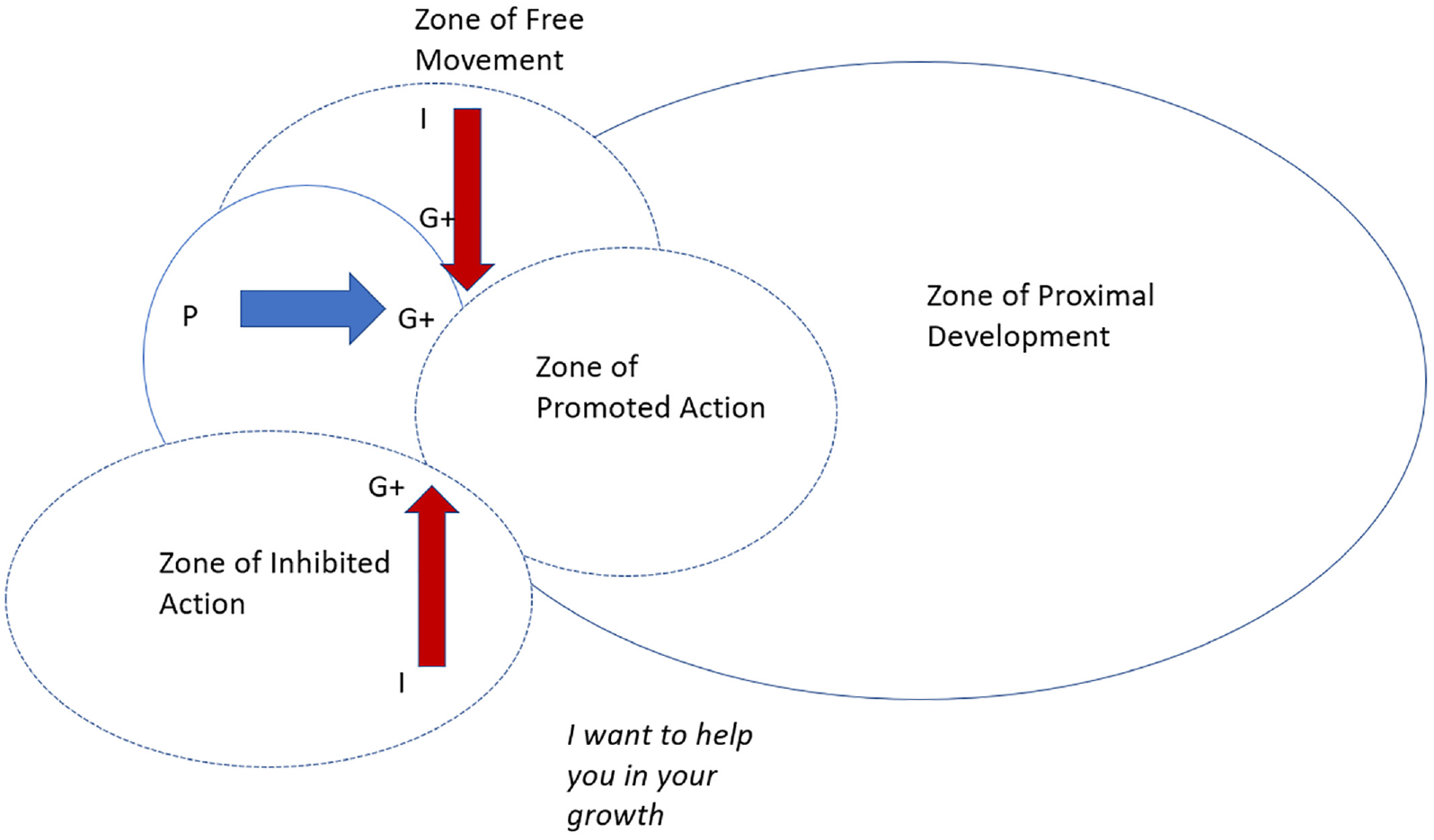
The course instructor promoting actions and inhibiting actions that are in accordance with the student’s self-determination tendency.
The student turns to the professor in order to look at his ideas for promoted actions and inhibited actions while the professor does something similar reaching out to the initial ideas of ZIA and ZPA on the side of the student (see Figure 4). Both negotiate their ZIA and ZPA because both propose each other elements that are promotable and inhibitable meaning that the student and the professor also look at the inner core regions of their ZIAs in order to know which elements can be further sub-summed under the umbrella of the ZIA. The basic idea is again transparency, but transparency understood in a dynamic way—namely to construct and co-construct ZIA and ZPD jointly in dialogue.
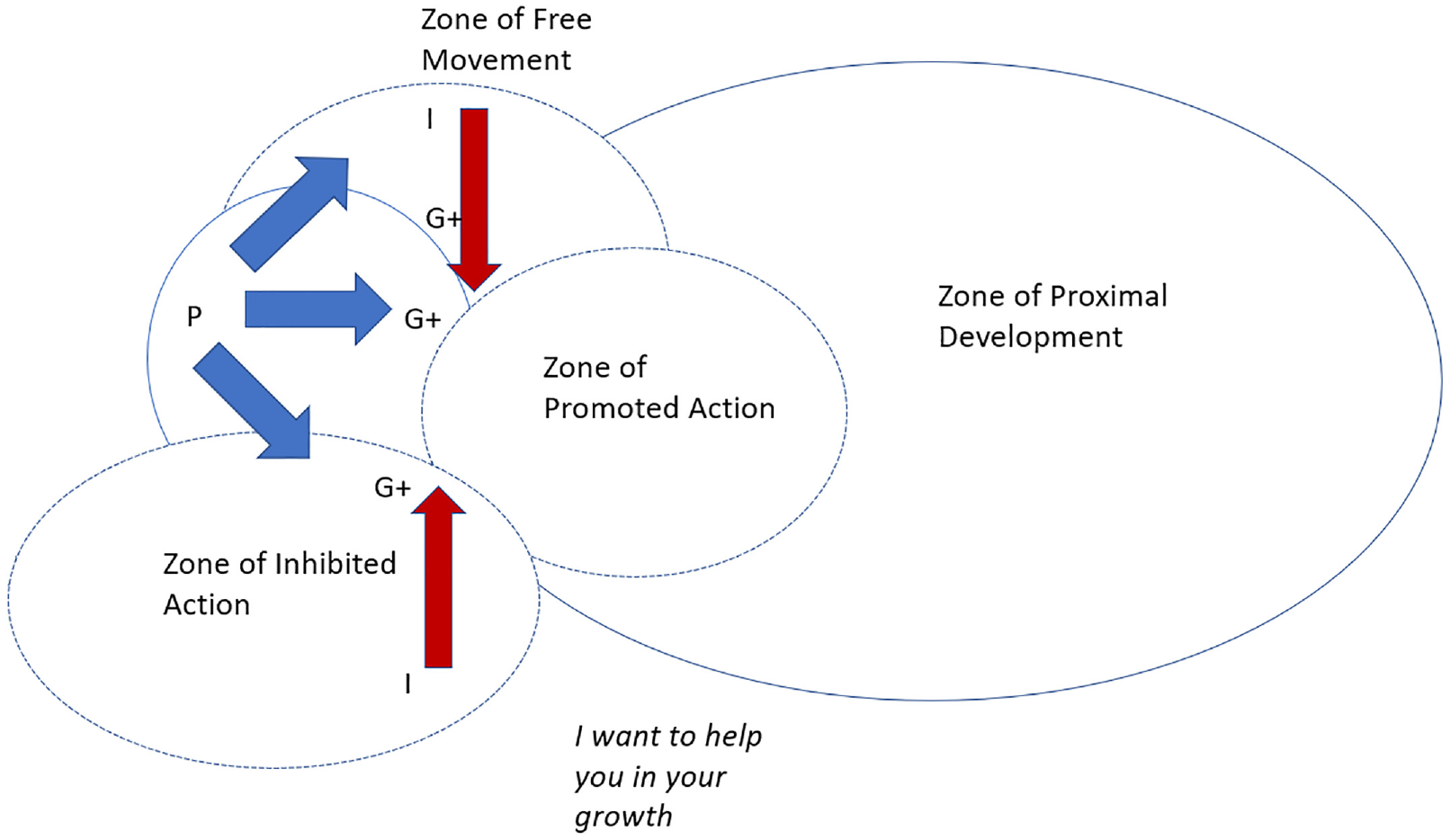
Getting a mutual glimpse into the interconnected zones of student and professor.
This means that appropriate academic inhibition of ideas can only come into being if they are not superficially turned away but only if they are screened and related to the diverging ideas of the ZPA. Only then, student and professor get an idea which thoughts can be further inhibited because they are estranged from the self-determination tendency of the individual. And only then, student and professor get an idea which thoughts can be further promoted and are in line with the self-determination tendency because they have narrowed down the ZFM and made sense of what promotion actually means in regards to their topic. The true nature of what actually promotion and inhibition mean and how they relate to the self-determination tendency of the person can only be established through getting a mutual glimpse into the similarities and differences of promoted and inhibited ideas—which is a co-operative activity from past to future. Again, this makes it also fundamental to deal with inhibited ideas and to investigate the rationale for their inhibition. Once this work is accomplished in and through negotiation, the endless variety of stimuli that the individual encounters in his dynamic ZFM can be easily transferred into the ZPA or the ZIA—because now the shadow of the ZPA and the ZIA have turned into substance.
In other words, academic novelty can only come into being organically if two people in a university (working for a common issue for example) glimpse into their mutual interconnected ZFM, ZPA, and ZIA. Only through this co-operative endeavor both learn to un-shadow the nature of their ZIA and ZPD which helps them to structure the ZFM in full accordance with their self-determination tendency. This mutual glimpse makes necessary a meta-communication about the actual nature of ZPA and ZIA which helps to structure both zones more transparently than beforehand.
Evidently, it is indispensable that both persons look at the common features of the promoted actions as well as the inhibited actions and concentrate on the nuclei that emerge from this conceptual network. Only when this nucleus of ZPA and ZIA is fully differentiated, the ZPD can come into being because now the student (and the professor) has learnt where to look to acquire the skills and where not to look. The co-operative illumination of ZIA and ZPA and the build-up of a conceptual nucleus 7 are pre-requisites for the ZPD to come into being. Otherwise, promoted action and inhibited action will lie outside the life-space of the individual because it is not in accordance with the self-determination tendency of the respective person.
The question remains unaddressed about the generalizability of my writings. This is an important question that deserves some illumination. I am the opinion that my figures are valid for any type of encounter where a person expresses his self-determination tendency and becomes restricted by a given social situation. For sure, this needs to be cross-checked across different situations and relationships .This brings us directly to the discussion section of the present paper.
Discussion: On the hunt for some limitations
From a co-genetic perspective our writings seem to make sense. However, we have solely applied them onto a specific single case within the context of academic work, for example, how student and professor discuss the preparation (reading) for the student’s bachelor thesis and empirically from the viewpoint of writing an essay. Be that as it may, I am convinced that the present scientific inquiry can be extended onto other encounters in universities as well as onto other working environments, for example, more industrial work settings (see e.g. E. F. von Fircks, 2023).
When I was doing an internship in one of the biggest Luxembourgish banks, they did not offer me any potential promoted actions, nor did they inhibit any possible actions. Thus, my ZFM was openly structured, and almost without any borders. However, I was paralyzed by this as I did not know what to do because I could do almost anything. I had a self-determination tendency—that is to look at the process of personal selection. However, they said that I could basically do anything what I want. When I asked specifically whether I could join or observe how the personal selection process was done, they agreed but never showed me. Thus, they did not promote action nor did their inhibit action regarding my self-determination tendency. When I was trying to openly negotiate the ZPA, they did not do so. And the ZPA remained shadowy.
However, we have a similar outcome as afore mentioned. While in the previous situation, I was not able to develop the skills of the political implications of Gestalt psychology because I was not promoted enough and only inhibited, in this case I was neither promoted nor inhibited which came with the prize of an almost infinite ZFM that was not digestible for me as an ongoing psychologist.
Novelty (development) only comes into being if there is promotion and simultaneous inhibition that is not defined in a rigid (ontological fashion) but as something that is, becomes and is. Only when ZIA and ZPD can be openly negotiated, the meta field (their nucleus) shifts to the foreground which helps people to adapt their actions (promotions and inhibitions) according to a related self-determination tendency. My self-determination tendency in the more industrial setting died slowly too because it was not channeled at all. For novelty to come into being, an open border is necessary (the intertwinement of being and becoming); bordering and permeability of exactly that border are necessary for learning to take place. This is something—as we have seen in this section—that is not only limited to the study of academic encounters in universities but that applied to all encounters in work settings where novelty needs to be produced or development to be stimulated.
Some further limitations of the present scientific inquiry need to be discussed too. We have taken a specific stance toward the relationship between ZIA, ZPA, and ZFM. Only in some smaller paragraphs did we introduce the ZPD-notion, thus the jump from an educational what-is to an educational what-could-be condition (Valsiner & van der Veer, 1993, 2014). If we were more consistent in our scientific endeavor, we would have taken a more complex stance toward the quadruple relationship between ZIA, ZPA, ZFM, and ZPD and how one element in our co-genetic logic alters the other. However, the focus of the paper lies on the notion of the Zone of Inhibited Action and its instantiation and explanation. For that purpose, I named and included the ZPD while only loosely dwelling upon it. Future research needs to take a closer look into the co-operative power of mutual un-shadowing of ZPA and ZIA which helps to catalyze the jump from a non-desired present to a desired future state. My hypothesis—as abovementioned—remains that the ZPA, ZIA, and ZFM triadic relationship—if negotiated and illuminated in co-operative activity—lies at the foreground of the ZPD mechanism—something that has pre-occupied researchers more than decades (Valsiner & van der Veer, 1993, 2014; Zaretskii, 2009; Zaretsky, 2021).
At the end of the discussion, I am not shy to highlight again the provisional nature of the paper. We have gathered some theoretical and empirical evidence in regards to the newly initiated Zone of Inhibited Action (ZIA) and its relation to the ZFM, ZPA, and ZPD. However, the ZIA needs to be further developed and further instanced by future researchers. For example, it would be highly promising if researchers can extend the ZIA, ZPA, ZFM relationship not only to higher psychological processes as mentioned in this paper but onto the material qualities (affordances) of the environment that emerged from human activity mediating by thinking (Barker, 1965). Showing how the material environment (furniture) inhibits and blocks actions while promoting others and its relation to the self-determination tendency of the person remains an open but highly interesting question.
Conclusion: The Zone of Inhibited Action as starting point for further research
In line with Kurt Lewin’s field theory, his ZFM, Valsiner’s extension of ZPA as well as its relation to the ZPD, I have introduced an additional zone that is in a stark co-genetic relationship with the aforementioned. This is the Zone of Inhibited Action (ZIA). The ZIA works in conjunction—but not as a simple opposite—with the ZPA and ZFM. The ZIA must not be judged negatively from the very beginning because it helps to narrow down the ZFM in a peculiar way. In other words, it alters the ZFM to make it psychologically digestible. Something similar accounts for the ZPA. However, ZPA and ZIA should not be operationalized in a static way. On the contrary, the co-genetic relationship between ZIA, ZPA, and ZFM is inherently dynamic. This means that ZIA and ZPA are in the very beginning unstructured or un-differentiated but only become substantiated over the course of co-operative activity between student and teacher (course instructor). The shadowy nature of both zones only become illuminated by a back-and-forth activity of student and course instructor, and it is within that activity that student and course instructor discuss what actually inhibition and promotion mean regarding the self-determination tendency of our respective person. This creates conceptual (semiotic) nuclei that work in conjunction in order to channel goal-directed behavior. The student (or the worker) learns to know where to go and how to go there to speak within a metaphor; thus, the un-shadowing of ZPA and ZIA are the necessary pre-requisites for the jump from a what-is to a what-could be condition (ZPD). This knowledge is of course yet restricted to the domain of academic knowledge construction but can be and need to be expanded onto more classical work settings in order to investigate its generalizability.
Moreover, the ZPD—which was only at the background of the present scientific endeavor, needs to be shifted to the foreground and psychologists or social scientists need to be interested how the four different zones work in a co-genetic logic. All this highlights the need to study dynamic learning because all learning remains dynamic. Student’s self determination tendency constantly changes as well as the external impact under which ZPA and ZIA get negotiated which means that academic novelty cannot be analyzed from a static viewpoint. The present article sets the seed for that highly needed and courageous endeavor.
Footnotes
Acknowledgements
Für Anna Ghazi, für Reinhard Semmerling, für Jaan Valsiner, ohne die ich heute nicht schreiben würde. Ihr habt mir geholfen, mich besser kennenzulernen und den Weg des Tao zu gehen.
Author contribution
The article is a single contribution of Enno Freiherr von Fircks.
Declaration of conflicting interests
The author declared no potential conflicts of interest with respect to the research, authorship, and/or publication of this article.
Funding
The author received no financial support for the research, authorship, and/or publication of this article.