



Abstract
Paramedics’ continued exposure to work-related stressors can negatively impact emotional wellbeing. Having or developing resilience contributes to better coping. Understanding differences in individual predispositions as they relate to resilience and coping can provide a needed understanding of why some people flourish while others are more at risk, with important implications for identifying and facilitating bespoke support for paramedics more at risk. The purpose of this article then is firstly to review two of the main well-validated models of innate dispositions in differential psychology, widely used in organisational and industrial psychology: personality and vocational interests. These are The Big-Five/Five-Factor Model and Holland's RIASEC. Then, we report which dispositions are an advantage for paramedic coping and resilience. Concerning personality, our findings from the literature suggest that for paramedics, lower levels of Neuroticism and Openness, and higher levels of Extraversion, Agreeableness and Conscientiousness are associated with higher resilience and better coping. RIASEC associations suggest person-environment congruence is also related to resilience and coping, this being for those with the profession's predominant Holland code of RSI (Realist, Social and Investigative inclinations). Paramedics approximating these preferences are, it appears, innately relatively less at risk of the negative effects associated with occupational stressors in paramedicine. Stressors typically include post-traumatic stress disorder, major depression and other psychological reactions that all can result in suicide. Importantly, such resilience does not mean an individual is instinctively protected from some form of emotional suffering. The implications of verifying the significance of predispositions implies the need to harness organisational psychology as part of training courses, and the need for involvement of psychologists in the field, both preventatively and in clinical care.
Introduction
Events that threaten life, or lead to tragedy, are some of the work-related stressor's paramedics must deal with on a day-to-day basis, all of which can have a negative effect on health and wellbeing. 1 Being exposed to critical incidents on an ongoing basis can adversely affect emotional wellbeing which can lead to a range of conditions including Post-Traumatic Stress Disorder (PTSD), burnout 2 and even suicide. 3 Notwithstanding these inherent risks associated with the job, many people carry on in this important and essential profession, while others find it difficult to cope and are more at threat of psychological harm. 1 Identifying risk factors associated with psychologically well-established dispositions provides access to a pool of psychological evidence-based understanding. Such understanding of these factors can facilitate the bespoke design of strategies and interventions that build resilience and coping, especially to the benefit of otherwise more at-risk members of the profession. 4 It is important to note at this point that having resiliency does not necessarily mean an individual is instinctively protected from experiencing some form of emotional suffering. 5
The purpose of this article is twofold. First, to review two well-established theoretical trait models in dispositional psychology, models which have been operationalised with reliable questionnaires (often referred to as ‘tests’) extensively used in organisational and industrial psychology: personality traits and vocational interests. 6 Specifically, these two areas regarded as fundamental domains in the psychological dispositions of individuals are (a) personality, the pre-eminent model being the Big-Five (B-5) 7 and (b) occupational preferences, the pre-eminent model being Holland's 8 vocational interest-based theory (known as the RIASEC Model: Realistic, Investigative, Artistic, Social, Enterprising and Conventional). The above two models have been selected as there are well-established questionnaires with substantial research validating their veracity, that is, each offering suitable well-validated and reliable psychometric instruments. 6 Furthermore, they each are highly relevant to career choice and functioning, as such a mainstay in the instruments used in particular by organisational psychologists, that in itself reflecting their relevance to any workplace.
Secondly, this paper also reviews how collectively, the two dispositional domains are variously related to coping/resilience, identifying what a naturally more adaptable paramedic profile could/should look like. This is not to exclude any whose profiles are otherwise, but rather can offer a flag for the more vulnerable and thereby, in the interest of their wellbeing, offer them bespoke psychological support and appropriate choice.
The methodology deployed to review the literature used in this article was not intended to produce an extensive and systematic review. Rather, a critical appraisal of the relevant literature was achieved by conducting a narrative review 9 on the three topics of interest: B-5, RIASEC and Resilience. This process was pragmatic and provided a broader approach whereby, for example, various authors looked at the topics from different perspectives resulting in a more considered review. Moreover, the majority of articles were sourced from ProQuest, PsycINFO and MEDLINE databases. There were no restrictions placed on publication dates.
The next section of this article provides an explanatory theoretical overview of resilience followed by the B-5 and RIASEC.
Resilience
The notion of resilience has its origins in social work 10 and was first used in developmental psychology during the 1980s. 10 Newman 11 proposed a wide-ranging definition of resilience as being one's ability ‘to adapt in the face of tragedy, trauma, adversity, hardship, and ongoing life stressors’. Although Streb, Haller and Michael 12 consider a generally accepted meaning of resilience has not been established, White, Driver and Warren 13 define it as a multidimensional concept comprising activities and opinions that can be realised over time. In functional terms, resilience is regarded as a measure of the capacity to handle stress. 14
Resilience can be comprehended from two perspectives. First, as a means (resilience), and secondly, as a personality characteristic (resiliency). 10 Individuals who display more resiliency are inclined to want to live and exhibit higher self-worth and self-efficacy. 10 Moreover, Oginska-Bulik and Kobylarczry 10 suggest a resilient individual can be thought of as one who possesses emotional stability and is more likely to embrace negative situations as an opportunity to gain new experiences. They go on to highlight the importance that resiliency plays in averting the negative effects of adverse life experiences such as trauma.
Distressing experiences are commonly identified as ‘critical incidents’. Critical incidents encompass crises involving witnessing life-threatening injuries, experiences that can end in a stressful reaction within the responder. 15 The literature refers to ‘direct’ and ‘in-direct’ trauma16,17 to distinguish between the influence of a critical incident on the casualty versus the observer such as a paramedic. This means that paramedics are susceptible to facing alike symptoms to that of the casualty, although the consequences are often less severe. 18
Although PTSD is a more commonly observed disorder affecting emergency workers following their exposure to multiple stressful encounters, Major Depression, characterised by a continued pervasive despondent mood affecting everyday events, has also emerged as a frequent consequence of multiple exposures. 19 There is a body of research accumulating which now links PTSD and Major Depression to several diseases, including cardiovascular disease, diabetes and Alzheimer's disease. 19
Burnout is yet another potential consequence of continuing exposure to critical incidents. According to Hudek-Knezevice, Krapic and Jarduc 20 burnout encompasses a group of indicators involving physical and mental exhaustion. While burnout is distinguishable from work-related stress, burnout is the result of protracted exposure to job-related stress. 20 Regarded as a kind of work-related burnout, ‘compassion fatigue’ can be experienced by caregivers who provide ongoing compassion and care to others, with total neglect for their own welfare.21,22
Having briefly highlighted some of the adverse consequences linked to job-related stress, we note that different individuals react differently to stress and trauma. Among other factors, psychological research has identified a number of innate dispositional characteristics elucidated in personality theory as playing a vital role in assessing and responding to stressors. Arguably these also have a determining psychological role in regard to resilience.
The relevant psychological factors include, Neuroticism, Mindfulness, Self-efficacy and Coping. 21 ‘Neuroticism’ is said to be an attribute of a person who experiences ongoing problematic emotional states of anxiety and depression. 21 ‘Dispositional Mindfulness’ is different to ‘mindfulness’ which is often associated with the practice of meditation. In contrast, Dispositional Mindfulness can be conceived of as a relatively stable individual personality trait. 23 ‘Self-efficacy’ has been identified as an important trait that can affect an individual's wellbeing and resilience. 24 According to Bandura, 25 self-efficacy can be conceived of as a person's understanding about their ability to take control and to exercise the action needed to accomplish tasks that ultimately impacts their lives. Finally, the ability to cope following an adverse event involves a process of adjustment. 21 How individuals ultimately deal with the effect of trauma can be thought of in terms of adaptive and maladaptive coping strategies. The latter involves reactive behaviours that are more harmful, typically such as excessive alcohol consumption. 18
In summary, certain dispositions as captured by well-validated trait models in psychology are associated with better coping in response to encountering stressful life experiences. Understanding these relationships can facilitate the implementation of appropriate preventative, strengthening and response strategies that build resilience and coping.
Personality and the Big-Five/Five-Factor Model
Roodenburg, Roodenburg and Rayner point out that the Big-Five (B-5) and the parallel Five-Factor Models (FFM) are now generally accepted as the optimal empirically comprehensive map of personality dimensions. This mapping is a significant empirical advance on previously theoretically and intuitively based modelling. 26 It is important to recognise that each of the five dimensions is made up of more specific ‘lower order’ traits, 26 which can be useful in providing a more specific fine-grained evaluation of an individual's disposition. 27 These finer grained attributes also allow for better understanding the more general higher order traits. A summary of the B-5 dimensions along with descriptive examples and their more specific composite traits is listed in Table 1.
Big-Five dimensions, descriptive examples and specific traits.
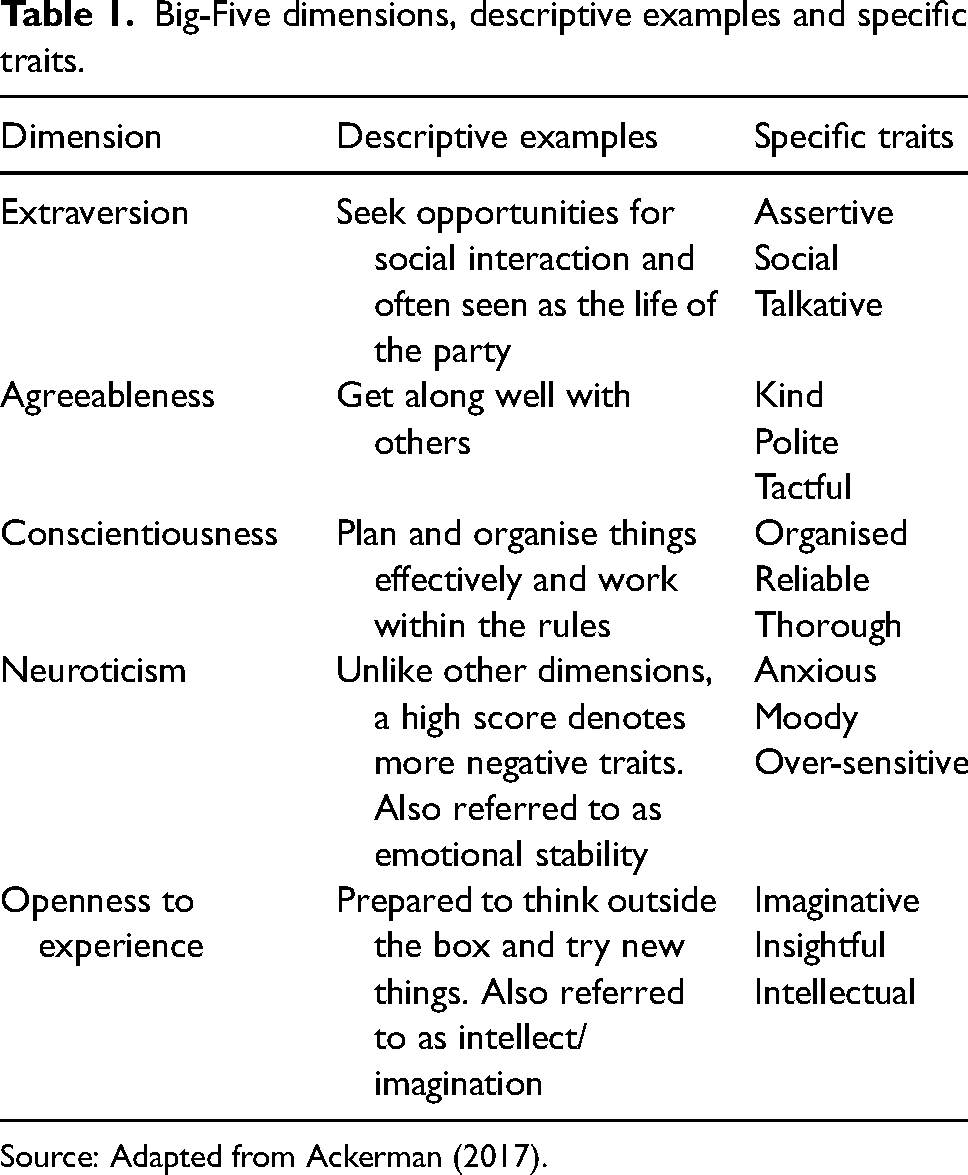
Source: Adapted from Ackerman (2017).
The following brief history is important as it describes how the B-5 model is the result of decades of personality research which commenced with the work of Raymond Cattell. In the 1940s, Cattell, working with his mentor Charles Spearman, developed factor analysis, now a well-established method of statistical analysis entertaining multilevels of complexity. At base, factor analysis identifies common variance among items, and parcels the communalities into distinct factors considered to make up a domain. 28 Cattell's use of factor analysis saw him postulating a set of 16 Personality Factors (16PFs) 29 : see Table 2.
Cattell's sixteen personality factors.
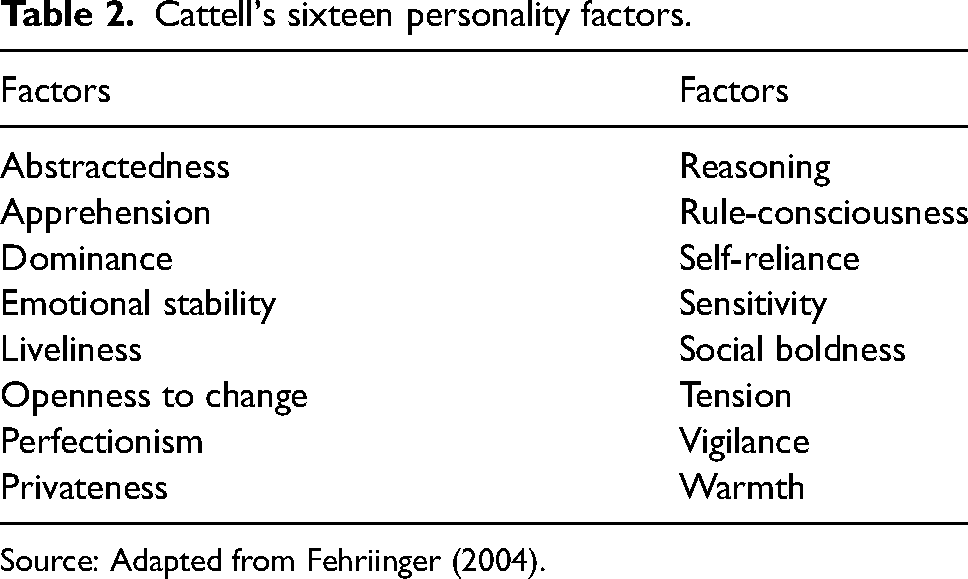
Source: Adapted from Fehriinger (2004).
Determining how many factors exist can be considered as much art as science. In 1947, Hans Eysenck proposed there were only two applicable dimensions of personality: extraversion and neuroticism. 29 Moreover, he suggested these could be combined to describe four key personality types: high extraversion/low neuroticism, high extraversion/high neuroticism, low extraversion/high neuroticism and low extraversion/low neuroticism. Eysenck went on to postulate explanations for high and low predispositions, theorising that differences in limbic system arousal may lead to differences in neuroticism. Moreover, low cortical arousal was postulated as leading to extraversion whereas, high cortical arousal has been shown to be associated with introversion. 29
The 1960s saw a refinement of Cattell's 16PFs model. Ernest Tupes, Raymond Christal and Warren Norman were responsible for identifying five recurrent factors across Cattell's 16 factors: Surgency, Agreeableness, Conscientiousness, Emotional Stability, and Culture.
30
In 1981, Lewis Goldberg instigated his analysis of a universal and comprehensive pool of items based on gathering all possible personality descriptors from the dictionary, then rating them against a large pool of individuals. The underlying assumption of the process, that all individual differences are encoded in language, became known as the lexical hypothesis.
31
This led to him finding the same five factors identified by Tupes et al. which he later referred to as the B-5:
In the late 1980s and early 1990s, two other personality researchers, Paul Costa and Robert McCrae 31 followed through on the work of Goldberg, independently verifying the validity of the B-5 as constructs of personality, and establishing questionnaires meeting stringent validity criteria including high reliability.
A point worthy of note here concerns the use of terminology when referring to the B-5. Some researchers use the label FFM while others, the B-5. 25 Roodenburg et al. 7 point out that while both models could be conceived of as parallel, they are not identical. Srivastava 26 explains this: first, Lew Goldberg B-5 was developed from ordinary language (the lexical approach). The FFM had a different basis: multiple personality questionnaires. 26 Srivastava has pointed to some arguments about the description and understanding of the fifth factor. Many lexical researchers refer to this factor as ‘Intellect/Imagination’, while questionnaire researchers use ‘Openness to Experience’. Regardless of which research tradition is adopted, both models are compatible, and in present-day application, the labels are often used synonymously. 26 The point here is that by showing their pedigree, reporting how two differing methodologies have arrived at such synonymous models helps readers in another discipline such as paramedicine to have confidence in the scientific veracity of the models and questionnaires available, necessary for justifying their use within paramedicine as an aid in the development of strategies to help build resilience and coping.26,28
Holland's personality-type occupational interest-based ‘RIASEC’ model
Holland's model of occupational interests and work environments is different to other research on occupational interests: it specifically acknowledges the part that personality plays. 32 Holland8,33,34 asserts that a person's preferred occupational choice is really an expression of their persona.
Holland's model assumes that people can be categorised as one of six types:
Holland's RIASEC types and descriptive examples.
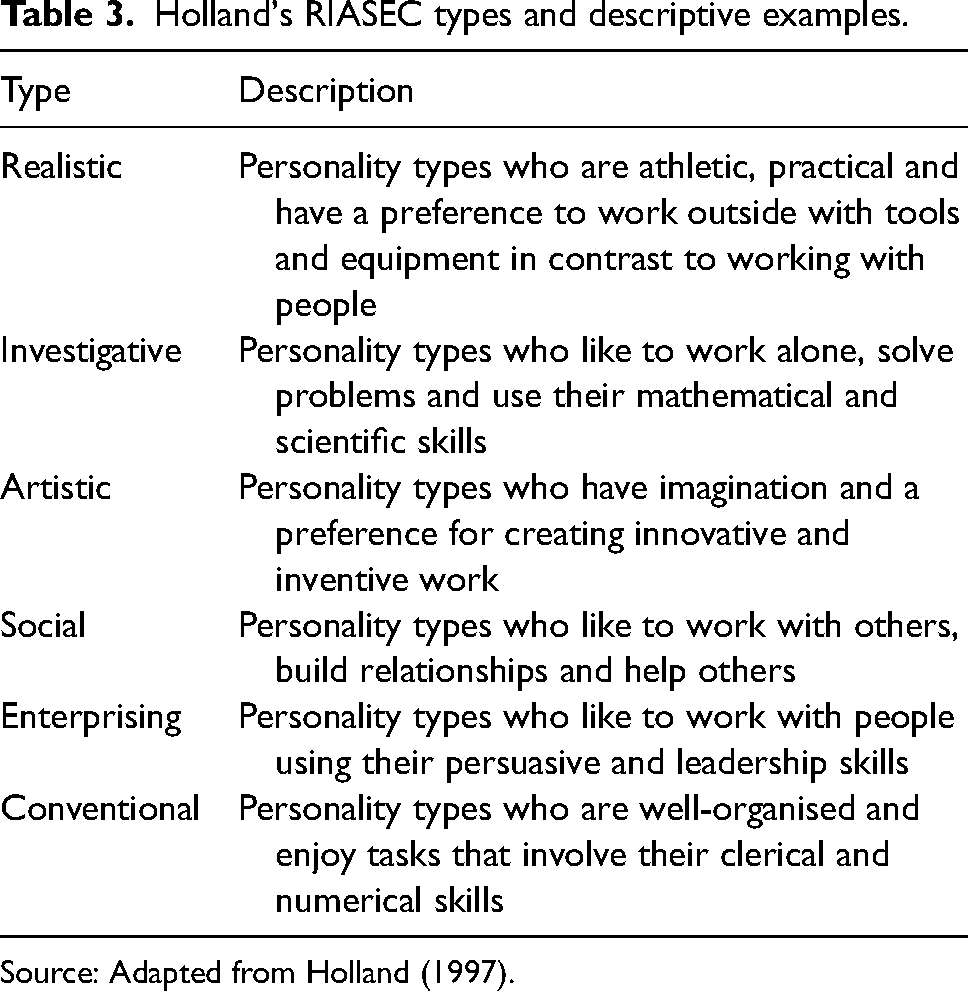
Source: Adapted from Holland (1997).
The Vocational Preference Inventory (VPI) and Self-Directed Search (SDS) are two inventories that can be used to ascertain an individual's Holland Code. This can then be used to locate a compatible or preferred work environment. If one adopts Holland's 8 idea that a person's occupational interests are a manifestation of their personality, then the VPI and SDS are really a type of personality inventories. The six personality types can thus be distinguished by individual attitudes, inclinations and capacity for coping with the demands of the surroundings, or to offer alternative ways of choosing and processing information. 8
Holland's theory espouses that individuals will pursue and thrive in settings that allow them to use their skills, abilities, express their viewpoints and morals, and engage with appealing tasks and responsibilities. 8 So for example, Investigative types tend to seek out Investigative environments.
The final idea in Holland's theory asserts that an individual's behaviour is ultimately a result of one's personality and interaction with the environment. According to Holland, 8 when an individual's personality type (or Holland Letter Code) is congruent with their work environment, or Holland occupational code, then theoretically, they are more likely to thrive, with important behavioural outcomes being realised such as work contentment, security and educational success. Conversely, incongruence occurs when opportunities in an individual's environment are unrelated to their talents and inclinations. 8
In summary, a person's preferred vocational choice is regarded as an expression of their personality. For dispositional psychologists, behaviour is ultimately regarded as a result of one's personality interacting with the environment. When a person's personality profile is known along with the profile of their environment, it is possible to postulate a likely propensity for either adaptive or maladaptive outcomes to arise from such interactions. The implication is that individuals with Realists–Social–Investigative (RSI) profiles will most easily settle into paramedicine, and least likely to suffer accumulated aggregated stress. Those technically equally capable but with differing personality profiles may benefit from more support in adapting, or from taking up roles within paramedicine that are alternative or supportive to the main workface.
Discussion
We have reviewed two established mainstream theoretical models most widely used to understand individual differences: personality and vocational interests 6 relevant to facilitating optimal adjustment in parmedicine.
To broaden understanding of relevance that will lead to justifying recommendations, we now go on to consider specifically identified personality dimensions and vocational preferences that are associated with and may explain better coping and resilience among paramedics.
B-5
In the long term, it can be argued as self-evident that a self-selection process based on job satisfaction results in individuals staying or leaving, thereby accentuating a particular personality profile within a particular occupation. In terms of emergency support personnel, Mitchell and Bray 36 used the B-5 model to elucidate the dominant personality characteristics of rescue personnel such as paramedics to be higher Extraversion, Conscientiousness and Agreeableness, and lower Neuroticism and Openness. It can be assumed that paramedics more allied to such a profile are more inclined to experience a positive outlook, greater job satisfaction and an enhanced ability to cope with the occupational stressors inherent within the profession.37–39
Interestingly, while Mitchell and Bray highlighted Neuroticism as an undesirable disposition, it has been suggested that individuals with high Neuroticism are nevertheless more likely to stay in the job, notwithstanding the daily stressors, rather than find a new workplace where the situation may be worse. 40 This suggests that ultimately, this cohort may be more at risk of ending up at some point in time being adversely affected by some form of emotional harm. Furthermore, Mitchell and Bray also espouse that high conscientiousness is a desirable trait in rescue personnel. 36 The importance of understanding this lies in the relevance to management making informed and ethical decisions, taking into account cost benefits, both personal and financial, as well as ascertaining the need to provide appropriate bespoke support.
There is a question of generalisability of profiles and their implications to similar occupations. How wide is the net? The view of a ‘rescue personality’ with a distinct profile was somewhat supported in a quantitative study undertaken in Germany 41 that explored the personality of Emergency Medical Service (EMS) personnel (n = 173). The study used the brief version of the Hamburg Personality Inventory (HPI-K) 42 and found several anticipated characteristics of the ‘rescue personality’ including low Neuroticism and Openness, and high Conscientiousness. Moreover, the EMS personnel scored low on Extraversion and even lower on Agreeableness which is not congruent with Mitchell's and Bray's 36 explanation. That the EMS personnel studied do not possess all the characteristics typified of one who serves in the emergency services can possibly best be explained by role differences between populations, and the advisability of personality research remaining specifically with the paramedic population, maintaining population homogeneity. It suggests the need for further research on factors such as common occupational responsibilities, tasks and skills that define a population.
The final justification of applying personality models in the process of improving wellbeing lies with the results of an extensive literature review that was conducted in Iran to systematically review the personality traits of paramedics. 43 Three hundred and ninety-eight articles were identified of which 27 were eligible for review. This literature review is particularly important as almost half of the studies were performed in the USA and Australia. Moreover, the selected articles involved a total of 9721 paramedics. With PTSD and burnout acknowledged as major disorders amid paramedics and emergency personnel,44,45 having established that individual dispositions have a relevant differential impact, this study maintained that knowing the desired profile of paramedics promises significant advantages in facilitating wellbeing.
To summarise: several key findings emerged from the review. First, paramedics were found to score high in Conscientiousness, sensation seeking, resiliency and empathy. Although Conscientiousness could be viewed as a favourable trait in paramedics, being meticulous and having ongoing attention to detail also puts them at risk of burnout. 36 Paramedics were also found to score low in Extroversion and Neuroticism. It also found it to be advantageous for paramedics who score low in Neuroticism as it can help them to maintain emotional stability when dealing with stressful situations. 41 On the other hand, high Neuroticism has been found to be strongly associated with PTSD. 45 Moreover, while Extraversion was deemed beneficial to score low, Extraversion is nonetheless an important trait identified as having a negative correlation with burnout, 46 a desirable trait in paramedics. Paramedics also showed lower scores on Openness. This is in contrast to Mitchell and Bray's 36 point of view where they suggest that higher scores in Agreeableness as well as Openness to Experience are desirable traits in emergency service respondents.
RIASEC
Holland (1997) asserts that optimum job satisfaction and the ability to cope within the chosen profession is more likely when there is a person-environment fit (or congruence). For paramedics the advantageous profile according to Holland is RSI. It is unlikely, however, and arguably undesirable, that every employed paramedic should be predominantly RSI. Alternative preference profiles will bring other advantages, and as already mentioned, potentially needed for other roles within paramedic services. The key point here is not one of greater expertise, but rather that the more closely an individual's dominant profile approximates RSI, the more likely they will be able to cope with the demands of the job. Others can benefit from bespoke support, and understanding their differences should facilitate better informed choice.
It is noteworthy here to indicate that there is much literature supporting the relevance of the RIASEC model to other occupational settings: for example, Kim and Park 47 with nursing students, and Petrides and McManus 48 with medical careers. However, an extensive search of the literature by way of a scoping review by Mason, Roodenburg and Williams 49 failed to locate any empirical research that relates the RIASEC model to paramedicine specifically, let alone connecting it with their wellbeing.49–51 This review was intentionally undertaken to determine which Holland code is more dominant among nurses and paramedics with implications for wellbeing.
A key finding of the review was the three-letter Holland code for nurses (
Relationship between B-5 and RIASEC
If the B-5 and RIASEC Models share a similar personality orientation in explaining individual differences, albeit from different perspectives, then it intuitively makes sense to expect there may be an overlap of some of their typological categories. 6 For example, based on their extensive meta-analysis, Barrick, Mount and Gupta 6 identified there to be noteworthy associations amid some B-5 personality traits and some RIASEC interest types. In particular, they found the Artistic and Enterprising RIASEC types and Personality traits of Extraversion and Openness to show the strongest relationship (p = .41 and p = .39), respectively. No relationship was found between the B-5 dimensions and the Realistic interest type which, as previously mentioned, is the most dominant personality type in the Holland Code for paramedics. Notwithstanding the Barrick, Mount and Gupta finding of some relationships between the two typologies, none of the associations they found have any relevance to the personality types and vocational interest types of paramedics. In another multivariate meta-analysis involving 34 studies, Hurtado Rua, Stead and Poklar 52 also found the relationship between the FFM and RIASEC dimensions to not be as strong as earlier understood. Hurtado Rua, Stead and Poklar point out that the two typologies are different and should not be regarded as similar models.
From another perspective and as a means to highlight their different purposes, De Fruyt and Mervielde 53 conducted a prospective study to investigate the validity of the FFM and RIASEC typologies in being able to predict employability and the nature or type of employment. De Fruit and Mervielde found the FFM to be more ‘employer-orientated’ where its validity was better seen in assessing employability and employment status. Conversely, the RIASEC model was found to be ‘employee-driven’ and better at forecasting the nature or type of employment that should be pursued.
While the B-5 and RIASEC are different models reflecting the perspectives of different purposes, there is merit in thinking of them as complementary typologies each contributing unique information and understanding to assessing one's ability to cope within any workplace. Thus, for example, whereas Holland's RIASEC Model can help determine if an individual's choice in the paramedic profession is congruent with their vocational interests, the B-5 adds another dimension by identifying whether their personality has other factors that provide for better coping and resilience.
Future research
The B-5 and RIASEC are not the only innate dispositions that could be reviewed to understand coping and resilience. New dispositional instruments are being developed based on other perspectives. For example, because of the appeal of strong face validity, cognitive style has long been of interest in education. Recent research utilising the rigorous empirical psychometric methods developed in researching the B-5 has resulted in the Ways of Thinking (WOT) model, which includes mapping the psychological structure of an individual's innate thinking preferences. 7 The WOT model involved three key developmental stages using methodologies developed in personality research. Each stage is undertaken by a different researcher, Roodenburg, 54 Roodenburg 55 and Costello, 56 respectively. Interestingly, it is possible to overlay the RIASEC types with WOT. 57 For example, a person who thinks intuitively is likely to possess the Investigative RIASEC type in their Holland code/profile. As such, the WOT extends understanding gained from the Holland Model and explains what thinking is more typically characteristic within certain types of occupation. In this context, further research incorporating the WOT would be helpful to understand what ways of thinking are associated with better coping and resilience among paramedics. Furthermore, research involving paramedicine students and the aforementioned models needs to be longitudinal in nature. This would allow for a better understanding of the dispositions at the outset, during training, and even over the course of their career. It would be interesting to know how the profile of ambulance paramedics compares with paramedics employed in different cultures such as the fire sector. Likewise, it would also be interesting to know if there are differences in paramedics who undertake training in the vocational, education and training sector versus under the tertiary sector.
Conclusion and recommendations
The purpose of this article was to briefly review two empirically well validated theoretical models in the psychological makeup of individuals, and to identify some of the personality traits that may facilitate paramedic coping and resilience. The two theoretical models reviewed were the B-5 and Holland's RIASEC model. In terms of the B-5, it is suggested that paramedics are more likely to be able to cope within their profession when they possess higher levels of Extraversion, Agreeableness and Conscientiousness, all of which could be considered protective factors. Conversely, lower levels of Neuroticism and Openness may be thought of having a desirable protective factor that improves personal resilience. According to Holland's RIASEC model, success and the ability to cope within the paramedic profession is also more likely when the person-environment is congruent. Ideally, this requires a person to possess a Holland personality profile or code of RSI.
This review article has sought to show that together, both models can provide a potentially justifiable profitable means by which to gain an awareness of a paramedic's innate strengths and vulnerabilities to allow for accommodation and prevention of reactions that potentially may put their wellbeing at risk. These models are linked with a wide range of psychological research that can be used in advising preventative and curative interventions that facilitate resilience and a personal sense of wellbeing.
Knowing the personality profile of undergraduate paramedic students at the time of their recruitment offers the first and arguably fundamental opportunity to facilitate adaptability into the profession. This knowledge should also lead to the design of tailored interventions for those who more at risk when ultimately and inevitably confronted by critical situations.
To properly utilise psychological models and measures in support of wellbeing, more than just debriefing is needed. Overall, we recommend that the implementation of using this broad psychological understanding, both in terms of paramedic training courses and field support, suggests an advisable level of expertise and specific competencies that are certified as required to practice psychology [in Australia by law as a registered psychologist]. Focus groups and workshops teaching reflection and self-understanding needed for informed decision making and self-management advisedly need to be facilitated by appropriately skilled and knowledgeable psychologists.
Footnotes
Author contributions
RM, JR and BW were involved in study design; RM collated articles; RM, JR and BW analysed articles; RM, JR and BW discussed core ideas; RM, JR and BW in manuscript writing.
Declaration of conflicting interests
The authors declared no potential conflicts of interest with respect to the research, authorship, and/or publication of this article.
Funding
The authors received no financial support for the research, authorship, and/or publication of this article.