




Abstract
In today’s era of evidence-based medicine, scholarly publishing plays a crucial role in advancing medical knowledge and academic careers. While manuscript (MS) writing has been widely addressed in previous literature, practical guidance for the subsequent submission and publishing process remains relatively underexplored. This article aims to provide a comprehensive roadmap for novice authors navigating the often complex journey of medical manuscript submission. Key steps were discussed, including assessing MS readiness, selecting the appropriate journal, adhering to submission guidelines, preparing a compelling cover letter, and managing the online submission system. The peer review process, responding to reviewer comments, handling rejections, and ensuring ethical conduct were also elaborated. Additional topics such as post-acceptance production, promoting published work, and the ethical use of artificial intelligence were underscored. Emphasis was placed on common pitfalls and actionable advice to improve the overall success and integrity of academic publishing.
Introduction
In the era of evidence based medicine, scholarly publishing is widely recognized as a cornerstone of generating, validating, and disseminating medical knowledge. 1 Staying updated with the latest medical literature, physicians/academicians also strive to contribute. Of note, this side of the scientific story is not without challenges and, previous reports have actually aimed to overcome those pertaining to the manuscript (MS) writing steps.2 -5 Herewith, to the best of our notice, practical solutions/suggestions for steps thereafter have not been presented in a clear and user-friendly manner. Accordingly, in this article, the authors address several issues to simplify and facilitate mainly the MS submission process (Figure 1). The discussion as regards the scientific content will not be included in this article and, needless to say, consulting a mentor who is experienced in scholarly publishing would easily replace any of the recommendations (if/when available).
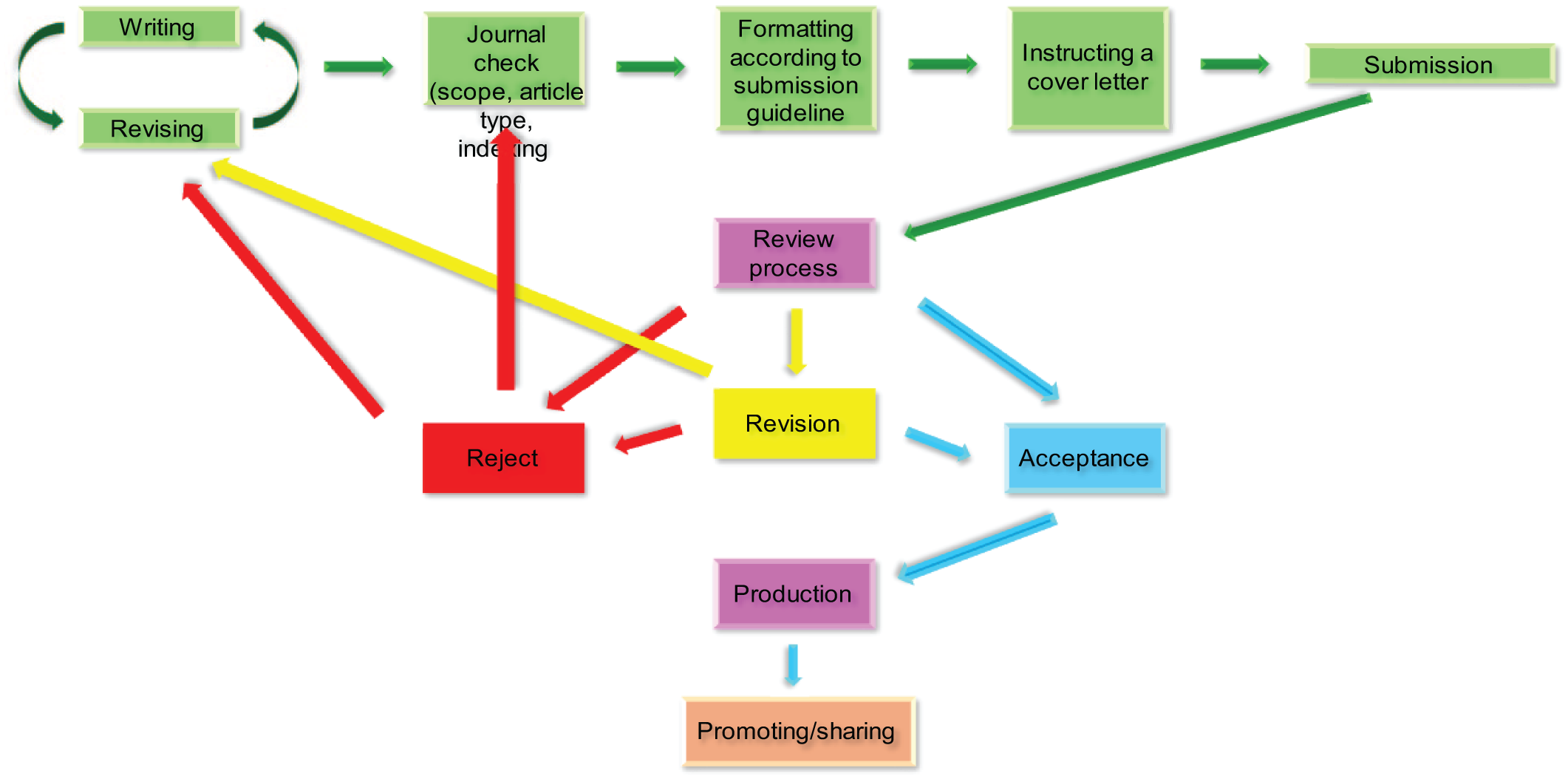
Overview of the medical manuscript publishing workflow.
Pre-Submission
Evaluating the Readiness of the Manuscript (MS)
This step ensures that the work is (technically) accurate and aligns with the publishing standards. Checking for format consistency, spelling/grammar errors, and proper citation of references is crucial. Authors who are not native English speakers may benefit from using automated language-support tools such as Grammarly, professional language editing services, or institutional writing centers, which can help improve clarity, grammar, and overall readability prior to submission. A fresh set of eyes (peer review by colleagues) can catch errors or ambiguities that have been missed; authors should therefore seek a ‘second look’. The use of a pre-submission checklist from the target journal can also ensure that all elements are present.
Identifying the Right Journal
Selecting the suitable journal or publisher significantly increases the possibility of acceptance. 6 Some ‘journal finder’ tools are available and, with the use of relevant keywords, they can help at this step.7 -9 Before proceeding with submission, it is important to feel safe that your MS does not get lost in a ‘black hole’. For instance, if the submission is a case report, it is essential to check whether the journal accepts that type of a MS. It may actually seem ridiculous, but this step is often overlooked by novice authors, leading to responses like ‘we regret to inform you that our journal does not publish that type of a MS.’ Not to mention, submission guidelines and recent issues give sufficient idea as regards the formats/topics individual journals prioritize.
Verifying whether the journal is indexed in reputable databases such as Web of Science, PubMed or Scopus can again provide insight into the journal’s credibility as well as the author’s required academic promotion criteria. 10 Other important factors to assess would include the impact factor, editorial board, peer review process, the median time to first decision or from submission to acceptance/publication.11,12 The journal’s stance on preprints and data sharing are also important in this rapidly changing scientific arena – especially if the study is time-sensitive and has the potential to add novel findings to the literature. Preprint servers are increasingly used to rapidly disseminate research findings before formal peer review. Authors may consider posting their manuscript as a preprint when timely communication is important, such as for rapidly evolving topics or publicly relevant findings. However, before doing so, authors should verify whether the target journal permits submission of manuscripts that have been previously posted as preprints. Preprints should be clearly labeled as non-peer-reviewed, and any subsequent revisions following journal peer review should be reflected in updated versions when possible. Importantly, preprints should not be viewed as a substitute for peer-reviewed publication but rather as a complementary step that enhances visibility and transparency. Indisputably, predatory journals – lacking reliable peer review process or transparent publishing charges and soliciting submissions aggressively – should be avoided. In addition to exercising general caution, authors are encouraged to use established tools designed to help identify trustworthy journals. The Think. Check. Submit. initiative provides a practical checklist for assessing journal credibility, including transparency of peer review, editorial board legitimacy, and publication practices. 13 Furthermore, subscription-based services such as Cabells Predatory Reports compile curated lists of potentially deceptive journals and publishers. 14 The original Beall’s List may also serve as supplementary screening tool. 15 Consulting such resources, alongside indexing status and journal websites, can help authors avoid predatory outlets and make informed submission decisions. Lastly, and above all, self-experience with the journal would definitely give the best idea.
Understanding (and Complying with) the Submission Guidelines
Despite some recent trends of format-free submission, journals have their own set of rules for MS preparation. For sure, if those are ignored, the paper can be rejected (immediately) even before it reaches a reviewer. Author instructions/guidelines typically outline MS lay out (eg, title page, abstract, introduction, methods, results, discussion, references), word limits, reference style and figure/table formatting. Further technical requirements might encompass blinding the MS, providing data availability statement, ethical concerns, or disclosure for funding and conflict of interest. Again, while many journals would return the MS for correction, failure to comply with the aforementioned instructions (by novice authors) could inevitably lead to desk rejection for some others.
To highlight why/how each and every instruction should be fulfilled, reference styling will hereby be exemplified. Commonly underestimated by the authors, reference section is actually one of the initial parts of the MS paid attention to by careful editors. Inconsistent style might indicate that the authors either do not know how to write them or they undervalue this step. 16
Many journals now require authors to provide a persistent digital identifier during submission, most commonly an ORCID (Open Researcher and Contributor ID). An ORCID uniquely distinguishes researchers, links their scholarly outputs across platforms, and reduces ambiguity in author identification. Authors are encouraged to register for an ORCID and ensure that it is correctly associated with their submission profile. In addition, persistent identifiers such as DOIs (Digital Object Identifiers), typically assigned through organizations like Crossref, facilitate reliable citation and long-term discoverability of published work. Incorporating these identifiers at the submission stage supports transparency, accurate attribution, and integration with journal and indexing systems.
Increasingly, journals and funders expect authors to support transparency and reproducibility by making underlying data and analytic code accessible whenever feasible. Authors should familiarize themselves with suitable, reputable data repositories for their discipline which provide persistent identifiers and long-term archiving. For computational or statistical analyses, sharing scripts and code through platforms can further enhance reproducibility.
Prior to submission, authors should review journal-specific data and code sharing policies, consider ethical and legal constraints (eg, patient privacy or proprietary data), and clearly describe in the manuscript where and how materials can be accessed. When full public sharing is not possible, a transparent explanation and controlled-access options should be provided. Thoughtful data and code sharing not only facilitate verification of results but also increase the credibility and impact of the work.
Crafting a Compelling Cover Letter
The cover letter can be seen as an elevator pitch to the Editor-in-Chief (EiC). It does not need to be long (a single page is plenty), but it does need to be clear, confident, and straight to the point. A cover letter typically begins with a polite greeting, such as ‘Dear Editor’ – there is no need for anything elaborate. It should briefly introduce the paper, outline its content, and explain its significance. Highlighting what makes the work fresh, timely, or particularly relevant to the journal’s readership is also important. Describing how the work contributes to the field and referencing any prior engagement with the journal (such as citing its articles) can strengthen the letter. It is important to confirm that the MS is original, not under review elsewhere, and approved by all authors. While avoiding exaggeration or excessive praise, authors who believe their data are particularly strong may succinctly highlight why their study is well suited to the journal and relevant to its audience. It should be kept in mind that the cover letter is the initial chance to convince the Editor(ial team).
Submission
Nowadays, most journals run their submissions through online systems or their own in-house platforms. Before jumping in, it would be wise to ensure that everything is in place, that is, cover letter, title page, main text, figures, tables, any Supplemental Material, plus the usual paperwork like (disclosure or copyright) forms. Metadata such as the title, short title, author names and affiliations, abstract, keywords, and funding info should match exactly with what is in the MS. Each journal might have its own technical requirements (eg, figure resolution and file type), those details do matter. All authors should have already reviewed and approved the final version and be listed accurately. If the platform requests suggested or opposed reviewers, consider recommending knowledgeable experts without close personal or professional ties. Upon submission, a confirmation e-mail is typically sent, and most platforms allow easy MS tracking through various review stages.
Peer-Review
What to Expect
Once your MS passes the EiC’s (as well as the technical staff’s) first look into it, the Associate Editor – or directly the reviewers – start to handle it. The process may be single-blind, double-blind, or open, depending on the journal. Once the (initial) peer review process is complete, again either first the Associate Editor or directly the EiC makes a decision in light of the comments of the reviewers – as regards the originality, relevance, clarity, strength of the study methodology/results as well as the charm of the written text. The arrived decision may generally range from accept, major/minor revision, or reject. In order not to fall in a ‘promising’ position, some journals also prefer to include ‘reject and resubmit’ option at this step. The timeline vary widely – 4 to 12 weeks – and could extend to multiple rounds of review. Constantly refreshing the inbox is tempting but delays would not be uncommon, as the reviewers are also busy academicians. Reaching out to the EiC/journal is typically not needed, provided the usual review timeframe has not surpassed.
Again, although journals try their best to provide a high quality review, dark (at least shady) side of the process might sometimes be inevitable. Yet, in some cases, the reviewer’s expertise falls far below that of the authors. Further, although rare, scientific misconduct can even ensue whereby the authors – while moving among different journals – might find a similar article already published (out of the blue) in one of the journals which already rejected their original manuscript. Herein, it is always recommended that authors somehow guarantee their really novel data publishing through a safe (and preferably) expedited process.
Responding to Reviewer Comments
If revision is requested, it can be considered a win (and should actually encourage the authors) since most papers undergo at least 1 round of revision before acceptance. On the other hand, reviewer feedback can often feel discouraging or even deflating. However, even harsh comments should not be taken personal and rather be considered as an opportunity to improve the current product. A detailed response letter should address each comment individually. A common format includes quoting the reviewer’s comment, followed by a specific response and references to changes made in the manuscript (including line/page numbers). Highlighting revisions in the manuscript would definitely help the EiC and reviewers (and is also prerequisite in many journals). While doing the revision; disagreement with the reviewer can exist and authors need to explain why they oppose (with robust evidence from the literature). Editors appreciate thoughtful and reasoned replies but not ignoring comments or vague/evasive responses. Once again; if present, bias, unconstructive/irrelevant criticism or seemingly arbitrary delays should not discourage novice authors who should learn to take those as positive reinforcement rather than frustrating and ever-perpetuating.
Handling Rejections and Resubmissions
‘Rejected ?! No worries, there are several other journals with their open arms waiting’ would be a good alternative psychology to overcome this otherwise knock out scenario. Yet, it happens to everyone, even seasoned researchers. The key is figuring out what (if any) went wrong and deciding what to do next. Sometimes it is just not the right fit for the journal. Other times, the reviewers found flaws in the design, analysis, or novelty. If they gave beneficial feedback, use it to revise your MS. If not, take a step back, reassess and send it to your next appropriate target. Some (even experienced) authors consider to rest their manuscript after 3 to 4 rejections. 17 It is noteworthy that scholarly publishing involves a dynamic interaction between authors and journals across multiple rounds of evaluation. Therefore, persistence should be coupled with critical self-evaluation; authors should continue submission only after ensuring that major conceptual or methodological concerns have been adequately addressed. For sure, if the EiC, reviewers or yourself arrive at a conclusion that there is a need for a bigger overhaul than you previously thought, you might carry on with major revisions in the study hypothesis, methodology and MS as well. When the new text is ready, it helps to choose a better-fitting journal and reader population. As an important side note, simultaneous submissions to multiple journals is a very quick/easy way to run into big trouble. When authors believe that an editorial decision is based on a factual misunderstanding, methodological misinterpretation, or clear bias; an appeal may be considered. It should be submitted respectfully and concisely, addressing specific points of concern and providing clear justification supported by evidence or literature. Emotional or confrontational language should be avoided. Authors should consult the journal’s stated appeal policy before proceeding, as procedures and eligibility vary across journals. It should be recognized that successful appeals are relatively uncommon; therefore, this option is best reserved for exceptional circumstances rather than routine disagreement with reviewers’ opinions.
Post-Acceptance
Acceptance and Production Process
First off, congratulations! After acceptance, the MS enters the production phase, which typically includes finalizing offprint preferences, publishing option (OA or subscription), copyright agreements, and proofreading. Authors are sent proof documents to check for typographical errors, formatting issues, and inaccuracies in author information, acknowledgments, or figures and tables. This stage is meant for minor corrections – major editing is a no-go here. If there is uncertainty about extra changes, the submission guidelines can be reviewed again or the EiC be contacted. Some journals publish accepted articles online ahead of print, when a DOI (Digital Object Identifier) number is assigned for citation and indexing purposes. Making your research visible can be achieved by sharing it on academic platforms like ORCID, Google Scholar, ResearchGate, and Academia.edu. Social media platforms such as Twitter (X) and LinkedIn also offer visibility opportunities. Preparing a lay summary or blog post can help reach a broader audience. Presenting your work at conferences, workshops, or institutional events can further enhance its reach and impact. The more actively you promote your research, the more likely it is to gain attention and citations. Of note, after the copyright transfer, the authors need to be aware that their article is ‘no more theirs’. As such, sharing its full-text in any of the above quoted platforms should cautiously be done – in line with the publisher’s policy.
Use of Artificial Intelligence
The use of artificial intelligence is again unavoidable with all the recent technological developments. While such tools can be a game-changer for writing and editing, their use should be both be transparent and not extensive. Limited use of artificial intelligence improving readability, grammar, and flow is reasonable; however, it should not contribute to the original content or replace (in any extent) the author’s intellectual input. Herein, to avoid ethical concerns, authors must also/strictly adhere to journal policies which already started to discuss whether artificial intelligence can be an author (which can actually not give copyright).
Many journals follow guidance aligned with the International Committee of Medical Journal Editors, which states that AI tools cannot be listed as authors because they do not meet authorship criteria such as accountability, responsibility, and ability to approve a final manuscript. In parallel, organizations such as the Committee on Publication Ethics emphasize transparency about AI assistance and the continued responsibility of human authors for all content. 18
Maintaining an Ethical Author Profile
Upholding ethical standards is essential in academic publishing. 18 All listed authors should meet criteria for authorship, including significant contributions to the research, manuscript drafting or revision, and final approval of the version submitted. 19 Despite clear authorship criteria, disagreements regarding author order, inclusion, or level of contribution may still arise. Such disputes are best prevented through early and transparent discussions among collaborators, ideally at the project’s outset and revisited as the work evolves. Referring to established recommendations, such as those from the International Committee of Medical Journal Editors, can provide a shared framework for determining authorship eligibility. When conflicts occur, authors should first attempt resolution through open, respectful communication within the research team. If consensus cannot be reached, involving an impartial third party (eg, a department chair, institutional research integrity office, or ethics committee) may be necessary. Importantly, journals are generally not arbiters of authorship disputes; therefore, resolving such issues prior to submission is critical. Proactive documentation of individual contributions can further minimize future disagreements. In addition, it should be kept in mind that plagiarism, data fabrication, and manipulation are serious violations that can lead to retractions and damage professional prestige. Conflicts of interest and funding sources should be disclosed transparently. If errors are discovered post-publication, authors should cooperate with editors to issue corrections. Engaging in peer review or editorial roles is another meaningful way to contribute ethically to the academic community. In the end, author’s reputation matters, and so does the integrity of the research community.
Conclusion
All things considered, medical publishing might seem straightforward on the surface, but once deep into the process, it can quickly turn into a maze – especially for early-career researchers. At this point, having a mentor (an expert in scientific publishing as well) in your corner can make all the difference. In addition to teaching the basics, his/her spotlight over each bump on the road (with real-life experience) will be invaluable. Last but by no means the least, in his/her absence, self-mentoring is required for those just starting out if they wish to stay afloat in the tough world of scholarly publishing.
Footnotes

Author Contributions
Funding
The authors received no financial support for the research, authorship, and/or publication of this article.
Declaration of Conflicting Interests
The authors declared no potential conflicts of interest with respect to the research, authorship, and/or publication of this article.
Data availability Statement
Data sharing is not applicable to this article as no new data were created or analyzed in this study.