



Abstract
Background:
While several clinical factors have independently been linked to anterior cruciate ligament (ACL) injury risk factors, their collective impact on knee loading during the sidestep maneuver is unknown. To better understand these factors, we assessed the relationship between strength, balance, and sprint kinetics and external knee abduction moments during sidestepping on each leg.
Methods:
Sixteen male academy-level rugby union athletes (age, 20 ± 3 years; body-height, 186 ± 9 cm; body-mass, 99 ± 14 kg) were bilaterally assessed in single-leg: isokinetic concentric and eccentric knee and concentric hip strength, balance at 2 difficulty levels, vertical and horizontal force production during maximal sprinting, and 3-dimensional motion capture while sidestepping on the preferred and non-preferred leg. A hierarchical multiple regression analysis based on this theoretical approach of the mechanics of ACL injury risk was performed.
Results:
When sidestepping on the preferred leg, larger abduction moments were explained by less concentric hip extension strength and vertical force production during maximal sprinting (R2 = 41%; ES = 0.64); when sidestepping on the non-preferred leg, larger abduction moments were explained by more concentric hip flexion strength (R2 = 8%; ES = 0.29). Larger symmetry scores between the legs (representing greater abduction moments) were explained by more horizontal force production during maximal sprinting and less eccentric knee flexion strength (R2 = 32%; ES = 0.56).
Conclusions:
Independently, the preferred and non-preferred legs contribute to increased knee abduction moments via unique distributions of strength and/or sprint kinetics. The allocations of strength and sprint kinetics appear interrelated through weaker posterior muscular strength and may be modifiable through a targeted strength training approach.
Introduction
Knee injuries are a problem in rugby union; namely injury to the anterior cruciate ligament (ACL). 1 Though not the most frequently occurring injury in rugby, ACL injuries cause the most damage to the athlete and club on and off the pitch. 1 While the mechanisms of contact ACL injuries are clear and straightforward (contact with another athlete or equipment), non-contact ACL injuries are far less understood. 2 Compared with straight-line running, where ACL injuries are not common, sidestepping involves single-leg deceleration combined with a change-of-direction, followed by a maximal reacceleration in the new direction. 3 The deceleration phase of sidestepping, known as “weight acceptance,” accounts for roughly the first 30% of stance (heel contact to toe off). During this phase is when the external loads placed on the knee can exceed the mechanical strength of the ACL and potentially cause injury. 4 Based on examination of tissue tolerance in vitro 5 and our understanding of knee loading in vivo, 4 larger external loads (specifically abduction moments) at the knee during weight acceptance suggest an increased risk of ACL injury. 3 As such, a number of researchers4,6 -11 assess knee abduction moments during the sidestep maneuver as a surrogate measure of non-contact ACL injury risk.
Considering the sidestep as it occurs in rugby, athletes are frequently required to rapidly decelerate their forward velocity on 1 leg, reorient the center-of-mass in a new direction, and then accelerate quickly. As such, athletes must possess attributes consisting of single-leg strength, balance, and sprint kinetics (force application) to perform the task efficiently and without injury. Three-dimensional analyses of the sidestep indicate that inappropriate postural adjustments (ie, including the distance from the center-of-mass to ankle-joint-center, trunk lateral flexion angle, and knee flexion angle) can increase external knee abduction moments and subsequent injury risk. 12 Unfortunately, the contributions of strength and musculoskeletal stability (assessed in a laboratory/clinical setting) to the athletes’ ability to perform the postural adjustments needed during the sidestep in the field are not well known.6 -8,13 Through strength and conditioning principles and/or screening and monitoring practice,6,13,14 ACL injury prevention strategies and research have gained great momentum in recent years. As such, common assessment strategies used to determine if an athlete may return-to-sport following an injury15,16 may also be useful for pre-injury screening to determine athlete injury risk. However, this approach has not yet been taken in rugby.
The incorporation of strength and balance training principles in injury prevention strategies is gaining popularity in sports science 17 due to its ability to protect an athlete against future injury. Lower-extremity strength stabilizes the knee (to reduce anterior tibial translation) and hip (to reduce hip adduction and knee abduction) during deceleration and can reduce knee loads.18,19 Similarly, single-leg balance has been shown to reduce the rates of multiple injuries in athletes by improving proprioceptive ability and has promise in protecting the knee joint from ACL injury.13,20 The incorporation of sport-specific tasks unique to the athlete studied (ie, sprinting and sidestepping) may also be beneficial in injury risk assessments as these movements are seen in many team sports, especially rugby. 21 While a link between the ability to produce force into the ground and ACL injury has not been made, several authors22 -25 have suggested a possible connection between reduced sprint ability and hamstring injury in a number of sports including football (soccer), Australian rules football, and rugby. Further, authors26,27 have suggested that hamstring weakness can increase the risk of ACL injury as a result of decreased kinematics and motor control to stabilize the knee joint. Therefore, a possible association between decreased force production during a sprint effort and an increased risk of ACL injury should be considered based on the common contributions of the hamstrings during sprinting and sidestepping (ie, eccentrically absorbing kinetic energy from the swing leg during the late swing phase and then concentrically producing force into the ground while sprinting 28 and eccentrically resisting anterior tibial translation during the braking phase and then concentrically generating force into the ground while sidestepping 29 ). Weak or asymmetrical concentric hamstring function may therefore indicate a reduced eccentric function to protect the knee during sidestepping; subsequently channeling more of the applied forces to the ACL.
Gaps in the literature currently exist connecting laboratory-based assessments and practical surrogate measures of ACL injury risk and how differences between legs may in turn influence that risk. Therefore, the aim of this study was to examine the relationship between functional assessments (strength, balance, and sprint kinetics) and a common maneuver used as a surrogate measure of ACL injury risk (knee abduction moments during a sidestep maneuver) among high-performance male rugby athletes. We hypothesized that the functional assessments would only explain a small percentage of the knee loading variance seen while sidestepping, but more importantly that each leg would individually contribute unique portions of strength, balance, and sprint kinetics to increased knee abduction moment.
Methods
Study design
This exploratory study was cross-sectional in nature comprising a level of evidence of 2c. Healthy participants performed a battery of quantitative functional assessments including (1) strength, (2) balance, (3) sprinting, and (4) sidestepping where the (a) preferred and (b) non-preferred legs were individually assessed. Testing took place over the course of 5 days.
Athletes
Sixteen male rugby athletes from a local high-performance academy participated in this research project (mean ± SD; age, 20.4 ± 2.7 years, body-height, 186.3 ± 9.1 cm, body-mass, 99.1 ± 14.4 kg). Athletes comprised forward (n = 12) and backs (n = 4) with an average playing experience of 11.0 ± 3.6 years. All but one forward indicated their right leg as their preferred kicking leg. Preferred kicking leg was defined as the leg in which they could kick the ball the furthest with. Preferred sidestepping leg was defined as the plant leg which they preferred to sidestep off of. There was 100% agreement between preferred kicking and sidestepping legs. At the time of this study, all athletes were free from any acute or chronic injury or illness that may have inhibited them from performing the required assessments at maximal effort. Testing occurred during the athletes’ off-season after ~24 hours of rest. All procedures used in this study were approved by the Auckland University of Technology Ethics Committee (13/378). All athletes provided their informed verbal and written consent prior to data collection.
Data collection
All athletes were fitted with identical compression clothing (Nike Pro Compression, Nike, Inc., Beaverton, OR, USA) and cross-training shoes (GEL-KUROW, ASICS Ltd., Kobe, Japan). A general self-selected lower-extremity dynamic warm-up protocol identical to the team’s weight training, practice, and game warm-up procedures was performed. Following the warm-up, athletes were randomly allocated to an assessment protocol consisting of strength, balance, sprinting, and sidestepping assessments. Each assessment protocol (strength, 30 balance, 31 sprinting, 32 and sidestepping 10 ) has been individually described in great detail elsewhere, and is accessible for further understanding of reliability metrics, machine calibration, collection procedure, data verification, and processing techniques.
In brief, the 5 assessment protocols consisted of the following: Strength 30 —concentric and eccentric knee and concentric hip isokinetic strength assessments were performed at 60°·s−1 on a Humac Norm dynamometer (Lumex, Ronkonkoma, NY, USA). Following a familiarization warm-up, athletes performed a maximal effort trial consisting of 5 extension and flexion actions on each leg. Balance 31 —Athletes were positioned in a single-leg standing position in the center of a platform on a Biodex Balance SD System (Biodex Medical Systems, Inc., Shirley, NY, USA). Following a familiarization warm-up, athletes performed three 20 seconds trials of single-leg balance at Level-8 (more stable) and Level-2 (less stable) on each leg. Sprinting 32 —Athletes were secured to a vertical strut via non-elastic tether on a Woodway Force 3.0 (Woodway USA, Inc., Waukesha, WI, USA) NMT ergometer. Following a familiarization warm-up, athletes performed two 8 seconds maximal velocity sprint efforts from a “blocked” starting stance. Sidestepping 10 —Athletes were given a 10 m runway to maximally accelerate and perform a 45° sidestep on a force platform (Type 9287C; Kistler Instrumente AG, Winterthur, CHE). A 9-camera (T10S; Vicon Motion System Ltd., Oxford, UK) motion capture system tracked 78 reflective markers to calculate inverse dynamics during the sidestep. Following a familiarization warm-up, athletes performed 3 successful maximal effort sidestepping trials on each leg, consisting of reaching an approach velocity of ⩾6.0 m·s−1, striking the force platform completely with the sidestepping foot, and executing the task as quickly as possible. A visual illustration of the assessment protocol used in this theoretical approach can be found in Figure 1.
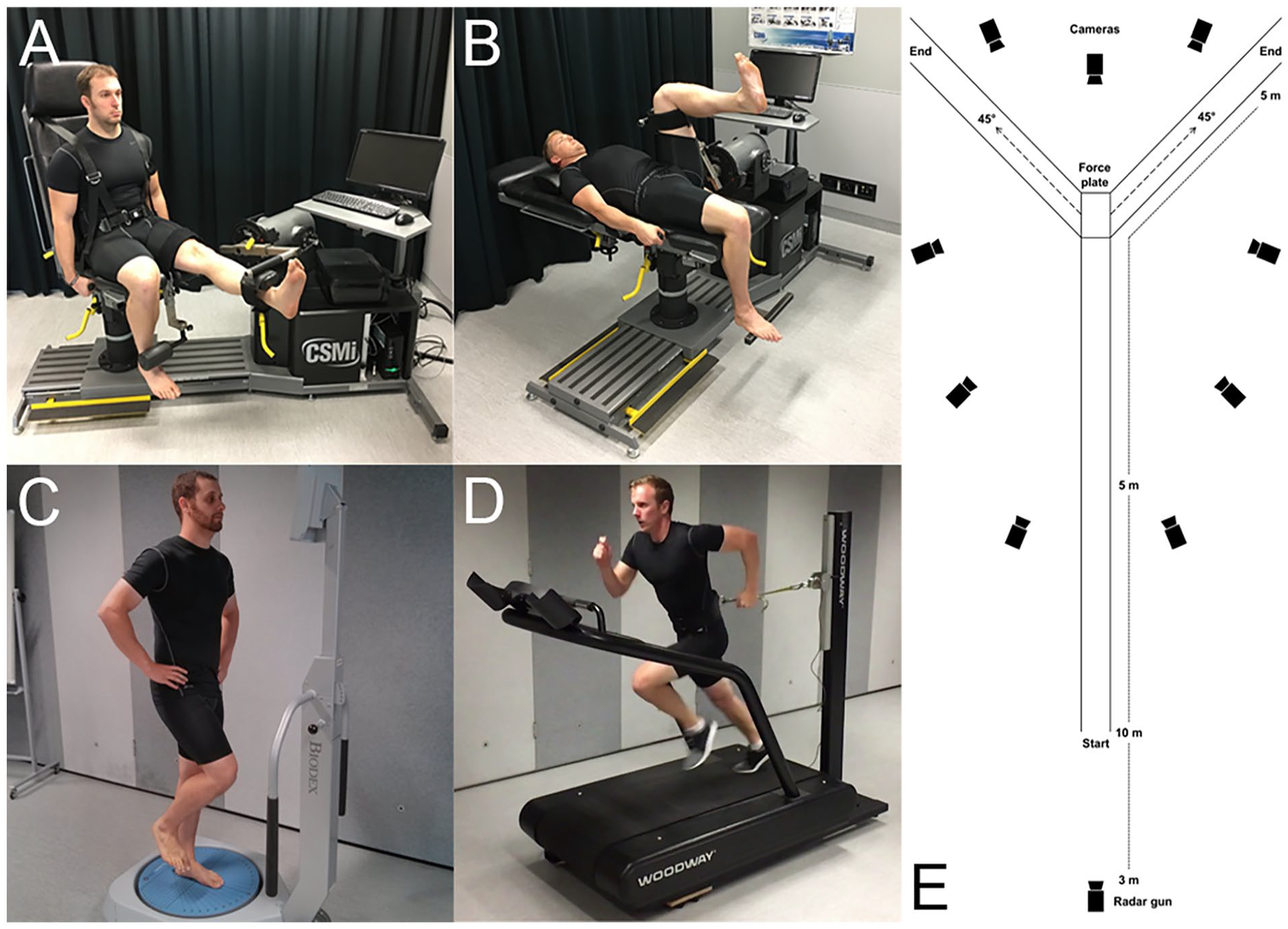
A visual illustration of the assessment protocol used in this theoretical approach consisting of concentric and eccentric isokinetic (A) knee and (B) hip flexion and extension strength, 30 (C) multiple difficulties of dynamic single-leg balance, 31 (D) various phases of sprint kinetics, 32 and (E) maximal effort sidestepping. 10
For all assessments, athletes were verbally and visually instructed on how to perform the specific task and were allowed adequate familiarization of the protocol. Assessments began only when the athlete felt comfortable with performing the movement at a maximal effort. Athletes were provided adequate rest periods to recover during the assessments. Strong verbal encouragement was provided to ensure maximal effort was produced (excluding balance where the athletes were allowed silence to concentrate). Each leg was individually assessed in all assessment protocols for subsequent asymmetry analyses.
Data analysis
Custom-made LabVIEW (Version 14.0; National Instruments Corporation, Austin, TX, USA) and Matlab (R2014b; The MathWork, Inc., Natick, MA, USA) programs were created to analyze all data. Strength data (100 Hz) in the form of torque-angle curves were filtered with a fourth-order polynomial and separated into extension and flexion actions (where the first repetition of each action were removed) before the mean peak torque and angle of peak torque were extracted. Balance data (20 Hz) from the balance assessment were generated within the Biodex software using the mean of the 3 trials performed. Data were presented as overall, anterior-posterior, and medial-lateral scores. Sprinting data (200 Hz) were filtered with a dual low-pass Butterworth filter at 10 Hz and separated into initial acceleration (steps 1 and 2), acceleration (steps 3-12), and maximal velocity (steps 13-22). Sidestepping data (3-dimensional motion [100 Hz] and ground reaction force [1000 Hz]) were filtered with a low-pass fourth-order zero-lag Butterworth filter using a cut-off frequency of 16 Hz in Visual 3D (4.91.0; C-Motion, Inc., Germantown, MD, USA). Athlete-specific helical-axis joint-center locations for the hips and knees were calculated from the range-of-motion trials (hip star and squats respectively) using Matlab.33,34 Knee moment data were defined as those externally applied to the segment’s distal end and normalized to body-mass and body-height (Nm·kg−1·m−1) and time data were normalized to stance phase (%; from initial contact to final contact) to facilitate comparison between all athletes.
Individual symmetry angle scores were calculated for all variables using a modified non-dimensional relationship (equation 1). 35 This equation was chosen as it does not require an arbitrary reference leg, is unaffected by artificial inflation by near-zero numbers and is useful in determining clinically relevant information in sports science.35 -37 The resulting score (between 0% and 100%) reflects the absolute percentage difference between the legs; where 0% indicates perfect symmetry and 100% indicates perfect asymmetry.
Equation 1. Absolute symmetry angle (ABSθSYM).

but if,

then,

Statistical analysis
In support of this theoretical approach, independent variables of interest included concentric and eccentric strength at the knee and concentric strength at the hip, ability to maintain single-leg balance at multiple difficulty settings, and sprint kinetics (vertical and horizontal force production; FV and FH, respectively) during acceleration and maximal sprinting. Previous rugby research examining differences between legs in injury risk assessments 16 were also considered. The principles of magnitude-based decisions (formerly magnitude-based inferences) were implemented in this study rather than traditional significance testing to identify practically important determinants of increased knee loads and to provide a more detailed interpretation of the findings. 38
Correlation matrices were separately produced and analyzed for the independent variables within the theoretical approach mentioned above which pertained to the preferred leg, the non-preferred leg, and the symmetry angle (the absolute difference between the 2 legs [range: 0%-100%]). Checks for multicollinearity and variance inflation factor (Pearson’s r ⩾ .8 and VIF > 5) were used to identify which variable(s), if any, contributed to collinearity. 39 Any variable(s) identified as contributing to collinearity were closely assessed to determine if its absence in the subsequent regression model would negatively affect the initial theoretical approach (Figure 2). After removal of collinear variables, all remaining variables entered a new correlation matrix where they were correlated with the dependent variable. Mean and standard deviation, goodness of fit presented as Pearson correlation coefficient (r), and coefficient of determination (R2) were produced for each model. The scale of thresholds used for interpreting the practical importance of the individual variable correlations were <.10 (trivial), .10 (small), .30 (moderate), .50 (large), .70 (very large), .90 (nearly perfect), and 1.0 (perfect) correlations. 40 Based on this scale, only moderate or higher (⩾.30) correlations were considered practically important for the subsequent multiple regression equation and a minimum of a 5:1 ratio of athletes to independent variables (16 athletes = a maximum of 4 independent variables) were implemented to account for a lack of generalizability (shrinkage) and inflated error rates due to the study’s smaller sample size. 41

Statistical analysis flow-chart used in the theoretical approach. Twenty-two independent variables were considered for each leg on each athlete based on our theoretical model. First, a multicollinearity adjustment was made, excluding 8 variables listed, followed by a variance inflation factor adjustment, excluding an additional 6 variables listed. The resulting 8 independent variables (eccentric knee flexion and extension torque, concentric hip extension and flexion torque, dynamic postural stability index L8 and L2, and vertical and horizontal force during maximal sprinting) entered the final correlation matrices.
The 2 criteria listed above were used in determining which independent variables would continue on to the hierarchical multiple regression equation. Each variable entered the equation in a separate block in descending order of practical importance (highest to lowest Pearson’s r). The adjusted R2 (
Following the statistical process, unstandardized and standardized coefficients (B and β, respectively) for the individual independent variables and R2,
Results
Descriptive information (mean ± standard deviation, r, and R2) of the initial correlation matrices pertaining to the 3 groups are presented in Table 1. Large negative (concentric hip extension torque [−0.56]) and moderate negative (FV during maximal sprinting [−0.40], eccentric knee extension torque [−0.38] and concentric hip flexion torque [−0.31]) correlations were observed with knee abduction moment at weight acceptance during the sidestep maneuver in the preferred leg. Moderate positive (concentric hip flexion torque [0.37]) and negative (FV during maximal sprinting [−0.33]) correlations were observed in the non-preferred leg. Large positive (FH during maximal sprinting [0.58]) and moderate positive (FV during maximal sprinting [0.46]) and moderate negative (eccentric knee flexion torque [−0.40] and concentric hip flexion torque [0.37]) correlations were observed in the symmetry angle. All other variables did not meet the minimum requirements: presented small or trivial correlation coefficients (<.30) and/or exceeded the 5:1 ratio of athletes to independent variables.
Correlation matrices.

Abbreviations: N, newton; m, meter; kg, kilogram; °, degree.
Correlation matrices for the relationship between the independent variables in the theoretical approach and the dependent variable (knee abduction moment at weight acceptance during the sidestep maneuver) among the 3 groups, n = 16. Values are means ± standard deviation; Pearson correlation coefficient (r); coefficient of determination as a percent (R2 [%]). Numerical superscript represents the largest Pearson correlation coefficients which satisfies the effect threshold value of ⩾.30 (representing a moderate magnitude of the effect), presented in descending order.
While some of the independent variables listed above met the initial inclusion criteria (r ⩾ .3 and 5:1 ratio of athletes to independent variables), these variables were subsequently removed as their inclusion lowered the R–2 of the overall model.
The hierarchical multiple regression analysis equations for the 3 models are presented in detail in Table 2. In Model 1, preferred leg, concentric hip extension torque was entered first and explained 33% of the adjusted variation in knee abduction moment and FV during maximal sprinting was entered second and explained an additional 8%. Eccentric knee extension torque (originally entered third) and concentric hip flexion torque (originally entered fourth) lowered the
Hierarchical multiple regression analysis.

Abbreviations: B, unstandardized coefficient; β, standardized coefficient; R2, coefficient of determination; R–2, coefficient of determination adjusted for degrees of freedom; SEE, standard error of the estimate; N, newton; m, meter; kg, kilogram; %, percent.
Hierarchical multiple regression analysis for the prediction of knee abduction moment at weight acceptance during the sidestep maneuver among the 3 theoretical models, n = 16.
Practical decisions are based on the square-root of the adjusted correlation coefficient. Small and large effect: .10 to <.30 and .50 to <.70, respectively.
Discussion
To the best of our knowledge, the current study is the first to aid in our understanding of the primary characteristics of the sidestep with current assessment strategies used to evaluate injury risk in athletes15,16 and then observe that relationship with knee loading during the sidestep. Dynamic postural stability (Level-8 [more stable] and Level-2 [less stable]) contributed nominally to knee loading in either leg despite previous research13,17 highlighting the importance of balance training as a factor to improve injury prevention models. This finding may be explained, in part, by the substantial differences in age, sex, sport, assessment protocol, and injury location between the current study and previous work in the area of neuromuscular training for sports injury prevention.13,17 What we can infer from the data is that knee loading in the preferred leg was influenced by weak lower-extremity posterior strength (specifically hip extension [glutes]), and knee loading in the non-preferred leg was marginally influenced by strong lower-extremity anterior strength (specifically hip flexion [hip flexors]); confirming that each leg possesses unique mechanical characteristics. We can also infer that larger asymmetries in FH during maximal sprinting influence larger asymmetries in knee loading, suggesting a potential link between sprint kinetics and ACL injury risk.
Just under half of the variance (41%) in a larger external knee abduction moment at weight acceptance of sidestepping was explained by lower levels hip extension strength (glutes and hamstrings) and FV during maximal sprinting in the preferred leg alone. When performing a sidestep, the athlete must first decelerate the body before reorienting the center-of-mass in a new direction. It is during the weight acceptance phase where the knee and hip move into greater degrees of flexion by eccentrically lengthening the quadriceps, hamstrings and glutes to accept the mass of the athlete and decelerate their forward velocity. Adequate strength in these muscle groups has been found18,43 to provide the appropriate joint stability and to protect the ACL and other soft tissues. A lack of adequate strength and control at the hip has been targeted44,45 as a main contributor to larger moments experienced at the knee within the sidestep maneuver. It is thought 18 that stronger hip muscles can better resist high levels of externally applied loads, causing internal rotation and adduction of the femur, subsequently aiding in the reduction of internal rotation and abduction of the knee. With this thought in mind, the athletes in our cohort who possessed lower levels of hip extensor strength also presented larger knee abductor moments while sidestepping. In addition, lower levels of eccentric knee extension strength and hip flexion strength also showed moderate correlations (r = −.31 to −.38) with larger knee abductor moments. While these last 2 variables were disallowed in the final model, they do support the suggestion that (1) posterior-chain strength and (2) overall hip strength are vital components in reducing larger external loads in the preferred leg during the sidestep.
Another interesting finding in the preferred leg was that lower levels of FV during maximal sprinting contributed to higher levels of knee abduction moments during the sidestep. When considering the spring-mass model,
46
a stiff lower-extremity will produce the greatest FV due to the rigidity of the model in transferring energy compared to a compliant lower-extremity which will absorb more energy by greater degrees of flexion across the lower-extremity joints. However, as many of the events in rugby are not cyclic (sidestepping, jumping, kicking, etc.), each leg may present a different stiffness profile. This may be the case in the current study as only the preferred leg presented a relationship between lower FV and larger knee moments; potentially suggesting that the preferred leg in rugby athletes acts as the “stick” leg (absorbing more energy).22,46 Additionally, if the glutes in a particular athlete are weak and yet are still required to activate, control, and aid in decelerating the body, the athlete may in fact require more time at which to flex the hip or a longer range-of-motion of hip flexion in order to accomplish the task. Therefore, weaker glutes and lower FV may be inherently linked as a function of each other. However, as there was no collinearity between the 2 variables and the expected contribution of each variable greater than randomness alone (eg, the
The non-preferred leg presented a unique model to that of the preferred leg where only 8% of the variance seen in higher levels of knee abduction moment was explained by higher levels of hip flexion strength (hip flexors). The non-preferred leg acts as the redirecting leg during the sidestep maneuver, and therefore may experience a less loading compared to the preferred leg. This could add up to a lower frequency of single-leg loading and the deceleration phase may be much shorter and require less joint flexion in the knee and hip. 47 If this were the case, the higher frequency of muscular “recoil” to redirect the leg would potentially be localized to the anterior-chain musculature (ie, quadriceps and hip flexors). While the hamstrings and glutes may be strong in these athletes, the hip flexors (or other quadriceps) may be stronger than normal. Stronger levels of hip flexor strength could add to an athlete being quad-dominant or essentially throw off the ideal balance of the hamstrings to quadriceps ratio at the knee and/or at the hip.30,48 The aforementioned connection between strong hip flexors and larger knee abduction moments are purely speculative at the time as this measure of strength only provides a small examination of the relationship. What is more important to take note of is that the non-preferred leg is not affected by lower levels of posterior-chain strength as was the preferred leg. Additional athlete characteristic or performance variables may further explain this finding increase. 10
Very little research has been performed using symmetry angle scores and even less outside of linear walking, jogging, and sprinting activities; however, its importance and contribution to our understanding of individual differences is well established.35 -37 As such, in addition to assessing the unique characteristics of each leg in terms of raw variables, we also deemed the inclusion of assessing the difference between the legs as equally important to acquire the complete picture of our athletes’ injury risk status. As such, we ran a third model using our symmetry angle scores in an attempt to answer the question, “If asymmetries exist in traditional assessment measures of strength, balance, and sprint kinetics, would they also exist in knee abduction moments as a surrogate measure of ACL injury risk?” We found that larger symmetry angle scores in FH during maximal sprinting and smaller symmetry angle scores in eccentric knee flexion strength (quadriceps) explained 32% of the variance of larger symmetry angle scores in knee abduction moments. Hip extension strength has been shown to impact FH and subsequently sprint velocity. 49 Decreases in FH have also been found pre- and post-injury in footballers and rugby athletes. 24 While both of these studies produced a measure of force production (the summation of both legs) via center-of-mass acceleration and position, it can be asserted that the net force is the product of the contribution of the right and left legs (or preferred and non-preferred in the context of the current study). Therefore, a decrease in net FH could be the result of a decrease in only 1 leg, which would present a larger symmetry angle score.25,50 If an athlete possessed a larger asymmetry in FH, this would inform us that one of the legs is potentially not operating as efficiently (or at the same level) as the other. If the leg which produced the lower FH is doing so because it lacks the strength, then it could be speculated that the same “weak” leg would lack the posterior-chain strength that supports the lower-extremity joints during a sidestep. The notion that an imbalance in FH while sprinting can potentially increase injury risk is very novel and interesting, however, more research needs to be conducted to substantiate or refute these assertions.
Limitations
We feel it is important to acknowledge several limitations in the current study to give context to the interpretations of our findings. First, the theoretical approach that we implemented in this study was thought to best represent the most fundamental characteristics of the sidestep maneuver; consisting of strength, balance, and sprint kinetics. While the assessments in this study were primarily conducted in the sagittal (anterior-posterior) and coronal (medial-lateral) planes, we do want to acknowledge the importance of the transverse (internal-external rotation) plane as it pertains to knee loading; with multiplanar loads believed to produce the greatest increase of ACL injury risk during the sidestep. 3 However, we can also acknowledge the unavoidable potential for other authors to see differently and possibly use alternative assessment tools which they feel might better characterize the sidestep. As the presence of unique views from researcher to researcher is unavoidable, we ensured that our assessment tools within our theoretical approach were also within the boundaries of typical field- and laboratory-based research and practical return-to-sport decision making to aid in the carryover of previous and future work.15,16 Second, as our sample size was smaller (n = 16) than typically desired for regression analyses (n > 50), we used a very strict and robust statistical model and interpretation process to focus on the true importance of the model. We felt that it was the appropriate step to ensure that we obtained meaningful results based on our sample population, thus allowing us to propose the most accurate considerations available without the influence of data inflation, error, or chance. Third, as the purpose (and theoretical approach) of this study was to examine the relationship between select assessment tools and knee loading during the sidestep of each leg, the results from this study are unique to: (1) male rugby union athletes; (2) leg division using the preferred and non-preferred leg; and (3) external knee abduction moments during the sidestep maneuver; normalized to the individual athlete’s body-mass and -height. As specific as this study may seem, the information resulting from our results provides valuable information regarding injury risk factors in rugby at which to build upon with future research potentially examining female and/or professional rugby using the theoretical model found in this study.
Conclusions
Our stepwise regression analysis of lower-extremity differences in knee moments during sidestepping in male rugby athletes showed that the preferred and non-preferred legs possess unique mechanical attributes. The attributes between the legs also appear interrelated and may be modifiable through a targeted strength training approach. For example, both legs presented a relationship with increased knee loading through weaker posterior muscular strength (glutes and hamstrings) or stronger anterior muscular strength (hip flexors and quads), providing valuable information into the importance of appropriate levels of strength about the hip. We therefore suggest the incorporation of hip strength testing in all forthcoming research related to ACL injury risk. Additionally, we would like to introduce the possibility of greater knee abduction asymmetry during sidestepping resulting from greater asymmetry in FH during maximal sprinting. A greater understanding of posterior-chain strength application would provide valuable insight on this notion and undoubtedly progress the field of research.
When assessing athletes for injury risk factors, practitioners, and clinicians should incorporate a multicomponent assessment strategy combining elements of single-leg strength at the knee and hip and single-leg sprint kinetics during maximal sprinting (if available). The interpretation of such a testing strategy would identify single-leg values lower than pre-established norms and/or asymmetries between the legs. An individualized or “targeted” strength training program could then be created for the athlete to work on increasing strength and/or decreasing asymmetries where needed. Follow-up assessments could then determine the effectiveness of the program and any subsequent modifications needed for the progression. Future research is greatly needed in the area of individualized training programs to determine their effectiveness in reducing injury risk and/or increasing performance in athletes.
Footnotes
Acknowledgements
Dr. Scott R. Brown was funded by the AUT Vice Chancellor’s PhD scholarship. The authors thank all of the athletes, coaches, physiotherapists, and strength and conditioning staff associated with Auckland Academy for their participation.
Author Contributions
All authors contributed to the study conception and design. Material preparation, data collection and analysis were performed by SRB. The first draft of the manuscript was written by SRB and all authors commented on previous versions of the manuscript. All authors read and approved the final manuscript.
Funding:
The author(s) received no financial support for the research, authorship, and/or publication of this article.
Declaration of Conflicting Interests:
The author(s) declared no potential conflicts of interest with respect to the research, authorship, and/or publication of this article.
Data Availability
The data that support the findings of this study are available on request from the corresponding author.
Ethical Approval and Informed Consent
Informed consent was obtained from all participants after the nature and possible consequences of the study was explained. All procedures used in this study were approved by the Auckland University of Technology Ethics Committee (#13/378) for Human investigation.
