



Abstract
Background
There is surging interest in workplace mindfulness programs to address employee stress, resilience, and performance, however, significant gaps in knowledge remain around feasibility, acceptability, effectiveness, and predictors of therapeutic change.
Objective
This study evaluated whether a brief, 4-session Mindfulness Skills Course (MSC) for university employees, covered by the institution’s wellness benefits, was effective in reducing stress, increasing mindfulness, improving feelings toward oneself and others, and increasing work performance.
Methods
Prospective observational cohort study design. Participants completed self-report surveys before and after the MSC. Class attendance and home mindfulness practice were recorded to assess feasibility and adherence. Paired t-tests and Pearson correlations were used to evaluate program effectiveness and predictors of change.
Results
190 employees enrolled for the in-person course during the first year of roll-out. Of those, 164 (86%) completed pre-course surveys, 134 (82%) attended at least three class sessions, and 123 (75%) completed the post-course surveys and program evaluation. Paired samples t-tests showed improvements for perceived stress, mindfulness, and relational wellbeing with moderate to large effect sizes (d = .44 - .78; P’s < .001). Self-perceived work performance increased with a small effect (d = .33; P < .001). More frequent home meditation practice was positively correlated with a larger increase in mindfulness (r = .20; P < .05). Increased mindfulness correlated with reduced stress (r = −.55), greater positive emotions towards self (r = .38), and reduced negative emotions towards self (r = −.40) and others (r = −.42) (all P’s < .001). Reduced stress was correlated with increased perceived work performance (r = −.22; P < .05). Higher baseline stress levels predicted greater increases in mindfulness (β = .37, R2 = .14, P < .001), while lower baseline mindfulness predicted greater reduction in stress (β = .27, R2 = .07, P < .01).
Conclusion
Taken together, these results support the feasibility and effectiveness of a brief, 4-wk, employer-sponsored mindfulness skills course, which may be most helpful for individuals with higher stress and lower trait mindfulness.
Introduction
Stress and stress-related symptoms can be a burden to employees and employers alike, with substantial costs to quality of life, well-being, and workplace productivity. 1 For example, the 2020 Stress in America survey found that 64% of employed adults reported that work was a “very or somewhat significant” source of stress, highlighting the ongoing need for work-specific stress reduction programs. 2 It is well known that high levels of acute stress as well as chronic stress are associated with increased risk of mental health disorders, including anxiety, depression, insomnia and other sleep disorders, eating disorders, substance use, and interpersonal conflict. 3 The connection between stress and mental health is especially important given that mental disorders are one of the leading causes of absenteeism and lost workplace productivity. 1 Moreover, persistent stress can cause common stress-related physical symptoms like headaches, gastrointestinal distress, high blood pressure, musculoskeletal tension and pain (eg, neck and back pain), lethargy/fatigue, and susceptibility to infectious disease, all of which can precipitate visits to healthcare providers, and, in turn, further contribute to lost productivity.4,5 Taken together, high levels of work-related stress coupled with the prevalence and costs associated with persistent stress and stress-related conditions points to the need for evidence-based workplace interventions to simultaneously reduce stress, enhance mind-body health, and optimize workplace performance.
Mounting evidence shows that mindfulness training can effectively reduce stress and promote mental health and well-being, in both clinical populations and healthy adults.6,7 Mindfulness can be briefly defined as awareness and acceptance of one’s experience in the present moment. 8 Mindfulness-Based Interventions (MBIs) aim to cultivate greater mindfulness through daily meditation practice, and mindfulness meditation training has been shown to improve psychological wellbeing, quality of life, and relationship quality.9-11 In addition to training attention, awareness, and nonjudgment, mindfulness practice also involves the core qualities of compassion, connection between self and others, and being able to respond wisely vs reacting automatically to stress. 12 Conceptually, mindfulness training in the workplace can help relieve stress, in part, by practicing greater empathy, compassion, and acceptance toward oneself and others, yet the empirical effects of mindfulness training on shifts in relational perception at work remain unclear. 13
Given its documented effectiveness in reducing stress and enhancing emotional well-being in both clinical and nonclinical populations, there has been surging interest in how to integrate mindfulness training into the workplace.9,14,15 One early integrative review found preliminary evidence for significant effects of mindfulness on a range of workplace outcomes, including job performance, communication & relationship quality, leadership/teamwork, and psychological and physical well-being. 16 Much of that early work, however, was limited to cross-sectional survey studies on dispositional (trait) mindfulness as a correlate of work-related attributes; far fewer studies had tested the actual impact of mindfulness training programs offered in the workplace. Another review of 40 specific studies of mindfulness interventions at work found that these programs often improved employee self-rated health and wellbeing, however, study quality was often poor. 17 Hence, the authors put forth a number of specific recommendations to improve future research investigations, including clearly defining and conceptualizing mindfulness, maintaining key elements of established evidence-based MBIs, conducting compliance checks for home practice (when home practice is required), measuring trait mindfulness pre- and post-intervention, reporting data on acceptability including attrition, session attendance, and satisfaction with training, and addressing organizational as well as individual level variables when designing and reporting on workplace MBIs. 17
Consistent with the review by Jamieson and Tuckey, 17 other recent reviews of the literature have collectively highlighted a number of important evidence gaps, unanswered questions, and barriers to widescale implementation, including: (a) inconsistent effects of workplace MBIs on key outcomes such as stress and workplace performance, (b) unclear program attrition rates and acceptability, (c) little evidence for the “active ingredients” or “mechanisms of change” that explain program-related improvements, (d) degree of adherence to home meditation practice, (e) unestablished association between home meditation practice and program outcomes, and (f) whether individual differences in baseline characteristics can help inform who should take part in workplace mindfulness programs based on likelihood of benefit.13,15,18-23 Furthermore, another recent review and meta-analysis by Buric and colleagues 24 found that meditation programs affect participants differently and relatively little attention has been paid to individual differences, such as baseline stress level, mental health, or one’s innate capacity for mindfulness, that might predict program outcomes. Advancing knowledge in this area is critically important for understanding who is most likely to benefit from MBIs.
In sum, the state-of-the-science indicates that many anticipated outcomes of workplace MBIs, such as lower stress or improved workplace performance and relationships, are still equivocal. And there remains a paucity of data on feasibility, employee satisfaction, and sustainability, all of which are presumed vital for positive individual and organizational level impact. 15
Recognizing the need for employers to offer accessible, affordable, and organizationally sustainable programming to help reduce stress and promote optimal functioning and well-being, the University of Pennsylvania developed a brief Mindfulness Skills Course (MSC) designed to teach employees the basic principles and practices of mindfulness. 16 The 4-session course was covered as an employee wellness benefit, consistent with the newly coined concept of Contemplative Management Practice – a practical worksite management strategy that aims to “achieve individual and organizational objectives by elevating mindfulness” through mindfulness training. 15
The present study evaluated all three categories of work outcomes specified by Contemplative Management Theory, an emerging research discipline that aims to understand the impacts of mindfulness at work on (1) well-being, (2) relationships, and (3) performance.15,16 Further, as recommended by Contemplative Management Theory and Practice, this project evaluated mindfulness on multiple levels: as a trait, as a daily practice, and as an intervention that could be sustained organizationally. To help fill current gaps 15 in evidence with respect to workplace mindfulness feasibility, effectiveness, dose-response, mechanisms of change, and predictors of individual variation in benefit, we aimed to evaluate the new program in its first year of roll-out. We hypothesized that the 4-wk MSC would be feasible, as indicated by rates of program enrollment and attendance, acceptable as measured by participant attrition and satisfaction, and effective, as measured by employee rated levels of stress, trait mindfulness, feelings of positivity and negativity toward oneself and others, and workplace performance.
Methods
Participants
Demographic Characteristics of MSC Enrollees (n = 190)

Note. MSC, mindfulness skills course.
Procedures
The Institutional Review Board determined that the study protocol was exempt from full review since no personally identifiable information was available to researchers nor linked to any data. By voluntarily completing survey measures, individuals assented to participate in this prospective observational study.
All individuals interested in taking the MSC first registered with EAP, which included a phone screening to confirm employee status, gathering demographic information, and screening out individuals planning to use the course in place of psychotherapy. Individuals were referred by EAP staff for further psychiatric assistance, as needed. To preserve anonymity, demographic data were transferred to researchers de-identified and aggregated from all who registered for the course (n = 190); therefore, demographic information could not be linked to specific individuals’ survey data, attendance, or home practice logs.
Each participant who attended the first session of the course received a folder with weekly discussion handouts, a CD with 4 guided meditations, and weekly mindfulness practice logs. Participants could also access the guided meditations by phone, or online through a password-protected university website. A short battery of self -report surveys was administered at the beginning of Class One, and at the end of Class Four. Surveys included the Perceived Stress Scale (PSS), Mindful Attention Awareness Scale (MAAS), Self-Other Four Immeasurables (SOFI), and the World Health Organization Health and Performance Questionnaire.
Mindfulness Skills Course Development and Curriculum
The MSC was based on the Mindfulness-Based Stress Reduction (MBSR) course developed by Jon Kabat-Zinn and colleagues at the University of Massachusetts. 8 MBSR traditionally follows a structure of 8 weekly 2.5- hour sessions with a seven-hour “Day of Mindfulness” retreat typically held on a weekend between the sixth and seventh class sessions. Home meditation practice of 45-60 minutes, 6 days per week, is typically required.
Since MBSR requires a significant investment of time, developers of the Penn employee mindfulness course (JMG, JJH) sought to create a briefer version that would be more accessible to busy university employees that still achieved the same goals of increasing mindfulness, decreasing stress, and applying the core principles and practices of mindfulness to work and daily life. The new course was designed to include 4 weekly 1.5-hour group sessions and brief (10-15 min.) home mindfulness meditation practice each day in between class sessions. Courses were offered at different times throughout the workday at different worksite locations across campus to make the program accessible to as many employees in the university and health system as possible.
Each week focused on developing different mindfulness skills that are theoretically tied to occupational performance, including focused attention, non-judgmental awareness of thoughts, emotions, body symptoms/sensations, movements, and behaviors, perceived judgments about oneself, judgments about others, and the general ability to use focused attention and broadened awareness to self-regulate the mind, the brain, the body, and behavior.15,16,25 Class One centered on attention to breath, posture, and basic tenets of sitting meditation, and developing a committed practice routine. Class Two incorporated a longer sitting meditation with continued focus on breath, posture, sound, and thoughts/emotions as they arise. Class Three focused on the body scan meditation with attention to each specific region of the body, noting and releasing tension in each area. Class Four focused on walking meditation (slow, normal speed, and rushed) and tied together all the practices into a unified whole intended to help participants plan how to implement skills at work and home.
MSC sessions were structured to begin with a five-minute instructor-led meditation, followed by a check-in of 10-15 minutes during which participants could share their experience of the opening meditation in the group as well as their experience of practicing mindfulness meditation throughout the week. The instructor also used this check-in time to reinforce the main tenets of mindfulness such as non-judgmental awareness, working with the wandering mind, acceptance, and compassion. This was followed by a short didactic period focused on explaining topics relating to stress management and mindfulness. Participants received handouts to supplement the presentation of new material. Following a longer guided practice, participants then engaged in group discussion about their meditation experiences related to the theme of the session. Employees were encouraged to exercise these skills outside of a structured group environment by practicing at home daily and working with audio tracks of guided meditations ranging from 2-30 minutes. These tracks were made available online, on CDs, and via an automated phone service where participants could call in and select a particular guided meditation track professionally recorded by the two course instructors. The availability and brevity of the practices reinforced the idea that one could achieve a more relaxed and aware state, regardless of the duration or location of meditation. To encourage sustained practice after completing the MSC, enrollees were invited to attend hour-long, weekly drop-in mindfulness sessions, which were made available for free.
Instructor Credentials
The two mindfulness course instructors (JMG, JJH) each had over 10 years of sustained personal mindfulness meditation practice, in addition to 10 years of teaching mindfulness meditation to clients and small groups as Licensed Psychologists. JMG had formal mindfulness teacher training, including a 7-day professional training in MBSR coordinated by the Center for Mindfulness in Medicine, Health Care, and Society (Worcester, MA) and a Mindfulness Training for Professionals certificate from Duke Integrative Medicine. JMG had also completed several teacher-led silent retreats in mindfulness meditation (Omega Institute, Garrison Institute, Insight Meditation Society, and Duke Integrative Medicine) and had taught at least 13 MBSR and similar mindfulness-based and mind-body skills programs since 2001.
Measures
Demographics
The EAP collected demographic information over the phone from individuals enrolling in the MSC. This included age, sex, length of employment at the university, and type of employment. As shown in Table 1, the sample was predominantly female, middle-aged, and most had been employed at the university for more than 5 years.
Psychosocial Outcomes
Perceived Stress
The 10-item Perceived Stress Scale (PSS) 3 was used to assess participants’ level of psychological stress – one of the key well-being outcomes of mindfulness at work according to Contemplative Management Theory. 15 Participants are prompted to think about the last month and rate how often they “felt stressed” or “could not cope with all the things [they] had to do”, as well as how often “things were going [their] way” or they have been “able to control irritations in [their] life.” 3 Items are scored from 0-4, with 0 indicating “never” through 4 indicating “very often.” To score the scale, positive items are reverse-scored and all items are then summed, with higher scores indicating higher levels of stress. This measure of stress was chosen because it is widely used as an outcome in mindfulness-based intervention studies, it is not specific to a particular stressor or condition, and it is sensitive to change with brief mindfulness training programs.18,21 Cronbach’s alpha for our sample was .90 at baseline.
Trait Mindfulness
The 15-item Mindful Attention Awareness Scale (MAAS) 26 was used to measure dispositional (trait) mindfulness. Consistent with Contemplative Management Theory and Practice, individual differences in trait mindfulness were used as a predictor, an outcome, and as a correlate of intervention-related changes in other workplace outcomes. 15 Sample items include “I could be experiencing some emotion and not be conscious of it until later” and “I do tasks automatically, without being aware of what I’m doing.” Participants rate how frequently they experience these, on a scale from 1 indicating “almost always” to 6, “almost never.” The item-level mean is calculated by summing items and dividing by 15 (the number of items), with higher scores indicating higher levels of mindfulness. The MAAS scale was chosen because it is the most widely used self-report measure of mindfulness, and because respondents without previous mindfulness training are likely to recognize and accurately respond to its items.15,26,27 Cronbach’s alpha for our sample was .87 at baseline.
Relational Well-Being
Given the importance workplace social interactions can have on well-being and performance, both positively and negatively, the Self-Other Four Immeasurables (SOFI) scale 28 was used to assess changes in relational well-being that represent another outcome domain from Contemplative Management Theory that should be sensitive to mindfulness training. 15 The SOFI presents individuals with eight words that describe different thoughts, feelings, and behaviors: four positive (friendly, joyful, accepting, compassionate) and four negative (hateful, angry, cruel, mean). Participants are asked to rate to what extent they have thought, felt, or acted in those ways in the past 7 days towards both themselves and others by responding 1 indicating “very slightly or not at all” through 5, “extremely”. Four subscales are calculated by summing the relevant items: positive feelings towards the self and others, and negative feelings towards the self and others. Cronbach’s alphas for our sample for the four subscales at baseline are: positive self = .91, positive others = .80, negative self = .87, negative others = .67.
Work Performance
The World Health Organization Health and Performance Questionnaire (HPQ) 29 assesses elements of workplace productivity and performance, one of the three key outcome domains specified by Contemplative Management Theory.15,16 The HPQ is also designed to help employers evaluate investments in employee healthcare. 29 To assess work performance, this study focused on the presenteeism item of the HPQ that is designed to measure suboptimal work performance. Specifically, the item used for analysis asked employees to rate their perceived productivity relative to others with a similar job: “On a scale from 0-10, where 0 is the worst possible job performance anyone could have at your job and 10 is the performance of a top worker, how would you rate your overall job performance on the days you worked during the past 4 weeks (28 days)?” The HPQ also includes items about average hours worked per week and average weekly hours expected by employers. In our sample, employees reported working an average of 39.74 hrs/wk (SD = 11.98) and stated the university expected them to work an average of 38.62 hrs/wk (SD = 7.02), consistent with full-time employment.
At-Home Mindfulness Practice
Participants completed home mindfulness practice logs, which prompted them to mark an “X” to indicate each instance of different types of daily mindfulness practices. Practice data was not obtained by researchers after the final class session since class enrollees had no further scheduled contact with instructors. The logs included the types of practice introduced in a particular week’s class in addition to those from previous weeks: (Week One) “Arriving and Centering” and “Attention to Breath”, (Week Two) “Sitting Meditation”, (Week Three) “Body Scan.” Participants were also asked to write down at least one mindful experience per week. 107 participants completed at least one log (87% of those who completed the class and for whom we have post-course data). The total number of mindfulness practice sessions was calculated by summing all “X” on participants’ logs for all weeks handed in. Minutes of practice were not recorded, in part to maintain focus on establishing a consistent daily practice (irrespective of minutes) and in part to lessen the reporting burden on already highly stressed employees.
Attendance
At each class session, participants signed an attendance sheet. EAP maintained attendance records for employee benefit purposes. Researchers used attendance sheets marked with only a unique identifier, to match attendance information with other outcome data. ‘Completers’ were defined by attending at least 3 of the 4 class sessions. Those who completed the program were presented with a certificate of completion signed by the course instructor.
Course Satisfaction Evaluations
Participants completed a course satisfaction survey at the end of the final class. It listed 5 statements concerning program acceptability and perceived utility: (1) Did the course meet its stated goals, (2) Were instructors prepared and knowledgeable about mindfulness, (3) Was the course material useful in one’s work or personal life, (4) Did the training help in managing stress, and (5) Would participants recommend the program to managers. Individuals responded 1, indicating “disagree strongly,” through 5, “agree strongly”. Evaluations were completed anonymously so participants could feel comfortable providing honest feedback about their level of satisfaction.
Analysis Plan
This study was designed as a pre-post program evaluation to test the feasibility, acceptability, and effectiveness of a new mindfulness skills course for university employees. Data analysis was performed using SPSS v. 24.0 (Armonk, NY). Descriptive statistics were calculated for all measures used and variables were screened for distributional assumptions before analysis. All continuous variables were approximately normally distributed (skewness and kurtosis <2.0.)
To compare our sample at baseline to normative samples for each outcome measure, independent samples t-tests (2-tailed) were conducted. To test for differences after course completion, paired samples t-tests (2-tailed) were performed to compare class completers’ post-course data with their pre-course data. Independent samples t-tests were conducted to assess if non-completers differed significantly on any of the outcome variables at baseline. Bivariate Pearson correlations were calculated to determine the association between change scores in mindfulness, perceived stress, relational wellbeing, and workplace performance. Regression analyses were conducted to examine baseline stress level or baseline level of mindfulness as predictors of course outcomes. Effect sizes were calculated and interpreted based on the recommendations of Cohen, 30 where bivariate correlations (r) and standardized regression coefficients (β) of 0.10, 0.30, and 0.50 are considered ‘small’, ‘medium’, and ‘large’, respectively; standardized mean differences (Cohen’s d) of 0.20, 0.50, and 0.80 are considered ‘small’, ‘medium’, and ‘large’; and R2 values of 0.01, 0.06, and 0.14 in regression models are considered ‘small’, ‘medium’, and ‘large.’
Results
Feasibility
Of the 190 individuals who registered, 164 (86%) attended the first class and completed the pre-course survey packet. 134 of those individuals (82%) attended at least 3 of the 4 class sessions and 123 of those completed the post-survey packet (75% of those that provided pre-class data). No significant difference between completers and non-completers was found at baseline on any outcome measure. All courses offered were fully enrolled and average class size was 13 (SD = 4).
Baseline Analyses
Comparing this sample of Penn employees to normative data from community adult samples published in original psychometric papers, Penn employees were significantly more stressed (n = 164, M = 18.63, SD = 6.31 vs n = 1037, M = 16.23, SD = 7.31; t = 3.98, P < .001), 3 less mindful (n = 163, M = 3.63, SD = 0.80 vs n = 200, M = 4.22, SD = 0.63; t = 7.86, P < .001), 25 and more self-critical, including higher levels of negative emotions towards the self (n = 163, M = 1.89, SD = 0.85 vs n = 104, M = 1.57 SD = 0.62; t = 3.32, P = .001) and lower levels of positive emotions towards the self (n = 163, M = 2.90, SD = 1.03 vs n = 104, M = 3.32, SD = 0.86; t = 3.46, P < .001). 27 Penn employees did not differ from a normative sample on negative or positive emotions towards others. 27 Average baseline self-perceived work performance over the 4-week preceding the mindfulness course was 7.65 (SD = 1.65) out of 10, significantly lower than the national norm of 8.62 (SD = 1.19) for a comparable sample of employed adults (n = 84, t = 4.77, P < .001). 29
Program Effectiveness
Paired Samples t-Tests Pre- and Post- Employee Mindfulness Course

Note. PSS, Perceived Stress Scale; MAAS, Mindful Attention Awareness Scale; SOFI, Self-Other Four Immeasurables Scale; HPQ, World Health Organization Health and Performance Questionnaire.
Adherence & Satisfaction
4-Week Mindfulness Skills Course Evaluations
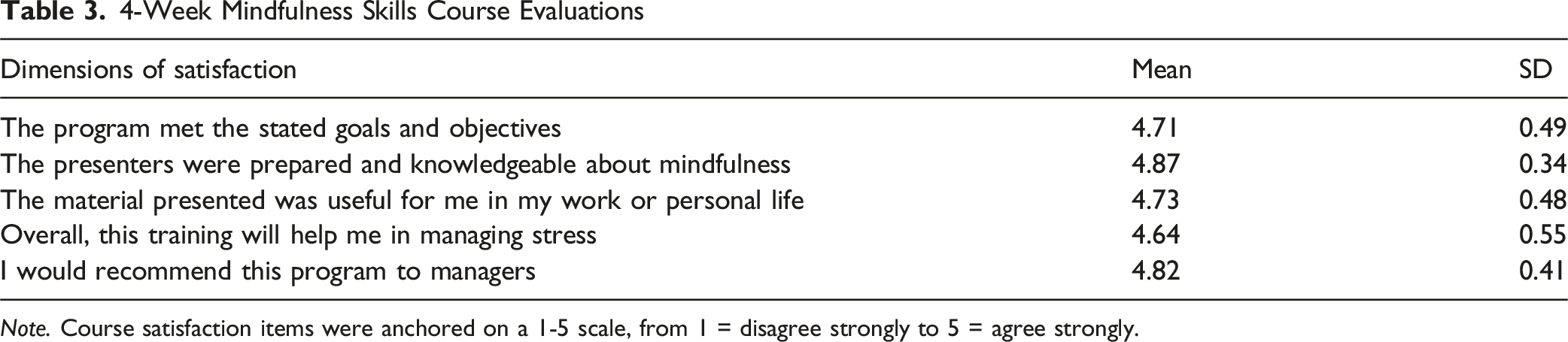
Note. Course satisfaction items were anchored on a 1-5 scale, from 1 = disagree strongly to 5 = agree strongly.
Individual Differences: Correlates and Predictors of Change
Regarding associations between program outcomes, increased mindfulness was strongly correlated with reduced stress (r = −.55, P < .001; see Figure 1), and moderately correlated with increased positive emotions towards oneself (r = .38) and decreased negative emotions towards both oneself (r = −.40) and others (r = −.42; all P’s < .001). The positive correlation between increased mindfulness and increased positive emotions towards others was not statistically significant (r = .17, P = .07). Reduced stress was significantly correlated with increased work performance (r = −.22, P < .05). Increased mindfulness after completing the 4-wk course was significantly correlated with decreased stress. Notably, 81% of participants reported a decrease in stress after taking the mindfulness course (as indicated by a negative PSS change score), and 78% experienced an increase in mindfulness (as indicated by a positive MAAS change score). Together, these data demonstrate substantial responsiveness to a brief, 4-wk workplace program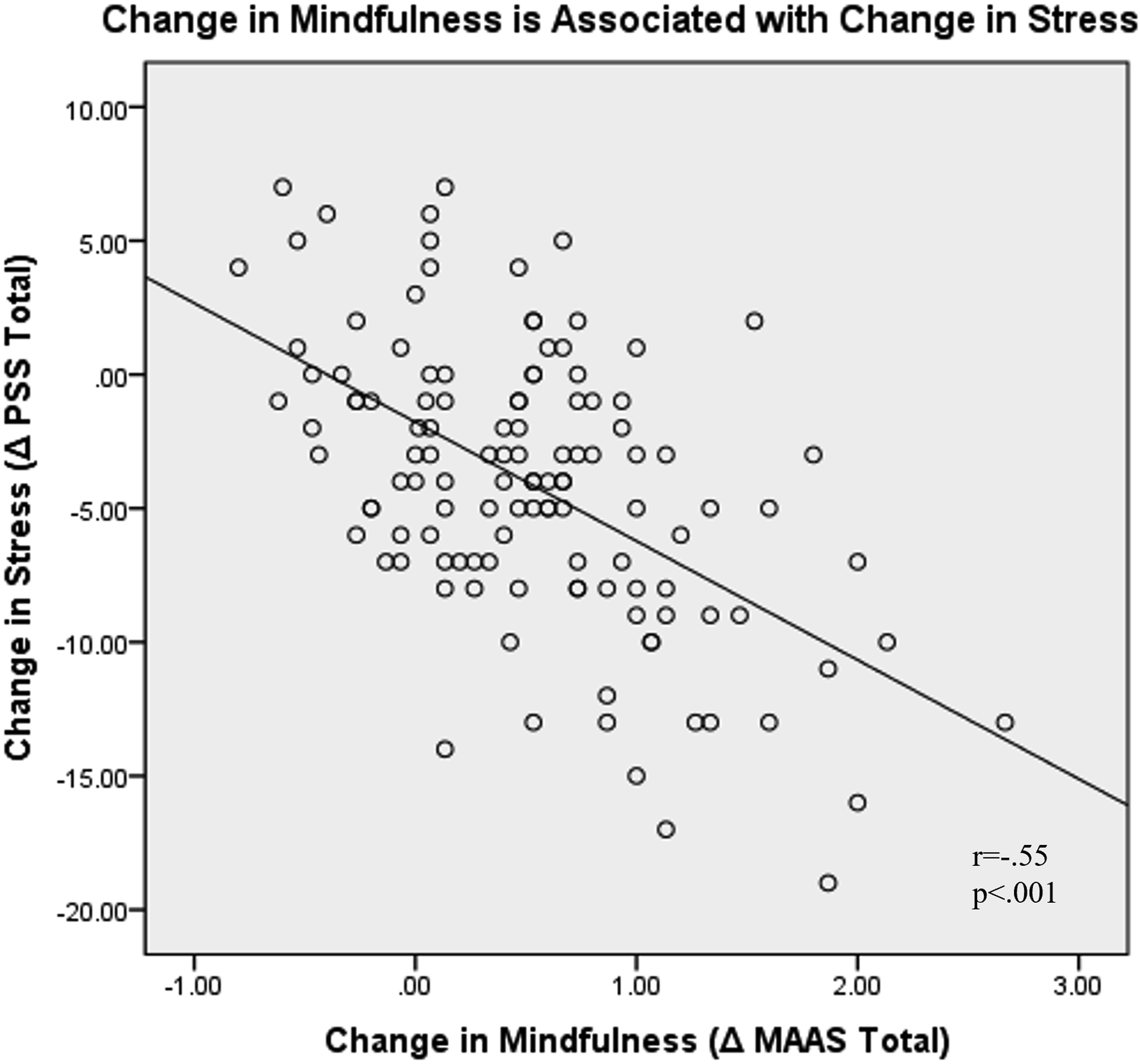
Finally, regression analysis revealed that baseline (trait) mindfulness significantly predicted change in perceived stress (β = .37, t(119) = 4.27, P < .001), such that less mindful participants at the beginning of the course reported greater reductions of stress following the course. Specifically, dispositional mindfulness at baseline explained 14% of variance in change in stress levels (R2 = .14, F(1, 119) = 18.23, P < .001), a large magnitude effect (see Figure 2A). (A) Baseline mindfulness scores predicted change in perceived stress, such that individuals with lower dispositional levels of mindfulness coming into the program reported greater reductions in stress after completing it. Baseline mindfulness explained 14% of the variance in the change in perceived stress scores, a large magnitude effect. (B) Baseline stress level predicted change in mindfulness, such that individuals coming into the mindfulness program with higher levels of stress saw a greater increase in mindfulness after completing the program. Baseline stress level explained 7% of the variance in the change in mindfulness scores, a medium sized effect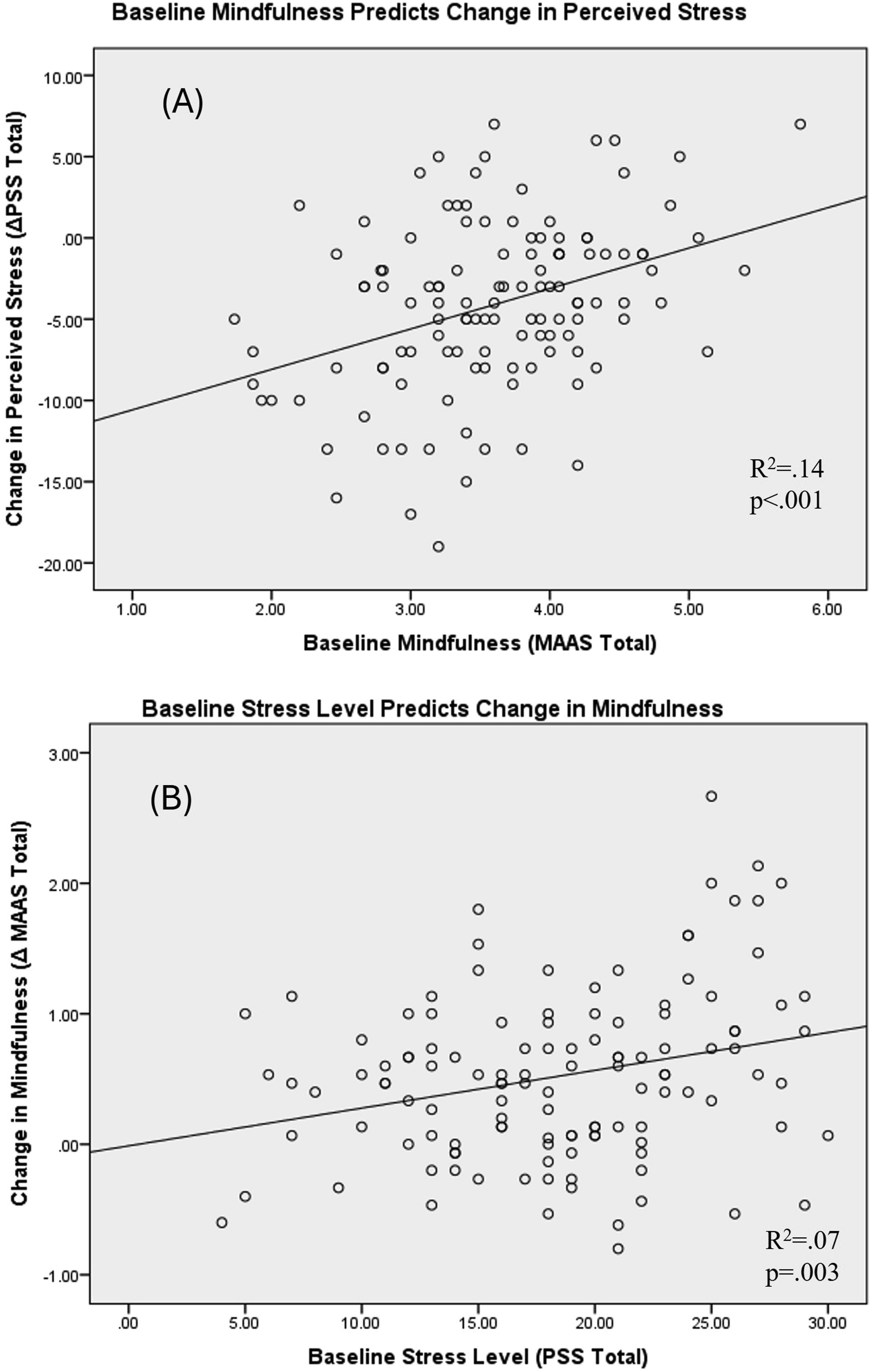
Regression analysis further showed that baseline levels of stress significantly predicted change in mindfulness (β = .27, t(120) = 3.06, P < .01), such that higher levels of stress before taking the mindfulness skills course predicted greater increases in trait mindfulness after completing the program. Baseline stress explained 7% of the variance in change in trait mindfulness (R2 = .07, F(1, 120) = 9.33, P < .01), a medium-sized effect (see Figure 2B).
Discussion
The present study evaluated whether a brief, employer-sponsored workplace mindfulness program was feasible and effective in a large, urban university and health system setting. The 4-session Mindfulness Skills Course (MSC) for Penn Employees was feasible, as evidenced by maximum enrollment rates for each class and an 82% completion rate. In addition, participants rated the program as highly acceptable and valued. Specifically, employees strongly agreed that the course was useful to them in their work and personal lives, it helped in managing stress, and that they would recommend the program to others. Although qualitative data were not collected to precisely explain why MSC participants showed such high levels of adherence, we speculate that offering a brief, voluntary course supported by the institution as a wellness benefit likely maximized feasibility, acceptability, and accessibility, while balancing expectations and perceived value. It is also possible that as MSC participants began to notice some degree of benefit, they may have felt more motivated to attend class and to practice meditation at home, thereby creating a positive feedback loop where better adherence promoted more improvement and vice versa.
After completing the 4-wk MSC, participants reported significantly lower levels of stress as well as higher levels of mindfulness, relational wellbeing, and workplace performance. Effect sizes were relatively large for perceived stress and trait mindfulness, moderate for relational wellbeing, and small for workplace performance. Taken together, these main findings demonstrate that a brief, 4-wk workplace mindfulness course covered by institutional wellness benefits is indeed feasible, highly acceptable, and effective in simultaneously reducing employee stress, improving relational well-being, and boosting perceived workplace performance.
Data on individual differences in response to the program showed that increases in trait mindfulness significantly correlated with other outcome measures, including reduced stress, greater positive emotions towards oneself, and reduced negative emotions towards both oneself and others. These findings are consistent with both historic and modern conceptualizations of mindfulness meditation training, in which there is an emphasis on greater attention, awareness, acceptance, and compassion toward oneself and others. 31 In addition, this study found the amount of home practice positively correlated with change in mindfulness, supporting the concept that a mindfulness intervention teaches specific mindfulness practices that induce states of mindfulness which, over time, increase trait mindfulness. 17 Additionally, we found that reduced stress levels directly correlated with improved self-rated workplace performance, consistent with the principles of Contemplative Management Theory and the expected impact of Contemplative Management Practices. 15 Finally, in the present study, individuals who reported the lowest levels of dispositional mindfulness upon enrolling in the program experienced the largest reductions in perceived stress, while individuals who initially reported the highest levels of stress experienced the greatest increase in mindfulness. In practical terms, the 4-wk MSC program was most beneficial for those employees with higher stress and lower dispositional mindfulness scores at baseline. These observations support a recent meta-analysis that found substantial individual differences in outcomes of MBI training. 24 As such, these new data help advance the field which currently has limited evidence for predictors of therapeutic change in workplace MBIs. 20
Overall, the current results are consistent with other intervention studies that found workplace mindfulness training significantly reduces stress in employees in other job sectors.16,17,32,33 The rate of course completion was also consistent with previous work.32,33 Further, the effect sizes observed in this study were commensurate with those of several systematic reviews and meta-analyses of MBIs in the workplace.17,18,21-23,34
Regarding effective dose and dose-response questions, most workplace mindfulness interventions studied to date are 8-12 wks or sometimes more. While useful for those who can commit and attend, long programs may not be feasible for many employees, particularly those who are the most stressed and the least mindful. A small number of studies have examined shorter programs, which appear to be equally effective. 34 Our study on a 4-week mindfulness program replicates this finding and extends it by showing a direct correlation between changes in trait mindfulness and both stress and home meditation practice.
Finally, we found that the 4-session program was associated with a statistically significant (6%) improvement in self-rated workplace performance, an understudied outcome with equivocal results and insufficient data for a prior meta-analysis. 18 This modest change was unlikely due to a ceiling effect because the current sample scored lower than the norm for this measure and thus had substantial room to improve. 29 Analogous to public health initiatives where small changes made among many individuals in a population can exert a significant health impact at the societal level, making the 4-wk MSC routinely available to university employees on a large-scale could similarly generate a significant impact in workplace performance at the institutional level should the organization be able to sustain it as an employee wellness (EAP) benefit.
The present study has a number of strengths that build on prior workplace mindfulness literature, including a relatively large sample size, assessment of feasibility, acceptability, and theoretically important outcomes, including perceived work performance and relational well-being that have been understudied. The current investigation also examined theoretically grounded mechanisms and predictors of change, such as increased trait mindfulness as a correlate of stress reduction, and baseline characteristics such as higher stress level and lower trait mindfulness level that predicted program responsiveness.
At the same time, there were several limitations. First, this was a convenience sample of full-time university employees who voluntarily chose to enroll in the 4-week mindfulness skills course. Although it is possible that there may have been a selection bias such that the present sample may not reflect the organization’s employees as whole, 15 it has also been argued that workplace mindfulness programs should always be “voluntary” since motivation and commitment are considered critical factors for engagement and success. 31 Second, all outcome measures were subjective self-report surveys. Although each validated outcome measure was selected for its theoretical importance in the workplace and its direct link to the stress management skills employees were taught in the 4-wk MSC, self-report scales in general can be prone to recall bias and/or social desirability. Nonetheless, the range of effect sizes here was generally consistent with previous randomized controlled trials of workplace mindfulness training programs,18,21,34 suggesting these evaluation findings are valid and reliable. Third, this program evaluation study did not use a control or a comparison group and did not assess durability of immediate post-course improvements. As such, the relative benefit of mindfulness training vs other workplace wellness activities or programs remains to be determined. Fourth, although this study included a wide range of ages, job types, and length of employment, over 80% of program participants were women. Consistent with most previous trials, 35 the extent to which MBIs benefit men is less well established. Finally, because participant demographics were recorded by EAP intake personnel and were deliberately kept separate from the study outcome data to preserve employee anonymity, moderation analyses could not be conducted to test whether characteristics like age, gender, race, job type, or workload, for example, might modify the program’s effects.
Considering the balance of study strengths and limitations and remaining gaps in the field, future studies would benefit from using a mixed-methods approach to balance “top-down” (organization-imposed, metric-driven) with “bottom-up” (employee-centered, first-person experience) perspectives regarding needs assessment and preferred intervention approaches. Specifically, it remains unknown how best to tailor and adapt mindfulness training to optimize work-related wellness and performance goals at both the individual and organizational level. For example, it remains to be determined whether online delivery (eg, real-time videoconferencing in groups) or individual utilization of mobile applications (eg, Headspace) are equally effective as on-site, in-person workplace mindfulness programs. Different employees with different needs, interests, schedules, and preferences may benefit from different formats. In addition, it will also be important for future studies to go beyond subjective, self-report measures and include objective behavioral and/or biological assessments of mindfulness, stress, cognitive-emotional functioning, prosocial behavior, and verifiable workplace performance metrics, including productivity/goal attainment, absenteeism, presenteeism, and job satisfaction/turnover intention. 15 And more rigorous experimental evidence is needed, including longer follow-up times to assess durability of improvements and active control groups to ascertain the comparative effectiveness of workplace MBIs. 14
In summary, a 4-session Mindfulness Skills Course for university employees was feasible, highly acceptable, and effective in reducing stress to levels below the national norm for full-time employees. Participants also reported increased levels of trait mindfulness, relational wellbeing, and self-rated workplace performance. Moreover, increased levels of mindfulness were directly correlated with both reduced levels of stress and improved relational well-being toward oneself and others. More frequent home practice correlated with larger increases in mindfulness, and individuals with the highest level of stress and the lowest level of mindfulness at baseline appeared to benefit most. Taken together, these findings support both the feasibility and effectiveness of a brief mindfulness course supported by an institutional wellness benefit. Given the significant time commitment and cost for traditional, self-pay, 8-wk MBSR courses (often $500-$650 per person), the present results support integrating briefer, organization-sponsored mindfulness programs at work that are easily accessible and useful to all benefits-eligible employees regardless of job type or income.
Footnotes
Author Note
The original work was performed while all authors were employed at the University of Pennsylvania. JMG’s primary affiliation is now Rowan University. MKP is now affiliated with Cincinnati Children’s Hospital Medical Center, Division of Behavioral Medicine and Clinical Psychology, Cincinnati, OH, USA. DEB is now affiliated with University of Hawaii at Manoa, College of Social Sciences, Department of Psychology, Honolulu, HI, USA. The program evaluated in this article is proprietary: the 4-wk Mindfulness Skills Course for employees is owned by the University of Pennsylvania and contracted for use exclusively with designated partners of Penn Medicine. Preliminary findings were presented as a research poster at the 28th annual convention of the Association for Psychological Science, Chicago, IL.
Acknowledgements
We foremost thank those at the University of Pennsylvania who shared an institutional vision and provided administrative leadership to develop, implement, and evaluate this program (Marylynn Windish, Charles Baker, Gregg Mattison, Kristin Shaner, Rosellen Taraborelli, and Jody Foster). We also thank the University of Pennsylvania Employee Assistance Program (EAP) for coordinating course enrollment and materials (Bridget Callahan and Angena Mombrun). In addition, we thank our research assistants for their help with data entry and quality assurance (Sean Cleary, Tucker Collins and S. Adam Slawek), and several colleagues for their constructive feedback on earlier drafts of the manuscript (Vanessa Anyanso, Carly Johnson, Gabrielle Chin, and Luke Miller).

Ethical Considerations
The University of Pennsylvania’s Institutional Review Board reviewed the study protocol and determined it was exempt because no personally identifying information was linked to the study data. Study procedures were performed in accordance with the Declaration of Helsinki.
Consent to Participate
Assent was obtained from all individual participants prior to participating in the study.
Consent for Publication
The authors affirm that human research participants assented to publication of their de-identified survey data.
Author Contributions
Jeffrey Greeson: Conceptualization, Methodology, Investigation, Project administration, Supervision, Data curation, Formal analysis, Writing – original draft, Writing – review & editing. Jason Hutchings: Conceptualization, Methodology, Project administration, Supervision, Data curation, Writing – review & editing. Mary Keenan-Pfeiffer: Project administration, Writing – original draft, Writing – review & editing. Jonathan Reda: Project administration, Writing – original draft, Writing – review & editing. Devin Barney: Writing – review & editing.
Funding
The authors received no financial support for the research, authorship, and/or publication of this article.
Declaration of Conflicting Interests
The authors declared no potential conflicts of interest with respect to the research, authorship, and/or publication of this article.
Data Availability Statement
The intervention under study is proprietary and owned by the University of Pennsylvania. Hence, the data will not be made publicly available.