



Abstract
Background
Mental health of emerging, young adults remains a concern, particularly in lower income groups who receive less mental healthcare. Mindfulness-based interventions yield mental health benefits and have been widely applied, though reach and accessibility remain limited. Poor mental health can negatively impact job performance, physical health, and life trajectories.
Objective
A mindfulness elective was offered through a year-long job training program serving diverse, low-income emerging adults. We investigated relevant outcomes in a mixed methods quasi-experimental study.
Methods
Pre-/post-elective surveys assessed mindfulness, mental health, and well-being using established measures. We analyzed within- and between-group differences comparing mindfulness vs control (Year 1) and 12-week vs 6-week (Year 2) participants using t-tests and mixed effects models. Focus groups were conducted and analyzed using codebook thematic analysis.
Results
Participants (n = 212) provided evaluation data. Over two years, 195 participated in a mindfulness elective (mean age = 22.3 [SD = 2.7] years; 47.2% female, 94.4% from racially and ethnically minoritized groups). In Year 1, mindfulness participants exhibited many pre-to-post improvements, including greater mindfulness (+8.4, 95% CI: 5.8, 11.0) and life satisfaction (+10.3, 95% CI: 7.0, 13.6) and lower stress (−8.2, 95% CI: −10.4, −5.9); no changes in controls were observed. In Year 2, mindfulness participants improved in mindfulness and life satisfaction plus self-compassion (12-week: +0.6, 95% CI: 0.4, 0.8; 6-week: +0.4, 95% CI: 0.1, 0.6), connectedness (12-week: +0.7, 95% CI: 0.5, 0.9; 6-week: +0.4, 95% CI: 0.2, 0.6), and mind-body connection (12-week: +1.8, 95% CI: 1.2, 2.4; 6-week: +0.6, 95% CI: 0.0, 1.3). Additional benefits were observed (eg, in stress, focus, emotional reactivity) but significance varied by elective length. Focus groups were generally concordant with quantitative results. Respondents described how the elective enabled self-care, supporting health and professional development.
Conclusions
Integrating mindfulness into job training for underserved emerging adults was well-received, effective, and supports mental health equity.
Introduction
Mental health in emerging, young adults persists as a concerning public health issue. The transition from childhood to adulthood is fraught with complex social, emotional, and developmental changes as young people pursue opportunities in education, training, and relationships with the goals of achieving independence and self-sufficiency. 1 Testament to this life stage’s challenges, nationally representative US epidemiological studies find high overall prevalences of anxiety (36%), depression (29%), and serious psychological distress (13%) in this age group.2-4 Rates are sustained and elevated among racially and ethnically minoritized groups -- 35% of Black young adults have anxiety and 35% have depression while 37% of Latine young adults have anxiety and 32% have depression. 2 Mental health burden can be exacerbated by low-income status -- in one study, nearly half (48%) of young adults with incomes below $30,000 screened positive for anxiety and 36% for depression. 2 Additionally, exposure to other stressors (eg, trauma, discrimination, community violence) often co-occurs in low-income groups, compounding mental health risk.5-8
Poor mental health interferes with daily functioning, impairs relationships, 9 and increases absenteeism and presenteeism, which may subsequently reduce workplace productivity, earnings, and precipitate job loss over the long term.10-12 Inequities in mental health risk factors, burden, and care can have wide-ranging implications over the life course. Increasing provision of mental healthcare and treatment may avert such trajectories. However, youth and Blacks and Latines are less likely to seek out and/or receive these services.13-17 Among young adults, barriers to mental healthcare-seeking include stigma, distrust, confidentiality concerns, provider misinterpretation of symptoms, and inaccessibility to care (eg, with time, transportation, cost).13,14 Among people of color, there are additional deterrents related to language, geography, limited economic resources and insurance, challenge navigating healthcare institutions, mental health workforce shortages, and culturally incompetent care that can lead to misdiagnoses or under-examination.15,18-21 Structural inequalities such as racism, colonialism, and discrimination experienced in healthcare settings and everyday life also play a role.6,8,16,18,22 Combined, substantial barriers need to be overcome to receive mental health care in this population and unmet needs persist. As is, more than half of Americans with any mental health disorder do not receive care. 23
Mindfulness-based interventions offer a pragmatic means to address mental health challenges and can be widely accessible. Evidence substantiating mindfulness-based interventions is considerable.24-35 Generally, research has found positive associations between mindfulness and mental health.25,31,32 Mindfulness is inversely associated with depressive symptoms,24,28,33 anxiety,24,34 and stress.24,29 Ways by which mindfulness may foster positive psychological outcomes include the elicitation of self-compassion, perspective shifts, acceptance skills, positive states of mind, emotional regulation, lower perceived stress and psychological distress, and enhanced psychological well-being attributable to being in a restorative state of “deep rest”.25,36-38 Also, through the stress buffering framework, mindfulness practices may (1) increase functional activity in the prefrontal cortex via the “regulatory” pathway while (2) decreasing functional connectivity in the amygdala or body’s stress alarm via the “reactivity” pathway. 37 Together, this modulates activation of the hypothalamic-pituitary-adrenal (HPA) and sympathetic-adrenal-medullary (SAM) axis to increase stress resilience and support physical and mental health.37,39
Low-income and racially and ethnically minoritized populations are less likely than their higher-income and White counterparts to participate in mindfulness-based interventions. 5 Still, a recent systematic review of mindfulness-based interventions in these groups corroborates small but statistically significant benefits of mindfulness on these groups’ well-being overall. However, few studies of these more marginalized demographic groups center upon the unique life stage of emerging young adulthood. Existing studies tend to involve smaller sample sizes,28,40-43 enroll more women than men, and/or recruit from University settings,22,28,31,33,41 limiting their generalizability. Reasons why there are fewer mindfulness studies in lower income young adults of color mirror why such populations also receive less mental healthcare – eg, transportation, time, and financial cost barriers; less flexible schedules; childcare and family demands; lack of diverse representation in researchers and providers; distrust of the healthcare system and research study involvement; and cultural disconnects between mindfulness program content with the lived experiences of minoritized young adults.5,8,28 Thus, developing and hosting mindfulness interventions that circumvent these barriers is necessary. Integrating such programming into non-clinical settings serving these populations may also be promising. Indeed, mindfulness-based interventions in diverse school settings have had greater benefits compared to similar programming outside of schools. 8
This study utilized a convergent mixed methods design to comprehensively evaluate a mindfulness elective integrated into an existing job training program for diverse, lower income emerging adults. We aimed to explore and explain the experience of the mindfulness program in this population, testing the program in general (ie, mindfulness vs non-mindfulness) and comparing two program durations (ie, 12-week vs 6-week). We hypothesized that: (1) emerging young adults participating in the mindfulness elective would have better mindfulness, mental health, and well-being outcomes vs non-mindfulness participants, (2) those participating in the 12-week program would have better outcomes than those in the 6-week version, and (3) the program would prove acceptable to participants overall.
Methods
Study Setting
Year Up is a national non-profit organization that promotes technical and professional skill development to emerging adults. Year Up aims to close socioeconomic opportunity gaps through job training. In the San Francisco Bay Area, a local chapter of Year Up (Year Up Bay Area [YUBA]) provides free year-long training programs for diverse young adults from low-income backgrounds to prepare them for technology-based careers. Year Up implements a rigorous approach characterized by “high demand and high support.” Thus, local leaders wished to address mental health-associated challenges (ie, stress, anxiety, and depression) in their participants. A community-academic partnership was formed between YUBA and the University of California, San Francisco (UCSF)’s Osher Center for Integrative Health (OCIH) to offer an elective course on mindfulness in YUBA’s job training programs: the “Mindfulness Program for Underserved Youth” (hereafter referred to as the “mindfulness elective”, “mindfulness training”, or “the elective”).
Study Population and Intervention
To be eligible for Year Up/YUBA, students met the following criteria: have a high school diploma or GED and no Bachelor’s degree, be low-income (average annual incomes at enrollment: <$9000 [individual], $25,000 [family]), and be able to commute to the program. In this study, students entered the program with ≥2 significant risk factors (eg, chronic unemployment or underemployment, unstable housing, family issues, mental health issues, or involvement with the criminal justice system). Main goals of the mindfulness elective were to (1) reduce symptoms of stress, anxiety, and depression by building coping skills and fostering mental resilience, and (2) improve focus on job training and internship performance to maximize career and life success potential. To participate in the elective, interested Year Up participants submitted applications recounting prior experiences with mindfulness, what they hoped to gain from it, and potential barriers to participation. YUBA and OCIH staff reviewed applications and selected candidates based on likelihood of full participation in the program. (A weekly 75-minute drop-in class was offered to accommodate Year Up students who were not admitted into the elective.) In the first year, we offered four cohorts of the mindfulness elective (two at 14 weeks and two at 12 weeks because of logistical Year Up scheduling needs). In the second year, we offered eight cohorts in response to high demand for the elective (four at 12 weeks, four at 6 weeks). Sessions were held weekly at the Year Up site in-person for two hours. Programming drew upon mindfulness-based stress reduction, mindfulness for coping and mental health and well-being, positive psychology, yoga, and socioemotional learning. Each cohort concluded with an outdoor daylong retreat.
Data Collection
We used a convergent parallel mixed methods design. Participants completed quantitative surveys pre- and post-participation in the mindfulness elective. Questions included demographics and a range of mindfulness, mental health, and well-being measures. At Year 1, data were also collected from a subset of Year Up participants who did not participate in the elective to serve as a “control” group. At Year 2, some additional mindfulness and mental health measures were included. Focus groups were conducted at every elective cohort’s end. Data collection staff were different from interventionists. More description of qualitative methodology follows below. Participants provided informed consent and were renumerated. Study protocols were approved by an academic Institutional Review Board (IRB).
Measures
Mindfulness and Related Measures
We assessed overall experiences of mindfulness over the past week with the 14-item version of the Freiberg Mindfulness Inventory 44 ; higher scores reflected greater mindfulness. 45 We also used the 12-item Neff Self-Compassion Scale – Short Form, which provides a total self-compassion score after summing six subscales (self-kindness, self-judgement, common humanity, isolation, mindfulness, and over-identification). Response options utilized a 5-point Likert scale; higher scores reflected greater self-compassion.46,47 We also examined three mindfulness-related topics relevant to job performance: how often respondents’ attention wandered to outside topics during Year Up, how often it was challenging to focus on the task at hand, and how often respondents believed they reacted emotionally to a situation before thinking. These items utilized a 5-point Likert scale (1 = never, 5 = always) with higher numbers indicating more attention wandering, trouble focusing, or emotional reactivity.
In Year 2, we included two additional mindfulness-related measures. First, a modified version of the Awe Experience Scale’s (AWE-S) Connectedness subscale, which assessed the degree of feeling connected to entities beyond oneself in the past week, was implemented. The original scale’s five items (eg, “I experience a sense of oneness with all things.”) were administered though two items’ wording was changed for readability. Additionally, we appended nine new question items to the scale to assess feelings of connection or disconnection with one’s body, animals, and nature. We calculated an overall score based on a mean of all items; higher scores reflected greater connectedness. 48 Second, a modified version of the Interpersonal Mindfulness Scale (IMS), which measured one’s capacity to be mindful while interacting with others, was administered. To minimize respondent burden, this scale was condensed from its original 27 items encompassing four subscales (twelve items were chosen by selecting the top three items for each of the subscales based on factor loadings) and has since been validated.49,50 Total score was based on the mean of all items; higher scores reflected greater interpersonal mindfulness. 51
Mental Health and Well-Being Measures
Overall psychological stress experience over the past week were assessed by the 4-item Patient Reported Outcomes Measurement Information System (PROMIS) Pediatric Short Form v1.0 - Psychological Stress Experiences 4a measure. Past month life satisfaction was assessed by the 4-item PROMIS Pediatric Short Form v1.0 - Life Satisfaction 4a measure. Scoring for both was completed using published scoring tables to generate standardized T-scores (population mean = 50, standard deviation = 10). This was possible as participants had non-missing data.52,53 Higher scores reflected higher stress or life satisfaction, depending.54,55 Daily mindset of respondents was assessed through the question “How would you rate your overall mindset on an average day?” Respondents used a 3-point scale (1 = generally optimistic, 3 = generally pessimistic, 2 = a mix of optimistic and pessimistic).
Two assessments measured well-being. First, past month overall sleep quality was assessed via three items (difficulty getting to sleep at night, frequency of waking during the night, and frequency of nightmares during the night) using a 7-point Likert scale (1 = not at all, 7 = all of the time). Calculating the mean of the three items yielded the overall score and higher scores reflected greater sleep disturbance. Second, mind-body wellness connection was assessed via one question: “On an average day since joining Year Up, how connected do you feel to your body and physical wellness on a scale of one to ten?” Higher scores reflected greater connection and wellness.
In Year 2, the 20-item Positive and Negative Affect Schedule (PANAS) was added to assess past week positive and negative emotionality (10 items each). Response options utilized a 5-point Likert scale and positive and negative affect items were summed separately to yield a positive and negative score for each respondent. Higher scores reflected higher respective affect. 56
Statistical Analysis
Summary statistics were calculated to provide descriptive data on the study population. Scores on outcome measures were examined continuously and demographics were analyzed categorically. Evaluations were done by year, informed by the community partner’s contemporaneous priorities. In Year 1, analyses focused on comparing youth participating in the mindfulness elective to inactive controls as well as on examining pre-/post- changes. In Year 2, analyses focused on examining 12-week vs 6-week participant performance to test program modifications for scalability. Comparisons to assess between- and within-group differences were conducted via Student and paired t-tests for continuous data and Pearson’s chi-square test or Fisher’s exact test (when cell frequencies/counts were <5) for categorical data. Linear mixed effects models were used to evaluate pre-to-post changes and compare group differences. In separate models for each outcome measure and study year, models included fixed effects for survey time point, group, and their interaction, and a random effect for participant to account for correlation of repeated measures. Year 2 models additionally included a fixed effect for gender to account for baseline imbalances in distribution. Quantitative analyses were conducted with Stata v15 (College Station, TX).
Qualitative Assessments and Analyses
We conducted focus groups at the end of each cohort’s mindfulness elective at the daylong retreat. All elective participants were invited to focus groups, regardless of whether they completed surveys. This inclusive approach was taken to capture as many perspectives as possible. A research team member facilitated focus groups using a semi-structured guide consisting of five open-ended questions: “How, if at all, did the program help you take better care of yourself?”, “What, if anything, about the program has helped you cope with stress?”, “What, if anything, from the program helped you in your work?”, and “What would make the program better?” The goal of these discussions was to gauge participant expectations of the elective, elucidate ways participants were incorporating teachings into their daily lives for stress management, self-care, and health, if/how the program has impacted their work performance, and overall program impressions and feedback. Discussions were audio-recorded, professionally transcribed, and analyzed by three research team members using Dedoose (Los Angeles, CA) software. The qualitative analysis team used a codebook thematic analysis approach with a combination of inductive and deductive codes. 57 Program feedback was also summarized.
Reflexivity Statement
The project team comprised YUBA staff, mindfulness instructors, and academic researchers with training in integrative health, public health, social work, and sociology. The team was racially and ethnically diverse, including Asian, Black/African American, Latine, and non-Latine White members. Research procedures were conducted by team members from the academic partner in the community-academic partnership that hosted this program.
Mixed Methods Integration
Quantitative data were juxtaposed with qualitative data and discussed amongst co-authors to prepare and present a more thorough understanding of participants’ experiences in the mindfulness elective. Attention was paid to how the quantitative and qualitative findings related to each other and identify points of concordance and discordance. 58
Results
Study Participants and Baseline Descriptive Characteristics
Demographic and Baseline Characteristics of Survey Participants by Program Year.

Bolded values represent statistical significance at a=0.05.
aCalculated from t-tests for continuous variables or Pearson’s chi square tests for categorical variables (or Fisher’s Exact P-values where appropriate).
bn = 4 missing from N noted above for the particular section.
cn = 2 missing from N noted above for the particular section.
dn = 1 missing from N noted above for the particular section.
eSome participants selected “other” as an answer choice for the focus question wherein supplemental text could be provided. However, no text was ever reported so these responses were subsequently recoded to missing for analyses when they happened.
fn = 3 missing from N noted above for the particular section.
gn = 9 missing from N noted above for the particular section.
hn = 6 missing from N noted above for the particular section.
iAs measured by the Awe Experience Scale (AWE-S).
jAs measured by the Interpersonal Mindfulness Scale (IMS).
kAs measured by the Positive and Negative Affect Schedule (PANAS).
Table 1 also presents baseline data for mindfulness, mental health, and well-being measures for all participant groupings by year. In Year 1, control group respondents reported slightly higher self-compassion than mindfulness respondents at baseline (P = 0.02). In Year 2, baseline differences included higher scores of emotional reactivity (P = 0.006), psychological stress (P = 0.01), and negative affect (P = 0.049) among respondents in the 12-week groups vs the 6-week respondents. Overall, Year Up survey respondents’ mindfulness, mental health, and well-being measures reflected poor-to-average performance. For example, in both years, elevated psychological stress (T-scores above 50) and lower life satisfaction (T-scores below 50) were observed. Scores on trouble focusing, emotional reactivity, and more disturbed sleep were also greater than the midpoints for these scales, reflecting greater disruption.
We conducted 21 focus groups with 122 mindfulness elective participants over the two years. Results are organized below by outcome topic (mindfulness, mental health and well-being), with quantitative results presented first followed by qualitative findings and then integration of quantitative and qualitative material. Program feedback is also reviewed.
Mindfulness and Related Measures
Mean Within-Group Changes and Between-Group Differences in Outcome Measures for Mindfulness Intervention and Control Groups (Year 1) and 12-Week and 6-Week Mindfulness Intervention Groups (Year 2) a .

Bolded values represent statistical significance at a=0.05.
aChanges are from baseline to elective end. Differences are between comparison groups in their baseline−end changes. All are derived from linear mixed models.
bYear 2 models are adjusted for gender to account for gender imbalances in the baseline distribution. Unadjusted model results were comparable (not shown).
cAs measured by the awe experience scale (AWE−S).
dAs measured by the Interpersonal mindfulness scale (IMS).
eAs measured by the positive and negative affect schedule (PANAS).
In Year 2, the 12-week mindfulness participants exhibited significant improvements on nearly all mindfulness and related measures including the two newly added ones (Table 2) but not attention wandering (P > 0.05). Pre-to-post changes were in hypothesized directions. For the 6-week mindfulness participants, significant pre-to-post changes were observed and in hypothesized directions for a smaller subset of measures. Significant improvements in both 12-week and 6-week versions were observed; general mindfulness (12-week: +6.8, 95% CI: 4.3, 9.4; 6-week: +5.4, 95% CI: 2.6, 8.2), total self-compassion (12-week: +0.6, 95% CI: 0.4, 0.8; 6-week: +0.4, 95% CI: 0.1, 0.6), and connectedness (12-week: +0.7, 95% CI: 0.5, 0.9; 6-week: +0.4, 95% CI: 0.2, 0.6) all increased. For focus, emotional reactivity, and interpersonal mindfulness, only the 12-week participants significantly improved.
Joint Display Summarizing Participant Experiences With Mindfulness Electives, Mixed-Methods Analysis of Participant-Reported Outcomes and Qualitative Findings.
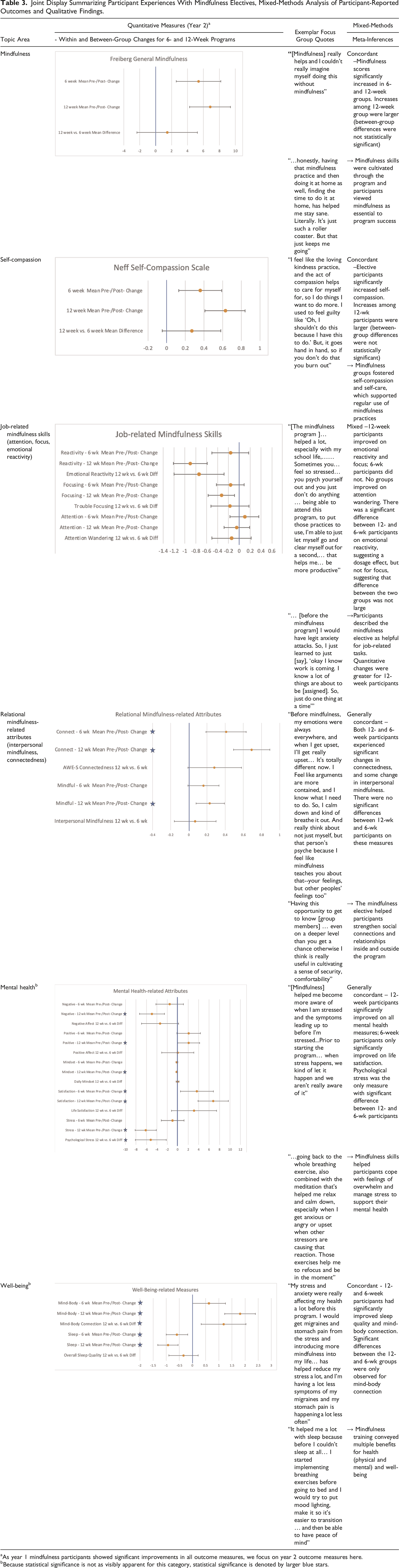
aAs year 1 mindfulness participants showed significant improvements in all outcome measures, we focus on year 2 outcome measures here.
bBecause statistical significance is not as visibly apparent for this category, statistical significance is denoted by larger blue stars.
Self-care and self-compassion appeared to be potent levers for positive effects of the elective based on focus group data especially. For many participants, mindfulness practice was a new experience, and some had previously imagined such training to be out of their reach. Given the complexities of many participants’ daily lives, engaging in something like this for oneself (i.e., self-care) was otherwise challenging, particularly during a demanding job training program. However, the mindfulness elective allowed for time, focus, and skills supportive for overall health. As one participant said, “I think it's a really big privilege to be able to do yoga, practice mindfulness… a lot of reflecting is usually done by people who have the time to do reflecting. And so, the comparison was that usually the people who are tight on money or just stressed all the time don't really have the time to be able to take care of themselves. So, it's a really big privilege to be able to take care of ourselves.” Another participant reflected, “[The program] really helped me to … to take it easy when I need[ed] to and prioritize my health first.” In this way, the mindfulness elective also helped participants’ relationships with themselves, enabling them to “slow down”, relax, and practice self-compassion. One participant remarked their ability to cultivate self-compassion through mindfulness and be present helped them be more forgiving of themselves for past mistakes – “The most important thing for me from mindfulness is to be in the present… I would be fixated on a lot of things that happened to me in the past and/or worried about the future… I’d be really hard on myself instead of focusing on what’s going on now…. I feel that’s where the [loving-]kindness comes in, and just being loving and kind to yourself and having that gratitude for things that you already have done.” These qualitative findings coincide with the significant increases in self-compassion scores observed in both 12- and 6-week participants (see Table 3). While greater point estimates of increases were again observed in 12-wk participants, the difference between groups was not statistically significant, suggesting the lack of a dosage difference at these levels for self-compassion scores as well.
Participants described mindfulness skills enabling their higher-quality work and better performance in Year Up. Mindfulness practices improved participants’ abilities to cope with stress and feelings of overwhelm associated with increased workloads as well as general life changes. One participant stated, “Sometimes I felt overwhelmed, and now I just sit back and I practice mindfulness and it helps me to also ground myself…” Participants also thought the elective class facilitated an energizing yet relaxing environment that supported their professional development by holding space for self-care and engaging in breathing techniques, yoga, stretching, and journaling. Students reported being able to complete work tasks more efficiently and calmly after learning mind-body practices. One participant said, “It really helped a lot, especially with my [job training program], especially with the deliverables that I’ve had. Sometimes you just feel so stressed that you psych yourself out and you just don’t do anything … being able to attend this program, to put those practices to use, I’m able to just let myself go and clear myself out for a second, and that helps me actually be more productive.”
Some participants explained they were better able to experience life in the present moment, think more clearly, and focus as a result of the elective. One said, “… [mindfulness] helps me be self-aware. I can pinpoint what’s stressing me, and it’s a lot easier to know what approach to take in order to relieve myself of any stress or weight I have on my shoulders.” Another student explained, “We have all our projects on top of other projects, and altogether, on top of other projects. So, [mindfulness] helped me to actually separate all of them and be concentrated and be present.” Participants also discussed the value of trying to mitigate their reactive impulses through mindfulness. A student continued, “...during training time, I would have legit anxiety attacks. So, I just learned to …[say], ‘okay I know work is coming. I know a lot of things are about to be [assigned]. So, just do one thing at a time.” For many students, mindfulness and breathing techniques helped with specific job-related performance tasks like public speaking that brought up feelings of stress and anxiety. Said an individual, “Going into Year Up, I was really, really, really bad at public speaking, and once I found out about 4 × 4 breathing and just different breathing techniques... I just did my breathing exercises before I would speak and it would help me so much more, and now I'm getting better at it.” Interestingly, while the qualitative data supported the benefits of mindfulness for job performance, the quantitative results were more mixed (Table 3). For example, Year 1 participants improved on attention wandering but both 12- and 6-week participants in Year 2 did not. In Year 2, there was also a general lack of improvement in job-related measures amongst 6-week participants.
Participants indicated that breathwork, loving-kindness meditations, and five senses exercises helped increase feelings of self-awareness and kindness towards others. This in turn facilitated increased connectedness with colleagues and less frustration. One participant said, “I love the loving-kindness [practices]. … it just helped me a lot … before I had a hard time really giving people second chances … I realized that there’s things that I’ve done that I let myself down, so other people can let me down too.” Many participants reported they were able to take pauses more often when angry, consider the present facts, and avoid reacting immediately. One explained, “If someone says something to me that will piss me off, instead of me just going in, I’ll take a step back--just [use] breathing techniques.” Another participant said, “I had zero patience for people before I started mindfulness… I always used to stress over things I can’t control. Doing mindfulness just showed me to be open-minded, and that helped me out.” Another individual shared, “Before mindfulness, my emotions were always everywhere, and when I get upset, I’ll get really upset… It’s totally different now. I feel like arguments are more contained, and I know what I need to do. So, I calm down and kind of breathe it out. And really think about not just myself, but that person’s psyche because I feel like mindfulness teaches you about that--your feelings, but other peoples’ feelings too.”
The group structure of the mindfulness elective was instrumental. Participants reported feeling a sense of connectedness with other group members akin to what they imagined mental health support groups to foster. Several participants stated that it was connections with group members that motivated them to attend the elective consistently. One participant reported, “Having this opportunity to get to know [group members] and maybe even on a deeper level than you get a chance otherwise … is really useful in cultivating a sense of security, comfortability--those types of things.” Another participant said, “Here it is like a small family where everybody protects you, but when you are going out in the world, there is like everything new and no one is going to come to you and talk to you, like honest and kind. …[It] would be really helpful for us to continue [with the mindfulness intervention], just for us and for our health.” Indeed, participants perceived the integrated elective to be a key support for their mental health and performance during a demanding training time. One student reflected, “going through a program like this greatly helped my overall mental health. Along the way I discovered a lot about myself. My personal development is through the roof.” Qualitative findings also supported the trends seen in the interpersonal mindfulness and connectedness measures, bolstering the elective’s benefits for relationships.
Mental Health and Well-Being
In Year 1, mindfulness participants significantly improved pre-to-post elective on multiple mental health and well-being indicators (P-values <0.05) (Table 2). Changes were in the hypothesized directions of improved mental health (ie, decreased psychological stress, increased life satisfaction, more positive daily mindset, less sleep disturbance, enhanced mind-body connection). The control group did not exhibit any significant changes in any of the indicators over the same pre-to-post period (all P > 0.05). Between-group differences were only observed for life satisfaction, daily mindset, and mind-body connection (P < 0.05).
In Year 2, 12-week participants exhibited significant greater improvements (vs 6-week participants) on all mental health and well-being measures (all P < 0.05). Conversely, 6-week participants only exhibited improvements in life satisfaction, sleep quality, and mind-body connection (P < 0.05). Comparing the pre-/post- changes between 12-week and 6-week participants, significant differences were only found for psychological stress and mind-body connection. In both cases, 12-week participants experienced statistically greater improvements.
During focus groups, participants discussed how the mindfulness elective supported aspects of their mental health by strengthening their coping skills and stress management. Many participants felt equipped to identify the onset of stress earlier and take action to prevent it from worsening. Said one participant, “[Mindfulness] helped me become more aware of when I am stressed and the symptoms leading up to before I'm stressed. And that way, it kind of alleviates that from becoming a bigger issue. Prior to starting the program… when stress happens, we kind of let it happen and we aren't really aware of it.” Participants recognized the value of these strategies for themselves and others. Another student said, “mindfulness was super impactful for myself and other classmates. It helped with stress and anxiety. I wish everyone could incorporate this into their lives.” Specific practices like breathing were also effective to support mental health. For example, one participant said, “I personally have minor panic attacks… But the breathing exercises help a lot, especially during like rush hours on like [public transit]… Breathing helps me to calm myself down.” Another continued, “…the whole breathing exercise,… combined with the meditation [--] that's helped me relax and calm, calm down, especially when I get anxious or angry or upset when other stressors are causing that reaction. Those exercises help me to refocus and be in the moment versus being so focused on the negativity of things. … it makes for a positive outcome…” Qualitative findings corroborated trends in the quantitative mental health measures (i.e., stress, life satisfaction, daily mindset, positive and negative affect) observed in the 12-week participants; 6-week participants only saw significant changes in one measure - life satisfaction (Table 3).
Focus group participants also reflected upon multiple improvements in physical symptoms and well-being that they attributed to mindfulness training. Numerous participants reported decreased headaches and muscle tension as well as better digestion and sleep. Said one participant, “My stress and anxiety were really affecting my health a lot before this program. I would get migraines and stomach pain from the stress and introducing more mindfulness into my life … has helped reduce my stress a lot[.]…, I’m having a lot less symptoms of my migraines and my stomach pain is happening a lot less often.” Many participants attributed sleep improvements to techniques learned during the program, including body scans, breathing, playing calming sounds, using dim-to-dark transitional lighting, and evening yoga. One participant said “…before I couldn't sleep at all [so] I started implementing breathing exercises before going to bed and I would try to put mood lighting, make it so it's easier to transition … and then be able to have peace of mind.” Another participant recounted “…mindfulness classes have definitely helped me in terms of sleep. I usually can't go to sleep. My mind is running. Running, running, running, all throughout the night no matter how tired I am. … So, learning things like the body scan has definitely helped me in terms of quieting and focusing on just my body and then eventually I'll fall asleep.” Lastly, participants additionally reported healthier shifts in behaviors including mindful eating and reducing/stopping tobacco, marijuana, or alcohol use. These qualitative findings were supported by trends in the quantitative sleep and mind-body connection measures (Table 3).
Program Feedback
The mindfulness program was well-received by participants overall. Said one, “It just improved every aspect of my life. I’m glad I did it. It truly exceeded my expectations.” The program appeared to meet many students’ expectations of the program, which was to learn ways to cultivate lifelong coping skills, decrease existing mental health and sleep issues, manage emotions, and practice self-care. One focus group respondent compared the mindfulness intervention to traditional individual therapy and found the elective to be more accessible, practical, and easy to practice. Remarked another participant, “I have just been through a lot lately and I just need this space, a clear space to concentrate and set new goals for my life, and because we didn’t have a space at home. I found it at mindfulness.”
During the two years of activity, interest in the mindfulness elective far exceeded its capacity. Participants expressed their overall gratitude towards having 12- and 6-week options. It enabled more cohorts to be conducted and trainees reached. One participant reflected, “I think it's good to have both the 6-week program and the 12-week program because coming into it, I wanted the 12 weeks, but there weren't any available spots. Then I was put into the 6-week, and despite it being short, I'm still able to absorb what I'm being taught within a short amount of time.” Comparing the 12-week vs. 6-week duration, some 6-week participants said their shorter program provided a good introduction to mindfulness and that this option was especially suitable for those less familiar with mindfulness but interested to trial it before committing to a longer program. The shorter version was also logistically easier to fit into busy schedules. Some 6-week participants did report feeling, however, that the program was too short. Little criticism of the 12-week program was voiced, save for one participant who found it too long and the content repetitive.
Discussion
Here we have detailed a 2-year mixed methods evaluation of the Mindfulness Program for Underserved Youth, an elective borne from a community-academic partnership and integrated into a job-training program serving diverse, low-income young adults in Northern California. In Year 1, when the mindfulness program was compared with a control group, intervention participants consistently exhibited improvements in mindfulness, mental health, and well-being. These benefits extended into qualities helpful for professional success (eg, attention, focus, and emotional reactivity) and alleviated psychosomatic symptoms (ie, sleep difficulties). In Year 2, which compared 12- and 6-week versions of the program, the improvements observed in the first-year participants were replicated in the 12-week participants. Participants in the shorter 6-week program also saw significant changes, but mostly in mindfulness and psychosomatic symptoms. In focus groups, participants readily extolled the benefits of the program to cope and manage stress. Participants appreciated that the program was integrated into their job training program as an elective, expressing their belief that their success in the larger program was facilitated by the opportunity to engage in self-care and acquire and practice mindfulness skills. Participants incorporated these skills into their daily lives, and it helped further support their professional development, bolster feelings of connection and support with their colleagues, and benefit their mental health and well-being. Integration of the elective into Year Up Bay Area enabled its pragmatic reach into a diverse, low-income group of emerging adults that otherwise has (1) limited access to mental health and well-being support as well as (2) less time, mental energy, and other resources to devote to self-care. Quantitative results and focus group findings were generally concordant and, overall, the mindfulness elective was impactful in this underserved population.
These findings are consistent with the literature, indicating significant benefits in mindfulness, mental health, and overall well-being with mindfulness-based interventions.8,28,59 Interestingly, however, our mixed methods findings were not completely aligned, with some discordance noted with outcome domain, elective arm (12-week vs 6-week), and dimension (quantitative vs qualitative). Other work studying diverse groups has found the effectiveness of coping strategies to be context dependent on the nature of a stressor42,43; the measure, timing, and/or comparison being made. Indeed, comparisons between 12- vs 6-week group improvements suggest that, while mindfulness, self-compassion, life satisfaction, and psychosomatic issues may improve with shorter programming, improvements in stress and attributes related to professional skills (eg, focusing and emotional reactivity) may take more time or a greater “dosage” to see. These differences could also reflect the possibility that measures more directly acted upon by the intervention (for example, mindfulness and self-compassion) may improve earlier compared to measures that are more downstream (eg, attention wandering or trouble focusing). Interestingly, there were few statistically significant differences observed between the 12-week and 6-week intervention groups, and this was reflected in the qualitative data as well; participants in both groups seemed to benefit from the elective. Notably, many within-group changes for 6-week participants were not statistically significant, though they were in the hypothesized directions of effect.
In this study, a community-academic partnership integrated a mindfulness elective into a job training program. Given the negative effects of poor mental health on job performance as well as the limited access to quality, culturally concordant and mental health support among emerging adults with low-income and/or of color, it is necessary to expand programming in this space. Efforts to improve and tailor the design of mindfulness-based interventions to specific groups and contexts are increasing and important for their success. Examples of considerations that were made here with Year Up include employing facilitators from the participating community or demographic group, incorporating established cultural values, using terms familiar to the community, providing community resources to meet identified needs, and integrating programs into existing sites or programs already utilized by or familiar to the participating community. 8 Other programs have been similarly situated in workplaces, 59 schools,27,29,60 youth shelters, 61 and churches. 62 Making modifications such as the ones discussed here can be effective, pragmatic ways to (1) overcome social, structural, and cultural barriers, (2) reach populations who do not have access to existing programs, and (3) advance optimal health through whole-person approaches, promoting integrative health equity. 63
Self-care emerged as an important driver of intervention benefits and effects. Study participants relayed challenges that made self-care difficult and “a privilege,” reinforcing the added value if not pragmatic necessity of integrating mindfulness into an existing or ongoing activity for under-resourced groups especially. Aujla and Narasimhan provide a thought-provoking Perspective on self-care and health equity in the Lancet. As defined by the World Health Organization, self-care is “the ability of individuals, families and communities to promote health, prevent disease, maintain health, and cope with illness and disability with or without … a health worker”. 64 With self-reliant natures and community-oriented histories, many self-care activities can be viewed as equalizing and shared social supports. Yet, the realities of social and structural forces can impede the use of self-care pursuits such as mind-body practices, exercise, nutrition, and sleep. What’s more, the need to engage in self-care also highlights another health equity issue – given the “odds” at which self-care and biomedicine sometimes find one another, relying on self-care can be considered emblematic of “a collective struggle” that “arises out of systematic and institutional failures in existing medical systems.” 64 Further, it is in settings where the social and structural conditions are such that people “avoid the health system altogether” that initiatives promoting self-care are necessary. 64 It could be argued then that, currently, this is the state that most closely resembles the US mental health care system, particularly for diverse, low-income, and/or racially and ethnically minoritized emerging adults.
This study had considerable strengths. Year 1’s control group allowed evaluation of the mindfulness elective itself, while Year 2’s design tested intervention dose and corroborated within-group changes observed among the 12-week program participants in Year 1. There was substantial racial, ethnic and gender diversity represented within our sizable study sample. Lastly, we evaluated the elective using a rigorous comprehensive mixed methods approach that encompassed well-established PROMIS and mindfulness measures. 65 Quantitative and qualitative integration allowed for the triangulation of data and also promoted a nuanced understanding of participant experiences.
Study limitations include the reliance on subjective, self-reported measures and that data was not also collected during the intervention period. However, nearly all measures were validated, and pre- and post-responses could be considered together with qualitative data that could speak to the intervention experience. Another limitation stems from the small proportion of participants that completed pre- and post- surveys in Year 1. The control group response numbers were very low. This may limit representativeness of the data. Also, there were some baseline group differences in Year 1 and 2. Together, these may potentially bias results (eg, amplify intervention effects) as “control” and “6-week” comparison group members appeared to be in slightly better mental health than “intervention” and “12-week” participants, respectively. However, mixed-effects models leverage all available data. Also, Year 1 results were considered with Year 2 analyses, which had higher response rates. Quantitative results can also be couched within qualitative findings. Other limitations may stem from the fact that data collection and analysis may not have been racially, ethnically, or gender-concordant between study staff and respondents in all instances; it is possible that the data solicited and interpretations may not fully reflect the intended meanings and lived experiences of participants. However, the study incorporated processes for self-reflexivity to reduce potential biases and support validity of findings. Also, data on additional covariates that could potentially confound the associations of interest (eg, household/family composition, immigrant and/or insurance status, trauma exposure, social support) were not examined. However, participants fit into a narrow socioeconomic band, likely minimizing the possible influence of these unknown characteristics on group comparisons.
Future studies could address study limitations and extend this work by considering more covariates as potential confounders, mediators, and/or moderators. Increasing focus on self-care and its pivotal role in mindfulness-mental health interventions could also be informative. Self-compassion is another topic worthy of closer examination; increasing research is establishing its importance to psychosocial health as it can help people process negative life experiences and beget adaptive (vs maladaptive) emotional regulation.36,66 Additionally, this study was unable to assess long-term effects of the mindfulness elective. Forthcoming studies could follow-up with participants at multiple points beyond intervention end (eg, during internship or when they embark on their first jobs post-Year Up). Lastly, it could be helpful to also look into more formal ways to adapt evidence-based interventions 67 and address sustainability to continue similar programming in these settings and with more diverse and underserved communities.
Conclusion
We conducted a mixed methods study to evaluate a mindfulness elective integrated into a job training program for diverse, low-income emerging adults during a critical life stage. We found the intervention to promote mindfulness, mental health, and well-being globally, with qualitative data suggesting additional benefits for job performance as well as the importance of self-care. Our findings support the need, utility, and potential of integrating tailored mindfulness programming into activities and settings frequented by under-resourced, underrepresented, and underserved emerging adults to support their mental health and well-being. Mental health is foundational to healthy and successful life trajectories and efforts such as these are a pragmatic and promising strategy to advance integrative health equity.
Footnotes
Acknowledgements
We recognize Year Up Bay Area program staff for their talents and dedication, without which the study and these analyses would not be possible. Additionally, we express immense gratitude to Denise Ruvalcaba and Ry Joachim for support with data collection and analysis. Most of all, we thank Year Up Bay Area participants for being so giving of their time and efforts.
Declaration of Conflicting Interests
The author(s) declared no potential conflicts of interest with respect to the research, authorship, and/or publication of this article.
Funding
The author(s) disclosed receipt of the following financial support for the research, authorship, and/or publication of this article: Research reported in this publication was supported by the Mount Zion Health Fund through two campus-community partnership awards (#20180232 and 20190183). DTC, ATL, SCA, and EE received funding support through the UCSF Osher Center research training fellowship programs (National Center for Complementary & Integrative Health [T32AT003997 and T35AT010592]; MT Chao and SR Adler, PIs); MTC received support from a UCSF/Genentech Mid-Career Award (MTC). The content is solely the responsibility of the authors and does not necessarily represent the official views of the funders.
Ethical Statement

Data Availability Statement
The data supporting the findings of this study are available by contacting corresponding author MTC and shareable upon reasonable request.