



Abstract
This paper presents an analysis of problem posing in the 2022 Chinese mathematics curriculum standards. The standards emphasize three competencies: being able to observe the real world from a mathematical perspective, being able to think mathematically about the real world, and being able to express the real world using mathematical language. The standards mention problem posing and the role problem posing plays in developing students’ “three competencies” more than 80 times. In Chinese curriculum standards, problem posing has been used as a cognitive activity, an instructional goal, and an instructional approach. In particular, the 2022 Chinese curriculum standards emphasize the four abilities of discovering problems, posing problems, analyzing problems, and solving problems. The paper ends with a discussion of how to implement problem posing in the classroom to realize the problem-posing requirements of Chinese curriculum standards.
Keywords
Despite varying definitions of curriculum, there exists wide consensus about the impact curriculum has on instructional improvement (Ball & Cohen, 1996; Cai & Howson, 2013). In fact, curriculum has been viewed as an agent of educational reform in mathematics education (Cai & Howson, 2013). Engaging in problem posing involves educators and learners creating (or modifying) problems derived from contexts (problem situations), which is crucial for enhancing students’ capacity for innovation. Thus, to realize the promise of problem posing (National Council of Teachers of Mathematics [NCTM], 1989), it is necessary to investigate curriculum. Although curriculum can be examined at different levels (Cai & Hwang, 2021), this paper aims to examine problem posing in the planned curriculum in China—that is, to examine curriculum standards or syllabi to understand the degree of emphasis of problem posing in China.
Curriculum standards, also called syllabi, are official documents from the state that guide the development of educational programs. Syllabi have a direct impact on the development of textbooks, the methods employed by educators, and the learning experiences of students. Currently, numerous nations emphasize the importance of problem posing within their mathematics curriculum guidelines. The notion of problem posing was not included in the 30 mathematics curriculum standards for primary and secondary schools officially issued by China before 1949; however, after the People's Republic of China was established in 1949, a total of 39 mathematics curriculum syllabi were sequentially published for primary and secondary schools, including 12 documents that featured the topic of problem posing. There has been no alteration in the expectations for problem posing between the 2020 Revised Edition and the General High School Mathematics Curriculum Standards (2017 Edition; Chinese Ministry of Education, 2017/2020). In 2021, Chen et al. undertook a comprehensive longitudinal review of research findings concerning problem posing within 10 educational syllabi that were officially published between 1952 and 2017. So far, few studies have synthesized earlier research to systematically explore the problem-posing features identified in the most current Compulsory Education Mathematics Curriculum Standards (2022 Edition; Ministry of Education of the People's Republic of China, 2022; hereafter referred to as the New Curriculum Standards).
Thus, we conducted a three-step analysis of the New Curriculum Standards. The first step was to identify all words related to problem posing. The second step was to determine the Standards’ intended conceptualizations, which were coded as (1) a cognitive activity, (2) a learning goal, and (3) an instructional approach. The third step was to examine how the term problem posing was related to other terms such as creativity or innovation. Two of the authors first discussed the coding, and then one of the authors coded the entire document about the term “problem posing.” Another author critically reviewed the author's coding and agreed on over 95% of the codes. There were two missing identifications of “problem posing” in the New Curriculum Standards and seven disagreements on the problem-posing conceptions, which were resolved through discussion.
This paper is structured with three main sections. First, we provide an overview of problem posing in the New Curriculum Standards, followed by defining problem posing in general as well as according to the three conceptualizations of problem posing as a cognitive activity, learning goal, and instructional approach (Cai, 2022). In these two sections, we provide descriptions of standards as well as present some data from our analysis of the New Curriculum Standards, discussing the findings in the broader context of problem-posing research. Because the focus of this paper is on curriculum standards, we discuss implementing problem posing in the classroom based on four steps of a problem-posing instructional model. This section addresses the recommendation to implement problem posing in the classroom as specified in the New Curriculum Standards.
Overview of problem posing in the New Curriculum Standards
Putting core competencies into practice is the focus of the New Curriculum Standards, which emphasizes the cultivation of core competencies beyond knowledge and skills. Unlike basic knowledge and abilities, core competency encompasses a deeper understanding that goes beyond mere knowledge, skills, and attitudes: It represents a person's ability to perform certain behaviors in real situations. Specifically implemented in mathematics courses, these new standards clarify core competencies as the following three competencies: being able to observe the real world from a mathematical perspective, being able to think mathematically about the real world, and being able to express the real world using mathematical language.
Taking these three competencies as the curriculum's overarching goal, the New Curriculum Standards accordingly expands the two basics (basic mathematical knowledge and basic skills) emphasized in previous curriculum standards into four basics: basic knowledge, basic skills, basic mathematical ideas, and basic activity experience. Whereas the two basics emphasize mere static learning results, the four basics emphasize the dynamic process of students acquiring knowledge and skills. Students’ thinking, feelings, and experiences in this dynamic process are important for a few reasons (in the New Curriculum Standards). First, students’ thinking, feelings, and experiences are more important for new mathematics learning and applications than are basic skills and knowledge. In addition, the thoughts, emotions, and experiences that students encounter while learning significantly influence their mathematical understanding and feelings about mathematics in real-life situations, more so than the actual knowledge and skills they acquire.
Given the emphasis on the importance of students’ thoughts and experiences in the learning process, in the cultivation of specific mathematical abilities, the New Curriculum Standards pays more attention to the integrity of the interaction process between “students” and “problems” and transforms the original two abilities of analyzing and solving problems into four abilities of “discovering problems, posing problems, analyzing problems, and solving problems” (hereafter referred to as Discover-Pose-Analyze-Solve). It is worth noting that this more complete interaction process with problems has greatly changed students’ identity in the learning process from passive problem solvers to active problem posers and problem solvers. The shift in identity enhances students’ ability to gain knowledge and skills while also fostering greater independence in their participation, leading to a more favorable experience with and attitude toward mathematics. Such integration of cognition and attitude is itself a concrete manifestation of core mathematical competencies. From this perspective, posing problems serves not just as an instructional goal that embodies essential competencies but also as a crucial method for developing, realizing, and applying those competencies through instruction.
The New Curriculum Standards includes a clear statement about the relationship between the four abilities and three competencies: Students should be guided to observe the real world with a mathematical perspective while discovering and posing problems, to think about the real world mathematically while analyzing problems, and to express the real world in the language of mathematics while solving problems.
Although this discussion only emphasizes the importance of problem posing in cultivating the core competency of “observing the real world with a mathematical perspective,” a large number of studies have found that for students to discover and pose meaningful mathematical problems in real situations (Cai et al., 2015; Silver, 1994) requires them not only to observe the real world with a mathematical perspective but also to “think about the real world mathematically” and “express the real world with mathematical language.” In other words, problem posing is crucial to the development of all three competencies.
Because of this, the importance of problem posing in the New Curriculum Standards is also directly reflected in the number of times it is mentioned. The 173-page New Curriculum Standards mentions “problem posing” as many as 81 times. On average, it is mentioned once every few pages. Such frequent mentions of problem posing are rare in international curriculum literature. Looking back in history, the first time the United States emphasized problem posing in curriculum standards was in the Mathematics Curriculum Standards issued by NCTM in 1989. However, problem posing was mentioned about 20 times in this document. The reliance of the New Curriculum Standards on problem posing not only reflects the important position of problem posing in modern mathematics education but also echoes the progress of research in problem posing over the past 30 years.
Among the 81 mentions of “problem posing” in the New Curriculum Standards, nearly one-half point to both teaching objectives and teaching methods, nearly one-third clearly point to teaching objectives only, and about one-fifth point to teaching methods only. Clearly, the New Curriculum Standards regards problem posing as both a teaching objective and a teaching method. Although the New Curriculum Standards does not explicitly point out that problem posing is a cognitive process, just as it assumes that problem-solving is a cognitive activity, it also assumes that “posing problems” is a cognitive activity. For example, when discussing effective problem-posing teaching, the New Curriculum Standards clearly points out that “problem posing should trigger cognitive conflicts among students” (p. 85). Therefore, although this document does not clearly explain the three meanings of problem posing (cognitive activities, teaching objectives, and instructional approaches) (Cai, 2022), the default definition of these three meanings in the expression is still quite clear. Therefore, we review the latest research to make some specific interpretations of the three meanings of problem posing. First, we will clarify the meaning of the term problem posing.
Interpretation of problem posing in the New Curriculum Standards
Description of problem posing
In mathematics education research, problem posing commonly refers to the idea that, in the classroom, teachers set up different types of situations tailored to specific learning goals, enabling students to pose mathematical problems based on these situations and, in turn, grasp relevant mathematics. In the New Curriculum Standards, the phrase “problem posing” is used only four times, with the remainder of instances using the phrase “pose problems” to express this activity and idea. Perhaps this way of expressing problem posing is more consistent with the other three abilities: discover problems, analyze problems, and solve problems. In fact, in the New Curriculum Standards, “pose problems” is used 19 times in combination with the other three abilities of the four Discover-Pose-Analyze-Solve abilities, 15 times in combination with discovering problems, and 10 times in combination with solving problems. Problem posing alone was mentioned 37 times. Even though both “pose problems” and “problem posing” are used in Chinese curriculum standards, they both refer to problem posing in the literature (e.g., Cai, 2022; Cai & Hwang, 2020; Silver, 1994). Thus, for the readers of AJME and beyond, we will use “problem posing” for the remainder of this paper.
One thing seems clear in the New Curriculum Standards which is that discovering problems and posing problems are the prerequisite or precursor for analyzing and solving problems. Regarding the relationship between problem discovery and problem posing, the New Curriculum Standards seems to assume that problem discovery is the prerequisite or precursor for problem posing and that problem discovery is a mathematical interpretation of the real world. To grasp and comprehend the complexities of the real world, students need to apply mathematics to articulate their findings into valuable, reasonable, and researchable mathematical problems.
Problem posing as an instructional goal
As one of the four Discover-Pose-Analyze-Solve abilities, problem posing is viewed as an instructional goal in the New Curriculum Standards. The New Curriculum Standards points out that students should be able to actively participate in mathematical inquiry activities and develop innovative thinking habits through discovering and posing problems. Obviously, the two primary advantages of problem posing include students’ active engagement and innovative thinking habits. The former is related to students’ intrinsic motivation and is a noncognitive social–emotional characteristic, whereas the latter is often studied as a cognitive characteristic. Prior research on mathematical problem posing has clearly documented the positive impact of problem posing on both cognitive and noncognitive characteristics (Cai & Leikin, 2020).
First, the New Curriculum Standards puts great emphasis on the cultivation of students’ “innovative thinking habits.” This term is mentioned as many as 45 times in the standards, and they are defined as “actively trying to discover and pose meaningful mathematical problems from daily life, natural phenomena or scientific situations” (p. 11). Silver (1994) argued that creativity or innovation is closely related to deep, flexible knowledge in content domains; is often associated with long periods of work and reflection rather than rapid, exceptional insight; and is susceptible to instructional and experiential influences. Because students can usually pose a variety of mathematical problems through their own thinking and interaction with others during the problem-posing process, such openness and autonomy provide unique opportunities for developing students’ innovative thinking habits in mathematics. Research has also confirmed the role of problem posing in cultivating students’ innovative thinking skills. In addition, problem posing is used directly as an effective method to assess students’ innovative thinking in mathematics (Cai et al., 2015).
In addition to innovative thinking habits, the New Curriculum Standards attaches great importance to the cultivation of students’ “active engagement” in learning. There are 12 places in the standards that mention the importance of students “actively” trying, participating in, and communicating about mathematical thinking and the relationship of this with mathematical core competencies. The document begins by stressing that “the process of learning for students ought to be dynamic and interactive” (p. 3).
Although scholars initially focused more on the relationship between problem posing and mathematical cognitive factors in prior teaching research, the connection between problem posing and noncognitive aspects, such as motivation to learn, has not been entirely overlooked. For example, Silver (1994) highlighted in a significant paper that providing students with the opportunity to pose problems they are truly interested in naturally boosts their interest in learning. Recently, an increasing number of studies have begun to focus on the relationship between problem posing and social–emotional factors. Cai and Leikin (2020) even edited and published a special issue in Educational Studies in Mathematics, one of the world's top mathematics education research journals, to explore the relationship between problem posing and social–emotional factors. In this special issue, Voica et al. (2020) pointed out that compared with the problem-solving process, students have a higher sense of autonomy and control in the problem-posing process, which makes it easier to stimulate learners’ intrinsic motivation. The New Curriculum Standards also pays attention to the impact of student autonomy on intrinsic motivation in the learning process. The importance of “autonomy” is mentioned 23 times in the entire text. Indeed, due to the generative nature of problem posing itself and students’ ownership of the problems they pose, question posing provides students with opportunities and contexts to develop and express autonomy. It is important to emphasize that although autonomy in learning is essential, it alone does not guarantee the development of intrinsic motivation. According to self-determination theory, to generate strong intrinsic motivation, in addition to autonomy, participants need to feel competent (through challenging but appropriately difficult tasks) and a sense of social belonging (being recognized by and connected to others). The latter two are closely related to the teaching tasks designed by teachers and social interactions in the classroom. Therefore, the extent to which problem posing can foster intrinsic motivation in students largely depends on teachers, who design and propose tasks, as well as those who provide feedback and allow for independence throughout the problem-posing experience.
To ensure that students engage in productive problem posing in the classroom, teachers need to select and deliver appropriate and meaningful problem-posing tasks (Cai & Hwang, 2023). Initially, teachers must develop the skill of effectively posing problems themselves. Research indicates that educators must acquire and develop this skill through training. Chinese educators often find it difficult to adopt a more flexible approach to teaching that involves posing open-ended questions as they are used to rigorously following detailed lesson plans that have been meticulously prepared. Empirical research has also found that even very experienced Superfine Teachers 1 are very concerned about uncertainties related to problem-posing teaching. Indeed, no matter how experienced a teacher is, they cannot fully predict all the problems that students may pose. It is encouraging to see that Cai et al. (2020) discovered that their specialized training not only enhanced the problem-posing skills of Chinese educators but also boosted their confidence in employing this technique in their teaching. These findings serve as a driving force for achieving the educational goal of incorporating problem posing into the New Curriculum Standards.
Training students to become better problem posers can promote the development of their core literacy; however, although the New Curriculum Standards clearly states that it is important to focus not just on how well students can analyze and solve problems but also on their ability in finding and posing problems, there is an absence of well-defined approaches to improve students’ abilities in developing problems during classroom discussions. Despite this, there have been encouraging results in the realm of educational studies. For example, research has revealed that when teachers purposefully help students enhance the variety and difficulty of the problems they pose, these students become more proficient at posing problems in later problem-posing activities. Students can also demonstrate notably enhanced questioning skills after a year of training, regardless of the concurrent problem-posing training their instructors are undergoing (Cai et al., 2015).
To develop students’ problem-posing ability in a targeted way, we first need to understand the cognitive ability required for problem posing and its relationship with other mathematical abilities. The exploration of problem posing as a cognitive activity has provided us with numerous valuable insights in this area.
Problem posing as a cognitive activity
As mentioned above, whereas problem-solving is regarded as a cognitive activity, the New Curriculum Standards also assumes that problem posing is a mental endeavor. Various narratives demonstrate this assumption. Above, we noted that the New Curriculum Standards prioritizes both the cognitive and noncognitive elements involved in problem posing, such as fostering innovative thought. As another example, when discussing the implementation of the curriculum, the New Curriculum Standards posits that problem posing is an important “teaching method that can trigger students’ thinking” and that effective questioning needs to be able to “trigger students’ cognitive conflicts … and promote students’ active exploration.” Although the New Curriculum Standards assumes the cognitive characteristics of problem posing, it does not go into detail about the specific cognitive characteristics of problem posing and related important topics, such as what kind of cognitive details problem posing contains; what its relationship with problem-solving, also a cognitive activity, is; and whether problem posing can be used as a means of cognitive assessment. Let's discuss these three problems based on existing research findings.
What is the cognitive process of problem posing? Pittalis et al. (2004) suggested that problem posing is a form of very complex information processing. Problem posers not only need to filter and reencode the quantitative information in the problem scenario as well as establish the relationship between these quantities but they also need to give the quantities and their relationships special meanings in a specific context. Interestingly, even with such complex cognitive details, Pittalis et al. found that students of all grades, including students in the first stage of study, could pose effective mathematical problems, although a small proportion of the problems they posed were not mathematical problems. More noteworthy is that Silber and Cai (2021) found that even students with difficulties in learning mathematics (with course grades D and F) were capable of posing valuable mathematical problems. Some of the problems they asked were even as mathematically complex as those asked by students with excellent mathematical performance. This is probably because the cognitive abilities required for problem posing and problem-solving are not completely consistent. Their finding provides inspiration for us to think about how to use problem-posing teaching to provide unique and effective forms of help for students with learning difficulties.
Although the New Curriculum Standards regards problem posing and problem-solving as two interrelated learning processes, the relationship between the two is not discussed in detail. Evidence suggests that their connection is quite profound. For example, Cai and his colleagues found that students from both China and the United States with exceptional problem-solving skills could create a larger quantity of and more intricate math problems (Cai et al., 2013; Cai & Hwang, 2002; Silver & Cai, 1996). Cai and Hwang (2003) found that good problem solvers and problem posers in sixth grade tended to use more abstract rule-forming strategies. They posited that problem solvers who use more abstract problem-solving strategies are more likely to pose imaginative math problems that go beyond the given problem situation.
The existing research shows that although problem-solving and problem posing may differ in their cognitive components, they are closely related and mutually reinforcing. According to Kopparla et al. (2019), training students’ skill in problem posing can lead to a boost in their problem-solving ability and vice versa. Given the strong mental link between problem posing and problem-solving, is it possible to incorporate the evaluation technique of problem posing into the conventional educational assessment framework focused on problem-solving? The New Curriculum Standards points out that the evaluation dimension needs to be more diverse in that it should focus on students’ proficiency in problem analysis and resolution as well as on their ability to discover and pose problems. In this way, whether and how to use problem posing as an assessment method is an important issue related to whether it can effectively assess and evaluate the formation and development of students’ core literacy. Unfortunately, the field of mathematics education is still in the early stages of developing problem-posing tasks for assessment purposes.
Silver (1994) discussed researchers using problem posing as a cognitive focus to assess students’ mathematical understanding. For example, Kotsopoulos and Cordy (2009) used problem posing as a formative assessment method to determine the direct relationship between students’ current thinking and learning goals. Researchers have also employed problem posing to evaluate teachers’ comprehension of mathematics. By analyzing the problems formulated by students, students’ weaknesses and difficulties in mathematical understanding can be pinpointed. Problem posing plays a unique role in enabling teachers to uncover insights that other assessment techniques may overlook. For example, Yao et al. (2021) found that, compared with problem-solving, problem posing provided a better opportunity to help learners understand the concept and meaning of fraction division. By utilizing problem posing, educators can gain a distinctive viewpoint toward evaluating the cognitive skills and conditions of their students while also creating an environment conducive to personalized instruction and enhancing learning possibilities.
In summary, posing problems is a complicated mental process, much like solving them. Although the two concepts are interconnected and can enhance each other, they each possess distinct cognitive components. Problem posing can even help us better evaluate students’ innovative thinking (Silver, 1994). A clearer understanding of the cognitive aspects of problem posing would enable us to establish cognitive objectives for teaching, thereby enhancing the focus of classroom problem-posing instruction.
Problem posing as an instructional approach
According to the New Curriculum Standards, problem posing is not just a skill and a teaching aim but is also a vital method for promoting the development of core literacy. The ability to successfully integrate problem-posing instruction in educational settings is crucial. In educational research and classroom practice, problem-posing instruction is a relatively novel idea. Even though this idea was put forward in the United States at an earlier time, this instructional technique is still considered nontraditional. Because problem posing is usually more open than problem-solving, problem-posing teaching involves greater uncertainty than does traditional problem-solving classroom teaching. Teachers in China, familiar with exerting authority and control in the classroom, encounter specific cognitive and cultural obstacles with problem-posing teaching. Although the New Curriculum Standards does not discuss this further, recent studies and training efforts by various researchers in China have offered valuable insights for applying problem-posing teaching methods within the framework of Chinese culture.
Cai (2022) proposed a teaching model to help teachers design and use problem-posing teaching methods. He highlighted the importance of designing problem-posing tasks. A problem-posing instructional task is generally divided into two parts: the situation and the prompt (Cai & Hwang, 2023). For example, consider a specific task found on page 107 of the New Curriculum Standards: “There is an art exhibition on Saturday and Sunday in an exhibition center. Figure 1 shows the records of visitors.
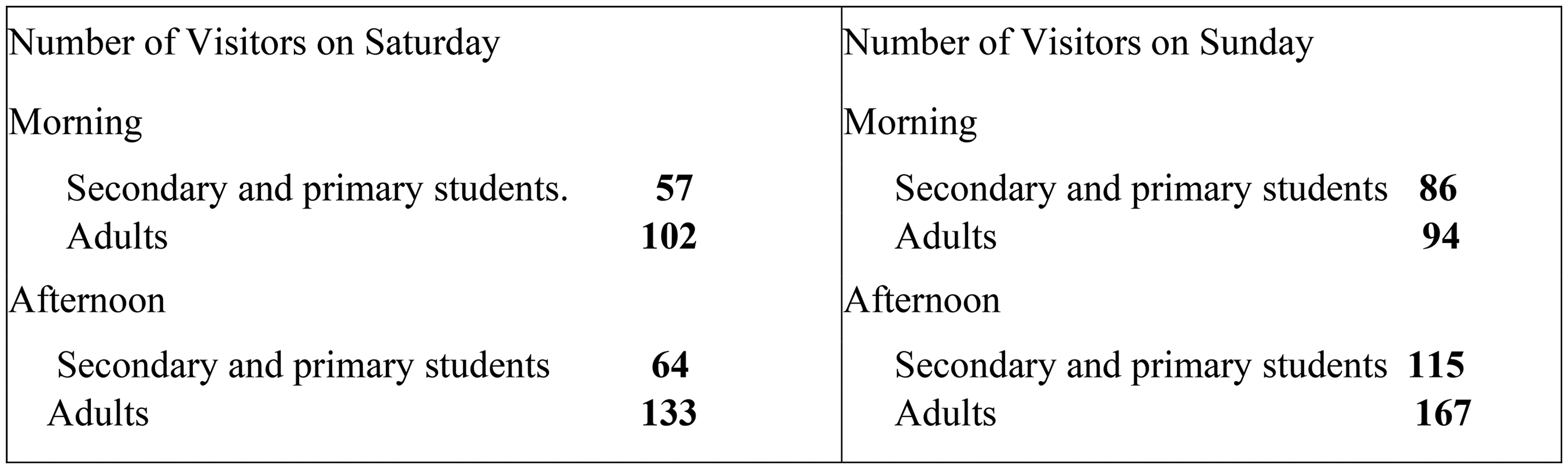
The records of visitors.
Based on the number of visitors recorded, what (mathematical) problems can you pose?”
In this example, the figure with numbers is the problem situation, and “Based on the number of visitors recorded, what problems can you pose?” is the prompt.
Let's focus on the problem situation first. The New Curriculum Standards clearly states that teachers need to “Enhance the effectiveness of situation creation and issue identification to encourage students’ engagement in instructional activities,” but there is no specific explanation of what a problem situation is. In research, problem situations like the above are called real-life situations as opposed to mathematical situations. An example of the latter situation is as follows: “6 × (3 + 2) = 30. Please pose a real-life problem that can be solved using this expression.”
It should be noted that the problem situations in the New Curriculum Standards are mostly real-life scenarios. In particular, the New Curriculum Standards advocates the use of problem posing in comprehensive practice courses and project learning. For example, when guiding the implementation of project learning, the New Curriculum Standards points out: Project Based Teaching focuses on solving real-life problems with mathematical methods, and its goal is to use mathematical thinking to analyze the relationship between elements and discover laws, cultivate model concepts, experience the process of discovering, posing, analyzing, and solving problems, and cultivate application awareness and innovation awareness.
However, these two different problem scenarios can facilitate different cognitive learning opportunities because they require different forms of mathematical understanding and cognitive processing. Cai and Hwang (2023) proposed that both real-life and mathematical scenarios require students to establish connections between life experience and mathematical knowledge in the process of problem posing, although the cognitive processes of the two are different. Problem posing in a mathematical context can help students explore abstract mathematical features and then substantiate them using their specific knowledge and life experience. Problem posing in a real-life context is just the opposite, helping students abstract mathematical features from specific scenarios. Cai and Hwang (2023) further proposed that we can subdivide the types of problem scenarios according to the presentation of the scenario content, suggesting that no matter the kind of problem scenario, problem-posing tasks can provide unique learning opportunities that nonproblem-posing teaching cannot provide. Of course, problem scenarios can also be connected to other subject content, such as science.
In addition to the problem situations, the problem-posing instructional task must also clearly guide students in what they are supposed to do. In alignment with the instructional goals, teachers have the flexibility to use different prompts, such as:
Pose all the mathematical problems you can think of; Pose problems of different difficulty levels (e.g., “pose an easy one, a medium one, and a very difficult one”); Based on this sample problem, pose similar ones (or problems with different structures).
Like problem situations, the prompt in a problem-posing instructional task will also directly affect students’ problem posing. For example, in the above exhibition task, if “What problems can you pose?” were changed to “What mathematical problems can you pose that contain at least two operations,” the cognitive requirements of the two prompts, the focus of the students, and the openness of the problems would likely vary. Such changes affect the results of problem posing. Cai and Jiang (2017) analyzed the problem-posing tasks in Chinese and U.S. mathematics textbooks and found that the prompts in the tasks were very different. Their later analysis revealed that the inclusion of prompts in a sample problem had a direct impact on how students approached problem posing. Although more research is needed on how to design prompts in different instructional contexts, teachers must consider the impact of different prompts on teaching when designing problem-posing instructional tasks.
It is worth noting that in problem-posing instruction, the teaching process is not over when students pose problems. Teachers must further handle the problems posed by students. That is, teachers need to work with students to analyze posed problems and then select some of them to be solved. Although the New Curriculum Standards combines problem posing with analyzing and solving problems, there is no special description for how to analyze and handle the problems posed by students during problem-posing instruction. Due to the varied and unpredictable nature of the challenges presented by students in problem-posing instruction, managing these issues involves greater uncertainty and complexity than in instruction where teachers pose the problems for students to solve.
Prior to addressing issues related to handling problems, we should first focus on teachers’ predictions of problems given that their skill in predicting student questions can greatly impact students’ learning. Understanding the foundational aspects of students’ ability to generate problems is crucial for teachers to predict the problems they may pose. Students tend to formulate some routine and familiar math problems (like the problems in textbooks) but the types of problems posed are often relatively simple, and they are not always good at posing innovative and complex math problems. The progression of students’ ability to formulate problems occurs in phases: Prior to second grade, they are moving from a state of being unable to generate problems to one where they can successfully do so, and from Grades 2 to 5, students are in the partial thinking stage of problem posing. Students at this stage can pose problems in an open situation, but most of them are simple problems or sporadic developmental problems. Grade 6 students enter the “overall thinking stage” of problem posing. If students experience problem-posing teaching, about half of them can pose developmental problems in a relatively systematic way. Understanding how students approach problem posing enables educators to anticipate the kinds of issues students will present on a broader scale. Secondly, to predict the problems posed by students, for given specific teaching content, teachers can sort students’ posed problems by sampling, classifying, analyzing, and comparing them with the problems posed by the teachers themselves to grasp the fundamental principles behind and enhance their ability to foresee posed problems with greater accuracy. Xu et al. (2020) revealed considerable differences in how accurately Chinese teachers could predict students’ posed problems, with predictions varying between 9% accuracy and 89% accuracy. They posited that this variation was connected to the teachers’ experience with teaching problem posing.
Teachers have different ways of dealing with the variety of problems posed by students. Based on existing research, Cai (2022) and Mo and Wang (2023) summarized four steps: analyzing the problems, selecting the problems, sequencing the problems, and solving the problems. In the problem analysis stage, teachers can guide students to discuss, revise, classify, summarize, and conclude the problems they posed. On this basis, some problems can be selected for problem-solving. Interestingly, these researchers found that in actual teaching, after solving the selected problems, some teachers started a new round of conceptually more complex problem-posing activities by changing the original problem context based on the problem-solving. Even during such a cycle of problem-posing activities, students’ mathematical modeling was guided. This demonstrates how the teacher's approach to problem posing can directly affect students’ learning outcomes.
To conclude, the process of instructing students in problem posing is a multifaceted, flexible, and organized educational endeavor. There are elevated qualifications expected of teachers. Initially, it is essential for teachers to be skilled in formulating problems. In addition, they must create suitable question scenarios and guidelines that align with the traits of their students and the subject matter being taught. Moreover, during the execution of classroom strategies, it is crucial to predict students’ difficulties while also guiding students in appropriately tackling the posed problems based on the learning goals. All these elements bring forth special challenges to the professional development of teachers in implementing problem posing in classrooms.
Regardless of the possible cognitive and noncognitive advantages of teaching through problem posing, the teacher, who designs and implements the instruction, plays a critical role in realizing these advantages. However, the New Curriculum Standards does not explicitly describe what teaching through problem posing entails, provide detailed guidelines for how to implement it, or offer specific suggestions for supporting teachers’ professional development to address the unique challenges of this instructional approach. In addition, current Chinese school curricular materials only include a very small proportion (less than 3%) of problem-posing tasks (Cai & Jiang, 2017). The inadequacy of both concrete curriculum guidance and teaching resources imposes special challenges in enacting problem-posing education in classrooms in China. Fortunately, recent studies and training initiatives by researchers in China have provided valuable insights into incorporating problem posing in the classroom and supporting corresponding teacher professional development.
Although the concept of a general model for teaching with problem posing remains highly debated—and its existence uncertain—research and practices in China show promising progress in outlining a relatively clear instructional framework. Based on extensive research and classroom practices, researchers (Cai, 2022; Mo & Wang, 2023) have proposed a Problem Posing Instructional Model with four major steps:
Presenting a problem situation. Specifying task requirements (prompts or guiding instructions). Posing problems by students. Handling student-posed problems.
Although the four steps are interrelated and influence one another, each step has distinct pedagogical functions and specific demands on teachers’ professional skills. The first three steps focus on guiding students in posing problems, whereas the fourth step centers on effectively integrating student-posed problems into instruction. Below, we will elaborate on each of the four steps in sequence.
Step 1: Presenting a problem situation
After determining the specific teaching content and objectives, teachers need to provide a clear and accessible interpretation of the teaching materials; accurately identify the students’ actual learning starting points; and design problem-posing situations based on students’ prior knowledge, relevant life experiences, and developmental characteristics. These situations aim to help students pose mathematical problems of varying quantity, difficulty, and structure while fostering their mathematical understanding. As discussed previously, problem-posing situations can be categorized into two main types: real-life situations and mathematical situations. Below are two simple examples: Real-life situation: Xiaohong has 3 apples and Xiaozhang has 5 apples. Please pose 2 mathematical problems based on this situation. Mathematical situation: Here is an equation of 5 × (3 + 4) = 35. Please pose a mathematical problem which can be solved by using the expression.
It should be noted that when designing either type of situation, teachers should consider how to resonate with students’ genuine emotions and inspire them to view the world through a mathematical lens, identify quantitative relationships and spatial forms in real-world phenomena, and pose meaningful mathematical problems, thereby fostering authentic learning and conceptual understanding. Of course, the purpose of designing situations is not merely the acquisition of knowledge; the design should also reflect how different students can engage in diverse mathematical thinking when faced with the same situation. This approach lays a solid foundation for students to successfully pose questions.
Step 2: Specifying task requirements (Prompts)
As demonstrated in the two above examples, when presenting a problem situation, teachers should also clearly specify the specific task requirements for posing problems, which are conveyed through guiding instructions (e.g., “Please pose 2 mathematical problems based on this situation”). These instructions typically clarify aspects such as the number of questions and the level of difficulty required. For example, the previous guiding instruction could be modified to “Please pose one simple and one moderately challenging mathematical question based on this situation.” This modified guiding instruction specifies two questions with differing difficulty levels. In doing so, not only stimulates students to think at various levels but also helps teachers assess the learning and questioning abilities of students at different levels.
The reasonableness of the prompts is closely related to whether students can pose problems, pose multiple problems from different angles, and pose problems with varying levels of difficulty. This directly impacts the cultivation of students’ fluency, divergence, flexibility, and depth of thinking (Cai et al., 2023). Therefore, teachers should clarify specific requirements for problem posing based on the teaching content and objectives.
To support teachers in becoming adept at problem-posing instruction, Cai (2022) summarized how they must focus on enhancing two key competencies:
The ability to pose high-quality, valuable, and meaningful mathematical problems in real-life and mathematical contexts. The ability to create problem-posing teaching situations and craft effective guiding instructions.
In terms of strategies for improvement, Cai (2022) provided two approaches:
Participating in problem-posing research groups: Teachers can join research groups focused on the problem-posing teaching approach. Within such groups, teachers practice posing questions based on the same scenario. By adopting a learner's mindset and viewing situations from students’ perspectives, they can simulate the process of problem posing, which helps refine their own abilities in this area. Enhancing situation creation and guiding instructions: The core of problem-posing instruction lies in situation creation and providing guiding instructions, both of which must align closely with curriculum goals and teaching tasks. Teachers should continuously improve their professional skills and expertise, experimenting, exploring, and analyzing their teaching practice. Through ongoing trials and research, they can develop stronger capabilities in designing scenarios and crafting guiding instructions.
Step 3: Posing problems by students
After the teacher presents the problem situation and clarifies the task requirements, students are expected to pose questions based on the given guidelines. Depending on the teaching content and task requirements, students may pose problems either in written form or orally. Additionally, problem posing can be fulfilled individually, in small groups, or through a combination of the two—for instance, students could first pose problems individually and then engage in group discussions to summarize and refine their problems before presenting them as a group.
Regardless of the format in which students pose their problems, teachers should promptly document and display these problems in preparation for the next step: handling student-posed problems.
Step 4: Handling student-posed problems
Given that all education combines both individuality and sociality, all classroom teaching involves a process wherein individual and social learning complement and promote each other. In the context of problem-posing teaching, individuality is reflected in each student independently posing questions that are personally meaningful, interesting, and worth exploring based on the given situation. Sociality, on the other hand, is manifested in the exchange, discussion, supplementation, and integration of the different individual ideas enacted in the process of teachers’ handling of student-posed problems.
Handling student-posed problems, which often comes with significant uncertainty and unpredictability, presents unique challenges for teachers in China who are accustomed to traditional, meticulously planned lessons. In addition to its pedagogical significance in shaping the impact of problem posing on teaching, this aspect requires a shift in approach. Unfortunately, the New Curriculum Standards provides little guidance on how to effectively manage student-posed problems.
Cai (2022) proposed four sequential steps for handling students’ posed problems: organizing and analyzing problems, selecting problems, sequencing problems, and solving problems. He argued that the first three steps are preparatory steps arranged in order that precede the last step, solving problems. However, it is worth noting that in actual teaching, solving problems does not always require going through the steps of organizing, selecting, and ordering questions. It is entirely possible to proceed directly to solving problems after students have posed their problems.
In effectively handling student-posed problems, teachers can face at least three challenges. The first challenge concerns how to address nonmathematical problems posed by students. Although it is both practical and pedagogically reasonable to skip such problems, Cai (2022) argued that this approach might raise concerns about teaching equity by potentially discouraging the students who posed them. Plus, Ran et al. (in press) found that such unexpected responses from students may also exhibit innovative ideas.
The second challenge involves handling student-posed problems that, though desirable and even challenging as mathematical problems, are not directly related to the learning objectives of the lesson. A critical aspect of managing student-posed problems is for teachers to assess how well these problems align with the lesson's goals. In their analysis of 22 problem-posing teaching cases, Zhang and Cai (2021) found that teachers consistently skipped over problems unrelated to the instructional objectives, often explaining that they would not address those questions because they were not relevant to the day's lesson. For problems aligned with the learning goals, teachers typically categorized them by difficulty:
For relatively simple problems, teachers would guide students to quickly solve them through whole-class discussion, often asking students to collaboratively sort out the answers. For very challenging problems, teachers often assigned them as homework or reserved them as tasks for future lessons. The focus of in-class discussions was generally placed on moderately challenging problems, which offered opportunities for deeper engagement and collective problem-solving.
The third challenge lies in the generative nature of problem-posing tasks. These tasks are inherently open-ended, allowing students to pose a wide variety of problems based on their own experiences. This diversity can complicate teachers’ immediate decision-making about how to address the posed problems effectively. Xu et al. (2020) explored teachers’ ability to predict the types of problems their students might pose and found that the alignment between teachers’ predictions and students’ actual problem-posing outcomes was often less consistent or accurate than expected. For instance, teachers in their study generally overestimated the complexity of students’ posed problems. Teachers tended to predict more sophisticated problems requiring functional relationships than what the students generated, even among higher-grade students.
To address this third challenge, teachers need training to improve their ability to anticipate students’ problem-posing behavior. During the planning phase, teachers should be equipped to account for the range of potential problems students might pose. Developing an understanding of students’ thinking in relation to mathematical problem posing is a crucial step in using this approach to assess students’ mathematical understanding in the classroom. Consequently, anticipating possible student-posed problems should be an integral part of lesson planning for problem-posing activities (Cai et al., 2020; Koichu, 2020).
Overall, although the New Curriculum Standards does not provide further elaboration, recent training programs and empirical studies conducted by scholars in China have contributed some key information about the practical application of problem-posing instruction in classrooms. These efforts have also identified effective strategies for professional development to support teachers in implementing problem-posing practices within the context of Chinese culture.
Decades of research and practice in problem-posing teaching have shown that systematic training can enable teachers to become skilled problem-posing instructors. For example, numerous problem-posing workshops have been given in China. These workshops provide platforms for continuous exchange and experience sharing, allowing teachers to enhance the quality of their own problem posing significantly. Moreover, they have become increasingly adept at anticipating and addressing the diverse problems posed by students, thereby enriching the teaching and learning process.
Conclusion
The Chinese New Curriculum Standards emphasizes problem posing as a vital approach to fostering core mathematical competencies in students. These include competencies in observing, analyzing, and articulating real-world phenomena through mathematical perspectives. Problem posing is recognized as a critical tool for evaluating students’ innovative thinking and refining instructional objectives. The inclusion of problem posing in the Chinese New Curriculum Standards highlights its role as a dynamic and transformative educational practice. By focusing on problem posing, the curriculum seeks to promote students’ creativity and deepen their mathematical understanding, aligning with broader educational reform goals. However, implementing problem-posing instruction presents significant challenges, primarily due to the high demands it places on classroom teachers.
As Bruner (2009) astutely observed, any successful educational reform must ensure that the curriculum can be effectively used by “ordinary teachers” to teach “ordinary students.” Yet, the New Curriculum Standards lacks detailed guidance on how to integrate problem posing into everyday classroom practice. Specifically, a gap exists between the intended curriculum and its practical application in typical classroom settings. The development of teacher education programs and collaborative workshops has proven instrumental in closing this gap. These initiatives equip educators with the skills and strategies needed to design, implement, and support problem-posing activities effectively. As research and practice continue to advance, problem posing demonstrates considerable potential to enhance both teaching and learning, establishing itself as a cornerstone of modern mathematics education in China.
Footnotes
Contributorship
Jinfa Cai contributed to the conceptualization and writing of the paper. He has also contributed to the revision of the paper. Tao Wang contributed to the data coding and writing of the paper. Shengying Xie contributed to the writing of the paper.
Declaration of conflicting interests
The author(s) declared no potential conflicts of interest with respect to the research, authorship, and/or publication of this article.
Funding
The author(s) received no financial support for the research, authorship, and/or publication of this article.
