



Abstract
In recent decades, the different manifestations of mathematical problem posing (MPP) have become important objects of research in mathematics education. However, according to some researchers, these different manifestations pose the risk that the term “problem posing” might become “so diffuse as to undermine its analytic power and reduce it to an ephemeral sign”. This is because the activities of problem posing are formulated in different ways, using different mathematical idioms. This article studies the language of problem posing in three English-speaking countries: England, the USA, and Singapore. I analyzed the secondary school curriculum texts in the three countries. What language is used to denote MPP activities? What are the differences in language between England, the USA, and Singapore? The work will give insights into the way MPP plays a role in England, the USA, and Singapore and will conclude with the implications of the findings.
Introduction
In recent decades, the different manifestations of mathematical problem posing (MPP) have become important objects of research in mathematics education. There is a growing body of empirical evidence for MPP's potential to support students’ mathematical understanding, problem-solving ability, and creativity; for example, a review of interventions for MPP showed a medium, positive, and significant mean weighted effect size with several intervention components (Zhang et al., 2024). In becoming more important, though, these different manifestations pose the risk that the term “problem posing” might become “so diffuse as to undermine its analytic power and reduce it to an ephemeral sign” (Ruthven, 2020, p. 1). This is due to the activities of problem posing being formulated in different ways, using different mathematical idioms. By “idiom,” I refer to the terms and terminology used in combination with MPP. For example, Silver (2013) expressed concerns that MPP has been applied to several different contexts, including teachers posing problems for their students, teachers posing problems for themselves, and students posing problems for their classmates. In other words, who are the “targets” of the problem posing can vary. Another issue concerns what the field actually means by problems: Are they more open-ended queries, for example, or can they also include more closed problems? This element is associated with the expected activities that educators expect students to complete as part of the MPP: The language verbs used to describe such activities matter. This article studies the language of problem posing in three English-speaking countries: England, the USA, and Singapore. I particularly focus on how MPP is used in their respective curricula. I do this by conducting a text analysis of the three relevant curriculum specifications for the three countries. I consider particular keywords, including “mathematical problem posing” as well as more broadly associated terms such as “problem,” “problems,” and all combinations with other words in addition to commonly occurring “bigrams” (pairs of words). I also include “verbs” to indicate the expected cognitive activities. The article aims to answer the research question “What idioms do the mathematics curricula of England, the USA, and Singapore use regarding mathematical problem posing?” and attempts to use the answer to this question to provide insights for policymakers and educators regarding integrating MPP in the curriculum.
Mathematical Problem Posing (MPP)
To be able to discuss the language of MPP, we first need to have insight into how MPP has been described in prior literature. Cai and Hwang (2020) edited a seminal academic special issue on MPP research, highlighting the many faces of MPP. Among these many faces, they tabulated several definitions of problem posing. Cai et al. (2020) referred to problem-posing tasks as “those which require teachers or students to generate new problems and questions based either on given situations or on mathematical expressions or diagrams” (p. 2) and as involving three specific intellectual activities: (a) Teachers themselves pose mathematical problems based on given situations or on mathematical expressions or diagrams, (b) Teachers predict the kinds of problems that students can pose based on given situations or on mathematical expressions or diagrams, and (c) Teachers design mathematical problem-posing tasks for students to pose problems. (p. 2)
A further question, then, is what such problems should look like. A review of the recent MPP literature shows that these also are hard to pin down. For example, Cai et al. (2020) stated that problem-posing tasks “generate new problems and questions based either on given situations or on mathematical expressions or diagrams” (p. 2). These situations can be either real-life contexts or mathematical contexts. The emphasis on generation is also featured in work by Chen and Cai (2020), who emphasized the generation of problems based on a given mathematical expression, and Xu et al. (2020), where MPP is about the generation of new problems when given a problem situation. Koichu (2020) described problem posing as authentic mathematical activity: New problems are posed not just as exercises in problem posing but for genuine mathematical or pedagogical needs. In my view, this also is most relevant when discussing MPP in the context of curricula. After all, even if there isn’t a genuine need for MPP, the inclusion of MPP-related curriculum objectives would be very relevant for classroom mathematics. This poses a problem for MPP in relation to curriculum as well. Brady et al. (2024) pointed out that problems often are “implicitly conceptualized as ‘carriers’ of key constructs in the curriculum, leading students to identify individual curricular contexts with particular problem types” (p. 38). Such an approach can restrict attention to problems and problem types that illustrate particular concepts in a curriculum, hence implicitly suggesting that only particular problems are worthwhile to study. Problems generated by students, as in problem posing, might therefore be deemed not important enough as carriers of key constructs in the curriculum. Another layer to this discussion arises if one would stipulate that problems need to be “group worthy” (Crespo & Harper, 2020), as not all problems might cognitively engage all group members (for a review, see Nokes-Malach et al., 2015). Sometimes the nature of the MPP problems is very specific. Leikin and Elgrably (2020) provided very detailed requirements of what they called “Problem Posing through Investigation,” with an emphasis on geometric proof and formulating new proof problems. These again were in the context of preservice teacher training. This does beg the question of whether MPP is perhaps more suitable for particular contexts, for example, preservice and in-service teachers who will be confronted with having to design problems and tasks for their students, as well as mathematics topics that are more suited for open exploration. Finally, educators sometimes discuss to what extent problems need to be completely new. The argument can be made that simply including a category of problems in a curriculum document implies that it won’t be completely new. This might be the reason why participants in Koichu's (2020) study were not comfortable calling the posed problems new and so put the word “new” in quotation marks, with problem posing as both reformulation and as generation of “new” tasks.
Cai and Hwang (2020) themselves kept the definitions of problem and task broad to include “any mathematical question that can be asked and any mathematical task that can be performed based on the problem situation” (p. 2) and context broadly to include “within-mathematics situations that give rise to new questions as well as situations drawn from (or embedded in) external referents such as real-life phenomena and questions arising from other disciplines” (p. 2). Stoyanova and Ellerton (1996) distinguished between free, semi-structured, and structured problem-posing situations based on their degree of structure. In “free situations”, problems are posed based on a given, naturalistic, or constructed situation without restrictions. In “semi-structured situations”, learners are asked to pose problems regarding an open situation but with the concepts of previous mathematical experiences. Finally, in “structured situations”, learners pose problems based on a specific problem as can be seen in the work of Leikin and Elgrably (2020). It could be argued that in a curriculum and with schooling, learners will always have previous mathematical experiences; thus, it remains to be seen whether any learning in schools is truly new and novel. Notwithstanding this, Stoyanova and Ellerton's (1996) view would imply that in all these cases, MPP would remain relevant. Baumanns and Rott (2022) elaborated on the nature of problems in MPP by formulating three dimensions. The first dimension is about whether MPP generates new or reformulates given problems as new. The second dimension considers whether MPP poses routine or non-routine problems. The third dimension refers to the required metacognitive behavior of the MPP activities. The third dimension broadens the scope of MPP as this does not just refer to the problems themselves but to a range of behaviors associated with the planning, monitoring, and evaluating of the problem-posing context.
Such broadening highlights the importance of the whole process but also risks expanding the notion of MPP to an undesirable extent. Ruthven (2020), in his commentary, noted the stretched notion of MPP, highlighting how problem posing now also seems to include probing questions and as such does not just concern substantive mathematical tasks but also a range of cognitive and metacognitive prompts about such tasks. The examples noted in the previous literature include, as also noted by Ruthven (2020), elements of task design (e.g., open-ness of the tasks), classroom organization (e.g., group work), lesson planning (e.g., when teacher activities or student activities occur), and teacher questioning (e.g., probing). Although such a broad definition of MPP does pose challenges, it can be argued that an expansive view of problem posing does justice to the breadth of various pedagogical considerations. However, these considerations should be combined into coherent and clear classroom models.
In this study, I do not pin down the definition of MPP as I am interested in how MPP manifests itself in the curriculum documents of three countries. To do this, I can’t only rely on the term “problem posing”, as our review of recent MPP literature shows many faces of MPP. These many faces pose particular challenges for this study. This study uses two lenses for the analysis. Firstly, I use Baumanns and Rott's (2022) framework for characterizing problem-posing activities, linking three theoretical constructs from research on problem posing, problem-solving, and psychology, namely: (1) problem posing as an activity of generating new or reformulating given problems, (2) emerging tasks on the spectrum between routine and non-routine problems, and (3) metacognitive behavior in problem-posing processes. The use of this framework implies that I adopt a broad view of MPP, not just including problem posing but also associated concepts and behavior. Doing this ensures that even if MPP is not mentioned explicitly, I still pick up other ingredients that might underpin MPP. Secondly, I distinguish between students and teachers as actors in MPP activities, as described by Cai and Hwang (2020, p. 3). By distinguishing between students and teachers, I can also better clarify their respective roles in MPP.
Mathematics schooling in England, the USA, and Singapore
In this study, I am interested in the different guises of MPP in the curricula of three different countries. I focus on the curricula for England, the USA, and Singapore, in particular the school years in lower secondary education. England is the country of residence of the author of this article. Singapore was chosen as it was the highest-scoring jurisdiction in the 2022 Programme for International Student Assessment for Mathematics (Organisation for Economic Co-operation and Development [OECD], 2023). A Web of Science search on April 15, 2025, on “mathematical problem posing” yielded 132 hits with by far the most, 56, originating from the USA. Given that English is its primary language, the USA can be readily compared with England and Singapore. To contextualize the mathematics curriculum, I first describe some general features of these education systems (Reynolds et al., 2024).
Schooling in England
Maintained schools in England are legally required to follow the National Curriculum.
1
Academies and Free Schools (which receive funding directly from the government) have greater autonomy. However, they are expected to teach a curriculum that is comparable in breadth and ambition to the National Curriculum, and many choose to teach the full National Curriculum to achieve this. Most schools have internal end-of-year examinations as well as more frequent small-scale summative assessments. GCSE Mathematics is an important national qualification taken at the end of Year 11 (Grade 10). The national curriculum for mathematics says students “should also apply their mathematical knowledge in science, geography, computing and other subjects” (Department for Education, 2013, p. 2). At the end of the Key Stage 3 (KS3) mathematics program of study for 11- to 13-year-olds, students should:
be fluent in the fundamentals of mathematics, through varied and frequent practice with increasingly complex problems over time, so that students develop conceptual understanding and the ability to recall and apply knowledge rapidly and accurately; reason mathematically by following a line of inquiry, conjecturing relationships and generalizations, and developing an argument, justification, or proof using mathematical language; and solve problems by applying mathematics to a variety of routine and non-routine problems with increasing sophistication, including breaking down problems into a series of simpler steps and persevering in seeking solutions.
The curriculum is organized into distinct domains, and students build on learning achieved at Key Stage 2 and connections across mathematical ideas to develop fluency, mathematical reasoning, and competence in solving increasingly sophisticated problems with good written and mental arithmetic. Teachers and students use digital tools and materials for mathematics teaching and learning as teachers deem appropriate.
Schooling in Singapore
The Secondary Mathematics curriculum builds on the primary curriculum and sets out the mathematics knowledge and skills at each grade level that students should acquire from Secondary 1 (Grade 7) to Secondary 4 (Grade 10). The curriculum was first introduced in 2020 at Secondary 1 (Grade 7), with the Grade 8 curriculum first implemented in 2021. The syllabuses (Ministry of Education Singapore [MoE], 2024) are supported by a mathematics framework that articulates the principles of an effective mathematics program that is applicable to all grade levels, from the primary to pre-university (Grade 12). The framework sets the direction for the teaching, learning, and assessment of mathematics across all grade levels. Central to this framework is the focus on the development of mathematical problem-solving competency. Supporting this focus are five interrelated components: concepts, skills, processes, metacognition, and attitudes. The education system is evaluated through focus-group discussions, school visits, and regular meetings conducted by Curriculum Planners with school leaders and teachers as well as research projects by the National Institute of Education. Technology is used to help students understand mathematical concepts through visualizations, simulations, and representations and develop twenty-first century competencies such as the ability to work collaboratively and think critically about solutions. They also support exploration and experimentation and extend the range of problems accessible to students. The mathematics curriculum takes the position that computational tools, including digital-based ones, are essential for the learning of mathematics.
Schooling in the USA
Education policy is organized at the state level in the USA. The Common Core State Standards (National Governors Association Center for Best Practices and Council of Chief State School Officers [CCSS], 2010) was an attempt to provide a common curriculum approach. The website of the Common Core is a “set of clear, high-quality academic standards in mathematics and English language arts. These standards outline what students should know and be able to do at each grade level”. 2 Forty-one states, the District of Columbia, four territories, and the Department of Defense Education Activity (DoDEA) initially adopted the Common Core State Standards. States and districts vary in their evaluation of curriculum implementation, including evidence-based practices for implementation and state review processes for instructional materials. States also consider student performance on assessments aligned to state standards. Under the 2015 Every Student Succeeds Act guidelines, states are required to test students annually in mathematics in Grades 3–8 and once in high school. State and/or regional accrediting bodies evaluate the appropriateness and quality of a school's curriculum. Many school districts and schools have chosen to integrate technology (computers, tablets, and interactive whiteboards) with their mathematics instruction.
Methodology
I analyzed the mathematics education curricula in England, the USA, and Singapore. What language is used to denote MPP activities? What are the differences in language between England, the USA, and Singapore? Such an analysis is relevant, as English (2020) argued that “Curriculum developers and policymakers thus need to make a concerted effort to embed problem posing within their guidelines” (p. 3). The work gives insights into the way MPP plays a role in the English, U.S., and Singapore curricula and concludes with the implications of the findings. I used the main curriculum documents for Year 8 (12- to 13-year-olds) for England, the USA, and Singapore. I first identified word frequencies for the core document and then performed a content analysis for keywords, including “problem”, “problems”, and all their combinations with other words as well as commonly occurring bigrams. Furthermore, I looked at verbs to indicate the expected cognitive activities. I report the frequencies of these words but then also, by country, present a Keyword in Context (KwiC) analysis. A KwiC analysis is a method used in text analysis to identify and display the occurrences of a specific keyword within its surrounding context. This technique helps in understanding how a word is used in different contexts by showing the keyword along with a few words before and after it. Analyses were conducted within R and R studio, using a variety of R packages, including the quanteda package (Benoit et al., 2018). Finally, I conducted a thematic analysis of all the KwiC results for the keyword “problem” (Braun & Clarke, 2006). This included first familiarizing myself with the KwiC data and then generating sets of similar keywords in context to define common themes.
Curriculum documents included
For England, I reviewed the curriculum document “Mathematics programmes of study: KS3—National curriculum in England” (Department for Education, 2013). Not all schools have to follow the National Curriculum in England (e.g., Multi Academy Trusts do not), but many academies follow most elements of the national curriculum because they participate in the assessments and inspections aligned with the national curriculum (Maisuria, 2023). For the USA, I looked at the Common Core State Standards (CCSS, 2010). Forty-one states, the District of Columbia, four territories, and the DoDEA have adopted the Common Core State Standards. As the document contains all the mathematics from Kindergarten to the end of high school, I included the general text of the standards as well as descriptions for Grade 7 and Grade 8. For Singapore, I reviewed the “G1 MATHEMATICS SYLLABUS – Secondary One to Four Implementation starting with 2020 Secondary One Cohort” (MoE, 2024). Each document can be seen as a representation of the lower secondary mathematics curricula in England, the USA, and Singapore, respectively.
Results
I now present the results of our document analysis of the three curriculum documents. My first observation is that there is a large difference between the length of the curriculum documents. The USA document has the lengthiest text with 3,721 words, with slightly fewer words than the Singapore document (3,436 words). The English document has by far the least words, with 1,175 words. It must be noted, though, that it is hard to infer anything from these lengths, as much depends on the granularity of the curriculum objectives.
Bigrams and prevalence
Using a threshold of at least 10 mentions of pairs of words, the most commonly occurring bigrams included specific terms for countries that can be grouped in three clusters. Firstly, there were terms related to the specific curriculum contexts of the three countries, including terms such as Key Stage, Common Core, and Grade 8. Secondly, there were general terms such as “mathematics syllabus”, “mathematics curriculum”, and “proficient students”. Finally, there also were mathematics-specific terms, including “algebraic expressions”, “proportional relationships”, “linear equations”, “real world”, and “mathematical objects”. Table 1 presents the top 10 most commonly occurring terms in each of the three curriculum documents.
Top 10 terms in curriculum documents for England, the USA, and Singapore.
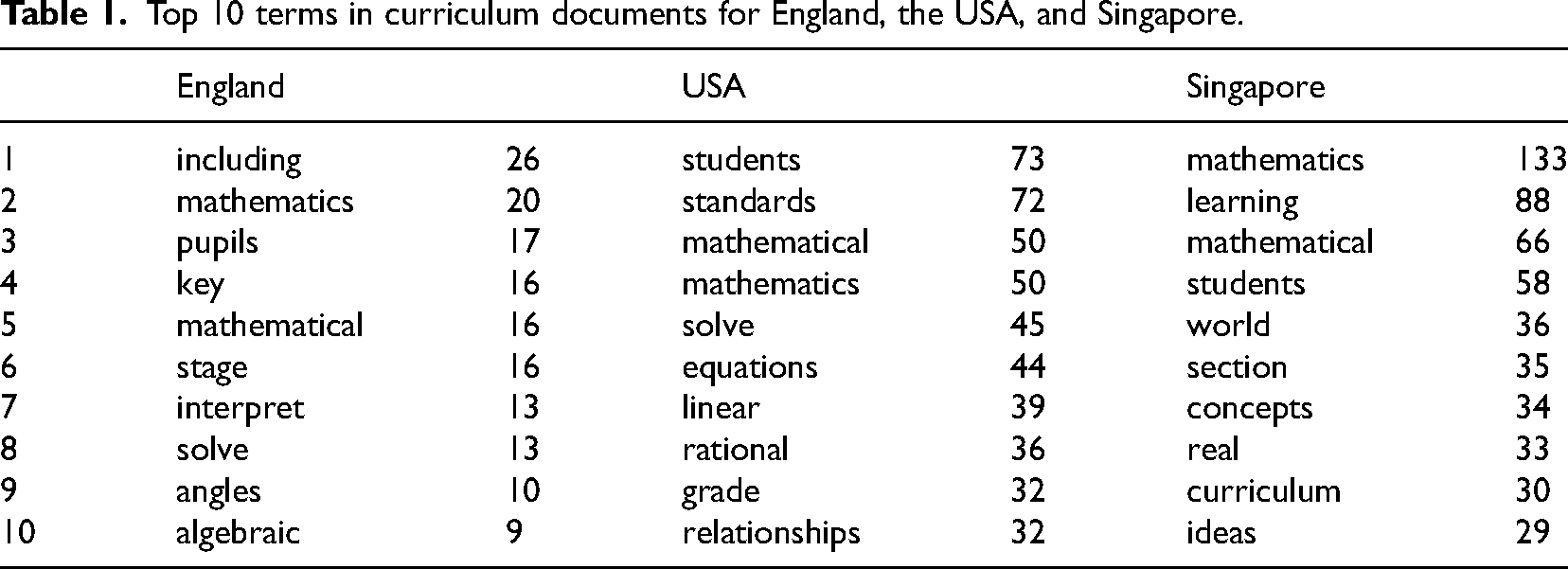
Top 10 terms in curriculum documents for England, the USA, and Singapore.
Some of these words, as in the analysis of bigrams, concern terms related to the specific curriculum contexts of the three countries, including words such as “key” and “stage” for England, and more general terms such as “mathematics” and “mathematical” unsurprisingly occur quite often. The English document talks about “pupils” whereas the USA and Singapore documents use the word “students”. However, there are also some interesting differences between countries. For example, the term “interpret” is in the top 10 in England but does not feature in the other two. Although both the USA and Singapore documents do use several variations of this term, amounting to around a similar number of occurrences as in the England document, we need to recall that the English document is much shorter. Some specific mathematical terms denote curriculum differences. “Angles” are frequently mentioned in the England document, but 16 such mentions in the Singapore document are sizable as well, with the USA document mentioning “angle” and “angles” 19 times. Different forms of “equations” are mentioned more often in the USA document, with Singapore using the term relatively seldom. The term “real”, often used in the phrase “real world”, is used most often in the Singapore document, but only reaches the top 20 in the USA document and is negligible in the England document. Although all curricula include “concepts”, the England document includes the term only four times (and “conceptual” one time). The USA document mentions “concept” three times, “concepts” four times, and “conceptual” three times. The Singapore document mentions concept-related terms 37 times. In other words, Singapore's curriculum has a much stronger focus on concepts. A final observation is that the USA and England curricula hardly mention “ideas”, whereas the Singapore curriculum uses the term quite frequently.
I then proceeded to the KwiC thematic analysis. I first looked at the words “pose” and “posing”. “Posing” was only mentioned once in the USA document, but it referred to “decomposing”. The term “pose” occurred 14 times, but the majority of instances referred to “compose(d)” and “purpose”. This was also true for the only occurrence of this term in the England document. After excluding these instances, only two occurrences remained, one in the Singapore and one in the USA documents. The Singapore document states under the header “Mathematics and twenty-first Century Competencies” that “When students pose questions, justify claims, write and critique mathematical explanations and arguments, they are engaged in reasoning, critical thinking and communication” (MoE, 2024, p. 12). The USA document, in contrast, refers to specific content: “Solve multi-step real-life and mathematical problems posed with positive and negative rational numbers in any form (whole numbers, fractions, and decimals), using tools strategically” (CCSS, 2010, section 7. EE). It seems fair to conclude that problem posing hardly features in the three curricula, with only Singapore using the term once. So, although the England mathematics curriculum for KS3 emphasizes several key areas, including problem solving, mathematical reasoning, and fluency in mathematical fundamentals, it does not explicitly mention problem posing as a distinct component. Problem posing, which involves creating new problems or reformulating given problems, can be an integral part of developing mathematical thinking and creativity. Whereas the curriculum focuses on solving a variety of routine and non-routine problems, teachers might incorporate problem posing as a strategy to enhance students’ understanding and engagement with mathematical concepts. The USA curriculum text also emphasizes problem solving and mathematical practices but does not explicitly mention problem posing as a distinct element. However, the standards encourage students to engage deeply with mathematical concepts, which can include activities related to problem posing. The Standards for Mathematical Practice, which are part of the CCSS, highlight important skills such as making sense of problems, reasoning abstractly and quantitatively, and constructing viable arguments. Such practices can include problem posing as students explore and create new problems based on their understanding of mathematical concepts. The Singapore curriculum text again emphasizes problem solving as a central component, while only mentioning “posing” once. However, its curriculum framework does encourage the development of mathematical thinking through various processes, including problem solving, conceptual understanding, and metacognition. For some time, teachers in Singapore have been known to incorporate problem-posing as part of their instructional strategies to promote mathematical thinking (Yeap & Kaur, 1997).
As the previous initial analysis again shows, MPP is often defined in a wider sense, as presented in the literature review. I then looked at associated terms, starting with the term “problem”. In total, the term “problem” (and its variations, such as “problems”), was present 157 times in the three curriculum documents: 23 times in the England, 69 times in the Singapore, and 65 times in the USA documents. Given the length of the documents, in relative terms, these numbers are comparable. Table 2 presents six examples from each country: Some themes such as sequencing, the context of problems, routine or non-routine problems, representations, and others appear in all three curricula, whereas some themes are emphasized more in some curricula than others. All three curricula mention problem solving, emphasizing solving various types of problems, both routine and non-routine, with increasing complexity. The Singapore document does this in combination with inspiration from real-world situations and the importance of applying mathematical concepts to practical scenarios. The USA document does this as well, with the text highlighting the importance of solving both real-world and mathematical problems. This emphasis on real-world problems also appears in the England curriculum document but as part of applying mathematical knowledge to a variety of contexts. The USA document formulates this as applying mathematical knowledge to everyday life, society, and various contexts, such as planning events or analyzing community problems. Hand in hand with problem solving, the term “reasoning” is apparent under different guises. The England curriculum highlights the importance of developing mathematical reasoning and competence in solving sophisticated problems, whereas the USA curriculum underscores a similar significance of reasoning and proof in understanding and solving problems as well as justifying conclusions. The Singapore curriculum also supports this by mentioning creative and logical thinking needed to tackle problems, suggesting that these skills are essential for effective problem solving. Another interesting theme concerns the role of language. For example, the England document stresses the need for pupils to develop a deep conceptual understanding and justification using mathematical language. The importance of communicating mathematical ideas effectively is mentioned by the Singapore and USA documents as well, including the use of mathematical language and representations, such as graphs and coordinate systems, to communicate and solve problems including understanding different approaches to solving complex problems. Conceptual understanding is also mentioned in the USA document but not in the Singapore document. However, there is ample mention of “concepts”, as also demonstrated in Table 1. Unique to the England curriculum document is an explicit mention of how pupils who are not sufficiently fluent should consolidate their understanding, including through additional practice, before moving on. This echoes the English policy of “teaching for mastery” (National Centre for Excellence in the Teaching of Mathematics, n.d.). Although this focuses on primary education, it also has had an influence on secondary education. The Singapore and USA documents mention mathematical modeling, with the former discussing the process of modeling, which involves making assumptions, simplifying problems, and representing them mathematically to find solutions, whereas the latter relates this to a process of mathematical modeling which involves representing real-world problems mathematically and finding solutions. The England document does mention “models” but does not explicitly relate them to “real-world problems”, instead more generally speaking of “situations”. The Singapore and USA documents devote text to the use of tools, including technological tools such as spreadsheets, to aid in problem solving and to clarify mathematical concepts. The England text, again, stays general and broad in stating that teachers and students should use digital tools and materials for mathematics teaching and learning as teachers deem appropriate. The use of technology was also a theme in Zhang et al.'s (2025) review, noting how technology could support MPP practices. The Singapore document is the only one to include the importance of metacognition (thinking about one's own thinking) and having a positive attitude toward problem solving. This includes monitoring and regulating one's problem-solving strategies and being persistent. The other two curricula of England and the USA mention the importance of the latter as well. For example, the England text encourages breaking down problems into simpler steps and persevering through challenges, whereas the USA text mentions various mathematical practices, such as making sense of problems, persevering in solving them, and using different methods to check answers. The Singapore document is the only one to emphasize interdisciplinarity: knowledge and practices across Science, Technology, Engineering, and Mathematics (STEM) disciplines to solve complex problems collaboratively. Finally, the USA document emphasizes the theme of quantitative relationships more than the others. The text discusses understanding and making sense of quantities and their relationships in problem situations, including decontextualizing and contextualizing problems. Although the other two curricula mention quantities as well, they are more often part of specific content items. As a notable observation seemed to revolve around the use of the term “real-world”, I conducted an additional KwiC analysis of this term. The term does not feature in the England curriculum document but features 14 times in the USA text and 29 times in the Singapore text. Overall, there seem to be more commonalities between the Singapore and USA curricula than between either of these curricula and the England curriculum.
Six examples of the keyword “Problem” in context for three curriculum documents from England, the USA, and Singapore. “Pre” indicates the text preceding the keyword and “post” indicates the text after the keyword.
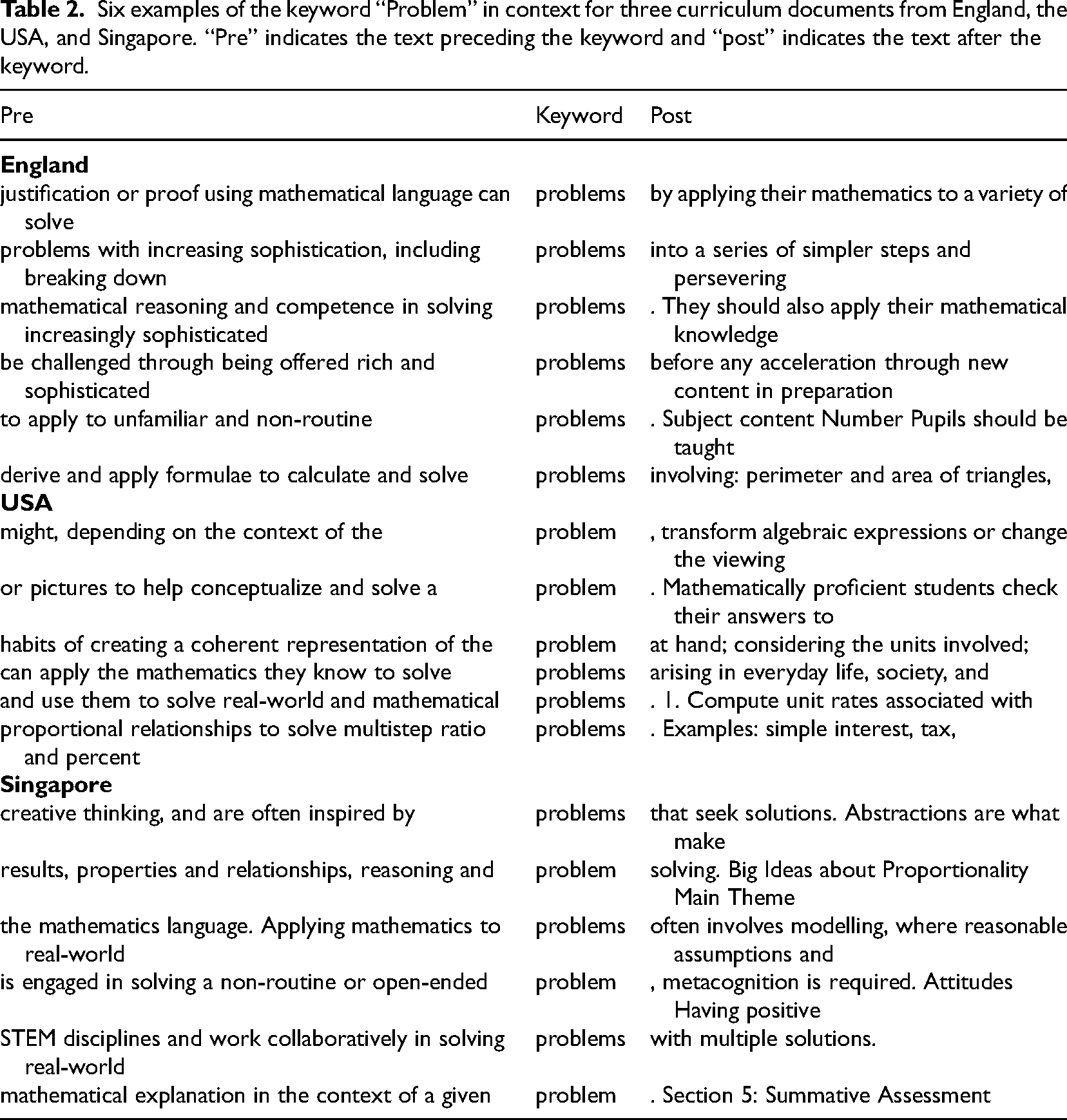
Six examples of the keyword “Problem” in context for three curriculum documents from England, the USA, and Singapore. “Pre” indicates the text preceding the keyword and “post” indicates the text after the keyword.
This article started with the observation that MPP is not always one clear-cut concept but has different guises and associated concepts. This “idiom of problem posing”, on the one hand, makes the ideas of MPP more powerful and influential, but, on the other hand, as Ruthven (2020) noted, makes the ideas more opaque. Such linguistic ambiguity is also apparent in the curriculum documents of England, Singapore, and the USA. In this article, I set out to answer the research question “What idioms do the mathematics curricula of England, the USA, and Singapore use regarding mathematical problem posing?” Two of the curricula do not mention MPP at all; one, that of Singapore, refers to “when students pose questions”. At the same time, there is a raft of terminology that surrounds MPP, including problem-solving, mathematical reasoning, and mathematical language in all three curricula, something I explicitly accounted for by choosing an inclusive framework that doesn’t just focus on MPP but also focuses on associated concepts and processes. It is noteworthy that the “real world” hardly features in the England curriculum. According to Leikin et al. (2025), mathematical modeling and problem posing are “intrinsically interconnected” as mathematical modeling processes “require the formulation of mathematical problems, while situation-based PP employs modeling principles” (p. 1). In Blum and Leiss’ (2007) modeling cycle, the word “real” plays a significant role in the modeling process, with a “situation model” distinguished from a “real situation”. It could be that the England curriculum means as much when stating that students should be taught to “begin to model situations mathematically and express the results using a range of formal mathematical representations” (Department for Education, 2013, p. 5), but this is not explicitly linked to the “real world”. Although all three curricula mention “tools”, the Singapore and USA curricula provide more detail than the England text about the ways in which tools can contribute to tackling problems. It seems important to provide such detail because the myriad of available tools can be used in many different ways. Mackrell and Bokhove (2017) interviewed four developers of technology environments and highlighted how the degree of open-endedness of platforms is a major design consideration, especially if a tool should enable students to pose problems themselves.
Singapore seems to pay more attention to “soft skills” such as metacognition as well as “ideas”’ and gives extensive attention to “concepts”, which seems to clash with some of the caricatures of mathematics education “in the East” (Bokhove, 2022; Leung, 2001). One aspect of the caricature might concern a theme that previously partly occupied the “Math Wars” (Schoenfeld, 2004), namely the theme of an alleged tension between procedural fluency and conceptual understanding. It was notable that all three curriculum documents mention procedures and procedural fluency, although problem solving and mathematical reasoning seem to be more prevalent in the idioms used. Nevertheless, the presence of both procedural and conceptual knowledge is in line with research on mathematical proficiency (e.g., Rittle-Johnson et al., 2015). The picture that East Asia is mainly about procedures is not sufficient, exemplified, for example, by the Chinese curriculum including more than just procedures in their “Four Basics” (Cheng et al., 2021). One could argue that if the England curriculum has little “problem posing” and interprets mastery as “those who are not sufficiently fluent should consolidate their understanding, including through additional practice, before moving on” (Department for Education, 2013, p. 2), this is a one-sided view of “mastery” at odds with the inspiration for such approaches in the Singapore curriculum. In adopting concepts and terminology from other curricula, we need to ascertain what exactly is meant by them and refrain from caricatures.
With the breadth of idioms used for MPP and associated approaches, it might be argued that it would be best if the MPP community returned to a more focused definition or recognized that they are aware of the broader definition. The advantage of a broader definition is that many more opportunities for robust data analysis become available. However, such data analyses might be quite challenging. One reason why this study adopted a broad view of MPP is that I suspected that MPP might not be all that prevalent in curricula around the world, whereas associated concepts and ideas might be. I alluded to this in the literature review in citing Brady et al. (2024), with problems suitable for MPP perhaps not being deemed important enough as “carriers” of key constructs in the curriculum. This issue can’t be seen as separate from countries’ exam regimes either. MPP problems are very hard to assess. In their review, Zhang et al. (2025) concluded that the measurement of MPP still poses an enormous challenge, even arguing that measuring MPP competence is at least as challenging as defining it. Their review revealed that measurement instruments are “primarily self-designed or task-based, focusing on evaluating individuals’ changes in specific criteria related to mathematical problem-posing competence” (Zhang et al., 2025, p. 22). Zhang et al. (2025) also concluded that “assessment of mathematical problem-posing competence development, as required in intervention studies, presents a substantive theoretical and methodological challenge” (p. 22) and still “lacks a standardized test for mathematical problem-posing competence” (p. 23). There is a discussion to be had, though, about whether including MPP in countries’ examinations on the one hand might contribute to uptake but on the other hand also risks focusing on “routine” problems.
Returning to the lens of Baumanns and Rott's (2022) framework, we see that all three problem-posing activities are scant in the three curricula, with only the Singapore curriculum paying some limited attention to metacognitive behavior in problem-posing processes. We also could not see a distinction between MPP for students and teachers, as proposed by Cai and Hwang (2020, p. 3). I broadened the scope mainly because MPP occurred so sporadically, but if we broaden MPP to include associated concepts as well, then the emphasis is primarily on student activities. Overall, the lack of an explicit mention of MPP in the curricula does not mean that this activity does not happen in the curricula. However, it might contribute to what Ruthven (2020) described as the term being so “diffuse as to undermine its analytic power and reduce it to an ephemeral sign” (p. 1). When considering MPP, I suggest four short-term actions for policymakers, researchers, and educators alike.
Firstly, there should be more precision in the terminology used in curricula. It is fine that there is a plurality of views on what actually constitutes MPP. However, every time MPP is mentioned, it should be made clear what exactly are the key working ingredients. This is especially important if the aim is to include MPP in any curriculum statements. As could be seen in the England curriculum, it is easy to include generic, sweeping statements that might be interpreted as space for MPP, but it is more likely that if it is not explicitly mentioned it simply will not happen. Secondly, thoughts about MPP should take into account specific countries’ curricula and mathematics education contexts rather than a one-size-fits-all approach. Given that Zhang et al. (2025) concluded that research on MPP interventions only covered 14 different countries/districts, there is still much to research. Thirdly, we need to be able to assess MPP more effectively. Although a risk of including MPP in exams might be “teaching to the test”, knowing when high-quality problem posing is taking place and when it is not is essential for all mathematics classroom practices. Finally, we need to know what material barriers against MPP uptake exist, and, if they aren’t easy to resolve, focus should be on quality of practices rather than on quantity. Research on MPP has been around for a while, with publications and citations, according to Web of Science, far and few 20 years ago to 10 publications and 426 citations in 2024. A broader interpretation of MPP will almost certainly also show a large increase in the research attention on these concepts and ideas in mathematics education research. If we believe in MPP, we need to find out why there is little uptake in curricula and think of ways to mitigate challenges in implementing problem posing.
Footnotes
Data availability statement
Data concerns publicly available documents and links are included in the manuscript.
Declaration of conflicting interests
The author declared the following potential conflicts of interest with respect to the research, authorship, and/or publication of this article: I am an associate editor of the journal, but the editor for this special issue is independent, and I have not been involved in any of the decision-making.
Ethical standards
The work complies with ethical standards.
Ethics and informed consent
This is a document analysis and therefore did not require ethical approval.
Funding
The author received no financial support for the research, authorship, and/or publication of this article.
