



Abstract
Values are pivotal in mathematics education. Coming to grips with values in mathematics as a means of understanding them well enough to enculturate children in the subject has been highlighted in the literature. Valuing in mathematics has been positioned as the key driver of both the content of the mathematics curriculum and its teaching. This study explored values implicit in Ghanaian Senior High School mathematics textbooks. A sample of four best-selling Ghanaian Senior High School Form 1 Core Mathematics textbooks were purposely selected for this study. Using a checklist, the study explored mathematical values and mathematics educational values implicit in these textbooks. Findings from the study revealed that mathematical values of Objectism, Progress and Openness were emphasized more in the textbooks, while mathematics educational values namely Formalist View, Theoretical Knowledge, Instrumental learning, Accessibility and Evaluation were also emphasized more. How these values were conveyed is presented and the implications of the results of the study for policy and practice are also discussed, especially the need to use an array of mathematics books rather than only one to teach students in order to expose them to the values they need to become life-long learners in mathematics.
Introduction
Research has shown that students’ beliefs, attitudes, emotions, and other affective components correlate with their academic performances (Grootenboer & Marshman, 2016; Seah et al., 2016). Seah et al. (2016) argue that value as an affective construct, for example, is used to determine the importance that is placed on the components of mathematics. This, therefore, places students’ apathy for the study of mathematics at the doorsteps of the pedagogy the deployed in teaching mathematics. Juxtaposing the importance of mathematical valuing in mathematics education, with the attention given to it in and out of the mathematics classroom, leaves much to be desired. However, whether teachers can improve their content knowledge and deploy appropriate pedagogy, whether students like or dislike mathematics, among other peripheral factors, mostly depend on the textbooks available for use (Oates, 2014).
In many countries, textbooks are used by both teachers and students in the study of mathematics. The literature suggests that they are essential for both teachers and students (Lepik et al., 2015). Seah and Bishop (2000) describe textbooks as ‘invisible teachers’ because they are often the teachers of teachers and students. This is supported by Oates (2014), who opines that textbooks give teachers some respite to refine their pedagogies. Yang and Sianturi (2017) argue that, in many nations, textbooks have been used as a fundamental teaching tool to support instructor guidance as well as student comprehension. The literature suggests that most students rely on mathematics textbooks as a tool for self-directed learning (Singh et al., 2020). This positions textbooks as being critical for independent learning by students.
Implicit in textbooks are mathematical values which are supposed to convey the aspirations of a nation, as stated in the syllabus. For example, the second general objective of the Ghanaian Core Mathematics syllabus states that by the end of the instructional period, students should be able to, ‘Recall, apply and interpret mathematical knowledge in the context of everyday situations’ (p. iii). This presupposes that the syllabus proposes Relational Understanding and Relevance Value as contained in mathematics educational values, and Control value, as contained in mathematical values by Seah and Bishop (2000) and Dede (2006a). How are these values imbibed in students? It is definitely from teachers to students, as many will suggest; but textbooks form part of the key curriculum materials teachers use.
Textbooks, being invisible teachers in which a lot of values are contained and transmitted (Daher & Abu Thabet, 2020; Seah & Bishop, 2000), imply that they are tools used in enculturating learners (Bishop, 1988). Writers of textbooks do not only convey mathematics contents but are mentors in transmitting several other ideas about the discipline, which include values (Daher & Abu Thabet, 2020). Vundla (2012) argues that poor quality textbooks are the major cause of phobia of students and its associated impact on students’ poor performance in mathematics. Despite international research efforts, especially in developed countries to explore values implicit in mathematics textbooks, very little attention has been paid to values studies in general and values implicit in the mathematics curriculum in countries in Sub-Saharan Africa such as Ghana. This study contributes to the international literature on values by exploring values that are implicit in best-selling Senior High School textbooks in order to ascertain whether the values espoused by these textbooks support the acquisition of knowledge, skills, and attitudes that will position students as life-long learners in mathematics. This exploration is necessary as the preamble of the Ghanaian Senior High School mathematics curriculum highlights the acquisition of these attributes by students once they are exposed to school mathematics (NaCCA, 2020).
‘Values’ is a construct that has attracted several definitions which, according to Corey and Ninomiya (2019), is mostly influenced by considerations such as how values differ from other affective constructs such as beliefs, attitudes, and emotions. Values also differ in terms of personal, societal, and (or) cultural levels. Seah (2019), in an attempt to define values in mathematics education, stated that: valuing is defined as an individual's embracing of convictions in mathematics pedagogy which are of importance and worth personally. It shapes the individual's willpower to embody the convictions in the choice of actions, contributing to the individual's thriveability in ethical mathematics pedagogy. In the process, the conative variable also regulates the individual's activation of cognitive skills and affective dispositions in complementary ways. (p. 107)
Bishop (1996) and Dede (2006a) identified three main types of values as general educational values, mathematical values, and mathematics educational values. The general educational values, according to Bishop (1996), are the values, which help in controlling behaviour and activities of the school; they constitute norms governing the institution. Researchers in the area of values have identified attributes such as integrity, modesty, and kindness as examples of general education values (Dede 2006a; Dollah et al., 2019). Bishop (1988) identified three pairs of values that are inherent in the study of Western/international mathematics as ideological values, sentimental values, and sociological values. The pair constituting the Ideological values were Rationalism - Objectism. Rationalism operates on the principles of logic, connectedness, completeness, and cohesion, whereas Objectism values operates on the principle that, not only do ideas emanate from our interaction with our environment, but also with objects which provide the basis for abstraction (Bishop, 1988; Dede, 2006a). The pair that constitutes sentimental values is Control - Progress. Control value demonstrates the security provided by mathematics over issues and solutions in a variety of social contexts in addition to natural events (Seah & Bishop, 2000). Control, as a value of mathematics, helps one to have a feeling of mastery over his/her environment, whereas Progress emphasizes opening the schema of mathematics to accommodate new ideas. It emphasizes stability in mathematics and welcomes alternative convictions (Bishop, 2008). The pair, Mystery - Openness, forms the sociological values. Mystery value reflects the often-shady nature of mathematics, whereas Openness as a value of mathematics is about the formalisation of mathematical knowledge by dehumanising it so that it could be open to criticism by anybody anywhere. Thus, the Mystery value suggests that even though mathematics conveys the value of Openness, there is yet a challenging or surprising component, which many people try hard to unravel. It conveys the abstract, mysterious, and exclusive nature of mathematics and certain surprises associated with mathematics. The Mystery value is also positioned as reflecting: interesting, surprising or challenging tasks in mathematics. Therefore, this value may differ depending on the student, teacher and mathematicians. For example, for students, there is a mystery value in showing that the product of the side lengths of all Pythagorean triangles is a multiple of 30. The proof of last Fermat’s theorem or the proof of Goldbach’s conjecture may be a mystery for a mathematician (Dede 24/12/2023, written communication).
Literature suggests that mathematics educational values are related to pedagogy and practice in the mathematics classroom (Bishop, 1996; Dede, 2006a). Seah and Bishop (2000) categorised them into five complementary pairs of values namely Formalistic – Activist view, Instrumental understanding/learning – Relational understanding/ Learning, Relevance-Theoretical Knowledge, Accessibility-Specialism and Evaluation – Reasoning. Formalistic – Activist view. The Formalist views mathematics as a ‘meaningless formal game played with marks on paper, following rules’ (Ernest, 1991, p.10) while the Activist view is based on intuition and inductive reasoning, which implies discovery learning. Dormolen (1986) argues that those who hold the Formalistic view believe that the proper way of mathematics reasoning is deductive reasoning while those who hold the Activist view believe that inductive reasoning motivates students to inquire, discover, and generalise when necessary, which is believed to promote creativity.
Instrumental understanding/Learning – Relational understanding/Learning. Skemp (1987) identified relational and instrumental understanding as the two kinds of understanding in the mathematics classroom. Skemp (1987) described instrumental learning as ‘rules without reason’ (p.153) and relational understanding as knowing how to follow procedures and why the procedures work. According to Skemp (1987), relational understanding stresses on displaying the relationship among various concepts and forming appropriate graphics. Skemp (1987) opines that even though relational understanding takes much time as compared to instrumental learning, the concepts once learned are retained for a longer term. Relevance – Theoretical Knowledge. Relevance of mathematical knowledge is assessed on how it is directed towards solving particular cultural problems whiles theoretical mathematics Knowledge may not be associated with any familiar everyday context (Seah & Bishop, 2000).
Accessibility – Specialism. The accessibility and specialism continuum associates itself with the level of cognition in participating in mathematics activities. Accessibility deals with mathematical activities which, according to Bishop (1988), is within the cognitive capacity of students. Specialism, on the other hand, is about mathematics activities which can only be done by students who may have special proficiency in mathematics (Seah & Bishop, 2000). Evaluation – Reasoning. According to Seah and Bishop (2000), evaluation involves knowing and applying routine operations; it involves knowing algorithms and operations to predict an unknown answer. Reasoning, on the other hand, emphasizes the power of reasoning and communication in problem solving (Dede, 2006a). Reasoning involves questions that may involve other operations other than the ones used in the classroom.
The structure of the Ghanaian pre-tertiary education system consists of two years of pre-school (KG), six years of primary education, three years of Junior High School education and three years of Senior High School education. The development of mathematics curriculum and assessment standards for pre-tertiary institutions other than Technical and Vocational Education in Ghana is in the domain of the National Council for Curriculum and Assessment (NaCCA). NaCCA performs other oversight responsibilities, which include approving appropriate textbooks for use at the kindergarten, primary, Junior High School and Senior High School levels. Mathematics at the Senior High School level is of two types: Elective Mathematics and Core Mathematics. The study of Core Mathematics is mandatory for all Senior High School students, and Elective Mathematics is mandatory only in a few programmes, such as general science and business with elective mathematics or economics with elective mathematics.
The literature suggests that mathematics curricula and textbooks are expected to convey values (Daher, 2021; Seah & Bishop, 2000). Daher (2021) argues that values in mathematics textbooks affect students learning; hence, the need to ensure that Mathematics textbooks contain the right content. Textbooks provide pivotal support in students’ learning. The literature suggests that textbooks affect students’ learning of Mathematics in diverse ways, including the provision of mathematical tasks for practice, and their influence on students’ mathematical thinking (Daher, 2021; Dede, 2006a; Glasnovic Gracin, 2018). Daher and Abu Thabet (2020) opine that not only are textbooks useful for students but also mathematics teachers since they provide teachers with both content and pedagogical knowledge. Seah and Bishop (2000) rather refer to mathematics textbooks as invisible teachers. It is, therefore, clear that talking about students’ achievements and performance is impossible without considering the type of textbooks they use.
Values in mathematics textbooks have attracted the attention of mathematics education researchers, especially in developed countries mainly in Europe and Australia, and some developing countries in Asia (Daher 2021; Dede 2006a, 2006b). Research studies on values in mathematics textbooks at the primary and secondary levels have been conducted in these geographical contexts (Dede 2006a, 2006b; Dollah et al., 2019; Seah & Bishop, 2000). Researchers have used different frameworks to explore values in mathematics textbooks at primary and secondary levels. At the primary level, for example, Dede (2006a) used semantic content analysis to identify mathematics educational values and mathematical values in eight mathematics textbooks in Turkey. The study revealed that, with regard to mathematical values, both 6th and 7th primary school graders’ textbooks prioritised Rationalism over Objectism, Control over Progress and Openness values over Mystery values. For the Mathematics educational values, the study revealed that, the 6th and 7th primary graders’ textbooks emphasized Formalistic views, Theoretical knowledge, Instrumental understanding, Accessibility, and evaluation as against their complementary values pairs namely Activist views, Relevance, Relational understanding, Specialism, and Reasoning.
Daher (2021) used Sam and Ernest's (1997) framework on values in mathematics to explore the values in geometry and measurement topics in primary six textbooks in Palestine. The study found the prioritisation of three main values namely Epistemological values, Personal values and Sociocultural values. At the secondary level, for example, Dede (2006b) explored mathematical values conveyed by high school mathematics textbooks. A total of twelve mathematics textbooks for 9th, 10th and 11th graders were used. The study revealed the prioritisation of Rationalism, Control, and Openness mathematical values as compared to their complementary values. Again, mathematics educational values such as Formalistic view, Theoretical knowledge, Instrumental understanding, Accessibility and Evaluation were also conveyed more in all the textbooks as compared to their complementary values.
Some international comparative studies on values in mathematics textbooks have also been carried out between countries (Dollah et al., 2019; Seah & Bishop, 2000). Findings from these studies appear to suggest that prioritisation and signaling of values in mathematics textbooks could be similar in different sociocultural contexts. Seah and Bishop (2000), for example, observed from their comparative study of values conveyed in lower secondary school mathematics textbooks in Singapore and Victoria in Australia that the mathematics textbooks for lower secondary schools in both Singapore and Victoria prioritised Objectism, Control and Mystery mathematical values over their complementary values of Rationalism, Progress and Openness. Mathematics educational values such as Formalistic views, Instrumental understanding, Theoretical knowledge, Specialism and Evaluation were emphasized more than their complementary values of Activist Views, Relevance, Relational Understanding, Accessibility and Reasoning. Other researchers have also shown that prioritisation of values in mathematics textbooks could also differ between sociocultural contexts. Dollah et al. (2019), for example, investigated the values conveyed in four Australian and Malaysian mathematics textbooks. The study revealed that while the textbooks from both countries emphasized the value of Progress using directive statements and questions, the characteristics of alternative and growth were conveyed more in the Australian mathematics textbook than that of the Malaysian, although the value of Progress was conveyed in all the books using histories. This finding appears to support the literature that values are socio-culturally driven (Davis et al., 2019; Seah, 2019).
Despite the key role textbooks are expected to play in conveying mathematical values and mathematics educational values, there appears to be a dearth of research in this area of mathematics education, especially, in sub-Saharan African countries in general and Ghana in particular. All the studies that have been carried out to ascertain values implicit in mathematics textbooks have been carried out in developed countries that are performing very well in international assessments in mathematics. It is against the background of the paucity of research in values implicit in mathematics textbooks that this study explored the values inherent in mathematics textbooks in Ghana.
Purpose of the study and research questions
The purpose of this study was to explore mathematical values and mathematics educational values implicit in the best-selling Ghanaian Senior High School Form 1 (SHS 1) Core Mathematics textbooks as well as how they are conveyed. The following research questions were posed to guide the study:
Which mathematical values are emphasized in the best-selling Ghanaian SHS 1 Core Mathematics textbooks? How are mathematical values mainly conveyed in the best-selling Ghanaian SHS 1 Core Mathematics textbooks? Which mathematics educational values are emphasized in best-selling Ghanaian SHS 1 Core Mathematics textbooks? How do the best-selling Ghanaian SHS 1 Core Mathematics textbooks mainly portray mathematics educational values?
Conceptual framework
Bishop's (1988) seminal categorisation of mathematical values and mathematics educational values provided the framework for the exploration of the values implicit in the Ghanaian SHS 1 Core Mathematics textbooks since most value studies that have focused on textbooks largely drew on the same source (Dede, 2006a; Seah & Bishop, 2000). The mathematical values and their signals as well as mathematics educational values and their signals are presented in Tables 1 and 2, respectively.
Mathematical values and value signals.
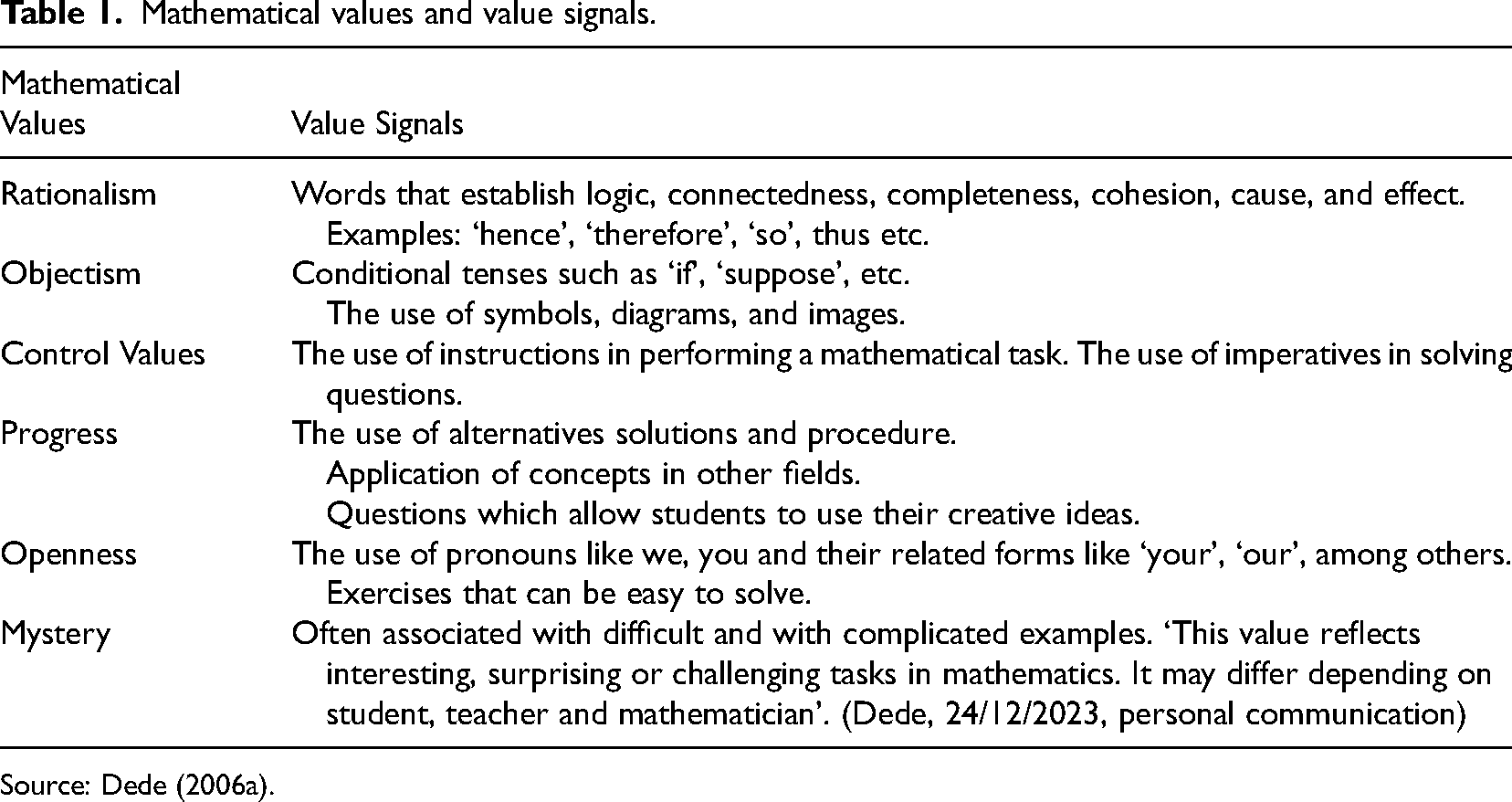
Mathematical values and value signals.
Source: Dede (2006a).
Mathematics educational values and value signals.
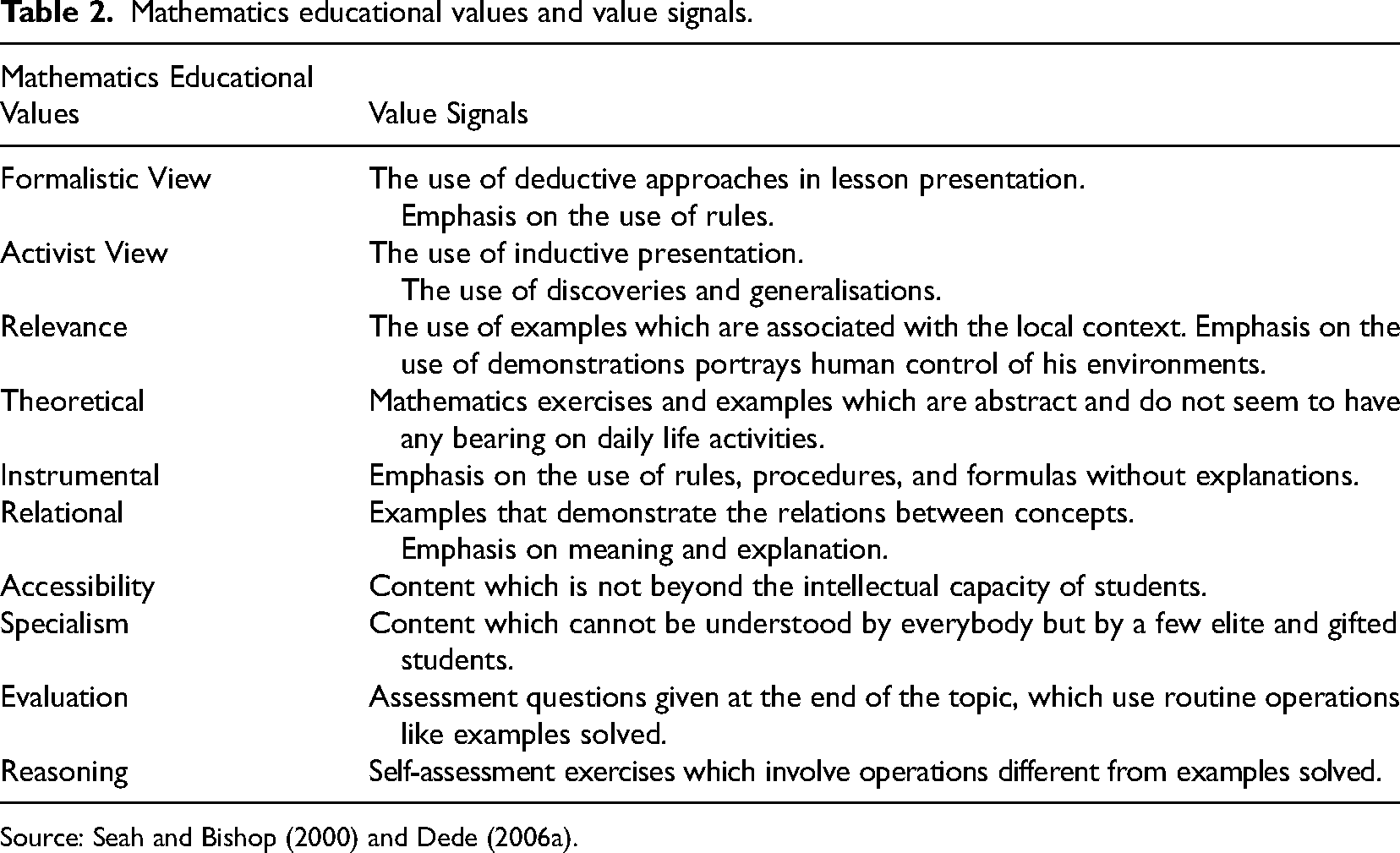
Source: Seah and Bishop (2000) and Dede (2006a).
Research design
Phenomenological study design was used to explore the values implicit in the mathematics textbooks. Leedy and Ormrod (2016) argue that phenomenological study aims at obtaining a deeper understanding of a particular phenomenon. The approach is qualitative-based, with content analysis being a major part of this design. The literature suggests that content analysis may form an integral part of data analysis in a phenomenological study (Leedy & Ormrod, 2016). This design was adopted since the study sought to explore a phenomenon; that is, the values implicit in the best-selling Ghanaian SHS 1 Core Mathematics textbooks and how they are conveyed by analyzing the content of the textbooks.
Population and sample
All SHS 1 mathematics textbooks formed the population of textbooks. However, the top four popular/best-selling textbooks at the time of research were purposely sampled. The information on the popular books was obtained from a website (https://www.schoolmallgh.com/shop/school-textbooks/shs/all-textbooks-shs) that tracks the sale of textbooks. These textbooks were sampled premised on the fact that their higher patronage implied they had greater influence on the knowledge and general world view of students in mathematics. Pseudonyms were used to represent these textbooks as BK 1A, BK 1B, BK 1C and BK 1D, respectively.
The research instrument
The authors drew on the works of Seah and Bishop (2000) and Dede (2006a) to develop a checklist and used it to explore values implicit in mathematics textbooks. The checklist consisted of four columns, with the following headings: Values, Descriptions, Types of Activities, and Value signals. The value column showed the type of values to be explored. Descriptions were also given on the values to be explored in the second column. Types of activities which were signaled by these values were contained in column three, while the last column provided details on how these values were signaled. The instrument was pre-tested to ensure that it elicited valid response. The checklist was given to four experienced mathematics educators who were conversant with the discourse around values in mathematics and mathematics teaching to use it to evaluate the values implicit in a mathematics textbook that did not form part of the grade level textbooks that were used in the main study. Through the process, a few portions of the checklist that needed to be made clearer to the users of the instrument were clarified. For example, in order to clarify signaling of connectedness under Rationalism value, the use of ‘therefore’ in the textbooks was agreed to be included in the counts under this value because the literature positions ‘therefore’ as a logical connector, that relates to the Rationalism value (Dede, 2006a).
Data collection and analysis
The four raters who were involved in pretesting the instrument participated in the main study because they had had experience using the instrument. The raters read each of the four best-selling textbooks, agreed on the values conveyed in each of the textbooks, and recorded their observations as one report. Semantic content analysis was used to explore values conveyed in each of the four best-selling Ghanaian SHS 1 Core Mathematics textbooks. The value signals in the checklist aided in analyzing the various contents of the textbooks sampled. The various values were identified and counted as and when they appeared in the illustrative examples and exercises in the textbooks. In order to keep the paper within the word limit of the journal, the main ways in which values were signaled have been summarised and reported. Each of the textbooks covered 12 topics based on the SHS1 curriculum in Ghana. A particular value was explored for all the 12 topics in all the four best-selling Ghanaian SHS 1 Core Mathematics textbooks before moving to the next value until all the values were fully explored. Case 1 shows an example of how values were identified.
Case 1
Given that
P (3 + an) = a − n (clear the bracket)
3P + anP = a − n (group terms with a)
3P + n = a − anP (factorise a) … (BK 1B, Page 56)
With the example in Case 1, Control values, for instance, are signaled through the use of imperatives and structured instructions. Therefore, in the above example, the number of times the value is signaled was counted as 5; that is; ‘cross multiply’, ‘clear the bracket’, ‘group terms with a’, ‘factorise a’, ‘divide both sides by 1 − np’, which were structured instructions in solving the question. These procedures were followed for other examples, illustrations, and exercises until all the mathematical values and mathematics educational values were fully explored. Value counts for all the values were then compared with their complementary pairs of values to determine whether there was a balance in the number of times they were conveyed. Table 3 presents the various values and their complementary pairs under mathematical and mathematics educational values.
Complementary pairs of values in mathematics.
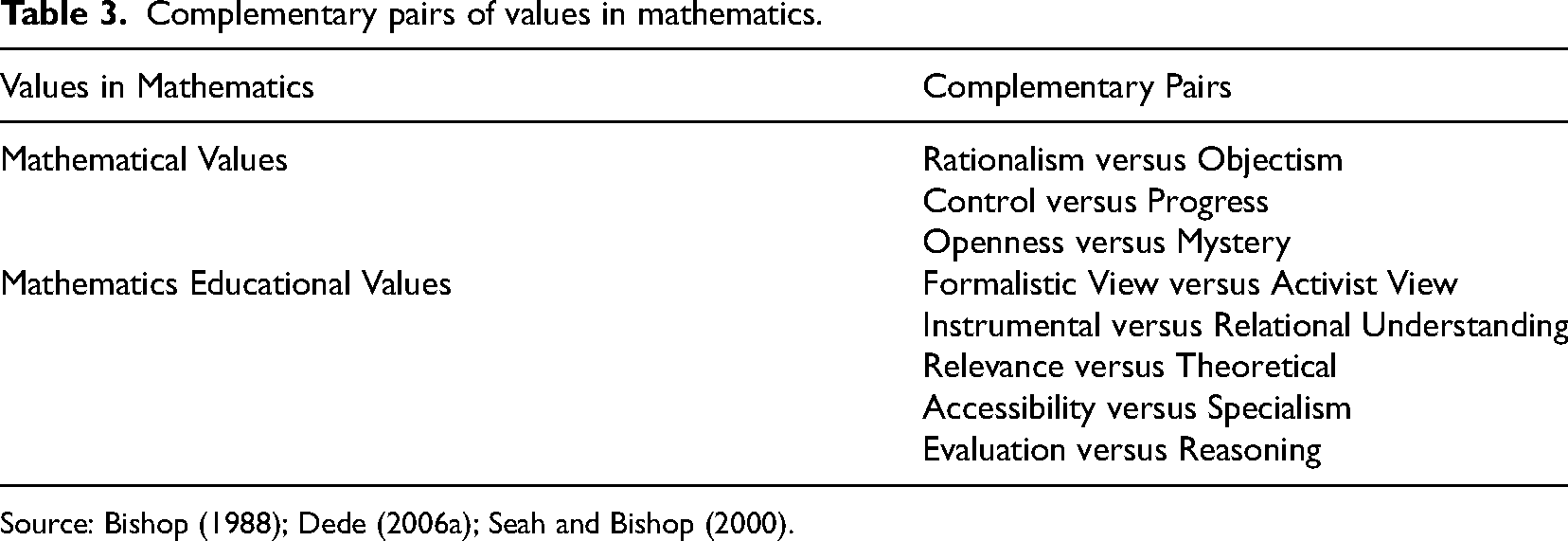
Complementary pairs of values in mathematics.
Source: Bishop (1988); Dede (2006a); Seah and Bishop (2000).
How each of these values was conveyed has also been presented, using excerpts from the textbooks. These excerpts are presented as ‘Cases’ and, hence, Case 2, Case 3 and Case 4 represent illustrative examples 2, 3 and 4.
In this section, the mathematical values and mathematics educational values and how they manifested in the four best-selling Ghanaian SHS 1 Core Mathematics textbooks are presented.
Mathematical values conveyed in textbooks 1A, 1B, 1C and 1D
Appendix A presents the total value counts for the various values as conveyed in all the four best- selling SHS 1 Core Mathematics textbooks. For all the textbooks explored, it was observed that a total of 25049 mathematical values were conveyed. This was made up of 8577 from BK 1A, 5759 from BK 1B, 7205 from BK 1C, and 3508 from BK 1D. This implies that BK 1A and BK 1D conveyed the most and least mathematical values, respectively.
The number of times a particular value was signaled in a textbook was different, depending on the textbook used. Generally, the values of Rationalism (688), Objectism (4024), Control (1823), Openness (1592), and Mystery (204) were conveyed in BK 1A more than in any other textbook, except for the value of Progress (271) which was conveyed in BK 1B more than any other value. The high frequency of most of these values in BK1A as compared to the others suggests that it is the main source of conveyance of these values through textbooks to students in Ghanaian senior high schools. This book was the most popular at the time of data collection (i.e., according to the website that tracks the sale of textbooks in Ghana), implying that it also contributes in conveying these values to many students as compared to the other books.
The total value counts for Rationalism, Objectism, Control, Progress, Openness and Mystery were 1887, 12704, 4725, 749, 4431 and 478, respectively. The objectism value was conveyed in each of the four textbooks more than any other value. Objectism conveyed (87%) and Rationalism conveyed 13% of total values on the ‘Rationalism – Objectism’ continuum, Control (86%) and Progress (14%) on the ‘Control – Progress’ continuum. Mystery (10%) and Openness (90%). Putting all the four textbooks together, we found that the value of Objectism (12704) was signaled more than the value of Rationalism (1880), Control (4750) was signaled more than the value of Progress (749) while Openness (4431) was emphasized more than the value of Mystery (478) (see Appendix A).
It was also observed that, even though all the four books signaled more Objectism – Rationalism values, differences existed in which of the complementary values was least conveyed. BK 1A–C conveyed less of Mystery – Openness values, while BK 1D conveyed less of Control-Progress value (see Appendix A).
How mathematical values were conveyed in textbooks 1A, 1B, 1C and 1D
How mathematical values were conveyed in the various textbooks sampled are presented in this section under the various complementary pairs, using excerpts from illustrative examples and exercises from the textbooks.
Objectism – rationalism continuum
Under this continuum, logical connectors in the form of subordinating conjunctions such as ‘therefore’, ‘hence’, ‘since’, among others which establish cause - and – effects, were seen to be the main means through which Rationalism value was conveyed in the four best-selling textbooks. Other subordinating conjunctions such as ‘because of’, ‘that is’, ‘it means’ among others which seek to explain concepts and ensure cohesion and completeness were also seen as means through which Rationalism values were conveyed in the textbooks considered. The use of mathematical symbols dominated how Objectism values were conveyed. Even though other signals such as the use of objects, charts, diagrams, and images were also identified as the means through which the values of Objectism were conveyed, symbols such as +, −, >, =, <, and ∴ were heavily utilised. This was evident in Case 2 where +, −, and =, were utilised.
Case 2
The average of five numbers 4, 10, 24, x, and 16 is 13. Find the value of x
Since the average of the five numbers is 13, the sum of the five numbers is 15 × 13 = 65
Therefore, 4 + 10 + 24 + x + 16 = 65
54 + x = 65
x = 11. (BK 1A, p. 349)
From Case 2, it could be seen that the value of Rationalism was emphasized, using subordinating conjunctions ‘since’ and ‘therefore’ which establish cause-and-effect relationship. These conjunctions also establish meaning and create logic in mathematical arguments. In Case 2, the subordinate conjunction ‘since’ was used to establish the reason why the sum of the five numbers is 45. ‘Therefore’, which is a conjunctive adverb, helps to transition to the next step of presenting the solution. It does so by establishing the cause-and-effect relationship. That is, since the sum of the five numbers is 65, then 4 + 10 + 24 + x + 16 = 65. So, in effect, the value of x = 11. mathematical symbols such as =, + and − were heavily utilised as they conveyed Objectism values.
Control-progress continuum
The use of imperatives like ‘solve’ and ‘find’ as well as the use of step-by-step instructions also served as the main means the value of Control was conveyed in BKs 1 A – D, as demonstrated in Case 3.
Case 3
Solve the value for x in
5x − 3 = 3x + 7
5x − 3 = 3x + 7
To get rid of 3x, subtract 3x from both sides.
i.e., 5x − 3−3x = 3x + 7 − 3x
2x − 3 = 7
To get rid of −3, add 3 to both sides
i.e., 2x − 3 + 3 = 7 + 3… (BK 1A, p. 250)
In Case 3, it was observed that BK 1A used the imperative ‘solve’ as well as structured instructions. This also reflects how Control was conveyed in the other books considered.
For Progress value, verbs such as ‘how’, ‘prove/show’ and ‘verify’ were the main ways the value of Progress was signaled, as evident in Case 4a. Other ways in which Progress value was signaled included the use of alternative solutions and procedures (see Case 4b, for example) and application of concepts to other fields (see Case 4c, for example). In Case 4a, one needs to prove or determine which of the relations given is a one-to-one function. This could be done if knowledge of the differences between a relation and a function is already known. The ability to link existing knowledge to new situations characterises the Progress value. This was also evident in Case 4c in which under the topic ‘Formulas, Linear Equations, and Inequalities – Change of Subject’, the equation for the total mechanical energy was used. This linked the topic ‘change of subject’, which is supposed to be a mathematics topic in Physics. It exemplifies the application of the concepts to other academic disciplines, which signals Progress value.
In Case 4b, it could be seen that the textbook used two approaches to solve the task. The first approach involved looking at the relationship between an exterior angle and its adjacent interior angle, which sums up to 180°. Therefore, if an exterior angle is given as 72° then each of the interior angles becomes 180° − 72° = 108°. Hence the sum of the interior angles of a pentagon (a polygon with 5 sides) becomes 108° × 5 = 540°.
The second approach involved the use of the general formula for finding the sum of interior angles of a regular polygon, which is (n − 2) × 180°, where ‘n’ is the number of sides. Since a pentagon has 5 sides, then the sum of its interior angles is: (5 − 2) × 180° = 540°. The use of an alternative solution as shown in Case 4b also exemplifies how Progress value was signaled.
Case 4a
A function g: x → x2 + 1 is defined on the domain{−1, 0, 1, 2}. Use arrow diagram to show whether or not g is one-to-one. BK 1A, p.150
Case 4b
The exterior angle of a regular pentagon is 72°. Find the sum of its interior angles.
If the exterior angles is 72°, then the interior angle = 180°−72° = 108°.
A regular Pentagon has 5 sides . The sum of the interior angles of the pentagon = 5 × 10⁸° = 540°
The sum of interior angles = (5 − 2) × 180°
= 3 × 180° = 540° (BK 1A p. 222)
Case 4c
The total Mechanical energy (E joules) of a given particle of mass m kg moving at a speed v m/s is given as E = V + (1/2)mv2, where V joules is its potential energy. Make v the subject of this formula. Find the speed of a particles of mass 3 kg when its potential energy is 100 joules and its total mechanical energy is 250 joules (BK 1A, p. 246).
Mystery – openness continuum
The value of mystery was conveyed in the textbooks, using examples that might be comparatively difficult and might not be the same or similar to what was already contained in the mathematics textbook. The value of mystery was also conveyed through illustrations and exercises that present mystery and surprises. Case 5 provides an example of how the value of mystery was conveyed.
Case 5
A cyclist starts a journey from Town A. He rides 10 km north, then 5 km east and finally 10 km on a bearing of N45°E
How far east is the cyclist's destination from Town A? How far north is the cyclist's destination from Town A? Find the distance and bearing of the cyclist's destination from town A. Correct your answer to the nearest km and degrees (BK 1A, p. 296).
In Case 5, since this question may not be the same or similar to what is already contained in the illustrations and examples used; it may present some form of confusion and opaqueness in unravelling how to go around the situation. The often-shady nature of mathematics portrays the Mystery value.
The value of openness sought to establish that mathematics truth is open to critical examination and scrutiny. This is mostly to validate mathematical facts. This value was conveyed in the textbooks often through mathematics activities that were generally easy for students to solve. The use of pronouns like ‘we’, ‘you’, ‘us’, among others, which seek to confirm or validate mathematical truths, were also identified to signal the value of Openness. Case 6 illustrates an example of how the value of Openness was signaled.
Case 6
To arrange
So that we have… (BK 1A, p.61)
In Case 6, the use of ‘we’ and other pronouns creates the impression of awareness of an existing trait. So ‘we can’, ‘we have’, among others, signal the value of Openness.
Mathematics education values conveyed in textbooks 1A, 1B, 1C and ID
Mathematics educational values represent values implicit in pedagogies adopted in presenting mathematics ideas. Seah and Bishop (2000) present these values under five complementary pairs of values as Formalistic view-Activist view, Instrumental- Relational understanding, Relevance- Theoretical knowledge, Accessibility-Specialism value, and Evaluation-Reasoning values. These values were explored in all the textbooks. In exploring Mathematics Education values, the number of times a value signal is conveyed is counted until each of the textbooks has been fully explored. An illustrative example of how the mathematics education values were estimated is provided in Case 7.
Case 7
In the illustration in Case 7, the book just gave the axioms without any systematic proofs. Therefore, to compute, for example ‘discount allowed’, you merely have to put in the values. This depicts how formalistic values are conveyed. The number of times these are conveyed is counted; in this case, this value is conveyed 3 times.
The Mathematics Education value counts for the four textbooks are presented in Appendix B. The grand totals of the values for the four textbooks (BKs 1 A – D) showed that the total value counts for Formalistic View, Relevance Knowledge, Instrumental Understanding, Accessibility and Evaluation were 2582, 1739, 3364, 4495 and 3907, respectively, while their complementary pairs of Activist view, Theoretical knowledge, Relational Understanding, Specialism and Reasoning were 1138, 3717, 1051, 651 and 332, respectively. This gives a total of 22976 mathematics educational values conveyed in all the four textbooks. Out of this total, 9481 were conveyed in BK 1A, 5819 in BK 1B, 6135 in BK 1C and 1541 in BK 1D. In all the four textbooks, it was observed that Formalistic View, Activist View, Theoretical knowledge, Instrumental Understanding, Relational Understanding, Specialism, Accessibility, Evaluation and Reasoning were conveyed in BK 1A more than in any of the other books. However, in BK 1C, Relevance Value was conveyed more than in any of the other books. Reasoning Value was the least conveyed value in all the books.
The textbooks showed some differences with respect to which of the complementary pairs of values was conveyed the most or least. For example, BK 1A conveyed more Evaluation – Reasoning values and less Formalistic-Activist values, as compared to BK 1B which conveyed more Relevance – Theoretical knowledge and less of Evaluation – Reasoning values. BK 1C conveyed more Relevance- Theoretical values just as BK 1B but less Formalistic – Activist view. The Formalistic and Activist value which was least conveyed in BK 1C, was rather conveyed the most in BK 1D, while the complementary pair Instrumental – Relational understanding was conveyed the least in BK 1D.
How mathematics educational values were conveyed in textbooks 1A, 1B, 1C and 1D
In this section, how the mathematics educational values were conveyed in each of the textbooks are presented, using excerpts of examples, exercises or illustration from the textbooks to support major arguments.
Formalistic-activist view
Formalistic view was conveyed in the mathematics textbooks, mainly using deductive and receptive methods, as evident in Case 8. Teachers who hold the Formalistic view teach through the programmed instructions for students to acquire certain concepts (Dormolen, 1986), as demonstrated in Case 8.
Case 8
Find the image of −4 under the mapping ƒ: x →
To find the image of a number when the rule for the mapping is given, substitute the number into the rule
−4 →
−4 → −4 ∴ the image of −4 is −4 (BK 1B, p.157).
Activities that invoked intuitiveness, as shown in Case 9, for example, helped in generalising by deducing the general rule or formula for the pattern. Such activities reflected how the majority of the textbooks conveyed the Activist view.
Case 9
Finding the sum of interior angles of a regular polygon (BK 1A, p. 217)
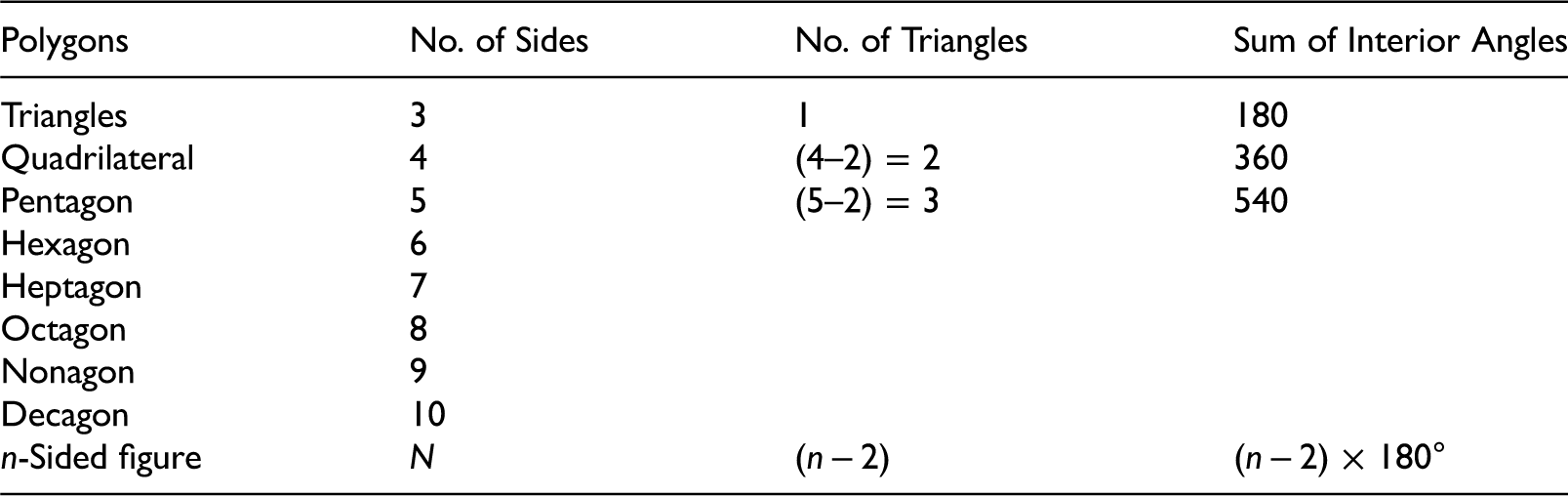
As can be seen from Case 9, the textbook provides an explorative means of identifying patterns before generalisation is made. That is, after identifying that the number of triangles is two less than the number of sides, and identifying that the sum of interior angles of a triangle is 180°, one can then generalise that the sum of the interior angles of a regular polygon of n sides is given as (n − 2) × 180°.
Relevance – theoretical knowledge
Mathematics activities which drew the attention of students to the link between school and out of school signaled how the values of Relevant Knowledge was conveyed, as observed in Case 10, while activities that are devoid of societal context, as in Case 11, signaled how Theoretical knowledge was conveyed.
Case 10
A man invests a sum of money at 4% per annum simple interest. After 3 years, the principal amounts to Gh₵ 7000. Find the sum invested (BK 1D, p. 328).
Case 11
Decrease 150 by 20% (BK 1B, p. 416)
Relational understanding – instrumental understanding
Mathematics activities that are tailored to link relevant schema of students reflected Relational learning value, as evident in Case 12. In this case, Pythagoras theorem is applied in a real-life activity, where a ladder is used to help students to learn mathematics in context.
Case 12
A ladder leans a vertical wall of height of height 12 m. If the foot of the ladder is 5 m away from the wall, calculate the length of the ladder (BK 1A, p. 206).
Mathematics activities that teach rules and how rules must be applied, as shown in Case 13, signaled the Instrumental Learning values.
Case 13
We can only add or subtract surds which are alike or have the same form.
Note: reduce first to their basic forms, if they are not
It is evident from Case 9 that rules and how they must be applied are emphasized; thereby reflecting Instrumental understanding. These were some of the examples of how instrumental and relational understanding values were conveyed in Books 1A–D.
Accessibility-specialism
The Accessibility and Specialism continuum from the accounts of Dede (2006a) as well as Seah and Bishop (2000) talks about whether mathematics activities in the classroom can be performed by everyone or for some ‘elite’ group who have knowledge in it. Specialism values are, therefore, portrayed in textbooks through examples, illustrations and exercises which could only be done by some gifted students, given the level of the students. The mathematics activities that almost every student can do as they have had engagements convey the value of Accessibility. The textbooks conveyed the Accessibility value through mathematics activities which were quite easy to perform, looking at the grade level of the students. Case 14 reflects the value of Accessibility, while Case 15 reflects the value of specialism.
Case 14
Find the truth set of the following equation.
4x = 12 (ii) 3x + 7 = 22 (BK 1D, p. 30) If
Case 15
A motorist travelled 40 km at an average speed of 30 km/h. If he made the return journey at an average speed of 50 km/h, find the average speed of the whole journey (BK 1A, p. 395).
In Case 14, it is expected that the average students should be able to solve them by making x the subject of the questions. However, in Case 15, the student is expected to decode the mathematics from the context being described, formulate the appropriate equations, and solve it. Specialised vocabulary or the mathematics register like ‘average’ and ‘speed’ must be known by the student in order to solve the problem. Seah and Bishop (2000) argued that the nature of mathematics remains mysterious and, hence, mathematics knowledge may not be easily accessible to everyone but to a special group of people. This task relates to Mechanics, which portrays the value of specialism.
Evaluation-reasoning
Evaluation value relates to routine exercise that accompanies teaching and learning, while Reasoning value relates to problem-solving that requires the students to exhibit some creativity and critical thinking in solving mathematics task (Dede, 2006a). Analysis of the mathematics textbooks revealed that self-assessment questions that used routine operations similar to the ones conveyed in illustrations and examples, conveyed the value of Evaluation. On the other hand, mathematics activities that required students to exhibit deeper thinking and creativity beyond the examples and illustrations in the textbook signaled the Reasoning value. Typical examples of activities in the textbooks that signaled the Evaluation-Reasoning pair of Mathematics Education value are presented in Cases 16 and 17.
Case 16
Find the truth set of the following.
x + 3 > 5 7x + 15 < x + 3 (BK 1C, p. 59).
Case 17
Two men start from towns 20 km apart and walk towards each other.
They meet in 120 minutes. One walks at 6 km/h. How fast does the other man walk? (BK 1A, p. 282).
In Case 16, the use of routine symbols, as conveyed in the textbooks, makes it easier to solve the task and students may not necessarily resort to the power of reason. That is not, however, the situation in Case 17, as students need to engage in some level of deep thinking before they can solve the questions. Case 16 reflects Evaluation value while Case 17 reflects Reasoning value.
Discussion
The objectism value dominated the values explored in the four best-selling mathematics textbooks. This was evident in the use of symbols like +, −, ×, =, as was seen in Case 2. The total value count for Objectism was 12704, which represented 50.7% of the total mathematical values (25046) explored in all the textbooks. The values of Control (4750) and Openness (4431) followed in that order, as they represented 18% and 17.69% of total mathematical values conveyed. The value of Mystery was least conveyed as they represented 1.9% of the total Mathematics values conveyed. This suggests that, generally, the textbooks emphasized Objectism and Control and Openness values as compared to their complementary pairs of Rationalism, Progress and Mystery, respectively.
The way values related to mathematics and mathematics learning are presented in these popularly adopted textbooks shows a rather unjustifiable manner of presenting mathematics knowledge. Logical structures appear not to be fully utilised to make meaningful connection of concepts. This presents a situation where there may not be enough bases to see the connectedness, cohesion, and completeness of a particular mathematical idea. With emphasis on Control as against Progress, the mathematics textbooks used several imperatives and systematic instructions as against the use of mathematics proofs, as evident in Case 3. Mathematics ideas were presented in a way that did not engage students’ critical thinking, problem solving and problem posing (Singer et al., 2015). The books did not adequately promote inquiry as problem solving questions were not fully deployed. It is, therefore, not surprising that the value of Mystery was less emphasized.
Even though the values emphasized in BK 1 A-D were in line with the work of Seah and Bishop (2000), they were not conveyed exactly in the same manner. For example, while the Activist view from the account of Seah and Bishop (2000) was presented by linking mathematical knowledge to various historical experiences in the Singaporean textbooks, BK 1A-D conveyed the Activist view mainly using mathematics activities, which helps students to explore and discover patterns and generalise them.
The findings of this study appear to differ from earlier studies in some respects. For example, while the values of Objectism and Openness were emphasized more than their complementary values of Rationalism and Mystery, respectively, the finding of Seah and Bishop (2000) revealed that Rationalism and Mystery values were emphasized as against their complementary values. Again, Dede's (2006a) study revealed that the value of Rationalism was emphasized more than its complementary value of Objectism, while the findings of this study revealed that Objectism was emphasized more than its complement, Rationalism value. This appears to support the observation in the literature that values are socioculturally driven (Davis et al., 2019; Dede, 2019), and/or that their relative emphases in textbooks have evolved over the last two decades.
The textbooks conveyed more Formalist view than the Activist view. The use of deductive logic dominated the Formalistic-Activist continuum. Valuing of Formalistic view more than the Activist view suggests that the books presented mathematics ideas in ways that could discourage inductive reasoning. Rather the use of approaches that promoted deductive reasoning such as formal axioms which students are to fix in values to get their preferred result were prevalent. Theoretical value was conveyed 3717 times, representing 16% of the total value counts for mathematics educational values and 70% on the Relevance–Theoretical knowledge continuum. This is not surprising to the authors, given that Theoretical Knowledge was valued more than Relevance in the textbook. This could be linked to the over-emphasis on Objectism and Control values observed in the mathematical values. This suggests that mathematics is not likely to be presented as a fun activity that is linked to the sociocultural context of students. Results from a recent study in Ghana have shown that students and teachers appear to value fun lower than other attributes associated with mathematics teaching and learning (Davis & Abass, 2023).
Students may not see the Relevance of mathematical knowledge presented in their textbook to their sociocultural context because they are mostly devoid of such context, as evident in Case 11. When mathematics is seen to be relevant in the daily life of students as evident in Case 10, mathematics learning becomes relevant to students. It was, therefore, not surprising that the books emphasized Instrumental understanding (3364) and less of Relational understanding (1051). Solved textbook examples were seen to be largely routine and did not prepare students adequately to solve high cognitively demanding task in mathematics. The values of Accessibility -Specialism were conveyed 4495 and 651 times, respectively. This was not surprising to the authors since the textbooks explored were Core Mathematics textbooks that were meant to give students the general mathematical knowledge they need to progress academically through the high school level to the University level, unlike the specialism characterised by narrow but high depth of the Elective or Pure mathematics textbooks. It was also not surprising that Evaluation (3907) was conveyed more than the value of Reasoning (332). This could also be due to the assumption that Core Mathematics is not for those who aim to pursue mathematics-related disciplines; thereby, keeping the cognitive demands low by emphasizing routine exercise (Evaluation), rather than high cognitively demanding tasks involving critical thinking, conjecturing, and problem-solving. This presents an imbalance in the way the textbooks presented various mathematics values. Considering the role of mathematics in the development of students’ critical thinking, problem posing and problem-solving skills, these complementary pairs of values should be given equal attention in all mathematics books.
As with the findings of previous studies on Mathematics Education values (Dede, 2006a; Seah & Bishop, 2000), the findings from this study also highlighted the Formalistic view, Theoretical understanding, Instrumental learning/understanding, and Evaluation values. However, findings on Accessibility and Specialism continuum from this study differed from what was found in the earlier studies by Seah and Bishop (2000) in their analysis of lower secondary mathematics textbooks in Australia and Singapore. Seah and Bishop (2000) found emphasis on Specialism in both Australian (Victorian) and Singaporean textbooks. This appears to support the earlier argument that values are socioculturally driven (Davis et al., 2019; Dede, 2019).
The observation of the four mathematics textbooks showing some differences with respect to which of the complementary pair of both mathematics values and mathematics Education values were conveyed appears to suggest that apart from the fact that values are socioculturally driven (Davis et al., 2019; Seah, 2019), values in mathematics and its teaching implicit in mathematics textbooks could be informed by attributes of mathematics and its teaching that textbook authors find important. Textbook authors who do not value the mysticism associated with mathematics and the fact that mathematical truth could always to proven to make it open are not likely to give students’ enough mathematical experiences which present puzzling situations and proofs of such situations, as was found in Books 1A, 1B and 1C. All the three textbooks were found to have lower representations of sociological values involving Mystery and Openness.
Conclusion and implication
The three pairs of mathematical values, as proposed by Bishop (1988), were emphasized in the four best-selling textbooks at varying levels. The values of Objectism, Control and Openness were emphasized more than their complementary pair of Rationalism, Progress and Mystery, respectively. Objectism values were dominant in all the textbooks and these were mainly conveyed through the use of mathematical symbols such as +, −. . Abstract mathematical ideas were presented without using enough logical structures to help establish meaning, connectedness, and reasons they make due to less emphasis on Rationalism as compared to Objectism. Best-selling Book 1A appeared to emphasize mathematical values as compared to the others. However, each of the books emphasized different values. These findings have implications for curriculum development in mathematics. The values projected in the revised mathematics curriculum, for example, do not reflect mathematical values at all (NaCCA, 2020). They reflect general education values, since textbooks are informed by the mathematics curriculum, there is the need to revisit the values projected in the mathematics curriculum to ensure that they reflect mathematical values so that textbook writers will be guided by mathematical values rather than general educational values. The literature suggests that values in mathematics provide the drive for mathematics learning (Seah & Anderson, 2015). Hence, the projection of the right values in mathematics in the mathematics curriculum and textbooks will provide the necessary drive to position students as lifelong learners in mathematics.
The findings from the study also have implications for both pre-service and in-service training. As highlighted in Davis and Chaiklin (2015), socio-cultural sociocultural issues continue to remain a missing ingredient in mathematics teacher preparation. Values education should form part of Mathematics teacher education at all levels in order to prepare curriculum leaders who will be able to develop value driven curriculum that will help train the twenty-first century mathematics learner. Varying emphases on values in the different books also have implications for practice. For students to obtain the full benefit of mathematics learning, teachers would have to use different books rather only one book. This will enable students to acquire all the relevant mathematical values across the various books and benefit from mathematics teaching and learning.
Mathematics educational values explored from the textbooks also emphasized Formalist view, Theoretical Knowledge, Instrumental understanding, Accessibility and Evaluation as against their complementary pairs of Activist view, Relevance Knowledge, Relational understanding, Specialism and Reasoning, respectively. Presenting concepts without providing students the opportunity to reason inductively were common in the mathematics textbooks. This finding has implications both for mathematics curriculum development and mathematics pedagogy. Mathematics curriculum should also emphasize all the Mathematics education values. These complementary pairs of values in their right portions form the basis of high quality mathematics pedagogy and should be emphasized in the curriculum at all levels to influence the development of textbooks and other curriculum materials in mathematics such as teachers and learners guides. Pre-service programmes should expose potential mathematics educators and curriculum developers to these values, while in-service programmes should build/strengthen the capacity of curriculum developers and textbook authors to draw on the mathematics education values to present mathematics in ways that will engage students in high quality mathematical thinking.
Mathematical values and mathematics education values were conveyed in varied proportions in each of the four sampled books. The implication is that students will benefit from using an array of mathematics books rather than the use of only one book. Values that may be deficient in one book may be prevalent in other books. That will enable the students to be exposed to all the necessary mathematical values and mathematics educational values that will position them as lifelong learners in mathematics.
Limitations and future study
The study was limited to only the best-selling textbooks, hence the findings may not reflect the situation for all textbooks. In order to obtain a more comprehensive picture, the least selling books and some of the unapproved books being used as supplementary materials can be subjected to a similar analysis to ascertain the values in mathematics and mathematics education that they convey. Again, the main ways in which value signals under each of the pairs of mathematical values and mathematics educational values portrayed were summarised and presented in order to keep the paper within a reasonable length. Frequency on each of the value signals for all the value signals was, not presented separately in the results of the research, future studies could, therefore, pay attention to that. There is also the need for future research to investigate why textbooks that were developed based on the same curriculum projected different mathematical values and mathematics education values. There is, therefore, the need to explore the relationship between values projected in the curriculum and the various textbooks to ascertain how they align. Future studies can also look at the situation at other school levels.
Footnotes
Contributorship
Both Nicholas Essien and Ernest Kofi Davis contributed to the whole process of the development of the paper, namely conceptualisation of the study, review of related literature, development of the methods, data collection and analysis, and writing of the whole manuscript. However, Ernest Kofi Davis provided guidance/leadership for the research project. Both authors read and approved the manuscript.
Declaration of conflicting interests
The authors declared no potential conflicts of interest with respect to the research, authorship and/or publication of this article.
Funding
The authors received no financial support for the research, authorship and/or publication of this article
