




Abstract
This research explores the type of conceptual difficulties that female Saudi students encounter in Introductory Algebra courses at college level and identifies pedagogical practices that might impact students’ learning of algebra. Instructional tasks were designed and implemented for 12 weeks to collect and analyze data. The research sample consisted of a study group of 28 students from an Introductory Algebra class. The findings identified and classified the types of difficulties that the students encountered and suggested instructional models to overcome or minimize them and a theme to teach and learn algebra.
Introduction
Introductory Algebra course is one of the Preparation Program courses at Prince Mohammed Bin Fahd University (PMU); a private university in the eastern province in the Kingdom of Saudi Arabia (KSA). The course is designed to teach the students basic algebraic skills and concepts, such as evaluating and simplifying expressions, solving linear and quadratic equations, exponents, proportions, and radicals. Successful completion of the course is a prerequisite to enrollment into the intermediate algebra or pre-calculus courses. In PMU, there is a significant number of English Language Learners (ELL) with varying levels of proficiency in spoken and written English while Introductory Algebra course in is planned to be delivered in the English language.
English language holds significant importance in Saudi Arabia (KSA) due to its role as a form of social capital in international business communication, contributing to the economic development of the country (Mahboob & Elyas, 2014). To enhance linguistic capital and the language skills of Saudi students, there is a growing emphasis on integrating English language teaching into the formal education system (Alharbi, 2015). This is in line with the recognition that improving proficiency in English is crucial for operating in a globalized world, as highlighted by Graddol (2006).
Additionally, the teaching approach used by the majority of instructors in Saudi Arabia as well as in PMU is primarily the conventional teacher-centered (Moores-Abdool et al., 2009) where rote learning is emphasized over creative thinking (Krieger, 2007). Thus, Saudi students like other ELL learners are challenged simultaneously: “learning a new language while learning new academic content” (Carrier, 2005, p. 6).
As an instructor in the female campus (coeducation at college level is prohibited in KSA), the researcher observed that some Saudi female students were encountering conceptual and linguistic difficulties in algebra classroom. Despite these difficulties, students are required to learn algebra as it plays an important role in their future academic and career success as well as the extent that it is commonly called the gatekeeper subject (Smith & Thompson, 2008). To overcome these difficulties, researchers suggest teaching approaches that focus simultaneously on language and content, such as content and language integrated learning (CLIL) (Akbarov et al., 2018; Eltoum, 2021).
Content and language integrated learning is a dual-focused educational approach that promotes using an additional language for learning and teaching of language and content simultaneously (Coyle et al., 2010). It is also one of the most well-known approaches to education that seeks to integrate content and language learning. As per Nikula (2006), “CLIL needs to be understood as an umbrella term for divergent ways of implementation rather than referring to a specific model or a clearly defined teaching method” (p. 28).
The primary objective of this research is to identify and examine the conceptual challenges faced by female Saudi students in the process of learning algebra. There are few studies that identify the conceptual difficulties encountered by Saudi students at tertiary level while learning algebra. There is a clear need for more research to be conducted in KSA and focusing on more scientific studies in areas, such as students’ difficulties, misconceptions, and attitudes in learning algebra in the Saudi context (Borg & Alshumaimeri, 2012). The findings of the research will be used to suggest pedagogical practices that could support Saudi students in developing algebraic understanding as general principles for learning. Therefore, this research might be of value to worldwide educational institutions with similar contextual settings. Through this, the research will contribute to research in the field of algebra (i.e., algebra learning and teaching) and knowledge construction.
Background and the nature of the discipline
Reviewing the literature led to the conclusion that there are several diverse views that often identify different aspects of the concept and different understandings of the characteristics of algebra (Goos et al., 2020; Kaput, 2008). The attempts to answer Lee's (1997) interview question “What is algebra?,” which was presented to a cohort of mathematicians, have generated seven themes, including a school subject, generalized arithmetic, a tool, a language, a culture, a way of thinking, and an activity (Kieran, 2007). The theme that was agreed on by most of the interviewees was “algebra is an activity.” “Algebra emerges as an activity, something you do, and an area of action in almost all of the interviews” (Lee, 1997, p. 187). This theme was supported by Kieran (2022) who brought together most of the different perspectives by developing a model based on the perception of algebra as an activity.
When it comes to grasping the core principles of algebra, it is important to acknowledge that researchers’ perspectives and cognitive frameworks influence their comprehension of algebra, highlighting both areas of agreement and inconsistency. A prominent theme among researchers is the perception of algebra as a tool for expressing generalities (Bell, 1996).
2.1 Generalization, patterns, and algebraic symbolism
According to Harel and Tall (1991), generalization in mathematics refers to the application of a particular argument in a broader context. There are different forms of generalization that are not algebraic in nature, such as in the arithmetic generalizations of some patterns (Radford & Peirce, 2006). To construct algebraic generalizations of patterns, it is critical to understand and recognize patterns. As explained by Orton & Orton (1999), patterns represent recurring designs or sequences, and they involve organizing mathematical objects based on a shared rule. Deriving the common rule from a given pattern is a form of generalization. Patterns and generalizations are interconnected because patterns can express generalities in certain contexts.
Pattern generalizations are essential in algebra. Lee (1997) argues that “algebra, and indeed all of mathematics is about generalizing patterns” (p. 103). However, it is worth knowing that not all patterning activity results in algebraic thinking (Radford & Peirce, 2006). Therefore, instructors need to use the appropriate pedagogical strategies to help the students engage in algebraic generalizations and patterns (Kızıltoprak & Köse, 2017; Radford & Peirce, 2006).
Furthermore, some researchers consider algebraic symbols as a necessary component of algebraic thinking (Bolondi & Ferretti, 2021), while others view them as an outcome or as a communication tool (Zazkis & Liljedahl, 2002). Even though symbolism has special importance in algebra, symbols do not work alone to construct meaning. Instead, a semiotic system in which many elements (i.e., natural language, diagrams, and tables) work together constructs meaning in mathematics (Lemke, 2003). Therefore, it is this process of semiosis or meaning-making that is of crucial importance. Another important competence of algebra learning is the ability to use communication to express generalities (Dörfler, 1991). Algebraic reasoning (AR) is one of the methods used to express generalization.
2.2 Algebraic reasoning
According to Kaput and Blanton (2005), AR involves students generalizing mathematical concepts based on specific instances, supporting those generalizations through argumentation, and expressing them using more formal and developmentally appropriate methods. Algebraic reasoning, therefore, allows for describing patterns of relationships among quantities. This attribute of algebra distinguishes it from arithmetic, which focuses mainly on performing calculations with known quantities.
Watson (2009) emphasizes the importance of algebraic understanding when calculations fail and ad hoc methods, specific solutions that can't be generalized, can't be utilized. Algebraic thinking is essential in scenarios like solving equations with noninteger solutions and handling unknowns on both sides of an equation. Informal algebraic knowledge is crucial too for fostering comprehension of algebraic concepts (Kaput, 1999). All students, regardless of their algebraic background, possess and employ informal strategies to solve algebraic problems. In line with Hall et al. (1989), college undergraduates often turn to model-based reasoning rather than formal algebraic knowledge when tackling nonroutine algebra problems. Here, they typically draw on situational context from the problem to guide their approach to problem-solving.
Two of the common informal methods are the guess and check method and the unwind strategy. According to Johanning (2004), guess and check method involves selecting a value for an unknown quantity and testing it using relational reasoning. Students repeat this process until they achieve the desired outcome, adjusting their guesses based on previous results. On the other hand, the unwinding method employs inverse operations to reverse the quantitative constraints and isolate the unknown quantity (Kieran, 1992). Unwinding provides a natural entrée to inverse operations and equations balancing.
Informal strategies such as guess and check may hinder the learning of formal algebraic methods as they can deter students from understanding and developing AR. However, these informal methods also serve as a foundation for formal algebraic methods (Rojano, 1996). Some of the reasoning techniques that students at PMU were having difficulties with were related to functional thinking.
2.2.1 Functional thinking: recursive and explicit rules
Lannin et al. (2006) note that research highlights students’ use of diverse reasoning types, including recursive and explicit rules (p. 300). Recursive rules involve tracking changes between terms in dependent variables, while explicit rules employ index-to-term reasoning, linking independent and dependent variables. Explicit rules are straightforward, relying on input manipulation for output calculation. Encouraging students to engage with both recursive and explicit thinking, as per Lannin et al. (2006), fosters problem-solving flexibility. Additionally, students should generalize these rules by identifying overarching relationships between domain values.
Revisiting the notion of algebra as an activity of generalization, specifically regarding algebra as a generalization of arithmetic as seen by Usiskin (1999) leads to the second type of AR, a generalization of arithmetic.
2.2.2 Generalizing arithmetic
Algebra is largely perceived as a generalization of arithmetic. According to Grabiner (2010), Algebra extends beyond generalized arithmetic and encompasses notable differences in its approach. Arithmetic focuses on calculations with positive numbers and the four basic operations. In contrast, algebra utilizes letters, symbols, and/or characters to represent numbers and express mathematical relationships (Stacey & MacGregor, 1999).
Therefore, it is essential that students understand the differences between the two and make the shift from arithmetic to algebra. Watson (2009) stated that the nature of the shifts from arithmetic to algebra involves shifts in perception that are common in mathematics, such as moving from quantifying to relationships between quantities and from operations to structures of operations. Kieran (1992) suggested that there are difficulties students encounter in making the direct shift, such as:
Students must understand the operations and their inverses, which will allow them to use the “undo” method when solving algebraic problems instead of relying on multiplication facts and their knowledge of number bonds. The meaning of the equals sign in algebra differs from its meaning in arithmetic. In the former, it means “is equal to” or “is equivalent to,” while in the latter it means “calculate.” When numbers and letters are used together, the numbers must be treated as symbols in a structure and not evaluated (e.g., The structure
Furthermore, Watson (2009) provided a summary of what had to be learned to shift from arithmetic and algebra, such as the focus on relations and expressions, not calculations, understanding the meaning of operations and inverses, and representing general relations, which are manifested in situations. Clearly, this will have a significant impact on student academic literacy skills in Arabic as well as in English.
Regarding this study, challenges linked to the previously mentioned sources were noticeable and apparent in the students’ work. Additionally, the students were facing difficulties specifically related to algebraic equations and expressions.
2.3 Interpreting algebraic equations and expressions
Stacey and MacGregor (1999) propose that algebraic equations and expressions can be interpreted in two distinct ways: one is referred to as “procedural” or “operational,” and the other as “structural” or “conceptual.” Instrumental understanding is about knowing the rules without reason. It is more about “Tell me how to operate it; never mind how it works,” where relational understanding is about knowing how and why to do something. There is general agreement that the relations between conceptual and procedural knowledge are considered bidirectional, even though there are some differences in the way these two types of understanding are defined and assessed.
In their study, Stacey and MacGregor (1999) indicated that some students associate procedural thinking with arithmetic and conceptual thinking with algebra. For example,
The educational conceptual approach enhances student comprehension through the connections it draws between verbal descriptions, tables, graphs, and equations. Students must grasp that different representations can convey identical relationships, a foundation crucial for advanced problem-solving skills, enabling more adept handling of intricate tasks. Attaining such proficiency necessitates a principled understanding (Niemi, 1996). However, Pape and Tchoshanov (2001) observed that during representation creation or problem-solving, students tend to simplify abstraction levels. This trend signals an underdeveloped conceptual grasp. Glaser and Bassok (1989) posit that both conceptual and procedural knowledge are vital for solution development. Thus, a robust link exists between mathematical competence and conceptual/procedural abilities, crucial for learning and effective problem-solving.
The encounters that arise in the context of generalization, AR, and algebraic equations and expressions could potentially be the underlying causes of certain misconceptions experienced by students. Students often face challenges in learning algebra due to their flawed understanding of arithmetic concepts. Misconceptions developed during arithmetic learning can hinder their comprehension of new algebraic concepts and impede their conceptual growth in the subject.
2.4 Misconceptions
The most significant things that students bring to class are their conceptions (Lawson et al., 2019). According to Ausubel (2000), for meaningful learning to occur, the connection should be made between the new knowledge and the relevant existing concepts in the students’ cognitive structure. According to Lucariello et al. (2014), when students’ preinstructional knowledge aligns with the concepts being taught, it is considered “anchoring conceptions.” Conversely, if their preinstructional knowledge is erroneous and does not match the curriculum, it is labeled as “misconceptions.”
Additionally, Birenbaum et al. (1992) state that algebraic misconceptions hinder students’ algebraic success. When students have misconceptions, learning becomes challenging as their existing knowledge must be restructured, a process called conceptual change (Carey, 1985). To foster conceptual growth, it is crucial to address these misconceptions before introducing new concepts, enabling alignment between existing knowledge and new information. This contrasts with the more difficult process of replacing misconceptions through conceptual change, as highlighted by Lucariello et al. (2014).
Yet, Chinn and Brewer (1993) contend that conventional teaching methods fall short in achieving conceptual change, despite their effectiveness in promoting conceptual growth. To address this, Lucariello et al. (2014) propose instructional tactics such as enhancing metacognition and creating learning experiences that guide students in identifying and rectifying erroneous knowledge. Thus, educators benefit from recognizing prevalent algebraic errors, enabling them to create targeted strategies for rectifying misconceptions. Some strategies designed to facilitate conceptual change unfold in three phases: awareness, disequilibrium, and reformulation (Pines & West, 1986).
During the awareness phase, teachers employ experiments and discussions to analyze students’ thinking errors. They work on integrating new concepts into existing frameworks (Posner et al., 1982). The disequilibrium phase introduces anomalies to disrupt students’ frameworks, pushing them to identify inconsistencies (Pines & West, 1986). The teacher takes on an adversarial role, fostering critical thinking (CT). In the reformation phase, the focus shifts to conceptualization and resolving anomalies, culminating in an enhanced understanding of the subject.
To overcome these challenges or at least minimize their impact on students’ learning, instructors can resort to interactive teaching and learning approaches that provide students with opportunities to develop and refine their essential skills, such as CT, problem-solving, and language proficiency.
This research combines different types of data and methods of analysis through a process of triangulation. The triangulation of the data should lead to a credible understanding of the situation and enhance this research validity (Brady et al., 2004). A “concurrent triangulation design” (Creswell & Clark, 2007) where the collection and analysis of each type of data are independent of the other, and the outcomes of each type do not influence each other was utilized.
3.1 Participants and settings
The participants in this research were students in an Introductory Algebra class that the researcher instructs on the female campus. There was a total of 28 students in this class and all of them were informed of the research and invited to participate. All the participants signed consent of their willingness to participate in the research. Furthermore, an ethical approval was sought and received for this research project from a university ethics committee.
The participants were aged 18–28, but the majority (more than 60%) of the students were between 18 and 19 years old. Regarding the marital status, one of the students was married and the rest were singles. Thirty-nine percent of the students had taken the course before with an average of 3 times (range was 0–6). A pretest was given to the students at the beginning of the semester to evaluate their conceptual knowledge and linguistic proficiency (represented in their abilities to understand and answer test questions). Students’ grades were poor; 14.5 out of 30 was the highest and zero was the lowest score. Data about the participants were collected from a prequestionnaire 1 that was given to the students prior to the beginning of the research.
3.2 Methods and research instruments
The instruments to be used were designed by the researcher to gather the data. The research question was: What kinds of conceptual difficulties do female Saudi students in “University” encounter in learning Introductory Algebra?
The instruments used to collect data were documents (i.e., tests and exams [TE], homework [HW], classwork [CW], and instructional tasks [IT]) and researcher's field note (RFN) and students’ reflective notes (SRN).
3.3 Research plan
The research utilized a pedagogical model that was designed based on CLIL pedagogic approaches and it utilized a CLIL instructional model to teaching and learning algebra. The model was designed based on interactive teaching and learning methods, such as problem-based learning (PBL), cooperative learning (CL), and inquiry. The students were given opportunities to express their understanding and develop skills, such as CT and problem-solving through questioning and CL. Therefore, activities, such as the “Do Now,” which is a question that was assigned to students at the beginning of each class.
“Do Now” questions were used to introduce new concepts (i.e., hooks to raise the students’ curiosity about the new topic). Similarly, “Ticket out of the Door” problems were given to the students at the end of the class to evaluate the students’ understanding of concepts and to summarize what they learned. These activities, in addition to the instructional tasks, were used to provide the students with opportunities to express their understanding and develop skills, such as CT and problem-solving through questioning, discussion, and CL.
The model also focused on algebra academic language and utilizing the Language Triptych (Coyle et al., 2010) to analyze the language used in the classroom, training the students to identify keywords when solving application problems, and familiarizing themselves with the structures and forms of algebraic questions in English so that they could respond properly. Additionally, the model focused on setting language objectives for each lesson and utilizing vocabulary activities that would enrich the students’ vocabulary and improve their comprehension skills and make it part of regular assignments. Developing this linguistic competence would allow the students to be more confident to participate in classroom discussions and academic discourse.
The model also employed students’ first language (L1) in some situations and for specific purposes, such as using Arabic to activate students’ prior knowledge and to facilitate comprehension and knowledge construction. In cases where the students were learning new concepts that they had not been introduced to in their previous study in Arabic, learning was supported by using familiar ideas in L1 that are related to the new concept to construct new knowledge. Furthermore, the model utilized the 4C's framework as a guide to classify the difficulties that were identified from the literature review and design a plan to overcome them. Therefore, the instructional model was considering the elements that impact the learning process, such as the content and culture. Culture here is about the classroom culture and the main features of the learning environment.
The key components in designing the instruction were identified from the literature review (Figure 1):
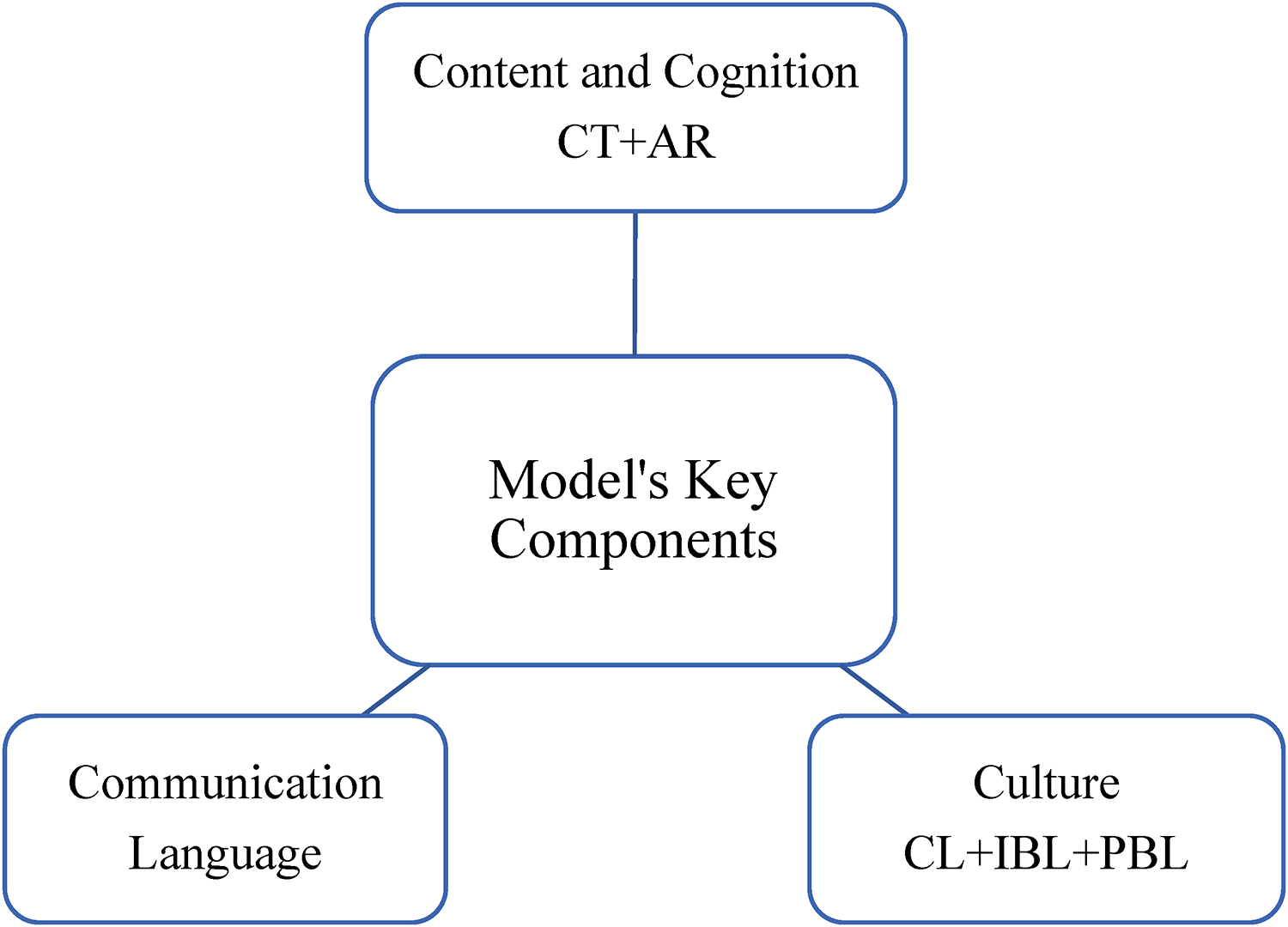
Research tools: Key components for designing unit and lesson plans.
Content and Cognition: CT and AR
Communication: Language
Culture: Inquiry-based learning (IBL), PBL, and CL
The Conceptual Framework (Figure 2) for this research emerged from the literature review and presents its aims of identifying students’ difficulties and suggesting possible pedagogical practices that have the potential to minimize or overcome them to create an environment that promotes effective learning of algebra. Effective learning of algebra will take place when the students overcome the difficulties which they encounter in learning the subject and are able to communicate their understanding of the subject using proper language. The identified algebraic difficulties will be discussed in the research findings section.
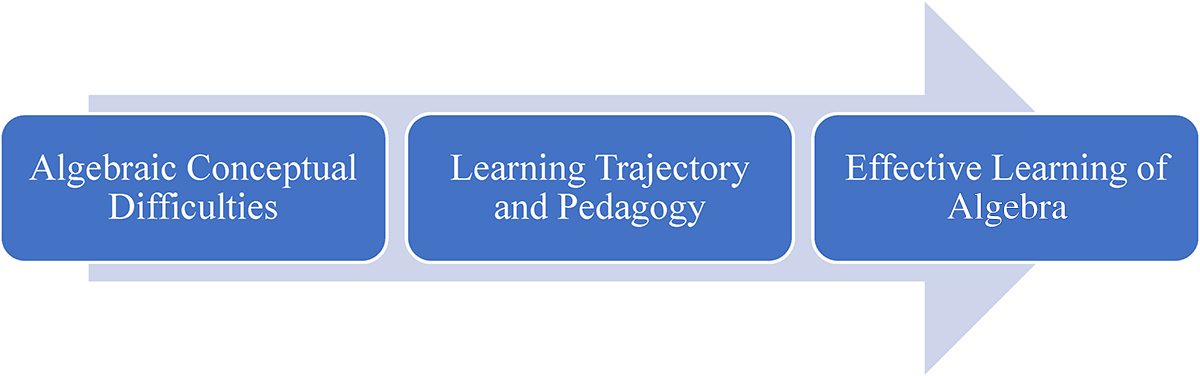
Research conceptual framework.
The research was conducted over a period of 12 weeks. Over a total of ten lessons, seven instructional problem-solving and task-based activities were designed to promote essential algebraic skills, such as CT, problem-solving, and linguistic skills (i.e., use of language to express ideas, define concepts, and communicate understanding). Furthermore, the students were engaged in task-based activities to provide evidence of the processes they have worked through and led to the solutions. They were expected to write reflective notes (SRN) in English that were integral to the main part of each learning task. In the SRN, the students were asked to list the steps they have taken throughout the activity, explain their problem-solving strategies, and their rationale for using the specific method they used while working on the task. The purposes of the questions and the SRN were to guide student thinking and to monitor the development of their conceptual understanding and linguistic skills through reflection.
Furthermore, the researcher kept detailed field notes. The field notes help in deepening understanding of specific situations and in evaluating the impact of the alternative pedagogical model. The main purpose of the RFN was to collect data that triangulates the data collected from the documents. They were critical in providing supplementary data about the alternative conceptions and difficulties that were evident from the students’ work and their mistakes in the HW, CW, IT, and TE data.
Prior to reporting data findings, it is important to clarify that the work of all the students in the sample group was examined, coded, and analyzed. The codes indicate the student's number and group. For example, G2.3 represents student number 3 in group 2. It is also important to note that “some” was used in reference to more than five and less than half the total number of participants and “many” were used in reference to more than half of the participants.
The different data sources used in the document analysis using a content analysis approach led to identifying some sources of difficulties acting as barriers to students’ progression in the Introductory Algebra course. These are represented in Figure 3. The findings confirm that the pedagogical approach had to address students’ difficulties and encourage practices that motivate the students to be active learners who think critically and take responsibility for their own learning.
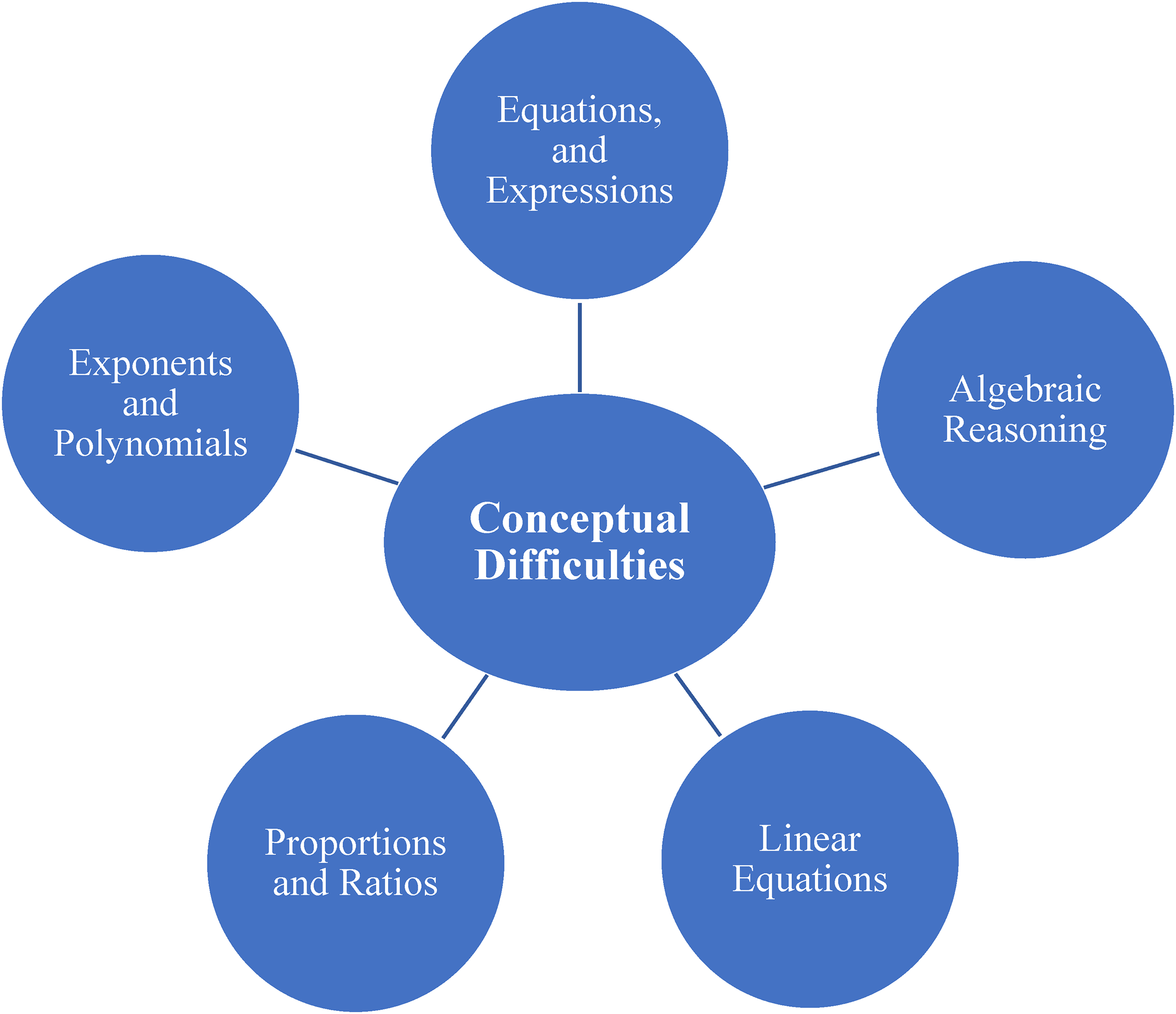
Conceptual difficulties: Summary of difficulties’ categories.
4.1 Equations and expressions
4.1.1 Differentiating between expressions and equations
Findings confirmed that the students were facing the difficulty in shifting from arithmetic to algebra. This was in line with Watson's work mentioned in 2.2. The following data findings emerged: Task 2 identified students’ inability to differentiate between expressions and equations. The task required learners to find the area of the shape in Figure 4.
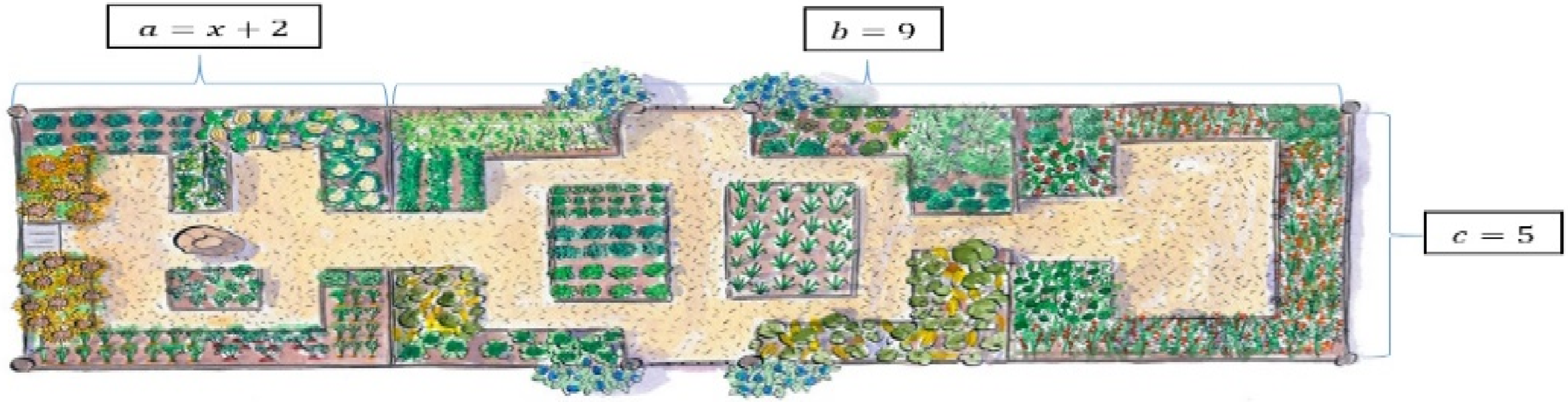
It extract: Differentiating between expressions and equations.
At the beginning, four out of six groups (G1–G6) asked for the value of
Furthermore, attempting to find the value of the area of the shape, the students resorted to informal reasoning techniques, such as guessing different values for
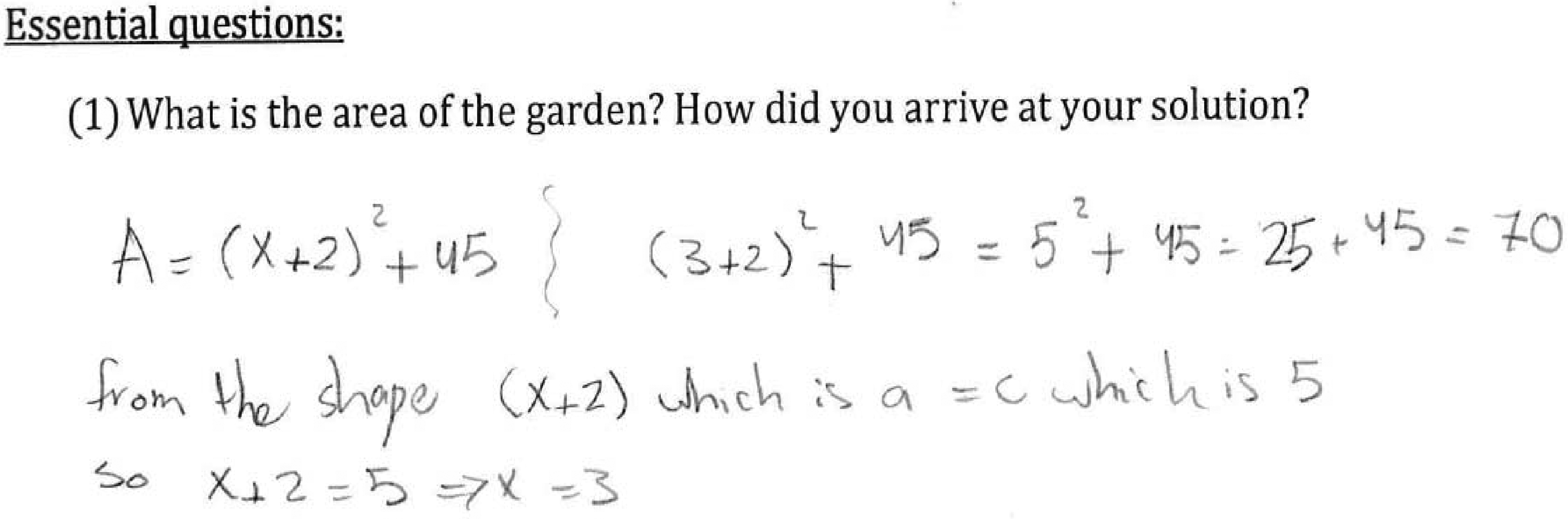
Students’ reflective notes (SRN) Extract (G5): Differentiating between expressions and equations.
This problem with algebraic expressions was also evidenced by the students’ CW in Groups 1, 3, and 6 with a problem like the one in Task 2. Students resorted to the following techniques in trying to find the value of the area of the shape:
Transforming an expression into an equation by adding an “equal sign” and solving the equation by finding a numerical value for the area (see the CW extracts for G6—Figure 6 and G3—Figure 7).
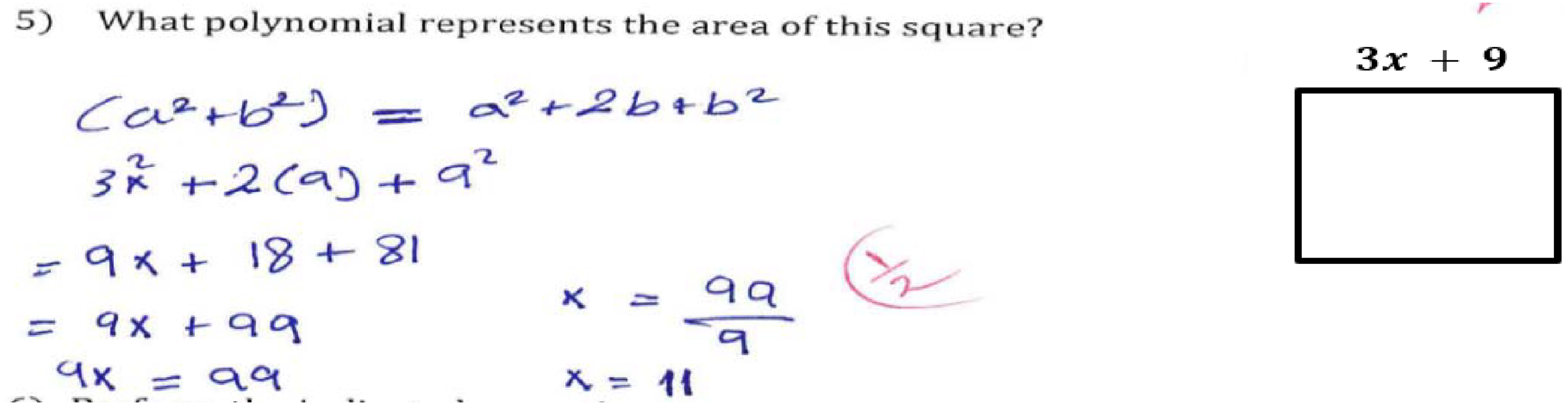
Classwork (CW) Extract (G6): Transforming an expression into an equation.
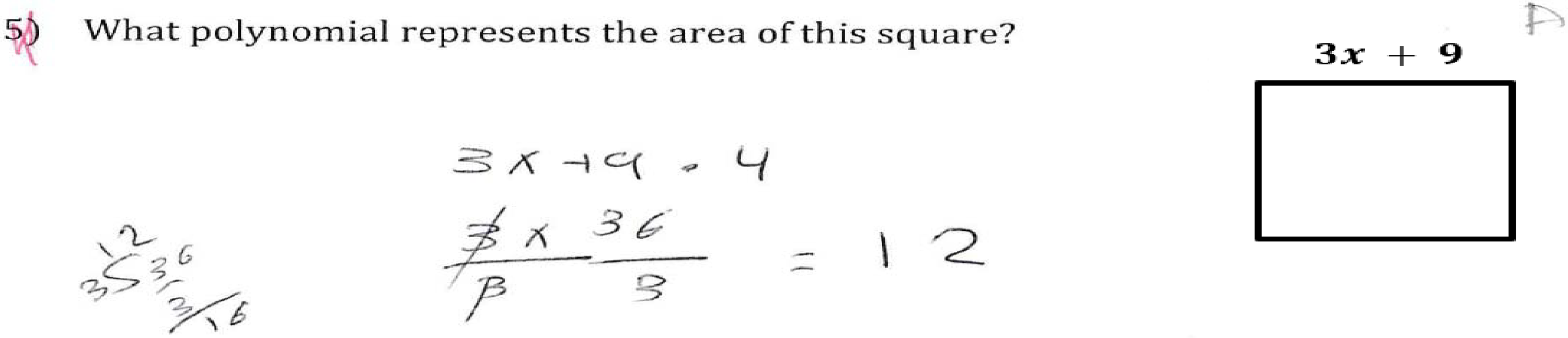
Classwork (CW) Extract (G3): Transforming an expression into an equation.
These findings agree with what was stated by Kieran (1992) and mentioned in Section 2.2 about the type of difficulties that students face when transitioning from arithmetic to algebra, particularly regarding the interpretation of the equal sign. In algebra, the equals sign signifies “equality” or “equivalence,” whereas in arithmetic, it indicates the requirement for a calculation or computation.
To assist students in distinguishing the usage of the equals sign in different contexts, instructors should offer explicit instruction on its meaning. This teaching should incorporate the concepts of “expression” and “equation” and connect them to both procedural and conceptual knowledge associated with each concept.
Ignoring the variable and adding unlike terms to find a numerical value that represents the area of the square, such as in the work of the students in G1 shown in Figure 8. Students’ attempts to find a numerical value representing the area of the shape could result from their inability to accept the “lack of closure” (Kieran, 1992). Also, the insistence on finding a numerical value and the dissatisfaction with the representation of an area by an algebraic expression indicated that students were having difficulties in differentiating between equations and expressions. This suggests a correlation between these two difficulties.
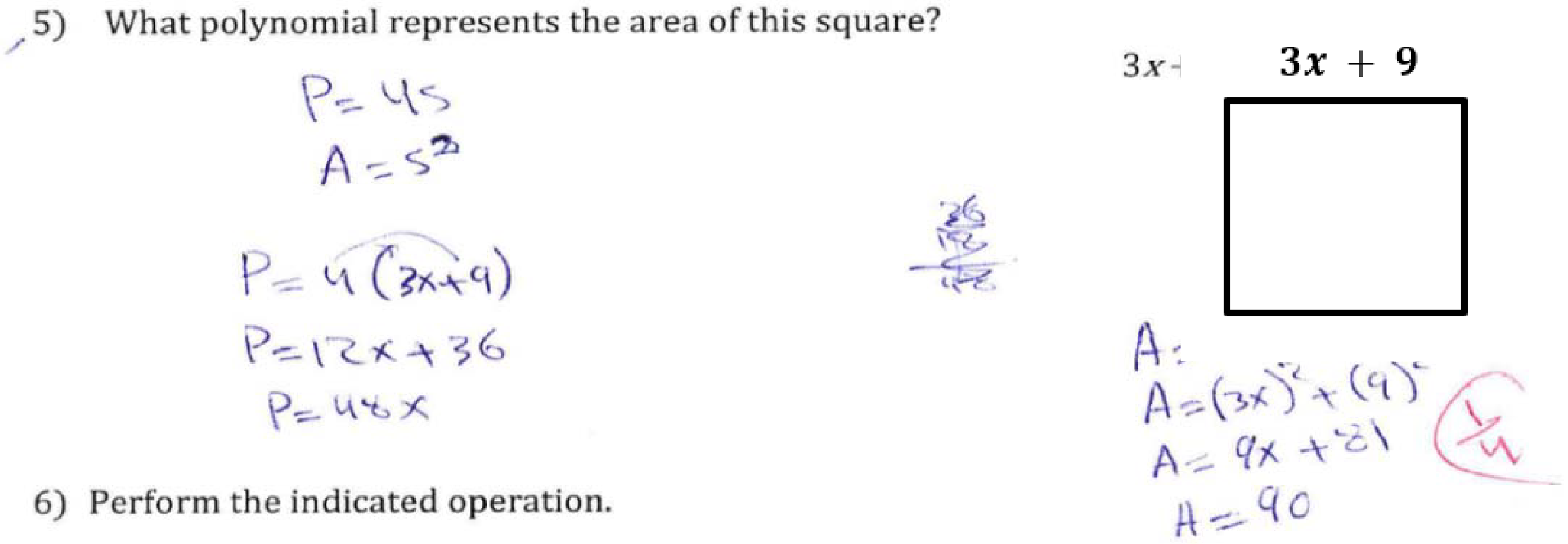
Classwork (CW) Extract (G1): Ignoring the variable.
Furthermore, understanding algebraic structure and the different representations of algebraic concepts is what characterizes conceptual understanding. The focus on the structure of algebraic expressions is fundamental. In the previous problem (Task 2), students were interpreting
4.1.2 Using the inverse operation
The analysis of students’ work demonstrated that many of them do not possess adequate knowledge of this concept and its use. Prior knowledge in solving equations and inequalities was mainly restricted to procedural understanding of the process. To solve equations, students initially relied on the methods they had previously learned. They also transferred these methods and strategies to solving inequalities. The most common strategy used was “moving to the other side,” which involved moving terms from side to side and changing signs to isolate the variable and find its value.
For example, in the following problem drawn from the students’ HW, students were asked to explain how to solve this equation
Inappropriate use of “moving to the other side” strategy might explain student errors in solving equations and inequalities. For instance, CW data showed that in solving a problem such as
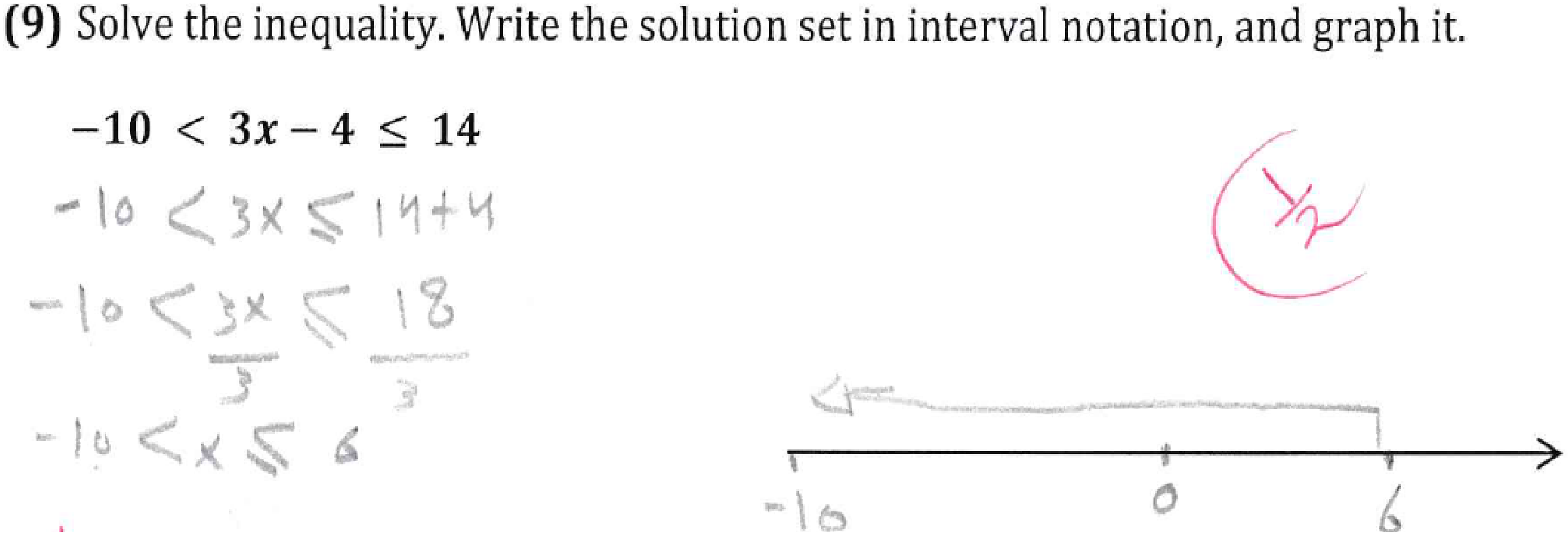
Tests and exams (TE) Extract (1)-G4.1: Using the inverse operation.
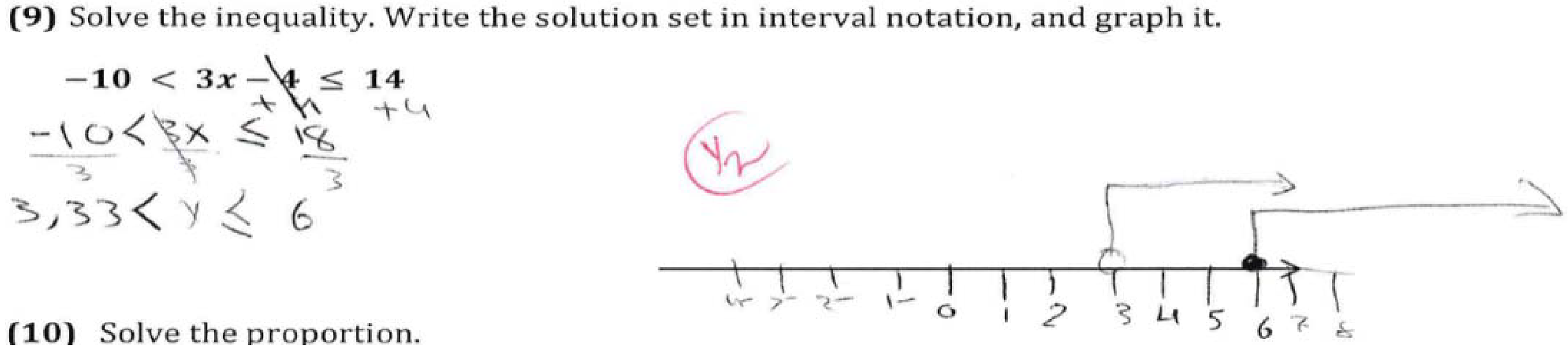
Tests and exams (TE) Extract (2)-G2.2: Using the inverse operation.
The first extract showed that the student G4.1 performed both the addition and division operations on the right side, whereas the student G2.2 in the second extract added 4 only to the left side but divided all the sides by the coefficient of the variable. However, all the 11 students “moved” 4 to the right side. For this reason, raising students’ awareness by creating situations where a specific strategy does not work draws attention to this misconception and provides appropriate application and the rationale for using it, that is, the use of inverse operation alongside addition and multiplication properties of equalities to solve equations and inequalities.
Using similar situations where the “moving to the other side” would not be useful would draw the students’ attention to the downfall of these methods and, therefore, guide them to use the proper algebraic methods to solve equations and inequalities.
4.1.3 Solving literal equations
Since a literal equation differs from other equations in that solving does not require finding a specific value for a particular variable but depends on rearranging variables into a more convenient form for later use, TE data revealed students’ difficulties. When the students tried to solve a specified variable, such as solving for
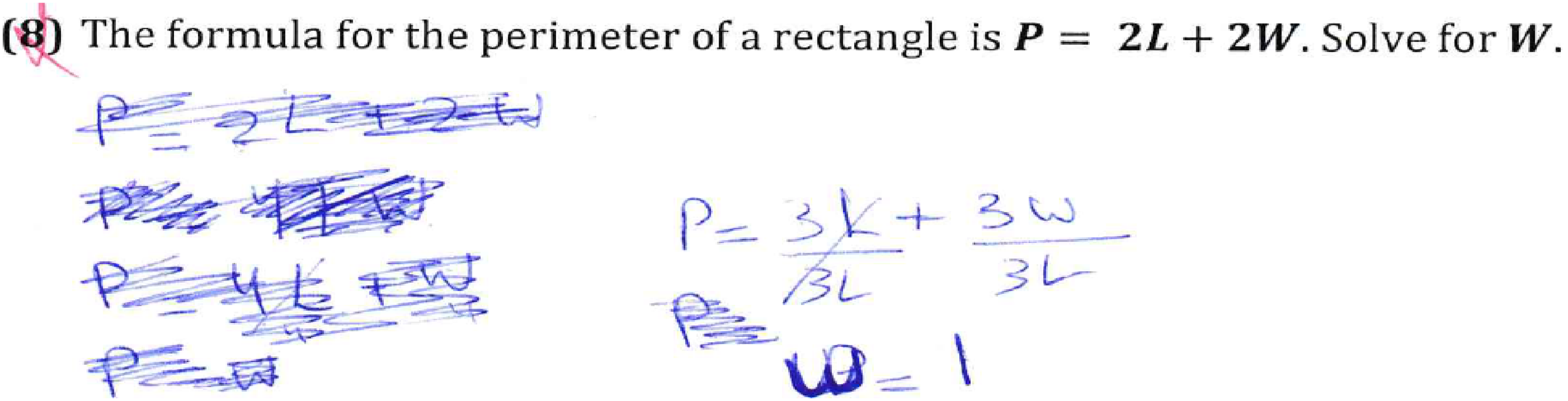
Tests and exams (TE) Extract-G3.4: Solving literal equations.
4.2 Algebraic reasoning
Data showed that students had difficulties in forming generalizations from patterns and experiences. The difficulties that repeated frequently were related to the following:
4.2.1 Relational and informal reasoning
The TE problem below required students to apply AR to construct an equation that represents the relationship between the given quantities. In the following problem: A certain number is the same as the square root of the product of 8 and the number. Find the number.
Twelve out of 27 students used relational and informal reasoning, such as guessing, to find the solution. Data revealed examples of answers without any explanations (eight students). Only four of the students who constructed the radical equation
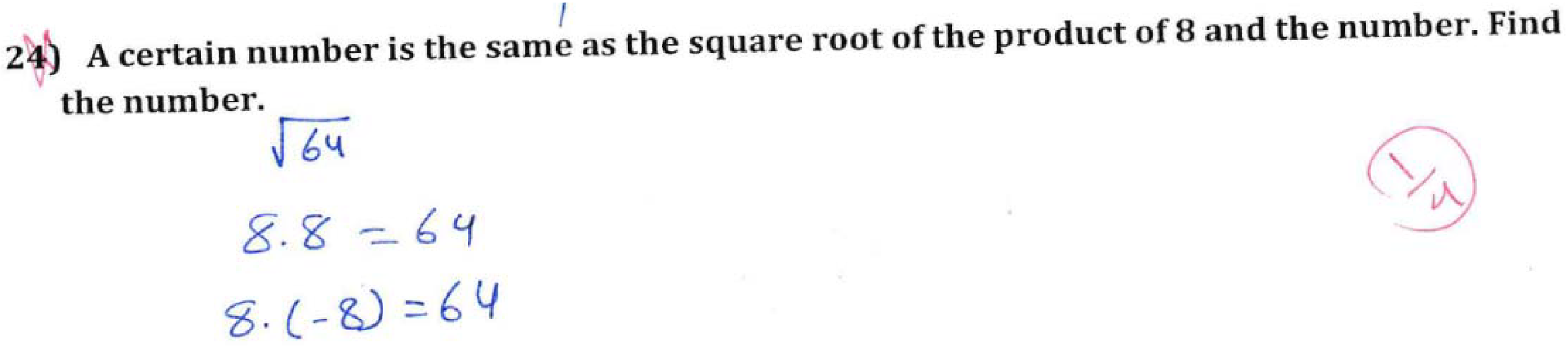
Tests and exams (TE) Extract (1)-G3.2: Relational and informal reasoning.
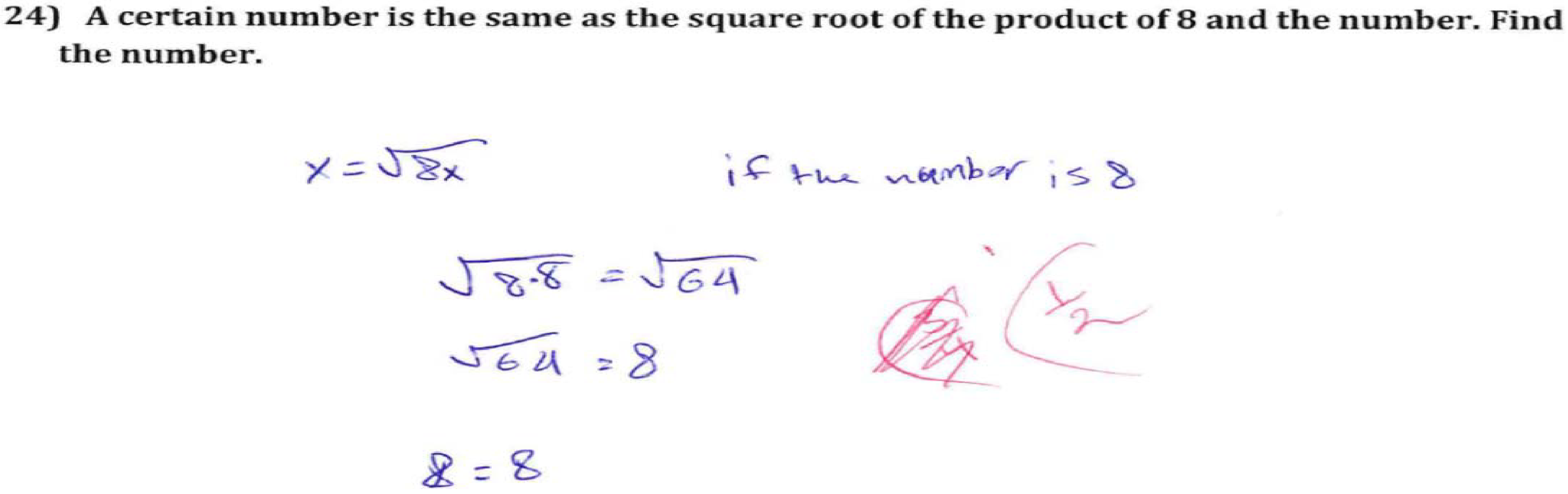
Tests and exams (TE) Extract (2)-G4.3: Relational and informal reasoning.
The data were in line with what has been alluded to by Watson (2009) in 2.3 about the impact of the persistent use of calculation approaches on preventing the students from developing the desired algebraic understanding. The data also clearly indicated the need for students to be guided through problem-solving processes. This suggests that the students have the tendency to draw upon informal strategies of reasoning instead of employing algebraic thinking. Therefore, students need support to see algebra as “a set of extremely powerful problem-solving methods” (Stacey & MacGregor, 1999).
This goal can be accomplished by utilizing pedagogical strategies to engage the students with tasks or activities in an algebraic sense. For instance, instructors can draw students’ attention to the connections between algebraic concepts and the procedures present in the problems. Instructors can also ask questions that make the students realize how the solution process is affected by the placement of the quantities relative to the operations in problems. Furthermore, instructors should encourage the students to consider other forms (i.e., geometrical) of representation to understand the context of the problem.
4.2.2 Dependent and independent variables
While all students have previously been introduced to the concept of dependent and independent variables, limited opportunities for them to internalize, use, or even recall prior knowledge leads to barriers in solving algebraic problems. This observation was made based on the students’ performance on Task 4 (Figure 14).
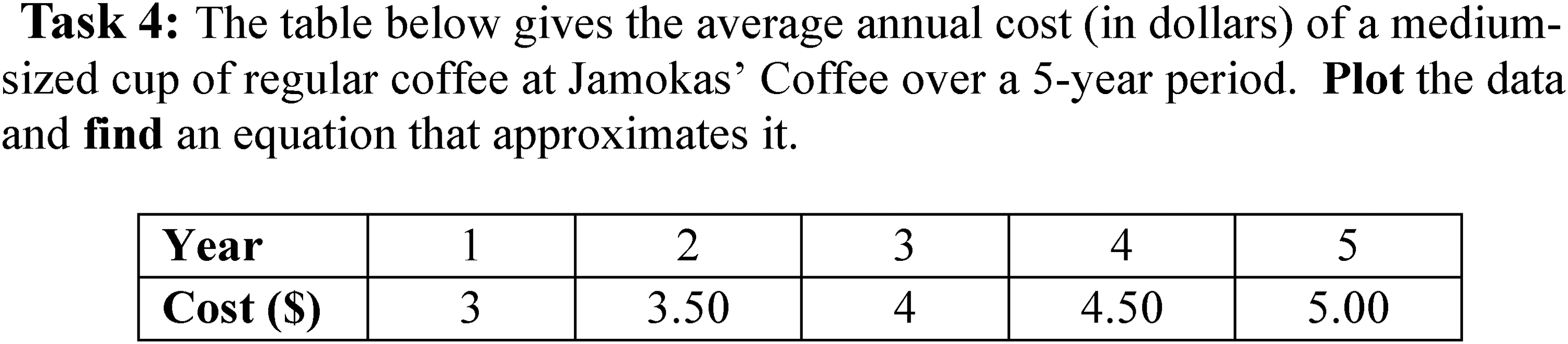
(Task 4): Finding a linear equation that fit a given data set.
One of the objectives of this task was to assess students’ ability to find linear equations that fit a given data set. Students were expected to apply their understanding of the slope to find an equation that satisfies the conditions provided by the context of the problem. Data revealed two main difficulties: the process of assigning variables and the type of reasoning that the students use in their solution process.
4.2.3 Assigning variables
Students knew that because there were two variables in the context of this problem—time and cost—one of these should be - It does not matter which one of the variables is - - - We guessed the answer! (G4) - We figured it out that the years must be in the denominator from the phrase “over a 5-year period,” which was in the problem. The word “over” means division. (G5) - We just knew that time must be
These responses from all study groups illustrated difficulties in assigning and labeling variables, including those who knew time was always in the
4.2.4 Recursive and explicit reasoning
While working on Task 4, students demonstrated a tendency to reason recursively to find the relationship between the dependent and the independent variables, perhaps due to the ease in finding the relationship between the term and its predecessor rather than finding the relationship between the input and the output. That is, the students were trying to find the rate of change for years and costs. They were able to see that
The structure of the problem involved patterns that contributed to the students’ tendencies to think recursively. This concurs with Stacey & MacGregor's (1999) findings that, while working on activities that include patterns, students tend to focus on recursive rather than explicit relationships. Even though some of the students were trying to find the rate of change in the cost
Data revealed that students in G2 were trying to obtain values for
4.3 Linear equations
Tests and exams data identified difficulties related to concepts associated with linear equations. These difficulties were related to the following:
4.3.1 Finding
- and
-intercepts
Finding
One of the recommended methods for addressing this challenge involves employing visual representations that enable students to observe the two intercepts on a graph and establish a connection with the algebraic procedure of determining their coordinates.
4.3.2 Deciding whether two lines are parallel, perpendicular, or neither
When the students were asked to decide whether two lines are parallel, perpendicular, or neither, given two equations as follows;
TE extract: Deciding whether two lines are parallel, perpendicular, or neither.
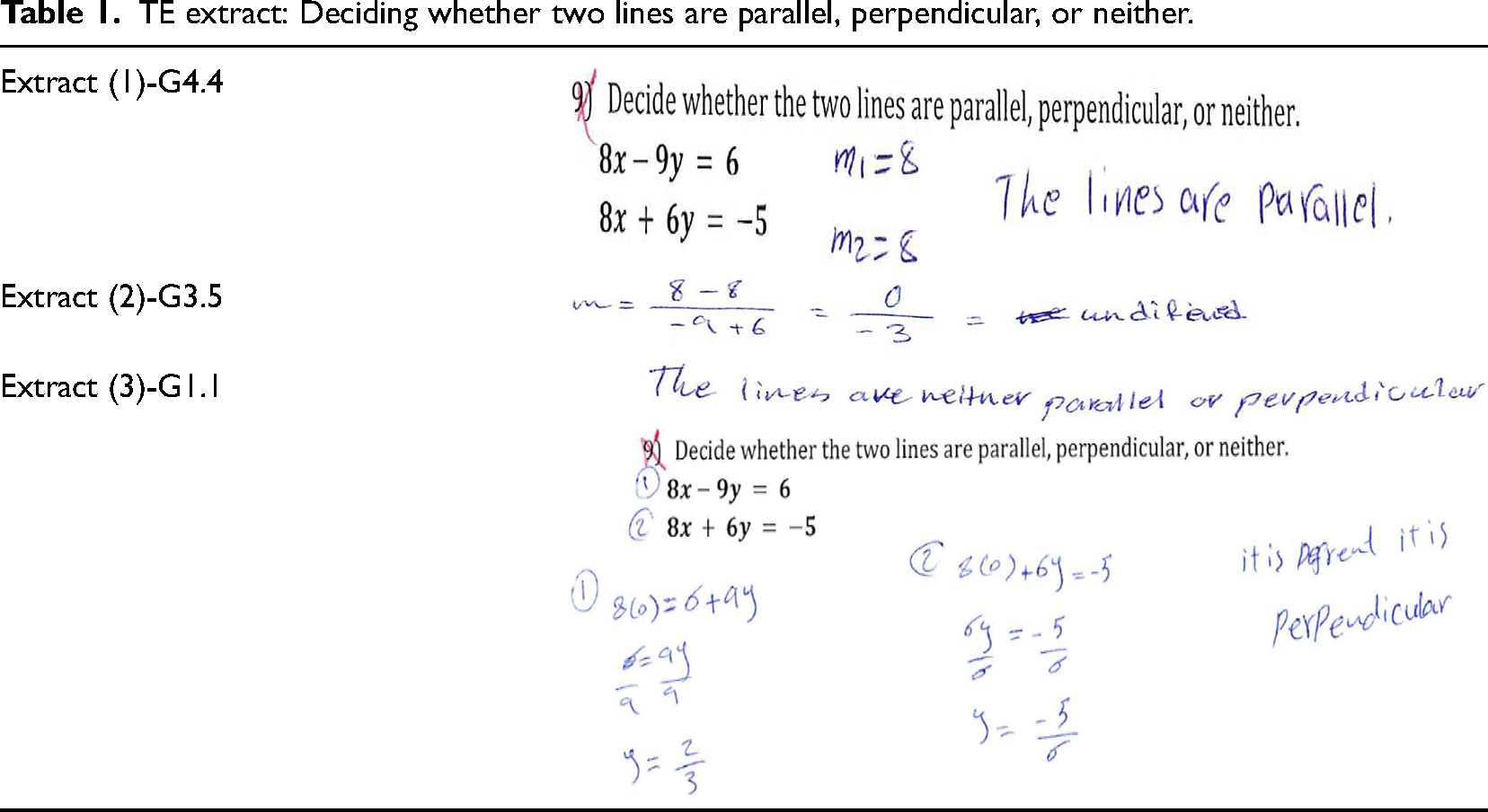
Additionally, the same data revealed that two students (G3.5 and G1.4) confused finding the slope from an equation with finding the slope when two points are given. They took the coefficient of the
A total of three students (G1.1, G5.2, and G3.4) assumed the value of
The difficulties that students are encountering with learning equations can be minimized if the students refrain from treating symbols “as though they have a life independent of any meaning or any relationship to the quantities in the situation in which they arose,” as Sowder and Harel (1998) put it (p. 5). Geometrical representations can help explain and guide the correctness of each step or term in a series of algebraic operations.
4.4 Proportion and ratio
Upon analyzing the students’ work, three different types of misconceptions were identified in relation to proportions.
4.4.1 Making two equations from one proportion
Some students tended to make two equations from one proportion, instead of making one equation to find the value of the variable. For example, in the CW problem
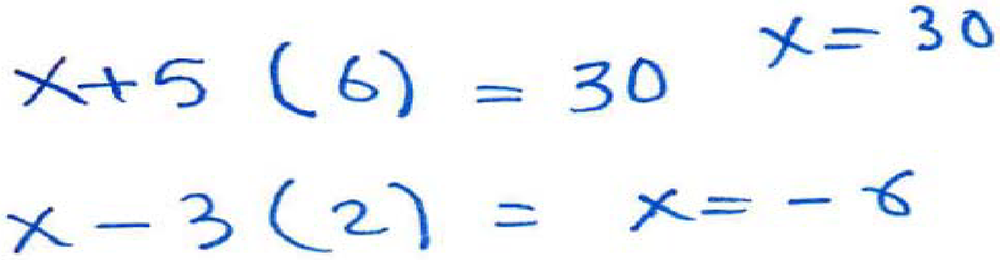
Classwork (CW) Extract (G3): Making two equations from one proportion.
To solve this problem, cross-multiplication was required to find the value of the variable. Instead of finding one value for x, the students found two different values. It was obvious that the students were encountering difficulties with solving proportions. To tackle these difficulties, it is important for teachers to offer clear and direct guidance on the concept of proportions, establish a strong basis in relevant mathematical concepts, emphasize problem-solving strategies, and provide abundant chances for practice and real-world application. Instructors can also use manipulatives, visual aids, or provide examples from real-world applications.
4.4.2 Performing cross-multiplication
Another misconception identified by HW data concerned cross-multiplication. Some of the students multiply only by the first term of the second ratio. For example, when students were multiplying 6 by (
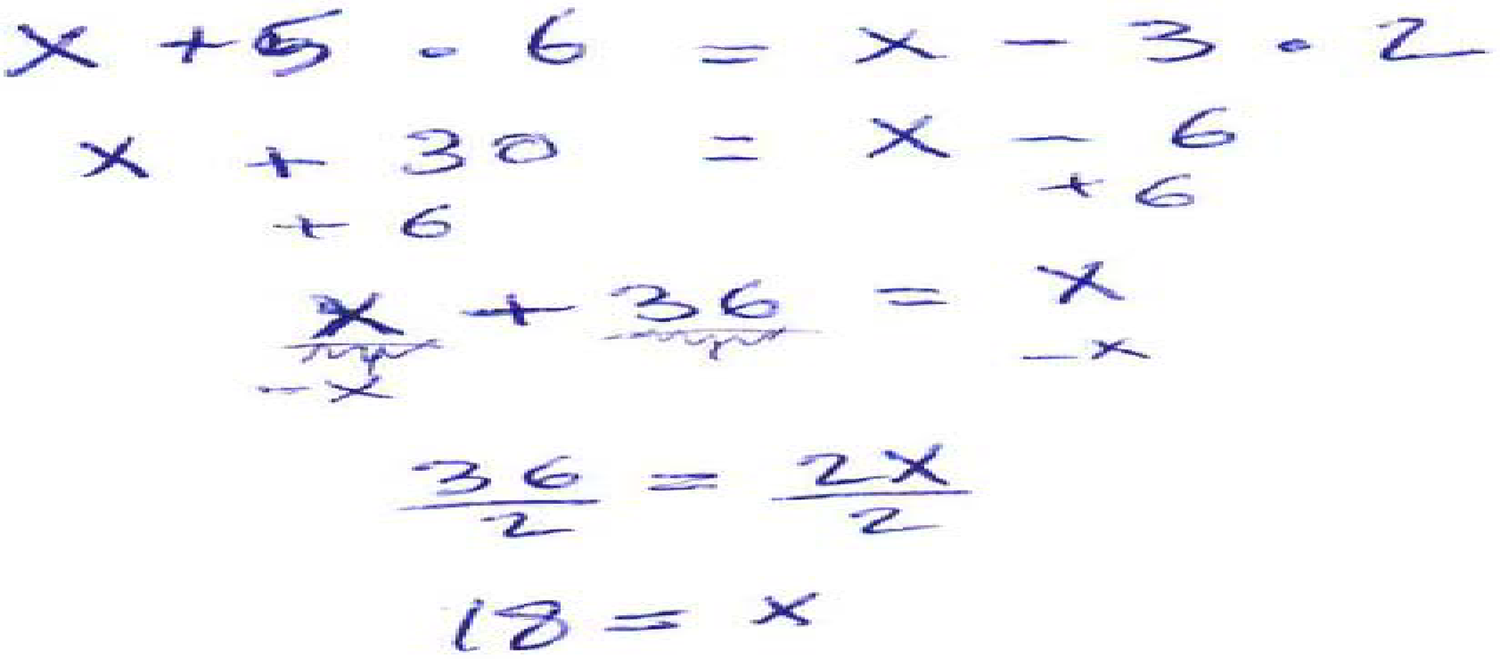
Homework (HW) Extract-G2.2: Performing cross-multiplication.
4.4.3 Multiplying by the reciprocal
The data also revealed some mistakes related to the use of the reciprocal of the second ratio (Figure 17). As in the previous problem,
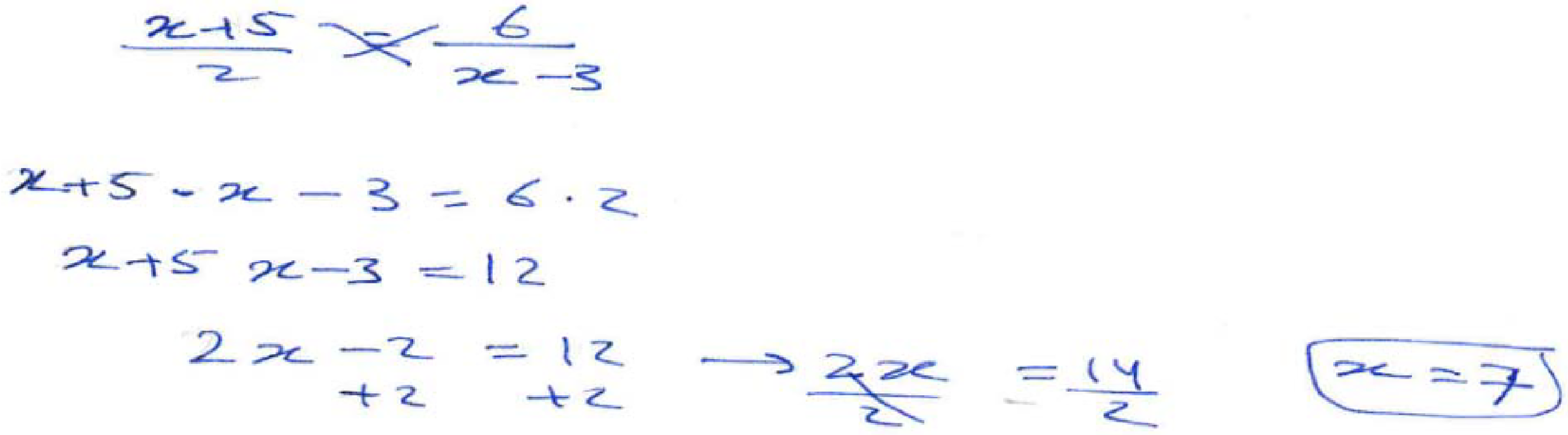
Homework (HW) Extract-G3.4: Multiplying by the reciprocal.
To overcome problems related to proportion and ratio, a quick revision of some simple examples that might help to remind the students of the proper technique is suggested.
4.5 Exponents and polynomials
Emergent difficulties and misconceptions linked to exponents and polynomials, such as evaluating exponents, working with integer exponents, and writing large and small numbers in scientific notation were identified.
4.5.1 Evaluating exponents
Even though exponents are used to express repeated multiplication, HW, CW, TE, and RFN data showed that some students evaluate them by multiplying the base by the exponents. For instance, when asked to evaluate the expression
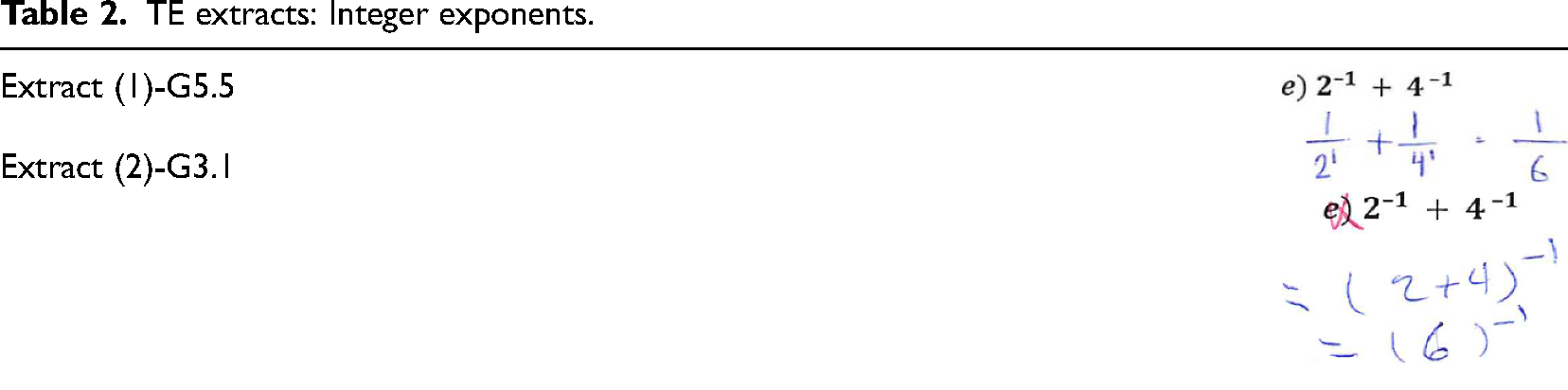
4.5.2 An integer exponent
Regarding evaluating exponential terms or expressions with negative exponents, TE data showed that when asked to evaluate expressions, such as the following:
TE extracts: Integer exponents.
4.5.3 Rules of exponents
Tests and exams data revealed that some students did not know the proper use of the quotient and product rules of exponents. For example, to evaluate
4.5.4 Scientific notation
Difficulties and misconceptions in writing numbers in scientific notation were evident in the HW and CW data, for example, Counting only zeros in the case of writing large numbers (Figure 18) and misplacing or writing numbers without the decimal point (Figures 18–20).

Classwork (CW) Extract (G1): Writing numbers in scientific notation.

Classwork (CW) Extract (G4): Writing numbers in scientific notation.
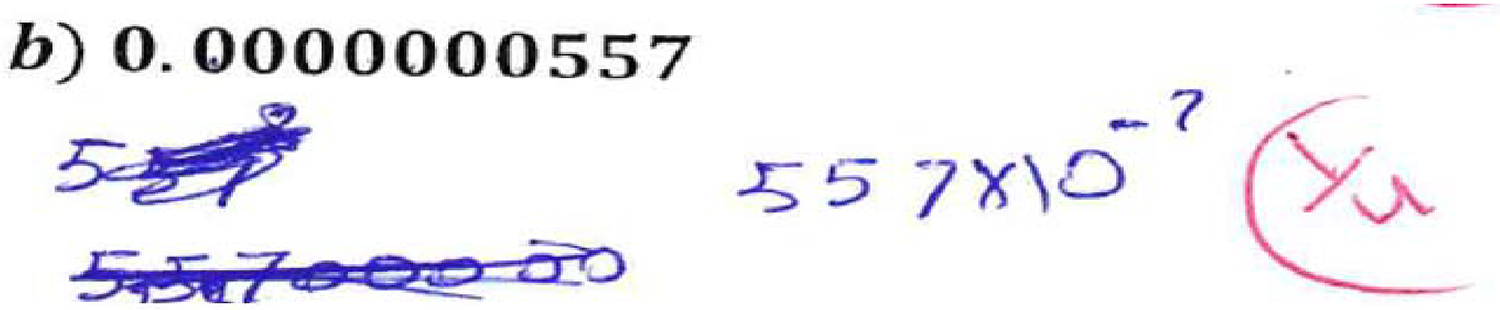
Classwork (CW) Extract (G6): Writing numbers in scientific notation.
4.5.5 Exponents and polynomials
Homework and CW data demonstrated confusion in the rule of squaring binomials [
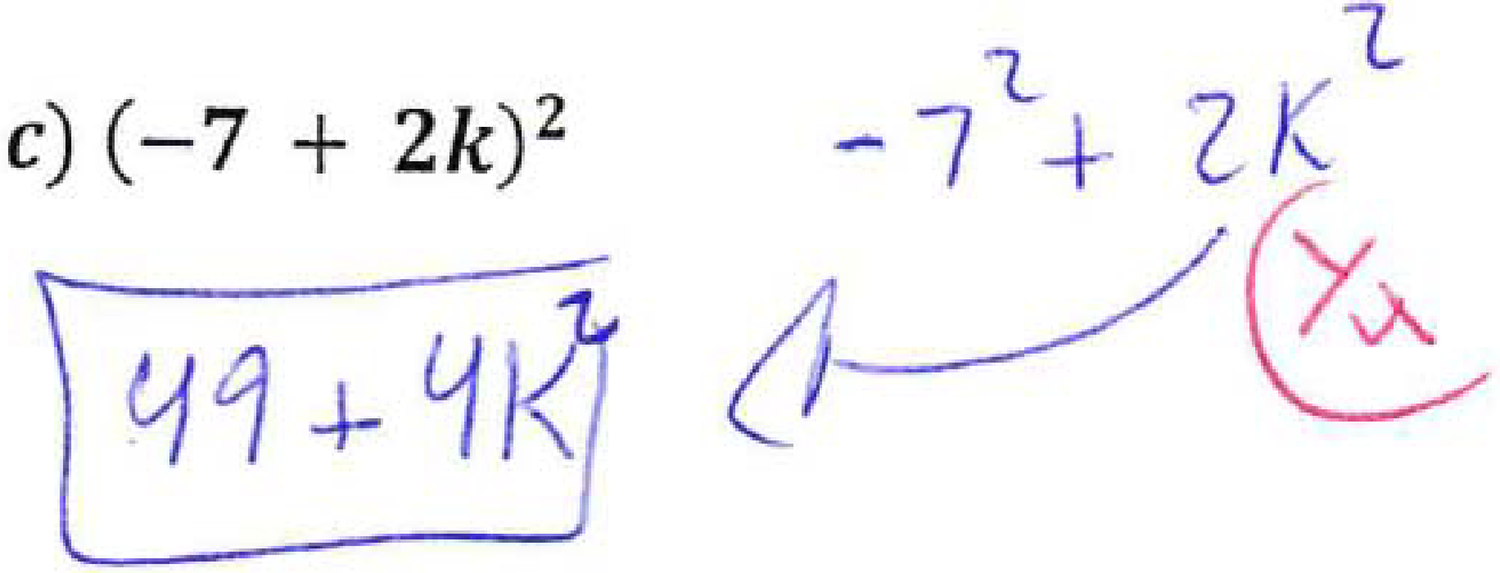
Homework (HW) Extract-G5.4: Squaring a binomial.
There is also evidence that students had problems when multiplying two conjugates. In the TE problem where the students were asked to multiply these two conjugates
Activities that engage the students in comparing and contrasting situations that require the use of specific rules might help them overcome the confusion they experience when working with exponents.
Data revealed that the participants in this research were having challenges with exponents, likely attributed to the abstract nature of the concept and their insufficient foundational understanding. Additionally, these challenges may stem from limited practice and application. Therefore, it is recommended that instructors deliver scaffolded instructions that offer a step-by-step explanation, breaking down exponent rules and properties into more manageable concepts. Instructors can also try to connect exponents to real-world contexts to demonstrate their relevance and application, such as in scientific notation, compound interest calculations, or population growth models.
Research and development have the potential to drive meaningful change in mathematics education when evidence-based practices are integrated into everyday teaching. The difficulties experienced by the participants in this study were diverse and stemmed from various sources. Students’ unique challenges, influenced by factors, such as prior knowledge, skills, and interest in the subject, can affect their motivation and class engagement.
The identified difficulties were specifically associated with various algebraic concepts, including equations, expressions, and AR. While this list is not comprehensive, it does encompass the difficulties that were frequently observed throughout the research period. The primary objective of this study was to comprehend the nature of these difficulties and analyze their underlying causes. Additionally, the research provided recommendations on how to address and overcome these difficulties.
This research primarily emphasized the use of learning activities to foster the development and enhancement of students’ conceptual knowledge and understanding. As mentioned in the literature review, there was a consensus that “Algebra as Activity” was the most suitable theme. Therefore, it is recommended to adopt “Algebra as Activity” as the theme for teaching “Introductory Algebra” at PMU and similar educational settings. According to this theme, teaching and learning algebra involve actively engaging students in learning activities specifically designed to cultivate CT and problem-solving skills. The activities aim to support students in transitioning from arithmetic to algebra, while also promoting AR and thinking. Furthermore, the activities can help identify students’ misconceptions so that they can be addressed and altered to allow for conceptual growth.
Finally, this research has produced implications that can be utilized and customized, making them potentially valuable for policymakers in a broader sense, as well as faculty members at PMU, including the following:
Adopting teaching approaches that might contribute to the reform of mathematics education at PMU and in similar learning contexts in the region.
- Creating opportunities for students to be engaged in mathematical discourse and classroom practices that underlie AR. - Endorsing pedagogical actions that structure students’ engagement in activities that foster CT and learning conversations to facilitate learning algebra with deep understanding embedded in rich conceptual dialogues. - Shifting away from the conventional role of students as passive receivers of instruction to active and constructively critical participants.
Consideration of these implications in the learning contexts can help in developing and improving skills that are critical to conceptual understanding as well as language acquisition and proficiency.
Supplemental Material
sj-docx-1-mea-10.1177_27527263231203092 - Supplemental material for The conceptual difficulties Saudi female ELL students encountered in learning algebra: A case of a college preparatory program
Supplemental material, sj-docx-1-mea-10.1177_27527263231203092 for The conceptual difficulties Saudi female ELL students encountered in learning algebra: A case of a college preparatory program by Russina A Eltoum in Asian Journal for Mathematics Education
Footnotes
Availability of data
The datasets generated during and/or analyzed during the current study are available from the corresponding author on reasonable request.
Declaration of Conflicting Interests
The author(s) declared no potential conflicts of interest with respect to the research, authorship, and/or publication of this article.
Ethical approval
I was not required to fill a form to conduct this research but the chair department was notified and gave her verbal consent.
Funding
The author(s) received no financial support for the research, authorship, and/or publication of this article.
Informed consent
Consent from
Dear participant:
This survey questionnaire is an attempt to Research Algebra Learning in the Saudi Context. Your input is an essential element in this study and will be kept strictly confidential. This information will be used for research purposes only. Of course, your participation is voluntary. We appreciate your time and effort. If you have any questions about this study, please feel free to contact me. If you would like to have a summary of the results. Please e-mail us at

Supplemental material
Supplemental material for this article is available online.
Notes
Author biography
References
Supplementary Material
Please find the following supplemental material available below.
For Open Access articles published under a Creative Commons License, all supplemental material carries the same license as the article it is associated with.
For non-Open Access articles published, all supplemental material carries a non-exclusive license, and permission requests for re-use of supplemental material or any part of supplemental material shall be sent directly to the copyright owner as specified in the copyright notice associated with the article.
