




Abstract
Generalisation is a key feature of learning algebra, requiring all four proficiency strands of the Australian Curriculum: Mathematics (AC:M): Understanding, Fluency, Problem Solving and Reasoning. From a review of the literature, we propose a learning progression for algebraic generalisation consisting of five levels. Our learning progression is then elaborated and validated by reference to a large range of assessment tasks acquired from a previous project Reframing Mathematical Futures II (RMFII). In the RMFII project, Rasch modelling of the responses of over 5000 high school students (Years 7–10) to algebra tasks led to the development of a Learning Progression for Algebraic Reasoning (LPAR). Our learning progression in generalisation is more specific than the LPAR, more coherent regarding algebraic generalisation, and enabling teachers to locate students’ performances within the progression and to target their teaching. In addition, a selection of appropriate teaching resources and marking rubrics used in the RMFII project is provided for each level of the learning progression.
Keywords
Introduction
International studies have consistently shown Australia lagging behind many countries such as Singapore, Hong Kong, the Netherlands and Canada in mathematics. When the different domains of mathematics are separated, algebraic reasoning lags behind other content areas of mathematics (Thompson et al., 2020). The results for mathematics for the Programme for International Student Assessment (PISA) show a steady decline for Australian students since 2003, with the average performance in 2018 for the first time falling below the international average (Thomson et al., 2019). Attributing this to a narrow focus on manipulative skills and low-level algebraic skills seems to miss the point. While routine skills and procedures help to underpin algebraic reasoning, classroom teaching and assessment need to recognise the importance of algebraic reasoning and how it needs to be cultivated.
An effective means of developing algebraic reasoning has been in the use of targeted teaching that is informed by evidence-based learning progression research. This article builds on an earlier investigation into the algebraic reasoning learning progression in the Reframing Mathematical Futures II (RMFII) project (Day et al., 2019). The RMFII project aimed to build a sustainable, evidence-based learning and teaching resource to support the development of mathematical reasoning (Siemon & Callingham, 2019). The project was conducted from 2014 to 2018 and was funded by the Australian Department of Education and Training through the Australian Mathematics and Science Partnership Programme. A total of 32 project schools (80 teachers and 3500 students) from around Australia participated in RMFII and an additional 1500 students from Years 5 to 10 assisted in the trialling of the assessment tasks. As a result of the RMFII project, three evidence-based learning progressions (LPs) for algebraic, statistical and geometric reasoning together with validated assessment forms were produced. From each learning progression, eight zones were identified and targeted teaching advice for each zone was developed to assist teachers to move students forward in their mathematical reasoning learning journey.
As a part of this project, extended response multi-stage assessment tasks were designed to elicit algebraic reasoning, with data collected from a national sample of over 5000 Australian students from Years 7 to 10 (junior secondary school). The algebraic reasoning learning progression developed in RMFII covered a range of algebraic concepts for these years, comprising Pattern and Function, Equivalence and Generalisation. The current article builds on this work by developing a learning progression specifically for one aspect of algebraic reasoning, that is algebraic generalisation, and by extending the range of students included so that the learning progression now covers Years 5–10 (primary to junior secondary school). Difficulties in identifying an appropriate learning progression both from a general perspective and from our experience in the RMFII study are considered. This experience has been important in our preparation of teaching advice suitable for teachers in Australian schools. Our proposed progression for algebraic generalisation and its related teaching advice are intended to provide a practical base to enable teachers to target their teaching appropriately for each student.
Literature review
Before describing our research, it is important to identify several key ideas implicit in the idea of generalisation which can be applied in this article to the algebraic reasoning tasks of RMFII. Some authors, such as Love (1986) and Mason (1996), have suggested previously that the generalisation of a pattern, at its core, rests on the capability of noticing something general in the particular. Kieran (2007), however, has reminded us that this feature alone may not be sufficient to characterise the algebraic generalisation of patterns, arguing that in addition to seeing the general in the particular, students need to be able to express generalisation algebraically.
For other authors, such as Dreyfus (2002), generalisation is a mental process considered as a prerequisite for abstraction, understood in the sense that “to generalize is to derive or induce from elements, to identify points in common, to expand the domains of validity” (p. 35). Apart from his appropriate emphasis on expanding the domains of validity, Dreyfus is not so helpful in telling us what forms these more refined mental processes should take.
In Rivera’s (2010) view, following a generalisation of patterns implies that students perform [...] coordinating their perceptual and symbolic inferential abilities so they are able to construct and justify a plausible and algebraically useful structure that could be conveyed in the form of a direct formula (p. 298).
Rivera’s emphasis on constructing and justifying a plausible and algebraically useful structure does point more clearly to the forms that we should be looking for. Algebraic formulations are important, as Kieran (2007) noted, but these need to be supported by explicit reasoning in terms of justification and explanation. These points are directly relevant to the tasks used by RMFII to assess algebraic reasoning in which students are invited at various points to explain their reasoning. This is an important feature of the progression we will use.
Radford (2006) provided several important constituents required for algebraic generalisation, which he sees as starting by noticing commonalities among some elements of a sequence. We would refer to these as particular instances. He then pointed to the importance of noticing that this commonality applies to all terms of the sequence and finally being able to provide a direct expression of that commonality. His reference to ‘generalizing a pattern algebraically’ also seems to imply that in addition to algebraic symbolisation, students also need to explain – to serve as a warrant is the term he uses – why the generalisation applies ‘beyond the perceptual field’. To quote from Radford: Generalizing a pattern algebraically rests on the capability of grasping a commonality: noticed on some elements of a sequence S, being aware that this commonality applies to all the terms of S and being able to use it to provide a direct expression of whatever noticing of a local commonality that is then generalized to all the terms of the sequence and that serves as a warrant to build expressions of elements of the sequence that remain beyond the perceptual field. (Radford, 2006, p. 5)
Our proposed learning progression
Some of the above authors explain their ideas by pointing to a few illustrative tasks involving relatively simple number patterns and relations, or those that use diagrams that form patterns. Validating a learning progression for algebraic generalisation calls for more than illustrative tasks. The five levels of algebraic generalisation which we present in this article are informed by the literature review. Our elaborations of these five levels will be based on our analysis of students’ responses to RMFII tasks designed to assess algebraic reasoning, and their validity will be supported by data analysis drawn from the RMFII project. Our proposed five levels of algebraic generalisation are as follows: Working with particular instances. Noticing and describing regularities and patterns. Forming expressions – either verbal or symbolic. Using equivalence to examine different expressions of the same relationships and expressions. Explicit generalised reasoning where students move between the particular to the general and vice versa, are able to identify and describe what varies and what stays the same and to work confidently with generalised expressions in different forms.
National Numeracy Learning Progression sub-strand NPA.
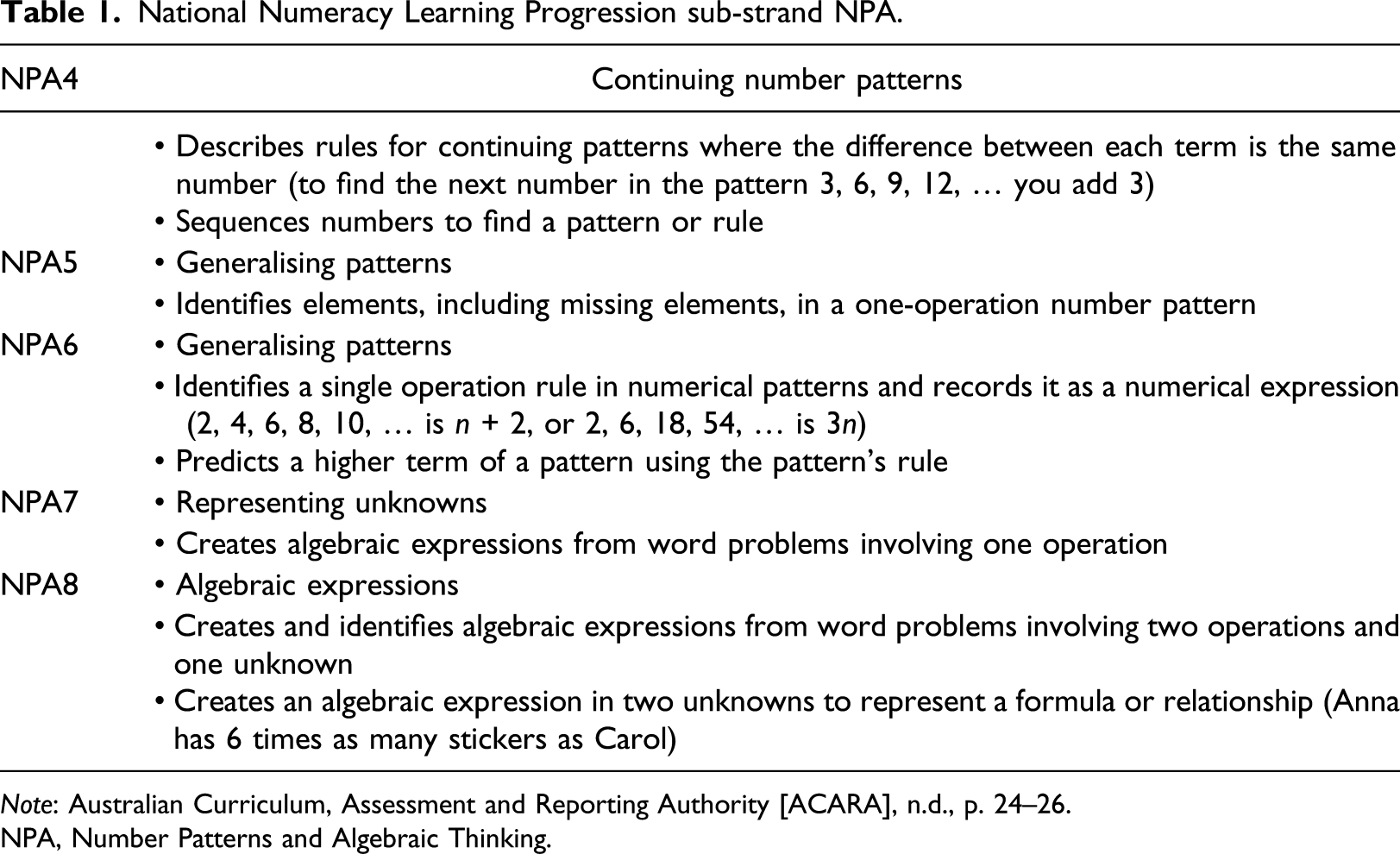
Note: Australian Curriculum, Assessment and Reporting Authority [ACARA], n.d., p. 24–26.
NPA, Number Patterns and Algebraic Thinking.
The learning progression shown in Table 1 correctly draws attention to the first three elements of our proposed progression: working with particular instances; noticing and describing regularities and patterns and forming expressions (either verbal or symbolic). It fails to capture the final two elements of our progression, namely, understanding and using equivalence to work with algebraic expressions and the use of explicit generalised reasoning.
Describing our five levels using the RMFII assessment tasks
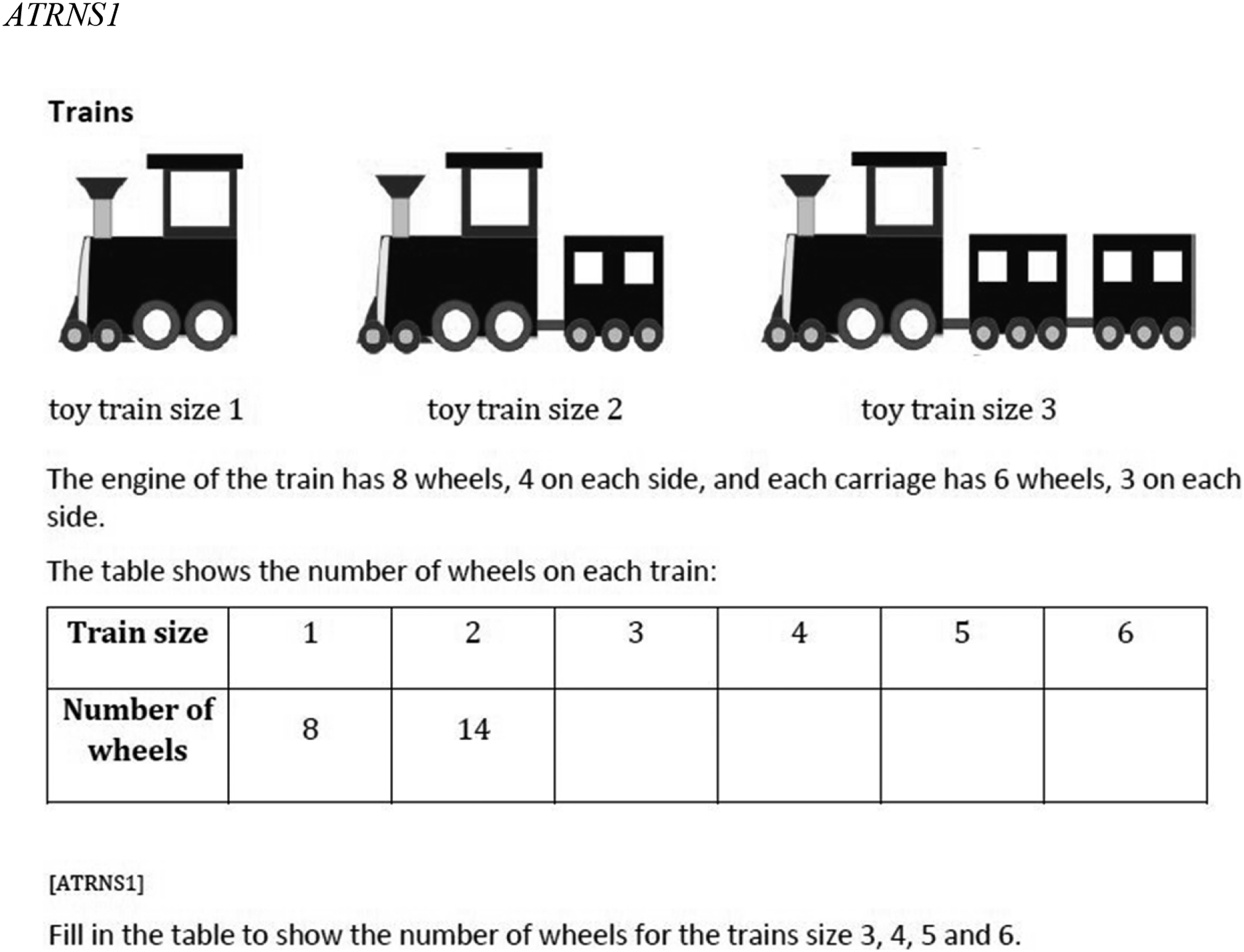
Working with Particular instances. This initial level is important in the algebraic generalisation process as many RMFII tasks start by presenting one or more initial cases for students to consider. For example, the Trains task (ATRNS) shows the number of wheels used for the train engine and how an additional six wheels are added for each carriage of the increasing values of the sequence. The opening question associated with this task, ATRNS1 (see Figure 1), gives the number of wheels for Train sizes 1 and 2 and asks students to complete a table for Train sizes 3, 4, 5 and 6. Noticing and describing Regularities. These cases are important because they assist students to see regularities, in other words, to attend to those quantities that remain fixed and those that vary (Radford, 2006; Rivera, 2013). Regularity can be represented using a table of values or some other summary representation. Regularity must be noticed, and requires a sequence of particular cases, where students can see the contextual features which underpin the regularities. Students need to recognise that one particular case may not be associated with a single rule. For example, one of the RMFII tasks dealing with equations asks students to write in symbols or describe in words five different rules that could be using to generate an output of 14 from an input of 5. Forming Expressions – either verbal or symbolic. The next level beyond observing and of understanding regularities is the expression of a formula. A generalised expression will require students to describe the variables that denote the regularities and constants they have noted. Generalisations may be expressed in words or symbols. For example, in another question (ATRNS4) associated with the Trains task, students are asked to write down in words or symbols a rule for working out how many wheels any sized train would need. To arrive at a rule, students need to have successfully understood and represented several cases and to notice the regularities exhibited in each case. Using Equivalence. Students should be able to recognise that generalisations can be represented by different symbolic expressions depending upon the viewpoint of students and the generalisation process. In the question (ATRNS4), there are several equivalent formulations, such as N = 8 + 6 (S−1), or N = 6 × S + 2 (where N is the number of wheels and S is the number of carriages). ATRNS1.
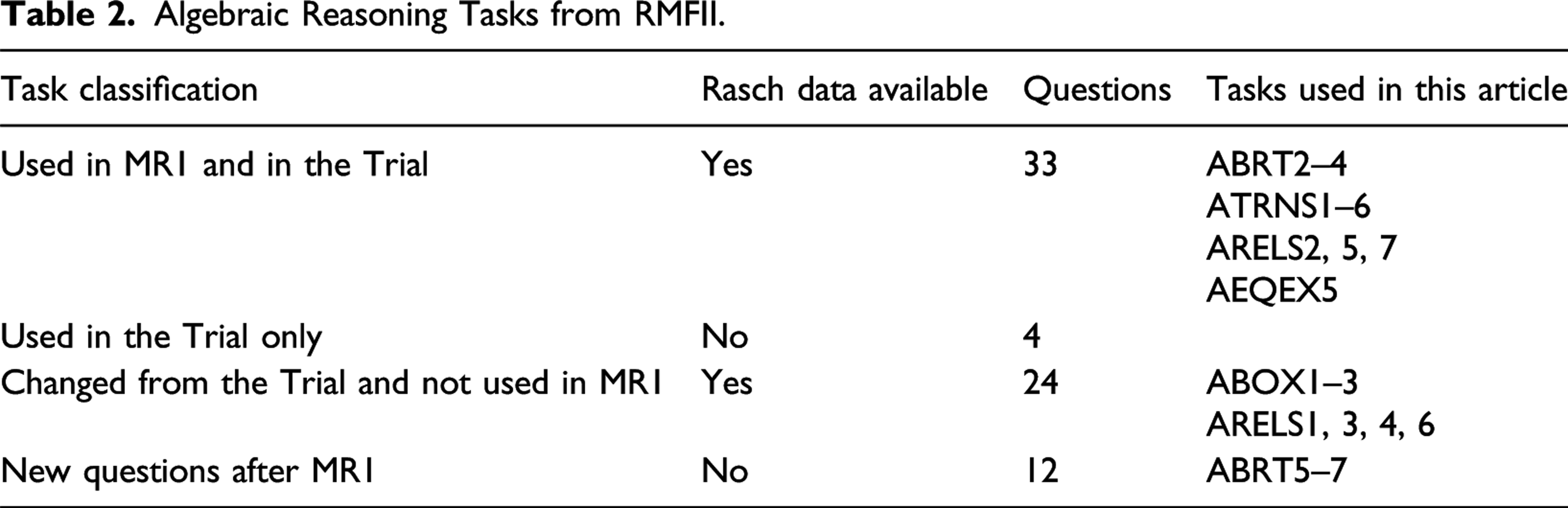
Algebraic Reasoning Tasks from RMFII.
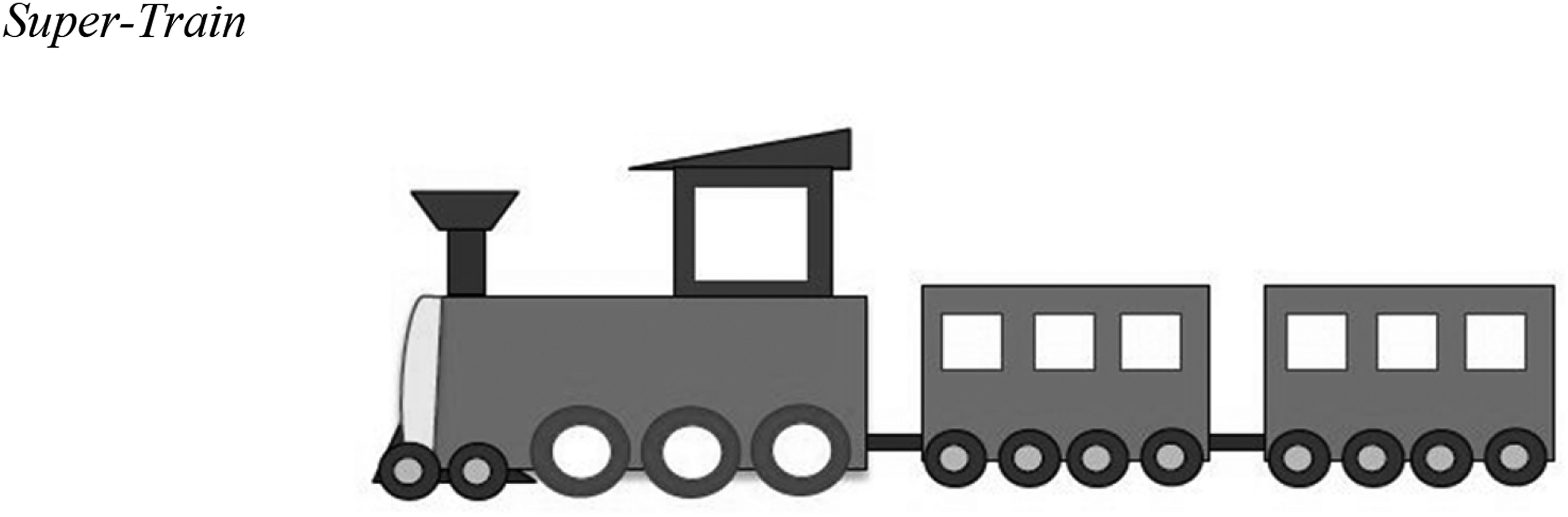
Establishing equivalence can be demonstrated by showing that different expressions always generate the same number where the same variables are used. Alternatively, equivalence may be established by using algebraic simplification. Both techniques are important for demonstrating that two expressions, while different on the surface, are in fact equivalent. 5 Explicit generalised reasoning is evident where students move between the particular to the general and vice versa, can identify and describe what varies and what stays the same and work confidently with generalised expressions themselves. In an extension of the Trains task mentioned previously, a Super-Train is introduced (see Figure 2) where the engine has 10 wheels, and each carriage has 8 wheels. Students are asked in question ATRNS6 to write a rule in words or symbols for working out the size of a Super-Train given any number of wheels. In a preceding question, ATRNS5, students had already been asked to formulate a rule for working out the number of wheels any sized Super-Train would need. A possible answer to ATRNS5 would be N = 8S + 2. Students could then answer ATRNS6 by creating a table of values using the above formula and then finding rule with S in terms of N, or they could transform the formula N = 8S + 2 to make S the subject. Super-Train.
As the research of Kaput (2008), Carraher et al. (2007) and Blanton et al. (2015) demonstrated, helping students to articulate and refine their algebraic thinking, especially their algebraic reasoning and justification, are complex and challenging tasks even for capable teachers. These abilities require constant and supportive cultivation if they are to be achieved by most students. One of the strengths of the RMFII extended tasks is that they can differentiate students’ responses. The analysis in RMFII used Rasch modelling (Bond & Fox, 2015) to identify eight zones of algebraic reasoning from Zone 1 to Zone 8 across Pattern and Function, Equivalence and Generalisation. Expanding the range of achievement, especially with respect to the development of fully generalised reasoning, remains our challenge as this project moves into its next phase.
Implications of the RMFII research in algebraic reasoning
The research in RMFII developed an effective learning progression, with associated tasks for students’ algebraic reasoning (Day et al., 2017). Nearly all tasks are graduated (multi-part), and thus we are confident they can elicit progressive levels of students’ algebraic generalisation, which is one aspect of the whole of algebraic reasoning in the RMFII learning progression. We also believe that assessment tasks of this kind are suitable for classroom teachers to help teach algebraic generalisation.
The Rasch analysis used in the RMFII study was intended to measure the cognitive difficulty of the tasks in algebraic reasoning. The analysis informed the development of a robust set of assessment forms, each using a collection of assessment tasks which enable teachers to assess students and determine the approximate zone of algebraic reasoning in which they are operating. Using the evidence-based learning progression in algebraic reasoning which was developed in RMFII, teaching advice was provided to enable teachers to target their teaching and assist students to move forward in their learning. As a precursor to focusing on generalisation, we will show here how several RMFII assessment tasks are able to elicit the full range of graduated responses from Zone 1 to Zone 8. We will then elaborate and validate a practical and robust learning progression for describing and characterising algebraic generalisation based on students’ performances.
Our first task has been to show how the existing RMFII tasks, supported by the available Rasch modelling, align with and help to elaborate our five-point categorisation of algebraic generalisation. A second goal is to show how this revised categorisation is likely to be useful to teachers in the middle school years, a key area for the development of students’ capacity for algebraic generalisation.
Among the 70 or so RMFII assessment questions in algebraic reasoning, there was a subset of tasks, each of which consisted of four or more questions connected to the one problem context and required algebraic generalisation to achieve a full score for that question. Typically, these tasks started with questions dealing with particular instances, requiring students to identify regularities and then asking students to use these to form symbolic expressions, upon which they were then invited to explain and justify their reasoning.
Validating the five levels of our learning progression in algebraic generalisation
In this section, we draw on the Rasch modelling that was used in RMFII to rank the cognitive difficulty of students’ scored responses on the set of algebraic thinking tasks and relate it to the proposed five levels of an algebraic generalisation learning progression. The Rasch analysis was repeated with data from students in Years 5 and 6 and further data from students in Years 7–10 and was stable.
Based on the available Rasch modelling in which the item difficulty of RMFII tasks is distributed across eight zones, with Zone 1 characterising the easiest and Zone 8 characterising the most difficult, our analysis of RMFII tasks relating to algebraic reasoning will proceed in two ways. The first will follow an analysis of one extended assessment task (ABRT) along similar lines to that carried out in our 2017 article (Day et al., 2017) relating to the ARELS (Relational Thinking tasks) 1–7 which showed how this set of tasks was successful in identifying different degrees of cognitive difficulty across Zone 1–Zone 7 of the Rasch scale. In this first stage of our analysis, we will show that students’ responses to an RMFII task Board Room Tables (ABRT2−8) can be used to offer confirmatory evidence to our five-level progression. However, one proviso needs to be given at the outset that Rasch data were not available for all components of the ABRT.
In a second stage of analysis, we will overcome this problem by using available Rasch data to identify students’ responses to a suite of different tasks, showing clearly that there is a clear correspondence between the features of students’ responses to these tasks which illustrate the five levels of our progression, and which at the same time is confirmed by all eight zones of the RMFII Learning Progression in Algebraic Reasoning.
Table 2 sets out the complete set of RMFII tasks related to algebraic reasoning, identifying those that are referred to in this article. MR1 refers to the first data collection round of the RMFII project.
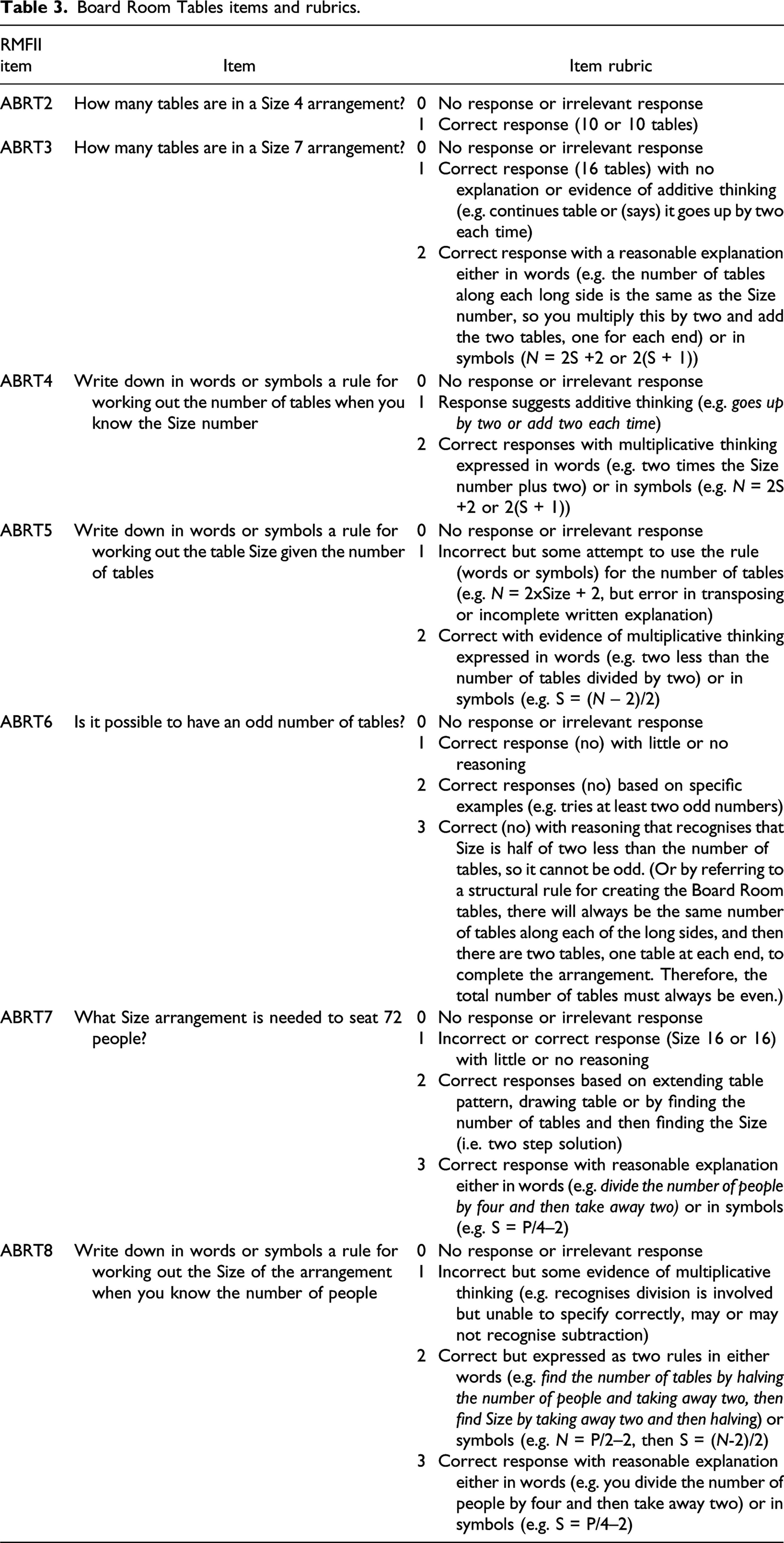
Board Room Tables items and rubrics.
Validation test 1 – using the Board Room Tables tasks 2–8
Board Room Tables (RMFII) consists of seven questions – ABRT2 to ABRT8 – graduated to give evidence of increasing levels of generalisation. Each question is provided with its own scoring rubric with guidance to teachers on how students’ responses might be scored (see Table 3). Rasch analysis data are also available for the first three of these questions to show how students’ responses to these questions and their scores have been scaled. The problem task scenario for ABRT is shown in Figure 3. Board Room Tables.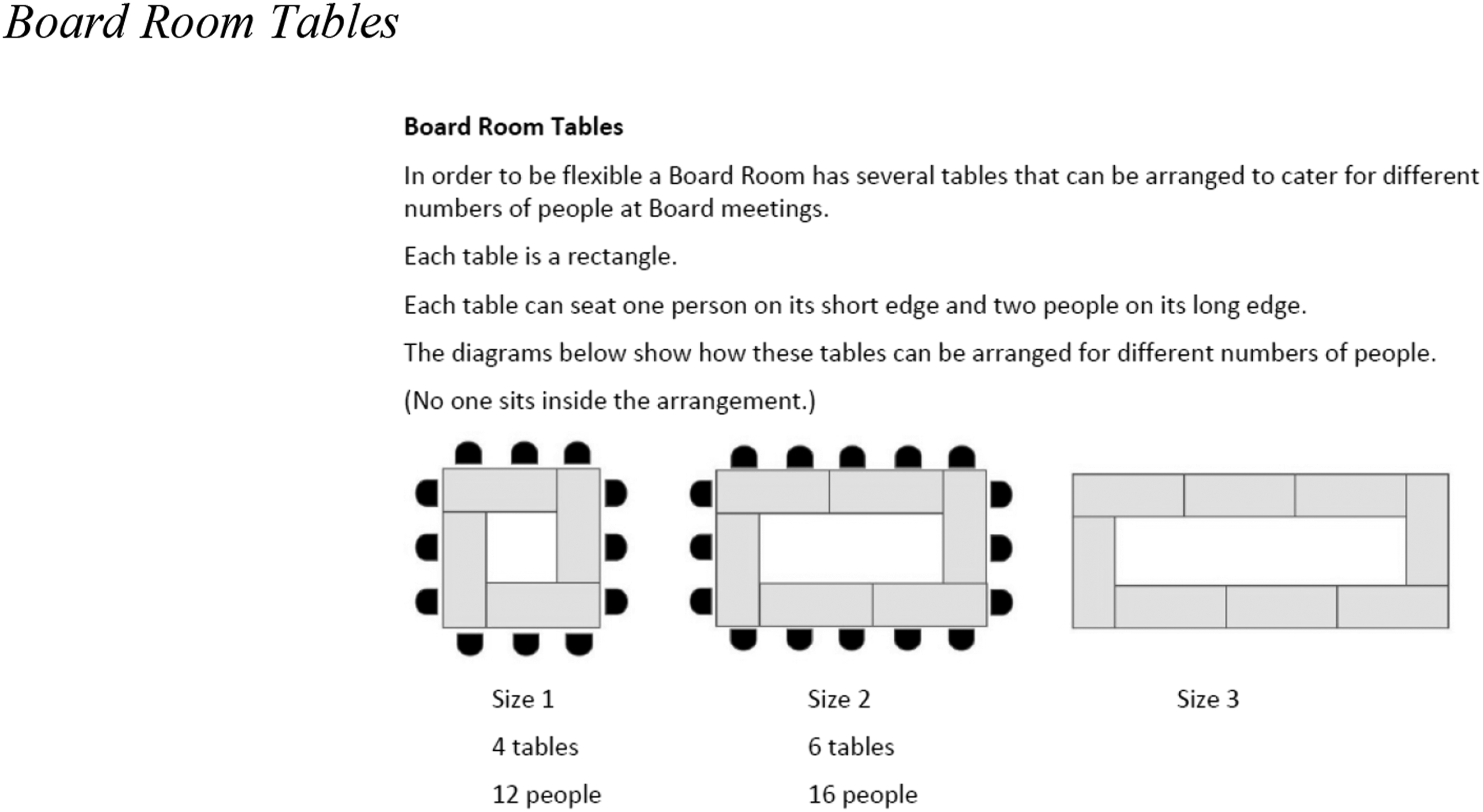
Results for questions in task ABRT
Question ABRT 2: How many tables are in a Size 4 arrangement?
A response ABRT2.1 (indicating a score of 1 on task ABRT2) is in Zone 1 of the Rasch scale. This response corresponds to the first level of our progression where students can work successfully with particular instances. In most cases, this is the foundation upon which subsequent levels of algebraic generalisation can be built. For example, students having been shown in the diagram the number of tables in Size 1, Size 2 and Size 3 are likely to have extended this pattern one more time by adding two more tables.
Question ABRT 3: How many tables are in a Size 7 arrangement? Explain your reasoning.
A response ABRT3.1 is in Zone 1 of the Rasch scale. No evidence of generalisation is required for a correct response (16 tables). A response ABRT3.2 again illustrates students working successfully with particular cases, the first level of our progression.
A response ABRT3.2 is in Zone 6 of the Rasch scale. The requirement to offer an explanation in verbal or symbolic form necessitates that students can relate the number of tables (N) to the size (S) of the arrangement. A Score of 2 requires a multiplicative relationship involving the number of tables (N) and the size (S) of the arrangement, thus moving beyond an additive representation for the number of tables for Size 7 (7 + 7 + 1 + 1). This response corresponds to the third level of our progression where students can form verbal or symbolic expressions to express generalisation.
Question ABRT 4: Write down in words or symbols a rule for working out the number of tables when you know the Size number.
A response ABRT4.1 is in Zone 3 of the Rasch scale. There is evidence of generalisation in that students understand that two additional tables are required for each increase in the Size of the arrangement. This partial generalisation is based on additive thinking and does not necessarily relate the two variables, N and S. This response corresponds to the second level of our progression where students successfully notice and describe regularities and patterns.
However, a response ABRT4.2 is in Zone 6 of the Rasch scale. A score of 2 requires a multiplicative relationship involving the number of tables (N) and the size (S) of the arrangement. This response, like that for ABRT 3.2, corresponds to the third level of our progression where students can form verbal or symbolic expressions to express generalisation.
Question ABRT 5: Write down in words or symbols a rule for working out the table Size given the number of tables.
Although there are no Rasch data for ABRT 5, the close similarities between ABRT 5.2 and the preceding ABRT 3.2 and ABRT 4.2 would support our view that a response shown in ABRT 5.2 corresponds to the third level of our progression where students can form verbal or symbolic expressions to express generalisation.
Question ABRT 6: Is it possible to have an odd number of tables?
Although there are no Rasch data for ABRT6, we would argue that a response ABRT 6.3 is indicative of the fifth level of our progression where students use explicit generalised reasoning to discuss features of generalisations. We need to seek additional Rasch data to confirm that a response such as ABRT 5.3 would be in Zone 7 or 8.
Question ABRT 7: What Size arrangement is needed to seat 72 people?
A successful response to this question requires students to connect the Size variable with the variable N representing the number of tables and the variable P representing the number of people.
Although there are no Rasch data for ABRT7, a response ABRT 7.1 would illustrate students working successfully with particular instances, the first level of our progression. A response ABRT 7.2 would correspond to the second level of our progression where students successfully notice and describe regularities and patterns. A response ABRT 7.3, such as S = P/4 – 2), would correspond to the third level of our progression where students form verbal or symbolic expressions to express a generalisation.
Question ABRT 8: Write down in words or symbols a rule for working out the Size of the arrangement when you know the number of people.
A response ABRT 8.2 corresponds at least to the third level of our progression where students form verbal or symbolic expressions to express a generalisation. However, when students correctly write down two expressions such as N = P/2 – 2 and then S = (N−2)/2, this could be evidence that they recognise that N, S and P denote the same variables and that they can be substituted for one another. Where this takes place, we would see this as corresponding to the fourth level of our progression where students use equivalence to explore different expressions of the same relationship.
We would argue that a response such as ABRT 8.3 should be indicative of the fourth level of our progression if students use the previously found expressions N = P/2 – 2 and S = (N−2)/2 to generate a table of values relating S, N and P and then seek to find a generalised expression for S in terms of the number of people P from the values in the table, such as S = P/4 – 2).
It might, however, be argued that this last stage could be evidence of explicit generalised reasoning, the fifth level of our classification, where students move between the particular to the general and vice versa, are able to identify and describe what varies and what stays the same and to work confidently with generalised expressions themselves.
Given the complexity of this task, it may have been preferable to ask students to explain their reasoning allowing for a more finely grained scoring 0–4 where a response such as ABRT 8.4 could represent the most developed and explicit generalised reasoning. This would allow us to see this task as offering opportunities for students to display forms of explicit generalised reasoning corresponding to the fifth level of our progression, where students are able to work confidently with generalised expressions themselves, such as using substitution to eliminate N from the two expressions N = P/2 – 2 and S = (N–2)/2. Such an extension of the scoring rubric would need to be supported by confirmatory Rasch data.
Validation test 2 – using graded responses across a range of RMFII tasks
Graduated responses from RMFII ranked according to confirmed Rasch analysis.
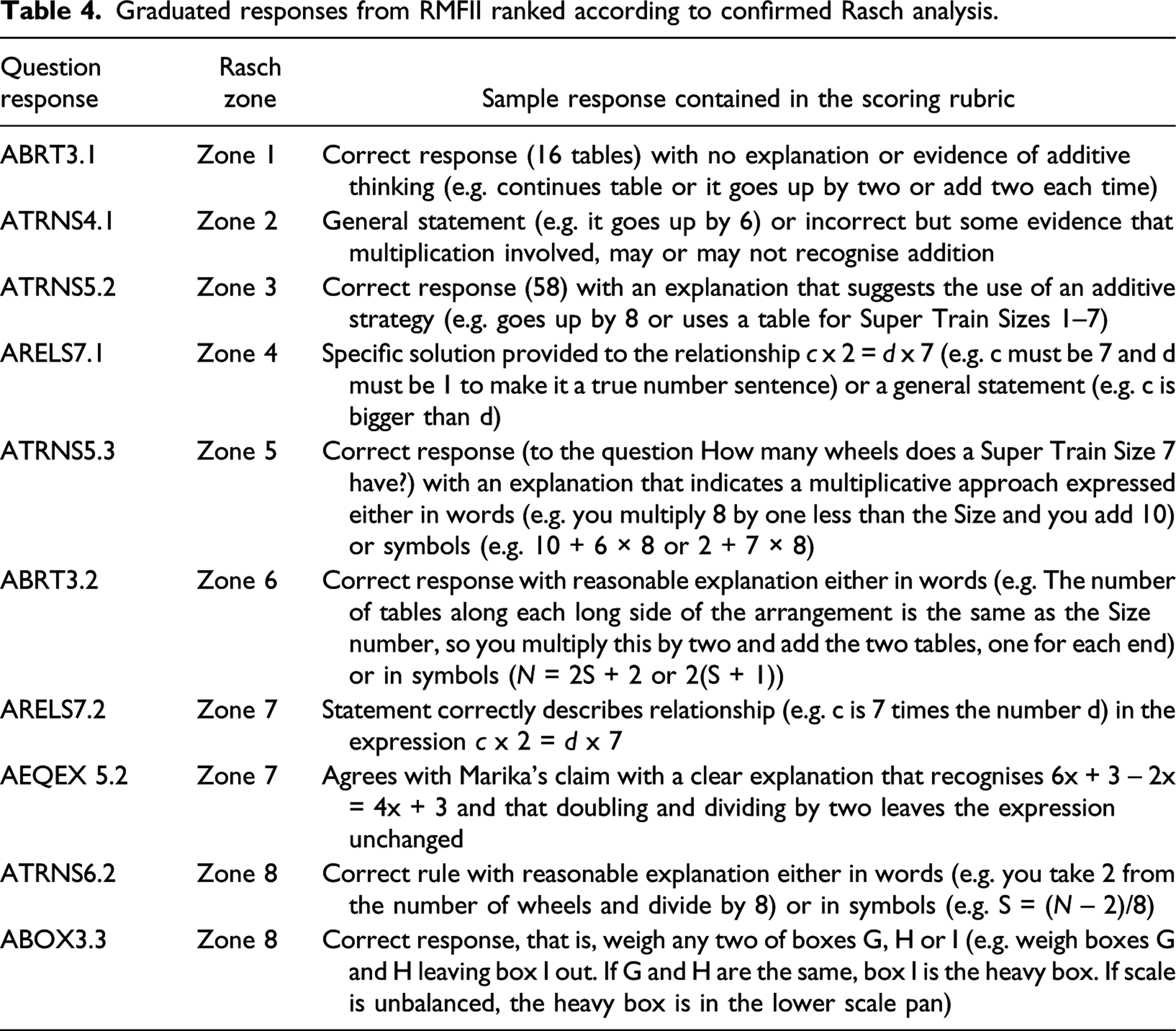
Two responses in Zones 1 and 2 ABRT3.1 and ATRNS4.1 exemplify the first level of our progression where students can identify and work with only with particular instances.
Zones 3 and 4, illustrated by responses to the Trains question ATRNS5.2 and the Relational Thinking question ARELS7.1, correspond to the second level of the progression where students notice and describe regularities and patterns.
Zones 5 and 6, utilising responses to two questions from Trains ATRNS5.3 and a Board Room Tables question ABRT3.2, correspond to the third level of the progression where students can correctly form expressions – either verbal or symbolic.
Zone 7 can be illustrated by two responses – ARELS7.2 and AEQEX5.2 – drawing on students’ understanding of equivalence based on relational thinking and two ways of writing an equivalent algebraic expression, which corresponds to the fourth level of the progression. The respective scoring rubrics require students to use “algebraic equivalence” to examine different expressions of the same relationships and expressions.
Zone 8 can be illustrated by two responses – one to the Super-Trains question (ATRNS6) and to another task called Boxes (ABOX), shown in Figure 4, where students have to generalise a balance situation for identifying the one box among nine similar boxes which is known to be heavier than the others. Zone 8 corresponds to the fifth level of the progression. Here, the scoring rubric requires students to use explicit generalised algebraic reasoning. ABOX1 question.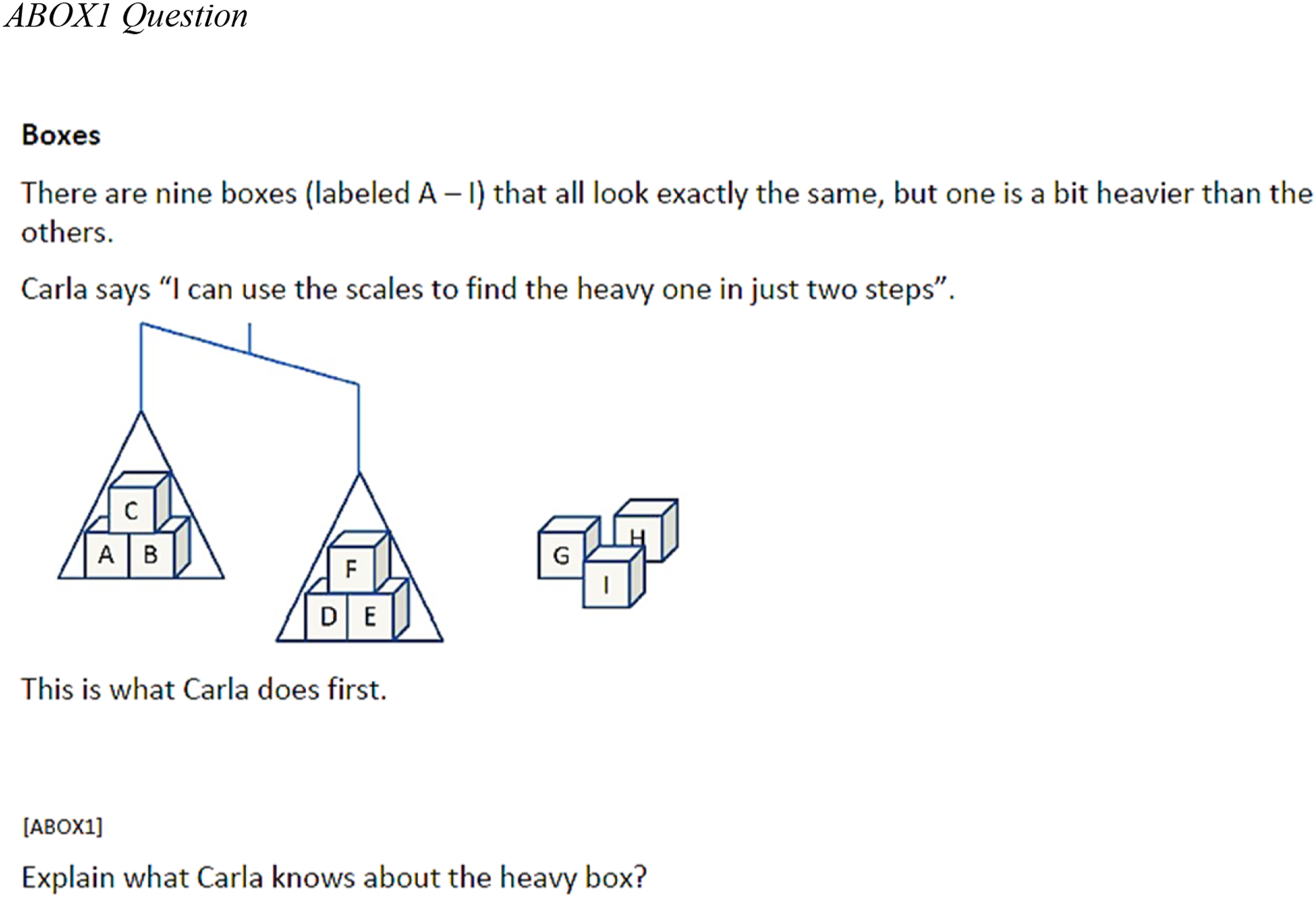
A strength of this confirmatory classification is that it is replicable allowing the same conclusions to be drawn from responses to a different set of questions. For example, the set of seven Trains questions (ATRNS) has Rasch data on 16 graded responses by students ranging from Zone 1 to Zone 8. Similarly, seven Relational Thinking questions (ARELS) have Rasch data on 13 graded responses by students ranging from Zone 1 to Zone 7. Other tasks used in Table 4 such as Boxes (ABOX) with its three questions have eight graded responses ranging from Zone 3 to Zone 8. No responses to the ABOX questions are located at Zone 1 or Zone 2, presumably because the ABOX tasks are presented students with the boxes already divided into groups of three. Figure 4 shows the ABOX1 question.
Limitations
There are several minor caveats we need to offer. A first is that the 120 graded responses are not evenly distributed across the eight Rasch zones. For example, there are only 7 responses that are classified in Zone 8, compared to 17 in Zone 7. On the other hand, there are 13 graded responses each in Zone 1 and Zone 2.
A second caveat is that the Rasch modelling that has been completed is on the whole set of algebraic reasoning questions. It is desirable to collect a new set of data that focusses specifically on the learning progression for algebraic generalisation proposed in this article, for example, on the complete set of ABRT and ATRNS tasks.
In addition to the Rasch modelling of student responses, qualitative analysis should be completed on a range of actual student written responses. This would be beneficial in understanding specific features of student thinking and would be beneficial to teachers.
Conclusion
The analysis of the nature of the questions in relation to the available Rasch data clearly validates the five-level progression of generalisation across the algebraic reasoning tasks. To this extent, it is an evidence-based learning progression. More importantly, evidence-based learning progressions have been shown to be practical for teachers using the RMFII tasks themselves and their associated scoring rubrics (Siemon et al., 2021). These can be applied to evaluating students’ responses to teacher-generated and to similar textbook tasks.
Future work on LPs needs to be supported by large scale data of the kind provided by the RMFII project. From our perspective, LPs are intended primarily to inform teaching and assessment of students’ thinking by teachers. Supported by psychometric measurements, such as its use of Rasch analysis, the focus of RMFII has been on producing tasks, scoring rubrics, and targeted teaching advice that Australian teachers can use. This evidence-based learning progression can better inform the AC:M and provide teachers with a clearer path to enhancing students’ algebraic generalisation.
The kinds of algebraic generalisations that have been exemplified in this article are at the core of mathematical reasoning. It is fundamentally important, therefore, for teachers and students to become aware of, and confident in, what is needed in effective justification using appropriate combinations of language and algebraic representation. As a form of reasoning and proof, and for strong application in a plethora of problem-solving situations, algebraic generalisation will be embedded in students’ continuing study of mathematics. Our task in this article has been to explicate clearly for teachers, including pre-service teachers, curriculum planners and researchers the conditions for and stages of this important component of mathematical reasoning.
Footnotes
Declaration of conflicting interests
The authors declared no potential conflicts of interest with respect to the research, authorship, and/or publication of this article.
Funding
The authors disclosed receipt of the following financial support for the research, authorship, and/or publication of this article: The Reframing Mathematical Futures II (RMFII) Project 2014–18 was funded by the Australian Mathematics and Science Partnership Programme scheme, Australian Government, Canberra in partnership with industry partners and practitioners in each State and Territory and the Australian Association of Mathematics Teachers (AAMT). The views expressed here are those of the authors and do not necessarily reflect the views of the funding body.
