




Abstract
This study explored what Ghanaian student teachers value in college mathematics learning. A cross-sectional survey involving 180 student teachers from College of Education in Ghana was conducted using the What I Find Important (WIFI) in mathematics learning questionnaire. The study employed principal component analysis with Oblimin rotation and one-way multivariate analysis of variance in analyzing the data gathered. Among the findings, it was found that student teachers value exploration, connections, understanding, and fluency in their study of college mathematics. Also, the findings of the study revealed a statistically significant difference in what student teachers value in college mathematics learning across college class levels. To facilitate a clearer understanding of valuing in the colleges of education in Ghana, it is considered important to establish through research the values of teacher educators regarding college mathematics learning and teaching, and how these values reflect what student teachers value and those values espoused in the new 4-year Bachelor of Education (B.Ed.) curriculum in Ghana.
Introduction
Many students approach mathematics learning with negative affect including anxiety, fear, and disengagement. It most likely came about as a result of developing and implementing a mathematics curriculum that is packed with values, abilities, and techniques that do not match what students value (Seah et al., 2016). Over the past two decades, there has been an increase in global interest and research regarding the role of values in mathematical education (Davis et al., 2019). The recent developments in culture and mathematics have also brought the issue of values into greater focus, raising awareness of school mathematical values together with individual students’ values. This could be a consequence of the realization that values are a crucial component of the classroom affective environment which sustains students’ learning interest in mathematics and consequently improve their achievement (Vecchione & Schwartz, 2022; Weidinger et al., 2020). Weidinger et al.’s (2020) study, for example, found intrinsic, attainment, and utility task values in mathematics as positive predictors of German secondary school students’ mathematics achievement. Since values influence students’ interests, thoughts, decisions, preferences, and behaviors about mathematics, Bishop (2008a, 2008b) believes that values can be a valuable instrument for fostering cognitive and affective growth in mathematical education. This then brings into focus a greater need to examine values, which represent a more influential affective force than beliefs and attitudes.
Values seem to signify different things to different people depending on the situation. In the context of mathematics education, values are characterized as qualities that an individual internalizes and attaches value to, giving them the will and drive to stick with any course of action they decide to pursue in the study and teaching of mathematics (Seah, 2016). Values are thought to control how a student's or teacher's emotional and cognitive dispositions in relation to learning or teaching components of mathematics are aligned. They offer students the “will and grit to maintain any ‘I want to’ mindset in the learning and teaching of mathematics” (Seah, 2018, p. 575).
Values in mathematics and mathematics education have been categorized in many ways by various researchers (e.g., Bishop, 1988, 2008a; Seah, 2016). Bishop (1996) classified educational values into three categories: general educational, mathematics educational, and mathematical values. The things that mathematics as science finds valuable are mathematical values. Bishop contends that the values upheld by Western Mathematics are those of mathematics. They are “values which have developed as the knowledge of mathematics has developed within ‘Westernized’ cultures,” according to Bishop (2008a, p. 83). Mathematical values are generated by how mathematicians from many cultures have developed the field of mathematics and are connected to the nature of mathematical knowledge itself. Examples of such values include objectism, rationalism, openness, etc. These values give students a subtly conveyed message about what matters in mathematics learning (Seah et al., 2017a).
The mathematics educational values are “values embedded in the particular curriculum, textbooks, classroom practices, etc. as a result of the other sets of values” such as those associated with general educational and mathematical values (Bishop, 2008a, p. 83). These are the attributes of mathematics learning that students would highlight and believe are crucial for academic achievement in mathematics which are connected to the way the subject is taught. Examples of these values include clarity, practice, accuracy, etc. These valuings take place in the context of actions taken to improve mathematics teaching and learning. In fact, one could argue that whereas a student may not value practice in studying History, they may value it in mathematics in order to continue honing their expertise.
Additionally, general educational values are those that are regarded as important in school education generally, and which are taught through different school subjects, including mathematics. These values, according to Bishop (2008a), are “associated with the norms of the particular society, and of the particular educational institution” (p. 83). These values are crucial for the preservation and improvement of the social fabric. Examples of these values include obedience, integrity, kindness, etc.
Although value has been discovered to be a significant affective aspect of mathematics education, it is the least discussed, measured, and researched phenomenon among the affective variables (Tapsir et al., 2018). Relatively, value is a recent field of research in mathematics education compared to other affective mathematics variables like beliefs, attitudes, and perceptions. In spite of the dearth of empirical research, there is evidence of valuing research globally (Davis et al., 2019; Davis et al., 2021; Dede, 2006; Seah et al., 2017a, 2017b).
A study investigating values in mathematics education portrayed by elementary student teachers was conducted by Haciomeroglu (2020) in Turkey. The study's findings, which were based on responses from 401 elementary student teachers at two public universities, indicated that, on the whole, student teachers had positive values regarding mathematics education. They understood that mathematics’ theoretical nature would be meaningless without its connections to practical life (Haciomeroglu, 2020). The results showed that there were no significant differences in the values of mathematics education among student teachers concerning the number of years they spent in the program. In a related situation, Dede (2006) explored the mathematics educational values of college students at Cumhuriyet University in Sivas, Turkey towards the function concept. Data were gathered from 11 items of chosen reasons for questions and 10 open-ended questions. The results showed that the formalistic view, relevance, accessibility, reasoning, and instrumental learning values were favored by students from all grade levels when learning the function concept.
In their study, Pang and Seah (2021) discovered that Korean students are conscious of the importance of understanding, connections, accuracy, and efficiency attributes in mathematics learning. They concluded that the blend of these values plays a part in having the desire to achieve at a high level. This clarifies why Korean students, according to Pang and Seah (2021), “performed excellently in mathematics despite most of them having negative affect about mathematics and/or mathematics learning” (p. 287). Tang et al.'s (2020) investigation focused on Eastern Chinese students’ preferences for certain qualities of mathematics learning. Seven components, including culture, memorization, technology, objectism, practice, comprehension, and control were discovered to make up the dimensions of the students’ value structure in learning mathematics. The study also demonstrated that students’ perceptions of what is significant in mathematics learning are crucial in determining how their learning activities are regulated.
In a similar context, Zhang (2019) also looked into the components of mathematics learning that the Chinese Mainland's primary and secondary school students assigned a special priority to using the What I Find Important [WIFI] (in mathematics learning) questionnaire. The primary students tended to place more weight on memory, effort, ability, formula use, and diligence compared to the secondary students. Secondary students were more inclined to prioritize knowledge and critical thinking as aspects of studying mathematics. These suggest that among students from mainland China, there were disparities in values according to grade level. A teacher-led but student-centered learning style was valued by students in general. These findings were consistent with those of Seah et al.'s (2017a) study which revealed statistically significant difference in the nine attributes which Japanese students valued as a function of their grade levels: primary or secondary school.
In a comparative study, Zhang et al. (2016) employed a WIFI questionnaire to investigate primary students’ values in mathematics learning in Tawain, Chinese Mainland, and Hong Kong. The findings show that the students’ value structure has six dimensions: relevance, achievement, communication, practice, information and communications technology (ICT), and feedback. Nevertheless, statistically significant differences between the regions were discovered in each of the six value components produced from the main components analysis.
A similar study in the Ghanaian context that analyzed data from both primary and secondary school students was conducted by Davis et al. (2019) to explore how Ghanaian pupils valued mathematical learning. Using the WIFI questionnaire, the study examined the effects of grade levels on the aspects of mathematics learning that 1,256 elementary, junior high, and senior high school students considered valuable. According to the survey, Ghanaian students valued qualities including authority, fluency, relevance, accomplishment, ICT use, adaptability, and techniques when learning mathematics. To determine whether there are any notable variations in what students valued about mathematics across grade levels, the one-way multivariate analysis of variance (MANOVA) was employed. The findings also showed a notable impact of grade and school levels on students’ value of mathematics. Thus, it was discovered that students’ values for mathematics varied significantly between grade levels and also between primary, junior high, and senior high schools. In their recent study, Davis et al. (2021) polled 416 senior high school students from Cape Coast, Ghana to find out what they valued most about their mathematical education. Principal component analysis was used to assess the collected data. The study found that Ghanaian senior high school students valued feedback, fluency, connections, understanding, problem-solving, learning technologies, instructional materials, and open-endedness as essential components of their mathematical education.
From the literature, it is observed that most of the studies focus on what students in primary and secondary schools value in mathematics learning and teaching with very few studies (e.g., Dede, 2006; Haciomeroglu, 2020) conducted among tertiary students. It, therefore, appears that there is no empirical research in the Ghanaian context investigating what students at Colleges of Education/Universities value in mathematics learning. This study thus fills the research gap by investigating what student teachers at the tertiary levels of our education system value in mathematics learning and whether a statistically significant difference exists in what student teachers value across college class levels.
As it has become increasingly recognized that what students value in mathematics learning influences their mathematics achievement, teachers are therefore required to pay close attention to students’ value preferences in mathematics education. Notwithstanding, mathematics teachers are faced with the challenge of determining which mathematical values should be created through mathematics education that would meet the needs of their students. This study sheds light on college students’ value structure in mathematics learning so that teacher educators can capitalize on these structures to inform their instructional decisions in the classroom. These instructional decisions have a significant impact on how mathematics learning is evaluated because what is judged depends on what is intended (goals), which in turn heavily relies on mathematical values. The findings from this study would also provide a useful starting point for developing an evidence base on what student teachers at the college of education (tertiary level) value in mathematics learning in Ghana. Thus, this study contributes to the existing literature by furthering what researchers know about values and valuing; specifically focusing on what tertiary students value in the learning of mathematics.
Moreover, this study calls attention to the values that student teachers at the college of education in Ghana consider critical and important in mathematics education, and stimulates dialogue among the scientific community on how to meet these value needs of the student teachers through decision making in classroom instruction. The findings would help teacher educators, curriculum developers, and policymakers to help better understand the local context. The study is timely, given that this knowledge of what student teachers value in mathematics learning at the College of Education in Ghana would help us to better plan the implementation of the new 4-year B.Ed. mathematics curriculum which envisioned instilling the needed competencies through teacher education. In this context, the study sought to answer the following research questions:
What values are of interest to student teachers in college mathematics learning? Does a statistically significant difference exist in what student teachers value in college mathematics learning across class levels?
Theoretical framework
In understanding what student teachers value in college mathematics learning and how that changes as they progress along the college levels, a well-established theoretical framework would be required. We employed Bishop's (1988) six values cluster model, which was based on his research and publications about mathematicians’ activities throughout Western history and culture. According to Bishop (1988), there are three pairs of complementary mathematical values that relate to ideological, sentimental, and sociological values. These pairs are, respectively, rationalism-objectism, control-progress, and mystery-openness. He described “rationalism-objectism as the twin ideologies of mathematics, those of control-progress as the attitudinal values which drive mathematical development, and, sociologically, the values of openness-mystery as those related to potential ownership of, or distance from mathematical knowledge and the relationship between the people who generate that knowledge and others” (Bishop, 1988, p. 82).
Rationalism is specifically related to logical analysis, reasoning, and mathematical argument. Contrarily, objectism emphasizes the objectification, concretization, symbolization, and application of mathematical concepts. Valuing progress is valuing alternative approaches, creating new ideas, and challenging established ones, whereas valuing control is valuing mastery of rules, facts, procedures, and established criteria. For the final complimentary pair, the value of openness relates to the value of individual justifications and proofs, while the value of mystery relates to the value of the mystique, fascination, and wonder of mathematical concepts (Bishop, 2008a, 2008b). In order for mathematics education to be effective, Bishop (1988) contends that it must foster the development of both of these complementary sets of values. In this study, we explore what matters most to student teachers at different college levels in their mathematics learning experience using the theoretical framework provided by these categorizations of values.
Methodology
Research design
The study employed a cross-sectional survey design (Cohen et al., 2018) to gain a broad picture of what student teachers of a College of Education value in college mathematics. A survey serves as one of the efficient ways of gathering data on a one-shot basis to make generalizations about the targets of focus (Cohen et al., 2018).
Sample and sampling technique
The study was conducted among student teachers who are specializing in mathematics at a College of Education in Ghana. These student teachers were drawn from class levels: 100, 200, and 300. Student teachers pursuing B.Ed. program progress through 4-year levels. Student teachers in levels 100, 200, 300, and 400 are those in years 1, 2, 3, and 4, respectively. The study excluded final-year student teachers who were in level 400 due to their unavailability during the conduct of this study. Level 400 student teachers were out of campus for their final-year Supported Teaching in Schools (STS) program within the period the study was conducted.
Cohen et al.'s (2018) sample size determination table was used to calculate the sample size for the study, using a confidence level and interval of 95% and 3%, respectively. For the purpose of the study, student teachers were selected using a proportionate stratified sampling technique. This led to the selection of 180 student teachers for the study, of which 59 were from level 100, 63 from level 200, and 58 from level 300. To conduct the survey among these selected student teachers, we sought written permission from the College management and also obtained informed consent from individual participants before the survey's commencement.
Instrumentation and method of data analysis
The WIFI in mathematics learning questionnaire, which has previously been validated, was used for this study. The WIFI instrument, which was specifically created and later cross-culturally verified for this kind of study, offers an effective tool to determine what learners value in mathematics learning (Seah, 2016). This instrument was made up of four sections: A, B, C, and D. Section A, which consisted of 64 items explored what students find important in learning mathematics. Section B, with 10 items asked respondents to indicate along a continuum the degree to which their valuing tends toward one of two bipolar assertions. Four scenario-stimulated items made up section C, while section D with 13 items asked for the student's biographical information (see Seah, 2016). However, since this study is exclusively interested in what student teachers value in college mathematics learning, just section “A” consisting of 64 Likert-type items of the WIFI questionnaire (English version) was modified for use in the data collection. A five-point Likert-type scale was used with absolutely important (1 point), important (2 points), neither important nor unimportant (3 points), unimportant (4 points), and absolutely unimportant (5 points).
In addressing the research question and testing the hypothesis, a principal component analysis with Oblimin rotation and one-way MANOVA were performed using the Statistical Product and Service Solutions (SPSS) version 23 in analyzing the data. In all, 162 responded questionnaires were screened for data analysis as 18 of the questionnaires were not able to be retrieved from participants.
Issues of validity and reliability
In spite of the WIFI questionnaire being an instrument specifically created and cross-culturally validated in selected counties including Ghana for exploring what learners value in mathematics learning, it was pilot tested on 20 student teachers in the College to determine their reliability. The WIFI questionnaire's Cronbach alpha score was 0.82, exceeding the advised value of 0.7 (Taber, 2018), which suggests adequate internal consistency. Some of the items that the students found confusing/unclear were slightly altered as a result of this procedure to make them clearer. In determining the face and content validity of the WIFI questionnaire, a draft of the updated WIFI questionnaire was distributed to two other researchers in the field of the study for their expert judgment about the instrument on the accuracy and appropriateness of the instrument items.
Results
What values are of interest to student teachers in college mathematics learning?
The 64 items on the WIFI Scale were subjected to principal components analysis (PCA) in an effort to ascertain the bare minimum number of factors that can be used to accurately depict the interrelationships among the collection of variables in the data.
The data's appropriateness for factor analysis was evaluated before performing PCA. Table 1 presents two different tests: Kaiser-Meyer-Olkin Measure (KMO) of sampling adequacy and Bartlett's test of sphericity that affirms the factorability of the correlation matrix or otherwise. As evident in Table 1, KMO recorded a value of 0.886. This indicates that it is plausible to conduct factor analysis, thus, it is meritorious (Howard, 2016). The correlation matrix's identity as an identity matrix is tested using Bartlett's test of sphericity, that is, the variables are unrelated and not ideal for factor analysis. From Table 1, Bartlett's test of sphericity value was statistically significant (p = .00), and therefore factor analysis is appropriate.
Kaiser-Meyer-Olkin and Bartlett's test.

Kaiser-Meyer-Olkin and Bartlett's test.
Many coefficients of 0.3 and above were found when the correlation matrix was examined. Employing Kaiser's criterion and scree test techniques, a decision concerning the number of factors to retain was made. When applying Kaiser's criterion, only components with an eigenvalue of 1 or greater were of interest to us. To this end, only the first 12 components that recorded eigenvalues above 1 (22.322, 8.132, 5.972, 4.955, 3.406, 2.373, 2.252, 1.794, 1.472, 1.267, 1.250, and 1.022) were found in assessing how many components fit this requirement. These 12 components explain an overall 87.84% of the variance.
A close look at the scree plot showed a distinct discontinuity after the fourth component. This demonstrates that the first four components explain a substantially larger portion of the variance than the other components. We made the decision to keep four components for further research using Catell's (1966) scree test. The results of the parallel analysis, which indicated only four components with eigenvalues exceeding the appropriate threshold values for a randomly created data matrix of the same size (64 variables × 162 respondents), provided additional support for these conclusions.
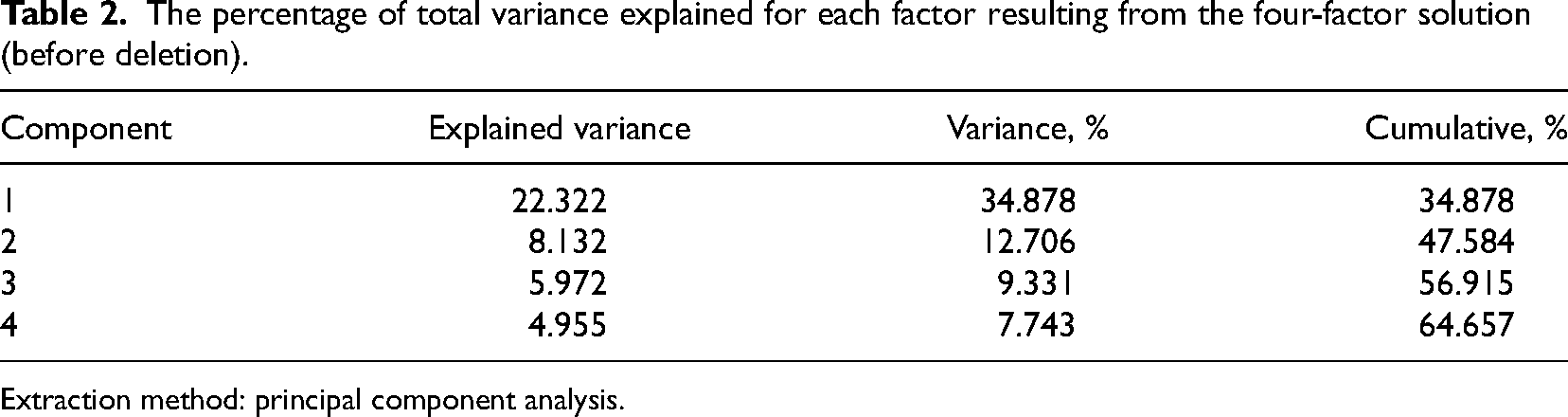
We adopted an exploratory approach, testing out several factors until a workable solution was discovered (Tabachnick & Fidell, 2013). In this light, Oblimin rotation was performed where the four-factor solution was forced. The percentage of total variance explained for each factor resulting from the four-factor solution is presented in Table 2.
The percentage of total variance explained for each factor resulting from the four-factor solution (before deletion).
Extraction method: principal component analysis.
The four-component solution explained a total of 64.66% of the variance, with components 1, 2, 3, and 4 contributing 34.88%, 12.71%, 9.33%, and 7.74% respectively. These results show linear relationships between the various factors, providing context for the use of factor analysis.
After four-factor rotation, we observed that 13 items did not mesh well with the rest of its component's items from the communalities output. We have considered the need expressed by Pallant (2011) and Tabachnick and Fidell (2013) that for a successful outcome and to be interpreted, the magnitude of the factor loadings must be more than 0.3. In this direction, the 11 items with communality values less than 0.3 were deleted from the WIFI scale. Also following the four-factor rotation, many variables with strong loadings served as each component's representation, however, we could not obtain a simple structure where every variable loaded substantially on only a single component.
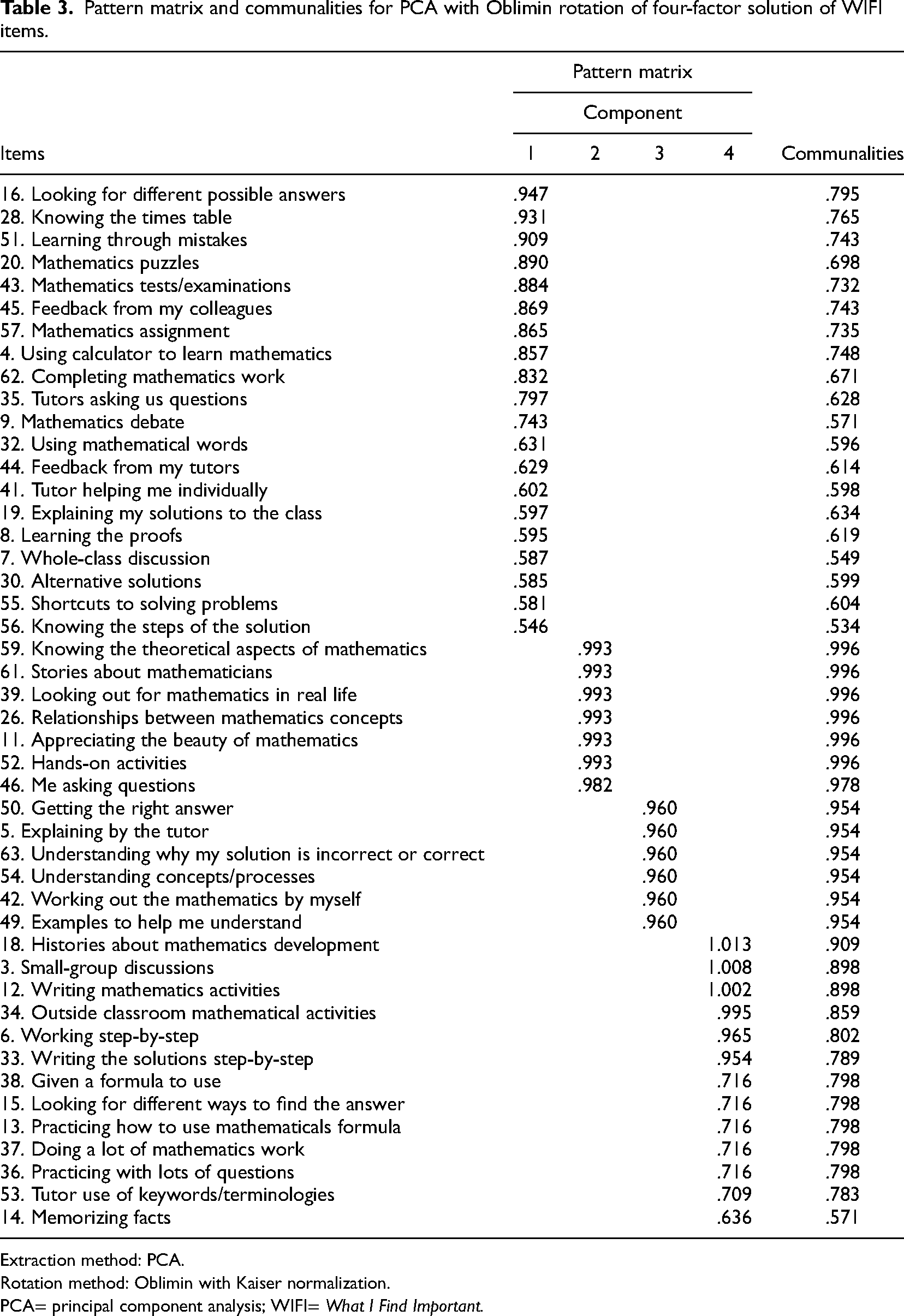
From the pattern matrix output, we found seven cross-loading items which were also deleted. Pallant (2011) recommends the removal of variables that just do not load on only one component to obtain a more optimal solution. After the deletion of the 18 items, the PCA with Oblimin rotation was repeated with the remaining 46 items to obtain a simple structure (Tabachnick & Fidell, 2013) as shown in Table 3.
Pattern matrix and communalities for PCA with Oblimin rotation of four-factor solution of WIFI items.
Extraction method: PCA.
Rotation method: Oblimin with Kaiser normalization.
PCA= principal component analysis; WIFI= What I Find Important.
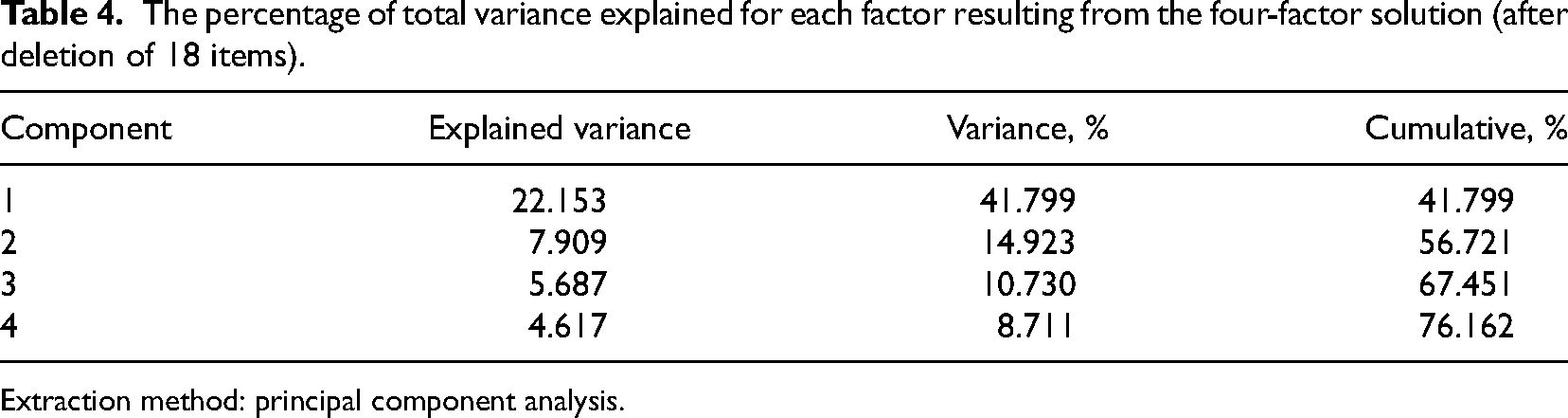
After the deletion of these items, the percentage of total variance explained for each factor resulting from the four-factor solution is presented in Table 4.
The percentage of total variance explained for each factor resulting from the four-factor solution (after deletion of 18 items).
Extraction method: principal component analysis.
The four-component solution after the deletion of some of the items explained an overall 76.16% of the variance, with components 1, 2, 3, and 4 contributing 41.80%, 14.92%, 10.73%, and 8.71%, respectively. These results indicate linear associations between the different factors, giving meaning to the application of factor analysis. In comparison, it could be observed that the overall variance explained for each of the four components has increased. This confirms the assertion made by Pallant (2011) that, removing items with low communality values tends to increase the total variance explained.
Oblimin rotation was carried out to assist in the interpretation of these four components. As shown in Table 3, the rotated solution demonstrated the existence of a simple structure, with all variables considerably loading on only one component and the four components exhibiting a variety of strong loadings.
Following the results in Table 3, the similar explanatory criteria for the items that saturate in each component were used as the basis for assigning a label to each one. The first component (C1) was labeled exploration. Most of the items that loaded on C1 such as Knowing the steps of the solution (item 56), Looking for different possible answers (item 16), Alternative solutions (item 30), Learning the proofs (item 8), and Mathematics puzzles (item 20). Also, the component labeled Exploration comprised 20 items accounting for 41.80% of the overall variance. However, a few items such as Feedback from my colleagues (item 45), Using mathematical words (item 32) which loaded onto C1 seem not to be reflective of exploration.
The second component (C2) was labeled connection. Most of the items that loaded on C2 such as Looking out for mathematics in real life (item 39), Knowing the theoretical aspects of mathematics (item 59), Relationships between mathematics concepts (item 26), and Hands-on activities (item 52). Also, the component labeled connection comprised seven items accounting for 14.92% of the overall variance. However, the item Me asking questions (item 46) which loaded onto C2 seems not to be reflective of connection.
The third component (C3) was labeled understanding. Most of the items that loaded on C3 such as Understanding why my solution is incorrect or correct (item 63), Understanding concepts/processes (item 54), Examples to help me understand (item 49), and Explaining by the tutor (item 5). Also, the component labeled understanding comprised 6 items accounting for 10.73% of the overall variance. However, the item Getting the right answer (item 50) which loaded onto C3 seems not to be reflective of understanding.
The fourth component (C4) was labeled fluency. The majority of the items that loaded on C4 include Doing a lot of mathematics work (item 37), Given a formula to use (item 38), Practicing with lots of questions (item 36), and Memorizing facts (item 14). Also, the component labeled fluency comprised 13 items accounting for 8.71% of the overall variance. However, a few items (Histories about mathematics development, item 18; Small-group discussions, item 3) which loaded onto C4 seems not to be reflective of fluency.
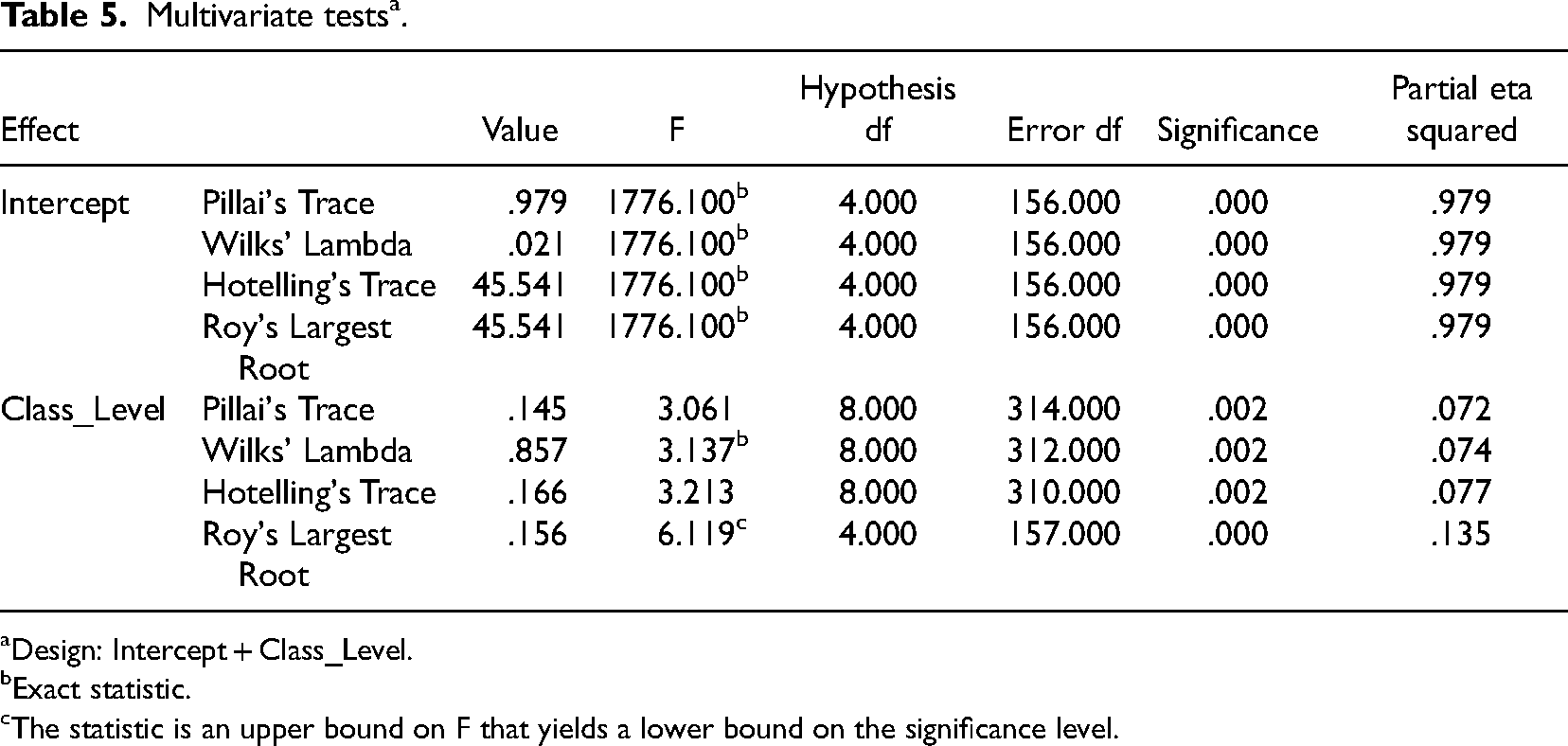
To look into differences in values at the class level, a one-way between-groups multivariate analysis of variance was conducted. Components 1, 2, 3, and 4 served as the four dependent variables. Class level constituted the independent variable. The initial examination of the assumptions of normality, linearity, univariate and multivariate outliers, homogeneity of variance-covariance matrices, and multicollinearity was performed, but no significant violations were found. To determine if there are statistically significant differences between the groups on a linear combination of the dependent variables, Table 5 gives multivariate tests of significance.
Multivariate tests
a
.
Multivariate tests a .
Design: Intercept + Class_Level.
Exact statistic.
The statistic is an upper bound on F that yields a lower bound on the significance level.
From Table 5, it could be observed that the pooled dependent variables showed a statistically significant difference depending on the class level, F (8, 156) = 3.14, p = .002; Wilks’ Lambda = 0.86; partial eta squared = 0.07. Hence, we conclude that there is a statistically significant difference in what student teachers value in college mathematics learning across class levels by rejecting the null hypothesis and accepting the alternative hypothesis.
Obtaining significant results on the multivariate test, we deemed it necessary to conduct further investigation to find out whether student teachers at the various class levels differ on all of the dependent measures, or just some. Table 6 presents the results for the tests of between-subjects effects.
Tests of between-subjects effects.
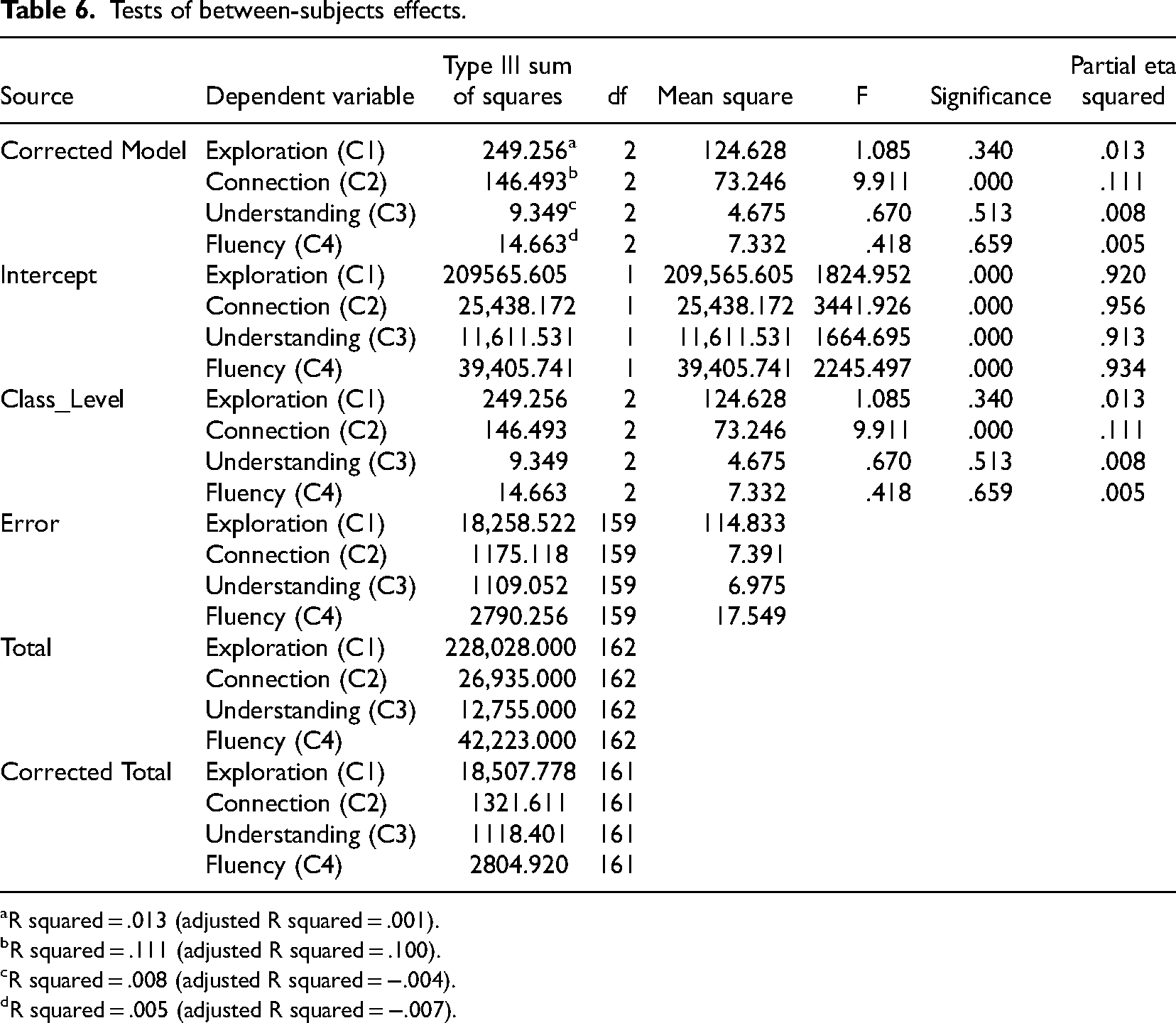
R squared = .013 (adjusted R squared = .001).
R squared = .111 (adjusted R squared = .100).
R squared = .008 (adjusted R squared = −.004).
R squared = .005 (adjusted R squared = −.007).
The only difference to achieve statistical significance when the findings for the dependent variables were taken independently (see Table 6), using a Bonferroni adjusted alpha level of 0.013, was connection, F (2, 159) = 9.91, p = .00, partial eta squared = 0.11. Though statistically significant, the study found a small effect as 11% of the variance in the scores for connection was explained by class level. Table 7 presents the estimated marginal means that compare group means.
Estimated marginal means.
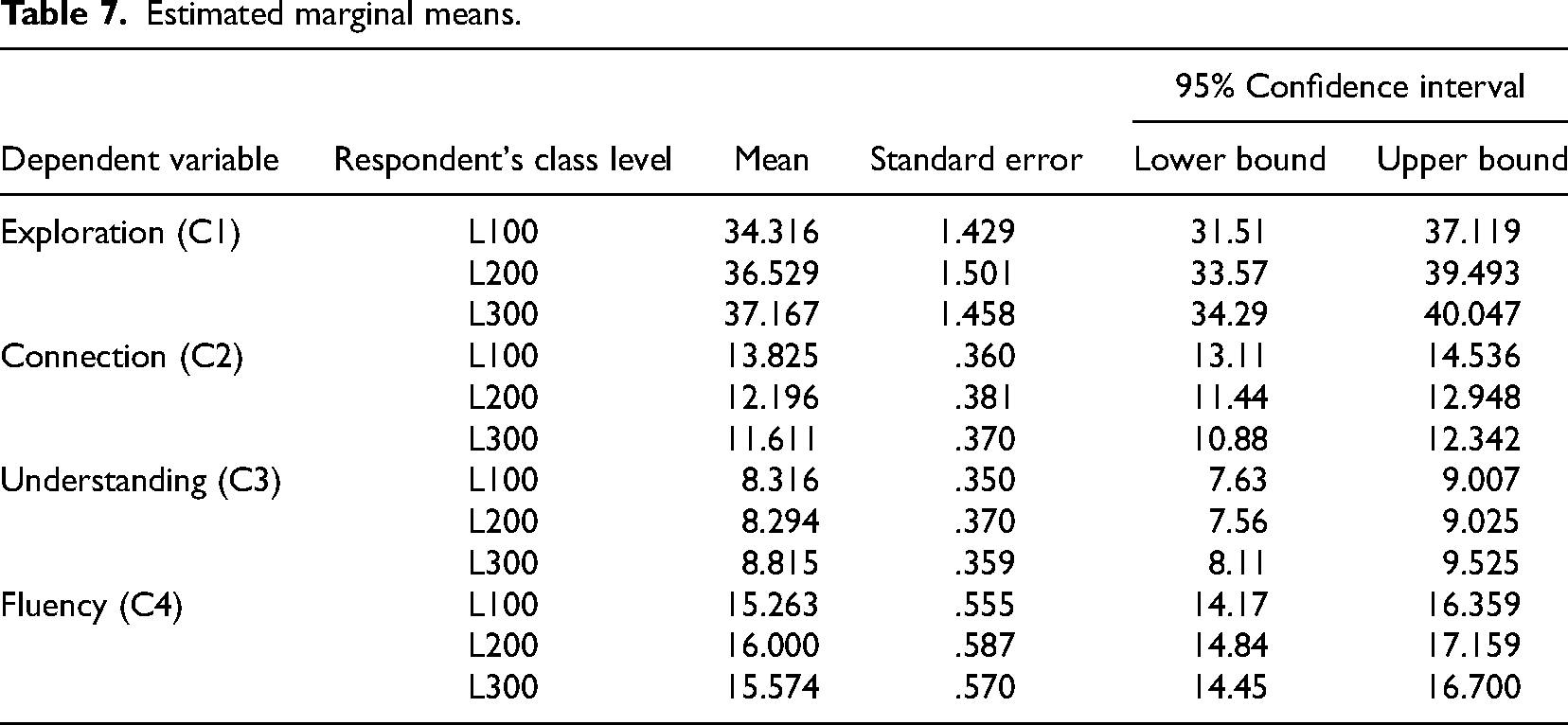
An inspection of the mean scores showed that level 100 student teachers reported the highest levels of connection (M = 13.83, SE = 0.36, N = 57) compared to that of level 200 student teachers (M = 12.20, SE = 0.38, N = 51) and level 300 student teachers (M = 11.61, SE = 0.37, N = 54). The indication is that level 100 student teachers value connection more than their colleagues at the other two levels.
For the valuing of connection, there is a downward trend with the projected marginal mean score rising with grade level. And that the higher student teachers progress through academic levels, the lower they value connection. Even though there was statistical significance, less than 2-scale points actually separated the three mean scores’ actual differences.
This study investigated what student teachers at a College of Education value in mathematics learning, and whether a statistically significant difference exists in what student teachers value across class levels. In the study, we sampled 180 student teachers of which 162 of them responded to the WIFI questionnaire.
Four qualities that these student teachers valued most in their mathematics learning were determined using the principal component analysis with Oblimin rotation, accounting for 76.16% of the total variance. These qualities are exploration, connection, understanding, and fluency, from highest to least in terms of the proportion of variation explained. These attributes that student teachers value regarding mathematics learning were consistent with some of the attributes Davis et al.'s (2021) study found among senior high school students in Ghana. Davis et al. (2021) found among other things that Ghanaian senior high school students deemed connections, understanding, and fluency vital in their mathematics learning. These findings are quite not surprising since these senior high school students are the ones who complete school and get admitted into tertiary education (College) to pursue their teacher education programs. Therefore, these students might have carried along with them some of these qualities of mathematics that they value whiles at senior high school.
What the student teachers at the College value in this study is probably related to the new demands placed on them as teachers to be by the new teacher education program. For instance, the reason why student teachers place such a high value on exploration, connections, and understanding may be that doing so enhances their ability to deal with contextualized mathematics learning and transform knowledge to learners they will be teaching in Ghanaian basic schools after completion of program.
In the quest to investigate whether a statistically significant difference exists in what student teachers value across grade levels, a one-way MANOVA was employed. The findings suggest a significant difference in what student teachers value in college mathematics learning across class levels for the four components namely, exploration, connection, understanding, and fluency. These findings corroborate Davis et al.'s (2019) study findings that discovered a notable impact of grade level on Ghanaian students’ valuing in studying mathematics at primary and secondary school levels. These were consistent with Seah et al.'s (2017a) study which showed a statistically significant difference in what Japanese students value in studying mathematics in terms of their grade levels: primary or secondary school. Contrarily, Haciomeroglu’s (2020) investigation on values in mathematics education among Turkish elementary student teachers found no significant differences in the values of mathematics education among student teachers with reference to the number of years they spent in the program.
The findings revealed that the projected marginal mean scores for grade level decreased for the valuing of connection (looking out for mathematics in real life [item 39], knowing the theoretical aspects of mathematics [item 59], relationships between mathematics concepts [item 26], and Hands-on activities [item 52]). These findings, therefore, suggest that valuing of connection decreases as student teachers progress in their undergraduate program in terms of class levels. These attributes relate more to what Bishop et al. (2006) describe as empiricism value of mathematics learning. It could therefore be argued that student teachers in level 100 at the college value connection/empiricism in mathematics learning more than level 200, while student teachers in level 200 also value connection/empiricism in mathematics learning more than those in level 300.
Conversely, the results also showed an increase in the grade level calculated marginal mean scores for the valuing of exploration (alternative solutions [item 30], looking for different possible answers [item 16], knowing the steps of the solution [item 56], and learning the proofs [item 8]). These findings imply that valuing of exploration upsurges as student teachers progress in their undergraduate program in terms of class levels. These attributes to a large extent relate to what Bishop et al. (2006) describe as progress value of mathematics learning. It could therefore be argued that student teachers in level 100 at the college value exploration/progress in mathematics learning less than level 200, while student teachers in level 200 also value exploration/progress in mathematics learning more than those in level 300.
A significant part of what student teachers valued in mathematics at the College of Education corresponded to the demands of the new 4-year B.Ed. curriculum, which aims to develop new teachers who are highly competent, motivated, effective, engaging, and equipped to teach the basic school curriculum and so enhance all students’ learning outcomes and prospects in life (Ministry of Education, 2018a). The student teachers value of connection, for example, stands to prove that they have been forming critical values that will prepare them for the challenges ahead of them in their teaching career such as lack of connection between mathematics and real-life experiences, and among various subjects. Also, as a consequence, what student teachers value as important in mathematics can serve as a guide for teachers in designing learning activities.
Conclusions
This study has improved our knowledge of what student teachers at a College of Education value in mathematics learning and how these valuings develop across class levels. Having found attributes that student teachers value in mathematics learning, teacher educators would be more confident in leveraging these values by way of designing classroom instruction that reflects those values so as to support student teachers’ cognitive and affective growth. This will then lead to improvement in the prospective teachers’ mathematical learning experiences. We believe that the key to teacher educators leveraging student teachers’ value in mathematics learning in teaching is to have an understanding of what their students value mathematics learning.
Student teachers at this tertiary institution value exploration, connections, understanding, and fluency in their study of college mathematics. These qualities largely align with some of the valuing reported by senior high school students in Ghana (see Davis et al., 2021). Our investigation of whether a statistically significant difference exists in what student teachers value across grade levels using one-way MANOVA revealed a statistically significant difference in what student teachers value in college mathematics learning across class levels. Therefore, we draw the conclusion that there are statistically significant differences in what College of Education student teachers value in mathematics education at different levels. The only difference to achieve statistical significance when the findings for the dependent variables were taken independently, using a Bonferroni adjusted alpha threshold of 0.013, was connection.
The results of this investigation have ramifications for future studies. It is crucial to note that the study was only done in one of the 46 public Colleges of Education in Ghana, even though the sample size was sufficient to justify generalizing our findings to the student–teacher population at the selected College of Education. Hence, the results could not represent Ghana's status as a whole. Future WIFI studies may therefore include data from other Colleges of Education across the nation. Moreover, to facilitate a clearer understanding of valuing in the colleges of education, it is considered important to establish through research what teacher educators value regarding college mathematics teaching, and how these values reflect what student teachers value and those values espoused in the new 4-year B.Ed. curriculum.
Footnotes
Acknowledgements
We wish to acknowledge the student teachers of St. Joseph's College of Education for their acceptance and participation in this study.
Contributorship
Declaration of Conflicting Interests
The author(s) declared no potential conflicts of interest with respect to the research, authorship, and/or publication of this article.
Funding
The author(s) received no financial support for the research, authorship, and/or publication of this article.
