



Abstract
The critical role of teacher–student interaction in students’ educational outcomes, sense of belonging, and psychological and social well-being makes teacher–student interaction between international students and their teachers at the host universities worthy of research. Using Norton’s model of language, identity and investment to examine Chinese students’ in-class interaction with their Australian teachers, we found Chinese students tended to avoid classroom interaction. Although this finding appears to be due to language and cultural reasons, Norton’s model seems to provide a more profound interpretation of our participants’ reluctance to invest in in-class teacher–student interaction, particularly with the addition of the ‘culture’ element to the model. Students’ out-of-class interaction with their Australian teachers seems to reveal a tension in intercultural communication: most participants favoured oral, face-to-face and immediate communication by using phones and social media apps rather than emails. Suggestions for enhancing intercultural understanding and interaction between international students and their host university teachers are discussed.
Keywords
Introduction
With the rapid development of international mobility comes the increasing number of international students to countries such as the United Kingdom, the United States and Australia. For example, the total enrolment number of international students in Australia between January and April 2020 was 694,118, and half of them were enrolled in the university sector (Department of Education, Skills and Employment, 2020). While for a country, transnational education is valued as a national project, for an individual, it means acquiring a wider range of cultural capital and therefore the status of a global citizen (Chung et al., 2018).
A large volume of research examines the acculturation experiences of international students from the academic, social and psychological perspectives (e.g. Andrade, 2006; Wright and Schartner, 2013; Zheng, 2017). Most of these studies touch on international students’ interaction with host university teachers in class (e.g. Heng, 2018; Holmes, 2006; Wang and Bai, 2020), but their interaction with teachers out of the classroom is not as much researched despite a plethora of research on out-of-class teacher–student interaction (TSI) between teachers with domestic students. Nonetheless, findings from studies on TSI in higher education (faculty–student interaction in the US context) show that quality and frequency of this interaction, both in class and out of class, have a bearing on students’ sense of belonging, which is of utmost importance for student retention, and are good predictors of students’ learning, and benefit students’ affective and intellectual development (e.g. Astin, 1984; Cox and Orehovec, 2007; Glass et al., 2015; Kim and Sax, 2009).
TSI seems particularly important for international students because they come to their host countries with the desire to gain rich academic, linguistic and cultural experiences. They want to become an ‘international person’ (Fang and Wang, 2014), to be deeply involved in the host country life and interact with the local people. Among those people are the university teachers with whom they may have the most frequent interactions. This study, therefore, aims to examine whether international students take advantage of the opportunities to interact with their teachers both in class and out of class and what factors impact on these two forms of interaction. This study contributes to the literature on transnational higher education by adopting Norton’s model of language, identity and investment as the analytical tool to explain international students’ in-class interaction with their host teachers and extending the original model with the addition of culture as an important element. The other contribution it makes includes the finding that there is a misalignment in interpersonal communication preferences between Chinese students and their Australian teachers, which provides an insight into traditional Chinese values as well as the practice of modern communication technology use in China.
Interactions between international students and their host country teachers
Anecdotally and in early research, international students, particularly students from East Asia, tend to be portrayed as passive rote learners who are more likely to adopt a surface learning approach and lack critical thinking skills (e.g. Ballard, 1987; Watkins and Biggs, 2001). These ‘traits’ seem to be displayed particularly in formal in-class interaction with both instructors and their fellow students. International students reportedly have limited participation in class discussion and rarely raise questions in Western classrooms (e.g. Kettle, 2005; Liu, 2002). In addition, researchers and teachers observe similar in-class silence of learners in countries such as Korea, Japan and China (Jin and Cortazzi, 2008; Kim et al., 2016; William, 2017), which seems to reinforce their negative impression about Asian learners. Indeed, Chinese researchers’ studies also find that Chinese learners appear not only silent in higher education classrooms (Lei et al., 2017), but their willingness to interact in class seems to decrease in primary school (Tang et al., 2020). Despite recent asset-based research focusing on Asian academic cultures that encourage independent thinking as well as research problematising a Eurocentric view of participation (Murray and McConachy, 2018), international students do not tend to interact as much as expected by lecturers in the ‘communication-heavy’ Western classrooms (Ha and Li, 2014; Murray and McConachy, 2018: 260; Wang and Moskal, 2019). Some prefer to leave questions until after class instead of asking them in class (Leedham, 2015). On the other hand, international students voice their bewilderment at their instructors in host universities keeping them at ‘arm’s length’, offering little support, especially after class (Ballard, 1987; Hellsten and Prescott, 2004), and not providing ‘correct’ answers to their academic questions (Ballard, 1987).
While both international students and their host university teachers experience some challenges when interacting with each other, most research reports linguistic barriers and cultural differences as the reasons behind international students’ in-class interaction with their host teachers (e.g. Sovic, 2013; Wang and Moskal, 2019).
Linguistic explanations in the literature
Language is usually the most straightforward explanation given by international students to account for their lack of interaction in class (Sawir, 2005; Wang et al., 2016; Wu, 2015). Although they have passed the entry language test or the equivalent, they may still be unable to adapt to the rate of speech of the lecturers, their accent, use of idiomatic expressions and trailing off at the end of a sentence (Sovic, 2013; Wang et al., 2016; Wu, 2015). In unravelling the mystery of ‘silent’ international students, Sawir (2005) found that in addition to the teacher-centred transmissive education model generally, a heavy emphasis on grammar, reading and writing in English teaching, the lack of (good) language exposure, as well as a stress on accuracy over fluency in the students’ prior English learning are to be blamed for international students’ limited English communicative competency. In addition, they are self-conscious of their accent, lack of fluency, imperfect grammar and the childish way they may sound when using a second language (Hellsten and Prescott, 2004). All these ‘inadequacies’ in their linguistic competence may exert negative psychological impacts on international students, leading to anxiety and reduced confidence and an unwillingness to communicate in class (Aoyama and Takahashi, 2020). Linguists have long noticed that the foreign language classroom can create anxiety in learners (Horwitz et al., 1986), and communication apprehension and fear of negative evaluation are two of the three constructs (communication–apprehension, test anxiety and fear of negative evaluation) in her Foreign Language Classroom Anxiety Scale. English is a foreign language for Chinese international students, so participating in English, according to Horwitz et al. (1986), may cause anxiety, which would in turn deter them from actively interacting with their host teachers. The anxiety may be exacerbated when the Australian classroom is filled with domestic students for whom English is their first language (L1) (Liu, 2002; Takahashi, 2019).
Despite these language challenges faced by international students, recent research problematises the deficit and othering discourse prevailing in the research on the linguistic competence of international students (e.g. Pham and Tran, 2015), and reveals that language learning as a process of intercultural learning is a constant relationship building between the self and the others (Harvey, 2016). Indeed, Ha and Li’s study (2014) shows that language barriers could be a motivating factor for international students to participate in class communication.
Cultural explanations in the literature
Researchers are not satisfied with the linguistic explanations only, and they dig deeper into the cultures of these international students. The ‘passive-receptive’ learning style that is observed by Western teachers in Asian students (e.g. William, 2017) is often attributed to the Asian cultures emphasising collectivism, power distance, uncertainty avoidance and face (Smith and Khawaja, 2011; Tang et al., 2020; Tran, 2013; William, 2017). Given this cultural tendency, interaction in an Asian classroom is characterised by the teacher’s dominance and students’ ‘compliance and silence’ (William, 2017: 50). Most of the time, students are required to listen attentively to the teacher and do not speak until they are called upon (Holmes, 2006). According to Jin and Cortazzi (2008), to Asian students and teachers, the primary role of in-class teacher–student interactions is for the teacher to check and for students to demonstrate whether they have mastered the knowledge imparted. As a result, most questions the teacher asks students to answer are not open questions but those with ‘correct’ answers (Guo and Pilz, 2020). This appears in contrast to the role of communication in the Western classroom where TSI in the form of discussion and question-raising open up the channel for students to discover knowledge and develop autonomy in learning and critical thinking skills (William, 2017). In addition, asking and answering questions may run the risk of being laughed at or receiving negative feedback from teachers (Tang et al., 2020), and therefore losing face, whereas very active class participation may be seen by peers as showing off, wasting the class time or even gaining teachers’ favour (Chalmers and Volet, 1997; Ha and Li, 2014). A strong version of Asian international students’ behaviour patterns believes that they are ‘culturally conditioned’ and adaptation to the Western academic culture would therefore be difficult (Wong, 2004).
However, Holmes (2006: 30), in studying the cultural factors behind Chinese students’ in-class interaction with their New Zealand classmates, raises important questions for researchers to consider when examining intercultural communication: ‘Whose values and rules for communication and conduct are privileged, ignored, or devalued?’ Researchers, according to Holmes (2006), should study international students’ communication behaviour that is situated within a culture and a context, rather than making sweeping conclusions.
Theoretical framework: Language, identity and investment
As a response to Holmes’ (2006) call for a situated study of international students, we adopted Norton Peirce/Norton’s (1995, 2013; hereafter ‘Norton’) framework of language, identity and investment to conceptualise the current study and hopefully offer a more nuanced sociological explanation for international students’ lack of participation in the host country classrooms.
According to Norton (2013: 4), identity is ‘the way a person understands his or her relationship to the world, how that relationship is structured across time and space, and how the person understands possibilities for the future’. Language used by an individual represents a particular identity of that individual and using language to participate in social communication allows an individual to negotiate their identity within the group (Liu, 2002; Osborne, 2012). Rather than a fixed character trait as postulated by psycholinguists, identity as defined by Norton is dynamic and changes across time and space (Darvin and Norton, 2015), so when an international student moves across borders, they may find their identity changes accordingly. This is particularly true if the language and culture are unfamiliar and the previously valued capital in their home context reduces its value in the new environment where ‘functions that are valid in local settings are imposed on the ways of speaking of transnationals, and discourses only gain value when others grant them value’ (Darvin and Norton, 2015: 45). Often the less competent use of the dominant language in, and the insufficient local knowledge of, the host academic context may work against international students, threaten their identity (Osborne, 2012) and make them feel that they are less competent human beings (Morita, 2004). Rather than seeing themselves as a legitimate member of the language/cultural community, they may feel that they do not have legitimate ownership of the dominate language and are therefore ‘other’ (Harvey, 2016).
A marginalised and excluded identity may have a profound effect on an individual’s (such as an international student) commitment to certain practices – ‘investment’, a term used by Bonny Norton Peirce to describe the social and historical relationship of immigrant English learners in Canada to the target language (Norton, 1995). The construct ‘investment’ is developed to complement the psycholinguistic theories about motivation and to better capture the social and historical relationship that language learners construct with the target language and the larger social world.
Using the term ‘investment’, which has an economic overtone, she postulates that language learners invest in a second language because they expect to ‘acquire a wider range of symbolic and material resources, which will in turn increase the value of their cultural capital and social power’ (Darvin and Norton, 2017: 2). As a result of this increase in cultural and social capital value, language learners reassess their ‘sense of themselves, their identities, and their opportunities for the future’. Their investment in second language learning is therefore also an investment in identity which is multiple, a site of struggle and changes across time and space (Weedon, 1987), ‘and thus investment is complex, contradictory, and in a state of flux’ (Darvin and Norton, 2015: 37). If the language practices in a given classroom are imbued with power relations, learners may be unwilling to invest in the practices although they may be highly motivated (Norton, 2013).
Although Norton’s focus was on second language learners, her conceptualisation about language, identity and investment is also applicable to Chinese students in our study as they are second language learners as well. We argue that in-class interaction with teachers is a form of investment for students due to the various benefits discussed in the Introduction. However, language as symbolic capital determines the inclusion and exclusion of international students depending on their competence in the dominant language used in the host country (Harvey, 2016; Pham and Tran, 2015). If international students find that the power imbalance in the classroom due to differences in linguistic capital threatens their established identity, they may be reluctant or refuse to invest in classroom communicative activities. That is, a Chinese international student’s less-than-competent use of the English language in the Australian classroom may deprive them of the positive identity associated with the value that the competent use of this symbolic capital can add, making them feel marginalised, excluded and segregated from the host classroom culture, and leading them to avoid or resist communication in class. Adopting the language of ‘investment’, we believe that when Chinese international students perceive no return of symbolic or material resources from using the target language to engage in classroom interaction, they may not view it as a worthwhile investment and make no efforts to use it.
Adopting the above theoretical framework in this study, we wished to understand whether Chinese international students invest in classroom interaction with their teachers in the Australian academic context, and how language, identity and investment interact with each other in deciding their investment or non-investment. The interview questions also focused on students’ investment in TSI and factors influencing their interaction with their Australian teachers. To make students feel at ease, we used mostly lay terminology when conducting the interviews. In addition, past literature reports that informal out-of-class interactions between students and teachers contribute to students’ retention, improved academic achievements and social/psychological well-being (Astin, 1993; Cox and Orehovec, 2007; Glass et al., 2015; Mara and Mara, 2011). However, most literature in this regard focuses on out-of-class interactions between the faculty and domestic students (e.g. Astin, 1993; Cox and Orehovec, 2007; Glass et al., 2015). Little research seems to have dealt with out-of-class interactions between international students and their host university teachers. Therefore, this study explored Chinese students’ out-of-class interactions as well. The research questions for this study were therefore:
How did Chinese international students interact with their host university teachers in class and out of class?
How did Chinese international students’ language, identity and investment interplay with each other in the in-class TSI?
What factors affected the way they interacted with Australian teachers outside the class?
Methodology
Research context
This article reports findings from a research project that examined joint 2+2 programmes between one Australian university and four Chinese institutions. These joint programmes were established around 10 years ago and are business-oriented due to the good reputation of business programmes offered by the Australian university. These 2+2 programmes allow students to spend two years in each country to complete their degree: students are prepared in the English language and foundation business courses at the Chinese universities during the first two years before coming to the Australian university to study their chosen majors in the last two years. The Australian university recognises the credits students have earned from the foundation business courses at the Chinese institutions as one-year equivalent of the Australian university’s three-year Bachelor of Business degree. Students receive the degree from the Australian university after they successfully complete their study in Australia. While students can have direct entry into their degree programmes if they pass the English proficiency test, most of our participants had to do some language courses at the Australian university before they met the language proficiency requirement for degree study. At the Australian university, teaching is delivered mainly in two modes: lectures and tutorials. Lectures are mostly unidirectional content delivery with class sizes ranging from less than 100 students to around 500, whereas tutorials are usually for knowledge and skills applications where there is more student–student and TSI with a smaller number of students (around 30). Oral participation in class is not assessed.
Participants
After ethical approval, we recruited 22 Chinese international students studying on 2+2 programmes at the Australian university. Eleven were in the second semester of their degree study, and the other half were in the fourth semester (last semester) at the Australian university. Among them, six were female and 16 male. Eleven were finance majors, six marketing, three accounting, one advertising and one international business. The participants came from four Chinese higher education institutions located in economically developed cities. As most of them had attended the Australian university for at least one semester, they were able to provide valuable data about their experiences in both China and Australia.
Data collection and analysis
Qualitative face-to-face interviews were adopted because instead of finding aggregate patterns of the in-class and out-of-class TSIs, this study intended to gain an in-depth understanding of students’ lived experiences of TSIs from the participants’ perspectives (Creswell, 2009). In addition, while in-class TSIs may be observable, out-of-class TSIs would be hard for public observation. Moreover, the reasons behind Chinese students’ interactions with their teachers may be best drawn out by asking the individuals themselves, because according to symbolic interactionist theory (Crotty, 2007), dialogue is a highly useful way to access people’s mental and affective processes. One-to-one interviews allow the researchers to probe into interesting themes that emerge on the spot by asking follow-up questions. In this way, an understanding of the TSI issue from the insiders’ perspectives can be achieved (Merriam, 1998). All the above reasons led to the decision to use interviews as the most effective way to elicit information from Chinese international students to address the research question.
A semi-structured interview was conducted with each participant for 45 to 60 minutes at one of the researchers’ office at the end of 2017. The interviewer was a Chinese academic with extensive research and teaching experience in both Chinese and Australian higher education contexts, but who had not known the participants before the interviews. The only possible power dynamics that existed between the interviewer and the participants was that the interviewer was the students’ senior with regards to age. This may mean that the participants, growing up in the Chinese culture, would show due respect to the interviewer, but other than that, there was no power relationship between the interviewer and the participants. The interviews were conducted in Chinese for ease of communication and capture of nuances of meaning. The interviews were audio-recorded and transcribed verbatim by native Chinese speakers.
This was part of a larger explorative study that examined the various aspects of Chinese 2+2 students’ intercultural experiences across the contexts including TSI. The interview questions for this study were formulated based on the past literature (e.g. Cox and Orehovec, 2007; Ha and Li, 2014; Sovic, 2013; Wang and Bai, 2020) rather than being guided by Norton’s theory (Norton Peirce, 1995). The theory was, instead, employed as an analytical tool for data interpretation. Some sample questions asked during the interview included: ‘Do you ask questions in class if you have one?’, ‘Why or why not?’, ‘What do you do if you wish to ask your teacher questions after class?’ and ‘Have you booked consultations with your teachers?’ In reporting the study, the quotes were translated and agreed upon by both researchers who are accredited Chinese–English translators. In order to protect participants’ identity, pseudonyms are used throughout.
Following Creswell’s (2009) qualitative data analysis model, we conducted thematic data analysis of the interview transcripts together. We first read through the transcript to get a sense of the data before we focused on the text segments that were relevant to our research question: in-class and out-of-class teacher-student interactions. After we located those text segments, we assigned a code label to each segment, using the participants’ words or our own label to sum up students’ comments. We then examined these preliminary codes derived from students’ answers to our interview questions by listing them to check overlap and redundancy. We eliminated the redundant codes and collapsed similar codes so that we could narrow down the many codes we constructed at the early stage to extract broader themes. After we extracted themes, we made constant comparisons between the themes and the interview data. At the final stage, we read all the transcripts again to make sure that the themes were appropriate and no text segments had been overlooked.
Findings
Our research aims to explore Chinese students’ in-class and out-of-class interactions with Australian teachers, so the findings are organised under two major themes: in-class interactions and out-of-class interactions with subthemes subsumed under them.
In-class interactions
As indicated in the literature review, a wealth of research reported that international students, including Chinese students, tend to stay silent and passive in class. Instead of ‘actively’ interacting with teachers as domestic students do, this student cohort seems more comfortable learning ‘passively’. In order to confirm/reject such a finding, we focused on the student participants’ question-raising behaviour, not only because it is a primary form of TSI in the classroom (Jin and Cortazzi, 2008) but also because we believe question-raising is more needs based than other forms of interaction such as volunteering answers to teachers’ questions.
Question raising
The students’ reports about question raising in the Australian classroom supported the past literature about silent Chinese students in Western universities (e.g. Ha and Li, 2014). Most student participants admitted that they did not ask questions in front of the whole class, be it at lectures or tutorials, and our data did not seem to show much difference between students of different year levels. For example, Cao, a student in her second semester, said: ‘[the number of Chinese students] asking questions in class may be one out of ten, one-tenth, that is it’ (Cao). The majority preferred not to do so in front of the whole class, rather, they do it either after class or in private as noted by Bai, a final year student: I don’t ask questions in class, but if I have questions, I would ask the teacher after class in private. Or during group work in class, when the teacher comes to our group asking whether our group has any questions, I would take this opportunity to ask. (Bai)
This finding is not only corroborated by Jin and Cortazzi (2008) who found Chinese students prefer to ask questions after class but also by lecturers in Murray and McConachy (2018) who reported that international students seemed to feel more comfortable in class participation when they were working in smaller groups. In spite of the overall tendency to avoid asking questions in front of the entire class, there were one or two ‘brave’ ones: ‘I participate in discussion and ask the teacher questions. However, I am one of those whose English is not good but would push themselves to do so’ (Guo).
Student-provided reasons for their in-class reticence
Participants reported quite a number of barriers that inhibited them from actively contributing to the oral class activities including asking questions. The most prominent obstacle, according to the student participants, was lack of confidence in their command of English, a reason reported by Japanese international students in Aoyama and Takahashi (2020). Some students were worried about their English listening competence: ‘I may not be able to understand the teacher’s explanations immediately. If I keep asking, I will take up other students’ time, so I usually ask in private’ (Cao). Others chose to be silent due to their weak speaking skills: ‘[I rarely ask questions] just because I feel I have difficulties in expressing myself accurately and clearly’ (He).
Student participants also regarded cultural differences as a factor, and below is Feng’s explanation: Australian students would stop teachers on the spot if they do not understand. They ask the teacher to explain one more time. Yet with Chinese students, our mode of education before university was not like theirs; in China, mainly the teacher talks in front, and if you have any questions, you ask the teacher after class.
Another culturally related inhibitor was the fear of losing face: ‘Asking questions at a big lecture is too embarrassing as there are locals among the students. I am afraid they may laugh at me if I use a wrong word’ (Bai). There were also students who were concerned that their questions would be irrelevant to others: Sometimes if the questions are simple or straightforward, I would ask the tutor (teaching assistant) straight away, but if the question is specifically related to myself or if it is complex and takes time for the teacher to offer a detailed explanation, I would ask it after class. (Peng)
Due to one or more or all of these factors, most Chinese students would try to solve their academic problems first by working with their fellow Chinese classmates before they approached the teacher: ‘We usually send a representative to ask the teacher. That’s it. [The representative would ask the teacher] after class before the teacher leaves’ (Xu). This supports the concerns expressed by Zhou and Todman (2008) that Chinese students tended to solve academic problems in their own groups, making lecturers unaware of the problems that individual students may have.
Out-of-class TSIs
According to the student participants, there were two main out-of-class channels through which students could contact teachers in Australia – email and consultation. The participants had differing expectations about out-of-class TSI.
Written vs instantaneous communication
Many participants complained about the inefficiency and inconvenience of email communication. They compared the different practices at their home institutions in China and in Australia. At home students were used to face-to-face communication with teachers because most students lived on campus, and students could go straight to the teacher’s office to find them. Or else, they could leave a WeChat 1 message or ring their teachers to get an immediate response: ‘Our class [back home] had a chat group, and if you had any questions, you would just leave a message there. Now in my WeChat group, I can still make voice calls to our teachers’ (Wen). However, most Australian teachers were more protective of their private time, and some told their students: ‘Don’t ring me unless it is urgent, and I won’t answer your calls’ (Wen). The preferred mode of communication at the Australian university is email, but quite a few student participants commented they were either not used to using email for communication, or they found emails quite inefficient: ‘If it is after hours, the teachers here would not reply to your email until the next day’ (Bai). There were, however, a couple of others who considered their instructors’ response to their email the next day to be efficient enough.
Out-of-class consultations
The other form of out-of-class TSI at the Australian university, i.e. consultations with teachers, did not seem to be a usual practice at the Chinese home institutions. According to Kang: In here [Australia], there is a special time when the teacher would sit in their office and if you have any questions you can come. I am not sure whether it is part of their job, but in China, this would be a teacher’s free choice: They do it only when they want to do it.
He was among the few who were positive about consultations with teachers due to the face-to-face contact: ‘I think consultations are much better than email. They are a good way to improve students’ learning skills and help students with their questions’ (Kang).
Most participants, however, avoided consultations but used email first to ask their Australian teachers questions: ‘I have been to consultations, but I generally email teachers first. If I still don’t understand, I book a consultation with the teacher’ (Feng). While some participants complained about the inefficiency of email communication, others found consultations unproductive as well: ‘After the lecture, I may have lots of burning questions and want them to be immediately answered, but if I make an appointment with the teacher, I may have forgotten their lecture contents’ (Liu). Others admitted not making full use of consultations because it is not worthwhile: In Australia, you come to the university when you have class, and go back home after class; in China, students live in campus dormitories, so it is easy to walk from our dorm to teachers’ offices to ask questions. Here [in Australia], a return trip would take 1–2 hours. So I would rather email the teacher. This would save me a lot of time. (Shen)
In addition, the consultation time could be short: ‘If the teacher has booked a lot of students [during the time], you have to rush. Five minutes, within five minutes they would finish with you’ (Liu). Consultations may not achieve the desired outcomes for some students. Two students touched on the way that their Australian teachers answered their questions at consultations. Instead of providing them with a direct definitive answer that they were more used to in China, Australian teachers gave them freedom and autonomy to make their own decisions: ‘I would ask the teacher: “Is this way of doing it fine?” He/she would say: “It is up to you”. . . . I felt frustrated and really miserable’ (Guo).
The participants’ reports about their out-of-class interactions with their Australian teachers suggest that there was a mismatch of expectations in communication. Chinese students seemed to expect verbal, immediate and definitive responses from their teachers, which they were more used to receiving from their Chinese teachers due to the physical proximity and the perception of the teacher as the source of absolute knowledge (Ballard, 1987). When their expectations were not met in the new educational setting, they felt disoriented, helpless and frustrated. The Australian teachers’ preference for email communication and appointment making, and their protection of private after-hours time, seemed to some Chinese participants that they did not want to develop a close relationship with their students.
Discussion
In this study, 22 Chinese international students reported their experiences about their in-class and out-of-classroom interactions with their Australian teachers. The findings about in-class interactions support past findings about the limited interaction of Chinese international students with their host teachers in the United States, the United Kingdom, Australia and New Zealand (e.g. Hodkinson and Poropat, 2014; Holmes, 2004; Jin and Cortazzi, 2006). Their out-of-classroom interactions with their Australian teachers seem to be an emerging theme that has attracted little research attention so far.
While the Australian host university provided opportunities for more formal in-class TSIs, the Chinese students tended to avoid them. Although they were able to take advantage of out-of-class interaction channels such as emails and consultations adopted at the Australian university, most of the students favoured quicker and more immediate responses like those from their teachers in China by using phones and social media apps.
Avoidance of in-class interactions
Chinese students’ avoidance of in-class interaction with teachers is in line with previous findings about Chinese learners in both the Chinese and international contexts (Hodkinson and Poropat, 2014; Jin and Cortazzi, 2008; Leedham, 2015; William, 2017). The findings also support the linguistic and/or cultural explanations discussed in the literature review for international students’ lack of class participation (e.g. Holmes, 2006; Sawir, 2005). However, underneath the apparent linguistic and cultural explanations, the interplay between language, identity and investment may provide a more profound insight into Chinese international students’ reticent behaviour in the Australian classroom. In addition, we found that culture appears to play a critical role in this interplay too. As such, we argue that the Chinese students’ unwillingness to invest in classroom interaction with teachers may originate from their sense of threatened identity in the Western classroom, which may in turn arise from the power relationship in the Australian classroom related to the use of the English language and the Australian academic cultural norms.
Firstly, our data suggests that Chinese international students seem to experience an identity crisis due to their self-perceived ‘insufficient’ English skills in contrast with fluent domestic students. All these 2+2 Chinese students were young adults who had finished two years of university study in their own country before coming to Australia and had lived independently in Australia for at least one year (Wang and Bai, 2020). In their own country and culture, they were in the minority as they had received a university education (She, 2020) and may expect a promising future, although since 1999 higher education is no longer seen as elitist in China (MOE, 2019). As such they were capable of using their L1 to perform high-order intellectual thinking required of university students. However, their past cultural and symbolic capital such as their L1 seems devalued in the Western academic context (Schneider, 2018) where being able to communicate in fluent English is the valued capital. The limited possession of this valued form of capital therefore may have made it difficult for these participants to invest in class participation, which seems to reproduce the negative identity of the Chinese students.
The Chinese participants’ lack of investment in classroom interaction also seems to support Norton’s contention that if the language practices in a given classroom are imbued with power relations, learners may be unwilling to invest in the practices although they may be highly motivated (Norton, 2013). In our case, we argue that Chinese students sense the power imbalance that is derived from the use of English (their second language), which causes them to be marginalised (Pham and Tran, 2015) and threatens their previously established identity. So most chose not to invest in such class interaction to protect their positive identity, although their reticence may give them a negative identity (Liu, 2002). In addition, it is possible that the majority of them did not imagine their identity in the future as requiring a native speaker competence in English, which may have contributed to their lack of investment in class interaction with the teachers (Darvin and Norton, 2015).
Secondly, Australian and Chinese students are socialised into different cultural and educational practices, which means that they grow up with different class participation protocols (Takahashi, 2019). In the Australian setting as in other Western academic settings, teaching and learning tends to be dialogic (Holmes, 2004), so students’ contributions are encouraged and welcomed, whereas for Chinese students, interrupting the teacher with questions/comments is usually considered disruptive to the teacher’s teaching plan (Jin and Cortazzi, 2008). With grasping knowledge as the main learning goal, Chinese students’ role is mainly absorbing knowledge like a sponge, a popular metaphor in the Chinese language, and Chinese students are accustomed to teacher-centred lectures (Guo and Pilz, 2020). More than 10 years’ socialisation in the Chinese educational setting may not have allowed our participants to perceive as many benefits from investment in class interaction. Thus, their habitus of not actively interacting with teachers seems to have become part of their identity that they are more comfortable with. Moving out of the cultural comfort zone can be challenging to their identity, particularly when in-class interaction is not assessed, which again diminishes their willingness to invest in classroom interaction with teachers.
Thirdly, the Chinese cultural value about ‘face’ – one’s public self-image – seems to aggravate this identity crisis because, to save face and assert one’s positive identity, failures, mistakes and inadequacies are to be avoided at all cost (Hodkinson and Poropat, 2014; Holmes, 2006). As the Chinese face is associated more with how one thinks a community may judge them, Chinese students may be unwilling to embarrass themselves and other Chinese students with their ‘imperfect’ English (Liu, 2002) in a classroom filled with fluent, spontaneous and outspoken first language speakers (Holmes, 2006; Liu, 2002; Takahashi, 2019). Some participants confessed that instead of asking questions in class, they sometimes pretended to have understood, behaviours quite similar to those displayed by the Chinese international students in Liu (2002). In addition, some participants reported that their questions may be ‘irrelevant’ to others in class, which stopped them from asking them in front of the whole class. According to Relevance Theory in linguistics, a communicator communicates with the expectation that their utterance would bring positive cognitive effect to the recipient, that is, making ‘a worthwhile difference to the individual’s representation of the world’ (Wilson and Sperber, 2002: 251). What is communicated is optimally relevant to a listener if and only if ‘it is relevant enough to be worth the audience’s processing effort’ (Wilson and Sperber, 2002: 256). The Chinese students did not wish to appear ‘stupid’ by asking ‘unworthwhile’ or ‘irrelevant’ questions, which would lead to loss of face. This judgement of relevance/irrelevance can be complicated by cultural norms that are involved in a ‘foreign’ educational context. That is, unfamiliar with Western academic cultural conventions, internationals students may not be confident enough in making decisions about what questions are relevant and irrelevant. As a result, if asking ‘worthwhile’ or relevant questions gives them more face (Jin and Cortazzi, 2008: 242) and reaffirms their positive identity, they would prefer to leave the possibly ‘irrelevant’ questions to after class in order to reduce the impact of ‘negative identity’.
However, Chinese international students may not realise that class participation can affect how lecturers perceive students and evaluate them, as well as how they adjust teaching strategies and manage the class (Murray and McConachy, 2018). In addition, their limited class participation may also prevent teachers from intercultural adaptation that ultimately benefits international students (Zhou and Todman, 2008).
Nonetheless, it is important to guard against the reductionist explanation for a phenomenon as complex as students’ reluctance to interact in class. In spite of the general avoidance of in-class interaction with teachers, a few participants were indeed able to sometimes break their linguistic/cultural constraints to participate in class interaction when it was extremely necessary or chose to ask the teacher questions when the latter came to their group discussion, supporting Darvin and Norton’s (2015: 37) notion that an individual’s identity in a linguistic context is ‘fluid, multiple and a site of struggle’. In addition, one participant’s (Bai) comment that he preferred to ask questions when working in a small group indicates that class size and personal characteristics such as self-confidence can be similarly important. Indeed, studies on factors influencing classroom interaction with teachers show that teachers’ traits, classmates’ traits, class size and class climate are all important contributors (Rocca, 2010). An approachable, inclusive and respectful teacher, supportive and familiar classmates, a smaller class, and a cooperative and student-centred learning environment would facilitate students’ active participation (Rocca, 2010). This finding also supports Holmes’ (2006: 30) suggestion about a ‘culture-specific’ approach that focuses on the specific situation and specific individual in examining intercultural communication.
The findings from this study allow us to modify Norton’s model of language, identity and investment by adding an important element of culture in explaining Chinese students’ lack of investment in in-class interaction with teachers (Figure 1). The proposed model illustrates the differentiating roles played by language, culture and identity in Chinese participants’ investment in class interaction with Australian teachers by highlighting the prominent role of identity in accounting for international students’ avoidance of in-class interactions. It suggests that an individual’s language and culture are important contributors to their identity, but they may not be the fundamental reasons for international students’ lack of class interaction with their teachers. Rather, identity seems to play the important mediating role. Full command of their L1 and familiarity with their culture (the ‘+’ symbol in Figure 1) give the international students a relatively established identity in their home society. However, limited proficiency in the dominant language in the host country and the unfamiliar academic culture make them feel excluded and their identity threatened (the ‘–’ symbol). Notions of saving face as well as personal and contextual characteristics such as lack of self-confidence and large class size further contribute to students’ threatened identity, which may lead to their avoidance of in-class interaction with their teachers. Our findings and conclusion, therefore, show that identity is multiple, a site of struggle, and changes across time and space (Holmes, 2006; Weedon, 1987) and that Chinese participants’ lack of investment in classroom interaction with their host teachers is therefore also an unwillingness and refusal to invest in an undesirable identity.
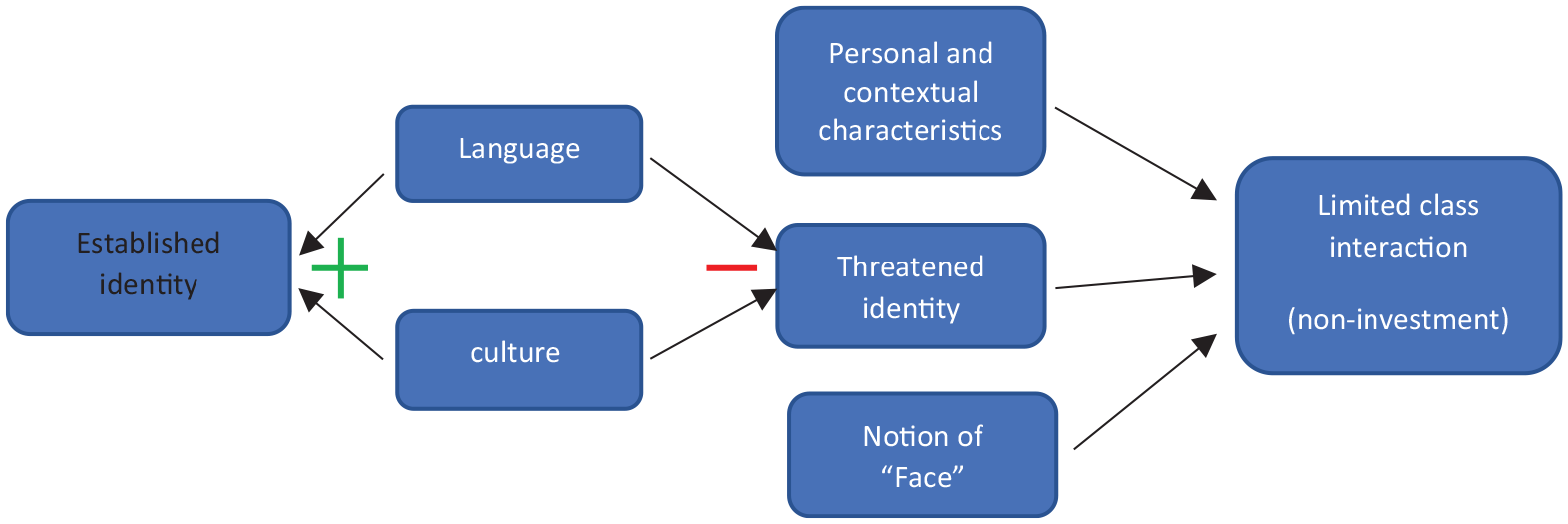
A model explaining Chinese international students’ reticence.
Communication preferences in out-of-class interactions
The findings show that the use of different modes of communication preferred in the two educational settings seems to be responsible for the tensions found in the out-of-class interactions between Chinese international students and their Australian teachers. Figure 2 is a diagrammatic representation of the communication preferences by the Australian teachers and Chinese students as revealed from the findings. Chinese students preferred verbal communication, but written email communication is the norm in the Australian setting; the Chinese students were accustomed to immediate responses whereas the use of emails and consultations at the Australian host university could delay responses; the Chinese students favoured spontaneous communication while scheduled communication is the practice in the Australian university culture; and Chinese students desired definitive answers to their academic questions, yet Australian teachers encourage students to draw their own conclusions. While the findings echo the desire of Chinese participants in Heng (2017) for more teacher support, the above tensions also indicate the conflicts between different cultural frames (in this case, communication preferences) when the two cultures are in contact (Agar, 2002). Chinese students brought their own cultural frames about teacher-student communication to the Australian contexts where different frames of communication are used.
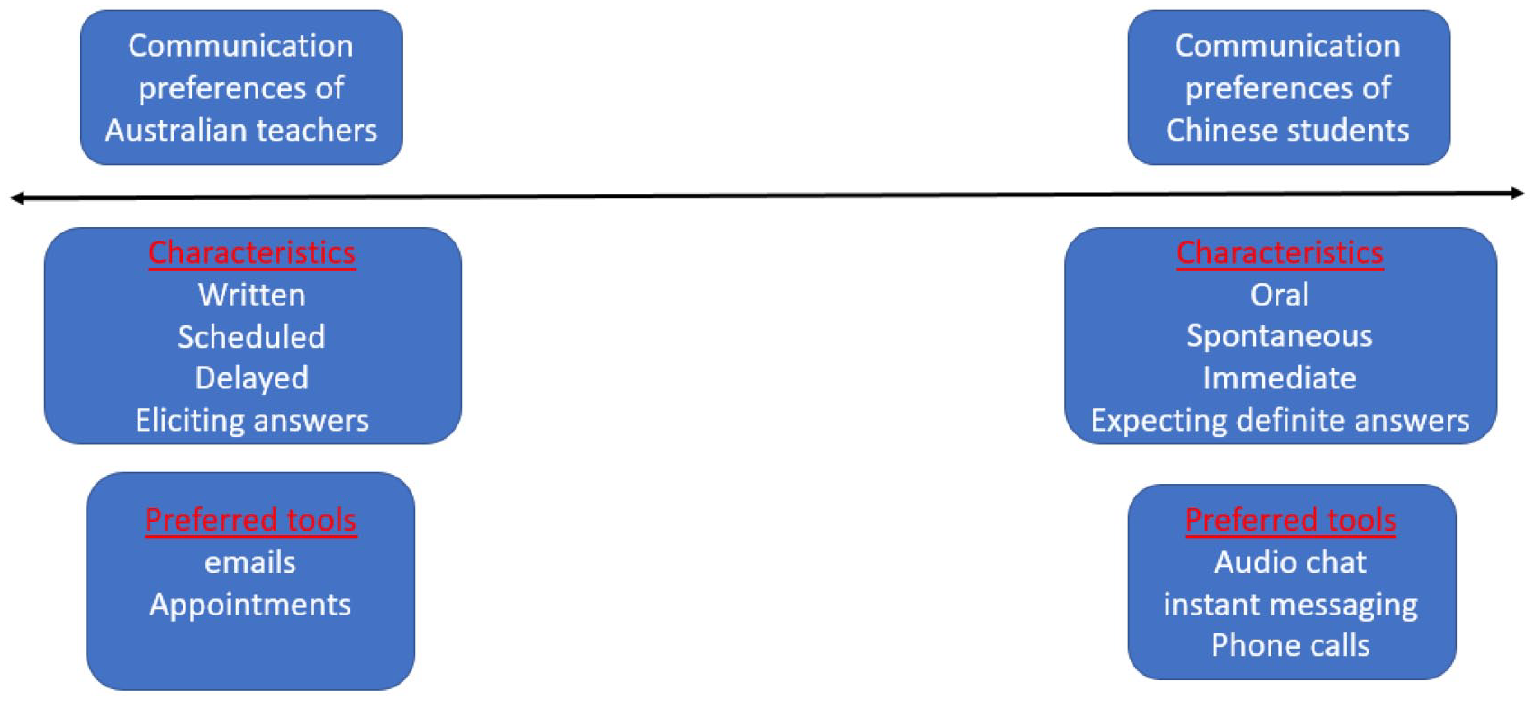
Communication preferences of Australian teachers and Chinese students.
A majority of the past literature about international students’ overseas experiences focuses on the mismatch of expectations in the academic areas such as learning and teaching styles and assessment (Cross and Hitchcock, 2007; Wu, 2015). This study, however, seems to reveal an additional mismatch that seems to be less researched in the transnational higher education field: the mismatch of cultural frames in communication styles between teachers and international students in the digital age. This misalignment can lead to international students’ frustration and the feeling of distance, which in turn may affect students’ social and academic experiences. Australian communication styles may intend to be professional and efficient, but could appear to the Chinese students as distant and unwelcoming because they are accustomed to communicating with their Chinese teachers either via phone or through face-to-face contact. When they feel they are being kept at arm’s length, it could be detrimental to their sense of belonging (Baumeister and Leary, 1995), reduce their motivation to mingle with the local culture and increase their dissatisfaction (Glass et al., 2015). In addition, quite a number of participants remarked that they did not have the habit of checking emails, but such a practice may cause students to miss important information and result in serious consequences. However, according to Agar (2002), there are three steps that students should take in intercultural communication – mistake, awareness and repair. The mistakes we make in cross-cultural contact based on our own cultural frames raise our awareness that these frames operate differently from our own. With this awareness comes the possibility of repair – either changing our frames or adding new frames. These three steps can lead an individual to develop not only cultural awareness and understanding but also appreciation of other cultures and enrichment of their intercultural repertoire. This study can serve to raise such an awareness and promote intercultural dialogue.
Conclusion, limitations and further research
With more than half of a million international students seeking education in Australia and many more in other countries such as the United States and the United Kingdom, students’ satisfaction with their overseas experience, particularly the interaction with the local culture and people, is critical to host universities and governments. This qualitative interview study examined the in-class and out-of-class interactions between Chinese international students and their Australian teachers at the host university. Due to the small sample of 22 students from only one Australian university and four Chinese universities, as well as a single data source, the findings of this qualitative study are not intended to be generalised to all joint programme settings. However, the insights gained from this study can be utilised by and transferred to other similar programmes between Chinese (or other) and Australian (or other host) institutions.
This study contributes to the literature on transnational higher education as it focuses on an aspect of international students’ experiences that has been largely under-researched, especially out-of-class interaction between international students and their host university teachers. In addition, this study extends Norton’s framework by applying it in researching international students’ unwillingness to invest in classroom interactions with their host teachers, which is one of the new attempts with the model. In addition, this study modifies the model by adding and highlighting culture as an important factor in construing Chinese students’ identity and their investment. This modified framework can help to develop an in-depth understanding in Australian (or other Western) teaching staff about Chinese students’ avoidance of in-class interaction so that they can make their classrooms more inclusive and equitable (Suspitsyna and Shalka, 2019). Moreover, our findings highlight the need for Chinese home institutions to prepare their students in cross-cultural awareness such as class participation protocols and different communication preferences across different higher education settings so that students can capitalise on their overseas experience.
The current research is an exploratory study that collected data from 22 students through interviews. These interviews may only represent the subjective perceptions of a small number of Chinese international students on the 2+2 joint programmes. Future research can be both qualitative and quantitative, using teaching observation and surveys and including a larger student sample. It could also include or focus on teachers’ experiences of both in-class and out-of-class interactions with (Chinese) international students at host universities. With academics of host universities included, many successful cases of communication between the academics and (Chinese and other Asian) international students may become known, which can provide inspirations for wider academic communities in developing effective interaction with the large (Chinese and Asian) international student populations in globalised higher education.
Footnotes
Funding
The author(s) disclosed receipt of the following financial support for research, authorship, and/or publication of this article: This research was supported by Women in Research Grant Scheme of Queensland University of Technology, Brisbane, Australia (2017).