




Abstract
Empirical research has demonstrated that mathematical errors originate from various causes that may have different implications for the learning process. Mathematical errors are an international phenomenon as all teachers from different cultural background must handle them every day during teaching-and-learning processes. When errors arise, teachers must determine whether and how to deal with them and whether the error should be corrected. Although errors and how they are addressed by teachers are of high pedagogical importance, teachers’ approaches to handling student errors remain underexplored. The study reported herein examines the ways in which mathematics teachers handle student errors in various situations, and whether any connection between the error type and the manner in which it is corrected may be reconstructed. The study participants comprised 13 secondary mathematics teachers in a large city in northern Germany. Each teacher was video-recorded over two 90-min-lessons, and the data were subsequently evaluated using qualitative content analysis. The results indicate that teachers’ approaches to correcting mathematical student errors diverged considerably depending on the phase of the lesson during which the error occurred. In particular, during the class discussion phase, a high proportion of the corrections were performed by the students’ classmates, whereas corrections executed during the group work, partner work, or individual work phases were primarily performed by students who had made the errors and the teachers. Given that the teacher's approach to handling errors exerts a significant influence on teaching-and-learning processes, further research is required to identify the most prolific approaches to handling errors in order to foster students’ mathematical understanding.
Keywords
Introduction
General consensus exists within the mathematics educational discourse that not only are mathematical errors inevitable in teaching-and-learning scenarios but that they can even be beneficial for the learning process (e.g., Borasi, 1987; Brodie, 2014; Oser et al., 1999). Mathematical errors are understood in this paper as deviation from a mathematical norm, i.e., generally valid statements and definitions of mathematics as well as generally accepted mathematical-methodical procedure, which may occur orally or in written form (Heinze, 2004; Oser et al., 1999; for more details, see Chapter 3.1). Therefore, errors should be dealt with constructively. To ensure prolific learning processes, students should be able to recognize their errors and understand where they have gone wrong in their learning processes. Having the chance to explain the error's cause has the potential to empower students to correct their mistake and thus acquire a deep and comprehensive understanding (Oser et al., 1999; Prediger & Wittmann, 2009). In principle, the student's teacher or their classmates may also explain the error (Breternitz, 2021; Helmke, 2010), although empirical evidence suggests that the final correction should, if possible, be provided by the students who had made the error themselves (Helmke, 2010; Schoy-Lutz, 2009). Correction of the error guided solely by cues from others is unlikely to be particularly helpful, as this does not provide a thorough understanding of the concepts underlying the errors (Rach et al., 2016; Ruf et al., 2004). Identification of those concepts is crucial, as they are meaningful to students and must be transformed into more appropriate conceptions (Brodie, 2014).
However, empirical studies further indicate that, in practice, classroom approaches to handling errors cannot always be regarded as conducive to learning. For example, the teacher will often correct the errors (Gardee & Brodie, 2022; Heinze, 2004; Santagata, 2005; see also Fritz, 2022), perhaps focusing exclusively on the correction without probing the error in greater detail (Türling, 2014).
This open question prompted us to ask how such procedures might be justified—that is, what circumstances during lessons influence the teacher's decision to correct the student errors themselves. Furthermore, the question arises as to whether the lessons include any phases during which students who make mistakes can execute the corrections by themselves. During collaborative classroom discussions, the teacher must be mindful of the well-being of the entire class and decide whether in-depth discussion of an individual student error will be relevant to all students or whether the other students are unlikely to make such an error—for example, because the concept behind it has already been understood (Baldinger & Campbell, 2019; Oser et al., 1999). This fact leads to the question whether teachers choose different correction approaches in collaborative classroom discussions than they do in phases during which the teacher deals with individual students or small groups in turn.
The present paper addresses the above questions, examining who corrects mathematical errors that arise in teaching–learning scenarios, how or when the correction is executed, and whether any correlation exists between the error type and the approach adopted in correcting it.
Literature survey
Few studies in recent years have explored how mathematical student errors are dealt with in practice, and of those that have investigated this issue, only a few have focused on error correction. While student errors worldwide have in many cases a common structure, the way teachers react to them differs across cultures, and results vary, suggesting that it is highly important to survey studies on this topic, especially considering cultural differences (Hu et al., 2022).
In a comparative study between US American and Italian students, Santagata (2005) identified country-specific differences between these two cultures. Italian teachers most frequently asked the student who has made the error to correct it, whereas it was more common for US teachers to ask a classmate to correct the error. The latter approach was observed quite seldom for the Italian teachers. In analyzing the teachers’ error-negotiation approaches, Santagata found that in both countries, correction by the teacher was the most common approach. This was followed in both countries by paraphrasing the question, including a hint to the student who had made the error. The US teachers passed the question equally often on to a classmate who may have provided the right answer without elaborating on the mathematical concept or the procedure (Santagata, 2005).
More differentiated results were achieved by Schleppenbach et al. (2007) in a comparative study between Chinese and US American teachers from grade 1 and grade 5. They did not only find culturally specific differences between Chinese and US American teachers in the way how teachers dealt with errors, but they also identified remarkable differences related to the age of their students. US teachers in the higher grades tended to correct the errors more directly than in the lower grades. The Chinese teachers, on the other hand, were more likely to let the students in the higher grades work on their errors. In the first grade, the teachers from both countries tended to work with the student who had made the error. In fifth grade, they were more willing to involve other students as well.
Based on the framework by Schleppenbach et al. (2007) limiting their study to Chinese teachers, Li et al. (2016) emphasized that the teachers still play the main role when it comes to address the errors. They found out that teachers correct the error, explain the wrong answer, or help the student to recognize the error. Both Li et al. (2016) and Schleppenbach et al. (2007) observed that Chinese teachers tended to pose questions to the student who had made the error. The reason for this action pattern can be that teachers may intend to actively involve the students in the lessons, to motivate them to work with their errors instead of just correcting the error (Li et al., 2016; Schleppenbach et al., 2007).
In contrast to these results, a study by Gardee and Brodie (2022) found out that teachers from South Africa in a secondary school corrected the errors by themselves and did not use the errors as departure point for developing new knowledge.
Similar results were reported by Heinze (2004) in a study on proof lessons carried out at German higher-track secondary schools. It was found out that a quarter of the errors identified in his study were corrected directly without any explanation. Approximately half of the errors were put up for discussion, while of these, in a third of the cases each, the errors were addressed with clarification by a classmate or correction by the student who had made the error. For approximately one-sixth of the errors put up for discussion, the teacher ultimately provided clarification (Heinze, 2004).
In Fritz's (2022) study, teachers largely emphasized the independence-oriented approach to error correction—that is, they allowed the students to resolve their own errors. However, the lessons studied were problem-solving lessons in German schools fostering own activities by the students (Fritz, 2022).
Sporadic findings indicate that teachers’ approaches to errors and correction may vary depending on the type of error that has occurred. According to Breternitz (2021), the approaches that teachers adopt in dealing with errors depend on the error itself as well as on the students’ performance and the teachers’ personal preferences. Cursory errors may be corrected directly by the student themselves, as they are caused, amongst others, by a lack of concentration or by an overload of the working memory when procedures have not yet been automated (Prediger & Wittmann, 2009). A dependency of the kind of tasks and its demand level was pointed out in the study by Heinze (2004). He observed that in algorithm-oriented teaching-and-learning processes, errors pertaining to mathematical expressions were directly corrected in more than half of the cases. By contrast, errors in the areas of argumentation and proof were more intensively dealt with and typically clarified by classmates or corrected by the students themselves (Heinze, 2004). Li et al. (2016) also concluded that the error handling activity pattern by the teacher depends on the instructional context. They could observe that in geometry classes, more questioning feedback than declarative feedback was given, and in algebra classes, more declarative feedback than questioning feedback took place (Li et al., 2016).
Theoretical framework
Ways of dealing with errors
Errors are described in the literature as deviations from a norm, the definition of which is crucial to distinguish an incorrect from correct statements (Oser et al., 1999). For example, this norm may be defined as something that has already been established in the classroom (Prediger & Wittmann, 2009) or may be described as the general understanding of mathematics (Heinze, 2004). Owing to these variations in the definition of the norm, the understanding of an error can also vary. It is thus important that the norm is known so that all parties involved are capable of determining whether an error has occurred (Steuer, 2014).
When a mathematical error occurs in class, it is usually the teacher who draws attention to it, as several empirical studies have observed (Heinze, 2004; Santagata, 2005; Steuer, 2014). In doing so, the teacher can decide whether to address the error (Breternitz, 2021). Empirical research generally considers a situation to be an error situation only if the teacher somehow makes it explicit that an error has occurred (e.g., Breternitz, 2021; Heinze, 2004). To facilitate learning from errors, errors must be permitted in classroom situations (Oser et al., 1999). Although an error-tolerant climate alone is not sufficient to motivate students’ constructive engagement with errors (Rach et al., 2012), learning progress is significantly correlated with a constructive error climate (Steuer & Dresel, 2015; see also Li et al., 2016). A constructive error climate is one in which both teachers and students acknowledge errors as potentially helpful; in which neither teachers nor classmates react negatively when errors occur; in which errors are analyzed and used as learning opportunities with teachers’ support; and in which errors that arise in learning situations are not negatively included in the performance assessment but rather their resolution is regarded as a crucial element in the learning process (Steuer, 2014). Here, learners have the opportunity to realize that mathematical thinking is more important than reaching the correct solution (Gardee & Brodie, 2022). Therefore, teachers’ evaluations of and feedback to students’ answers should not only be limited to the right or wrong answer but also focus on the students’ understanding of the content (Li et al., 2016).
When errors arise, they may be dealt with in different ways. For example, they may be resolved using either a constructivist approach or instructivist approach. Here, constructivist denotes an approach wherein the focus is placed on the student who makes and then corrects the error independently with the support of the teacher (Helmke, 2010). In the instructivist approach, the teacher guides the error correction and, for example, explains the error to the student who made the error or offers hints to explain the issue (Helmke, 2010). Although the European didactic discourse in particular exhibits a tendency to favor the constructivist approach (e.g., Breternitz, 2021; Schoy-Lutz, 2005), both approaches complement one another and are thus important in the mathematical learning process, whereas an exclusive focus on one of the two approaches is considered dysfunctional (Berthold & Renkl, 2008; Helmke, 2010). Several studies are based on a similar distinction, which may be broadly generalized as student-centered or teacher-centered (e.g., Cooper, 2009; Heinrichs, 2015; Hu et al., 2022; Larrain Jory, 2021; Müller et al., 2008; Schoy-Lutz, 2005; Son & Sinclair, 2010). Additionally, some studies have identified error-negotiation approaches that deviate from those just mentioned (e.g., Benecke & Kaiser, 2022; Li et al., 2016; Özdemir & Dede, 2022; Schleppenbach et al., 2007). Within the framework of our own studies, seven teachers’ approaches in dealing with mathematical student errors could be reconstructed as either process-oriented or more pragmatic (Benecke & Kaiser, 2022):
A process-oriented approach with general strategic help: the teacher provides general strategic help and thus allows the learners to recognize their mistake and develop the correct solution themselves; A process-oriented approach with content-related strategic help: the teacher allows learners to address the error themselves by providing help that is content-related but nonetheless strategic in nature; A process-oriented approach with content-related help: the teacher provides help strongly oriented to the mathematical material, so that the learners have the opportunity to correct their mistake themselves; A process-oriented approach that focuses on the correct aspects: that is, the teacher focuses on the correct components of learners’ statements and intervenes only lightly to address the wrong parts; A pragmatic approach with passing on the error/the question: that is, the teacher intends to answer the question swiftly with no detailed discussion of the error among the learners; rather, a quick correction of the error takes place by passing on the question to other learners; A pragmatic approach with help in correcting the error: the teacher provides small steps in correcting the error without providing the learner with an opportunity to correct the error themselves; and A pragmatic approach with a focus on the incorrect aspects: the teacher focuses on what the student has done wrong by foregrounding the mistake itself through critical remarks, without probing the possible causes of the mistake.
The first three patterns of teachers’ approaches were theoretically located in Zech's (2002) framework, who developed a taxonomy of possible types of help in problem-solving according to the principle of minimal help. The taxonomy distinguishes, among others, the three kinds of help mentioned above.
General strategic help provides cross-curricular methodological cues that ask students to, for example, read the task carefully or produce a drawing. In providing content-related help, the teacher addresses the corresponding task more clearly with targeted help and may, for example, ask the students to solve the problem graphically or mention a specific calculation method that might help. Content-related help is the most task-oriented help and may extend to providing partial solutions (Zech, 2002). In our study, it became evident that teachers provided such help not only when students did not know something or were stuck but also when an error had occurred (Benecke & Kaiser, 2022).
The other four approach patterns were reconstructed from the empirical material. Passing on the error or the question was characterized by the fact that when a student gave an incorrect answer, another student was asked for the correct solution. An example of such passing on of the question is the so-called “Bermuda Triangle of error correction” mentioned by Oser et al. (1999, p. 27 translated by the authors), whereby students are called on until they provide the correct solution. Incorrect answers are generally not addressed, which led Oser et al. to assume that their learning potential is not exploited and thus disappears “like an airplane in the Bermuda Triangle” (translated by the authors). Helping to correct the error is a result-oriented approach in which the goal of correcting the error quickly is evident. This can manifest itself, for example, in the teacher guiding the student who made the error in small steps toward the correct solution (Benecke & Kaiser, 2022). Focusing on what is wrong may constitute an approach in which the error is criticized in a negative sense. However, it is also possible to regard the error from a neutral perspective without considering the components that are already correct. This contrasts with the approach in which the teacher emphasizes and foregrounds the correctness of a partially incorrect statement. This approach can reinforce learners’ correct thought processes and help identify approaches to build on as well as taking them further (Benecke & Kaiser, 2022; Holzäpfel et al., 2015).
One possible mode of differentiation in dealing with errors is to distinguish the phases of instruction during which the error occurs (Benecke & Kaiser, 2022; Fritz, 2022; Heinze, 2004; Schleppenbach et al., 2007; Schoy-Lutz, 2005). A distinction is typically drawn between class discussions involving the entire class, which are conducted frontally by the teacher, and work phases, during which the teacher converses with individual students (Benecke & Kaiser, 2022; Schoy-Lutz, 2005); alternatively, it may be limited to a single instructional phase from the outset (Heinze, 2004; Schleppenbach et al., 2007). The work phase can include individual, partner, or group work (Benecke & Kaiser, 2022). The point in time in the lesson (Fritz, 2022) or the phase of the learning process (Holzäpfel et al., 2015) in which the error occurs can also function as a differentiating feature.
Types of knowledge
Apart from careless mistakes, errors are generally made due to a lack of knowledge required to work on a task or problem. In research, knowledge is often subdivided according to the framework by Anderson and Krathwohl (2001), who distinguish factual knowledge, conceptual knowledge, procedural knowledge, and metacognitive knowledge and considered them to form parts of a continuum that ranges from “concrete (factual) to abstract (metacognitive)” (p. 5, emphasis in original). They define factual knowledge as “knowing that” and including “knowledge of terminology” and “knowledge of specific details and elements” (p. 45). This includes, for example, the naming and pronunciation of mathematical terms and operations and knowledge of what various mathematical symbols signify. Knowledge of, for example, mathematical concepts and theorems then falls under the category of conceptual knowledge. Here, it is particularly a matter of how individual aspects and information are connected and how they should be classified within the overall concept. Knowledge about how something works describes procedural knowledge. In mathematics education, this is not only the knowledge about the application of mathematical methods but also the knowledge about which criteria to choose and which method would be best to apply. Metacognitive knowledge is understood as knowledge about “cognition in general” as well as “awareness of and knowledge about one's own cognition” (Anderson & Krathwohl, 2001, p. 55). In addition to knowledge about learning strategies and problem-solving strategies, this includes, for example, the knowledge that problem-solving strategies are particularly useful when the corresponding procedural knowledge is lacking. Furthermore, metacognitive knowledge includes knowledge about one's own abilities, motivation, and goals when working on a task (Anderson & Krathwohl, 2001).
Research questions and methodical approach
The study is guided by an overarching research question concerning the approaches that mathematics teachers adopt in dealing with student mathematical errors in the classroom that may be divided into the following two research questions:
Which patterns of correction approaches in dealing with errors can be reconstructed? What connections between the correction approaches, the error type, the instruction phase during which the error occurs, and the teacher's approach or learner's approach with the error can be reconstructed?
The study was conducted as a qualitative supplementary study as part of the Teacher Education and Development Study in Mathematics (TEDS-M) research program. We briefly introduce the TEDS-M research program and study design before describing the procedure used to analyze the data.
Study design and sample
The study described here was conducted as part of the TEDS-Instruct and TEDS-Validate studies, which are part of the TEDS research program (Teacher Education and Development Study in Mathematics), a continuation of the TEDS-M international comparative study. The TEDS-M study, carried out under the auspices of the International Association for the Evaluation of Educational Achievement (IEA), was conducted in 17 countries from 2008 to 2010 and examined the professional competence of future mathematics teachers as they concluded their training (Blömeke et al., 2010a, 2010b). TEDS-Instruct was conducted between 2014 and 2017 with 118 mathematics teachers in Hamburg, Germany, surveying teaching quality in a subsample of 38 teachers in addition to teachers’ professional knowledge, situation-specific skills, and the achievement progress of the students they teach. The study's purpose was to explore the influence of professional competence and instructional quality on student achievement (König et al., 2021). The in vivo survey instrument used for this purpose was newly developed as part of TEDS-Instruct (Jentsch et al., 2021; Schlesinger et al., 2018) and was validated as part of TEDS-Validate. For this purpose, in the 2016 to 2017 detailed study described here, instructional videography was produced with 15 of the 38 teachers from TEDS-Instruct, who were evaluated again—as in TEDS-Instruct—for two double lessons (i.e., 90 min each) in their mathematics classes to assess the quality of their instruction. Where possible, these double lessons should be consecutive and present an introductory lesson and a practice lesson.
Video recording was conducted according to the guidelines by Seidel et al. (2003). Two cameras were used—one focused on the teacher and the other providing an overview of the class. The overview camera was static and positioned in front of the classroom and captured the general atmosphere in the class through its microphone. However, it was unable to fully record individually conducted conversations. To capture teacher–student interactions and other situations characteristic of the classroom (Seidel et al., 2003), the camera focused on the teacher was operated continuously, and a collar microphone worn by the teacher was used to record one-on-one conversations between teacher and students.
The sample, adjusted for technical problems, comprises instructional videos with eight female and five male mathematics teachers from a large northern German city. The lessons took place in secondary school classes of grades five to ten, and the schools were located in areas of varying socioeconomic status. The teaching experience of the participating teachers ranged from 3 to 32 years.
Data evaluation
Owing to the study's qualitative orientation, qualitative content analysis according to Mayring (2014) and its continuation with the MAXQDA program by Kuckartz (details in Rädiker & Kuckartz, 2019) appeared to be the most appropriate method for evaluating the videos. Qualitative content analysis is particularly well suited to systematic, strongly rule-guided analyses of material that is communicative by nature, such as audio and video material. In light of the analyses’ strong rule-guidedness, these methods fulfill the quality criteria of empirical research very well. Quantitative evaluation as a supplement to qualitative analyses is also commonly used (Mayring, 2014).
The video material was analyzed by means of the MAXQDA program, through direct coding on the video which is in accordance with known methodological standards (Rädiker & Kuckartz, 2019), as the focus on the interactions meant that the precise words used were less significant.
All scenes in which student errors occurred or teachers judged something to be incorrect were tagged, providing a total of 576 situations, with considerable variation in the number of student errors per teacher. Table 1 presents the number of error situations for the different teachers introducing the sample.
Information on the sample and number of error situations in class.

Information on the sample and number of error situations in class.
Based on the definition by Heinze (2004), a mathematical student error was defined as a statement or activity that deviated from a generally accepted mathematical norm. Given that it was not clear from the data what was considered a mathematical error in each class, this general definition of an error facilitated unequivocal assignment. Moreover, situations may arise wherein a teacher considers an activity to be an error but this is only partially correct according to the above definition—for example, if students solve tasks in a way that is mathematically correct but that does not reflect the method intended by the teacher. If a teacher flagged this action as erroneous, the situation was analyzed as an actual mathematical error (see also Schleppenbach et al., 2007).
The error situation was regarded as finished when the teacher was no longer dealing with the error. This could conclude with the error being corrected or with a request that the learners address the error again. In the latter case, we also analyzed whether any further treatment of the error took place during the course of the lesson.
In the second step, the error situations were coded inductively according to which approaches the teachers exhibited in relation to the error—that is, from the data, without any prior determination of codes (Mayring, 2014). This yielded 44 approaches that were grouped into the seven main categories described above as teachers’ approach patterns (Benecke & Kaiser, 2022). In addition, the instructional phase during which the error occurred was assigned to the error situations. Instructional phases identified in the videotaped lessons were, on the one hand, teacher-led class discussions and, on the other hand, working phases, during which the students worked independently. Here, a further distinction was drawn between individual, partner, and group work. Other instructional phases, such as student presentations, were occasionally coded.
To answer the question about the error's correction, the error situations were analyzed in terms of who corrected the error in the end. The error was corrected either by the teacher, the student himself, a classmate, or a person of the category “other” which included, for example, if it was not possible to determine precisely whether the student themselves or a classmate corrected the error or whether the correction was developed among the entire class over the course of the teaching event. If an error was corrected by a teacher without any further handling of the error being evident, this was coded as immediate correction by the teacher and formed a subcategory of correction on the teacher's part. Aside from correction by a specific person, it was possible that no correction would be evident for a given error.
With reference to the knowledge types defined by Anderson and Krathwohl (2001), we further analyzed which error types occurred by determining which knowledge type was missing, leading to the error's occurrence (see Chapter 3.2), whereby errors based on a lack of metacognitive knowledge could not be identified in our study. According to Anderson and Krathwohl (2001), the categories of conceptual and procedural knowledge are not always clearly distinct, and therefore, we included an “unclear error type” category in our analyses.
The adequacy of the coding manual was checked in the frame of two bachelor theses with double coding. These two theses led to some changes in the coding manual and showed altogether the adequacy of the manual. We did not carry out further double coding due to the high interpretative character of the codes and the high-inference nature of the coding procedure.
MAXQDA analysis tools were used to address both research questions. In addition to calculating the relative frequencies of the assigned codes, we used the code relations browser and the complex code configurations (Rädiker & Kuckartz, 2019) to analyze the relationships between error type, instructional phase, approach, and correction. For this purpose, the extent to which the codes overlapped was examined. These correlations were then tested for significance using a χ2 test.
In the following, the results are presented along the research questions.
Correction approach in dealing with errors (first research question)
The first step in addressing the first research question about correction approach in dealing with errors was to analyze the extent to which the errors were corrected. Of the 576 error situations considered, correction was identifiable in 512 error situations, and no correction was identifiable in 64 error situations, largely because the participants were focusing on a different aspect in the interaction. This occurred both in conversations between teachers and students and in situations when, for example, the teacher left the students to continue working independently with the request to deal with the error again and did not ask about it again later.
Most errors were corrected directly within the error situation itself (n = 457), while only some were corrected during the course of the lesson (n = 55). Such later corrections could occur as a result of situations such as those explained above, when the teacher again asked the students about the error, but we also observed that errors were later taken up again during class discussion.
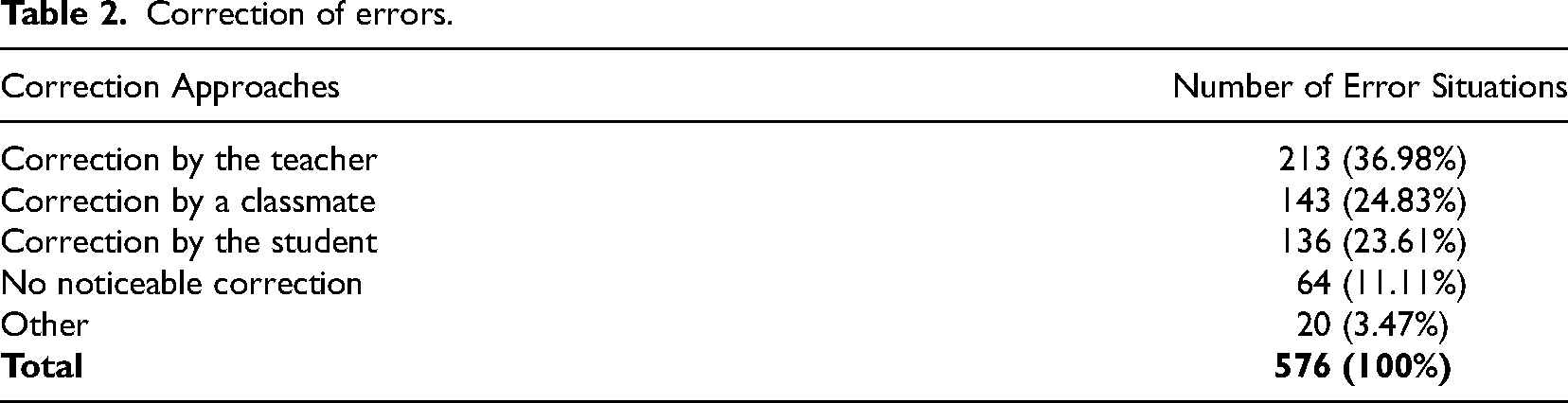
Table 2 shows the distribution of who corrected the errors in the observed lessons. The errors were most frequently corrected by the teacher. Correction by classmates and by the students themselves occurred in roughly equal proportions and was less frequent than correction by the teacher.
Correction of errors.
Correction of errors.
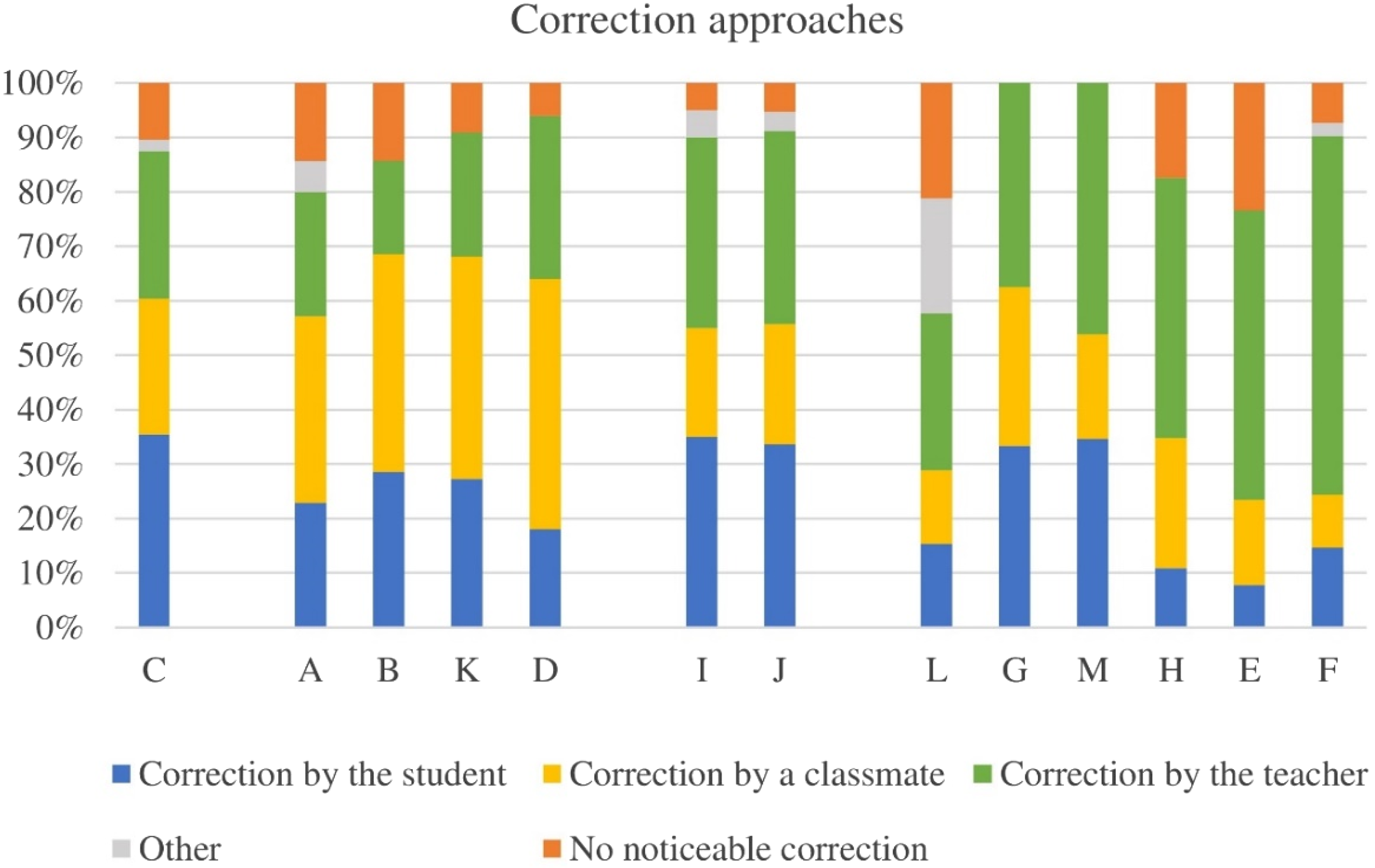
When counting the number of correction approaches occurring with each teacher, it could be identified that each of the first three correction approaches occurred most frequently with at least one teacher. Due to the respective highest number of occurring correction approaches, we identified the following four groups shown in Figure 1.
Group 1: The teachers who most often allowed the learners to self-correct (teacher C); Group 2: The teachers in whose groups the classmates most often provided the corrections (teachers A, B, D, and K); Group 3: The teachers who asked the students who erred to correct the error equally as often as they corrected the error themselves (teachers I and J); and Group 4: The teachers who most often corrected the error themselves (teachers E, F, G, H, L, and M).
Distribution of correction approaches.
Of the above, the largest group comprises those teachers who most often correct the errors themselves followed by those teachers who encourage correction by the students’ classmates.
Immediate correction by the teacher was identified as a subcategory of correction by the teacher. In these error situations, the teacher corrected the error immediately but did not address it in detail. Thus, the error situations were completed within a few moments and were not raised again later. Overall, immediate correction was identified in 8% (n = 46) of the error situations, although this approach to dealing with errors was common to among all teachers; however, for most teachers, it was <8% of the errors that occurred. Three teachers (B, E, and L) provided immediate correction in 11%, 13%, and 12% of the cases, respectively. Only one teacher (F) exhibited this correction approach in 27% of the error situations that occurred in her classroom.
In this section, we examine the second research question concerning the correlations between the individual variables. For this purpose, correlations between the correction and the teaching phase during which the error occurred, the error type, and the teacher's approach were analyzed. We shall first present the results individually prior to discussing the results of the correlation analyses.
Individual results
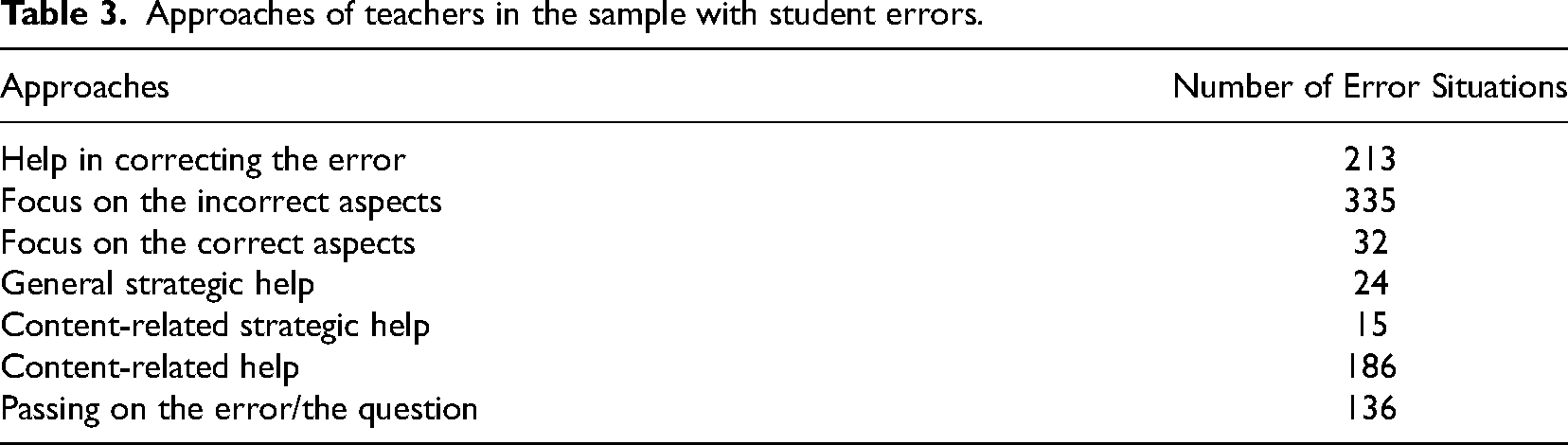
Based on analysis of the teachers’ approaches, it is striking that general-strategic and content-strategic help were scarcely used, which corresponds to the results of the study by Leiss (2007). The teachers’ most frequent approach was to focus on the incorrect aspects of the solution; only in a handful of error situations did the teachers focus on the correct aspects of the students’ approach to the solution (Table 3). It should be noted that several approaches were possible in any given error situation (Benecke & Kaiser, 2022).
Approaches of teachers in the sample with student errors.
Approaches of teachers in the sample with student errors.
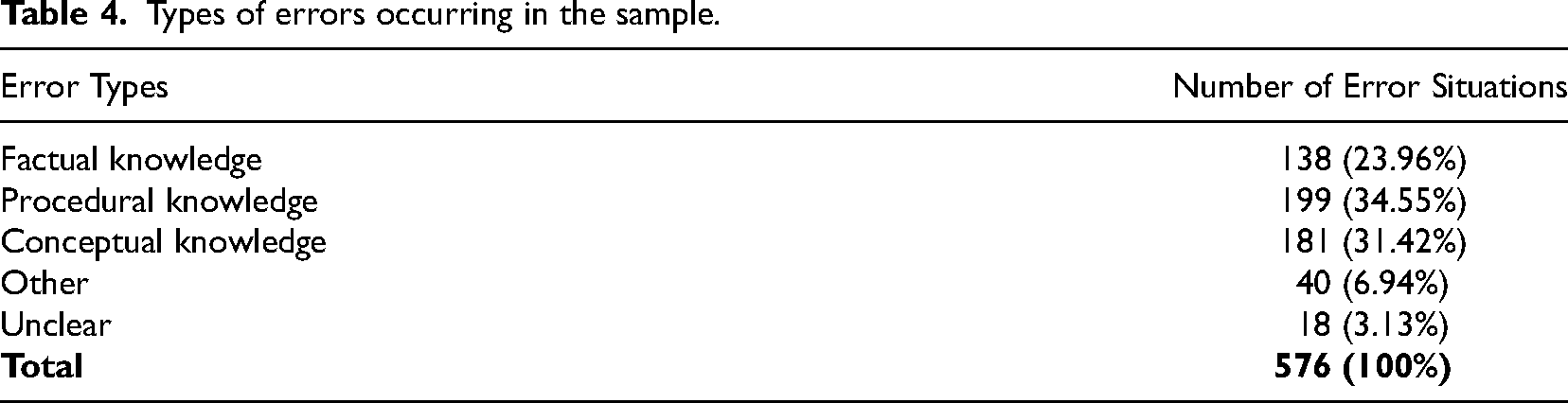
Regarding the error types, which were developed along the classification of the required knowledge, around 90% of the errors could be classified in the categories factual, procedural, or conceptual knowledge. Here, the proportions did not differ significantly; the errors, which are caused by missing factual knowledge, simply occurred somewhat more rarely (Table 4).
Types of errors occurring in the sample.
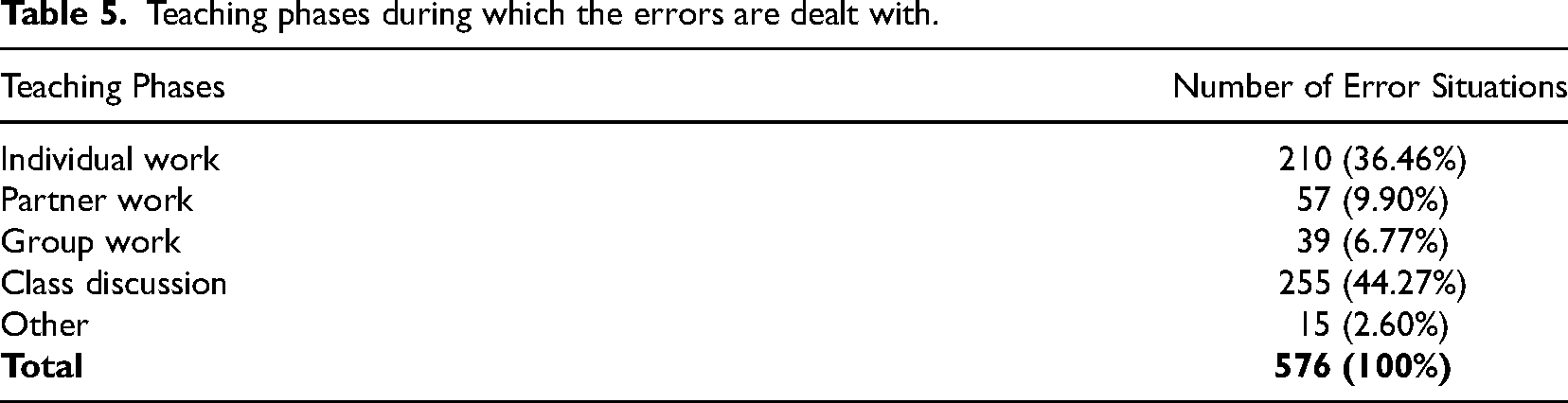
Regarding the phases in which the errors were addressed, our analyses reveal that most errors were addressed during class discussion and in individual work phases. Only around 16% were observed in cooperative work phases, whereby also more individual work phases and phases with class discussions were identified in the videotaped lessons than partner and group work (Table 5).
Teaching phases during which the errors are dealt with.
To examine the relationships between the discrete influencing variables, we first analyzed the relationships between error correction type, teaching phase, and error type (Figure 2).
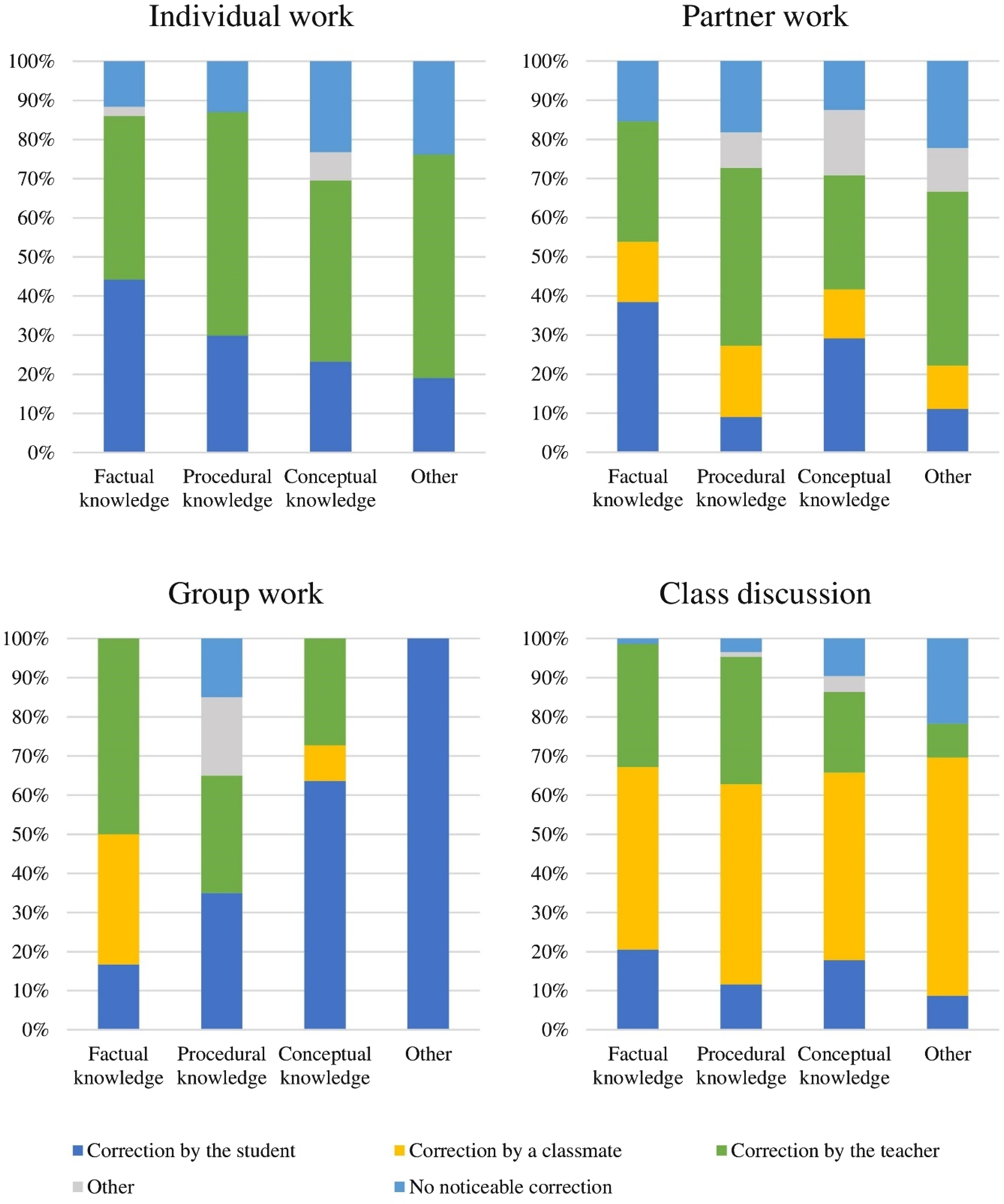
Relationships of teaching phase, correction, and error type.
At a first glance, it is noticeable that relatively similar results may be identified within the respective teaching phases (with the exception of the results pertaining to the group work phase) and that the individual teaching phases differ significantly from one another. These correlations could also be proven with a χ2 test: a significant correlation with mean effect was observed between the correction approach and the instructional phases (
Corrections performed by the teacher dominated in the individual work phase. Only errors that were associated with the area of factual knowledge were corrected in roughly equal parts by teachers and the students themselves. A similar picture emerges for partner work, except that here the correction by the classmate was possible and could also be reconstructed to a small extent. In addition, errors based on problems with procedural knowledge were only rarely corrected by the students.
In the case of group work, the large proportion of corrections made by the students is particularly striking. Whereas errors based on problems with factual knowledge were most often corrected by the teacher, errors in procedural knowledge were corrected somewhat more frequently by the students themselves, and in the case of errors in conceptual knowledge, correction by the students themselves clearly predominated. These results indicate clear differences in correction approaches during group work compared to the other work phases. This may be because group work was intentionally selected as a cooperative learning method and, if necessary, tasks could also be specifically selected for exchange among the students. In teaching of this type, the teacher has the opportunity to take a step back as student activity increases, as empirical studies attest (e.g., Leuders, 2006). This often leaves more time for the teacher to provide guidance to help students with problems that they cannot solve together as a group.
Correction approaches during class discussion differed from all other instructional phases by the high proportion of correction by classmates. Error type appeared to be almost irrelevant; all errors in this sample were most frequently corrected by classmates. This is mainly due to the way in which errors are dealt with in class discussion, which will be discussed in greater detail in connection with the analyses discussed below.
Teachers’ tendencies to immediately correct errors appear to play a special role. More than half (54%) of the errors that were corrected immediately were errors in factual knowledge. Errors based on lack of procedural knowledge accounted for 33% of the errors corrected immediately, while errors based on lack of conceptual knowledge comprised 11%; 2% were assigned to the other category. The results indicate that teachers respond immediately to errors that indicate gaps in factual knowledge and attempt to bridge such gaps by means of direct correction.
The results indicate a connection between correction approaches and the teaching phase in which the error occurs and are thus analyzed in greater detail below with qualitatively oriented detailed results. The approaches that led to the respective correction in the instructional phases are analyzed in line with the study's second research question. To this end, the number of coded approaches for each teaching phase was analyzed, depending on who corrected the error (Figure 3).
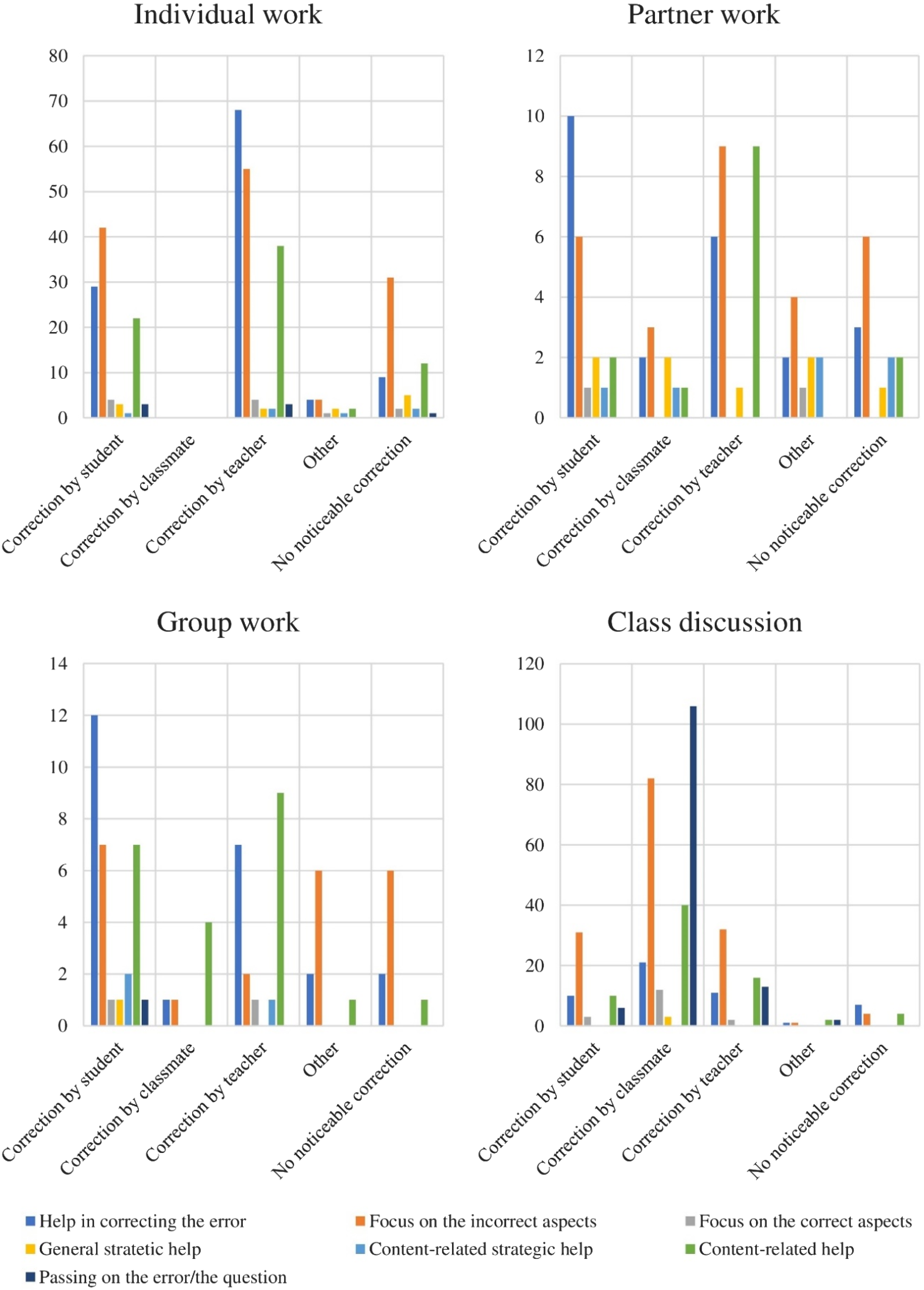
Number of coded approaches in relation to correction and teaching phases.
To exemplify the approaches in the respective situations, a transcript of an exemplary situation is presented and interpreted for each correction type in the sense of a typifying procedure, which exemplifies the connection between the teacher's approach to handling the error and its correction.
The results clarify that teachers often focused on the incorrect aspects of the solution in the sense of adopting a pragmatic approach in class (Table 3 and Figure 3). This approach was dominant, particularly during individual and partner work; in class discussion, it could be reconstructed mainly in connection with correction by a classmate, but this was also due to the prevalence of this type of correction during class discussion. Likewise, the teacher's approach “help in correcting the error” occurred in connection with correction by the teacher in individual, partner and group work, though leading proportionally more often to correction by the student themselves in the latter two instructional phases. First, the teachers’ correction will be clarified using an example. In this example situation, it occurred in connection with the approach “focus on the incorrect aspects” during individual work, as was often the case in this study. In this case, the teacher's correction is characterized by their focus on the incorrect aspects of the solution process while overlooking the aspects of the solution process that may already be correct.
The example situation involves teacher F, who was teaching a 9th-grade class. In the first videotaped lesson, she introduced the mathematical concept of conditional probability. After the introduction, the students were asked to practice using tasks from the textbook, which the teacher supplemented with two additional questions. The following sequence dealt with one of these additional questions: “You meet a boy. What is the probability that he does not ride a horse?” The task included the following four-field table, which the student set up correctly:

Prompted by the student's raised hand, the teacher went to him and looked at his solution process in the notebook.
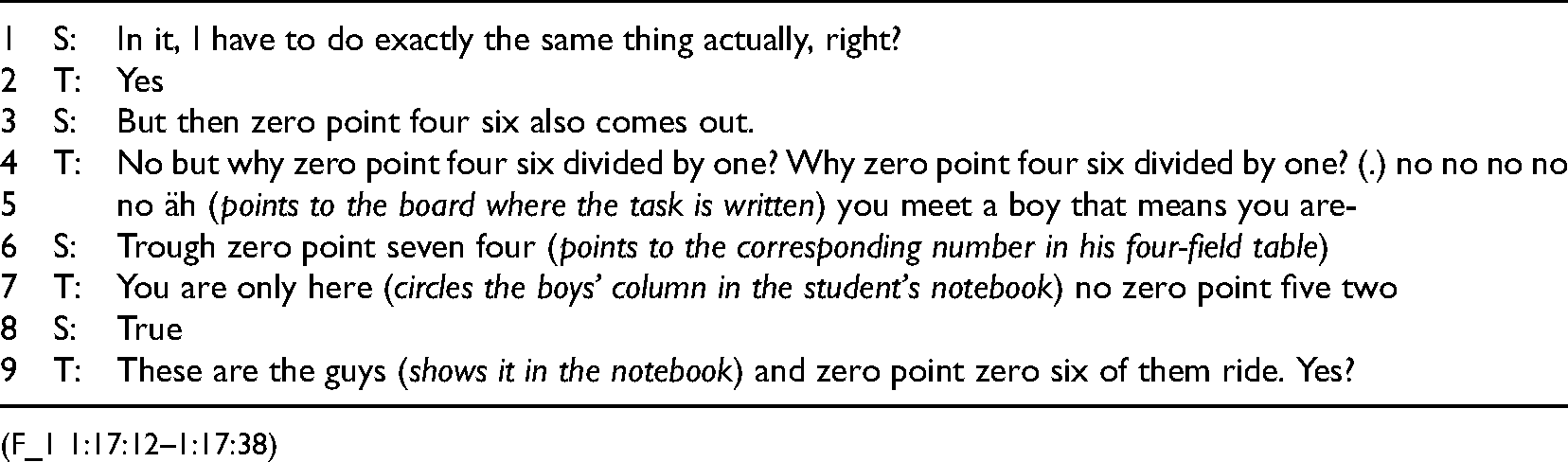
(F_1 1:17:12–1:17:38)
In the lesson sequence, teacher F discovered an incorrect calculation in the student's notes (line 4). In pointing this out to the student, she focused on the mistake and did not discuss what he may have already had done correctly. Her attention to the incorrect procedure or the reason for the error was limited (lines 5–7). She provided the students with one of the values he needed for the calculation (line 7). By focusing on the incorrect aspects of the student's solution (dividing by 1 instead of dividing by 0.52) instead of focusing on the correct aspects (0.46 being the correct proportion of children who are boys and do not ride, lines 3 and 4), she gets confused herself and points to the wrong value (0.06, line 9). After briefly leaving, she returns and clarifies which numbers the task's description were pointing towards.
Often, the provision of content-related help from the teacher in individual and group work allowed the students correcting the errors themselves. Overall, the teacher's provision of content-related help occurred most frequently in group work. Strategic help was offered almost exclusively in individual and partner work.
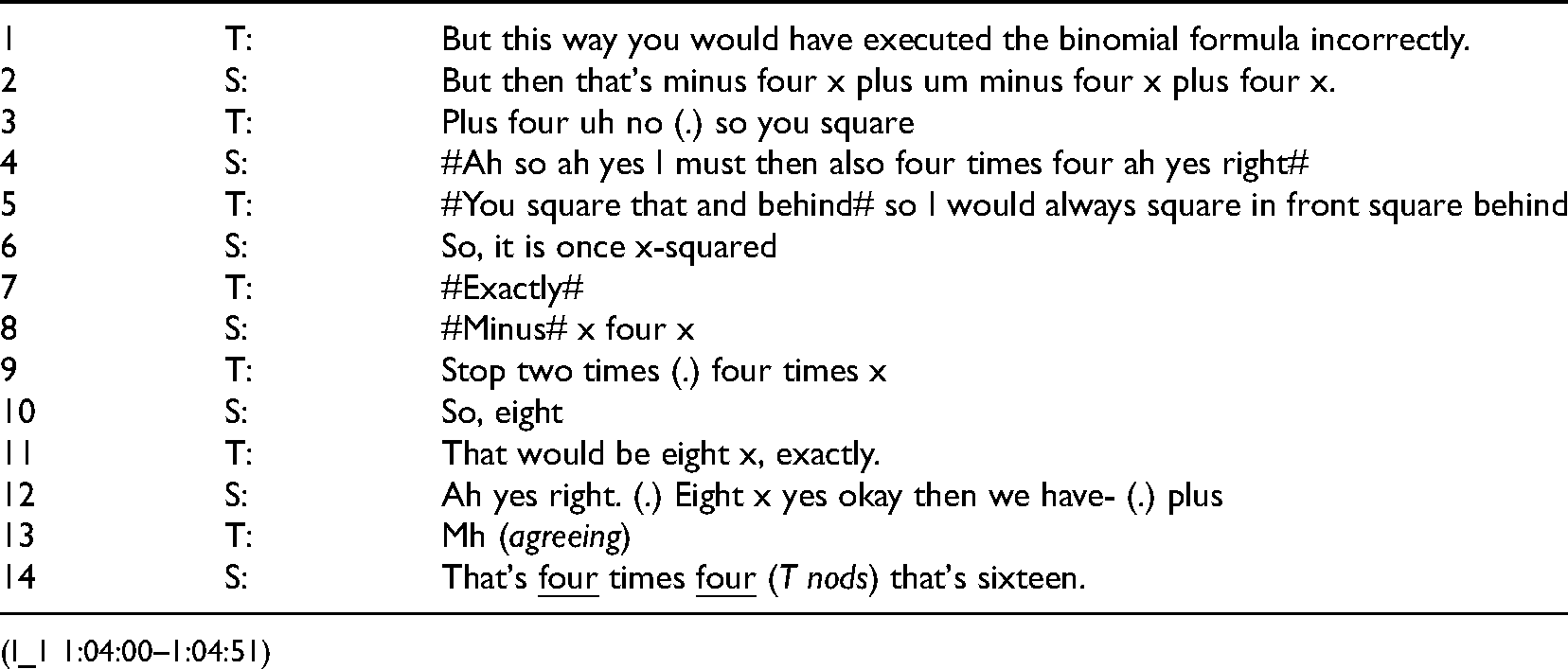
In the following example, the student executed the correction herself as part of a group work phase, but with considerable help from the teacher. The transcript is from a 10th-grade class taught by teacher I. The students in this class were about to take their final written exams. In preparation, they worked in groups during the first videotaped lesson on multiple-choice tasks similar to those that are characteristic of exams and in which technical aids such as calculators and formulas are not permitted. A student raised her hand and asked a question about a task, and the teacher noticed an error.
(I_1 1:04:00–1:04:51)
Teacher I drew the student's attention to the error and provided help with the content by referring to the binomial formula (line 1). She recalculated the tasks with the student (lines 2–14), which helped her to correct the mistake. With this help, the student herself ultimately succeeded in correcting the error.
During the class discussion, the teacher's approach of “passing on the error/the question” could be reconstructed as a central approach, occurring almost exclusively in class discussion and generally accompanied by the correction of a classmate. If an error occurred, the teacher would task one of the classmates with correcting the error or providing the correct answer to the question without affording the student who had made the error an opportunity to correct it.
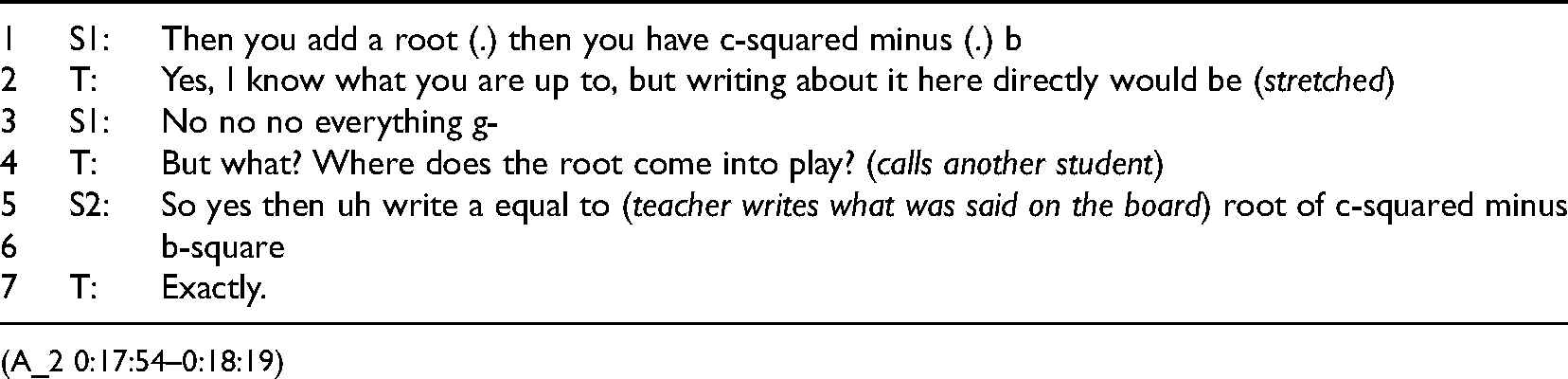
In the following, we provide a typical example of such a mode of interaction: in the sequence, teacher A taught an 8th-grade class and introduced the Pythagorean theorem in the first videotaped lesson. The selected sequence is taken from the second videotaped lesson, in which the Pythagorean theorem was repeated at the beginning. For this, the learners worked on a task wherein they were asked to calculate the height of a ladder of 2.5 m length placed diagonally against a house wall at a distance of 1.5 m away. Following a partner work session, the teacher discussed the solution with the students in plenary. The first step in rearranging the formula had already been explained by a student, and the teacher had written on the board
(A_2 0:17:54–0:18:19)
After the first student provided an answer that was incorrect—or at least insufficiently precise (lines 1–3)—the teacher asked another student to correct what was said (lines 5 and 6). The teacher said “I know what you’re going to do” to positively emphasize that the student's plan was on the right track but did not give the student an opportunity to correct their answer or render it more precise.
Situations without any noticeable correction of an error happened usually due to the fact that students or teachers were preoccupied with something else. If the error was not corrected during a conversation between students and teacher, it was possible that it would be passed over, possibly even after the teacher had dealt with the error to some extent because the teacher had set other priorities for the lesson. The teacher's approach we could reconstruct most often in this context was the focus on the incorrect aspects.
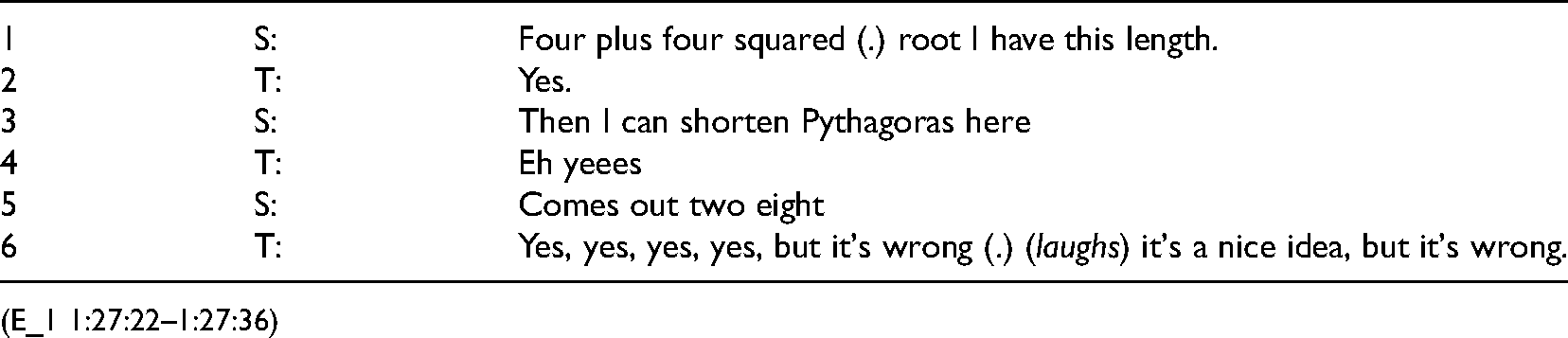
An example of such a passing over of an error could be reconstructed in a lesson given by teacher E, who taught in a 10th-grade class. The topic of the lesson was the introduction of vectors, and the students worked on tasks from the book during the second half. Among other things, they had to describe a pyramid with the help of vectors. At the end of the lesson, the tasks were discussed using the blackboard. While one student wrote his solution on the blackboard, another student raised his hand and presented his solution to teacher E.
(E_1 1:27:22–1:27:36)
The student presented his calculation method to teacher E (lines 1–5), which the teacher evaluated as incorrect (line 6) but gave no further discussion to.
In summary, a connection between correction approaches when errors arose and the teaching phase could be reconstructed, whereas only a tenuous connection between correction approaches and error type could be observed. The teachers’ tendency to issue immediate correction, meanwhile, appears to be dependent on error type and occurs most frequently when the error indicates problems with the students’ factual knowledge. Differences can also be observed between the individual teaching phases with respect to the teachers’ approach in dealing with errors. In particular, “passing on the error/the question” occurs almost exclusively in class discussion and generally results in a correction of the error by a classmate.
In this study, we analyzed teachers’ different approaches to correcting mathematical errors that occurred in class. The instructional phase during which the error was corrected, the error type, and the main agent were considered.
To address the first research question, we analyzed when and if an error was corrected and who corrected it. The study clarified that correction by classmates and the student themselves occurred in more or less equal measures (25% and 24%, respectively), while correction by the teacher predominated significantly (37%). The dominance of the teacher is consistent with results of the majority of other studies (e.g., Gardee & Brodie, 2022; Heinze, 2004; Li et al., 2016; Santagata, 2005). In addition, our analysis of the most frequent correction approach used by teachers identified four groups, meaning that teachers preferred one particular approach to dealing with errors in each case. Among these, the group of teachers who most frequently corrected the error themselves was the largest. These results are consistent with the literature: for example, Fritz's (2022) study indicates that, for teachers, correcting the error themselves is associated with the least amount of time. Breternitz (2021) also demonstrated that teachers showed preferences for particular approaches to dealing with errors, and according to her study, these were also influenced by the error type.
To address the second research question, we reported correlations between error type, instructional phase, teacher approaches, and correction approaches. We reported a significant relationship between the correction of the error and the instructional phase during which the error occurs. We were able to confirm a correlation between error type and error correction, although only of minor significance. Errors that were corrected immediately by the teacher mostly pertained to factual knowledge. This corroborates Heinze's (2004) finding that most errors in factual expression were corrected directly.
Overall, the teachers correction dominated during individual and partner work phases. Only errors that pertained to factual knowledge were corrected in roughly equal measures by teachers and the students themselves. It is striking that in group work phases—in contrast to the other instructional phases—different correction patterns emerged in association with error type. The most common correction approach here is that completed by the student themselves, although in the case of errors caused by problems in factual knowledge, this approach to correction is relatively rare. Errors caused by problems in conceptual knowledge were corrected by the students themselves in more than half of the cases. The abovementioned time aspect may have played a major role here. Since students mostly work independently during group work sessions, the teacher has more time to address errors and initiate a more constructivist approach. This is further attested by the fact that here, more often than in the other teaching phases, content-related help was provided to support the students in analyzing and correcting the error. The group work phases were those for which the fewest student errors could be reconstructed, which somewhat limits the results’ significance. In Germany, working in groups is a common and widespread method to support cooperative learning and student-oriented teaching, which is in line with a constructivist orientation widely accepted in Western Europe. However, there is also a trend in China towards activating the students in lessons as Li et al. (2016) could observe. Although the teaching culture in European and East Asian countries differs, there are currently common efforts towards student orientation (Li et al., 2023).
The correction approaches in the classroom discussion show that half of all errors were corrected by classmates, which is far above any other working phase. This way of dealing with corrections by classmates is due, among other things, to the fact that the correction of the error was often passed on to the classmates by the teacher. These results are in line with the results of the studies by Stevenson and Stigler (1992) and Santagata (2005) who also observed in their international comparative studies that US teachers often passed the question to another student. In addition, it is in line with the repeatedly described “Bermuda Triangle of error correction” (Oser et al., 1999, p. 27; translated by the authors), in which it becomes clear that errors are not taken up productively, and thus the learning potential of errors is not exploited. For example, the findings of Matteucci et al. (2015) also showed that teachers with a positive error orientation did not pass on questions to other students. In our study, however, error situations in which approaches that could be characterized as the “Bermuda Triangle of error correction” were identified occurred relatively rarely, with only nine cases observed. Thus, the handling of corrections by classmates in classroom discussions need not inevitably culminate in a “Bermuda Triangle of error correction,” as the teacher can still address the error constructively. However, the high number of requests for error correction by classmates in classroom discussions is striking. The following explanation seems conceivable to us: teachers might have a certain reluctance to correct the error directly due to an essentially constructivist attitude toward mathematics learning, just as they might be reluctant to ignore the error, since both are at odds with a constructive approach to student errors, which can be seen as consensus in the current discourse, at least in Western countries (Borasi, 1987; Holzäpfel et al., 2015; Oser et al., 1999; Schoy-Lutz, 2009, among others). Teachers, however, must deliberate as to whether addressing the error in detail would be appropriate for the productive growth of the students in the class as a whole (Baldinger & Campbell, 2019; Oser et al., 1999). Dealing with an individual error in class discussion might lead to instructional disruptions or cause the attention of all students in the class to decline. By asking the other students to correct the error that had occurred, the other students become involved, which may lead the teacher to feel that all students are still involved (see also Santagata, 2005). By contrast, spontaneously deciding on a constructive approach to dealing with the error that involves all students is quite challenging with regard to method and content. In terms of creating a positive error climate, another explanation for this finding may be that asking for correction may be perceived as helping or kindly supporting the student who has made the error (Oser et al., 1999). Moreover, the teacher's intention to protect the student from humiliation might lead the teacher to quickly call on someone else to correct the error (Santagata, 2005). However, this does not seem to be a useful approach; Schleppenbach et al. (2007) concluded that in classes where errors are conceived as commonplace, students do not get discouraged by them and are better at correcting errors themselves and learn more than when errors are avoided (Schleppenbach et al., 2007).
Santagata (2005) also reported that Italian teachers’ handling of mathematical errors depended on the instruction phase during which the error occurred. In phases when students were working at the blackboard—a common teaching approach in Italy—students were primarily asked to correct their own mistakes. In other phases, classmates were more frequently asked to correct the errors (Santagata, 2005). This specific approach to instruction could hardly be reconstructed in the lessons we recorded. In the few situations in which a student worked at the blackboard, the class was regarded more as a source of support, and the errors were discussed together.
The minimal correlations between error type and correction approaches in our study may also be attributable to the fact that the error types are defined relatively generally. Were we to break down the error types into facets and analyze, for example, responses to specific errors in technical language, which is counted as factual knowledge, further correlations could likely be reconstructed. Furthermore, it would be useful to distinguish teachers’ handling of careless errors, which may occur in all error types, including errors based on misconception. Future studies should investigate such issues to examine the extent to which teachers exhibit different approaches to error correction.
Footnotes
Contributorship
Kirsten Benecke collected and analyzed the data, both authors interpreted the results jointly. Kirsten Benecke developed the first version of the manuscript, both authors contributed to the revision and finalization of the manuscript.
Declaration of Conflicting Interests
The author(s) declared no potential conflicts of interest with respect to the research, authorship, and/or publication of this article.
Funding
The author(s) received no financial support for the research, authorship, and/or publication of this article.
Informed consent
This research received ethical approval from Administration of the Free and Hanseatic City of Hamburg. Participating teachers have provided their written consent to participate in the study.

Correction (December 2024):
Article updated to add Informed consent section.