




Abstract
Valuing in mathematics is one of the areas in mathematics education that has attracted the attention of mathematics education researchers in recent times. While efforts have been made to research the attributes students value in their mathematics learning, the same cannot be said about attributes teachers and their students value in mathematics learning, and value alignment in mathematics learning between teachers and students. This paper reports on a study that sought to explore what teachers and their students value and the alignment between attributes teachers and their students value in learners’ mathematics learning. A survey of what students and their teachers value in learners’ mathematics learning was conducted with 690 senior high school students and 66 teachers from nine schools, using adapted What I Find Important in my mathematics learning questionnaires. A multistage sampling procedure involving the use of stratified random sampling and purposive sampling procedures was used to select the research participants. The data obtained from the study were then analysed, using frequency counts, mean and standard deviation and principal component analysis. The results from the study revealed that the senior high school mathematics teachers valued Authority, Engagement, Strategy and Communication in students’ mathematics learning, while the students valued Authority, Relevance, Understanding, Engagement, Strategies, ICT and Achievement in their own mathematics learning; an indication of a gap in valuing among the two groups of research participants. Implications of the findings for mathematics teaching and learning as well as in-service and pre-service education programmes are provided.
Background to the study
Chief Examiners’ Reports on the mathematics examinations conducted for Grade 12 students in Ghana by the West Africa Examination Council (WAEC), the regional examining body, have consistently listed mathematics as one of the subjects students perform poorly in. Available data over the last five years (2018–2022) show that on average more than a third of candidates who wrote the West African Secondary School Certificate Examination (WASSCE) were unable to obtain a grade better than C6 in core mathematics (see Table 1), which is the grade students need in order to obtain admission into University. The Ghanaian tertiary education system and the economic prospects of the country are adversely affected by this perennial poor performance in mathematics, as a significant number of graduates of secondary school, fail to meet the minimum standards of performance in mathematics needed to successfully complete a tertiary degree in mathematics and science-oriented fields (MoE, 2019).
Percentage of candidates’ attainment of grades A1 to C6 in the West African Secondary School Certificate Examination (WASSCE) across core subjects from 2018 to 2022.

Percentage of candidates’ attainment of grades A1 to C6 in the West African Secondary School Certificate Examination (WASSCE) across core subjects from 2018 to 2022.
Note. WEAC (2018, 2019, 2020, 2021 and 2022).
Efforts have been made by researchers in mathematics education to understand why Ghanaian students’ performance in mathematics is not as good, as expected (Azila, 2021; Davis, 2016, 2018). Various interventions have also been implemented by the Ministry of Education to enhance the performance of students and support mathematics teachers to be equipped with better instructional strategies. For example, the introduction of teacher licencing and development of comprehensive professional development sessions by the National Teaching Council (NTC, 2021) to update teachers’ knowledge and skills as well as to help them acquire professional development points for their progression are interventions that aim to improve teacher quality and students’ performance. Thus, the teaching of mathematics and science subjects in schools has been prioritised by the Ministry of Education for almost a decade now, through the provision of various incentives to the teachers and the introduction of interventions aimed at improving the quality of teaching and learning of mathematics to improve students’ performance in the subject. Despite all these efforts, students’ performance in mathematics has not been as good as expected (WAEC, 2018, 2019, 2020, 2021, 2022).
Reasoning and feelings are part of the learning and teaching of mathematics; hence, the need to shift attention to studying how students and teachers feel about their classroom activities (Clarkson et al., 2019). Bishop (1988) identified emphasis on the acquisition of knowledge and neglect of values in mathematics education as one of the fundamental problems associated with mathematics teaching and learning in schools. Bishop's (1988) assertion reflects the situation in Ghana today. In Ghana, much attention has been paid to research into areas of mathematics education such as the teaching methodologies that are most effective in aiding students’ mathematics understanding (Davis, 2017), and the impact of in-service teacher training programmes on participants’ teaching efficiency (Davis & Ampiah, 2008; Davis & Insaido, 2017; Minadzi et al., 2022). Meanwhile not much has been done in the area of values.
Mathews (2001) positions value as a mediator of learning behaviours. This conceptualisation of value presents what students and teachers find important in mathematics learning as a mediating factor in the teaching and learning of mathematics. In this paper, values in mathematics education are defined as attributes of importance and worth that are internalised by students and teachers that provide them with the will to maintain any course of action chosen in mathematics learning and teaching (Seah & Anderson, 2015). This definition helps to position what teachers and students value in mathematics as drivers of mathematics learning and teaching.
While studies on values in mathematics and its teaching and learning have attracted the attention of many researchers in developed economies for over three decades (Bishop, 1988; Clarkson & Bishop, 1999; Dede, 2006; FitzSimons et al., 2000; Yazici et al., 2011), the same cannot be said in developing countries in the sub-Sahara African countries such as Ghana (Seah et al., 2017b). Values studies in Ghana have attracted little attention (Davis et al., 2019b; Seah et al., 2017b). However, the literature suggests that in mathematics education, values are critical components of classrooms’ affective environments and, thus, have a vital effect on the ways students select to take part (or not take part) in mathematics (Bishop, 2008). Seah (2016) stated that to facilitate students’ appropriate valuing such that it helps them to study mathematics more effectively, the first step would be to have a good idea of what is currently being valued by students. Seah and Anderson (2015) argue that ‘as a volitional variable, values (in mathematics education) not only motivate and guide decisions and actions; they also provide one with the will and determination to maintain course of action in the face of competing actions and obstacle’ (p. 3123).
In effect, teachers’ decisions in the classroom are informed by what they value in mathematics and its teaching and learning. Teachers’ values in mathematics also have consequences for students’ opportunities to learn mathematics (Aktas et al., 2019; Dede, 2013). Aktas et al. (2019), for example, observed a relationship between elementary mathematics teachers’ values and their noticing (as in how they respond to situations in their classroom). To choose to engage in purposeful learning, students and teachers in mathematics classrooms need to share some basic values of mathematics and mathematics education (Anderson & Osterling, 2019). Hence, appropriate valuing by teachers and their students can serve the purpose of fostering mathematical understanding and performance in mathematics.
What students value in their mathematics learning is most likely to be influenced by how they have been taught in the classroom as well as their existing conceptions of mathematics (Wong et al., 2016; Zhang & Wong, 2015). When students see mathematics as a set of rules, facts, and procedures, their learning approach and understanding are likely to be more instrumental and they will probably also value this approach to the learning of mathematics (Zhang, 2019). Seah and Anderson (2015) argue that ‘considering any classroom interaction, then, what is conveyed (verbally or otherwise) and the subsequent response would reflect what the teacher or student is valuing’ (p. 3122). This argument positions valuing by teachers and learners as a key driver of effective mathematics teaching and learning. Value negotiation and alignment has, therefore, been identified in the literature as a powerful tool for promoting quality mathematics classroom encounter (Kalogeropoulos & Clarkson, 2019; Seah & Anderson, 2015). Seah and Anderson (2015), for example, argue that ‘in order for a lesson to “move forward” productively, teachers would have negotiated about competing values such that there is achieved certain level of alignment amongst the values concerned’ (p. 3124). This makes an investigation into what both teachers and their students value in mathematics learning important. It also supports earlier calls by researchers for the need to investigate what teachers and their students value in order to ascertain how valuing by both teachers and their students compare and align (Davis et al., 2019b; Seah & Anderson, 2015).
In this study, we do not conceptualise value alignment as correspondences between teacher and students values in mathematics but as that which ‘facilitates the co-existence of different values that are held by different people interacting together …’ (Seah & Anderson, 2015, p. 3124). We argue that any attempt to contribute to research in the area of value alignment and negotiation in developing countries in sub-Sahara Africa that has seen very few studies in the area of mathematics education such as Ghana should begin with values that are held by teachers and their students. It is for this reason that this study was designed to investigate attributes teachers and their students’ value in mathematics learning.
Previous studies that have researched valuing among teachers and students have focused on value alignment strategies to promote effective students’ engagement during mathematics lessons in schools, using either interviews or questionnaire surveys (Kalogeropoulos & Clarkson, 2019; Seah & Anderson, 2015). These studies were all carried out in developed countries. However, the current study explored what students and their teachers valued in students’ mathematics learning, using a questionnaire survey.
The purpose of the study
The study sought to examine the attributes Ghanaian senior high school mathematics teachers and their students value in mathematics learning. It further explored the relationship between valuing in mathematics among the teachers and their students to ascertain whether their values align.
Research questions
The following research questions were posed to guide the study:
What do mathematics teachers value in mathematics learning? What do students value in mathematics learning? What is the relationship (if any) in valuing of mathematics learning among students and their teachers?
Research question 1 was posed to guide the exploration of the attributes mathematics teachers value in students' mathematics learning, while research question 2 was posed to explore the attributes mathematics students value in students’ mathematics learning. These questions helped the researchers to ascertain the drivers of students’ mathematics learning among the students and their teachers (Seah & Anderson, 2015). Research question 3 was posed to explore value alignment in mathematics among students and their teachers. This helped to ascertain how valuing among students and their teachers is compared since value alignment has been positioned in the literature as being an important factor in students’ mathematics learning (Kalogeropoulos & Clarkson, 2019; Seah & Anderson, 2015). Again, if teachers’ values in mathematics learning are different from students, they may use teaching methods that may not be suitable for the students. The misalignment in values may affect students’ opportunities to learn. Students’ achievement in mathematics may therefore not be as good as teachers may expect.
Methods
As this study sought to collect data on what students and their teachers value from a large number of research participants and described the situation as it occurred in natural settings, the descriptive survey research design was adopted (Creswell, 2012). The What I Find Important (in my mathematics learning) (WIFI) questionnaire was modified and used for this study. The original WIFI instrument was made up of four sections lettered A–D (Davis et al., 2019b). However, only 64 Likert-type items in Section A and the Biographic Data in Section D of the original WIFI questionnaire were modified and used to obtain the data for this research. The nature of these items afforded the exploration of attributes teachers and their students valued in mathematics learning using a large number of participants. The WIFI instrument was originally designed for use by students alone. In order to make it possible for both students and their teachers to respond to a similar set of items in Section A, some of the items that might confuse the teachers to relate the item to themselves rather than to students, such as item 29 ‘Making up my own mathematics question’ and item 39 ‘Given a formula to use’ were modified as ‘Students making up their own mathematics questions’ and ‘Giving students a formula to use’, respectively, for the teachers. Items which were generic to mathematics learning such as ‘Knowing the times table’ (Item 28) and ‘Knowing the steps to the solution’ (Item 19) were not modified. Reducing the number of items in an already validated questionnaire without compromising the scope of the information the instrument was designed to elicit is an acceptable methodological approach (Roccas et al., 2017).
Two questionnaires were generated, one each for students and their teachers. The modified WIFI questionnaires were pre-tested in a school district in Southern Ghana that shared similar characteristics to the Upper West Region of Ghana. The instruments were pre-tested by administering the teachers’ version to the teachers and the students’ version to the students. This was followed by interviews to ensure that the items in the questionnaire elicited valid responses. A few of the items that were not clear to both teachers and students were revised. The modified WIFI instruments were reviewed by colleagues in mathematics education to ensure that they elicited valid responses. Reliability analysis carried out with the modified WIFI instruments using the Cronbach Alpha yielded reliability coefficients of 0.747 for the teachers’ instrument and 0.891 for the students’ instrument. These reliability values suggest that the items were generally reliable (Creswell, 2012).
The student and teacher participants for the study were drawn from public senior high schools in the Upper West Region of Ghana. This region was chosen because it is one of the regions in which students’ performance in mathematics at the senior high school level has been consistently low (MoE, 2019). As with the national picture, the picture of students’ performance in mathematics is also low. The list of senior high schools was obtained from the Metropolitan Education Office. Senior High Schools in the research locale are categorised, based on the availability of resources. This is measured by facilities at the school such as library, dormitory, classrooms, laboratory and equipment, as Categories A, B and C schools, with Category A schools being the most resourced and C schools being the least resourced. The list obtained reflected these categories. Treating each of the categories as strata, the stratified random sampling procedure was used to select nine (out of 31) senior high schools in the Region. This sampling procedure afforded the researchers the opportunity to randomly select schools from within the three subgroups (stratum) of the population, such that each stratum was adequately represented. In each school, senior high school Form 2 and Form 3 students and their teachers were purposely sampled. These students were between the ages of 17 and 19 years old. Form 1 students were not included because they had not reported to campus at the time of the research. To solicit participation, a short presentation was made to the research participants about the research project, after which they were offered the opportunity to participate in the study.
A total of 756 research participants made up of 690 senior high school students and 66 of their teachers participated in the study. Out of the total of 690 students, 232 were selected from Category A schools, 221 students from Category B schools, and 237 students from Category C schools, while 25 teachers were from Category A schools, 22 from Category B and 19 from Category C schools. Ethical clearance was obtained from the University of Cape Coast Institutional Review Board before the commencement of the study.
In addressing the research questions, a principal component analysis (PCA), which is ‘the default method of factor extraction used by SPSS’ (George & Mallery, 2003, p. 256), was executed using the SPSS software to analyse the data. Through this analysis process, the value labels corresponding to the attributes valued by students and teachers in mathematics learning were derived. Frequency count, mean (M) and standard deviation (SD) were also used to explore the ratings of each of the items by the respondents.
Results
All the 756 teacher and student participants who took part in the study responded to the items in the questionnaires. The results presented in this section, therefore, reflect the results from all the research participants. The results from the study are presented based on the research questions that were posed to guide the study.
Research question one: What do mathematics teachers value in mathematics learning?
In order to explore how teachers generally rated the items in the WIFI instrument, frequency counts and descriptive statistics involving M and SD were used. The results revealed that the majority (56; 84.5%) of the items in the WIFI questionnaire were rated by the teachers as being either absolutely important or important. Only a few (8; 12.5%) were rated as neither important nor unimportant.
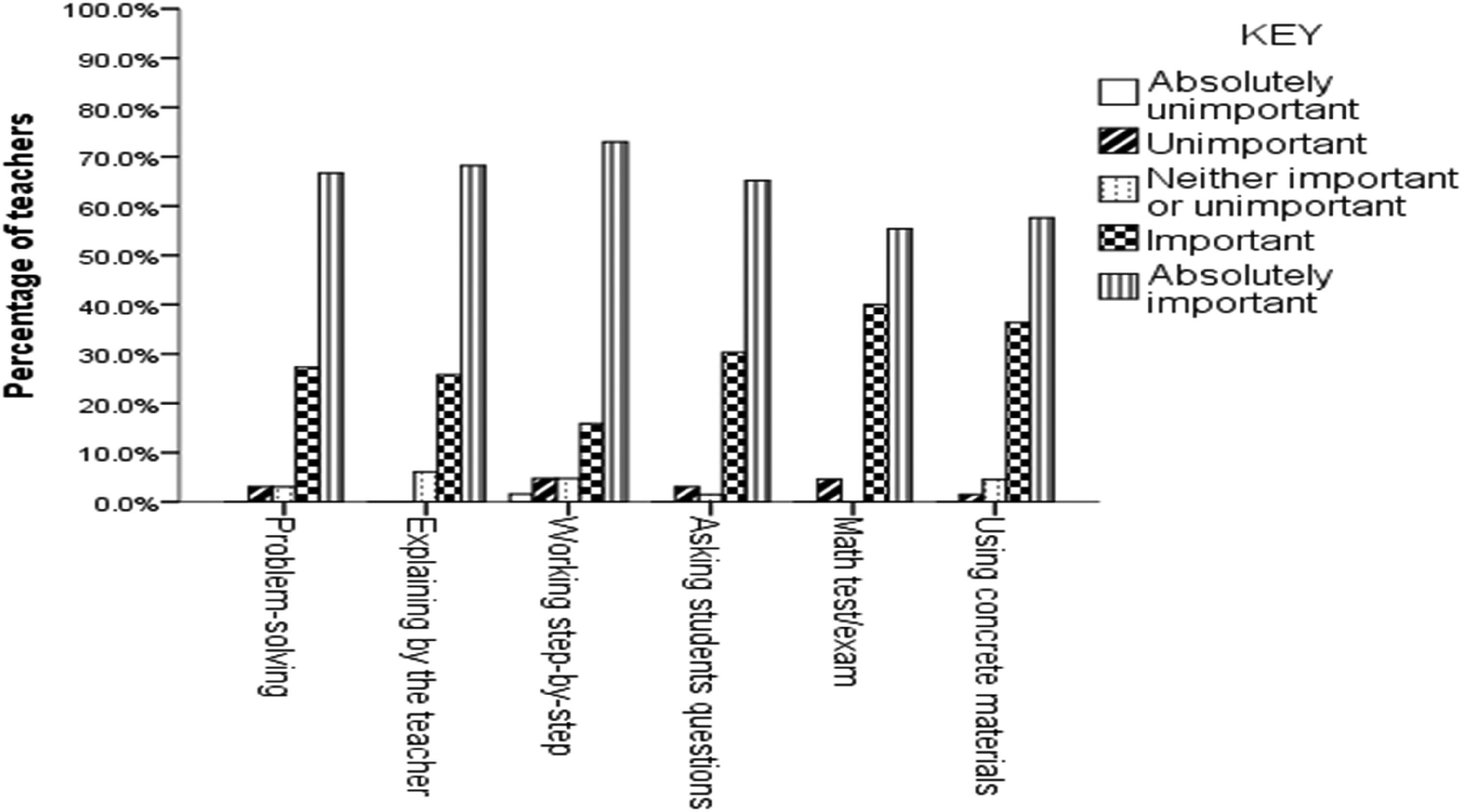
The six topmost-rated items in the WIFI instrument by the mathematics teachers were: explaining by the teacher (M = 4.62; SD = 0.60); asking students questions (M = 4.58; SD = 0.68); problem-solving (M = 4.58; SD = 0.70); working step-by-step (M = 4.54; SD = 0.91); using concrete materials to help students understand mathematics (M = 4.5; SD = 0.66) and mathematics tests/examinations (M = 4.46; SD = 0.73).
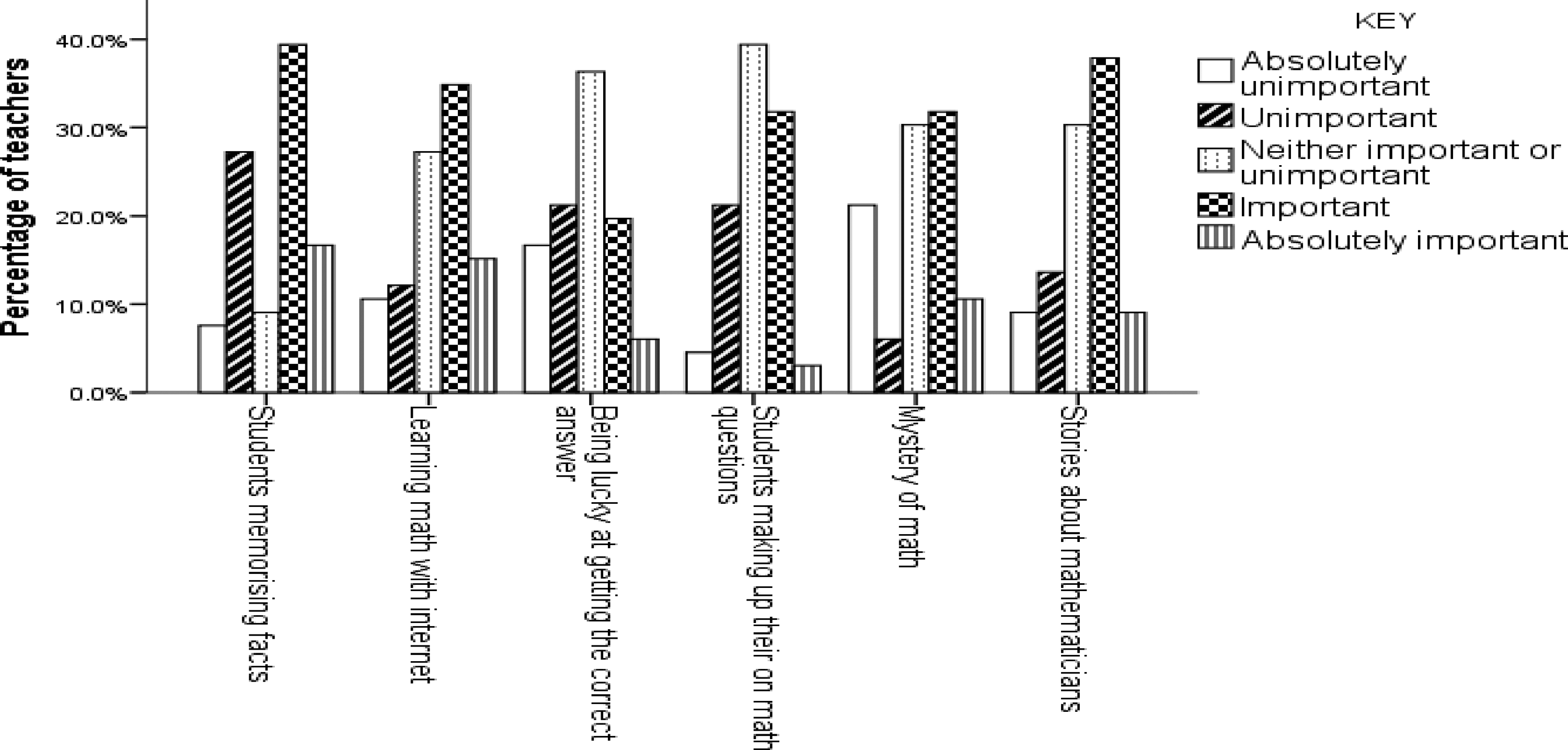
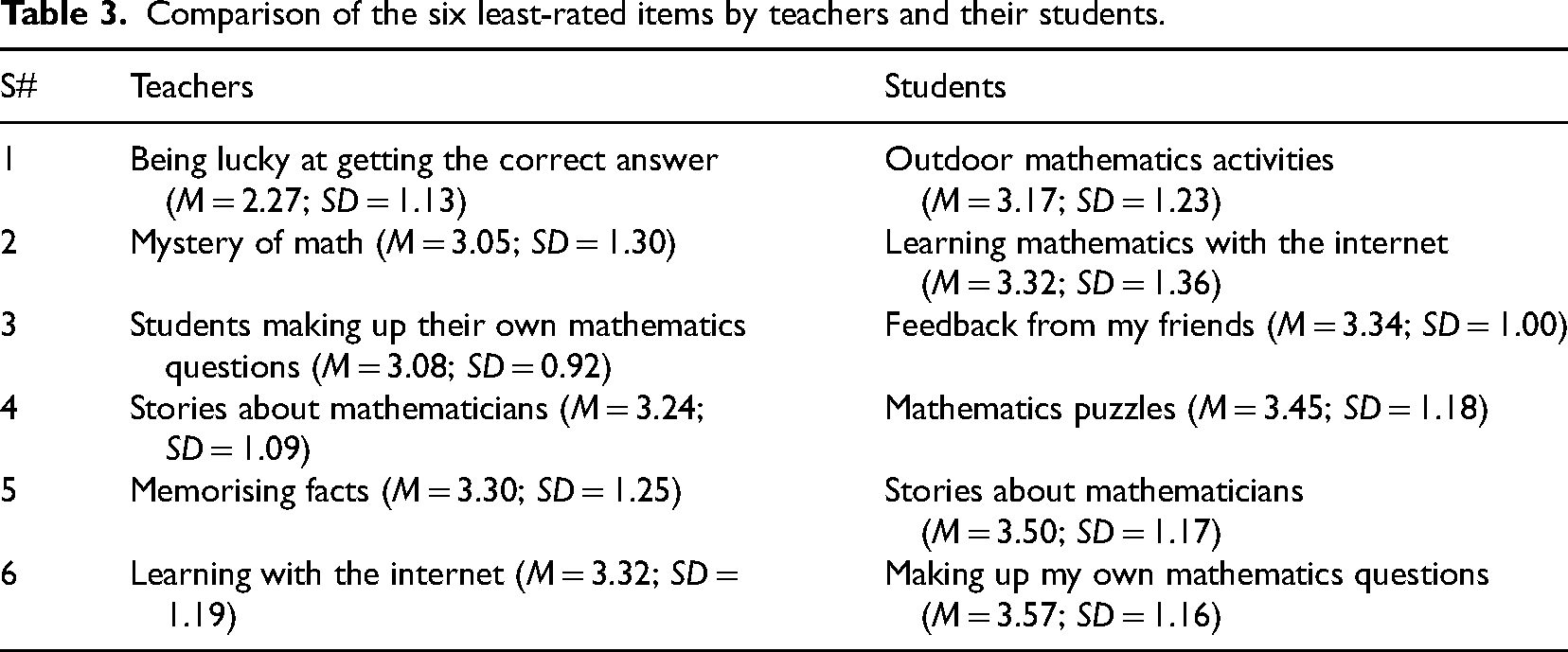
The results in Figure 1 show that apart from ‘working step by step’, none of the topmost items was rated by the teachers as being absolutely unimportant, although a few of the teachers rated many of the topmost-rated items as being unimportant. The six least-rated items by the mathematics teachers were: learning mathematics with the internet (M = 3.32; SD = 1.19); students memorising facts (M = 3.30; SD = 1.25); stories about mathematicians (M = 3.24; SD = 1.09); students making up their own mathematics questions (M = 3.08; SD = 0.92); mystery of math (M = 3.05; SD = 1.30) and being lucky at getting the correct answer (M = 2.27; SD = 1.13) (see Figure 2).
The six topmost-rated items by mathematics teachers.
Attributes the teachers found important in the teaching and learning of mathematics
A PCA with varimax rotation was conducted to assess the underlying structure for the 64 items of the WIFI questionnaire. The use of varimax rotation was to ensure that the final factors were uncorrelated and for that matter independent as much as possible (Leech et al., 2005). Sixteen components were initially generated which explained 82.27% of the total variation (see Appendix A). To determine the number of components to retain, the scree plot was examined.
However, the scree plot did not give a clearer picture of the number of components to retain, since there was no clear change in the slope. According to O’Conner (2000), the scree plot method can be subjective, as it is based on the researcher's perception of where the ‘elbow’ of the plot levels out. As a result, the Brain P. O’Connor parallel analysis was performed to determine the number of components to retain. The parallel analysis for the study was run in SPSS (v. 20) utilising the rawpar.sps script developed by O’Conner.
Based on the parallel analysis conducted, four factors were retained. To improve clarity, the items with loadings <0.40 were omitted. Consequently, a PCA was performed with maximum likelihood extraction with a varimax rotation, specifying a four-factor solution.
When the results for the PCA were analysed, 25 of the items were loaded on the first component. Some of the items that loaded on this component included ‘explaining by the teacher’, ‘using the calculator to check the answer’, ‘mathematics test/examination’, ‘mathematics homework’ and ‘a teacher helping students individually’. Component 1 was therefore labelled Authority. Twenty-one items were loaded on the second component. Some of the items that were loaded on this component were ‘teacher asking students questions’, ‘practicing with a lot of questions’, ‘hands-on activities’, ‘learning the proofs’ and ‘looking for different ways to find the answer’. Component 2 was therefore labelled Engagement. Nineteen items were loaded on the third component. Some of the items that were loaded on this component included ‘given a formula to use’, ‘using diagrams to understand mathematics’, ‘short cut to solving a problem’ and ‘knowing which formula to use’. Component 3 was labelled Strategy. Eight items were loaded on the fourth component. Some of the items were ‘small-group discussion’, ‘mathematics debate’, ‘stories about mathematics’ and ‘mathematics puzzles’. Component 4 was labelled Communication (see Appendix B).
In order to explore how students generally rated the items in the WIFI instrument, frequency counts and descriptive statistics involving M and SD were used. The results revealed that the majority (58; 90.7%) of the items were rated as either important or absolutely important by the students. Only a few (6; 9.4%) of the questionnaire items were rated as neither important nor unimportant.
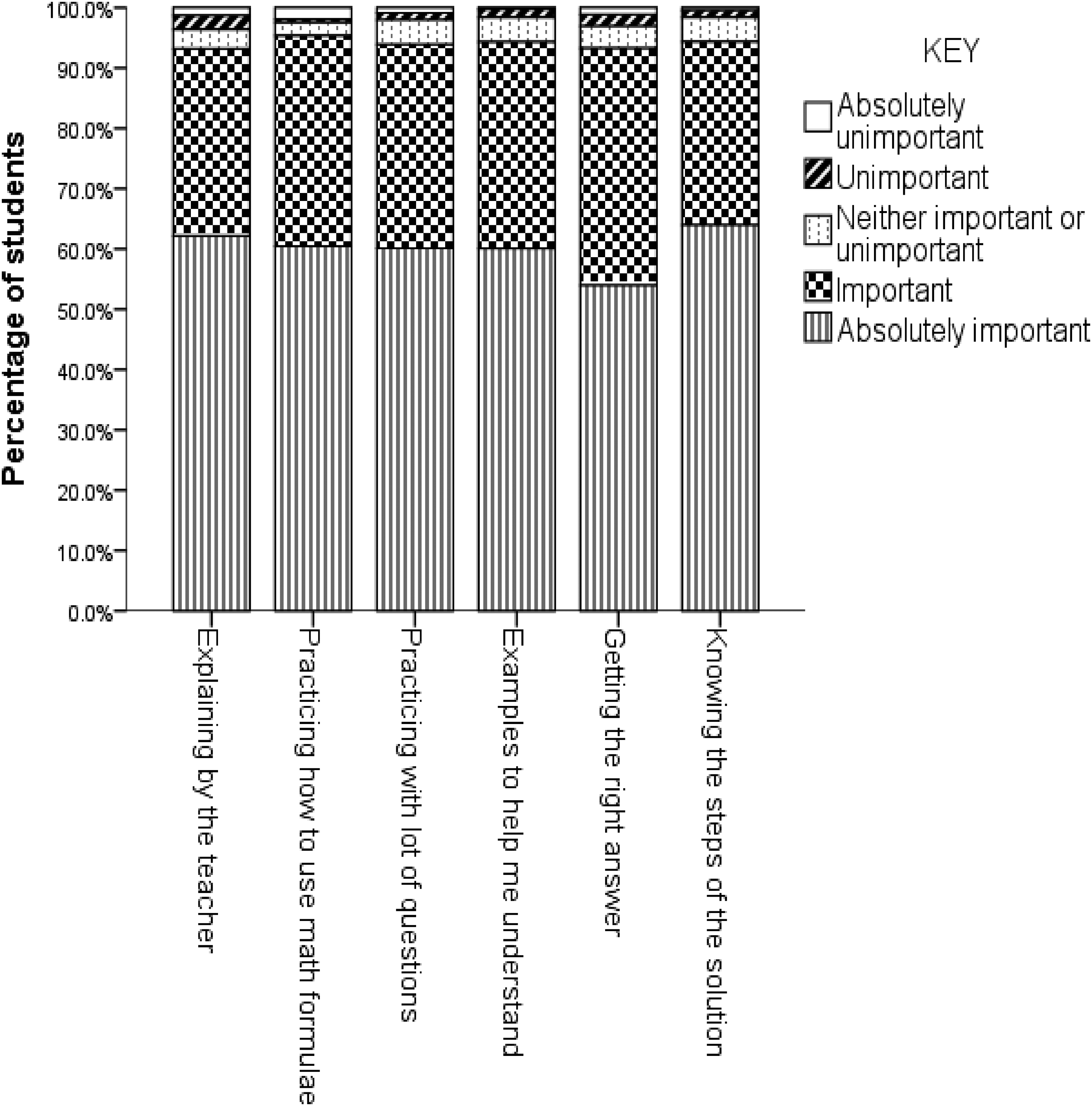
The results from the study revealed that the six most rated items were: knowing the steps of the solution (M = 4.56; SD = 0.67); examples to help me understand (M = 4.52; SD = 0.67); practising how to use mathematics formulae (M = 4.51; SD = 0.74); practising with lots of questions (M = 4.51; SD = 0.71); explaining by the teacher (M = 4.50; SD = 0.78) and getting the right answer (M = 4.50; SD = 2.07). These six items were all rated by the majority of the students as being absolutely important or important. Only a few of the students rated these items as being unimportant (see Figure 3).
The six least-rated by teachers.
The six least-rated items were: making up my own mathematics questions (M = 3.57; SD = 1.16); stories about mathematics (M = 3.50; SD = 1.17); mathematics puzzles (M = 3.45; SD = 1.18); feedback from my friends (M = 3.34; SD = 1.00); learning mathematics with the internet (M = 3.32; SD = 1.36) and outdoor mathematics activities (M = 3.17; SD = 1.23). Figure 4 shows the frequency distribution of the responses for the least-rated items.
The six topmost-rated items by students.
Attributes students found important in the teaching and learning of mathematics
Similar to the analysis performed to determine the attributes mathematics teachers valued in teaching and learning mathematics, a PCA with varimax rotation was conducted to ascertain the underlying structure for the 64 items of mathematics teaching and learning activities of the WIFI questionnaire. Eighteen components were initially generated, which explained 58.95% of the total variation (Appendix C).
A PCA was performed with maximum likelihood extraction with a varimax rotation, which specified seven factors. When the results of the PCA were analysed, 22 of the items were loaded on the first component. Some of the items that loaded on this component included ‘explaining by the teacher’, ‘teacher asking us questions’, ‘given a formula to use’, ‘using the calculator to check the answer’ and ‘mathematics test/examination’. Component 1 was labelled Authority. Thirteen items were loaded on the second component. Some of the items that were loaded on this component included ‘connecting mathematics to real-life’, ‘stories about mathematics’, ‘stories about recent development in mathematics’, ‘relationship between mathematics concepts’, ‘mathematics games’, and ‘looking out for mathematics in real-life’. Component 2 was therefore labelled Relevance. Ten items were loaded on the third component. Some of the items that were loaded on this component were ‘teacher use of keywords’, ‘using diagrams to understand mathematics’ and ‘using concrete materials to understand mathematics’. This component was labelled Understanding.
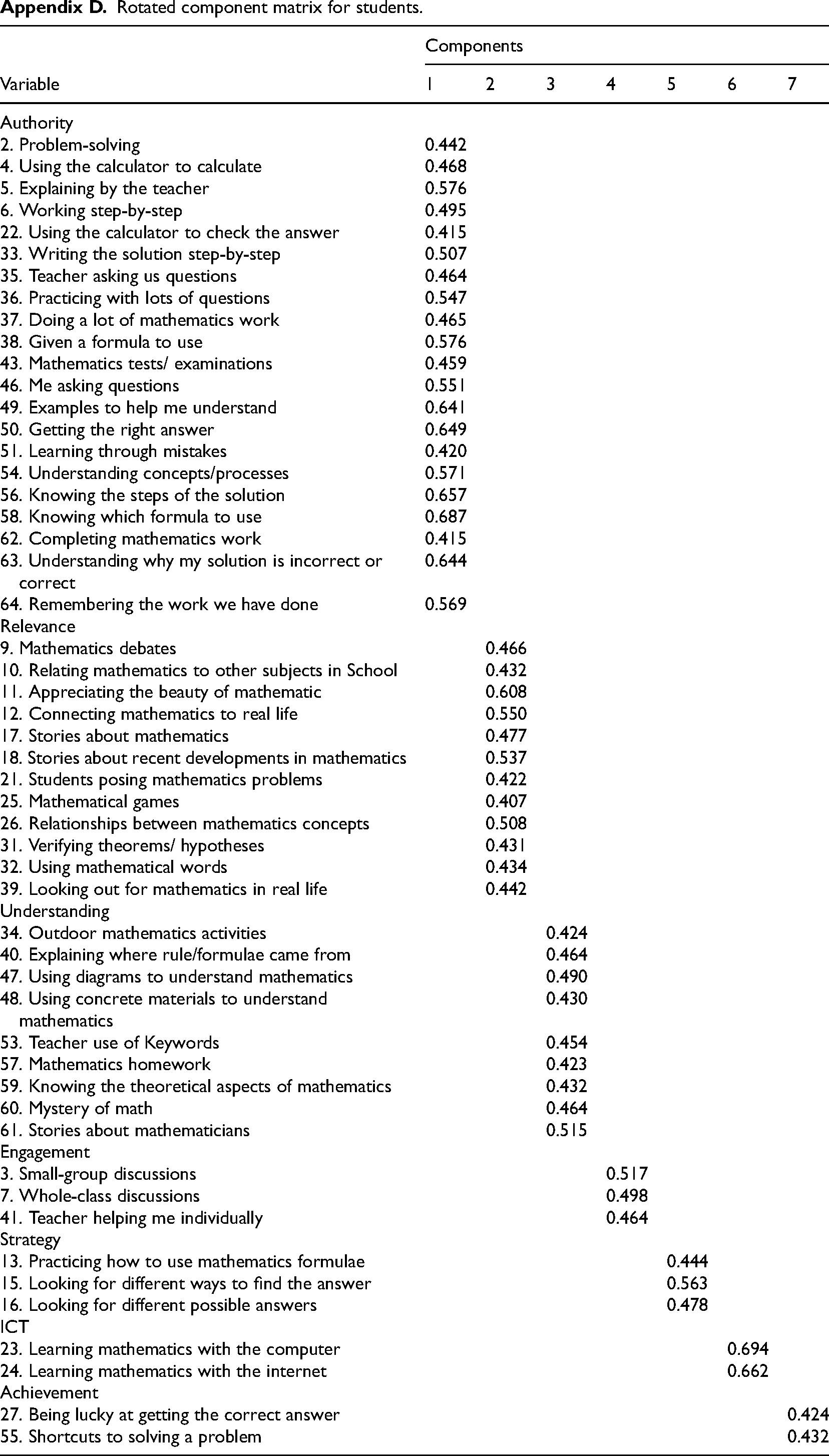
Three items were loaded on the fourth component. The items that were loaded on this component were ‘small-group discussion’, ‘whole-class discussions’ and ‘teacher helping me individually’. The fourth component was therefore labelled Engagement. Three items were loaded on the fifth component. These were ‘practicing how to use mathematics formulae’, ‘looking for different ways to find the answer’ and ‘looking for different possible answers’. Component 5 was labelled Strategies. Two items were loaded on Component 6. These were ‘Learning mathematics with the computer’ and ‘learning mathematics with the internet’. Component 6 was therefore labelled ICT. Two items loaded on Component 7. These were ‘being lucky at getting the correct answer’ and ‘shortcuts to solving a problem’. Component 7 was labelled Achievement (see Appendix D).
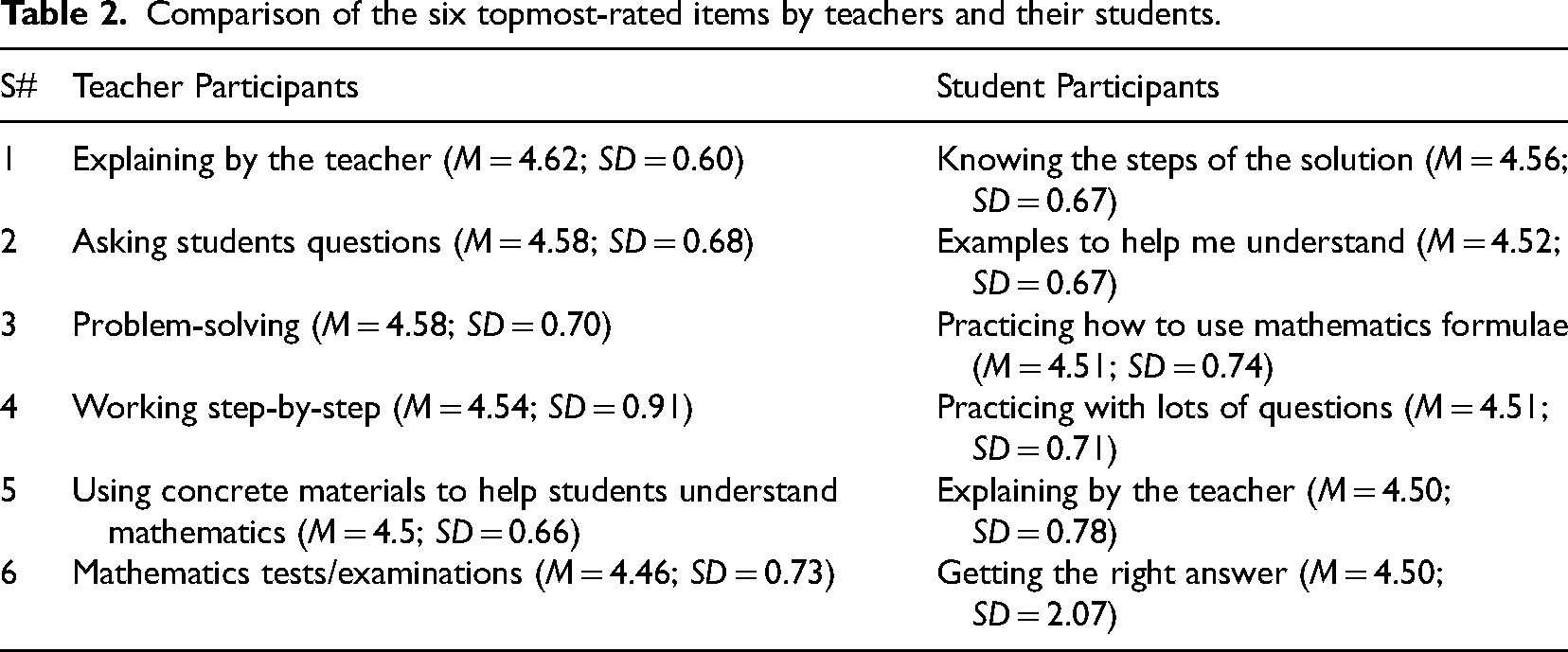
Table 2 presents the six topmost-rated items by teachers and students. The results in Table 2 show that the item ratings differed. With the exception of the item ‘explaining by the teacher’, which the teachers rated as the topmost and students as the fifth topmost, the six topmost-rated items generally differed among the two groups of respondents.
Comparison of the six topmost-rated items by teachers and their students.
Comparison of the six topmost-rated items by teachers and their students.
The six least-rated items by teachers and students are presented in Table 3. As with the results from Table 2, the results in Table 3 also show that the item ratings generally differed. With the exception of the items, ‘learning with the internet’ and ‘students making up their own mathematics questions’, which were common to the two groups of respondents, generally, the rating of items among the groups differed.
Comparison of the six least-rated items by teachers and their students.
In order to explore the value alignment between students and teachers, what each group valued in mathematics teaching and learning was compared. The results are presented in Table 4. The results in Table 4 shows that while the teachers valued four main attributes, the students valued seven. Apart from Authority which was common to the two groups, what the students valued in their mathematics learning generally differed from their teachers.
Comparison of attributes teachers and their students valued in mathematics teaching and learning.
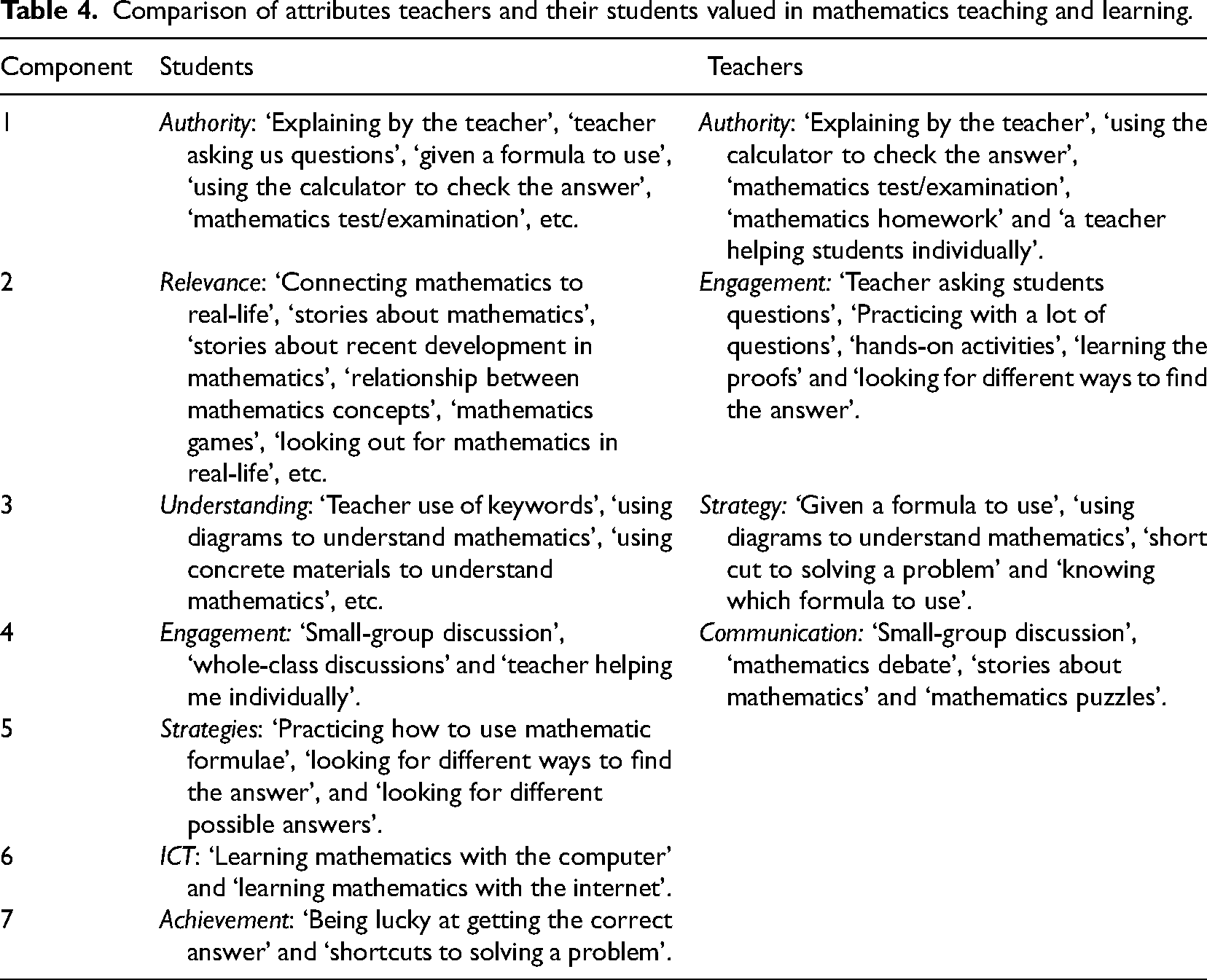
This study sought to explore what teachers and their students’ value in mathematics learning and how valuing among these two sets of participants is compared. The results from the study showed that teachers valued four main attributes in mathematics learning. In order of priority, these were (1) Authority (‘explaining by the teacher’, ‘using the calculator to check the answer’, ‘mathematics test/examination’, ‘mathematics homework’ and ‘a teacher helping students individually’); (2) Engagement (‘teacher asking students questions’, ‘practicing with a lot of questions’, ‘hands-on activities’, ‘learning the proofs’, ‘looking for different ways to find the answer’, etc.); (3) Strategy (‘given a formula to use’, ‘using diagrams to understand mathematics’, ‘short cut to solving a problem’, ‘knowing which formula to use’, etc.); and (4) Communication (‘small-group discussion’, ‘mathematics debate’, ‘stories about mathematics’, ‘mathematics puzzles’, etc.). While all the attributes valued by the teachers contribute to effective mathematics learning, prioritisation of Authority over Communication suggests that these teachers are likely to perceive mathematics learning as an academic activity that students are expected to muster or gain control over rather than fun activity (Seah & Anderson, 2015). Prioritisation of Authority, Engagement and Strategy over Communication by the teachers could also be due to the socio-mathematical norm of mathematics teaching in Ghana, where mathematics learning is always preceded by the teachers providing definitions of concepts, followed by solving some examples from textbooks or past examination papers for or with students and later giving students related questions to solve (Davis et al., 2019a). This sequence of presentation of mathematics often does not enhance productive communication by way of dialogue among learners in ways that help them to actively discover mathematical concepts by themselves (Groth, 2013). Mathematical debate, for example, is not common in Ghanaian schools (Davis, 2018; Fletcher, 2005; Varly & Saarpong, n.d.).
The attributes that were valued by teachers generally reflected the top and the least-rated items in Figures 1 and 4 and Tables 2 and 3. For example, the highest-rated items such as ‘explaining by the teacher’, ‘asking students questions’, ‘working step-by-step’ and ‘mathematics test and examinations’ and the lowest-rated items such as ‘mystery of mathematics’, ‘students making up their own mathematics questions’, ‘stories about mathematicians’ and ‘learning with the internet’ appear to emphasise valuing of control over mathematical knowledge without fun. This is because the use of internet to learn mathematics, stories about mathematicians and students making up their own mathematics questions make the learning of mathematics interesting and fun. Literature suggests that problem-posing is one of the critical thinking activities that contribute to high-quality mathematics learning in school (Singer et al., 2015). Rating it low shows that this is not an activity teachers consider important and this could be attributed to the socio-mathematical norm of mathematics education in Ghana, where this study was carried out (Davis et al., 2019a).
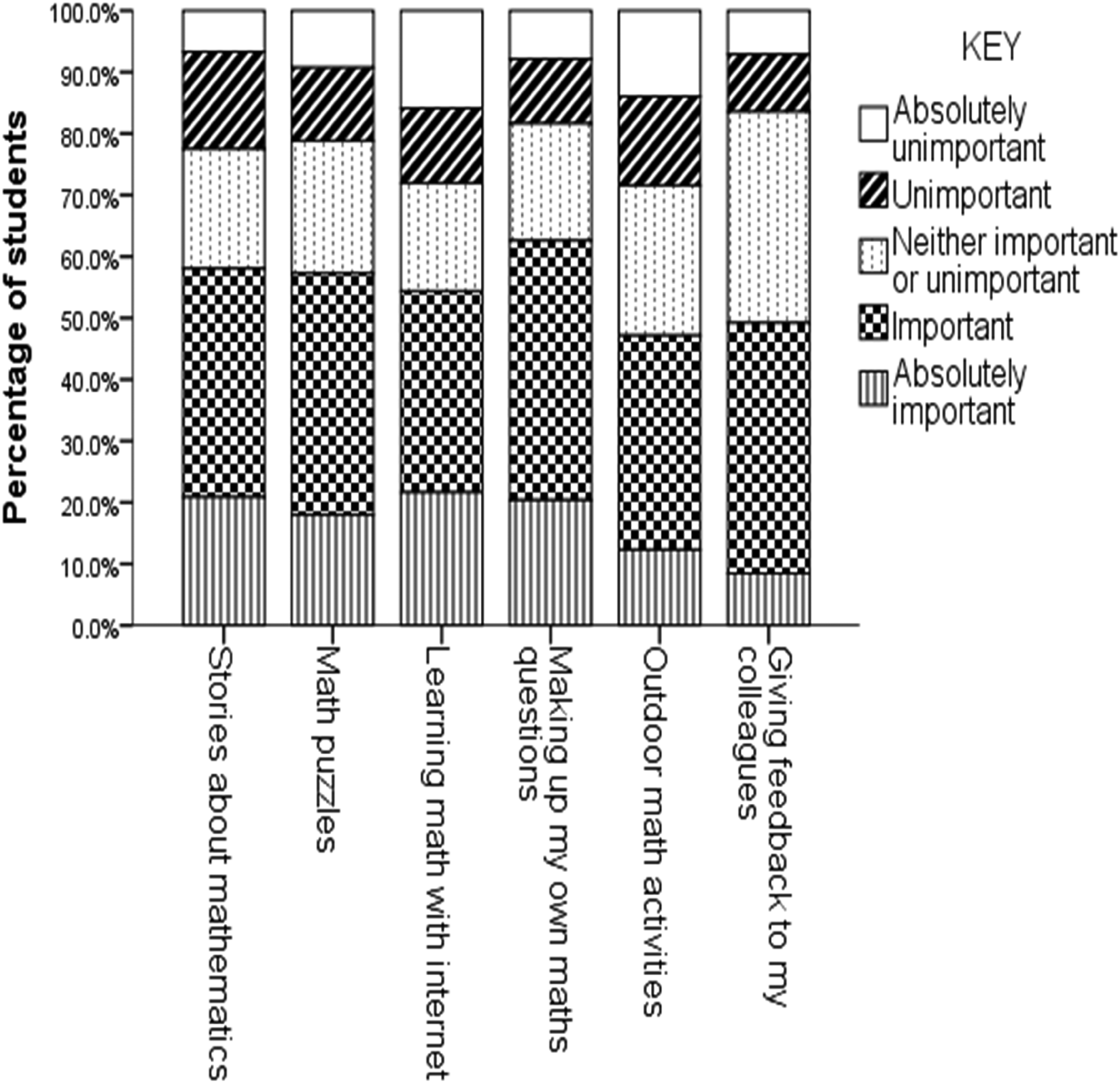
The six least-rated items by students.
The results on teachers valuing in mathematics learning in this study could also be influenced by the nature and content of mathematics teacher education many of the teachers might have gone through. The discourse around the sociocultural relevance of mathematics, including values in mathematics, presentation of mathematics as a fun activity as well as problem-posing and pedagogies that support the same are not often present in both in-service and pre-service mathematics teacher education programmes (Davis, 2016; NTC, 2021; Wilmot et al., 2015). Teachers are therefore not likely to value such attributes in students’ mathematics learning.
The students valued seven main attributes in their mathematics learning. These were the attributes in order of priority, (1) Authority (‘explaining by the teacher’, ‘teacher asking us questions’, ‘given a formula to use’, ‘using the calculator to check the answer’ and ‘mathematics test/examination’), (2) Relevance (‘connecting mathematics to real-life’, ‘stories about mathematics’, ‘stories about recent development in mathematics’, ‘relationship between mathematics concepts’, ‘mathematics games’ and ‘looking out for mathematics in real-life’), (3) Understanding (‘teacher use of keywords’, ‘using diagrams to understand mathematics’ and ‘using concrete materials to understand mathematics’), (4) Engagement (‘small-group discussion’, ‘whole-class discussions’ and ‘teacher helping me individually’), (5) Strategies (‘practicing how to use mathematic formulae’, ‘looking for different ways to find the answer’, and ‘looking for different possible answers’), (6) ICT (‘learning mathematics with the computer’ and ‘learning mathematics with the internet’), and (7) Achievement (‘being lucky at getting the correct answer’ and ‘shortcuts to solving a problem’). As with the teachers, the attributes valued by the students are equally important for quality mathematics learning. Valuing relevance in addition to the other attributes appears to suggest that these senior high school students do not only value control over the subject matter but its application in life. The results in Figures 2 and 3 and Tables 2 and 3 regarding the best-rated items such as ‘knowing the steps of the solution’, ‘examples to help me understand’, ‘practicing how to use mathematics formulae’ and ‘practice with lots of questions’ supports the observation of valuing of control in the learning of mathematics. While the least-rated items such as ‘outdoor mathematics activities’, ‘feedback from my friends’ and ‘stories about mathematicians’ appear to show that even though the students valued ICT, generally, as with the teachers, they did not value fun. This could also be attributed to the socio-mathematical norm in Ghana, where mathematics is not often presented as a fun activity.
The results from the study have shown that while teachers valued four attributes in mathematics learning, students valued seven. This result suggests that students valued more attributes in their mathematics learning as compared to their teachers. This finding is unique since other WIFI studies that made use of the same instruments in different contexts administered the instruments to only students (Seah et al., 2017a; Seah et al., 2017b). None, as far as the researchers are aware administered the instruments to both students and their teachers to ascertain how valuing of mathematics among teachers and their students compares.
Teachers and their students valued similar attributes in a few cases (i.e., Authority and Strategy). The observation of both teachers and students not valuing fun associated with the learning of mathematics may support literature on the influence of teachers’ values on students’ values. It also supports the literature that values in mathematics education is context driven (Dede, 2015; Davis et al., 2019b). However, the two groups of participants appeared to generally value different things in mathematics learning. There were five attributes that were valued by students but not their teachers, while two of the attributes were valued by teachers but not students. This appears to suggest that in the classroom setting what the teacher finds important in mathematics learning is not generally the same as what students find important in their mathematics learning. This finding supports the exploration of research in the area of value alignment and provides the basis for the various value alignment strategies that have been identified in the literature (Kalogeropoulos & Clarkson, 2019; Seah & Anderson, 2015).
Attributes the senior high school mathematics teachers valued in mathematics learning in order of priority were Authority, Engagement, Strategy and Communication, while those valued by students in their mathematics learning were Authority, Relevance, Understanding, Engagement, Strategies, ICT and Achievement. Although the attributes valued by the two groups of participants are important for mathematics learning, it was clear that the students valued more attributes than their teachers. Many of the attributes valued by the students were not present in the attributes valued by the teachers. We, therefore, conclude that the role of teachers as educators and students as learners (with their future ambitions) appear to relate to valuing in mathematics learning by the two groups of participants. Valuing of fun associated with mathematics learning was not observed among both the students and their teachers. We conclude that the culture of mathematics teaching and learning in Ghana, which does not present mathematics learning as fun reflected valuing among the students and their teachers (Davis, 2018; Davis et al., 2019a; Varly & Saarpong, n.d.). However, future research may explore how teachers’ and students’ values of mathematics affect their teaching and learning behaviours, respectively, as well as the teaching and learning outcomes, through classroom observation.
The findings of the study point to the need for value alignment and negotiation in mathematics teaching and learning in Ghana (Kalogeropoulos & Clarkson, 2019; Seah & Anderson, 2015). The literature suggests that value alignment enhances the harmonious co-existence of values held by different people working together and thus promotes recognition and inclusion of what is valued by all parties involved in classroom interaction (Seah & Anderson, 2015). In this context, value alignment will require mathematics teachers in Ghana and other sub-Saharan African countries that share similar situations as Ghana to identify and recognise attributes students value in their mathematics learning and ensure that they are taken on board in mathematics teaching and learning in the classroom. This has the capacity to strengthen the relationship between the teacher and the students and improve teaching and learning practice, as the literature indicates that a teacher's ability to facilitate value alignment between the attributes valued by him/her and students fosters good relationships and improves teaching practices (Seah & Anderson, 2015).
In-service and pre-service mathematics teacher education programmes in Ghana and sub-Saharan African countries that share similar situations as Ghana should begin to pay attention to mathematical values and mathematics education values. This will create awareness about the existence of values in mathematics and its teaching among teachers so that they teach in ways that will help students to appreciate values in mathematics that will prepare them as lifelong learners in mathematics. Currently, sociocultural discourse in mathematics education including values in mathematics has not attracted the attention it deserves (Davis, 2016). For example, there is no module on values in mathematics and mathematics education in the professional development sessions run by the National Teaching Council of Ghana (NTC, 2021).
Footnotes
Contributorship
Ernest Kofi Davis conceptualised and framed the study, and contributed to the whole research process including the write-up. He also did the final proofreading. Amidu Tikiwi Abass contributed to all the research process except conceptualization and framing of the paper and proofreading of the manuscript. Both authors read and approved the manuscript.
Declaration of Conflicting Interests
The author(s) declared no potential conflicts of interest with respect to the research, authorship, and/or publication of this article.
Funding
The author(s) received no financial support for the research, authorship, and/or publication of this article.

Authors biographies
Rotated component matrix for students.
| Variable | Components | ||||||
|---|---|---|---|---|---|---|---|
| 1 | 2 | 3 | 4 | 5 | 6 | 7 | |
| Authority | |||||||
| 2. Problem-solving | 0.442 | ||||||
| 4. Using the calculator to calculate | 0.468 | ||||||
| 5. Explaining by the teacher | 0.576 | ||||||
| 6. Working step-by-step | 0.495 | ||||||
| 22. Using the calculator to check the answer | 0.415 | ||||||
| 33. Writing the solution step-by-step | 0.507 | ||||||
| 35. Teacher asking us questions | 0.464 | ||||||
| 36. Practicing with lots of questions | 0.547 | ||||||
| 37. Doing a lot of mathematics work | 0.465 | ||||||
| 38. Given a formula to use | 0.576 | ||||||
| 43. Mathematics tests/ examinations | 0.459 | ||||||
| 46. Me asking questions | 0.551 | ||||||
| 49. Examples to help me understand | 0.641 | ||||||
| 50. Getting the right answer | 0.649 | ||||||
| 51. Learning through mistakes | 0.420 | ||||||
| 54. Understanding concepts/processes | 0.571 | ||||||
| 56. Knowing the steps of the solution | 0.657 | ||||||
| 58. Knowing which formula to use | 0.687 | ||||||
| 62. Completing mathematics work | 0.415 | ||||||
| 63. Understanding why my solution is incorrect or correct | 0.644 | ||||||
| 64. Remembering the work we have done | 0.569 | ||||||
| Relevance | |||||||
| 9. Mathematics debates | 0.466 | ||||||
| 10. Relating mathematics to other subjects in School | 0.432 | ||||||
| 11. Appreciating the beauty of mathematic | 0.608 | ||||||
| 12. Connecting mathematics to real life | 0.550 | ||||||
| 17. Stories about mathematics | 0.477 | ||||||
| 18. Stories about recent developments in mathematics | 0.537 | ||||||
| 21. Students posing mathematics problems | 0.422 | ||||||
| 25. Mathematical games | 0.407 | ||||||
| 26. Relationships between mathematics concepts | 0.508 | ||||||
| 31. Verifying theorems/ hypotheses | 0.431 | ||||||
| 32. Using mathematical words | 0.434 | ||||||
| 39. Looking out for mathematics in real life | 0.442 | ||||||
| Understanding | |||||||
| 34. Outdoor mathematics activities | 0.424 | ||||||
| 40. Explaining where rule/formulae came from | 0.464 | ||||||
| 47. Using diagrams to understand mathematics | 0.490 | ||||||
| 48. Using concrete materials to understand mathematics | 0.430 | ||||||
| 53. Teacher use of Keywords | 0.454 | ||||||
| 57. Mathematics homework | 0.423 | ||||||
| 59. Knowing the theoretical aspects of mathematics | 0.432 | ||||||
| 60. Mystery of math | 0.464 | ||||||
| 61. Stories about mathematicians | 0.515 | ||||||
| Engagement | |||||||
| 3. Small-group discussions | 0.517 | ||||||
| 7. Whole-class discussions | 0.498 | ||||||
| 41. Teacher helping me individually | 0.464 | ||||||
| Strategy | |||||||
| 13. Practicing how to use mathematics formulae | 0.444 | ||||||
| 15. Looking for different ways to find the answer | 0.563 | ||||||
| 16. Looking for different possible answers | 0.478 | ||||||
| ICT | |||||||
| 23. Learning mathematics with the computer | 0.694 | ||||||
| 24. Learning mathematics with the internet | 0.662 | ||||||
| Achievement | |||||||
| 27. Being lucky at getting the correct answer | 0.424 | ||||||
| 55. Shortcuts to solving a problem | 0.432 | ||||||