



Abstract
Both educational policies and current mathematics education research highlight that all students should be given the opportunity to be creative in mathematics class. However, if creativity is of such significance to mathematics learning, how can we describe the mathematical creativity of school children? Conducting an integrative literature review, this article aims to answer this question by synthesizing conceptual aspects and research results on the mathematical creativity of young school children working on mathematical open tasks. Here, concepts of creativity in mathematics education based on a divergent production approach are emphasized in detail. This leads to the introduction of the term “individual mathematical creativity” and to the suggestion of a framework to qualitatively characterize the individual mathematical creativity of school children working on open tasks. Its relevance and application as a scientific and/or educational tool to analyze and foster the creativity of students are explained exemplarily using the creative task processing of the 6-year-old student Jessica.
Introduction
Mann (2006) highlighted that “the essence of mathematics is thinking creatively” (p. 239). In line with this statement, there has been a strong increase in research on mathematical creativity recently that aims to in-depth describe the creative behavior of mathematics students (Sheffield, 2013). Mathematics education uses a wide variety of research approaches that are strongly influenced by psychological research (e.g., Kaufman et al., 2017) and presents multifaceted theoretical and empirical conceptualizations of mathematical creativity (e.g., Leikin & Sriraman, 2017). Considering the quality of the various definitions of mathematical creativity, the study of Joklitschke et al. (2022) reflects that notions of creativity are often presented indirectly, and as Plucker et al. (2004) stated “with an ‘oh, by the way’ tone” (p. 87), so that researchers, as well as mathematics educators, may perceive mathematical creativity as a rather soft construct (Sriraman, 2005, 2009). For example, one highly received and adopted definition of mathematical creativity was presented by Liljedahl and Sriraman (2006), who describe “mathematical creativity at the school level as the process that results in unusual (novel) and/or insightful solution(s) to a given [mathematical task], and/or the formulation of new questions and/or possibilities that allow an old [task] to be regarded from a new angle […]” (p. 19). Despite the fact, that this understanding of mathematical creativity includes important fundamental abilities of school children that are essential for the learning of mathematics (Bahar & Maker, 2011; Mann, 2006), Liljedahl and Sriraman (2006) did not specify their central and, to some extent, evaluative attributes of unusual (novel), insightful, and new any further.
Regarding these (and similar) not operationalized definitions, it seems challenging for us—probably as well as for other mathematics education researchers and educators—to observe, qualitatively describe, and, in turn, foster the mathematical creativity of school children working on mathematical tasks. Clearly, the presented exemplary definition of Liljedahl and Sriraman (2006) fulfills the demand of Plucker et al. (2004) to develop explicit (micro)domain-specific definitions of mathematical creativity, but it is not yet sufficiently descriptive to be accessible for qualitative research studies on the creative behavior of school children doing mathematics.
The need for specific and insight-based descriptions of mathematical creativity is also reflected in international education policies. In an especially fast-moving world strongly shaped by digital technologies, the Organisation for Economic Cooperation and Development (2019) labels creativity as one of the essential 21st-century skills and emphasizes the importance of promoting creative behavior (i.e., thinking ahead, considering problems in new ways, or reflecting upon existing solutions) of all students in all school disciplines. Recognizing the personal as well as social-wide relevance of fostering creative behavior of students, creativity as a keyword occurs in most (inter)national standards for school education (Care, 2018). For instance, Wyse and Ferrari (2015) note that creativity is mentioned in all 26 European and British school curriculum texts, but they expose that creativity appears most frequently in art-related subjects and is used rarest in the context of mathematics education. Especially in the context of mathematics, Wyse and Ferrari (2015) highlight that there is a wide gap between claiming creativity as a fundamental aim in learning mathematics and “its realisation in the specific knowledge and abilities that learners have to develop” (p. 37). This lack of concrete operationalization makes it difficult for mathematics educators to grasp the term creativity and consequently foster the mathematical creative behavior of their students (e.g., Cremin et al., 2015).
Therefore, one aim of current research on mathematical creativity is to develop precise conceptualizations of mathematical creativity that will enable both mathematics education researchers as well as educators to specifically observe, in-depth describe, and individually promote creative behavior in students. Researchers “begun to sort and map existing studies” (Joklitschke et al., 2022, p. 1162) on mathematical creativity to filter out theoretical as well as empirical research gaps that can pave the way to new explicit and practice-oriented definitions. However, mathematics education researchers often focus on students in higher grades, mathematically gifted or highly intelligent students (e.g., Aßmus & Fritzlar, 2018; Juter & Sriraman, 2011; Leikin & Elgrably, 2020; Leikin & Pitta-Pantazi, 2013; Singer, 2018). In contrast, we, just like Kattou et al. (2016), assume that all school children can be individually creative in specific mathematical learning contexts. Considering the age of students, research studies from Torrance (1968), Sak and Maker (2006) or Tsamir et al. (2010) highlight that young school children at the preschool or primary school level in particular work creatively on mathematical tasks as they appear to be open-minded and hardly influenced from peers or learned solution methods. To operationalize the construct of mathematical creativity, it therefore seems significant to focus on preschool and primary school children's creative behavior. From the assumption that everybody can be creative follows that differences in the children's creativity appear in relation to their individual mathematical expertise and educational background on a qualitative level (Leikin, 2009b). Hence, we aim to develop a theoretically derived and simultaneously practice-orientated framework of the individual mathematical creativity of school children (InMaCreS) that can serve both as a tool for mathematics education researchers to analyze the creative behavior of young mathematics students and as a tool for mathematics educators to observe and foster the creativity of their students. The flexible use of the InMaCreS framework in science and school represents a significant innovation in the development of notions of mathematical creativity. Consequently, we aim to answer the following research question: How can the individual mathematical creativity of young school children be theoretically modeled by a framework allowing mathematics educators to observe, describe, and foster the creativity of their students in daily activities of doing mathematics?
To answer this question, we specify in the following section our research method and subsequently, present our results of the integrative review on mathematical creativity. Since these results constitute the theoretical basis of our definition of young school children's mathematical creativity, the different theoretical aspects are described in detail. As the essence of our article, the definition and the development of our framework are presented in the subsequent sections. To illustrate our complex theoretical considerations and as an inspiration for further empirical studies, we shortly present an example of how the framework can be used for describing the creativity of a first-grade student. The article ends with a discussion of the implications and limitations of the new framework.
Method: Integrative review
Since researchers from various related disciplines such as psychology, pedagogic, and, in particular, mathematics education conceptualize the construct of mathematical creativity in different ways, systematically reviewing every research contribution of the last 70 years to this topic is both impossible and hardly purposeful (for a methodological overview on systematic reviews see Sutton et al., 2019). In fact, our aim is to develop a (new) conceptual framework that can be used by mathematics education researchers and educators to characterize the mathematical creativity of school children. We consequently conducted an integrative review (Sutton et al., 2019; Torraco, 2005; Whittemore & Knafl, 2005) whose purpose is “to overview the knowledge base, to critically review and potentially re-conceptualize, and to expand the theoretical foundation [on mathematical creativity of students]” (Snyder, 2019, p. 336).
In conducting this integrative review on the mathematical creativity of school children, we collected theoretical as well as empirical research sources that specifically address and conceptualize the construct of mathematical creativity of students of all ages and of all individual biographies in learning mathematics at school. Starting in 2018, to collect, summarize, and map international state-of-the-art articles on the mathematical creativity of school children, we methodically used a combination of forward snowballing followed by keyword-based search strategies (Wohlin et al., 2022) to gradually enrich the notion of mathematical creativity (see Figure 1). In the sense of forward snowballing, the initial analysis of significant overview articles, books, and book sections of mathematics education research (Joklitschke et al., 2022; Kwon et al., 2006; Leikin, 2009b; Leikin & Pitta-Pantazi, 2013; Leikin & Sriraman, 2017; Liljedahl & Sriraman, 2006; Mann, 2006; Pehkonen, 1997; Sriraman, 2009; Sriraman & Lee, 2011) has led us to a variety of articles that deal with specific theoretical aspects of the definition of mathematical creativity and examine them in detail. Here, we gathered frequently cited research articles not only from mathematics education research but also from psychological or educational studies (e.g., Guilford, 1950, 1967, 1968; Torrance, 1966).
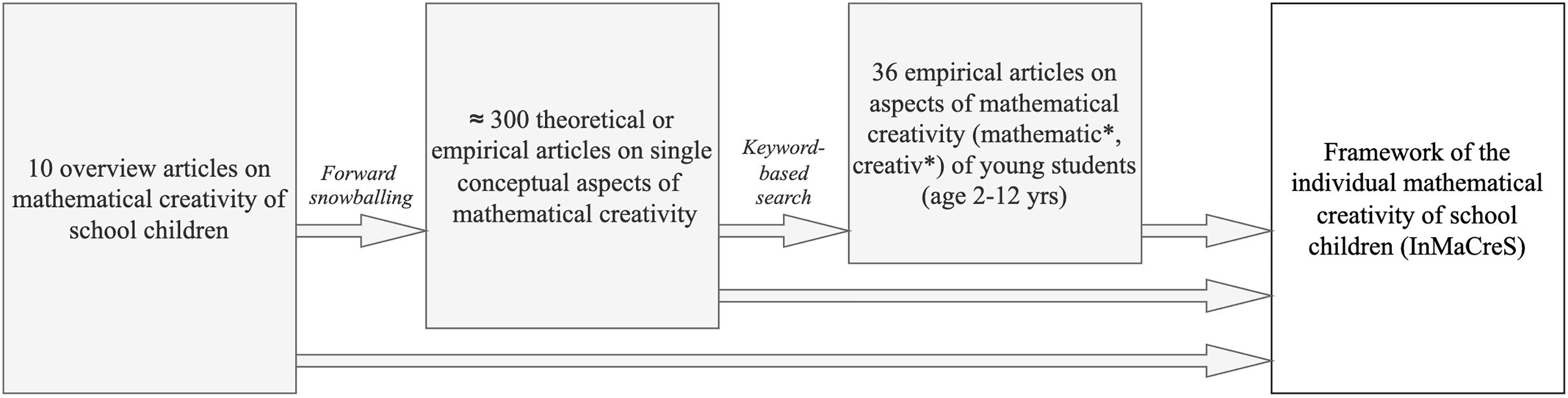
Data collection of the integrative review.
Our aim, however, was to develop a practice-orientated framework for the individual mathematical creativity of school children. Since the international research on students’ creativity was noticeably inspired by the work of Leikin (2009b), we subsequently conducted a keyword-based search to include recent research studies from the past 10 years that deal intensively with mathematical creativity, especially of young school children and studies that concentrate on fostering students to be creative in mathematics classes. Therefore, on November 5, 2020, we conducted a keyword-based search with the terms mathematic* and creativ* 1 in the databases of APA PsycArticles, APA PsycInfo, Education Source, ERIC, MLA International Bibliography with Full Text, and PSYNDEX Literature with PSYNDEX Tests. This search resulted in 810 research sources. By filtering those articles that specify the age of their participants as childhood (birth–12 years) and the context by referring to school age (6–12 years), 36 articles remained. Twenty-four of these 36 research sources focus intensively on school children as creative persons and describe the creative abilities of students working on specific mathematical tasks. The remaining 12 articles deal with features of mathematics lessons with their specific creativity-enhancing tasks as creative environments that stimulate school children to act creatively.
According to the elements of data analysis presented by Whittemore and Knafl (2005), we reduced, displayed, compared, and summarized the various conceptual aspects that are entailed in the collected articles to synthesize a framework of the InMaCreS. We exclusively integrated those in-depth research sources that made a significant contribution to the theoretical understanding of mathematical creativity regarding all school children working on mathematical tasks (see the comprehensive literature list in the Appendix). Especially findings on young school children as creative persons and designing mathematics lessons as creative environments were integrated into our framework, as the framework is intended to serve mathematics researchers and educators for observing, describing, and promoting mathematical creative activity in each of their students.
Summarizing and synthesizing the various notions of creativity that are presented in the reviewed research articles, we worked out some recurring and thus arguably significant aspects for a definition of the term mathematical creativity that can be described as either fundamental or content-related. In this section's introduction, we give a short overview of the different fundamental and content-related aspects and how they are connected, before we elaborate on them in more detail and relate them to our focus on (young) school children's mathematical creativity in the following subsections. The fundamental and content-related aspects as well as their relations are synoptically presented in Figure 2.
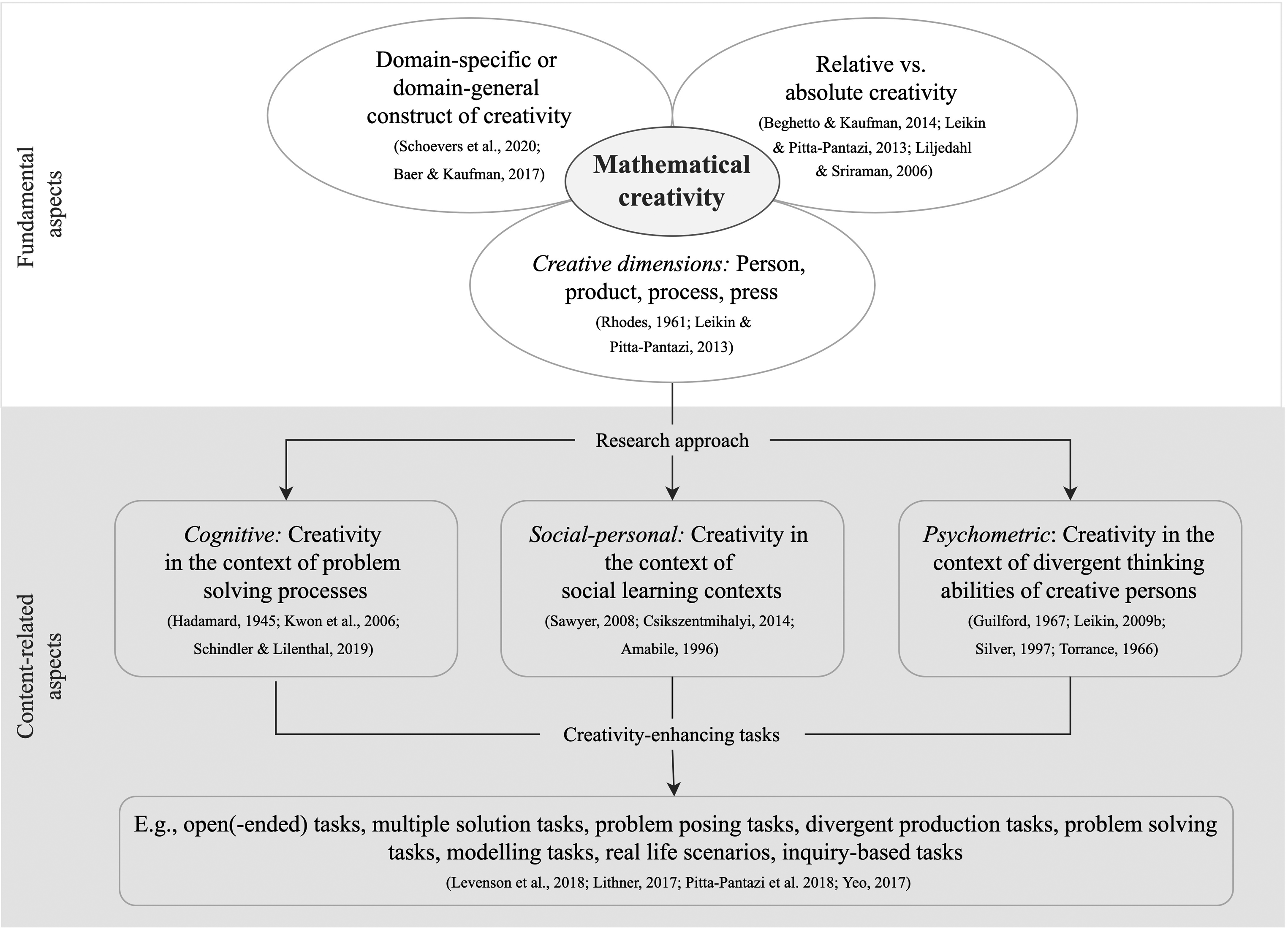
Fundamental and content-related aspects of notions of mathematical creativity.
Three fundamental aspects need to be considered to develop an explicit definition of the term mathematical creativity (see Figure 2, top). (a) It has to be evaluated if creativity is seen as a domain-specific or domain-general construct: is creativity a person's general ability or can somebody be exclusively mathematically creative? (Baer & Kaufman, 2017; Plucker & Beghetto, 2004; Schoevers et al., 2020). (b) It has to be considered if creativity is viewed as a relative versus an absolute construct: does it make a conceptual difference whether researchers focus on the creativity of young school children, adults, or mathematics experts? (Beghetto & Kaufman, 2014; Kaufman & Baer, 2006; Leikin & Pitta-Pantazi, 2013; Liljedahl & Sriraman, 2006). (c) Finally, the creative dimensions need to be taken into account: what does the word creativity refer to—the person, the product, the process, and/or the press? (Leikin & Pitta-Pantazi, 2013; Rhodes, 1961). The evaluation of these fundamental aspects needs to be a first step when developing an explicit definition of mathematical creativity, as the setting of priorities for the fundamental aspects directly influences the choice of content-related aspects for the definition of individual mathematical creativity of school children.
For the content-related aspects (see Figure 2, center), we identified three main lines of research approaches on creativity in the reviewed literature (e.g., Pitta-Pantazi et al., 2013; Sriraman, 2004; Sternberg & Lubart, 1999): (a) cognitive approaches focus on creative processes (e.g., Ervynck, 1991; Hadamard, 1945; Schindler & Lilienthal, 2019; Sriraman, 2004) and tend to examine students’ “flexible problem-solving-abilities” (Kwon et al., 2006, p. 52). (b) social-personality approaches concentrate on specific social contexts in which creativity arises. They study appropriate social environments for the development of creativity (e.g., Sawyer, 2008), cultural characteristics in which creativity manifests (e.g., Csikszentmihalyi, 2014), and personal features of certain creative persons such as students (e.g., Amabile, 1996). (c) Psychometric approaches are the most common lines of creativity in mathematics education research (Joklitschke et al., 2022). They define the four divergent production abilities of fluency, flexibility, originality, and elaboration (Guilford, 1967; Torrance, 1966) for the purpose of (quantitatively or qualitatively) evaluating the creativity of students based on their creative products (e.g., Leikin, 2009b, and recent research works). Besides these three research approaches within the content-related aspects of mathematical creativity, we have found a wide variety of different terms and descriptions of mathematical tasks that encourage children's mathematical creativity (Levenson et al., 2018; Lithner, 2017; Pitta-Pantazi et al., 2018; Yeo, 2017). The choice of creativity-enhancing mathematical tasks, however, depends as much on the specification of the fundamental aspects of the conceptualized notion of mathematical creativity as on the research approach chosen.
These briefly described fundamental and content-related aspects as well as their specific relationships serve as a basis for any conceptualization of the term mathematical creativity. While mathematics education researchers need to specify their orientation on all outlined fundamental aspects depending on their research interests, the content-related aspects are structured hierarchically. Based on the identified fundamental assumptions on the notion of mathematical creativity, the choice of an appropriate research approach and subsequently, the choice of mathematical tasks to encourage students to be creative directly relate to these specifications.
As elaborated before, our aim is to theoretically derive a concrete definition as well as a framework to characterize the individual mathematical creativity of young school children. Keeping this focus in mind, we will hereafter in-depth present the review results on the fundamental and content-related aspects as systematized in Figure 2 and provide reasons for selecting relevant aspects that are especially important for conceptualizing young students’ individual mathematical creativity.
In the reviewed research literature, three fundamental aspects of the definition of mathematical creativity—domain-specificity, relativity, and creative dimension (see Figure 2)—can be found that are meaningful for defying our term of individual mathematical creativity and, thus, are subsequently elaborated in detail.
Creativity as a domain-specific construct
One general question in the research on creativity in psychological, educational, or didactical literature is whether the construct of creativity is domain-general, domain-specific, or both (e.g., Plucker & Beghetto, 2004; Schoevers et al., 2020). Domain-generality implies that creativity is an ability of each person that occurs in all domains of life in the same way and, thus, can be fostered in all domains equally (Baer, 2012). To this date, there is no empirical evidence for this assumption (Ivcevic, 2007). That is why Baer (2012) advocates to “focus on more limited, domain-specific theories that attempt to explain how creativity works in different domains” (p. 27) like in mathematics when working on various mathematical tasks. Thus, domain-specificity means that a person's creativity in one domain like mathematics is not (neither positive nor negative) a predictor for the creativity of this person in another domain (Baer, 2012). In contrast to these two opposites, recent mathematics education research such as the work of Sriraman (2005) or Schoevers et al. (2020) take a mediating position in the discussion about the nature of creativity and describe creativity in the context of mathematics education as consisting of both domain-general and domain-specific aspects. By highlighting the relationship between these both characteristics of creativity, Baer and Kaufman (2017) developed the Amusement Park Theory (APT). With the APT model, the authors propose four hierarchy levels—initial requirements, general thematic areas, domains, and microdomains—that “range from extremely domain general to extremely domain specific” (p. 10) aspects. Each level is associated with specific (creative) traits or skills and thus, focuses on the creative person. The initial requirement (level 1) that describes the highest degree of domain-general creativity, motivation, is such a personal trait. The three subordinated levels display various domain-specific traits of creative behavior. By focusing on a particular general thematic area (level 2) such as the scholarly environment, a domain (level 3) such as mathematics education, and a specific microdomain (level 4) such as specific tasks, the focused creativity includes more and more domain-specific aspects.
Since we intend to build a framework to identify and qualitatively describe the creativity of school children working on mathematical open tasks (microdomain level according to Baer and Kaufman, 2017), the notion of creativity has to be domain-specific. To emphasize this fundamental aspect, we use the term mathematical creativity.
Creativity as a relative construct
Another important and fundamental aspect in the literature dealing with mathematical creativity is the question of to whom this construct refers, respectively, for whom mathematical creativity is defined. To answer this question, Kaufman and Beghetto (2009) developed the Four-C-Model of creativity that differentiates four consecutive stages of creativity (see Figure 3): the Mini-C of school children, the Little-C of each person, the Pro-C of persons in a specific domain, and the Big-C of professionals. The Mini-C-creativity is especially important for this article because it focuses on students and their creative abilities in domain-specific learning situations (Beghetto & Kaufman, 2014). In summary, the Four-C-Model emphasizes the essential difference between the individual creativity (Niu & Sternberg, 2006) of students and that of professional mathematicians.
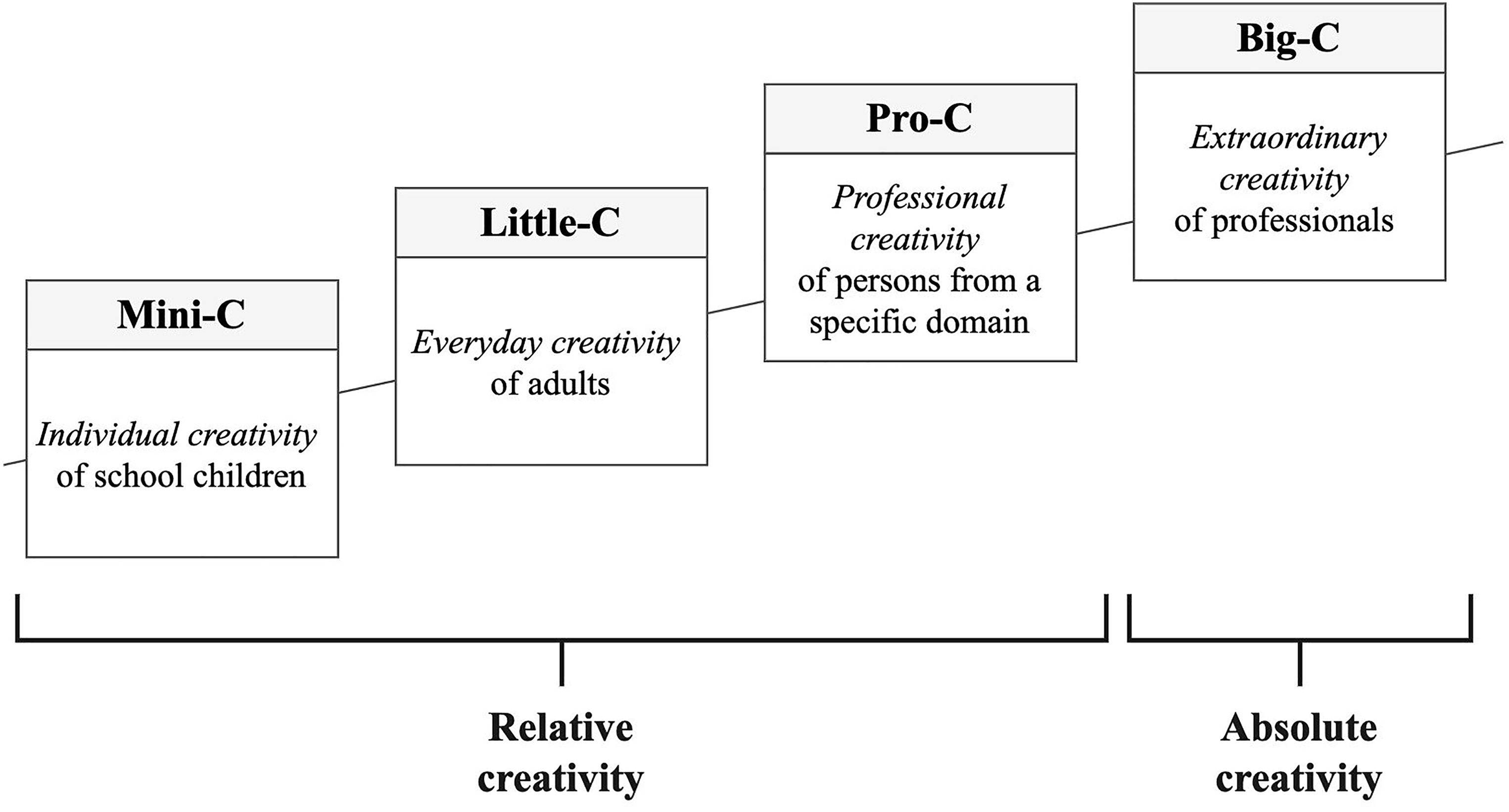
Synopsis of the Four-C-Model (Kaufman & Beghetto, 2009) and the terms relative and absolute creativity (Leikin, 2009b).
This distinction is understood under the concept of relative creativity in contrast to absolute creativity (Leikin & Lev, 2013; based on Vygotsky, 2004) (see Figure 3). For the domain of mathematics education, “[r]elative creativity refers to a specific person in a specific group acting in a creative way” (Leikin, 2009a, p. 398). With regard to the assumption that everyone can be creative (Kaufman & Beghetto, 2009), differences in children's mathematical creativity appear on a quantitative and qualitative level, as presented in the following section on content-related aspects of the notion of mathematical creativity.
For this article, we emphasize the relative definition by establishing the term individual for the construct of mathematical creativity and thus, we use the term individual mathematical creativity. Subsequently, there needs to be a closer look at the possible creative dimensions that can be focused on with this term.
Leikin and Pitta-Pantazi (2013) stated that those definitions of mathematical creativity have been proven useful that have a specific focus. These foci are based on the dimensions described by Rhodes (1961) as the four Ps of creativity, namely the creative person, the creative process, the creative product, and the creative press.
Research that focuses on the creative person primarily investigates the person's personality traits and/or cognitive abilities that promote creativity (e.g., Kattou et al., 2016; Pitta-Pantazi et al., 2013). For school children in particular, the enjoyment of mathematics is an important factor in showing their individual mathematical creativity (Mann, 2006; Starko, 2018). Creative processes relate to the question: “What are the stages of the thinking process?” (Rhodes, 1961, p. 308). Recent research is still based on the creative problem-solving model from experts such as Hadamard (1945) and intensively focuses on school children's individual creative processes (Schindler & Lilienthal, 2019) or their Aha!-moment (Liljedahl & Sriraman, 2006). Sternberg and Lubart (1999) characterize creative products by the attributes “novel (i.e., unexpected, original) and appropriate (i.e., useful, adaptive concerning task constraints)” (p. 3). Because the analysis of creative products (any type of working result) may lead to conclusions about the creative process (Liljedahl & Sriraman, 2006), these two dimensions are strongly related. The creative press concentrates on environmental influences in which fostering the individual mathematical creativity of students can be successful. Examples of research focuses are the relationship between persons and their context (Csikszentmihalyi, 2014), the design of creativity-fostering mathematical tasks such as open tasks (Levenson et al., 2018), or fundamental social values and traditions (Runco, 2004).
Complex connections between the four dimensions occur and must be taken into consideration (Pitta-Pantazi et al., 2013). To empirically use the definition of mathematical creativity, it seems reasonable to set an emphasis on one dimension. In this article, school children as creative persons are focused on because of the relativity and domain-specificity of creativity. In our construct, the four dimensions interact with each other as follows: a creative person establishes a creative product within a creative environment and in a creative process.
To summarize, the introduced term individual mathematical creativity of school children emphasizes three fundamental aspects, namely the domain-specificity, the relativity of the notion, and the focus on the creative persons. Nevertheless, the question remains, which mathematical thinking and behavior of school children working in a mathematical environment on a specific mathematical task can be labeled as mathematically creative? To answer this question, content-related aspects of the definition of the individual mathematical creativity are now presented.
Content-related aspects of the notion of creativity
As Kwon et al. (2006) highlight, “instructional approaches in school mathematics greatly depend on which definition [of mathematical creativity] is emphasized” (p. 52). Therefore, it is necessary to precisely and content-relatedly define the individual mathematical creativity of young mathematics students based on the before-explained fundamental aspects. Since our focus is on school children as creative persons, we suggest the choice of a psychometric research approach to reconstruct the children's creative abilities based on their creative products and processes. Therefore, understanding mathematical creativity in the context of divergent thinking, open tasks (among various other mathematical types of tasks) seem to be suitable to encourage school children to show their individual mathematical creativity. Both content-related aspects—divergent production abilities and open tasks—are presented in detail in the following sections.
Divergent production abilities as characteristics of creativity
In our reviewed literature on mathematical creativity in the context of divergent thinking, four divergent production abilities (fluency, flexibility, originality, and elaboration) are constantly named. Some of them have been empirically proven to influence as well as interact with each other (Kattou et al., 2016; Leikin & Lev, 2013) and they allow a qualitative description of mathematical creativity.
Since the notion of mathematical creativity is characterized by the interplay of all divergent abilities, this conceptual understanding of originality leads to the conclusion that only a few school children can be creative. This contradicts the fundamental assumption that all students may show their individual mathematical creativity in everyday mathematical situations of learning and play (Aßmus & Fritzlar, 2018; Kaufman & Beghetto, 2009). By focusing on young school children's creativity in this article, it seems less purposeful to describe originality by the mathematically extraordinary quality of ideas (Silver & Cai, 2005). Regarding the mathematical expertise of young mathematics students, the approach in defining originality by Silver (1997) is more focused on the individual creative person and their ability to generate new types of ideas. Hence, originality is the students’ ability to “examine many solution methods or answers (expressions or justifications) [and] then generate another that is different” (Silver, 1997, p. 78). This means that—after the students eventually stop the divergent production of their own volition—originality can only occur when students reflect on their entire individual answer that is composed of various (types of) ideas and extend them. With this definition, originality differs from flexibility. With flexibility, the review of previously shown chronological ideas may inspire students to further (types of) ideas. Thus, short reflective moments emerge that are mostly initiated by the school children spontaneously. In the case of originality, the school children purposefully and often stimulated by mathematics educators reflect and extend their complete answer to a mathematical task, that is, all various (types of) ideas that have been fluently and flexibly produced.
Open tasks that foster the mathematical creativity of school children
The choice of the task directly determines school children's mathematical thinking and this, in turn, influences their mathematical creativity (Breen & O'Shea, 2010). That is why the impact of various activities to foster the mathematical creativity of students is “one of the main lines of research regarding creativity” (Pitta-Pantazi et al., 2018, p. 42) in mathematics education research. Besides problem-solving activities, a variety of task formats such as open tasks, modeling problems, daily life scenarios, problem posing, or multiple solution tasks are examined regarding their influence on mathematical creativity (for an overview see Pitta-Pantazi et al., 2018). To examine the (everyday) mathematical creativity of children in mathematics classes, we emphasize a type of mathematical task that enables students to show their divergent production abilities (fluency, flexibility, originality, and elaboration): open tasks (Hershkovitz et al., 2009; Silver, 1997). Open tasks are known for facilitating school children to demonstrate their individual creativity in mathematics (e.g., Levenson et al., 2018).
The openness of mathematical tasks “refers to the existence of more than one (preferably many more than one) possible pathways, responses, approaches, or lines of reasoning” (Sullivan et al., 2000, p. 3) that can be chosen individually by the processing student. Therefore, open tasks are characterized by the explicit invitation to produce multiple solutions while simultaneously choosing appropriate solution methods, or in the words of Sullivan et al. (2000), pathways or approaches (also called multiple solution tasks by Leikin, 2009b). In their research on 5-year-old preschoolers, Tsamir et al. (2010) highlight that young children “who have had little experience with standard mathematical [tasks], may be more open and creative in their thinking than older children who have been acculturated by years of solving standard one solution [tasks]” (p. 228). This significant research result about young primary students being equally or more creative than older students can also be supported by the work of Kattou et al. (2016), Sak and Maker (2006), Schacter et al. (2006), or Torrance (1968). Therefore, school children of all ages are capable of working on open tasks, which enable learning for all students (Hershkovitz et al., 2009)
In addition to the various solution methods, open tasks highlight the children's individual working process instead of solely reaching the right answer. Around 25 years ago, Becker and Shimada (1997) emphasized that, when working on open tasks, school children have to be creative by discovering new pathways in solving the task as well as combining mathematical aspects and abilities to form something new. Being mathematically creative in this way facilitates the school children's performance in mathematics based on their individual abilities, to be mathematicians by developing their own solution methods, and to produce an answer to a mathematical task that is appreciated in class (Kwon et al., 2006).
Yeo (2017) developed a framework to characterize the openness of mathematical tasks that can be used as an analytical tool for researchers and mathematics educators. In the following, the main characteristics of open tasks that foster students to be creative, that is, to show their divergent production abilities, are presented in terms of the five defined task variables answer, goal, methods, complexity, and expansion: allowing students to show their fluency, the answer to an open task must consist of a variety of (types of) ideas and thus be very much open as well as not determined. Consequently, we cannot expect that two school children will produce identical answers to the same open task. Focusing on the ideas of the students, solutions can indeed be mathematically incorrect, but the idea might be appropriate to the open task and thus part of the answer. With respect to the mathematical learning biography and the age of the students, the goal of the open task should be formulated clearly rather than vague so that it becomes clear that a divergent production is expected from the students. To allow the (young) students to show their flexibility and originality when working on an open task, the choice of methods (respectively, methods or pathways) is up to the students and not prescribed by the task itself. Since every school child is free to choose their individual strategy, they can show different types of ideas as well as changes of ideas (flexibility) as well as reflect on and extend them afterward (originality). The openness of the task relating to the prior explained characteristics implies a certain degree of complexity, which potentially exceeds the mathematical abilities of the students. Focusing on elaboration as well, the teacher must be able to reduce the complexity by appropriate scaffolding (e.g., Anghileri, 2006) as already stated, for example, by concrete (meta-)cognitive prompts (Bannert, 2009) such as “Can you explain how do you come up with this idea?” or “What is your next idea?” (Bruhn, 2022b). Those prompts foster school children to explain their thoughts and subsequently, develop additional methods in working on the task. Last, open tasks do not have to prompt the children to expand the task, in the sense of transferring the mathematical content for attaining more mathematical understanding. Expansion is not a characteristic of creativity-enhancing open tasks.
Considering the previously explained characteristics that are based on Yeo (2017), we collected some examples of open tasks that can be used in mathematics lessons for enhancing the individual mathematical creativity of school children. Allowing all students to work creatively, the complexity of the exemplary open tasks that preliminarily focus on primary school children can be adjusted on a content-specific level.
Find different facts with the number 4. Draw various squares that have an area of 2 cm2. Name various objects of length 1 m.
Framework to characterize the individual mathematical creativity of school children working on open tasks
Building on the detailed results of the integrative review and, in particular, based on the specified fundamental and content-related aspects of mathematical creativity, we precisely define the individual mathematical creativity of school children. Our definition of individual mathematical creativity is presented in the following subsection. Subsequently, and as the main emphasis of this article, we outline the development of the InMaCreS framework that may serve as an analytical tool for mathematics education researchers and as an educational tool for teachers to observe the creativity of young students. To illustrate the potential of using the framework for qualitatively describing the creativity of young school children, we finally analyze the exemplary task processing of one first grader named Jessica who worked creatively on an arithmetic open task.
Definition of individual mathematical creativity
For summarizing the previously presented results of the literature review, we used the graphical systematization of the fundamental and content-related aspects as presented in Figure 2 and reduced them to highlight our specifications of the notion of individual mathematical creativity of young school children (see Figure 4).
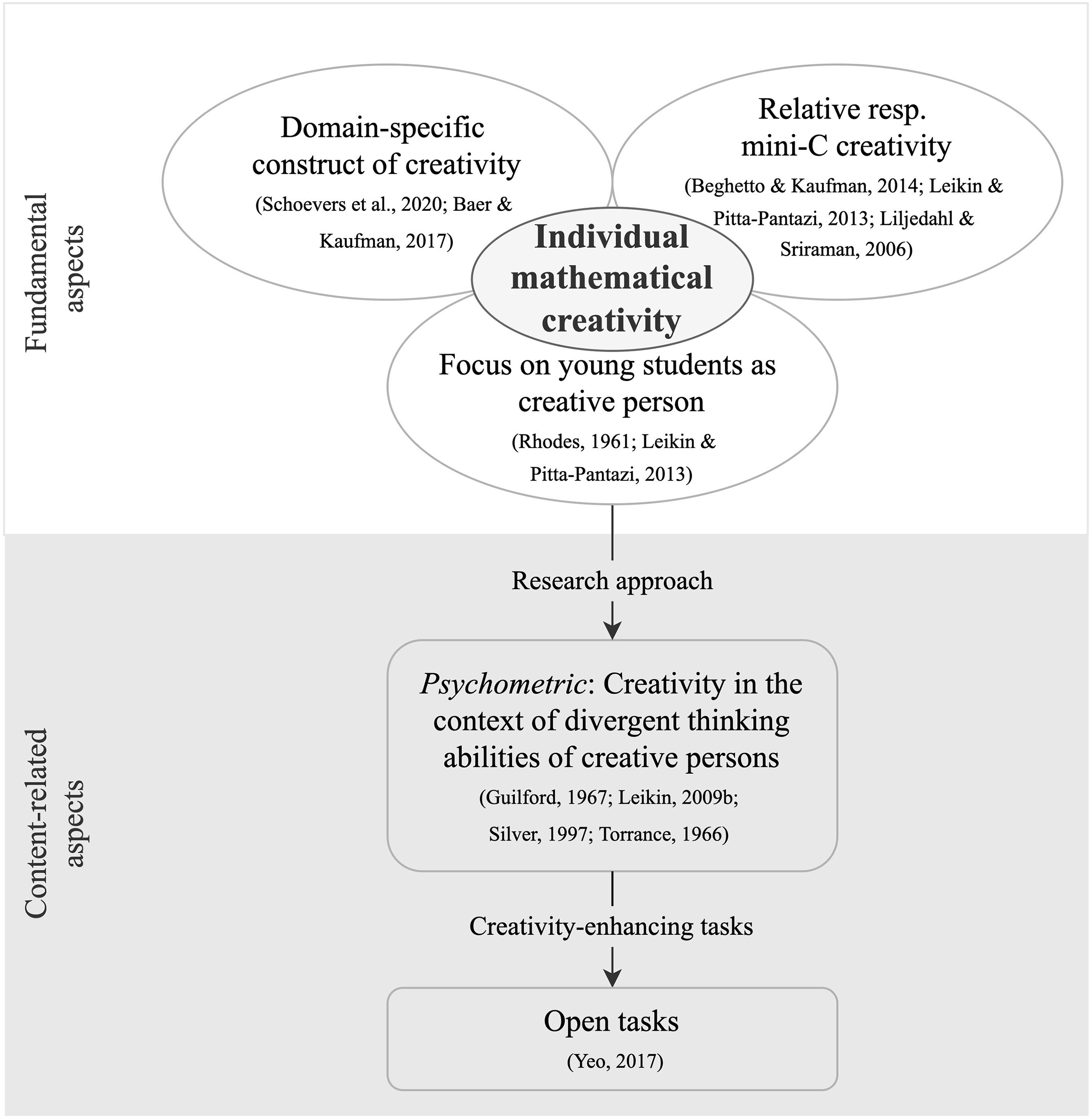
Definition of the individual mathematical creativity of young school children.
Initially, the term individual mathematical creativity emphasizes three fundamental aspects that are equally significant and interact with each other (see Figure 4, top): the construct of creativity in mathematics education is frequently grasped as domain-specific, and thus, young school children may show specific creative abilities when working on appropriate mathematical tasks. Moreover, mathematical creativity is understood in a relative way, meaning that the creative behavior of school children must be described in reference to their individual mathematical abilities and/or to other peers. Lastly, by using the term individual mathematical creativity, we focus on (young) school children as creative persons.
Regarding the content-related aspects (see Figure 4, bottom), a psychometric research approach is used to describe the individual mathematical creativity of students as creative persons by focusing on four divergent production abilities, namely fluency, flexibility, originality, and elaboration. This results in the use of mathematical open tasks that allow school children to show their individual mathematical creativity by working divergently on the task.
Based on these extensively presented fundamental and content-related theoretical explanations, we define individual mathematical creativity as follows: The individual mathematical creativity is the relative ability of a school child to produce ideas to an open task in a mathematical learning context (fluency), to show different types of ideas and to switch between them (flexibility), to find ideas in addition to the previously produced ideas (originality), and to explain the production of their own ideas (elaboration).
Our aim is to develop an analysis tool that can easily be used in mathematics education research and in mathematics lessons to make the individual mathematical creativity of students empirically visible. For observing and describing school children's creative behavior when working on open tasks—either as a researcher or an educator—we need to break down the theoretically derived definition and sort the relevant parts into a framework that makes their reciprocal relations and overlaps transparent in a graphic way. Therefore, we hereinafter present our considerations for the development of the InMaCreS framework (see Figure 5) based on the reviewed literature by clarifying flexibility as two separate abilities, outlining our thoughts on designing a working process in which children can display their originality, and describing the specific relations between the four divergent production abilities fluency, flexibility, originality, and elaboration.
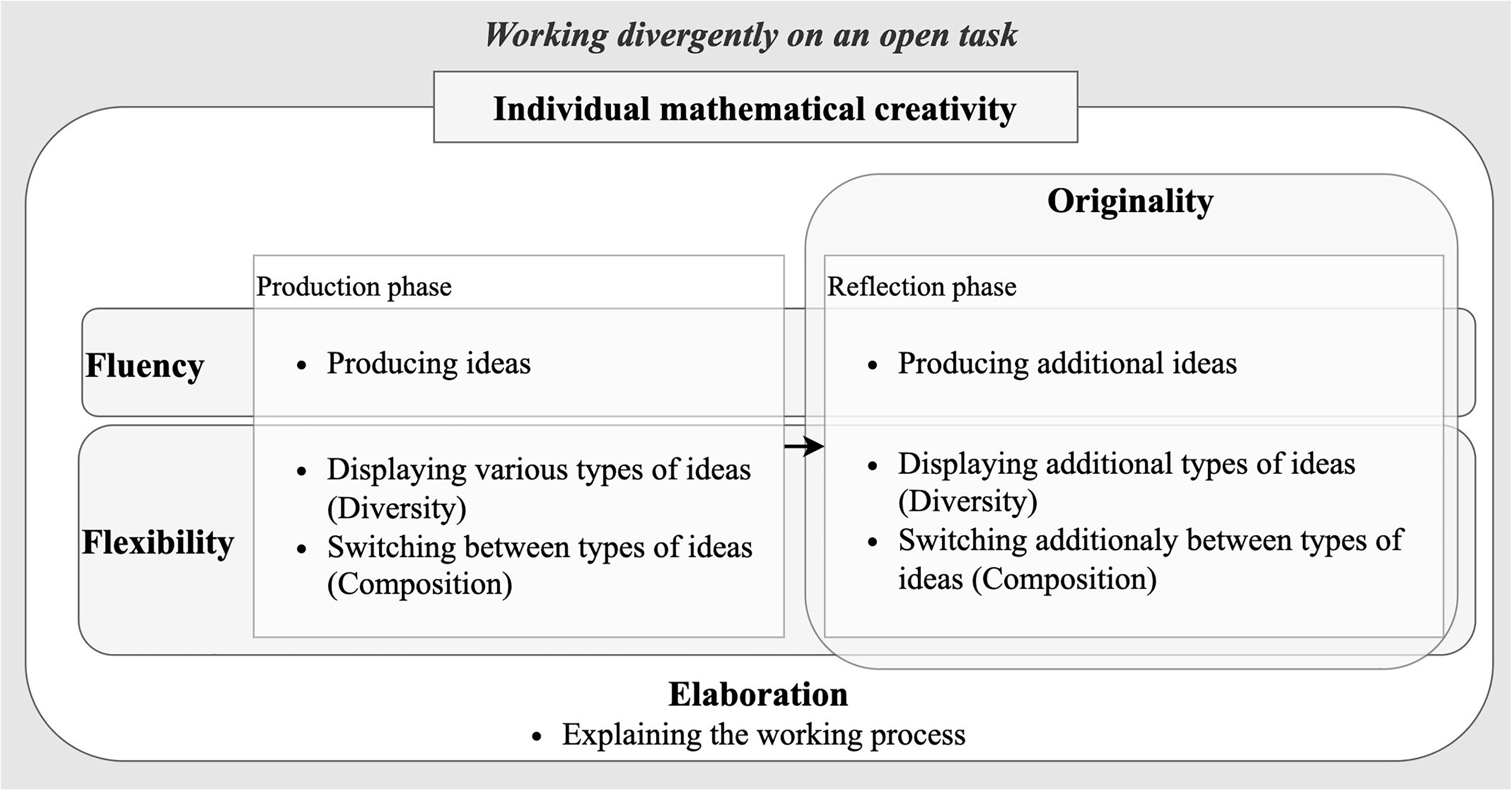
Framework to characterize the individual mathematical creativity of school children (InMaCreS).
4.2.1 Flexibility as two separate abilities
As previously presented, both the research literature on divergent production abilities and our definition of the term individual mathematical creativity specify flexibility as the student's ability to show different types of ideas and to switch between them. This definition consists of two parts (showing types of ideas vs. switching between types of ideas) and entails two separate abilities, which might be differently developed in school children. We think it is worthwhile to look at these two parts of flexibility separately. To emphasize the two aspects, we label the ability to show different types of ideas as diversity and the ability to switch between the different types of ideas as composition. The two abilities are reflected in the framework as two separate list paragraphs for flexibility (see Figure 5). To what extent a connection exists between composition and diversity remains to be explored by using the InMaCreS framework as a mathematics education research tool.
For a mathematical school context, we defined originality as a student's capability to reflect and extend his/her answer to an open task. However, students usually end their working process after they think they found all (for them individually possible) solutions to the open task. There is neither a need nor an opportunity to find additional ones, in which case originality cannot be observed. Therefore, the creative task processing should be followed by a teaching phase in which mathematics educators carefully and purposefully encourage the school children to reflect on and expand their answers. This is particularly important with young students because we found that reflecting, in the sense of exploring and reviewing, triggers especially young students to find additional ideas and types of ideas. However, school children's ability to be original has to be distinguished from brief reflective moments during the working process when students are—consciously or unconsciously—inspired by one of their own ideas to produce additional ideas or types of ideas. Consequently, these mini-reflections are relevant as they mainly affect the student's fluency and flexibility as characteristics of their individual mathematical creativity. Unlike these reflective moments, originality relates to the student's conscious, sensible, and broad reflection of the entire answer to open tasks that they individually created. To observe and foster this essential creative ability, we therefore suggest dividing the creative task processing into two phases that build on each other and are strongly bound: First, in a production phase, the school children work individually on the task and produce various solutions. Afterward, in a reflection phase, the students review and try to extend their answers.
Both phases should be sensitively initiated by mathematics researchers or educators by using appropriate verbal stimuli to clarify the assignment and to support the student's creative task processing without influencing them. To begin the production phase, we found it reasonable to first ask the (young) school children to find a single solution to a mathematical task, then to find a second one, and afterward to open the task completely. Considering for example the open task “Find different facts with the number 4,” the production phase may be introduced by the questions “Can you find a fact with the number 4?”, “Can you find another fact with the number 4?” and “Can you now find various facts with the number 4?” To guide the subsequent reflection phase, the verbal impulse “If you now look at all your facts, what ideas did you have? Can you find even more different facts with the number 4?” seems appropriate to foster the students to show their originality by reflecting on and extending their answer to the open task.
To progressively strengthen students’ autonomy when working creatively on open tasks, our recommended verbal stimuli can also be used in peer interaction by the children themselves to encourage each other's fluency, flexibility, and originality. However, the way the various questions should be used by the young learners needs to be discussed purposefully and, most of all, practiced often to create a positive learning environment in which all school children can be creative. The InMaCreS framework reflects the two phases as two boxes with separate lists of foci for analysis which have to be applied from left (production) to right (reflection) (see Figure 5). Following our considerations, children can display originality only during the reflection phase.
Connections between fluency, flexibility, originality, and elaboration
Looking even closer at the originality, we suggest that children can extend their answer in three different ways: by producing additional ideas (fluency), by showing additional types of ideas (flexibility-diversity), and/or by additionally switching between types of ideas (flexibility-composition). Consequently, originality directly refers to both fluency and flexibility; they overlap in the reflection phase. This also means that we can observe and describe a child's fluency and flexibility both in the production and reflection phases. In the InMaCreS framework, fluency and flexibility are arranged as two horizontal strands that pass through first the production and second the reflection phase. In the latter, the two horizontal strands overlap the vertical strand of originality.
We regard elaboration as the basis of our framework because it can be displayed and observed during the whole working process. A second reason for this consideration is that the divergent production abilities fluency and flexibility are strongly related to elaboration. By explaining or commenting on their creative behavior, children become more aware of their thoughts and ideas (Sonneberg & Bannert, 2015) which, in turn, may have a supporting impact on the working process. As a result, elaboration may (positively and negatively) influence all the other abilities. We, therefore, think it is important to invite children to verbalize their thoughts to their mathematics educators and/or their classmates throughout the working process and to consider their explanations when characterizing the children's mathematical creativity. This view is reflected in the InMaCreS framework by elaboration being the background on which the intertwined strands of fluency, flexibility, and originality are set (see Figure 5).
Exemplary application of the InMaCreS framework: Jessica's individual mathematical creativity
In this last section, we like to illustrate our theoretically derived framework of the individual mathematical creativity of school children (see Figure 5) and highlight concrete implementations for both mathematics education researchers to explore the creativity of mathematics students and for teachers to encourage school children to be creative. For this purpose, we subsequently present and analyze the creative behavior of Jessica, a 6-year-old German first-grade student that worked in June 2019 on the open task Find different facts with the number 4. We chose an arithmetical focus for designing this open task since Jessica, like all German first-grade students, had mainly spent the first 10 months of mathematics education at her municipal primary school developing abilities in dealing with numbers, addition/subtraction facts up to 20, as well as arithmetical structures (Kultusministerkonferenz, 2022), and was now able to use her experience to work creatively on the open task. Following the theoretical considerations of our notion of individual mathematical creativity, we purposefully implemented a teaching episode so that we were able to use the InMaCreS framework as an analytical tool to describe creative activities of Jessica in detail. On a methodical level, the creative task processing of the first-grade student was videotaped and a think-aloud method (overview by Leighton, 2017) was used to gain access to the child's mental world (see for more details Bruhn, 2022a).
Jessica's creative processing of the open task Find different facts with the number 4 can be described as follows: At first, Jessica produced 13 facts with the number 4 in total whereby three facts were doubles (in order of appearance:
We now use the theoretically derived InMaCreS framework to describe Jessica's individual mathematical creativity in a qualitative way and thereby demonstrate a way in which mathematics education researchers and/or mathematics educators can use the framework to make visible, explore, and describe the individual mathematical creativity of school children working on open tasks. We describe Jessica's individual mathematical creativity according to the InMaCreS framework as follows.
Starting in the framework's top left corner with the strand of the divergent production ability fluency in the production phase, Jessica was capable of working divergently on the open task Find different facts with the number 4. When she worked individually on the task, the girl produced and explained 10 facts with the number 4, three of which were doubled. Jessica produced more subtraction facts (6 of 10) than addition facts (4 of 10) and all facts used numbers up to 10. When focusing arithmetically on the facts, all but one were mathematically correct
In the following, the focus is set on the second strand in the InMaCreS framework highlighting flexibility with the two aspects of diversity (types of ideas) and composition (switching between types of ideas) in the production phase. To identify different types of ideas that school children show when working creatively on one specific open task, students’ various (fluently produced) ideas must be systematized by focusing, for example, on the representation level, mathematical content, mathematical objects, or mathematical structures that are used (e.g., Kattou et al., 2016; Leikin & Lev, 2013). For describing Jessica's flexibility when working on the open task Find different facts with the number 4, we used an inductive content analysis to categorize Jessica's 13 ideas into different types of ideas (Bruhn, 2022a). By mainly explaining that she has various facts in her head that come to the fore, Jessica showed frequently one type of idea, the so-called freely-associated ideas. This type of idea is characterized by the children's creative behavior of freely—mathematically unstructured but still associated with numerical or arithmetical features—producing facts for the open task. Jessica's verbal or gestural clarifications (her elaboration ability), as well as the placement of the facts on the table, served as explanations on how and why these facts might be produced by the child. Besides various freely associated ideas, the first grader showed in the production phase two isolated structure-using ideas (producing and explaining facts based on arithmetical structures) and one pattern-forming idea (producing and explaining facts based on a numerical pattern). Focusing on the aspect of the composition of Jessica's flexibility, she pursued the freely associated ideas for a long time, but switched six times between this and the other two types of ideas. Proportionally to her total amount of 13 ideas in the production phase, we characterize such behavior in the task processing as varied procedure. We use this term in contrast to a straight-line procedure, which would be when the child only shows very few types of ideas (flexibility) and—in relation to their total number of ideas—do not or only occasionally switch to another type of ideas (composition).
In the process of characterizing Jessica's creativity, we now have to look at her behavior in the reflection phase in order to describe her originality. This divergent production ability has strong connections to fluency and flexibility, as shown in the InMaCreS framework by overlapping the three strands (see Figure 5). Regarding Jessica's fluency, the girl first reviewed her production. Eventually, she picked out different facts and showed additional ideas by explaining arithmetical structures, numerical patterns, or classifications that might connect her previously produced facts. Overall, Jessica was able to explain in a mathematically transparent way her various (same and additional) types of ideas. She separated, for instance, the facts
Discussion
Finally, there are a few implications as well as limitations of the framework that can be used to characterize the individual mathematical creativity of school children. The theoretical background of the framework is the definition of mathematical creativity in the context of the divergent production theory based on (Guilford, 1967) and extended to mathematics education by, for example, Leikin and Pitta-Pantazi (2013). Thus, it only focuses on the students as creative persons (e.g., Kattou et al., 2016) and their creative abilities, namely fluency, flexibility, originality, and elaboration in an appropriate mathematical learning situation.
The decision about the content-related basis of the InMaCreS framework has a direct impact on the suitable tasks that foster the creativity of school children and vice-versa. To use the framework in mathematics education research and at schools, open tasks that are characterized by the openness of their answer, method, goal, and complexity (Yeo, 2017) should be applied. The used task Find different facts with the number 4 is only one concrete example for open tasks to use in primary mathematics education.
However, the strength of the InMaCreS framework lies in its adaptability to various fields of application like the mathematical experience of the students, different school grades, the learning background of the school children, or various mathematical contents (e.g., arithmetic, geometry, or mathematical analysis). It has to be considered, though, that the choice of mathematical content affects the types of ideas school children may show. In addition to the presented arithmetical types of ideas, new or adapted categories for the types of ideas children show when working on the task have to be developed. This adaptability of the framework is based on the assumption that the individual mathematical creativity of students is domain-specific (Baer & Kaufman, 2017; Schoevers et al., 2020) and, in particular, a relative construct (Leikin, 2009b; Liljedahl & Sriraman, 2006). Therefore, the various creative working processes of one child can be compared to build a generalizable qualitative description of their creativity in mathematics.
In this article, we applied the InMaCreS framework exemplarily to the creative working process of the first grader Jessica and we were able to describe her individual mathematical creativity in detail. By using the framework to explore the creativity of more children working on the same or different open tasks, a high variety of qualitative characterizations of the individual mathematical creativity of these students can be expected. Of course, the framework may serve to quantify all insights about the divergent production abilities to evaluate both the individual mathematical creativity of school children working on open tasks as well as mathematical creativity training in school. For this, further research is needed.
As Kaufman and Beghetto (2009) already stated, everyone can be creative. The framework to characterize the InMaCreS facilitates exploring the various kinds of creativity of students working on open tasks.
Footnotes
Contributorship
Svenja Bruhn conducted the research and wrote the initial draft of the manuscript. Miriam M. Lüken provided important ideas for the research and its presentation in the manuscript. In an interactive process, Svenja Bruhn and Miriam M. Lüken were involved in critically reviewing, commenting on, and revising the original draft to the final manuscript that both authors read and approved.
Declaration of Conflicting Interests
The author(s) declared no potential conflicts of interest with respect to the research, authorship, and/or publication of this article.
Funding
The author(s) received no financial support for the research, authorship, and/or publication of this article.

Notes
Author biographies
List and details of reviewed literature structured by theoretical aspects on mathematical creativity of school children. Note. A full reference list can be found in the main article. For the type of articles, the abbreviation E refers to empirical articles, T indicates theoretical contributions, EB stands for scientific edited books, and P for practical handbooks or articles for educators that address the topic of students' mathematical creativity.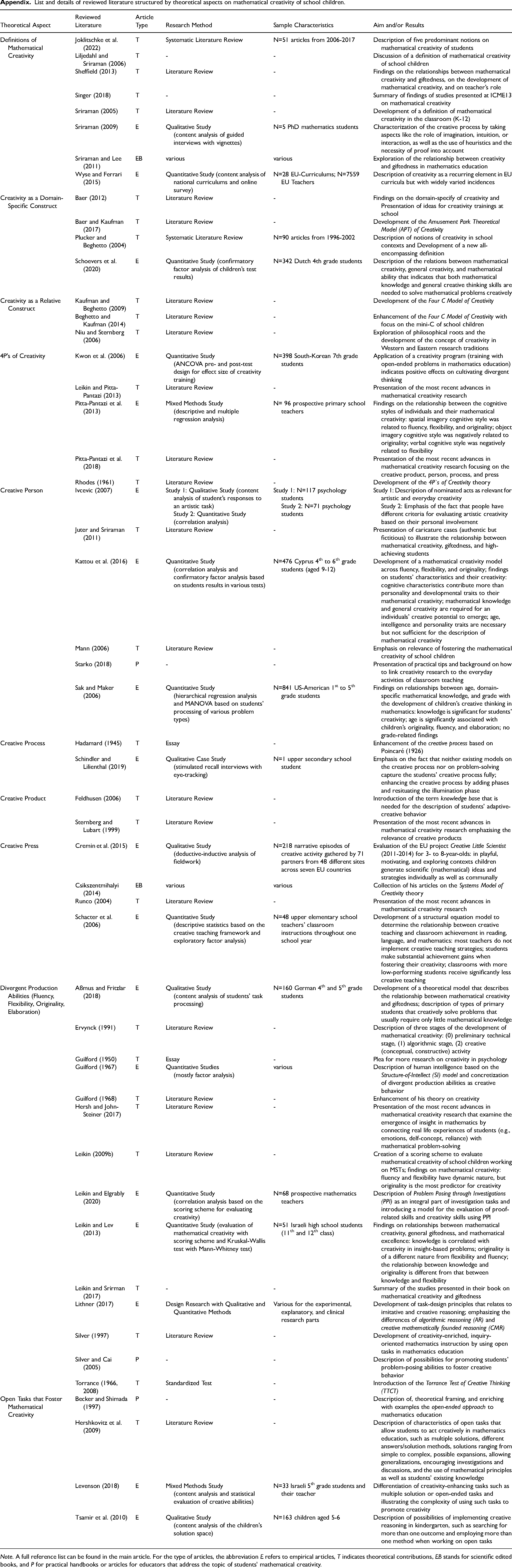
Theoretical Aspect
Reviewed Literature
Article Type
Research Method
Sample Characteristics
Aim and/or Results
Definitions of Mathematical Creativity
Joklitschke et al. (2022)
T
Systematic Literature Review
N=51 articles from 2006-2017
Description of five predominant notions on mathematical creativity of students
Liljedahl and Sriraman (2006)
T
-
-
Discussion of a definition of mathematical creativity of school children
Sheffield (2013)
T
Literature Review
-
Findings on the relationships between mathematical creativity and giftedness, on the development of mathematical creativity, and on teacher’s role
Singer (2018)
T
-
-
Summary of findings of studies presented at ICME13 on mathematical creativity
Sriraman (2005)
T
Literature Review
-
Development of a definition of mathematical creativity in the classroom (K-12)
Sriraman (2009)
E
Qualitative Study
(content analysis of guided interviews with vignettes)N=5 PhD mathematics students
Characterization of the creative process by taking aspects like the role of imagination, intuition, or interaction, as well as the use of heuristics and the necessity of proof into account
Sriraman and Lee (2011)
EB
various
various
Exploration of the relationship between creativity and giftedness in mathematics education
Wyse and Ferrari (2015)
E
Quantitative Study (content analysis of national curriculums and online survey)
N=28 EU-Curriculums; N=7559 EU Teachers
Description of creativity as a recurring element in EU curricula but with widely varied incidences
Creativity as a Domain-Specific Construct
Baer (2012)
T
Literature Review
-
Findings on the domain-specify of creativity and Presentation of ideas for creativity trainings at school
Baer and Kaufman (2017)
T
Literature Review
-
Development of the Amusement Park Theoretical Model (APT) of Creativity
Plucker and Beghetto (2004)
T
Systematic Literature Review
N=90 articles from 1996-2002
Description of notions of creativity in school contexts and Development of a new all-encompassing definition
Schoevers et al. (2020)
E
Quantitative Study (confirmatory factor analysis of children’s test results)
N=342 Dutch 4th grade students
Description of the relations between mathematical creativity, general creativity, and mathematical ability that indicates that both mathematical knowledge and general creative thinking skills are needed to solve mathematical problems creatively
Creativity as a Relative Construct
Kaufman and Beghetto (2009)
T
Literature Review
-
Development of the Four C Model of Creativity
Beghetto and Kaufman (2014)
T
Literature Review
-
Enhancement of the Four C Model of Creativity with focus on the mini-C of school children
Niu and Sternberg (2006)
T
Literature Review
-
Exploration of philosophical roots and the development of the concept of creativity in Western and Eastern research traditions
4P’s of Creativity
Kwon et al. (2006)
E
Quantitative Study
(ANCOVA pre- and post-test design for effect size of creativity training)N=398 South-Korean 7th grade students
Application of a creativity program (training with open-ended problems in mathematics education) indicates positive effects on cultivating divergent thinking
Leikin and Pitta-Pantazi (2013)
T
Literature Review
-
Presentation of the most recent advances in mathematical creativity research
Pitta-Pantazi et al. (2013)
E
Mixed Methods Study
(descriptive and multiple regression analysis)N= 96 prospective primary school teachers
Findings on the relationship between the cognitive styles of individuals and their mathematical creativity: spatial imagery cognitive style was related to fluency, flexibility, and originality; object imagery cognitive style was negatively related to originality; verbal cognitive style was negatively related to flexibility
Pitta-Pantazi et al. (2018)
T
Literature Review
-
Presentation of the most recent advances in mathematical creativity research focusing on the creative product, person, process, and press
Rhodes (1961)
T
Literature Review
-
Development of the 4P`s of Creativity theory
Creative Person
Ivcevic (2007)
E
Study 1: Qualitative Study (content analysis of student’s responses to an artistic task)
Study 2: Quantitative Study (correlation analysis)Study 1: N=117 psychology students
Study 2: N=71 psychology studentsStudy 1: Description of nominated acts as relevant for artistic and everyday creativity
Study 2: Emphasis of the fact that people have different criteria for evaluating artistic creativity based on their personal involvement
Juter and Sriraman (2011)
T
Literature Review
-
Presentation of caricature cases (authentic but fictitious) to illustrate the relationship between mathematical creativity, giftedness, and high-achieving students
Kattou et al. (2016)
E
Quantitative Study
(correlation analysis and confirmatory factor analysis based on students results in various tests)N=476 Cyprus 4th to 6th grade students (aged 9-12)
Development of a mathematical creativity model across fluency, flexibility, and originality; findings on students’ characteristics and their creativity: cognitive characteristics contribute more than personality and developmental traits to their mathematical creativity; mathematical knowledge and general creativity are required for an individuals’ creative potential to emerge; age, intelligence and personality traits are necessary but not sufficient for the description of mathematical creativity
Mann (2006)
T
Literature Review
-
Emphasis on relevance of fostering the mathematical creativity of school children
Starko (2018)
P
-
-
Presentation of practical tips and background on how to link creativity research to the everyday activities of classroom teaching
Sak and Maker (2006)
E
Quantitative Study
(hierarchical regression analysis and MANOVA based on students’ processing of various problem types)N=841 US-American 1st to 5th grade students
Findings on relationships between age, domain-specific mathematical knowledge, and grade with the development of children’s creative thinking in mathematics: knowledge is significant for students’ creativity; age is significantly associated with children’s originality, fluency, and elaboration; no grade-related findings
Creative Process
Hadamard (1945)
T
Essay
-
Enhancement of the creative process based on Poincaré (1926)
Schindler and Lilienthal (2019)
E
Qualitative Case Study
(stimulated recall interviews with eye-tracking)N=1 upper secondary school student
Emphasis on the fact that neither existing models on the creative process nor on problem-solving capture the students’ creative process fully; enhancing the creative process by adding phases and resituating the illumination phase
Creative Product
Feldhusen (2006)
T
Literature Review
-
Introduction of the term knowledge base that is needed for the description of students’ adaptive-creative behavior
Sternberg and Lubart (1999)
T
Literature Review
-
Presentation of the most recent advances in mathematical creativity research emphazising the relevance of creative products
Creative Press
Cremin et al. (2015)
E
Qualitative Study
(deductive-inductive analysis of fieldwork)N=218 narrative episodes of creative activity gathered by 71 partners from 48 different sites across seven EU countries
Evaluation of the EU project Creative Little Scientist (2011-2014) for 3- to 8-year-olds: in playful, motivating, and exploring contexts children generate scientific (mathematical) ideas and strategies individually as well as communally
Csikszentmihalyi (2014)
EB
various
various
Collection of his articles on the Systems Model of Creativity theory
Runco (2004)
T
Literature Review
-
Presentation of the most recent advances in mathematical creativity research
Schacter et al. (2006)
E
Quantitative Study
(descriptive statistics based on the creative teaching framework and exploratory factor analysis)N=48 upper elementary school teachers’ classroom instructions throughout one school year
Development of a structural equation model to determine the relationship between creative teaching and classroom achievement in reading, language, and mathematics: most teachers do not implement creative teaching strategies; students make substantial achievement gains when fostering their creativity; classrooms with more low-performing students receive significantly less creative teaching
Divergent Production Abilities (Fluency, Flexibility, Originality, Elaboration)
Aßmus and Fritzlar (2018)
E
Qualitative Study
(content analysis of students’ task processing)N=160 German 4th and 5th grade students
Development of a theoretical model that describes the relationship between mathematical creativity and giftedness; description of types of primary students that creatively solve problems that usually require only little mathematical knowledge
Ervynck (1991)
T
Literature Review
-
Description of three stages of the development of mathematical creativity: (0) preliminary technical stage, (1) algorithmic stage, (2) creative (conceptual, constructive) activity
Guilford (1950)
T
Essay
-
Plea for more research on creativity in psychology
Guilford (1967)
E
Quantitative Studies
(mostly factor analysis)various
Description of human intelligence based on the Structure-of-Intellect (SI) model and concretization of divergent production abilities as creative behavior
Guilford (1968)
T
Literature Review
-
Enhancement of his theory on creativity
Hersh and John-Steiner (2017)
T
Literature Review
-
Presentation of the most recent advances in mathematical creativity research that examine the emergence of insight in mathematics by connecting real life experiences of students (e.g., emotions, delf-concept, reliance) with mathematical problem-solving
Leikin (2009b)
T
Literature Review
-
Creation of a scoring scheme to evaluate mathematical creativity of school children working on MSTs; findings on mathematical creativity: fluency and flexibility have dynamic nature, but originality is the most predictor for creativity
Leikin and Elgrably (2020)
E
Quantitative Study
(correlation analysis based on the scoring scheme for evaluating creativity)N=68 prospective mathematics teachers
Description of Problem Posing through Investigations (PPI) as an integral part of investigation tasks and introducing a model for the evaluation of proof-related skills and creativity skills using PPI
Leikin and Lev (2013)
E
Quantitative Study (evaluation of mathematical creativity with scoring scheme and Kruskal-Wallis test with Mann-Whitney test)
N=51 Israeli high school students (11th and 12th class)
Findings on relationships between mathematical creativity, general giftedness, and mathematical excellence: knowledge is correlated with creativity in insight-based problems; originality is of a different nature from flexibility and fluency; the relationship between knowledge and originality is different from that between knowledge and flexibility
Leikin and Srirman (2017)
T
-
-
Summary of the studies presented in their book on mathematical creativity and giftedness
Lithner (2017)
E
Design Research with Qualitative and Quantitative Methods
Various for the experimental, explanatory, and clinical research parts
Development of task-design principles that relates to imitative and creative reasoning; emphasizing the differences of algorithmic reasoning (AR) and creative mathematically founded reasoning (CMR)
Silver (1997)
T
Literature Review
-
Development of creativity-enriched, inquiry-oriented mathematics instruction by using open tasks in mathematics education
Silver and Cai (2005)
P
-
-
Description of possibilities for promoting students’ problem-posing abilities to foster creative behavior
Torrance (1966, 2008)
T
Standardized Test
-
Introduction of the Torrance Test of Creative Thinking (TTCT)
Open Tasks that Foster Mathematical Creativity
Becker and Shimada (1997)
P
-
-
Description of, theoretical framing, and enriching with examples the open-ended approach to mathematics education
Hershkovitz et al. (2009)
T
Literature Review
-
Description of characteristics of open tasks that allow students to act creatively in mathematics education, such as multiple solutions, different answers/solution methods, solutions ranging from simple to complex, possible expansions, allowing generalizations, encouraging investigations and discussions, and the use of mathematical principles as well as students’ existing knowledge
Levenson (2018)
E
Mixed Methods Study
(content analysis and statistical evaluation of creative abilities)N=33 Israeli 5th grade students and their teacher
Differentiation of creativity-enhancing tasks such as multiple solution or open-ended tasks and illustrating the complexity of using such tasks to promote creativity
Tsamir et al. (2010)
E
Qualitative Study
(content analysis of the children’s solution space)N=163 children aged 5-6
Description of possibilities of implementing creative reasoning in kindergarten, such as searching for more than one outcome and employing more than one method when working on open tasks