




Abstract
Textbooks remain an important and sometimes the only resource for teachers in developing nations. The participative relation between the teachers and the textbooks can be studied through an analysis of how the object of learning is mediated through a careful selection and sequencing of examples, tasks, and representations. In this paper, we use the Mathematical Discourse in Instruction framework to abstract the knowledge demands placed on the teachers by textbooks. We compare the textbooks of two countries, India and South Africa, for the topic of introduction to decimal operations. Findings indicate that these textbooks promote reliance on whole number thinking while deemphasising the use of fractional notation in generalizing the algorithm for decimal addition using a variety of examples, tasks and multiple representations. The demands on teacher knowledge include examining the affordances of using mediational tools while making connections between learners’ prior and emerging knowledge. The study offers an approach for unpacking the relational transparency of textbooks and can therefore be usefully extended to analyze and inform the design of educative materials for teachers.
Keywords
Introduction
Rational numbers are at the core of the elementary school mathematics curriculum. Developing representational flexibility with rational numbers requires movement between lexical expressions (zero point seven five), numerical notations (0.75,
A group of primary school learners were asked to represent 1.3 and 1.37 using a representation of their choice. Most of the learners (189 of 210) used a number line to represent decimal numbers with tenths and a grid for hundredths (see Figure 1). When probed to justify their choice of representations, the learners stated that “number line is for tenths” and “tenths cannot be shown on a grid.” The learners found it difficult to compare 2.5 and 2.50 using a number line, since they used a grid representation for 2.50. In another task, learners could locate 1.37 on a number line with tenths (1, 1.1, 1.2, 1.3, 1.4…) but struggled to locate it on a number line with whole numbers. Learners’ use of representations depended on the places in a decimal number, which motivated us to probe the issue further. In a professional development session, the teachers of these learners were asked to complete the same learner tasks. They too chose a number line to represent 1.3 and a grid to represent 1.36. Following this initial study, several more teachers and their learners were requested to do this task and the responses were similar.
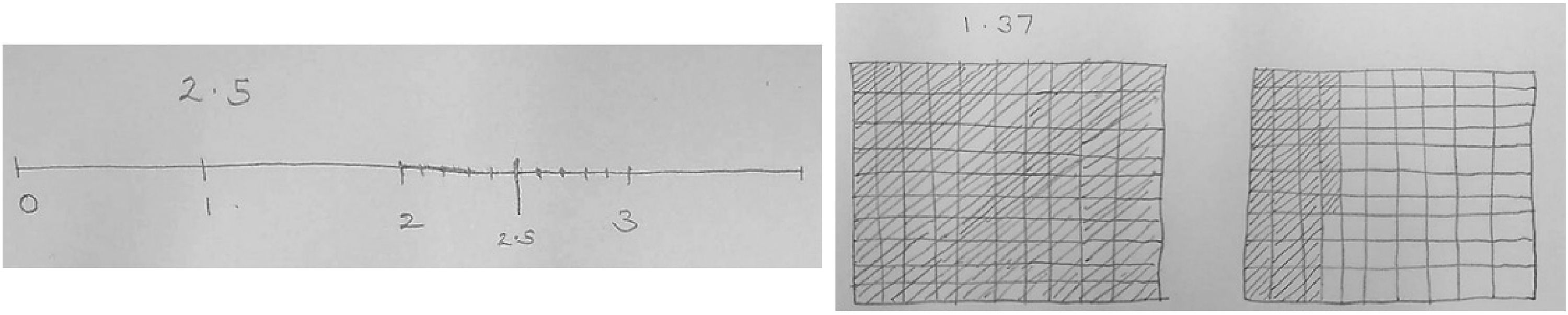
Learner responses to representing decimals.
For the teaching of decimals, textbooks commonly use the number line and grid models. How do textbooks deal with these different representations and what kind of challenges do such choices pose on teachers’ knowledge, were the questions of interest in this study. Textbooks contain packaged information, which needs unpacking by teachers when using them in classrooms (Herbel-Eisenmann, 2007; Olsher & Cooper, 2021). In both our countries (India and South Africa), textbooks have mathematical authority in terms of selection and enactment of content, particularly in the absence of other educative materials and of teacher agency in selecting content from different sources (Leshota, 2020; National Curriculum Framework for Teacher Education (NCFTE), 2010). Nonetheless, textbooks in all contexts make certain mathematical expectations of teachers (Stein & Kim, 2011). We refer to the mathematical challenges posed by the textbooks on teachers as knowledge demands 1 . Textbooks pose different kinds of demands on teachers’ knowledge, for example, expanding an example set by creating simpler or more complex examples or examples of the same kind; offering counter examples for potential overgeneralizations; linking different explanations, etc. These knowledge demands are topic-specific in nature, having generalized and particularized components. We compare the affordances of selecting specific examples, tasks, and representations to mediate the topic of decimal addition by textbooks of two countries, India and South Africa. We argue that an abstraction of knowledge demands from a systematic analysis of mediational tools used to communicate the content offers a useful vantage point to study the teacher-textbook interaction. Such an analytical approach can be usefully extended to analyzing the design expectations of any curricular material.
We locate this study in the existing literature on the teacher-textbook relation, followed by an overview of what is learnt from the literature on decimal learning.
Mediational relation between teacher and textbook
Mathematics textbook research is a disciplined inquiry within the broader field of research on curriculum materials in mathematics education. Fan et al. (2013) reviewed the research on mathematics textbooks and classified it into: (a) the role of textbooks; (b) textbook analysis and comparison; (c) use of textbooks in classrooms; and (d) other areas such as reading electronic and/or interactive textbooks. In this scheme, a study of the relation between the teacher and the textbook falls at the interface of textbook analysis and use in classroom. Textbooks determine what gets selected for use in the classroom and how it is mediated (Herbel-Eisenmann, 2007). The colonial history of India and South Africa manifests in the prevalence of the textbook culture in school teaching with textbooks being the sole resource for the teachers (Leshota, 2020; Vijaysimha, 2013) and a lack of supportive instructional materials. Nevertheless, teachers mediate the textbook content depending on the extent of their alignment with the voice of the text (Herbel-Eisenmann, 2007; Vijaysimha, 2013). Teachers follow or subvert, draw upon, interpret, or participate with the text (Remillard, 2005). The relation between the teacher and the textbook is therefore mutual, and the interaction between the two determines what is enacted in the classroom. Rezat and Straesser (2014) define the mutuality of this relationship using utilization schemes, that is, the capability of the artefact (in this case textbooks) in transforming the users’ (teachers’) schemes and the ability of the teacher to develop ways of utilizing the textbook, unimagined by the developer, by extending the artefacts to aims and in-the-moment situations. Adler (2021) suggests the need for design principles which will strengthen the participative relationship between the teacher and the textbook by foregrounding the relational transparency between them. The research reported in this paper offers a way of investigating and unpacking the relational transparency through the process of inferring the knowledge demands.
Learners’ thinking about decimals
In this study, we are interested in the quality of opportunities provided by the textbooks in supporting the learning of decimal addition, which inform or are informed by the literature on decimal learning and teaching. Research on understanding how learners make sense of decimals has a long history. Most of the research in this field has identified the difficulties that learners face when reading and writing decimals (Brueckner, 1928; Resnick et al., 1989), comparing decimals (Resnick et al., 1989; Sackur-Grisvard & Léonard, 1985; Steinle & Stacey, 2004), and shifting the decimal point when multiplying and dividing decimals (Grossnickle, 1943). An analysis of learner difficulties reveals their overreliance on rules learnt during whole number and fraction arithmetic (Resnick et al., 1989; Sackur-Grisvard & Léonard, 1985; Steinle & Stacey, 2004). Suggestions for dealing with these difficulties include different task types on varying the decimal length and digit values (Steinle & Stacey, 2004), using referents such as Dienes blocks (Wearne & Hiebert, 1988), cross-notation knowledge (Braithwaite et al., 2022), and movement between different representations (Shaughnessy, 2009). The literature on learner difficulties in decimals suggests an explicit use of examples to understand the (a) limitations of whole number and fractional thinking, for example, challenging longer is larger thinking; (b) semantics of the decimal system using representations; (c) using variety of decimal numbers with varying length and digit values; and (d) flexible movement between fractional and decimal notations to develop mastery. Siegler et al. (2011) argue that understanding fractions and decimals involves developing a sense of their magnitude, which means that the rational numbers can be compared, ordered, and depicted on a number line.
Analytical framework
We draw on the Mathematical Discourse in Instruction (MDI) framework (Ronda & Adler, 2017) for textbook analysis to discern the knowledge demands placed on the teacher. After a brief overview of the context of development of MDI, we discuss how it was used to infer the knowledge demands placed on the teachers by the textbook.
Situated within a socio-cultural perspective, the MDI framework was developed to capture differences in the discourses in mathematics classrooms in under-resourced contexts, particularly in South Africa (Ronda & Adler, 2017). The framework identifies discourse patterns and brings into focus what is made available to learn in a mathematics lesson and how it is made available (Ronda & Adler, 2017). In MDI, the mathematical content and the related capabilities are defined as the object of learning (OoL) (Marton, 2015). The OoL is mediated through exemplification, explanatory communication, and enabling learner participation. In this paper, we zoom into the exemplification aspect of the framework to focus on the demands placed on the teacher by the knowledgeable selection and sequencing of examples in the textbook.
Exemplification is a high leverage practice (Ball, 2017; Goldenberg & Mason, 2008; Watson & Mason, 2006; Zaslavsky, 2019; Zazkis & Leikin, 2008), valuable in mathematics teaching and therefore teacher education, since it is central to all topics within mathematics, impacts students’ learning, and is learnable and improvable (Adler & Pournara, 2019). Further, evidence supports that, teachers are more receptive to changing exemplification in their practice when compared with other reform teaching practices (Adler & Pournara, 2019). In MDI, exemplification is understood through examples, tasks, and representations. An example is a particular case of a general class of objects. Tasks involve the capabilities to be developed among learners through the selected use of examples, and representations include semantic constructions with varying degrees of abstractions used to support learning of a specific concept or capability. The three aspects of exemplification are explained using a sample task on decimal addition, from the Indian textbook (National Council of Educational Research and Training (NCERT), 2006), in Figure 2.
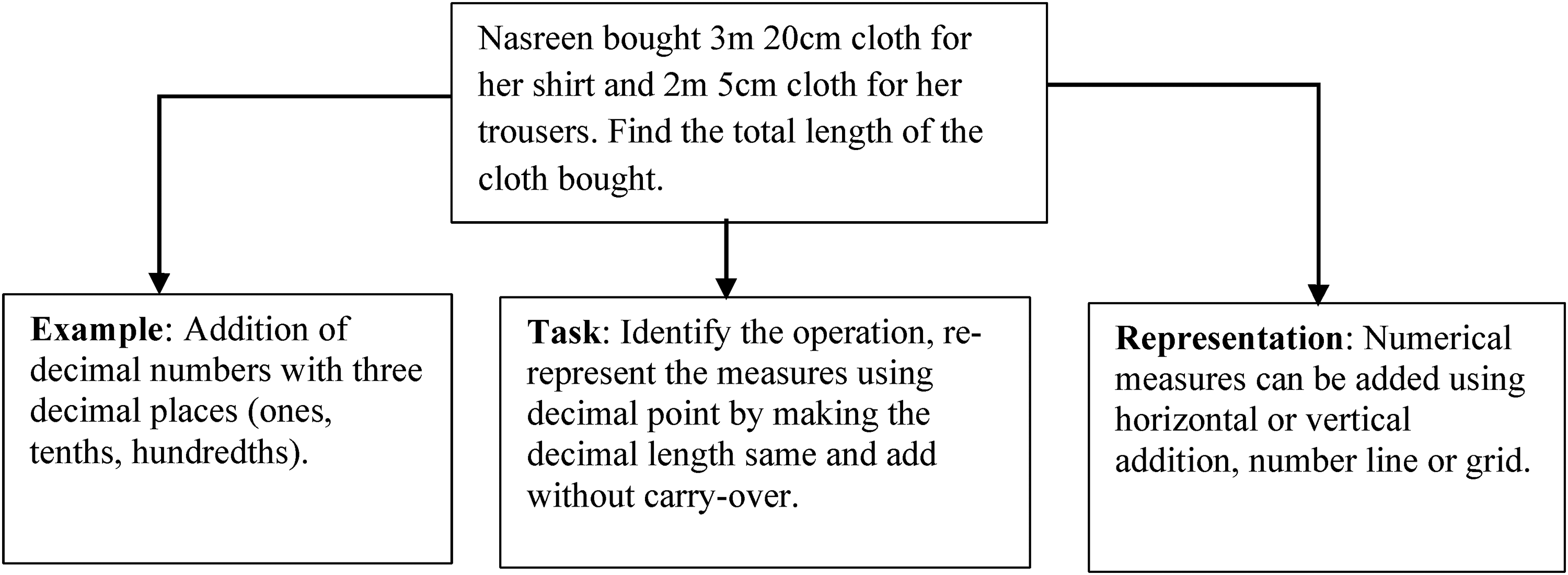
Exemplifying decimal addition.
In variation theory, example sets refer to specific classes of objects where attention is paid to similarity, contrast, and fusion 2 to enable generalization (Marton & Tsui, 2004; Watson & Mason, 2006). In teaching, explicit attention to the property that connects examples or distinguishes across examples becomes important. Similar example sets promote generalization for a specific class of objects through invariance of the property that binds the class together. The boundary of these specific examples becomes visible when contrast is offered through a different counter example. The variation between and within example sets is helpful in drawing learners’ attention to a key idea (concept or procedure). For instance, differences between adding decimals of same/varying length (e.g., 3.4 + 1.2 and 3.4 + 3.41) and same/varying digit values (e.g., 3.4 + 3.4 and 3.4 + 1.27). This distinction is important in decimal teaching, particularly as learners make connections between whole number thinking and decimal procedures. Tasks refer to the mathematical actions performed on an example (Christiansen & Walther, 1986), for example, a word problem, a bare number problem, representing decimals using a number line, input-output diagrams, etc. However, what is in focus through a task needs to be understandable for the teacher, who then decides when and how to use it for foregrounding or practicing a specific idea. The mediation also takes place through specific representations. In decimal teaching, common representational forms used are real-life or realistic contexts, linear and area models, and symbolic (numbers and symbols) representations. Teachers navigate the demands of moving between different examples, tasks, and representations by linking them in ways that learners can use them with understanding. We consider OoL as the means of binding together the mediational tools to examine the linkages between them.
In this study, we examine the selection and sequencing of examples, tasks, and representations, to unpack ways in which they are used to mediate the object of learning in the textbooks with the aim of discerning the knowledge demands placed on teachers. The specific research questions to address this aim are: (a) What kind of mediational tools are used to introduce decimal operations, and (b) How are these mediational tools linked to each other, and to the intended object of learning?
Methodology
Two Grade 6 mathematics textbooks, one from India (henceforth TI) (NCERT, 2006) and one from South Africa (henceforth TS) (Scheiber et al., 2009), were analyzed for the content of decimal addition. TI is a national textbook, published by the national council, which the Indian states can either use or adapt to create state-level textbooks. The private publishers use the national textbook as a reference for designing textbooks and other resources. TI was published in 2006 after a major reform in the Indian curriculum which called for a shift in mathematics teaching and learning from procedures and rote-memorization to processes such as problem solving and approximation (NCERT, 2005). The textbook does not come with a supplementary text for the teachers.
TS is part of a well-known series of mathematics textbooks produced by a private publisher. It was published in 2009 to align with the Revised National Curriculum Statement (RNCS) (Department of Education [DoE], 2002) which sought to clarify and streamline the stipulations of the first post-apartheid curriculum (DoE, 1997). While the rhetoric of international curriculum reform is visible at the level of curriculum policy, most RNCS-aligned texts tend to display fewer features of curriculum reform than previous editions of the same textbook series. This textbook series provides teacher guide which consists mostly of answers to the questions in the learner book.
We do not claim that the textbooks reflect how the content is taught in classrooms. However, the selection and sequencing of content is representative of other textbooks that are used in the two countries. We do not analyze the fidelity of these textbooks to their respective curricula. Rather, we compare and analyze them in contrastive ways to illuminate how they deal with the content which afford opportunities for learning and thus we infer what knowledge demands are placed on teachers. The analysis began with identifying how the topic of decimal addition was dealt in the two textbooks. The focus on decimal emanates from a prior study on investigating and supporting teachers’ topic-specific knowledge (Takker, 2021).
Decimals are introduced in India at Grade 5 and in South Africa at Grade 4. Decimal operations are introduced in Grade 6 in both countries. Broadly, the two Grade 6 texts (TI and TS) include decimal place value, comparison and ordering of decimals, fraction and decimal conversions, and addition and subtraction of decimals. Decimal addition builds on learners’ prior knowledge of whole numbers, fractions, and measurement and builds up to percentages, mensuration, and geometry. A summary of the topics dealt with in Grades 5 to 7 which build on and from decimal understanding is presented in Table 1.
Decimal trajectory in textbooks.
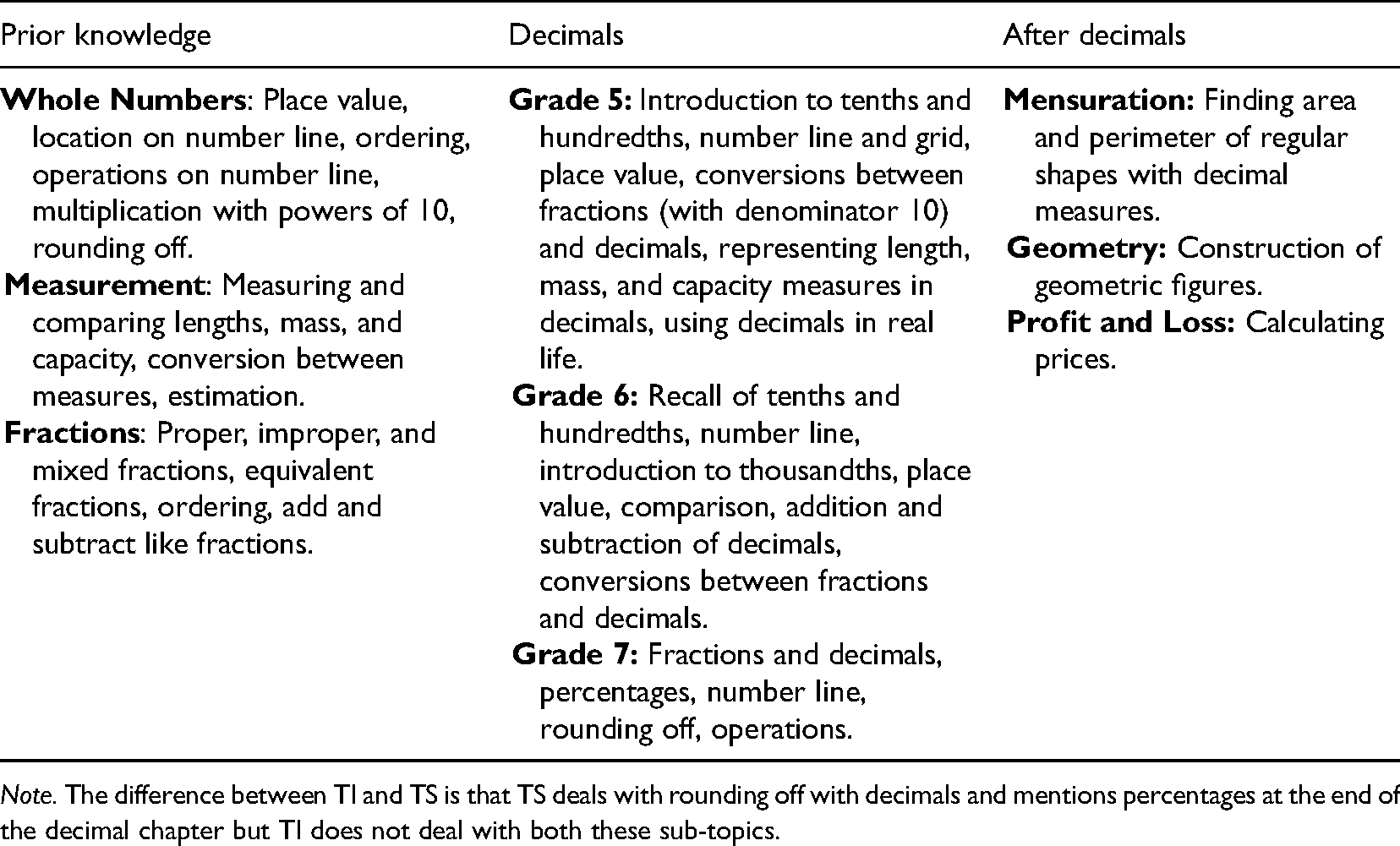
Decimal trajectory in textbooks.
Note. The difference between TI and TS is that TS deals with rounding off with decimals and mentions percentages at the end of the decimal chapter but TI does not deal with both these sub-topics.
For Grade 6, there are a few sub-topics which differentiate the two texts. TI has a section on the three contexts—money, length, and weight—in which decimals are used. TS deals with rounding off decimals, estimation of sum and difference, and writing percentages as decimals and fractions. Since the focus of the study was to examine how decimal operations were introduced, we analyzed the first five example sets from each textbook, which included 16 examples from TI and 30 examples from TS. Table 2 presents a summary of the (a) number and type of examples—worked, in-text 3 , and unsolved problem, (b) operation in focus, (c) verbal and visual representations used in the example, and the (d) explanation offered in the solution. The coding of each example was done by the first author and validated by the second author, who made suggestions about the selection of categories of the mediational tools discussed in this paper.
Summary of first five example sets from TI and TS.
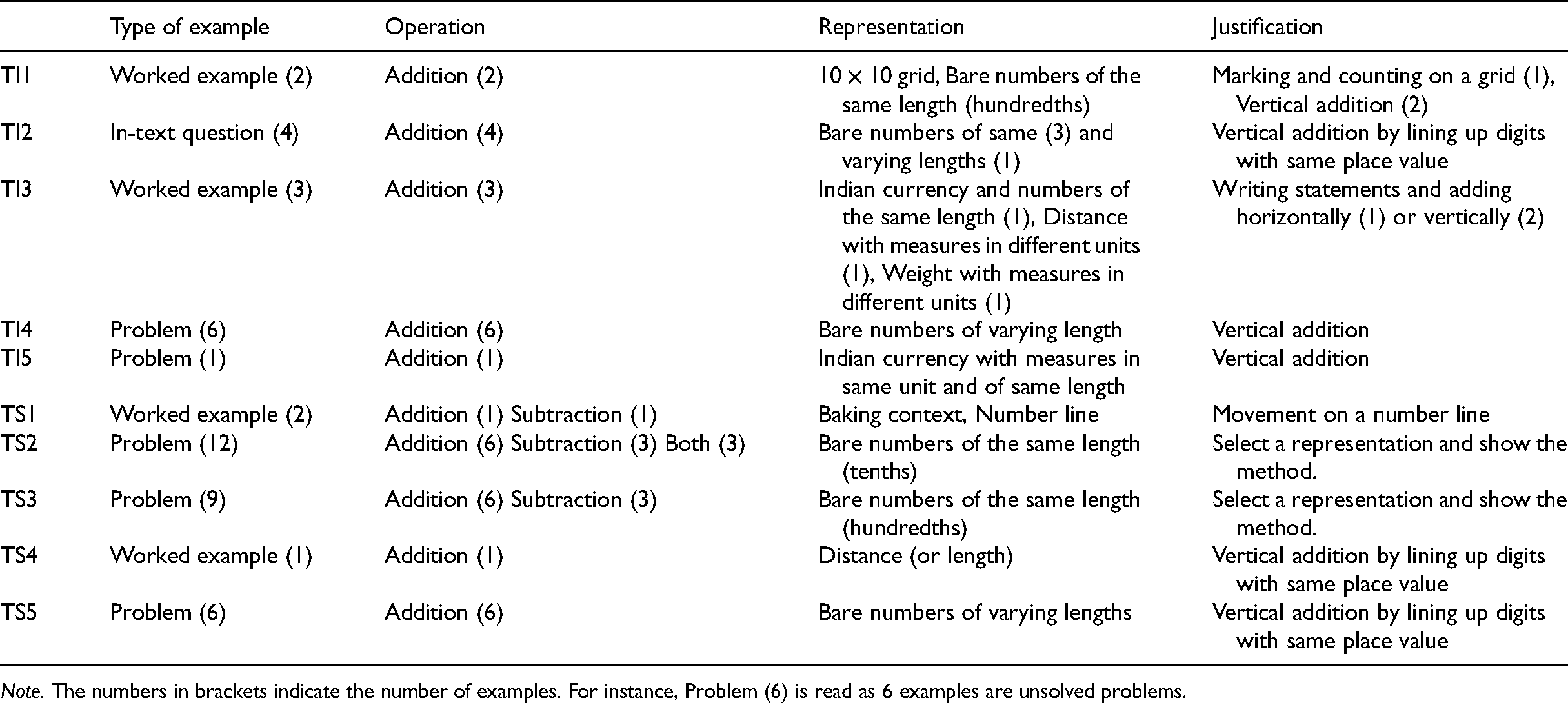
Note. The numbers in brackets indicate the number of examples. For instance, Problem (6) is read as 6 examples are unsolved problems.
The process of analysis began with identifying the OoL stated or indicated by the text, and then examining how the OoL is mediated through sequencing of examples, expected mathematical action from the learner (selection of representation, repeating the procedure, thinking of an alternate way, etc.), and the representation used for justification (the three categories shown in Figure 2). Figure 3 shows the Example 1 from the first example set (E1.1) and its analysis using the three mediational categories is presented in Table 3.
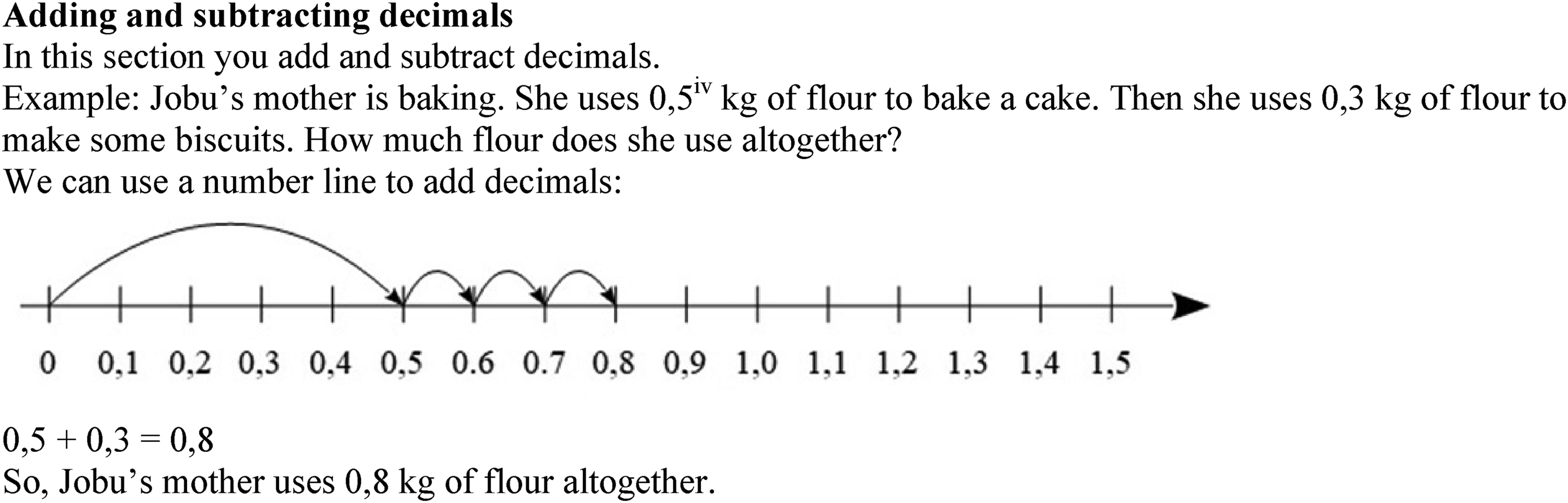
E1.1 Reproduced from TS.
Analysis of E1.1 from TS.
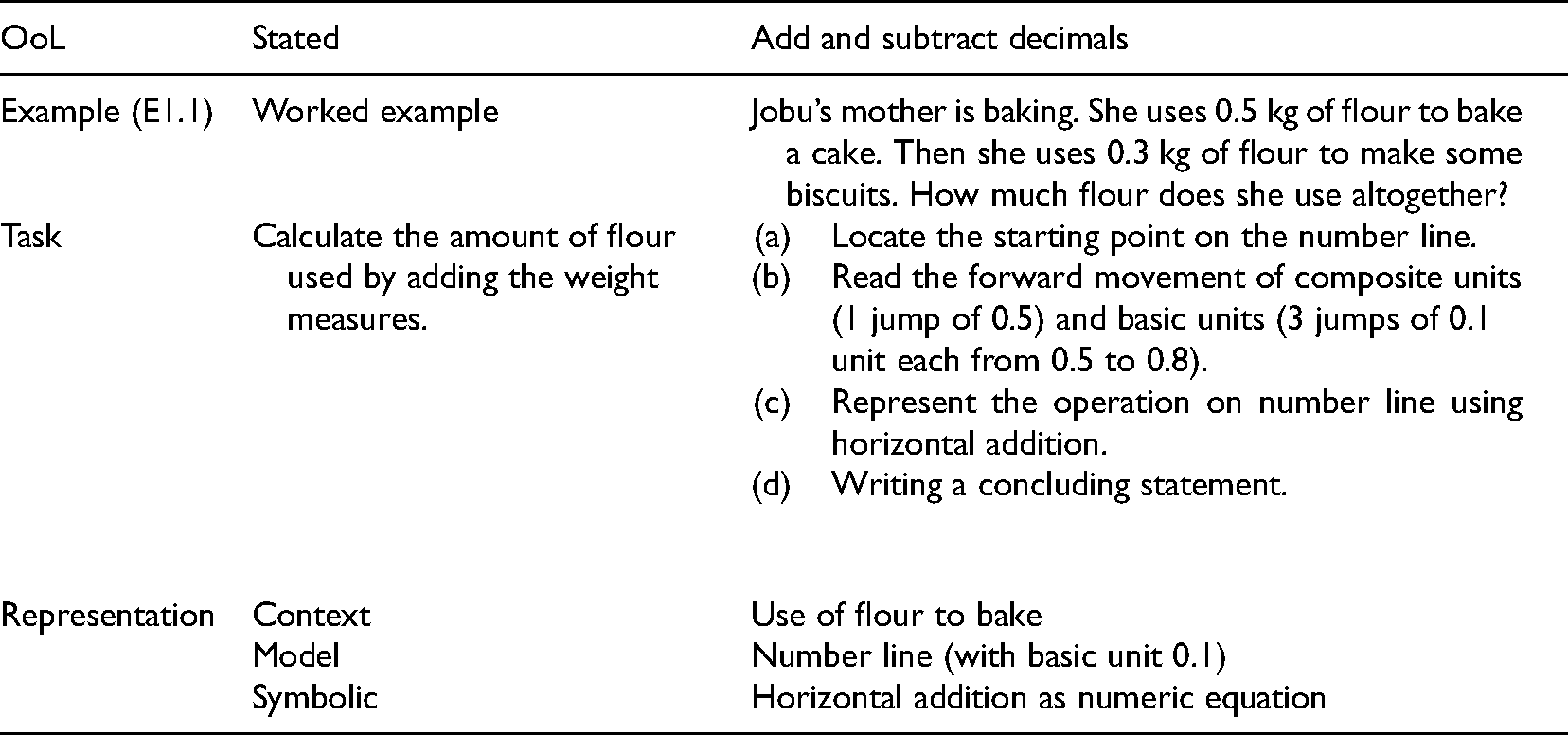
We began by classifying the example as worked, in-text or a problem, then noted the expected learner task and sub-tasks, and the representations expected to be used. After the completion of the table for each example (as shown in Table 3), we examined each example set for variation, that is, to identify similarity and/or contrast, to infer the kind of generalization that is promoted. Similarly, we studied the variation within tasks (comprehend a word problem and calculate, input-output diagram, etc.) and representations (linear, area, symbolic, etc.). Then we noted the links between examples, tasks and representations made by the textbooks.
The findings of the textbook analysis are organized in three sections. We begin by discussing how decimal addition is introduced using the pre-requisite knowledge expected from the learners. Second, we analyze what is made available to learn through a study of variation in examples, tasks, and representations followed by a commentary on the relationships forged between the mediational categories and their alignment towards the OoL. In conclusion, we infer the knowledge demands placed on the teachers through the careful selection and sequencing of the content in the two textbooks.
Overview of decimal addition in textbooks
In TI, the operations on decimals begin with addition and are followed by subtraction. In TS, addition and subtraction of decimals are introduced in the same section. Neither text mentions the inverse relation between addition and subtraction. In both textbooks, worked examples precede the in-text questions or unsolved problems thus stating the procedure that the learners are expected to use.
The examples and problems include bare numbers and contextual problems. Both textbooks use national currency, weight, and length/distance as contexts for decimal addition. We noted some differences in the sequencing of these contexts and their position with respect to the bare number problems in the texts. TI introduces decimal addition using bare numbers, strengthens the use of vertical addition as a procedure and then poses word problems to apply the learnt procedure. In contrast, TS begins with a weight measurement context to introduce addition and later gives several bare number problems for learners to practice vertical addition. The contexts on distance and currency are dealt with in separate sections.
Another notable difference is how the measures are represented in the word problems. TI uses measures in different units within the same example set, for instance, referring to one length as 20 m and 5 cm, and to weight/mass as 2 kg and 750 g but currency as ₹7.45. TS, on the other hand, consistently uses measures in the larger unit with decimal point such as R2.61, 16.59 m, 0.9 kg. We return to the affordance of using these symbolic representations later.
The two texts introduce decimal addition using different models but eventually shift to vertical addition. TI uses a
In solutions to the contextual examples, both texts use statements, albeit slightly differently, to indicate the action to be performed. In TS, the mathematical actions are indicated in sequence as: (a) “First I will subtract the 3, then 0.2 and finally 0.05” (p. 224), (b) “We can also use a number line to subtract decimals” followed by a number line (p. 222). In TI, statements include identifying the given information, and moving toward finding the unknown, for example, “Money spent for pen = ₹9.50; Money spent for pencil = ₹2.50; Total money spent = ₹9.50 + ₹2.50; Total money spent = ₹12.00” (p. 178).
Use of mediational tools
We now examine the affordances of how the mediational tools are used in the text. These include variation in bare number and contextual examples, use of models and symbolic representations, and the links between them.
Variation in bare number examples
In TI, the place value of decimal numbers in the first two example sets is invariant, except E2.2 (see Table 4, TI) and the digits in the fractional part vary. It is expected that the learners will practice adding numbers with the same length (E1.1, 1.2, 2.1) and then make the length the same (in E2.2) before addition. Another similarity in Example sets 1 and 2 is that the digit at the units (or ones) place is zero while the digits at the other two places are non-zero although a zero must be appended in E2.2. Except E1.1, all the other examples require carry-over to the higher place value. The places at which carry-over happens vary among examples. For instance, for E1.2 the sum of the digits at the hundredths and tenths places exceeds 10 but for E2.1, the sum exceeds 10 at the hundredths place only. The sequence of examples with carry-over are not organized in increasing complexity. The textbook expects learners to draw on their understanding of whole number addition as evident from the statement “we can add decimals in the same way as whole numbers” (NCERT, 2006, p. 178).
Example set with bare numbers from TI and TS.
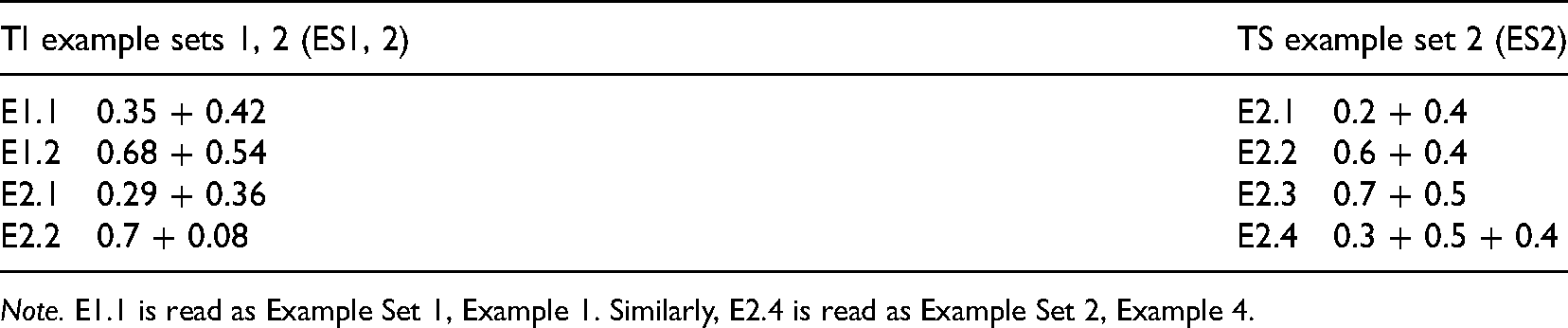
Example set with bare numbers from TI and TS.
Note. E1.1 is read as Example Set 1, Example 1. Similarly, E2.4 is read as Example Set 2, Example 4.
In TS, the first example set involves a contextual problem, which is discussed in the next section. In the second example set (see Table 4, TS, ES2), all the numbers have the same place value (units and tenths) with zero at the units’ place. E2.4 involves three addends. Like TI, in TS the sum of the digits at each place value from E2.2 is 10 or more. Since there is only one place value with a non-zero digit (tenths), there is no scope for doing a carry-over twice. In other words, variation is in addition with and without carry-over, and in the number of addends. The carry-over in this example set (ES2) influences the whole number part.
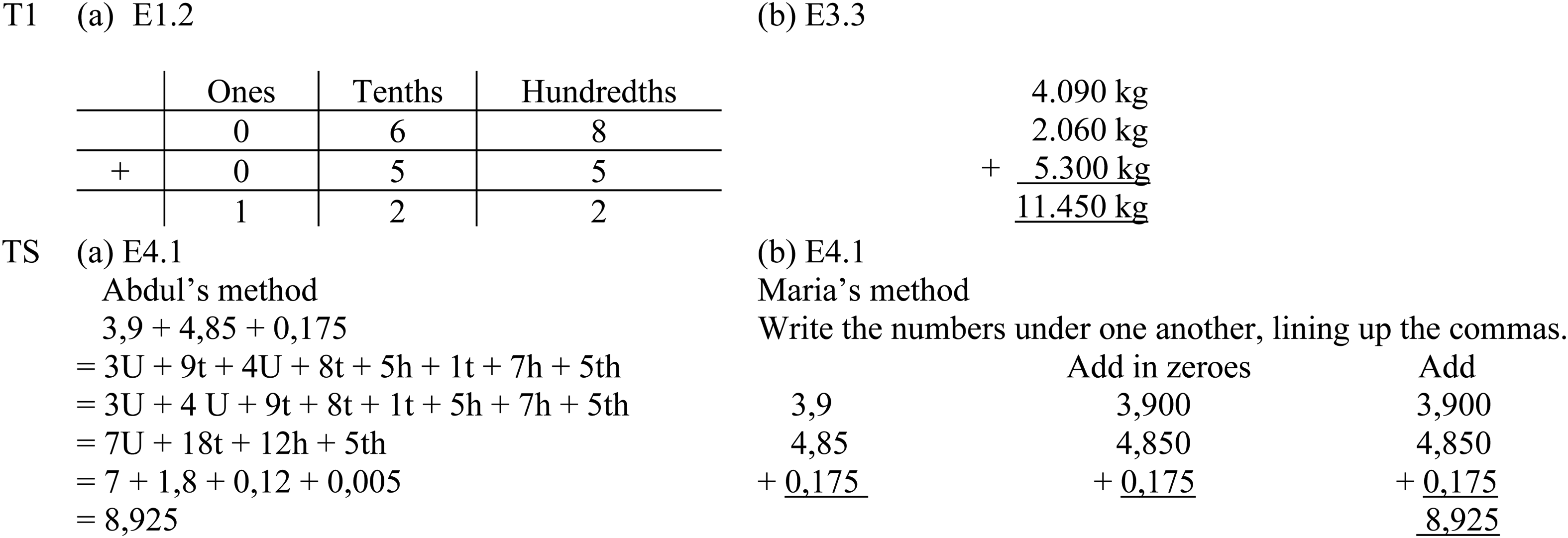
In TI, a grid is used as a justification for solving the addition problem and the vertical addition is presented alongside (see Figure 4). The connections between the two representations: grid and vertical addition are not explicitly stated. The grid is not used henceforth, and the procedure of vertical addition is carried forward, where in some instances, place value of digits is mentioned. The justification offered in TS in the first example uses a number line followed by a number sentence written horizontally (see Figures 3 and 5). Here too the relation between the two representations is assumed followed by which vertical addition is introduced and expected to be used by the learners (see Figure 6).
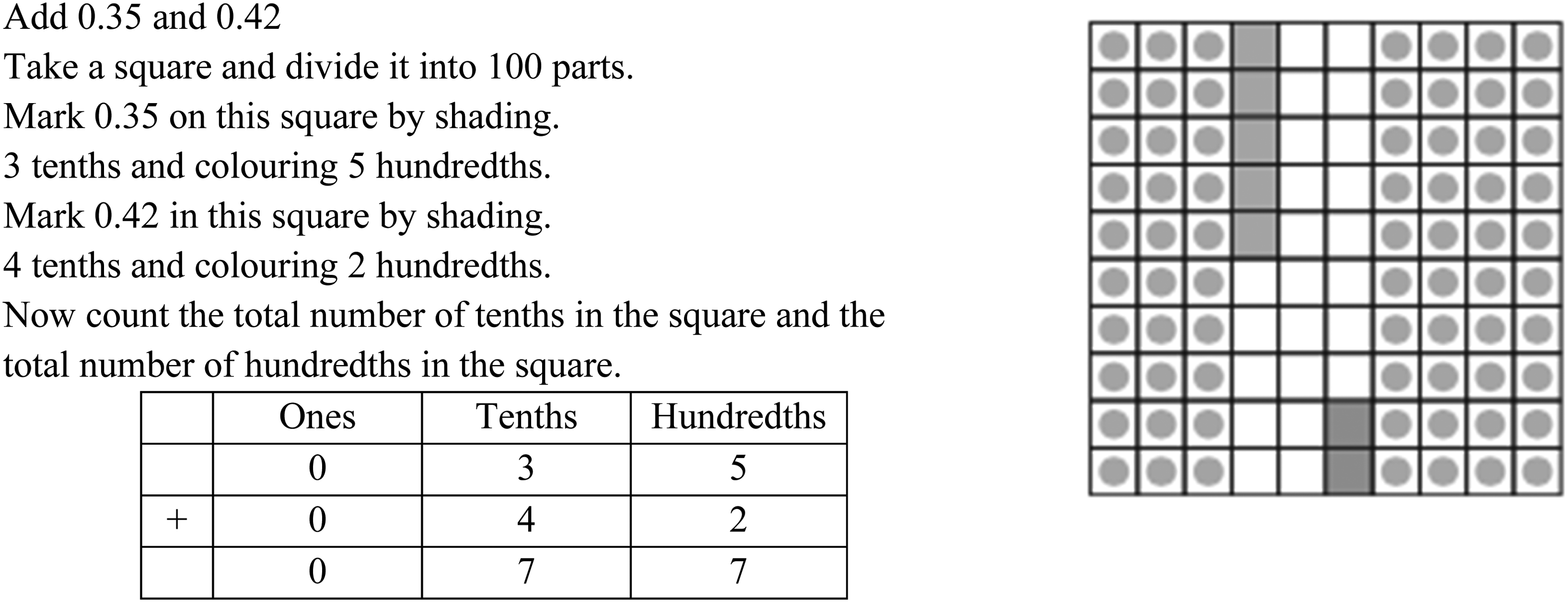
Addition using grid in E1.1 from TI.
Vertical addition in TI and TS.
In both texts, the use of bare number examples with the same decimal length draws learners’ attention to adding the digits with the same place values. The carry-over at different place values does not however consistently align with this focus. The generalization to the procedure of vertical addition calls for making the place values of each digit visible and constantly referring to the relation between consecutive place values. While the decimal addition can be considered as a generalization from whole number addition algorithm, the fractional place values in a decimal number require the algorithm to be revisited particularly for the examples with carry-over. In the selection of numbers, the example sets with the same digit values such as 2.5 and 2.50 or 3.0 and 3 suggested in the literature on decimals (e.g., Steinle & Stacey, 2004) are not used in either text. In terms of the justification offered for the worked examples, both texts offer two perceptually different representations using a model and the horizontal and/or vertical addition. While the use of multiple representations is useful in visualizing addition, the links between these representations need to be made explicit so that they are not treated as different ways of doing addition, disconnected from each other 4 . Additionally, the procedure of lining up and appending the zeroes needs suitable justification and the proposition of adding decimal numbers like whole numbers needs to be challenged, particularly when measures are represented in different units 5 .
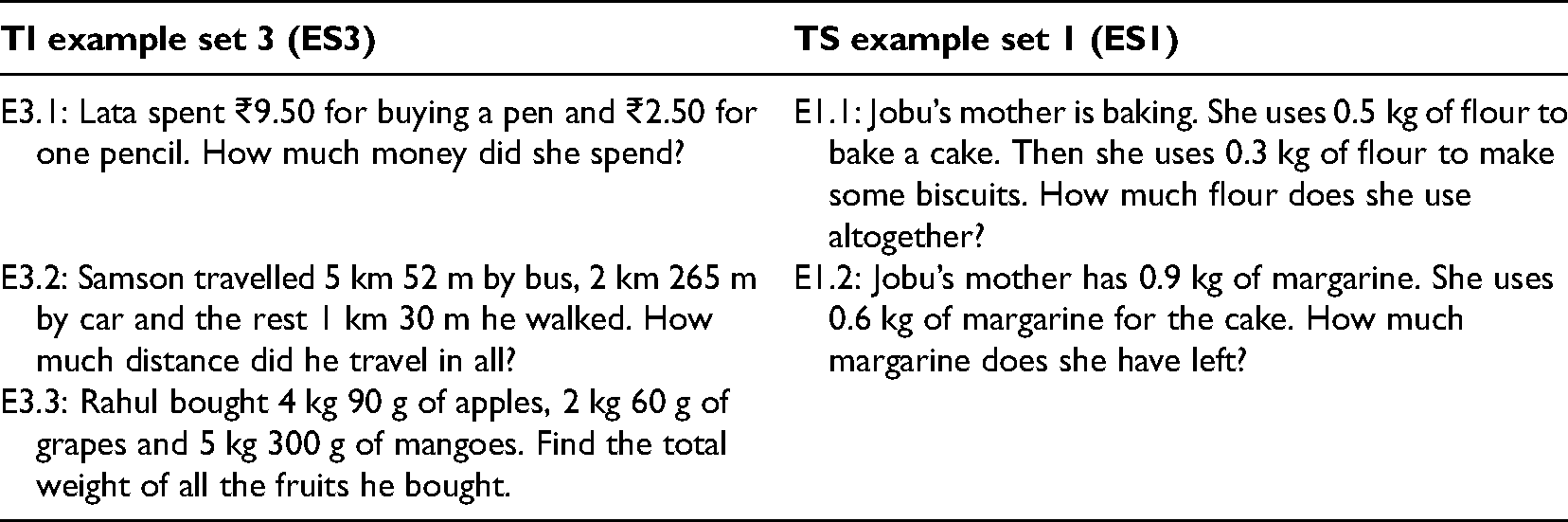
The first example set with contextual problems from each textbook is reproduced in Table 5.
Contextual examples from TI and TS.
Contextual examples from TI and TS.
In TI, the example set with contexts includes Indian currency, distance (or length), and weight measurement (see Table 5, TI, ES3). The similarity between the three worked examples is that they are all contexts of decimal addition. The affordance of the relation between place values for each context is different. In the example with Indian currency (E3.1), the relation between the two units is 100 times, 1 rupee (or ₹) = 100 paisa (or p). This means that the context affords the relation of
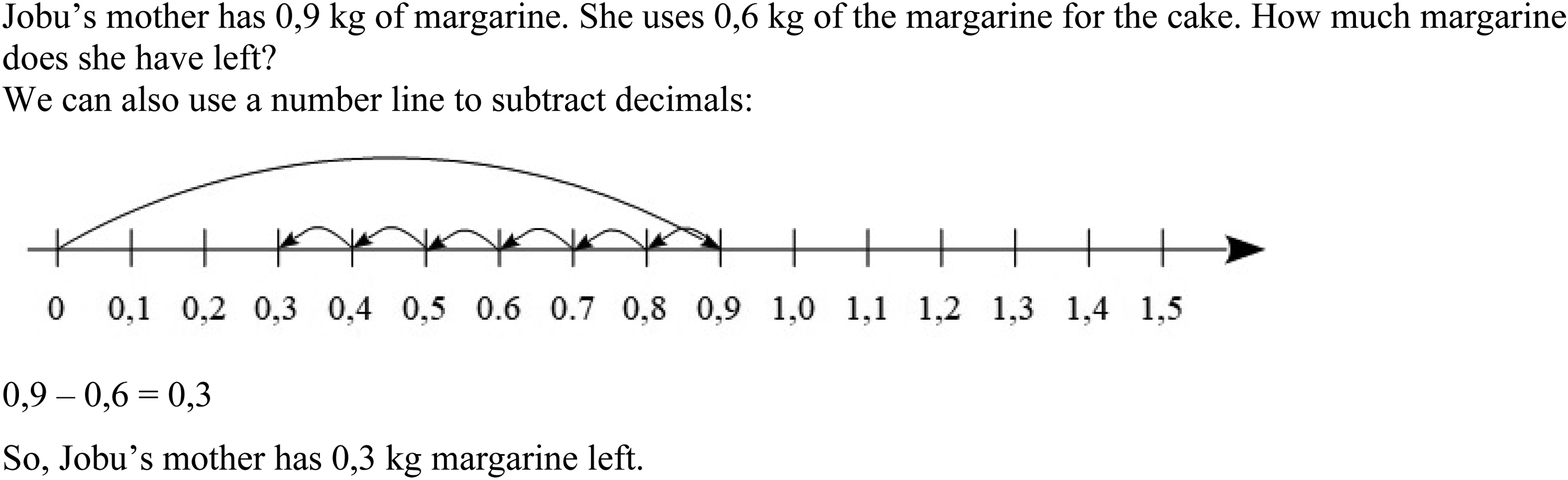
In TS, the first example set (Table 5, TS, ES1) includes two contextual problems, E1.1 and E1.2, which have the same context and decimal place value but vary in terms of the operations to be performed. Learners are expected to use a number line to represent the operation 6 to be performed (see Figure 3). The task is for learners to identify the basic unit (0.1), make the first composite unit for the addend (jumps from 0 to 0.5), then make a forward jump of n times the basic unit (in this case, 3 times 0.1) depending on the second addend and backward jumps for subtraction.
The variation in contextual problems from the two texts (shown in Table 5) is different, which helps in illuminating the affordance of dealing with decimal addition in different ways. First, a point of similarity between the example sets is that the measures are unrealistic for the learners and in the case of TI also obsolete. Second, the breaking up of measures into smaller units, as in the case of TI (Table 5, TI, E3.2 and E3.3), might not be a suitable context for introduction to decimal operations, as the measures can be added separately. Since the relation between the units (or place values) is not foregrounded in the text, it is likely that learners may overgeneralize the whole number addition and face difficulty in converting the measures to larger units. It is important here to draw learners’ attention to the difference between 5 km 52 m and 5 km 520 m, since in this case, they cannot append the zero at the end, as was taught in the lining up strategy when adding bare numbers. The text does not deal with estimation in performing operations, which makes dealing with such learner difficulties more challenging for the teacher. In TS, the learners are expected to comprehend the operation to be used to solve the problem, but the inverse relation between the operations is not mentioned.
In this section, we discuss an example set with models to examine what is afforded through their use in learning decimal addition. The two textbooks use different models: TI uses an area model and TS uses a linear model. The models are introduced in the first example set, presumably for the purpose of justifying decimal addition.
In TI, the addends 0.35 and 0.42 in the first example are represented on two different parts of the grid (left and rightmost, see Figure 4) using dots and shaded squares. The learners are expected to count the shaded parts. Since tenths and hundredths are represented differently on the grid, it is expected that learners will count 3 and 4 columns of dots 7 and 5 and 2 shaded squares. This representation allows learners to see digits of two decimal numbers, which have the same place value. The alignment of the digits of the two addends is common to the grid and vertical addition representation.
TS also uses a linear model (number line) to add and subtract decimals (see Figures 3 and 5). In the first two examples, a tenths number line from 0 to 1.5 is shown. The first jump on the number line is of a composite unit starting from 0 (0.5 for E1.1 and 0.9 for E1.2). These units are called composite since they are made up of smaller units of 0.1, which is called the basic unit. The choice of this basic unit is not justified. After locating the first composite unit, repeated jumps of the basic unit 0.1 are made in the forward or backward direction depending on the operation. In Figure 3, the jump of a composite unit of 0.5 is followed by three forward jumps of 0.1 units each. Similarly, in Figure 5, the jump of a composite unit of 0.9 is followed by six backward jumps of 0.1 units each. The decomposition of the second addend or the subtrahend makes the learners aware of the basic units that make the composite unit. While the decomposition is an effective strategy for adding and subtracting numbers, which number needs to be decomposed and what would be the basic unit needs to be made explicit in the text. The action on the number line is compressed as a numerical equation. In the third example set in TS, the basic unit changes to hundredths (0.01) and the numbers to be operated have three place values. Now the number line is drawn from 0.01 to 0.30. The choice of giving a number line and asking learners to use it to add and subtract is in sync with the previous unsolved examples. The basic unit has changed from 0.1 to 0.01 but the reason for the change in the basic unit and the links between these basic units are not discussed. Such a selective use of basic units when working with decimals of different lengths could possibly be the reason for learners’ limited use of these representations and difficulty in linking them, such as difficulty in representing 2.5 and 2.50 using the same number line.
Subtraction using number line in E1.2 from TS.
Both texts use models for the introduction of decimal operations but quickly shift to vertical addition. In each text, two perceptually different methods of adding (see Figure 6) are introduced and the connections between these methods are not explicitly stated. In vertical addition, decimal numbers are lined up around the decimal point and added. The horizontal and vertical arrangement of the addends (shown as Abdul and Maria’s methods in Figure 6) aligns with different strategies for addition: pairing digits with the same place value in E4.1a and lining up using the decimal point and appending the zeroes in E4.1b, respectively. However, the similarities and differences in these two methods need unpacking by the textbook and in classroom teaching.
While the two texts use different models (linear and area), the models are used for the purpose of introduction only and not as ways of solving problems consistently. The grid representation extends from the area model that learners would have encountered during fractions. Notably, the fraction notation is not used in decimal addition. A decimal number is decomposed into tenths and hundredths and shown using different shading patterns in a grid. The differential shading allows learners to align the digits of the two addends which have the same place value but constrains the relation between consecutive place values among digits of a number such as ten hundredths make a tenth. Also, representing the digits of a decimal number separately without stating the relation between the positions of these digits potentially hinders learners from forming an understanding that a decimal number is composed of whole number and fractional part.
The number line representation is also an extension of how fractions are represented. Here learners can practice making jumps of basic or composite units to add or subtract. However, this representation does not help in knowing how the number line is constructed, why one of the numbers to be operated is to be decomposed and which number must be decomposed, and most importantly, what is the relation between the number lines with different basic units that is 0.1, 0.01. The density of decimal numbers is not conveyed through such a disconnected treatment, nor through the grid representation.
The models by themselves are not used as representations to support learners’ understanding of decimal operations, which was the stated object of learning. While both models can be built on fractional understanding, the units selected in each model and the relation between the units is obscured in their use. Instead, the models are used as a transition toward vertical addition of decimals, without making the connections between the models and the symbolic representation explicit.
In this section, we infer the knowledge demands that are placed on teachers by the textbooks through the choice of examples, tasks and representations. The construct of knowledge demands helps us in foregrounding the participative relation between the teacher and the textbook by offering a way of unpacking the relational transparency.
Affordance of whole number thinking
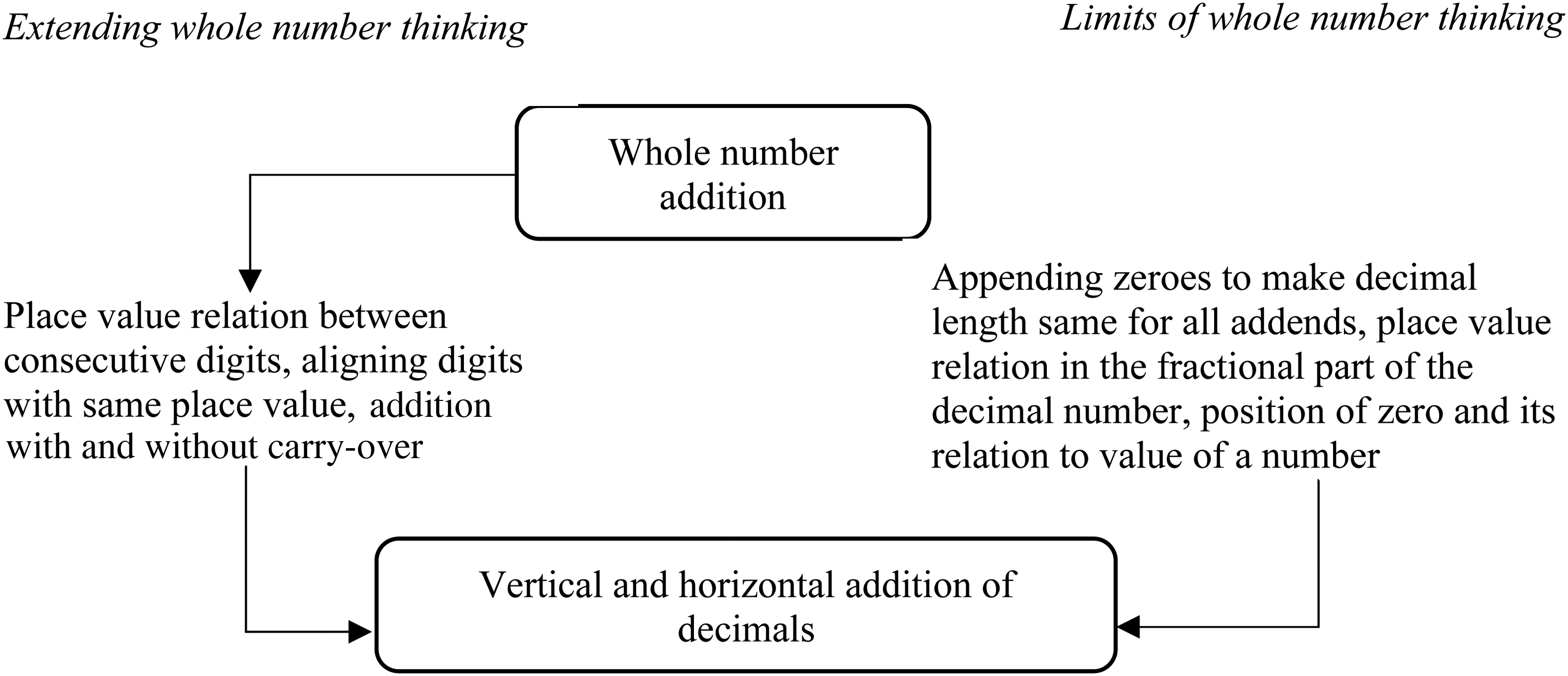
It is well known that learners tend to overgeneralize their understanding of whole numbers when making sense of decimals (Resnick et al., 1989; Steinle & Stacey, 2004). Both textbooks promote an extension of whole number addition to decimal addition, thus posing demands on the teacher to examine the affordances of the potential overgeneralization. In vertical addition, the addends are lined up using the decimal point to align the digits with the same place value. If the addends do not have the same length, zeroes are appended at the end to make decimal length the same for the ease of addition. In examples where measures are expressed in different units, the learners first need to convert them into a larger unit by placing zeroes in missing place value positions. In the process of adding decimals vertically, the alignment of digits with respect to the place value is the only extension from whole number addition. Further, in carry-over problems, the relation between the tenths and units place would need specific attention in teaching. The placement of zeroes to create equivalent decimals does not extend from the whole number understanding and is therefore a case where generalization from whole numbers does not work. While making the lengths of decimals the same, learners tend to make errors in the placement of zero. The demand on teachers’ knowledge is to draw learners’ attention to when the position of zero changes the value of a decimal number and when it does not (Takker & Subramaniam, 2019).
While both textbooks vary the lengths of the addends, the variation is not systematic in terms of comprehensively covering addition without carry-over, with zero at different place values, and addition with carry-over. Additionally, variation in using decimal numbers with the same digits but different values, such as 50.1 + 5.01 + 0.51, is not used. The knowledge demands placed on the teacher therefore involve careful variation in decimal numbers (including the selection and sequencing of examples) of varying lengths and digit values (Steinle & Stacey, 2004), explicitly discussing the affordance of using the whole number addition algorithm for decimal addition (see Figure 7) and uncovering the connections within a specific representational form.
Affordance of whole number addition for decimal addition.
Learners need an understanding of both whole numbers and fractions when working with decimals (Brousseau et al., 2008; Takker, 2021). The understanding of fractions can be extended to addition of decimals in representing decimals using linear and area models, and when working with the measurement context.
In both textbooks, fraction and decimal conversion is discussed as a separate sub-topic and is not used as a method for decimal addition. The addition of like and unlike fractions, a topic covered earlier in the curriculum in both countries, can be usefully extended to the addition of decimals. Further, learners’ prior knowledge of decimal-fraction conversion and equivalent fractions can be used to rationalize the need to make decimal lengths same while adding. The demand on teachers therefore is to recall learners’ prior knowledge of fractions including writing decimals as fractions, creating equivalent fractions, representing them on linear and area representations, and adding them; and extend this knowledge to the addition of decimals (see Figure 8).
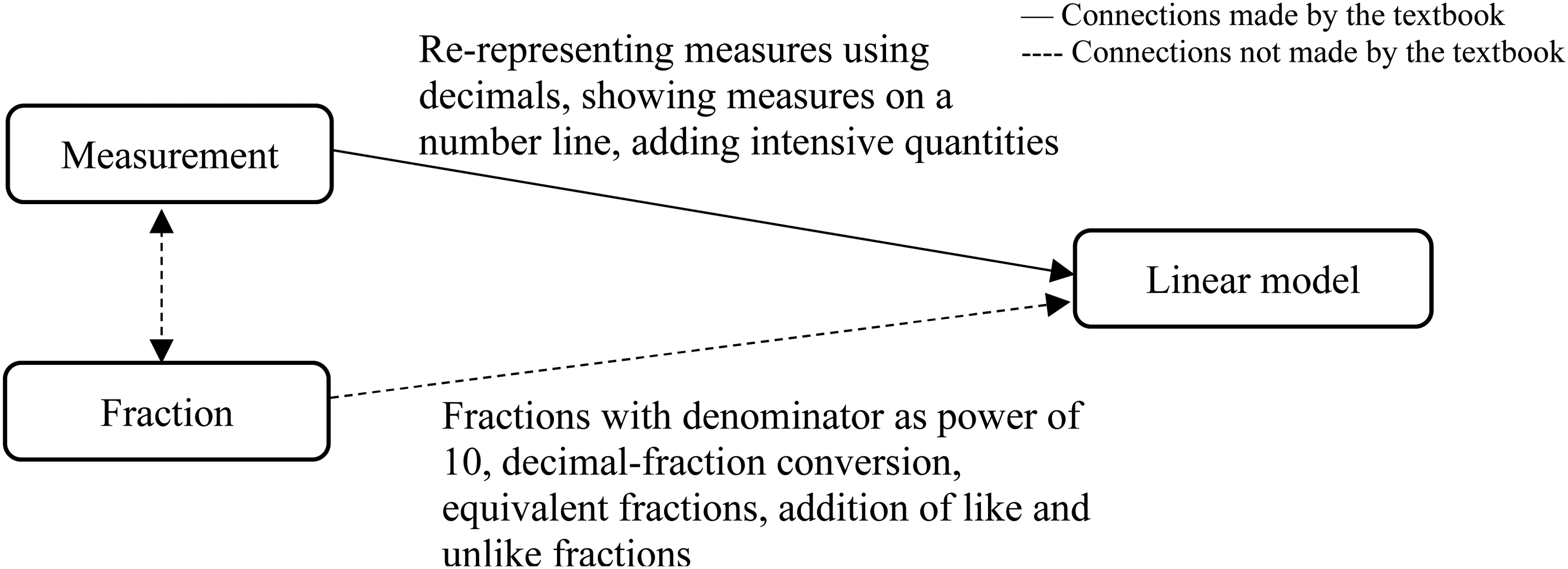
Connections between fractions, measurement, and decimal addition.
Measurement has been used extensively by both textbooks as an application context for decimal addition. In TI, the length measures in two related units are expressed using whole numbers (see Table 5, TI, E3.2 and E3.3). The use of whole number measures reinforces the procedure of adding different measures as separate whole numbers without creating the need for re-representing them as decimals. Learner difficulties such as with the placement of zeroes (e.g., 5 km 52 m could be treated as 5 km and 520 m, or 5 km and 0.052 m) when converting between measurement units, also discussed in the whole number subsection above, need attention. Again, the measure interpretation of fractions is a part of learners’ prior knowledge and can be utilized to support transition from treating different measures as whole numbers to adding measures in the same units. There is a potential for using linear and area models for representing measures and extending learners’ fractional understanding to use these for addition of decimals. An overreliance on whole number thinking is marked with a noticeable omission of fractional representation in the two textbooks. The teacher is expected to make the connections between the measure interpretation of fractions, representing measures through models, and use it as a justification for decimal addition.
In both textbooks, decimal addition is addressed through multiple representations, including contexts and bare numbers, linear or area model, and vertical or horizontal addition. The key idea in understanding vertical addition is the alignment of digits with the same place value but at the same time maintaining the relation between consecutive place values of digits of a number. Decimal addition relies on adding the digits in base ten system and continuous links between consecutive place values within a number and across addends. In horizontal addition of decimals in TS, as shown in Figure 6, each digit is accompanied with a letter as its place value (e.g., 5h is read as 5 hundredths) which is added to the digit with the same place value (7h) and the sum (12h) is rewritten using a decimal point (as 0.12) for further addition with other place values. The re-representation of a decimal number (from 12h to 0.12) is connected to the measure interpretation as the unit in which the part is expressed determines the notation. In other words, 0.12 is written in relation to the units/ones place, while 12h is expressed in hundredths. The re-representation of the same measure in different units (place values in case of decimals) is helpful in developing representational flexibility. Both textbooks treat the decimal numbers as combinations of digits and emphasize alignments of digit with the same place value for addition (see Figure 6). The instruction of lining up the commas in TS is a technique to align the digits with the same place value, which implicitly uses a mirror metaphor as opposed to a consecutive relation between place values of digits in a decimal number, particularly the relation between the fractional and whole number part, that is, ones and tenths. The misplacement of mirror on the decimal point instead of the units place has led to learners’ difficulties, for instance, in anticipating a place for oneths in the place value table (see Takker & Subramaniam, 2019 for details). In short, in vertical addition, the alignment of addends using the decimal point is not necessarily consistent with aligning the digits with the same place value unless the decimal number is read with the digits and their place values.
In the area model (or grid), the different ways of shading tenths and hundredths in the textbook (see Figure 4), without mentioning the relation between them also obscures the relation between consecutive place values. While the symbolic representations and area model foreground the place value understanding and use it to extend the whole number to decimal addition, the linear model requires an understanding of fractional units. To conclude, two kinds of knowledge demands are placed on teachers depending on the choice of representations. First, in the symbolic and model-based representations, the choice of the basic unit and manipulating composite units remain to be explicitly shown and explained by the teacher. Second, the linear, area, and symbolic representations stem from different referents from learners’ prior knowledge and decimal addition requires connecting these different pieces of knowledge (see Figure 9). Recalling these referents when explaining decimal addition and linking different representations to reinforce the base ten structure of decimals, are the knowledge demands posed on teachers.
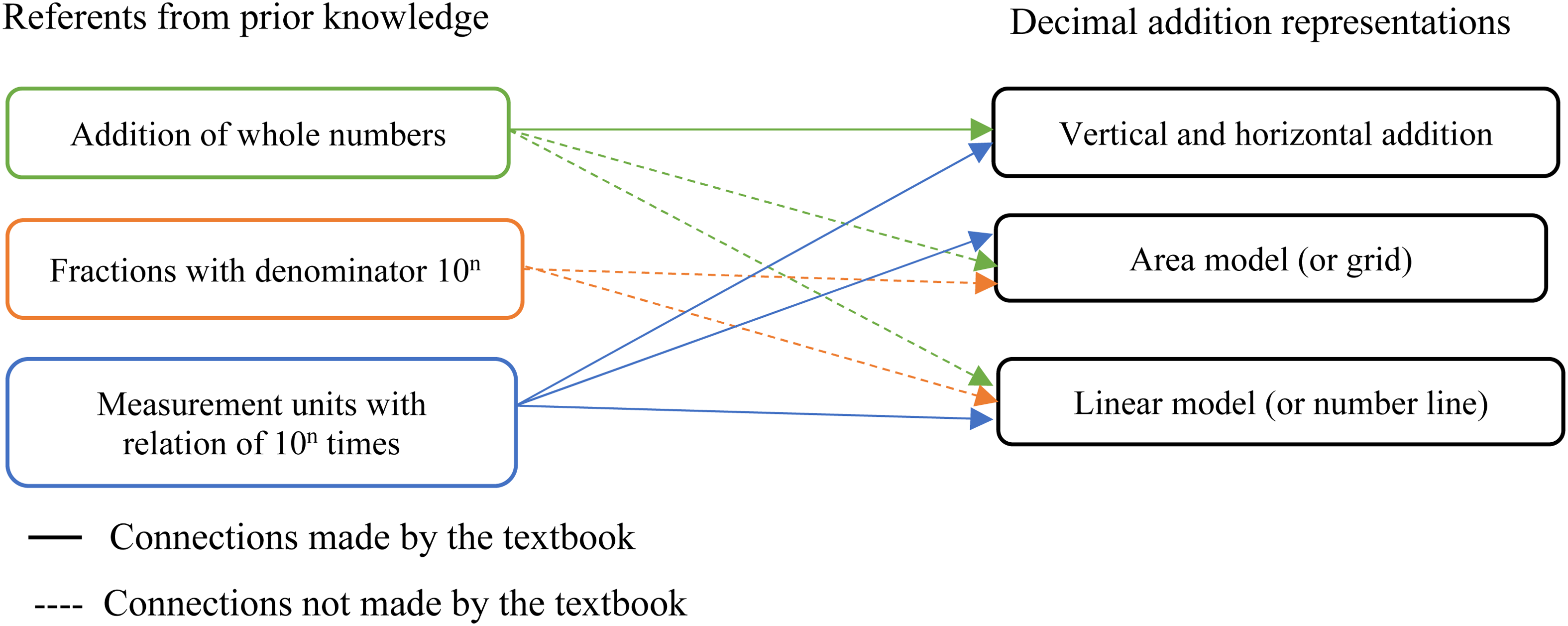
Decimal addition explanations using known referents.
The appropriateness of the contexts and models used for decimal addition, that is, their affordance and limits, and the connections between contexts and models is an important aspect of teachers’ knowledge. When learning decimals, a measurement context offers more scope for the relation between different place values when compared with a currency context. However, a currency context is familiar to the learners. The representational limitation of the currency context needs to be made explicit, particularly for teachers. Further, the reason for selecting these contexts is their closeness or relevance to the learners’ context. Therefore, the choice of measures which are realistic becomes salient in supporting learners in relating to what they are learning. The measures used in the contexts selected by both textbooks are obsolete or unrealistic and their limited use for the purpose of introducing decimal addition does not help achieve the purpose for their inclusion in the textbook. It therefore becomes difficult for the teacher to support the learners in making sense of quantities, which need to be accurate and demand the use of decimal representation, for example, the exact composition of various chemicals in medicines or distances in field athletics. The textbooks need to provide a variety of contexts in which decimal representation is necessary and helps learners in understanding the value of accurate measures. Subsequently, the affordance of fraction representations in case of non-terminating decimals also needs attention.
Secondly, the relationship between the situation depicted in the context and the choice of model needs to be consistent at least at the introductory stages, so that the two can support the reasoning for adding decimals. Using a number line for representing the baking context (TS) or using a grid for the measurement of a table (TI), constrains the opportunity for learners to visualize these situations with a supportive model. Eventually, learners are expected to develop the abstraction of using different model-based or symbolic forms to represent a variety of contexts. The meaningful use of contexts and representations needs to be scaffolded, both in textbooks and teaching. The selected contexts and representations do not support the teachers in exploring the affordance or the counter productiveness of decimal representations that are used in the textbook. Also, recognition of the additional demands of contexts where a measure needs to be converted to represent a decimal (e.g., time) as well as the limitations of non-mathematical representations of decimals, such as overs in a cricket match, also appear in the contingent classroom situation requiring teachers’ attention. Lastly, varying level of alignment between contexts and representations to support learners’ developing understanding of decimal addition, poses knowledge demands on teachers.
Discussion
We began by sharing an anecdote where Grades 5 and 6 learners from eight classrooms in the same school in India preferred to use a linear representation for showing decimals with tenths and a grid representation for decimals with hundredths. While the teachers and learners were aware of the different representations, their limited use motivated us to examine how textbooks dealt with different representations. Focusing on how decimal addition is treated in an Indian and a South African textbook helps in unpacking the participative relation between the teacher and the textbook, through the extended use of the analytical construct of knowledge demands.
This paper makes several contributions to international research in mathematics education. Firstly, we build upon the previous work related to application of the MDI framework by elaborating the exemplification aspect to examine how the mediational tools: examples, tasks, and representations, are used by the textbooks to introduce decimal operations. This paves the way for further use of MDI as an analytical tool in different contexts and for different purposes, other than how it has been used till date. The second contribution is that the analysis enables us to infer the topic-specific knowledge demands placed on the teachers when interpreting and using these textbooks. These demands include knowledge of the affordance and counter-productiveness of the selected contexts, models, and representations. Thirdly, and more generally, the analysis supports previous work on the importance of teachers’ knowledge of topic-specific learning which includes awareness of the literature on the learning of specific topics and dealing with learners’ prior knowledge by supporting and challenging it, as necessary, while learning the new content. Fourthly, the methodological approach of inferring knowledge demands from the study of textbooks can be extended to identifying generic knowledge demands placed on teachers when teaching other mathematical topics, as well as for analyzing the educative material designed for the teachers.
The research reported in the paper was intentionally restricted to addition of decimals at Grade 6 level. We did not analyze the corresponding section on subtraction of decimals in Grade 6 nor other operations on decimals in higher grades. This focus enabled us to illustrate how one aspect of MDI, exemplification, provides a suitable lens to identify knowledge demands placed on teachers. This opens opportunities for future research to explore other topics and to identify knowledge demands emanating from the other two mediational tools in MDI—explanatory communication and learner participation.
The literature on specialized knowledge for teaching (e.g., Ball, 2017) emphasizes the need for developing a knowledge base which teachers can use during planning and teaching. In contexts where textbooks are an important resource for teachers, the kinds of mediational tools that are used in the textbook and explicit suggestions on the process of mediation can be considered as useful supports for teachers’ knowledge. An important implication of the study is the need for considering the development of such a knowledge base for textbook writers. While acknowledging the technical constraints of textbook writing, such as close alignment with the intended curriculum, fitting the content within a page limit, and an adequate weightage to progressively developing topics, it is important to think of ways in which a repository of topic-specific literature can be made accessible and usable for textbook writers. In school contexts where textbooks are the dominant source of knowledge for teachers and learners, improving how content is made available through an informed literature review would help in creating effective learning opportunities for textbook writers, teachers, and learners.
Footnotes
Acknowledgements
The findings, conclusions, and recommendations made in the article are of the authors and NRF does not accept any liability in this regard.
Contributorship
Shikha Takker conducted the research and drafted the manuscript. Craig Pournara provided important ideas for the research, helped in refining the scope of the paper, and edited drafts of the paper. Both the authors have read and approved the final manuscript.
Declaration of conflicting interests
The author(s) declared no potential conflicts of interest with respect to the research, authorship, and/or publication of this article.
Funding
The author(s) disclosed receipt of the following financial support for the research, authorship, and/or publication of this article: This work was supported by the South African Agency for Science and Technology Advancement and the National Research Foundation of South Africa.
