




Abstract
In 1999, Liping Ma's study of US and Chinese elementary teachers’ mathematical knowledge presented readers with a puzzle. Why did the US teachers, all of whom had tertiary degrees and were enrolled in intensive post-graduate programs, show less knowledge of school mathematics than the Chinese teachers, who had so much less education? Why were the Chinese teachers able to connect procedural topics such as algorithms with conceptual topics such as place value and the distributive law? We believe that an important part of the explanation is that the school arithmetic in the two countries was profoundly different: Unlike the school arithmetic of their US counterparts, the solid substance of the school arithmetic learned and taught by the Chinese teachers afforded mathematical reasoning. We illustrate this claim and the meaning of “solid substance” by presenting a logical system distilled from 19th-century US and 20th-century Chinese elementary textbooks. This system extends the system described in our 2018 article “The Theory of School Arithmetic: Whole Numbers.”
1. Introduction
In 1999, Knowing and Teaching Elementary Mathematics: Teachers’ Understanding of Fundamental Mathematics in China and the United States presented readers with a puzzle. Four of its six chapters concerned interviews of Chinese and United States elementary teachers. (For the interview protocols, see Kennedy et al., 1993.) The two groups of teachers were not chosen to be representative or similar in status. Instead, they included teachers considered “better than average” in their respective countries (Ma, 1999; NCRTE, 1991, p. 70). The teachers described how they would respond to four classroom situations: teaching subtraction with regrouping; addressing a mistake in multi-digit multiplication; creating a word problem for division by fractions; and addressing an incorrect student conjecture about area and perimeter. The puzzle: Why did the US teachers, all of whom had tertiary degrees and were enrolled in intensive post-graduate programs, show less knowledge of school mathematics than the Chinese teachers, who had so much less education?
An important part of the answer may be that school arithmetic in the two countries was profoundly different. (We write “was” because expectations have changed in both countries. For example, influenced by the 1989 US Curriculum and Evaluation Standards, significant changes in school arithmetic has appeared in the 2001 Chinese Mathematics Curriculum Standards.) The knowledge displayed by the Chinese teachers was supported by the solid substance of school arithmetic in China. But such knowledge was not readily available to their US counterparts, although a similar “solid substance” occurs in 19th-century US arithmetic textbooks. In this article, we give an account of this “solid substance” and end with some examples of its connection with the teachers’ responses.
There are at least two different perspectives on arithmetic in elementary school, each embodied by a corpus of content knowledge.
In one perspective, the main purpose of arithmetic is that students learn to compute the four basic operations with whole numbers and fractions, for example, to give the answer “3” to the question “1 + 2 = ?”, or the answer “
A second perspective is that students use arithmetic to acquire a sound foundation for their future—for everyday life when they grow up, as well as further study of mathematics. The corresponding content knowledge has two main components. One is proficiency in computing. Gained by following conventional procedures as well as using shortcuts, 2 it is considered not only as a skill needed in everyday life, but also the “substance” to foster and sharpen students’ understanding of numerical concepts such as those described in this article. Also, proficiency in computing greatly eases mental load later when students approach sophisticated mathematical problems. An important part of this proficiency is understanding the meaning and computational use of two kinds of notation for numbers: base-ten notation and fraction notation.
The other component is the ability to solve word problems by using an “arithmetic equation” or a “quasi-equation.” 3 Students learn how to formulate an arithmetic equation to display their approaches to solving a word problem, from one-step whole number problems through multi-step problems with fractions. This ability, consisting of skills and the habit of analyzing a quantitative relationship and representing it with a quasi-equation, prepares students to move on to their later learning of algebra, geometry, and so forth. Also, the process of developing this ability serves as the “substance” to foster students’ logical and abstractive thinking. Word problems in school arithmetic are usually presented with situations related to everyday life. An important task of this type of presentation is to trigger students’ intellectual curiosity and to lead their minds beyond everyday life. 4
These two components, proficiency in computing and using equations to solve word problems, are woven together by what we call “the theory of school arithmetic.” An important stage in this theory's development occurred during the rise of universal education in the United States in the second half of the nineteenth century. During this rapidly spreading movement, mathematical scholars wrote textbooks for elementary school students. Within these textbooks, “arithmetic was increasingly formalized into a logical system” (Bidwell & Clason, 1970, p. 1). This effort endowed “merchant arithmetic”—a collection of rules for computing commercial transactions—with the potential to foster logical thinking and reformed it as a school subject. However, within the United States, this logical system was ignored during the Progressive era and abandoned during the New Math. 5
Outside the United States, it survived, and was improved and enriched in a few other countries, for example, East Asian countries where students perform well on international surveys such as the Trends in International Mathematics and Science Study (TIMSS) and the Program for International Student Assessment (PISA). The theory of school arithmetic described in this article was distilled from textbooks of the 19th-century United States and 20th-century China, but its elements are not unique to these textbooks. Textbooks from Japan and the Soviet Union which were translated into Chinese during the 20th century also show important features of the theory. 6
This theory has two important features:
A system of definitions and axioms modeled on the definitions, postulates, and common notions of Euclid's Elements. These make relationships among operations explicit and afford explanations for algorithms and computations in terms of a small number of assumptions. This article focuses on the definitions rather than the axioms. (These axioms are compensation, and the commutative, associative, and distributive properties.) Horizontal equations and expressions. Relationships among operations may be expressed symbolically by a series of equations, for example, if 1 + 2 = 3, then 3 – 1 = 2. Unlike vertical columns, horizontal expressions allow students to solve sophisticated problems, showing a solution as a single arithmetical expression given in terms of the operations used to obtain it. These are illustrated by examples at the end of this article.
The theory also has rules that are consequences of one or more definitions. For example, an instance of the rule of like numbers is that 2 apples and 3 oranges cannot be added.
Logical features of the theory. As in the Elements, definitions are given in an order that is logical in the sense that if one definition depends on another, then it appears after that definition. For example, because the definition of addition depends on the definition of sum, the definition of addition is given after the definition of sum. Thus, these definitions are not circular as with dictionary definitions, but follow Pascal's 1655 dictum “In definitions use only terms which are perfectly clear in themselves or which have been previously defined” (as quoted in Young, 1920, p. 190).
A longstanding tradition in philosophy advocates simplicity in theoretical formulations of mathematics and science (Baker, 2016). Some examples are Ockham's Razor (sometimes known as the Principle of Parsimony) and a statement attributed to Einstein: “Everything should be made as simple as possible, but no simpler” (for further examples in a variety of fields and eras, see Baker, 2016). For mathematical theories, simplicity is often referred to as “parsimony” and often focuses on use of the fewest possible assumptions and on use of definitions that are general enough to include all cases under consideration. The theory presented in this article is parsimonious in at least two ways.
Rather than being given independently, the definitions of operations are given in terms of two basic quantitative relationships: sum and addends; product, multiplier, and multiplicand. For example, the definition of addition is given in terms of the relationship of sum and addends. The two basic quantitative relationships for whole numbers and fractions are the same.
Psychological features of the theory. In their collection of readings about mathematics education in the United States, Bidwell and Clason remarked, “In the mid-nineteenth century school mathematics was still the science of quantity and geometry the science of space. Basing mathematics on quantity allowed mathematical and psychological theory to mesh better then than at any later time: one initially learned mathematics from quantitative reality” (1970, p. 2). They noted that in practice, this meant using manipulative objects such as cubes, beans, corn, and buttons in early number work.
In the theory, this emphasis on quantity is reflected in the definition of a number as a collection of units 7 and the notion of concrete numbers (e.g., 3 beans, 4 buttons, or 5 inches) as opposed to abstract numbers (e.g., 3, 4, 5). The distinction between concrete and abstract numbers is similar to the modern-day distinction between quantities with and without dimensions (see The International System of Units (SI), Newell & Tiesinga, 2019, pp. 13–14). In the classroom, this distinction is sometimes described in terms of units: “5 inches” has units; “5” does not.
A feature of the theory that is different from a modern-day US viewpoint is the notion that abstract numbers mirror concrete numbers in having “number units” that act like units of measurement (see Tables 1 and 2). A positive integer is a collection of ones and can be “measured” in terms of ones, tens, hundreds, and so forth. A positive rational number can be “measured” in terms of “fractional units” or “decimal fraction units.” Today, we can see the system of units for abstract numbers as mirroring the system of metric units for length (or for mass). For example, in the metric system there is a basic unit (meter) and “many as one” units (e.g., 10 meters make 1 decameter) and “fractional units” (e.g.,
The main types of units.

Unit values represented in notation systems.

In the theory, “unit value” is used to state rules for number units, such as ones, tens, hundreds; or halves, thirds, fourths. Rules such as “Only like numbers (i.e., numbers with the same units) may be added” are introduced for concrete numbers, followed by their analogues for computation with number units, for example, “Only digits with like unit value may be added.” Rules are introduced first for whole numbers (concrete and abstract), then for fractions.
Organization of this article. The theory has two parts: one on whole numbers and one on fractions. The first part is presented in our article “The Theory of Arithmetic: Whole Numbers” (Ma & Kessel, 2018). This article focuses on presenting the second part. Although definitions and rules for whole numbers remain the same for fractions, associated concepts expand. These and other pedagogical features are mentioned in pedagogical remarks that follow definitions and rules.
We do not present the two parts of the theory consecutively. Instead, we give the definitions and rules in three sections: general definitions (e.g., unit, number); addition and subtraction; multiplication and division. To emphasize the similarity of definitions and rules for the two sets of numbers, each section consists of two subsections: definitions and rules for whole numbers; definitions and rules for fractions. Each subsection is organized to emphasize the similarity of definitions and rules for concrete numbers, abstract numbers, and computation with numerals.
An important function of the theory is to provide rationales for algorithms used to compute operations with whole numbers and fractions. For reasons of space, these rationales are not given in this article.
Note that the theory described in this article underlies the type of school arithmetic in which students explore and represent relationships among the four operations. Although some 19-century school textbooks presented definitions, rules, and axioms like those in this article, more recent elementary textbooks do not present them as formulated here. Moreover, some distinctions need not be made for students. For example, students need not make explicit distinctions between numbers and numerals or use terms such as “digits with like unit value.” Instead, they speak of “the digits of a number” rather than “the digits of a numeral” or “digits with the same units.” Such distinctions are needed in the theory to express connections between numbers and operations and the notation used to represent and compute them.
2. Definitions and rules of the theory
2.1 General definitions: Whole numbers
Units, unit value, numbers, abstract, concrete, and like numbers. A single thing, or a one, is called a unit or unit one. The name of the thing is the name of the unit. “One” is considered an unnamed unit. A group of things or a group of units, if considered as a single thing or one, is also called a unit. In this definition, we see two types of unit. The first type we call “one-as-one unit” and the second “many-as-one unit.” Although the concept is called “unit,” use of the terms “unit one” and “one” in teaching helps to connect “unit” with students’ conception of “one.”
There is a subtle conceptual difference between viewing something as being a collection of units and being described in terms of units. This difference in views is analogous to two views of measurement. For example, when a book is described as “10 inches long,” one might envision a collection of 10 identical objects, each called “an inch,” laid end-to-end along the side of a book. Or, more abstractly, the 10 identical inches are represented on a ruler as identical lengths, but not identical objects, instead the first length is labeled 1, the second 2, and so on.
The unit value of a one-as-one unit is one. The unit value of a many-as-one unit is the cardinality of the group of things that compose the unit. The unit value of one ten is ten. A hundred has the unit value of one hundred. The concept of unit value is used in giving rationales for computational algorithms, which are not discussed in this article.
A number is a unit or a collection of units.
An abstract number is a number whose units are not named.
A concrete number is a collection of units with the same name. When they begin school, elementary students’ conceptions of number often do not include abstract numbers such as “five,” but rather concrete numbers such as “five apples.” An important task of elementary mathematics is to develop students’ conceptions of abstract numbers and their ability to compute with abstract numbers. (For further discussion see Ma & Kessel, 2018.)
If two concrete numbers each have units with the same name, they are called like numbers. As with the concept of concrete number, the concept of like number serves as an important resource for instruction when students are learning to compute with abstract numbers.
Digits are symbols used to represent abstract numbers. There are nine significant digits and one non-significant digit. Each of the nine significant digits represents a different number:

The non-significant digit is 0.
A sequence of digits is called a numeral. An abstract number is a collection of ones. A numeral for that number represents it as a collection of different units: ones, tens, hundreds, and so forth. The rightmost digit indicates the number of ones, the digit immediately to its left indicates the number of tens, etc.
Because there are only nine significant digits, one digit cannot represent more than nine units. Although there are only ten different digits, every abstract whole number can be represented as a numeral.
The position of a digit in a numeral is called its place. Each place represents a different unit. The value of a unit represented by a given place is ten times the unit value represented by the place immediately to its right.
2.2 General definitions: Fractions
Fractional unit. If one unit is partitioned into several equal parts, each of these equal parts is called a fractional unit (see Fig. 1). Any two of these equal parts are like fractional units. Thus, A fractional unit is an abstract concept. In children's everyday life, except for “half” or “half of half” there are few opportunities for them to experience a concrete number that is a fractional unit. From fractional units, a new set of numbers is generated: fractions.

Fractional unit.
A fractional unit, if considered as a single thing or one, is also called a unit or a unit one.
A group of fractional units, if considered as a single thing or one, is also called a unit or a unit one.
The theory of arithmetic begins with unit one. The concept of unit one increases in abstraction several times (see Table 1). The concept of many-as-one unit is one increase in abstraction. The concept of a single fractional unit is another increase in abstraction. Considering several fractional units as one unit is yet another increase in abstraction. Each of these types of unit has its own role in the theory.
Whole numbers and fractional numbers. One unit or a collection of like integral units is called a whole number. A fractional number (or fraction) is a fractional unit or a collection of like fractional units.
8
(For example, one seventh, three sevenths, and eight sevenths are all fractions.) It is only after the concept of fraction is introduced, that there is a need for the terms whole number and integral unit.
In both cases, whole number and fractional number, a number is a collection of like units. Because fractional units are a new type of unit which (unlike many-as-one units) cannot be converted to integral units, this creates a new set of numbers.
In this way, the concept of number is expanded.
In human history, the natural numbers were the first type of numbers used. The first expansion was to fractions. Introducing a new type of numbers indicates use of the earlier numbers in a skillful way but also indicates awareness of their limitations. Use of a new type of number is significant in the discipline of mathematics.
School arithmetic reflects this historical trajectory. For elementary students, after they master operations and the two basic quantitative relationships with whole numbers, the experience of learning operations with fractions affords the opportunity to understand why introducing a new type of number is interesting and necessary.
Unit of a fraction and its value. A fraction is a collection of like fractional units. Any one of those units is the unit of the fraction. (For example, the unit of The unit value of a fraction is equal to its fractional unit. (For example, the unit value of
There is another term in mathematics, unit fraction. Although unit fraction and fractional unit have similar names and are written symbolically in the same way, the associated concepts are different. The concept of fractional unit emphasizes the concept of unit. It is a special type of unit from which fractional numbers are created. The term unit fraction emphasizes the concept of fraction. It is a type of fractional number. The concepts of fractional unit and unit fraction are not the same. In school arithmetic, the concept of fractional unit is very important, while the term unit fraction can be ignored. 9
Notation, numerator, and denominator. Any fractional unit is the result of the partition of a unit (1, 1 apple, 1 inch, etc.) into equal parts. The fractional unit is written The number of fractional units is indicated by the numerator of the fraction. One seventh is written
Within the whole numbers, the result of division is not always defined, for example, there is no whole number that could be the quotient of a given whole number divided by a larger whole number, for example, 3 ÷ 5. Because of this, remainders occur in division of whole numbers when “number” means only “whole number.” As shown in this section, expanding the meaning of number to include fractions makes the result of division defined for any two whole numbers or any two fractions. (Note that zero is not one of the whole numbers under consideration.)
Fractions with the same denominators. Fractions written with the same denominators have fractional units of the same value. Fractions written with the same denominator are very important when computing sums and differences of fractions.
When learning fractions, students will work with fractions written in different ways such as proper fractions, improper fractions, mixed numbers, and complex fractions. These different forms are more important for computation. They are not necessary concepts of the theory, so will not be discussed in detail here.
2.3 Addition and subtraction: Whole numbers
This subsection gives definitions and rules for addition and subtraction of whole numbers and for use of base-ten notation to compute sums and differences of these numbers.
The sum of two numbers. The sum of two numbers is a third number which contains as many units as the other two numbers taken together.
Addition. The operation of finding the sum of two numbers is called addition.
Addends. The two numbers summed are called addends.
The rule of like numbers for addition. When two addends are concrete numbers, they must be like numbers. Their sum and the two addends are like numbers. For example, we can add 29 apples and 34 apples, that is, the sum of 29 apples and 34 apples is defined and its units are apples. This rule is a consequence of the definitions of number, sum, and addition. Because a concrete number is defined as a collection of units with the same name, collecting the units of two unlike concrete numbers or of a concrete number and an abstract number does not result in a number.
Another consequence of this rule and conventions for notation is that a numeral can be written as the sum of numerals each of which represents the value of exactly one type of base-ten unit, for example, 21 = 20 + 1.
The rule of like unit value for addition. When computing a sum of numerals, only digits of like unit value can be added. For example, when computing the sum of 29 and 34, we can add 2 tens and 3 tens to get 5 tens, and 9 ones and 4 ones to get 13 ones. The result is 5 tens and 13 ones. Conventions for numerals require that digits in each place be 0, 1, … , 8, or 9, so we cannot write 13 in the ones place of the sum. Instead, we convert 10 ones to 1 ten. The sum is thus 6 tens and 3 ones, which we write as 63. This rule is the analogue for numerals of the rule of like numbers.
Subtraction. If a sum and one addend are known, the operation of finding the unknown addend is called subtraction.
Minuend, subtrahend, difference. The known sum in subtraction is called the minuend. The known addend is called the subtrahend. The unknown addend, which is the result of the operation of subtraction, is called the difference.
The rule of like numbers and the rule of like unit value for addition applied to subtraction. When minuend and subtrahend are concrete numbers, they must be like numbers. Their difference, minuend, and subtrahend are also like numbers. When computing a difference of numerals, only digits of like unit value can be subtracted.
2.4 Addition and subtraction: Fractions
This subsection gives definitions and rules for addition and subtraction of fractions and for use of fraction notation to compute sums and differences of these numbers.
The definitions for addition and subtraction of fractions are the same as those for whole numbers. These definitions are made in terms of the basic quantitative relationship “sum of two numbers”: The sum of two numbers is a third number which contains as many units as the other two numbers taken together. Here “number” includes whole numbers and fractions, and “unit” includes integral and fractional units. Note that defining a fraction to be a collection of fractional units rather than a collection of unit fractions allows the definitions of addition and subtraction to be the same for whole numbers and for fractions.
The rule of like numbers for addition and subtraction of concrete fractions is the same as that for whole numbers. For example, we can add
The rule of like unit value for addition and subtraction. When adding and subtracting numbers expressed in fraction notation, only those with the same unit value can be added and subtracted. In other words, when adding and subtracting numbers expressed in fraction notation, only those written with the same denominators can be added and subtracted.
Fractions written with unlike denominators must be converted to like denominators in order to be added or subtracted. Thus, to compute the sum of
When the concept of number is expanded to include fractions, the definition of addition and subtraction is the same as that for whole numbers. The axioms (i.e., compensation, and the commutative, associative, and distributive properties) and rules of computation (e.g., the rules of like numbers and like unit value) remain the same for addition and subtraction.
Teaching students to calculate sums and differences of fractions is one of the hardest tasks in teaching. Its difficulty can be decreased if the rule of like numbers for addition and subtraction is emphasized when students learn operations with whole numbers.
Converting fractions written with unlike denominators to those written with like denominators involves complicated computations with its own terminology. These terms (prime number, composite number, greatest common divisor, least common multiple) are not directly related to the theory, and will not be discussed here.
The numbers in whole-number word problems are mostly concrete numbers with units that refer to physical objects (e.g., 3 apples), but those in word problems for addition and subtraction of fractions refer mostly to less tangible objects. For example:
A group of students are doing a project together. They finished Bill and Cathy each borrow a copy of the same book. Bill read
After fractions are introduced, the next stage of learning involves working mainly with quantitative relationships involving numbers with units that may be more abstract in two ways: the units refer to less tangible objects (e.g., portions of a project finished or a book read) and may be fractional units (e.g.,
2.5 Multiplication and division: Whole numbers
This subsection gives definitions and rules for multiplication and division of whole numbers.
The product of two numbers. The product of two numbers is a third number which contains as many units as one number taken as many times as the units in the other.
Multiplication. The operation of finding the product of two numbers is called multiplication.
Multiplicand, multiplier, and factors. Multiplicand is the number to be taken. It is the first term in a multiplication expression. It is the term to the left of the multiplication sign. The multiplier is how many times the multiplicand is taken. It is the term to the right of the multiplication sign and is always an abstract number. When both multiplicand and multiplier are abstract numbers, they are also called factors.
The distinction between multiplicand and multiplier does not remain throughout elementary mathematics. Initially, it is important because it helps students to be aware of the new many-as-one unit (each copy of the multiplicand), helping them to expand their conception of unit.
In a tape diagram, the many-as-one unit (i.e., the multiplicand) is depicted as a length (see Fig. 2 which is adapted from Hironaka et al., 2000/2006, p. 19). The multiplier indicates the number of those lengths in the diagram. Illustrating multiplication with a tape diagram rather than an array of dots distinguishes multiplier and multiplicand, and may help students to “unitize” the multiplicand, that is, see the multiplicand as a single unit rather than several ones. 10 Figure 2 shows how each many-as-one unit (a group of 5 oranges) is associated with a “piece of tape” (a green rectangle). Later tape diagrams omit pictures of the units such as the orange dots representing oranges.
Prior to multiplication, tape diagrams for addition and subtraction may be introduced in ways that show concrete numbers as lengths and suggest the connection between number as collection of objects and as a length. For example, Mathematics for Elementary School, a Japanese textbook series, shows a tape diagram for a second-grade addition problem in which each of two addends is shown as a line of dots within the tape. Similarly, for subtraction problem the subtrahend is shown as a line of dots within the tape (see Fig. 3 which is adapted from Hironaka et al., 2000/2006, pp. 12, 20). These also illustrate the basic quantitative relationship “sum of two numbers.” (In English, the word “total” is used because children may confuse “sum” with “some.”)

Introducing tape diagram to represent multiplicand as a many-as-one unit.
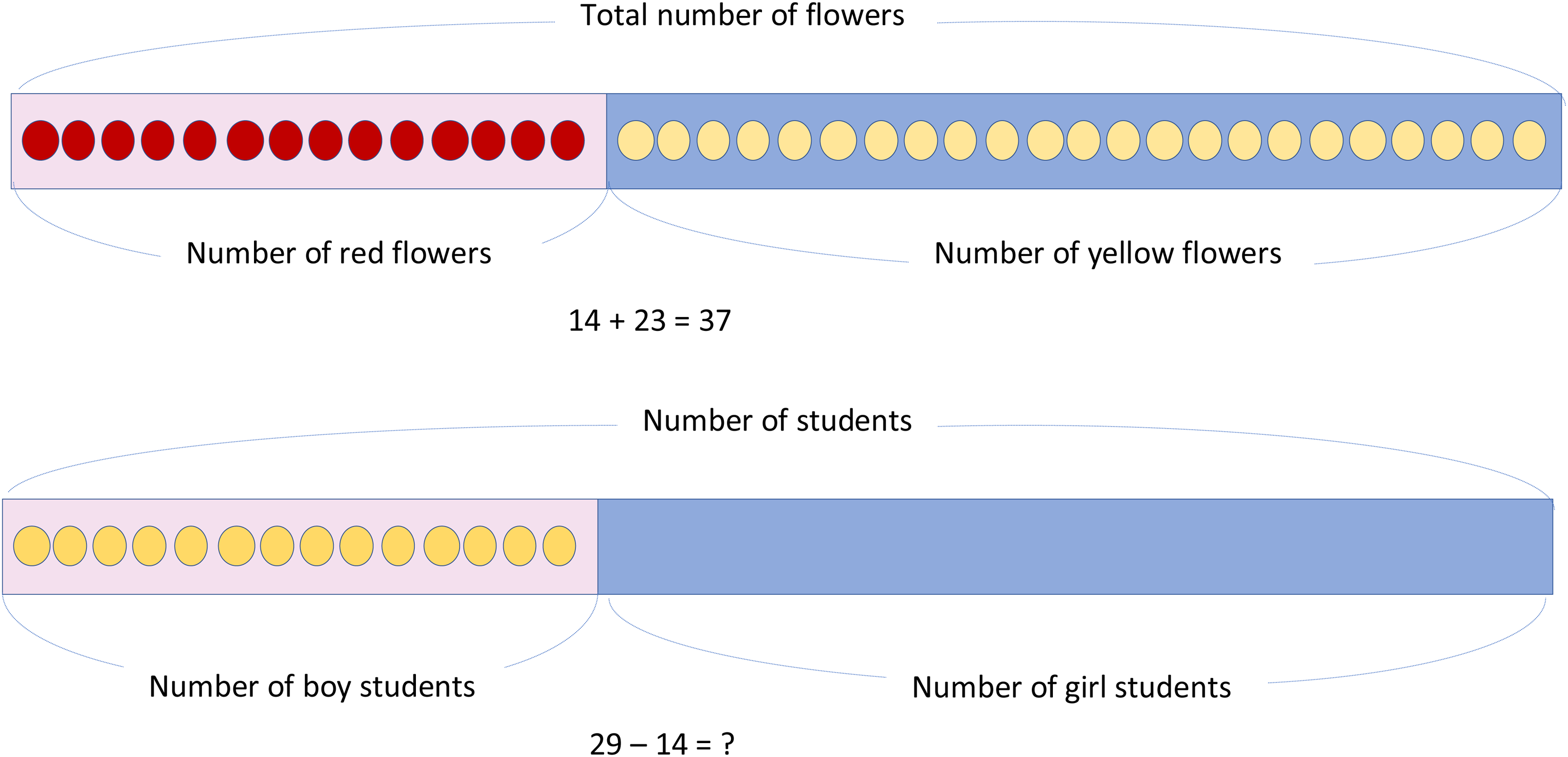
Introducing tape diagrams for addition and subtraction.
The rule of like numbers for multiplication. When the multiplicand is a concrete number, the multiplicand and the multiplier are not like numbers. In that case, the product and the multiplicand are like numbers.
In a tape diagram that shows a multiplicand that is a concrete number, the multiplicand and product are depicted as lengths (e.g., see Fig. 2).
Division. If a product and one of the multiplicand or multiplier are known, the operation of finding the unknown multiplier or, respectively, multiplicand is called division. Division is also the operation of finding the unknown factor when the product and one factor are known.
To find an unknown multiplicand is called partitive division.
For a partitive division with a concrete-number dividend, a tape diagram shows the unknown multiplier as an unknown length.
To find an unknown multiplier is quotitive division.
For a quotitive division with a concrete-number dividend, a tape diagram shows the unknown multiplicand as an unknown number of lengths.
To find an unknown factor is neither quotitive nor partitive division.
Dividend, divisor, quotient, remainder. The known product in division is called the dividend. A known multiplicand, multiplier, or factor is called the divisor. The unknown, which is the result of the operation of division, is called the quotient.
The dividend may be the sum of a number smaller than the divisor and a product where one factor is the divisor. The former is called the remainder. In this case, the result of division has two parts: quotient and remainder. Remainder is a temporary term in school arithmetic. After fractions are introduced, there is no longer a need for this term.
The rule of like numbers for multiplication applied to division. In partitive division, dividend and quotient are like numbers. In quotitive division, dividend and divisor are like numbers.
2.6 Multiplication and division: Fractions
This subsection gives definitions and rules for multiplication and division of fractions.
The product when the multiplier is a whole number. The product of two numbers is a third number which contains as many units as one number being taken as many times as the units in the other.
This definition is the same as that for whole numbers.
The product when the multiplier is a fraction. The product of a fraction and another number is a third number formed by partitioning the multiplicand into as many equal parts as the denominator of the multiplier and taking as many of those parts as the numerator of the multiplier (see Fig. 4).
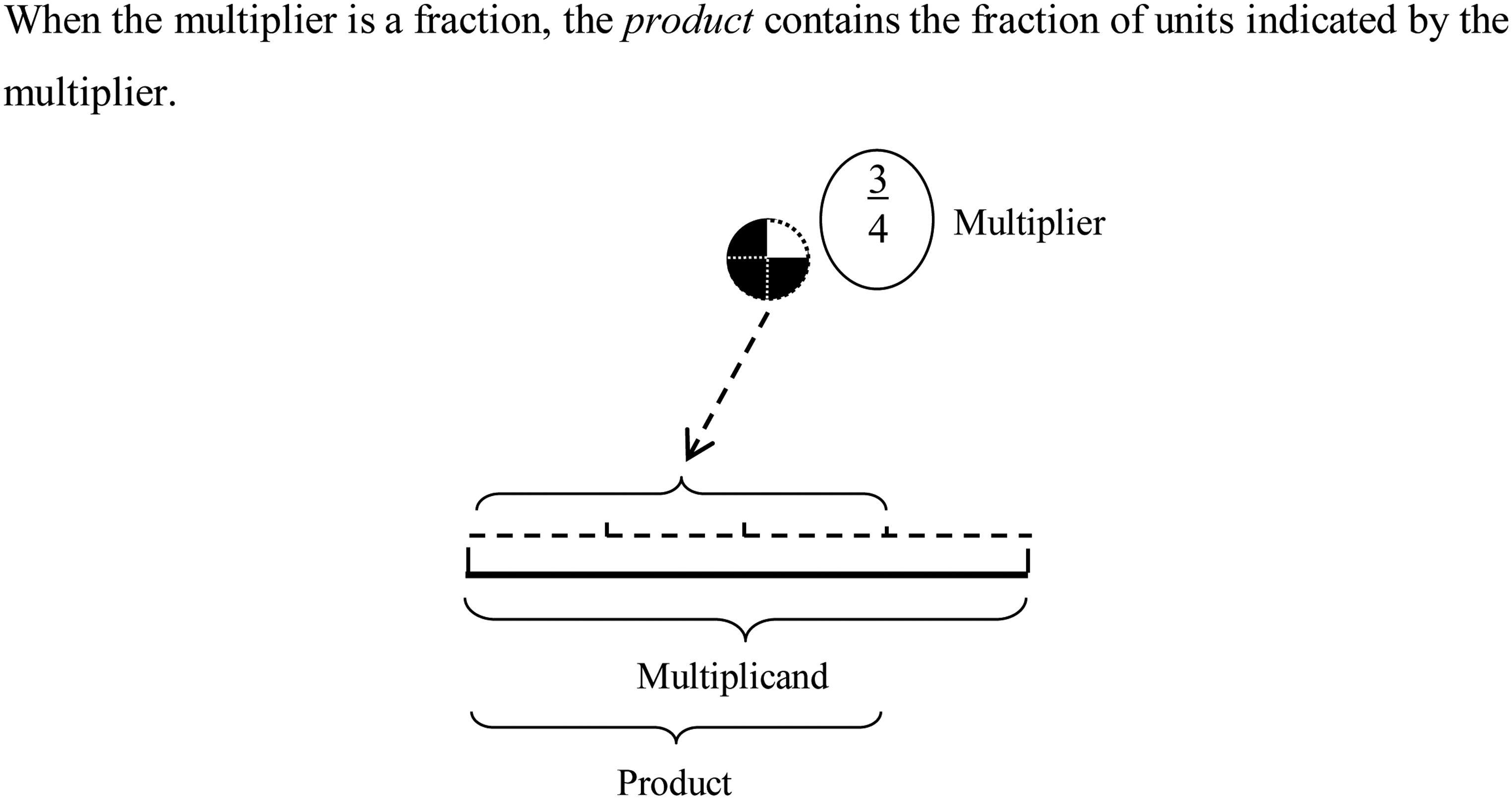
The definition of the product when the multiplier is a fraction.
Because a whole number can be considered as a fraction with denominator 1, this definition of product for a fractional multiplier reduces to the previous definition of product when this definition is used with a multiplier that is a whole number (identifying the whole number with a fraction with denominator 1). Thus, the same definition of product could be given whether the multiplier is a whole number or fraction.
The definition of multiplication when the multiplier is a fraction. To multiply a fractional unit by a whole number or fraction, consider the multiplicand as a many-as-one unit, partition it into equal parts according to the denominator of the multiplier. The product is equal to any one of those parts.
For example, to multiply
For example, to multiply
To multiply several fractional units by a whole number or fraction: Consider the multiplicand as a many-as-one unit, partition it into equal parts according to the denominator of the multiplier. Take one of those parts the number of times indicated by the numerator.
For example,
A number multiplied by a fraction is to find the fractional part. For example, to find
To find a fractional part of a number, use multiplication.
When the multiplier is a whole number different from 1, the result of multiplication is larger than the multiplicand. When the multiplier is a fraction smaller than 1, the result of multiplication is smaller than the multiplicand.
Whether the multiplicand is a whole number or a fraction does not change the definition of multiplication from its definition for whole numbers. For example, to find 12 times
Using only terms that students already know, we can also say whether or not the multiplier is a whole number or a fraction, the multiplicand (which can be a whole number or fraction) is considered as unit one. The multiplier decides whether the product is several of that unit or a fractional part of that unit.
The distance between Bill's house and school is 3 miles. The distance between Cathy's home and school is 3 times that distance. How far is Cathy's home from school? The distance between Bill's house and school is 3 miles. The distance between Cathy's home and school is The distance between Bill's house and school is The distance between Bill's house and school is
In the four problems above, the distance between Bill's house and school is the multiplicand. The distance between Cathy's house and school is the product to be found. Whether or not the multiplicand is a whole number or a fraction, it is considered as a unit. Whether the product is several times the unit or a fraction of the unit is decided by whether the multiplier is a whole number or a fraction.
Historical notes. Here are examples of how multiplication by fractions has been described in textbooks. What is the product of
In multiplying a given number by a fraction you take that fractional part of the given number. (Buckingham, Elementary Arithmetic, 1953, p. 66)
Finding such a part of a number as is indicated by a fraction is called multiplying the number by the fraction. (Sheldons' Complete Arithmetic, 1886, p. 54)
Fraction and division. Division is the inverse of multiplication. As for whole numbers, it is to find an unknown multiplier or multiplicand. For example, we know that 6 ÷ 3 = 2 because 2 × 3 = 6. Now that numbers include fractions and multiplication has been defined for fractions, quotients of whole numbers exist. For example, because
Similarly, we can write 2 ÷ 3 as the fraction
A division expression such as 2 ÷ 3 is equal to a fraction. One part of a partition of a unit into equal parts can be written as a division expression in which 1 is the dividend and the divisor is the number of parts. One part of a partition of a unit into equal parts can be written as a fraction. In the fraction, the dividend is called the numerator; the divisor is called the denominator. The division sign corresponds to the fraction bar.
The definition of division with fractions derived from the definition of multiplication when the multiplier is a fraction. Division is the inverse operation of multiplication.
The rule of like numbers for multiplication and division of fractions is the same as that for whole numbers.
Quotitive division. To find what part of the second number is of the first, divide the second by the first. (Wentworth & Smith, 1915, p. 94)
As with whole number division, division is the inverse operation of multiplication: when the product and multiplicand or multiplier are known, to find the unknown multiplier or multiplicand.
Quotitive division is to find the multiplier. To find how many copies of a smaller number are contained in a given number or to find how many times larger than the smaller number the given number is. These examples illustrate conceptions of quotitive division in which the quotient is a whole number: How many twos are contained in 8? Eight is how many times larger than 2? Or many copies of
To find what fractional part of a larger number a smaller number is. These examples illustrate conceptions of quotitive division in which the quotient is a fraction: What fractional part of 8 is 2? Or, 2 is what fraction of 8? One fifteenth is what fraction of
The two types of quotitive division are: a) multiplicand is smaller than or equal to multiplier; b) the quotient is a fraction less than 1.
The difference between these two types of quotitive division depends on which is larger: dividend or divisor. Whether or not the known numbers are whole numbers or fractions doesn't matter; however, this does not need to be made explicit to students.
Partitive division.
Given a part of a number, to find the number. (Wentworth & Smith, 1915, p. 95)
Partitive division is to find the multiplicand, when the product and the multiplier are known.
If the multiplier is a whole number this is to find the size of the many-as-one unit when the number of those units is known. (Partition 8 into four equal shares. How many in one share? Eight is four times a number, what is the number? Or, partition
If the multiplier is a fraction, this to find the whole (the many-as-one unit) when a fractional part of the whole is known. (If a quarter of a number is 2, what is that number? Or, if
The difference between these two types of partitive division depends on which is larger: dividend or quotient. For the former, the quotient is smaller than the dividend. For the latter, the quotient is larger than the dividend.
The two types of partitive division are: a) quotient is larger than or equal to dividend; b) divisor is a fraction less than 1.
Examples of problems about partitive division from a textbook: If
A farmer sold
Partitive division of fractions contributed a new way of solving an old type of arithmetic problem. For example, there is a famous problem: The head of a fish weighs
Formerly, this was solved by the “Rule of False Position.” If the weight of the whole fish is 12 ounces, then the head is 4 ounces, the tail is 3 ounces, and the body is 5 ounces. Evidently (as Sanford puts it), the weight of the whole fish is the same multiple of 12 ounces that 30 ounces is of 5 ounces. As Sanford (1927) notes, “forethought in selecting the guessed answer makes it possible to avoid fractions, at least until the last step of the work.” Use of partitive division removes the need for this forethought.
To use partitive division to solve the problem, consider the weight of the whole fish as the unit. The known weight, 30 ounces, is obtained from the whole fish by cutting off its head and tail. The problem doesn't tell us what fraction of the whole the body is. However, we are told that the head is 
Ma (2013) mentions the following problem: Mrs. Chen made some tarts. She sold
Like the fish problem, in this problem the whole (all the tarts) is unknown. We are told that a part of the whole is 200 tarts. The problem also tells us how to find what part of the whole the 200 tarts are. The 200 is the difference between the amount sold in the morning and the amount sold in the afternoon. The part sold in the morning is 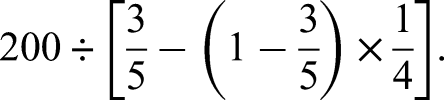
The famous problem of Diophantus's tombstone is a problem of this type. With this approach, which is built on the definitions used in the theory of school arithmetic, students can even solve the problem of Diophantus's tombstone.
3. Summary
In this article, the two parts of the theory (whole numbers and fractions) were not presented consecutively as the associated ideas would occur in instruction. Instead, to emphasize the similarity of definitions and rules for the two sets of numbers, the definitions and rules were presented in three sections: general definitions (e.g., unit, number); addition and subtraction; and multiplication and division. The definitions and rules of the theory show how arithmetic knowledge may be organized via a small number of concepts and principles—a feature of expert knowledge (National Research Council, 2000). Although computations with whole numbers and fractions may look very different, the definitions and rules of the theory allow them to be explained according to the same underlying principles.
Important features of the theory are the definitions of number, unit, like number, sum, and product. In learning arithmetic with whole numbers, students’ initial conceptions of each are established. In learning multiplication with whole numbers, students’ conceptions of unit expand to include many-as-one unit.
The second part of the theory concerns fractions. Students’ conceptions of unit expand again to include fractional unit. The underlying definition of number—a collection of like units—remains the same, but students’ conceptions of number expand to include fractions and their conceptions of unit expand to include many-as-one fractional unit. The underlying definition of sum (and addition and subtraction) remains the same. In multiplication with a fractional multiplier, students use the conception of many-as-one fractional unit.
The notion of unit is used in measurement, in representing nonnegative integers and nonnegative rational numbers, in the definition of multiplication, and in solving word problems. This last use offers students the opportunity to formulate new units such as the weight of the fish in the fish problem, and the total number of tarts in the tarts problem.
4. Concluding remarks
Instruction and instructional design. It is the role of instructional design and classroom instruction to help students learn the substance of the theory. This article has only briefly discussed how that might occur. (For more examples, see Ma, n.d.; Ma & Kessel, 2018.) The role of the theory is to provide explicit definitions, explicit descriptions of relationships among concepts and explicit descriptions of how notation is used. In the pedagogical remarks, we have outlined how students’ conceptions are intended to change with instruction.
Psychologists have studied relationships between children's knowledge of whole numbers and their knowledge of fractions finding that “a large body of work demonstrates that children's prior knowledge of whole numbers negatively biases their understanding of fraction symbols” (Sidney & Alibali, 2017, p. 32). A recent approach is to consider relationships between children's knowledge of whole numbers and their knowledge of fractions in terms of analogical transfer—“the transfer of strategies or mental models from one problem to another… guided by learners’ perception of similarity between the two problems” (Sidney & Alibali, 2017, p. 32; see also Sidney, 2020; Sidney et al., 2022).
Our presentation of the theory stresses analogies between definitions and rules for whole numbers and for fractions. The terminology used in the theory reflects these analogies, for example, “whole number unit,” “fractional unit,” “like numbers,” “like units.” Tape diagrams display some of the analogical structures for operations with whole numbers and fractions described in the theory. Both terminology and tape diagrams can be a source of “instructional analogies, [that draw] on more familiar ideas to help students make sense of new or difficult concepts” (Sidney, 2020, p. 1). Such analogies may be a factor in explaining Chinese children's success in learning about fractions.
Teacher knowledge. Returning to the puzzle of the US and Chinese teachers’ responses, we briefly sketch examples of connections—or lack thereof—with the theory with regard to fractions. (Examples for subtraction and multiplication of whole numbers appear in Ma & Kessel, 2018, pp. 457–458.)
The teachers were asked to compute 1
Only one US teacher created a correct representation of a word problem for 1
As noted earlier, elements of the theory are not unique to textbooks of the 19th-century United States and 20th-century China. Questions about the theory's evolution and its influence on instructional choices in different countries are far from answered.
Footnotes
Acknowledgements
We thank two anonymous reviewers for comments that substantially improved the article. Support from the Brookhill Foundation for the writing of an earlier version of this article is gratefully acknowledged. This article is an outcome of a larger project supported by the Carnegie Foundation for the Advancement of Teaching while Ma was a senior scholar there between 2001 and 2008.
Contributorship
Liping Ma conducted textbook and historical analysis. Liping Ma and Cathy Kessel wrote the article.
Declaration of conflicting interests
The author(s) declared no potential conflicts of interest with respect to the research, authorship, and/or publication of this article.
Funding
The author(s) received no financial support for the research, authorship, and/or publication of this article.
