



Abstract
The current study investigated creativity-directed problem-solving processing that explicitly requires solving pattern generalization problems in multiple ways. To examine mathematical creativity, we employed a multiple solution tasks approach, asking participants explicitly to solve pattern generalization problems in multiple ways. The participants were engaged with pattern generalization-multiple solution tasks in which patterns were presented numerically, diagrammatically, or contextually. The study aimed to examine whether success and creativity associated with solving pattern generalization-multiple solution tasks are affected (I) by expertise in mathematics (EM) and general giftedness (G) and (II) by task complexity and representation. Two hundred and ninety-eight participants from four research groups that differed in levels of general giftedness (G) and mathematical expertise participated in the study. We found that G affected statistically significant all the components of creativity when solving pattern generalization-multiple solution tasks, independently of task representation. Surprisingly, the effect of EM was lower and dependent on the type of task representation. Also surprising, we found statistically significant interactions between G and EM factors when solving pattern generalization-multiple solution tasks. The findings demonstrate a significant effect of task representation on students’ levels of success and creativity when engaged in solving pattern generalization-multiple solution tasks: contextual representations were approached with the highest level of success and creativity, whereas numerical representations appeared to be tackled with the lowest level of success and creativity. We suggest that mathematical instruction should integrate pattern generalization-multiple solution tasks to promote students’ mathematical expertise and creativity.
Keywords
Introduction
Generalization is defined as “the process by which one derives or induces from particular cases” (Sriraman, 2003, p. 206). Generalization processing is important both for the advancement of mathematics as a scientific field (Sriraman, 2003, 2004 with reference to Piaget, 1971) and for the development of mathematical reasoning in mathematics education (Rivera, 2013). As such, generalization is a potentially creative process that can lead a person to discover something new to them (Assmus & Fritzlar, 2022). Researchers in mathematics education and beyond connect the ability to generalize with levels of intelligence (Sternberg, 1979) and mathematical competencies and mathematical giftedness (Assmus & Fritzlar, 2022; Krutetskii, 1976; Sriraman, 2003).
Interestingly, the connections between mathematical creativity (MC), giftedness, and mathematical expertise are explored using different types of mathematical tasks and are rarely connected to pattern generalization (PG; Leikin & Sriraman, 2022). Moreover, more research evidence is available nowadays that suggests that creativity-directed activities are an effective instructional tool that promotes the advancement of mathematical knowledge and skills along with raising positive affect locally—when performing creative mathematical tasks—and globally, by raising mathematical curiosity and motivation to learn mathematics.
Surprisingly only a few studies have systematically explored creativity related to PG. Taking into account connections drawn in the research literature between creativity and mathematical giftedness (Leikin & Lev, 2013, Sriraman, 2005), in this study, we employ PG problems (Rivera, 2013) to examine the associations between success and creativity in mathematical performance associated with general giftedness and mathematical competencies. To examine the relationships between solving PG problems and general giftedness and mathematical expertise, we employ a
PG problems are classified according to the method of representation of a pattern in the problem: numerical, pictorial, or computational (Becker & Rivera, 2005). Moreover, importantly in the context of studies that examine mathematical giftedness, Paz-Baruch et al. (2022) recently demonstrated that general giftedness and mathematical expertise are predicted differently by visual competencies and pattern recognition. Due to the centrality of representations in mathematics education and mathematical problem solving (Goldin & Kaput, 1996; Janvier et al., 1993; Zhang, 1997), we integrate into our study pattern generalization problems in different representations.
Finally, PG problems can be solved using an inductive approach, with systematic analysis of the items at a different position of the sequence, or by insight, through focusing on one particular item in the sequence. In addition, PG tasks can be approached in multiple ways. Thus, in this study, we combine PG problems with a multiple solution tasks (MST) approach to the evaluation of creativity (Leikin, 2009) and employ PG-MSTs to examine the effect of general giftedness (G) and expertise in mathematics (EM) on students’ creative performance in mathematics.
Background
Beginning with Polya (1945/1973), who emphasized the importance of generalization in mathematics, which has been defined as “passing from one object to a whole class containing that object” (p. 12), the mathematics education literature has stressed the centrality of generalization activities for the development of mathematical reasoning. There exist different types of generalization activities, of which PG is a particular type. Rivera and Becker (2016) describe PG problems in terms of constructing a mathematical structure from a sequence of particular cases (p. 53). PGs can be classified according to how the pattern is presented in the problem: numerical, pictorial, or computational (Becker & Rivera, 2005; Zazkis & Liljedahl, 2002, 2004). Sometimes PG provides students with realistic contexts for understanding and answering questions about pictorial representations of sequences and their numerical values (Billings et al., 2007). In other cases, PG problems require students to deal with series presented using numbers or using geometric shapes (Moss & Beatty, 2006).
Krutetskii (1976) concluded that more “capable” (gifted) students were able to form mathematical generalizations rapidly and broadly. He noted that these “capable” students were able to discern the general structure of the problems before they solved them. The “average” students were not always able to perceive common elements in problems, and the “incapable” students fared poorly in this task. For students to formulate generalizations correctly, they had to abstract from the specific content and single out similarities, structures, and relationships. Skemp (1986) argued that “mathematical generalization is a sophisticated and powerful activity” (p. 58) and drew a connection between mathematical understanding and the ability to generalize.
Schoevers et al. (2022) argued that creativity predicted student performance on geometrical problems generally and that creativity predicted student achievement on geometry problems requiring multiple solutions. Focusing on patterns, Assmus and Fritzlar (2022) argue that mathematical activity offers a variety of opportunities for creative development. They find several types of flexibility related to the invention of patterns and a high correspondence between mathematical giftedness and MC regarding the invention of figural patterns. In light of the above observations, we hypothesize that when solving equivalent PG tasks that are represented differently, students show greater success solving tasks that are shown diagrammatically compared to tasks that are shown numerically. We employed six PG problems which solvers were required to solve in multiple ways using different solution strategies—we call these tasks PG-MSTs. The study examined both PG skills as well as MC by using three patterns in two of three forms (numerical, contextual, and diagrammatic).
Research has shown that students who can apply their knowledge creatively are better equipped to address complex problems of the 21st century (Pellegrino & Hilton, 2012). The ZDM Special Issue (Leikin & Sriraman, 2022) opens with a systematic survey of empirical studies on creativity in mathematics (education) which identifies three major groups of studies: (a) studies that examined the relationship between MC and other factors such as mathematical achievements, level of mathematical instruction, general ability, motivation and other personal characteristics; (b) studies that examined the development of MC through different types of instructional practices and mathematical tasks; and (c) teachers’ professional development directed at teaching mathematics with creativity. In this special issue, two papers were devoted to the analysis of creativity associated with solving PG tasks. Assmus and Fritzlar (2022) investigate creativity related to the generation of diagrammatic patterns by students with varying levels of mathematical giftedness and demonstrate that mathematical expertise increases creativity. Singer and Voica (2022) demonstrate that PG itself is a creativity-directed activity as related to the pattern “creation.” In the current study, we employ a model for evaluating MC using PG-MSTs. Importantly to the current study, creativity research suggests that different components of general giftedness can be relevant to different creative domains (Beaty & Silvia, 2013; Cho et al., 2010; Kahveci & Akgul, 2019; Kellner & Benedek, 2017). Mathematical competence should also predict MC (Elgrably & Leikin, 2021; Leikin & Lev, 2013). Therefore, we hypothesize that higher mathematical originality will be linked to general giftedness. In this paper, we examined differences in the generalization processing employed by experts and non-experts while solving problems in which generalization patterns are introduced in different representations.
The Study
Research goals and hypotheses
The current study aimed to examine associations between students’ general giftedness (G) and expertise in mathematics (EM) and performance on PG-MSTs that are related to MC. Moreover, we examined whether these associations were related to the complexity of the problem and the types of representations (numerical, diagrammatic, or contextual). Correspondingly, we examined the following hypotheses: H1: Higher mathematical fluency and flexibility are linked to factor EM.
H2: Higher mathematical originality is linked to factor G.
H3: Task complexity affects associated creative components when solving the problems.
H4: When solving equivalent PG tasks that are represented differently, students show greater success in solving tasks in diagrammatic representation.
Research sample and sampling procedure
We recruited 298 students from two different higher education academic institutions. The sampling procedure employed two ability tests: The Raven test (Raven, 2000) was used to assess General Giftedness (G factor) of the participants and the scholastic assessment test in mathematics (SAT-M) to assess the level of mathematical competencies of the participants. The participants took the tests in electronic form using computers or tablets in the presence of the first author of this paper.
The Raven test consists of a 3 × 3 matrix in which the bottom right entry is missing and must be selected from 6 to 8 alternatives. Solving Raven's matrices type problems essentially requires figuring out the underlying rules that explain the progression of shapes. We used a shortened version of the Raven test, which contained 30 items to be completed within 15 min (validated by Zohar, 1990). Items are displayed in black ink on a white background and become increasingly challenging as the participant progresses through each set. The range of scores for the Raven test is 0 to 30, such that the score indicates the number of correct responses. Participants’ scores on the SAT-M determined the EM factor (identifying whether mathematical competencies were at the excelling level or not-excelling level). The SAT-M test contains questions from various mathematics topics and is a multi-component test. We utilized a shortened version of the SAT-M test, consisting of 35 questions with a time limit of 30 min. The range of SAT-M test scores is 0 to 35; the final score represents the number of correct responses (adopted from Zohar, 1990). The students were subdivided into four experimental groups designed with varying combinations of expertise in mathematics (EM) and giftedness (G): G-EM group (n = 58) included students who were identified as both generally gifted and excelling in mathematics. G-NEM group (n = 25) included students who were identified as generally gifted but not excelling in mathematics. In the NG-EM group (n = 76), students were identified as not generally gifted but as excelling in mathematics. The NG-NEM group (n = 86) included students who were identified as not generally gifted and not excelling in mathematics.
The four groups were significantly different both in EM and G factors. Table 1 displays the statistical differences between the four research groups.
Means and standard deviations of participants’ scores on the Raven and SAT-M tests by groups and the corresponding effects of G and EM factors.
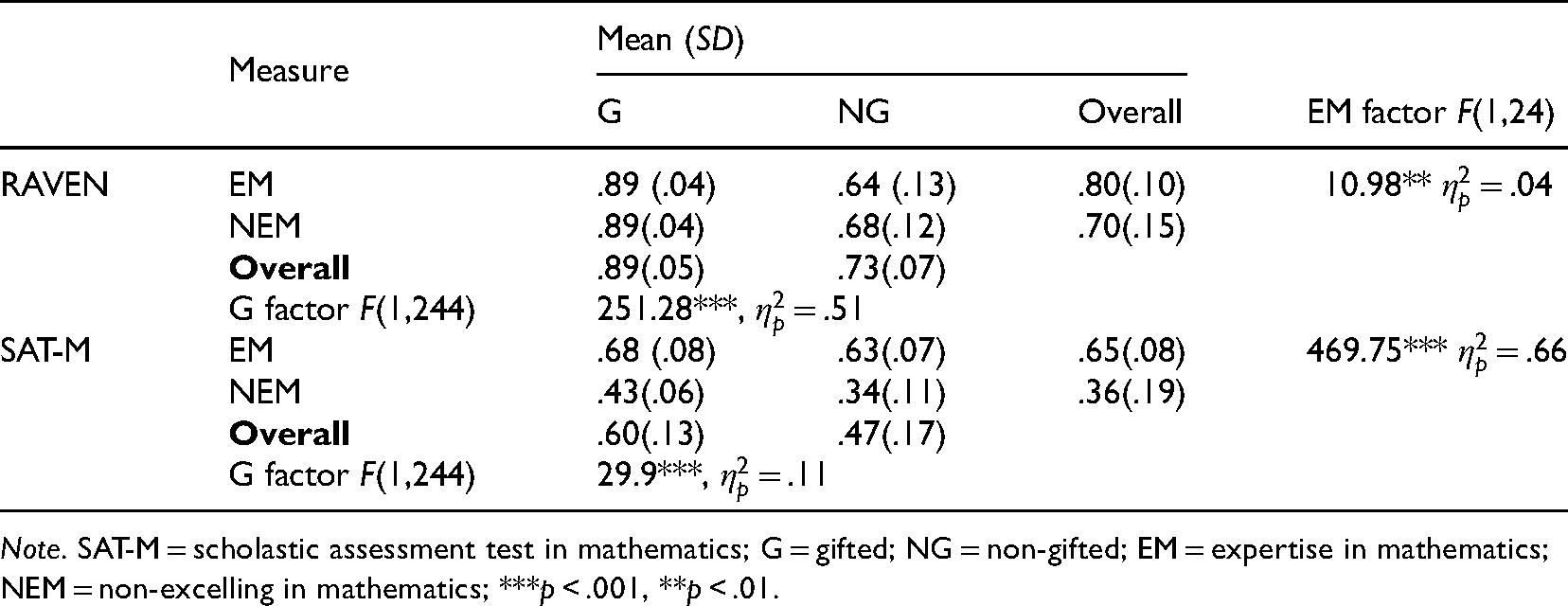
Means and standard deviations of participants’ scores on the Raven and SAT-M tests by groups and the corresponding effects of G and EM factors.
Note. SAT-M = scholastic assessment test in mathematics; G = gifted; NG = non-gifted; EM = expertise in mathematics; NEM = non-excelling in mathematics; ***p < .001, **p < .01.
The PG-MSTs test included six PG-MSTs in which students were explicitly asked to solve a PG problem in as many ways as possible. We used a 3 × 3 task design (Figure 1): PG-MSTs presented in three different mathematical representations (diagramed, contextual, and numerical) and varying in the level of complexity of the generalized formula (Figure 1). Contextual PG-MSTs are based on Arbona et al. (2019). Participants were given 30 min to complete the PG-MSTs test.
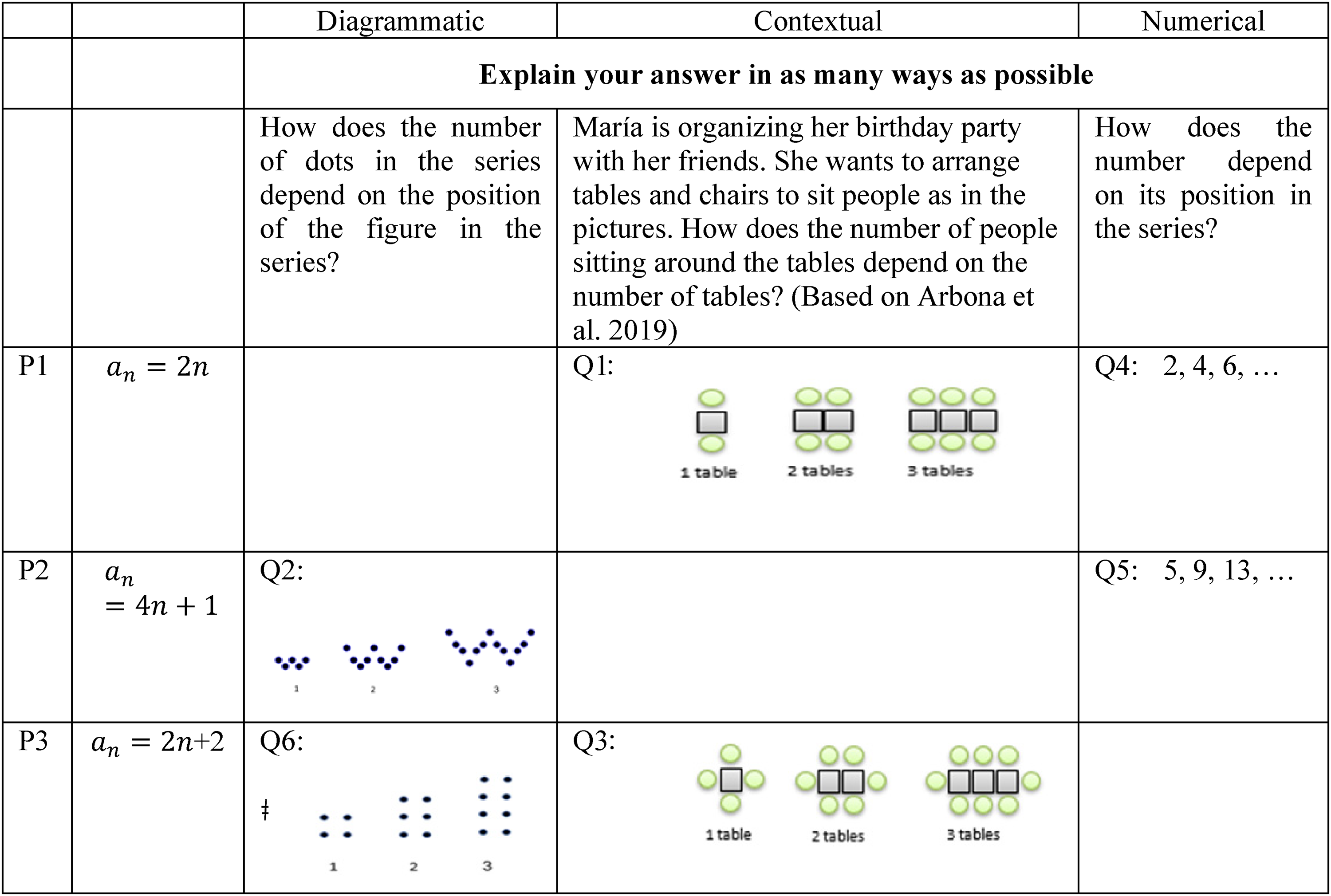
3 × 3 tasks design in the study.
Participants’ problem-solving performance was evaluated for correctness and creativity components (fluency, flexibility, originality, and creativity).
The accuracy of each solution was evaluated according to the completeness of the solution. Students received 10 points if they offered a correct and well-justified solution. Figure 2 shows an example of a PG task with contextual representation and depicts 10 different solutions to the problem. Overall, students could receive a total correctness score of 60 for the six problems on the test.
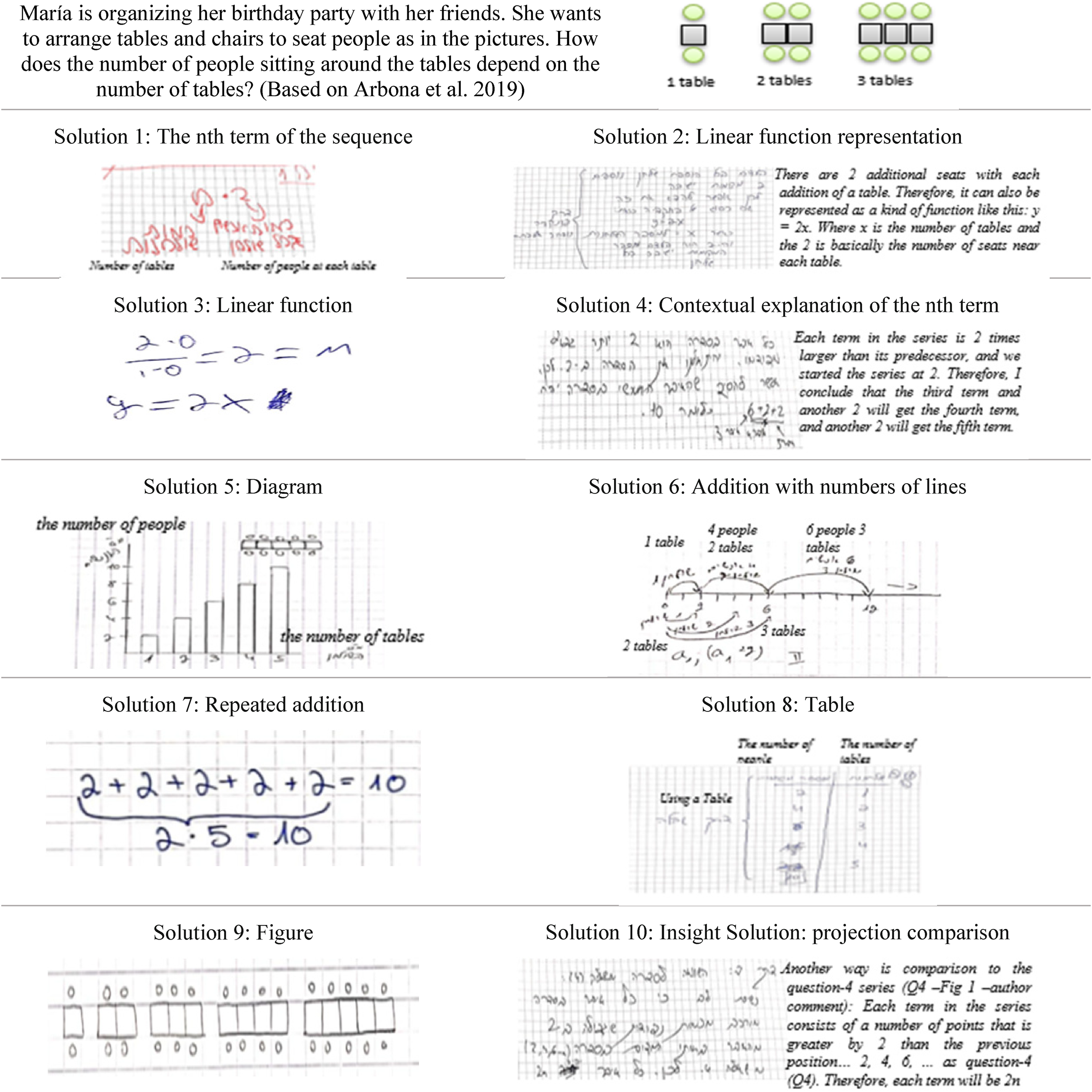
Examples of multiple solutions to P1-contextual.
We employed Leikin's (2009, 2013) model for the evaluation of creativity using MSTs. The fluency score is evaluated by summing up each student's appropriate solutions. For example, the fluency score for all 10 solutions presented in Figure 2 would be 10. The second scoring component is flexibility. To evaluate the flexibility of a participant's solution, the first step is to create groups of solutions. Classifying each solution into a group requires differentiating between students’ solutions for the specific task. Two solutions fit separate groups if they employ solution strategies based on different representations, principles, properties, or problem-solving methods. The first solution in a specific solution group receives a score of 10, even if it is the only solution provided. If a solution fits a different group of solutions than the solutions performed previously, it receives a score of 10. Solutions that belong to a group already represented will receive a score of 1 if the solution is distinct from the other solution that fits in that group. For example, a score of 10 would be given for solution 4 if it was produced after solution 1 (see Figure 2). Alternatively, a score of 0.1 is given if the solution is very similar to another one in the group. For example, solution 2 in Figure 2 would receive a flexibility score of 0.1 if produced after solution 3. The total flexibility score for a particular problem equals the sum of the student's flexibility scores for each solution.
The third scoring component is originality, which is evaluated by comparing the solver's personal solution space with the communal solution space of the relevant group. Let P be the percentage of students in the group that produces a particular solution. If most students in a group gave the same or a very similar solution (
Scoring scheme for evaluating creativity (borrowed from Leikin, 2013).
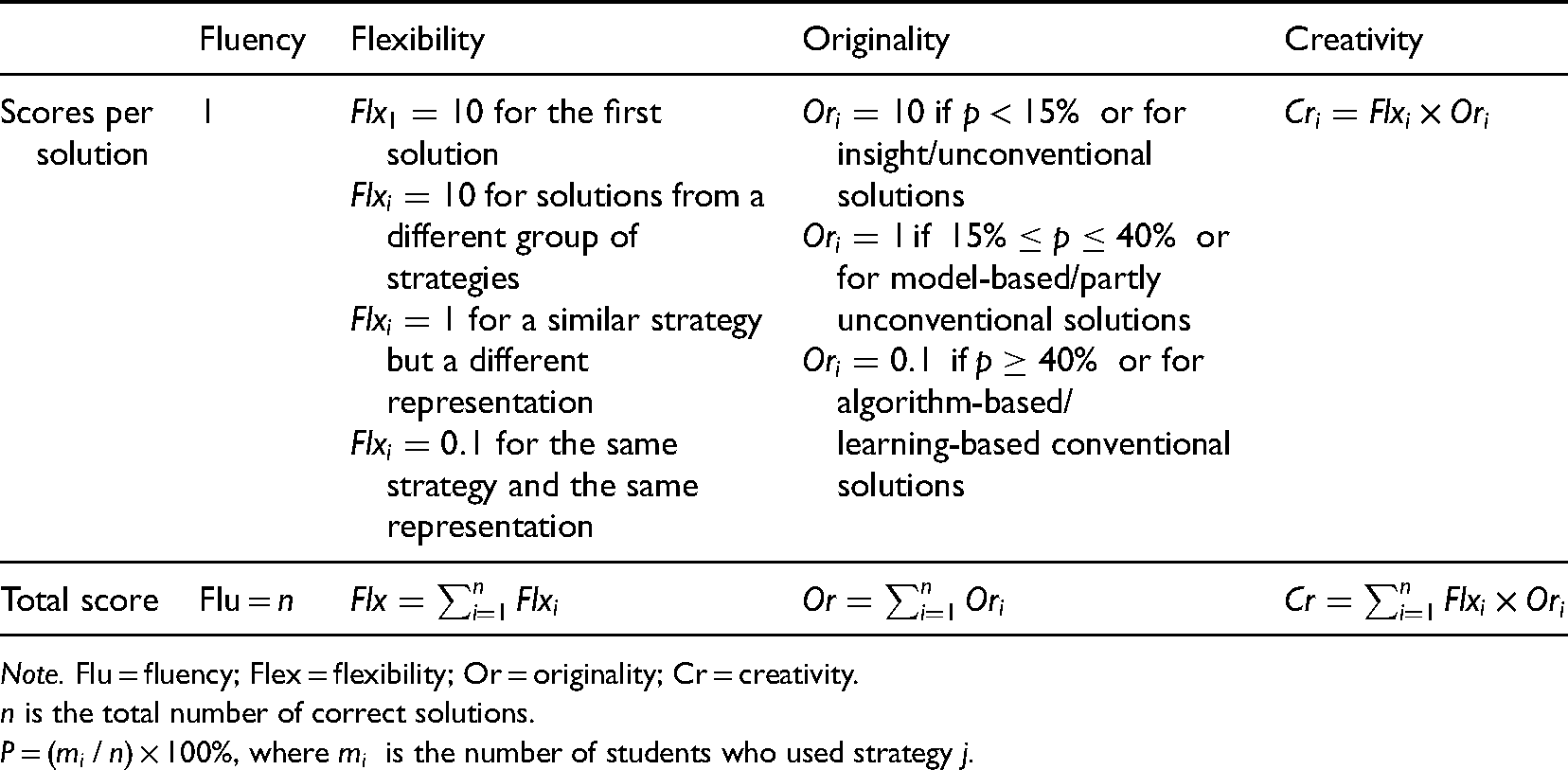
Scoring scheme for evaluating creativity (borrowed from Leikin, 2013).
Note. Flu = fluency; Flex = flexibility; Or = originality; Cr = creativity.
n is the total number of correct solutions.
P = (
The fourth scoring component is creativity, which is evaluated for a particular solution as the product of the solution's originality and flexibility:
The model for evaluating creativity used together with a particular set of PG-MSTs constitutes one of the research instruments in this study. This model was validated in previous studies (Leikin, 2009, 2013; Leikin & Lev, 2013), and was accepted and employed in this study with a diverse set of PG problems. The systematic review of the empirical research on creativity in mathematics (education) revealed that MSTs are the most frequently used research tool for the evaluation of MC at the school level. Examples of such studies can be seen in Assmus and Fritzlar (2022) and Schoevers et al. (2022).
We performed the following statistical analyses:
Examining effects of EM and G factors using repeated measures multivariate analysis of variance (MANOVA) to examine hypotheses H1 and H2. Examining effects of the three tasks’ (P1, P2, and P3) complexity on the correctness and the creativity components (hypothesis H3) using three-way MANOVA. Examining the effects of the three types of representations on the correctness and the creativity components (hypothesis H4) using three-way MANOVA.
Findings
Table 3 summarizes the overall correctness and creativity components scores of the study participants on their problem-solving performance associated with G and EM factors. G and EM factors affect significantly all the creativity components (Table 4). Also, there are significant interactions of G and EM on fluency F(1, 241) = 10.66, p < .000, flexibility F(1, 241) = 15.75, p < .000, originality F(1, 241) = 18.22, p < .000 and creativity F(1, 241) = 17.36, p < .000.
Correctness and creativity components in six problems (overall) solved by the participants.
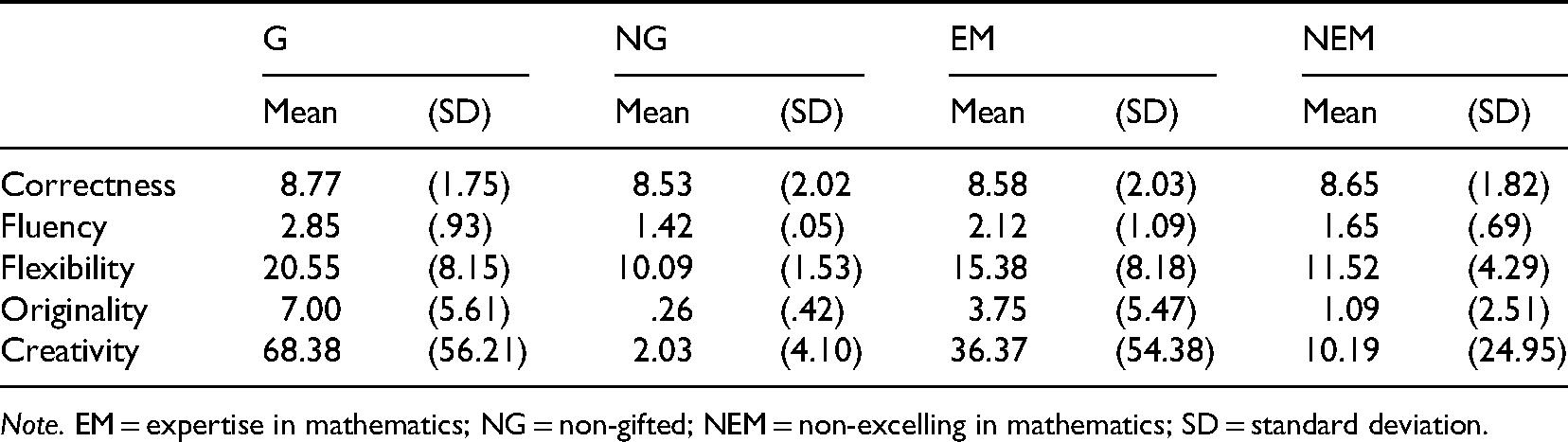
Correctness and creativity components in six problems (overall) solved by the participants.
Note. EM = expertise in mathematics; NG = non-gifted; NEM = non-excelling in mathematics; SD = standard deviation.
Main effects of G and EM on the five study variables.
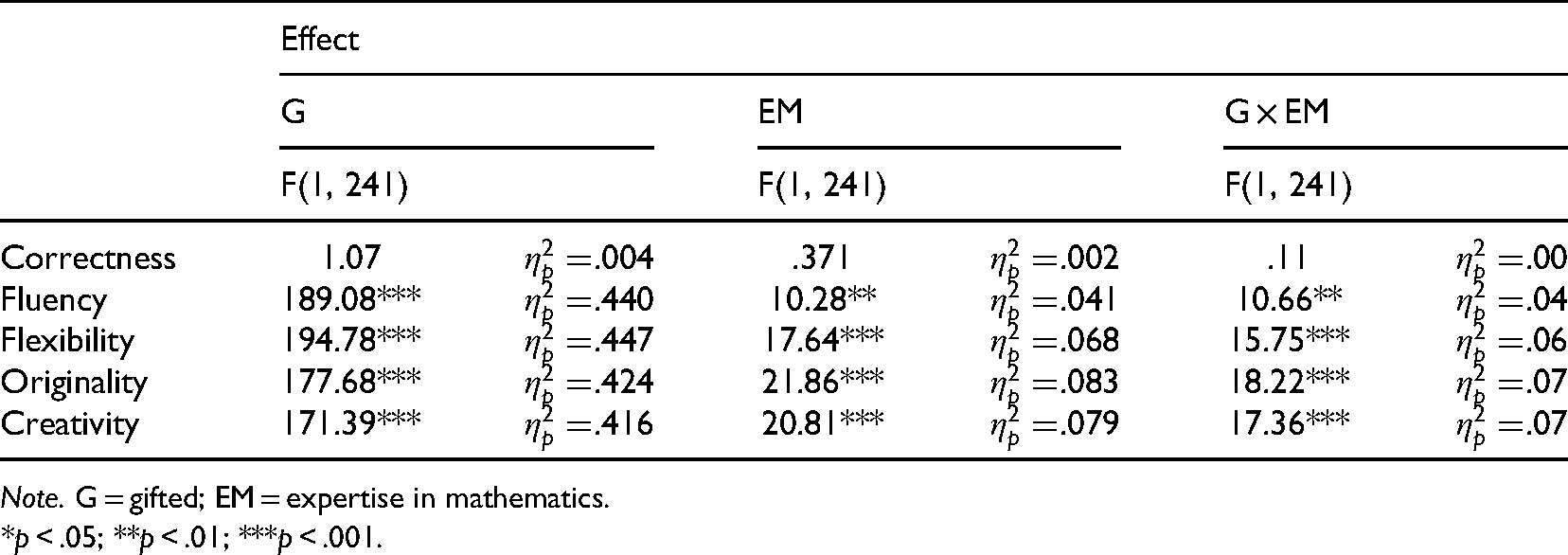
Note. G = gifted; EM = expertise in mathematics.
*p < .05; **p < .01; ***p < .001.
Means and standard deviations attained by the 245 study participants on correctness, fluency, flexibility, originality, and creativity for all the three problems in three different conditions are presented in Table 5.
Descriptive statistics of research variables.
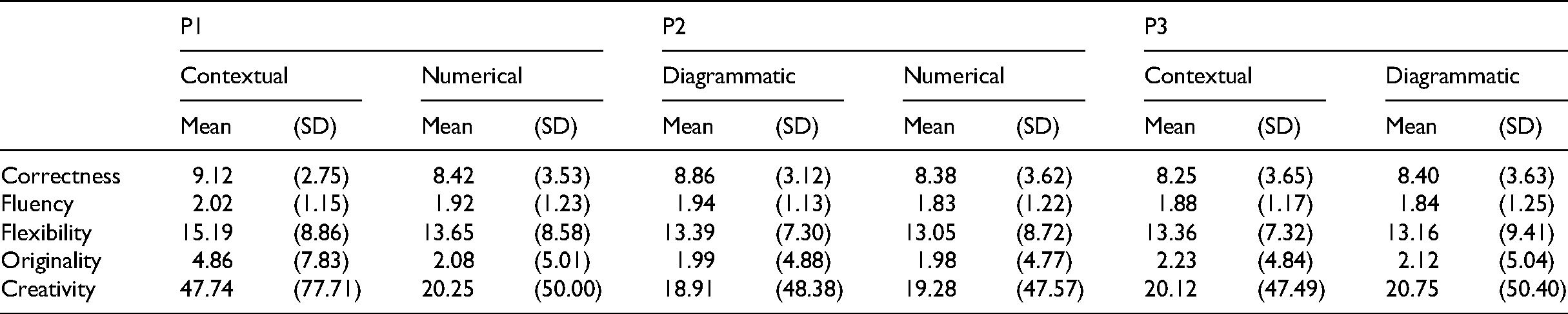
We explored the interaction effects between the problems and G and EM with creativity components linked to the three problems with different levels of complexity (Figure 3). Table 6 demonstrates the effect of the three problems (P1, P2, or P3) on creativity components and correctness with the G and EM factors. First, using three-way MANOVA, we found a significant problem effect for all the variables, WilksΛ = .56,
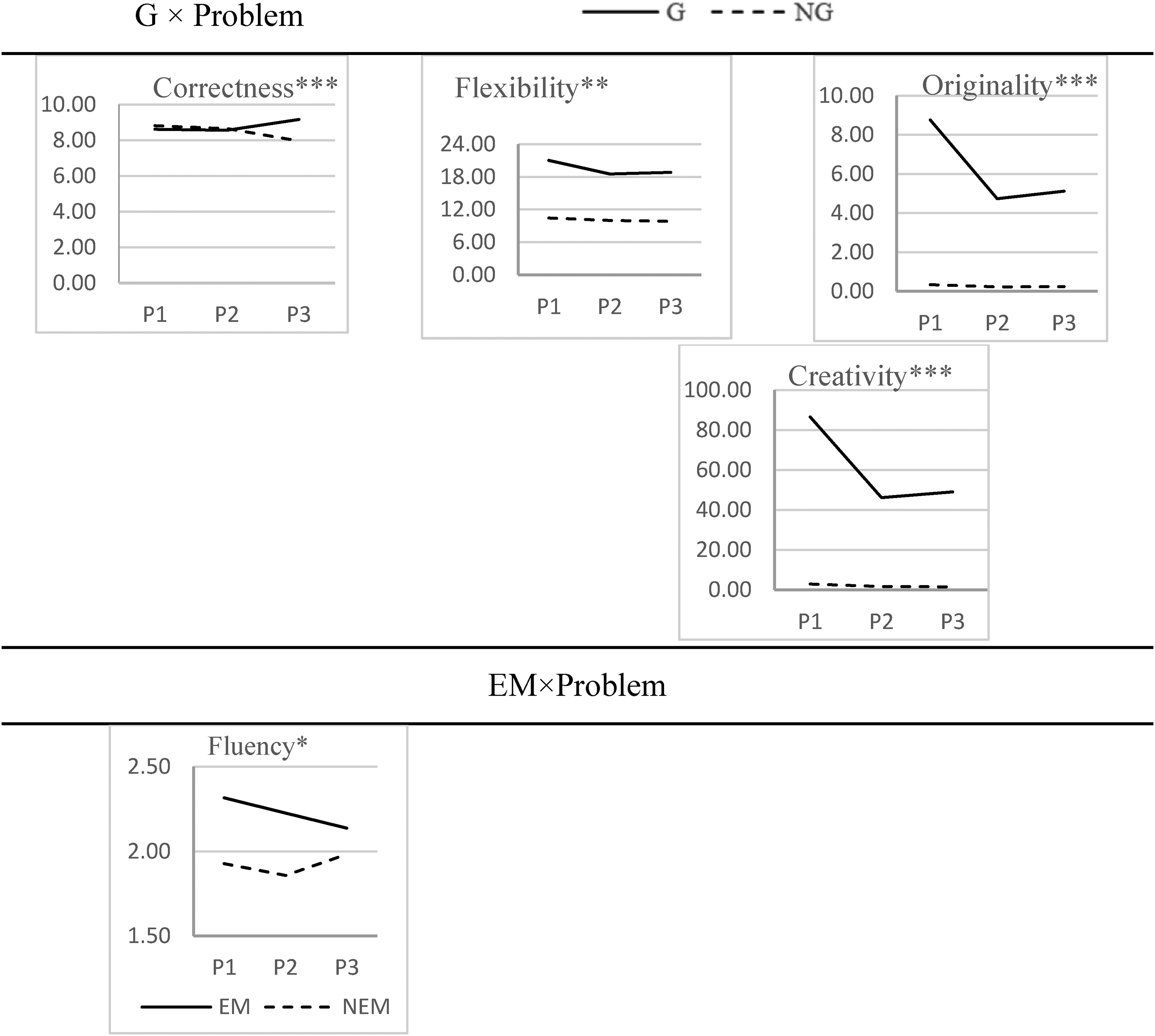
Significant interaction between the effects of problems and G and EM factors. Note. G = gifted; EM = expertise in mathematics.
Significant effects of problems (P1, P2, or P3) on correctness and creativity components and the associated effects of G and EM factors.
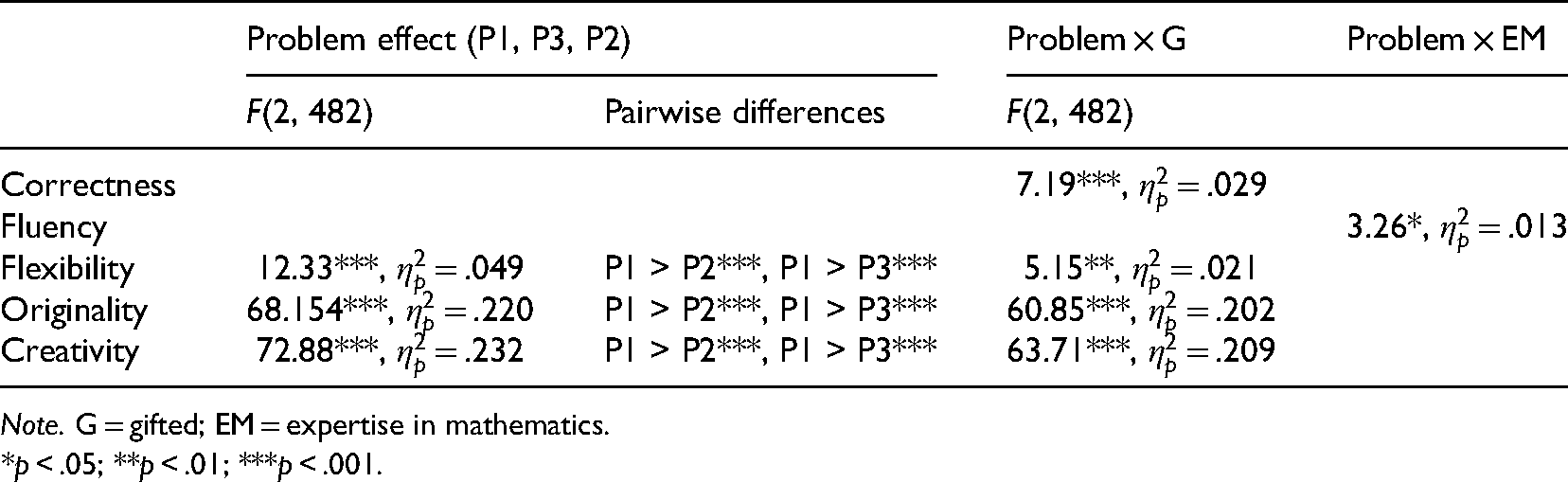
Note. G = gifted; EM = expertise in mathematics.
*p < .05; **p < .01; ***p < .001.
Second, we investigated the effects of representation (Table 7). We found that the representation of the problems had a significant effect on correctness and all creativity components, F(10, 232) = 16.87, p < .001, WilksΛ = .58,
Significant representation effects on correctness and creativity components and the associated effects of G and EM factors.
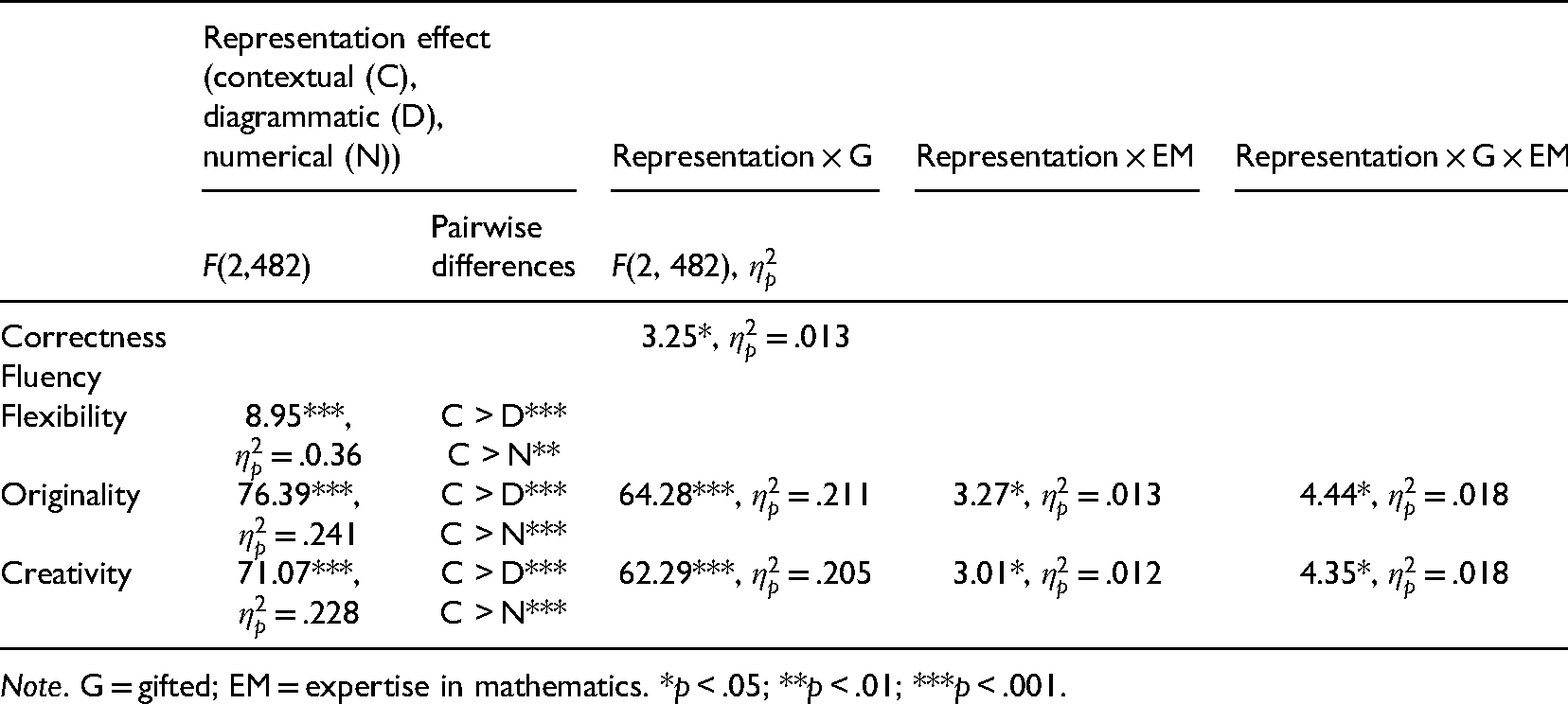
Note. G = gifted; EM = expertise in mathematics. *p < .05; **p < .01; ***p < .001.
Also, we found a low significant interaction effect between the representation and G on correctness F(2, 482) = 3.25, p < .05,
Regarding hypothesis H1, we found no significant effect of representation and EM on the flexibility component. This finding does not appear to support hypothesis H1.
As evidence for hypothesis H2, we found that the interaction between representation and G significantly affected the originality component of creativity for all three problems (Table 7), F(2, 482) = 64.28, p < .001,
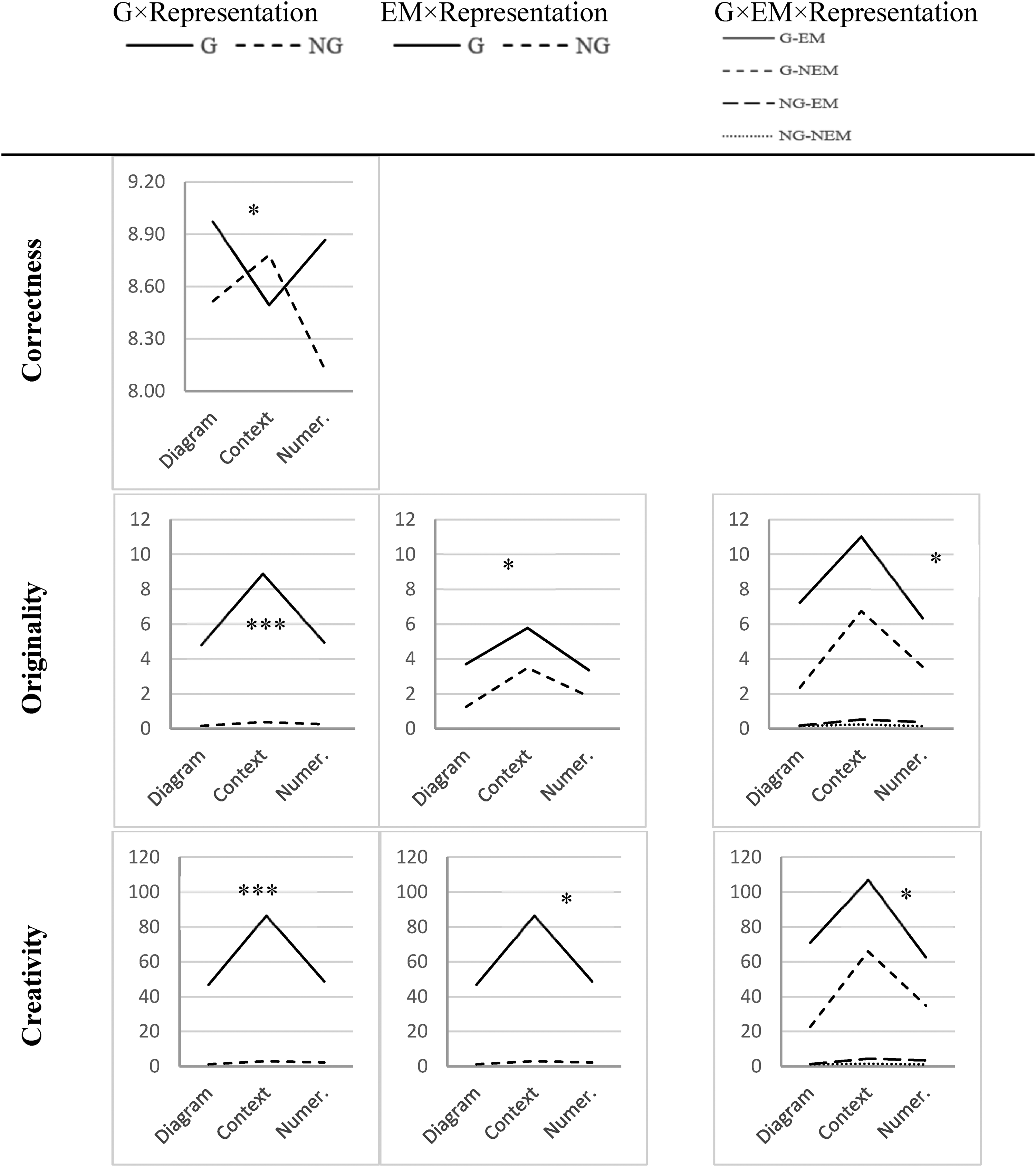
Significant interaction between effects of representation and G and EM factors. Note. G = gifted; EM = expertise in mathematics.
Moreover, the interaction of representation and G and EM has an important impact on originality, F(2, 482) = 4.44, p < .05, and
Additionally, we found a significant interaction between representation and G and EM on creativity, F(2, 482) = 4.35, p < .05,
The current study aimed to confirm four hypotheses regarding the associations between students’ general giftedness (G) and expertise in mathematics (EM) and their performance on PG-MSTs that are related to MC. The current study extends previous research in several ways. First, previous research did not examine the relationships between creativity competencies and the representation of PG tasks. Moreover, the current research demonstrates more understandable mathematical elements of PG, emphasizing the importance of general giftedness and expertise in mathematics. Specifically, the student participants were divided into four groups according to two factors: giftedness (G) and expertise in mathematics (EM). Based on a comparison of mean scores of correctness and creativity across the four groups, it was revealed that the G-EM group outperformed the other groups. In other words, generally gifted individuals who excel in mathematics (G-EM individuals) exhibited superior performance on PG-MSTs.
The first research hypothesis was that higher mathematical fluency and flexibility are linked to the EM factor. This hypothesis stemmed from the assumption that fluency and flexibility are linked to a strong knowledge base. This result would support Kattou et al. (2013) study that revealed that mathematical ability is predicted by MC.
The current study found partial support for the first hypothesis. Across several analyses, we found significant associations between giftedness and expertise in mathematics and the fluency and flexibility components of MC regarding contextual and numerical PG-MSTs. Importantly, this finding was specific to the less complex task (P1). When we evaluated the more complex task (P2), we found that EM was not associated with fluency or flexibility in the numerical representation of the task but that the associations were significant for the contextual representation of the task. In addition, we found a significant interaction between giftedness and EM in predicting scores on fluency and flexibility on P2-diagrammatic.
Regarding the third PG-MST, we found a significant association between EM and flexibility for both the contextual and diagrammatic representations of the task. The EM factor attains complete realization only in interaction with the G factor; the G-EM group outperforms all the other groups. Hence, EM and G appear to have different effects depending on the mathematical task at hand. Furthermore, we found that students who both were G and EM (the G-EM group) performed the best on PG-MSTs and in generating solutions.
The second research hypothesis was that general giftedness is associated with mathematical originality. Our study results support this hypothesis. G was found to be significantly associated with the number of correct solutions and scores on fluency, flexibility, originality, and creativity. This pattern of results was found across all tasks and representations. Originality was found to be highly associated with G. This result is consistent with Leikin’s (2009, 2013) work that suggests that creativity depends on originality. G and EM were differentially relevant to participants’ success on the tasks, depending on the task representation and the arithmetic series. Participants with low general and mathematical abilities demonstrated similar performance on the tasks, regardless of the representation.
G-EM participants exhibited superior performance on all the tests, including insight-based problems. The findings indicated that EM had a significant effect on solving tasks that require applying knowledge typically learned in high school mathematics. In contrast, the G factor had a significant main effect on insight-based problems that are not part of the school’s mathematical curriculum. Solving these types of problems requires original mathematical reasoning. These findings support those found in Leikin et al. (2016) study.
The third research hypothesis was that when solving equivalent PG-MSTs that are represented differently, students show greater success solving tasks that are shown diagrammatically as compared to solving tasks numerically. Findings indicated within-subject differences in the effect of representation on participants’ success in solving the problem across the three tasks; specifically, students demonstrated more correct responses and showed greater creativity when tasks were represented contextually or diagrammatically compared to numerically. There are significant differences between students’ success and creativity when solving the task in different representations. Our findings are in line with previous works that show that diagrammatic representations help develop students’ generalizing abilities (Barbosa & Vale, 2015; Becker & Rivera, 2005; Warren & Cooper, 2008).
Based on our findings, we can conclude that differences in students’ success in solving PG tasks and implementing creative strategies are due to the nature of the representation of the tasks. Thus, our fourth hypothesis is confirmed: students demonstrate more success when solving tasks that are represented diagrammatically in contrast to tasks that are represented numerically.
In conclusion, findings from the current study revealed that G and EM are different yet related characteristics in terms of their effects on MC. Overall, our study suggests that both G and EM are crucial factors in MC. Whereas EM appears to be important to students’ success in solving tasks that are based on mathematical knowledge taught in school, G appears to be crucial for solving unfamiliar problems that require insight.
Footnotes
Acknowledgements
This project was made possible through the support of a grant from the Aaron Gutwirth Foundation. This publication reflects only the views of its author(s) and not necessarily those of the Gutwirth Foundation. Our sincere thanks go to the University of Haifa for its generous support of this study.
Declaration of Conflicting Interests
The author(s) declared no potential conflicts of interest with respect to the research, authorship, and/or publication of this article.
Funding
The author(s) disclosed receipt of the following financial support for the research, authorship, and/or publication of this article: This work was supported by the Ida Wechsler Fund and Gutwirth Memorial Foundation.
Informed consent
The research was performed with approval of ethic committee of the Faculty of Education, University of Haifa (Approval Code: 144/19) on the date 30th April 2019. The participants provided informed consent to participate in the study.

Correction (December 2024):
Article updated to add Informed consent section.