



Abstract
Although research shows that Students of Color have negative experiences at predominantly White high schools (PWHSs) due to race, there is little research to show this impact in STEM at PWHSs. This study aims to analyze the assets of minoritized students at PWHSs and the impact on their experiences in STEM. The researchers utilized the Community Cultural Wealth model to analyze the assets minoritized students bring to PWHSs and its impact on student experiences. Findings demonstrate that aspirational, familial, navigational, and social capitals were the most significant contributors to their success in STEM settings at PWHSs. Additionally, the study demonstrates the need for institutions to recognize the cultural assets of Students of Color in STEM spaces.
Introduction
Existing research shows that experiences of racial discrimination impact students’ academic achievement and engagement (Leath et al., 2019). This is especially true at predominantly White institutions (PWIs), such as high schools. Students of Color are underrepresented in science, technology, engineering, and mathematics (STEM). Only 12.6% of Latine/x students and 9.9% of African American students obtain STEM degrees (National Center for Education Statistics, 2023). These students are more socioeconomically privileged in comparison, which is similar to Students of Color in STEM attending predominantly White universities (Bowen and Bok, 1998). However, despite being from comparatively higher socioeconomic backgrounds, they still experience barriers to their success. Therefore, there is a need to study the experiences of STEM Students of Color at PWHSs. For example, the underrepresentation of Students of Color in STEM begins early in their academic journey, as they are often disproportionately concentrated in under-resourced K-12 schools where access to rigorous STEM courses is limited in comparison to PWHSs (Ladson-Billings, 2006; Museus et al., 2011). Second, racial discrimination is even more present in PWIs and extends to an assumed White normative educational context which perpetuates Eurocentric curricula (Sue & Spanierman; 2020), tokenization (Solorzano et al., 2000), and assimilation (Museus, 2008). Students of Color also have less access to advanced math or science courses due to tracking (Oakes, 1990). This creates a problematic and harmful learning environment for Students of Color at PWIs.
Although there is extensive research on the various systemic barriers that impede Students of Color as they navigate postsecondary STEM pathways, there is less research on the experiences of STEM Students of Color at PWHSs. Andriaccio (2021) found that African American adolescent males attending a predominantly White high school (PWHS) experienced racial stereotyping that impacted their self-efficacy, sense of belonging at school, and perceived educational opportunities. Thomas et al. (2020) also found that African American students attending a PWHS experienced antiblackness and cultural assault that made their school experiences difficult. Furthermore, it is important to highlight and examine the assets and strengths that Students of Color bring to PWHSs (Hernandez and Villodas, 2019; Rincon et al., 2020). The purpose of this study is to use an asset-based perspective to analyze the STEM experiences of Students of Color at PWHSs. It is important to analyze these experiences to understand further and eliminate barriers of access for Students of Color in these environments. The researchers utilize the Community Cultural Wealth (CCW) model as an asset-based perspective to analyze the high school environment and its impact on student experiences.
This study interrogates the standard deficit approaches in K-12 to highlight the cultural assets of Students of Color, so that institutions ensure equitable processes. School environments must serve Students of Color and foster their academic achievement. First, we will overview the relevant research on this topic. Then, we will discuss the theoretical framework, Community Cultural Wealth, that underpins this study. Next, we will discuss the methodology and results of the study. From there, we will move into the discussion and implications of the research. The research question for the study was: What are the cultural assets that high school Students of Color utilize to facilitate their success in PWHSs, particularly in STEM settings?
Terms
There are some key terms in this study that need to be defined. First, the term Students of Color is used to describe students who do not identify as White. However, in this study, the participants all identified as Latine/x or Black/African American in the U.S. context. Second, predominantly White institutions (PWIs) are any educational institution that is predominantly White in the student population. Whereas predominantly White high schools are used to describe high schools that have predominantly White student populations. Finally, STEM experience is a broad term to encompass participants’ experiences in STEM classes, achievement, identity, and connection to STEM.
Literature review
Racialized experiences of students of color
Students of Color experience ongoing racial inequity in K-12 schools. Students of Color experience barriers to learning to their fullest potential (Darling-Hammond, 2010), fragmentation in the pipeline to college (Ferguson, 1998), and are ill-equipped for career readiness (Gandara and Contrearas, 2009). Additionally, existing research shows that students of color are more likely to be suspended from their classes by White teachers (Okonofua et al., 2016). Many of the existing research implies that the problem is students of color themselves, instead of placing the responsibility on systemic structures that have perpetuated inequity and constrained educational opportunities for students (Ladson-Billings, 2006). For example, much of the research positions students of color in a deficit lens, such as needing additional resources or being “behind” (Milner, 2010; Valencia, 2010). These experiences negatively impact students of colors’ educational experiences and outcomes.
Experiences of students of color in predominantly white high schools
While under-examined, prior research has shown that students of color may experience a range of racialized challenges in PWHSs (Carter, 2007; Carter Andrews, 2012; Chapman, 2014; Frankenberg et al., 2016; Thomas et al., 2020). Notably, the literature on Students of Color in PWHSs has largely focused on Black students. For instance, Black students in PWHSs were hyper visible—spotlighted to discuss topics around race—and invisible—ignored by teachers and peers in classrooms (Carter Andrews, 2012; Thomas et al., 2020). Teachers’ racial spotlighting of students of color led to harsher punishments for them compared to White students, even when both groups committed the same infraction (Chapman, 2014). These racialized perceptions led the predominantly White communities to respond with contempt and pity toward Black students (Thomas et al., 2020).
Given such racial barriers, Black students in PWHSs developed ways to resist racist encounters. For example, Carter’s (2007) study on high-achieving Black students in PWHSs revealed that students formed counter spaces to actively resist racially hostile educational environments and found opportunities to affirm their racial identity to maintain academic success. Another study by Carter Andrews (2012) found that high-achieving Black students in PWHSs resisted racial discrimination in unique ways, such as asking for support from Black administrators to confront racial issues and verbally challenging experiences of racial stereotypes directly with their peers. These findings underscore how Black students leverage unique navigational, social, and resistant capitals to address racialized challenges and maintain their positive racial self-concept to achieve academic success in predominantly White educational spaces.
Moreover, Latine/x students face similar challenges as Black students in PWHSs. For example, they experienced racial microaggressions, racially derogatory statements, social exclusions from peers, less academic support from teachers, and lower expectations of their academic success from teachers (Ballinas, 2017; Pasco et al., 2022). Instances of racial discrimination increased in intensity and frequency for Latinx students who attended PWHSs compared to those who attended racially diverse high schools (Ballinas, 2017; Pasco et al., 2022). Contrary to Black students, Latine/x students in PWHSs received discrimination from White peers due to their language or accents (Ballinas, 2017). This example reflects how the linguistic diversity of Students of Color is framed as language deficiency rather than cultural strengths of proficiency in multiple languages.
Although these patterns of racialization may potentially restrict Latinx students’ academic opportunities, they employed various strategies in PWHSs to combat these negative influences. Resembling those used by Black students, Latinx students actively constructed ethnic enclaves, populated by Latinx students and teachers to enhance their sense of belonging in school and address racialized experiences (Salerno and Reynolds, 2017). These shared spaces also promoted access to resources, as teachers consistently offered academic and social advice to students (Salerno and Reynolds, 2017). Thus, previous findings acknowledge that Latinx students also possess unique social and navigational capitals to succeed academically in predominantly White educational spaces.
However, the cultural assets Students of Color bring to PWHSs have been understudied compared to the existing literature on predominantly White higher education institutions. Much of the literature on PWHSs contributed to a limited portrayal of the experiences of Students of Color, focusing on a single racial population, especially Black students (Carter, 2007; Carter Andrews, 2012; Thomas et al., 2020), and often at one particular school (Carter Andrews, 2012; Thomas et al., 2020). Furthermore, the scarcity of research on Latinx students in PWHSs, in contrast to their counterparts in predominantly White higher education institutions, warrants further investigation into their experiences and outcomes. Importantly, the majority of the research on Students of Color in PWHSs does not explicitly focus on diverse cultural assets that these students draw upon to succeed academically. Instead, it broadly categorizes them as strategies for overcoming racial barriers. Therefore, these gaps call for a deeper investigation into the nuanced cultural assets that Students of Color rely on to thrive in PWHSs.
Theoretical foundation
Our study used Yosso’s (2005) Community Cultural Wealth (CCW) model to examine how Students of Color leveraged various forms of capital to navigate PWHSs and achieve success in STEM, despite barriers. The CCW model is grounded in Critical Race Theory and focuses on “cultural knowledge, skills, abilities, and contacts possessed by socially marginalized groups that often go unrecognized and unacknowledged” (Yosso, 2005: p. 69). The model challenges Bourdieu’s (1986) deficit perspective of capital by highlighting how Communities of Color possess several capitals to challenge oppression and systems of power. Specifically, the model includes six interconnected capitals—aspirational, navigational, social, linguistic, familial, and resistant capitals. Aspirational capital is the ability to uphold high goals and expectations, despite experiencing oppression. Linguistic capital refers to the abilities gathered through multilingual communication. Familial capital reflects knowledge collected through kinship and community. Social capital refers to networks and community resources that guide People of Color (POC) through society’s institutions. Navigational capital is the ability to navigate through social institutions that are not originally built for Communities of Color. Lastly, resistant capital is the skills accumulated through challenging inequities.
Furthermore, we relied on CCW to help us recognize the assets Students of Color bring to PWIs and how they navigate and resist such environments, especially as STEM aspiring students. Previous studies have used CCW to explore POCs’ experiences and outcomes in PWIs (Rincon and Rodriguez, 2021). Nonetheless, the model has rarely been used to examine the experiences of POC attending PWHSs and how such experiences impact their success in STEM classrooms. Existing research suggests that PWHSs and STEM pathways are often unwelcoming to Students of Color and lead to outcomes gaps (Bottia et al., 2021; Thomas et al., 2020). Thus, CCW allowed us to shift our focus to an asset orientation and challenge existing deficit perspectives. Therefore, we utilize the CCW model to offer a unique perspective, exploring how capitals serve as strengths and are mobilized in PWHSs to achieve positive STEM outcomes.
Methods
The study utilized a qualitative approach as the research design. This was an appropriate approach to our study because our purpose was to understand the experiences of Students of Color at PWHSs, especially with their experiences in STEM. We were specifically interested in analyzing the cultural assets students of color bring to their experiences in STEM and if they felt they were recognized for their strengths. In the study, data was collected through in-depth interviews. (Merriam and Tisdell, 2015). Some questions included topics regarding students’ aspirational, linguistic, familial, social, navigational, and resistant capital. Additionally, topics regarding students’ experiences in STEM courses and PWHSs were also addressed as well. All the data collected from our study was coded and analyzed using themes that emerged from the data to inform our understanding of the participant’s experience. We used a qualitative approach because it is a fitting research design to discover how the participants construct meaning and the ways to create accurate interpretations of their experiences, specifically around their experiences in STEM.
Sample
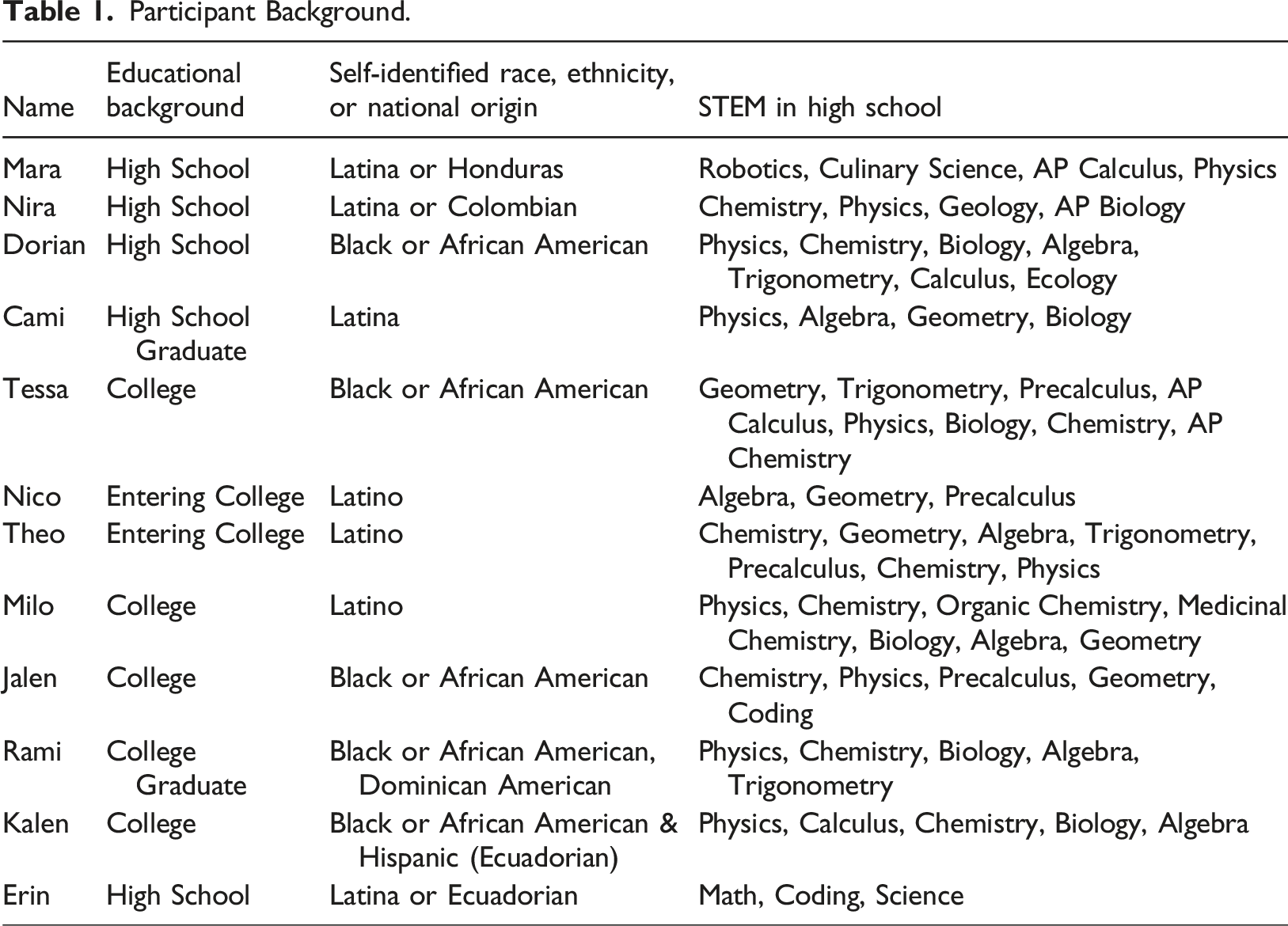
Participant Background.
Data analysis
The researcher identified a few key themes, with the experiences of Students of Color at PWHSs and the impact on their experiences in STEM being the central unit of the study analysis. The researchers established inter-rater reliability to ensure trustworthiness of the study. Inter-rater reliability was assessed through MAXQDA at 81%, of which 80% was the minimum requirement. Furthermore, to ensure trustworthiness of the findings, the researchers engaged in member checking and continuous debriefing throughout the data analysis phase. Three cycles of coding were completed. To analyze the data, the researchers utilized the following steps. First, the researchers transcribed the interviews using a transcription software and field notes were typed up and organized. Then, the researchers began coding the data with open coding and then transitioned to looking at themes across the data. The researchers created a codebook that was created at the beginning of the data analysis portion of the study. The codebook was continually modified throughout the course of the study using a constant comparative process. The researchers also used the concepts of CCW to analyze the participants’ experiences. The data was coded based on a few broader categories derived from CCW: (1) linguistic capital, (2) aspirational capital, (3) familial capital, (4) social capital, (5) navigational capital, and (6) resistant capital. The researchers refined the codes through an iterative process and focused on the participants’ experience at PWHSs and the impact on their experience in STEM. Afterwards, this was compared across the interviews, field notes, and documents which resulted in the themes that emerged.
Positionality statement
Our experiences and backgrounds inform our approach to research. Our identities are significant in our research (Milner IV, 2007). We believe that our experiences are assets to our research and not deficits. Both authors identify as Students of Color, specifically Asian Americans. They are both cisgender females. The first author is a first-generation immigrant from South Korea. Her educational journey was marked by challenges stemming from systemic barriers, cultural nuances, and language barriers. She struggled in school, in particular STEM courses, which were often isolating and difficult spaces to navigate. She also attended a PWHS, where she felt culturally alienated and pressured to assimilate. These experiences formed the basis of this inquiry and hope to highlight the many assets that Students of Color bring to STEM spaces.
The second author, currently a doctoral student in Education, became interested in supporting Students of Color in STEM due to her personal journey of aspiring to pursue a medical career during high school. However, she ultimately abandoned these aspirations after encountering challenges in college-level math and science gatekeeping courses. Despite growing up in racially diverse communities and schools, her experience as an Asian American female in a predominantly White STEM educational environment sparked numerous questions about educational contexts and student outcomes. Her lived experiences enabled her to establish rapport with research participants and understand the nuanced racialized barriers they may encounter in STEM. Additionally, she recognized the diverse range of cultural assets that these students draw upon to achieve success. Her personal experiences largely shaped her perception of the world, the framing of the study, and the interpretation of data.
Findings
Students of Color bring many different types of assets to their academic journeys and STEM experiences. Their skills, communities, and perspectives provide a rich foundation that they utilize for their academic success, despite facing immense systemic barriers. In our data analysis, we utilized the tenets of CCW to guide our understanding of students’ experiences. Additionally, we used a priori codes within each CCW theme. Themes and codes emerged through an iterative coding process. The most relevant assets and themes that emerged were aspirational, familial, social, and navigational capitals. Although we utilize CCW in our data analysis, the capitals and skills that students use overlap and are not mutually exclusive to each specific capital. This means that some things the participants shared could be double-coded as multiple capitals, such as navigational and familial capital. In particular, we found that navigational and social capital had many overlapping codes, as well as familial and aspirational capital. Additionally, Students of Color referenced both academic achievement and STEM success interchangeably. The study focuses on the participants’ STEM experiences at PWHSs.
Aspirational
Participants reported several aspirational capitals motivated them to succeed academically and pursue STEM. According to Yosso (2005), aspirational capital is defined as “the ability to maintain hopes and dreams for the future, even in the face of real and perceived barriers” (p. 77). The data analysis revealed that students drew upon various aspirations, including seeking social mobility and encouragement through role models. This code was also interrelated with familial capital, as many participants shared that their families were a source of their aspirations.
Social mobility
Many students shared that their desire for social mobility motivated them to succeed academically and pursue STEM. Specifically, as students came from low-income backgrounds, their parents taught them that a college education, especially a STEM degree, would help increase their social mobility and reap greater benefits in life. Frequently, these advantages were compared to the notion that they have the ability and responsibility to attain higher earnings than their parents. While students referred to their low socioeconomic status as one of the barriers in their lives, it often served as a driving force to achieve social mobility. For example, Christopher, a Latinx student shared, Because my parents have always stressed education. Because we didn't have a lot when we moved to this country. And it's just always been something that they tried to instill in me so that I can come out of college with a degree and have a better career for myself than they would have been able to have moving here. And I know that without college, I would basically be stuck in the same situation. So it's kind of something that I know I need to get through.
Several participants shared that their parents’ struggles served as a vehicle for educational aspiration. Although participants’ parents might not have received a college degree or formal U.S. education, they had high expectations for their children and motivated them to imagine a successful future beyond their present circumstances. For example, when asked what motivates him to succeed academically, Joshua, a Dominican student, recounted how his difficult upbringing and his parents’ emphasis on resilience shaped his strong commitment to seeking a promising future. I’m just driven, like I refuse to fail. Well, I grew up really poor. I had no clothes, no food. So for me, failure is not an option. My parents raised me with that mentality. I learned that and I refuse to give up simply because I get that. You give up like, you lost. Like there's no coming back; it's so difficult to come back.
Additionally, Students of Color in this study were keenly aware of the deficit perceptions that underestimated their academic potential. Rather than allowing these perspectives and current situations to discourage them from achieving their goals, students in this study were determined to overcome barriers, placing value on the possibility of their educational outcomes. Notably, Jack described that his family’s prioritization of education inspired him to work hard, despite challenges. These examples demonstrate that Students of Color are not discouraged from deficit perspectives or present economic challenges. Instead, students can use these barriers as motivation to achieve academic success and, in turn, positively impact their future economic circumstances.
Role models
Participants in this study reported that role models motivated them to pursue STEM-related careers. Notably, students acknowledged finding people with similar racial backgrounds in STEM was difficult. Consequently, seeing someone of color succeed in a STEM-related career inspired them to develop and maintain their aspirations to pursue STEM fields. For example, Jessica pointed out that despite the racial obstacles Latinas face in STEM fields, she finds inspiration in observing other Latinas pursuing successful careers in STEM. This motivates her to work even harder to achieve her STEM-related aspirations. Well, if we look at Latinas, if we were to search, there's barely a lot of Latinas who have gotten into the STEM field. But seeing the females who have [gotten into the STEM field] just motivates me into wanting to be like them. No matter what anyone thinks, you can do it. It’s just a matter of pushing yourself and not just doing whatever the school tells you…Like seeing females do it means that I can also do it if I try hard.
Jessica added that she recognized her role models’ challenges and felt connected with them as individuals from Communities of Color. By witnessing others’ success and dedication, students felt encouraged to pursue their own goals in STEM.
Similarly, others shared that exposure to individuals with comparable backgrounds in STEM fields helped reframe their setbacks as opportunities for growth. These experiences indicate that having a relatable role model can inspire Students of Color, empowering them to perceive STEM careers as viable options and imagine themselves in those roles.
Familial capital
Many of the participants also shared about the assets of their family background. In CCW, familial capital is defined as “cultural knowledge nurtured among familia (kin) that carry a sense of community history, memory, and cultural intuition.” (Yosso, pg. 79, 2005). Through our data analysis, the sub-themes of family encouragement and family resources emerged as important factors of students’ familial capital. Participants described the different types of encouragement they received from their families, such as descriptions of family encouragement to pursue STEM or academics. Participants also described the different types of resources their families offered, such as descriptions of the family’s resources, monetary or not, to pursue academics and STEM. These two sub-themes highlight the importance of familial capital, and the ways family was a valuable asset to the success of Students of Color. As previously, mentioned, families often were a source of the student’s aspirations.
Family encouragement
Participants shared about the family encouragement they received to pursue their academic and career goals. Parents provided encouragement and support in pursuing STEM career options and academics. For example Sarah, an Ecuadorian student, shares: My parent’s support and also teacher's support have made me do better. Because my mom’s always telling me how STEM is the future. So I should try applying to STEM programs. So that really helped me like, ‘Oh, I should push forward.’
Additionally, parents provided advice and guidance in career choices, academics, and the college admission process. Overall, it was clear that all the families of the participants valued education and hard work and emphasized this to the students. Oftentimes, families of color are depicted as not “valuing” education, but the data from our interviews show otherwise. Similar to aspirational capital, families stressed the importance of being academically successful. Some parents who had existing background knowledge were able to provide guided support to students in their academics. This guided support was helpful for students to reach their goals successfully. For example, Michael, an African American student, shares that his father was very supportive of his STEM progress and journey. It was also clear that extended families played a role in supporting and guiding students in their academic pursuits. Four of the participants shared that extended family members were provided important support and advice in their academics.
Family resources
Families provided resources for their students in a few different ways, such as bilingual skills, their existing knowledge of STEM, their career occupations providing insider knowledge, and enrolling students in outside enrichment programs. These resources helped benefit the students academically. One resource was the family’s linguistic abilities and knowledge of multiple languages. This was beneficial because it gave students additional tools for communication. Additionally, understanding multiple languages can allow for greater depth and understanding of concepts that are not fully communicated in one and elaborated further with the other. For example, Sarah, an Ecuadorian student, shares how being bilingual benefitted her experience in STEM by allowing her to utilize two languages to better understand STEM ideas: So I think being bilingual is so like, I’m so lucky that I do have parents who have enforced this Spanish on me, because I have some, like, I’ve known people whose parents speak English to them. So they’re just like, they just don’t know Spanish at all. So I think the fact that my parents have spoken to me in Spanish, like forever, I mean my skills, I’m not gonna say like I'm the best at Spanish, but I understand it and I can speak it pretty well. So I think that’s really helped me, especially in terms of STEM. I'd say, I feel like I can help communicate better. Because I feel like it makes me see my ideas [in STEM] differently.
Additionally, another family resource was their existing knowledge of STEM. This was helpful for students to understand the importance of STEM and want to pursue STEM as a future career option. Family members’ career occupations were also a helpful resource for students to understand how to navigate different academic contexts. For example, Michael’s father had a career in mathematics and therefore he was able to provide additional help with mathematical concepts and tutoring so that he was successful in that subject. Additionally, Amanda’s uncle was a teacher and could provide advice on how to navigate the school system and determine which courses were the most appropriate to take.
Lastly, another family resource was the understanding to enroll students in outside enrichment programs. All the students shared that outside enrichment programs were a helpful resource that helped motivate or provide additional skills so that they could be successful academically. For example, James, an African American student, shares: My parents more specifically put me in programs that they knew would benefit me and be around individuals where it would be beneficial later on, was the key factor. You know, I used to literally hate coming back from school, and have my dad make me do math books on top of the homework I was already doing at school. I used to hate it until I realized like, I’m like, wow I’m a little ahead of what everyone else is doing to the point where it’s just like, you gotta work hard.
Students of Color expressed the benefits of having parents who understood and provided opportunities outside of school for them to improve academically or increase their interest in STEM.
Social capital
The student participants described the social capital assets they utilized to be successful in their academics and STEM. In CCW, social capital is defined as “networks of people and community resources. These peer and other social contacts can provide both instrumental and emotional support to navigate through society’s institutions.” (Yosso, pg. 79, 2005). Through the data analysis process, some relevant sub-themes emerged. These sub-themes are outside resources, school members, friends, and the similarities shared with their networks. Outside resources are defined as descriptions of the participants’ support from outside resources. School members are defined as descriptions of the participants’ support from school members such as teachers, counselors, admin, etc. Friends are defined as descriptions of the participants’ support from peers. Similarity is defined as descriptions of the participant referring to receiving support from people with similar backgrounds or someone they can relate to. These three groups of networks were frequently cited by student participants as sources of support and strength in their academic trajectories. Throughout these groups, participants also described the similarities they shared with these groups and the ways that this was helpful for them to meet their academic goals. Social capital often overlapped with codes for navigational capital, as participants’ social networks often provided information and resources to navigate PWHSs and STEM contexts.
Outside resources
Students described the support they received from outside programs, such as after-school or other college programs. These programs provided additional resources, such as scholarships or tutoring. They also provided workshops or classes with interesting content, such as frog dissections or computer science coding. This content helped students feel more interested and connected to STEM subjects. Additionally, the outside programs provided support and advice for students’ academic success. They also provided college application support and helped connect students to other individuals such as directors of programs. For example, Jennifer, a Colombian student, shares: So that was definitely dope, the experiences as well that the afterschool program got you in. For example, the trips or the people you got to talk to and the connections that you make. For example, right now they’re really about to help me a lot with, um, I don’t know if you’re familiar with Rock University. But they have a really, really close connection to one of the program managers there. So they’re basically trying to get me into the program. Basically, this is a full ride but it’s really hard to get in. But because of the connection, for example, I have a little bit more of an advantage.
The outside programs seemed very impactful in students’ academic careers and were impactful in their STEM experiences. Students knew to navigate these outside programs as a tool and additional resource for their educational growth.
School members
Students described the social capital they received from school members, specifically teachers. Teachers provided social capital to students in a few different ways. They connected with students individually and helped them connect to STEM subjects. Additionally, they provided academic support through avenues such as tutoring or support with difficult content. They also encouraged students to pursue STEM or more difficult subjects. For example, Jessica shares: My robotics teacher, he recommended me to do like he said you should probably take computer science AP, and because he saw how much I enjoyed doing robotics, and it’s come much, like work hard in order to find solutions to coding and getting my robot to work in that class. And just my teachers in school, I constantly tell them about everything I’m doing outside of school and how I continue to pursue STEM learning and they feel proud of me and they also say, ‘Oh, you should take this class because it helps you out’ or when they see I’m not doing good in a class or you can do is like they’re really motivating in that sense.
Teachers also opened doors for students that they might not have otherwise been able to access themselves. Teachers were a large part of the students’ social networks and capital.
Friends
Participants shared about the ways their friends were a source of support and capital in their academic journeys. Students shared about finding friends where they were like-minded or had similar interests or goals. Students of Color also described the importance of shared cultural backgrounds. These friend groups provided great support to the participants by providing networking opportunities, academic support, sharing advice, etc. For example, Robert, an African American student, shared that he obtained an internship due to his friend sharing information with him. Many participants described their friends as important supporters in their academic trajectories, even offering important opportunities and areas of growth. Students of Colors’ friends were impactful and helpful for students to attain their goals.
Similarity
Throughout these different types of social capital, the participants discussed how sharing similar experiences with their friends and other social networks was an important part of succeeding in educational spaces. They described having similar career or subject interests, goals, and racial backgrounds. Specifically, many participants shared that surrounding themselves with others who shared the same goals as them was important to success. For example, James shared: So it was great to be exposed to that. And you see how beneficial it is. Because when people start climbing, if you’re around them, oftentimes where everyone climbs around you, you’re all kind of climbing together. That’s how it works. So you got to be around great people.
They also shared that finding friends with similar racial backgrounds provided them with support, community, safe spaces, and comfort in their educational spaces as well. For example, Ashley, an African American student shared: Luckily, I hung out with other after-school program students, there were two more, there was one that I hung out with, no, there’s three, actually, in my year that I hung out with a lot. So, I think having that community and I met more People of Color throughout the four years, but I think being around People of Color was my safe space for the most part.
Students of Color had an understanding that these similarities were an asset to their educational journeys. They recognized the importance of finding people who would support them in their goals and could understand their racial backgrounds. They successfully used their social capital to succeed in PWIs.
Navigational capital
Participants reported using unique navigational capitals to enhance their skills and interests in STEM. Yosso (2005) defined navigational capital as “skills of maneuvering through social institutions” (p. 80). The findings suggest that Students of Color attending PWHSs navigated their educational and STEM pathways by taking initiative and utilizing online resources. The two sub-themes are different in that taking initiative focuses heavily on individual agency while utilizing online resources refers to how students sought online resources to overcome insufficient institutional support and increase access to STEM spaces.
Taking initiative
Participants in this study actively sought information and opportunities to navigate STEM spaces. As members of racially minoritized groups, participants understood the consequences of being silenced and marginalized throughout their educational trajectories. Students also reported facing challenges in navigating institutions because their parents, who often came from immigrant backgrounds, did not possess the necessary information to assist them. These barriers, however, did not discourage them from accessing opportunities. Instead, students developed a stronger sense of agency to seek resources.
Notably, the majority of students placed the responsibility to learn and find information by themselves since help was not readily available otherwise. A few students admitted the negative consequences of being afraid to ask for help. This strong sense of individual agency was grounded in their belief that resources were accessible as long as they sought them proactively. Students emphasized the need for independent learning and placed the responsibility for learning and finding information on themselves in STEM spaces. For instance, Christopher, a Latinx student, shared an example of how individuals had the autonomy to take charge of their own education and succeed in STEM classes. It's up to you to raise your hand and say, “Hey, I know that it might seem obvious to you, ninth-grade math teacher, because this is based on your experience. But I need you to show me step two, how did you get there?” So it's up to you to do that. It's up to you to go after school and ask your teacher questions. You have to be your own best advocate. They're not gonna go up to you and ask.
Additionally, students’ consistent success in finding help when needed fueled their initiative to find information. For instance, Matthew described the benefits of a non-profit organization for students interested in mathematics: “I felt like I always had someone to ask for help, for any doubts that my school couldn’t help me with.” These successes contributed to students’ increased confidence in their ability to succeed and positive outlook for their future. Students also underscored the importance of relationships to navigate PWHSs and find opportunities in STEM. Networking was a form of information building that gave students greater understanding of how to navigate the system. By taking the initiative to ask questions and seek others for advice, students actively took ownership of their learning and managed to navigate STEM spaces.
Utilizing online resources
The findings suggest that due to insufficient resources and staffing in schools for comprehensive STEM education, students turned to online resources as forms of navigational capital. Specifically, participants discussed that teachers had limited capacity to serve them since they catered to a large number of students. Participants also reported that they felt limited in STEM resources in school and desired greater opportunities to engage in STEM. Consequently, the Internet served as a space for students to navigate and expand their skills and interests in STEM. Students shared that they were more likely to consult the Internet as a resource, in comparison to peers or teachers at PWHSs because of barriers at school, such as lack of teacher availability and ease of information available on the internet.
Students researched online to find information about succeeding in STEM, answers to their questions, or gain exposure to advanced topics beyond what their schools offer. They were eager to learn more about specific STEM subjects and searched for resources catering to their interests, ultimately preparing them to pursue STEM in college. For instance, Christopher, a Latinx student, shared, I always just like to learn about it. If I didn't understand something, I just watched YouTube videos about it. It helped me understand it more and things like that. And then I started to realize, what you can actually do with it.
Through efficient utilization of online resources, students gained access to a wide range of information, enabling them to learn faster than traditional in-school methods. Matthew shared “Now you can learn 10 times faster on Google if you use it properly, than if you were studying in school. You know, it’s because there are resources all around you.” Some mentioned that online resources were valuable alternatives for overcoming the knowledge gap because it was easily accessible. Accessibility was important for Students of Color in this study because, as aforementioned, resources were not readily available in their schools or communities. Despite facing challenges, students leveraged online resources as navigational capital to access and expand their potential in STEM fields.
Discussion
Recognizing the cultural assets of students of color
Oftentimes, Students of Color and their communities are portrayed with harmful racial tropes that are deficit-oriented. CCW highlights the assets that Communities of Color use to combat oppression and systemic barriers. Our findings show the many-layered assets that Students of Color bring to their academic experiences and how they were able to successfully pursue STEM subjects. Additionally, the findings show how the various capitals are not static but interconnected and substantiated through their connection, which bolsters its efficacy within the broader CCW framework. Students of Color were able to use aspirational capital to motivate and encourage themselves to continue pursuing their academic goals, despite facing systemic barriers. The need and desire for social mobility was a strong motivation for academic success. Additionally, role models provided guidance and inspiration that the path to STEM success was possible. Families also provided encouragement and resources for Students of Color to reach their academic goals and be successful in STEM. They stressed the importance of education and provided additional resources for students to be successful. Social capital in the form of outside resources, friends, or school members also provided support and assets for Students of Color to successfully navigate academic spaces by providing opportunities and information sharing. Students of Color also discussed the importance of sharing similar goals, interests, and racial backgrounds with their networks. Additionally, Students of Color utilized navigational skills such as taking initiative and utilizing online resources to succeed in STEM classes.
Similar to Fernandez et al. (2023), we see CCW as a liberatory framework that centers the voices and experiences of STEM Students of Color in PWHSs. CCW showcases the ways that STEM Students of Color are empowered to navigate and challenge systemic inequities, which ultimately contribute to their academic success and growth in PWHSs. Their use of social and familial networks rejects individualism and embraces the liberatory ideology to support each other in their pursuit of academic success.
Cultural assets and STEM
Our study highlights the many cultural assets Students of Color bring to their STEM experiences. Few of the existing literature highlight the cultural assets of Students of Color in STEM spaces. Oftentimes, the literature speaks to the barriers and deficiencies of Students of Color to successfully pursue STEM (Jackson et al., 2019). For example, previous research has associated Students of Color with lower academic achievement (Gandara and Contreras, 2009), underrepresentation in STEM fields (Rivers, 2017), and a lack of access to resources (Ong et al., 2011). However, Students of Color clearly utilize many cultural skills and resources to successfully navigate STEM spaces, despite facing systemic barriers. It is important that STEM educational spaces recognize these assets and provide more opportunities for Students of Color to thrive. Many times, solutions in STEM speak to the need for Students of Color to assimilate and conform to the dominant culture (Suarez-Orozco et al., 2008) and develop deficit-based interventions, such as remedial coursework or tracking into lower-level classes (Goffney et al., 2018). However, our study showcases the assets Students of Color possess and the need for the responsibility for change to be placed not on students or their communities, but instead on systems and structures.
Implications
The findings from this study have implications for research, policy, and practice. Regarding research, our study contributes to the limited empirical knowledge on the experiences of Students of Color attending PWHSs, especially pertaining to their STEM experiences. Since the racial composition of schools shapes the experiences and outcomes of Students of Color, future inquiries should examine how educators can empower students to leverage their capital in largely unwelcoming or oppressive environments to succeed academically, particularly in STEM spaces. We encourage further examination of the nuances of each capital found in this study, describing how it manifests and build on one another and how these processes differ according to the school’s racial composition. Additionally, future research should shift away from a deficit perspective focusing on why Students of Color fail to assimilate into school environments to an asset-based perspective highlighting how POC possess various forms of capital to navigate such environments. Such research could include how school members, including teachers, counselors, and principals, perceive students’ cultural capitals and how they support and encourage students to leverage them.
With regard to practice, exploring students’ lived experiences, strengths, and skills that promote their success in STEM, particularly in the context of PWHSs, may help schools identify ways to foster inclusive school environments that allow racially diverse students to thrive. This means schools must embrace a strengths-based perspective that celebrates the diverse experiences, backgrounds, and perspectives of Students of Color. We hope that this understanding will not only expand access to STEM for Students of Color but also create educational environments that are culturally affirming. Educators can also play a pivotal role in fostering aspirational capital amongst Students of Color by providing opportunities for mentorship and exposure to successful role models in STEM fields. By nurturing students’ aspirations, educators can help motivate them to persist in pursuing their STEM goals despite systemic barriers. Educators should also recognize the importance of social and familial networks in supporting Students of Color. Building strong partnerships with families and communities can enhance student access to resources, encouragement, and guidance. This will ultimately foster a more supportive learning environment in PWHSs and STEM spaces.
For PWHSs to create a more inclusive and equitable STEM environment, PWHSs must take intentional steps to address systemic barriers and create opportunities for Students of Color to thrive. For example, our study suggests that PWHSs must be intentional about recruiting and retaining diverse teachers in STEM classrooms who can serve as role models and are committed to promoting students’ success, offering rigorous academic and extracurricular options, and partnering with communities and families of color to build trust and foster meaningful engagement to support Students of Color. By actively valuing and supporting the cultural assets of Students of Color, PWHSs can create a more inclusive and equitable STEM educational environment for all students. Schools and districts can also collaborate with community organizations to leverage external resources and support networks for Students of Color. By fostering strong partnerships with community-based organizations, schools can create comprehensive support systems that address the needs of Students of Color.
Regarding policy, policymakers should consider educational policies and initiatives that reward Communities of Color in STEM education and operate from an assets-based perspective instead of assuming deficits. Policymakers can prioritize initiatives that support the development of social and navigational skills among Students of Color. This includes access to peer support networks, bridge programs, expanded STEM pathways, and online resources that empower Students of Color to navigate academic spaces effectively and build social capital. This can also include policies for culturally responsive curriculum development in STEM and the implementation of inclusive hiring incentives so that STEM educators reflect the diversity of the student population.
Conclusion
It is important that educators fully recognize the cultural assets of Students of Color and the immense skills and resilience that they engage to be successful in STEM spaces. Despite the many challenges and systemic barriers they face, Students of Color truly possess many cultural assets that allow them to resist oppression and find success in predominantly White and STEM spaces. It is important for educators to understand that systemic barriers in STEM academic spaces must be addressed so that Students of Color can thrive. However, oftentimes solutions are conceptualized as individual actions that are burdensome, and the responsibility is placed upon Students of Color and their families. The perception and mindset around Students of Color in STEM need to be shifted to recognize their assets instead of viewing their culture as a detriment to success.
Footnotes
Declaration of conflicting interests
The author(s) declared no potential conflicts of interest with respect to the research, authorship, and/or publication of this article.
Funding
The author(s) received no financial support for the research, authorship, and/or publication of this article.
