



Abstract
This paper examines how the creative power of storytelling through documentary film can contribute to the debate around racism and racial discrimination in Scottish Higher Education using the qualitative approach of filmed interviews with Nigerian migrants studying and working at Higher Education Institutions (HEIs). Using Critical Race Theory for data analysis, I argue that storytelling provides insights into the lived experiences of Nigerian migrants in Scotland at Scottish HEIs. The data collected for this study shows that they are not being supported or heard enough in schools based on their experiences of racism and racial discrimination and the Equality Act 2010 does not offer adequate protection for them.
Introduction
This paper examines how the creative power of storytelling through documentary film can contribute to the debates on racism and racial discrimination in Scottish Higher Education specifically in the cosmopolitan cities of Edinburgh and Glasgow, drawing on data from filmed interviews with Nigerian migrants studying and working at Higher Education Institutions (HEIs). This is a by-product of my ongoing PhD research where I am using documentary film to explore the lived experiences of Nigerian migrants while they are trying to integrate into Scotland. Studies have shown that students of other races who attend culturally diverse mainstream schools with mostly White students face several race-related challenges in their learning environments (Chapman and Bhopal, 2018). Even in a country that promotes its hospitality and inclusivity such as Scotland, adequate provisions for the lived experiences of these challenges however remain rare at HEIs. According to research, racial disputes include physical fighting and bullying which often take the form of name-calling and other macro-aggressive tendencies towards students of colour (Tatum, 2007; Varma-Joshi et al., 2004).
Much research discusses the effect of racism and racial discrimination on migrants’ health and psycho-social wellbeing (Urzúa et al., 2020), while the media reports global racist incidents regularly (Song, 2018). Current research and tactical documents like the Equality Act 2010, intend to protect human rights. Still, substantial inequalities remain in the lives of students and workers of colour in many countries, including Scotland (Kennelly and Mouroutsou, 2020).
Although the Anti-racism in Scotland: Progress Review 2023 details the progress made on commitments within the Race Equality Framework (2016–2030) and the Immediate Priorities Plan (2021–2023) (Scottish Government, 2023), the lived experiences of Nigerian Migrants interviewed show that racism in Scottish HEIs is systemic and not much progress has been made even with the Diversity, Equity and Inclusion agenda championed in most Scottish HEIs.
This paper aims to highlight through storytelling the racial discrimination and racism, specifically causal racism experienced by Nigerian migrants who came to Scotland via the study and work routes. I present data on the experiences of interactions with their peers and colleagues while working and studying at Scottish HEIs. Causal racism here refers to the racism that includes speech and behaviours that treat cultural differences – such as forms of physical features, that is, skin colour or accents – as awkward, manifesting in disapproving glances, exclusionary body language, and marginalising people’s experiences as invalid, including microaggressive ways of questioning people’s intelligence (Banaji et al., 2021).
I argue that Nigerian migrants in Scotland at Scottish HEIs are not being supported or heard enough at their institutions despite the debates around decolonisation and anti-racism discourse in research and teaching, based on their experiences of racism and racial discrimination. To further explore the experiences of Nigerian migrants studying at HEIs, I employ Critical Race Theory (CRT).
CRT in combination with storytelling permits me to recognise and take up race-specific issues and is significant in that it identifies and reveals the indisputable racism and racial discrimination present in Scottish HEIs (Parker and Lynn, 2002). A cursory review of CRT shows that CRT education research has been conducted in Scotland and that these theories are considered beneficial by Scottish anti-racism educators (Arshad, 2018). However, this paper offers a necessary CRT-based analysis of the lived experiences of Nigerian migrants studying as students and working as educators active in the Scottish HEI school environment. I, therefore, aim to contribute to international debates around racism and racial discrimination in HEIs by looking at specific policies around Diversity, Equity and Inclusion and their failures and successes as described in personal stories of lived experiences, as race equity is a crucial aspect of social justice in democratic societies (Kennelly and Mouroutsou, 2020).
After an outline of the Scottish educational context, in what follows I analyse migration in general and the Nigerian migrant experience more specifically within Britain’s colonial history. The following two sections explore existing literature on CRT, institutional and individual racism and the Nigerian migrants’ voice. Next, I present my critical and theoretical approach through arts-based research, which presents us with uniquely rich and affective data and findings. The paper concludes with a discussion of findings highlighting the normalisation of racism and racial discrimination in the lives of Nigerian students and educators in Scotland, which is a country that usually promotes its hospitable and inclusive national cultural identity. I am, therefore, able to indicate a need to address racism and racial discrimination more efficiently and effectively in HEIs, based on the stories shared by participants for this study.
The Scottish educational context
The racial discrimination affecting Nigerian students and workers who migrated out of their home country has been more thoroughly researched in the United States (US) than in the UK (Imoagene, 2017). The UK says it is a more open society yet ‘the door may be only half open to some’ (UK Government, 2021: 7), signalling the inequality at the very roots of the UK system against migrants who come here for work or study.
Like in the United States of America, Nigerians are the most educated immigrant group in the United Kingdom (Asekun and Arogundade, 2017). The migration of Nigerians alongside other Black Africans into the UK is, according to a 2021 report by the Commission on Race and Ethnic Disparities: The Report (UK Government, 2021), helping to gradually close the inequalities gap in education by what the report describes as ‘immigrant optimism’ among Black Africans. Immigrant optimism is described as: ‘a phenomenon where recent immigrants devote themselves more to education than the native population because they lack financial capital and see education as a way out of poverty’ (p. 32). On top of that, a 2023 report by the Equality and Human Rights Commission (EHRC) indicates that the education attainment by African, Black, and Caribbean pupils has improved faster than all other ethnic groups between 2011/12 and 2020/21. Over this period, the proportion of pupils passing at SCQF Level 6 or above increased by 20.6 percentage points to 83.7% in 2020/21. Also, the majority of school leavers who were in education, training or employment 3 months after leaving school in 2020/21 were among the African, Black, and Caribbean ethnic group at 98.8%. In 2021, Black Africans aged 16 and over were more likely at 55.1% to have a university or professional degree than any other ethnic group (EHRC, 2023).
Generally in the UK, Black African parents place a higher value on education. Hence, they give strong parental support to their children to help them succeed in school (Demie, 2021; Demie and Mclean, 2007). Likewise, a recent study shows that among the largest ethnic groups sitting for high school national examinations in the United Kingdom, Black African students did well, better than the national averages for students achieving 5 or more A*-C including English and Maths (DfES, 2003).
Equally, migrants and migration positively impact Scotland’s economy, labour market, public services, communities, and culture. The positive influence and impact of economic migrants, students, and those accompanying or joining family members have been experienced differently in Scotland from the rest of the UK (Scottish Government, 2024). Migrants to Scotland tend to be young and economically active, and they generally arrive with qualifications, which gives them the potential to complement the stock of human capital in the host country (De Lima and Wright, 2009). However, qualifications are often not fully recognised or utilised in host countries and some migrants with higher level qualifications are working in jobs of low skill and minimum wage incomes (Bell et al., 2014). For Scottish employers, migrants are a flexible source of labour to be drawn on when the economy is strong, or when labour demand exceeds local supply. In the large rural areas in Scotland, agriculture is where migrant workers form an important workforce (Cheape, 1983). International evidence shows that skilled migrants can boost innovation, stimulate economic growth, and encourage the local labour force to invest in training to take on and specialise in jobs in which the nation or region has a comparative advantage (Bell et al., 2014). Indeed, Scotland has been reliant on migrant labour to fill up vacancies in the healthcare sector (Dustmann and Frattini, 2011). As at September 2023, 20.4% of workers in the NHS were non-UK nationals meaning one in five NHS staff in England are non-UK nationals (Baker, 2023). Likewise, children of migrants have contributed significantly to Scotland’s thriving arts and sports sectors. While some have represented Scotland in international sports tournaments, others have showcased their talents in acting. These contributions to all sectors of culture and society in Scotland are therefore recognised and acknowledged, but their full potential is not achieved.
Top sending countries for international students to UK HE Institutions in 2022/23.
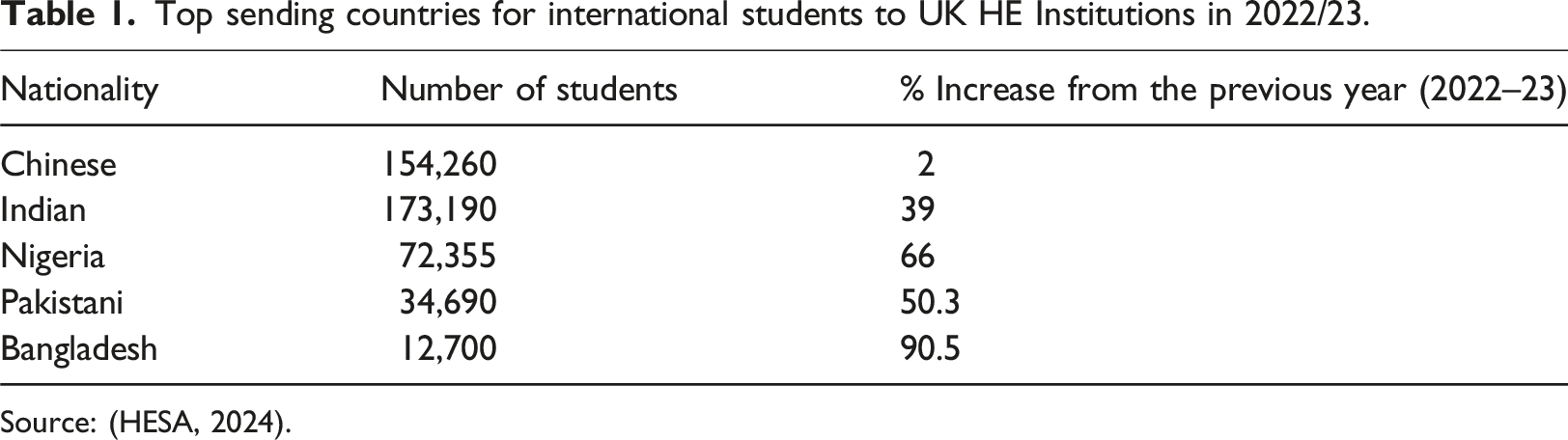
Source: (HESA, 2024).
The Scottish Government is clear that there is no place for racism or discrimination within its schools, further and higher education institutions, as stated in a report by Education Scotland (Education Scotland, 2021) and the 2023 Anti-Racism Report by the Scottish Government (Scottish Government, 2023). Inclusion, diversity, and equality have been core policies that underpin education and learning in Scotland.
Yet, the reality of Nigerian migrants living in Scotland interviewed for this study shows that what is written as a policy is different from what they experience at HEIs. Year-on-year, Scottish HEIs are promoted to Nigerians in the cities of Lagos and Abuja through recruitment fairs like SI-UK (SI-UK, 2024) through the British Council. It is one of the reasons Nigerians come to Scotland to study in addition to colonial ties to Britain and the earliest exploration of Scottish missionaries in South-Eastern Nigeria (this will be further explained later in this paper). Reports have shown that Scottish HEIs depend on international students for funding their activities. International postgraduate tuition fees vary from £9000–£30,000 yearly while international undergraduate tuition fees vary from £11,400–£38,000 yearly (British Council, 2024). This fee is on top of the cost of living and the limitations on allowances for work. A report by BBC Scotland stated that a drop in the number of international students could put Scotland’s education sector under serious financial pressure as finances for the free tuition for Scottish undergraduates is made possible by the financial contribution of overseas students (BBC, 2024).
However, a 2020 report by the UK’s Equality and Human Rights Commission (ERC, 2020) shows that racial harassment is a common experience for a wide range of students and staff at universities across England, Scotland, and Wales. According to the report, 24% of students from an ethnic minority background have experienced racial harassment since starting their course. 20% of students have been physically attacked while 56% of students who have been racially harassed have experienced racist name-calling, insults, and jokes. Other common discriminatory practices they have experienced include subtle and nuanced acts, being ignored or excluded from conversations or group activities (p. 6).
Also, the perceived absence of racism in Scotland has been entrenched in public discourse and political rhetoric in the country (Braber, 2012). This contrasts with England, where racist language still permeates society and racism is certainly recognised and discussed in the public sphere, and where new immigration laws increasingly clamp down on the number of migrants coming into Britain. Furthermore, the term ‘New Scots’ has been used by elite Scottish politicians to describe migrants and their descendants who are born and raised in Scotland (Neil et al., 2018).
However, the danger of the perceived absence of racism in Scotland would mean not taking at face value the lived experiences of Black African migrants, which comes with the risk of underestimating the contemporary struggle against racism by Migrants and ‘New Scots’ (Devine and McCarthy, 2018; McCollum et al., 2018). Studies have shown that racism is a daily occurrence in Scotland as there are New Scots known as the ‘black and brown Scots’ who live the reality of racialised minorities (Devine and McCarthy, 2018). From racist harassment in the community to systematic discrimination in the workplace, these ‘New Scots’ are still perceived as not Scottish at all or not enough (Adogame and Lawrence, 2014). Despite its progressive transformations in Diversity, Equity and Inclusion instituted via the Equality Act, the fact remains that racism exists at all levels of Scottish culture and society (Neil et al., 2018). To show its commitment to migrants’ and refugees’ integration, the Scottish Government has released a revised version of the New Scots Strategy (Scottish Government, 2024). It is part of the government’s drive for a fair and equal Scotland, where people’s rights are respected and protected, and everyone is empowered to reach their full potential. With this strategy, the Scottish Government is taking a multi-directional approach to the integration of refugees and migrants by making integration work not only on New Scots or the communities where they live but also on institutions such as schools, and healthcare providers.
So, Black African students have experienced racism in many forms, including covert acts of racial discrimination that are nuanced or go unnoticed and unacknowledged by offenders at HEIs (Williams, 2020). These covert acts have been described as microaggressions by African-American psychiatrist Chester Pierce (Williams, 2020). Pierce (1974) defined microaggressions as ‘black-white racial interactions […] characterised by white put-downs, done in an automatic, preconscious, or unconscious fashion’ (p. 515 in Clark et al., 2014). Similarly, Sue et al. (2007) described racial microaggression as momentary and ordinary verbal, behavioural, and environmental indignities with damaging cumulative psychological effects on people of colour.
Contemporary forms of racial microaggressions are subtle, indirect and often invisible to perpetrators (Neville et al., 2012). Sue et al. (2008) explained that ‘Racial microaggressions are similar to unconscious racism, but they are broader, describe a dynamic interplay between perpetrator and recipient, and focus primarily on their everyday active manifestations’ (p. 329). Black African students and educators who are studying or working at Scottish HEIs are not exempt from these microaggressions as they have experienced microinsults, microinvalidations, and microassaults while carrying out their duties. Sue et al. (2007) observed that microinsults manifest in subtle communication that transmits insensitive and demeaning ideas about people of colour. Microinvalidations nullify and minimise visible minorities’ thoughts, feelings, and lived experiences. They describe microassaults as overt manifestations of racial microaggressions.
From the preceding explanations, the main question remains, are (Scottish) HEIs doing enough for efficient integration of African students into their environment, and what are the discrepancies between the policy discourse and the lived experiences of Nigerian students and staff working at Scottish HEIs?
Defining Nigerian Migrants and British colonial history
The global migration of Nigerians dates to the pre-colonial era and began with the Hausa transnational trade that can be traced to the trans-Saharan trade between the fourteenth and sixteenth centuries (Akinrinade and Ogen, 2011). But it was the trans-Atlantic slave trade, that marked the most significant milestone in the forced movement of Nigerians to the New World. The colonial era witnessed extensive labour migration needed for plantations, mines and public administration from Nigeria (Adepoju, 2005). Also, during this period, Nigerians migrated to the United Kingdom mainly for higher education. Some of these migrants decided to stay in Britain after their studies, although often the original plan was for them to return to Nigeria and assume official positions left by the departing British colonial administration (Hernandez-Coss et al., 2006). Civil and political unrest in Nigeria in the 1960s, and the collapse of the oil boom in the 1980s, led to a large number of refugees and skilled workers migrating to the UK (Akinrinade and Ogen, 2011).
Similarly, Scotland played a role in the British-Nigerian colonial history. In 1846 a Scottish-sponsored Presbyterian mission landed in Calabar, present-day south-eastern Nigeria. Calabar had been West Africa’s busiest slave embarkation point (Taylor, 1985). Through the traditional rulers in the region, the missionaries began educational and community service, with educational curricula containing commercial and industrial subjects as well as the classic Bible and literary studies (Taylor, 1985). While in Calabar, the Scots pioneered European-styled education in eastern Nigeria and they were practically all Presbyterians, sponsored by the kirk. The Scottish culture of the missionaries was as characteristic of their work as was their Knoxian church tradition. While the focus of the Scottish missionary was to teach the Bible, there was an indication of a commitment to the educational, social, and economic development of the region as well as to the spiritual growth of the inhabitants (Ayandele, 1966).
Paradoxically, the economic prosperity trumped by the Scottish missionaries appears to have eluded Nigeria as the economic challenges persist. Recently, the poor economic situation in Nigeria forced Nigerians to seek better economic opportunities abroad via the study or work route, with most of them moving to the UK, thus making Nigeria one of the top sending countries for study in the UK (Asekun and Arogundade, 2017). The ongoing high inflation rates occasioned by the poor economic policies of the Nigerian Federal Government, removal of fuel subsidies and insecurity – specifically kidnapping in the north and more recently in the south – are forcing middle-class Nigerians to migrate to countries like the United Kingdom, Spain, the Netherlands, Germany, and the United States of America (Imoagene, 2017).
Therefore, the experiences of Nigerian immigrants in Scotland are worth researching because their experiences are a substantial part of the immigration story of Britain, Scotland inclusive (Imoagene, 2017). In Scotland, Nigeria ranks fourth – after Poland, the Republic of Ireland and Italy as the most common non-British nationalities in Scotland in 2020 (National Records of Scotland, 2021). An annual population survey shows that in 2017 there were 10,000 Nigerians in Scotland and the number is growing year-on-year (Scotland, 2017). As of 2021, 17,000 Nigerians were living in Scotland according to a report by Statista and National Records of Scotland (National Records of Scotland, 2021; Statista, 2021). Scotland is promoting itself as a hospitable and welcoming country to migrants, and doing so sets it apart from England within the UK, so it is interesting to get qualitative data on the lived experiences of Nigerian migrants and compare them to official quantitative data. Internationally, Scotland has a strong global identity situated in relationships and individuals’ connections. It has a strong reputation as a welcoming place to live and work, study, visit, and do business (Scottish Government, 2024). In addition, there are an estimated 40 million people or more globally who consider themselves to be of Scottish heritage (Scottish Government, 2023).
Migrants are described here as individuals who leave their country of usual residence, whether within a country or across an international border, temporarily or permanently for different reasons; either economic or otherwise (International Organization for Migration, 2019). At the international level, there is no universally accepted definition of migrant. However, the definition used here was previously used by The International Organisation for Migration. The term includes several well-defined legal categories of people, such as migrant workers, as well as those whose status or means of movement are not specifically defined under international law, such as international students (International Organization for Migration, 2019).
Research on migration movements reveals that the twenty-first century will be the century of the migrant (IOM, 2010; WHO, 2015) and there were more regional and international migrants than ever recorded in history. Currently, there are over 1 billion migrants, and this figure is expected to rise as people migrate because of increasing environmental, economic, and political instability (The United Nations Human Development Report, 2009). One could infer from these reports that migration is inevitable in the coming years and decades. In addition, in the UK over the past 25 years, African immigrants have become the most rapidly growing segment of the black population, overtaking Caribbeans – even though the Caribbeans have been in the UK a generation longer than Africans (Coleman and Salt, 1991). It is noteworthy that migration pattern suggests the UK ranks seventh among the top destination countries Nigerians apply for asylum (World Data, 2021). Nigeria is among the top 10 countries for female asylum applicants in the third quarter of 2022 and is one of two countries with the highest number of female applicants, with females constituting 54% of the total applications made by Nigerians (Ajayi, 2023).
Conceptualising racism and racial discrimination: Critical race theory (CRT) approach
As a term, race has been described by proponents of Critical Race Theory as a social construct (Kennelly and Mouroutsou, 2020). It is often connected to the idea that people can be divided into diverse groups based on physical features they seemingly share such as skin colour and eye shape (Manglitz et al., 2006). Therefore, it has been defined based on society’s identification of ancestry, appearance, and ethnicity: a societal process called ‘racial formation’ (Lopez, 1994: 24). For this reason, some critics (Miles, 1993) put race in inverted commas suggesting erroneously that it is non-existent, perhaps in the same way that it is dishonest to claim to be ‘colour-blind’ when it comes to race.
Although socially constructed, race exists (Ladson-Billings, 2013). The classification of persons into race has created hierarchy and White privilege. Advocates of Critical Race recognise the existence of socially constructed race groups, and the suppression connected to being classified by White prevailing culture as ‘non-White’ (Kohli, 2009; Ladson-Billings, 2013).
CRT pioneers such as Bell (1988) and Delgado (1989) argued that racism should not be regarded as actions of individual discrimination that can be eradicated easily. Rather, it is a prevalent aspect of life, entrenched through historical consciousness and ideological choices about race, which in turn has directly impacted some country’s legal systems and the ways people think about the law, racial categories, and privilege (Harris, 1993).
CRT theorists like Gillborn (2006) argue that in the past few decades, CRT research mostly focused on the US although some researchers are currently encouraging the framework in the UK as essential to promoting anti-racism. CRT has been considered as a framework by Arshad (2018) in Scotland and proposed by Valdelièvre of the Scotland Trade Union Council (STUC) Black Workers’ Committee for future research (Kennelly and Mouroutsou, 2020).
CRT finds its root in the assertion that society is deeply racially classified and unequal. Therefore, the process of power methodically marginalises racially oppressed people (Hylton, 2012). Traditionally, educational research has ignored historically marginalised groups by simply not addressing their concerns, or de-emphasized race by arguing that the problems minority students experience in schools can be understood via class or gender analyses that do not fully take race, culture, language, and immigrant status into account (McCarthy, 1993).
Research shows that racism does not exist in unusual or fixed forms (Nazroo et al., 2020). Controlled systems of domination and racism steeped in history and politics, racisms work to discriminate against disenfranchised groups, based on professed physical and cultural differences (Golash-Boza, 2016). It has been conceptualised as a bias that includes hostile emotional reactions to members of a specific group, acceptance of negative stereotypes, and racial discrimination against individuals, which could lead to violence in selected circumstances. Golash-Boza (2016) states that racism encompasses a philosophy where physical dissimilarity is connected to cultural and social differences, thus permitting people to be positioned on a hierarchal scale. This thinking enables the relegation of those considered to be inferior.
Emirbayer and Desmond (2015) argue that racisms predominantly function as part of a broader scheme of racialisation, in which a collective of racial attitudes are determined and given meaning within racial classes. Similarly, Omi and Winant (1994) theorise that advanced societies are deeply enveloped in race thinking, to such an extent that racial formations and categorisation are integral to their organisation and regulation. Furthermore, Song (2014) proposed that racism should be viewed as a specific form of racialisation. She based her argument on the proposition by Omi and Winant (1994), and states that racism exists not just where race is summoned or represented, but where ‘it creates or reproduces structures of domination based on essentialist categories of race’ (Song, 2014: 113), thus moving racism beyond the realm of discourse and into the lived experience (including microaggressions).
Jones (2000) developed a framework for understanding racism on three levels: institutionalised racism, personally mediated racism, and internalised racism. Jones defines institutionalised racism as disparity in access to the goods, services, and opportunities of society based on race. Institutionalised racism is normative and structural, having been systemised into institutions of custom, practice, and law, without a recognisable perpetrator. Similarly, Nazroo et al. (2020) argue that institutional measures are burdened with racialised connotations and associated emotional content.
Personally mediated racism, Jones (2000) describes as prejudice and discrimination, where prejudice means disparate assumptions about the capabilities and intent of others, according to their race. Discrimination means disparate actions toward others. Personally mediated racism can be deliberate as well as unintended and is revealed in actions such as a ‘lack of respect, suspicion, standing when there are empty seats on public transportation, devaluation, that is, surprise at competence and dehumanisation’ (p. 1213).
Internalised racism Jones (2000) defines as a recognition by races that are discriminated against of negative messages about their own abilities and inherent worth. It is typified by their inability to believe in others who look like them or themselves. They would normally accept limitations to their own full humanity, including their right to self-determination. ‘It manifests as an embracing of “whiteness” (use of hair straighteners and bleaching creams, stratification by skin tone within communities of colour; self-devaluation (racial slurs, rejection of ancestral culture); and resignation, helplessness, and hopelessness (dropping out of school)’ (Jones, 2000: 1213).
Studies have revealed that the frequency of racism and racial discrimination has remained persistent over time (Karlsen and Nazroo, 2002). Discrimination has been defined as the differential treatment of different age, gender, racial, ethnic, religious, national, ability identity, sexual orientation, socioeconomic, and other groups at the individual level and the institutional or structural levels (Bastos et al., 2010). Discrimination is usually the behavioural manifestation of prejudice and involves negative, hostile, and dangerous treatment of rejected group members.
What is really interesting here is that ‘voicing’, storytelling and counter-storytelling, are accepted and established methods in CRT (Hylton, 2012). One of the goals of CRT is ‘to present storytelling and narratives as valid approaches through which to examine race and racism in the law and in society’ (Parker and Lynn, 2002: 10). In this study, I aim to bring together the power of storytelling in film and documentary, with the use of storytelling in CRT, firmly rooted in the standpoint that race and racism exist and that the lived experiences of those at the receiving end of it in education is valid and can inform a renewed approach to discourse and policy. Where CRT narratives about racism and racial discrimination offer the basis for much-existing research, I posit that using film narratives can achieve a higher viewership and more effective (and affective) responses, which may, in turn, inform discourse and policy at HEIs in a more holistic manner.
Method of data collection
This study used the evocative and creative power of filmed interviews for data collection because film and video have been used in qualitative research as tools for data collection tools, as a means of dialogue between the researcher and participants, and as a means for sharing research results (Shrum and Duque, 2008). Research suggests that narratives are easier to comprehend, and audiences find them more engaging than traditional logical-scientific communication (Dahlstrom, 2014). The emotive power of film enables research participants to tell their own stories as they see them and ‘images on the screen have a validity, a weight of their own in a way that words do not’ (Cooper and Dancyger, 2013: 17). Storytelling finds its roots in the narrative tradition, and film is a creative way to visually convey messages and remains an effective and affective tool for engaging audiences (Walker and Boyer, 2018).
Storytelling as a methodology is well suited to explore the lived experiences of Nigerian migrants in HEIs in Scotland and enable me to dig deeper into issues beyond what resides on the surface. As a universal language, stories allow researchers to examine aspects of the human consciousness, discover the meaning of human reality and appraise everyone’s function within it (Rooney et al., 2016). Using storytelling also allows me to investigate the constructed meanings of social reality in the present but as they relate to the past offering exceptional insights into the behaviours and perceptions of Nigerian migrants in Scotland (Bennett and Detzner, 1997).
Using documentary film as research through storytelling entails researchers and participants collaborating with professional filmmakers to record participants in their social context (Parr, 2007; Slutskaya et al., 2018). The social context here deals with the lived experiences of Nigerian migrants as they relate to work and study while trying to settle in Scotland, and quantitative methods are not likely to provide the depth needed to examine these (Cohen et al., 2011). I worked collaboratively with participants, including those who wished to be anonymised or not engage in their own filmmaking, to enable them to achieve a storytelling aspect and narrativize their experiences. This enabled them to take part in the knowledge generation process.
And so, in my view, documentary film is a generative tool in scholarly research that enables participants to narrate life experiences through the democratisation of collaboration and shed light on issues around social justice and inequities in public education (Friend and Caruthers, 2016). Using film in research enables me to capture the authentic voices and lived experiences of the experiences of participants and it is a powerful way to advocate for democracy in education that can be utilised to bring to light existing inequities (Friend and Militello, 2015).
A qualitative approach like a film that lends itself to storytelling is most appropriate for this research. As Delgado (1989) asserts the White majority should be interested in these ‘stories’ because it is only by listening to [watching] these stories could the attitude of seeing the world from one standpoint be challenged and ‘one can acquire the ability to see the world through others’ eyes’ (p. 2439). Additionally, I agree with Manglitz et al. (2006) that it is important to legitimise stories about discrimination from the perspective of people of colour. The stories of victims of racism are useful under CRT because their experiences are real and show how the past is connected to the present and expose how the hierarchical relationships of power protect the legal interest of Whites over persons of colour (Parker and Lynn, 2002; Williams, 1991).
This study interviewed Nigerian migrants living in Edinburgh and Glasgow who came to Scotland through study and work visa routes between 2014 and 2024. Those who have Indefinite Leave to Remain were excluded from this study because they are already in an advantaged position over those who came in through the study or work routes in the last 10 years, when the poor economic situation in Nigeria reached its worst point and migration peak. Initially, purposive sampling was used to recruit participants through a call-for-participants message. This later dovetailed into snowball sampling as those participants, who responded to the initial call for participants, shared it with others in their circle.
This study is based on audio-visually recorded semi-structured in-depth interviews with 20 Nigerians living in Edinburgh and Glasgow. Participants are given the option to be anonymised. Only two out of the 20 people interviewed asked to remain anonymous. Three others declined to be filmed because they were camera-shy, but an audiovisual-recorded interview via Zoom was approved. They were asked to record their voices over images that best explain their lived experiences while studying in Scotland.
Six out of the 20 participants interviewed are female. This has allowed me to explore how each of these representatives of broader Nigerian society are negotiating their identities in a multicultural society like Scotland, how they think their host society sees them, and how they see their host society.
Ethical issues
As with most film-based research, the core ethical issues associated with my project relate to consent, confidentiality, and anonymity (Wiles et al., 2008). These concerns were based on the need to protect the dignity, privacy, and wellbeing of research participants (Wiles et al., 2010). These considerations are particularly significant given that video can easily threaten participants’ anonymity (Harper, 2005; Warren, 2009) and expose sensitive areas of their lives (Ray and Smith, 2011).
Therefore, I needed to consider the ethics of recognition and rethink informed consent that could be ongoing and negotiated rather than fixed (Ray and Smith, 2011). I had to consider the dangers of Open Access materials by acknowledging the ethical imperative to share research findings. I also must consider how viewing audiences would engage with the research output. At the start of the research, I had to rethink how participants could retain anonymity and explore alternative forms and visual re-representations and revisualisation. For ethics of recognition, participants were given the option to be anonymised by laying their voices over images that best tell their migration story.
Participants can also become very distressed by how their voice or image is edited and presented (Parr, 2007). I considered my roles as researcher, filmmaker, and editor so as not to intrude on, and interrupt, the activities of participants or what they said, and impose on the film (via editing) my preconceived views about those who are the subject of the film (Spencer, 2011). I considered who has the power of editorship, and control over outputs. I ask myself these questions: who has the power to decide what clip or frame to include or exclude? Who has the power to include all the clips considering the time and energy invested in the data collection process by the participants and me? To address these ethical concerns, participants were allowed to review the video clips during the editing process.
Discussion of findings
During data analysis, common visible themes emerged during the editing stage based on the stories told by participants and were grouped to form a coherent narrative. For example, for participants who experienced racism that took the form of naming calling, and who were racialised based on their skin colour, their narratives were arranged into a sequence on the timeline to form a single film. Each of them was shown how their clips were arranged and juxtaposed against the stories of other participants who were racialised like them. Therefore, this series was titled: ‘That’s Not My Name’. Two main themes emerged from this series which represent major tenets of CRT including bullying, and casual racism, which include macro-aggressive ways of questioning people’s intelligence or laughing at participants’ accents.
The concepts of racism and racial discrimination based on the tenets of CRT have been used to clarify how student experiences with peers; educators’ experiences with colleagues and educators’ experiences with white students can create a racially hostile environment for students and educators of colour in predominantly White HEIs. The findings demonstrate that racism and racial discrimination are major elements of student and educator experience (Arshad et al., 2005). Findings also reveal that the racism and racial discrimination experienced by participants follow one of the tenets of CRT the intersectionality of race, class, and gender. Therefore, participants shared their lived experiences relating to studying and working in Scotland as Black Africans specifically from Nigeria, there were some significant differences in their experiences based on their skin colour, accent, and gender. The significance of class and gender theories as they contribute to CRT should not be played down as race is a springboard for investigating the complex identities of those who have been marginalised (Hylton, 2012). Nigerian students and educators interviewed were not just othered based on their colour but also their gender and intelligence.
For example, one of the participants who is an educator at one of the HEIs in Scotland narrated her experience of being discriminated against by her students because of her colour. She told me: “Then I also had an experience even as a lecturer. When I started lecturing the students, I didn’t even know, they didn't say it to my face. Apparently, they had a WhatsApp group, and they were chatting about me, that I have an accent. They wrote a lot; black lecturer, what does she have? What does she know? So, one of them again told me. She sent a screenshot of everything they discussed. It was taken up in the school. It became a big thing in the university.”
This kind of experience is described by Bastos et al. (2010) as interpersonal racism and discrimination which questions her intelligence and knowledge as a teacher. Similarly, another participant who is currently a PhD student at one of the universities in Glasgow recounts his experience with a white female student as follows: “I was talking with somebody and the lady, she is not Scottish, but she is a student. She wasn't, she's not Scottish. But she was a friend to another white lady. And she too, because I was teaching her something when I finished, she now said, that lady was saying, why are you going to meet that black guy to teach you? I'm like, what is it about being a black man?”
The view that whites are more intelligent than blacks is rooted in the historical controversy of race and intelligence. This controversy dates back to the 18th century during the slave trade when there were debates on the question of whether innate differences in intellectual capacity existed between races, between blacks and whites (Fish, 2002). Also, some European philosophers and scientists like Voltaire, David Hume, Immanuel Kant, and Carl Linnaeus, presumed that white people were intellectually superior to black people. Ever since, the debates have continued. Some researchers argue that the differences among racial groups when it comes to intelligence are often assumed to be racial (Williams, 2009). They posited that environmental and cultural factors and genetics are determinants of a high intelligence quotient among racial groups. However, some researchers theorised that the reason for variances in Black/White Intelligence Quotient is a nominal question because ‘race’ and ‘IQ’ are subjective social constructions (Rushton and Jensen, 2005). van Sterkenburg et al. (2019) argued that social hierarchy in which white majority ethnic people are associated with skills like leadership and mentality that are usually rated more positively have been naturalised.
Racial boundaries are normally drawn based on physical markers such as skin pigmentation, hair texture, and facial features (Omi and Winant, 1994); while ethnic boundaries are normally drawn based on cultural markers such as language, religion, and shared customs. Although notions of race as a meaningful biological category have been debunked – as has also racial science, which linked social outcomes to biological traits – race and racial categorisation still hold great social and political power in contemporary British society (Jones, 2000). Therefore, it is not surprising that the second participant was racialised based on his skin colour by being called a ‘black man’.
Furthermore, the first participant, whose story was mentioned above also recounted how her colleague racialised her by excluding her from a joint supervisory role. Hear her:
‘Recently the one I had was actually with a lecturer, with a researcher that we are co-supervising a PhD student. And he just told me: oh, for this supervision, I only need you for this part, like telling me what to do and what not to do. And he excluded me from a lot of conversation with the student, which I didn’t even know. I didn’t know there was anything going on. I just noticed the student was copying me into conversation. Reading through, I feel I should have been part of this. Why am I just getting to know this? And you know, a lot of things like that. There have been instances when even colleagues will not greet me. You’ll say good morning, and some of them will just walk past you like they didn’t hear you’.
This participant believes her gender as a female in addition to her colour plays a role in why her co-supervisor who identifies as male excluded her from their joint supervisory role. This kind of experience Solorzano (1998) categorises as racist and sexist attitudes and behaviours which he explains are not uncommon at HEIs. Solorzano (1998) theorises that not much is known about gender microaggressions and their impact on the careers of black women. Critical race scholars like Russell (1992) suggest that racism and sexism could be barriers in the career paths for women of colour generally and could harm their mental wellbeing.
The student studying at one of the HEIs in Glasgow recounts yet another incident: “The third incident was when I was sitting in a chair at the university doing my work. So, my hand was on the desk. So, one lady, she was just my classmate anyway. So, she’s not black. Obviously, she’s not that skin colour. So, she was touching my knuckles. So, I turned and like, why are you touching me? She said she just wanted to feel me. She just wanted to know how it feels. So, I just say, well, is this human? Because I don't really understand why people would be thinking or acting this way.”
This kind of experience shared by the participants falls under the assumption that white skin colour is the norm, and superior to black skin, in Sue et al.’s (2007) proposed classification systems for racial microaggressions. It can be likened to the touching of hair and expressions around its texture (Dabiri, 2019) and as a violation of physical privacy. This is a specific type of microaggressions experienced by Black Africans in Scotland as a result of their race or ethnicity. This kind of microaggressions is commonplace for people with various marginalised identities. Thus, this kind of microaggression connotes ethnoracial microaggressions (Williams, 2020).
Furthermore, according to the 2020 Report by the Equality Rights Commission (ERC, 2020), in Britain’s HEIs, ethnic minority staff, are excluded and marginalised, overlooked for professional development, and have to contend with harsh comments and stereotyping from colleagues. The report stated that senior academic staff who are essential when it comes to the university’s reputation and funding are often regarded as unrebukable, hence their behaviours go unchallenged. Microaggressions are often shrugged off and harassment is brushed under the carpet, forcing some staff to leave their jobs.
Conclusion
As it stands, the law does not adequately protect staff and students in Scottish HEIs. For example, the major legal protection from racial discrimination for university staff and students is the Equality Act 2010 but the protection the Equality Act 2010 provides is limited, predominantly concerning discrimination of staff or students by third parties, including student versus student and student versus staff discrimination (ERC, 2020). Although some participants who are students said they received support from their schools when they arrived, however, during their study they noticed subtle discrimination from some of their teachers and fellow students. These experiences they said made them feel unwelcomed at times isolated and vulnerable. They also said they feel angry and resent the system as they experience a loss of confidence, and humiliation, which could be damaging to their mental health and wellbeing. When I asked participants if they reported incidents of racial discrimination, their response was no. This confirms the 2020 report by ERC (ERC, 2020), that most students and educators do not report cases of racial discrimination to their universities because they do not have confidence in the system.
Racism and racial discrimination in Scottish Universities have continued despite the Diversity, Equality and Inclusion Framework championed by many of them. Substantial inequalities persist and Nigerian migrants studying or working in these universities don’t feel at home as they don’t feel heard or supported enough.
To curb this, Kennelly and Mouroutsou (2020) suggest that a curriculum that explicitly includes race talk and counter-narratives would be of great benefit to schools and students. According to them, extra explicit and direct conversation about race introduced in the curriculum would help to limit bias.
Additionally, Pollock (2004) recommends that dialogues with students about race can be an effective tool HEIs in Scotland can use to analyse how students experience school or how educators experience work, in an attempt to work towards more equitable schools.
Finally, storytelling has proven to be a fruitful methodology for understanding the lived experiences of Nigerian migrants who came to Scotland for work or study at HEIs. Through their stories, insights are gained into their internalised process, and I believe a traditional research method may not be effective in accessing their perceptions as they relate to their lived experiences studying or working at Scottish HEIs. Therefore, this paper contributes to the literature on racism and racial discrimination in HEIs. Apart from a significant contribution to Scottish literature it also contributes to international literature on how the creative power of storytelling through documentary film can be used to examine migrants’ experiences in schools.
Footnotes
Declaration of conflicting interests
The author(s) declared no potential conflicts of interest with respect to the research, authorship, and/or publication of this article.
Funding
The author(s) received no financial support for the research, authorship, and/or publication of this article.
