



Abstract
The Higher Education Sector in Britain, United Kingdom (UK) is currently being taken to task regarding issues of structural inequality and unfair outcomes for student learners from non-white backgrounds, also referred to as the degree awarding gap. How do we disrupt the narrative concerning race, and more specifically as part of our learning, teaching and assessment practices? Using Critical Race Theory, a project, ‘Disrupt the Discourse,’ an initiative launched in 2021 is a small scale case study piloting the application of the aforementioned theory as part of learning and teaching in a Higher Education Institution based in London. The project explored issues of curriculum design, and assessment practices in response to the issue of the degree awarding gap. The initiative explicitly explores uncomfortable conversations about race as part of learning and teaching practice and by working with a team of anti-racist scholars, a curriculum framework and digital toolkit to explore the lived experiences of student and staff was created. Feedback from the pilot was encouraging, academics from different curriculum disciplines and cultural backgrounds saw the initiative as instrumental in re considering assessment practices, curriculum content and pedagogy as part of learning and teaching practice.
“The master’s tools will never dismantle the master’s house, is a fitting caution for Black and other scholars of color who seek to use traditional social and behavioral sciences research as a tool to achieve social justice and equity in Black communities” (Lordes, in Bowleg, 2021).
Introduction
The Higher Education sector in Britain, United Kingdom (UK) is currently being taken to task in tackling issues of structural inequality and unfair outcomes for student learners of different groups based on gender, disability, Race/ethnicity and those as looked after children in care. The current statistics based on racial inequalities shows that while 78% of white home students nationally graduate with good degrees (2.1 or 1st class) only 53% of black 1 students achieved the same (Office for Students, 2019), (Campbell, 2022). This has spurred developments in the creation of the ‘What Works’ Centre to support Universities to cut the equalities gap and draw lines of accountability through the implementation of Widening Participation Plans for UK Universities (Office for Students, 2019). In light of Audre Lorde’s quote above as cited by Bowleg (2021) in order to address issues of structural inequality, it will require disruptive innovation, which means going beyond the traditional norms of equality and diversity rhetoric and buzz words.
As it stands, strategic imperatives across the sector often involves a concerted effort to widen participation, increase continuation rates, significantly reduce the BAME 2 degree awarding gap for those coming from socio-economic deprivation, with the need to also evaluate the impact of such efforts (Hayton, 2019). At a course level, developing teaching excellence is recognised and manifests as part of most university’s Learning and Teaching Framework (LTF) and National Student Survey (NSS) action planning. London Metropolitan University has spear headed what is described as an Education for Social Justice framework (ESJF) and course pilot’s matrix for course development planning, which includes Value Added data for monitoring continuation and completion as well as the Race Equity Charter Mark (REC) as a bench mark for progress in race equity. These aligned initiatives help to paint a picture for localised curriculum courses, thus informing the vision, mission and objectives for improving fair outcomes for all students.
Rationale and context
London Metropolitan University’s Education for Social Justice Framework (ESJF) was launched in April 2020, inspired by Mountford-Zimdars et al. (2015) along with other research and good practice within the sector to work towards the implementation of an inclusive pedagogy. The framework is largely informed by the theoretical principles found in ‘critical theory’ which advocates for anti-oppressive practice through the liberation of marginalised voices of the oppressed, using the vehicle of education (Freire, 1970). Pedagogy that is informed by Critical Theory often address core issues of social justice and imbalance of power.
An Education for Social Justice would want to recognise this and begin to alleviate problems and barriers as recommended by Mountford-Zimdars et al. (2015) in six defined areas as follows; (1). Increasing accessibility, (2). Developing inclusive leadership, (3). Inclusive assessment, (4). Identity, personalisation and reflection, (5). Critical Theory and pedagogy and (6). Relationships and psychosocial environment in order to make for more emancipatory learning and teaching.
Defining emancipatory pedagogy
Proponents of critical pedagogy reject the idea that knowledge, as presented within the curriculum, is politically neutral, it often serves the social and economic interests of the dominant classes and groups within society and therefore teaching is an inherently political act, whether consciously done or not. Issues of social justice, power, and democracy are not distinct from acts of learning and teaching. Therefore, those who subscribe to an ‘emancipatory pedagogy’ will see the goal of critical pedagogy as the emancipation from oppression through an awakening of critical consciousness, achieved through dialogue (Freire, 1970; Giroux 2007).
To assist in the awakening of this ‘critical consciousness 3 ’ and as the focus of this Disrupt the Discourse (DtD) project, a transformative framework informed by a curriculum course design was developed. The manifestation of the framework was in the form of an online toolkit and accompanying workshop sessions that has been co designed with academics. The co designed process featured academics and specialists in the field of anti-racist practice, as well as researchers in ‘Critical Race Theory (CRT).’
Critical race theory (CRT)
CRT is steeped in radical activism that seeks to explore and challenge the prevalence of racial inequality in society. It is based on the understanding that race and racism are the product of social thought and power relations. In this context applying CRT would mean exposing the way the academy maintains racial inequality through the operation of its policies, structures and processes (Rollock and Gillborn, 2011)
The Disrupt the Discourse (DtD) project provides an ambitious offering, inviting the collaboration of staff and colleagues to share their learning and teaching practice. This also provides another layer to staff’s continual professional development (CPD). DtD embodies a dialogic pedagogy as theorised by Freire for learning and teaching and captures the values and theoretical principles of the Education for Social Justice Framework (ESJF), as well as remains cognisant of the associated activities across the institution also inspired by the framework.
Critical race theory as a reflective framework for teaching and learning
The Disrupt the Discourse (DtD) project presents a unique opportunity as part of a strategy to collate digital content and case studies that specifically explores the application of CRT as part of learning and teaching practice. The DtD project provides a vehicle for considering the combined personal, lived experiences of racism and privilege as part of teaching. Furthermore, using these experiences, and the insights gained, colleagues are encouraged to develop and share good practice across curriculum areas and different schools of thought, making for a rich exchange of ideas and experiences. Therefore, making spaces for pedagogical transformation possible at a local department level with the potential to serve as a framework across the institution.
The application of Critical Race Theory is key to this framework as it is apt for framing conversations and the ‘critical reflection’ of academics broaching the topic of racism and racial inequity. The core tenets of Critical Race Theory include privileging the voices of people of colour with lived experience as a counter narrative. This counter narrative acknowledges the normalcy of racism through white supremacy (Rollock and Gillborn, 2011). The theory also acknowledges multiple forms of subordination and oppression and the collective impact that these can have on people of colour, inviting us to consider this through an intersectional lens (Bhopal and Preston, 2012).
The intention is to enable ‘critical conversations across a series of themes and working groups for example, ‘Decolonising the Curriculum’, ‘working with students as partners’ course periodic review processes, or responding to ‘Big Data’ regarding differential outcomes for different student groups. The DtD project compliments other core activities such as the ‘Empowering London’ initiative which is intentional about giving back to the city. The University’s commitment to civic duties are apparent with a need to provide continuing professional Development (CPD) opportunities grounded in critical theory to help lecturers to critically reflect and apply pedagogical ideas as part of practice. Co creation and collaboration is instrumental to working with students, through praxis, inspiring them to take action in the real world by participating in research projects and work based learning initiatives.
Since the launch of the ESJF, there has been a concerted effort to tackle structural inequality and influence wider institutional change. In response the ‘Disrupt the Discourse’ initiative could be considered within the theoretical lens of Engestrom’s (1987) adapted Activity Model which presents the ESJF initiative as a catalyst for transformative learning and teaching. Engestrom’s ‘Activity Model’ depicts learning as not taking place within a vacuum and instead presents learning as often permeated by external forces which include a number of stakeholders, co-curricular or aligned activities initiated by learners or their lecturers, and these can be complimentary or indeed counter-productive to the learning process itself (Engestrom, 1987).
Traditionally, the model presents stakeholders positioned outside of a triangular model and these would consist of Anti Racism specialists and educational activists, lecturers, students, and academic staff. The Project Lead and DtD facilitators all represent the active participants who are constantly mediating critical race dialogue; interpreting, constructing, resisting, navigating and making sense of this initiative for their own individual practice. Within the triangle, represents the key ‘activity’ linked to the Disrupt the Discourse project as intended, which emphasises critical reflection and individual learning for academics, working towards the development of anti-racism learning resources they can use as part of unlearning racist practices, as well as the opportunity to share these experiences and emerging practice as part of group reflection spaces. At the core of these activities are scaffolded opportunities for collaboration, co creation and a community of shared pedagogic practice. The intention is always to transform and enhance teaching and learning practice that improve outcomes for all students and involves and affects all stake holders as depicted in this activity system of critical reflection, learning and action (praxis). See Figure 1. Below for illustration of the adapted activity model. Engestrom (1987) adapted activity model.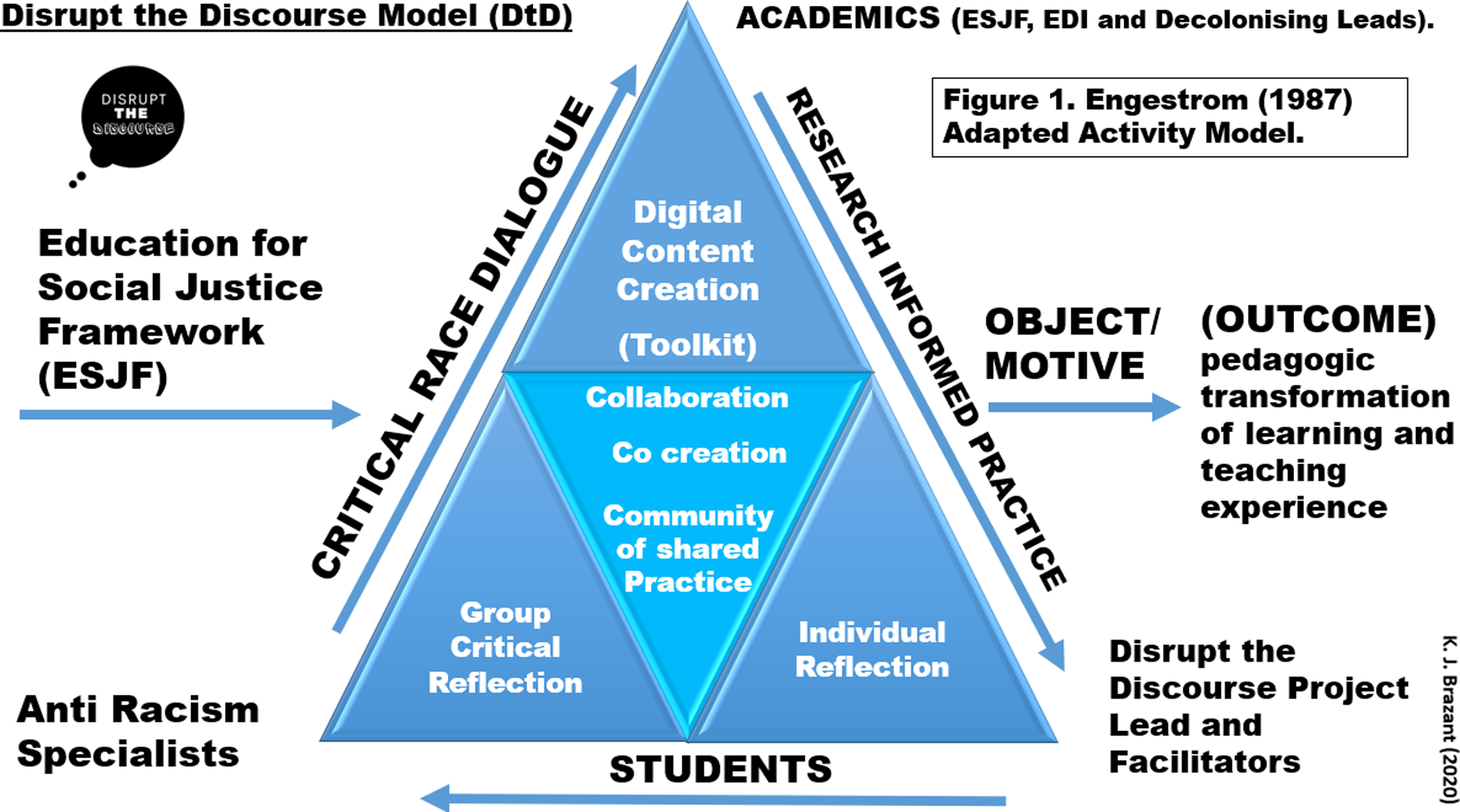
Conceptually, DtD provides a space of activity for academics to familiarise themselves with and practice the application of critical theories and pedagogies whilst processing what this will mean for their practice and immediate curriculum development. To scaffold this process, content and resources created in the form of a digital toolkit were produced. Further supporting activities have included exploration of associated themes through workshop sessions. These sessions acted as a process by which to ‘decode’ and ‘codify’ teaching and learning practice as part of the learning culture of the host institution. Facilitated and mediated by the project lead whilst collaborating with internal and external visiting professors and academics specialising in critical race theory.
Main aims and objectives of the Disrupt the Discourse (DtD) project
• To develop introspection, critical reflection and boost staff confidence in navigating themes of race, ethnicity, privilege and inequality as part of learning and teaching practice. • To develop an ecosystem of pedagogic activity that helps to bolster anti-racist pedagogies in partnership as part of teaching and learning practice. • To form a Community of Practice (CoP) of academic colleagues, staff, and institutional partners interested in developing and sharing practice across the School and eventually the institution in ways that considers the positionality and intersections of student and staff identity as part learning and teaching.
These aims tie into the broader institutional ambition: • to enhance the external profile of the University as a catalyst for transforming education through Social Justice but also; • to act as a driver for knowledge transfer in educational research/practice and foresee further collaborations and promote partnerships with HEIs in the sector and with ideologically aligned organisations.
Distinct and unique features of the project
• A co creation and collaborative approach to creating anti-racist digital content, learning materials and case studies in the form of a toolkit. • Amplifying authentic voices of professionals, researchers and academics with lived experience or allyship. • To not just explore the ‘content’ of CRT and Intersectionality as learners but to also engage in ‘praxis.’ • An innovative approach to manifesting transformative education for social justice. • Creating space to talk about race.’ - Encouraging lecturers and academic staff to reflect on positionality as part of their practice, including trauma, and white fragility.
Methods
Given the complexity and nuances of the knowledge created and exchanged through the lens of critical theory, this project uses a qualitative research approach (Denzin and Lincoln 1998). The methodology as part of this research is aligned with Freirean education that is dialogic and dialectical.
For example, constructions of race, and difference are important to highlight here, given the context of the DtD project and issues being explored. The broad tenets of social constructionism plays an important role in decoding the multiple truths to potentially emerge from interactions between staff, students and course material. This project and other associated learning and teaching initiatives have emerged as a result of the degree awarding gap with various interpretations as to why it exists (see studies Campbell, 2022 and Mountford-Zimdars et al., 2015). Some have taken different approaches such as a deficit view of BAME (Black Asian and Minority Ethnic) students failing to make the grade due to indicators of deprivation and academic ability that impacts overall attainment. However, social constructionism encourages us to take a ‘critical stance on the often taken for granted production of knowledge that it is not objective, or unbiased’ (Burr, 1995: 13). Therefore, preparing academics for reflection and reflection in action as part of dialogue and the experiential learning process will be important (Coulson and Harvey, 2013). The world contains multiple truths that co-exist, the view held here by the research and project lead is that the BAME degree awarding gap implies the issue of structural inequality and institutional racism is a significant factor within the academy (Campbell, 2022).
These challenges around ethics, confidentiality issues and the potential dissonance experienced aligns with Phenomenography. This is what (Zuber-Skeritt, 2004) refers to as being in the world and the reality of the context in which the research is taking place, this has a particular focus on the ‘thoughts, feelings, experiences and interactions’ of all subjects involved in the research (Zuber-Skeritt, 2004). This ultimately enables the researcher to track and capture the experiences of people between people within a given context and time period. Phenomenography in various studies has been presented as a research method that qualitatively analyses human behaviour by capturing the different ways in which people experience, conceptualise and understand various phenomenon around them (Marton 1994; Saijo, 1994).
In preparation for the project a substantive literature review was compiled. The project, produced a conceptual framework using Engestrom’s (1987) activity model for facilitating dialogic teaching as part of critical questioning and interrogation of academic ideas, beliefs and assumptions when considering unfair and unequal outcomes for students. This forms the epistemological basis of the project’s research enquiry.
The intention and development of this project is to locate it as ‘the practice of freedom’ (Hooks, 2003) in opposition to structural inequality and unfair outcomes, this has philosophical roots in ‘Praxis’ and social justice (Freire, 1970). Smith (2011) outlines the characteristics of praxis described as a ‘moral disposition to act rightly and truthfully and with a regard and concern for human well-being’ (Smith, 2011). Smith goes onto to describe further that “it is the process by which a theory, lesson, or skill is enacted, embodied, or realised. “Praxis” may also refer to the act of engaging, applying, exercising, realising, or practising ideas” (Smith, 2011).
In developing this idea further, praxis also comes with it levels of criticality of the world as informed by critical education studies and similar disciplines. According to Belton et al. (2011) praxis is the underlying ‘critical analysis of a live project or phenomenon aided by critical reflection as informed by theoretical ideas’. The intention through this project was to also model a critical disposition through the delivery of the course and digital content materials produced for lecturers. This is intended so their learners can experience critical pedagogy as an engagement with learning that is ‘creative, other seeking and dialogic.’ (Freire, 1970; Smith, 2011).
The proposed curriculum design could be understood under the auspices of an education for social justice. An education aligned to and cognisant of philosophies in critical theory, dialogic, dialectic traditions. Praxis shapes the philosophical approach to the development of the ‘Disrupt the Discourse’ project (DtD) as found in the following notable studies (Alexander, 2008; Altorf, 2016; Engin, 2017; Hajhosseiny, 2012). The project content reflects the challenges in learning and teaching as a result of power differentials and the colonial legacies that students and indeed staff bring with them as part of learning and teaching dynamics. These connections and themes are made explicit as part of the curriculum content. What follows are the core theoretical principles that underpin the project, the building blocks of dialogic teaching as interpreted as the ‘critical dialogue’ theorised by (Freire, 1970).
Principle 1
Teaching and learning should be disruptive to traditional forms of teaching. In short, this means challenging any teaching that is seen to be transactional and monologic in discourse with a view to decentering power from the lecturer as noted in the following studies (Bakhtin, 1981, 1986, 1999; Shor and Freire, 1987; Smith 2011; Stewart and McClure, 2013; Nesari, 2015). These studies reveal a pedagogical approach that is cognisant of the need to redistribute power, power in this instance is the normative view of knowledge production. There is an assumption that students are held in a deficit in the minds of their lecturers, sometimes manifested as what Freire (1970) referred to as ‘Banking Education’, the view that learners become educated by an all knowing and more knowledgeable other, where knowledge is transmitted from lecturer to student. Critical Race Theory (CRT), as a starting point, expands our understanding by calling us to decenter whiteness in a bid to understand the experiences of marginalised BAME student voices as part of a counter narrative and this invites critique of knowledge creation, especially if it subjugates and excludes (Bowleg, 2021).
Freire’s (1970) work to help enlighten and emancipate the poor people of Latin America has salience with the plight of students from non-traditional backgrounds and the ‘culture of silence.’ Silence, in this context are the marginalised voices that become enslaved, subservient and submissive to the dominant culture of its time (Vittoria, 2018). This is aligned with more recent studies that have explored ‘silence in academic talk’ (Engin, 2017) or the notion of ‘ideas dying’ in the classroom (the ideas of non-English speakers that were never brought into the classroom because of colonial legacies) (Marjonovic-shane et al., 2019). These studies in particular make us more aware of the dangers of silenced marginalised voices and establishes the need for Freirean approaches that encourages teacher’s authority to be shared with students. This can be practically applied by adopting creative approaches to ‘exploratory talk’ as part of smaller class discussion as well as mediated dialogue between learners and teacher supporting the development of the ‘dialogic self’ (Giroux, 2007; Trahar, 2011; Nesari, 2015).
Principle 2
Teaching should facilitate creativity within a conducive learning environment (Gilbert, 2017; Rogers and Freiberg, 1994; Smith, 2011). Recent studies and research from the field of learning development demonstrates an increasing interest into adopting and embracing creative approaches that is responsive to the needs of a student cohort and ultimately being present to where students are at in relation to their learning. Notable studies include the embracing and evidencing of dialogic work and creation of ‘third space’ partnerships in learning development such as (Abegglen et al., 2019a; Abegglen et al., 2019b; Burns et al. 2019) where the possibility of lived experiences and collaborations open doors to personal interpretation of learning and the co construction of knowledge and ideas has become manifold as part of learning development practice. These spaces for collaboration become more accessible when considering recent works of compassion (Gilbert 2017).
It is argued here, that a compassionate pedagogy within a supportive learning environment will enable and encourage critical thought and dialogue. The most recent studies of ‘compassion in higher education encourages students to become more alert and tend to the distress of others as part of group work and inclusive assessment approaches (Hill et al., 2022; Gilbert, 2017). The findings are encouraging, as students are assessed and develop cognitive skills in compassion that can be applied beyond the boundaries of the academy. Inclusive assessment approaches and ‘dialogic mediation’ where the lecturer makes a conscious effort with students to mediate their own interpretation of what they are learning, making way for a new body of knowledge and insights to add to that of their peers.
Principle 3
knowledge is co constructed, through experiential learning experiences; “We become ourselves through others” according to the works of Vygotsky (1967). The process of scaffolding students’ learning and knowledge is influential in the following studies (Alexander 2008; Gillies, 2016; Gravett and Henning, 1998; Harland, 2003). In this context, assessing where learners are at with regard to their knowledge of CRT, is key to what is known already and what they may struggle with independently.
Using the concept of scaffolding and the zone of proximal development (ZPD) to illustrate, reveals active learning, reflective learning and awareness of learning by applying this to their immediate practice. This not only increases the chance of academics engagement but gives it a sense of urgency and purpose (Stewart and McClure 2013). In essence, The DtD project intends to support the application of CRT and intersectionality through a process of scaffolding and the Zone of Proximal Development (ZPD). According to Coulson and Harvey (2013: 406) this process requires learners to engage in various phases of reflective learning; firstly, learning to reflect which includes introducing different models and digital content to encourage and prepare for reflection. Secondly, reflection for action which focuses on providing academics opportunities for reflection skills practice and peer formative feedback, thirdly, reflection in action that will give opportunities for academics to consider the implementation of their changes, regarding CRT and intersectionality in their respective curriculum areas as well as making sense of those learning experiences. Other activities include modelling, through the use of case studies, recorded vignettes/digital content, and live webinars as well as bridging and helping academics to make connections between materials and learning (Harland, 2003).
Navigating trauma, insensitivity and white fragility
However, as ambitious as this project is, it is not without its tensions, given the sensitivity of the topics explored. The content and themes explored has proved triggering for colleagues having had lived experiences of discrimination, oppression and structural inequality. As part of this project a ‘Research Ethics Form’ was submitted for approval and a ‘Research Project Consent Form’ was shared with participants on the project. In part, some colleagues who identified with relevant critical theory strands as part of their lived experiences were engaging in such a discourse for the first time in their professional careers, although in some instances this can be cathartic, it can also be problematic for some colleagues reliving their trauma. According to the seminal works of Scott (1990) oppressed, subordinated groups are often forced to engage publicly with their ‘hidden transcripts’ in a public forum or arena. These hidden transcripts are the authentic talks and feelings conducted by subordinate groups in referring to those in power (dominant) and very rarely come to light save for other forms of expression in a bid to dilute, in fear of causing offense to those in power (Scott, 1990: 30). What then exists is a ‘public script’ developed by subordinate groups to effectively survive, maneuver and negotiate around dominant groups as part of damage control that is performative in action (Scott, 1990).
Those academics who may well have experienced oppression and discrimination are not the only ones affected. Triggering feelings of discomfort or cognitive dissonance associated with guilt when encountering notions of privilege from white colleagues is a two way street. In acknowledging this privilege and seeing oneself through a racialised lens can be a trigger of white fragility and even insensitivity that also needs to be given careful consideration (Diangelo, 2018: 7). Based on their lived experiences the pressing question for any initiative of this kind is how authentic will the engagement of academics be when exploring the themes? These ‘triggering’ conversations will need to be considered and tended to with a degree of sensitivity.
Introducing critical race theory (CRT) as a threshold concept
As part of the curriculum design and accompanying digital toolkit, the project adopts a ‘process driven model’ derived from ‘complexity theory’ that suggests that learning is nonlinear and complex without needing to prescribe intended learning outcomes and formal assessments (Knight, 2001). According to Knight (2001) a process approach questions what good learning experiences are and for this particular subject, choosing learning encounters that are compatible with the content material.’ Therefore, participants engaging in this project experienced an emphasis on learning activities and processes that supported transformative outcomes such as encouraging individual personal and professional reflection, whilst being encouraged to submit reflections and case studies based on practice, which supports social constructionist and dialogic approaches to learning (Knight, 2001: 375). Furthermore, vital talking points as part of the project’s interviews with academics who specialise in Critical Race Theory and intersectionality are important in confirming and advising on the best activities, and learning materials to support engagement with the overall content.
A process driven approach is useful for capturing what makes a good learning experience. However, Knight (2001) refers to the need for coherence of curricula by using a constructive aligned model of curriculum design cognisant of learning outcomes, assessments and activities are equally important. This entails setting clear intended learning outcomes and then developing ‘constructive’ opportunities for students to make sense of learning through lecturer/instructor scaffolded activities and assessment tasks (Biggs, 1999). However, critics argue that emphasising learning outcomes does make learning an overly bureaucratic process of tick boxing and Bartholomew and Curran (2018) have developed a student centric model that can still maintain congruence and achieve alignment without the bureaucracy.
This informs the approach to this particular project using a ‘student centric’ aspect of curriculum course design that has an emphasis on the ‘intended evidence for achievement’, this could be experienced as the ingredients of what good learning looks like (Bartholomew and Curran, 2018). This means making explicit the intended evidence required to demonstrate that students understand and that learning is taking place. Therefore, this means also designing the best ways to measure this evidence and how to facilitate student learning putting in feed forward opportunities to help students achieve this evidence, then formulating the intended outcome statements afterwards (Bartholomew and Curran, 2018). This is a process that equally contains both a ‘process driven’ approach as well as holding congruence of the overall curricula. According to Land et al. (2005: 53–54) “A threshold concept represents a transformed way of understanding, or interpreting, or viewing something without which the learner cannot progress…. (They) bind a subject together, being fundamental to ways of thinking and practicing in that discipline”
Exploring CRT as a threshold concept using the DtD digital toolkit acts as an initial introductory step in understanding key concepts (Cousin, 2010). As part of the exploration of the DtD toolkit these ‘threshold concepts’ consisted of explainer videos, vignettes, creative case studies and digital content accompanied by recommended learning, blogs and reading materials. A full list of categories was created to house these materials on the web platform. To consolidate these concepts, discussions with academics and visiting professors acted as a space to discuss, explore and reflect on the material and their learning. This allows for a revisiting of these concepts and ideas at a deeper level, providing that material is presented as such to pique the interests of academics and their motivations as part of learning discovery. A ‘spiral curriculum’ supports the self-led construction and meaning of learning (Bruner, 1960) and therefore, deepens the understanding of these concepts through individual reflection aided with resources. The workshop series, also aided this process where social construction, peer led activities and exchanges enable meaning, through shared lived experiences (Vygotsky, 1962).
Workshop delivery approach and implementation
Initially, the DtD online toolkit had been conceptualised and co-created with the support of academics and researchers highlighting ‘lived experiences’ and trialled by a group of staff members and students. During this developmental stage, feedback had been obtained which focussed on the design, layout and the subject content within the resource. This process helped to shape and improve user-friendliness of the toolkit and informed the subsequent workshop sessions.
After conducting several planning meetings with the Head of School, Heads of Subject and the Project Lead in the School, three courses were identified. The pilot was based on the following factors: (1) courses identified with the largest degree awarding gap (APP), (2) student outcomes data and (3) Course cohort size. The participating staff group from these curriculum areas were made up of around 35 staff members delivering under graduate and some post graduate courses.
Session outline, participation and engagement
The project commenced with an online launch event followed by staff completing a pre-session survey to identify their hopes, wishes and perceived challenges in participating in the programme. Staff were then given access to the DtD digital toolkit. Following their engagement with the toolkit, academic colleagues were invited to attend five workshop sessions themed and organised around the following key topics: • Session (1): What does a compassionate pedagogy look like? • Session (2): How do we disrupt Hegemonic Whiteness? • Session (3): What is our academic and student experience? • Session (4): How do we apply Critical Race Theory in our classrooms? • Session (5): How can collaboration/co creation enhance our practice?
Quotations lifted from survey responses contrasting participants’ “hopes” and “challenges” of engaging with the project.
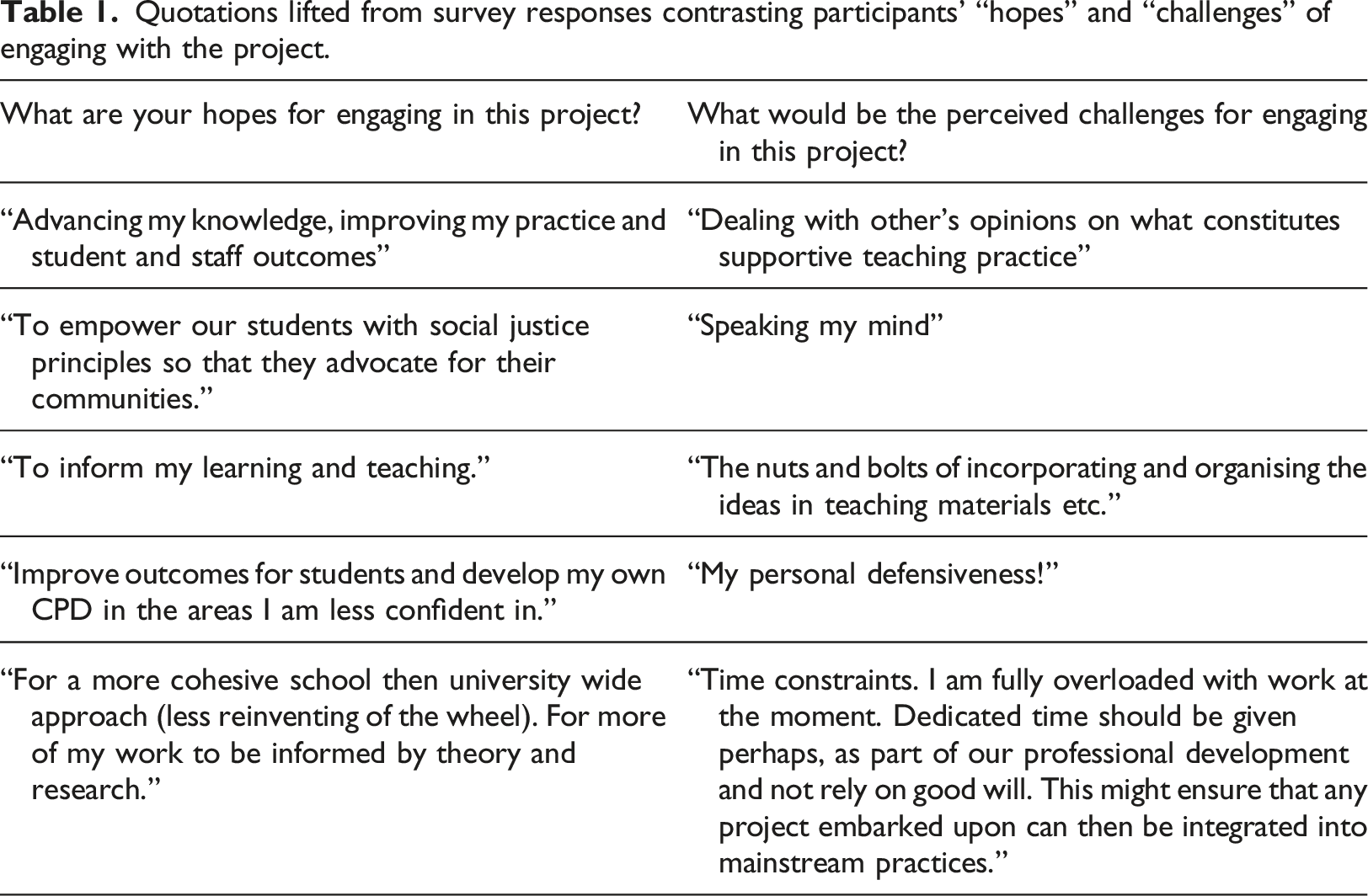
A survey was also used for capturing feedback from users of the toolkit and also conducted semi structured interviews with the co-authors, who contributed to creating the resource. The participants included students, Senior Lecturers and academic skills support staff across the institution
Project findings
There had been a sense that participants had been on a personal as well as professional journey of exploring learning and teaching through the lens of Critical Race Theory (CRT) and, with colleagues building trust and safety in the process with each other. When tackling difficult and more sensitive topics of exploring ‘whiteness’, white fragility’ and lived experiences of ‘trauma’ or ‘racial battle fatigue’ there were instances of colleagues appropriately correcting one another on use of language and certain terms. This is testimony to the compassionate sense of belonging fostered within the learning environment which enabled authentic sharing from participants (Gilbert, 2017). Staff who identified as white felt open and not attacked and equally those identifying as being from marginalised groups also felt able to share and be vulnerable. In fact, it was noted that some colleagues were seen in a different light as a result of the space and time afforded for engaging in this project. Below are some quotes taken from the anonymised survey: “This is ambitious/courageous in its three approaches: to state the case, kickstart action with real help, and then call out to the teaching and learning community to pool our resources for embedding critical theories right into the curriculum where they belong. Students can lead on this too if staff will let go of being the ONE who is responsible, and hold the door open for them to contribute to this natural evolution of education.” (Feedback from an Associate Professor who participated in DtD). “My favourite aspect of the toolkit is that it is comprised of different materials. It is very engaging using materials such as videos, podcasts, interviews etc. I think this is very different to anything I have seen which is mainly just text based, for someone who doesn't have the best concentration span this is very engaging. There are also some great examples used in how we can display information and ideas.” (Feedback from a senior Lecturer engaged in the project).
All staff appeared to appreciate the opportunity to develop ideas locally and across curriculum disciplines. Participants experienced a ‘safe-space’ although, this is a problematic term, as no space can ever truly be fully ‘safe,’ yet colleagues felt comfortable discussing contentious terms and language resulting in it proving beneficial by those who engaged with the project. Collated feedback suggests colleagues appreciated interactions with different course teams resulting in more diverse ideation for collaboration and cross-disciplinary projects.
A strong narrative that came out was that the academics, who co-authored this project, highlighted the importance of them also having had lived experiences of the issues being discussed. As part of postulating collaboration and co creation, future iterations of the project will have an emphasis on auto ethnographic methodology. This invites colleagues to personally reflect and creatively explore their personal experiences as part of a wider pedagogic process of transformation and innovation, which is a novel and appealing prospect (Adams and Ellis 2011).
This is particularly apt for black and minority ethnic staff who often sit within a myriad of themes that often mirrors the student experiences of inequality, progression, internalisation, and racist pedagogical practices of the academy (Arday, 2020; Back 2004). McKinney De Royston et al. (2020) refers to black educators enacting protective stances of black student learners. Where black educators who have once been learners or students have experienced racialised inequality, provide protective factors for their black students and colleagues by creating symbolically ‘safe’ environments where they feel ‘cared for’ ‘safe’ and at ‘home’ (McKinney De Royston et al., 2020, 23). This is an aspect of the project that black and minority ethnic staff embodied as part of a personal and professional endeavor, which brings with it a notable obligation of duty to protect those alienated from the academy. However, it carries the risk associated with acting as allies, advocates, co-conspirators in enacting political and culturally appropriate pedagogies with students (Mckinney De Royston et al., 2020: 29). This is a dynamic that needs to be further explored as part of initiatives that involve ‘Decolonising’ or advocates for ‘Equality, Diversity and Inclusion’, ‘race equity’ and the considerable burden this places on people of colour to facilitate and participate in such initiatives.
Conclusion
In conclusion, this paper recommends the need to support the role of ‘positionality’, for those leading, facilitating and participating in workshop sessions and initiatives focused on exploring themes of race and structural racism as part of learning and teaching practice. These considerations include being cognisant of hierarchy and authority within the academy, particularly with the participation of senior academics who may be seen to be entrenched in their own views, compounding the often conflicting forces of insensitivity, resistance and white fragility from potential allies. Furthermore, we must remain cognisant of the role of trauma and racial battle fatigue for marginalised staff of lived experience.
A concerted effort is needed to make provision for a transformative learning process that is supported and guided. Collaborations between staff and students should also be scaffolded with times and spaces given outside of the programme to encourage collaborations and share practice. As part of this project the workshop sessions worked as an initial starting point for colleagues to share ideas but recognised that this would need to be sustained beyond the Disrupt the Discourse (DtD) Initiative and be loosely monitored for the purposes of capturing changes in behaviour and to record innovative practice. For the future roll out of such an initiative, serious thought needs to be given on the framing of such an initiative. This project has highlighted that in order to tackle complex issues of differential degree award outcomes for home based BAME students, you require a radical and innovative approach. A whole institutional approach is needed where leadership can counteract potential resistance from staff with a need to achieve the authentic buy-in that drives the eventual participation, behavioural and organisational cultural change we all wish to see.
Footnotes
Declaration of conflicting interests
The author(s) declared no potential conflicts of interest with respect to the research, authorship, and/or publication of this article.
Funding
The author(s) received no financial support for the research, authorship, and/or publication of this article.
